Epoxy Blends
JYH-LUEN CHEN, HUI-MIN HUANG, MING-SHIU LI, FENG-CHIH CHANG Institute of Applied Chemistry, National Chiao-Tung University, Hsinchu, Taiwan
Received 3 March 1998; accepted 30 May 1998
ABSTRACT: Transesterification has been investigated in poly(-caprolactone) (PCL)– epoxy blends. In the hot melt process, the hydroxyl on diglycidyl ether of bisphenol-A (DGEBA) monomers is too low to give a noticeable transesterification reaction. In the postcure process, model reactions reveal that the hydroxyls from a ring-opening reac-tion are able to react with the esters of PCL. In the meantime, the PCL molecular weight decrease and its distribution becomes broader. Nuclear magnetic resonance spectra reveal that fraction of the tertiary hydroxyls converts to secondary hydroxyls. In the cured DGEBA–3,3⬘-dimethylmethylene-di(cyclohexylamine)–PCL blend, a ho-mogeneous morphology is achieved. PCL segments are grafted onto the epoxy network after postcuring and result in the lower Tg observed in the differential scanning
calorimetry thermogram. A higher transesterification extent also results in broader transition peaks by dynamic mechanical analysis.© 1999 John Wiley & Sons, Inc. J Appl Polym Sci 71: 75– 82, 1999
Key words: epoxy; poly(-caprolactone); transesterification
INTRODUCTION
Transesterification between polymers have been often used to prepare multiblock copolymers in a rather uncontrolled way.1 Interchange reactions can take place between ester and hydroxyl groups in the presence of a catalyst or at a high temper-ature.2,3In the phenoxy-polyester blends, the ex-tent of such interchange reactions can be con-trolled by the processing temperature and time.4,5 After a prolonged interchange reaction, an immis-cible binary blend eventually becomes a uniform random-copolymer structure.
Several polyester– epoxy blends have been studied previously. A high dissolving tempera-ture of some crystalline polyesters, such as liquid
crystalline polymers (LCP),6 –12inhibits the use of
hot melt process in dissolving these crystalline polyesters into epoxy monomers. Poly(butylene terephthalate) (PBT) has been incorporated into epoxy networks by either a hot melt or a solution process.13–19Cured PBT– epoxy products with ho-mogeneous and heterogeneous morphologies have been reported.18,19 However, the
transesterifica-tion between hydroxyl groups from the ring-opened epoxy and the ester groups on PBT at a high temperature of melt dissolving process and at high curing temperatures has virtually been ignored. Our previous studies20 –25on polycarbon-ate (PC)– epoxy blends cured with various curing agents revealed that transesterification indeed occurred in these systems. PCL is able to act as a polymeric plasticizer for many polymers.26 The
hydrogen bonding between the network hydroxyls and the ester of PCL results in a homogeneous epoxy–poly(-caprolactone) (PCL) blend cured by an amine at a temperature above the PCL melt-ing temperature.27 Alternatively, a
heteroge-Correspondence to: F.-C. Chang.
Contract grant sponsor: National Science Council, Taiwan, R.O.C.; contract grant number: NSC 87-2216-E-009-007.
Journal of Applied Polymer Science, Vol. 71, 75– 82 (1999)
© 1999 John Wiley & Sons, Inc. CCC 0021-8995/99/010075-08
neous morphology was obtained when the same epoxy–PCL blend was cured by an anhydride. An epoxy resin containing hydroxyl groups was mod-ified by the ring-opening polymerization of the -caprolactone onto the hydroxyl groups.28,29The
modified epoxy resin was further combined with anhydride or amine to give a curable composition. Both the modified resin and the compositions are useful in coating.
Since PCL has a relatively lower melting tem-perature (63°C), it can be dissolved in most epoxy monomers easily. During the hot melt process at 150°C, the possible transesterification between the hydroxyl groups from the epoxy monomer and the ester groups from the PCL has been investi-gated in this study. Monofunctional epoxy is uti-lized to model the reactions involved in this sys-tem. The effects of transesterification on thermal properties of the cured products are also exam-ined.
EXPERIMENTAL Materials
The epoxy monomer, DER 332, purchased from the Dow Chemical Company, is a low-molecular-weight liquid diglycidyl ether of bisphenol-A (DGEBA) with a epoxide equivalent weight of 172–176. PCL used in this study is TONE® Poly-mer P-787 purchased from the Union Carbide Corporation with an Mn equal to 80,000. The aliphatic amine used as a hardener is the 3, 3⬘-dimethylmethylene-di(cyclohexylamine) (C-260) from the BASF. Monofunctional epoxy, phenyl glycidyl ether (PGE), was purchased from the To-kyo Chemical Industry Co. The chemical struc-tures of epoxy, PCL, C-260, and PGE are illus-trated as follows:
Blending Procedures
The homogeneous mixture of PCL– epoxy equal to 30/70 % by weight was firstly prepared by a hot
melt process at 150°C under nitrogen gas for 1 h. After cooling to 100°C, a calculated amount of additional epoxy resin and hardener were added to bring the mixture to the desired composition. The mixture was then cast immediately into steel molds for primary curing in an oven for 2 h at 100°C. These products were postcured at 150, 175, or 200°C for 5 additional hours, respectively. For model reaction, mixtures of PGE–C-260 –PCL equal to 60/24/12 % by weight and 60/24/1200 % by weight were prepared by the same procedure.
Characterizations
0.5% by weight solution of the PGE–C-260 –PCL blend was prepared in tetrahydrofuran (THF) and analyzed by gel permeation chromatography (GPC) at a 40°C column temperature and a 1.0 mL/min flowing rate. Characterization by Fourier transform infrared spectroscopy (FTIR) was per-formed on a Nicolet 520 spectrometer in the transmission mode with a resolution of 4 cm⫺1. Samples were pasted onto salt disks and mounted on a temperature-controlled disk holder of the FTIR instrument. FTIR spectra were taken after heating the sample at desired temperature and time. Nuclear magnetic resonance (NMR) analy-sis was measured with a Bruker-DRX 300 NMR spectrometer. The PGE–C-260 –PCL equal to 60/ 24/12 % by weight blend diluted by deuterated chloroform (CDCl3) was used to observe the 1
H-NMR spectra. The glass transition temperature (Tg) of the cured blend was determined by differ-ential scanning calorimetry (DSC) using a heat-ing rate of 10°C/min in the dynamic scan. Dy-namic mechanical analysis (DMA) of the cured sample was performed on a TA Instruments DMA 983 using a heating rate of 5°C/min. A Hitachi model S-570 scanning electronic microscope (SEM) was employed to examine the morphology of the fracture surface.
RESULTS AND DISCUSSIONS Blending Process
Dissolving PCL in the DER 332 epoxy resin by a high-temperature (150°C), hot melt method re-sulted in a homogeneous and viscous solution. After cooling to room temperature, the PCL crys-tallized from the solution, and the whole mixture became a white solid mass. By comparing the GPC, retention times of the pure PCL and the
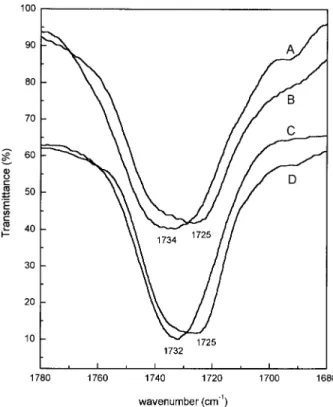
PCL–DER 332 equal to a 30/70 mixture (Fig. 1), the retention time of the PCL component in the PCL–DER 332 blend is identical to the pure PCL. That means that the molecular weight of PCL does not change during the hot melt process. Curve (A) of Figure 2 shows the carbonyl absorp-tion (1734 cm⫺1) of the neat PCL at 100°C. Curve
(B) gives the spectrum at room temperature when most of the PCL is crystallized, and the absorp-tion at 1725 cm⫺1 corresponds to the oriented carbonyl in crystal lattice. Curves (C) and (D) in Figure 2 display the absorptions of PCL–DER 332 blend at 100°C and room temperature, respec-tively, giving the same trend as the pure PCL, except for reduced band widths. PCL in the PCL– DER 332 solution has a higher mobility to orien-tate itself to a more ordered sorien-tate and results in
Figure 1 GPC chromatograms of (A) neat PCL and (B) PCL–DER 332 equal to a 30/70 mixture.
Figure 2 The carbonyl stretching absorption in the FTIR spectra of (A) neat PCL at 100°C, (B) neat PCL at 25°C, (C) PCL–DER 332 equal to 30/70 at 100°C, and (D) PCL–DER 332 equal to 30/70 at 25°C.
Figure 3 GPC chromatograms of PGE–C-260 –PCL equal to the 60/24/1200 blend: (A) 100°C for 2 h, (B) 100°C for 2 h, then 200°C for 2 h, and (C) 100°C for 2 h, then 200°C for 5 h.
Figure 4 PCL absorptions in GPC chromatograms of (A) neat PCL, (B) PGE–C-260 –PCL equal to 60/24/12 after postcuring at 150°C for 5 h, (C) PGE–C-260 –PCL equal to 60/24/12 after postcuring at 175°C for 5 h, and (D) PGE–C-260 –PCL equal to 60/24/12 after postcur-ing at 200°C for 5 h.
narrow band widths of the absorption peaks. Therefore, only physical interaction is involved in this system, and no chemical reaction occurs in the hot melting process.
Model Reactions
Figure 3 illustrates the GPC chromatograms of the PGE–C-260 –PCL equal to a 60/24/1200 mix-ture that was initially cured at 100°C for 2 h and then at 200°C for an additional 2 and 5 h. When this PGE–C-260 –PCL mixture is heated at 100°C for 2 h [Fig. 3, curve (A)], the retention time of the
PCL peak remains unchanged at 20 min. The peak at 25 min retention time corresponds to the product from the PGE–C-260 (equal equivalent ratio) mixture after a ring-opening reaction.
Residual of the unreacted reactants are still present in this product at a 30-min retention
Figure 5 1H-NMR spectra of PGE–C-260 –PCL equal to 60/24/12 postcured at (A)
time. PGE and C-260 cannot be distinguished by this GPC chromatography. The quantity of the unreacted reactants and this ring-opening prod-uct decrease gradually during the postcure pro-cess [Fig. 3, curves (B) and (C)]. Meanwhile, the PCL peak shifts to higher retention time (reduced PCL molecular weight). After heating at 200°C for 5 h, only a very small amount this ring-open-ing product is left while the PCL peak shifts to an even higher retention time. This observation im-plicates that the molecular weight of PCL is re-duced during postcuring in addition to the above reaction.
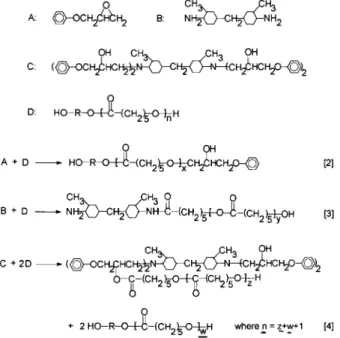
Figure 4 illustrates the GPC chromatograms of this PGE–C-260 –PCL equal to a 60/24/12 mix-ture after postcuring at 150, 175, and 200°C for 5 h, respectively. The stoichiometric ratio of this mixture is equal to that of DER 332–C-260 –PCL equal to 64/24/12. Compared to the peak of the neat PCL [Fig. 4(A)], the PCL molecular weight distribution shifts to a longer retention time with the increase of postcuring temperature [curves (B) to (D)]. This phenomenon implicates that the PCL molecular weight is reduced and the distri-bution is broadened. Data from Figures 3 and 4 indicate that at a high temperature, the unre-acted epoxy and amine may react with PCL as equations (2) and (3). Meanwhile, transesterifica-tion of these ring-opened epoxy–amine oligomers scissor PCL chains during postcuring, as shown in equation (4). Copolymers composed of PCL seg-ment, PGE, and C-260 hardener are formed dur-ing postcurdur-ing. The possible reactions involved are shown as follows:
In equation (4), there are 4 tertiary hydroxyls on (C) and 1 secondary hydroxyl chain end on (D) (PCL) (excludingOROOH) as the potential sites for transesterification. After transesterification, a fraction of tertiary hydroxyls convert to the sec-ondary hydroxyls on the scissored PCL chain end. Hence, the transesterification leads to the in-crease of the secondary hydroxyls and the de-crease of the tertiary hydroxyls. In1H-NMR spec-tra, the broad peak centering at␦3.34 represents the mixture containing the tertiary and the sec-ondary hydroxyls postcured at 150°C [Fig. 5(A)]. A higher postcuring temperature (200°C) leads to the greater transesterification extent; thus, the quantity ratio of the tertiary to secondary hy-droxyls decreases. This variation results in the broad peak of the hydroxyls shifting to␦3.54 [Fig. 5(B)], which is consistent with the proposed mechanism.
The Cured Epoxy–PCL Blends
Figure 6 shows FTIR spectra in the carbonyl stretching range of the DER 332–C-260 –PCL equal to 64/24/12 blend before and after postcur-ing at different temperatures. The shoulder at a lower wave number than 1734 cm⫺1 increases with the increase of the postcure temperature. Additional fraction of the hydroxyls of the opened epoxy network is consumed during this transes-terification reaction, and another carbonyl with different substituents from the original PCL is
Figure 6 The carbonyl stretching absorption in FTIR spectra of the DER 332–C-260 –PCL equal to 64/24/12: (A) 100°C for 2 h, primary curing; (B) 100°C for 2 h then 150°C for 5 h postcuring; (C) 100°C for 2 h, then 175°C for 5 h postcuring; (D) 100°C for 2 h, then 200°C for 5 h postcuring.
produced. A portion of these original ester groups from the PCL linking to the methylene is con-verted to that linking to the methine. The meth-ine is able to stabilize the carbonyl more effec-tively than the methylene; therefore, the stretch-ing energy of CAO double bond reduction induced by the methine is more significant than that by the methylene. The growth of the shoulder at a lower wave number implicates more ester linking to the methine. A higher heating temperature leads to a higher extent of the transesterification, thus, a higher fraction of the ester connecting to the methine of the epoxy network.
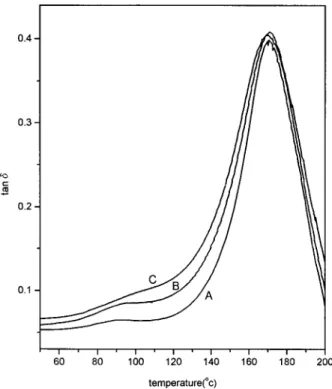
SEM micrographs in Figure 7 display that DER 332–C-260 –PCL equal to the 64/24/12 blend remain homogeneous after postcuring at different temperatures. The results observed in model re-actions can be applied to these DER 332–C-260 – PCL blends. DMA spectra (Fig. 8) indicate that a higher transesterification extent from a higher postcure temperature leads to a broader ␣-tran-sition peak. Curve (A) displays an evident ␣-tran-sition at about 170°C and a smaller-transition peak at 90°C. From curve (A) (150°C) to curve (C) (200°C), this small -transition peak gradually shifts to a higher temperature and eventually Figure 7 SEM micrographs taken on the fracture
surfaces of DER 332–C-260 –PCL equal to 64/24/12 postcured at (A) 150°C or (B) 175°C or (C) 200°C for 5 h.
Figure 8 DMA spectra of DER 332–C-260 –PCL equal to 64/24/12 postcured at (A) 150°C, or (B) 175°C or (C) 200°C for 5 h.
combines with the main ␣-transition peak at curve (C). Transesterification results in a uniform chemical structure composed of the PCL and the PCL-containing epoxy network. The softer parts (PCL segments) reduce the initiating tempera-ture of relaxation. Hence, a broader tan␦ peak is observed in the specimens of higher transesteri-fication extent.
Table I lists the glassy transition temperatures (Tgs) of various DER 332–C-260 –PCL composi-tions and postcure temperatures. For the pure epoxy (PCL equal to 0% by weight), the higher postcuring temperature results in higher conver-sion and a higher Tg, as would be expected. At a relatively lower postcuring temperature (150°C), Tgreduction with the increase of PCL content is less substantial (from 172.1 to 155.6°C). At higher postcuring temperatures (175 and 200°C), Tg re-ductions are more drastic (178.3 to 146.0°C and 182.2 to 141.3°C). This can be interpreted as more soft PCL segments linking to the rigid epoxy net-work at higher postcuring temperature and, thus, results in lower Tg.
CONCLUSIONS
Homogeneous DER 332–C-260 –PCL blends are obtained after initial curing at 100°C and post-curing at higher temperatures. Model reactions using monofunctional epoxy provide the evidence that transesterification reaction indeed occurs during the postcuring step. This result can be applied to the cured epoxies. After transesterifi-cation, PCL chains are scissored into segments and grafted onto the epoxy network. These
grafted PCL segments influence the thermal properties of the epoxy network more signifi-cantly than by the semi-IPN structure. The broader glass transition behavior observed corre-sponds to the PCL graft–network structure. This research is financially supported by the National Science Council, Taiwan, R.O.C., under contract No. NSC 87-2216-E-009-007. The authors thank Epolab Chemical Co. for materials donation.
REFERENCES
1. Noshay, A.; McGrath, J. E. Block Copolymers; Ac-ademic Press: New York, 1977.
2. Mahajan, S. S.; Idage, B. B.; Chavan, N. N.; Si-varam, S. J Appl Polym Sci 1996, 61, 2297. 3. Wang, C. S.; Sun, Y. M. J Polym Sci, Part A: Polym
Chem 1994, 32, 1295.
4. Mondragon, I.; Gaztelamendi, M.; Nazabal, J. Polym Eng Sci 1988, 29, 1126.
5. Mondragon, I.; Remiro, P. M.; Nazabal, J. Eur Polym J 1987, 32, 125.
6. Mallon, J. J.; Adams, P. M. J Polym Sci, Part A: Polym Chem 1993, 31, 2249.
7. Barclay, G. G.; Ober, C. K.; Papathomas, K. I.; Wang, D. W. J Polym Sci, Part A: Polym Chem 1992, 30, 1831.
8. Barclay, G. G.; McNamee, S. G.; Ober, C. K.; Pa-pathomas, K. I.; Wang, D. W. J Polym Sci, Part A: Polym Chem 1992, 30, 1845.
9. Chien, L. C.; Lin, C.; Fredley, D. S.; McCargar, J. W. Macromolecules 1992, 25, 133.
10. Carfagna, C.; Amendola, F.; Giamberini, M. J Ma-ter Sci Lett 1994, 13, 126.
11. Carfagna, C.; Amendola, E.; Giamberini, M. Mac-romol Chem Phys 1994, 195, 2719.
12. Szczepaniak, B.; Frisch, K. C.; Penczek, P.; Leszc-zynska, I.; Cholinska, M.; Rudnik, E. J Polym Sci, Part A: Polym Chem 1995, 33, 1275.
13. Nichols, M. E.; Robertson, R. E. J Polym Sci, Part B: Polym Phys 1994, 32, 573.
14. Nichols, M. E.; Robertson, R. E. J Polym Sci, Part B: Polym Phys, 1994, 32, 1607.
15. Kim, J. K.; Robertson, R. E. J Mater Sci 1992, 27, 161.
16. Kim, J. K.; Robertson, R. E. J Mater Sci 1992, 27, 3000.
17. Wang, X.; Li, Y.; Yu, Y. J Mater Sci 1997, 32, 111. 18. Oyanguren, P. A.; Frontini, P. M.; Williams, R. J. J.; Girard-Reydet, E.; Pascanlt, J. P. Polymer 1996, 37, 3079.
19. Oyanguren, P. A.; Frontini, P. M.; Williams, R. J. J.; Vigier, G.; Pascanlt, J. P. Polymer 1996, 37, 3087.
Table I Glass Transition Temperature (°C) of DER 332–C-260 –PCL Blends Postcured at 150, 175, or 200°C for 5 H Temperature PCL Content 0 Wt % 3 Wt % 6 Wt % 9 Wt % 12 Wt % 150°C postcured 172.1 168.8 165.7 162.2 155.6 175°C postcured 178.3 166.0 158.0 154.6 146.0 200°C postcured 182.2 164.1 154.3 152.2 141.3
20. Li, M. S.; Ma, C. C. M.; Chen, J. L.; Lin, M. L.; Chang, F. C. Macromolecules 1996, 29, 499. 21. Li, M. S.; Ma, C. C. M.; Lu, M. S.; Lin, M. L.; Chang,
F. C. J Polym Sci, Polym Chem Ed 1996, 34, 3303. 22. Li, M. S.; Ma, C. C. M.; Lin, M. L.; Lu, M. S.; Chen,
J. L.; Chang, F. C. Polymer 1997, 38, 845.
23. Li, M. S.; Ma, C. C. M.; Lu, M. S.; Lin, M. L.; Chen, J. L.; Chang, F. C. Polymer 1997, 38, 855.
24. Chen, J. L.; Lu, M. S.; Huang, H. M.; Chang, F. C. J Polym Res 1996, 3, 177.
25. Lin, M. L.; Chang, F. C.; Li, M. S.; Ma, C. C. M. J Polym Sci, Polym Phys Ed 1997, 35, 2183. 26. Paul, D. R.; Newman, S. Eds., in Polymer Blends,
Vol. 2; Academic Press: New York, 1978; Chapter 22.
27. Clark, J. N.; Daly, J. H.; Garton, A. J Appl Polym Sci 1984, 29, 3381.
28. Watanabe, S.; Inoue, K.; Okitsu, K. U.S. Pat. 4,521,570 1985.