Formation of optical vortex lattices in solid-state microchip lasers: Spontaneous transverse
mode locking
Y. F. Chen*
Department of Electrophysics, National Chiao Tung University, Hsinchu, Taiwan, Republic of China Y. P. Lan
Institute of Electro-Optical Engineering, National Chiao Tung University, Hsinchu, Taiwan, Republic of China 共Received 2 April 2001; published 14 November 2001兲
We experimentally investigate pattern formation in a solid-state microchip laser with a large Fresnel number. Controlling the reflectivity of the output coupler can generate the stable square pattern of optical vortex lattices. The formation of square vortex lattices is found to be a spontaneous process of transverse mode locking within almost-degenerated mode families. The frequency of self-induced oscillation in square vortex lattices agrees well with the numerical calculation. The chaotic relaxation oscillation is found in square vortex lattices due to the multi-longitudinal-mode operation.
DOI: 10.1103/PhysRevA.64.063807 PACS number共s兲: 42.60.⫺v, 42.65.⫺k, 42.50.⫺p
The study of pattern formation in laser systems has be-come one of the most active fields of research in recent years because there are some interesting similarities in behavior between optical and hydrodynamic systems 关1兴. Theoretical models used to describe lasers with a large Fresnel number were usually analyzed with partial differential equations de-rived from the Maxwell-Bloch equations关2–5兴. These mod-els predicted the formation of periodic structure such as square optical vortex lattices 共SVLs兲 关3,6兴 and of localized structures such as spatial soliton关7兴. Theoretical results also predicted that class-A lasers with a large Fresnel number emit stationary patterns of SVLs near the laser threshold关8兴. However, the dynamic characteristics of class-B lasers such as CO2or solid-state lasers are those of oscillations with an inertial nonlinearity. In the case of such oscillators the per-turbations exhibit oscillatory relaxation. Theoretical analysis puts in evidence the qualitative differences of transverse dy-namics for class-A and -B lasers with a large Fresnel number. Even so, not much has been done so far to observe the dif-ference.
Previous works carried out with CO2 lasers have shown evidence of spatiotemporal complexity关5,9兴 but the pattern dynamics near the laser threshold differed from those pre-dicted by the models. Experimental works in CO2lasers usu-ally used long cavities in which the longitudinal-mode spac-ing is of the same order of magnitude as the transverse-mode spacing. The presence of several longitudinal modes prob-ably constituted the main reason for the discrepancies be-tween theoretical predictions and experimental observations. The recent rapid progress of diode-pumped microchip la-sers has driven a renaissance of solid-state laser-physics re-search and led to novel phenomena关10兴. The diode-pumped microchip laser can be easily operated in single longitudinal mode more than the ten times above threshold before the second longitudinal mode reaches threshold because the mi-crochip gain medium has a short absorption depth that
re-duces the spatial hole burning effect. In this paper, we present the first experimental results of pattern formation in a fiber-coupled diode end-pumped microchip laser with a large Fresnel number. A fiber-coupled laser diode is used to main-tain the cylindrical symmetry in the laser cavity. It is found that pattern formation strongly depends on the reflectivity of the output coupler. When the output reflectivity is not high enough, the transverse-mode pattern near the pump threshold is usually a high-order Laguerre-Gaussian 共LG兲 TEM0,l mode with the distribution cos2l 共or sin2l兲 in azimuthal angle, having 2l nodes in azimuth. Slightly above the pump threshold, the laser emits a pair of transverse LG TEM0,l cosine and sine modes with chaotic dynamics. On the other hand, a high Fresnel number microchip laser can emit the pattern of the SVLs when the output reflectivity is high enough. Especially, the dynamics of the SVLs are not the results of multimode operation but exhibit single-frequency characteristics. The SVL pattern can be described as trans-verse mode locking within almost-degenerated mode fami-lies. It is also found that the SVL pattern may display chaotic relaxation oscillations through the onset of multi-longitudinal-mode operation.
The experimental cavity we use is analogous to the one described in Ref.关11兴. We set up the resonator length to be as short as possible for reaching a large Fresnel number. The total resonator length is ⬃2.0 mm. The output coupler is a concave mirror with the radius of curvature of 50 mm. In the present resonator, the frequency spacing between consecu-tive longitudinal modes is about 60 GHz, while the fre-quency difference between consecutive transverse modes is
⬃5 GHz. Since the longitudinal-mode spacing is greater by
one order of magnitude than the transverse-mode spacing, the present laser can be easily operated in single longitudinal mode to study the pattern formation. The pump source is a 1-W fiber-coupled laser diode 共Coherent, F-81-800C-100兲 with a 0.1 mm of core diameter. The Fresnel number for an end-pumped solid-state laser can be expressed as Fr
⫽p
2
/(L), wherepis the pump size, is the lasing
wave-length, and L is the resonator length. To have a high Fresnel *Corresponding author. FAX: 共886-35兲 729134; email address:
number, the pump size should be as large as possible. The pump size on the laser crystal can be easily adjusted by de-focusing the pump source. In the present experiment, the pump size was adjusted within 0.5–1.5 mm. The maximum pump size depends on the lasing threshold. Using
⫽1.064m and L⫽2 mm, the Fresnel number in the
ex-periment can be varied from 100 to 1000.
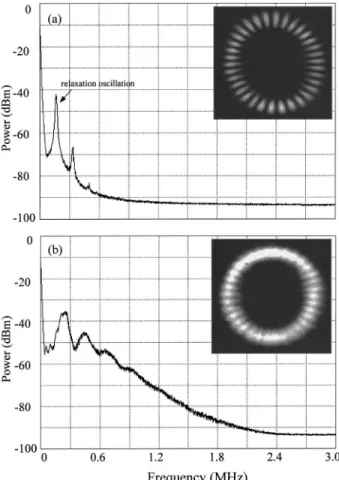
First we used an output coupler with the reflectivity of 97% in the laser resonator. Near lasing threshold, the laser emits a pure high-order LG TEM0,l mode with the distribu-tion cos2l共or sin2l兲 in azimuthal angle, having 2l nodes in azimuth. The laser oscillating on a single high-order LG mode comes from the fact that the pump profile is similar to a doughnut-type distribution. As shown in Fig. 1共a兲, the free-running single-transverse-mode class-B laser displays relax-ation oscillrelax-ations that play an important role in the dynamics of multitransverse-mode class-B lasers. Slightly above lasing threshold, the present laser usually emits a pair of transverse LG TEM0,lcosine and sine modes with chaotic dynamics, as shown in Fig. 1共b兲. The appearance of dynamic chaos is believed to arise from the interaction of the relaxation fre-quency and the astigmatism-induced frefre-quency difference between two similar LG TEM0,l modes. Even though the geometry is cylindrical symmetry, there is still certain astig-matism in the present cavity because of thermal lensing ef-fect and anisotropic properties of the gain medium.
Astigmatism-induced splitting of the two similar mode fre-quencies has a significant influence on laser dynamics. A nonlinear system of the Maxwell-Bloch equations 关12兴 was used to investigate the dynamics of two similar LG TEM0,l modes in a class-B laser. It is found that there is a chaotic set of solutions when the astigmatism-induced frequency differ-ence is close to the relaxation frequency. Note that the sys-tem of equations for the dynamics of a class-B laser operat-ing in two similar LG TEM0,lmodes is similar to the system describing generation of counterpropagating wave in a bidirectional-ring class-B laser, as discussed in Refs. 关13兴,
关14兴. Therefore, the condition for chaotic emission is also
predicted in a bidirectional-ring class-B laser 关13兴.
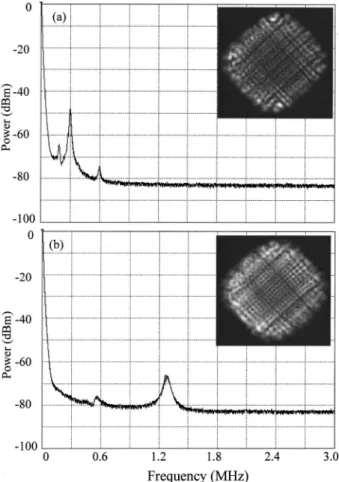
The patterns observed so far can be interpreted as the simultaneous excitation of two similar LG TEM0,l modes. This implies that the patterns were still linear because all their properties were determined by the boundary conditions, not by the nonlinearity of the gain medium. ‘‘Essentially nonlinear’’ pattern formation of lasers as it is predicted by the Maxwell-Bloch equations, requires not only a large Fresnel number of the resonator but also a continuum of transverse modes 关6,8兴. In order to excite a continuum of transverse modes simultaneously, we increased the reflectiv-ity of the output coupler to 99%. With an output coupler with the reflectivity of 99% we have observed a succession of spatially well-organized SVL patterns whose complexity in-creases with the Fresnel number. These SVL patterns, as shown in Fig. 2, are very different from the monomode struc-tures associated with Laguerre or Hermite-Gauss functions in an empty cavity. Surprisingly, the measurement of the optical spectrum indicated that the SVL pattern was a single-mode emission rather than a combination of lasing modes. In other words, the formation of SVL patterns can be interpreted as a spontaneous process of transverse mode locking of nearly degenerate modes, assisted by the laser nonlinearity. The nonlinearity is due to the dynamics of the saturation process. Although similar transverse locking in the generation of op-tical vortex crystals was demonstrated in broad-area VCSELs关15兴, optical systems so far have not generated such a large number of vortices in a single-mode emission. In addition, the present experiment provides the first observa-tion of the transiobserva-tion from the linear to the essentially non-linear pattern formation in a solid-state microchip laser. The highly regular crystal-like vortex patterns have also been demonstrated in CO2laser system关9兴. However, the pattern generated in CO2 laser system is a multiwavelength pattern not a coherent pattern. Therefore, the dynamics of the present SVL pattern is entirely different from that of the previous pattern found in CO2laser. Increasing the pumping power to the maximum pump power that is 5– 8 times above lasing threshold, depending on the Fresnel number, the present SVL patterns were always preserved. Moreover, the SVL patterns were also preserved in free-space propagation. The power spectrum was also measured to study the dy-namics of the SVL patterns. Figures 3共a兲 and 3共b兲 show, respectively, the results of the power spectrum just near and seven times above lasing threshold for the SVL pattern with Fr⬇500. The fact that the power spectrum is almost indepen-dent of the region of the laser mode detected confirms the
FIG. 1. Power-intensity spectra of laser emission for LG TEM0.17 mode: 共a兲 near lasing threshold, 共b兲 1.25 times above threshold. Beam profiles are shown in the insets.
present SVL pattern to be a nearly pure single-mode emis-sion. The temporal behavior was found to be similar to the dynamics of single transverse mode in class-B lasers except that there is an additional oscillation component with fre-quency lower than the relaxation frefre-quency. We believe that the additional oscillation mode can be interpreted as the ‘‘acoustic’’ oscillation mode. The theoretical analysis 关6兴 show that there are two pure vibrational modes of the self-induced dynamics of vortex lattices: 共1兲 ‘‘acoustic’’ oscilla-tion mode, where the neighboring vortices along a diagonal
oscillation in phase; 共2兲 ‘‘optical’’ oscillation mode, where the neighboring vortices along a diagonal oscillation in an-tiphase. The acoustic mode is the oscillation that only the transverse modes from the same degenerate family are in-volved, whereas the optical oscillation mode occurs when the transverse modes from two-different families are simulta-neously excited. Since the present SVL emanates from a high level of degeneracy of transverse-mode families, the self-induced oscillation should belong to the acoustic mode. The numerical calculation 关6兴 shows that the frequency of the acoustic oscillation is smaller by a factor of 2.8⫾0.1 than the relaxation oscillation frequency. As shown in Fig. 3, the ex-perimental result agrees very well with the theoretical pre-diction. The good agreement supports the affirmation that self-induced oscillation is the acoustic mode that resembles the oscillation of atoms in alkali-halide-type crystal when an acoustic phonon is excited.
The studies so far have been restricted to the dynamics of the SVL patterns belonging to a single longitudinal mode. To see the influence of multilongitudinal mode on the dynamics of the SVL patterns, we used an output coupler with the reflectivity of 99.8% in the resonator. The lasing threshold in the present case is less than 50 mW due to the low round-trip losses. The laser can be operated in multilongitudinal by in-creasing pump power more than ten times above threshold. Near lasing threshold, the SVL pattern and its power
spec-FIG. 2. Beam profiles of laser emission for SVL patterns, mea-sured with the CCD camera, for three-different Fresnel numbers.
FIG. 3. Power-intensity spectra of laser emission for SVL pat-tern: 共a兲 near lasing threshold, 共b兲 seven times above threshold. Beam profiles are shown in the insets.
trum is similar to the results shown in Fig. 3共a兲. When the pump power was increased to lead to multi-longitudinal-mode operation, chaotic relaxation oscillations were ob-served. As shown in Fig. 4, although the SVL pattern was nearly preserved in the multi-longitudinal-mode operation, the power-spectrum broadened. The broadening of the power spectrum indicates that the appearance of chaotic oscillations in free-running class-B lasers without external periodic per-turbations is of considerable interest. The two-frequency route to chaotic relaxation oscillations has been observed in a diode-pumped microchip laser with the TEM00mode output in two-longitudinal-mode oscillation regime 关16兴. The weak cross-gain coupling among two-longitudinal modes has been proposed to explain the relaxation oscillation instabilities. The instability of the SVL pattern in the multi-longitudinal-mode operation may originate from the same nonlinear gain mechanism.
Finally, it is worthwhile to mention that the mode profiles shown in Figs. 2– 4 are rather different from higher-order mode of Hermite-Gaussian 共HG兲 type in two dimensions. The distinctions can be found not only from the pattern pro-files but also from the dynamics. To show the differences, we generated a higher-order two-dimensional共2D兲 HG mode by using a top-hat pump profile and a cavity in which the output coupler is a concave mirror with the radius of curvature of 50 mm and the reflectivity of 97.5%. Figure 5共a兲 shows the transverse pattern and power-intensity spectrum for HG TEM5,4mode near lasing threshold. The difference between the mode pattern shown in Fig. 2 and the 2D HG mode shown in Fig. 5共a兲 can be distinctly found. Experimental results reveal that the single 2D HG mode pattern certainly
changes to a multimode pattern by slightly increasing the pump power, as shown in Fig. 5共b兲. Conversely, the transverse-mode-locking SVL patterns, as shown in Fig. 3, are insensitive to the pump power.
In summary, we demonstrated the generation of SVL pat-terns in solid-state microchip lasers with a large Fresnel number. The SVL pattern was found to emanate from a spon-taneous process of transverse mode locking of nearly degen-erate modes, assisted by the nonlinearity of gain medium. The dynamics of the SVL pattern agrees very well with the theoretical prediction. The ability to spontaneously generate optical vortex lattices in a microchip laser is both of a fun-damental interest and could have applications in a variety of areas such as dynamic optical storage and processing.
The authors thank the National Science Council of the Republic of China for financially supporting this research under Contract No. NSC-89-2112-M-009-059.
关1兴 M. C. Cross and P. C. Hohenberg, Rev. Mod. Phys. 65, 851 共1993兲.
关2兴 R. Lefever, L. A. Lugiato, W. Kaige, N. B. Abraham, and P.
Mandel, Phys. Lett. A 135, 354共1989兲.
关3兴 P. Coullet, L. Gil, and F. Rocca, Opt. Commun. 73, 403 共1989兲. 关4兴 G. L. Oppo, G. D’Alessandro, and W. J. Firth, Phys. Rev. A 44,
4712共1991兲.
关5兴 G. Huyet, C. M. Martinoni, J. R. Tredicce, and S. Rica, Phys.
FIG. 4. Power spectrum for the self-chaotic oscillations of SVL pattern in the multi-longitudinal-mode operation. Beam profiles are shown in the insets.
FIG. 5. Power-intensity spectra of laser emission for HG TEM5,4 mode: 共a兲 near lasing threshold, 共b兲 1.1 times above threshold. Beam profiles are shown in the insets.
Rev. Lett. 75, 4027共1995兲.
关6兴 K. Staliunas and C. O. Weiss, J. Opt. Soc. Am. B 12, 1142 共1995兲.
关7兴 M. Brambilla, L. A. Lugiato, F. Prati, L. Spinell, and W. J.
Firth, Phys. Rev. Lett. 79, 2042共1997兲.
关8兴 K. Staliunas and C. O. Weiss, Physica D 81, 79 共1995兲. 关9兴 D. Dangoisse, D. Hennequin, C. Lepers, E. Louvergneaux, and
P. Glorieux, Phys. Rev. A 46, 5955共1992兲.
关10兴 K. Otsuka, P. Mandel, and E. A. Viktorov, Phys. Rev. A 56,
3226共1997兲.
关11兴 Y. F. Chen, Y. P. Lan, and S. C. Wang, Appl. Phys. B: Lasers
Opt. 72, 167共2000兲.
关12兴 D. V. Skryabin, A. G. Vladimirov, and A. M. Radin, Quantum
Electron. 27, 892共1997兲.
关13兴 N. V. Kravtsov and E. G. Lariontsev, Quantum Electron. 24,
841共1994兲.
关14兴 A. G. Vladimirov, Opt. Commun. 149, 67 共1998兲. 关15兴 J. Scheuer and M. Orenstein, Science 285, 230 共1999兲. 关16兴 K. Otsuka, S. L. Hwong, and B. A. Nguyen, Phys. Rev. A 61,