Effects of Atenolol and Losartan on Baroreflex Sensitivity
and Heart Rate Variability in Uncomplicated
Essential Hypertension
Chang-Ming Chern, MD, MPH,* Hung-Yi Hsu, MD, PhD,† Han-Hwa Hu, MD,* Yen-Yu Chen, MD,*
Li-Chi Hsu, MD,* and A-Ching Chao, MD‡
Abstract: Baroreflex sensitivity (BRS) and heart rate variability (HRV) are potential therapeutic targets. The present study was con-ducted to assess changes in BRS and HRV after monotherapy with losartan versus that of atenolol in uncomplicated essential hyperten-sion. Thirty subjects with uncomplicated essential hypertension were randomized to receive atenolol 50 mg to 100 mg (n = 15) or losartan 50 mg to 100 mg (N = 15) daily for 6 months. Instantaneous systolic blood pressure (SBP) and heart rate were assessed using servo-controlled infrared finger plethysmography before treatment and at the end of 3 months and 6 months after treatment. The fluctuation in SBP and interpulse interval (IPI) was divided into three specific frequency ranges by fast Fourier transform as high frequency (HF; 0.15 Hz–0.4 Hz), low frequency (LF; 0.04 Hz–0.15 Hz), and very low frequency (VLF; 0.004 Hz–0.04 Hz). The BRS was expressed as (1) SBP-IPI transfer function with its magnitude in the HF and LF ranges and (2) BRS index alpha. The HRV was expressed as total power and power in the LF and HF ranges of interpulse interval. Blood pressure was reduced to a similar extent in both groups. Compared with the baseline, BRS did not improve in both groups at month 3. However, BRS was significantly improved in the losartan group (P , 0.05) but not in the atenolol group at month 6. In addition, BRS was significantly higher in the losartan group than the atenolol group at month 3 and month 6 (P , 0.05). Moreover, heart rate variability was significantly reduced in the atenolol group at month 6 (P , 0.05), but not in the losartan group. The HRV in the losartan group was significantly higher than that in the atenolol group at month 6 (P , 0.05). These findings suggest superior effects of losartan on BRS and HRV than atenolol in uncomplicated essential hypertension, which may be beyond blood pressure reduction/resetting.
Key Words: atenolol, baroreflex sensitivity, essential hypertension, heart rate variability, losartan
(J Cardiovasc PharmacolTM2006;47:169–174)
T
he cardiovascular benefits of blood pressure (BP) lowering in hypertensive patients have long been established. How-ever, further reduction in the incidence of coronary heart disease and stroke remains an important goal, and effects of antihypertensive agents beyond BP lowering have emerged as an important research topic. Dysregulation of the autonomic nervous system has been implicated in the pathogenesis of essential hypertension,1,2which can be reasonably and non-invasively approached with measurement of baroreflex sensi-tivity (BRS) and/or heart rate variability (HRV) in the frequency domain.3,4
Several large-scale population-based surveys5–11 have demonstrated the association between hypertension and reduced BRS and/or HRV, suggesting these markers as poten-tial therapeutic targets in antihypertensive treatment. This is particularly true given that reduced BRS and/or HRV are adverse prognostic factors in patients with heart disease such as myocardial infarction and congestive heart failure and in general population.12–15
Clinical studies regarding the effects of antihypertensive treatment on HRV and/or BRS in hyper-tensive patients have shown mixed results.16–34
These studies varied considerably in study design, including age and types of participants (eg, healthy subjects or hypertensive patients), severity of hypertension, class and dose of BP lowering agents, duration and route of antihypertensive therapy, and method-ology of measurement of HRV and BRS, making comparison of different antihypertensive agents, in terms of the effects on HRV and/or BRS, difficult. Therefore, prospectively designed interventional studies comparing different BP-lowering agents in hypertensive patients are required to address if there are differential effects on HRV and BRS. The Losartan Inter-vention For End Point Reduction in Hypertension (LIFE) study suggests that there are BP-independent effects of losartan-based therapy in cardiovascular risk reduction, compared with atenolol-based therapy.35
Therefore, we designed this study, with the purpose to evaluate whether BRS and/or HRV were affected to the same extent by monotherapy with losartan and atenolol in uncomplicated essential hypertension (UEH). The possible differential effects of losartan versus atenolol on cerebrovascular regulation will be reported in a separate article.
Received for publication June 22, 2005; accepted November 9, 2005. From the *Section of Cerebrovascular Disease, Neurological Institute, Taipei
Veterans General Hospital & National Yang-Ming University School of Medicine, Taipei, Taiwan; †Section of Neurology, Department of Internal Medicine, Taichung Veterans General Hospital, Taichung, Taiwan; and ‡Department of Neurology, Kaohsiung Medical University and Hospital, Kaohsiung, Taiwan, R.O.C.
This study was partially supported by a grant from Taipei Veterans General Hospital.
Reprints: A-Ching Chao, Department of Neurology, Kaohsiung Medical University Chung-Ho Memorial Hospital No.100, Shih-Chuan 1st Road, Kaohsiung, Taiwan, R.O.C. (e-mail: [email protected]).
METHODS
Study Population
In this study, we recruited 36 eligible subjects with UEH from the Outpatient Clinics of a tertiary referral hospital from June 2002 through July 2003. BP was measured on three or more clinic visits using a standard mercury sphygmomanom-eter. Subjects with secondary hypertension were excluded. All individuals were non-obese and nonsmokers. Subjects had provided a complete history and undergone physical and labo-ratory examinations before consideration of eligibility. The inclusion criteria for participation were (1) untreated essential hy-pertension with systolic BP between 140 mm Hg to 179 mm Hg and/or diastolic BP between 90 mm Hg to 100 mm Hg, (2) no diabetes mellitus, (3) absence of electrocardiogram (ECG) evidence of left ventricular hypertrophy (LVH) by Sokolow-Lyon and/or Cornell Voltage criteria,36
cardiac arrhythmia or myocardial ischemia, and no history or symptoms of heart failure, coronary artery disease, or myocardial infarction, (4) no carotid stenosis of greater than or equal to 30%, (5) no history or symptoms suggestive of stroke or transient ischemic attacks, and (6) no contraindications to the use of losartan or atenolol. The exclusion of greater carotid stenosis and stenosis of major intracranial arteries in the brain base were made using color-coded duplex ultrasound (Acuson 128 XP; Acuson, CA) with 7.5-MHz probe for extracranial examination and 2-MHz probe for intracranial examination. Female subjects were excluded if they had childbearing potential without exercis-ing adequate contraceptive protection. Also excluded was a serum creatinine greater than 1.4 mg/dL and history of gastric, biliary, or small intestinal surgery that results in clini-cal malabsorption. Patients who required regular usage of any other drugs that may affect BP or autonomic nervous system prior to study entry were excluded from the study. All were carefully instructed about the study protocol and procedure. Six subjects were excluded for various reasons (three refused to sign the consent form, and the other three had difficulty of regular follow-up), and 30 subjects gave their informed consent to inclusion. Our Institutional Review Board approved the study procedure.
Study Design
This is a randomized controlled parallel group study. These 30 eligible participants were randomly assigned in a 1:1 allocation ratio to losartan group and atenolol group. Evalu-ations of BRS and HRV were conducted prior to initiation of antihypertensive therapy (baseline) and after 3 months and 6 months of treatment. Subjects in the losartan group initially received 50 mg of losartan (COZAARÒ, Merck Sharp & Dohme), and those in the atenolol group 50 mg atenolol (TenorminÒ, AstraZeneca) once daily. The dose was main-tained in the first month, and was doubled to twice daily afterward if the participant’s BP failed to reach the ther-apeutic target of less than 140/90 mm Hg or a decrement of 20/10 mm Hg. Treatment was continued for six con-secutive months. All patients were scheduled to return for outcomes assessment at the end of month 3 and month 6 by the investigators.
Analysis of Baroreflex Sensitivity and Heart
Rate Variability
Baroreflex sensitivity and HRV were evaluated at base-line before drug administration and at the end of month 3 and month 6. All studies were conducted in the morning, at least 2 hours after a light breakfast, in a quiet, temperature-con-trolled room. Subjects were asked to refrain from alcohol-, caffeine-, or nicotine-containing products for at least 12 hours before the study. All measurements for spectral analysis were performed in a supine position for 15 minutes. The detailed methodology for spectral and transfer function analyses of systolic blood pressure (SBP) and interpulse interval (IPI) signals has been reported elsewhere.37
In brief, instantaneous SBP and heart rate of all participants were assessed non-invasively using the servo-controlled infrared finger plethys-mography (Portapres, model-2, TNO-BMI). Both SBP and IPI signals were obtained, displayed, and stored by a personal com-puter (IBM-PC compatible). Auto- and cross-spectral analysis of SBP and IPI were performed by fast Fourier transform. The fluctuations in SBP as well as IPI were diffracted into three components at specific frequency ranges designated as high frequency (HF) (0.15 Hz–0.4 Hz), low frequency (LF) (0.04 Hz–0.15 Hz), and very low frequency (VLF) (0.004 Hz–0.04 Hz). The BRS was evaluated using cross-spectral analysis of SBP and IPI signals,37, 38
and expressed as (1) transfer function with its magnitude (ms/mm Hg) in the HF (BrrHF) and LF (BrrLF) ranges and (2) the BRS index alpha,20,37,38computed as the mean of the square roots of the ratios of the spectral powers of IPI and SBP in the LF and HF bandwidths, if the coherence between the two signals was .0.5.20,37
The heart rate variability (HRV) was evaluated using auto-spectral anal-ysis of IPI signals and was expressed as the total power (HF, LF, and VLF) and the power of the LF and HF components.37
Safety Assessments
The safety profile of the study medications was deter-mined by physical examination, vital signs, laboratory testing (complete blood count and serum chemistry), and spontaneous reporting of any adverse experiences by the participants.
Statistical Analysis
Due to the nature of the small sample size, nonpara-metric statistical methods were used. Variables with contin-uous data are expressed as mean 6 SD. Baseline comparisons of the two treatment groups were performed using Fisher Exact test for discrete data and Wilcoxon Rank Sum test for contin-uous data.
Treatment effects were first analyzed using distribution-free Wilcoxon signed rank test for within-group effect. Paired replicates analyses were performed on all possible combina-tions (ie, 3-month versus baseline, 6-month versus 3-month, and 6-month versus baseline) within and between each of the two treatment groups. Wilcoxon rank sum test was used to assess the difference of the treatment effect between the two treatment groups on their correspondent pairs after the within-group effects concluded. The statistically significant level was defined at two-sided P value less than 0.05.
RESULTS
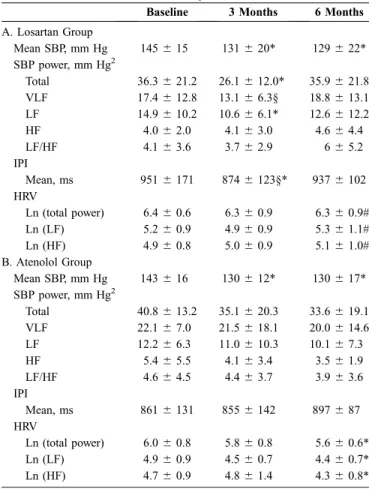
The baseline demographic characteristics were similar between the two groups (Table 1). None of the participants were lost to follow-up during the study period. Table 2 shows the data of SBP, spectral components of SBP variability, IPI, and HRV (after natural logarithmic transformation of IPI power spectrum) in supine rest position in the losartan group (Table 2A) and in the atenolol group (Table 2B) before and after treatment. The BP levels were not different between both groups before treatment, and BP was significantly reduced to a similar extent in both groups at month 3 and month 6 (P , 0.05). The baseline LF and HF fluctuations of the systolic BP vari-ability in the three frequency ranges did not differ between the two groups. The LF and VLF BP spectral power was signif-icantly decreased at month 3 but insignifsignif-icantly at month 6 in the losartan group compared with that at the baseline. The LF BP power in the atenolol group showed a non-significant trend of decrement at month 3 and month 6. The HF spectral power and the L/H ratio of the BP spectrum were little changed in both groups either at month 3 or month 6.
The mean baseline IPI seemed relatively lower in the atenolol group, but the difference was not statistically signifi-cant. The IPI levels were not different between the two groups at month 3 and at month 6. The IPI values significantly de-creased at month 3 (P , 0.05), but later inde-creased to near baseline level at month 6 in the losartan group. However, the IPI values little changed in the atenolol group at month 3 and month 6. Regarding the HRV, the baseline IPI spectral power was not different between the two treatment groups, including LF power, HF power, and total power. These spectral compo-nents were insignificantly changed in either group at month 3. However, by the end of month 6, these indices of HRV were significantly reduced in the atenolol group (P , 0.05), but little altered in the losartan group. In addition, HRV in the losartan group was significantly higher than the atenolol group at month 6 (P = 0.033 for total power, P = 0.0127 for LF power, and P = 0.0346 for HF power).
Baseline BRS (baroreflex gain) was not much different between both groups, including index-a, BrrLF, and BrrHF (Table 3). These BRS indices were significantly increased in the losartan group at month 6. However, they were not sig-nificantly changed within either group at month 3 and in the atenolol group at month 6. Nevertheless, intergroup difference was observed at month 3, in which losartan group showed significantly higher BRS than atenolol group (P = 0.0367 for
BrrLF, P = 0.0124 for BrrHF, and P = 0.0442 for index-a). Such difference was even more obvious at month 6 (P = 0.0097 for BrrLF, P = 0.0189 for BrrHF, and P = 0.0146 for index-a). Considering the absolute difference in BRS between month 6 and baseline in each group, the increment in BRS was
TABLE 1. Demographic Data of Participants
Losartan Group Atenolol Group Male 13 10 Female 2 5
Mean age (range) 64 6 12 years (range 38–75)
69 6 9 years (range 52–80)
Ex-smokers 3 2
Hypercholesterolemia 3 2
Defined as serum total cholesterol .200 mg%.
TABLE 2. Spectral Analysis of Blood Pressure, Interpulse Interval, and Heart Rate Variability
Baseline 3 Months 6 Months A. Losartan Group Mean SBP, mm Hg 145 6 15 131 6 20* 129 6 22* SBP power, mm Hg2 Total 36.3 6 21.2 26.1 6 12.0* 35.9 6 21.8 VLF 17.4 6 12.8 13.1 6 6.3§ 18.8 6 13.1 LF 14.9 6 10.2 10.6 6 6.1* 12.6 6 12.2 HF 4.0 6 2.0 4.1 6 3.0 4.6 6 4.4 LF/HF 4.1 6 3.6 3.7 6 2.9 6 6 5.2 IPI Mean, ms 951 6 171 874 6 123§* 937 6 102 HRV Ln (total power) 6.4 6 0.6 6.3 6 0.9 6.3 6 0.9# Ln (LF) 5.2 6 0.9 4.9 6 0.9 5.3 6 1.1# Ln (HF) 4.9 6 0.8 5.0 6 0.9 5.1 6 1.0# B. Atenolol Group Mean SBP, mm Hg 143 6 16 130 6 12* 130 6 17* SBP power, mm Hg2 Total 40.8 6 13.2 35.1 6 20.3 33.6 6 19.1 VLF 22.1 6 7.0 21.5 6 18.1 20.0 6 14.6 LF 12.2 6 6.3 11.0 6 10.3 10.1 6 7.3 HF 5.4 6 5.5 4.1 6 3.4 3.5 6 1.9 LF/HF 4.6 6 4.5 4.4 6 3.7 3.9 6 3.6 IPI Mean, ms 861 6 131 855 6 142 897 6 87 HRV Ln (total power) 6.0 6 0.8 5.8 6 0.8 5.6 6 0.6* Ln (LF) 4.9 6 0.9 4.5 6 0.7 4.4 6 0.7* Ln (HF) 4.7 6 0.9 4.8 6 1.4 4.3 6 0.8*
VLF, very low-frequency power; LF, low-frequency power; HF, high-frequency power; LN, natural logarithm; IPI, interpulse interval. #: losartan vs. atenolol, P , 0.05; *: vs. baseline, P , 0.05; **: vs. baseline, P , 0.01; §: 3 months vs. 6 months, P , 0.05.
TABLE 3. Spontaneous Baroreflex Sensitivity Before and After 3 and 6 Months of Treatment
Baseline 3 Months 6 Months Losartan Group BrrLF 4.1 6 2.0 4.7 6 2.1# 5.1 6 2.4*## BrrHF 5.8 6 2.6 7.0 6 3.1§# 8.6 6 4.6**# Index-alpha 5.5 6 1.9 6.2 6 2.6# 7.3 6 3.3*# Atenolol Group BrrLF 3.3 6 1.4 3.5 6 1.6 3.4 6 2.8 BrrHF 4.9 6 2.9 5.3 6 4.2 4.5 6 2.2 Index-alpha 5.2 6 2.1 5.1 6 3.7 4.3 6 1.1
*: baseline vs. 6 months, P , 0.05; **: baseline vs. 6 months, P , 0.01; §: 3 months vs. 6 months, P , 0.05; §§: 3 months vs. 6 months, P , 0.01; #: losartan vs. atenolol, P , 0.05; ##: losartan vs. atenolol, P , 0.01.
significantly higher in the losartan group than the atenolol group (P = 0.0195 for BrrLF, P = 0.0363 for BrrHF, and P = 0.0194 for index-a).
Efficacy
All participants had their BP controlled to the target values of less than 140/90 mm Hg except 6 subjects (3 in each group) at month 6. The average daily dose of losartan at month 6 was 76.7 mg, and was 73.3 mg in the atenolol group.
Safety Profile
No serious adverse events were reported in either of the two treatment groups. No patient withdrew from the study because of adverse events. The most common adverse event reported was fatigue, which was mild and occurred in two patients in the atenolol group and none in the losartan group. No laboratory adverse events were reported, including any significant changes in renal function (creatinine, BUN). No new onset diabetes mellitus was noted by the end of month 6 in either group.
DISCUSSION
We comparatively evaluated the effects of antihyperten-sive therapy with losartan and atenolol on BRS and HRV. Six-month treatment was found to result in a significant increase of BRS in the losartan group and a decrease of HRV in the aten-olol group in comparison with the respective baseline values. There were no significant changes in HRV and BRS in either group by the end of month 3. The intergroup comparison also showed a significant difference in BRS and HRV at month 6, which were higher in the losartan group. The cause of such disparities cannot be explained by differences in BP reduction because blood pressures were reduced to a similar extent in both groups.
In addition, there are some important issues that deserve to be mentioned. First, duration of antihypertensive therapy seems important for BRS to improve in the losartan group. It may be necessary for such a treatment to last for longer than 3 months to improve BRS, suggesting that structural changes, rather than functional alterations per se, are necessary to im-prove BRS. Second, the HRV and BRS were differentially affected in both groups, suggesting that these two autonomic markers may provide independent information on autonomic regulation.
Angiotensin II (AII) receptor (AT1 receptor) blocker (ARB) and beta-adrenergic blocker (BB) have had well-documented BP-lowering effects with additional benefits on certain cardiovascular co-morbidities such as congestive heart failure or myocardial infarction, which are associated with an excess of renin-angiotensin activation and/or altered auto-nomic balance with reduced vagal activity. Consequently, the beneficial effects of ARB and BB on BRS and HRV in these patients would be more evident. However, the effects of these BP-lowering therapies on BRS and/or HRV have been much less consistent in hypertensive patients without end-organ dysfunction and in normotensive subjects.
The effects of BB on BRS16–21
and/or HRV17,19,20 in healthy subjects or hypertensive patients were not consistent in
the previous studies. Age appeared important for the equivocal results associated with BB treatment. We have enrolled older patients (mean age 69 years) in our study whose BRS might be much less responsive to atenolol therapy. Chen et al18 also reported that BRS was more likely to improve with BBs in younger hypertensive patients than in older patients. More-over, the previous studies suggesting beneficial effects of BB on BRS in essential hypertension16,17,19,20
were conducted on patients of much younger age (average age ranging from 42 to 49 years) compared with our patients (mean age 69 years). Another important factor is LVH. Lack of improvement in HRV by atenolol or losartan may be related to absence of LVH in our patients. Several studies have demonstrated that BRS22 and/or HRV23,24
are negatively correlated with LVH, and correction of LVH is associated with improvement of BRS25 and/or HRV26
in hypertensive subjects. However, it is still possible that some of our participants might have LVH if evaluated by more sophisticated means such as echocardiog-raphy. Thus, the decrease in HRV in the atenolol group at month 6, but not in the losartan group, might be related to the less efficacious effect of atenolol on LVH compared with losartan.35
The beneficial effects of ARBs on BRS and/or HRV in uncomplicated hypertensive patients were rarely reported in those on ARB treatment of less than 3 months, which is com-patible with our observation.27–32
Amador et al27
reported improved HRV and decreased left ventricular mass in 25 prehypertensive obese middle-age subjects after 16 weeks of losartan therapy (50 mg/d). Absence of obesity and LVH in our patients may have explained the discrepancy from our study. Moreover, Guasti et al28
conducted a randomized cross-over study of enalapril and losartan treatment, each for 2 months, on 19 hypertensive patients, and BRS was not differ-entially changed during the two antihypertensive treatments. Fridman et al29
treated 22 hypertensive patients with candesartan (16 mg/d) for 6 weeks, but BRS was not influenced. These studies also supported our observation that the improvement in BRS was not achieved at month 3 but at month 6 in the losartan group.
Although ACEIs and ARBs affect RAAS at different levels, there were reports that ARBs may have effects on BRS similar to ACEIs. In a placebo-controlled, randomized, double-blind, cross-over study,30
BRS was comparably and signifi-cantly increased by either losartan or enalapril in 10 healthy individuals with induced high serum AII levels. However, Rongen et al31
failed to show improvement in BRS in 9 young healthy men after losartan treatment (100 mg/d) for 1 week. In addition, Heusser et al32
report that eprosartan at 600 mg/d might diminish the total power of HRV (P , 0.05) and the BRS (P , 0.01) in a short-term (7 days) double blind cross over study in 25 normal young males. The researchers sug-gested that the marked increase in circulating AII might be related to the decreased baroreflex gain. These trials are diffi-cult to compare with ours given the very short-term use of ARB or ACEI and much younger age of these healthy participants. Nevertheless, Munakata et al33
demonstrated that BRS was not changed at month 3, but significantly improved at month 12, in 12 hypertensive patients treated with ACEI (temocapril or cirazapril), and the controlled blood pressures
were not different at month 3 and month 12. Therefore, it strongly suggests that the beneficial effects associated with ARB/ACEI on BRS and/or HRV in hypertensive patients may not be related to BP lowering per se. Other mechanisms may have played an important role.
There were very few studies comparing the effects of ACEI/ARB versus BB on BRS and/or HRV. Ylitalo et al34 disclosed that the decreased BRS, as compared with normal controls, was not different between those treated with BBs (40 cases) and ACEIs (40 cases), but the cross-sectional study design was not intended to address this issue.
Blockade of RAS with ACEI/ARB may reverse the angiotensin-induced effects (including the adverse effects of AII on BRS) along with BP reduction. This beneficial effect on BRS in hypertensive patients without end-organ damages, however, may take more than 3 months to be detected. The results of our study also suggest that chronic losartan therapy is associated with significant improvement in BRS in other-wise healthy subjects with essential hypertension. On the other hand, the ability of BBs to enhance BRS has been limited in the elderly patient with UEH. This is in agreement with the previous studies. Lack of this effect could also partially be attributed to small sample size. Nevertheless, it could also be attributed to less efficient effects of atenolol on reversing car-diovascular maladaptations associated with hypertension, such as intimomedial thickening, endothelial dysfunction, and ven-tricular hypertrophy, than losartan.35,39
Moreover, blocking the type 1 receptor (AT1) of AII by losartan may have additional benefit of increasing nitric oxide (NO) bioavailability.40 The neuronal as well as the endothelial production of NO may play a facilitatory role in the regulation of BRS and HRV in health and in disease states.41
Furthermore, NO has been demon-strated to augment cardiac vagal control in humans, suggesting beneficial effects on BRS and HRV.42
Atenolol, however, does not possess such an NO-releasing effect. The fundamental differential effects on NO release may be a major reason for the observed differences on BRS and HRV between the two groups of patients in our study. This is further supported by the Losartan Intervention for End Point Reduction in Hyperten-sion (LIFE) study,35
in which losartan was demonstrated to offer greater cardiovascular risk reduction than atenolol de-spite comparable BP lowering in hypertensive patients. The results from our study may provide additional explanations for this large-scale outcome study regarding the benefits of losartan therapy other than BP lowering.
The limitations of this study include a small sample size, the lack of blinding of the patients, and lack of real control group of patients. In addition, the spectral indices used in our study are not a direct measure of autonomic nerve activity to the heart and vessels. Only indirect inferences can be postu-lated from our data. Nevertheless, this noninvasive assessment of spontaneous BRS and HRV has been proven to be of clinical usefulness, providing two important markers with cardiovas-cular prognostic value; still it is impossible to conclude that there is any superiority of losartan compared with atenolol until there is a real control group of patients.
In conclusion, hypertension is associated with decreased BRS, which may be improved with antihypertensive treatment. The ability of different classes of antihypertensive agents to
improve BRS and/or HRV in patients with essential hyper-tension may vary, which may account for the differences in cardiovascular risk reduction.
ACKNOWLEDGMENT
The authors are greatly indebted to Ms. Wen-Yung Sheng, MS, of the Neurological Institute, Taipei Veterans General Hospital, for her statistical assistance and manu-script preparation.
REFERENCES
1. Esler M. Noradrenaline release and the pathophysiology of primary human hypertension. Am J Hypertens. 1989;2:S140–S146.
2. Yamori Y. Neurogenic mechanisms of spontaneous hypertension. In Onesti G, Fernandes M, Kim KE (eds). Regulation of Blood Pressure by the Central Nervous System. New York: Grune and Stratton Inc; 1975: 65– 76.
3. Task Force of the European Society of Cardiology and the North American Society of Pacing and Electrophysiology. Heart rate variability: standards of measurement, physiological interpretation, and clinical use. Circulation. 1996;93:1043–1065.
4. Parati G, Di Rienzo M, Mancia G. How to measure baroreflex sensitivity: from the cardiovascular laboratory to daily life. J Hypertens. 2000;18: 7–19.
5. Schroeder EB, Liao D, Chambless LE, et al. Hypertension, blood pres-sure, and heart rate variability: the Atherosclerosis Risk in Communities (ARIC) study. Hypertension 2003;42:1106–1111.
6. Ylitalo A, Airaksinen J, Tahvanainen K, et al. Baroreflex sensitivity in drug-treated systemic hypertension. Am J Cardiol. 1997;80:1369–1372. 7. Mussalo H, Vanninen E, Ikaheimo R, et al. Baroreflex sensitivity in essential and secondary hypertension. Clin Auton Res. 2002;12:465–471. 8. Sevre K, Lefrandt JD, Nordby G, et al. Autonomic function in hyper-tensive and normohyper-tensive subjects: the importance of gender. Hypertension 2001;37:1351–1356.
9. Huikuri HV, Ylitalo A, Pikkujamsa SM, et al. Heart rate variability in systemic hypertension. Am J Cardiol. 1996;77:1073–1077.
10. Fagard RH, Pardaens K, Staessen JA. Relationships of heart rate and heart rate variability with conventional and ambulatory blood pressure in the population. J Hypertens. 2001;19:389–397.
11. Singh JP, Larson MG, Tsuji H, et al. Reduced heart rate variability and new-onset hypertension: insights into pathogenesis of hypertension: the Framingham Heart Study. Hypertension 1998;32:293–297.
12. La Rovere M, Bigger JT Jr, Marcus FI, et al. Baroreflex sensitivity and heart-rate variability in prediction of total cardiac mortality after myocardial infarction. ATRAMI (Autonomic Tone and Reflexes After Myocardial Infarction) Investigators. Lancet. 1998;351:478–484. 13. Nolan J, Batin PD, Andrews R, et al. Prospective study of heart rate
variability and mortality in chronic heart failure: results of the United Kingdom heart failure evaluation and assessment of risk trial (U.K.-heart). Circulation. 1998;98:1510–1516.
14. La Roverre MT, Pinna GD, Hohnlose HS, et al. Baroreflex sensitivity and heart rate variability in the identification of patients at risk for life-threatening arrhythmias. Implications for Clinical Trials. Circulation. 2001;103:2072–2077.
15. Tsuji H, Larson MG, Venditti FJ Jr, et al. Impact of reduced heart rate variability on risk for cardiac events: the Framingham Heart Study. Circulation. 1996;94:2850–2855.
16. Parati G, Mutti E, Frattola A, et al. Beta-adrenergic blocking treatment and 24-hour baroreflex sensitivity in essential hypertensive patients. Hyper-tension 1994;23:992–996.
17. Lucini D, Pagani M, Malliani A. Improved baroreflex control of the heart rate with chronic beta-adrenergic blockade in mild hypertension. J Hypertens. 1993;(Suppl 11):S156–S157.
18. Chen X, Hassan MO, Jones JV, et al. Baroreflex sensitivity and the blood pressure response to beta-blockade. J Hum Hypertens. 1999;13:185–190. 19. Floras JS, Hassan MO, Jones JV, et al. Factors influencing blood pressure and heart rate variability in hypertensive humans. Hypertension 1988;11: 273–281.
20. Lucini D, Pagani M, Mela GS, et al. Sympathetic restraint of baroreflex control of heart period in normotensive and hypertensive subjects. Clin Sci. 1994;86:547–556.
21. Parati G, Pomidossi G, Grassi G, et al. Mechanisms of antihypertensive action of beta-adrenergic blocking drugs: evidence against potentiation of baroreflexes. Eur Heart J. 1983;4:19–25.
22. Lantelme P, Khettab F, Gustaud M-A, et al. Spontaneous baroreflex sensitivity: toward an ideal index of cardiovascular risk in hypertension? J Hypertens. 2002;20:934–944.
23. Kohara K, Hara-Nakamura N, Hiwada K. Left ventricular mass index negatively correlates with heart rate variability in essential hypertension. Am J Hypertens. 1995;8:183–188.
24. Mandawat MK, Wallbridge DR, Pringle SD, et al. Heart rate variability in left ventricular hypertrophy. Br Heart J. 1995;73:139–144.
25. Head GA. Baroreflex and cardiovascular regulation in hypertension. J Cardiovasc Pharmacol. 1995;26(Suppl 2):S7–S16.
26. Ylitalo A, Airaksinen KE, Sellin L, et al. Effects of combination antihypertensive therapy on baroreflex sensitivity and heart rate variability in systemic hypertension. Am J Cardiol. 1999;83:885–889.
27. Amador N, Encarnacion JJ, Guizar JM, et al. Effect of losartan and spironolactone on left ventricular mass and heart sympathetic activity in prehypertensive obese subjects: a 16-week randomised trial. J Hum Hypertens. 2005;19:277–283.
28. Guasti L, Petrozzino MR, Mainardi LT, et al. Autonomic function and baroreflex sensitivity during angiotensin-converting enzyme inhibition or angiotensin II AT-1 receptor blockade in essential hypertensive patients. Acta Cardiol. 2001;56:289–295.
29. Fridman KU, Wysocki M, Friberg PR, et al. Candesartan cilexetil in hypertension: effects of six-weeks’ treatment on haemodynamics, baroreceptor sensitivity and the rennin-angiotensin-aldosterone system. Blood Press. 1999;8:242–247.
30. Yee KM, Struthers AD. Endogenous angiotensin II and baroreceptor dysfunction: a comparative study of losartan and enalapril in man. Br J Clin Pharmacol. 1998;46:583–588.
31. Rongen GA, Brooks SC, Ando S, et al. Neural and hypotensive effects of angiotensin II receptor blockade. Hypertension 1998;31(1 part 2):378–383.
32. Heusser K, Vitkovsky J, Schmieder RE, et al. AT1 antagonism by eprosartan lowers heart rate variability and baroreflex gain. Auton Neurosci-Basic Clin. 2003;107:45–51.
33. Munakata M, Aihara A, Nunokawa T, et al. The influence of one-year treatment by angiotensin converting enzyme inhibitor on baroreflex sensitivity and flow-mediated vasodilation of the brachial artery in essential hypertension–comparison with calcium channel blockers. Clin Exp Hypertens. 2003;25:169–181.
34. Ylitalo A, Airaksinen KE, Tahvanainen KU, et al. Baroreflex sensitivity in drug-treated systemic hypertension. Am J Cardiol. 1997;80:1369– 1372.
35. Dahlo¨f B, Devereus RB, Kjeldsen SE, et al. Cardiovascular morbidity and mortality in the Losartan Intervention For Endpoint reduction in hypertension study (LIFE): a randomised trial against atenolol. Lancet. 2002;359:995–1003.
36. Jern S. Assessment of left ventricular hypertrophy in patients with essential hypertension. Blood Pressure 1997;6(Suppl 2):16–23. 37. Kuo TBJ, Yien HW, Hseu SS, et al. Diminished vasomotor component of
systemic arterial pressure signals and baroreflex in brain death. Am J Physiol. 1997;273:H1291–H1298.
38. James MA, Paneral RB, Potter JF. Applicability of new techniques in theassessment of arterial baroreflex sensitivity in the elderly: a compar-ison with established pharmacological methods. Clin Sci. 1998;94:245– 253.
39. Schiffrin EL, Park JB, Intengan HD, et al. Correction of arterial structure and endothelial dysfunction in human essential hypertension by the angiotensin receptor antagonist losartan. Circulation. 2000;101:1653– 1659.
40. Donmez G, Derici U, Erbas D, et al. The effects of losartan and enalapril therapies on the levels of nitric oxide, malondialdehyde, and glutathione in patients with essential hypertension. Jpn J Physiol. 2002;52:434–440. 41. Chowdhary S, Townend JN. Nitric oxide and hypertension: not just an endothelium derived relaxing factor! J Hum Hypertens. 2001;15:219– 227.
42. Chowdhary S, Vaile JC, Fletcher J, et al. Nitric oxide and cardiac autonomic control in humans. Hypertension 2000;36:264–269.