
選擇台灣兒童美語補習班之關鍵因素探討 - 政大學術集成
69
0
0
全文
(2) 選擇台灣兒童美語補習班之關鍵因素探討 Taiwanese Children’s English Cram Schools: An Investigation of Choice Factors. 研究生 : 吳曉怡. Student: Sylvia Wu. 指導教授 : 白德傑. Advisor: Glen H. Brodowsky. 學. 國立政治大學. 商學院國際經營管理碩士學程 碩士論文. Nat. sit. y. ‧. io. A Thesis. er. ‧ 國. 立. 政 治 大. n. Submitted a to International MBA Program v. l. ni. C hChengchi University National i U e ngch. in partial fulfillment of the Requirements for the degree of Master in Business Administration. 中華民國九十九年七月 July 2010.
(3) Acknowledgement I would like to express the deepest appreciation to my advisor, Professor Glen H. Brodowsky, who has guided and supported me throughout my thesis.. Without his guidance and persistent help this thesis would not. have been completed. I have learned a lot during this research.. It is. something that is different from the textbooks. I would also like to thank the members of the oral committee, Professor Jack Wu and Professor Jan-Juy Lin.. 立. appreciated.. 政 治 大. Your advice and comments were greatly. ‧ 國. 學. Special thanks to all my friends from the IMBA program.. I am very. ‧. glad I had joined this program and made so many lifetime friends. It. y er. io. sit. Nat. was a great experience I will never forget.. n. a my parents for supporting I would also like to thank i v me to pursuit my Masters Degree.. l C n U h e ntogshow i Lastly, I want my true h c. appreciation to my. significant partner, who has always been there for me all the time. Without his encouragement, I wouldn’t be doing this right now. you everyone! I hope you are all proud of me!. ii. Thank.
(4) Abstract Taiwanese Children’s English Cram Schools: An Investigation of Choice Factors and Industry Performance By Sylvia Wu. 政 治 大. We all know that English is the most spoken language all over the world. Students. 立. in Taiwan are required to learn English in elementary school.. Parents notice the. ‧ 國. 學. importance of English and start sending children to English cram schools. However, how should parents pick a school that is suitable for the children?. The objective of. ‧. this research is to indentify the key factors that influence parent’s decision while. y. Nat. sit. picking English cram schools for children in Taiwan. The methodologies used in. n. al. er. io. this research are focus group, mystery shopper, and online survey.. i Un. The goal of the. v. focus group is to find out what factors parents consider while choosing English cram schools.. Ch. engchi. The mystery shopper would visit different schools and act as a parent. searching for school for the child. To verify the analysis one step closer and to find out the public’s recognition of English cram schools, an online survey was conducted. After analyzing the data, this research indicates a conclusion that the main factors that influence parent’s decision are the learning environment, teaching quality and attitude, long-term management and commitment, and price.. Bigger chain stores have strong. marketing positioning and brand recognition, however, that doesn’t mean better service and quality or the final decision to pick the cram school.. In the short run,. large chain stores not only gain the business opportunity, but also earn the profit as they wished. Nevertheless, in the long run, parents would notice the inconsistency.
(5) and unsatisfying services and eventually switched to a smaller privately owned schools that hires experienced and professional teachers. The relationship between the cram schools, parents, and teachers are very important.. Therefore the best. outcome for the children and for the parents to find the best school is to get a balance of all these factors.. This research pointed out problems that most parents might not. have noticed before. Parents put a lot of effort in their children’s education and a large portion of the household income goes to the children’s tuition. There is a big market for English cram schools in Taiwan, and large chain schools have done well on marketing the school. In order to keep and maintain the walk-in customers’ business, the larger chain stores could focus more on the quality control and provide a survey or. 政 治 大. questionnaire for the parents periodically to get their feedback or suggestions. Thus. 立. for the smaller privately owned schools to differentiate themselves and get the. ‧ 國. 學. public’s attention, they could spend more on advertising and selling the school by. America or Canada.. ‧. showing parents that they only hire experienced and professional teachers from North Then the children and the parents will get the best outcome in. sit. y. Nat. io. n. al. er. learning English and getting the services and quality they paid for.. Ch. engchi. ii. i Un. v.
(6) TABLE OF CONTENTS Chapter 1. . Introduction.......................................................................................................... 1 . 1.1 . Research Motivation ................................................................................................ 1 . 1.2 . The System of Education in Taiwan – English as a Second Language ................... 2 . 1.3 . Cram School Trend in Taiwan ................................................................................. 3 . 1.4 . Problems and Goal ................................................................................................... 5 . Chapter 2. 2.1 . Research Methodology ........................................................................................ 7 . Focus Groups ........................................................................................................... 8 . 2.1.1 . Advantages of Focus Groups ............................................................................... 8 . 2.1.2 . Steps to Designing Focus Groups ........................................................................ 9 . 2.1.3 . Disadvantages of Focus Groups ........................................................................ 11 . 立. Mystery Shopper .................................................................................................... 12 Scenarios ............................................................................................................ 12 Online Survey ........................................................................................................ 18 Analysis ............................................................................................................. 20 . Nat. Focus Groups ......................................................................................................... 20 . y. 3.1 . ‧. Chapter 3. . sit. 2.3 . 學. 2.2.1 . ‧ 國. 2.2 . 政 治 大. 3.1.2 . Feedback ............................................................................................................ 22 . 3.1.3 . Results ............................................................................................................... 23 . n. 3.2 . al. er. Participant’s background ................................................................................... 20 . io. 3.1.1 . Ch. engchi. i Un. v. Mystery Shopper .................................................................................................... 28 . 3.2.1 . Teaching quality ................................................................................................ 30 . 3.2.2 . Environment ...................................................................................................... 33 . 3.2.3 . Attitude .............................................................................................................. 35 . 3.2.4 . Long term management ..................................................................................... 37 . 3.2.5 Other .................................................................................................................. 39 3.3 4 . Online Survey Results ............................................................................................ 42 . Discussion ....................................................................................................................... 47 4.1 . Teaching quality and teacher commitment ............................................................ 47 . 4.2 . Learning environment and long-term management ............................................... 48 iii.
(7) 4.3 . Other perspectives .................................................................................................. 50 . 5 . Conclusion ....................................................................................................................... 53 . 6 . Future Direction and Recommendations ......................................................................... 56 . Reference ................................................................................................................................. 58 Appendix ................................................................................................................................. 59 . 立. 政 治 大. ‧. ‧ 國. 學. n. er. io. sit. y. Nat. al. Ch. engchi. iv. i Un. v.
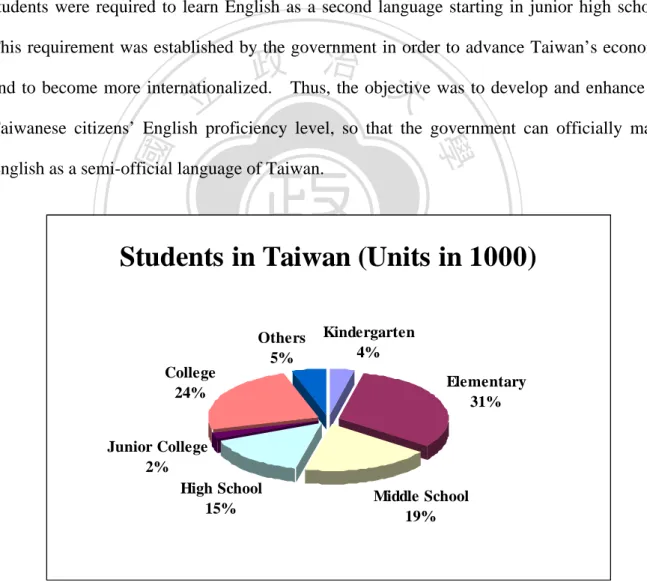
(8) LIST OF FIGURES Figure 1 Students in Taiwan ........................................................................................... 2 Figure 2 Children’s English Ranking in Asia ................................................................ 5 Figure 3 Focus Group Steps ........................................................................................... 9 Figure 4 Number of Children from Focus Group Participants .................................... 21 Figure 5 Other Cram Schools Students Enrolled ......................................................... 21 Figure 6 Prior Teaching Experience Requirement ....................................................... 30 Figure 7 Maximum Number of Students in Classroom ............................................... 31 Figure 8 Types of English Teachers at Cram Schools.................................................. 32. 政 治 大 Figure 10 Year School Established .............................................................................. 39 立. Figure 9 Number of English Classes per Week ........................................................... 34. ‧ 國. 學. Figure 11 Average Tuition Fee per Class ..................................................................... 41 Figure 12 Estimated Profit at Different Cram Schools per Month .............................. 42. ‧. Figure 13 Top of Mind Awareness ............................................................................... 43. sit. y. Nat. Figure 14 Types of English Cram Schools................................................................... 44. n. al. er. io. Figure 15 Way of Recognition of English Cram Schools ............................................ 45. i Un. v. Figure 16 Importance of English Cram School ........................................................... 45. Ch. engchi. Figure 17 Considering Chain Stores for English Cram School ................................... 46 Figure 18 Children’s English Ranking in Asia ............................................................ 51 Figure 19 Average TOEIC Score ................................................................................. 52 Figure 20 Average TOEIC Ranking ............................................................................. 52 Figure 21 Perspectives from three different roles ........................................................ 55. v.
(9) LIST OF TABLES Table 1 Children’s English Ranking in Asia .................................................................. 4 Table 2 Mystery Shopper Comparison......................................................................... 29 Table 3 Tuition Fee Comparison .................................................................................. 40. 立. 政 治 大. ‧. ‧ 國. 學. n. er. io. sit. y. Nat. al. Ch. engchi. vi. i Un. v.
(10) Chapter 1.. 1.1. Introduction. Research Motivation There is no doubt that English is the most spoken language all over the world.. even become the main second language for everyone to learn.. It has. This is also the fact in Taiwan.. Influenced by Chinese tradition, people in Taiwan have placed a high priority on education;. 政 治 大. thus, competition for higher education is extremely fierce.. 立. During the past, students didn’t. have to learn English until they were in junior high school. However, nowadays in order to. ‧ 國. 學. increase students’ English knowledge and language ability, the Ministry of Education in Taiwan is requiring students to learn English in elementary school.. Some private. ‧. kindergartens even offer a Chinese-English bilingual environment for children to get used to. y. Nat. sit. speaking and listening to English at a much younger age. In a very competitive educational. n. al. er. io. society like Taiwan, parents started to notice the importance of English. matters a lot.. i Un. Every points. v. Therefore, parents are sending children to English cram schools to improve. Ch. engchi. their prospects and to gain an early advantage.. The choice is not whether parents will send their children to an English program but which school they should send them to. How should parents pick a school that is suitable for the children?. Which school is the best for the children?. The objective of this research is to. identify the key factors that influence parent’s decision while picking English cram schools for children in Taiwan.. 1.
(11) 1.2 The System of Education in Taiwan – English as a Second Language The system of education in Taiwan is similar to most countries, which begins with nine years of compulsory education. It is divided into six years of elementary and three years of junior high school.. Since the implementation of the compulsory education system in 1968,. the primary language of instruction in Taiwan has always been Mandarin.. However,. students were required to learn English as a second language starting in junior high school.. 治 政 大 was to develop and enhance all and to become more internationalized. Thus, the objective 立. This requirement was established by the government in order to advance Taiwan’s economy. Taiwanese citizens’ English proficiency level, so that the government can officially make. ‧ 國. 學. English as a semi-official language of Taiwan.. ‧. n. al. College 24%. Others 5%. Ch. Kindergarten 4%. engchi. Junior College 2% High School 15%. er. io. sit. y. Nat. Students in Taiwan (Units in 1000). i Un. v. Elementary 31%. Middle School 19%. Figure 1 Students in Taiwan. According to the statistics from Taiwanese government (Directorate General of Budget, Accounting and Statistics, Executive Yuan) and as illustrated in Figure 1, the total number of. 2.
(12) students at all levels of education in Taiwan is more than 5 million, which is about 21% of the total population of Taiwan. school students.. Among the 5 million students in Taiwan, 31.4% are elementary. Therefore, after the establishment of the First to Ninth Grades Curriculum. Alignment, the Ministry of Education in Taiwan integrated English education into the elementary curriculum in 2005. As a result, all elementary school students have to start learning English beginning in the fifth grade instead of seventh grade. However, with the government adjusting and updating regulations all the time, two years later, the new policy for. 政 治 大. English to become a compulsory subject has now changed to third grade.. 立. With this new. regulation, English has become a compulsory subject for every eight-year-old child in. ‧. ‧ 國. 學. Taiwan.. sit. y. Nat. 1.3 Cram School Trend in Taiwan. io. er. Parents in Taiwan push children toward education achievement, the higher the better.. al. This has led to increased competition to get into the top schools, as there is a clearly-defined. n. iv n C hierarchy of schools in Taiwan. Children to learn English in elementary U h e n garecnow h i obligated school, and with the intense pressure placed on students to achieve, many parents enroll their children in private after-school classes intended to supplement their regular education.. Most parents have responded to this pressure by enrolling their children in cram schools. Cram schools are becoming a major focus of educational training in Taiwan.. Learning. English is popular, important, and is also a trend in Taiwan because it is an international language. The need for children to master English at an early age is critical for most Taiwanese parents. Many parents believe English fluency will provide a competitive edge to their children in pursuing educational opportunities and ensuring professional success beyond. 3.
(13) their education into their adult lives. In response to the growing demand, a booming industry of children’s English cram schools has grown to help parents by providing after school supplementary English programs for their children to ensure their English proficiency.. Even though the tuition at cram school. is high, most parents are still willing to pay because it will help their children’s success in life, and most importantly, they don’t want their children being left behind.. 政 治 大 Children's English Ranking in Asia 立 2007 Ranking 2008. 學. Malaysia. India. 2. Hong Kong. Indonesia. 3. India. Philippines. 4. Indonesia. Hong Kong. 5. Taiwan. Taiwan. 6. Philippines. 7. Vietnam. Vietnam Japan Korea China. Ch. 8. e n g c9 h i. y. sit. er. al. n. Thailand. ‧. 1. io. Malaysia. Nat. ‧ 國. Table 1 Children’s English Ranking in Asia. i Un. v. Thailand. Japan. 10. China. 11. Korea. A study from University of Cambridge ESOL (English for Speakers of Other Languages) Examinations even mentioned that children’s English ability from the age of seven to twelve, in all the countries in Asia, Taiwan ranked number 5 in 2008 (Table 1). Due to the fact that children in Taiwan are starting to learn English earlier, their English ability ranking has improved (Figure 2).. Therefore, the majority of the children in Taiwan start learning English. earlier than they are supposed to learn it in their primary school curriculum.. 4. Some even start.
(14) in kindergarten to keep their parents satisfied that they are gaining a head start on guaranteeing a successful future.. Children's English Ranking in Asia 11. 11 10. 10 9 9 8 7 6. 6. 5. 5. 政 治 大 4. 3 2. 2. 4. 3. 8 7. 2007 2008. 1 1. 立. H. ‧ 國. ‧. Figure 2 Children’s English Ranking in Asia. sit. y. Nat. er. Problems and Goal. io. 1.4. 學. C h on ina g K on g In In dia do ne sia Ja pa n K or M ea al a Ph ysi a ili pp in e Ta s iw Th an ai la nd V iet na m. 12 10 8 Ranking 6 4 2 0. al. n. iv n C U busy h eschools located near n g corh ipopular. The market for cram schools is an extremely large and profitable business in Taiwan. Most cram schools are. intersections in big cities.. According to the report from Taipei Times in 2007, nearly 60 percent of all primary and secondary school students attend English cram schools and there are at least 14,411 registered cram schools in Taiwan.. The major children’s English cram schools in Taiwan includes. Giraffe Cultural Enterprises, Hess Young Scholar’s English School, Kojen English Center, Happy Marian, Joy English School, and Kid Castle Educational Corporation, just to name a few.. Among these schools, some are corporate-owned chains while others are franchises.. These are the bigger brands that parents often recognize due to their powerful advertisements on TV or brand images.. However, the question remains about whether these popular. 5.
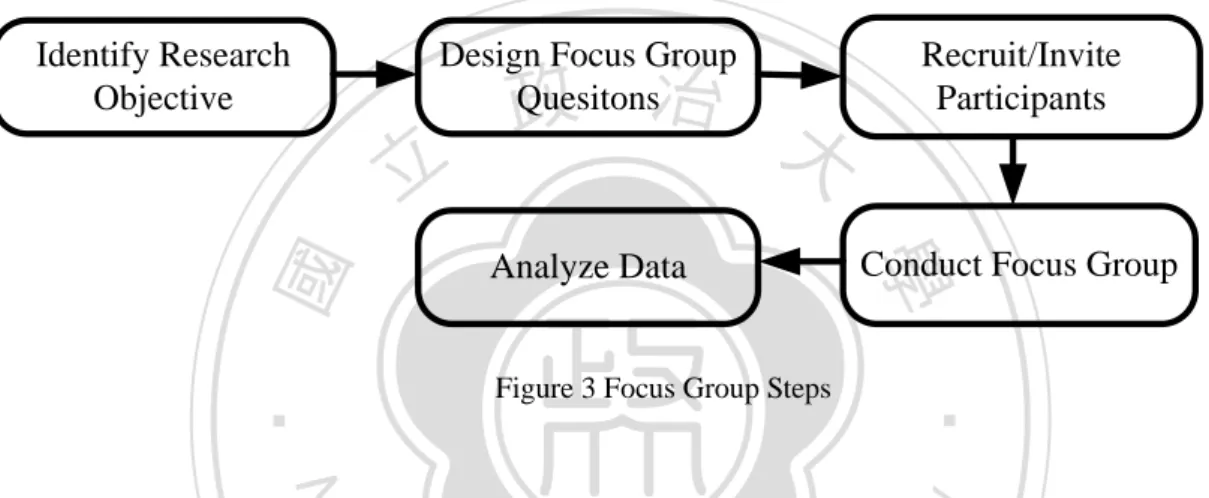
(15) brand-name schools and chain stores are best for students whether parents are simply influenced by. It’s clearly that parents are sending their children to cram schools.. What remains. unclear are the factors that parents consider while choosing the right one for their son or daughter. Some factors that may explain their choices might include price, location, quality, or service. Then again, there may be other factors that matter the most.. With all these. questions in mind, the goal of this research is to identify all of these factors by conducting. 政 治 大. focus groups method, and collecting data from mystery shopping.. 立. ‧. ‧ 國. 學. n. er. io. sit. y. Nat. al. Ch. engchi. 6. i Un. v.
(16) Chapter 2.. Research Methodology. There are many different types of marking research methodology. conducted using exploratory research and descriptive research.. This research is. In order to solve our. problem and accomplish our goals, the methodologies used in this research are three qualitative research methods: focus groups, mystery shopper and online survey.. 政 治 大. The objective of the focus group is to gain qualitative understanding of what factors. 立. parents would consider while choosing English cram schools. Since it remains unclear. ‧ 國. 學. whether all of the factors affecting such choices have been identified, it is appropriate to conduct a qualitative study to identify underlying as-yet-unidentified factors.. ‧. However, there are both pros and cons on conducting a focus group. The ability to. y. Nat. sit. analyze the data may be limited by the small size of the focus groups.. While focus groups. er. io. provide insights into consumer behavior or generate hypotheses, they are not sufficient for. n. aConsequently, i v of this research was to use a a second phrase l C n hengchi U The mystery shopper would visit different English cram schools and act as. testing these hypotheses. mystery shopper.. if he or she was a parent searching for the perfect school for his or her child.. While visiting. other schools, the mystery shopper would try to collect more information. Ideally, all parents want their child to learn English well. Yet, there are so many English cram schools in Taiwan.. We won’t be able to visit all the schools in Taiwan. In. order to verify our analysis one step closer, an online survey was conducted.. The purpose of. the online survey is to variety parents’ recognition of English cram schools.. Optimistically,. more solid hypotheses could be accomplished after these three phrases of research were completed.. Thus, the goal of this three phrased study was the development of hypotheses. 7.
(17) about the motivations and factors behind parental choice of English cram schools.. Statistical. testing of these hypotheses is beyond the scope of this paper.. 2.1 Focus Groups A focus group is a useful qualitative research tool often used in social research, business, and marketing.. Focus groups were first used in the world of marketing to evaluate. potential customer response to new products. Now they are being used in many domains for. 政 治 大. many other purposes. Focus groups are small open group discussions, addressing a specific. 立. topic, which usually involves six to twelve participants, either matched or varied on specific. ‧ 國. 學. characteristics of interest to the researcher. (Morgan & Spanish, 1984). The group needs to be large enough to generate rich discussions but yet not so large that some participants are left. ‧. out.. It is a powerful social interviewing technique that allows researchers to elicit several. y. Nat. sit. viewpoints form participants at the same time. With this focus group, the evaluator has the. n. al. er. io. opportunity to collect qualitative information that can be used to identify the reasons and answers to the research objectives.. 2.1.1. Ch. engchi. i Un. v. Advantages of Focus Groups Many different types of focus groups have been done for many different purposes.. Compared with other research methodologies, the focus group has been found to be the most effective for learning about opinions and attitudes, piloting new products and generating recommendations. ♦. The advantages of a focus group are as follows:. It is relatively easy to assemble, inexpensive, and flexible in terms of format, types of questions and desire outcomes.. ♦. Researchers may interact directly with participants and obtain rich data in the. 8.
(18) participants’ own words.. This also gives them the opportunity to clarify the. responses, and receive contingent answers. ♦. It also allows respondents to react to other group members, and to generate new ideas that might not have been pointed out in individual interviews.. 2.1.2. Steps to Designing Focus Groups. Identify Research Objective. Design Focus Group Quesitons. 政 治 大. Conduct Focus Group. 學. ‧ 國. 立. Recruit/Invite Participants. Analyze Data. ‧. Figure 3 Focus Group Steps. y. Nat. er. io. sit. A well developed focus group needs to include a number of open-ended questions and it should be asked in such a way to trigger discussion among the participants. In order to. n. al. Ch. i Un. v. obtain useful comments and feedback from participants, the research objectives should be defined clearly.. engchi. As illustrated in Figure 3, the first step to designing a focus group is to. identify the research objective, which is to gather ideas and opinions on the factors parents consider while choosing English cram schools, and other valuable information.. To. maximize the effectiveness of the evaluation, the researcher needs to focus on aiming the questions to lead the participants to response to the research objective.. The questions that. were asked in this research are as follows: ♦. What are the reasons you are sending your children to English cram schools after their primary school?. 9.
(19) ♦. What are three or four things do you like best about the English cram school your child is attending?. ♦. What are three or four things that the English cram school your child is attending currently does that you thin are the least useful?. ♦. What are some things the English cram school isn’t doing that you would like them to do?. ♦. When choosing a program for your son/daughter, what are the three most important. 政 治 大. factors for you to consider?. 立. There are so many big chain stores English cram schools. differences between big chains and small ones?. ♦. What are the main. 學. ‧ 國. ♦. Other than the questions mentioned, are there any other suggestions or thoughts that. ‧. you would like to point out regarding choosing English cram schools?. sit. y. Nat. n. al. er. io. Different authors have suggested different number of participants for a focus group.. i Un. v. However, there is no universal indication about the recommended number of people per group.. Ch. engchi. After calling all the potential participants to recruit them, a formal confirmation letter was also sent. (Appendix A) Six parents with children currently enrolled in English cram schools were invited to participate in the focus group.. To thank the participants’. willingness to join the focus group, a USB memory stick, along with some light snack, dessert, and drinks, were given as incentives.. It was conducted in a comfortable room, and in a. relaxed and informal atmosphere on August 15, 2009. In order to collect demographic information from the participants, each of them was asked to fill out a simple form before the focus group.. (Appendix B) At the beginning of. the focus group, the moderator welcomed the participants and briefly introduced the purpose. 10.
(20) of the research and encouraged each participant to feel free to share their ideas.. The. moderator stressed that there were no right or wrong answers, therefore each and every one’s response and opinion are very valuable.. It is also important to let the participants understand. that what is said in the room stays here. Even though a video camera was capturing through out the focus group to verify participants’ responses, their identity will still remain anonymous.. The purpose of videotaping the whole session of the focus group is to help the. researcher analysis the discussion by going through all the verbal and nonverbal behaviors.. 政 治 大. The focus group roughly lasted for an hour and half.. 學. ‧ 國. 立 2.1.3. Disadvantages of Focus Groups. Although the qualitative data collected from focus groups offer interesting advantages, The advantages of focus groups are as. sit. y. Nat. follows:. ‧. there are some limitations and disadvantages as well.. ♦. The open-ended nature of the responses may be difficult to analyze because it is. n. al. er. The findings may not represent the views of larger segments of the population.. io. ♦. unstructured.. Ch. engchi. i Un. v. ♦. Small number of participants may limit the generalization of the research.. ♦. A dominant member of the group may bias the result, and more reserved members may hesitate to talk.. ♦. Participants’ response may be easily misunderstood or misjudge.. Due to all these disadvantages, the data gathered from the focus group may not be sufficient and be representative of the whole population. methodology is required for this research to obtain more data.. 11. Therefore, a second research.
(21) 2.2 Mystery Shopper The second methodology used for this research was to become a mystery shopper.. The. term mystery shopping and mystery customer research refers to the same activity and are defined by the Market Research Society as: “The use of individuals trained to experience and measure any customer service process, by acting as potential customers and in some way reporting back on their experiences in a detailed and objective way”. It is a method for exploring everyday experience and it can be carried out in a variety of. 政 治 大. ways – such as by talking face-to-face in person, by telephone, by letter/email, or by surfing. 立. company being studied is dealing with customers.. 學. ‧ 國. on the internet. It is also a way of identifying the strengths and weakness of how the The key to successful mystery shopping. is having simple, believable scenarios for the shopper to follow.. The shopper should be. ‧. The scenario is made as realistic as possible so it. sit. Nat. employee and measure their performances.. y. given instructions or procedures to test the genuine knowledge and service skills from the. n. al. er. io. mimics natural consumer behavior in the market concerned and can be enacted convincingly by the mystery shopper.. 2.2.1. Ch. engchi. i Un. v. Scenarios Scenarios are not scripts, but rather a briefing or a guide for the shopper.. For example,. in this research, the scenario was to have the secret shopper to pose as a parent of a young child who is considering sending the child to a cram school.. The goal was to find out as. much information as possible from different English cram schools around the same neighborhood.. The scenario for the mystery shopper was a mother who was trying to find. the best suitable English cram schools for her first grade son.. The scenario must be relevant,. credible, and practical. All the information about the “made up son” will be given to the. 12.
(22) mystery shopper before visiting different schools, so that it seems more realistic and not too over rehearsed.. Like a regular parent who is very concerned about her child’s education, the. following list is the basic information that must be obtained during the shopping trip: ♦. Schedule of each English class (Time and Length). ♦. Price. ♦. Language used in class. ♦. Homework assignments and tests. ♦. Number of students per class. ♦. Types of teaching materials used. ♦. Foreign teachers or local teachers. ♦. Teacher’s teaching experience. ♦. Full time or part time teachers. ♦. Teacher’s turnover rate (Yearly contracts). ♦. Environment of the school (Safety and cleanliness). 學 ‧. ‧ 國. y. Nat. n. er. io. al. sit. 立. 政 治 大. Ch. engchi. i Un. v. The objective of asking these questions during the secret shopping is to gather more information that might have been bias from the participant’s response during the focus group that was conducted.. By observing different schools, the shopper would be able to. experience and gain more perspectives on choosing the perfect English school for his or her child.. 2.2.1 Schools visited There are many English cram schools throughout Taiwan. primary schools or at major interactions in big cities.. 13. They are easily spotted near. In this research, we would be only.
(23) using Taipei City as a sample, with the majority of school visited located in the Hsin-Yi District.. 1.. Below are the descriptions of the schools that the secret shopper visited.. Hess. Company History – Hess Educational Organization was established by Mr. Joseph Chu and. 政 治 大. his wife, Ms. Karen Hess in 1983. Over the past 25 years, Hess has grown from Karen and. 立. Joe’s original 60 students to over 60,000 students enrolled in a variety of. programs.. The. ‧ 國. 學. educational program at Hess is divided into Hess International Kindergarten, Hess Young Scholar’s English School, Hess Junior High English School, and Hess International Studies. ‧. Institute. The total number of Hess Schools in Taiwan is unidentified but we can see that. y. Nat. sit. currently there are 52 flagship braches listed on the company website.. Since the. n. al. er. io. establishment of the Hess Publishing Company in 1987, Hess also provides books and. i Un. v. resources to other English schools across Asia to teach English as a foreign language.. Ch. engchi. In. 1990, Hess opened its first bookstores, and now operates more than 30 chain stores nation-wide. Such remarkable success and growth has allowed Hess to become the largest private English Educational Organization in Taiwan today.. Branch visited – Hess Young Scholar’s English School: Taipei, Sun Yet Sen Memorial Hall. 14.
(24) 2.. Happy Marian. Company History – Happy Marian was established in September 1989.. A group of scholars. and educators were brought to establish the Hsuan Shian Corporation in order to improve the. 治 政 大pre-school language institution in Learning Organization was opened. It was the first 立 quality of English language learning.. Happy Marian has been using the whole language approach to learning since 1991.. 學. ‧ 國. Taiwan.. In December 1991, the Happy Marian Language. Over the years more and more students have graduated from their program.. Therefore,. ‧. starting in 2003, the program was expended to include elementary school students.. Happy. sit. y. Nat. Marian’s program is divided into two main programs – Happy Marian Children’s World Now there are 31 Happy Marian. io. er. (Pre-12) and Happy Marian Elementary English Program.. al. n. Children’s World and 18 Happy Marian Elementary English Programs throughout the island,. i n Cparts mainly in the Northern and Central of Taiwan. U hengchi. v. Branch visited - Happy Marian Elementary English Program: Taipei, Sun Yet Sen Memorial Hall. 3. Kojen Company History – Kojen Language School (also known as Kojen English Centers) was originally called ELSI.. The founder and current President of Kojen, Mr. Kenneth Hou,. 15.
(25) opened its first language center in 1982.. Since then, it has opened many other locations. throughout Taiwan, and has been one of the longest running cram schools in Taiwan. Currently there are 25 branches of Kojen English Centers in Taiwan. Kojen has three main teaching programs: Kindergarten and Children’s English, Adult English, and English for Special Purposes.. Kojen’s well-organized Children’s Department remains one of the largest. and most trusted cram schools in Taiwan.. 政 治 大. Branch visited – Kojen English Center: Taipei, Tai-Da Branch.. 立. ‧ 國. ‧. Joy. 學. 4.. y. Nat. Today there are more than 200 schools across the island. er. io. by Sam Chen and Peggy Huang.. sit. Company History – The first Joy school was opened in 1981 in the Hsin-Yi District in Taipei. n. aMost i v or owner-operated. Joy l Cof the schools are franchised n hengchi U programs; Joy Pre-schools, Joy American School and Joy Regular. and 12 schools in China. offers three different School.. Students at Joy are generally from three to sixteen years of age, and currently there. are approximately 10,000 students enrolled in various classes throughout Taiwan and China.. Branch visited – Joy Regular School: Taipei Kwan-fu Branch. 16.
(26) 5.. Giraffe. Company History – Giraffe English World was established by Minister Wi Shein Wei. 1986, it was originally called “Biao-Kan English” in Chinese, meaning benchmark. next year, he opened the first English Learning Center for children.. In The. In 1988, Giraffe English. goal was to create a “No Chinese” learning 政The 治 大. School was opened for franchising.. 立. environment for children to help them to learn English. At present, there are 658 Giraffe. ‧ 國. 學. locations throughout Taiwan and more than 100,000 students enrolling each year.. ‧. Branch visited – Giraffe: Taipei Kwan-Fu Branch. n. er. io. sit. y. Nat. al. 6.. Ch. engchi. i Un. v. AMC. Company History – American Magazine Center (AMC) Language School was established for more than six years ago.. It is a franchised language school and institution from the. American Magazine Center.. AMC was established by Peter Hsu in 1979.. The. organization has been in the English magazine business for more than thirty years in Taiwan. From just a few editors that started a single magazine, the magazine has grown to a group that incorporates magazines and books editorial departments, an educational television department,. 17.
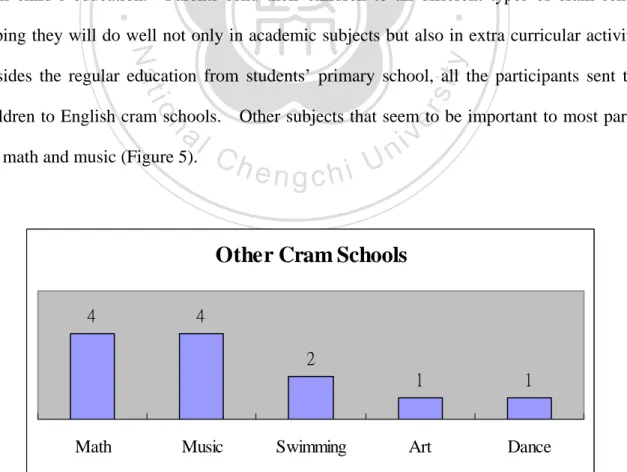
(27) and many other enterprises.. With the strong reputation in researching and developing. English language teaching materials, AMC language schools welcome those who want to start their own elementary language institutions to join the franchise.. Presently, there are 162. franchised stores throughout Taiwan.. Branch visited – AMC Language School: Taipei Da-Zhi Branch. 立. ‧ 國. Smart Kids. 學. 7.. 政 治 大. ‧. Company History – Smart Kids English School is a privately-owned school located in the Minshen District in Taipei.. It is not a franchised store and there are no other chain stores. y. Nat. er. io. sit. locations in Taiwan. It was established in 2002 by a working mother who was searching for the perfect English school for her daughter. Shuwan Cheng, the President and the founder,. n. al. Ch. i Un. v. originally worked at an international company.. She realized the importance of English. therefore created a “No Chinese” English school.. The curriculum is mainly for elementary. engchi. school and junior high school students.. It has been doing really well in the neighborhood.. The founder is seeking for opportunity to open a chain store in the future.. 2.3. Online Survey Following the initial phases of qualitative analysis, a small internet survey was. developed in an attempt to validate the findings of the earlier two phases.. The purpose of. this survey was to get a brief idea about how and what the public thinks about English cram. 18.
(28) schools in general.. The survey focused on the following questions:. . Name 3 English cram schools you know.. . How do you know about the schools mentioned?. . What’s your impression of the schools mentioned?. . Would you first consider chain stores when picking English cram schools?. . When you pick an English cram school, what is most important?. 立. 政 治 大. ‧. ‧ 國. 學. n. er. io. sit. y. Nat. al. Ch. engchi. 19. i Un. v.
(29) Chapter 3.. Analysis. 3.1 Focus Groups In this section, we will be analyzing the information gathered from the focus group. First we will talk about the participants’ demographic backgrounds. the feedback from the participants.. Then we will list out all. Based from their feedback, we can highlight the. 政 治 大. important factors they consider when choosing English cram schools.. 立. These seem to fall. commitment, and long term management.. 學. ‧ 國. into four categories, which are the teaching quality, environment of the school, teacher’s In each category, we will analyze why these are. the key factors for parents in the following subsections.. ‧ y. Nat. Participant’s background. sit. 3.1.1. n. al. er. io. There were six participants that joined the focus group.. i Un. The participants are parents. v. who currently enrolled their children in a small privately-owned English cram school.. Ch. engchi. Among the six participants, two of them picked the current privately-owned cram school because of the good word of mouth from other parents. The other four had bad prior experiences with the larger chain stores; therefore they shifted to the smaller ones hoping to find better quality and service. of the fathers.. It so happened that all the participants were mothers instead. Three of the mothers are housewives, and the other three are full-time. working mothers in the publishing industry, travel industry, and design industry. Three of them have only one child currently in second grade, while the other three each have two children, one in elementary school and the other in junior high school (Figure 4).. 20.
(30) Number of Children. 50%. 50%. 1 2. 政 治 大 Figure 4 Number of Children from Focus Group Participants 立. ‧ 國. 學. Since people are having fewer children nowadays, parents tend to spend more money on. ‧. each child’s education. Parents send their children to all different types of cram schools hoping they will do well not only in academic subjects but also in extra curricular activities.. y. Nat. er. io. sit. Besides the regular education from students’ primary school, all the participants sent their children to English cram schools. Other subjects that seem to be important to most parents. n. al. are math and music (Figure 5).. Ch. engchi. i Un. v. Other Cram Schools 4. 4 2. Math. Music. Swimming. 1. 1. Art. Dance. Figure 5 Other Cram Schools Students Enrolled. 21.
(31) 3.1.2 Feedback The following are lists of feedback from the participants. Reasons for sending their children to English cram school ♦. Don’t want their children to fall behind compared to others. ♦. Want children to like English. ♦. English is important – international language. ♦. Have strong basic English ability – speaking and listening skills. Good qualities of the current English cram school. ♦. Cleanliness of environment and meals/snacks. ♦. No academic pressure. ♦. Convenient location. sit er. io. al. iv n C U English h e nguidance Teaching students basic manner g c h ibesides n. ♦. ‧. Good teaching quality - professional. Nat. ♦. 學. 2.. y. ♦. 政 治 大 Able to communicate when traveling to different countries 立. ‧ 國. 1.. ♦. All English speaking environment. ♦. Low turn-over rate for English teachers – all full-time teachers. ♦. Teachers’ friendly attitude. ♦. Flexible schedule. ♦. Children willing to learn – happy to go there every day. ♦. Strict separation according to each level. ♦. Long term management. ♦. Providing different contests regularly to encourage students. 22.
(32) 3.. Important factors on choosing English cram school ♦. Teaching quality. ♦. Environment. ♦. Feeling after try out class (a positive experience in the trial session). ♦. How teachers communicate with parents. ♦. Pressure to sign up for the school immediately. ♦. Teacher’s attitude and enthusiastic in teaching – use fun ways to teach. ♦. Teacher’s teaching method. ♦. Price. ♦. Long term management of school. ‧. ‧ 國. 學 y. Nat. Differences between chain stores and small business English cram school. sit. 4.. 立. 政 治 大. ♦. Teaching attitude between part-time and full-time teachers. ♦. Teaching methods and classroom management. ♦. Better word of mouth. ♦. Teaching and learning goals. n. 3.1.3. al. er. Staff member’s attitude at front desk. io. ♦. Ch. engchi. i Un. v. Results Based on the feedback from the participants, there seems to be a consensus that most. parents send their children to English cram schools because of the importance of the English language. Parents want their children to like English and develop the basic written, speaking and listening abilities in English while young.. 23. By comparing the good qualities from the.
(33) current cram school and factors parents consider while choosing a perfect school, we can come up with some critical success factors for this research.. 1.. Teaching quality The quality of the teacher seems to be one of the main factors parents consider.. prefer to have teachers who have prior teaching experiences.. Parents. They feel that a good teacher. won’t know how to teach overnight. It takes time and practice. They also want someone. 政 治 大. who really enjoys teaching and views teaching as a professional career, not just a job.. 立. Parents are satisfied when they see their child happy to go to English cram school everyday,. ‧ 國. 學. and most importantly, to see their learning progress.. In addition, parents believe that having good quality of the teaching materials is also. ‧. essential. It is hard for younger students to learn English by rules. If a teacher really. y. Nat. n. al. er. A creative teacher would be able to come up with fun games and activities to. io. environment.. sit. enjoys teaching, he or she is expected to put a lot of effort into creating a fun learning. teach grammar.. Ch. engchi. i Un. v. The focus group participants care about the teacher’s background too. They would like to know the teacher’s educational background, and where he or she was originally from. Most of them have a preference for foreign teachers from North America.. The reason. behind this has nothing to do with discrimination, but mainly because of the accent. English language most often heard is American-English.. The. Fewer parents want their children. to learn British-English. In a non-English speaking country like Taiwan, letting children speak and listen to American-English with foreign teachers is something that most parents can’t provide at home.. 24.
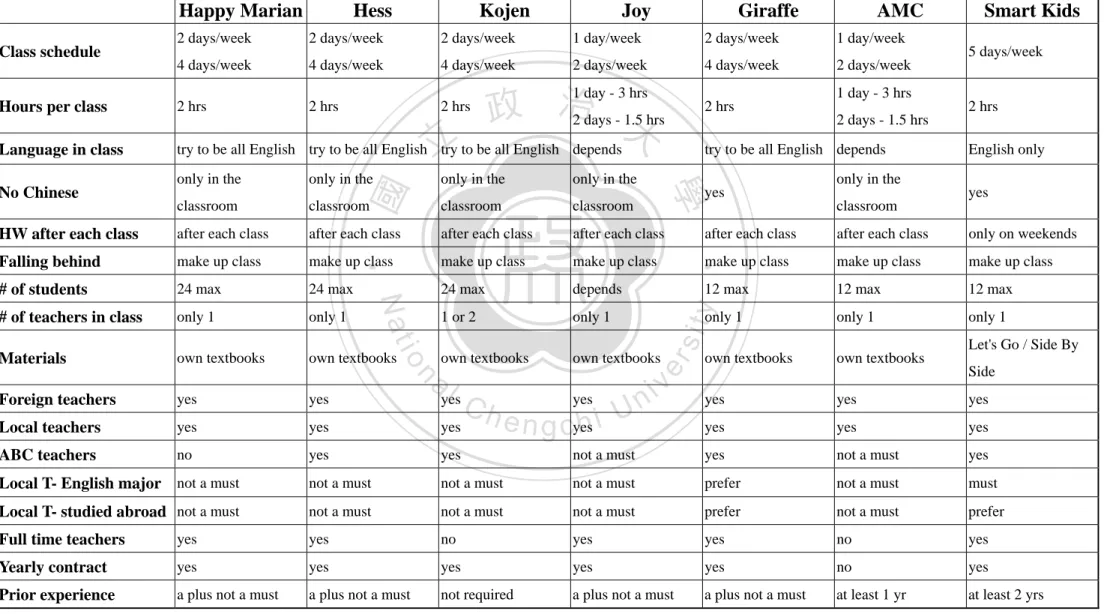
(34) 2.. Environment of the school A clean and safe environment is definitely a must too.. a school that is dirty or in an unsafe neighborhood.. No one would send their child to. A cram school is not like a regular. primary school where you are assigned to attend based on your residence. more opportunities to decide which cram school to attend.. Parents have. When parents are shopping. around for crams schools, the first thing they notice is the cleanliness and safety of the school. Parents pay attention to small details.. For instance, whether the floors, classrooms,. 政 They治also look大for security gates or teachers at the. bathroom, and kitchen are clean or not.. 立. front desk to make sure no strangers would walk in or allow children to leave school. ‧ 國. 學. unnoticed.. Parents also notice the size of the classrooms and how many students are. enrolled in the school and in each class.. These are just some questions that might pop out. ‧. into the parent’s mind while walking around the school.. Therefore, in order to leave a great. y. Nat. n. al. er. io. environment.. sit. first impression when the parents walk into the school, it is essential to create a nice friendly. i vIf n U. Children learn very fast, especially with peers.. Ch. engchi. the school can provide an. all-English-speaking environment, in a way, children will be forced to speak English only. With some body language involved, they will be able to speak English without fear within a short period of time.. Also, it is a good sign when the school is able to create a fun. environment that makes a child look forward to going there every day. should be happy and look forward to go to the cram school. persuade their child to go there.. Parents and children. They shouldn’t need to drag or. Due to all these reasons, a great environment for learning is. definitely something to put in mind in order to gain the parent’s satisfaction.. 3.. Teacher’s commitment. 25.
(35) A good attitude always makes a huge different in the service industry. Many bigger chain stores recruit part-time English teachers only.. These teachers typically only come in. and teach hourly and then leave right after they finish.. Parents feel that with this kind of. teaching attitude, teachers wouldn’t be as enthusiastic about teaching compared to a teacher who works full-time and who is able to spend more time with the students each day. Part-time teachers would only have to clock in at their scheduled time, go in class and teach for a few hours, then clock out when times up and go home.. Most parents that participated. 政 治 大. in the focus group mentioned this problem, and had been unsatisfied with this kind of. 立. teaching attitude that they had experienced at other schools.. On the other hand, full-time. ‧ 國. 學. teachers have the opportunity to be with the students longer each day and have the chance to know more about each and every student’s personality. These teachers are better able to. ‧. identify the problem easily if the children are falling behind or if something were to happen.. y. Nat. sit. The way teachers and parents communicate is also a significant factor. Although the. n. al. er. io. teacher’s goal is to educate the student, it is also the teacher’s job to communicate with the parents periodically.. i Un. v. In a way, parents, not just the children, are the school’s customers.. Ch. engchi. Parents respect teachers who exhibit a professional.. Participants also explained that they don’t like high pressure selling techniques. Parents also dislike the pressure of being forced to sign up for the class immediately when they walked in a school or right after the try-out class. When deciding whether or not to enroll their child, they consider the attitude from the front desk staff teachers. Are they explaining the curriculum in a nice friendly way? questions that are quite important to the parents.. Are they professional?. These are the. A good school should let the parents, their. customers, have the opportunity to go back and think it over or even compare with other schools.. If the teachers at the front desk have a nice and friendly attitude, parents tend to. 26.
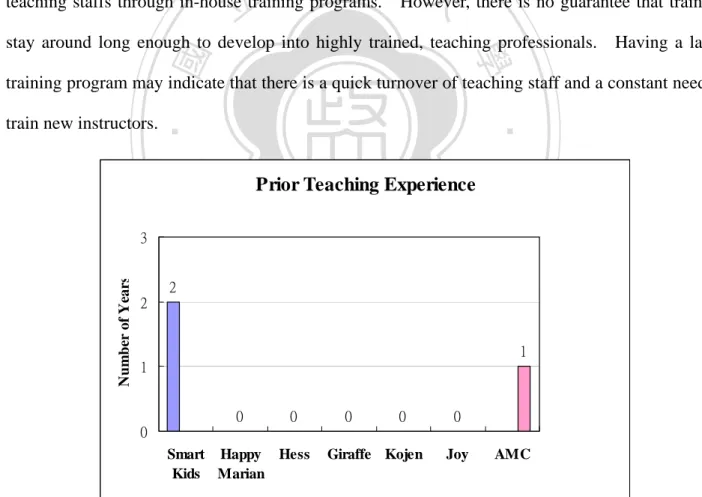
(36) feel more welcomed and willing to stay.. 4.. Long term management Parents feel more secured when they see a well organized curriculum that has been. established for a long time. English level by level.. They want to feel comfortable to see their children learning. If the school provides a well-designed curriculum plan, parents. wouldn’t have to change cram schools often. Parents are sending children to learn English when they are very young.. 政 治 大. When parents are satisfied with the curriculum and the service. 立. provided at the school, they will continue to register their children at the same school as they. ‧ 國. 學. grow older. Since this is the case, parents tend to ask around about the school’s reputation, which means word or mouth is very powerful. They would want to know about the service. ‧. sit. Nat. whether the school will close down or not one day.. y. and quality of the school. They wouldn’t want to register for the school and worry about. er. io. Although the bigger name-brand schools have a strong brand image, they are mainly. al. n. i v name might be well-known to while their brand n CTherefore, hengchi U the public, there are still possibilities that there is inconsistency in the quality from one franchised by individual owners.. location to another. Occasionally, some schools branches are closed down due to poor management.. One of the participants from the focus group pointed out that there was a. school near her house that had changed their name three times within the past two or three years. School.. It changed from Sesame Streets, to Shane English School, to now AMC Language Surprisingly, these are all big franchises English cram schools. As a result, in. order to obtain parents’ trust and commitment, a well structured long term business management plan is needed.. 27.
(37) 3.2. Mystery Shopper In this section, we will be analyzing the information gathered from the mystery shopper. experience.. We will be only evaluating the seven schools that the mystery shopper visited.. First we have summarized all the information from seven schools (Table 2).. Then based on. the data, we will also analyze the important factors on choosing English cram schools into the same four categories as the focus group.. In each category, we will analyze the problems. that were noticed from each school in the following subsections.. 立. 政 治 大. ‧. ‧ 國. 學. n. er. io. sit. y. Nat. al. Ch. engchi. 28. i Un. v.
(38) Table 2 Mystery Shopper Comparison. Happy Marian. Hess. Kojen. Joy. Giraffe. AMC. 2 days/week. 2 days/week. 2 days/week. 1 day/week. 2 days/week. 1 day/week. 4 days/week. 4 days/week. 4 days/week. 2 days/week. 4 days/week. 2 days/week. Hours per class. 2 hrs. 2 hrs. 2 hrs. Language in class. try to be all English try to be all English try to be all English depends. Class schedule. 立. 1 day - 3 hrs 政 治 2 days - 1.5 hrs 大 only in the. classroom. classroom. classroom. classroom. HW after each class. after each class. after each class. after each class. after each class. Falling behind. make up class. make up class. make up class. make up class. # of students. 24 max. 24 max. 24 max. depends. # of teachers in class. only 1. only 1. 1 or 2. only 1. Materials. own textbooks. own textbooks. own textbooks. own textbooks. after each class. 2 days - 1.5 hrs. n. classroom. 2 hrs English only yes only on weekends. make up class. make up class. make up class. 12 max. 12 max. 12 max. only 1. only 1. only 1. own textbooks. own textbooks. yes. yes. yes. yes. yes. yes. y. n U i e n g cyes h. iv. only in the. 5 days/week. after each class. sit. io. er. Nat. Ch. yes. ‧. ‧ 國. only in the. 學. only in the. al. 1 day - 3 hrs. try to be all English depends. only in the. No Chinese. 2 hrs. Smart Kids. Let's Go / Side By Side. Foreign teachers. yes. yes. Local teachers. yes. yes. yes. ABC teachers. no. yes. yes. not a must. yes. not a must. yes. Local T- English major not a must. not a must. not a must. not a must. prefer. not a must. must. Local T- studied abroad not a must. not a must. not a must. not a must. prefer. not a must. prefer. Full time teachers. yes. yes. no. yes. yes. no. yes. Yearly contract. yes. yes. yes. yes. yes. no. yes. Prior experience. a plus not a must. a plus not a must. not required. a plus not a must. a plus not a must. at least 1 yr. at least 2 yrs. yes. 29. yes.
(39) 3.2.1 1.. Teaching quality Problem 1 – Prior teaching experience Most chain stores don’t require teachers to have prior teaching experience.. Hess, Giraffe, Kojen, and Joy all have several branches through out Taiwan.. Happy Marian,. They have all been. in the cram school business for decades. Therefore they have a stronger brand positioning.. With. well-reorganized brands and bigger corporate structures, these schools are able to provide training programs for new-comers, either with or without teaching experience. Perhaps, none of them would require teachers to have an educational background in early childhood or education.. As. illustrated in Figure 6, the privately-owned school requires teachers to have at least two years. 政 治 大 teaching staffs through in-house training programs. However, there is no guarantee that trainees 立 teaching experiences. One may argue that the larger corporations develop their own professional. ‧ 國. 學. stay around long enough to develop into highly trained, teaching professionals. Having a large training program may indicate that there is a quick turnover of teaching staff and a constant need to. Nat Number of Years. sit. n. al. er. io. 3. Prior Teaching Experience. y. ‧. train new instructors.. 2. Ch. 2. engchi. i Un. v. 1 1 0. 0. 0. 0. 0. 0 Smart Happy Hess Kids Marian. Giraffe Kojen. Joy. AMC. Figure 6 Prior Teaching Experience Requirement. 2.. Problem 2 – Number of students per class The number of students per class would influence the quality of teaching as well. It is must. 30.
(40) easier to handle a smaller class, especially when teaching very young children.. Teachers would. have more opportunities to interact with students more in a smaller group. Based from the data gathered from the mystery shopper, majority of the large chain schools have class sizes up to 24 students. As illustrated in Figure 7, only 29% of classes would accept the maximum of 12 students in the classroom.. It is not easy to practice conversation or have some free talk. individually with 24 students in a classroom.. On the other hand, with bigger groups, teacher’s. classroom discipline would be a challenge.. It is hard for the teacher to stand in front of the. classroom teaching and making sure that all 24 students are paying attention and truly understanding what he or she is explaining.. This would lead to less productivity in learning.. 政 治 大. 立Students in Classroom ‧. y. sit. io. n. al. er. ‧ 國. 學. Nat. Max of 12 29%. Depends 29%. Ch. e nMax g cofh24i. i Un. v. 42%. Figure 7 Maximum Number of Students in Classroom. 3.. Problem 3 – Types of teachers required After the mystery shopper visited all the schools, she noticed that there are different types of. English teachers at the schools. In each class, the English teachers are all paired up with one foreign teacher and one native Chinese-speaking teacher for each class.. The Chinese-speaking. teacher might be either teachers that were born or raised in America or any other English speaking countries, or local Taiwanese teachers that were born and raised in Taiwan.. 31. However, the local.
(41) Taiwanese teachers are not necessary teachers who had studied abroad or had academic backgrounds in English. Some schools will hire local Taiwanese teachers as long as they pass a basic English proficiency test and did well during an interview conducted in English. As listed in Figure 8, all seven schools have hired foreign teachers.. However, only two schools, Giraffe. and Smart Kids, required local Taiwanese teachers to have an English major background or have studied abroad before.. Type of Teachers 8 7. 立. 5 4 2 1. Foreign Teachers. ABC Teachers. Studied Abroad. ‧. 0. 政 治 大. 學. 3. ‧ 國. Schools. 6. English Major. Nat. n. al. er. io. sit. y. Figure 8 Types of English Teachers at Cram Schools. v ni. There are pros and cons about hiring Chinese-speaking English teachers.. Ch. engchi U. Initially the. purpose of having Chinese-speaking teachers is to communicate with the students when they really don’t understand what the foreign teacher is talking about. Not all parents could speak English fluently; therefore it is easier for parents to communicate with the Chinese-speaking teacher. Since English might not be the mother language for the local Taiwanese teachers and they might not have been exposed to English for many years, parents might doubt the Taiwanese teacher’s English ability, especially their pronunciation. On the other hand, some schools believe that grammar is more important and only local Taiwanese teachers are able to explain the grammar structures better.. Another problem that is related to this is that most large chain-store schools. claim that they only use English to teach inside the classroom.. However, it seems that they. purposely hired local Taiwanese teachers to explain the grammar structure in “Chinese”.. 32. Then.
(42) isn’t this violating the “all-English” teaching policy from the school’s mission?. 3.2.2 1.. Environment. Problem 1 – No Chinese A “no Chinese and all English” learning environment makes a big difference while children. are learning English. When children are placed in a no Chinese environment, they are forced to speak English. Some parents might feel that it’s too much of a burden for young children. However, children are able to use their body language and the limited vocabulary they have to start a simple conversation with their peers.. Moreover, young children are less afraid of making. 政 治 大 Therefore, some schools made rules for children to speak English only once they step through the front door, and not just in 立. grammatical errors and are able to speak freely without thinking.. If children speak Chinese, they will be scolded or receive some sort of minor. ‧ 國. punishments.. 學. classrooms.. The purpose of this is to encourage students to speak English as much as possible.. ‧. Most importantly, the goal is to get the students to feel comfortable speaking English in their daily When the investigator walked into two of the schools, once the door was opened, all she. y. sit. er. al. n. just to students.. Even the front desk staff members were speaking English to one another, not. io. heard was English.. Nat. lives.. Ch. engchi. i Un. v. This makes a strong impression on potential parents when they walked in for try outs.. On the. other hand, at the other schools, not only teachers, but also students were all speaking Chinese. From a parent’s point of view, would they want to spend so much money for their children to learn English in a learning environment that still speaks Chinese all the time? This would be something to consider.. 2.. Problem 2 – Number of classes per week In order to improve faster, the number of classes per week is also another factor. If students. meet five days a week, they are exposed to English every day.. The more opportunity you have to. speak, read, and write in English, the faster you can improve.. 33. That’s why there is a saying.
(43) “practice makes perfect.”. Thus, if students only study English twice a week, the materials that. could be taught are limited.. Teachers would have to spend more time reviewing the materials. taught from the previous class first, before moving on to the next lesson. Children’s learning progress from classes twice a week would definitely be slower than classes offered five times a week. As listed in Figure 9, out of the seven schools that the investigator visited, only the small non-franchised school offers a five-day-a-week curriculum for students.. Others mainly offer. classes that meet twice a week only.. English Classes. 立. ‧. 0. 2 days/week. 1 day/week. Figure 9 Number of English Classes per Week. io. al. n. 3.. 4 days/week. sit. Nat. 5 days/week. y. 2. er. 4. ‧ 國. 6. 學. Schools. 8. 政 治 大. i n C U h estore Problem 3 – Differences in each chain ngchi. v. In order to gather and verify more information, the investigator called around different branches for each school.. Surprisingly, the investigator noticed quite a few differences within the. same corporate-owned or franchised school. The first difference noticed was that not all schools follow the same price list. don’t follow the same class time arrangements.. They also. Even though the corporate office franchised their. school names, the individual owner of each school is able to change around the class schedule and the price. Due to the different geographic locations, braches in the metropolitan areas would definitely look different than the smaller ones in rural areas. Some schools would look very fancy and big. 34.
(44) from the outside, yet others would only have a small company logo on the outside. Some of the schools only use the name of the English cram school to recruit students to learn English. However, their main business target is to offer after school program to help students to finish their homework from their primary school or in other words, providing a day care service.. The. shocking news found from the investigator was that the director from one of the “Joy English School” said that they offer FREE English classes if students enrolled in the Chinese class every day. Ironically, Chinese seems to be more important than English at “Joy ENGLISH School”. Another differences noticed was if the school offers kindergarten, then their school would have more facilities and bigger area for the children.. 政 治 大. Happy Marian.. 學. 1.. Attitude. ‧ 國. 立 3.2.3. This case was especially true at Hess and at. Problem 1 – Unfriendly attitude. ‧. When the investigator was at one of the big well-known English schools, she didn’t feel. n. al. After she had explained herself at. er. io. hadn’t arranged an appointment with the school ahead of time.. sit. y. Nat. welcomed when she walked in. One of the schools refused to let her visit the school because she. v. the front door, the staff member at the front desk asked for her telephone number and told her that. Ch. engchi. i Un. the director or the person in charge would call her back, but they never did. Even though the school might have a strong brand name recognition in the market, that doesn’t necessary mean they shouldn’t welcome walk-in first time customers. In order to find out if this was true at all the other branches, the investigator visited another branch. This time she was able to walk in and find out information about the school.. However,. the staff at the front desk wasn’t very professional either. When she walked in, there was a kid who was sitting at the front desk writing his Chinese homework next to the staff member.. When. the staff member saw her walked in, the teacher told the kid to work on the assignment by himself first and that she would help him later. While the investigator was asking about the curriculum, the price, and the time schedule at the school, the child interrupted our conversation because he had. 35.
(45) some questions.. The front desk staff stopped the conversation with the customer, and said to the. student, “What do you need? CAN’T you tell I’m in the middle of something?” with a stern look on her face and in a mean voice. Unfortunately, that poor kid got yelled at by the front desk staff in a loud voice, which is something that a parent would not want to see. It is interesting to see how her attitude had changed from when she talked to the investigator to when she spoke to the student.. Was she pretending to be friendly to the customer?. If she could. be so mean to the students when a potential customer is there, how would she be when the parents are not around?. In conclusion, the investigator not only did not feel that the school appreciated. her business, but also observed an unfriendly attitude.. No matter how big or how strong the. 政 治 大. company image is, leaving a nice and friendly attitude is very important to parents.. 立 Problem 2 – Unprofessional. ‧ 國. 學. 2.. How people talk, act, and work determines whether you are a professional or amateur. A. ‧. professional school keeps its workplace clean and orderly, and provides high quality services.. If a. sit. y. Nat. parents or a potential customer walks into the school, a professional staff member at the front desk. n. al. A professional. er. io. should always be prepared and ready to introduce the school’s program right away.. v. school should also have fliers or program brochures, or business cards and contact information of. Ch. the school ready for parents in handy.. engchi. i Un. This was not always the case at another brand-name school. the investigator visited. At first, during a preliminary telephone conversation, the front desk staff clearly stated that she wasn’t able to explain the school’s curriculum and asked the investigator to stop by the school in person and speak to the school director. When the investigator got to the school, the front desk staff still couldn’t provide any kind of services.. While talking to the school director, the director. asked the assistant to get the school’s program and class schedule. However, she couldn’t find it and had to print out new ones from the computer. The school did not have the brochures ready nor did the assistant know which program to print out. It seems like the front desk assistants are not well-trained.. Without the director, no one seems to be able to handle the business.. 36. Having.
(46) the customer wait there while they prepared it is just unprofessional. administrative tasks should have been done and been well-prepared in advanced.. These kinds of If simple things. like would cause such a chaos, who know how well the school is running.. 3.2.4 1.. Long term management Problem 1 – Strong market positioning for brand name schools While walking around major streets in Taipei, mainly around elementary or junior high. schools, huge bulletin boards of different English schools are easily noticed. Most schools also have a mascot or a unique logo that represents the school. Bigger chain schools typically have. 政 治 大 Some schools also have catchy advertisement songs or slogans on TV to attract children’s attention. 立. larger budgets to spend a great deal of money on advertisement each year to promote their school.. ‧ 國. 學. When the advertisement is played over and over again on TV, the public is exposed to the brand more and they can recognize those schools more easily. With the internet technology today, all. ‧. these brand-name cram schools also set up websites for busy parents to find out more information. sit. y. Nat. about them.. n. al. er. io. A strong marketing position tends to show the public an impression that the business would be. v. in market for a long period of time.. This is something that smaller privately-owned schools. cannot compete with.. engchi. Ch. i Un. Without advertisements or websites, parents might get the wrong. impression that the school isn’t doing well and cannot afford spending more money on selling the school.. In the long run, this is something that smaller schools should improve to show that they. are a strong established business that would last in the market.. 2.. Problem 2 –No career improvement at small schools The size of the company makes a difference in the long term business. When the company’s. business scale is smaller, there aren’t as many career opportunities compared to bigger chain stores that have corporate offices. job or to the company.. This could be a problem because teachers might not be loyal to the. Teachers might not be committed to his or her job as a professional teacher.. 37.
(47) They will only stay with the company for a short period of time.. When the staff and teachers at. smaller schools seek a better job opportunity, they would leave the company.. The flip side of this. is that when the business scale is bigger, a lot of decisions must be approved through the corporate office.. This usually takes longer time to process and usually a lot more company policy would be. involved. When there are more staff members in a corporation, the company would have to spend more money on employee’s benefit packages. Due to the huge amount of employees in the whole school, they would all be sharing the amount of resources or employee benefits, not to mention lower salary wages. smaller schools.. On the other hand, the chances of all these issues might not be a problem at. Smaller privately-owned schools usually spends less money on all the costs,. 政 治 大 In conclusion, although there isn’t a great career growth in smaller companies, there are still some 立 therefore they are able to spend the extra money they saved from advertising on employee’s salary.. ‧ 國. 學. advantages that most chain-store schools can’t offer. Therefore, there are pros and cons on both small schools and bigger chain schools.. ‧. Problem 3 –No published teaching materials for small schools. sit. y. Nat. 3.. n. al. in the English cram school industry for quite a long time.. Ch. engchi. They have been. er. io. Majority of the schools were established during the late 1980s (Figure 10).. v. Although AMC Language School didn’t. i Un. join the industry until 6 years ago, they have been in the English magazine business for more than 30 years in Taiwan.. All of these schools has opened many chain stores or opened themselves up. for franchising and their businesses have been growing. publish their own textbooks and teaching materials.. As a result, these schools were able to. They are able to make profits from not only. the children’s tuition fees but also the material fees from their own publishers. However, as for the smaller privately-owned schools, they are using textbooks and teaching materials that could be bought in the open market.. This could be a problem because if other competitors know what type. of materials are being used, they can easily copy the school’s curriculum system.. Therefore, in. the long run, smaller privately-owned schools might want to consider to start publishing their own textbooks and teaching materials. 38.
(48) Year Established 2010 2005 2000 1995 1990 1985 1980 1975 1970 1965. Joy. Kojen. Hess. Giraffe Happy Smart Marian Kids. AMC. Figure 10 Year School Established. 3.2.5. 立. 政 治 大. Problem 1 – Time slot overlap with other cram schools. 學. ‧ 國. 1.. Other. Parents nowadays wish their children to be talented and do well in all subjects. After students are finished with their primary school day, the majority of them go directly to crams schools.. ‧. could be English class, math class, piano class, or swimming class, just to name a few.. It. Nat. y. Finding. n. al. er. Some parents might feel that academic subjects are more important than extra-curricular. io. schools.. sit. the right class schedule that fits the parent’s needs is a critical factor when parents pick cram. i Un. v. activities. Then they would want their children to learn English every day after school.. Ch. engchi. However,. if students have English classes five days a week, they wouldn’t have time for other classes such as math, or music.. Children’s free time after school would either be all occupied with English. classes or might be overlapped with other classes. On the other hand, some parents might not want their child to only learn English. For that reason, most English cram schools offer classes that only meet twice a week.. For other parents. who might feel that other classes are equally important and would prefer the twice-a-week class. Everyone has their own different needs. No one has the perfect answer to how many days students should spend on learning English.. Therefore, it all comes down to what kind of outcome. parents are looking for.. 39.
數據



+7


相關文件
• Extending students’ learning experience through promoting Reading across the Curriculum (RaC) & using Writing across the Curriculum (WaC) activities as a
• To explore the roles of English Language curriculum leaders in planning the school-based curriculum in primary schools under Learning to Learn 2.0.. • To introduce
Using Information Texts in the Primary English Classroom: Developing KS2 Students’ Reading and Writing Skills (New). Jan-Feb 2016
A good way to lead students into reading poetry is to teach them how to write their own poems.. The boys love the musical quality of
one on ‘The Way Forward in Curriculum Development’, eight on the respective Key Learning Areas (Chinese Language Education, English Language Education, Mathematics
Work in a collaborative manner with subject teachers to provide learners with additional opportunities to learn and use English in the school. Enhance teachers’ own
Students read the adapted version of the fable “The Lion and the Mouse” to learn to be grateful and the English saying of wisdom “One good turn deserves another.” Teachers
The Seed project, Coding to Learn – Enabling Primary Students to Experience a New Approach to English Learning (C2L), aims to explore ways to use coding as a means of motivating
