
中國英語新聞頻道CNC World在軟實力發展脈絡下如何選擇新聞框架 - 政大學術集成
88
0
0
全文
(2) facilitate this new role, China has increasingly come to apply “soft power” to help leverage her actions. Soft power, as conceptualized by Joseph Nye (2004), can facilitate a nation to achieve its diplomatic objectives as it is non-obtrusive and popularly welcomed. For China, such efforts began around the 1930s, and included such endeavors as worldwide English publications, state visits by China’s president or prime minister and ministers, participating in cultural. 政 治 大. activities by high profile writers and artists, restoring Confucianism, establishing. 立. Confucius Institutes around the world to teach Chinese language and spread. ‧ 國. 學. Chinese culture, hosting mega events like the Olympic Games and the World Expo.. Nat. io. sit. efforts in attempting to reach out to other nations.. y. ‧. This list can go on and on. All these testify to a rising China and her determined. er. In spite of the intensified efforts of reaching out and communication to the. al. n. v i n world with a “new China,” the C country’s especially human rights, product h e n images, gchi U safety and her peaceful role, remain tarnished. To counter- act the phenomena, China has also actively used global broadcasting media to promote or to interpret the image of herself. Most recently, in 2000, CCTV-9 began the first around the clock English language broadcasting. However, CCTV-9 didn’t receive much worldwide attention, and its image re-shaping effect is thus limited. In 2010, China established a 24-hour TV news channel, CNC World, which models after 2.
(3) CNN format and style to actively and routinely engage in presenting news about China and the world from a Chinese perspective hoping that it will eventually become a major alternative information source that compares with Al Jazeera in rivaling the world views of CNN and BBC or other international media. China is reported to have invested RMB $2 billion to launch the channel (Hille, 2010). Can CNC World achieve its announced objectives of helping promote China’s. 政 治 大. soft power by presenting “objective and unbiased” news about China and the. 立. world? This is a question that interests not only China herself but also other. ‧ 國. 學. international media and world leaders. This problem is what the present thesis. ‧. intends to address. Of both practical and academic significance, the thesis will. Nat. io. sit. y. first provide an overview of the establishment of CNC World and then review the. er. various studies that have examined similar attempts in international. al. n. v i n C h This will be followed communication or use of soft power. e n g c h i U by a detailed description of the method to be used in assessing CNC World’s performance in accordance with its claimed objectives and the research findings. Finally, the thesis will discuss its findings in relation to previous ones with the hope of identifying some general principles that may be useful in assessing similar future attempts.. 3.
(4) 1.2 CNC World as Soft Power Soft power is one of the diplomatic resources for nations to attract allies without using force or material incentives. Public diplomacy is the mechanism that levers soft power for the purpose of influencing overseas audiences to promote a nation’s interests and advance its foreign policy goals. It includes activities such as language and academic exchange, cultural events, tourism. 政 治 大. promotion, and worldwide radio and television broadcasting. Among all the. 立. activities, thanks to the cross-border communication technologies, media. ‧ 國. 學. broadcasting is playing an increasingly important role in public diplomacy. CNN. ‧. and BBC are two known examples. These two worldwide broadcast networks. Nat. io. sit. y. have contributed to spreading western democratic ideologies and forming the. er. world of the dominant frames in viewing global agenda (Silvia, 2001).. al. n. v i n C h audience’s conception This power of shaping worldwide toward news engchi U. incidents or dominating the preference of images of countries is precisely the kind of soft power which nations are eagerly seeking nowadays. The rising Arabic news channel Al Jazeera is another example. In recent years, Al Jazeera has gradually formed an effective alternative international public opinion source on Arab issues and has further enhanced the political status of its founder nation, a small Arabic country, Qatar. The success of Al Jazeera means that the ability of 4.
(5) competing for the worldwide advocates has now become a significant factor in defining a national’s strength (Oifi, 2005). Hence, without exception, the fast developing eastern dragon, China, is aware of this trend. Rising and determined to play a more substantive role in world politics and economics, China is now paying apparently more attention to soft power. Among all the endeavors, building up a global communication platform is in the soft power policy scope.. 政 治 大. It seems that after decades of slumber, China has chosen a relatively peaceful. 立. way to inform the world about its awakening and has started to express her. ‧ 國. 學. opinions about major global issues. In July, 2010, China took a step further to. ‧. build an international news channel of her own. Xinhua News Agency, the. Nat. io. sit. y. dominant Chinese news agency, established a worldwide 24-hour. er. English-language news channel, CNC World, with a distinguished newsroom in. al. n. v i n C h news agencies, Times Square where other significant e n g c h i U like Reuters, News Corp. and the New York Times, are located (Barboza, 2010). This movement signaled that China intends to have a global news channel to match the country’s rising economic and diplomatic power and more effectively project its view to an international audience (Xinhuanet, 2010b). The initial investment in CNC World amounts to unprecedented RMB$ 2 billion (US$ 0.3 billion). Moreover, Xinhua News Agency also tailored its English news production to fit electronic devices 5.
(6) such as the outdoor LED screen, cable TV receivers, personal computer, cell phones and iPad in order to have the news message heard and seen as widely as possible. The establishment of CNC World in some way implies that China no longer keeps a low profile in presenting and interpreting herself but rather taking the wheel to express her own perspective toward worldwide agendas. In CNC World’s official statement, the purpose of CNC World is to “be an. 政 治 大. unbiased global news network that offers objective, comprehensive, in-depth and. 立. multi-dimensional news coverage and an alternative source of information for. ‧ 國. 學. the global audience” (Xinhuanet, 2010a). However, the effect of CNC World is of. ‧. great uncertainty. Political centralism is an adverse factor to discredit the effect. Nat. io. sit. y. of media broadcasting (Cooper-Chen, 2010). The media in China are controlled. er. and censored and usually serve as political propaganda, and this tradition is. al. n. v i n Conh internet or worldUmedia. To be of the facing challenge by information engchi. equivalent effect to CNN, BBC or Al Jazeera, CNC World has to demonstrate its professionalism and credibility in news operations. In other words, China may have to undergo some fundamental political reform before it can win respect and obtain influence on the international media platform. Since China has invested so hugely in CNC World, it in some way shows China’s determination to reverse its national image on the global stage, hoping to receive positive returns from the 6.
(7) foreign audience. Hence, the news which CNC World presents has to move toward the anticipated Western news value. Allowing CNC World to report free of government control would represent a major change in Chinese policy, which challenges the Chinese government’s ability to adapt the democratic news value into its propaganda mechanism. China is already on its own way to a new and increasingly distinguished role in. 政 治 大. the international community. Today China can no longer live in the self-imposed. 立. isolation but has to interact with the world to stabilize and facilitate her rising. ‧ 國. 學. political and economic status, the establishment of CNC World is thus entrusted. ‧. with a major role in fulfilling the objective: How it is doing? Can it achieve its. Nat. n. al. Ch. engchi. 7. er. io. These are the questions the thesis intends to address.. sit. y. claimed objective of providing unbiased news on a changing China and the world?. i n U. v.
(8) Chapter 2 Literature Review and Research Questions To position CNC World properly, four key features of the macro environment are worth a closer look. They are Soft Power, National Images of China, English News Channels, and News Frames. Overall speaking, externally, for a developing country like China, soft power is critical to her economic growth, and economic growth determines the legitimacy’s stability. To develop soft power and to. 治 政 communicate with the world effectively, China has to大 convince the target 立 ‧ 國. 學. audience that her information is trustworthy and free of political control. However, a longitudinal look at China’s national image shows that China bears a. ‧. dubious reputation which hinders soft power. The assets and liabilities of China’s. sit. y. Nat. io. n. al. er. image are thus another point for review. As a result, CNC World marks a turning. i n U. v. point of China’s changing attitude toward the outside world. And through the. Ch. engchi. literature review, this thesis aims to present the full view of the context which CNC World exists and the expectations it might bear. 2.1 Soft Power The strength of a nation can be divided along three dimensions: military power, economic power and soft power (Carr, 1964). Ever since the cold war, a new climate has emerged in international politics attempting to engage with foreign publics on the intention to lever foreign public opinion to influence the 8.
(9) policy of that nation. This political climate change has drawn serious academic attention to soft power or public diplomacy. The term “ Soft Power” was first introduced by Joseph S. Nye in 1990, who further developed the idea into a complete concept in his book, Soft Power: the Means to Success in World Politics, after the September 11 attack (Nye, 2004). Soft power, according to Nye, is a diplomatic power to get others’ cooperation by exerting attraction. On a national. 政 治 大. level, this attraction comes from a nation’s culture, political ideals, and ability to. 立. shape the international agenda. Diplomatic demeanor without attraction cannot. ‧ 國. 學. produce soft power. The Voice of America distastes the audience because its. ‧. programs praise and promote the virtues of government policies which are often. Nat. io. sit. y. disagreed by many(Nye, 2008). But in contrast, attractive cultural production can. er. co-opt others without leaving a trace. Hollywood films depict dreamy life and. al. n. v i n Csettings, project the images in American a large number of “fans” in the h e n gattracting chi U foreign public. They contribute to America’s cultural hegemony in contemporary world (Vedrine & Moisi, 2001). Soft power is important because in many interstate and transnational issues, such as trade, financial regulations or climate change, no single nation can benefit without the agreement of other nations. Soft power as a much favored political practice in the last decade follows a reasonable logic. Communication technology is a key factor. The rising 9.
(10) importance of international broadcasting is closely linked to the development of technology. The advanced communication technology makes trans-border broadcasting become efficient in both time and cost. As a result, the foreign public has become accessible and even started to be taken into nations’ foreign policies. Some study indicated that The BBC World Service successfully changed the American’s distrust of the United Kingdom in 1940 and gradually turned the. 政 治 大. American public’s attitude from maintaining neutrality to supporting UK in the. 立. World War II (Cull, 1995). Cull (2008) indicated that international broadcasting. ‧ 國. 學. is one useful tool that a nation can employ to enhance its ability to communicate. ‧. with foreign publics. Although electronic media obtains potent power in. Nat. io. sit. y. influencing foreign public opinion, this speedy and wide-spread information flow. n. al. er. also challenges a nation’s capability to maintain its national image in a timely and efficient manner.. Ch. engchi. i n U. v. In China’s case, the government is aware that for all China’s prowess, it lacks the magnetic draw of a country like the US (The Economist, 2011). Shaping positive images is important to China’s current economic development because her stunning economic growth has convinced the other Western counterparts that it is just a matter of time before China becomes a formidable competitive rival. Yet the Communist ideology makes China an incompatible power to the global structure 10.
(11) now dominated by the United States. China has made great efforts to assure that its rise is “peaceful” rather than threatening. In December 2003, speaking at Harvard University, the Chinese premier Wen Jiabao made several points about turning its soft side to the world. First, China ‘s development depends upon the premise to contribute to the world peace; second, China will resort to peaceful means for development; third, China is prepared for a long-term process of hard work for. 政 治 大. economic prosperity; and last, even as China has achieved its economic. 立. development, it will seek no hegemony in the world or come out as a threat to any. ‧ 國. 學. country (Xia, 2011). It is obvious, China is eager to convince the world to cooperate. ‧. with her without excess precaution.. Nat. io. sit. y. To develop soft power, studies show that China owns assets of ancient culture. er. and economic success, but her human rights record, minority policies, propaganda. al. n. v i n C h and overallU natural of broadcasting are drawbacks, e n g c h i speaking, the world holds. suspicious attitude to this awakening dragon (d'Hooghe, 2007; Melissen, 2007; Sun, 2010). It is why China needs a platform to communicate with the world when she started to involve extensively with the world. For one thing, it is to improve her national image, for the other, to have stronger assertion of Chinese interest in multilateral bodies. Ingrid d’Hooghe (2007) pointed out that in the premise of keeping the legitimacy of the Communist Party rule while making an impression of 11.
(12) promising investment land, soft power plays a facilitating role. Because China can take advantage of her cultural and economic assets to shape favored images of herself: (1) to be seen as a country that takes good care of its people and seeks understanding for its political system and policies; (2) to be seen as a stable, trustworthy and responsible economic partner that does not have to be feared; (3) to be seen as a trustworthy and responsible member of the international. 政 治 大. community, capable of and willing to contribute actively to world peace. (4) to be. 立. respected as an ancient culture with a long history (d'Hooghe, 2007, p. 93).. ‧ 國. 學. In conclusion, to keep the momentum of the economic growth, China has to. ‧. build a supportive international environment for her ascendancy. However,. Nat. io. sit. y. communism is a counterforce to this appeal. Soft power becomes critical follows a. er. rational line because it divert the attention to the favorable side of China and in a. al. n. v i n C h toward China among level stimulate diverse evaluations e n g c h i U the nations in the world. On the other hand, communicating with the world through culture and thoughts, in some way helps China to spread the Chinese perspectives which have been in silent for way too long and win the assertion that matches her rising status. 2.2 National Image of China Many studies have been conducted on how major Western media construct China’s image, especially in those worldwide influential media. For example, how 12.
(13) New York Times and Newsweek cover the Tiananmen crackdown (S. Wang, 1995), how CNN and BBC frame SARS crisis in China (Huang & Leung, 2005), and how New York Times and The Economist portray the 2008 Olympic Games (Kuo, 2010). Looking into these studies, we may know that observing China’s image can never be detached from the economic and political context in China and the world. The Chinese Communist Party has taken efforts to promote worldwide. 政 治 大. image of itself for a long time. In other words, it is not a new undertaking.. 立. Beginning in the 1930s, the CCP invited several American journalists and authors. ‧ 國. 學. to visit and write about China. Books like Edgar Snow’s Red Star Over China,. ‧. which depicts Mao as a hero, helped to catapult the communist movement into. Nat. io. sit. y. world attention. In the 1940s, in addition to encouraging foreign journalists’ visit,. er. China launched publications in Spanish, French and English etc, trying to inform. al. n. v i n the foreign audience about theC development h e n g cinhChina i U in hopes to promote. communism (Ke, 2010), such efforts continued even during the turmoil years of the Cultural Revolution (ca. 1965-1975). Later on, under Deng Xiaoping’s “open-door-policy,” China has built a new open world image which is full of business opportunities as well as tourist attractions. It was the 1989 Tiananmen crackdown that has damaged severely China’s image. This negative image has hereafter become the preferred frame in Western mainstream media (S Wang, 13.
(14) 1995). In 2003, A resident correspondent in Washington D.C. who was born in China once wrote a book to capture the cotemporary Chinese image to Americans (Zhang, 2003). He found that most people tend to use rather negative phrases such as “ dictatorship,” “authoritarian,” or “communism,” to describe the China in their mind. However, in the last few years, things started to change. China is now a. 政 治 大. country in rapid transition. Statistics show that China is the second largest. 立. trading nation in the world next only to the United Sates, and the one with the. ‧ 國. 學. highest economic growth rate (MOEA, 2010). China’s increasing importance as. ‧. an international player has drawn a growing number of correspondents being. Nat. io. sit. y. stationed or working in China and contributed to the great volume of Chinese. er. coverage in the last few years. Take The Economist for instance. In 2009 and 2010,. al. n. v i n C hthe numbers of using of the 100 issues of the weeklies, e n g c h i U China as cover are 14. issues, while the US in average was 7 issues. But before 2005, there was hardly any China covers (The Economist). This indicates that the world has become attentive to this Eastern dragon. It is notable that especially in 2010, some headlines and the cover images of The Economist demonstrate the Western countries’ uneasiness toward the changing status of China. On the Feb. 6 issue, headlined Facing Up to China, with a tiny Obama facing a giant dragon overhead; 14.
(15) the Nov. 13 issue, headlined Buying Up the World: the coming wave of Chinese takeovers, with a composite picture showing Mao Zedong reaching out to the world with a bunch of cash; and the Dec. 4 issue bluntly headlined The Danger of a Rising China with a photo showing a fully armed soldier anxiously aiming his goal. Western media increased coverage of China is not only because it has become a rivalry power against other hegemonies such as the US and UK, but. 政 治 大. also of the fact that there is no sign that China’s rise is to abate in the near future.. 立. A study conducted in 2009 (Guo et al., 2009) indicated that coverage in both. ‧ 國. 學. The Times and The New York Times increased significantly from 2004 to 2008. In. ‧. addition, the same study also found that there is a change in the tone from hostile. Nat. io. sit. y. to friendly as well as from politicizing to de-politicizing. The Western world. er. seems to have a mixed complex toward a rising China. About economy, China is. al. n. v i n C h while as dubious depicted as growing and promising, e n g c h i U and immature when. reporting the country’s politics. Overall speaking, though images of China are diversified, the rooted western prejudice against China still remains (Kuo, 2010). To overturn her unfavorable image, China increasingly participates in or uses events to make herself visible in the world. Especially in the 2000s, the endeavors were obvious. According to Xinhua online statistics (2005), in the beginning of the 2000s, China signed 300-strong multilateral treaties and joined 15.
(16) in more than 130 inter-governmental and international organizations. China actively uses APEC, ASEAN or WTO as the communication platform to promote and set agenda for her own. In 2003, the Chinese president Hu Jintao attended the Group of Eight summit, marking China’s first participation and recognized as an equal dialogue counterpart in major economic and financial matters. Kao (2009) observed that “these forums provide opportunities not only to deliver. 政 治 大. support and goodwill in a face-to-face manner, but also to make high-profile. 立. appearance that significantly enhance the country’s overall global visibility.” In. ‧ 國. 學. addition to forums and organizations, China is also enthusiastic about hosting. ‧. mega-events to summon worldwide media exposure. Meinham (1990) claimed. Nat. io. sit. y. that mega events serve the function as to “produce, construct, and/or control. er. newsworthy events for the purpose of influencing foreign public or elite opinion. al. n. v i n C h2008 Beijing Olympics to their(nations’) advantage.” The e n g c h i U and 2010 Shanghai. Expo are two such mega events which provide the Chinese government a stage to project its soft power to match the country’s economic success. However, in terms of re-shaping her national images, China has continued to bear liabilities. Issues such as its human rights records, information censorship, and food safety contribute to western media’s negative coverage and act as counter forces to the peaceful rising image which China works so hard to 16.
(17) construct (Kao, 2009). These issues induce world doubts to the credibility of messages releasing from the Chinese government. The ruling Communist Party controls freedom and silences dissidents. The 1989 Tiananmen crackdown has shaped an almost rooted image that the Chinese government depreciates people’s rights to freedom, conscience, religion, opinion and expression, assembly and association which are valued by the democratic ideology. 政 治 大. (UnitedNations, 1948). The Chinese government also imprisons activists who call. 立. for political reforms. Wang Dan, one of the leaders of Tiananmen protest, was. ‧ 國. 學. jailed for the reason of spreading counterrevolutionary propaganda and. ‧. incitement; Huang Qi, who posted demands and complaints on behalf of the. Nat. io. sit. y. Sichuan Earthquake victims was arrested and accused of ” suspicion of illegally. er. possessing state secrets” (AssociatedPress, 2009); the 2010 Nobel Peace Prize. al. n. v i n C hpleaded for constitutional winner, Liu, Xiaobo, who publicly reform and justice engchi U. for the Tiananmen victim students, was sentenced to eleven years on accusation of “inciting subversion of state power” (Reuters, 2009). Information censorship is another issue frequently brought up often by the international community about the image of China. The post-Tiananmen era witnessed the dramatic turn of a Western media paradigm to China’s restricting freedom of political coverage which is defining the feature of media in China 17.
(18) today (Ke, 2010). All the sensitive political issues should only be filtered and released by state-owned media, or follow the instruction of the Party’s mouthpiece, Xinhua News Agency. Another worldwide hot issue about information control in China is the relocation of Google from China market in 2010 January. Google went public with complaints about the surveillance and censorship in the People’s Republic on announcing to pull out from China after. 政 治 大. unidentified attacks targeting Google’s service. However, the Chinese government. 立. denied such accusation and claimed that Google had been blamed by the. ‧ 國. 學. government for breaking the law by showing too many links to pornographic. ‧. contents (ChinaDaily, 2010). Besides, the Chinese government held that in the US,. Nat. io. sit. y. Google top executives got involved in politics rather deeply, its retreat from China. er. indicated that the company was seeking information monopoly in China in vain,. al. n. v i n and is playing the threateningC game U These are but some of h e(ChinaDaily, n g c h i2010).. the many negative images China whishes to reverse. Launching a 24-hour English news channel marks the latest effort in addressing the issue of China’s oversea images. 2.3 English News Channel and National Image Using media to promote one nation’s image is nothing new (Willnat & Luo, 2011). Mass media and news reports play a significant role in shaping public 18.
(19) opinion. People get the image of a nation by connecting the events reported by media. For example, Willnat’s (2011) study shows that the criteria that Americans use to judge a foreign country may attribute to the coverage of international affairs in the newspaper. And further, Wanta and his colleagues in their 2004 research indicated that when the US media put foreign nations in a negative frame, the audiences tend to hold a negative opinion toward those. 政 治 大. nations (Wanta, Golan, & Lee, 2004).. 立. Media shape audience’s perception toward the world especially in the. ‧ 國. 學. international level of frame, because of people’s lack of direct contact with. ‧. foreign countries and foreign people. Walter Lippmann(1922) in his Public. Nat. io. sit. y. Opinion hypothesized that “the real environment is altogether too big, too. er. complex, and too fleeting for direct acquaintance.” Hence we rely on stereotypes. al. n. v i n Cwhen to shape the outside world, and to understand a remote country, h e nit comes gchi U we tend to gain the stereotypes from media. Although media message does not function as magic bullet in terms of its effectiveness, theories such as Media Cultivation or Framing Theory imply that media do have effect on audience’s. attitude in the long run(R.M. Entman, 1993; Gerbner, Gross, Morgan, & Signorielli, 1994; Goffman, 1974). In international image shaping, media construction is an inevitable process of influence over foreign audiences’ perception toward other 19.
(20) nations. The media frame defines the interpretation of a certain nation. Nowadays, since satellite TV and Internet stream multimedia are so handy and prevalent, information flows across borders in real time, setting up a channel which can communicate with the global audience seems a straightforward first step to promote a nation’s image oversea. CNN and BBC are the best known international TV news channels around. 政 治 大. the world. Years latter, since the Arabic news network, Al Jazeera, which rose. 立. from the Middle East horizon, has gained worldwide attention at a steady pace as. ‧ 國. 學. another matching opinion power against the Western mainstream. Al Jazeera. ‧. positioned itself as a television channel featuring the Arab viewpoint of major. Nat. io. sit. y. events, particularly those related to conflicts between the West and Middle East. er. conflicts (Seib, 2007). Al Jazeera’s most important contribution may be its. al. n. v i n Cahrival alternative toUWestern news frame and its establishment of Arab media as engchi role in attracting global recognition of Arab voices(Seib, 2005). In 2000, Al Jazeera used graphic coverage to depict the Palestinian Intifada, providing its audience with footage of Palestinians clashing with Israeli forces and photo scenes of Palestinian stone-throwers fighting Israeli tanks as well as heavy artillery in Palestinian territories (Waxman, 2001). Many of the scenes were not covered by US media, but the reporting in Al Jazeera and its vivid news coverage 20.
(21) has successfully drawn Arabic audience’s attention and agglomerated viewpoints. In 2001, after the 911 attack, when the United States bombed Afghanistan, Al Jazeera was the only channel allowed by Taliban to cover the war there. During the Iraq war, many Arabs found that they did not have to turn to BBC, CNN or other outside news sources to gain an understanding of the incidents, they could instead find news presented from an Arab perspective. In addition, Internet. 政 治 大. search engine reported that the inquiries of Al Jazeera as subject were three. 立. times more than the search “sex” (Svensson, 2003). All of the above shows that. ‧ 國. 學. because of Al Jazeera, Western voices such as CNN and BBC no longer enjoy the. ‧. world’s attention by default.. Nat. io. sit. y. Many Western critics challenged the objectivity of Al Jazeera’s reporting, but. er. some scholars who studied Al Jazeera attribute its achievement to the credibility. al. n. v i n C hmotto of Al JazeeraUEnglish states: “to give voice of its reporting (Seib, 2007). The engchi to untold stories, promote debate, and challenge established perceptions (AJE, 2010).“ Media scholar Adel Iskandar commented that casting Al Jazeera English as an international news source, the entire Al Jazeera brand has been heavily mainstreamed in many parts of the world (Iskandar, 2005). In fact, Al-Jazeera programming makes more sense to the Arab communities than Western networks. Indeed, the influence of Al Jazeera can hardly turn over the nature of 21.
(22) current West-dominant political climate, but it is true that Al Jazeera has the ability to unite and mobilize the population in the Arab World. During the Iraqi war, the U.S government faced some opposition at home and more from abroad (Seib, 2008). It means that Al Jazeera could potentially affect U.S. foreign policy and have impact on the course of the conflicts. Al Jazeera has set a tempting example for China and has demonstrated the. 政 治 大. power of media war. Al Jazeera is established by the State of Qatar through the. 立. Qatar Media Cooperation. Before the establishment of Al Jazeera in 1996, Qatar. ‧ 國. 學. was little known internationally or even domestically in Arabic-language world.. ‧. But with the accomplishment, it claims a central political position among the Gulf. Nat. io. sit. y. states (Oifi, 2005). Scholars pointed out that more than any other Arabic states,. er. Qatar has developed the ability to impose the frame of world events on the. al. n. v i n C h & Nye, 1998). immense Al Jazeera viewers (Keohane; e n g c h i U The station has become a source of influence at disposal of a tiny country. To China, a country which is increasingly playing a significant role in major global issues, a channel like Al Jazeera can help China gain positive foreign public opinion and enhance her bargain power on key global political and economic issues. Samuel Huntington(1992) in his The Clashes of Civilization argued that the emerging international political battle will be hegemony over the norm. Even though in the 22.
(23) last decade, Western media have accorded more attention to China, but various academic research has continued to find that Western coverage on China remains critical despite China’s gradual opening up in politics and economy (Cohen, 2011). To match the country’s rising power and to sustain her economic growth, China needs not only to communicate with the world but also to have a platform of her own to interpret herself.. 政 治 大. In general, compared with the Chinese-language media, the development of. 立. English-language media in China was relatively slow and stable and less affected. ‧ 國. 學. by politics. Chinese scholar Guo Ke (2010) attributed this to three factors: (1) the. ‧. English channels target overseas or foreign audiences who are not at the center. Nat. io. sit. y. of Chinese politics; (2) the English-language channels’ influence is limited among. er. the Chinese population; (3) the control over media content is technically. al. n. v i n weakened simply because it isC inh a foreign language e n g c h i Uand most government officials do not fully understand it. In terms of foreign-language television channels, the Chinese national TV station, CCTV, firstly initiated four educational English programs which provide information for the elite group and for language learning. In the early 1990s, English-language media started to play a bridging role or as a platform for China’s international communication. CCTV-4, also known as CCTV International, 23.
(24) included 4 hours of English programs into its Chinese channel. CCTV-4 aimed to serve overseas citizens and foreigners who were interested in China. Later in 2000, CCTV-9 replaced CCTV-4 to become the nation’s only 24-hour English channel while CCTV-4 remains a channel targeting at overseas Chinese viewers. Emulating the Western TV style, CCTV-9 aims to communicate with English-speaking viewers more effectively. The development of English-language. 政 治 大. TV media echoed the development of China’s public diplomacy policies. Now. 立. a news channel to compete with CNN and BBC.. 學. ‧ 國. with its rising status in the world, China is apparently very serious about having. ‧. In 2010, China invested 2-billion RMB to build the 24-hour TV news channel,. Nat. io. sit. y. CNC World. Director of CCP Department of Propaganda, Liu Yunshan, said that a. er. 24-hour English news channel is essential because it is an urgent strategic task to. al. n. v i n make China’s communication C capability its international status (Hille, h e n match gchi U 2010). China is aware, in this modern era, who gains the advanced. communication skills, the powerful communication capability and whose culture is more widely spread is able to more effectively have impact on the world. Building up an English channel also has political implications. It shows the intention to communicate with elite public in democratic societies, especially those in the United States. In China’s case, United States is targeted with two 24.
(25) reasons (Wang & Shoemaker, 2011). One is that US has significant influence in various international organizations, having a positive image in the United States can help China win more support or sympathies in the organizational settings. Second, the United States plays an essential role in China’s economic growth, and China’s political stability relies greatly on the economic performance, and thus image management of China is gradually moving away from the periphery to the. 政 治 大. center of media work. In addition, there is an intentional political factor, that is,. 立. China wants to win over US or at least ”neutralize” the US in her dealing with. ‧ 國. 學. Taiwan so as to reduce or even silence the call for an “Independent Taiwan.”. ‧. Likewise, similar considerations must have been there with respect Tibet and. Nat. al. sit. Western News Frame v.s. China’s News Frame. er. io. 2.4. y. Xinjiang and other human rightsissues.. n. v i n C hcommunication, the Within the realm of political e n g c h i U public relies on three. sources to build reality: personal experience, interaction with peers and image selections of mass media (Neuman;, Just;, & Criglar., 1992). Although the effect of mass media is limited by the interpretation of individuals as well as alternatives, mass media have a strong impact by framing images of reality in a predictable and patterned way (McQuail, 1994). Mass media actively set the frames of reference that audience make use to interpret and discuss public events 25.
(26) (Tuckman, 1978). As to how mass media determine frames, Entman(1993) offered an explanation: “To frame is to select some aspects of a perceived reality and make them salient in a communication text, in such a way to promote a particular problem definition, causal interpretation, moral evaluation, and/or treatment recommendation (p.52).” In this sense, what portrayed in the mass media can systematically shape how the audience understand and interpret news. 政 治 大. events. Consistent among the definitions of Framing is the idea that news frames. 立. are critical to influence public as to how they construct perception of the outer. ‧ 國. 學. world. Semetko and Valkenburg (2000) have assorted five prevalent news frames:. ‧. attribution of responsibility, conflict, human interest, economic consequences. Nat. io. sit. y. and morality. News programs used to employ responsibility and conflict frames. er. while morality frame is the least frequent as Semetko et al concluded after. n. al. i n C content analyzing 1,522 television stories in 1997. hnews eng chi U. v. News frames vary when countries hold different ideologies and national interests. Shoemaker and Reese’s (1996) study indicates that social context is a determinant of news frame, which means the social system in which the media functions determine how the media organization selects frames. Social context includes news organizational environment, pressure from interest groups, government policies and practices, attitude, ideologies and values of journalists 26.
(27) and ruling elites (Andsager, 2000; Bagdikian, 1990; Herman; & Chomsky, 1988; Solomon, 1992). McManus proposed four forces in the determination of the news frame in a market-driven model of media: advertisers, investors, news sources and consumers (McManus, 1995). The market-driven news channel faces more than one idea competing for the news frame, and thus the news can be freer from control of one specific monopolistic ideology. Herman and Chomsky (1988). 政 治 大. presented another perspective of the building of news frame. They noted that in. 立. Western countries, news reporting goes through five filters before being. ‧ 國. 學. presented to the audience. These filters include ownership, advertising, news. ‧. source, expected audience response (flacks), and the social dominant ideology. At. Nat. io. sit. y. the time of Herman and Chomsky, the dominant ideology meant anticommunism,. er. but after September 11, anti-terrorism has become the focal one.. al. n. v i n Cand In countries such as the US the basic beliefs and assumptions which h eUK, ng chi U. the society holds are libertarianism and freedom of speech (Siebert, Peterson, & Schramm, 1963). Such society positions media as sources of information and news as watchdogs of the government. In contrast, in ccountries such as China and North Korea, the core value of mass media is to protect the stability of the government and to promote Communism (Siebert, et al., 1963) or to support and implement official policies. Comparing news coverage of SARS by Xinhua News 27.
(28) Agency and Associated Press (AP), Beaudoin (2007) found that AP tended to focus on the responsibility and severity of each news incident, while the Chinese media would focus on creating the truth that will best uphold the party and the state with spreading the information of the disease or investigating the responsibility are of less priority. Similarly, in 2006, Min Wu’s comparison of the AIDS/HIV coverage of Chinese and American media also showed that when. 政 治 大. touching public issues which demand policies from the government, an. 立. overarching anti-government frame was evident in American reporting while. ‧ 國. 學. Chinese media held a pro-government frame (Wu, 2006). Other than disease. ‧. genre, news of other nature presented different frames between western and. Nat. io. sit. y. Chinese media as well. In Sun’s (2010) study, in reporting of the 2008 Sichuan. er. Earthquake, a gap exists between western and Chinese coverage. Sichuan. al. n. v i n C his in essence moreUpolitically neutral. However, Earthquake as a natural disaster engchi Chinese coverage presented dramas of life and death, emotional involvement and the affirmation of human resilience. Some issues such as unnecessary death due to second-standard buildings or the duty of the local government were avoided in Chinese coverage. These studies seem to imply that the Chinese news media prefer human interest frame and morality frame than responsibility frame and conflicts frame, which is opposite to the frame priority of Western news media. 28.
(29) CCP political intervention appeared to be the factor behind these dominant presences of the human interest frame and morality frame in Chinese media’s coverage of the earthquake. In China, the propaganda department orchestrates the tune and frame of major incidents for news media to follow, news reporting should avoid violating state security or offending the rule of the Communist Party (Anne-Marie, 2008). As a result, the typical style of Chinese coverage. 政 治 大. focuses more on shaping the positive image of the government but less on. 立. responsibility or conflicts between people and ruling class (Ashley, 2006). All. ‧ 國. 學. these findings suggest that CNC World faces tough challenges in presenting. Nat. io. sit. long-held news rationales required by CCP.. y. ‧. China’s “soft power” to the world whether or not it continues to adopt the. er. 2.5 Research Questions. al. n. v i n Cofhthe above literature Based on the observations e n g c h i U review, one can conclude. that given the fact of China’s increasing involvement with the world, her attitude toward the foreign public has changed, too. China now takes initiatives to promote herself through cultural activities and high-profile exposure in international organizations or mega events. These endeavors are highly motivated by political and economic incentives. As economic growth is the key stabilizer of CCP’s legitimacy, to maintain the momentum of growth China needs 29.
(30) international support at multilateral bodies. Hence soft power becomes a dominant component in China’s foreign policy formation and implementation. Soft power relies on efficient international media promotion, but the Chinese media bear the historical shackle of political control which is the root cause as to why Chinese information has been found unconvincing in the international community. CCP is well aware of the problem and CNC World is established in. 政 治 大. respond to this challenge. CNC World is deliberately reformed in structure in. 立. hopes to make an impression of a news channel with neutral political stance.. ‧ 國. 學. This feature triggered the research interest in investigating how CNC World is. ‧. different from other Chinese international and world news channels.. Nat. io. sit. y. On the other hand, even though China is now playing a more significant role. er. in the international arena, the Chinese perspective remains disadvantaged in the. al. n. v i n C h The western media international public opinion sphere. e n g c h i U still possesses the. hegemony in directing the major global agenda or the global public’s perception toward events and images of nations. In other words, the western news frames continue to represent the mainstream preference of international audience. As a result, this thesis assumes that if China is going to attract the attention of global audience by CNC World, its news frames will have to adopt features that can properly represent China’s position on key world or Chinese issues by adopting 30.
(31) frames similar to those used by mainstream Western media. This thesis intends to answer how CNC World adjusts the Chinese perspective to western news value without fundamentally alternating China’s stances while still defending China’s interests. To answer the questions above, this thesis proposes to address the following research questions:. 政 治 大. 1. How does CNC World frame major global and China-related news events. 立. or issues?. ‧ 國. 學. 2. How do these CNC World frames compare with those in the other. ‧. Chinese international news channel, i.e. CCTV-9?. Nat. io. sit. y. 3. How do these CNC World frames compare with those used by the. er. Western international channel, i.e. CNN International?. al. n. v i n C hempirical researchUalso seems to suggest that in Review of conceptual and engchi covering events or issues that are of high relevance to China, CNC World will tend to adopt frames and discourse that are different to those of the western channel. On the other hand, in covering issues that are of low relevance, CNC World’s frames and discourse may be either neutral or similar to those of the major western news channel. The thesis should provide evidence for us to verify these observations. 31.
(32) Chapter 3 Research Method To answer the research questions, this thesis will employ discourse analysis to compare reporting frames among CNN International, CNC World and CCTV 9. Discourse analysis examines the selection of presentation and characteristics of the communication text and context carried by media which reveal the social forces directing the news product in a particular direction. Through the. 治 政 comparison of the discourse of CNN International, CNC 大World and CCTV 9, how 立 ‧ 國. 學. CNC World responds to the changing international context can be better understood. The rationale for and procedure of conducting discourse analysis are. ‧. presented in this chapter.. sit. y. Nat. io. n. al. er. 3.1 Choice of CNC World, CCTV 9 and CNN for Analysis. i n U. v. To assess the effect of CNC World requires a look at whether and how its. Ch. engchi. news frames differ from or coincide with those of other major international news media, such as the one the thesis chooses for study, CNN International. It will also require a look at whether and how its news frames differ from or resemble the CCTV- 9, the fully politically controlled Chinese international TV in reaching the global audience. The establishment of CNC World in some way suggests that China is fully aware of the significant role a positive national image and a trusted Chinese 32.
(33) perspective plays in her emergence as a world power. In order to shorten the gap between herself and the world, the dragon tries not only to speak the foreign tone, but also mimic the foreign behavior. To strive toward this goal, CNC World has designed 11 news programs, according to its official website (CNCWorld): China View: English news reporting focus on Chinese topics. China Report: In-depth analysis of one to two topics reported in China View. World News: The latest important world news around the globe.. 政 治 大. World Perspective: In-depth analysis of one to two topics reported in World. 立. News.. ‧ 國. 學. Economy Report: Latest world business and finance news. Lifestyle: Focus on social and cultural events like entertainment, sports,. ‧. health, technology and education from around the world.. sit. y. Nat. Quarterly Review: A three-monthly review of the world’s top stories.. al. n. China.. er. io. Click on Today: Coverage of breaking news and odd news taking place in. Ch. engchi. i n U. v. Global Visitor: A travel show across the globe to take viewer on behind-the-scene adventures into local culture, social movements and technological developments. Spotlight: Highlighting hot topics, focusing on in-depth reporting. Green Voices: Bringing the latest environmental headlines around the world. It can be seen that CNC World has adopted patterns of Western news operations. Focusing on international issues and targeting at the international audiences, it. 33.
(34) broadcasts news around the clock with its tone and color of news contents following CNN’s design. CNC World even models its studio settings after its western counterparts. However, there is no political commentary program on CNC World. In spite of these efforts, the world remains reserved toward the effect of CNC World. The greatest doubt comes from the political context and historical burden. 政 治 大. of the Chinese Communist Party (CCP), which has continued to keep its eyes and. 立. hands on media and treats media as its propaganda tools for either ideological or. ‧ 國. 學. political purposes. In fact, CNC World is under Xinhua News agency, which. ‧. reports directly to the State Council and is subsidized and controlled by the. Nat. io. sit. y. government. The news content from Xinhua News Agency is meant to reflect. er. government policy and avoids topics or issues that China considers politically. al. n. v i n C hsense, CNC World U sensitive (Scotton, 2010). In this e n g c h i is not exempted from CCP’s political control. However, China is aware that the world is doubtful to the credibility and objectivity of news coming out of China’s official media. Thus, instead of the typically fully-state owned structure, CNC World is financed with 49% of private investment and opens to foreign investors (Hille, 2010). This business-like approach aims to convince the world that CNC World is no longer a traditional propaganda tool but, instead, a channel to communicate China’s 34.
(35) comprehensive power to the world. CNN TV News, being one of the decisive players in determining international news frames and worldwide public opinion of significant events (Gurevitch, 1991; Silvia, 2001), is chosen as a reference for comparison. CNN news network has contributed to shaping the western ideologies as the dominant perspective for international news audience in understanding major global conflicts, such as the. 政 治 大. Chinese Tiananmen crackdown in 1989, the Persian Gulf crisis from 1990 to. 立. 1991, the Russian coup attempt of August 1991 and the civil wars in North Iraq,. ‧ 國. 學. Somalia, Rwanda, Bosnia and Kosovo (Gilboa, 2002). Audiences who are. ‧. concerned with global affairs are used to turning to CNN for information. CNN. Nat. io. sit. y. not only leads the trend of international thoughts toward major events but even. er. dominates what the critical agenda is at present. As such it has been criticized as. al. n. v i n C h hegemony byUfiltering world events in its helping to spread Western ideological engchi news reporting through a Western bias (Robinson, 1999). This bias primarily reflects the preferred perspective of the United States and Western Europe. However, the news value embedded in CNN coverage has helped to uphold surveillance on government and advocacy of people as the basic ideology of democracy.. CNN has contributed to spreading western democratic ideologies which are 35.
(36) used to contrast with Chinese authoritarian ones. However, in the changing political and economic landscape, the ability of leading the global public opinion which CNN has in hand is what China goes after. Accompanied with China’s extensive involvement in the world comes the desire to assert, more emphatically, China’s perspectives and interests in global public opinion. In this process, the democratic ideologies have become something that China seeks to cooperate or. 政 治 大. cautiously compromise rather than oppose or fight. The power of shaping. 立. worldwide audience’s conception toward significant international agenda or of. ‧ 國. 學. dominating the preference of images of countries is precisely the kind of soft. ‧. power which China is longing for and attempting to attain. As a result, CNN. Nat. io. sit. y. functions as a reference in this research to measure if CNC World has adjusted its. er. news frame to move closer to the news practices of western media in the context. al. n. v i n C h Chinese perspectives. that China is promoting the so-called Among CNN’s 15 engchi U. sister channels (CNN, 2012), CNN International is tailored to serve more than 200 million international audience by satellite, IPTV and cable. The motto of CNN International is “Go Beyond Borders,” which is realized by consolidating coverage on Asia, Europe, America, Arabic World and so on. As both CNN International and CNC World are aiming at worldwide public opinion, the thesis has chosen to focus on comparing these two international TV 36.
(37) news channels. On the domestic front, CCTV 9 is chosen as a comparing reference frame for assessing CNC World performance. In Semetko and Valkenburg’s(2000) news frame categories, CNN represent media structure which favors the democratic value that tends to frame events more responsibly and is more conflict oriented. In contrast, CCTV 9 is a highly CCP-controlled English news channel whose central news value is to follow political instruction of reporting. 政 治 大. and to maintain positive government image. It represents another type of news. 立. frame: human interest and humanity frame. China Central Television (CCTV) is. ‧ 國. 學. one of the major official media outlets and Party mouthpieces in China other than. ‧. the People’s Daily and Xinhua News Agency. It is directly under the State. Nat. io. sit. y. Administration of Radio, Film and Television (SARFT) supervised by the State. er. Council of China. Jirik (2008)once compared CCTV 9 with other global English. al. n. v i n news channels and found thatC among CCTV 9, CNN, BBC and Al Jazeera, “editorial hen gchi U values” is the most significant factor that makes CCTV 9 distinct (p. 250). To be more specific, in CCTV, both the formal editorial system and informal self-censorship mechanism are in place to ensure that its news production closely follows State/Party policy directives. The high-ranking managers of CCTV 9 meet with SARFT officials weekly to report previous week’s work and come up with the updated instruction for the current week’s news reporting (Gill & 37.
(38) Spriggs, 2005). Coverage in CCTV 9, as one of the significant Chinese global broadcasting channels which functions as the official information source and image shaping tool, is bound to represent a positive Chinese government image to domestic and global audience. Its news frame inevitably reflects the official CCP ideology or Chinese government perspective. CNC World claims that it intends to transform this perception. It is thus important to include CCTV 9 in the analysis for comparison.. 立. 政 治 大. CNN International, CNC World and CCTV 9 respectively represent western. ‧ 國. 學. and Chinese ideologies, and their distinctive ideologies differentiate their news. ‧. frames. CNC World is established at a moment when China is eager to build up. Nat. io. sit. y. her allure in the international community. It intends to achieve this objective by. er. reforming of the CCP long-held news frame. This thesis compares the news. al. n. v i n Csee frames of the three channels to what extent CNC World is fulfilling its h eto n gchi U claimed objective in “presenting objective and unbiased news about China and. the World.” 3.2. Choice of News Events for Analysis CNC World was officially launched in July 2010. Its running period is. relatively short compared with CNN International and CCTV 9 which both have been in operation over 10 years. The CNC World’s online archive of news 38.
(39) broadcasting is not available until the year 2011. As a result, this thesis chose the year 2011 as the research period to examine CNC World’s framing of selected China and world events. As this thesis tries to find out how CNC World “presents objective and unbiased” news about China and the world from a Chinese perspective, it proposes to examine how CNC World deals with the issues that have impact on. 政 治 大. China’s national image and her perspectives on major global agenda. The target. 立. news events for discourse analysis should fulfill the requirement of high visibility. ‧ 國. 學. and global significance. Time and The Economist are globally circulated news. ‧. magazines that are favored by a significant amount of audience. According to. Nat. io. sit. y. their official statistics, the global circulation of Time Magazine and The Economist. er. are 3.3 million and 1.5 million respectively. (The Economist, 2012; Time, 2012). al. n. v i n C h amount of audience The two magazines also have great e n g c h i U on the social media. In. December 2011, 462,928 people subscribed to Time magazine on Facebook and 956,159 to The Economist compared with 202,626 to Newsweek and 180,000 to The New York Times (Facebook, 2011). To find out what The Economist and Time both agree as significant global issues, this thesis uses the Top 10 Stories of 2011 selected by Time magazine as base and cross-check with the cover stories of The Economist because The Economist does not select top stories annually. Cover 39.
(40) stories used to be the highlight issue of The Economist magazine, and the Top 10 Stories of the year selected by Time are cited by many other media such as The New York Times, CNN, Xinhua News Agency and China Times (in Taiwan) in the end of 2011, which shows the value and significance of these chosen events were recognized and prevailingly acknowledged. In its special issue for The Top 10 Every Thing of 2011, Time selected the. 政 治 大 The Arab Spring Blooms in Tunisia and Egypt 立 The Killing of Osama bin Laden. following ten issues as the Top 10 World-News Stories for 2011 (Time, 2011):. al. sit er. io. 8. The Utoya Massacre 9. Dream of Palestinian Statehood Defferred 10. Anna Hazare’s Hunger Fasts Rock India. y. ‧. ‧ 國. 學. Japan’s Triple Disaster Europe’s Financial Crisis The Fall of Gaddafi The Arab Spring in the Weeds Famine in the Horn of Africa. Nat. 1. 2. 3. 4. 5. 6. 7.. n. v i n Cevents Five of these ten news issues or the cover stories of The Economist. h e noverlap gchi U They are: . The Arab Spring (Feb. 19th) The Killing of Osama bin Laden. . Europe’s Financial Crisis (July 16th , Sep. 17th) The Fall of Gaddafi (Aug. 24th ) Palestinian Statehood (Sep. 24th ). (May 7th). Thus, all these five issues are chosen in the analysis. In addition, to fulfill the purpose of this thesis, choosing some significant issues about China is necessary. After a search for the stories that use China as cover, in 2011, Time or The 40.
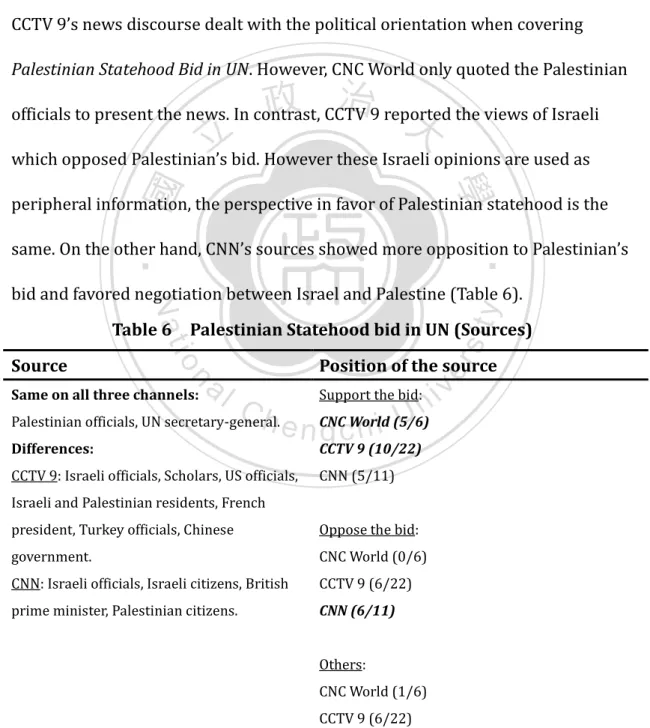
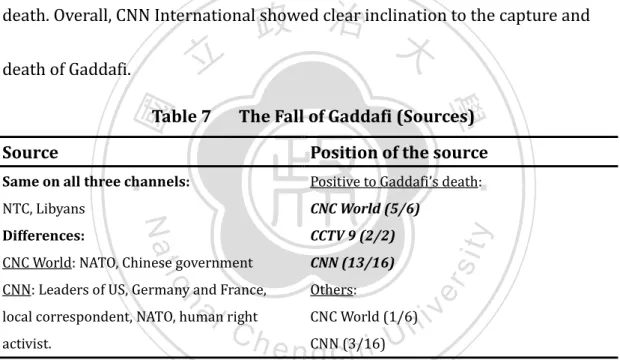
(41) Economist devoted a total of 33 headline stories on China. These 33 issues or events fall under four categories: China’s politics, economy, social conditions and China’s comments on international news events involving China. Of the 33 events, 3 are of the nature of a news incident rather than investigative reporting on China. Among these 3 events, the “China’s Libyan dilemma” stories are already included for analysis, the other two are thus chosen as well. They are: (1) The Yuan Abroad: Rise of the Redback – China’s currency policy (The Economist, Oct. 8) (2) Tension of South China Sea (Time, Aug. 22). 政 治 大. 立. ‧ 國. 學. In the end, a total of seven truly globally significant events are selected for. ‧. analysis. These events are briefly summarized as follows:. y. Nat. South China Sea Dispute between China and Vietnam: The tension between China. sit. n. al. er. io. and the Southeast Asia countries over South China Sea has caused great alarms. In June, two Chinese fishing boats twice cut the cables of a Vietnam oil exploring vessel which caused the serious protest from Vietnam. (The New York Times, 2011) The sample period is from June 1 to June 30.. Ch. engchi. i n U. v. US Currency Bill on China: In October 2011, suspecting that China manipulates its currency, the US Senate passed a currency bill on China with retaliatory tariffs. The US urged China to use nominal appreciation to rebalance the Chinese and global economies (The Economist, 2011). The sample period is from Oct. 1 to Oct. 31.. Palestinian Statehood Bid in UN: With the Mideast peace process as moribund as it has ever been, the leaders of the Palestinian Authority chose to appeal directly to the United Nations in their pursuit of statehood in September (Time, 2011). The sample period is from Sep. 1 to Sep. 30.. The Fall of Gaddafi: The four-decade-long dictatorial rule of Muammar Gaddafi was overthrown by Libyans in October 2011. On Oct. 20, Gaddafi was captured and 41.
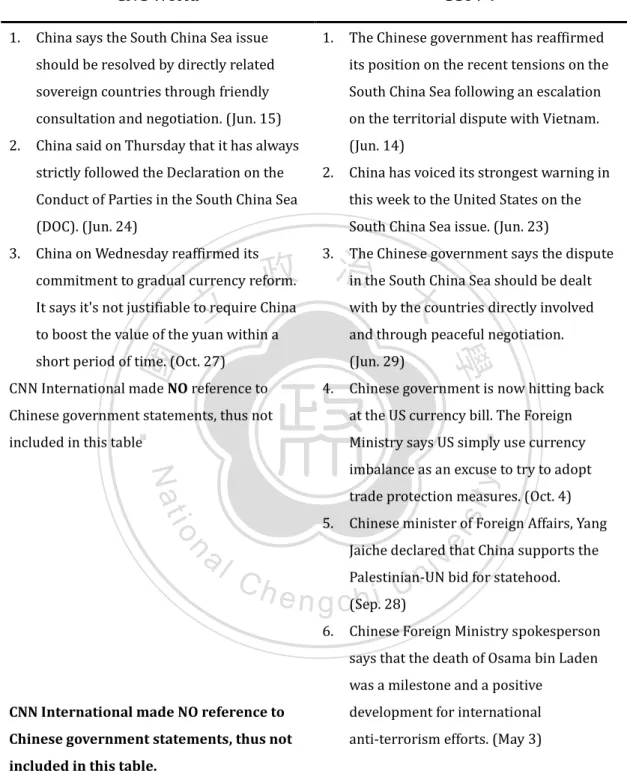
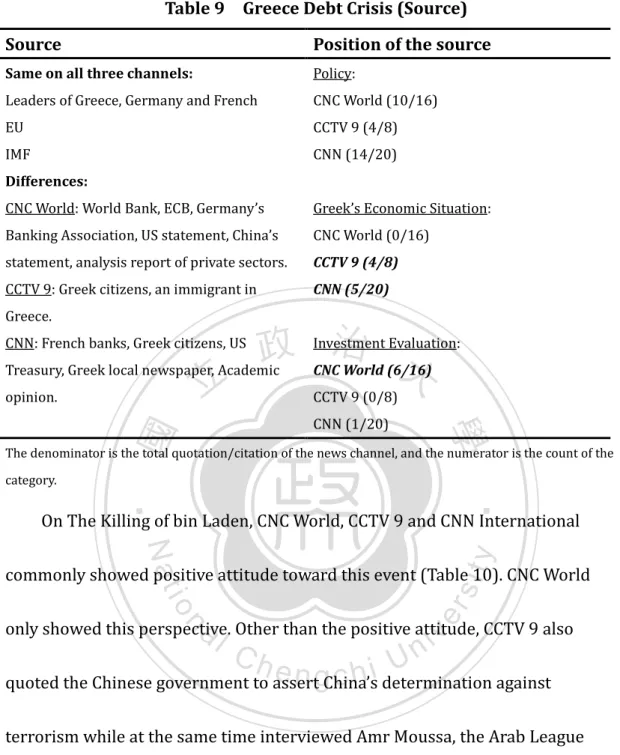
(42) killed by rebels, who also his body on display. (Time, 2011) The sample period is Oct. 21 to Oct. 22.. Arab Spring in Egypt: Starting from 2010, a revolutionary wave emerged in the Arabic world. In the beginning of 2011, inspired by the success of Tunisian protest for civil rights, Egyptian protests unfolded against the long-ruling President, Hosni Mubarak. Mubarak stepped down on 11 February, 2011 (Time, 2011). The sample period is from the burst out of Egypt protest on Jan. 26 to the day of Hosni Mubarak’s resignation on Feb. 12. Greece Debt Crisis: In the second half year of 2011, Greece's bankruptcy unfolded the financial crisis of eruozone. With the evolution of the crisis, Ireland, Portugal, Italy and Spain in turn released each’s excessive government debt (Time, 2011). This. 政 治 大 erupt, to represent the still evolving European financial crisis. And to Greek debt 立 crisis, September 2011 was the most crucial month because it was then that Greece thesis has chosen for analysis the Greek debt crisis, the most severe and the first to. ‧ 國. 學. went bankrupt and the eurozone started to get overwhelmed by protests, austerity plans and bailout meeting (CNC World, 2011). The sample period is from Sep. 1 to. ‧. Sep. 30.. y. Nat. The Killing of Osama bin Laden: On May 1, 2011, the US president Barack Obama. sit. n. al. er. io. announced from the White House, the killing of Osama bin Laden, the U.S.'s most wanted foe who mentor minded the 911 attack. (Time, 2011) The sample period is from May 2 to May 3.. Ch. engchi. i n U. v. The seven incidents above include both economic and political issues involving China to different degrees. Among them, South China Sea Dispute between China and Vietnam and US Currency Bill on China are of close interest to China. The former involves China’s assertion of territory and sovereignty in the Southeast Asia region which is of geopolitical and military significance. The latter is an economic issue, and the currency and exchange rate debate between the US and China has been the top agenda since 2009 (S & ED, 2009). With China’s rise of status in the international society, she has been 42.
(43) asked to take greater responsibility for the macroeconomic stability and follow the international monetary rule. This thesis assumes that the two Chinese international news channels, CNC World and CCTV 9, when reporting the two issues, will show more discrepancies with the Western channel, CNN International. Further, for the other five news topics, according to the Library of US Congress Studies (2004), Chinese leaders tend to view China as an integrator of the Third World, and China has involved in the foreign. 政 治 大. affairs of the developing countries by military or peaceful means such as trade favors or. 立. joint ventures. China has a near-alliance with the Islamic and Arabic countries, and. ‧ 國. 學. inclines to show sympathy toward the Palestine statehood in UN and support to the. ‧. regimes of Egypt and Libya. In such topics, there might be differences existing among. Nat. io. sit. y. the three channels. As to the financial crisis in Europe and the Killing of bin Laden,. er. which are highly relevant to the Western hegemonies but peripheral to China, this thesis. al. n. v i n C two assumes that the coverage of these reveal more accordance among the h eissues n gwill chi U three chose channels.. 3.3 Discourse Analysis Discourse, deemed as the bridge linking the society and cognition, has been approached by various disciplines, including linguistics, psychology and sociology (Brown; & Yule, 1989; Dijk, 1983). According to Alexander et al. (1987), language use, verbal interaction, and communication belong to the micro-level of 43.
(44) the social order, while power, dominance and hegemony are terms that belong to macro-level analysis. The purpose of discourse analysis is to bridge the gap between micro and macro approaches. In 1970s, the study of “texts” or “discourses” has benefited from linguistics, semiotics, psychology sociology and anthropology. Communication, as social science, places its emphasis of discourse analysis on the language use in a communicative act or piece. It is to examine the. 政 治 大. structure of social interaction manifested in conversation and textual. 立. descriptions which are results of the social context. According to Brown and Yule. ‧ 國. 學. (1989), communication is a process of relentless information producing and. ‧. interpreting, it is people who are involved in the production of information, and. Nat. n. al. Ch. er. io. people are in. Sociolinguist Labov (1972) elaborates:. sit. y. hence the communicative discourse reflects the communicative context which. i n U. v. the language system and language use are not autonomous but inextricably related to the interactional functions and the social context of communication; language and discourse forms thus mark or indicated their relevant social parameters and are treated as manifestation of social action of a specific kind (p.54, 55).. engchi. Discourses, as can be seen, are integral parts of communicative acts in specific sociocultural situation rather than isolated linguistic objects. Theorizing on discourse of news, Van Dijk (1983) has noted that news is not simply a description of the facts, but rather construction and reconstruction of reality which contain the norms and values of the society. News discourse 44.
(45) consists of shared belief about a society. The three major players, news sources, journalist, and audience are linked to one another by the news discourse. When journalists are producing the news text, their selection of words might reveal the social forces that direct the piece in a particular direction. Those social forces mainly come from three aspects: (a) the guidance of professional working theories and organizational constraint; (b) rules, conventions, rituals and. 政 治 大. structures of news discourse; and (c) anticipated audience interpretation (Gans,. 立. 1979; Tuckman, 1978). In other words, news text does not exist in vacuum but. ‧ 國. 學. rather is a practice constructed by social and political forces. Dijk notes:. ‧. Media discourse should not be seen merely as a ready “product” of news-gathering activities, but as the manifestation of a complex process in which knowledge, beliefs and opinions are matched with existing or incoming. y. Nat. sit. n. al. er. io. information about events, the social context of news production ,and representation of the reading public (Dijk, 1983, p. 28).. i n U. v. News messages often contain traces of the current social context and hence in. Ch. engchi. communication field, discourse analysis works as an effective research method to recognize the implicit ideologies of the present through the observation of the communicative discourse of news material. A central belief in the work of discourse is that of power. Choices of words and how the issue is discussed in the news are not trivial matters (Pan & Kosicki, 1993). In fact, how the news is framed holds great power in determining what the agenda is for the context and providing the handy tool for discussion. Such 45.
(46) power is not absolute or definitely obvious. Media are themselves a source of power resources. Gramsci (1996) coined the concept of “hegemony” to indicate that the control power is integrated in laws, social norms, habits, rules or general consensus and news uses symbolic devices to gain legitimacy and strive toward consensus. Analyzing news discourse is a way to analyzing the social power which attempted to control the mind and action of public through influencing their knowledge and opinion.. 立. 政 治 大. News frame is one of the key elements of news discourses. A frame is the. ‧ 國. 學. constructed theme contained or implied in a news text. Although in the circular. ‧. process of communication, the audience’s comprehension about a news. Nat. io. sit. y. discourse varies, the indicated frame device has the ability of directing attention. er. and focusing the perspectives available to audiences. Pan and Kosicki (1993). al. n. v i n synthesized that there are fourCdimensions U device: syntactical h e n g cofhthei frame. structure, script structure, thematic structure and rhetorical structure. Among the four devices, the syntactical structure is useful to evaluate the level of “objectivity” which is the mainstream professional conventions in news, because the sentences as a unit of a news piece indicate the dominant power or preference behind the scene, the analysis of syntactical structure includes examining the validity and facticity of quotes and citations, how the news 46.
(47) presenting authority and official source and also the marginalization of certain points of view by relating a quote or point of view to a social deviant or so(Hacket, 1984; Pan & Kosicki, 1993). Hence, to exercise discourse analysis, it is useful to employ the syntactical frame device if one intends to look into the level of objectivity. In other words, to perform discourse analysis, the target news texts should be first divided into practical frame units. Television news, as Reuven. 政 治 大. Frank, a former manager at NBC, suggests, is expected to hold the immediate. 立. interest of extensive audience, the form should be constructed in a very definite. ‧ 國. 學. order, there is an explicit tempo of “a beginning, middle and end” (Epstein, 2000).. ‧. And Thompson further articulates the structure with more specific sub divisions,. Nat. io. sit. y. that is, television news consists of five main substances: headline, straight read of. er. the presenter, voice pieces or interview clips, pictures and the commentary. al. n. v i n (Thompson, 2010). These fiveC substances serve as the basic structure of h e n gtogether chi U television news discourse. Television news summarizes the reality into a roughly three-minute flashing of images with audio aid. Each of the five major elements of Thompson’s TV news structure serves as a framing mechanism intending to guide the audience to perceive reality within the frame or frames constructed by visual and textual information. Adapting Thompson’s television news structure, the thesis will 47.
(48) analyze news discourse of the chosen 7 issues on CNN, CNC World and CCTV-9, in terms of: (1) headline; (2) the first sentence of the straight read of the presenter; (3) the source of interviewee or quotation or citation; (4) pictures and (5) the commentary. Headline, the first sentence of the oral reporting and commentary serve as summaries of the news which encapsulate the story (Thompson, 2010), the interview clips contains quotations and citations of the news source which. 政 治 大. have been filtered by the news editorial, and hence, who is interviewed or quoted. 立. implies the frame preference of the news channel. Besides, comparing with. ‧ 國. 學. printed media, television news’ impact comes from the visual power, so what the. ‧. news channels present the news with visual information is also the focus for. Nat. io. sit. y. analysis. But television news contains sequent takes of numerous pictures which. er. defy quantification. However, the continuing images and the text information on. al. n. v i n C h they are either the screen do not function separately, e n g c h i Ucomplementary or. irrelevant. Since the headline text represents the theme of the news or the preferred reading of the news, the running images should be presented and narrated in such a way to coincide with the headline text. It is thus of interest and significance to see whether the running images resonate or contradict the headline text. Helping to measure the implicit frames contained in the images projected on the screen, this technique can unearth information about the 48.
(49) reporting by CNC World, CCTV 9 and CNN International in their respective coverage of the chosen seven events of global impact and Chinese relevance. Such data, to be presented in the following chapter, form an important and integral part addressing the thesis’s research questions.. 立. 政 治 大. ‧. ‧ 國. 學. n. er. io. sit. y. Nat. al. Ch. engchi. 49. i n U. v.
(50) Chapter 4 Findings In total, 132 news clips of the chosen seven global issues during the study period are collected for analysis. As the archive data are sometimes incomplete, 8 news clips’ first read of the anchor of CNN International were missing. The body of these news items, however, remain available for analysis. Overall, the quantity of the news items carried by each news channel on the. 治 政 selected events is rather varied with notable discrepancies 大 (Table 1). 立 Table 1. Number of News Items on CCTV 9. CNN International. 4. 5. 1. 8. v ni. 5. 4. 13. 5. 5. 3. 7. 10. 7. 12. Greece Debt Crisis. 7. 5. 10. The Killing of Osama bin Laden. 2. 6. 8. South China Sea Dispute between China. io. sit. y. Nat. and Vietnam. ‧. CNC World. er. ‧ 國. 學. CNC World, CCTV 9 and CNN International. US Currency Bill on China. n. al. Ch. Palestinian Statehood bid in UN. e n g c h5i U. The Fall of Gaddafi. Arab Spring in Egypt. 50.
數據



+6

相關文件
Therefore, the “Buddhism for this World” is a movement, in certain aspects, of “returning to the India’s primitive Buddhism and early Mahāyāna Buddhism.” The proposing of
In this paper, through analysis and researching materials on the history of Chinese Buddhist scriptures and music, the author illustrates the characteristics of both sacred
6 《中論·觀因緣品》,《佛藏要籍選刊》第 9 冊,上海古籍出版社 1994 年版,第 1
Teachers may consider the school’s aims and conditions or even the language environment to select the most appropriate approach according to students’ need and ability; or develop
another direction of world volume appears and resulting theory becomes (1+5)D Moreover, in this case, we can read the string coupling from the gauge field and this enables us to
In addition to examining the influence that the teachings of Zen had on Shi Tao’s art and theoretical system, this paper proposes further studies on Shi Tao’s interpretation on
This study will base on the perspective of the philological education to discuss 788 characters that were commonly used in the daily life of the early Tang era, for highlighting
Through a critical examination of some Chinese Christian intellectuals’ discussion on the indigenization of Christianity in China, this paper attempts to show that Chinese
