內隱的權力與特權偏見:澳門小學常識教科書的內容
分析
謝金枝 澳門大學教育學院助理教授 臺灣教育評論學會會員摘要
本研究旨在分析澳門中文學校小學常識教科書中的人物圖片所可能隱含的 權力、特權的訊息,以及因性別、種族及障礙情況而產生的偏見。文中分析的常 識教科書是 2009 年由香港教育出版社出版的「澳門今日常識」,提供給澳門的中 文小學採用,每個年級有上、下兩冊,共 12 冊。本研究發現,所分析的教科書 中的人物圖片呈現以男性、華人及健全人為中心的偏見。在性別角色方面,男性 被視為是強壯、有權力及成功的意象;而女性則較以家庭為主,負責採買及準備 三餐,並且較常扮演關心者的角色,但同時也是需要被保護的。教科書的內容影 響學生的認知、思考及對世界的看法,為避免兒童把教科書中含有偏見的關係結 構視為理所當然,必須重視人物圖片呈現的均衡代表性。關鍵詞:
教科書;內容分析;小學教育;澳門
Invisible Biases of
Power and Privilege: a content
analysis of General Studies textbooks in primary
schools in Macao
Jin Jy Shieh
Assistant Professor, Faculty of Education, University of Macau, Member of Association for Taiwan Educational Review
Abstract
This study aims to uncover the hidden messages of power and privilege conveyed in the pictures of textbooks, with a particular focus on whether gender, race and disability biases are still present in the 12 General Studies textbooks which were published in 2009 by Educational Publishing House in Hong Kong and have been widely used from grades 1 to 6 by many primary schools in Macao. The results suggest that negative bias towards diverse groups still exists in the General Studies textbooks of Macao primary schools, including male-dominant, Chinese-centered and able-bodied-centered stereotypes. In addition, sex stereotypes exist with the image that males should be strong, powerful and successful, but females should focus on family, cooking and shopping and being attentive and protective. Since textbooks influence what students know, think, and their way of seeing and making sense of the world, it is vital to modify the current General Studies textbooks carefully to avoid young learners taking the unequal structure of relationships for granted.
Introduction
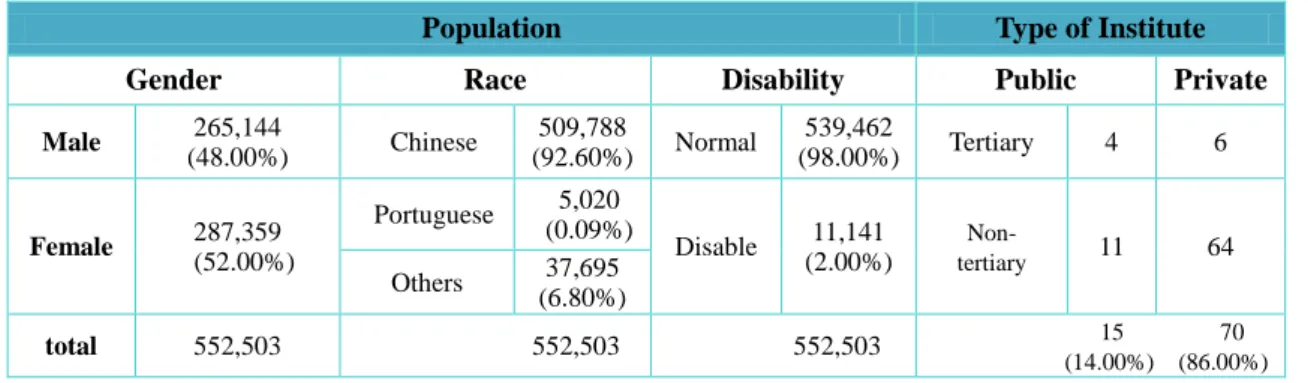
Macao is a Special Administrative Region of the People's Republic of China which is located in Guangdong province, on the western bank of the Pearl River Delta. Macao has an area of 29.9 sq. km, comprised of the Macau Peninsula 9.3 sq. km, the islands of Taipa (7.4 sq. km) and Coloane (7.6 sq. km) and the reclaimed area COTAI (5.6 sq. km)(Macau Government Tourist Office, 2012). The total population of Macau is estimated at around 552,503, with 92.60% ethnic Chinese, 0.09% Portuguese, and 6.80% others, including European and other nationalities (Macau Government Tourist Office, 2012; Government of Macao Special Administrative Region Statistics and Census Service, 2012). 52.00% of population is female, and 48.00% of population is male. Able-bodied people are majority, comprising 98.00% of the population, while persons with disability occupy 2.00% of the population. Chinese and Portuguese are the official languages. Macao does not have its own universal education system: 86.00% of schools are private (70 schools), while 14.00% are public (15 schools) (Government of Macao Special Administrative Region Statistics and Census Service, 2013) as shown in Table 1.
Table 1: General features of Macao’s population and institutions
Population Type of Institute
Gender Race Disability Public Private
Male 265,144 (48.00%) Chinese 509,788 (92.60%) Normal 539,462 (98.00%) Tertiary 4 6 Female 287,359 (52.00%) Portuguese 5,020 (0.09%) Disable 11,141 (2.00%) Non- tertiary 11 64 Others 37,695 (6.80%) total 552,503 552,503 552,503 15 70 (14.00%) (86.00%)
Macao was a former Portuguese colony. The policy of educational management under the Portuguese government used to be more focused on the Luso-Chinese schools which were publicly-managed, with a laissez-faire attitude to private schools (Feng, 1999). According to Feng (1999), the policy that favored public schools but ignored private schools, made Macao’s private schools diversified and dominant. Even today, there has been no fundamental change in this. Private schools in Macao have absolute freedom to set up their own school policy, and select classroom
textbooks for their school teachers (Guo, 2004; Yang, 2006). However, due to a small textbook market, schools in Macao don’t have the textbooks published by local publishers (Guo, 2004). Also a heavy teaching load made Macao teachers difficult to develop curriculum and teaching materials (Guo, 2004). Hence, schools in Macao often import textbooks from overseas, including Hong Kong, Taiwan and Mainland China depending on the school’s preference. According to a recent survey, the textbooks that Macao’s school teachers used in pre-primary and primary education were imported mainly from Hong Kong, with approximately 76.90% of the texts (Education and Youth Affairs Bureau, 2008 ; Guo, 2004). In Macao, most Chinese primary schools select textbooks of General Studies which were published by Educational Publishing House in Hong Kong. The main reason for choosing textbooks published in Hong Kong is because that Hong Kong and Macao share the same language, similar culture and background, as well as having similar subjects for primary schools (Chang, 1993). Also, they are very close to each other in terms of the geographic location (Chang, 1993). Interestingly, the Educational Publishing House in Hong Kong also publishes General Studies textbooks for its local primary schools, and it appeared that some parts of content were completely the same in both the Macao’s and Hong Kong’s versions although they were offered for two different regions.
Due to the reasons mentioned above, I have been very interested in finding out what content the textbook editors in Hong Kong would select when they edited textbooks for Macao’s schools, especially the frequency of presentation of different races, genders and disabilities. It was decided to focus on pictures of human beings because pictures mean more than words, and are easier for young pupils with limited ability of cognition to understand. Pictures often contain abundant information, affecting pupil’s way of thinking, behaving and, above all, their value-system (Chambliss & Calfee, 1998; Giordano, 2003; Nicholls, 2006; Provenzo, Shaver & Bello, 2011; Sleeter & Grant, 2011). Therefore, for the purpose of uncovering invisible biases conveyed in the pictures, I will specially examine issues in relation to the notions of power and privilege which might result in inequities by bias representations in textbook pictures.
conveyed in the pictures of textbooks, with a particular focus on whether gender, race and disability biases are still present in the 12 General Studies textbooks of Macao primary schools, which were published in 2009 by Educational Publishing House in Hong Kong and have been widely used from grades 1 to 6 by many primary schools in Macao nowadays.
Literature Review
This section will look at the literature in relation to concepts and relations between power, privilege, ideology and textbooks as well as some major research studies in relation to textbooks, privilege, and power.
Power, privilege, ideology and textbooks
The word “power” means the possibility of individuals or groups of carrying out their will, which in turn, affects the extent of the distribution of social resources, while “privilege” refers to the degree of distribution of social resources that individuals or groups are able to retain and control (Lenski, 1966). The level of privilege has something to do with the characteristics of individuals or groups which people perceive, regardless of whether the perceptions are accurate (Lechuga, Clerc & Howell, 2009). The notions of “power” and “privilege”, however, are interrelated in nature, and affect each other. Quite often, members of the privileged group of society dominate positions of power, and influence the determination of cultural norms, modes of thought, as well as behavioral norms (Lechuga, Clerc & Howell, 2009). Through the process of exercising power and privilege, groups which society centers on, are likely to make efforts to influence social and educational policies as well as curriculum content, and eventually, retain significant power and privilege for their own group. On the contrary, members of less privileged groups are overlooked, giving the impression that they are not of importance. For instance, males are seen as members of privileged groups, they are in the heart of a society and make the male-centered value a standard form of value for society (Lechuga, Clerc & Howell, 2009), while females on the other hand are often left marginalized. Another example, in terms of race and region, is that white people are seen as superior to blacks, while locals are perceived better than immigrants (Lenski, 1966). In other words, privilege,
in fact, is a function of power which is a major factor in determining the distribution of social surplus and service (Lenski, 1966).
However it is inevitable for society to differentiate groups according to race, ethics, religion, region and gender (Lenski, 1966). The degree of ownership of power and privilege directly affects the amount that group members receive from social distribution. If the way to differentiate groups is just, without prejudices and biases, we will take it for granted that groups with different characteristics would receive an obvious portion of the distribution of social resources. But, in reality, research has discovered that the way of differentiating social groups is related to the issues of power and privilege. In order to maintain their dominant position and benefit, people with strong power and great privilege, make their intentions invisible through an ideology, then, through the most powerful instrument - textbooks, pass on certain mode of thought to the younger generations, reproducing the structure of relations between different groups (Anyon, 2011; Apple, 1990,1991; Burstyn & Corrigan, 2011; Lenski, 1966; Luke, 1988; Sleeter & Grant, 2011).
Most people agree that the textbook is a powerful tool for transmitting ideology because almost every one regards what has been included in the content of textbooks as being authoritative, objective, neutral, and legitimate (Sleeter & Grant, 2011). However, the content of textbooks is not objective at all; it often serves the interests of powerful groups within society (Sleeter & Grant, 2011). Many scholars (Giordano, 2003; Nicholls, 2006; Provenzo, Shaver & Bello, 2011; Sleeter & Grant, 2011) have found that textbooks contain an ideology which covers an unequal structure of relationships, projecting specific views and interests of powerful and privileged groups. The ideology implied in textbooks is sometimes distorted by the privileged groups on purpose, to transmit in a form of invisible assumption to achieve the specific group’s goals in reproducing social status. Research evidence indicates that textbooks have been playing a critical role in education historically, and will continue to be at the heart of schooling in the 21st century (Albach, 1991; Chambliss & Calfee, 1998; Henson, 2010; Sleeter & Grant, 2011; Westbury, 1990; Woodward & Elliott, 1990). Textbooks are not only used widely in classrooms, but have also been recognized to have powerful impact on what students learn and think (Chambliss & Calfee, 1998). Moreover, textbooks affect students’ views on the reality of society,
limit students to think and behave in a certain way that privileged groups favor, thus keeping them away from thinking other alternative ways of life (Giordano, 2003; Nicholls, 2006; Provenzo, Shaver & Bello, 2011; Sleeter & Grant, 2011). As a result, textbooks become a tool for privileged groups to maintain their superior position and status. Eventually, they look down upon less privileged groups, reproducing the unequal condition on and on (Anyon, 2011; Apple, 1990, 1991; Lenski, 1966; Pinto & Coulson, 2011; Sleeter & Grant, 2011).
With the emphasis on social justice and fairness, however, the issues related to ideology and prejudices have received considerable attention. For example, Giordano (2003) pointed out that the development of the 20th century textbooks has gone through six different eras, namely: business, nationalistic, racial, gender, religious and learning tools. Each era indicates an effort to deal with issues raised from textbooks. In addition, a number of practical studies focusing on content analysis of textbooks have been conducted. The results have aroused the awareness of rectifying the presentation of content of textbooks (Anyon, 2011;Burstyn & Corrigan, 2011; Decharms & Moeller, 2011; Lechuga, Clerc & Howell, 2009; Mclntosh, 2009; Nasser & Nasser, 2008; Pinto & Coulson, 2011; Provenzo, Jr., 2011; Schneider, 2009; Thornton, 2009). To be fair, the representation of content of textbooks are now more balanced than in the past, with more diverse groups included (Nasser & Nasser, 2008). Yet, for the 21st century that emphasizes globalization, liberation, fairness, social justice and creativity, is the content of contemporary textbooks still projecting views, norms and values of privileged groups, letting groups with less privileges to be deemed as unimportant? Is the presentation of content in the 21st centurial textbooks used still illustrating male-centered values and stereotypes? There is a need to examine the presentation of content of textbooks published recently to find out the possible issues in relation to ideology. In so doing, the users of textbooks could raise questions for discussion in classrooms to liberate students’ way of seeing different groups in society and construct a more equal society for the coming generations.
Major studies in relation to textbooks, privilege, and power
This section will look at the work of recent researchers on the issues of textbooks. Many researchers think highly of the importance of textbooks and their
relation to power and privilege, especially by analyzing their content to uncover the issue of inequity in different groups, such as racial, gender, and religious groups. For the purpose of clarity, I summarize some relevant studies in Table 2.
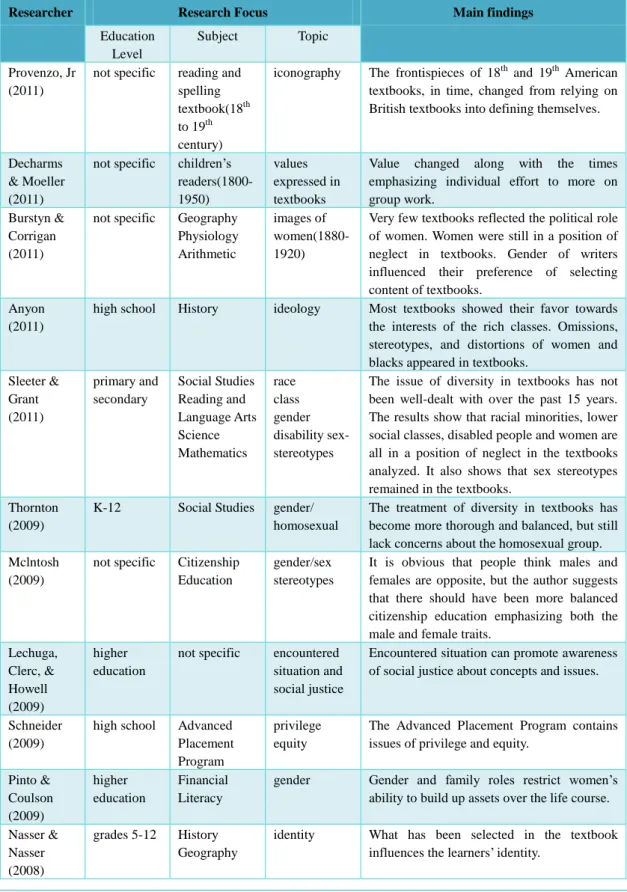
Table 2: Summary of the work of recent researchers on the issues of textbooks
Researcher Research Focus Main findings
Education Level
Subject Topic
Provenzo, Jr (2011)
not specific reading and spelling textbook(18th to 19th century)
iconography The frontispieces of 18th and 19th American textbooks, in time, changed from relying on British textbooks into defining themselves.
Decharms & Moeller (2011)
not specific children’s readers(1800-1950)
values expressed in textbooks
Value changed along with the times emphasizing individual effort to more on group work.
Burstyn & Corrigan (2011)
not specific Geography Physiology Arithmetic
images of women(1880-1920)
Very few textbooks reflected the political role of women. Women were still in a position of neglect in textbooks. Gender of writers influenced their preference of selecting content of textbooks.
Anyon (2011)
high school History ideology Most textbooks showed their favor towards the interests of the rich classes. Omissions, stereotypes, and distortions of women and blacks appeared in textbooks.
Sleeter & Grant (2011) primary and secondary Social Studies Reading and Language Arts Science Mathematics race class gender disability sex- stereotypes
The issue of diversity in textbooks has not been well-dealt with over the past 15 years. The results show that racial minorities, lower social classes, disabled people and women are all in a position of neglect in the textbooks analyzed. It also shows that sex stereotypes remained in the textbooks.
Thornton (2009)
K-12 Social Studies gender/ homosexual
The treatment of diversity in textbooks has become more thorough and balanced, but still lack concerns about the homosexual group. Mclntosh
(2009)
not specific Citizenship Education
gender/sex stereotypes
It is obvious that people think males and females are opposite, but the author suggests that there should have been more balanced citizenship education emphasizing both the male and female traits.
Lechuga, Clerc, & Howell (2009) higher education
not specific encountered situation and social justice
Encountered situation can promote awareness of social justice about concepts and issues.
Schneider (2009)
high school Advanced Placement Program
privilege equity
The Advanced Placement Program contains issues of privilege and equity.
Pinto & Coulson (2009) higher education Financial Literacy
gender Gender and family roles restrict women’s ability to build up assets over the life course.
Nasser & Nasser (2008)
grades 5-12 History Geography
identity What has been selected in the textbook influences the learners’ identity.
It can be seen from Table 2 that most textbooks which have been analyzed were used as part of the school curriculum. Almost all the educational levels have been included, from pre-primary to higher education. History and social studies textbooks seem to be most popular amongst researchers in the past and even today because their content is often seen as a tool to convey ideology that would favor certain social groups. However, more and more subjects have been analyzed by researchers recently, including science, mathematics, reading and language arts, geography, and so on. In terms of issues being examined, ideology, identity, group bias such as race, gender, social class, disability and sexual stereotypes, as well as the design and practice of activities to raise the awareness of social inequality, catch the researchers’ eyes.
The methods adopted for analyzing the text includes both qualitative and quantitative ones. The former is usually used to analyze the textbooks that comprise more written text than pictures, while the later might calculate the frequency of pictures represented in the textbooks. All in all, research studies with respect to textbooks, power and privilege show that, as Sleeter and Grant (2011, p. 183) pointed out, “the racial, social, gender, and disability inequalities that exist in school curricula have not changed much since 1990s”. Furthermore, it seems to be still the reality nowadays that white, male, and able-bodied people are in a dominant position in society, while, on the contrary, non-white, female and disabled people have a disadvantaged status.
In addition to the research studies in relation to textbooks, power and privilege, there are still others doing research in the area of theory. Butterfield, Demos, Grant, Moy, and Perez (1979, p. 389, cited from Giordano, 2003, p.76), for example, have developed a checklist making use of eleven criteria for detecting biased material. That is, in textbooks, children have the right to encounter:
1. Themselves, equally portrayed by race and sex;
2. Themselves, with positive role models, in non-stereotyping roles;
3. Themselves and adults of their own race and sex in decision-making and authoritative roles;
4. Themselves, in a variety of socioeconomic backgrounds and settings;
5.National and international stories which represent traditional and contemporary cultures in a variety of settings;
6. Two or more minority groups interacting within a story;
7. Diversity of color within racial groups in the illustrations;
8. Illustrations that reflect the growth patterns of children;
9. More than one language being spoken;
10. A proportionate number of students with handicapping conditions;
11.Accurate, active and positive portrayals of elderly persons and folktales representing ethnic groups.
Another well-known scholar, Lenski (1966, p.405), has elaborated the nature of power and privilege and goes on to explain the reasons that make females a disadvantaged state. He argued that firstly, the characteristics in physiology of women such as pregnancy, menopause, and menstruation may pose obstacles “in the intense competition for the more rewarding jobs”; secondly, “the traditional family system placed the primary responsibility on the wife”, asking her to be responsible for major housework, including preparing meals and doing the shopping; thirdly, the situation that “women have not been as successful as men on the average in the job world” makes women candidates more often to be rejected by “those who control access to such key resources as graduate fellowships or admission to industrial training programs”. Due to those reasons, “most women stop seeking for success in the world of work, economics and politics instead of relying on family”, thus results in a situation of inequality. Similarly, Pinto & Coulson (2009, p. 69) also suggested that “gender and family role restrict women’s ability to build up assets over the life course”.
Research methodology
This study aims to uncover the hidden messages of power and privilege conveyed in the pictures of textbooks, with a particular focus on whether gender, race and disability biases are still present in the 12 General Studies textbooks of Macao primary schools, which were published in 2009 by Educational Publishing House in Hong Kong and have been widely used from grades 1 to 6 by many primary schools in Macao nowadays.
This study adopted the “content analysis” approach because it is thought to be an appropriate method for the research purpose in accordance with what Weber (1985, p.9-10) has suggested, namely that:
Content analysis is a research methodology that utilized a set of procedures to make valid inferences from text. These inferences are about the sender of message, the message itself, or the audience of the message. Content analysis yields unobtrusive measures in which neither the sender nor the receiver of the message is aware that it is being analyzed.
In view of the situation that ideology which might convey an unequal relationship of social groups is often invisible, and that the sender and the audience of the message may not even be aware of it, content analysis should be the most suitable method for the purpose of uncovering the ideology implied in the textbook.
In seeking to raise the quality of content analysis, various ways to ensure a high degree of reliability including stability, reproducibility and accuracy, have been designed and implemented in this study. In order to increase the stability of the analysis, Weber (1985) recommends researchers to code the same text more than once by the same coder. Before I conducted the formal analysis of the textbooks, I coded 4 units included in the first volume of the textbook twice within a month by using the coding frames as demonstrated in Table 3 and 4.
Table 3: The coding frame for content analysis of gender, race and disability
Volume Unit
Gender Race Disability
Male Female Ambiguous Chinese Portuguese Others Able Disable Others
Table 4: The coding frame for content analysis of occupation, housework and leisure
Occupation Housework Leisure
Male Female Ambiguous Male Female Ambiguous Male Female Ambiguous
T N T N T N T N T N T N
Note. ‘T’ represents ‘Types of Occupation’, while ‘N’ indicates the ‘Frequency of Appearance’.
Table 3 is the coding frame for content analysis of gender, race and disability. In regard to the category of race, Chinese and Portuguese are emphasized because Macao used to be a Portuguese colony. There have been quite a few native Portuguese people that still live in Macao and take on important positions in the government sectors. In addition, Portuguese, even today, remains as one of the official language of Macao. When calculating the frequency of pictures represented in the textbooks, every picture of a unit was classified according to its categories of gender, race and disability at the same time. Therefore, the total number of pictures of gender, race and disability were the same. Table 4 is the coding frame for content analysis of occupation, housework and leisure. The way of calculating the frequency of pictures represented in the textbooks in terms of occupation, housework and leisure was based on the context of the picture. For pictures which were not belonged to any of those three categories, they would be classified into the category of "Ambiguous". During the coding process, researchers firstly listed out all types of the occupation, housework and leisure such as farmers, cooking and playing piano, and then calculated the frequency of appearance and identify which are male or female by either appearance.
For example, volume 1 contains four units, namely, “My Body”, “I Love My Home”, “My School” and “Amusement Park”. The result of the pilot analysis of gender showed that the correlation coefficient between two codings was .99. The set of data produced from the first coding was that 75, 71, 84, 29, 46, 70, 73 and 13, while the second coding produced the data set of 75, 72, 87, 30, 48, 70, 73 and 12. In
addition to stability, I also tested the reproducibility of the findings by asking one undergraduate to code the same unit - My Body, and then calculated the intercoder reliability. The pilot analysis of gender showed very positive correlation with my coding of 78 and 46 corresponding to 78 and 44 by the undergraduate student. This suggested that the analysis undertaken in this study would be highly reliable.
Based on the result of the pilot study, I was confident to invite the undergraduate student to code 8 volumes for grade 3 to 6, while I worked on 4 volumes for grade 1 and 2. The content analysis used in this study involved counting the frequencies of the presentation of the pictures in all 12 General Studies textbooks, categorized by gender (male, female and Ambiguous), race (Chinese, Portuguese and others) and disability (able, disabled and others). Furthermore, the sex stereotypes revealed in the occupations, house work and leisure in all 12 General Studies textbooks are also examined.
The classification of the pictures in terms of gender, race and disability was effected through two sided categories, namely female and male, able and disabled, Chinese and Portuguese. A third category (others/ambiguous) was created to include pictures that might be difficult to distinguish. For example, some pictures of new-born babies would be hard to tell the gender, so they were classified as “ambiguous”. Moreover, pictures analyzed in this study included photos from real life and pictures drawn by the textbook editors.
Results and Discussion
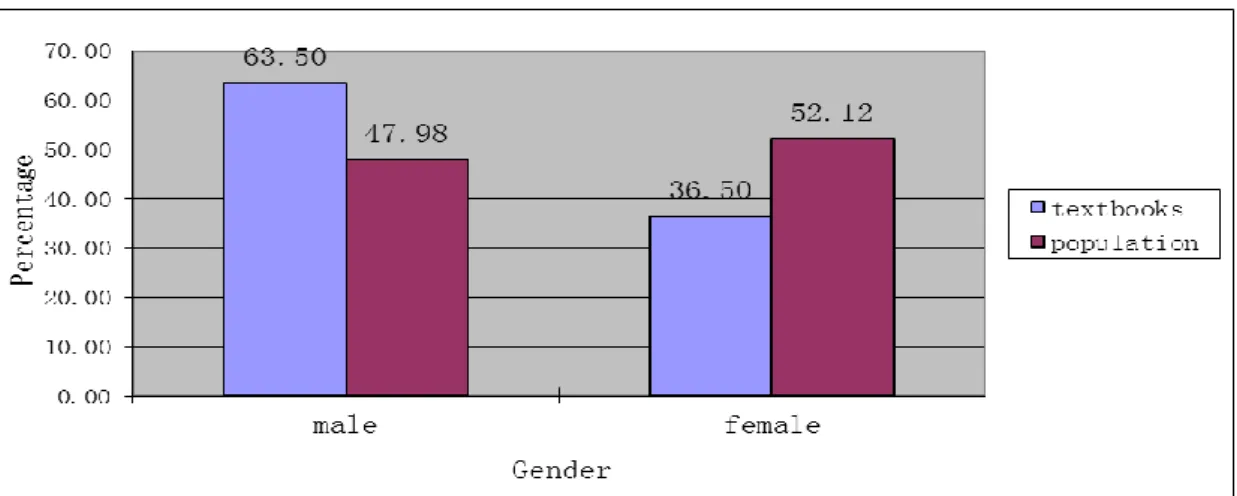
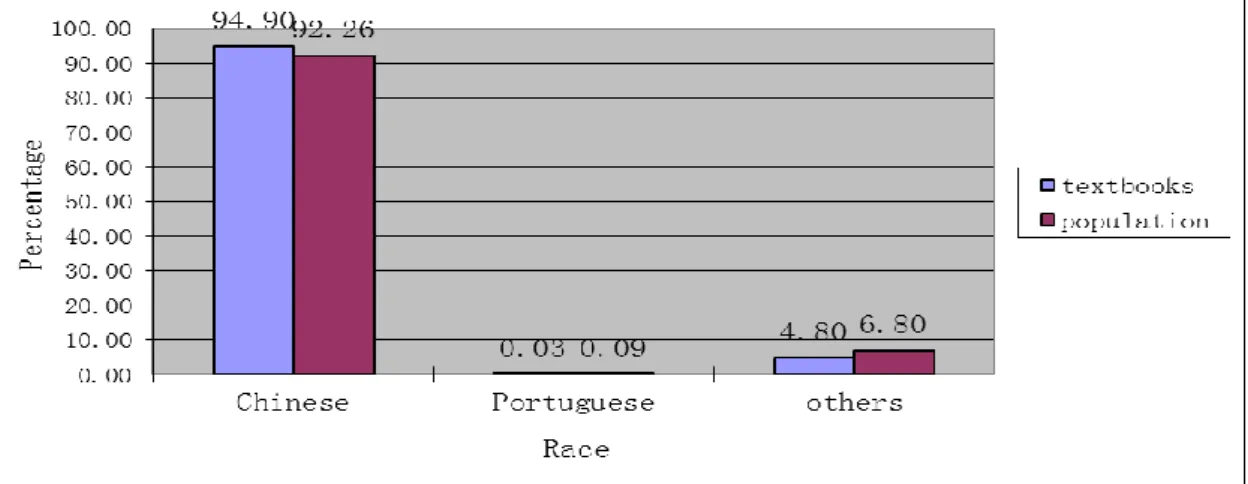
This section presents the results of this study, and discusses the findings in the light of previous studies in terms of gender, race, disability, and sex stereotypes. In order to further examine the relationship between the results of this study and the general population of Macao, both the results from this study and the composition of Macao’s population are displayed as Figure 1, 2 and 3. In addition, some qualitative analysis of pictures was made for the purpose of supporting the quantitative results.
Gender, Race and Disability
Figure 1, 2, 3 shows the overall results by gender, race and disability in this study compared with the general population of Macao. The results show that more males (63.50%) than females (36.50%) were represented in all of the 12 textbooks analyzed (approximately 2521/1451); and Chinese people occupy a very high percentage (95.00%) in the texts, while Portuguese and other races only feature approximately 5.00%. People with disability only appear about 0.40%. Moreover, Comparing both the results from this study and the composition of Macao’s population, it seems that the percentage of males (47.98%/63.50%), Chinese (92.26%/94.26%) and able-bodied (98.00%/99.60%) majority groups were all magnified, while the minority groups such as females (52.12%/36.50%), Portuguese (0.09%/0.03%) and other nationality (6.80%/4.80%) and disabled (2.00%/0.4%) persons were underestimated in textbooks. For example, the real percentage of distribution of gender in Macao’s population should be 52.12% of females and 47.98% of males, in other words, females in Macao society should be the majority group.
Figure 2: Percentage of appeared in textbooks and composition of population of Macao by race
Figure 3: Percentage of appeared in textbooks and composition of population of Macao by disability
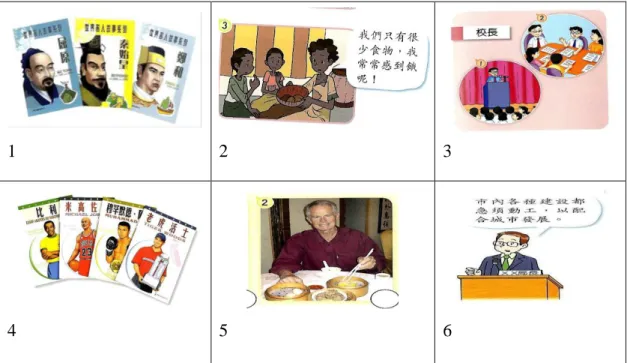
The results of this study seem to indicate that the presentation of content of the 12 textbooks analyzed still conveys a particular ideology, including traditional male-centered, Chinese-centered and able-bodied-centered values. In addition to the quantitative results, qualitative analysis of pictures also support the values of male-centered, Chinese-centered and able-bodied-centered. For example, in volume 3, when the content introduces the important people in the Chinese history, the picture particularly consists of only males including Qu Yuan, Qin Shihuang and Zheng He (see Figure 4, picture 1). Furthermore, in volume 5, when the content introduces the famous people in sports, the picture particularly consists of only males including Edson Arantes do Nascimento, Michael Jordon, Muhammad Ali and Tiger Woods (see
Figure 4, picture 2). Moreover, when the content introduces people holding important positions, the pictures usually appear only in men (see Figure 4, picture 3 & 6).
In view of what race appeared most in the textbooks, it was found that Chinese people take the subject position, while others remain in object position. For example, most non-Chinese people appeared in the textbooks show that they are either adjusting the way of living to more Chinese like (see Figure 4, picture 5), or they are poor or help-needed (see Figure 4, picture 2). The other races appeared in the textbooks are because they are related to Macao or the globe. For instance, they appeared in the unit of “Western Festival”, “"Global Village", “International Customs”, “Promoting Peace” and “Population and Food Issues”.
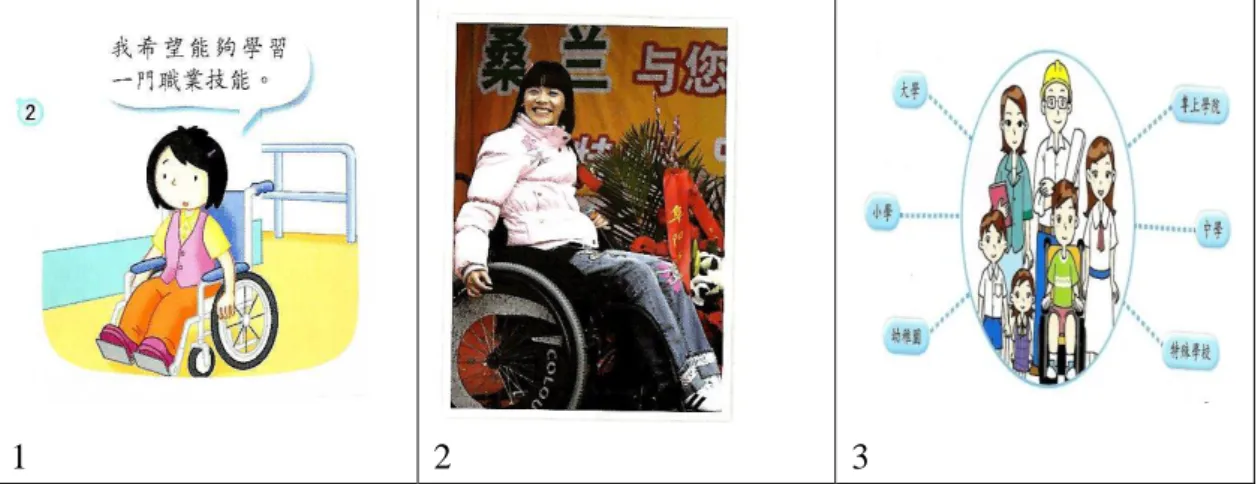
Interestingly, with respect to disability, not only is the percentage underrepresented, but the types of disability are limited to mainly physical disability (see Figure 5); the visually and hearing impaired only appeared once in all 12 textbooks.
1 2 3
4 5 6
Figure 4: Sample pictures of gender and race which appeared in textbooks
Note. 1 adopted from Volume 3 of General Studies, p.21; 2 adopted from Volume 12, p.65; 3 adopted
from Volume 2, p.61; 4 adopted from Volume 5, p.13; 5 adopted from Volume 7, p.15; 6 adopted from Volume 8, p.51.
Figure 5: Sample pictures of disability which appeared in textbooks
Note. 1 adopted from Volume 5 of General Studies, p.43; 2 adopted from Volume 7, p.49; 3 adopted
from Volume 7, p.20.
The findings of this study are consistent with those of Burstyn & Corrigan’s (2011), who found that women were still in a position of neglect in textbooks. Similarly, Anyon (2011) found that most textbooks analyzed “presented its favor to the interests of the moneyed classes. Omissions, stereotypes, and distortions that remain in updated social studies textbook accounts of Native Americans, Blacks, and women reflect the relative powerlessness of these groups”. Moreover, Sleeter & Grant (2011) also pointed out that racial minorities, lower social classes, disabled people and women were all in a position of neglect in textbooks. Although a great deal of studies about race discovered that white people were seen as superior to the blacks, and that locals were portrayed better than immigrants (Lenski, 1966), in fact, the message is that the majority group in a given society, regardless of race, gender and disability, is often the group who controls most of resources - power and privilege - , and dominates over other groups. However, the same situation happens in Macao, a Chinese-majority region. As we can see in this study, the representation of race in textbooks showed an extremely high percentage of Chinese people (94.90%), while others including Portuguese, occupy a very low percentage (4.93%). The results seem to remind us what Sleeter and Grant (2011, p.183) have said, that “the racial, social class, gender, and disability inequalities that exist in school curriculum have not changed much since 1990s”. One more point to be added is that, the textbook pictures analyzed in this study only presented two types of opposite sex, without any picture indicating homosexuality. This is also an issue that many textbook authors have not
noticed yet. Thornton (2009) argued that, even in the United States, the concerns about homosexual group were still being ignored.
Comparing both the results from this study and the composition of Macao’s population showed in Figure 1, 2, 3, however, what has been presented in the General Studies textbooks was still males-dominant, failing to reflect the actual reality. Burstyn and Corrigan’s (2011, p. 37) words are illuminative in this regard: “textbooks mirror society. They may distort, they may present only a segment of the whole picture. They provide one means of judging what a society wishes to pass on to its children”. Moreover, Provenzo, Shaver and Bello (2011, vii) explained that “the content of textbooks reflect the values and beliefs of the culture and historical period of which they are a part”. That is to say, the author of the textbook is not “just simply the individual who writes a text, but is part of a larger cultural discourse”. So, it might be not surprising to see inconsistency between the representation in textbooks and actual society. It just shows that many people such as textbook editors in contemporary society still retain a traditional view that men should be in the center of the society.
Sex Stereotypes
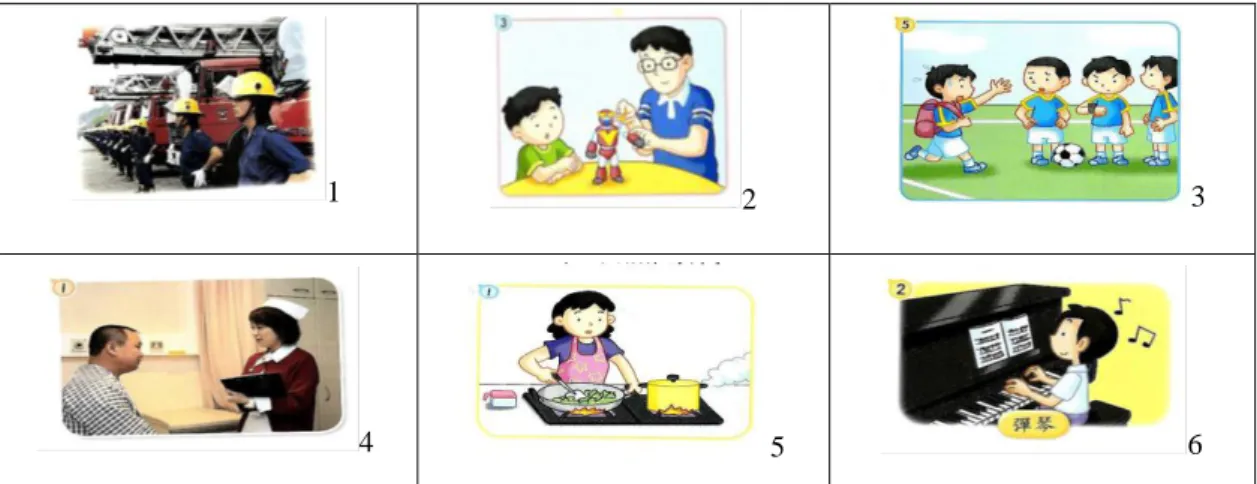
This study analyzed the dimensions of occupation, housework and leisure respectively to examine if there were any instances of sex stereotypes. Figure 6 shows the sample pictures of occupation, housework and leisure, while Table 5 demonstrates occupation, housework and leisure by gender.
1 2 3
4 5 6
Note. 1 adopted from Volume 3 of General Studies, p.44; 2 adopted from Volume 4, p.29 ; 3 adopted from Volume 4, p.11; 4
adopted from Volume 3, p.51; 5 adopted from Volume 1, p.31; 6 adopted from Volume 4, p.5 .
Table 5: Pictures appeared in either male or female
Occupation Housework Leisure Male Female Male Female Male Female
Soldier 83 Nurse 15 Heavy Lifting 15 Cooking 14 Football 55 playing piano 4 Lifeguard 18 Shop assistant 5 Maintaining /repairing 3 Shopping /preparing 3 Dragon -boating 11 Hopscotch 3 Firefighter 11 Dancer 5 Skating 4 Diving 2 Chief executive 7 Medical technologist 3 Badminton 4 balance beam 1 Captain 7 Dealer 3 Remote- control car 4 blowing bubbles 1 Official 28 Model 2 Kendo 4 Shooting 1 Driver 5 Recycler 2 Slide 4 Pilot 4 Barber 1 Hockey 3 Principal 3 Anchor 1 Climbing 2
The types of occupation that appeared in the 12 textbooks reached up to 50. Many of them did appear both in male and female roles, such as teachers, doctors, policemen, reporters, farmers and so on. However, some of them appeared only in either male or female. For example, soldier, lifeguard, firefighter, chief executive and captain were typically males, while nurse and shop assistant were mostly female (see Table 5). Similarly, there were about 58 types of entertainment in all 12 textbooks. Many of them appeared both in male and female, such as reading, jogging, rope-jumping, swimming and playing basketball. However, some types appeared only in either male or female. For example, football, dragon-boating, skating and badminton were typically male, while playing piano, hopscotch and diving appeared only in female (see Table 5). As to housework, there were lesser types than those appearing in occupation and leisure. Cleaning, dish washing, plant watering and decorating work appeared both in male and female, while heavy lifting and repair work were particularly for males, and shopping and cooking for females.
All in all, the results of this study suggest that sex stereotypes are present in the textbooks, with males usually appearing in the more powerful, important, and strength-needed occupations, such as government officials, chief executive, the captain, firefighter, and soldier. On the other hand, nurses and models only appear amongst females. With regards to house work, males are more likely to feature moving heavy objects and doing repair work, while cooking is still a predominantly female job even in the 21st century’s General Studies textbooks of Macao primary schools. Similar results were found in the analysis of leisure: dragon-boating, football and badminton appear only in males, while diving, playing piano, and archery only in females (see Figure 6 for examples of typical representation).
The overall view of the results suggests that the role of women in society seems to remain with the traditional model. “The appearance of females in non-traditional roles is uneven, few males are in nontraditional roles” (Sleeter & Grant, 2011, p.187). What makes this situation happen? Is the female really inferior to male in nature? In fact, it is not the case. Pinto and Coulson (2011, p. 69) pointed out that:
Social constructions about a woman’s role might also prevent her from pursuing such opportunities. Thus, woman’s inequities are viewed not as individual choice, but as systemic barriers which prevent a woman from either taking on a particular job, how many hours she can devote to the job, or working without hiatus…Much of the gender differences in wealth can be explained by the gendering of work and family roles that restricts women’s ability to build up assets over the life course.
Lenski (1966, p.405) and Pinto & Coulson (2009, p. 69) also explained the reason which put women in a position of inequality. Both of them believed that the reason most women stop striving for success in the world of work, economics and politics, is the traditional family system which hindered and restricted women to pursue high-end careers. In turn, the statement “women have not been as successful as men on the average in the job world” becomes a reality, and makes women candidates more often likely to be rejected by “those who control access to such key resources as graduate fellowships or admission to industrial training programs”. As such, women become a less powerful and privileged group in the society.
recommended Butterfield et al. (1979, p. 389, cited from Giordano, 2003, p. 76) indicates that the General Studies textbooks in primary schools in Macao published in 2009, still retain elements of issues of inequality and bias. As Butterfield et al. (1979) suggest, in textbooks “children should have the right to encounter themselves equally portrayed by race and sex”. Also, “two or more minority groups are interacting within a story”. “Diversity of color within racial groups represents in the illustrations”. Moreover, in terms of disability, there should be “a proportionate number of students with handicapping conditions”. However, in this study, the textbooks analyzed showed that either racial or sex representations were not equal, with male and Chinese-dominance, not to mention other races, such as Filipinos. In view of the interaction of different minority groups in a story, none of them appeared in all 12 textbooks. The illustration of diversity of color within racial groups was only found in the topic “making sense of the world”. But, it appeared only for the purpose of information-giving. When it comes to disability, the number of students with handicapping conditions was very low, suggesting lack of representation.
Butterfield et al. (1979, p. 389) recommended two significant criteria in relation to gender stereotypes, namely, “to encounter themselves, with positive role models, in non-stereotyping roles” and to “encounter themselves and adults of their own race and sex in decision-making and authoritative roles”. Based on these two criteria, this study found that textbooks implied sex stereotypes. Regarding the types of occupation, males took the position of power and played the decision-making and authoritative roles (see Table 5). On the contrary, females’ occupations included those jobs related to care, attention and protection, such as nurse and shop cashier (see Table 5). The pictures did not represent females with higher position in the government such as president and officials. In terms of housework, leisure and even toys-to-play, this study also showed that people seemed to hold a traditional view that males should contribute to housework through strength and skills, while shopping and cooking should be the females’ job. The sex stereotypes even appeared in the selection of toys, with boys playing with guns and robots, and girls with dolls. The findings from this study have also been echoed by those of other researchers such as Lenski (1966), Sleeter and Grant (2011) and Mclntosh (2009).
Conclusion
This paper aimed to analyze the pictures in the textbook of Macao primary school General Studies to uncover the ideology that might conceal an unequal structure in terms of gender, race and disability. Taken together, the overall results of this study suggest that “an ideology that misrepresents and conceals the unequal structure of relationships” (Anyon, 2011, p.111) is still present in the General Studies textbooks of Macao primary schools, including male-dominant, Chinese-centered and able-bodied-centered stereotypes. In addition, sex stereotypes still exist with the image that males should be strong, powerful and successful, but females should focus on family, cooking and shopping and being attentive and protective. Base on the findings of this study, we found that even textbooks which were published in the 21st century have still complex issues in relation to ideology that might conceal an unequal structure in terms of gender, race, disability as well as sex stereotypes. Since textbooks influence what students know, think, and their way of seeing and making sense of the world, it is vital for textbook related personnel, including editors, reviewers and the textbook users – teachers – to be aware of these issues. Being a textbook editor, he/she should notice that he/she “is not just the individual who write a text, but is part of a larger cultural discourse” (Provenzo, et al. (2011, vii). Therefore, the author of the textbook should reflect their implicit values and beliefs when editing a textbook to avoid creating biased presentation of pictures. In addition, in order to remind the editors not to create biased materials, it is necessary for them to consider using the checklist developed by Butterfield, et al. (1979, p. 389, cited from Giordano, 2003, p.76) to detect biased material.
As for the textbook reviewers, it is suggested that, except those explicit criteria for textbook review, reviewers should be able to analyze the overall presentation of pictures which might conceal an unequal structure in terms of gender, race and disability. It is also recommended that the reviewers could adopt the checklist developed by Butterfield, et al. (1979, p. 389, cited from Giordano, 2003, p.76) to detect biased material.
Speaking of the textbook users - especially school teachers, they should be responsible for detecting the issues of ideology in textbooks, if any, to make the issues
explicit to students in the classroom in order to facilitate student’s critical thinking. To conclude, it is vital for the textbook editors, reviewers and school teachers to take seriously the presentation of content to avoid young learners taking the unequal structure of relationships for granted.
References
Altbach, P. G. (1991). The unchanging variable: textbooks in comparative perspective. In P. G. Altbach, G. P. Kelly, H. G. Petrie, & L. Weis (Eds.). Textbooks in
American society: politics, policy, and pedagogy (pp. 237-254). NY: State University
of New York.
Anyon, J. (2011). Ideology and US history textbooks. In E. F. Provenzo, Jr., A. N. Shaver, & M. Bello (Eds.). The textbook as discourse: sociocultural dimensions of
American schoolbooks (pp.109-139).NY: Routledge.
Apple, M. W. (1990). Ideology and curriculum. NY: Routledge.
Apple, M. W. (1991). Regulating the text: the socio-historical roots of state control. In P. G. Altbach, G. P. Kelly, H. G. Petrie, and L. Weis (Eds.). Textbooks in
American society: politics, policy, and pedagogy (pp.7-26). NY: State University of
New York.
Burstyn, J. N., & Corrigan, R. R. (2011). Images of women in textbooks. In E. F. Provenzo, Jr., A. N. Shaver, & M. Bello (Eds.). The textbook as discourse:
sociocultural dimensions of American schoolbooks (pp.36-46).NY: Routledge.
Chambliss, M. J., & Calfee, R. C. (1998).Textbooks for learning: nurturing
children’s minds. MA: Blackwell.
Chang, T. M. (1993). Characteristics of the Macao Education: freedom and diversity. Journal of Administration, 6, 22(4), pp. 961-967.
Education and Youth Affairs Bureau (2008). Report of the examination on
non-tertiary education and its direction of reform. Macao: Education and Youth
Affairs Bureau. Retrieved from http://umir.umac.mo/jspui/bitstream/123456789/13031/1/1686_0_%E8%AA%B2%E
7%A8%8B%E6%94%B9%E9%9D%A9%E7%B8%BD%E5%A0%B1%E5%91%8A 20080107.doc
Giordano, G. (2003).Twentieth-century textbook wars: a history of advocacy and
opposition. NY: Peter Lang.
Guo, X. M. (2004). The background and possible ways of Macao curriculum change. Journal of Administration, 17, 66(4), pp. 1019-1032.
Henson, T. K. (2010). Curriculum planning – integrating multiculturalism,
constructivism, and education reform (4th ed.). US: Waveland Press.
Lenski, G. E. (1966). Power and privilege: a theory of social stratification. NY: McGraw-Hill.
Lechuga, V. M., Clerc, L. M., & Howell, A. K. (2009). Power, Privilege, and Learning: Facilitating Encountered Situations to Promote Social Justice. Journal of
College Student Development, 50(2), 1-10. DOI: 10.1353/csd.0.0064
Luke, A. (1988). Literacy, textbooks and ideology. UK: The Falmer Press.
Macau Government Tourist Office (2012). About Macau. Retrieved from http://www.macautourism.gov.mo/en/info/info.php
Government of Macao Special Administrative Region Statistics and Census Service (2012). Population Census- Year 2011. Retrieved from http://www.dsec.gov.mo/Statistic.aspx?NodeGuid=8d4d5779-c0d3-42f0-ae71-8b747b dc8d88
Government of Macao Special Administrative Region Statistics and Census Service (2013). Education Survey: 2011/2012. Retrieved from http://www.dsec.gov.mo/Statistic.aspx?NodeGuid=77e4b03a-e3bb-4c58-81f9-36e186 00ca43
Mclntosh, P. (2009). Gender perspectives on educating for global citizenship. In D. J. Flinders, Thornton, S. J. (Eds.) (3rd ed.). The curriculum studies reader (pp. 385-398). NY: Routledge.
Nasser, R., & Nasser, I. (2008). Textbooks as a vehicle for segregation and domination: state efforts to shape Palestinian Israelis’ identities as citizens. Journal of
Curriculum Studies, 40(5), 627-650.
Nicholls, J. (2006). Introduction: School history textbooks across cultures: international debates and perspectives. In J. Nicholls(Ed.). School history textbooks
across cultures: international debates and perspectives (pp. 7-13). UK: Cambridge
University Press.
Pinto, L., & Coulson, E. (2011). Social justice and the gender politics of financial literacy education. Journal of the Canadian Association for Curriculum Studies, 9(2), 54-84.
Provenzo, Jr., E. F. (2011). Education and the iconography of the Republic. In E. F. Provenzo, Jr., A. N. Shaver, & M. Bello (Eds.). The textbook as discourse:
sociocultural dimensions of American schoolbooks (pp.11-22).NY: Routledge.
Provenzo, Jr., E. F., Shaver, A. N., & Bello, M. (2011). Introduction. In E. F. Provenzo, Jr., A. N. Shaver, & M. Bello (Eds.). The textbook as discourse:
sociocultural dimensions of American schoolbooks (pp.1-8).NY: Routledge.
Schneider, J. (2009). Privilege, equity, and the advanced placement program: tug of war. Journal of Curriculum Studies, 41(6), 813-831.
Sleeter, C. E., & Grant, C. A. (2011). Race, class, gender, and disability in current textbooks. In E. F. Provenzo, Jr., A. N. Shaver, & M. Bello (Eds.). The
textbook as discourse: sociocultural dimensions of American schoolbooks
(pp.183-215).NY: Routledge.
Thornton, S. J. (2009). Silence on gays and lesbians in social studies curriculum. In D. J. Flinders, Thornton, S. J. (Eds.) (3rd ed.). The curriculum studies reader (pp. 362-367). NY: Routledge.
Weber, R. P. (1995). Basic content analysis. Beverly Hills: Sage Publications. Westbury, I. (1990). Textbooks, textbook publishers, and the quality of schooling. In D. L. Elliott & A. W. Woodward (Eds.). Textbooks and schooling in the
Woodward, A. W., & Elliott, D. L. (1990). Textbook use and teacher professionalism. In D. L. Elliott & A. W. Woodward (Eds.). Textbooks and schooling
in the United States (pp.178-193). Illinois: The University of Chicago.
Yang, Z. Q. (2006). The future development of non-tertiary education in Macao.