國 立 交 通 大 學
環 境 工 程 研 究 所
碩 士 論 文
考慮井部分貫穿效應之定水頭試驗
在非侷限含水層的解
Laplace-domain solution for transient flow into a partially penetrating
well in unconfined aquifers under the constant-head test
研究生 : 陳 庚 轅
指導教授 : 葉 弘 德
考慮井部分貫穿效應之定水頭試驗在非侷限含水層的解
Laplace-domain solution for transient flow into a partially penetrating
well in unconfined aquifers under the constant-head test
研 究 生:陳庚轅 Student: Geng-Yuan Chen
指導教授:葉弘德 Advisor: Hund-Der Yeh
國立交通大學
環境工程研究所
碩士論文
A Thesis
Submitted to Institute of Environmental Engineering College of Engineering
National Chiao Tung University in partial Fulfillment of the Requirements
for the Degree of Master of Science
in Environmental Engineering August 2010
Hsinchu, Taiwan
考慮井部分貫穿效應之定水頭試驗在非侷限含水層的解
研究生:陳庚轅 指導教授:葉弘德
國立交通大學環境工程研究所
摘 要
進行定水頭試驗時,需在抽水井中維持固定的水位高,並同時測量觀測井內洩降隨 時間的變化。本研究考慮在非侷限含水層裡有一部分貫穿井作定水頭試驗,推導水層水 位分佈之半解析解。本研究首先將部分貫穿井濾管部分設為定水頭邊界、盲管部分設為 不透水邊界,接著以自由液面條件來描述非侷限含水層的上邊界,最後利用分離變數法 及拉普拉斯轉換,推導得半解析解。此解可用來產生無因次洩降與時間之關係曲線,探 討部分貫穿井在水層中所造成的垂直流問題,亦可利用試驗數據來推求水層的參數。 關鍵詞:地下水,非侷限含水層,部分貫穿,定水頭試驗Laplace-domain solution for transient flow into a partially penetrating
well in unconfined aquifers under the constant-head test
Student:Geng-Yuan Chen Advisor:Hund-Der Yeh
Institute of Environmental Engineering
National Chiao Tung University
Abstract
The constant head test is to keep constant water level in the pumping well while the
drawdown into the observed well is measured. This study derives a semi-analytical solution
for drawdown distribution during constant-head test at a partially penetrating well in an
unconfined aquifer. The constant-head condition is used to describe the boundary along the
screen while no-flow condition is employed to describe the boundary along the casing of the
well. In addition, a free surface condition is utilized to delineate the upper boundary of the
unconfined aquifer. The Laplace domain solution is then derived using separation of
variables and Laplace transform. This solution can be used to produce the curves of
dimensionless drawdown versus dimensionless time to investigate the effects of vertical-flow
to identify the aquifer parameters from the data of constant-head test.
誌 謝
首先誠摯的感謝指導教授葉弘德,老師悉心的教導使我得以一窺地下水領域的深 奧,不時的討論並指點我正確的方向,使我在這兩年中獲益匪淺。老師對學問的嚴謹更 是我輩學習的典範。本論文的完成另外亦得感謝口試委員台灣大學劉振宇教授、中國科 技大學陳主惠教授、及中興大學謝平城教授有你們的指正及建議,使得本論文能夠更完 整而嚴謹。 除了老師外,最感謝的就是雅琪與彥如學姊,不厭其煩的指出我研究中的缺失,且 總能在我迷惘時為我解惑。感謝智澤、彥禎、玉德、仲豪、珖儀學長、敏筠、其珊學姐、 國豪、玉霖、昭志學弟們,兩年裏的日子,實驗室裏共同的生活點滴,學術上的討論, 感謝眾位學長姐、同學、學弟妹的共同砥礪,你們的陪伴讓兩年的研究生活變得絢麗多 彩。也感謝璟勝,課業的討論和有著趕作業的革命情感。士賓和博傑學長壘球的啟發, 信元、展帆、金澄、阿嚕、家馨、恰恰……排球隊一起運動和比賽,當然還有摯友勝然 和信佑從大學到研究所就一起鼓勵與支持,恭喜我們順利走過這兩年。女朋友怡蓁在背 後的默默支持更是我前進的動力,沒有怡蓁的體諒、包容,相信這兩年的生活將是很不 一樣的光景。 最後,將本論文獻給我最親愛的雙親,冠億,鶴升你們是我最親愛的家人,給我有 形與無形的支柱,謹將這份成果與榮耀與你們分享。Table of Contents
中文摘要...I
Abstract ... II
誌謝...IV
Table of Contents ... V
LIST OF FIGURES ... VII
NOTATION ... VIII
CHAPTER 1 INTRODUCTION... 1
1.1 Background ... 1
1.2 Literature Review ... 2
1.3 Objectives ... 6
CHAPTER 2 MATHEMATICAL DERIVATIONS... 7
2.1 Mathematical Model of Constant-Head pumping Test ... 7
2.1.1 Governing Equations... 7
2.1.2 Initial and boundary conditions ... 8
2.2 Laplace-domain solution... 10
2.3 Fully penetrating wells in unconfined and confined aquifers ... 12
CHAPTER 3 NUMERICAL EVALUATION ... 13
CHAPTER 4 RESULTS AND DISCUSSION... 16
4.1 Effective distance for the observation well with different specific time ... 16
4.2 Influence of specific yield ... 16
4.3 Effect of screen length ... 17
4.4 Effective distance for the observation well... 17
4.5 Effect of anisotropy ... 18
4.6 Influence of the well radius... 19
4.7 Effect of partially penetration ... 19
CHAPTER 5 CONCLUSIONS ... 20
APPENDIX A... 21
APPENDIX B... 29
APPENDIX C... 33
LIST OF FIGURES
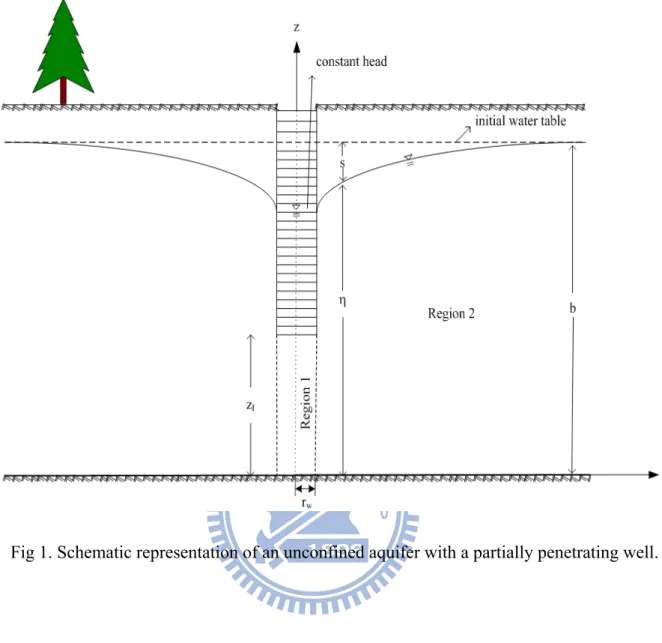
Fig 1. Schematic representation of an unconfined aquifer with a partially penetrating well...41
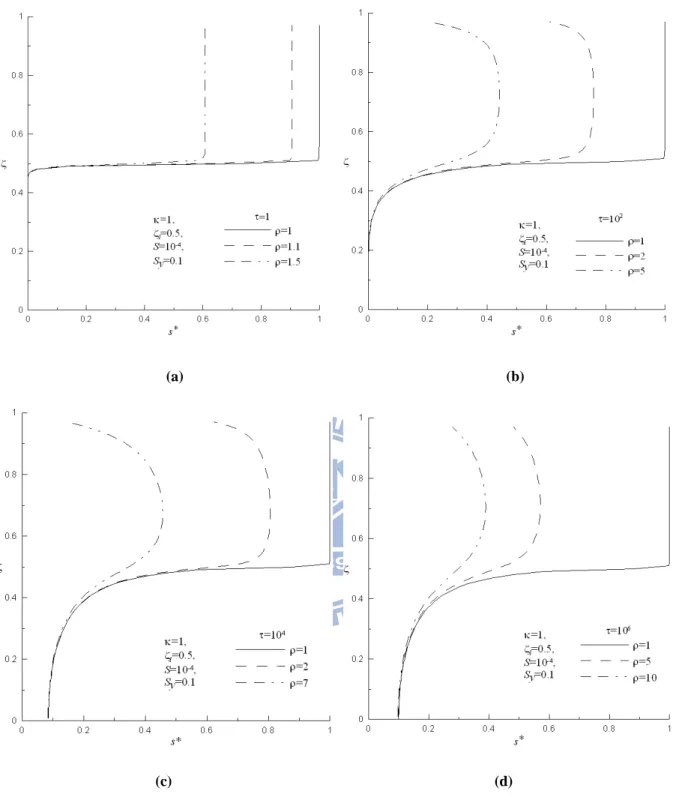
Fig 2. The dimensionless drawdown distributions at τ = (a) 1 , (b) 102 , (c) 104 , and (d) 106 .
...42
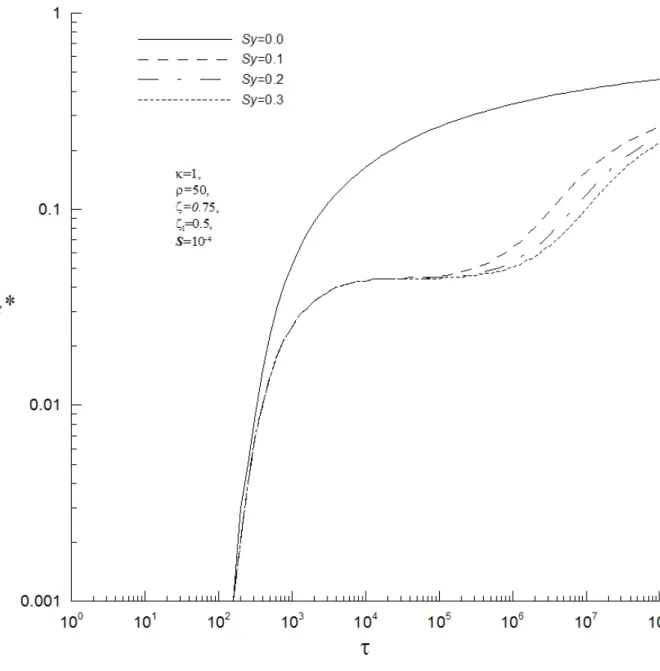
Fig 3. The effect of specific yield on the dimensionless drawdown during CHT. ...43
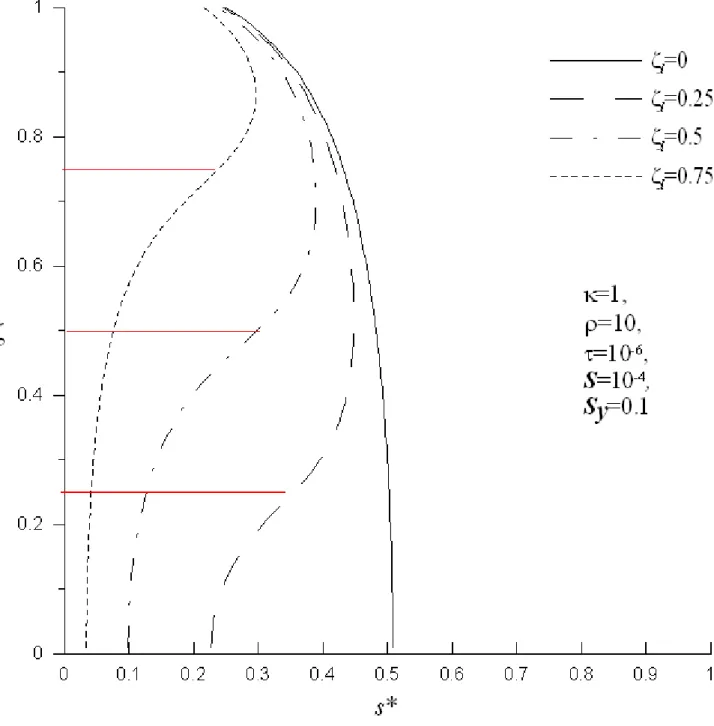
Fig 4. The dimensionless drawdown distributions at the well screen extended from ζ = to ζl
β
ζ = in region 2. ...44
Fig 5. Relationship for dimensionless drawdown versus dimensionless time with ζ =50, 75,
and 100 at ρ =10 or 100 for S = (a) 0 and (b) 0.1... 45 y
Fig 6. Spatial flow pattern in an unconfined aquifer with a partially penetrating well for κ =1,
100 = β , 25ζl = , 4 10− =
S at τ = 104 when S = (a) 0 and (b) 0.1. ... 46 y
Fig 7. The effect of conductivity ratio (κ) of region 2 on the dimensionless drawdown during
CHT. ...47
Fig 8. Drawdown distribution for a well with three different well radii (r = 1, 0.1 and 0.01 m) w
with σ =103, ζ =0.75, 5=0.
l
ζ and κ =1. ...48
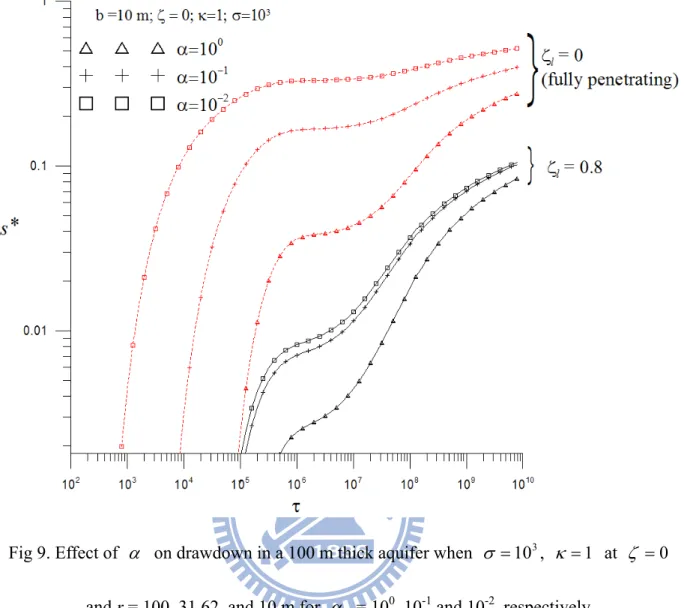
Fig 9. Effect of α on drawdown in a 100 m thick aquifer when σ =103, 1κ = at ζ =0
NOTATION
′ m A1 A1m(p)I0( p+ω1m) ′ n A2 A2n(p)K0( p+ω2n)b Initial saturated thickness
0 h Initial head h Hydraulic head ) ( 0 ⋅
I modified Bessel functions of the first kinds of order zero
) (
1 ⋅
I modified Bessel functions of the first kinds of order one
m
i0 I0( p+ω1m)/( p+ω1m ⋅I1( p+ω1m))
) (
0 ⋅
K modified Bessel functions of the second kinds of order zero
) (
1 ⋅
K modified Bessel functions of the second kinds of order one
Kr Radial hydraulic conductivity
Kz Vertical hydraulic conductivity
n
k0 ( p+ω2n ⋅K1( p+ω2n))/K0( p+ω2n)
r Radial distance from the centerline of the well
rw Well radius
* 1
s s /1 sw, dimensionless drawdown in region 1
* 2
s s /2 sw, dimensionless drawdown in region 2 ) , , ( ~* 1 P
s ρ ζ dimensionless drawdown in Laplace domain for region 1
(
P)
s , ,
~*
2 ρ ζ dimensionless drawdown in Laplace domain for region 2
Ss Specific storage
w
s Constant drawdown in the well
Sy Specific yield
t Time from the start of test
z Vertical distance from the bottom of the aquifer
zl Lower z coordinate of well screen
α α α ρ2 w = w α 2 w w κρ α = β b /rw ζ z /b
l ζ zl/ b η saturated thickness ρ ρ=r /rw w ρ ρw =rw/b σ σ =Sy/Ssb τ Krt/Ssrw2, dimensionless time m 1 ω separation constant n 1 ω separation constant 1 Ω ω1m/αw 2 Ω ω2n/αw
CHAPTER 1 INTRODUCTION
1.1 Background
Groundwater is water stored in aquifers. A unit of rock or an unconsolidated deposit is
called an aquifer when it can yield a usable quantity of water. There are two common types
of aquifers: confined and unconfined. Confined aquifer includes upper and lower confining
beds which are of low permeability. Unconfined aquifers are sometimes also called water
table aquifers, because their upper boundary is a water table.
There are two main hydraulic parameters play a crucial role for the aquifer system in
response to the test: transmissvity and storativity. Transmissivity describes the ease with
which water can move though an aquifer and is a product of hydraulic conductivity and
aquifer thickness. The behavior of hydraulic conductivity is similar to transmissvity.
Hydraulic conductivity has the same unit as velocity. Storativity is defined as the
dimensionless volume of water that an aquifer releases.
Two types of tests, named constant-head test (CHT) and constant-flux test (CFT), are
usually performed to characterize an aquifer for estimating the hydraulic parameters. The
CHT is usually employed for low-transmissivity aquifers, i.e., for aquifers with clay and/or
silt formation. The drawdown/buildup should be kept at a constant value during the test
which are mainly composed of sand and/or gravel materials. The well discharge rate should
be kept at a constant value during the pumping period.
1.2 Literature Review
For aquifers with low-transmissivity, CHT is more suitable to apply than CFT. The
wellbore storage at the pumping well has large effect on the early time drawdown behavior at
pumping and observation wells in CFT (Renard, 2005). If a CHT is established in a short
period of time, the effect of wellbore storage is negligible under the situations that the aquifer
has low transmissivity and the well radius is small (Chen and Chang, 2003).
In the past, many studies had been devoted to the solutions for CHT. Kirkham
(1959) derived a steady-state solution for groundwater distribution in a bounded confined
aquifer pumped by a partially penetrating well under CHT. They simplified the complexity
of the geometry by dividing the model into two different regions. Javandel and Zaghi (1975)
considered the groundwater in a confined aquifer pumped by a fully penetrating well that is
radially extended at the bottom of the aquifer. The procedure used in their study is similar to
that in Kirkham (1959) and the steady-state groundwater solution was obtained using
separation of variables. Jones et al. (1992) and Jones (1993) discussed the practicality of
CHTs on wells completed in low-conductivity glacial till deposits. Mishra and Guyonnet
drawdown is limited by well construction and aquifer characteristics. They developed a
method for analyzing observation well response under a CHT. There have been numerous
studies in the literature using CHT [e.g., Wilkinson, 1968; Uraiet and Raghaven, 1980; Hiller
and Levy, 1994; Chen and Chang, 2003; Singh, 2007].
Considering a CHT performed in a partially penetrating well, Yang and Yeh (2005)
developed a time-domain solution to describe the drawdown in a confined aquifer with finite
thickness skin. The boundary conditions along the partially penetrating well are represented
by a constant-head (first kind) boundary for the screen while a no-flow (second kind)
boundary for the casing. They transformed the first kind boundary along the screen into a
second kind boundary with an unknown flux which is time-dependent and therefore the
boundary along the partially penetrating well became uniform. The solution was then solved
by the Laplace and finite Fourier cosine transforms. Chang and Yeh (2009) used the
methods of dual series equations and perturbation method to solve the mixed boundary
problem for the CHT at a partially penetrating well. Chang and Yeh (2010) developed a new
model describing a CHT performed in flowing partially penetrating well for arbitrary location
of the well screen in a finite thick aquifer in depth. However, the studies mentioned above
are only applicable for confined aquifers.
For unconfined aquifers, Chen and Chang (2003) developed a well hydraulic theory
Chang et al. (2010) extended the work of Yang and Yeh (2005) to develop a mathematical
model for an unconfined aquifer system while treating the skin as a finite thickness zone and
derived the associated solution for CHT at a partially penetrating well. For other
environmental applications, light nonaqueous phase liquids (LNAPLs) are usually recovered
by wells held at constant drawdown (Abdul, 1992; Murdoch and Franco, 1994) and a
constant-head pumping is employed to control off-site migration of contaminated
groundwater (Hiller and Levy, 1994). At LNAPL contaminant sites the pollutant forms a
pool of LNAPL in the subsurface on the top of water table. It is therefore to install a well
with the screen goes from the top of the aquifer in unconfined aquifers.
For the research of CFT in unconfined aquifers, Neuman (1972) presented a new
analytical solution for characterizing flow to a fully penetrating well in an unconfined aquifer.
He assumed the drainage above the water table occurs instantaneously. Take into account
the effect of finite diameter pumping well, Moench (1997) developed a solution in
Laplace-domain for the flow to a partially penetrating well in unconfined aquifers. Contrary
to Neuman’s assumption, he used the free-surface boundary in Boulton (1954) under the
assumption that the drainage of pores occurs as an exponential function of time in response to
a step change in hydraulic head in the aquifer. Tartakovsky and Neuman (2007) presented
an analytical solution for drawdown in an unconfined aquifer due to pumping at a constant
by accounting for unsaturated flow above the water table and derived the solution from a
linearized Richards’ equation in which unsaturated hydraulic conductivity and water content
are expressed as exponential functions of incremental capillary pressure head relative to its air
entry value. Malama et al. (2007) utilized Laplace and Hankel transforms to obtain a
semi-analytical solution for the problem of flow with leakage in an unconfined aquifer
bounded below by an aquitard of finite or semi-infinite vertical extent. Malama et al. (2008)
further extended their previous work to a system consisting of unconfined and confined
aquifers, separated by an aquitard. The unconfined aquifer is pumped at a constant rate from
a partially penetrating well. Pasadi et al. (2008) considered the effect of wellbore storage
and finite-thickness skin and presented a Laplace-domain solution for CFT conducted in an
unconfined aquifer with a partially penetrating well.
More recently, Malama et al. (2009a) developed a semi-analytic solution for a
three-layered system, consisting of an aquifer and two confining units, due to constant rate
pumping of the aquifer at a fully penetrating well. Their solution was successfully tested on
the streaming potential data presented by Rizzo et al. (2004). Malama et al. (2009b) also
developed a semi-analytic solution for a fully penetrating well in an unconfined aquifer under
constant-rate pumping. Their solution was applied to estimate aquifer parameters using data
1.3 Objectives
Motivated by the literatures above, the purpose of this paper is to develop a mathematical
model for describing the drawdown distribution in an unconfined aquifer when performing
the constant-head test in a partially penetrating well. Without assuming constant-head
boundary along the screen as an unknown flux boundary, the system is separated into two
different regions and the solution of the model is directly obtained using method of separation
of variables and Laplace transform. This new solution can be used to determine the aquifer
parameters or to investigate the effects of vertical-flow caused by the partially penetration
CHAPTER 2 MATHEMATICAL DERIVATIONS
This chapter is divided into three parts. First, we develop a mathematical model for
describing the drawdown distribution due to the pumping from a partially penetrating well in
unconfined aquifers under constant-head test. The solution of the model is then derived by
Laplace transforms. Final, the Laplace-domain solution can be shown to reduce to the
solution in the case with a fully penetrating well.
2.1 Mathematical Model of Constant-Head pumping Test
The conceptual model for constant-head pumping in an unconfined aquifer system with a
partially penetrating well is illustrated in Figure 1. The well screen starts from z = zl with a
finite well radius rw. The domain is divided into two different regions. Region 1 is defined
by 0≤r ≤rwand 0≤z≤zl while region 2 is bounded within rw≤ r <∞ and 0≤ z≤η
where η is the saturated thickness.
2.1.1 Governing Equations
The aquifer is assumed to be homogeneous, infinite extent in the radial direction and the
seepage face in region 2 is neglected. The governing equations in terms of drawdown in the
l w s z r r r z z t s S z s K r s r r s K ≤ ≤ ≤ ≤ ∂ ∂ = ∂ ∂ + ∂ ∂ + ∂ ∂ 0 , 0 , ) 1 ( 1 2 1 2 1 2 1 2 (1) and η ≤ ≤ ∞ < ≤ ∂ ∂ = ∂ ∂ + ∂ ∂ + ∂ ∂ z r r t s S z s K r s r r s Kr ) z s , w , 0 1 ( 2 2 2 2 2 2 2 2 (2)
The subscripts 1 and 2 denote the regions 1 and 2, respectively. The drawdown at a distance
r from the center of the well and a distance z from the bottom of the aquifer at time t is
denoted as s(r,z,t) which is equal to h0 −h, where h is the initial head and 0 h is the
hydraulic head. The aquifer has the horizontal hydraulic conductivity Kr, vertical hydraulic
conductivity Kz, and specific storage Ss. Assume the drawdown is small in comparison with
the saturated aquifer thickness η , the boundary at the free surface ( z=η ) can be
approximated as z=b , where b is the initial saturated thickness. Therefore, the
governing equation for region 2 can be further expressed as
b z r r t s S z s K r s r r s Kr z s w ≤ <∞ ≤ ≤ ∂ ∂ = ∂ ∂ + ∂ ∂ + ∂ ∂ 0 , , ) 1 ( 2 2 2 2 2 2 2 2 (3)
2.1.2 Initial and boundary conditions
The initial condition for saturated thickness η( tr, ) is equal to b, the drawdowns are
therefore assumed to be zero initially in regions 1 and 2, that is
0 ) 0 , , ( ) 0 , , ( 2 1 r z =s r z = s (4)
The no-flow boundary condition at the bottom of the aquifer for both regions is
0 ) , , ( ) , , ( 0 2 0 1 = ∂ ∂ = ∂ ∂ = = z z z t z r s z t z r s (5)
The bottom of the well screen (z= ) is assumed to be sealed and the boundary condition for zl
s1 at this position is therefore a no-flow boundary. It is thus expressed as
w z z r r z t z r s l ≤ < = ∂ ∂ = 0 , 0 ) , , ( 1 (6)
The three-dimensional equation describing the flow at free surface for the unconfined aquifer
can be written as (Batu, 1998, p.107)
b z at t h S z h K z h K y h K x h Kx y z z y = ∂ ∂ = ∂ ∂ − ⎟ ⎠ ⎞ ⎜ ⎝ ⎛ ∂ ∂ + ⎟⎟ ⎠ ⎞ ⎜⎜ ⎝ ⎛ ∂ ∂ + ⎟ ⎠ ⎞ ⎜ ⎝ ⎛ ∂ ∂ 2 2 2 (7)
where Sy is the specific yield.
Considering the drainage process is transient and the drawdown everywhere of the system is
small in comparison to initial saturated thickness b. Using the linearized form that
neglecting the second-order terms of the hydraulic gradient in Eq. (7) of the kinematic
boundary condition at the water table (Neuman, 1972), the condition for the top boundary of
the region 2 is ∞ < ≤ ∂ ∂ − = ∂ ∂ = = r r t t z r s S z t z r s K w b z y b z z , ) , , ( ) , , ( 2 2 (8)
In addition, the boundary at r = 0 due to symmetry along the center of the well is written as:
l r z z r t z r s = < < ∂ ∂ = 0 , 0 ) , , ( 0 1 (9)
When r approaches infinity, the influence radius does not significantly affect the drawdown
(Batu, 1998). The remote boundary is therefore taken at ∞ instead of the influence radius.
0 ) , , ( 2 ∞ tz = s (10)
The boundary condition specified along the well is
0 , , ) , , ( 2 r z t =s z <z<b t> s w w l (11)
where s is a constant drawdown in the well at any time. w
At the interface between regions 1 and 2, the continuities of the drawdown and flow rate
must be satisfied: 0 , 0 , ) , , ( ) , , ( 2 1 r z t =s r z t <z<z t> s w w l (12) and 0 , 0 , ) , , ( ) , , ( 2 1 < < > ∂ ∂ = ∂ ∂ = = t z z r t z r s r t z r s l r r r r w w (13) 2.2 Laplace-domain solution
In order to express the solutions in dimensionless form, following dimensionless
variables are defined: s s1/sw
* 1 = , s s2/sw * 2 = , σ =Sy/Ssb , κ =K /z Kr , ρ =r /rw , b rw w = / ρ , 2 w w κρ α = , α α ρ2 w = , 2 / s w rt S r K = τ , ζ =z /b, and ζl =zl /b where s 1* and * 2
s stand for the dimensionless drawdowns for regions 1 and 2, respectively, σ is the
ratio between specific yield S and the storativity y Ssb, κ represents the dimensionless
conductivity ratio, ρ denotes the dimensionless radial distance, ρw is the dimensionless
aquifer to the bottom of the screen, respectively.
Taking the Laplace transform to the dimensionless governing equations of Eqs. (A1) and
(A2) subject to the dimensionless boundary conditions of Eqs. (A4) – (A11), the
Laplace-domain solutions for the dimensionless drawdowns in regions 1 and 2 are
respectively ) cos( ) ( ) ( ) ( ) , , ~ 1 1 0 1 0 0 1 * ( 1 ω ζ ρ ω ζ ρ m m m m m p I p I p A p s Ω + ⋅ + ′ =
∑
∞ = (14) and ) cos( ) ( ) ( ) ( ) , , ( ~ 2 2 0 2 0 0 2 * 2 ω ζ ρ ω ζ ρ n n n n n p K p K p A p s Ω + ⋅ + ′ =∑
∞ = (15)Applying the continuity conditions to Eq. (14) and Eq. (15), the coefficient A1m′ and
′
n
A2
are respectively obtained as
⎥ ⎦ ⎤ ⎢ ⎣ ⎡ Ω − Ω Ω − Ω + Ω + Ω Ω + Ω ′ ⋅ ⎥ ⎦ ⎤ ⎢ ⎣ ⎡ Ω + Ω Ω − = ′
∑
∞ = m n l n m n m l n m n n n m m m om m p i A p k A 2 1 2 1 2 1 2 1 0 0 2 1 1 1 1 ] ) sin[( ] ) sin[( ) ( 2 ) 2 sin( 2 ) ( ζ ζ (16) and ⎥ ⎦ ⎤ ⎢ ⎣ ⎡ Ω − Ω Ω − Ω + Ω + Ω Ω + Ω ′ ⋅ ⎥ ⎦ ⎤ ⎢ ⎣ ⎡ Ω + Ω Ω = ′∑
∞ = m n l n m n m l n m m m n n n n p A p A 2 1 2 1 2 1 2 1 0 1 2 2 2 2 ] ) sin[( ] ) sin[( ) ( 2 ) 2 sin( 2 ) ( ζ ζ ⎥ ⎦ ⎤ ⎢ ⎣ ⎡ Ω + Ω Ω − Ω + n n l n n p 2 2 2 2 2 ) 2 sin( ) sin( ) sin( 4 ζ (17)where p is the Laplace variable and the symbols A1m′,
′ n A2 , Ω , 1m Ω ,2n I0(⋅), I1(⋅), )K0(⋅ , ) ( 1 ⋅
K , and k0 are defined in Notation. The detailed derivations of Eqs. (14) and (15) are
2.3 Fully penetrating wells in unconfined and confined aquifers
Letting 0ζl = in Eqs. (16) and (17), the drawdown solution of Eq. (14) in region 1 is
equal to zero and the Laplace-domain solution in Eq. (15) for dimensionless drawdown in
region 2 with fully penetrating wells in unconfined aquifers is exactly the same as the solution
given in Chen and Chang (2003, Eq. (7)) when the skin factor S equals to zero after some k
algebraic manipulations. The detailed derivation for reducing the present solution to the
case of a fully penetrating well in unconfined aquifers is given in Appendix B. Furthermore,
by setting ζl =0 and σ =0, the Laplace-domain solution of Eq. (15) in region 2 can be reduced to the solution in Hantush (1964) for drawdown with a fully penetrating well in
confined aquifers. The detailed simplification of present solution to the situation of fully
CHAPTER 3 NUMERICAL EVALUATION
The numerical inversion given by Stehfest (1970) is adopted for calculating the
time-domain drawdown solutions in Eqs. (14) and (15) for regions 1 and 2, respectively.
Since there might be a problem of slow convergence when evaluating the infinite sums in Eqs.
(14) and (15), the Shanks method is applied to accelerate convergence for these infinite sums.
3.1 Shanks Method
The Shanks method, also called the ε–algorithm, is a non-linear sequence-to-sequence transformation. Shanks (1955) proved that this transformation is effective when applied to
accelerate the convergence of some slowly convergent sequences.
The partial sums, Sn, of an infinite series may be defined as
∑
= = n k k n a S 0(18)
where a is the kth term of the series. Based on the sequence of partial sums, the Shanks k
transform may be expressed as (Wynn, 1956)
,... 2 , 1 , ) ( ) ( 1 ) ( ) ( 1 1 1 1 = + − = + + − + i S e S e S e S e n i n i n i n i (19) where e0(Sn)=Sn and e1(Sn)=
[
e0(Sn+1)−e0(Sn)]
−1.It is necessary to set a certain convergence criterion when applying the Shanks transform
ERR S
e S
e2i+2( n−1)− 2i( n) ≤ (20)
The sequence of partial sums is terminated when this criterion is met and the infinite series
converges to the calculated e2i+2(Sn−1).
This method has been successfully applied to compute the solutions arisen in the
groundwater area (see, e.g., Yang and Yeh, 2002; Peng et al., 2002).
3.2 Numerical Inversion
The Laplace transform method is used to solve differential equations along with their
corresponding initial and boundary conditions. In many engineering problems, the
Laplace-domain solutions for mathematical models are tractable, yet the corresponding
solutions in the time domain may not be possibly or easily solved. Under such
circumstances, the methods of numerical Laplace inversion such as Stehfest algorithm
(Stehfest, 1970) or the Crump algorithm (Crump, 1976) may be used.
The Laplace transform of a real-valued function f(t), t≥0, is define as
dt t f e p F =
∫
∞ −pt 0 ( ) ) ( (21)And the inverse of F( p) is given by
dp p F e i t f
∫
+∞ pt ∞ − = ξ ξ π ( ) 2 1 ) ( (22)where ξ is in the region of any singularities of F( p).
expression. If F( p) is the Laplace transform, then the inverse f(t) can be approximately computed by
∑
= ⎥⎦ ⎤ ⎢⎣ ⎡ ⋅ ⎥⎦ ⎤ ⎢⎣ ⎡ ≈ N n n t n F V t t f 1 ) 2 ln( ) 2 ln( ) ( (23)where the quantity nln(2)/t substitutes the Laplace parameter p.
The coefficients Vn are given by
∑
+ = + − − − − − = min( , /2) 2 / ) 1 ( 2 / ) 2 / ( )! 2 ( )! ( )! 1 ( ! )! 2 / ( )! 2 ( ) 1 ( nN n k N N n n n k k n k k k N k k V (24)where N is an even number, k is the value of Floor((n+1)/2) where the function Floor(⋅)
maps a real number to the largest previous integer.
To use the Stehfest method, it is necessary to choose N, the number of terms to sum.
Theoretically, the larger the value of N, the more accurate the numerical solution. In fact, N
is limited by truncation errors. Thus, the use of large N values causes subtraction of one
large number from another, with a resulting loss of accuracy. Cheng and Siduruk (1994)
suggest the range 6≤ N≤20. This study uses N =8 in computing the solutions, which can
obtain accurate results. Note that the use of fewer or more terms of N may create inaccurate
CHAPTER 4 RESULTS AND DISCUSSION
4.1 Effective distance for the observation well with different specific time
Figure 2a demonstrates the dimensionless drawdown distributions for the dimensionless
distance ρ = 1, 1.1 and 1.5 at the dimensionless time τ = 1, while Figure 2b for ρ = 1, 2,
and 5 at τ = 102 , Figure 2c for ρ = 1, 2 and 7 at τ =104, and Figure 2d for ρ = 1, 5
and 7 at τ =106. The aquifer parameters used in these figures are as follows: β =100,
1 =
κ , = b=10−4
S
S s , Sy =0.1 and ζl =0.5. These figures show that the dimensionless
drawdown at ρ = 1 match the boundary condition of the wellbore at different time periods.
The dimensionless drawdown decreases with increasing ρ at τ = 1, 102, 104 and 106. In
addition, it is apparent that vertical flows occur at the water table due to the free surface
boundary as shown in Figures 2b – 2d.
4.2 Influence of specific yield
Figure 3 is plotted to examine the effect of specific yield S of region 2 on the y
dimensionless drawdown during CHT. This figure shows the response of dimensionless
drawdown in a 100 m thick aquifer at ρ = 50 κ =1, =10−4
S , ζ =0.75 and ζl =0.5
for S ranging from 0 to 0.3. The dimensionless drawdown decreases with increasing y S . y
elastic behavior of the aquifer formation at early time, i.e., the first stage. During the second
stage at the moderate times, the gravity drainage almost stabilizes the water table. Finally,
the effect of vertical flow vanishes at late times and the flow acts like Theis behavior again.
Figure 3 shows that the larger Sy is, the longer delayed yield stage will be. The reason might
be that larger Sy supply more water from the drainage. If S = 0, the top boundary y
represented by Eq. (7) becomes the no-flow condition and the aquifer can therefore be
considered as confined condition.
4.3 Effect of screen length
Figure 4 illustrates the distributions of the dimensionless drawdown at the well screen
extends from ζ =ζl to ζ =β in region 2 when
6
10 =
τ . This figure shows the
dimensionless drawdown increases with the length of well screen. The lines illustrate the
positions of the well bottom for different length of well screen. In addition, it can be
observed from the figure that large slopes of the drawdown distribution curves occur near the
free surface boundary and the edge of the screen. Therefore, vertical groundwater flows are
obviously large at these two areas.
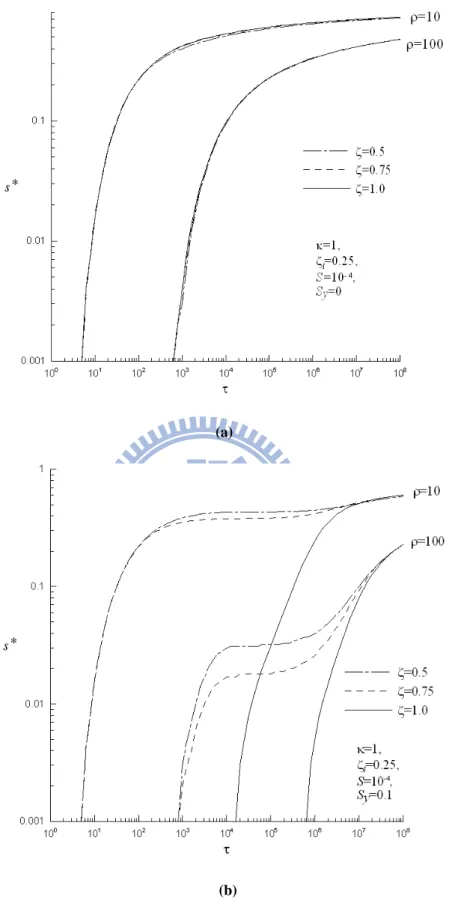
4.4 Effective distance for the observation well
observed location is plotted in Figure 5 for ρ = 10 and 100 with β =100, κ =1, S =10−4
and 25ζl =0. . The S is zero for confined aquifer and there is no vertical flow as shown y
in Figure 5(a). On the other hand, the vertical flow is apparent at moderate times for
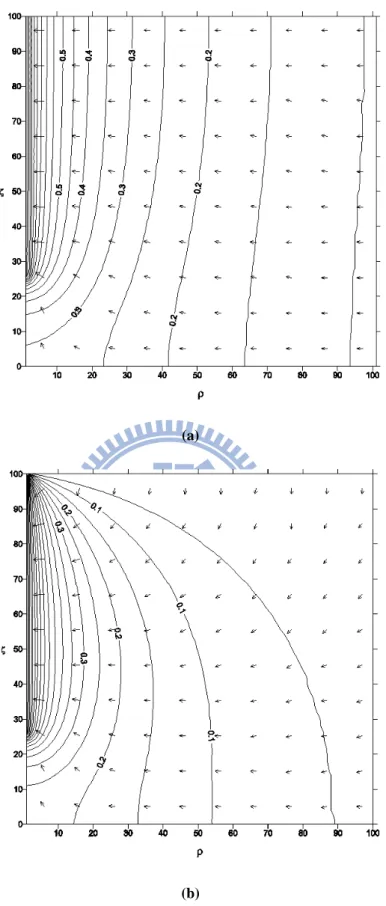
different radial distances as demonstrated in Figure 5(b) when S = 0.1. Figures 6(a) and y
6(b) illustrates the spatial flow pattern for S = 0 and 0.1 at y τ = 10
4 with the same
parameter values as those to draw Figure 5. Apparently, the vertical flow occurs only near
the bottom edge of the well screen when the aquifer is confined. However, for unconfined
aquifers, the flow at free surface is almost vertical and obvious vertical flows occur near both
the top and bottom edges of the well. It demonstrates that the vertical flow in the unconfined
system is induced not only by the effect of partial penetration but also the effect of free
surface boundary.
4.5 Effect of anisotropy
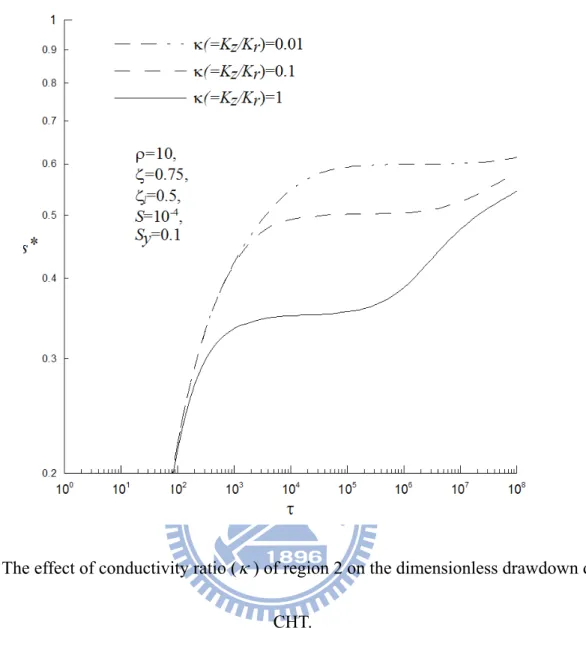
Figure 7 demonstrates the effect of the conductivity ratio κ (=Kz/Kr) on the
dimensionless drawdown during CHT. The vertical axis represents the dimensionless
drawdown and the horizontal axis represents the dimensionless time. The κ ranges from
2
10− to 1 with =10−4
r
K m/min, β =100 , S =10−4, 1Sy =0. , and ζl =0.5. The
dimensionless drawdown decreases with increasing κ indicating that the vertical flow from
4.6 Influence of the well radius
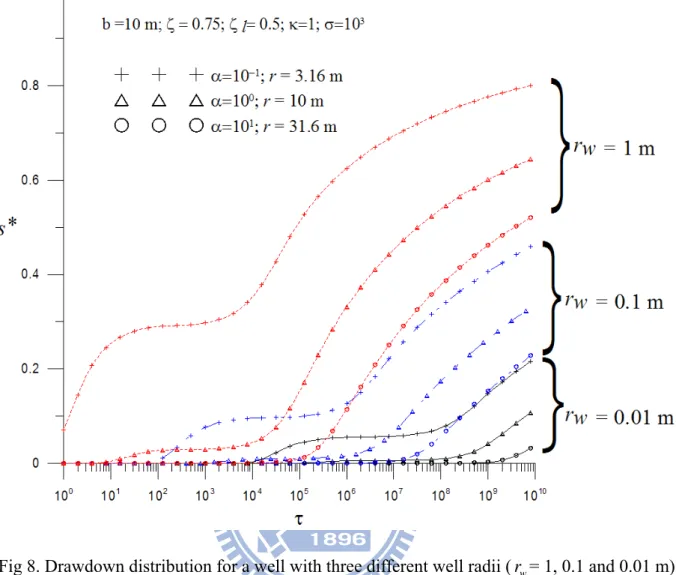
Figure 8 illustrates the effect of the well radius on drawdown distribution in a 10 m thick
aquifer. The considered well radii are 1, 0.1 and 0.01 m with σ =103, ζ =0.75, 5=0.
l ζ
and 1κ = . Drawdown is calculated at the distances of 3.16, 10, or 31.6 m from the
pumping well for α 10= -1, 1, and 101, respectively. The drawdown decreases with increasing distance from pumping well for different r as demonstrated in Figures 2a-d. w
The drawdown increases with r for different value of w α , indicating that the well radius has
significant effect on the drawdown distribution.
4.7 Effect of partially penetration
The effect of α on drawdown in the aquifer at ζ =0 when the well is fully (ζl =0) and
partially penetrating (ζl =0.8 ), is plotted in Figure 9 for
3
10 =
σ and κ =1. The
drawdown difference between the cases of full penetration and partial penetration decreases
with increasing α . It is reasonable that α1/2 is directly proportional to the radial distance
from the pumping well when the aquifer is isotropic and the partial penetration effect vanishes
when the radial distance goes large. Since α1/2 / κ
b
r = , it is proved that the radial
distance influenced by the partial penetration in unconfined aquifer under CHT is proportional
CHAPTER 5 CONCLUSIONS
A semi-analytical solution of the drawdown distribution is developed for CHT performed
in an unconfined aquifer with a partially penetrating well. The Laplace transforms and the
method of separation of variables are employed to derive the transient drawdown in the
Laplace domain for CHT. The Stehfest method is used to invert the solutions in
time-domain and the Shanks method is applied to accelerate convergence in evaluating the
infinite summations in the solution.
Large slopes of the drawdown distribution curves can be observed near the free surface
boundary and the edge of the screen, which indicates that the vertical groundwater flows
occur at these two areas. The dimensionless drawdown decreases with increasing S but y
increases with the length of well screen. For different r , the drawdown decreases with the w
increase of radial distance from pumping well and it might produce large error in drawdown if
assuming the radius of pumping well is infinitesimal.
The present solution can be used for describing the transient drawdown distribution or
investigating the effects of specific yield and conductivity ratio on the drawdown distribution
in unconfined aquifers. In addition, the present solution can reduce to the solution for a fully
penetrating well in either confined or unconfined aquifers under CHT.
APPENDIX A
The dimensionless governing equations of Eqs. (1) and (3) can be expressed as l w s s s s ρ ζ ζ τ ζ α ρ ρ ρ ∂ ≤ ≤ ≤ ≤ ∂ = ∂ ∂ + ∂ ∂ + ∂ ∂ 0 , 1 0 , 1 * 1 2 * 1 2 * 1 2 * 1 2 (A1) and 1 0 , 1 , 1 * 2 2 * 2 2 * 2 2 * 2 2 ≤ ≤ ∞ < ≤ ∂ ∂ = ∂ ∂ + ∂ ∂ + ∂ ∂ ρ ζ τ ζ α ρ ρ ρ s s s s w (A2) The dimensionless initial conditions for regions 1 and 2 are
0 ) 0 , , ( ) 0 , , ( * 2 * 1 ρ ζ =s ρ ζ = s (A3)
and the boundary conditions at the bottom and top of the aquifer for regions 1 and 2 in terms
of dimensionless form can be written as
0 ) , , ( ) , , ( 0 * 2 0 * 1 = ∂ ∂ = ∂ ∂ = = ζ ζ ζ τ ζ ρ ζ τ ζ ρ s s (A4) 1 0 , 0 ) , , ( * 1 = ≤ ≤ ∂ ∂ = ρ ζ τ ζ ρ ζ ζ l s (A5) and ∞ < ≤ ∂ ∂ − = ∂ ∂ = = ρ τ τ ζ ρ α σ ζ τ ζ ρ ζ ζ 1 , ) , , ( ) , , ( 1 * 2 1 * 2 s s w (A6)
The dimensionless boundary conditions at ρ = 0 and infinity are respectively written as
l s ζ ζ ρ τ ζ < < = ∂ ∂ 0 , 0 ) , , 0 ( * 1 (A7) 0 ) , , ( * 2 ∞ ζ τ = s (A8)
The dimensionless boundary condition along the screen is expressed as
0 , 1 , 1 ) , , 1 ( * 2 ζ τ = ζl <ζ < τ > s (A9)
0 , 0 ), , , 1 ( ) , , 1 ( * 2 * 1 ζ τ =s ζ τ <ζ <ζl τ > s (A10) and 0 , 0 , ) , , ( ) , , ( 1 1 * 2 * 1 < < > ∂ ∂ = ∂ ∂ = = τ ζ ζ ρ τ ζ ρ ρ τ ζ ρ ρ ρ l s s (A11)
The Laplace transform is defined as:
∫
∞ − = → = 0 * * 1 * 1 ( , , ) [ ( , , ); ] ( , , ) ~ ρ ζ ρ ζ τ τ ρ ζ τ τ τ d e s p s L p s p p (A12)where )~s1*(ρ,ζ,p is the dimensionless drawdown in Laplace domain. The solution for the
dimensionless drawdown solutions can be obtained by taking Laplace transforms of
governing equations Eqs. (A1) to (A2) using the initial condition (A3) and the results are
* 1 2 * 1 2 * 1 2 * 1 2 ~ ~ ~ 1 ~ s p s s s w = ∂ ∂ + ∂ ∂ + ∂ ∂ ζ α ρ ρ ρ , 0≤ρ ≤1, 0≤ζ ≤ζl (A13) and * 2 2 * 2 2 * 2 2 * 2 2 ~ ~ ~ 1 ~ s p s s s w = ∂ ∂ + ∂ ∂ + ∂ ∂ ζ α ρ ρ ρ , 1≤ρ <∞, 0≤ζ ≤1 (A14) The transformed boundary conditions at the bottom and top of the aquifer for regions 1 and 2
can be written as 0 ) , , ( ~ ) , , ( ~ 0 * 2 0 * 1 = ∂ ∂ = ∂ ∂ = = ζ ζ ζ ζ ρ ζ ζ ρ p s p s (A15) 1 0 , 0 ) , , ( ~* 1 = < < ∂ ∂ = ρ ζ ζ ρ ζ ζ l p s (A16) and ) , 1 , ( ~ ) , , ( ~ * 2 1 * 2 p p s p s w = ⋅ ⋅ − = ∂ ∂ = ζ ρ α σ ζ ζ ρ ζ (A17)
In the same fashion, the transformed boundary conditions at ρ= 0 and ∞ are l p s ζ ζ ρ ζ < < = ∂ ∂ 0 , 0 ) , , 0 ( ~* 1 (A18) and 0 ) , , ( ~* 2 ∞ p = s ζ (A19)
After taking the Laplace transform, the boundary condition along the well screen is
0 , 1 , 1 ) , , 1 ( ~* 2 ζ = ζl <ζ < τ > p p s (A20)
and continuity conditions become
l p s p s (1,ζ, )=~ (1,ζ, ), 0<ζ <ζ ~ * 2 * 1 (A21) and l p s p s ζ ζ ρ ζ ρ ρ ζ ρ ρ ρ < < ∂ ∂ = ∂ ∂ = = 0 , ) , , ( ~ ) , , ( ~ 1 1 * 2 * 1 (A22) Assume that * 1 ~
s and ~s2* are the product of two distinct functions, i.e.,
) , ( ) , ( ) , , ( ~ 1 1 * 1 p F p G p s ρ ζ = ρ ζ and s~2*(ρ,ζ,p)=F2(ρ,p)G2(ζ,p) , respectively.
Equations (A13) and (A14) can be, respectively, transformed as
1 1 21 2 1 1 1 21 2 1 1 G pF G F F G F G w = ∂ ∂ + ∂ ∂ + ∂ ∂ ζ α ρ ρ ρ (A23) and 2 2 22 2 2 2 2 22 2 2 1 G pF G F F G F G w = ∂ ∂ + ∂ ∂ + ∂ ∂ ζ α ρ ρ ρ (A24) Dividing throughout Equations (A23) and (A24) by F1G1 and F2G2, respectively, Equations
0 1 1 21 2 = + ∂ ∂ G G w m α ω ζ (A25)
[
]
0 1 1 1 1 21 2 = + − ∂ ∂ + ∂ ∂ F p F F m ω ρ ρ ρ (A26) and 0 2 2 22 2 = + ∂ ∂ G G w n α ω ζ (A27)[
]
0 1 2 2 2 22 2 = + − ∂ ∂ + ∂ ∂ F p F F n ω ρ ρ ρ (A28) where ω1m and ω2n are separation constants.The solutions of (A25) and (A27) subject to the boundary in (A15) are respectively
) cos( ) ( ) , ( 1 1 1 ζ p am p mζ G = Ω (A29) and ) cos( ) ( ) , ( 2 2 2 ζ p a n p nζ G = Ω (A30)
where Ω =1m ω1m/αw and Ω =2n ω2n/αw , )a1m(p and a2n(p) are constants with
respect to p . In addition, substituting (A29) into (A16) yields the following equation
0 )
sin(Ω1mζl = (A31)
The eigenvalues Ω in Equation (A29) can then determined by solving Equation (A31) and 1m
the result is , 1 l m m ζ π = Ω m = 0, 1, 2, … (A32)
Similarly, substituting (A30) into (A17) gives the following equation
) cos( ) sin( 2 2 2 n w n n Ω = p Ω Ω α σ , n= 0, 1, 2,… (A33)
The general solutions of (A26) and (A28) are respectively ) ( ) ( ) ( ) ( ) , ( 1 0 1 1 0 1 1 ρ p cm p I p ωmρ dm p K p ωmρ F = + + + (A34) and ) ( ) ( ) ( ) ( ) , ( 2 0 2 2 0 2 2 ρ p c n p I p ω nρ d n p K p ω nρ F = + + + (A35)
where )c1m(p , )d1m(p , )c2n(p and d2n(p) are constants.
Then, substituting (A34) into (A18) and (A35) into (A19), respectively, yields
) 0 ( ) ( ) 0 ( ) ( ) , ( 1 1 1 1 1 0 K p d I p c p F m m − = ∂ ∂ = ρ ρ ρ (A36) and ) ( ) ( ) ( ) ( ) , ( 2 0 2 0 2 ∞ p =c p I ∞ +d p K ∞ F n n (A37)
where )c1m(p and d2n(p) are constants. Note that d1m(p) and c2n(p) equal zero
because K1(0) and I0(∞) are, respectively, equal to infinity. The solutions of (A26) and (A28) are respectively
) ( ) ( ) , ( 1 0 1 1 ρ p cm p I p ωmρ F = + (A38) and ) ( ) ( ) , ( 2 0 2 2 ρ p d n p K p ω nρ F = + (A39)
The product of (A29) and (A38) gives the general solution of Equation (A23) as
) cos( ) ( ) ( ) , , ( ~ 1 1 0 1 1 * ρ ζ ω ρ ζ m m m m p A p I p s = + Ω m = 0, 1, 2, … (A40)
) cos( ) ( ) ( ) , , ( ~ 2 2 0 2 2 * ρ ζ ω ρ ζ n n n n p A p K p s = + Ω n= 0, 1, 2,… (A41)
where )A2n(p is the product of a2n(p) and d2n(p). Accordingly, the linear combination of
all the m’s solutions yields the complete solution for ~*( , , )
1 p s ρ ζ
∑
∞ = Ω + = 0 1 1 0 1 * 1 ( , , ) ( ) ( )cos( ) ~ m m m m p I p A p s ρ ζ ω ρ ζ (A42)Similarly, the complete solution for ~*( , , )
2 p s ρ ζ can be obtained as
∑
∞ = Ω + = 0 2 2 0 2 * 2 ( , , ) ( ) ( )cos( ) ~ n n n n p K p A p s ρ ζ ω ρ ζ (A43)The coefficients A1m(p) and A2n(p) are unknowns at this stage and can be solved from the
following equation obtained by substituting (A42) and (A43) into (A21) and (A20),
respectively, as 1 , 1 ) cos( ) ( ) ( 0 2 2 0 2 + Ω = < <
∑
∞ = ζ ζ ζ ω l n n n n p p K p A (A44) and∑
∑
∞ = ∞ = < < Ω + = Ω + 0 2 2 0 2 0 1 1 0 1 ( ) ( )cos( ) ( ) ( )cos( ), 0 n l n n n m m m m p I p A p K p A ω ζ ω ζ ζ ζ (A45)Equations (A40) and (A41) are organized and expressed as
∑
∑
∞ = ∞ = < < Ω + = Ω + 0 1 1 0 1 0 2 2 0 2 ( ) ( )cos( ) ( ) ( )cos( ), 0 m l m m m n n n n p K p A p I p A ω ζ ω ζ ζ ζ 1 , 1 < < = ζl ζ p (A46) In order to obtain concise solutions, we further define A2n (p)=A2n(p)K0( p+ω2n)′ and ) ( ) ( ) ( 1 0 1 1m p Am p I p m
A ′ = +ω and (A42) can be rewritten as
1 0 ), ( ) cos( ) ( ' 0 2 2 Ω = < <
∑
∞ = ζ ζ ζ f p A n n n (A47) where∑
∞ = < < Ω ′ = 0 1 1 ( )cos( ), 0 ) ( m l m m p A f ζ ζ ζ ζ 1 , 1 < < = ζl ζ p (A48) The term on the left-hand side (LHS) of Eq. (A47) is a half-range Fourier cosine series ofthe function on the right-hand side (RHS) of Eq. (A47) for the region 0<ζ <1. The
coefficient A2n′(p) can then be obtained from the properties of Fourier series as
∫
∫
Ω Ω = ′ 1 0 2 2 1 0 2 2 ) ( cos ) ( ) cos( ) ( ζ ζ ζ ζ ζ d d f p A n n n (A49)Carrying out the integration in (A49) and simplifying the result yields the coefficient A2n'(p)
as expressed in Eq. (17).
Similarly, substituting (A42) and (A43) into (A22), one can obtain
∑
∑
∞ = ∞ = Ω + + + ′ − = Ω ′ 0 0 2 2 2 1 2 2 0 1 1 ) cos( ) ( ) ( ) ( ) cos( ) ( n n n n n n m m m p K p K p p A p A ζ ω ω ω ζ , 0<ζ <ζl (A50)From (A50), the coefficient A1m′(p) can be determined as Equation (15).
Accordingly, based on the coefficients A1m'(p) and A2n'(p), the complete solution for
* 1
~
APPENDIX B
Simplification of Eqs. (15) and (16) to the case of fully penetrating well in unconfined
Letting 0ζl = in Eqs. (16) and (17), the drawdown solution of Eq. (14) in region 1 is equal
to zero and the Laplace-domain solution in Eq. (15) for dimensionless drawdown in region 2
pumping from a fully penetrating well in unconfined aquifers can be expressed as
) cos( ) ( ) ( 2 ) 2 sin( ) sin( 4 ) , , ( ~ 2 2 0 2 0 2 2 2 0 * 2 ω ζ ρ ω ζ ρ n n n n n n n K p p K p p s Ω + ⋅ + ⎥ ⎦ ⎤ ⎢ ⎣ ⎡ Ω + Ω Ω =
∑
∞ = (B1)Considering the skin effect in pumping system, Chen and Chang (2003) developed a
Laplace-domain solution for describing the flow in an unconfined aquifer with pumping from
a fully penetrating well under constant-head test. The solution is expressed as
⎭ ⎬ ⎫ ⎩ ⎨ ⎧ + ⋅ =
∑
∞ = − ) cos( ) cos( ) ( ) ( ) ( 2 ) , , ( 1 0 1 0 1 n n n n n k n n n D K S K K p L h ε λ ζ ε χ χ χ ρ χ τ ζ ρ (B2) β σ ε εtan( )= p (B3) ) / ( / 1 2 p p β εn β σ σ λ = + + (B4) where ( / )( 2/ 2) b r K Kz r w = β , ρ =r /rw , σ =Sy/S , 2 n n p βε χ = + , ζ =z /b , ) /( ) ( 2 S r Tt w =τ , εn is nth positive root of Eq. (B3), S is skin factor, p is Laplace k
transform parameter and −1{}
L is the Laplace inversion operator.
If skin effect is negligible (Sk =0), Eq. (B2) can be rearranged as
⎭ ⎬ ⎫ ⎩ ⎨ ⎧ ⋅ =
∑
∞ = − ) cos( ) cos( ) ( ) ( 2 ) , , ( 1 0 0 1 n n n n n n D K K p L h ε λ ζ ε χ ρ χ τ ζ ρ (B5)Since Eqs. (B1) and (B5) are both used for calculating the dimensionless drawdown in
identical to Eq. (B5).
Some definitions of variable in Eq. (B5) are different from that in Eq. (B1) and the
relations are αw =β, Ω2n =εn and p+ω2n =χn. Eq. (B5) can be thus rearranged as
⎪⎭ ⎪ ⎬ ⎫ ⎪⎩ ⎪ ⎨ ⎧ Ω Ω + ⋅ + =
∑
∞ = − ) cos( ) cos( ) ( ) ( 2 ) , , ( 2 2 1 0 2 2 0 1 n n n n n n D p K p K p L h λ ζ ω ρ ω τ ζ ρ (B6)Substituting (B3) into Eq. (4), one can obtain
) tan( ) tan( 1 2 2 2 2 n n n n n Ω Ω + Ω Ω + = λ (B7)
In addition, substituting (B6) into the term on the left-hand side (LHS) of Eq. (B5) results
in ) cos( ) tan( ) tan( 1 1 ) cos( 1 2 2 2 2 2 2 n n n n n n n Ω ⎥ ⎦ ⎤ ⎢ ⎣ ⎡ Ω Ω + Ω Ω + = Ω λ (B8)
Using the tangent relation (i.e.,tan(ϑ)=sin(ϑ)/cos(ϑ)), the denominator on the right-hand
side (RHS) of Eq. (B8) can be expressed as
) sin( ) ( cos ) sin( ) cos( 1 ) cos( ) tan( ) tan( 1 1 2 2 2 2 2 2 2 2 2 2 2 2 n n n n n n n n n n n Ω Ω Ω + Ω Ω + Ω = Ω ⎥ ⎦ ⎤ ⎢ ⎣ ⎡ Ω Ω + Ω Ω + (B9)
The RHS in Eq. (B8) can be further written as
⎥ ⎦ ⎤ ⎢ ⎣ ⎡ Ω Ω + Ω Ω + Ω = Ω Ω Ω + Ω Ω + Ω ) sin( ) ( cos ) sin( ) cos( 1 ) sin( ) ( cos ) sin( ) cos( 1 2 2 2 2 2 2 2 2 2 2 2 2 2 n n n n n n n n n n n (B10)
Eq. (B10) can be simplified using the triangle relationship (i.e., sin2(ϑ)+cos2(ϑ)=1) as
) sin( ) cos( 1 ) sin( ) ( cos ) sin( ) cos( 1 2 2 2 2 2 2 2 2 2 n n n n n n n n Ω Ω + Ω = ⎥ ⎦ ⎤ ⎢ ⎣ ⎡ Ω Ω + Ω Ω + Ω (B11)
n n n n n n 2 2 2 2 2 2 sin(2 ) 2 ) sin( 2 ) sin( ) cos( 1 Ω + Ω Ω = Ω Ω + Ω (B12)
From Eq. (B7) to (B11), the following relation is established
n n n n n 2 2 2 2 ) 2 sin( ) sin( 2 ) cos( 1 Ω + Ω Ω = ε λ (B13) Furthermore, base on Ω2n =εn and Eqs. (B6)-(B13), one can easily prove that Eq. (B1)
APPENDIX C
The Laplace-domain solution of Eq. (15) in region 2 for describing the flow due to pumping
from a fully penetrating well in confined aquifers can be expressed as
) cos( ) ( ) ( 2 ) 2 sin( ) sin( 4 ) , , ( ~ 2 2 0 2 0 2 2 2 0 * 2 ω ζ ρ ω ζ ρ n n n n n n n K p p K p p s Ω + ⋅ + ⎥ ⎦ ⎤ ⎢ ⎣ ⎡ Ω + Ω Ω =
∑
∞ = (C1)Substituting σ =0 (i.e., Sy =0 for confined aquifers) into Eq. (A33), one can obtain ... , 2 , 1 , 0 2 = = Ω n nπ n (C2)
Substituting Eq. (C2) into Eq. (C1) and using L'Hospital's rule, Eq. (C1) is simplified as
) ( ) ( 1 ) , , ( ~ 0 0 * 2 p K p K p p s ρ ζ = ⋅ρ (C3)
The non-dimensional form of Eq. (C3) is
) ( ) ( ' 1 ) , , ( ~ 2 0 2 0 2 p K r S K r r p K r S K p s p s r w s w r w s w ′ ⋅ ′ = ζ ρ (C4) where p′=(Ssrw2/Kr)p.
Eq. (C4) is further simplified as
) ( ) ( ' 1 ) , , ( ~ 0 0 2 w r s r s w r p K S K r p K S K p s p s ′ ′ = ζ ρ (C5)
Assuming the aquifer is confined, homogeneous and isotropic, the solution in Eq. (C5) is
identical to the Laplace-domain solution in Hantush (1964) written as
)
(
)
(
)
,
(
0 0 w wr
pK
r
K
s
p
r
s
⋅
⋅
⋅
=
λ
λ
(C6) where λ= (p⋅Ss)/K .REFERENCES
Abdul, A. S. “A new pumping strategy for petroleum product recovery from contaminated
hydrogeologic systems: Laboratory and field evaluations” Ground Water Monit. Rem. 12,
pp.105-114, 1992.
Batu, V. “Aquifer hydraulics: a comprehensive guide to hydrogeologic data analysis” John
Wiley & Sons Inc., New York, 1998.
Boulton, N. S. “Unsteady radial flow to a pumped well allowing for delayed yield from
storage” Intern. Assoc. Sci. Hydrol.,Rome. Pubi., 37, pp. 472-477, 1954.
Chen, C. S., and Chang, C. C. “Well hydraulics theory and data analysis of the constant head
test in an unconfined aquifer with the skin effect” Water Resour. Res.,39(5), pp.
1121-1135, 2003.
Cheng, A. H.-D., and Siduruk, P. “Approximate Inversion of the Laplace Transform” The
Mathematic Journal, 4 (2), pp.76-82, 1994.
Crump, K.S., “Numerical inversion of Laplace trans- forms using a Fourier
series approximation” J. Assoc. Comput. Mach.,23(1), pp. 89-96, 1976.
Chang, Y. C., and Yeh, H. D. “New solutions to the constant-head test performed at a
partially penetrating well” J. Hydrology, 369, pp. 90-97, 2009.
pp. 640-651, 2010.
Chang, Y. C., Yeh, H. D. and Chen, G. Y. “Transient solution for radial two-zone flow in
unconfined aquifers under constant-head test” Hydrological Processes, 24, pp.
1496-1503, 2010.
Hantush, M.S. “Hydraulics of wells” in Advances in Hydroscience, vol. 1, V.T. Chow, eds.,
Academic. San Diego. Calf., pp. 281-432, 1964.
Hiller, C. K., and Levy, B. S. “Estimation of aquifer diffusivity from analysis of constant-head
pumping test data” Ground Water, 32(1), pp. 47–52. 1994.
Javandel, I., Zaghi, N. “Analysis of flow to an extended fully penetrating well” Water Resour.
Res., 11(1), pp. 1059-164, 1975.
Jones, L., Lemar T., and Tsai, C. T. “Results of two pumping tests in Wisconsin age
weathered till in Iowa” Ground Water, 30(4), pp. 529-538, 1992.
Jones, L. “A comparison of pumping and slug tests for estimating the hydraulic conductivity
of unweathered Wisconsin age till in Iowa” Ground Water, 31(6), pp. 896-904, 1993.
Kirkham, D. “Exact theory of flow into a partially penetrating well” J. Geophys. Res., 64(9),
pp. 1317-1327, 1959.
Malama, B., Kuhlman, K.L., Barrash, W. “Semi-analytical solutions for flow in leaky
unconfined aquifer-aquitard systems” J. Hydrology, 346(1-2), pp. 59-68, 2007.
unconfined aquifer toward a partially penetrating pumping well” J. Hydrology, 356(1-2),
pp. 234-244, 2008.
Malama, B., Kuhlman, K. L., Revil A. “A semi-analytical solution for transient streaming
potentials associated with confined aquifer pumping tests” Geophysical Journal
International, 176(3), pp. 1007-1016, 2009.
Malama, B., Kuhlman, K. L., Revil, A. “Theory of transient streaming potentials associated
with axial-symmetric flow in unconfined aquifers” Geophysical Journal International,
179(2), pp.990-1003, 2009.
Mishra, S., and Guyonnet, D. “Analysis of observation-well response during constant-head
testing” Ground Water, 30(4), pp. 523–528, 1992.
Moench, A. F. “Flow to a well of finite diameter in a homogeneous, anisotropic water table
aquifer” Water Resour. Res.. 33(6), pp. 1397-1407, 1997.
Murdoch, L. D., and Franco, J. “The analysis of constant drawdown wells using instantaneous
source functions” Water Resour. Res., 30(1), pp. 117-127, 1994.
Neuman, S. P. “Theory of flow in unconfined aquifers considering delayed response of the
water table” Water Resour. Res., 8(4), pp. 1031-1045, 1972.
Neuman, S. P. “Effects of partial penetration on flow in unconfined aquifers considering
flow to a partially penetrating well in a phreatic aquifer” Adv. Water Resour., 31, pp.
383-398, 2008.
Peng, H. Y., Yeh, H. D. and Yang, S. Y. “Improved numerical evaluation of the radial
groundwater flow equation” Adv. Water Resour., 25(6), pp. 663-675, 2002.
Renard, P. “Approximate discharge for constant head test with recharging boundary” Ground
Water,. 43, pp. 439-442, 2005.
Rizzo, E., Suski, B., Revil, A., Straface, S., and Troisi, S. “Self-potential signals associated
with pumping tests experiments” Journal of Geophysical Research-Solid Earth,
109(B10203), 2004.
Shanks, D. “Non-linear transformations of divergent and slowly convergent sequence” J.
Math. Phys., 34, pp. 1-42, 1955.
Singh SK. “Simple approximation of well function for constant drawdown variable discharge
artesian wells” J. Irrigation and Drainage Engineering 133(3), pp. 282–285, 2007.
Stehfest, H. “Numerical inversion of Laplace transforms” Comm. ACM 13, pp. 47-49, 1970.
Theis, C.V. “The relation between the lowering of the piezometric surface and the rate and
duration of discharge of a well using groundwater storage”, Am. Geophys. Union Trans.,
16, pp. 519-524, 1935.
Tartakovsky, G. D., and Neuman, S. P. “Three-dimensional saturated-unsaturated flow with
Water Resour. Res., 43, W01410, doi:10.1029/2006WR005153, 2007.
Uraiet, A. A., and Raghavan, R. “Unsteady flow to a well producing at a constant pressure” J.
Pet. Technol., 32(10), pp. 1803-1812, 1980.
Yang, S. Y., and Yeh, H. D. “Solution for flow rates across the wellbore in a two-zone
confined aquifer” J. Hydraul. Eng., ASCE, 128(2), pp. 175-183, 2002.
Yang, S. Y., and Yeh, H. D. “Laplace-domain solutions for radial two-zone flow equations
under the conditions of constant-head and partially penetrating well” J. Hydraul. Eng.,
ASCE, 131(3), pp. 209-216, 2005.
Wilkinson, W. B. “Constant head in situ permeability tests in clay strata” Geotechnique, 18,
pp. 172-194, 1968.
Wynn, P. “On a device for computing the em(Sn) transformation” Math. Tables Aids Compyt.,
(a) (b)
(c) (d)
Fig 2. The dimensionless drawdown distributions at τ = (a) 1 , (b) 102 , (c) 104 , and (d)
Fig 4. The dimensionless drawdown distributions at the well screen extended from ζ = to ζl
β
(a)
(b)
Fig 5. Relationship for dimensionless drawdown versus dimensionless time with ζ =50, 75,
(a)
(b)
Fig 6. Spatial flow pattern in an unconfined aquifer with a partially penetrating well for κ =1,
100 = β , 25ζl = , 4 10− =
Fig 7. The effect of conductivity ratio (κ) of region 2 on the dimensionless drawdown during
Fig 8. Drawdown distribution for a well with three different well radii (r = 1, 0.1 and 0.01 m) w
with σ =103, ζ =0.75, 5=0.
l
Fig 9. Effect of α on drawdown in a 100 m thick aquifer when σ =103, 1κ = at ζ =0