台大農藝系 遺傳學 601 20000 Chapter 21 slide 1
CHAPTER 17
Variations in
Chromosome structure
and number
Peter J. Russell
edited by Yue-Wen Wang Ph. D. Dept. of Agronomy, NTU
台大農藝系 遺傳學 601 20000 Chapter 21 slide 2
Types of Chromosomal Mutations
1. Variations in chromosome structure or number can arise spontaneously or be induced by chemicals or radiation. Chromosomal mutation can be detected by:
a. Genetic analysis (observing changes in linkage).
b. Microscopic examination of eukaryotic chromosomes at mitosis and meiosis (karyotype analysis).
2. Chromosomal aberrations contribute significantly to human miscarriages, stillbirths and genetic disorders.
a. About 1⁄2 of spontaneous abortions result from major chromosomal mutations.
b. Visible chromosomal mutations occur in about 6/1,000 live births.
c. About 11% of men with fertility problems, and 6% of those institutionalized with mental deficiencies have chromosomal mutations.
台大農藝系 遺傳學 601 20000 Chapter 21 slide 3
Variations in Chromosome Structure
1. Mutations involving changes in chromosome structure occur in four common types:
a. Deletions. b. Duplications.
c. Inversions (changing orientation of a DNA segment). d. Translocations (moving a DNA segment).
2. All chromosome structure mutations begin with a break in the DNA, leaving ends that are not protected by telomeres, but are “sticky” and may adhere to other broken ends.
3. Polytene chromosomes (bundles of chromatids produced by DNA synthesis without mitosis or meiosis) are useful for
studying chromosome structure mutations (Figure 17.1).
a. Polytene chromosomes are easily detectable microscopically. b. Homologs are tightly paired, joined at the centromeres by a
proteinaceous chromocenter.
c. Detailed banding patterns are characterized for the four polytene chromosomes, with each band averaging 30 kb of DNA, enough to encode several genes.
台大農藝系 遺傳學 601 20000 Chapter 21 slide 4 Fig. 17.1 Diagram of the complete set of Drosophila polytene chromosomes
台大農藝系 遺傳學 601 20000 Chapter 21 slide 5
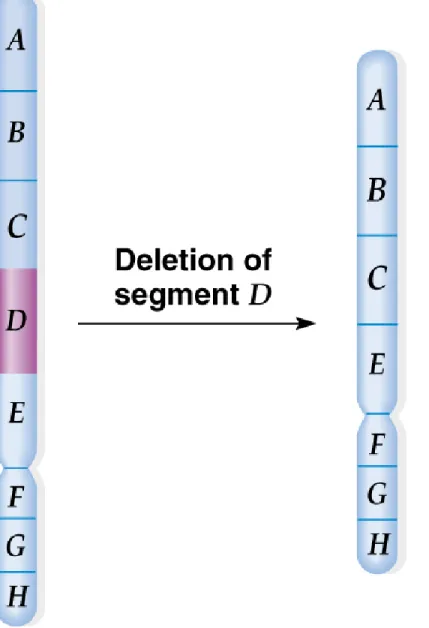
Deletion
1. In a deletion, part of a chromosome is missing.
a. Deletions start with chromosomal breaks induced by: i. Heat or radiation (especially ionizing).
ii. Viruses. iii. Chemicals.
iv.Transposable elements. v. Errors in recombination.
b. Deletions do not revert, because the DNA is missing.
2. The effect of a deletion depends on what was deleted.
a. A deletion in one allele of a homozygous wild-type organism may give a normal phenotype, while the same deletion in the wild-type allele of a heterozygote would produce a mutant phenotype.
b. Deletion of the centromere results in an acentric chromosome that is lost, usually with serious or lethal consequences. (No known living human has an entire
autosome deleted from the genome.)
c. Large deletions can be detected by unpaired loops seen in karyotype analysis (Figure 17.2).
台大農藝系 遺傳學 601 20000 Chapter 21 slide 6
Peter J. Russell, iGenetics: Copyright © Pearson Education, Inc., publishing as Benjamin Cummings.
台大農藝系 遺傳學 601 20000 Chapter 21 slide 7
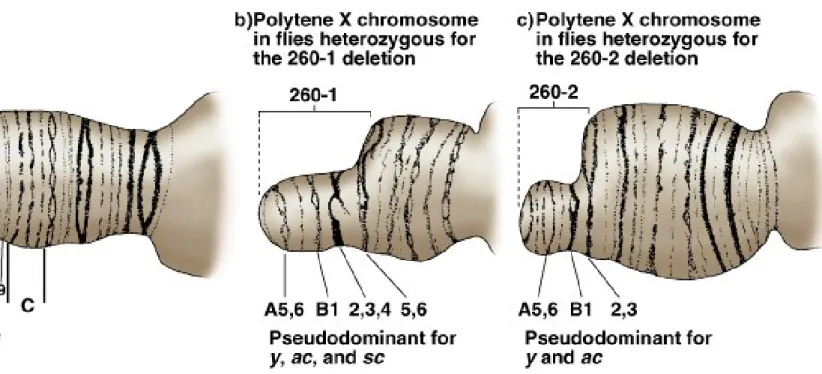
3. Deletion mapping can indicate the physical location of a
gene on the chromosome, because deletion of the
dominant allele in a heterozygote results in the recessive
phenotype.
a. Expression of the recessive trait caused by the absence of a
dominant allele is called pseudodominance.
b. Demerec and Hoover (1936) studied a fly strain heterozygous for
the X-linked recessive mutations y, ac and sc (Figure 17.3).
i. Genetic analysis shows the 3 loci linked at the left end of the
X chromosome.
ii. Deletion experiments correlate the deleted DNA with loss of
dominant alleles and the appearance of pseudodominance.
iii. This technique was used to produce the detailed physical
台大農藝系 遺傳學 601 20000 Chapter 21 slide 8
Peter J. Russell, iGenetics: Copyright © Pearson Education, Inc., publishing as Benjamin Cummings.
Fig. 17.3 Use of deletions to determine the physical locations of genes on
Drosophila
台大農藝系 遺傳學 601 20000 Chapter 21 slide 9
4. Human disorders caused by large chromosomal deletions are generally seen in heterozygotes, since homozygotes usually die.
a. The number of gene copies is important.
b. Syndromes result from the loss of several to many genes.
5. Examples of human disorders caused by large chromosomal deletions:
a. Cri-du-chat (“cry of the cat”) syndrome (OMIM 123450), resulting from deletion of part of the short arm of chromosome 5 (Figure 17.4). The deletion results in severe mental retardation and physical abnormalities. b. Prader-Willi syndrome (OMIM 176270), occurring in heterozygotes with
part of the long arm of one chromosome 15 homolog deleted. The deletion results in feeding difficulties, poor male sexual development, behavioral problems, and mental retardation..
台大農藝系 遺傳學 601 20000 Chapter 21 slide 10
Duplication
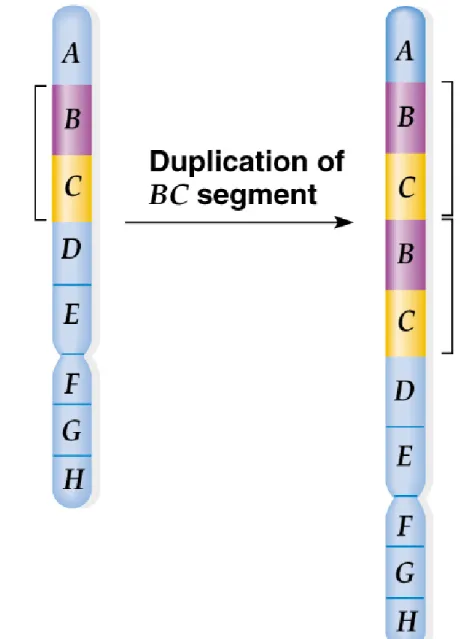
1. Duplications result from doubling of chromosomal
segments, and occur in a range of sizes and locations
(Figure 17.5).
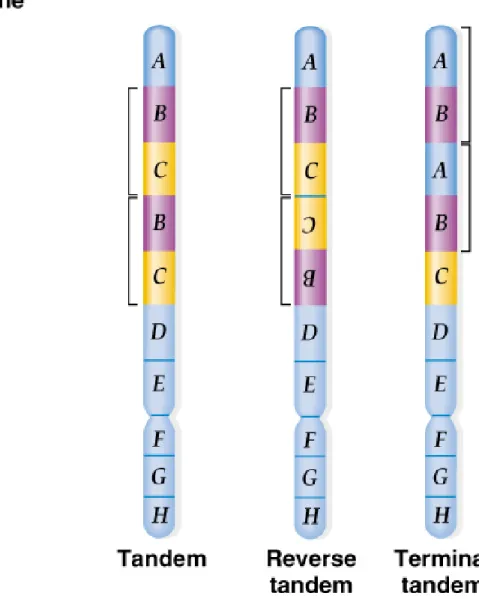
a. Tandem duplications are adjacent to each other.
b. Reverse tandem duplications result in genes arranged in the
opposite order of the original.
c. Tandem duplication at the end of a chromosome is a terminal
tandem duplication (Figure 17.6).
d. Heterozygous duplications result in unpaired loops, and may be
detected cytologically.
台大農藝系 遺傳學 601 20000 Chapter 21 slide 11
Peter J. Russell, iGenetics: Copyright © Pearson Education, Inc., publishing as Benjamin Cummings.
台大農藝系 遺傳學 601 20000 Chapter 21 slide 12
Peter J. Russell, iGenetics: Copyright © Pearson Education, Inc., publishing as Benjamin Cummings.
Fig. 17.6 Forms of chromosome duplications are tandem, reverse tandem, and
台大農藝系 遺傳學 601 20000 Chapter 21 slide 13
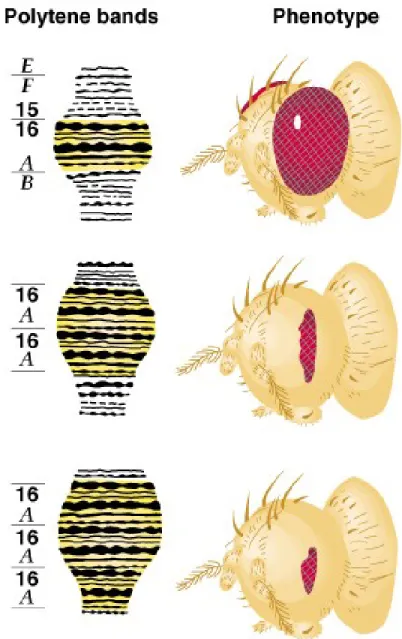
2. An example is the Drosophila eye shape allele, Bar, that
reduces the number of eye facets, giving the eye a slit-like
rather than oval appearance (Figure 17.7).
a. The Bar allele resembles an incompletely dominant mutation: i. Females heterozygous for Bar have a kidney-shaped eye that
is larger and more faceted than in a female homozygous for
Bar.
ii. Males hemizygous for Bar have slit-like eyes like those of a
Bar/Bar female.
b. Cytological examination of polytene chromosomes showed that the Bar allele results from duplication of a small segment (16A) of the X chromosome.
台大農藝系 遺傳學 601 20000 Chapter 21 slide 14
Peter J. Russell, iGenetics: Copyright © Pearson Education, Inc., publishing as Benjamin Cummings.
台大農藝系 遺傳學 601 20000 Chapter 21 slide 15
3. Multigene families result from duplications. Hemoglobin
(Hb) is an example:
a. Each Hb contains two copies of two subunits (e.g., 2 α-globins and 2 β-globins), and the identity of the subunits changes with the
organism’s developmental stage.
b. Genes for the α-type polypeptides are clustered together on 1 chromosome, and those for β-type polypeptides are clustered on another.
c. α-type genes have similar sequences, as do β-type. They probably result from duplication and subsequent sequence divergence.
台大農藝系 遺傳學 601 20000 Chapter 21 slide 16
Inversion
Animation: Crossing-over in an Inversion Heterozygote
1. Inversion results when a chromosome segment excises and reintegrates oriented 180
°
from the original orientation. There are two types (Figure 17.8):a. Pericentric inversions include the centromere.
b. Paracentric inversions do not include the centromere.
2. Inversions generally do not result in lost DNA, but phenotypes can arise if the breakpoints are in genes or regulatory regions.
3. Linked genes are often inverted together. The meiotic consequence depends on whether the inversion occurs in a homozygote or a heterozygote.
a. A homozygote will have normal meiosis.
b. The effect in a heterozygote depends on whether crossing-over occurs. i. If there is no crossing-over, no meiotic problems occur.
ii. If crossing-over occurs in the inversion, unequal crossover may produce serious genetic consequences.
台大農藝系 遺傳學 601 20000 Chapter 21 slide 17
Peter J. Russell, iGenetics: Copyright © Pearson Education, Inc., publishing as Benjamin Cummings.
台大農藝系 遺傳學 601 20000 Chapter 21 slide 18
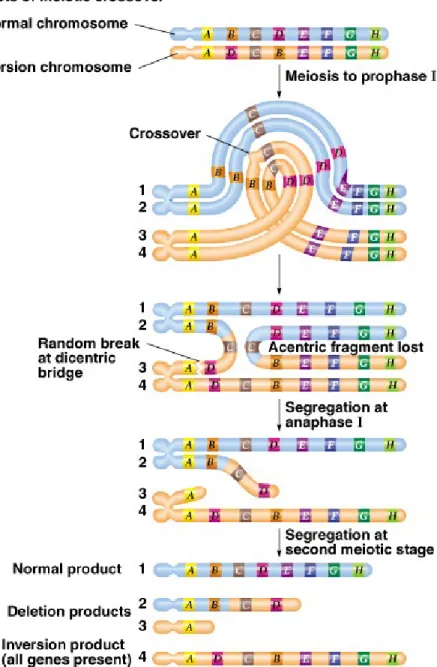
4. Different recombinant chromosomes are produced by crossover in a heterozygote, depending on centromere involvement:
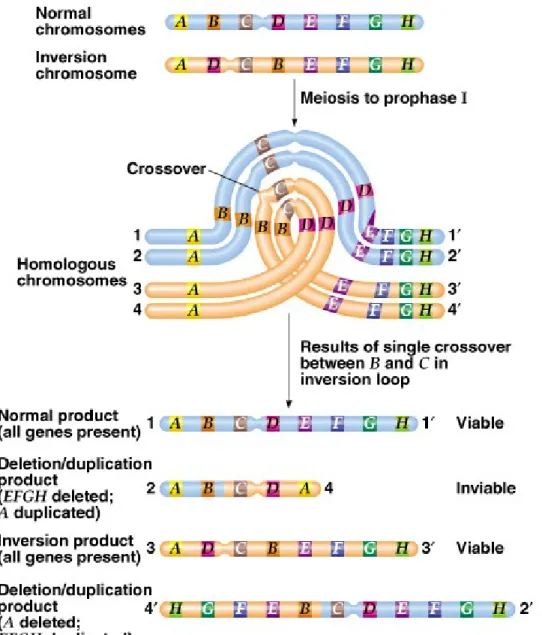
a. Paracentric inversions (no centromere) result in visible inversion loops between homologous chromosomes (Figures 17.9).
i. Crossover in the inversion region results in unbalanced sets of genes, and gametes or zygotes derived from recombined chromatids may be inviable due to abnormal gene dose.
ii. Without crossover in the looped region, gametes receive complete sets of genes (two gametes with normal and two with inversions) and are viable. iii. Effects of a single crossover within an inverted segment in a heterozygote
include (Figure 17.10):
(1) Joining of homologous regions of two chromatids to produce a dicentric bridge, and corresponding loss of an acentric fragment. (2) During anaphase the two centromeres of the dicentric chromosome
migrate towards opposite poles, causing the bridge to break, and producing two chromatids with deletions.
(3) The second meiotic division distributes one chromatid to each gamete:
(a) Two gametes carry normal sets of genes (one in the normal order and the other in inverted order).
(b) Two gametes are missing many genes, and are inviable.
(4) Female mammals often shunt dicentric chromosomes or acentric fragments to the polar bodies, so fertility may not be so reduced.
台大農藝系 遺傳學 601 20000 Chapter 21 slide 19
Peter J. Russell, iGenetics: Copyright © Pearson Education, Inc., publishing as Benjamin Cummings.
台大農藝系 遺傳學 601 20000 Chapter 21 slide 20
Peter J. Russell, iGenetics: Copyright © Pearson Education, Inc., publishing as Benjamin Cummings.
Fig. 17.10 Meiotic products resulting from a single crossover within a heterozygous,
台大農藝系 遺傳學 601 20000 Chapter 21 slide 21
b. Pericentric inversions that undergo a single crossover will result
in:
i. Two viable gametes, one with genes in normal order, the
other with the inversion.
ii. Two inviable gametes, each with some genes deleted and
others duplicated.
c. Some crossover events within the inversion loop do not affect
gamete viabiity Examples:
i. A double crossover close together involving the same two
chromatids (a 2-strand double crossover).
ii. Changes where duplicated and deleted segments do not
affect gene expression (e.g., very small segments).
iii. In mammals, inverted segments may remain unpaired, and
so avoid crossing-over.
台大農藝系 遺傳學 601 20000 Chapter 21 slide 22
Translocation
Animation: Meiosis in a Translocation Heterozygote
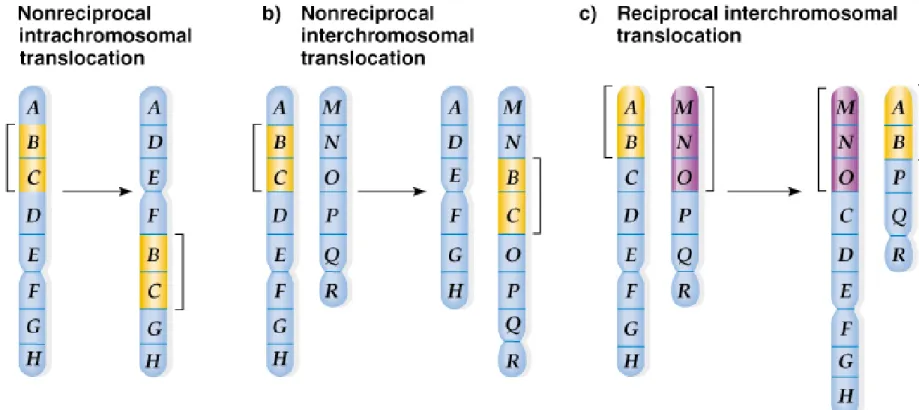
1. A change in location of a chromosome segment is a translocation. No DNA is lost or gained. Simple translocations are of two types (Figure 17.11):
a. Intrachromosomal, with a change of position within the same chromosome.
b. Interchromosomal, with transfer of the segment to a nonhomologous chromosome.
i. If a segment is transferred from one chromosome to another, it is nonreciprocal.
ii. If segments are exchanged, it is reciprocal.
2. Gamete formation is affected by translocations.
a. In homozygotes with the same translocation on both chromosomes, altered gene linkage is seen.
b. Gametes produced with chromosomal translocations often have
unbalanced duplications and/or deletions and are inviable, or produce disorders like familial Down syndrome.
台大農藝系 遺傳學 601 20000 Chapter 21 slide 23
Peter J. Russell, iGenetics: Copyright © Pearson Education, Inc., publishing as Benjamin Cummings.
台大農藝系 遺傳學 601 20000 Chapter 21 slide 24
d. Strains heterozygous for a reciprocal translocation must pair a set of normal chromosomes (N) with a set of translocated ones (T).
i. Result is a cross-like configuration in meiotic prophase I of four associated chromosomes, each partially homologous to two others in the group
(Figure 17.12).
ii. Anaphase I segregation may occur in three different ways (crossover will not be considered).
(1) Alternate segregation moves alternate centromeres to the same poles (e.g., N1 and N2 one direction, T1 and T2 the other). Gametes are
viable, with either normal or translocated chromosomes.
(2) Adjacent 1 segregation moves adjacent nonhomologous centromeres to the same pole (e.g., N1 and T2 one direction, N2 and T1 the other).
Gametes are inviable due to gene duplications and deletions.
(3) Adjacent 2 segregation is rare, moving different pairs of adjacent homologous centromeres to the same pole (N1 and T1 one direction, N2
and T2 the other). These gametes are usually inviable.
iii. Thus, heterozygotes for a reciprocal translocation are considered semi-sterile.
台大農藝系 遺傳學 601 20000 Chapter 21 slide 25
Peter J. Russell, iGenetics: Copyright © Pearson Education, Inc., publishing as Benjamin Cummings.
Fig. 17.12 Meiosis in a translocation heterozygote in which no crossover occurs
台大農藝系 遺傳學 601 20000 Chapter 21 slide 26
3. Animal gametes with large duplications or
deletions may function, but the zygote generally
dies. Small duplications or deletions may be
viable. Plant pollen with duplications or deletions
is usually nonfunctional.
台大農藝系 遺傳學 601 20000 Chapter 21 slide 27
Chromosomal Mutations and Human Tumors
1. Most human malignant tumors have chromosomal mutations.
a. The most common are translocations
b. There is much variation in chromosome abnormalities, however, and they include simple rearrangements to complex changes in chromosome structure and number. c. Many tumor types show a variety of mutations.
d. Some, however, are associated with specific chromosomal abnormalities.
2. Examples of specific abnormalities associated with tumors:
a. Chronic myelogenous leukemia (CML; OMIM 151410) involves a reciprocal translocation of chromosomes 9 and 22 (Figure 17.13).
i. Myeloblasts (stem cells of white blood cells) replicate uncontrollably.
ii. 90% of CML patients have the Philadelphia chromosome (Ph1) reciprocal translocation.
iii. The reciprocal translocation causes transition from a differentiated cell to a tumor cell, by translocating a proto-oncogene from chromosome 9 to chromosome 22, and probably converting it to the ABL oncogene.
iv. The hybrid gene arrangement causes expression of a leukemia-producing gene product.
台大農藝系 遺傳學 601 20000 Chapter 21 slide 28 Fig. 17.13 Origin of the Philadelphia chromosome in chronic myelogenous
leukemia
(CML) by a reciprocal translocation involving chromosomes 9 and 22
台大農藝系 遺傳學 601 20000 Chapter 21 slide 29
b. Burkitt lymphoma (BL) involves a reciprocal
translocation of chromosomes 8 and 14.
i. Induced by a virus, this disease is common in Africa.
ii. B cells are affected, and secrete antibodies as they
proliferate.
iii. The reciprocal translocation positions the MYC
proto-oncogene next to an active immunoglobulin
gene, resulting in over-expression of MYC and
台大農藝系 遺傳學 601 20000 Chapter 21 slide 30
Position Effect
1. Sometimes inversions or translocations change phenotypic expression of genes by the position effect, for example, by moving a gene from
euchromatin to heterochromatin (transcription generally occurs in euchromatin but not in heterochromatin).
2. This is an example of an epigenetic effect since the DNA sequence of the gene is not affected.
3. An example is the white-eye (w) locus in Drosophila:
a. An inversion moves the w+ gene from a euchromatin region of the X chromosome to a position in heterochromatin.
b. In a w+ male, or a w+/w female, where w+ is involved in the inversion, the eyes will have white spots resulting from the cells where the w+ allele was moved and inactivated.
4. Position effects are associated with some human diseases. Aniridia (“without iris,” OMIM 106210) is an example.
a. Aniridia is severe hypoplasia of the iris, usually associated with cataracts and clouding of the cornea.
b. The cause of aniridia is early termination of eye development, resulting from lost function of the PAX6 gene by deletion, mutation, or translocation.
台大農藝系 遺傳學 601 20000 Chapter 21 slide 31
Fragile Sites and Fragile X Syndrome
1. Chromosomes in cultured human cells develop narrowings or unstained areas (gaps) called fragile sites; over 40 human fragile sites are known. 2. A well-known example is fragile X syndrome, in which a region at
position Xq27.3 is prone to breakage and mental retardation may result (Figure 17.14).
a. Fragile X syndrome has an incidence in the U.S. of about 1/1,250 in males, and 1/2,500 in females (heterozygotes) (Figure 17.15).
b. Inheritance follows Mendelian patterns, but only 80% of males with a fragile X chromosome are mentally retarded. The 20% with fragile X chromosome but a normal phenotype are called normal transmitting males.
i. A normal transmitting male can pass the chromosome to his daughter(s). ii. Sons of those daughters frequently show mental retardation.
c. About 33% of carrier (heterozygous) females show mild mental retardation. i. Sons of carrier females have a 50% chance of inheriting the fragile X. ii. Daughters of carrier females have a 50% chance of being carriers.
台大農藝系 遺傳學 601 20000 Chapter 21 slide 32 Fig. 17.14 Diagram of a human X chromosome showing the location of the
fragile site
responsible for fragile X syndrome
台大農藝系 遺傳學 601 20000 Chapter 21 slide 33
d. Molecular analysis shows a repeated 3-bp sequence, CGG, in the FMR-1 (fragile X mental retardation-1) gene, at the fragile X site.
i. Normal individuals have 6–54 CGG repeats, with an average of 29.
ii. Normal transmitting carrier males, their daughters and some other carrier females have 55–200 copies, but do not show symptoms.
iii. Individuals with fragile X syndrome have 200–1,300 copies, indicating that tandem amplification of this sequence is tolerated until a threshold number of copies is reached.
iv. Amplification of CGG repeats occurs only in females, perhaps during a slipped mispairing process during DNA replication.
v. The FMR-1 product is an RNA-binding protein. The triplet repeat expansion in FMR-1 affects expression rather than protein coding, resulting in loss of gene activity.
3. There are other examples of triplet repeat amplifications that cause disease above a threshold number of copies. In these examples, amplification can occur in both sexes.
a. Myotonic dystrophy.
b. Spinobulbar muscular atrophy (Kennedy disease). c. Huntington disease.
台大農藝系 遺傳學 601 20000 Chapter 21 slide 34
Variations in Chromosome Number
1. An organism or cell is euploid when it has one complete set of
chromosomes, or exact multiples of complete sets. Eukaryotes that
are normally haploid or diploid are euploid, as are organisms with
variable numbers of chromosome sets.
2. Aneuploidy results from variations in the number of individual
chromosomes (not sets), so that the chromosome number is not an
exact multiple of the haploid set of chromosomes.
台大農藝系 遺傳學 601 20000 Chapter 21 slide 35
Changes in One or a Few Chromosomes
1. Aneuploidy can occur due to nondisjunction during meiosis.
a. Nondisjunction during meiosis I will produce four gametes, two with a chromosome duplicated, and two that are missing that chromosome.
i. Fusion of a normal gamete with one containing a chromosomal duplication will produce a zygote with three copies of that chromosome, and two of all others. ii. Fusion of a normal gamete with one missing a chromosome will result in a
zygote with only one copy of that chromosome, and two of all others.
b. Nondisjunction during meiosis II produces two normal gametes and two that are abnormal (one with two sibling chromosomes, and one with that chromosome missing).
i. Fusion of abnormal gametes with normal ones will produce the genotypes discussed above.
ii. Normal gametes are also produced, and when fertilized will produce normal zygotes.
c. More complex gametic chromosome composition can result when: i. 1 chromosome is involved.
ii. Nondisjunction occurs in both meiotic divisions.
iii. Nondisjunction occurs in mitosis (result is somatic cells with unusual chromosome complements).
台大農藝系 遺傳學 601 20000 Chapter 21 slide 36
2. Autosomal aneuploidy is not well tolerated in animals, and in mammals is detected mainly after spontaneous abortion. Aneuploidy is much
better tolerated in plants. There are four main types of aneuploidy (Figure 17.16):
a. Nullisomy involves loss of 1 homologous chromosome pair (the cell is 2N - 2).
b. Monosomy involves loss of a single chromosome (2N - 1).
c. Trisomy involves one extra chromosome, so the cell has three copies of one, and two of all the others (2N + 1).
d. Tetrasomy involves an extra chromosome pair, so the cell has four copies of one, and two of all the others (2N + 2).
3. More than one chromosome or chromosome pair may be lost or added. Examples:
a. A double monosomic aneuploidy has two separate chromosomes present in only one copy each (2N - 1 - 1).
b. A double tetrasomic aneuploidy has two chromosomes present in four copies each (2N + 2 + 2).
台大農藝系 遺傳學 601 20000 Chapter 21 slide 37 Fig. 17.16 Normal (theoretical) set of metaphase chromosomes in a diploid
(2N)
organism (top) and examples of aneuploidy (bottom)
台大農藝系 遺傳學 601 20000 Chapter 21 slide 38
4. Some types of aneuploidy have serious meiotic consequences. Examples:
a. A monosomic cell (2N - 1):
i. May produce gametes that are N (normal) and N - 1(monosomic). ii. Or, the unpaired chromosome may be lost completely, producing
gametes that are all N - 1.
b. A trisomic cell (2N + 1) with the genotype +/+/a, would be an example (assuming that this organism can tolerate trisomy, and no crossing-over occurs) (Figure 17.17).
i. Gametes produced belong to four genotypic classes, in these proportions:
(1) Two gametes with genotype +/a. (2) Two gametes with genotype +. (3) One gamete with genotype +/+. (4) One gamete with genotype a.
ii. The cross of a +/+/a trisomic to an a/a individual will produce a phenotypic ratio of 5 wild type : 1 mutant (a).
台大農藝系 遺傳學 601 20000 Chapter 21 slide 39
Peter J. Russell, iGenetics: Copyright © Pearson Education, Inc., publishing as Benjamin Cummings.
台大農藝系 遺傳學 601 20000 Chapter 21 slide 40
5. Human examples of aneuploidy in autosomes and sex chromosomes are summarized in Table 17.1.
a. Sex chromosome aneuploidy is found more often than autosome
aneuploidy, because lyonization compensates for chromosome dosage. b. Autosomal monosomies are rarely found in humans, presumably because
they are lost early in pregnancy.
c. Autosomal trisomies account for about half of fetal deaths, and only a few are seen in live births. Most (trisomy-8, -13 and -18) result in early death, with only trisomy-21 (Down syndrome) surviving to adulthood.
台大農藝系 遺傳學 601 20000 Chapter 21 slide 41
d. Trisomy-21 occurs in an estimated 3,510/106 conceptions, and 1,430/106
births (Figure 17.18).
i. Down syndrome individuals are characterized by: (1) Low IQ.
(2) Epicanthal folds over eyes. (3) Short and broad hands. (4) Below-average height. .
台大農藝系 遺傳學 601 20000 Chapter 21 slide 42
ii. Table 17.2 shows the correlation of maternal age and probability of trisomy-21.
(1) A female fetus before birth produces primary oocytes in her ovaries that stop their development at prophase I of meiosis.
(2) After puberty, secondary oocytes develop from the primary ones, entering the second meiotic division but again arresting, this
time at metaphase II.
(3) If fertilization occurs, the second meiotic division is completed.
(4) The probability of nondisjunction increases with length of time the primary oocyte is in the ovary.
(5) Amniocentesis or chorionic villus sampling can determine whether the fetus has a normal complement of chromosomes
iii. Additional risks for Down syndrome include: (1) Increased paternal age
(2) Smoking in mothers who have an error in meiosis II,
especially if they use oral contraceptives (oral contraceptives alone do not increase risk).
台大農藝系 遺傳學 601 20000 Chapter 21 slide 44
Animation: Down Syndrome Caused by a Robertsonian
Translocation
iv. Robertsonian translocation (centric fusion) produces three
copies of the long arm of chromosome 21, resulting in
familial Down syndrome (figure 17.19).
(1) In this nonreciprocal translocation, two
nonhomologous acrocentric (centromeres near end)
chromosomes break at centromeres.
(a) Both long arms become attached to the same centromere, creating a chromosome with the long arm of chromosome 21 and the long arm of chromosome 14 (or 15).
(b) The short arms also fuse, forming a reciprocal product that is usually lost within a few cell divisions.
(c) The heterozygous carrier of this chromosome is phenotypically normal, since the two copies of each major chromosome arm supply two copies of all essential genes.
台大農藝系 遺傳學 601 20000 Chapter 21 slide 45
Peter J. Russell, iGenetics: Copyright © Pearson Education, Inc., publishing as Benjamin Cummings.
台大農藝系 遺傳學 601 20000 Chapter 21 slide 46
(2) Mating of a heterozygous carrier and a normal
individual has a high risk of Down syndrome offspring
(Figure 17.20).
(a)The normal parent produces normal gametes, with one copy each of chromosomes 14 and 21.
(b) The heterozygous carrier parent produces three reciprocal pairs of gametes, each produced by different segregation of the three
chromosomes involved.
(c)Theoretically, the zygotes produced would be:
(i) 1⁄6 with normal chromosomes 14 and 21 (like 1 parent).
(ii) 1⁄6 heterozygous carriers with normal phenotype (like other parent). (iii) 1⁄6 inviable due to monosomy of chromosome 14.
(iv) 1⁄6 inviable due to monosomy of chromosome 21. (v) 1⁄6 inviable due to trisomy of chromosome 14.
(vi) 1⁄6 with trisomy of chromosome 21. These individuals have a normal chromosome number (46) but three copies of the long arm of
chromosome 21, sufficient to cause Down syndrome.
(vii) In summary, 1⁄2 the zygotes are inviable, and 1⁄3 of the live offspring are predicted to have Down syndrome, although the actual birth rate is lower
台大農藝系 遺傳學 601 20000 Chapter 21 slide 47 Fig. 17.20 The three segregation patterns of a heterozygous Robertsonian
translocation involving the human chromosomes 14 and 21
台大農藝系 遺傳學 601 20000 Chapter 21 slide 48
e. Trisomy-13 (Patau syndrome) occurs in 2/104 live births, and most die
within the first 3 months. Characteristics include (Figure 17.21): i. Cleft lip and palate.
ii. Small eyes.
iii. Polydactyly (extra fingers and toes). iv. Mental and developmental retardation. v. Cardiac and other abnormalities.
台大農藝系 遺傳學 601 20000 Chapter 21 slide 49
f. Trisomy-18 (Edwards syndrome) occurs in 2.5/104 live births, and 90%
die within 6 months. About 80% of Edwards syndrome infants are female. Characteristics include (Figure 17.22):
i. Small size with multiple congenital malformations throughout the body.
ii. Clenched fists. iii. Elongated skull. iv. Low-set ears.
台大農藝系 遺傳學 601 20000 Chapter 21 slide 50
Changes in Complete Sets of Chromosomes
1. Monoploidy and polyploidy involve complete sets of chromosomes, and so both are cases of euploidy. Euploidy is lethal in most animal species, but often tolerated in plants, where it has played a role in speciation and diversification.
2. Monoploidy and polyploidy can result when either round of meiotic division lacks cytokinesis, or when meiotic nondisjunction occurs for all chromosomes.
a. Complete nondisjunction at meiosis II will produce 1⁄2 gametes with
normal chromosomes, 1⁄4 with two sets of chromosomes and 1⁄4 with no chromosomes.
b. A gamete with two sets of chromosomes fused with a normal gamete produces a triploid (3N) zygote.
c. Fusion of two gametes that each have two sets of chromosomes produces a tetraploid (4N) zygote.
d. Polyploidy of somatic cells can result from mitotic nondisjunction of complete chromosome sets.
台大農藝系 遺傳學 601 20000 Chapter 21 slide 51
3. Monoploidy is rare in adults of diploid species due to
recessive lethal mutations.
a. Males of some species (e.g., wasps, ants and bees) develop
from unfertilized eggs and are monoploid.
b. Plant experiments often use monoploids.
i. Haploid cells are isolated from plant anthers and grown
into monoploid cultures.
ii. Colchicine (which inhibits mitotic spindle formation)
allows chromosome number to double, producing
completely homozygous diploid breeding lines.
iii. Mutant genes are easily identified in monoploid
台大農藝系 遺傳學 601 20000 Chapter 21 slide 52
4. Polyploidy involves three or more sets of chromosomes
(Figure 17.23), and may occur naturally (e.g., by breakdown
of the mitotic spindle), or by induction (e.g., with chemicals
such as colchicine).
a. Nearly all plants and animals probably have some polyploid tissues. Examples:
i. Plant endosperm is triploid.
ii. Liver of mammals (and perhaps other vertebrates) is polyploid. iii. Giant abdominal neuron of Aplysia has about 75,000 copies of
the genome.
iv. Wheat is hexaploid (6N) and the strawberry is octaploid (8N). v. North American sucker fish, salmon and some salamanders are
polyploid.
b. There are two classes of polyploids based on the number of chromosome sets:
i. Even-number polyploids are more likely to be at least partially fertile, because the potential exists for equal segregation of homologs during meiosis.
ii. Odd-number polyploids will always have unpaired
chromosomes. Balanced gametes are rare and these organisms are usually sterile or have increased zygote death.
台大農藝系 遺傳學 601 20000 Chapter 21 slide 53
Peter J. Russell, iGenetics: Copyright © Pearson Education, Inc., publishing as Benjamin Cummings.
台大農藝系 遺傳學 601 20000 Chapter 21 slide 54
c. Triploids are unstable in meiosis, because random segregation means that balanced gametes (either exactly N or exactly 2N) are rare.
i. The probability of a triploid organism producing a haploid gamete is (1⁄2)n, where n is the number of chromosomes.
ii. Triploidy is always lethal in humans, accounting for 15–20% of spontaneous abortions and 1/104 live births, with most dying in
the first month.
iii. Tetraploidy in humans is also lethal, usually before birth, accounting for 5% of spontaneous abortions.
d. Polyploidy is more common in plants, probably due to
self-fertilization, allowing an even-number of polyploids to produce fertile gametes and reproduce. Plant polyploidy occurs in two types:
i. Autopolyploidy results when all sets of chromosomes are from the same species, usually due to meiotic error. Fusion of a
diploid gamete with a haploid one produces a triploid organism. Examples include:
(1) “Seedless” fruits like bananas, grapes and watermelons. (2) Grasses, garden flowers
,
crop plants andforest trees.
台大農藝系 遺傳學 601 20000 Chapter 21 slide 55
ii. Allopolyploidy results when the chromosomes are from two
different organisms, typically from the fusion of haploid gametes followed by chromosome doubling. For example:
(1) Fusion of haploid gametes from plant 1 and plant 2
produces an N1 + N2 hybrid plant. No chromosomal pairing
occurs at meiosis, viable gametes are not produced and the plants are sterile.
(2) Rarely, division error doubles the chromosome sets (2 N1
+ 2N2). The diploid sets function normally in meiosis, and
fertile allotetraploid plants result.
(3) An example is crosses between cabbages (Brassica
oleracea) and radishes (Raphanus sativus), which both have
a chromosome number of 18.
(a) The F1 hybrids have 9 chromosomes from each parent, and have a morphology intermediate between cabbages and radishes. They are mostly sterile.
(b) A few seeds, some fertile, can be produced by the F1 through meiotic
errors.
(i) Somatic cells in the resulting plants have 36 chromosomes, a full diploid set from both cabbages and radishes.
(ii) These fully fertile plants look much like the F1 hybrids, and are named
Raphanobrassica.
(4) Polyploidy is the rule in agriculture, where polyploids include all
commercial grains (e.g., bread wheat, Triticum aestivum, an allohexaploid of three plant species), most crops and common flowers.