青少年肥胖、身體活動與社會體型焦慮之研究
研究成果報告(精簡版)
計 畫 類 別 : 個別型
計 畫 編 號 : NSC 98-2410-H-028-008-
執 行 期 間 : 98 年 08 月 01 日至 99 年 07 月 31 日
執 行 單 位 : 國立臺灣體育學院運動健康科學學系
計 畫 主 持 人 : 陳俐蓉
共 同 主 持 人 : 古博文
報 告 附 件 : 出席國際會議研究心得報告及發表論文
處 理 方 式 : 本計畫涉及專利或其他智慧財產權,2 年後可公開查詢
中 華 民 國 99 年 07 月 28 日
國科會專題研究計畫期末報告 1
青少年肥胖、身體活動與社會體型焦慮之研究
計畫類別(單選):新進人員研究計畫 研 究 型 別:個別型計畫 計 畫 歸 屬:人文處 申 請 機 構 /系所( 單位): 國立台灣體育學院 運動健康科學學系 本 計畫主持人姓名:陳俐蓉 本 計 畫 名 稱: 中文:青少年肥胖、身體活動與社會體型焦慮之研究 英 文:Obesity, physical activity and social physique anxiety
among adolescents
青少年社會體型焦慮與運動行為 摘要 目的:本研究目的在了解青少年社會體型焦慮與運動行為之關係 ,並探討在控制人口統 計、心理及行為變項後,兩者關係是否維持不變。 方法:樣本來自臺灣 18個中等學校,然後從每個學校選取 8個班級。總樣本數為 4230 人,年齡 12-19歲 (2223男生;2007女生)。參與者填寫人口統計變項 (年齡、性別、社經 地位、身高與體重)、運動、體重控制、抽菸喝酒等行為變項 、及心理變項 (社會體型焦 慮、自尊、外型描繪評分尺度與被取笑經驗 )。以階層迴歸分析運動行為及相關變項的預 測情形。 結果:研究結果顯示,運動行為為社會體型焦慮的顯著預測因子 ,可解釋 2.4%的變異量 (p<.001)。當人口統計變項加入迴歸分析,總變異量增加 14.7%。運動行為仍為社會體型焦 慮的顯著預測因子 (p<.001)。最後,將行為變項及心理變項加入 迴歸分析,對社會體型焦 慮的預測力提高 20.1%。在最後模式中,除社經地位變項,其他所有變項均為社會體型焦 慮的顯著預測因子,共可解釋 37.2%的變異量。在控制人口統計、心理及行為變項後,社 會體型焦慮與運動行為始終維持顯著的關係 (p=.002)。 結論: 本研究納入許多社會體型焦慮與運動行為的相關變項 ,並進一步探討兩者間的關 係。研究證實運動行為在控制人口統計 、心理及行為變項後,對社會體型焦慮仍具顯著預 測力。
國科會專題研究計畫期末報告
3
Title: Social physique anxiety and exercise among adolescents
Abstract
Aims: This study was designed to investigate the link between exercise and social physique
anxiety (SPA) among adolescents and to understand the SPA-exercise relationship for controlling
demographic, psychological and behavioral variables.
Methods: Participants were recruited from 18 high schools in Taiwan. Eight classes in each
school were then selected by convenience. A total sample of 4230 adolescents aged 12 to 19
resulted (2223 boys and 2007 girls). Participants completed measures of demographic variables
(age, gender, social economic status (SES), weight and height), exercise, weight loss, smoking,
drinking behaviors, and psychological variables ( SPA scale, self-esteem scale, contour drawing
rating scale, and teasing experience). A three -step forced entry multiple regression analysis was
performed to determine how much of the variance in SPA was explained by exercise and other
variables.
Results: Examination of the regression coefficient showed that exercise was a significant
negative predictor of SPA, accounting for 2.4% of the variance in SPA ( p<.001). Demographic
variables were entered for the next step, adding 14.7% of the variance. Exercise was still related
to SPA significantly (p<.001). When behavioral and psychological variables were added to the
model, the variance increased 20.1%. The final model revealed that all variables, except SE S,
were significant predictors, explaining 37.2% of the variance in SPA. The exercise-SPA
relationship remained statistically significant even after multivariate adjustment ( p=.002).
Conclusion: This study further explored the exercise -SPA relationship with a broad range of
variables. Exercise accounts for a significant amount of unique variance in the presence of
Title: Social physique anxiety and exercise among adolescents
Introduction
Studies have shown that many adolescents are insufficiently active and a consistent finding is that
physical activity declines with age during adolescence . Eklund & Bianco (2000) pointed out that
social physique anxiety is one of the important factors contributing to t his pattern of decline.
Exercise settings where the physique may be evaluated by others, might bring about the negative
affect-social physique anxiety (SPA) for adolescents. It is suggested that taking into account the
possible confounding factors (e.g. ag e, gender, and self-esteem) to better understand the social
physique anxiety-exercise behavior. Whether the social physique anxiety-exercise relationship is
dependent on these potential confounders need further explorations.
Additionally, cultural factor s may need to be studied for clarifying the social physique
anxiety-exercise relationship (Russell & Cox, 2003). The majority of the research has been produced with
samples of white Caucasian populations (Chu, Bushman, & Woodard, 2008; Craw ford & Eklund,
1994; Eklund & Crawford, 1994; Russell & Cox, 2003) . Whereas studies have provided some
information about the link between exercise and social physique anxiety, only a few studies have
assess social physique anxiety of adolescents (Eklund & Bianco, 2000; Smith, 2004) .
Therefore, the purpose of this study was to examine the relationship between social physique
anxiety and exercise among Taiwanese adolescents and to understand the social physique
國科會專題研究計畫期末報告
5
Methods Participants
Students were recruited as participants for this study from 18 high schools in Taiwan. Eight
classes in each school were then selected by convenience. All students in the selected classes
were invited to take part in this study. Participants completed the questionnaire in a group setting
during classes. A total sample of 4230 adolescents (2223 boys and 2007 girls) resulted.
Measures
Social physical anxiety: Hart et al. (1989) developed the Social Physique Anxiety Scale (SPAS)
to measure levels of social physique anxiety. The nine-item SPAS was used for this study since it
was recommended with adolescent sample (Smith, 2004). Respondents are asked to i ndicate the
degree to which statements are characteristic of them on a five -point Likert-type scale, ranging
from (1) not at all to (5) extremely.
Exercise behavior: Participants were asked whether they participated in exercise three or more
times a week for at least 20 minutes that made them breath hard on a regular basis. The answers
were categorized into a dummy variable: ‘Yes: 1 and No: 0’.
Self-esteem: The Rosenberg Self-Esteem Scale was originally developed for measuring global
self-esteem with adolescents, consisting of 10 items (Rosenberg, 1965). The respondent is
required to rate on a four-point Likert scale ranging from (1) strongly disagree to (4) strongly
agree.
Body shape dissatisfaction: The Contour Drawing Rating Scale which consists of nine male and
requires participants to locate their current and ideal body figure. The difference between the
ratings is calculated as ‘Self-Ideal Discrepancy’, and has been considered to be an indication of
body shape dissatisfaction.
Teasing experiences: Participants were asked whether they had any experience of being teased
because of body weight. The answers were cat egorized into a dummy variable: ‘Yes: 1 and No:
0’.
Behavioral variables: Participants reported whether they engaged in weight loss behavior and
whether they smoked or drank alcohol. The answers were categorized into dummy variables:
‘Yes: 1 and No: 0’.
Demographic variables: Age, gender, and weight status. Body mass index (BMI) was calculated using self-reported weight and height and classified using the Taiwan Department of Health
national definitions into a dummy variable: ‘overweight/obese: 1 and underw eight/normal weight: 0’. Socio-economic status (SES) was examined by parents’ occupation and education based on Hollingshead’s ‘Two Factor Index of Social Position’, modified to fit Taiwanese society by Lin
(Lin, 1994).
Statistical Analysis
Descriptive statistics for all key variables were calculated. The χ2-test or independent t-tests were
employed to examine gender difference. A three-step forced entry multiple regression analysis
was performed to determine how much of the variance in anxiety was explained by key variables.
The dependent variable was social physique anxiety, and th e predictors that were entered into the
model were exercise behavior, followed by demographic variables. Psychological variables and
health-related behaviors were added in the final step. A p-value of less than .05 was considered as
國科會專題研究計畫期末報告
7
Results
The participants reported a mean age of 17.2 (SD=1.0) years, mean BMI was 21.1 (SD=3.7),
mean self-esteem was 27.6 (SD=5.0), mean body shape dissatisfaction was 1.5 (SD=1.2), mean
social physique anxiety was 29.0 (SD=7.1). Girls scored significantly higher body shape
dissatisfaction and social physique anxiety than boys. These suggested that girls felt less positive
with their body shape and had a higher level of social physique anxiet y than boys. Girls also
reported more weight loss behavior than boys (girls: 30.8%, boys: 19.4%, respectively), even
though they were far more less overweight /obese than boys (girls: 8.5%, boys: 19.4%,
respectively). Approximately 30.9% of participants too k part in exercise regularly, with 42.0% in
boys and 17.7% in girls.
The three-step forced entry multiple regression analysis was conducted to test whether social
physique anxiety was related to key variables. The predictor of the first step was exercise
behavior. The results showed that exercise habit was a significant predictor ( p<.001) and
accounted for 2.4% of the variance in social physique anxiety. Demographic variables were
entered for the next step, adding 14.7% of the variance. An inverse associat ion was still found
between exercise and social physique anxiety ( p<.001). When psychological variables and health
-related behaviors were added to the model, the variance increased 20.1%. The exercise - social
physique anxiety relationship remained statisti cally significant after adjusting for demographic
variables, psychological variables, and health -related behaviors (p=002). The final model
revealed that all variables, except SES, were significant predictors, explaining 37.2% of the
Acknowledgement
This work is funded by the Taiwan National Science Council (No.: NSC-98-2410-H-028-008-)
References:
Chu, H.-W., Bushman, B. A., & Woodard, R. J. (2008). Social physique anxiety, obligation to
exercise, and exercise choices among college students. Journal of American College
Health, 57(1), 7-13.
Crawford, S., & Eklund, R. C. (1994). Social physique anxiet y, reasons for exercise, and attitudes
toward exercise settings. Journal of Sport & Exercise Psychology, 16 , 70-82.
Eklund, R. C., & Bianco, T. (2000). Social physique anxiety and physical activity among
adolescents. Reclaiming Children and Youth, 9 (3), 139-142.
Eklund, R. C., & Crawford, S. (1994). Active women, social physique anxiety, and exercise.
Journal of Sport and Exercise Psychology, 16 (4), 431-448.
Lin, S.-C. (1994). Sociology Education. Kao Hsiung: Fu Wen.
Russell, W. D., & Cox, R. H. (2003). Social physique anxiety, body dissatisfaction and self
-esteem in college females of differing exercise frequency, perceived weight discrepancy
and race. Journal of Sport Behavior, 26 (3), 298-318.
Smith, A. L. (2004). Measurement of social physique anxiety in early adolescence. Medicine and
表 Y04
國科會補助出席國際學術會議報告
99 年 7 月 20 日
報告人
姓名
陳俐蓉
職稱
助理教授
服務單位
國立臺灣體育大學 運動健康科學學系
國科會
補助金額
新台幣: 100,000元整
補助編號:98-2410-H-028-008
會議時間
2010 July 11
thto 16
th會議地點
Melbourne, Australia
會議
名稱
(中文)
第二十七屆應用心理學國際研討會
(英文)
27th International Congress of Applied Psychology
發表
論文題目
(中文)
青少年運動與社會體型焦慮之研究
(英文)
Exercise and social physique anxiety among adolescents
論文
發表形式
一、會議性質介紹:
本 國際 學 術 研 討會 係 由 【 國 際應 用 心 理 學會 The International
Association of Applied Psychology 】 及 【 澳 洲 心 理 學 會 Australian
Psychological Society】 共同主辦,每四年才辦理一次,過去已辦過26
次國際研討會,今年於Australia, Melbourne (2010) 辦理第27屆國際應
用心理學研討會。該研討會的學術地位崇高,國際應用心理學會The
International Association of Applied Psychology 於1920年成立至今,擁
有1500名來自世界超過 80個國家的廣大會員,是一個世界性的學術組
織。主要任務為推動應用心理學的發展與實踐,並促進應用心理學的
影響與世界交流。
本次會議主要包含21個議題:職場與組織心理學、心理測量與評
價、心理與社會發展、環境心理學、教育(學校)心理學、臨床心理學、
健康心理學、運動心理學、經濟心理學、心理諮商等等;會議內容還
包含學術倫理及社會文化相關領域之議題。因此,該研討會吸引來自
世界各地的心理學家、臨床學者、研究者、運動教練、商業管理人員
等共襄盛舉,相互交流與討論相關研究。
表 Y04
二、參加會議經過;
研討會會議於 7 月 11 日開始至 16 日結束。本次參與人數共計 3291
人,來自 67 個國家。其中參與發表之人員達 3223 人,亞太地區參與
人數佔多數,應用心理學會會員約佔參與者半數,碩博士學生約佔了
20%的參與人數。
參與人數與發表人數眾多,會議內容極為多元與豐富,會議議程
相當緊湊。會議議程從早上 8:30 開始,排到晚上 7:30 結束。除了上述
提及研討會議題包羅萬象外,本次會議形式亦包含專題演講
(keynotes)、專題座談會 (symposia)、專題討論會 (workshops)、一般口
頭發表 (individual paper presentations)、簡單口頭發表(brief oral
presentations) 以及電子海報發表 (electronic posters)等。然而由於發表
人數眾多,同一時段有多達 23 個議題,包含專題演講,座談會、討論
會、以及口頭發表等活動在不同會議廳同時進行,讓人目不暇給。
本次會議之註冊費頗高,800 澳幣(約新台幣 24,000 元)。
當天開幕式,主辦單位請澳洲當地原住民表演歌舞,有 3 位代
表致詞,講演時間拿捏恰當,內容風趣幽默,值得學習。
本研討會邀請許多大師擔任演講者,品質不錯。其中,大會辦
理 workshops,邀請統計專家 Barbara Byrne 講演 Beginner’s
guide to structure equation modeling: Basic concepts and
applications. 然而,美中不足的事,該課程需要額外付費,半
天 175 澳幣,一天 350 澳幣 (約新台幣 10,500 元)。
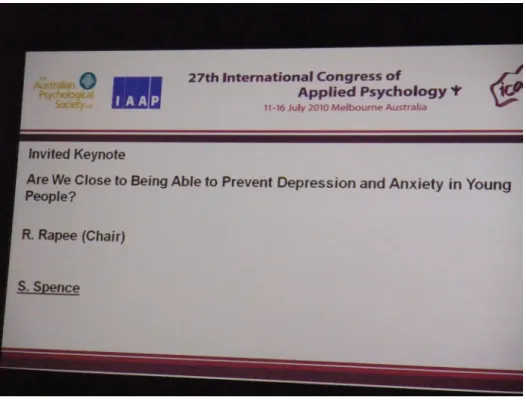
在所有的內容中,有一議題(邀請之專題演講) 與本研究 (運動
與社會體型焦慮) 相關性頗高,因此對此內容詳加說明。演講
者為 Susan Spence 教授,講題:Are we close to being able to
prevent depression and anxiety in young people? 短短一個小時
的演講內容,Spence 教授提供他們研究團隊 3 個研究的成果。
第一個研究針對青少年做認知行為介入,了解介入前後青少年
憂鬱與焦慮的改變情形(n=1500);結果發現介入前後
表 Y04
intervention group 與 control group 確實有顯著差異,但是在介
入結束後 1 年、2 年、3 年、4 年再進行施測,intervention group
與 control group 之憂鬱與焦慮情形則無顯著差異。研究者認
為,有可能是介入時間不夠長,青少年認知行為尚未形成習
慣,因此,第 2 個研究將介入時間分為 6 個月、12 個月、18
個月;樣本分為四組 (universal (all participants); indicated (high
risk groups); indentified (clinical); monitoring only) (n=2400);研
究結果發現四組間無顯著差異。研究者再度提出假設,認為可
能學校之環境因素扮演重要角色。因此,第 3 個研究將學校環
境因素(如校園安全,霸凌等),專業諮詢服務等因素納入介入
考量。本次研究人數多達 5500 人,50 個學校參與,研究時間
更拉長為 5 年。研究初步結果顯示,在 4 年後,青少年的憂鬱
程度各組間無顯著差異,而介入組之焦慮程度顯著降低、樂觀
程度與幸福情緒顯著上升。最後研究者總結,並提出討論議
題。究竟青少年心理與相關認知行為之偏差問題是否僅止於學
校?家庭或許是另一個思考點。介入的樣本應專注於危險族群
或 general population?另外,青少年時期實施介入,研究解果
顯示成效不大,是否介入時間太晚或太早?值得思考。
攜回該研討會會議議程,光碟片及相關書面資料
五、成果照片 (圖 1 - 圖 8)
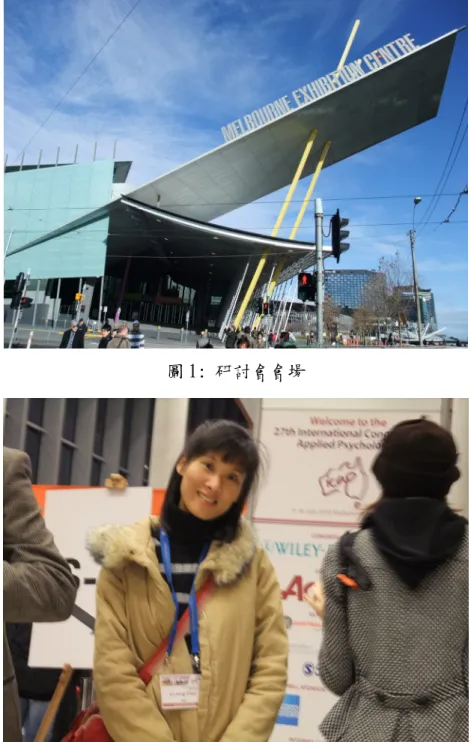
圖 1: 研討會會場
表 Y04
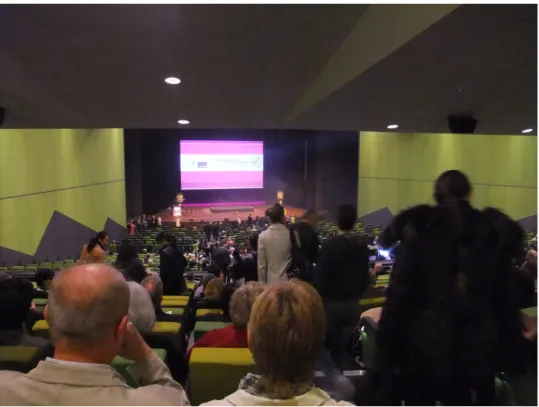
圖 3:開幕會場
圖 5:專題演講
表 Y04
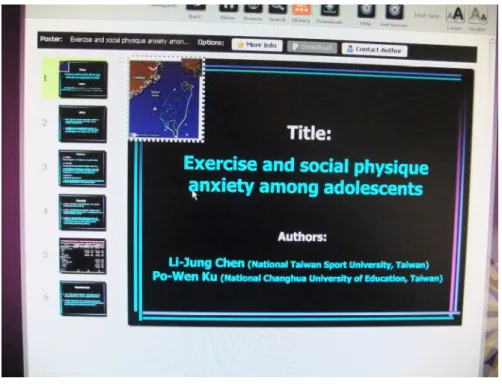
圖 7:電子海報發表現場
TEMPLATE FOR EITHER INDIVIDUAL ELECTRONIC POSTER
Abstract Title:
Exercise and social physique anxiety among adolescents Aim:
Method:
Results:
Conclusions:
This study was designed to investigate the link between exercise and social physique anxiety (SPA) among adolescents and examine the independent effects of exercise on SPA beyond demographic, psychological and behavioral factors
.
Participants were recruited from 18 high schools in Taiwan. Eight classes in each school were then selected randomly. A total sample of 4230 adolescents aged 12 to 19 resulted (2223 boys and 2007 girls). Participants completed measures of demographic variables (age, gender, social economic status (SES), weight status), exercise, weight loss, smoking, drinking behaviors, and psychological variables (the nine-item SPA scale, Rosenberg self-esteem scale, contour drawing rating scale, and experience of being teased). The SES was examined by parents’ occupation and education based on Hollingshead’s ‘Two Factor Index of Social Position’. The ‘Self-Ideal Discrepancy’ from the contour drawing rating is considered to be an indication of body dissatisfaction. A three-step forced entry multiple regression analysis was performed to determine how much of the variance in SPA was explained by exercise and other variables. The predictors entered into the model were exercise, followed by demographic variables. Then, psychological and behavioral variables were added in the final step.
Examination of the regression coefficient showed that exercise was a significant negative predictor of SPA, accounting for 2.4% of the variance in SPA (B(SE) = -2.34(.27), p<.001). Demographic variables were entered for the next step, adding 14.7% of the variance. Exercise was still related to SPA significantly (B(SE) = -1.14(.26), p<.001). When behavioral and psychological variables were added to the model, the variance increased 20.1%. The final model revealed that all variables, except SES, were significant predictors, explaining 37.2% of the variance in SPA. The exercise-SPA relationship remained statistically significant even after multivariate adjustment (B(SE) = -.69(.22), p=.002).
This study further explores the exercise-SPA relationship with a broad range of variables. Exercise accounts for a significant amount of unique variance in the presence of demographic, psychological and behavioral variables