Image De-Noising with a Fuzzy Filtering Technique
M. Mozammel Hoque Chowdhury and Md. Al-Amin Bhuiyan
Department of Computer Science and Engineering
Jahangirnagar University
Savar, Dhaka-1342, Bangladesh.
E-mails: [email protected], [email protected]
Abstract-
Image de-noising is a technique to reducenoises from a corrupted image. The aim of image de-noising is to improve contrast of the image or perception of information in images for human viewers, or to provide better input for other automated image processing techniques. This paper presents a new approach for image de-noising with a fuzzy rule-based filtering. Compared to other non-linear techniques, fuzzy filter is able to represent knowledge in a comprehensible way.
Keywords: Image de-noising, fuzzy filtering, image
enhancement, knowledge-based representation.
1. Introduction
Digital images acquired by modern sensors may be contaminated by a variety of noise sources. By noise we refer to stochastic variations as opposed to deterministic distortions such as shading or lack of focus. In many applications of image processing, the input image has noise and thus may not show the features or colors clearly. Thus, a major task in image processing is to extract information from the images corrupted by noise. The most common technique for noise removal is called filtering or de-noising and it creates a new image as a result of processing the pixels of an existing image. By image filtering some sort of enhancement in images can be achieved. The goal of image filtering is to improve the image quality so that the processed image is better than the original image for a specific application. Here, each pixel in the output image is computed as a function of one or several pixels in the original image, usually located near the location of the output pixel [1-4]. Image filtering can be very useful in many applications like machine vision, robot navigation, aircrafting, digital mammography and so on.
Many researchers have proposed de-noising algorithms for image processing [5-12]. This paper presents a new fuzzy filtering method based on fuzzy theory to reduce image noises and to increase the contrast of structures of interest in image. Compared to other techniques, fuzzy method can manage the vagueness and ambiguity in many image processing applications efficiently. The method is able to represent and process human knowledge and applies fuzzy if-then rules.
This article is structured as follows: Section 2 describes the basic principles of fuzzy image fltering, Section 3 presents the proposed filtering algorithm, Section 4 demonstrates experimental results and discussions. Finally, Section 5 concludes the paper.
2. Fuzzy Image Filtering
Fuzzy image filtering is based on gray level mapping into a fuzzy plane, using a membership function. The aim is to generate an image of higher contrast than the original image by giving a larger weight to the gray levels that are closer to the mean gray level of the image than to those that are farther from the mean. An image f of size MxN and L gray levels can be considered as an array of fuzzy singletons, each having a value of membership denoting its degree of brightness relative to some brightness levels. For an image f(x,y), we can write in the notation of fuzzy sets:
f(x,y) =U
xy
µ
xy / Ixy x=1,2,...,M and y=1,2,…,N (1)where Ixy is the intensity of (x,y)th value and µxy is its membership value. The membership function characterizes a suitable property of image like darkness, edginess, textural property etc. and can be defined globally for the whole image or locally for its segments. The basic principles of fuzzy filtering scheme are illustrated in Figure 1.
Figure 1 The basic principles of fuzzy filtering.
Input Image Image Fuzzification Membership Modification
Defuzzification
3. Proposed Fuzzy Filtering Algorithm
This section proposes a new filtering method based on Fuzzy set theory. This filter employs Fuzzy rules for deciding the gray level of a pixel within a window in the image. This is a variation of the Median filter and Neighborhood Averaging filter with fuzzy values. The algorithm includes the following steps:
1. At first the gray values of the neighborhood pixels (n×n window) are stored in an array and then sorted in ascending or descending order.
2. Then, fuzzy membership value is assigned for each neighbor pixels:
This step has the following characteristics: i. A Π-shaped membership function
is used.
ii. The highest and lowest gray values get the membership value 0. iii. Membership value 1 is assigned to
the mean value of the gray levels of the neighborhood pixels. 3. Now, we consider only 2×k+1 pixels
(k/2<=n2) in the sorted pixels, and they are the median gray value and k previous and forward gray values in the sorted list.
4. Now, the gray value that has the highest membership value will be selected and placed as output.
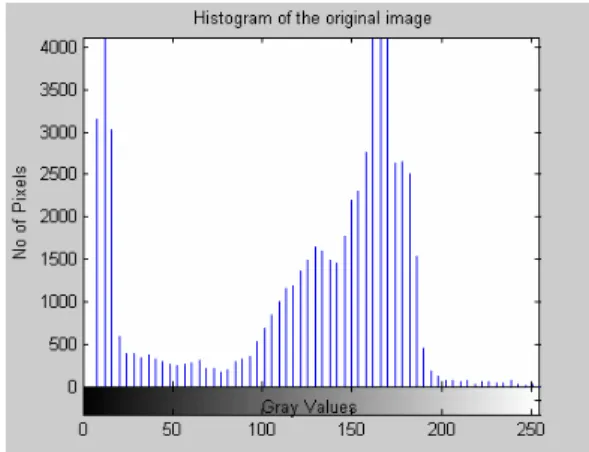
Figure 2 shows the memberships function for the gray levels in the original test image. The histogram of the gray levels in the test image is shown in Figure 3.
Figure 2 The memberships function for the gray levels in the original image.
Figure 3 The histogram of the original image.
4. Results and Discussions
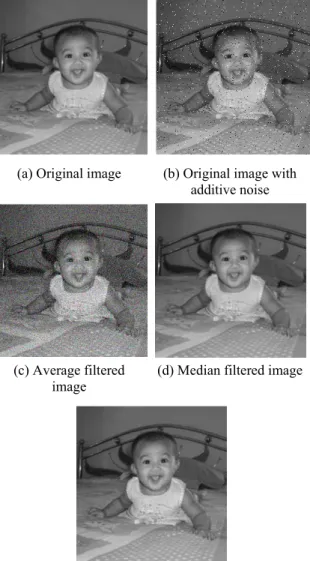
A Fuzzy rule-based filtering method for image de-noising has been proposed and implemented in this research. The effectiveness of this approach has been justified using different noisy and corrupted images. Experiments are carried out on a Pentium IV 2.1 GHz PC with 512 MB RAM. The test images are captured with a SONY VISCA camera. The algorithm has been implemented using Visual C++. Figure 4 shows an original test image with additive noise, and the corresponding output images with different filtering methods.
To test the effectiveness of the proposed algorithm, several quality measurement variables like peak signal to noise ratio (PSNR) and mean square error (MSE) have been estimated. Assume M×N initial image f(x, y), noised image f '(x, y), then the measure of peak signal-to-noise ratio (PSNR) can be defined by the following formula:
PSNR = 10log10(2552/MSE) dB (2) and, mean square error (MSE) is given by,
∑∑
[
]
= =−
=
M x N yy
x
f
y
x
f
MN
MSE
1 1 2)
,
(
'
)
,
(
1
(3) For example: Consider a 3x3 window of pixels asfollows, 91 114 175 92 116 176 95 111 182 Here, Original value: 116 Mean value: 128 Median value: 114 Let, Range value, k=2
Sorted order : 91, 92, 95, 111, 114, 116, 175, 176, 182 Membership value: 0.0, 0.0, 0.03, 0.56, 0.69, 0.76, 0.04, 0.03, 0.00 Selected value is: 116
-0.1 0 0.1 0.2 0.3 0.4 0.5 0.6 0.7 0.8 0.9 0 2 4 6 8 10 Pixels M e m b e rs h ip v a lu e Selected Median
Table 1 demonstrates the performance of the proposed
de-noising technique compared to other techniques. A comparison of gray values for the output images with Averaging, Median and Fuzzy filtering methods is illustrated in Figure 5. The proposed method incorporates the advantages of both the median filter and averaging filter. This method can successfully reduce noises from the corrupted image that results to sharp transitions in the gray values, and does not make the resultant image as blur as the neighborhood averaging filter.
(a) Original image (b) Original image with additive noise
(c) Average filtered
image (d) Median filtered image
(e) Fuzzy filtered image (proposed method)
Figure 4. The test image with additive noise and the
output images with different filtering methods (using a 3x3 mask).
Table 1
Comparison between different de-noising techniques
De-noising Techniques PSNR(dB)
No de-noising 16.54
Average Filtering 20.13
Median Filtering 24.52
Fuzzy Filtering (Proposed Method) 25.95
Comparison of gray values for differnt Filtering
84 86 88 90 92 94 96 98 100 102 104 1 2 3 4 5 6 7 8 9 10 11 12 13 14 15 16 17 18 19 20 Pixels G ray val u e
Original gray values Averaging Filtering Median Filtering Fuzzy Filtering
Figure 5 Comparison of gray values for the output images with Averaging, Median and Fuzzy filtering.
V. CONCLUSION
The fuzzy rule-based approach is a powerful method for formulation of expert system in a comprehensive way. In this research, a very simple and expert image de-noising technique has been implemented using fuzzy rule-based filtering. The effectiveness of the fuzzy rule-based filtering has been tested with different types of gray scale images with simple and complex backgrounds. Our next approach is to extend the algorithm for color images. This method will be very useful for segmentation, registration, identification and sharpening of objects in a scene.
References
[1] R. H. Sherrier and G. A. Johnson, “Regionally adaptive histogram equalization of the chest,” IEEE Trans. Med. Imaging, vol. MI-6, pp. 1–7, Mar.1987.
[2] H. C. Andrews, A. G. Tescher, and R. P. Kruger, “Image processing by digital computer,” IEEE Spectrum, vol. 9, pp. 20–32, July 1972.
[3] E. Peli, “Contrast in complex images,” J. Opt. Soc., vol. 7, pp. 2032–2040, 1990.
[4] R. Gonzalez and P. Wintz, Digital Image Processing, Addison–Wesley, 1987.
[5] W. M. Morrow, R. B. Paranjape, R. M. Rangayyan, and J. E. L. Desautels, “Region-based contrast enhancement of mammograms,” IEEE Trans. Med. Imaging, vol. 11, pp. 392–406, Sept. 1992.
[6] A. Toet, “Multiscale contrast enhancement with applications to image fusion,” Opt. Eng., vol. 31, no. 5, 1992.
[7] T. Zong, H. Lin, and T. Kao, “Adpative local contrast enhancement method for medical images displayed on a video monitor,” Med. Eng. Phys., vol. 22, pp. 79–87, 2000.
[8] A. Polesel, G. Ramponi, and V. J. Mathews, “Image enhancement via adaptive unsharp masking,” IEEE Trans. Image Processing, vol. 9, pp. 505–510, Mar. 2000.
[9] A. Beghdadi and A. L. Negrate, “Contrast enhancement technique based on local detection of edges,” Comput. Vis. Graph. Image Process., vol. 46, pp. 162–274, 1989.
[10] S. S. Agaian, K. Panetta, and A. M. Grigoryan, “Transform-based image enhancement algorithms with performance measure,” IEEE Trans. Image Processing, vol. 10, pp. 367–382, Mar. 2001. [11] S. Aghagolzadeh and O. K. Ersoy, “Transform
image enhancement,” Opt. Eng., vol. 31, pp. 614– 626, Mar. 1992.
[12] V. Bhaskaran and K. Konstantinides, Image and Video Compression Standards: Algorithms and Architecture. Dordrecht, The Netherlands: Kluwer, 1995.
[13] Maaten Jansen, Empirical bayes approach to improve wavelet thresholding for image noise reduction, Journal of the American Statistical Association, 2001, 96(454):629-640
[14] Donoho D. L., De-Noising by Soft-Thresholding. IEEE Trans. Information Theory,1995, 41 (3):613-62 7
[15] V. Strela, P. N. Heller, G. Strang, The application of multiwavelet filterbanks to image processing, IEEE Trans. Signal Processing, 1999, 8(4): 548-563.
[16] Toet, Multiscale contrast enhancement with application to image fusion, Optical engineering, 1992, 31(5):1026-1031