Department of Business Administration
I-Shou University
Master Thesis
Complete solutions of human resources management
in water supply company - Environment Binh Duong
in the period 2014- 2020
Advisor: Dr. Chiao-Ping Bao
Co-advisor: Dr. Ho Sy Tan
Graduate Student:
Phuc Bui Huu
July, 2014
DECLARATION
I hereby declare that the data and documents used for this thesis was collected from the actual source, is published in the reports of state agencies, is published in specialized magazines, books, newspapers ...
The proposals, solutions and recommendations are drawn from my own in the learning process, in theoretical research and in practical at Water Supply and
Sewerage Company – Environment Binh Duong.
Guarantee
Bui Huu Phuc
ACKNOWLEDGEMENTS
After learning program Master of Business Administration, Department of Business Administration – ISHOU University – Hong Bang International University, I want to express my sincere thank to my advisors who directly supported me during the process of learning.
So far I have completed the course and program completion of his thesis entitled, "Complete solutions of human resources management in water supply company - Environment Binh Duong in the period 2014- 2020"
On this occasion I am really grateful for valuable help from lectures working in Department of Business Administration – ISHOU University – Hong Bang International University. In particular, I want to express my sincere thank to Pr./Dr. Po, Chiao-Ping; Pr./Dr. Ho Sy Tan who directly supported me during the writing process of this thesis.
I am grateful to the leaders and employees of water supply company- Environment Binh Duong, who co-operated and provided the material for my thesis. Particularly, I am grateful to the employees who fill in the Employee’s Opinion Survey Form and provide me the information for my analysis and evaluation.
Finally, I sincerely thank my family, colleagues, friends and relatives were enthusiastic support, suggestions and help during my study and research.
ABSTRACT
The integration of Vietnam’s economy into the global economy has brought a lot of economic opportunities as well as challenges to businesses in Vietnam. As the country’s economy grows rapid, the human resource market is becoming more competitive than ever before. Thus, recruiting and retaining talents are critical tasks for companies in Vietnam. This study is conducted to find solutions for the water company, BIWASE, to improve its human resource management to operate more effectively and efficiently. Based on the results of the study, the author has proposed a variety of solutions in different aspects to help the company to increase its human resource management quality.
Keywords: human resource management, BIWASE, human resource policy
TABLE OF CONTENTS
DECLARATION ... I ACKNOWLEDGEMENTS ... II ABSTRACT ...III TABLE OF CONTENTS ... IV LIST OF FIGURES ... VIII LIST OF TABLES ... IX
CHAPTER 1 INTRODUCTION ... 1
1.1 PROBLEMS AND REASONS FOR THE SELECTION TOPIC ... 1
1.2 OBJECTIVES OF THE RESEARCH AND PRACTICAL IMPLICATIONS ... 2
1.3 SUBJECTS AND RANGE OF RESEARCH ... 3
1.4 THE STRUCTURE OF THESIS ... 4
CHAPTER 2 LITERATURE REVIEW ... 5
2.1 SOME BASIC DEFINITIONS IN HUMAN RESOURCE MANAGEMENT . 5 2.1.1 Human resource (HR) ... 5
2.1.2 Human Resource management definition ... 6
2.2 ROLES AND MEANING OF HUMAN RESOURCE MANGEMENT ... 9
2.3 THE THEORIES OF HUMAN RESOURCE MANAGEMENT ... 10
2.3.1 Theory X and Theory Y of Douglas McGregor ... 10
2.3.2 Theory Z of William Ouchi ... 13
2.4 INFLUENTIAL FACTORS IN HUMAN RESOURCE MANAGEMENT .... 15
2.4.1 External factors ... 15
2.4.2 Internal factors ... 16
2.5 THE ACTUAL SITUATION AND THE CHANGES IN HUMAN RESOURCE MANAGEMENT IN VIETNAM ... 17
CHAPTER 3 RESEARCH METHODOLOGY ... 20
3.1 RESEARCH METHODS ... 20
3.1.1 Preliminary research ... 21
3.1.2 Formal research ... 23
3.2 DATA PROCESSING METHOD ... 24
3.2.1 Clean data ... 24
3.2.2 Describe sample ... 24
3.2.3 Analyze the Descriptive statistics ... 25
3.3 RESPONDENT ... 25
3.3.1 Survey method ... 26
CHAPTER 4 RESULTS & ANALYSIS... 27
4.1 OVERVIEW OF VINH LONG WATER SUPPLY COMPANY LIMITED . 27 4.1.1 General introduction: ... 27
4.1.2 Responsibility of the company ... 27
4.2 ANALYSE HUMAN RESOURCE STRUCTURE ... 28
4.2.1 The structure of employment by qualification and gender ... 28
4.2.2 Employment structure based on age: ... 32
4.2.3 Assessing human resource using of VWACO ... 33
4.2.4 The problems and challenges of labor: ... 37
4.3 ANALYSIS AND ASSESSMENT OF HUMAN RESOURCE MANAGEMENT IN BIWASE ... 37
4.3.1 Human Resource Planning... 37
4.3.2 Recruitment ... 39
4.3.3 Layout, arrange assignments and promote staff ... 41
4.3.4 Work done assessment ... 46
4.3.5 Situation Analysis performs the function of human resource training ... 48
4.3.6 Salaries and bonuses ... 54
4.4 OVERALL ASSESSMENT ... 59
4.4.1 Advantages ... 59
4.4.2 Limitations ... 60
CHAPTER 5 CONCLUSION & RECOMMENDATION ... 62
5.1 SOME COMPLETING SOLUTION OF HUMAN RESOURCE MANAGEMENT IN BIWASE UNTIL 2020 ... 62
5.2 PERFORM WELL THE HUMAN RESOURCE PLANNING AND RECRUITMENT INNOVATION TO CREATE CONDITIONS TO ATTRACT GOOD WORKERS FROM OUTSIDE ... 62
5.3 IMPROVE THE QUALITY OF TRAINING ... 67
5.4 DEVELOP CORPORATE CULTURE ... 68
REFERENCES ... 69
APPENDIX 1 ... 71
LIST OF FIGURES
Figure 1 : Process research ... 21
Figure 2 : Employment structure chart bases on gender ... 30
Figure 3 : Employment structure chart bases on education ... 30
Figure 4 : Structure Chart labor by age ... 32
Figure 5 : Working productivity chart 3 years 2011, 2012,2013 ... 34
Figure 6 : Average income graph 3 years 2011, 2012, and 2013 ... 36
LIST OF TABLES
Table 1 : Human resource management and personal management ... 8
Table 2 : Employment structure of BIWASE in 2011 – 2013 period ... 28
Table 3 : Employment age statistics ... 32
Table 4 : Average working productivity BIWASE 2011 – 2013 ... 33
Table 5 : Average income of labors at BIWASE 2011-2013 ... 35
Table 6 : Statistic on recruitment ... 40
Table 7 : Review and evaluation of the 135 people on recruitment ... 40
Table 8 : Statistics about the nature of work ... 41
Table 9 : Assessment, evaluation, satisfaction degree of 135 people about the nature of work. ... 42
Table 10 : Statistics about the promotion opportunities ... 44
Table 11 : Assessment of 135 people about promotion opportunities... 45
Table 12 : Training budget in period of 2009-2013 ... 48
Table 13 : Statistics about training activities ... 50
Table 14 : Review and evaluation of 135 people about training program... 51
Table 15 : Descriptive Statistics Working Salary, bonus, remuneration policies ... 56
Table 16 : Review and evaluation of the 135 people on salary, bonuses and remuneration policies ... 56
PRELIMINARY SURVEY QUESTIONNAIRE ... 71
CHAPTER 1 INTRODUCTION
1.1 PROBLEMS AND REASONS FOR THE SELECTION
TOPIC
Along with the continuous development of science and technology and the globalization process is intense, traditional competitive elements of businesses such as capital, materials, technologies... have become saturated. Instead, a new resource, a new competitive factor that is decisive for the survival and development of enterprises is human - human resources.
However, Water Supply and Sewerage Company - Environment Binh Duong (hereinafter referred to as Water Supply Company Binh Duong) is currently facing challenges in the development process. The company was formerly a state owned enterprise (hereinafter referred to as SOEs) operating for public utility, was converted into a limited liability company one member, operating under the market mechanism. There are many challenges that confront the company, such as the pressure of population growth and urban is rising impact strongly on public utility operations, capital resources, particularly low quality of human resources that is large in number, the management of human resources at the company was not effective because it is affected by an ideology of a state owned company in the subsidy period..
Equipped with knowledge through courses MBA and work experience, I chose to implement the project "Complete solutions of human resources management in water supply company - Environment Binh Duong in the period
2014- 2020 ". On that basis, I can help leadership of company identify shortcomings in the governance policies of human resources, find proposal and solution properly and timely to overcome in order to build and develop human resources quality that is consistent with the development strategy of the company in the coming period.
1.2 OBJECTIVES OF THE RESEARCH AND PRACTICAL
IMPLICATIONS
The studies in thesis aim:
Present the general theoretical issues of governance and human resources and outline the experiences of some developed countries, some foreign companies on human resource management.
Implementation analysis and assessment of the situation of human resources management in Water Supply and Sewerage Company – Environment Binh Duong, in order to find out the achievements, identify shortcomings and limitations. Offer suggestions, the perfect solution the management of human resources for Water Supply and Sewerage Company – Environment Binh Duong up to 2020.
The successful research this topic will bring the following meanings:
Research topics to help managers Water- Supply Company Environment Binh Duong see the situation of human resource management in their units, which are the drawbacks discovered in the human resource management to find out proposals and solutions to improve human resource management that will
contribute to the construction and development of human resources in accordance with the strategic objectives of the company in the future as competition and integration.
1.3 SUBJECTS AND RANGE OF RESEARCH
Objects of the study in this project were identified as the management of human resources of the company; help the company has a current overview from which to develop better human resources in the coming period.
Range of the study and the solution is implemented in the project related to the operation and functions of human resource management at the company, it is true only for a time, a certain specific environments, so the limited range of the project is determined:
The spatial extent: The project made in Water Supply and Sewerage Company –Environment Binh Duong.
Address: 11 Ngo Van Tri - Phu Loi Ward – Binh Duong.
Primary data was collected from May to July of year 2014.
Secondary data were collected in the period from 2008 to 2012.
The proposal and solutions apply to the period from now to 2020.
Survey and investigation by the method of using questionnaires will be conducted with the sample size of about 180 samples, mainly survey and collect data on factors such as the nature of work; social policy; education - promotion; working relationships; recruiting; working assessment at the company ...
1.4 THE STRUCTURE OF THESIS
Topics include the following chapters:
Chapter I: Introduction
Chapter II: Rationale for human resource management
Chapter III: Research Methodology
Chapter IV: Analysis of situation and activities in human resource management of Water Supply and Sewerage Company - Environment Binh Duong.
Chapter V: Conclusions and recommendations some solutions to improve the human resources management of Water Supply and Sewerage Company – Environment Binh Duong.
CHAPTER 2 LITERATURE REVIEW
2.1 SOME BASIC DEFINITIONS IN HUMAN RESOURCE
MANAGEMENT
2.1.1 Human resource (HR)
Nowadays, there are many terms define about HR all over the world: according to United Nations Organizations, “HR is all knowledge, skills, experience, ability and creativity of human being related to the individual and national development.”, however, based on the International Labor Organization, “HR in each country is its total people who are in employment ages”.
HR is understood in two ways: In general, HR is the resource of work force for manufacturing and the development. In narrow meaning, HR is the social working ability, including employment age population group who can join in working, social producing, that means all specific individuals attending to working progress are a total factors of physical and mental strength used in working period.
In some recent years, Vietnamese scientists also are trying to define a single general for HR term: As Mr. Ngoc Hai – National Science “HR is the human resource of organizations (with different scales, types and functions) having the ability to participate in developing process of organizations as well as national, regional and world’s economic - social growth”. According to Human resource textbook, by Dr. Nguyen Ngoc Quan and Mr. Nguyen Van Diem at National Economic (2004), this term is known as: “Human resource in an organization
includes all labors working in that organization, and resources of each individual can be physical and mental.” (p.8).
2.1.2 Human Resource management definition
Human resource management relates to two concerns about “management” and “human resource”. Management is the process of finishing activities with higher effectiveness through other people. Management has a combination of science and leadership art. On the science aspect, a successful manager is the one who have strong managerial knowledge and skills. On the art aspect, a successful manager is a person who has an instinct capacity such as intelligence; negotiate talent, attracting other people to follow their guides. Also, they have a quickly concern catching ability and decision. They are friendly with others, confident, flexible in solving practical situations… Human resource of an organization is built up on individual’s bases that are in charge of different roles and linked together by specific objectives. Human resource is different to other resource at an enterprise is due to human nature. Human being has various abilities, particular traits, potential development, group and union building ability to protect their rights. Therefore, human resource is more difficult and complicated compared to other effects in business.
Human resource management studies about how to manage people in micro-scale organizations, and it has two basic objectives:
First, using effectively human resource in order to increase productivity and enhance efficiency of that organization.
Second, meeting daily demand of staff, providing conditions for them to display their abilities in their best. They will have feelings of motivation and encouragement at their work place, and then be loyal, willing to contribute at their company. (Tran Kim Dung, 2011)
So, HRM focuses on recruiting processes, training, development, leading and awarding employees on the purpose of organization’s goals achievement. From many years ago, people are just considered an input factor of business, therefore organizations have not give a careful attention of human resource management yet. On that way, in a long time, organizations lost their competitive power from work force in their operation.
In short, HRM is “a science about people management based on believes that human play an important role in long-term success of an organization or enterprise. An organization or enterprise can increase their competitive advantage by using effectively labors, utilizing experience and skills in order to get planned objectives. The purpose of HRM is to recruiter talent, quick learning and enthusiastic people in works, manage activities and award operating results as well as develop their ability.” (Price, 2004, p.25).
Generally, in the recent world, there are three different perspectives about relationship between human resource and human resource management.
In the first perspective, HRM is just a different term used to alternate for the
definition about previous human resource. This perspective goes deeply into researching scales and objects of human management in organizations. By contrast, it does not really reflect objectives of HRM in the modern world because
people have not been considered a crucial factor distributing in organizations’ success.
In the second perspective, HR management is fully different with old human
resource. HRM has new perspective, theories and methods. It is a new touching way for management. This perspective highlights the importance of human resource in organizations. It puts high values on the new management method through combining human management functions with organization’s strategies and using resources completely and as best as the organization can.
In the third perspective, human resource management is not considered an
evolution, but a next developing process, and a extension and completion of HRM. It is considered a middle perspective among the others. It focuses on the human roles in enterprises. The focus also is highlighted that it needs to improve human management, but not be in too strict conditions in high professional...in order to be suitable with developing countries.
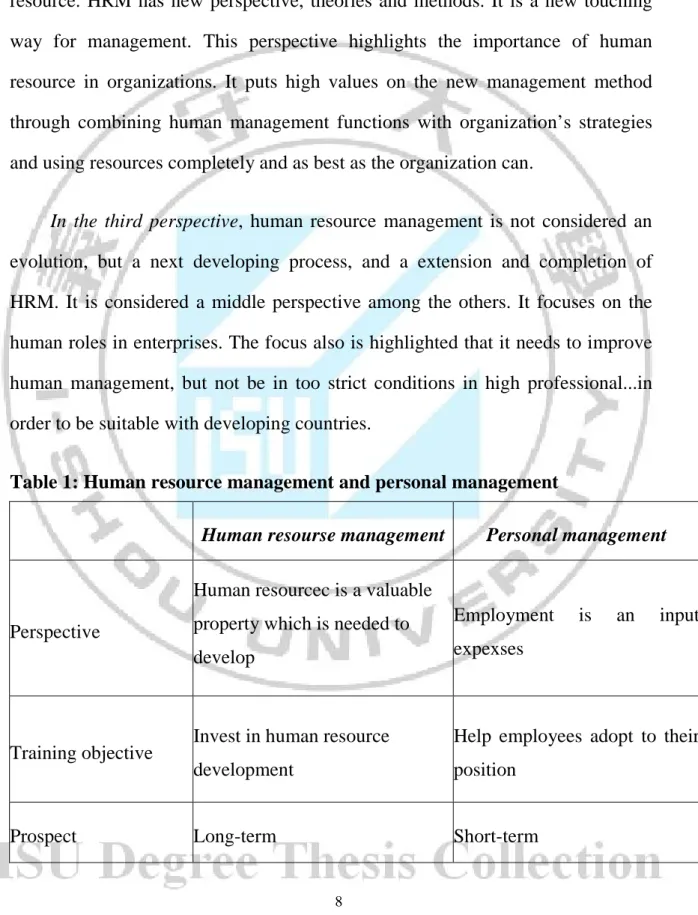
Table 1: Human resource management and personal management
Human resourse management Personal management
Perspective
Human resourcec is a valuable property which is needed to develop
Employment is an input expexses
Training objective Invest in human resource development
Help employees adopt to their position
Prospect Long-term Short-term
Competitive
Advantage Human resourcee quality Martket and technology
Productivity and Quality basic
Technology + organization +
Human resource quality Machine + Organization
Encouragement
Factors Job details + Promoting + Salary Salary + Promoting
Behavior with changes Adaptable human resource with challenges
Employees often contrast to changes
Source: Nguyen Thanh Hoi, 2007, Human Resource, Page 5.
2.2 ROLES AND MEANING OF HUMAN RESOURCE
MANGEMENT
Human resource is a crucial factor deciding the survival, development and advance of a country as well as enterprise. For enterprises, human resource management plays a central role in organization opening, helps them survive and develop in nowadays competitive environment. Especially in the front of economic integration, they have to face to giant firms and corporation all over the world. The importance of human resource management starts from the role of human. Human is the structural factor of the organization. It runs the organization and decides the success of the organization. Human resource is one of essential elements of organizations, therefore, HRM is the important field in management in every organizations. On the other hand, HRM will not be effective unless firms
manage their human resource, because all activities of companies implement by human being. Human resource management points out the direction for organization operation to achieve and maintain competitive advantage through specifying concerns about human resource and its strategies.
In Vietnam, the process of economic alternative displayed many disadvantages in economic management. That is considered one of the most reasons blocks the economy development. Economic management and human resource management are really necessary for potential exploration, economic development and living standard improvement.
2.3 THE THEORIES OF HUMAN RESOURCE
MANAGEMENT
2.3.1 Theory X and Theory Y of Douglas McGregor
Theory X and Theory Y are two theories of modern human resource management was initiated by Douglas McGregor (MIT Sloan School of Management) in 1960.
McGregor said that management strategies greatly influenced by the views of human nature, with the assumption that:
+ Human nature does not like to work and always escape when possible.
+ People like to be controlled, if these controls make them work well.
+ They just work under coercion, punishment.
+ They are passive, shirk the responsibility when possible.
+ They are selfish, think of themselves first, no ambition, desire to lead on.
McGregor named for this assumption is the theory X. Thus, according to the theory of X, the human is considered inherently negative, therefore the management method according to this assumption is: should reward if you want them work and punish when they do not work. The managers who follow the theory X usually have negative and ultra behavior. When a problem occurs, the first thing they will do is blame someone. They said that workers only work for themselves and can only be affected by money. In all situations, the employee will be held responsible and the objective causes such as system failure and policies, due to lack of training ... are being ignored or handled improperly needed. Theory X managers do not trust anyone. They believe in the mechanical and close supervision system and believe in the power of discipline.
However, McGregor said that in fact, at work, people may behave different from what is stated in theory X. He finished this comment and named it as theory Y. Theory Y assumes that humans always have aspirations and are capable of encouraging themselves, receiving the larger duty, control and governing. This theory also believes that humans like to perform tasks in a self-conscious way. Theory Y managers believe that creating good working conditions which causes workers interested in jobs, they will have great dedication. Therefore, managers try to do our best to liberate workers from the barrier to the ability to express themselves.
According to theory Y, human nature is considered positive, claims:
+ Human loves to work and considers employment as a need.
+ They have an awareness of self-examination, self-discipline, self-adjusting when works are assigned clearly.
+ Whether the normal person, there is also a sense of responsibility, self-esteem, take responsibilities at work.
+ Everyone has creative possibilities, though little creativity and enthusiasm to make a creative assignment.
Management methods according to the theory Y is believe in human, arouse internal forces and self-consciousness, particularly:
+ Trust, expand responsibilities and obligations of membership in the organization.
+ To promote autonomy, self-management of the working group.
+ Fair distribution of rights so that working groups can work actively, self-assessment, self-control and promote results of works.
+ Creating forms of activities to help people work closely and creatively.
Thus, from the content of theory Y, we can see this theory is more positive and progressive than theory X that it has a more exact look about human nature. Theory discovered that humans are not machines, the incentive for people within themselves. Administrators need to give them a good working environment and to know skillfully combine individual goals and organizational goals, meaning that administrators have to make employees understand that: to satisfy their goals, they need to implement the objectives of the organization. However, like theory X, Theory Y is not absolute, it is used in combination will provide high
performance. This theory is effective in suggesting for the management and is always a classics lesson in modern human resource management.
2.3.2 Theory Z of William Ouchi
William Ouchi is a Japanese immigrant in America. He is a scholar of management theories and also a professor of management at the University of California. He began to study the management methods of Japanese firms from 1973. In 1981, he published in the United States a book "Theory Z – How American enterprises can deal with the challenge of Japan."
The basic contents of theory Z of William Ouchi are:
1 Institutional of management have to ensure superiors can grasp of the situation of subordinates fully.
2 The managers at the local level must have enough rights to handle the problems at the grassroots level, must have the capacity to regulate and coordinate ideas and perspectives of workers, promoting positiveness for all people, encouraging them to brainstorm, make their plans and proposals.
3 Intermediate-level managers must perform the role of ideological consistency, revising and perfecting grassroots opinions, timely report the situation to their superiors and give recommendations.
4 Enterprise must hire workers in long term to make them feel secure and increase their responsibly, share the glory and tough with the firm, sticking their destiny to the fortunes of the enterprise.
5. Managers must regularly concerned about the welfare of workers, seeks to comfort them, creating harmony, cordial environment, no gap between superiors and subordinates.
6. The managers not only concerned with production tasks, but also have to make employees feel their work is not arid, not monotonous.
7 It should be noted staff training, improve the capacity in practical work in all aspects of them.
8 The observation of human expression should not be limited only in a small number of items but it must be observed in a comprehensive way, in the long run to have the exact basis.
Application of theory Z in practice:
Theory Z has many similarities with the theory of "inner incentives". In fact, the widespread theory Z has boosted the theory "inner Incentives" (Soul management) and the thought of it. Theory Z is supported and applied practically by many Japanese companies. It brings success of many Japanese companies and help Japan become a superpower in the world, as well as many Japanese companies become worthy adversary of the United States. Theory Z also has basic weaknesses, and the most important point is to create greater inertia in Japanese companies which the Japanese companies are trying to study and change until now.
In summary, when comparing management theory of the East and the West, we find them similar in that these theories revolve around the adjustment of human behavior; people are focus of any theory. However, there is also a
difference between management theory of the East and the West, Western theory considers the effectiveness of works as the highest target, while the Eastern theory overvalue “ethics” and “spirit” of human. (Ha & Nguyen, 2010)
2.4 INFLUENTIAL FACTORS IN HUMAN RESOURCE
MANAGEMENT
2.4.1 External factors
External factors are factors outside the enterprise, create opportunities and threat towards the enterprise. Nowadays, in the strong development of all fields about economy, society, environment which continuously changing. Accordingly, the important responsibility of managers is to adapt well with those changes to make correct decisions.
Economy environment: Factors like economic growth speed, inflation, geography, work market,...all affect directly to the salary, life and work of employees. Beside, population growth and exhausted resources, polluted environment make the competition between areas, nations, companies, even individuals gradually severe.
National laws: This is a regulation about managerial mechanism and salary policy in labor market. Therefore, human resource management at companies have to be suitable with national regulation system.
Science and technology: modern technology and new production techniques help some new industries appeared which require labors to be prepared new knowledge, skills, retraining, improved education with human resources in old
industries. New science also makes information environment developed and become a crucial resource with enterprises.
Cultural, social factors: they are factors containing large effects to behaviors of labors such as thought, psychology, behavior, living style,
Competition of enterprises in a sample industry create the human resource
movement from firm to firm, especially high qualified human resource.
Human resource supply in work force also is one of elements affects
quantity and quality of human resource in firms. The high or low supply influences directly the lack or redundancy of human resource in different periods of labor maker.
2.4.2 Internal factors
Business strategies: is one of strong influence in human resource management. Depending on different period, companies expand or narrow down their business and operation. That will increase or decrease the number of labors to fit the condition set by companies.
Leader’s team: Leader’s team affects a lot to human resource management in an enterprise which is displayed in communicating style, through applying motivation tools to affect behaviors of employees.
Human resource policy: human resource policy, such as training and retaining policies, works through the perspective about human resource planning in short-term and long-term in order to ensure the enterprise have enough human
resource in quality and quantity to meet goals about operation, management and production.
Organizational structure: Organizational structure is the arrangement method in different department, relationship, information resource between tasks, levels. It specifies functions, duties, authority among in-charge persons those tasks. It is an important factor deciding business results of a company.
Corporate culture: Corporate culture has very important position and role
in the development of every business. The mission and vision of the company has a direct impact to the business policies and personal policies of the organization. Meanwhile, leadership style, relationship between employees,... decide the management methods and work environment. This will contribute the attraction with work force, especially high qualified human resource.
Enterprise finance: This is a factor affects all other internal effects of the enterprise. Therefore, all policies of the company are built up have to base on suitability with financial power of the enterprise. Strong finance will ensure payment ability for workers, helps them feel comfortable to work and satisfied with necessaries.
2.5 THE ACTUAL SITUATION AND THE CHANGES IN
HUMAN RESOURCE MANAGEMENT IN VIETNAM
The practice of human resource management in Vietnam during the centrally planned period also was similar to human resource management practices in Soviet Union countries, China and former Eastern. The basic stages of human
resources management include recruitment process, training, developing, compensation, promotion, labor relations ect... are all general policies of the state and virtually unrelated to the specific practices of individual companies. The payment system had the average characteristics and based on seniority.
With the process of economic improvement, the new elements of the economy in competitive market mechanism have been gradually replacing the old management principles and procedures. And from this economic transformation, it has resulted in the enhancement of the human resource management, from lifetime recruitment mode to contracts recruitment mode aimed at developing human resources towards investments in individual workers. Enterprises and state officers have moved from passive mood, merely servants behaviors, to positive dynamic mood, largely based on individual efforts.
Therefore, to help human resource management in Vietnam get better, enterprises need to improve difficulties, obstacles and main disadvantages including:
Skilled level of workers is still low. There is a lack of good management officers, experienced experts in those industries.
Conflict status, imbalanced between surplus and shortage human resource (excess positions with low productive labors, while lack the skilled workers).
The general situation is low income; the living standard of labors has to face many difficulties, so that leads to decrease the economic results and productivity.
The sense of regulation respect is not high, not strictly, workers cannot express the industrial style. The role of workers in enterprise has not been properly noticed.
CHAPTER 3 RESEARCH METHODOLOGY
3.1 RESEARCH METHODS
Conducting surveys, collecting primary data from human resources at the company are served for the situational analysis, comment and evaluation, orient construction of solutions to improve human resource management at the company. The data were compared, analyzed, synthesized by computer software commonly used in statistical work is IBM SPSS Statistics V.20
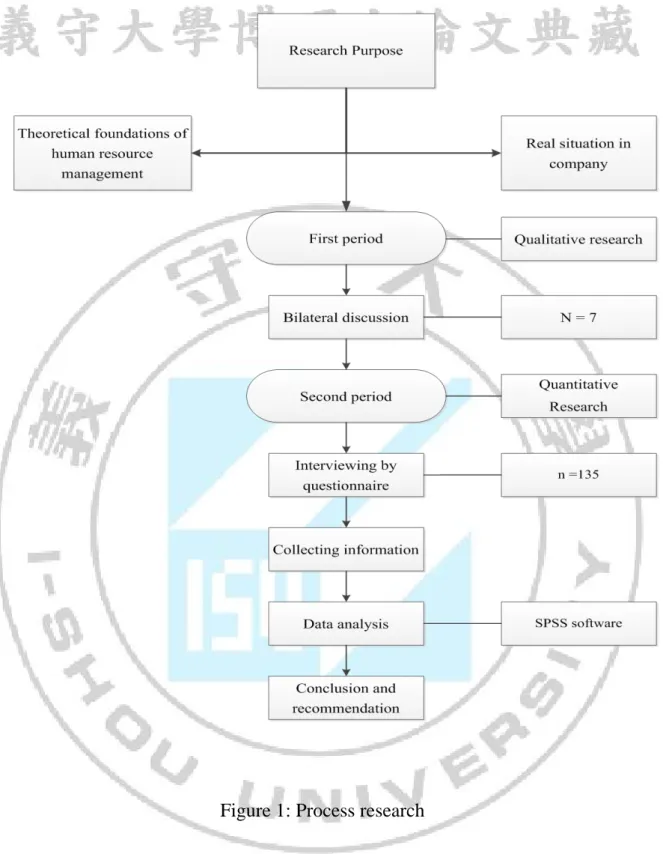
Process research is done and followed these steps: firstly determine the object to research and then find out the theoretical foundations of human resource management. Basing on this theory and real situation in Binh Duong water supply – sewerage- Environment Company, the author created the initial research model. Next research is through two periods: the first period is a qualitative research by bilateral discussion (n = 7) in order to calibrate the scale of the observed variables, the second period is conduct quantitative research (choosing model and surveying by questionnaire with n = 135). After collecting information from the survey questionnaire, data will be analyzed by IBM SPSS Statistics V.20 software The author then analyses the descriptive statistic. Finally, the author makes conclusions and giving recommendation for the company.
Figure 1: Process research
3.1.1 Preliminary research
Preliminary research was conducted through qualitative methods which base on the researches of Singh (2004), Tran Kim Dung (2009), Meyer and Allen (1990), materials about the impact of human resource management facts to the
level of staff cohesion and the Consultation Techniques of experts who have extensive experience in human resource field to adjust the scale and set the questionnaire which will be used in formal research.
The outline of discussion to poll the respondents is designed with two parts:
Introducing the purpose and nature of the research
The opening questions, which gather as many ideas as possible, are the basis for discussion.
The selected objects of group discussion are 7 staff in charge of personnel and policies in Binh Duong water supply – sewerage- Environment Company. After discussion, a draft scale will be built with 27 component elements of human resources management fact.
From the results of qualitative research, the elements building quantitative research content is selected and used to design the quantitative questionnaire.
The content of the questionnaire consists of two main parts:
Part 1: Design to collect information which relates to employees' opinions about the of human resources management facts.
Part 2: Design to collect descriptive information of Respondents.
The questionnaire was designed and tested in many stages to ensure that the collecting information is reliable for data analysis process.
Period 1: Construction of the raw questionnaire based on the necessary information in the theoretical model and group discussions.
Period 2: Questionnaire evaluation is conducted by testing the degree of understanding the questions, the evaluation is done by directly sending to our colleagues to find out the level of understanding and answering.
Period 3: Adjusting the question content and completing the survey questionnaire.
3.1.2 Formal research
Formal research is conducted by formal quantitative methods with directly interviewing techniques, interviewing by e-mail through survey questionnaire. The sample included 150 employees at all levels of Binh Duong water supply – sewerage- Environment Company.
The formal investigation questionnaire is formed from qualitative research after consultation of experts. The data, parameter will be tested, analyzed, evaluated by IBM SPSS Statistics V.20 software.
Research uses Likert scale with 5 levels: from 1 point – very wrong / strongly disagree, to 5 points – very right / Strongly Agree. Each question is a statement that shows the human resource management fact. With this design, the respondent will indicate the important level of the human resources management factors. The questionnaire consists of 27 questions corresponding 27 variables which affect the human resource management fact.
However, to achieve the desired results, the author tested with 20 staff in Binh Duong water supply – sewerage- Environment Company by factors which synthesized from discussion group to assess the relevance of the word, the meaning of the question, the ability to provide the information of respondent, the
relevance of these factors. Because of this, the author has adjusted the research elements, including 25 elements which belong to the human resource management fact.
3.2 DATA PROCESSING METHOD
3.2.1 Clean data
After interviewing, the questionnaire was checked error before entering into computer. Reviewing the questionnaire that respondent misunderstood the question and answered wrongly. After entering data into computer, data will be checked to find false and extra item, eliminated the patterns which have abnormal score in the test by descriptive statistics method through connective table with many variables.
3.2.2 Describe sample
Time of sending questionnaires and receiving answer sheets starts from January 06 2014 to May 09 2014. After collecting the questionnaires, before being processed and analyzed, the data has been checked and inappropriate answers are eliminated. 180 votes are distributed in two forms: distribute directly to departments office block and the remaining votes are sent to deputy station chief or station (at districts) to distribute for workers and receive later. At the end of the deadline 155 votes are received. However, 2 votes has not replied, 15 votes with 5 items did not answer, so 17 votes are excluded. When entering data into the computer, there were 3 votes which have 2 choices in a field, so 3 votes are also eliminated. 135 remaining votes are entered into the computer to check.
3.2.3 Analyze the Descriptive statistics
Descriptive statistics allow researchers to present the data acquired in a structured and summarized manner (Huysamen, 1990). The descriptive statistics are used in this research to analyses and describe data, including: Frequency, Percentage, Mean, Sum, Std. Deviation, Minimum, Maximum, SE mean
Likert scale with 5 levels is used in this research. Therefore, the overall satisfaction is a convention to easily remark when using the mean value to assess satisfaction levels of each factor.
Mean < 3.0 poor
Mean = 3.00 – 3.24 average
Mean = 3.25 – 3.49 Average good
Mean = 3.50 – 3.74 good
Mean = 3.75 – 3.99 very good
Mean >4.00 excellent
3.3 RESPONDENT
In the preliminary research period, objects who are selected to conduct group discussions and interview with experts are the personnel officer at Binh Duong water supply – sewerage- Environment Company to ensure the rationale of the survey and relevance with the real situation.
Then, in the formal research period, objects that are selected are staff at Binh Duong water supply – sewerage- Environment Company.
3.3.1 Survey method
The survey was conducted by directly sending detail questionnaire or via e-mail to the staff of VinhLong Water Supply Company.
CHAPTER 4 RESULTS & ANALYSIS
4.1 OVERVIEW OF VINH LONG WATER SUPPLY
COMPANY LIMITED
4.1.1 General introduction:
Binh Duong Limited Liability Supply Water-Environment Company is a 100% state ownership, managed 08 operators of water supply systems, including 02 systems in Thu Dau Mot city and 06 systems system in the urban towns of the province with a capacity of 98,000 m3 scale / day.
Company Name: Binh Duong Limited Liability Sewerage – Environment Company (BIWASE)
4.1.2 Responsibility of the company
Providing clean water based on national standard for urban areas in the province. Complete all assigned targets state and good focus on capital management to ensure properly using of funds and effective principle. In parallel with the implementation plan set out objectives, BIWASE has to complete other tasks such as budget, ensuring the spiritual and material life for employees, improve efficiency machinery, labor, creating products to meet domestic demand, manufacturing, business services, contributing to socio-economic development of the province of Vinh Long.
4.2 ANALYSE HUMAN RESOURCE STRUCTURE
4.2.1 The structure of employment by qualification and gender
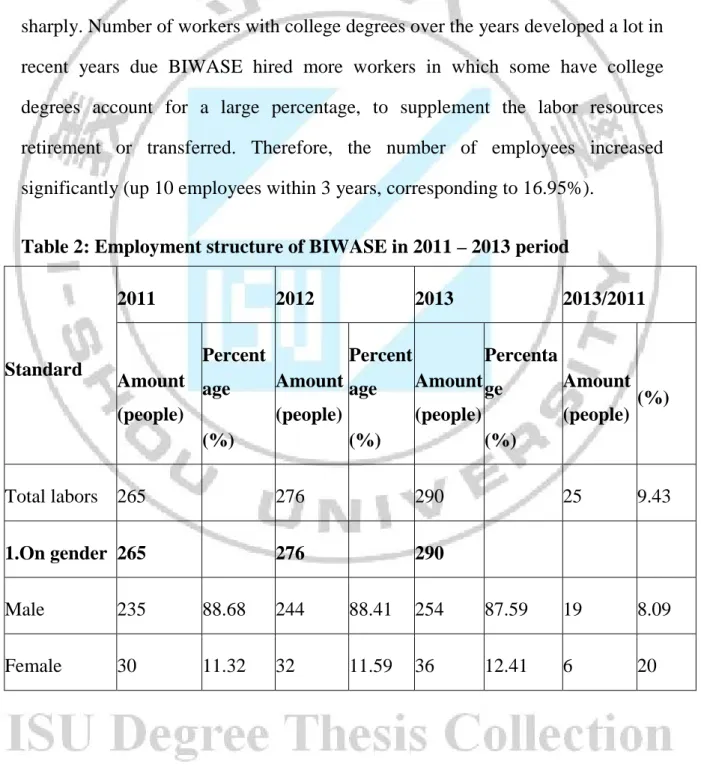
Using data in Table 2 show that, in general, the number of workers in recent years increased BIWASE but not so high (9.43% increase in 2013 compared to 2011) due BIWASE is interested in labor productivity over the number of employees. Every year the quality of the labor situation in BIWASE fluctuated sharply. Number of workers with college degrees over the years developed a lot in recent years due BIWASE hired more workers in which some have college degrees account for a large percentage, to supplement the labor resources retirement or transferred. Therefore, the number of employees increased significantly (up 10 employees within 3 years, corresponding to 16.95%).
Table 2: Employment structure of BIWASE in 2011 – 2013 period
Standard 2011 2012 2013 2013/2011 Amount (people) Percent age (%) Amount (people) Percent age (%) Amount (people) Percenta ge (%) Amount (people) (%) Total labors 265 276 290 25 9.43 1.On gender 265 276 290 Male 235 88.68 244 88.41 254 87.59 19 8.09 Female 30 11.32 32 11.59 36 12.41 6 20 28
Standard 2011 2012 2013 2013/2011 Amount (people) Percent age (%) Amount (people) Percent age (%) Amount (people) Percenta ge (%) Amount (people) (%) 2. Education 265 276 290 Undergraduat e 2 0.75 2 0.72 2 0.69 0 0 Bachelor 59 22.26 62 22.46 69 23.79 10 16.95 Below bachelor 63 23.77 68 24.64 72 24.83 9 14.29 Technical labor 131 49.43 136 49.28 143 49.31 12 9.16 Common labor 10 3.77 8 2.9 4 1.38 -6 -60
Source: Human resource/Administration department BIWASE
235 244 254 30 32 36 0 50 100 150 200 250 300
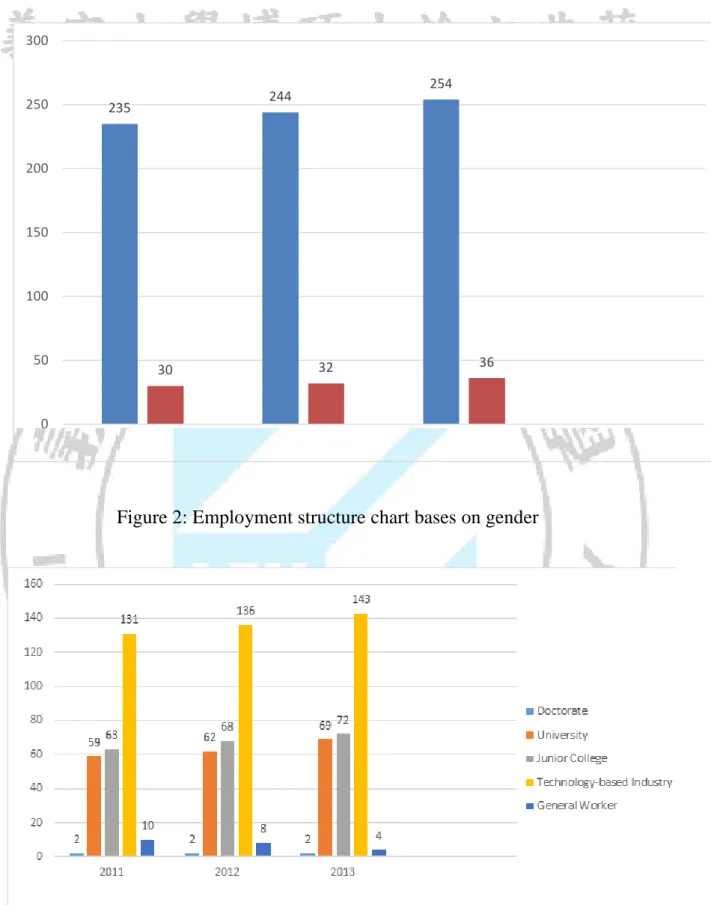
Figure 2: Employment structure chart bases on gender
Figure 3: Employment structure chart bases on education
From statistics to show that the labor force of highly qualified labor is not much, especially master degree, because BIWASE produces essential products for life and directly affects to health, therefore it should have skilled, qualified skilled workers in order to directly produce water, this is the core force of BIWASE so it needs to pay attention to invest this training department. Number of workers and technical workers also increased significantly, rising respectively 9:16% (12 people) because BIWASE is emphasizing more on the quality of the workforce directly, limiting the recruitment of untrained labor and encourage , enabling untrained workers receive training and improve their skills.
On the other hand, a team of unskilled labor in proportion BIWASE still not small, however over the years we also shows the proportion of this type of labor tends to decline, from 3.77% (2011) to 1.38% (2013). This is a good signal for the development of BIWASE, showing the structure of the labor movement BIWASE are more reasonable. Structure of labor by gender: in 2013 the number of female employees who work in BIWASE is 36 people, increase of 20% compared to 2011, however, due to specific industry sectors where the country is characterized by heavy labor anonymous, technical in nature, suitable for male workers, therefore female labor force in BIWASE accounts for a small proportion, about 12% to 15%, primarily perform office management jobs.
To constantly improve workforce, since 2000 BIWASE has invested in human resource development particularly focusing on training and retraining of personnel and technical resources, personnel professional training in many different forms in the country and abroad. Thus, qualification, professional experience of workers is significantly improved.
4.2.2 Employment structure based on age:
Table 3: Employment age statistics
NO. Age Amount of labors Proportion (%)
1 Under 30 61 21.04
2 From 30 to 39 121 41.72
3 From 40 to 49 75 25.86
4 Above 50 33 11.38
Total 290 100
(Source: Administrative Department – BIWASE)
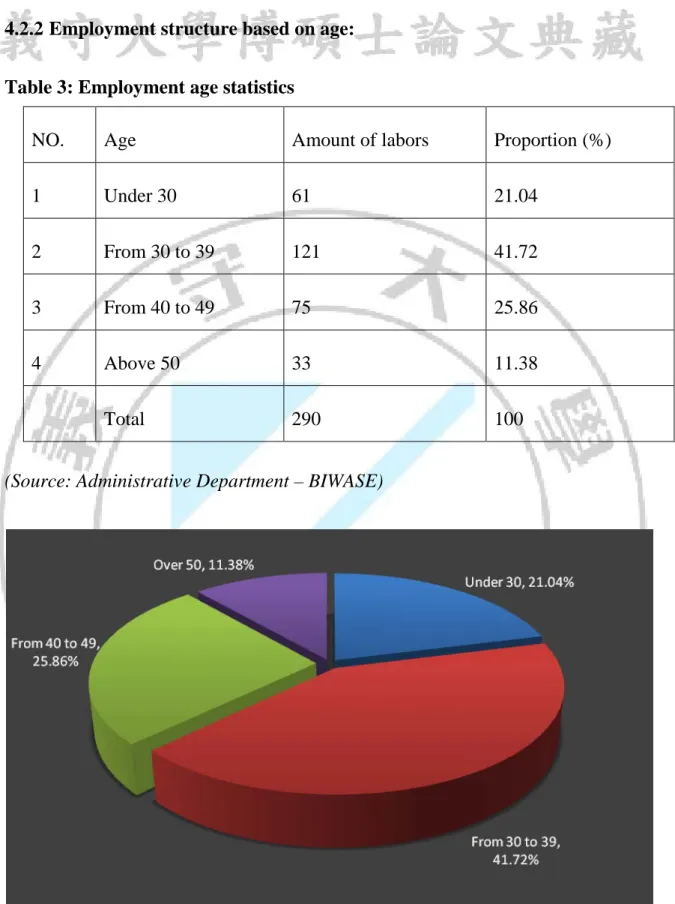
Figure 4: Structure Chart labor by age
Looking at the expression on the hurling of 290 employees (2013) of the female VWACO only 12.4 %, while the labor force is mainly male, female workers concentrated in a number of divisions and functions operations. Thus, due to the nature of the labor structure of VWACO mostly men.
Age Structure:
Employees under the age of 30, accounting for 21.04 %
The age of employees from 30 ÷ 39 accounting for 41.72 %
The age of employees from 40 ÷ 49 accounting for 25.86 %
Age of 50 ÷ 59 employees accounted for: 11.38 %
4.2.3 Assessing human resource using of VWACO
4.2.3.1 Assessing based on working productivity
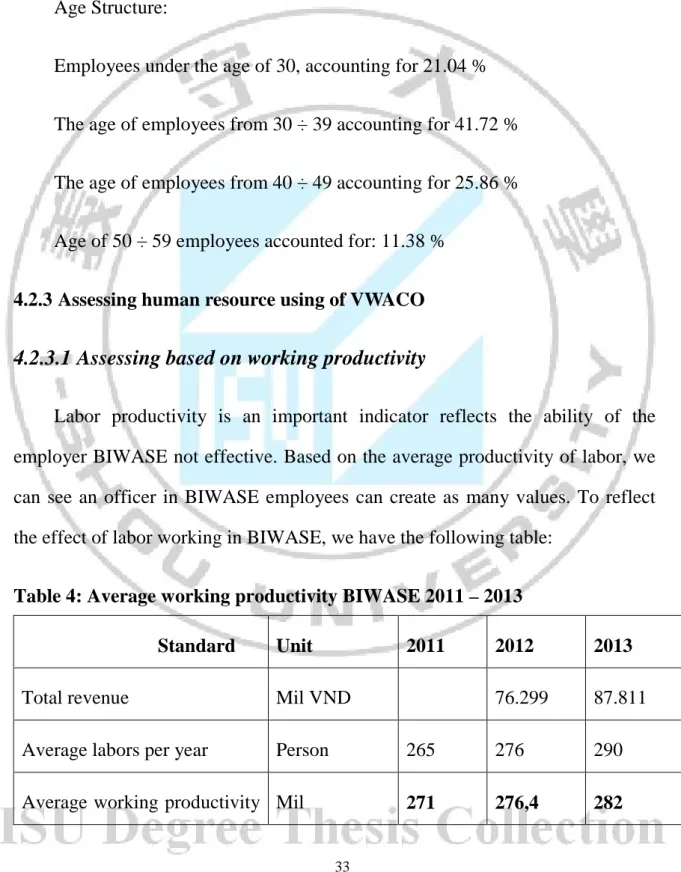
Labor productivity is an important indicator reflects the ability of the employer BIWASE not effective. Based on the average productivity of labor, we can see an officer in BIWASE employees can create as many values. To reflect the effect of labor working in BIWASE, we have the following table:
Table 4: Average working productivity BIWASE 2011 – 2013
Standard Unit 2011 2012 2013
Total revenue Mil VND 76.299 87.811
Average labors per year Person 265 276 290
Average working productivity Mil 271 276,4 282
per year. VND/Person/ year
(Source: Human resource/Administration department BIWASE)
Figure 5: Working productivity chart 3 years 2011, 2012,2013
Assessment: Labor productivity increasing steadily every year. Thus, we can say that VWACO effective use of their human resources.
4.2.3.2 Evaluated according to wage and income funds
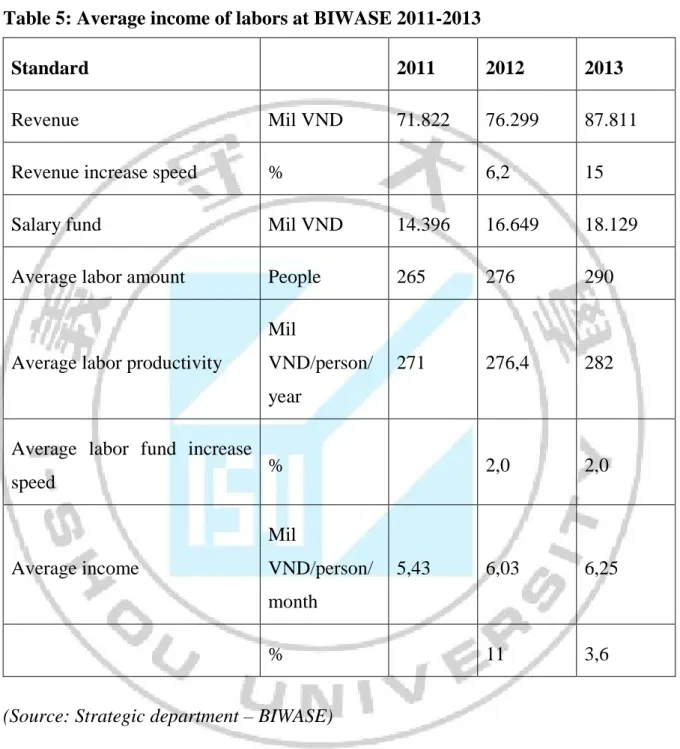
The average income of workers and employees is also an important indicator to assess the effectiveness employers in BIWASE. Income may reflect the living standards of workers. Income depends on the wage fund and other income (reward fund, welfare fund, income from other activities). If the fund is high
waged, the higher labor income, life always be improved and they will get on with the business.
Table 5: Average income of labors at BIWASE 2011-2013
Standard 2011 2012 2013
Revenue Mil VND 71.822 76.299 87.811
Revenue increase speed % 6,2 15
Salary fund Mil VND 14.396 16.649 18.129
Average labor amount People 265 276 290
Average labor productivity
Mil
VND/person/ year
271 276,4 282
Average labor fund increase
speed % 2,0 2,0 Average income Mil VND/person/ month 5,43 6,03 6,25 % 11 3,6
(Source: Strategic department – BIWASE)
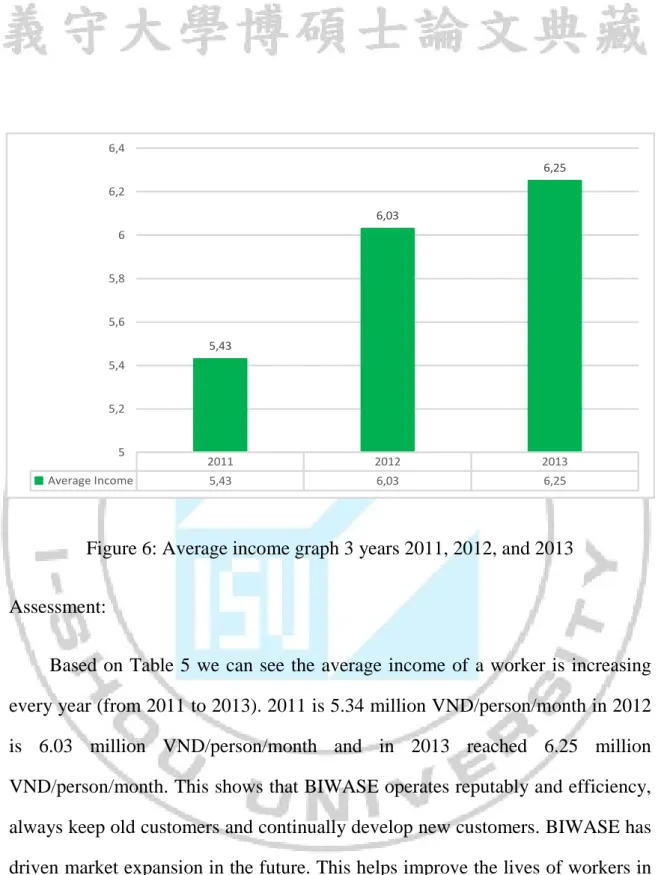
Figure 6: Average income graph 3 years 2011, 2012, and 2013
Assessment:
Based on Table 5 we can see the average income of a worker is increasing every year (from 2011 to 2013). 2011 is 5.34 million VND/person/month in 2012 is 6.03 million VND/person/month and in 2013 reached 6.25 million VND/person/month. This shows that BIWASE operates reputably and efficiency, always keep old customers and continually develop new customers. BIWASE has driven market expansion in the future. This helps improve the lives of workers in BIWASE, as well as enabling staff to fulfill their capabilities. If you keep such a business method, the business status of BIWASE will increasingly effective and sustainable development in the coming years.
2011 2012 2013 Average Income 5,43 6,03 6,25 5,43 6,03 6,25 5 5,2 5,4 5,6 5,8 6 6,2 6,4 36
4.2.4 The problems and challenges of labor:
The situation of BIWASE human resource management are facing difficulties at present that the majority of employees lacks enthusiastic in work, besides that due to the economic crisis makes lives of workers more difficult, have a negative impact on the morale should remain a certain number of such limited enthusiasm, dedication to work in a reduced number of individuals who have professional qualifications and experience in management is showing signs of oscillations in the work and they are willing to stay on if there is a more attractive offer from another company. Therefore BIWASE needs for timely correction, removing the difficulties and obstacles in order to build and enhance the collective strength of the unit. It requires BIWASE to review human resource management policies, should have specific policies in the management of human resources; that is to attract and retain employees with the gray matter; arrange and build up the human resource structure to achieve high efficiency in accordance with the business requirements.
4.3 ANALYSIS AND ASSESSMENT OF HUMAN
RESOURCE MANAGEMENT IN BIWASE
4.3.1 Human Resource Planning
In the production of BIWASE business over the years, the planning has helped BIWASE orientated their activities. Planning for manufacturing operations of BIWASE including formulation of human resources is one of the content is also mentioned. According to the guidelines, this is the research process; identify the needs of human resources, policy making and implementation of programs
and activities to ensure BIWASE have enough human resources with quality, relevant skills to do the job with productivity, quality and efficiency. However, the actual implementation of the work of human resource planning in BIWASE is not really good, there exists some limited aspects.
For the work of human resource planning is done best, BIWASE’s recruitment, training and salaries for employees should help they can create the best future strategy, and be consistent with the objectives long-term development strategy of BIWASE. This work should focus on the general characteristics of human creativity, intelligence, curiosity, to have a team of employees can be trusted and are committed to their organization. On the other hand, finding the best way to assess appropriately the capability of employees to implement the best payment and welfare.
* Job analysis
Job analysis helps BIWASE identify the conditions, duties and powers as the work done and the quality of personnel needed to perform the job well. Job analysis is performed through two document including the job description and job specification for each specific position.
By studying the performance of work at BIWASE analysis, the authors concluded that the following limitations: (1) job analysis has not been done methodically and efficiently in BIWASE, (2) the specific positions in BIWASE have not been built a table job description, job specification, employees must learn to perform, (3) job description, job specification have not been constructed, that make employees do not know the orientation. Recruitment then is subjective of organization & administration and leadership at BIWASE.
4.3.2 Recruitment
* Recruitment process
Through fieldwork in BIWASE implementing recruitment are the following limitations:
Recruitment of BIWASE is still relied on short-term, serving the needs of the shortage of organizations, and not well implemented human resource planning in order to attract good candidates to meet the needs in the long term.
Many departments do not have recruitment needs, but by acquaintances want to send their children to the office on paper request for recruitment, HR & Organization departments are not qualified to assess whether that recruitment is needed or not, resulting in over recruiting.
Source of recruiting candidates from the title of manager or higher level mainly to staff working in the department, branch. That leads to not attract the good from the outside, or from competitors.
Assessment:
Recruitment process in BIWASE is not tight; do not pay attention to the selection of right people. On the other hand, employers demand does to start from the business strategy, but mainly in the relationship, due to pressure from the informal labor force, resulting in improper recruitment as excess demand and waste human resources
On the other hand through assessment survey of 135 employees in the recruitment at BIWASE shows the following results:
Table 6: Statistic on recruitment Statistics TD1: you was recruited in accordance with job requirements TD2: you was recruited to evaluate the scale is appropriate TD3: You appreciated VWACO process used to recruit siblings N Valid 135 135 135 Missing 0 0 0 Mean 3,65 3,82 3,55 Std. Deviation ,813 ,961 ,861 Minimum 2 2 2 Maximum 5 5 5
Table 7: Review and evaluation of the 135 people on recruitment
No.
Questions
Satisfaction level
1 2 3 4 5
01 You was recruited in accordance with job requirements 11 43 63 18
02 You was recruited with the appropriate assessment scale 12 40 43 40
03 you was recruited to evaluate the scale is appropriate 16 46 56 17
(Note: 1-COMPLETELY disagree; 5: Totally agree).
In the three criteria of factors "Recruitment", it was found in mean scores achieved are quite high, suggesting that recruitment in BIWASE gained a certain number of items to meet the needs human resource in the short term, the human resource quality is improved through the years. However, there are still parts workers who have not appreciated highly the current recruitment, it shows that the recruitment process in BIWASE also has drawbacks, such as not building specific hiring procedures, standards in BIWASE’s recruitment is applied under the subsidy regime includes a number of recruitment criteria such as level of education; qualifications; health, gender, place of residence; acceptable work environment, working shifts ... only. These standards have not been tested in a scientific manner and in accordance with the division of labor that is primarily to meet the recruitment criteria. For example, qualification criteria are the candidates’ college just graduated from any university careers.
4.3.3 Layout, arrange assignments and promote staff
* Layout, staff assignment arrangement
Staff arrangement at BIWASE is very important decision. Employees are delivered on the right tasks will stimulate them to work actively to achieve high efficiency, which would otherwise cause depression when staff perform work and affect the business objectives of BIWASE.
To complete this thesis, we conducted survey with 135 people working at BIWASE with the following results:
Table 8: Statistics about the nature of work Statistics
BCCV1: You were recruited in accordanc e with job requireme nts. BCCV2: You understan d the nature of current work. BCCV3: You always finish tasks on time. BCCV4: You are willing to continue you current job. BCCV5: You prefer you current work. N Valid 135 135 135 135 135 Missing 0 0 0 0 0 Mean 3,85 3,67 3,77 3,95 3,69 Std. Deviation ,868 ,733 ,743 ,804 ,893 Minimum 1 1 2 2 2 Maximum 5 5 5 5 5
Table 9: Assessment, evaluation, satisfaction degree of 135 people about the nature of work.
NO. Question Satisfaction degree
1 2 3 4 5
04 You was recruited in accordance with job
requirements
1 4 44 51 35
05 You understand the nature of current work. 1 3 51 65 15
06 You always finish tasks on time. 7 35 75 18
07 You are willing to continue you current job. 5 32 63 35
08 You prefer you current work. 8 57 39 31
(Notes: 1- Strongly disagree; 5: Strongly agree).
In 5 criteria factors of "the nature of work ", it is found that mean scores achieved are quite high, this is the effort, the effort of management officers when switching from a State owned enterprise to limited liability company, step by step apply management technologies in reality and has earned a certain number of achievements, but now there are still a part of workers are not satisfied with your current job. Due to the nature of VWACO grown from State-owned enterprises, hence it still remains to some management positions are assigned based on feelings and collective trust, relationship.
According to the result from table 8 and 9, 86 people accounts for 63.70 % of people satisfied with the position allocation, assign them to work properly with professional. Satisfaction levels were assessed at the average value (mean) 3.85 is high. However, there are still some who do not understand the nature of the work and complete the work on schedule. However, the majority wants to continue doing the in charge work is 98 people, accounting for 72.6 % responded unsatisfactorily this criterion with the average value is 3.95, but there are still some people who are not interested in work was done with 65 people, accounting for 48.19 % said unsatisfied or temporary satisfied with the average value of 3.69.
Through the analysis of the survey above shows that BIWASE has not really used all the capacity of staff in work assignments, BIWASE has not assigned to employees in accordance with the procedures and methods appropriate, staff have not yet promoted creativity, flexibility in work, to enhance the competitiveness of the market BIWASE during the current economic crisis.
* Employee promotion
On the issue of promotion and advancement at work: promotion opportunities posed to employees is relatively low. The promotion and advancement based on background, experience and seniority, not really based on professional ability to make the subject criteria for staff promotion; not enthusiastic promoted, given the opportunity for young people who have the capacity to undertake professional work and passionate dedication, and accepting personal responsibility. This has discouraged a large amount of the qualified young people and the respect of those people with limited towards management as well. The influence of motivation of those who are good, easy to create the feeling of depression, then they leave BIWASE.
According to a survey of 135 people who are asked about the promotion and advancement of the work as follows:
Table 10: Statistics about the promotion opportunities Statistics CHTT1: You are encourag ed at works. CHTT2: Your superviso r understan ds your work demand. CHTT3: You have many promoti on opportu nities. CHTT4 : You underst and the promoti on conditi ons. CHTT5: Promotio n of VWACO is fare. CHTT6: You are paid attentio n to be promote d in works. N Valid 135 135 135 135 135 135 Missing 0 0 0 0 0 0 44
Mean 3,61 3,75 3,65 3,72 3,82 3,76
Std. Deviation 1,022 ,904 1,122 ,944 ,929 ,876
Minimum 1 2 1 1 2 2
Maximum 5 5 5 5 5 5
Table 11: Assessment of 135 people about promotion opportunities
NO. Question Satisfaction degree
1 2 3 4 5
09 You are encouraged at works. 2 19 37 48 29
10 Your supervisor understands your work demand. 11 43 50 31
11 You have many promotion opportunities. 5 17 35 41 37
12 You understand the promotion conditions. 2 10 42 51 30
13 Promotion of VWACO is fare. 10 42 45 38
14 You are paid attention to be promoted in works. 10 42 54 29
(Notes: 1- Strongly disagrees; 5: Strongly agree).
The results in Table 10 and 11 shows on promotion conditions, with 60% of 81 people are satisfied at the average value (mean) is quite high as 3.72, indicating that the majority of them understand promotion chances, but a lot of them have not understood the requirements of BIWASE to get promoted. In fact, there are criteria but leaders have not implemented completely thorough BIWASE, even when there are questions about promotion opportunities at work , accounting for 57.78 % of 78 people are satisfied , satisfied assessed at the average value of 3.65 (mid-range) , this suggests that the promotion of employees who are relatively good but uneven , mainly in management positions are appointed by the Director
and the subjective decision ; They also commented promotion policies of BIWASE pretty fair , accounting for 61.48 % of 83 people are satisfied with the average value is 3.82 , but little encouragement in the work from the promotion conditions , 77 people accounted for only 57.04 % satisfied , satisfy the average rating of 3.61 is quite high average level .
4.3.4 Work done assessment
With the assessment of completed work, currently BIWASE is ongoing to assess and classify monthly labor regulations. Labors are evaluated and graded A, B, C. Accordingly, after each month leading each departments, the committee hold meetings and workshops evaluating for each employee based on their own criteria in evaluating regulations. BIWASE classification of results is made in the meeting minutes, then transfer to Council of BIWASE about emulation (Director/deputy Director of the president authorized , the administrative head of the Organization of the permanent members , trade union representatives , other commissioners and secretary) . Among them:
Labor was assessed, graded A: No violation of any rules and regulations of BIWASE complete work over 95 points and 100 shall be entitled to allotment of the product with completed job is 1.0 (equivalent to 100% of the salary);
Labor was assessed , graded B or C , depending on the seriousness of the rules and regulations broken at BIWASE, based on the criteria of the regulations that apply done coefficients corresponding 0.8 and 0.6 (approximately 80 % and 60% of the salary) ;
Summarizing 12 months of the year, if the employee is assessed, classified employees are 100 % A (12 months is A) it will be divided and receive additional bonus with 100 %; if the employee remaining in 12 months has done coefficients are evaluated, the lowest classification (C, B) will be divided by the corresponding salaries and receive additional bonus levels (60 % and 8 0 %) .
With this evaluation method has advantages and disadvantages of the assessment and classification of labor done in BIWASE as follows:
* Pros: BIWASE built regulations including standards to ensure successful implementation of the rules and regulations of BIWASE;
* Cons:
The assessment criteria and grading has not been able to assess the difference between good and bad , have not helped the staff see the shortcomings in the implementation process improvement work , but just determine if there is anyone break the rules and regulations of BIWASE work . No effort to encourage employees to increase labor productivity performance of achieving high efficiency initiatives, technical innovations, but works done means just to not violate the policies.
The above methods of assessment on the issue only affects the employee's income , not create confidence for assessing staff view , is the cumulative classification performance for promotion at work , not pressure employee work efficiency . So do not create incentives for employees to strive to fulfill the job as well as an idea, or initiative.
Actual deployment assessment is still a sort of procedure; not shown movement during work.
Generally, BIWASE has finished the evaluation results of the work of employees under the monthly and year-end processes, however , standards and assessment methods for each of the staff is not good , also assess procedural , emotional , biased , and it fails to stimulate the workers emulation work .
4.3.5 Situation Analysis performs the function of human resource training
Education and training in BIWASE being done well will help employees gain skills and knowledge to serve c presses for working needs. In the area of water supply, the product is considered essential services of human being; it directly affects people's health. The updated knowledge and expertise, standards, regulations ... new technology for staff to improve product quality, is essential.
However, the training and development of human resources in BIWASE has not been adequately paid attention to. Analysis and quality assessment in the division of labor is not taken seriously, so the identification of training needs is not accurate, lack of budget for training (≤ 0.5 % of revenues). Funding for training over the years is shown in the table below.
Table 12: Training budget in period of 2009-2013
Content Unit per
year Year 2009 20010 2011 2012 2013 Revenue Billion VND 50.01 57.644 71.822 76.298 87.811 48
Total training budget Mil VND 47.6 48 79.5 81 482
Total labors Person 234 253 265 276 290
Training budget/person
Mil VND 0.203 0.190 0.300 0.293 1.662
Source: Administrative department at BIWASE
Currently, the training activity of BIWASE is complied with the following forms:
Training new employees: For the first time getting the new employees are introduced to guidelines or mandates, operational objectives, work processes, labor regulations, policies and regimes.... to help them become familiar with the new operating environment , create mood , peace of mind in the early days .
On the job training: This training is carried out in two ways: learning while working or ceasing to study. At BIWASE, we are commonly applied learning as they are working, high skilled people teach the lower ones, highly practical training, with hands-on learning, and work-study employees. Pausing work for studying is less common, the majority of the staff, school staff and outside are self-sufficient in the evenings and school holidays (Most of them graduated from Binh Duong College or university and Binh Duong vocational School).
Training for the future work: This is how training for staff and employees in the area of planning staff, to provide the knowledge and skills they need to not only do a good job now but also do a good job in the future as a promotion or training for a team of technical experts in front of the volatility of technology trend. Currently BIWASE sent two officers in the area of planning for graduate study in
business administration from me- I Shou University in Taiwan and 5 graduate students in Ho Chi Minh City
Through surveys of 135 employees in training at BIWASE evaluations of employees as follows:
Table 13: Statistics about training activities Statistics DT1: You are prepared enough knowled ge and skills for works done. DT2: The training program at your compan y is high qualified . DT3: The training program at your company is suitable for the work demand. DT4: Training activities are maintain ed fluently. DT5: You are interest ed in training . DT6: You have more develop ment opportu nities after being trained. N Valid 135 135 135 135 135 135 Missing 0 0 0 0 0 0 Mean 4,01 3,93 4,02 4,10 4,09 4,10 Std. Deviation 1,047 1,001 ,685 ,984 ,758 ,818 Minimum 1 2 3 2 2 2 Maximum 5 5 5 5 5 5 50