Subjectivity and Objectivity in Chinese Academic Discourse:
How Attribution Hedges Indicate Authorial Stance
Miao-Hsia Chang Yu-Wen Luo Yueh-Kuei Hsu
National Taiwan Normal University
Hedges can be used to show a speaker’s less than full commitment to the truth of a proposition in spoken discourse or to strengthen an author’s argument in academic discourse. Attribution hedges are hedges used by writers to qualify their claims by relating their arguments to a given source of information. This paper explores authorial stance in attribution hedges in Chinese academic discourse and their disciplinary variation. The disciplines investigated include the pure humanities, the social sciences and the hard sciences. The results show that writers in the pure humanities and social sciences use more attribution hedges in their writing. Furthermore, these writers reveal a greater tendency to use subjective accounts when they seek support for their claims, with social sciences writers reflecting a lesser degree of subjectivity. Specifically, writing in the pure humanities is characterized by hedges which display more individuality and which involve readers in the argument. Hard sciences writers, by contrast, reflect an objective stance with attribution hedges that imply the authors detachment from the argument. In short, pure humanities writing reveals a rhetorical style that is closer to interactively oriented spoken register. The incorporation of more informal elements may arise from the uncertain nature of findings in the pure humanities, where claims or propositions are mainly based on subjective evaluation or interpretation of data.
Key words: Chinese, academic discourse, attribution hedges, disciplinary variation, subjectivity, objectivity
1. Motivation and goals
The term “hedges” has been used by linguists to refer to expressions in interactional spoken discourse that signal speakers’ lack of full commitment to a proposition so as to weaken a potential face-threatening act (Fraser 1975, Lakoff 1975, Hübler 1983, Brown & Levinson 1987, Channell 1994, Mauranen 2004). However, whereas hedges weaken the strength of propositions in spoken discourse, they may “serve to strengthen the argument” in academic writing (Meyer 1997:21). Although researchers in academic discourse intend their work to be appealing to readers, they have to defend themselves from potential opposition or criticism (Bazerman 1988). In such cases, hedges serve to weaken the definiteness of statements and thus make claims “impregnable” (Meyer 1997:39). One type of hedge that is generally adopted by authors is to attribute the truth of a proposition to a given source. By attributing
This research project has been funded by the National Science Council, Taiwan, R.O.C., under grant
Number NSC 99-2410-H-003-095-. We would like to thank two anonymous reviewers for their insightful comments on an earlier version of this paper. Special thanks go to Dr. Chichun Hsu for providing statistical support. The authors are solely responsible for any errors contained herein.
their arguments to someone else (called “attribution shields” by Prince et al. 1982:89), to the writers themselves (Hyland 1998a), or to knowledge that is commonly shared by the authors and the readers (Hinkel 2004), authors seek support for their claims to alleviate the force of their arguments so as to avoid criticism from readers. Since all these hedges involve attribution of the truth of a claim to a given source, they will be referred to as “attribution hedges” in the current study. While there is a rich literature in the use of attribution hedges in English academic writing (e.g. Prince et al. 1982, Chafe 1986, Hyland 1996, 1998a), to date, except for studies on Chinese writers’ use of English hedges in an EFL/ESL context (Hinkel 1997, 2002, 2004, Li 1998, Lau 2001) or in spoken discourse (Biq 1990, Chen 2006), little attention has been given to the use of hedges in Chinese academic discourse. In light of this, this paper has two goals. First, we explore the linguistic realizations and functions of hedges in Chinese research articles. In particular, we focus on attribution hedges whereby writers qualify their claims by relating their arguments to a certain source of information. Second, as it has been shown that differences in the use of hedges exist between soft sciences (humanities and the social sciences) and hard sciences (the natural sciences) writers in English research articles (e.g. Hyland 1998b, 1998c, 1999, Varttala 2001, Abdi 2002, Blagojevic 2004, Hyland & Tse 2004), we examine how Chinese writers in different disciplines vary in their use of attribution hedges. The distinction between hard and soft sciences in this study follows the definition adopted by Hyland (1998c). The hard sciences, e.g. microbiology and astrophysics, involve “abstract conceptualization”, are “predominantly analytical and structuralist”, and are concerned with “quantitative model building and the analysis of observable experience to establish empirical uniformities”. The soft sciences, e.g. applied linguistics or the humanities, on the other hand, employ a “synthetic” approach with the arguments involving “concept experiencing” and “how human actions influence events” (Hyland 1998c:448).
The organization of this study is as follows. Section 2 reviews previous literature on attribution hedges in spoken and academic discourse. Section 3 describes the methodology adopted for this study. Section 4 presents and discusses the forms, functions, and distribution of attribution hedges in our databank. A conclusion is given in Section 5.
2. Previous studies
Quantitative analysis has shown that hedges are mainly used to perform two functions: to prevent opposition and thus save an author’s face, and to express appropriate cautiousness. In line with Brown & Levinson’s (1987) proposal that the use of hedges is motivated by negative politeness, Myers (1989) argues that hedges in
scientific writing can also be considered as face-saving devices because they mark a statement as merely tentative or approximate, leaving room for other possibilities or interpretations.
However, in addition to preventing opposition and saving face, hedges can also be utilized to show researchers’ evaluation of the reliability and accuracy of their arguments, which is a common characteristic of academic research. To show true understanding of knowledge, when writers lack full evidence about certain statements or about the relationship between data and analysis, they may employ hedges to qualify their claim (Prince et al. 1982, Dubois 1987, Channell 1994, Hyland 1996, 1998a). In addition, hedges may be used when imprecision is permissible in a particular research community (Dubois 1987, Channell 1990, 1994, Hyland 1998b). The above functions show that hedges are used by writers to express writers’ caution when evaluating and interpreting their findings (Hyland 1998a).
2.1 Attribution hedges
One manifestation of how speakers and writers are cautious about evaluating and interpreting their propositions is that they relate the truth of a proposition to a given source. Attribution to a certain source allows speakers and writers to hedge their claims and yields a softer tone to propositions. As also noted in the Introduction, a common type of attribution hedge, called an “attribution shield” by Prince et al. (1982:89), is for speakers to attribute the truth of propositional content to someone else in order to alleviate the force of the proposition. For example, the expression
according to in utterances like Um according to her estimates, she got the baby’s high heart rate back within …two to three minutes or so indicates that the nature of the
proposition is “knowledge or belief via hearsay” (Prince et al. 1982:89-91). Similarly, Chinese speakers employ genju ‘according to’ in spoken discourse to attribute a statement to a source other than their personal opinion, thus increasing objectivity (Liu 2006, Chen 2008). In academic writing, hearsay evidence is connected with source attribution, frequently realized as quotations or citations (Chafe 1986, Hyland 1996, 1998a). In such circumstances, writers avoid full responsibility for statements by acknowledging and taking a stance based on previous findings (Hyland 1998a).
Another type of attribution hedge is personal attribution. It is frequently realized in forms such as we think and in my opinion to attribute a claim to speakers or writers themselves. Personal attribution can function as a hedging device in that it suggests speakers’ or writers’ “attempt to limit the generalizability” of claims (Hyland 1998a:188), indicating that the statements are personal judgment or interpretation rather than facts and invite alternative views (Myers 1989, Salager-Meyer 1994,
Hyland 1996, 1998a, 1998b, 2000, Crompton 1997, Koutsantoni 2006). This interpretation is actually based on the negative politeness strategy of hedges (Myers 1989). The other hedging function of personal attribution is to signal solidarity or shared context with the academic community through the personal pronoun we, which invites readers to participate in the reasoning process and, on the other hand, implicitly attributes the responsibility of a claim to both the writer and the reader whilst decreasing the writer’s presence (Myers 1989, Hyland 1998b, Koutsantoni 2006). The function of the inclusive we is a strategy for positive politeness, as it involves both the speaker and addressee in the same activity (Brown & Levinson 1987:101). As in English academic texts, Chinese spoken discourse contains a number of personal pronouns to signal a speaker’s subjective attitude, e.g. women(de) ‘we (our)’, wo xiang ‘I think’, dui wo lai shuo ‘as for me’. The use of a plural pronoun or cognitive verb functions to reduce a speaker’s responsibility for the truth of a proposition (Lin 2005, Liu 2006).
A third type of attribution hedge is impersonal attribution. Compared to personal attribution, impersonal attribution is more common in academic discourse. It includes constructions where writers “attribute agency to abstract rhetors” (Hyland 1998b:365). This strategy is treated as a type of hedge in that it protects an author from possible criticism, especially regarding hard sciences writers, who tend to display objectivity by hiding their personal views with impersonal constructions (Gilbert & Mulkay 1984, Myers 1989, Meyer 1997, Hyland 1998a, 1998b, Koutsantoni 2006). The impersonal constructions are usually expressed through agentless passives and sentences with impersonal subjects such as It is generally believed… (Hyland 1998b:372). The latter often appears with “discourse-oriented verbs” like suggest and indicate, which convey less subjectivity than cognitive verbs (1998b:365). Therefore, impersonal constructions distance writers from personal involvement and responsibility for statements by leaving findings or evidence to speak for itself (Gilbert & Mulkay 1984, Meyer 1997, Hyland 1998b, 2000, Lau 1999). In Chinese spoken discourse, on the other hand, impersonal constructions usually take the form of impersonalized pronouns, used to refer to an unspecified person or group, or an unspecified referent, e.g. the referential second person singular pronoun ni ‘you’ (Biq 1991), the non-referential third person singular pronoun ta ‘s/he’, the third person plural pronoun
tamen ‘they’, and the indefinite pronoun mou ouhey’uheyy’, and the indefinite
pronoun noun singular pronounoun pronounther hand, impersonal constructions usually take the form of impersonalized
In addition to the three types of strategies outlined above, Brown & Levinson (1987) and Hinkel (2004:325) identify a further type of hedge whereby a speaker makes assumptions about shared knowledge between the interlocutors and attributes a
claim to the addressee to avoid taking full responsibility and to distance themselves from the claim. While these forms are mainly found in conversational and informal registers, ESL writers also use them in academic writing (Hinkel 2004). Additionally, according to our preliminary analysis, Chinese authors also employ this type of attribution in their writing. Therefore, we will also explore such uses by the Chinese writers in our study.
In short, the use of attribution hedges allows speakers and writers to reduce the strength of their claims by limiting the generalizability of the claims or by shifting responsibility to a given source. Studies have shown that writers in soft and hard knowledge fields vary in their use of hedges. In the following, we review previous research on disciplinary variation.
2.2 Disciplinary variation in the use of hedges
The main disciplinary variation in hedges lies in the amount of hedges used and the style in which they are expressed. Regarding the amount of hedges used, studies show that social sciences and humanity texts have a higher rate of hedges than hard sciences articles (Hyland 1998b, 1998c, 1999, 2000, 2004, 2005, 2008a, 2008b, Varttala 2001, Abdi 2002, Blagojevic 2004, Hyland & Tse 2004). This result reflects the epistemic and interpersonal nature of hedges since their use involves both a writer’s uncertainty and a reader’s engagement with a text, which is characteristic of writing in social sciences and the humanities (Hyland 1996, 2000, 2008a).
The types of hedges used by different disciplines also reflect different styles. In the hard sciences, questions or problems mostly arise from shared frameworks or knowledge and research issues are usually clearly defined (Bazerman 1988, Hyland 1998b, 1998c, 1999). In addition, claims or explanations are mostly based on empirical evidence and objective observation, with a limited number of controlled variables. Therefore, the need to express uncertainty or to involve readers in the arguments is reduced and personal involvement is minimized (Gilbert & Mulkay 1984, Hyland 1998b, 1999, 2005). In other words, writers in the hard sciences demonstrate objectivity and neutrality to stress that their results are not subject to individual factors but are unaffected generalizations (Hyland 2005, 2008a, 2008b). This objectivity could explain why scientific writers prefer modal auxiliaries and discourse-oriented verbs like suggest and indicate combined with impersonal subjects (Hyland 1998a, 1998b, 1999, 2005, 2008a, 2008b). These forms of hedge carry implicit writer evaluation and so function to detach the source of judgment from the writer.
In soft knowledge subjects, by contrast, where studies mainly deal with human activities, much less can be assumed or taken for granted due to relatively fewer
uniform frameworks and criteria of acceptance among community members (Bazerman 1988, Hyland 1998b). Moreover, it is more difficult to control research variables, and results are often affected by contextual factors (Hyland 1998b, 1998c, 2004, 2005, 2008a, 2008b, Hyland & Tse 2004). Therefore, claims in the soft knowledge fields are at a higher risk of negation and readers are more likely to have alternative views (Hyland 2005, 2008a). More specifically, studies in these fields often involve testing hypotheses in specific theoretical frameworks, interpreting statistical probabilities, and suggesting possible relationships between variables; consequently, statements have to be carefully evaluated (Varttala 2001, Hyland 2004, Lafuente et al. 2006). In addition, soft sciences studies contain a large proportion of qualitative description, and interpretation and speculation. Therefore, writers must persuade readers to follow their negotiation and plausible reasoning and accept their claims. As a result, authors in the soft sciences cannot present statements as confidently as writers in the natural sciences; rather, they have to present their claims with a proper level of uncertainty and tentativeness, thus using more hedges (Hyland 1998b, 2005, 2008a). This subjectivity is reflected in writers’ strengthening of their personal projection. Therefore, there are far more cognitive verbs like believe and
suppose and hedges are usually combined with personal subjects (Hyland 1998b,
1999, 2005, 2008a). Moreover, use of the first person subject suggests that “a degree of freedom to manipulate conventions is permitted” (Hyland 1998c:452) in soft knowledge disciplines and may serve as a means of distinguishing an author’s research, thus establishing authority and gaining personal credit (Hyland 2000, 2005, 2008a, Lafuente et al. 2006).
2.3 Summary
The foregoing discussion of attribution hedges indicates that hedges enable speakers and academic writers to present their arguments with appropriate caution and modesty when interpreting data, making critical judgments, or making general claims. As for variation in different fields of academic discourse, it has been found that writers in scientific fields tend to use fewer hedges than writers in the social sciences and humanities. Moreover, writers in hard knowledge fields prefer to use hedges with impersonal constructions while writers in fields dealing with ‘soft’ knowledge tend to use hedges indicating personal involvement. These observations reflect a subjective stance and objective perspective taken by authors when qualifying their claims.
Despite the insights gained into hedges in English and Chinese spoken discourse, far less is known about how writers express their stance through attribution hedges in Chinese academic discourse. Moreover, the difference in hedging frequency between
the social sciences and pure humanities seems unclear because the pure humanities and social sciences are both included within the broad category of the humanities. Besides, except philosophy, fields of pure humanities such as literature and history are rarely included in studies about disciplinary variation (Hyland 1998c, 1999, 2000, 2004, 2005, 2008a, 2008b, Hyland & Tse 2004). In view of the limited literature on disciplinary variation, the present study attempts to fill the gap by comparing attribution hedges used in the pure humanities, social sciences, and hard sciences. 3. Data and method
The data used for this study includes 90 Chinese journal articles from the following three fields: history & literature, business, and biology, representing the pure humanities, social sciences, and natural sciences, respectively. In addition to the use of attribution hedges examined in these academic fields, we also explore the variation between the pure humanities and social sciences. Owing to limited resources in the pure humanities, we have combined the research articles in history and literature into a single area.
To control the quality of the language, in each field three academic journals were selected from the outstanding journals recognized by the National Science Council (2000-2004, as the National Science Council cancelled this award after 2004) and those listed in the Taiwan Social Science Citation Index (2000-2008). For ease of analysis, only journals available in electronic versions were included in our corpus. The search yielded three journals from the pure humanities, three journals from social sciences, and another three from biology (See Appendix for details). From each journal, we randomly chose one research paper (cf. Hyland 1998c) from each volume published between 2000 and 2008. From these articles, we selected 10 papers of average text length within the same discipline (7-12 pages in biology, 14-34 pages in business, 22-45 pages in history & literature). To prevent personal writing preference, we also avoided choosing more than one research article written by the same author. By text length we mean text sections excluding titles, journal and author information, abstracts, tables of contents, endnotes, references, and appendices.1
In this study, the term “attribution hedge” refers to the linguistic device used by writers to indicate a source of knowledge in support of an argument. The hedge may represent a complete structural unit or it may bridge two phrase or clausess. By
1 An issue excluded in this study is the comparison among different rhetoric sections in research
papers. Although many studies have shown that the distribution of hedges varies with rhetoric sections in research articles (Salager-Meyer 1994, Hyland 1998a, Lau 2001), our Chinese data in business and literature and history, especially the latter, are rarely presented in the so-called “IMRAD” structure, i.e. introduction, method, result and discussion (Salager-Meyer 1994:153). Therefore, sectional difference in the distribution of hedges is not included in the present study.
placing responsibility for their argument on another source, an author qualifies a claim and reduces the potential of criticism. In the identification of attribution hedges, only attribution hedges which include explicit linguistic forms (cf. implicit citations) and which convey an author’s tentativeness or epistemic judgment were included in our analysis (Varttala 2001, Chen 2008). According to the type of source to which the authors attribute their claim, hedges are classified into four types: Attribution to previous research, attribution to assumed common knowledge, personal attribution, and impersonal attribution.
Owing to a lack of studies regarding attribution hedges in Chinese academic discourse in Taiwan, instead of searching for keywords from a given list, we made a manual word-by-word search of each academic article for possible attribution hedging devices. In the identification of hedges, ambiguous cases occur most frequently when a linguistic form seems to illustrate an attribution hedging function while in fact it doesn’t. Therefore, we provided two raters with the following information for coding: 1) the definition of attribution hedges as given in Section 2.1 and in the above paragraph; 2) examples that illustrate each attribution hedge (See Section 4.1.1-4.1.4 for exemplifications of these uses); 3) the following confounding examples along with their surrounding paragraph(s); and 4) explanations as to why the expressions in the following examples do not serve a hedging function:
(1) Chuantong huobi xuqiu hanshu shizheng moxing de lilun jichu, traditional currency demand function empirical model DE theoretical basis
dadi shi genju Baumol (1952), To-bin (1956) de jiaoyi dongji mostly be base.on PN PN DE transaction motivation
moxing, huoshi Friedman (1959) de zichan zuhe moxing.2 model or PN DE property combination model
‘Traditionally, the theoretical basis of empirical models of the money demand function is mostly based on Baumol’s (1952) and To-bin’s (1956) model of transaction motive, or on the portfolio theory proposed by Friedman (1959).’ (bus-economy-1)
2 The following abbreviations are used for the morphemic gloss in the examples cited in the current
study: BA: the ba marker, CL: classifier, DE: the de marker, LE: the marker LE, NOM: nominalizer, PASS: passive construction marker, PN: proper name, PROG: progressive marker.
(2) Ci shizheng jieguo yu guonei xuezhe ru: liangmingyi (1982) deng de this empirical result and domestic scholar like PN etc. DE
duanqi huobi xuqiu hanshu zhi guji jieguo xiang leisi. short.term money demand function of estimate result shared similar ‘This empirical result is similar to the estimated result regarding the short-term money demand function as reported in studies like Liangminayi’s (1982).’ (bus-economy-1)
(3) Songdai meikuang zhi jinri rengran jixu zai kaicai, you Song.Dynasty coal.mine till now still continue PROG mine have
neirong fenxi de, wo zhaodao le wu chu. content analysis DE I find LE five place
‘Coal mining is still going on in areas where coal was mined in the Song Dynasty. I found five (coal mining) areas whose (coal) content analysis (is provided in previous studies).’ (his&lit-NTU-1)
(4) Women kongzhi le jige yingxian faren shuominghui juban de we control LE several influence corporation conference hold DE
yinsu. determinant
‘We controlled several variables that would affect corporations’ decision to hold investors’ conferences.’ (bus-management-8)
(5) Yinci, dengji huangdi linxing mou gong juan riqi de therefore record emperor personal.visit certain palace dependent date DE
ren, bingfei qingdai de jingshifang taijian, er shi person not Qing.Dynasty DE household.managing.room eunuch but be
liushang tixi de nu guan. six.matron system DE female official
‘Therefore, in the Qing Dynasty, the person who recorded on which date and which concubine the emperor visited was not a eunuch from the Household Management Room but a female official from the Six Matrons System.’
(his&lit-NTU-9)
In (1), rather than making their own argument, the authors refer to Baumol, To-bin and Friedman to introduce the theoretical framework adopted by the study. In (2), although the authors show agreement with previous research, they do not present the main claim but embed the statement in their report about figures in a table. The main discussion is not made until a later section, after all the statistical results are presented. In (3), instead of presenting the main claim, the author reviews available studies containing information about coal mining. Example (4) is used by the authors in the
section of methodology in the article analyzed. The sentence starting with the pronoun
women ‘we’ introduces a method about the control of variables that would affect
corporations’ decision to hold investors’ conferences. As for the use of impersonal reference, in addition to those which are not used with authors’ claims, an indefinite pronoun like mou ‘certain’ in (5), which functions as a question word, meaning ‘which’, is also excluded from our analysis, as mou ‘certain’ is not related to a main proposition. No hedging function is intended for the author to avoid specifying the identity of the concubine. Instead, the main predication is about which official recorded the emperor’s personal visit.
The interrater reliability was .87 for attribution to previous research, .90 for attribution to assumed common knowledge, .92 for personal attribution, and .95 for impersonal attribution. Where disagreement occurs, the coding of each identified token was fully discussed between the raters before the final decision was made.
The texts were then segmented into words using the Chinese Word Segmentation System (Retrieved from http://ckipsvr.iis.sinica.edu.tw/, August 7th, 2009), a free program offered online by Academia Sinica of Taiwan since this is a prerequisite for any language processing system for linguistic analysis, machine translation or for information retrieval. A Chinese word, i.e. ci, is defined by this Segmentation System as the smallest meaningful linguistic unit which can be used independently (Retrieved from http://ckipsvr.iis.sinica.edu.tw, August 7th, 2009). This definition is consistent with the one provided by Li & Thompson (1981:13): “a unit in the spoken language characterized by syntactic and semantic independence and integrity”. The smallest word contains one character, chi ‘to eat’; however, a word may contain several characters, e.g. the NP dianbingxiang ‘refrigerator’ contains three characters. Although the latter word can be separated into three words, the componential meaning of these does not equal the meaning of dianbingxiang as a modern electrical appliance. In addition, dianbingxiang ‘refrigerator’ can be used as an independent unit and it stands in a paradigmatic relation with other NPs in the same syntactic slot. For example, dianbinxiang ‘refrigerator’ fills the same syntactic position as does qiche ‘car’ in Dianbingxiang/Qiche shi renlei yi xiang zhongyao de faming ‘The refrigerator/car is an important human invention’. Likewise, the two words can act as an independent semantic unit and fill other syntactic positions where NPs are permissible.
After the Chinese academic texts were segmented, Antconc 3.2.1w was used to count the word frequency. The occurrence of attribution hedges was then measured based on a normalized frequency per 1,000 words of text.
After the frequency count, we adopted statistical measurements, including ANOVAs and a t-test with the software SPSS, to investigate whether the observed
differences were statistically significant. The results of the analysis of source attribution hedges are presented and discussed in the following section.
4. Results and Discussions3
Analyses of the overall results showed that the density of attribution hedges varied in the different fields. The pure humanities articles contained the highest density of hedges, followed by the social sciences articles, with the biology texts containing the lowest number. The mean and standard deviations of the use of hedges across the three fields are displayed in Table 1.
Table 1. Overall distribution of attribution hedges (per 1,000 words) Academic fields
Attribution hedges Humanities Business Biology F Frequency per 1,000
words
M .761 .464 .464
10.012*
SD .683 .326 .326 Total of all attributions 224 113 27 Total of words 326,207 243,465 113,584 * p < .05
One-way analyses of variance (ANOVAs) were used to analyze the data. They revealed a significant overall disciplinary difference [F (2, 49.336)= 10.012, p<.001].4 Given the overall disciplinary variation, a Bonferroni post-hoc comparison was performed. The comparison revealed that the pure humanities articles had a higher proportion of total attribution hedges than the business and biology articles (ps < .040).
3 Although the average length of the articles in the three fields was different, the results of our
analyses show that there is not a clear correlation between text length and the hedges used. In fact, the contents of the articles in the three disciplines contain the major components of research articles. For example, although articles in biology are generally shorter than those in the other two fields, all the biology articles contain an introduction, the method/instruments used, results and discussion, and a conclusion. On the other hand, although some pure humanities articles do not contain a clear introduction or conclusion, the authors always provide extended arguments and a discussion of the research topic. Furthermore, of the 15 articles business and pure humanities articles longer than 30 pages, seven have a total frequency of hedges lower than two. In other words, text length does not seem to significantly correlate with the frequency of hedges. The main difference, instead, lies in the styles adopted by authors in different disciplines, as we discuss in detail in Section 4. We thank one of the reviewers for pointing out the influence of text length.
4 As the assumption of homogeneity of variance was not met, Brown-Forsythe’s F was computed for
the overall distribution and the distribution of attribution to previous research, personal attribution and impersonal attribution. As for attribution to assumed common knowledge, since the biology variance was zero, the Brown-Forsy correction was not performed. Instead, we used a t-test to compare the means of the three fields. To prevent an inflation of the Type I error rate, the alpha level was set at .017.
Given the significant difference in the overall distribution of attribution hedges, in Section 4.1, we further investigate the use of each strategy in different fields. Furthermore, we discuss the use of different strategies within the same field in Section 4.2. A summary and discussion is presented in Section 4.3.
4.1 Each attribution hedge in different fields
In the following, the use of each type of attribution hedge is discussed in terms of its function and use in different fields. Attribution to previous research is discussed first.
4.1.1 Attribution to previous research
Writers in all three fields commonly seek support from previous research when making reasonable judgments, predictions, or when proposing possible explanations for their findings.
Table 2 presents the means and standard deviations of attribution to previous research.
Table 2. Distribution of attribution to previous research
Humanities Business Biology F
Frequency per 1,000 words M .048 .151 .055 4.826* SD .079 .203 .118 * p < .05
Analyses of variance (ANOVAs) were carried out to analyze the differences among the three disciplines and they revealed an overall significant difference [F (2, 56.716, p = .012*)]. A post-hoc comparison showed that writers in business use a significantly higher proportion of attribution hedges than writers in the other two fields (ps < .04*), whereas no significant difference was found between the pure humanities and biology writers in use of this strategy. This difference might be due to the nature of research in these three fields. In business studies, writers are required to make hypotheses based on previous work. They also more often turn to previous studies for support when speculating on their findings. In contrast, biology writers mostly focus on the results of a new experiment rather than on checking the observed results with previous studies since research issues and experimental methods are much more clearly defined from shared frameworks in this field. As for writers in the pure humanities, they prefer to soften their claims with the other three hedges, as will be
shown in the upcoming sections. In what follows, we provide a qualitative analysis of the use of explicit reference to previous research by writers in the three fields.
One of the most common forms of attribution hedges across the three fields is the expression yiju/genju ‘according to’, used to introduce a previous study to strengthen the author’s argument, as exemplified in (6-7):
(6) Tongshi, zhide zhuyi de shi, genju chaoyuan fang de yijian, meanwhile worth notice DE be according.to PN DE opinion
xiaoeryixue cong zhonggu dao liusong shiqi, touguo luxinjing pediatrics from middle.ages to Liusong.period through PN
wenben de chuandi, sihu xingcheng yi ge juyou lianxuxing de text DE transmission seem form one CL have continuous DE
yixue zhishi chuantong. medica knowledge tradition
‘Meanwhile, what is worth noticing is that, according to Chao yuan-fang, through the dissemination of the Luxinjin text from “The Middle Ages” to Liu Song period, pediatrics seemed to have become a discipline with a continuing medical tradition.’ (his&lit-new-9)
(7) Ciwai, genju Houston and Ryngaert (1992) de shizheng jieguo, in.addition according.to PN DE empirical result
faxian jiaoyi liang yu baochou bianyi shu zai xiushi find transaction amount and return variation number at recess hou you buchang de xianxiang, yinwei bufen siren zixun after have compensation DE phenomenon because part private information
yao zai xiushi zhihou cai neng qude. Ben yanjiu renwei need at recess after then can obtain this research consider duiyu caiqu changqi touzi celue zhe, youyu shuangzhou zhouliu toward adopt long.term invest strategy person because even.week Saturday de xiushi... changqi touzi ren jiao you keneng denghou
DE close long.term invest person more have possibility wait
zhi ci zhou zai jinxing jiaoyi. to next week again carry.on transaction
‘In addition, according to Houston and Ryngaert’s (1992) empirical findings, the amount of trade and the rate of returns show a compensative effect after a long weekend because part of the private information (of the investors) can only be accessed after the market close. We believe that for long term traders, owing to the recess of Saturday in the 2nd or 4th week… they are more likely to wait until the following week to carry out their transactions.’ (bus-finance-4)
In (6), the author refers to an argument made by a researcher in the Sui Dynasty (6th century), Chao Yuanfang, to legitimize his claim about the transmission of knowledge in pediatrics. As for (7), an existing study is referred to about the amount of the transactions after a stock recess. Based on the previous observation, the authors then make predictions about stock investors’ strategies.
Writers may also align themselves with other researchers by using explicit agreement forms to strengthen their findings or claims. Comparison of the three academic fields shows that business writers employ most attribution hedges of this type (85%, 11/13) to approximate their findings to other research, as illustrated in excerpts (8-9):
(8) Yinci ben wen ke xiangxin zhongguodalu jumin touzi B gu therefore this. text can believe Mainland.China resident invest B stock de jine reng shu weixia, erqie A gu yu B gu shichang reng
DE amount still belong slight and A stock and B stock market still
shu quge; ci yi lundian yi shou dao Bailey (1994) belong distinct this one argument also receive reach PN
yiji Poon, Firth yu Fung (1998) de zhichi.
and PN PN and PN DE support
‘Therefore, we believe that the amount of investment in Type B stock by Mainland Chinese residents is still very small and that there is still a clear distinction between Type A and Type B markets; this argument finds support in Bailey (1994) and Poon, Firth and Fung (1998).’ (bus-finance-5)
(9) Zhe xianshi touzi jine jiao gao de gongtong jijin touzi ren, this show invest amount more high DE mutual fund invest person
keneng shi shuhui jine jiao gao de zhu yin, possible be redeem amount more high DE major reason
gai jieguo yu Shu, Yeh ji Yamada (2002) xiangsi. that result and PN PN and PN similar
‘This shows that investors who have invested larger amounts of money in mutual funds may be the main investors who redeem larger amount of money. This result is similar to Shu, Yeh and Yamada’s (2002) finding.’ (bus-management-9)
In (8-9), the authors cite other researchers in the explanation of their results and decisions to adopt a given model. By turning to other studies, the authors increase the credibility of their claims and shift partial responsibility to other researchers so as to avoid criticism.
To sum up, writers attribute their claims to previous studies to support an argument. Writers in the social sciences (business) use a significantly higher proportion of this hedge than the other two fields, whereas writers in the pure humanities and biology do not differ significantly in their use of this hedge. In the next section, we show that writers in the pure humanities have a stronger preference for attribution to common knowledge.
4.1.2 Attribution to assumed common knowledge
The authors included in the database also hedge their claims by making reference to “assumed common knowledge” to establish common ground with their readers. Such a strategy is treated as a hedge because it distances “the authors from the information by attributing it to an external source” (Brown & Levinson 1987, Hinkel 2004:325). As reviewed in Section 2, reference to common knowledge is conversational and used in informal registers (Hinkel 2004). Although it has not been observed in English academic discourse or Chinese spoken discourse in previous studies, interestingly, the Chinese writers in our database were found to utilize this strategy in a significant fashion. Table 3 displays the distribution of attribution to assumed common knowledge, followed by a statistical account:
Table 3. Distribution of assumed common knowledge
Humanities Business Biology T
Frequency per 1,000 words M .533 .067 .000 3.00* SD .973 .365 .000 * p < .017
Because Biology’s variance was zero, the Brown-Forsythe correction could not be applied. Therefore, we used a t-test to compare the means of the three fields.5 The results show that the articles in the pure humanities had a higher proportion of references to common knowledge than biology papers [t (29.000) = 3.00, p = .005*]. No difference was found, however, between the social sciences and biology articles, or between the social sciences and pure humanities papers [t (29.000) = 1 .00, p = .326; t (37.006) = p = 019]. In other words, writers in the pure humanities, in particular, stand out by regularly establishing common ground with readers while avoiding taking full responsibility for their claims. In the following, a qualitative analysis of the forms of common knowledge attribution is presented.
Typical expressions used for attributing opinions to common knowledge can be found in (10) and (11), where the inclusive women (zhidao) ‘(as) we (know)’ and
zhong suo zhou (jie) zhi ‘as known to all’ are used, respectively, to achieve mutuality
between writers and readers:
(10) Zuozhe yijing chenggongdi ba ziji de shengming zhuanhuan cheng author already successfully BA self DE life transform become
yuyan de huoli... suiran wenzhang buceng toulu zhe wei nianqing language DE vivacity although article never reveal this CL young
zuojia de xingming, women zhidao, zhe ge juzi nai chu zi writer DE name we know this CL sentence be out from
hengguangliyi de tou yu fubu.
PN DE PN
‘The author has successfully transformed his life into lively language... Although the name of the young writer is never revealed in the article, we know that this sentence comes from Hengguang Liyi never revealed in the article, riters and r
(11) Huobi de zhuyao gongneng ji zuowei shangpin mai mai guocheng currency DE major function be do.as goods buy sell process
zhong de jiazhi chidu, yinci shi jiaoyi de zhongyao meijie, middle DE value measure therefore be transaction DE important medium
zhe shi zhongsuozhouzhi de. this be as.known.to.all NOM
‘The main function of currency is as a measure of value for the transaction of goods. Therefore, it is a major medium in transaction. This is a commonly known fact.’ (his&lit-new-2)
The author of excerpt (10) presents an assumption about the identity of a young scholar discussed in the article. However, instead of citing published works, the author involves the readers in justifying this assumption. Likewise, the argument that currency is an important medium of transaction in (11) is reinforced by recourse to reader-writer shared knowledge. With the generality of the claim, the author reduces the distance between the audience and the writer and thus establishes solidarity between them (Vladimirou 2007:151, Chang 2011:85). Meanwhile, by holding the audience also accountable for the validity of the claim, the argument is softened and potential criticism is avoided.
The above quantitative and qualitative analyses regarding Chinese authors’ use of attribution to commonly held assumptions provide significant findings about a
hedging strategy not observed by prior studies on academic discourse. On the other hand, they offer additional support for the observation that in the soft sciences, more speculation and qualitative statements are presented and less scientific evidence is provided (Bazerman 1988, Hyland 1998b, 2004, 2005, 2008a, Hyland & Tse 2004). Furthermore, variation within the pure humanities, social sciences and hard sciences in this type of hedge demonstrates a stylistic distinction not previously noted in the literature. Put differently, the rhetorical pattern of vague reference to common knowledge seems to be characteristic of writers in the pure humanities in Chinese. As for texts in the other two fields, the scarcity of common knowledge attribution may be due to the focus of their study. In biology, the main purpose is to present the results of an experiment, whereas business articles usually involve theories of financial management and statistical analysis. Both approaches require established research to corroborate the findings. Therefore, knowledge that is known to the general public is generally avoided.
4.1.3 Personal attribution
Personal attribution often occurs with cognitive or speculative verbs like believe and suspect and indicates that statements are a personal judgment or interpretation rather than indisputable facts (cf. Section 2). In general, personal attribution allows academic writers to reduce the generalizability of claims by attributing their reliability to the authors themselves. The mean and standard deviations of personal attribution in the three fields are given in Table 4.
Table 4. Distribution of personal attribution
Humanities Business Biology Total F
Frequency per 1,000 words M 0.386 .208 0.050 0.215 7.348* SD 0.473 .297 0.183 0.363 * p < .05
Analyses of variance showed that there was an overall significant difference among the three fields [F (2, 58.737, p = .001*)]. A post-hoc comparison indicated that writing in the pure humanities contained a significantly higher proportion of personal attribution than that in biology (p = .001*), whereas no significant difference was found to exist between writing in business and biology or between that in the humanities and business. In fact, of the four strategies, personal attribution comprised almost half of all attribution hedges in this field (48.7%). On the other hand, although no significant difference was found between the humanities and business articles, the
means presented in Table 4 and the following section regarding pronominal personal attribution suggest that business writers have a tendency to use plural pronouns to express their subjective authorial stance.
The linguistic forms of personal attribution can be divided into two types: pronominal and non-pronominal personal attribution. Both types are discussed in turn.
Pronominal personal attribution
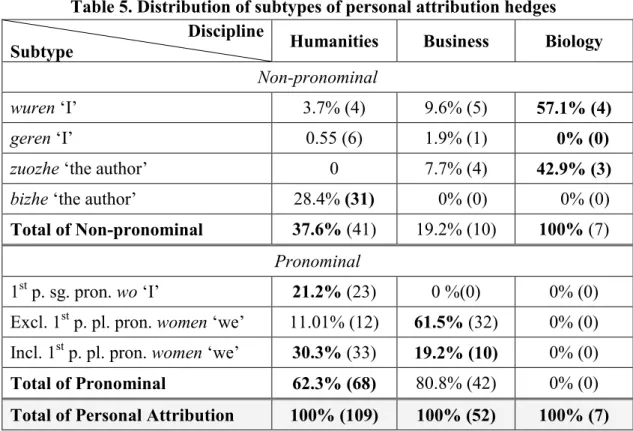
Pronominal personal attribution forms include the first person singular wo ‘I’ and plural women ‘we’. When an article is written by a single author, the author may present an argument as his/her own belief or subjective opinion by using wo ‘I’. Twenty-three tokens of wo ‘I’ were found in the databank. It is noteworthy that all 23 occurrences of ‘I’ were used by writers in the pure humanities (21.3% of all personal attribution hedges). These uses are suggestive of the great personal involvement in the history and literature writers’ claims:
(12) Buguo wo geng yuanyi ba zhe zhong xiao, kan zuo shi but I even willing BA this CL laugh see do be
kongdong de huai xiao, youqi shi, tamen sihu bu zhi empty DE bad laugh especially be they seem not know
weihe er xiao, sihu zhi shi zai huihuo xiao de biaqing. for.what and laugh seem only be PROG lavish laugh DE expression
‘However, I would rather consider such a laugh as vacuous and vicious, especially because they do not seem to know why they are laughing but are merely lavishing their expressions of laughing.’ (his&lit&philosophy-4)
(13) Wo xiang dadandi shuo, zuozhe shi youyi chuangzao yi I want boldly say author be intentionally create one zhong fengge xingshi, suiran jintian kan lai, ta dabufen de
CL style form although today see come he most DE
yuyan dou jiequaoya.
language all difficult.to.read.and.understand
‘I can boldly claim that the author intends to create a certain kind of style (with his article), despite the fact that most of the language (in this work) is difficult to read and understand.’ (his&lit&philosophy-4)
(14) Wo renwei chengui de huoqiang shi yong ju zhu zhicheng de, I think PN DE fire.gun be use giant bamboo produce DE
xian ba huoyao zhuang zai zhu tong li, zai jiaofeng first BA gunpowder place in bamboo tube inside PROG fight
shi dianran, fashe, yong lai shao diren. time ignite fire use come burn enemy
‘I believe that Chen Gui’s guns were made of giant bamboo. The gunpowder was first placed in bamboo tubes, and then was ignited and fired to kill enemies during wars.’ (his&lit-NTU-8)
In (12), the author presents a claim about the disagreeable nature of laughs in some sculptures. The claim is embedded in a sentence beginning with the first person pronoun and using a speculative/cognitive verb to express a personal stance. Likewise,
wo ‘I’ in (13) introduces the writer’s claim about another author’s style, and in (14), it
prefaces the writer’s assumption about the material and functioning of ancient guns. These uses of I display a subjective authorial stance by the Chinese writers in the pure humanities.
A slightly different trend is seen in the business articles. That is, instead of using
wo ‘I’, writers in this field mainly make use of the exclusive women ‘we’ to qualify
their claims (61.5% of all personal attribution forms). Even when an article is written by a single author, the author may use the exclusive ‘we’ as a substitution for the singular ‘I’ to humbly refer to himself or herself or to avoid direct reference (Liu et al. 2007). This enables the writers to project a more “modest self-image” (Vladimirou 2007:151) and to achieve solidarity with the readers. Consider (15) and (16):
(15) Yinci women tuilun zai ziben shichang jiegou jiao jianquan therefore we deduce at capital market structure more sound
shi, changshang weile yao kongzhi lingzujian bing kuozhang lirun, time industry for want control parts and expand profit hui zhuisui cengji moshi.
will follow hierarchy model
‘Therefore, we deduce that when the capital market structures are relatively sound, in order to control computer parts and increase profit, the industry will follow a hierarchy model.’ (bus-management-3)
(16) Suoyi, women juede muqian reng bu neng qingyidi digu
so we feel currently still not can easily underestimate shenzhi genbendi fouding le tade shi liao jiazhi.
even radically deny LE its historical material value
‘Therefore, we feel that we cannot easily underestimate or even deny the value of its historical material.’ (his&lit-new-2)
In (15), the exclusive women ‘we’ is used to refer to the writers themselves because the paper is written by two authors. (16), however, is from an article written by a single author, who argues for the reliability of the cited historical material due to the limited amount of literature available. However, since there is not enough historical evidence to support his interpretation, the author utilizes women ‘we’ to avoid explicitly referring to himself and therefore minimizes the chance of opposition. The use of the exclusive women in history and literature in a single-authored article is also found when writers lack confidence in the truth of a claim. With women ‘we’ instead of wo ‘I’, the writers’ personal views are played down and a mitigating effect is achieved.
Another pronominal use of personal attribution is the inclusive women ‘we’. It is only found in the soft sciences (30.3% in H&L and 19.2% in business). The inclusive ‘we’ involves the readers in the authors’ reasoning process. It directs the readers to an argument or speculation and is slightly different from the inclusive women ‘we’ in “attribution to common knowledge”, which is used to invite the readers’ agreement. The following extracts exemplify how authors involve readers in their reasoning: (17) Shouxian, women keyi jiang shiye qian xinzi, shiwei baoliu
first we can take unemployment before salary regard reserve gongzi, xianqian xinzi gao zhe duiyu gongzuo keneng jiao wage before salary high person to work possibly more tiaoti, suoyi zai jiuye jilu jiao di.
picky so again work chance more low
‘First, we can treat the pay received before unemployment as the wages of reservation. Those who have received higher pay before (being laid off) may be more picky about their jobs, so the re-employment rate is lower.’
(18) Tamen ren shu, women keyi liyong jialiwan shijian de they people number we can use PN event DE
lingsui ziliao, lue zuo tuice. fragmental material roughly make estimate
‘We can use the fragmental material related to the Battle of Kaleawan to estimate the actual number of people in Kaleawan.’ (his&lit-new-4)
In (17) and (18), the inclusive ‘we’ holds both the writers and the readers accountable for the claim (Vassileva 1998, Chang 2011). Moreover, women ‘we’ suggests “a degree of freedom to manipulate conventions” or research variants in business (Hyland 1998c:452). The tentativeness of the modal auxiliary keyi ‘can’ further strengthens the subjective manipulation of the inclusive ‘we’. Unlike the detachment implied in nominal expressions like zuozhe or bizhe ‘the author’, the inclusive we involves the reader and signals solidarity in the disciplinary community. In pragmatic terms, it is a strategy to fulfill positive politeness by implying that the writer and addressee “are cooperatively involved in the relevant activity” (Brown & Levinson 1987:125).
Non-pronominal personal attribution
Non-pronominal self-reference forms, including zuozhe/bizhe ‘the author’ and
wuren/geren ‘I’, are common across the three fields (humanities: 37.4%, business:
19.2%, biology: 100% of all personal attribution forms). They are characteristic of Chinese academic writing, and to date no English counterparts have been identified by research.6 It is also worth noting that non-pronominal self-reference was the only type of personal attribution used by biology writers. Some stylistic differences, however, were observed among the three disciplines, especially in the choice of linguistic forms. While the form wuren ‘I/we’ was the most general expression across the three fields,
zuozhe ‘the author(s)’ was preferred by business and biology writers, and bizhe ‘the
writer’ was exclusively used by writers in the pure humanities to refer to themselves (31/41, 75.6%). The following excerpts (19-22) illustrate these forms:
6 Sometimes, an author may refer to himself/herself as yanjiuzhe ‘the researcher.’ However, in the 90
articles we investigated, we did not find an author referring to himself/herself with this term. This may be attributed to disciplinary difference. Further study is required to investigate the use of such self-reference in other research articles. We thank one of the anonymous reviewers for pointing out this possible self-referring term.
(19) Wuren tuice ci nai jingyou zhonguo limushi chuanbo I/we infer this be through China cacopsylla.chinensis spread PDTW phytoplasma, zaocheng li shuairuo bing zhi shiji
PN PN lead.to pear weak disease of real
tian jian anli. field between case
‘We infer that the disease of pears in orchards (in central Taiwan) resulted from the spread of PDTW physoplasma by Chinese cacopsylla chinensis.’
(bio-plant-9)
(20) Muqian jiu bizhe er mu suo ji, sihu jin you zhangruan, currently as.for author ear eye place reach seem only have PN
qianzhangfan liang wei jiang gudian haiyang shici jia yi fenlei.
PN two CL take classical ocean poetry add use classify
‘As far as the author knows, it seems that only Qianzhangfan and Zhangruan have categorized classical maritime poetry.’ (his&lit&philosophy-3)
(21) Suiran xuezhe duiyu mingdai gongting shanshi shu he although scholar toward Ming.Dynasty palace food belong which zhong cai xi, huo yun qi shi nanfang shi de, huo yung kind vegetable system or say it be southern style NOM or say
xi yi nanfang fengwei wei zhu, jian ji beifang fengwei, bing be use southern taste be major include reach northern taste and zhujian jiarong, dan geren hai shi renwei qi yi beifanghua. gradually blend but individual still be think it already northernized ‘Although scholars have different arguments about the style of palace meals— some say that they belong to the southern style; others say that they are mainly of the southern style mixed with a northern flavor and that the two styles have gradually incorporated each other—I still believe that they have been northernized.’ (his&lit-NTU-9)
(22) Zuozhe jianyi yu jingjixing zaipei qiaomai tian zhouwei, bu author suggest at economic cultivate buckwheat field surrounding not yi sa bo youcai zuowei dao tian dongji lu fei zuowu. proper spread sow rape do.as rice field winter green manure crop ‘The author (I) suggests that for economic purposes, it is inappropriate to sow rapeseed around buckwheat plots as green manure in winter.’ (bio-plant-6) The above examples show that, compared with pronominal reference, although the authors still state their own beliefs or assumptions, the argument sounds more formal and suggests a sense of detachment. That the biology writers employ only
non-pronominal forms to refer to themselves reflects their objective stance. Even when they are presenting their own beliefs, they maintain a detached attitude and tend to obscure their identity, thus achieving a distancing effect. A detailed distribution of the personal reference forms used by writers of the three fields is given in Table 5.
Table 5. Distribution of subtypes of personal attribution hedges Discipline
Subtype Humanities Business Biology
Non-pronominal
wuren ‘I’ 3.7% (4) 9.6% (5) 57.1% (4)
geren ‘I’ 0.55 (6) 1.9% (1) 0% (0)
zuozhe ‘the author’ 0 7.7% (4) 42.9% (3)
bizhe ‘the author’ 28.4% (31) 0% (0) 0% (0)
Total of Non-pronominal 37.6% (41) 19.2% (10) 100% (7)
Pronominal
1st p. sg. pron. wo ‘I’ 21.2% (23) 0 %(0) 0% (0) Excl. 1st p. pl. pron. women ‘we’ 11.01% (12) 61.5% (32) 0% (0) Incl. 1st p. pl. pron. women ‘we’ 30.3% (33) 19.2% (10) 0% (0) Total of Pronominal 62.3% (68) 80.8% (42) 0% (0) Total of Personal Attribution 100% (109) 100% (52) 100% (7)
Several points can be made about the use of self-reference forms in addition to the above discussion. First, wo ‘I’ was exclusively used by the writers in the pure humanities. Second, the biology writers only employed the formal, non-pronominal forms to refer to themselves. Third, writers in the soft knowledge fields preferred to use the plural women ‘we’ even if they were the sole author of an article. In brief, when writers make a personal attribution to support a claim, writers in the pure humanities discipline reveal the greatest degree of subjectivity and individuality in their use of ‘I’. Subjectivity is also seen in business articles, especially in the use of pronominal self-reference. Writers in the hard sciences show the greatest degree of objectivity even when referring to themselves given the exclusive use of the more detached, non-pronominal self-referring forms.
4.1.4 Impersonal attribution
Writers can also mitigate their authority by attributing a proposition to an unspecified person, group or unspecified referent. Our results are partially in line with
previous findings in Chinese spoken discourse but dissimilar to findings on English impersonal constructions. That is, the writers in our databank mainly use the indefinite pronoun mou ‘certain’, although a small proportion of impersonal attribution hedges take the passive construction bei without an explicit agent. Before we discuss the functions of impersonal attribution in the academic articles we studied, we present the overall distribution of this strategy.
Table 6. Distribution of impersonal attribution
Humanities Business Biology Total F
Frequency per 1,000 words M 0.269 0.100 0.129 0.166 4.329* SD 0.327 0.174 0.177 0.246 * p < .05
Table 6 shows the mean and standard deviations of impersonal attribution hedges in the three fields. The F-test showed that there is an overall inter-disciplinary difference in the use of impersonal attribution [F (2, 61.589, p = .017*)]. Post-hoc comparison revealed that writers in the pure humanities use a significantly higher proportion of such hedges than biology writers (p = .022). However, no statistical difference was found between the pure humanities and business writers or between business and biology writers. Similar to the results regarding personal attribution, the writers in the pure humanities exhibited a strong preference for attributing their claims to a nonspecific group or referent.
As noted above, the linguistic forms of impersonal attribution comprise mou ‘certain’ and the agentless bei construction. When using mou ‘certain’, the authors displayed their plausible judgments by hedging the exact identity of a referential form: (23) Zhe biashi huoxing chengfen chule shengtai zhiwei, mouxie
this indicate active element in.addition.to peptide besides certain shuirongxing dafenzi wuzhi keneng ye han muli zhi water.soluble macromolecule substance possibly also with oyster of guoyanghua yizhi nengli youguan.
peroxidation resist ability related
‘This indicates that in addition to peptide, certain water-soluble macromolecule substances may also be related to oysters’ ability to resist peroxidation.’
(24) Dongduji guanyong mingming de xiangzheng shoufa, chule
PN common.practice naming DE symbolic method except
lishi shang zhenshi renwu, didian zhiwai, qita dabufen de history on real character place except other most DE
mingming ke shiwei wenhua yishi de biaozheng, daibiao naming can view.as culture consciousness DE symbol symbolize
wenhua zhong de mouzhong fanshi. culture within DE certain convention
‘Except for real people and places in history, most of the naming conventions in Dongdu Ji ‘Passage to the East’ can be viewed as symbols of cultural consciousness, representing a certain convention in the culture.’ (his&lit&philosophy-1)
The use of mou ‘certain’ in (23) indicates the authors’ uncertainty about the exact identity of water-soluble macromolecule substances, whereas in (24), the author implies that a specific referent is not necessary for the current purpose (Wang 1947, Liu et al. 2007, Chen 2008). Instead of focusing on a specific convention, the sentence stresses the symbolic meaning of the method of naming in Passage to the East.
With regard to the agentless passive construction, only seven examples out of 123 impersonal attribution hedges (5.7%, 7/123) were found in the databank:
(25) Raner, ruo jingliren de li zhi shi yinwei qi geren shengya de however if manager DE leave job be because his individual career DE
guihua, xiang genghuan xin huanjing huo bei wajiao dao plan want change new environment or PASS head.poaching reach
qita jijin gongsi deng, ze gai xunxi nai bei shiwei huai xiaoxi. other fund company etc. then that news be PASS view.as bad news
‘However, if managers quit their jobs because of personal career planning, of their wish to change their working environment, or due to head hunting etc., then such news is viewed as bad news.’ (bus-finance-7)
The passive marker bei, like the remaining cases of bei in our databank, occurs when the authors are defining research variables. Omission of the agent after bei allows the authors to distance themselves from taking the responsibility for the definition of the variables. Meanwhile, the definition involves unfavorable news. This is consonant with Wang’s (1947) contention that passives are mainly used to describe undesired events in Chinese. Table 7 summarizes the distribution of mou ‘certain’ and
Table 7. Distribution of subtypes of impersonal attribution Academic fields
Distribution & subtypes Humanities Business Biology
mou ‘certain’ 97.6% (83) 83.3% (20) 92.9% (13)
bei (passive marker) 2.35% (2) 16.7% (4) 7.1% (1)
Total 100% (85) 100%(24) 100% (14) 4.2 Comparison among hedges within the same field
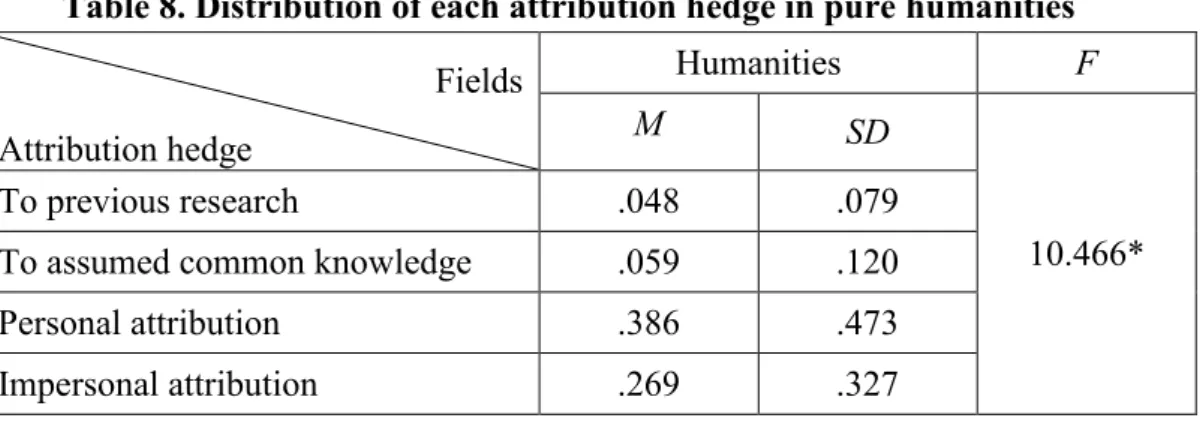
In the foregoing discussion, we have presented quantitative and qualitative analyses of the use of hedges in Chinese academic discourse in the disciplines of the pure humanities, business and biology. After investigating the use of each strategy and its disciplinary variation, we examined whether differences exist among strategies within the same discipline. Table 8 displays the mean and standard deviations of each type of attribution hedge in pure humanities:
Table 8. Distribution of each attribution hedge in pure humanities Fields Attribution hedge Humanities F M SD 10.466* To previous research .048 .079
To assumed common knowledge .059 .120 Personal attribution .386 .473 Impersonal attribution .269 .327 *p < .05
Prv Res = Common; Person > Prv Res; Person > Common; Person=Impersonal; Impersonal > Prv Res; Impersonal > Common.
The differences among attribution hedges used in the pure humanities were tested with one-way Repeated-measures ANOVA.7 The results revealed an overall significant difference among types of attribution hedges [F (1.87, 54.28) = 10.466, p < .001*]. A Bonferroni post-hoc comparison depicted “personal attribution” and “impersonal attribution” hedges as both being higher than the “to previous research” and “common knowledge” hedges in the pure humanities (ps < .012) while no significant difference was found between the personal and impersonal attributions. This statistical results accord with our previous argument (Sec. 4.1.3-4.1.4) that personal and impersonal
7 Because Mauchly’s test of sphericity was not met in the three fields, degrees of freedom were
attribution hedges count as a major attribution hedge among writers in the pure humanities. That is, pure humanities writers more frequently attribute responsibility for their claims to themselves or to an unspecified source.
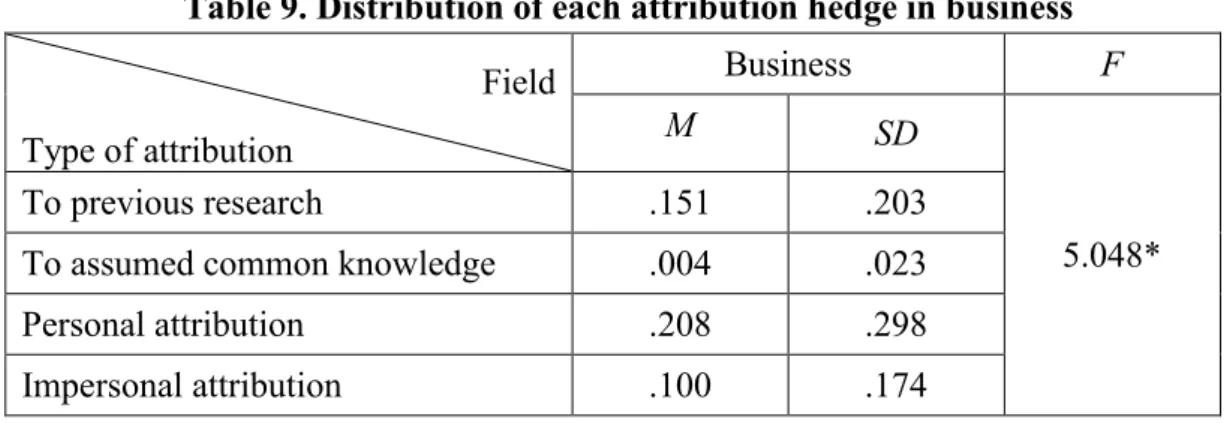
The mean and standard deviations for hedges within the business articles are shown in Table 9:
Table 9. Distribution of each attribution hedge in business Field Type of attribution Business F M SD 5.048* To previous research .151 .203
To assumed common knowledge .004 .023 Personal attribution .208 .298 Impersonal attribution .100 .174
p < .05
Prv Res > Common; Prv Res = personal; Prv Res = impersonal; personal > common; Impersonal > common; Impersonal = person.
Analyses of variance among the hedges used by business writers showed a significant difference among hedges in this field [F = (2.08, 60.298) = 5.048, p
= .009*]. A Bonferroni post-hoc comparison suggested that appeals to assumed
common knowledge were significantly lower in proportion than “previous research”, “personal”, or “impersonal” hedges (ps ≤ 0.5), whereas no significant difference was found between any other two strategies. These results indicate that when business writers present a given claim, they prefer to alleviate their responsibility by making explicit reference to previous research, by making a self-reference or by referring to an unspecific source. Part of the results correspond to the style observed in the pure humanities, which showed a stronger preference for making personal and impersonal attribution.
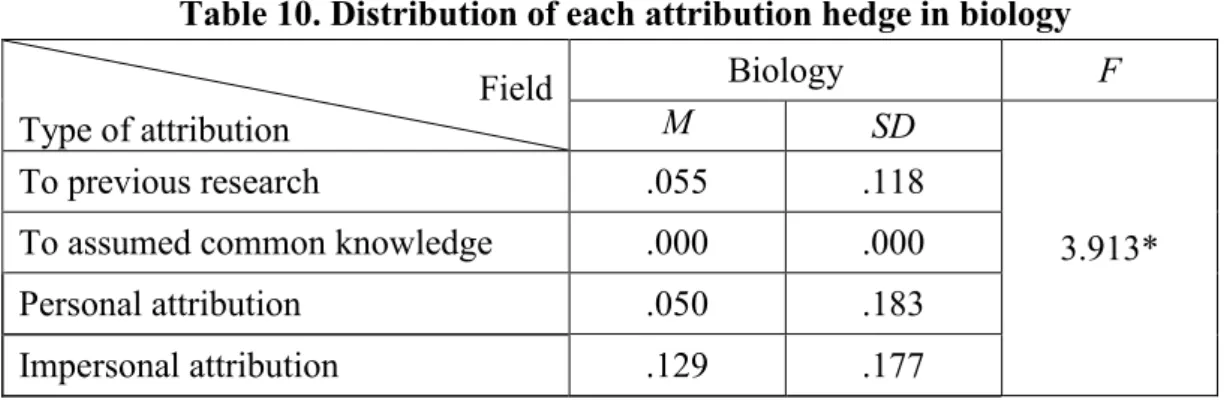
In the following, we discuss the results from biology articles. Table 10 shows the mean and standard deviations.