Exciton
binding
energy
in
a
GaAs/Al„Ga&
„As
quantum
well with
uniform
electric
field
Der-San Chuu and Yu-Tai ShihInstitute
of
Electrophysics, National Chiao Tung University, Hsinchu, Taiwan, Republic ofChina(Received 18December 1990;revised manuscript received 7 May 1991)
The efFects ofa uniform electric field on the binding energies ofexcitons and the subband energies in a GaAs/Al Gal Asquantum well are studied bya perturbative variational approach. Our calculation is
based on an e8'ective-width infinite-well model. The eftective-mass mismatch isalso taken into account. Our results show that the electric field causes a large shift ofthe subband energy and exciton peak posi-tion. The calculated results are compared with the data observed from an optical-absorption experi-ment. Satisfactory agreement isobtained.
I.
INTRQDUCTIQNRecently, growth
of
alternately thin-layeredsemicon-ductor heterostructures with controlled thicknesses and relatively sharp interfaces has become possible. More re-cently, much effort has been devoted to the study
of
theexciton states in these one-dimensional periodic
struc-tures and quantum wells. ' ' A knowledge
of
the exci-ton binding energy is crucial to the interpretationof
the photoluminescence spectra and photoluminescence exci-tation spectra, which are used to determine the electronicproperties
of
heterostructures. The exciton binding ener-gy is also important because it is now possible to make the layers so thin that some quantum-confinement effectsof
electrons and holes can readily be seen.For
example, in bulk GaAs, the exciton resonances can be observed only at low temperature. At room temperature, excitonicresonances are very weak and thus nonresolvable. How-ever, in multiple quantum wells, one remarkable phenomenon happens
—
the exciton resonances can be clearly observed at room temperature. When the electric field was applied in the direction perpendicular tothe lay-ersof
molecular-beam-epitaxy- (MBE-) grown multiple-quantum wells in a p-i-n doped structure, the field-induced absorption was observed to have a large shift tolower energies accompanied by some broadening. '
This exceptional quantum-confinement Stark efFect has received a lot
of
attention for devices because it isa very large electroabsorption effect even at room temperature.This efFect makes possible the fabrication
of
low-energyoptical modulators and switches. Many authors ' have devoted their efforts to studying the mechanism
of
the quantum-confinement. Stark effect. Mostof
thetheoretical works are usually based on the application
of
the conventional perturbation method, the traditional variation principle, Monte Carlo techniques, and exactnumerical approaches. A method based on the Monte Carlo technique and variation principle was developed by Singh ' and Singh and Hong to study the ground-state problem in an arbitrary quantum well. An extensive cal-culation on several variants
of
the single-subband modelof
the infinite and finite wells with interwell Coulomb effects were reported recently by Mo and Sung. Gal-braith and Duggan 'reported a variational calculationof
the external-field efFect on the exciton binding energy in a double-quantum-well model. Zhu investigated the effects
of
the heavy- and light-hole mixing on the exciton spectraof
a quantum well in the presenceof
the electric field by taking account the different exciton spinor com-ponents. The agreements with the experimental dataof
these theoretical works are, in general, only qualitative.It
is, therefore, interesting to employ different theoreticaltreatments tostudy the exciton binding energy
of
aGaAsquantum well with uniform electric field.
In the present work, we propose a simple but much more efficient approximation method to study the bind-ing energy
of
the exciton in atype-I heterostructure with an electric -field.For
the purposeof
illustration,numeri-calcalculation will be performed only forthe GaAs quan-tum well. This is because the experimental data for the
GaAs/Al„Ga& As quantum well isabundant.
II.
THKGRYWe consider a Wannier exciton in a GaAs quantum well sandwiched between two semi-infinite Al Ga& As slabs in the presence
of
a uniform electric fieldI'
along the positive z direction (i.e.
,perpendicular to the material layers). The originsof
distance andof
electrostatic po-tential are chosen at the centerof
the well.To
write down the Schrodinger equation, it is convenient to retain the z-direction-motion Hamiltonian but transform the in-plane motion Hamiltonian into plane-relative coordi-nates:x
=x,
—
xl, and y=y,
—
y&. This is because the ex-citon in-plane(x,
y) motion is free except for the Coulomb potential. Then under the effective-mass ap-proximation and by dropping the planecenter-of-mass-coordinates part, the Schrodinger equation can be ex-pressed as
where the exciton Hamiltonian His
EXCITON BINDING ENERGY IN AGaAs/Al„Ga&
„As.
. .
8055 g2 $2 $2+
2p& Bx By+
VB(z„L
—
/4)+F.
,
„
8 fi 8+
eFz, Bz, 2m,*,
Bz,+V,
B(z,
I.
—
/4)—
B A B—
eFz~ 2The
H,
orHI, are Hamiltonians for an electron or ahole in a one-dimensional confinement potential well acting under a uniform electric field. TheH
„
isthe Hamiltoni-an for a two-dimensional hydrogen atom. TheSchrodinger equations for
H„Hh,
andH
„can
be solved separately.For
H
„,
the eigenfunctions canbe solved exactly as2
k[x +y
+(z,
—
zl, )]'~
(2) eime (p,8)
=
N„
aon+
—,' lmlwhere
+,
,
is the exciton envelope wave function,E,„,
is the exciton energy and Egp isthe band-gap energyof
thematerial that forms the well, and X exp
pk ao(n
+
—,')
2lml ~n+Iml m,zmI,& Pj. mel+mh3. 2pk ao(n+
—,')
(5a)H=H,
+Hh+H„+H'(A,
)+E,
=Ho(A,
}+H'(A,
)+E,
„,
whereHo=H, +H&+H
~, andH
e=—
K
h=—
+eFz,
+
V,B(z,
L
/4),
—
Br'
a 2m eFzh+
VqB(—
zhL
/4),
—
(4a) (4b) Q2 B2 B2 2pi Bx By A, 2 H'(A,)=
k(2+
2)1/2 A,ek(x'+y')'
'
e2k[x +y
+(z,
—
zz)]'~
(4c) (4d) is the in-plane reduced mass. Egp will be assumed toremain constant under the electric field. The variable
r,
(rh ) is the electron (hole) position vector, m,*,
(ml*,,
)is the electron (hole) effective mass along the z axis,
m,*~ (m&~) is the electron (hole)
x,
y plane effective mass.These masses, are, in general, different in the wells and in the barriers, hence they are zdependent. The kinetic en-ergy has been written, for z-dependent masses, in a way which restores the Hermitian character
of
theHamiltoni-an. V, (Vh )is the barrier height confining the electron
(hole).
B(x)
is the unit step function:B(x)
=0
forx
(0,
B(x)
=1
forx
)
0,
andL
isthe well width. The dielectric constant k contained in the electron-hole Coulombin-teraction term is assumed
to
be z independent. We shall neglect image effects tosimplify the problem.Equation (2) cannot be solved exactly; the usual method for solving this problem is the variational
ap-proach. ' Here, we shall employ adifferent
approxi-mation approach, namely, the perturbative variational method (denoted as PVM} to study this problem. This
method has been successfully applied
to
calculate the im-purity levelofboth
isotropic and anisotropicsemi-conductors. Following the treatment
of
the PVM, a termof
—
A,e/k(x +y
)'
isnow added and subtracted fromH.
H
isthen divided into three terms:with n
=0,
1,2, 3,. .
.
and m=0, +1,
+2,
+3,
.
.
.
andX„
isthe normalization constant2 ao(n
+
—,')
(n—
fm f)! (2n+1)[(n
+
fm f)!] '1/2 (5b)The eigenenergies for
H„are
pyA, e v 2k2g2(n
+
1)2 2 A,R*
(n+
—,')
(5c)where
R
*=
p~e /2k A' is the eff'ective Rydbergcalculat-ed with transverse effective reduced mass p~.
For
the HamiltoniansH,
and H&, one can see that the potential-energy term in Eqs. (4a) and (4b) tends to+
aoas z goes to
+
~,
so that the solutionsof
the Schrodingerequation are restricted by a boundary condition that
re-quires the wave function to vanish at infinity. On the other hand, the potential tends to
—
~
as z goes to—~,
so that the system does not, strictly speaking, have true bound states.
'
In other words, the carrier initially confined in a well can always lower its potential energy by tunneling out the well when the field is not zero.However, provided the electric field is not too strong, we still expect to see resonances associated with the so-called
"quasiband" states.
'
Although the actual stateof
an isolated quantum well with an electric field is quasibound,it may be approximated by a bound state
if
the applied field isnot too strong so that the lifetime ~of
the carrierin the well is long enough. Thus one can neglect the
es-cape
of
the carrier outside the quantum well.'
' Wewill use the bound-state approximation
to
study the sub-band energies in a quantum well.For
theGaAs/Ga,
Al As superlattice, the conduction-band-edge offset Vo is about85% of
the band-gap difference between GaAs and Ga&Al„As,
thus electrons in theconduction band
of
GaAs are located, in general, in aquantum well with finite barrier height Vo.
Therefore, for our problem the Schrodinger equation
for subband energies
of
the electric (or the hole) in a finite-barrier-height quantum well with a uniform electric field can be expressed asd A d
H,
PF( )= —
—
P~(z)—
qFz(bF(z)+ V,P~(z) dz 2m~ dzdip(z)
QF(z) Z=L/2 where=&zPF(z»
(6a) 2m,'
—1/2 (Vo+
qFL /2Fz
—
)M„~z
I&I,
/2*'"'=
m„~z
&L/2
and the confining potential V, is defined as
0
for~z~)L/2
Vo for~z~
~L/2
.
(6b)
(6c)
where
We shall employ a simple perturbation approach
pro-posed by Lee and Mei ' tosolve
Eq.
(6). The main ideaof
this approach is to treat the finite-height-barrier potential-well problem as the approximationof
thecorre-sponding infinite-height-barrier potential-well problem with a broadened well width
L
+25,
where 5 is the penetration depth.To
find out the penetration depth, let us first assumethe electric field is so weak that the bound-state approxi-mation holds. Then the wave function inside the quan-tum well can be approximated as
PF(z)=c
expj
K(z)dz
(7a)0
for—
L/2
—
5L~z
~L/2+5~
Votherwise
.
(9c)The solution
of
Eqs.(6a) and (9c)can be expressed asP„(z)
=a„Ai(rl„)+P„Bi(g„)
with the boundary conditions
Nn(z)~z=L/2+5& Nn(z) ~z= L/2—
s&—
(10a)
(10b)
where
Ai(g„)
andBi(g„)
are Airy functions;a„,
I3„are
normalization constants andIf
we now move the well walls at—
L/2
andL/2
toand
L/2+5+,
then outside the new well walls the probability for finding the electrons are rathersmall. This is equivalent to saying that for the first-order approximation one can replace the finite-well problem with well walls located at
L/2
—
andL
/2 by an infinite-well problem with well walls located atL/2
—
—
5L andL/2+5~,
as shown inFig. 1.
Thus, our problemcorre-sponds to solving Eq.(6a) with Vz defined as
K(z)
=
1/2 2m~ (Vo qFzEz
)——
(7b) 2m(efiF
) 1/3(E„z+qFz)
. (10c)The integral contained in
Eq.
(7a) can be evaluated easily. One getsEquation (10b)yields
Ai(g„+
)Bi(g„)
—
Ai(g„)Bi(il„+
)=0,
(10d)2 PF
(z)=
c exp3qF
X 3qF(V
E
)3/2 (Vo qFzEz
)—
(7c)—
where rI„+ or r)„ is given by Eq. (10c)with z
=L/2+5~
or
—
L/2
—
6L and the eigenvaluesE„can
be obtained by solvingEq.
(10d)numerically.The
Ez
contained in Eqs. (9a) and (9b) is the totaleigenenergy for the finite-well problem [Eqs.(6a) and (6c)]
and is actnally unknown. In the
first-order-The first derivative
of
PF(z) can be expressed as1/2
dP~(z) 2m,
"
=4
(z) (Vo qFzFz
)—
dz
Therefore, the penetration depth at the boundary
z=
L/21s
dyF(z) F Z= —L/2 —1/2 2m (Vo—
qFL /2Fz
)—
(9a) —L/2-s I /2 L~2+ ~zRIn a similar procedure, the penetration depth at the boundary z
=L
/2 can be obtained asFIG.
1. A finite-height quantum we11acted on by an electricEXCITON BINDING ENERGY IN A GaAs/Al„Ga&
„As.
.
.
8057 approximation calculation, theEz
is approximated bythe eigenenergy
Ez
'of
the correspondinginfinite-barrier-height quantum well. The value
of
q contained in Eqs. (9a) and (9b) is—
e for the electron, and e for thehole. One can define the effective well width for the
elec-tron
(v=e)
or hole(v=h)
as'11',
„,
'(z„zl„p,
B,
A,)=N„
(p,6,
A,)P,
„(z)gl,„(z),
(12)where
@„(p,
B,
A.)and P„(z)
(v=e
for the electron andv=h
for the hole) are eigenfunctions obtained in Eqs. (5a) and (10a),respectively. The first-order energy correctionis defined as
+effv
~
+
~vL+
~vRNow from the above discussion, the solution for total
unperturbed Hamiltonian Ho can be expressed as
correction to the unperturbed energy
E,
"„',(X)=E.
,
„(X)+E„+E„,
+E„„
where
E„„(A,
)=-(n
+
—,')
is the eigenenergy for the two-dimensional hydrogen
atom;
E,
,
(El,,
)isthe eigenenergy for the electron (hole)in a finite quantum well with a uniform electric field ap-plied in the direction perpendicular to the well walls; and
E,
is the band-gap energyof
the well-acting material. Therefore, the total eigenenergy for the total Hamiltoni-anHis
EE,
'„",(A)=(e'
'(A)IH'(A)le'
'(A))
.
(13)E
(A)E
y(A)+E
+El,
+Es p+bE
l(A) (14) Since the second-order perturbation correction is ingen-eral much smaller than the first-order correction, the ex-pression in
Eq.
(13) can be treated as the total-energyI
For
the ground state, the energy correction b,E,
'„",(A,)canbe evaluated as
4g
2 L/2+5 RaE'.
„".,
(X)=
'„
f,
, ;
dz,ly„(z)I'
L/2+6 ao Xf
dzl, lpga,F(z)l'
'
+
lz,—
zl, I—
—
lz,—
zp,IH
hL 4A,IZ,—
z„
I ao4xlz,
—
z„
I ao (15) andm„=
(%,
„,
lm,",(z,
)lq,
„,
)
In the practical calculation, the wave function
4,
„,
con-tained in m,~or m&~is replaced by the unperturbed wave
function
4',
„,
'(z,
)or 4',
„,
'(zl, ), respectively. Theparame-ter A, contained in
Eq.
(14)can be determined byrequir-ing the fast convergence
of
the perturbation series, and is equivalent tosettingaE,
'„",(X)=0
. (16)After obtaining Xfrom the above equation, one can
sub-stitute this A,into
Eq.
(14)to get the total eigenenergyof
exciton
E,
„,
(A. ) and the binding energyof
the exciton:Ell
=E,
i+El(
+Es,
p—
E,„„where
E,
l (E~l) is theconfinement energy
of
the first electron (hole) subband. whereHi(x)
andN,
(x)
are the Struve and Neumann functionsof
order1.
The effective Bohr radiusao=kA'
/pie
and effective Rydberg R=pie
/(2k
A'2)are related with the in-plane reduced mass:
pi=m,
iml,i/(m,
i+mal,i),
where the equivalent in-plane effective masses m,~and m&~ are defined as follows:III.
RESULTS AND DISCUSSIONS+
3 4mhh, z 1 4m1h,z m1h (17a) mhh,l
1 4mhh,.
+
3 4m 1h, Mhh,i=
1 34M.
.
+
4M-.
,
1 34M.
.
.
+
4M.
.
.
(17b)The Eg p for GaAs and
Al„Ga1
As are assumed to be1.
424 eV and1.
424+
1.
247x eV, respectively.If
one usesthe
65%
—
35/o rule ' to share the difference betweenGaAs and
Al„Ga1
As band gaps, then one can obtainThe values
of
the physical parameters used in this work are taken from some previous works. ' ' Theeffective masses for the electron, light hole, and heavy hole inside the well are m,
,
=
0.
0665mo, m1h,=0.
088mo, and mhh,=0.
45mo, where mo is the electron rest mass. Those in the barrier areM,
,
=(0.
0665+0.
0835x)mo, Mll,,
=(0.
088+0.
049x)mo, and Ml,„,
=(0.
45+0.
31x)mo, wherex
is the Alcompo-sition which is taken as
x
=0.
32.
The effective massof
the holes are anisotropic. In the plane motion, they aret0'
E I~ 4 lU2—
ppA I i ~OQ T20 ELp (kv/c~)
80'«E~TRr
C I 20 gQf
the heavy kV/cm) dePe ell width&: ndence o ' -geld (in foUI we Electn-"
(inme»
o ding enf
sition x=
OO1.
- xclton bin 250A (Alcompo ]50, 200 and 2500 A..
1.
=95,
. rgy de-ell widths: he binding energ l for ourfi Ure that the from th gu field streng
0
ecan note the electrlc-as ng lectric fie sesfor»cre
nt valu re sjgnlfican a constan . Ch mo e oac ease 1sm n bin in hea~y- o corn h calcUlat fol g d to decl larger ec
r
exten-ieswe«
fouthe
excito»
energ increases ant
m we&&. ln l ger quansion»
250 o+ C LLl~
&00 F50 95A CL t00 I ~00 &0 ) FIEL I 20 50 ce of
the mean dependell;dths:
eld (gnkV/ o )f
~foUr w Elect -tension (in=p.
32).FI .
-e&cqton osition x=
heavy-hole-e plane e -e L,=95,
150, 2 ~ tric constant 1S0
14.eV~a&s)
The dielec r and 26eVa"d
"
k=1
b roun electro g . fi ]d stre g ~ sexac tcal-of
the e ested by p energy d-iect,rlc a rev'o e-fun'
nt
rs as sugge electron en r P . 16 Our re h electric e hen the hyslcal pa ult shows . fi ld increase '«o»ca»y
".
'd
by Ref-h sthat latlon Rs the el6
even w ses mono btal hjs show result agr . Strong as 2 f r ast«nge.
field»
a ble even e]ectrlct.
n ls fe].la th"
. fit
roxjIna lo d the first . Rn jn nl feld~e
a so l 2 Rnd 3 o l trlc field pe p 0 0 fir ez)0
regl so that they ld, thoughtill has alarg . for the ho the eec amp 1 le, an excl ds ate s 0region or t ez te ls stl
r
the electrothe third sta for
energy shift for
t
.
f
the elec-the d region ~ well. wl ths o ated Rs ngerf
the egect recalcUl he var)at o hole (L~tr,hL
95 A )andt"
d,
trength fo r sl;ghtly tron(L
eff'e lectric-6e ll idths are a func tionof
the11'ective vve 25
(L
—
133 esults showof
Mille It'ective wld ases slight4' 1,theelectri«e
err, h s increaoft
e electron 1 decrease t n dePth er-ho es enetra whl e e let- R that«hea
yf
h nd-side Pe the decreasese,
eases more th~,
- n becau~~t
e rapidly y the case tron inc tion dePf
the cas 0 of
the elect.
ical with resp
direction n ersymm
'
ihe negative .
for ihe hole no long
.
~ Shjft lnt
d ctjon or osltlon ltlve-z su an have P ~ ~ the pOS shift 'nll ag'ect the carr
electron h.ft
of
I,
&WlSitlon»
ron, light hese Pof
the ~lect r les.and ene1-gles 0
~ ecrease sUbb h t these energles e calc hole show
t
R Snce the e e and hea y field increases.f
the electron he electric than those o bband ast
e islarger lower su a,n energy than the energies h l becomes field 1s large,'
hatof
heavy the absorption ole are p shifts of
ene gyt
the excjton P These large an expect t fie]d ln-tive. traof
ex ' energy ton, soweca
as the e spectra h ft to lowelof
the asa].
arge s'
d d pendence o reases. the elect . ~RAS qc
shows .r
y ln a rlC- fle Uantum Figure 2 . blndlng ene gy h le exclton heavy I t&0EXCITON BINDING ENERGY IN AGaAs/Al Ga&
„As.
..
8059 $480— 1470— E C)~
t4$0 O CL ot450—
C) t440GaAs quantum well for several values
of
L
andI.
Theelectric-field-induced increase
of
the exciton size in the layer plane will make the exciton resonances weaken andbroaden. This isconsistent with the observation
of
Woodet
al.
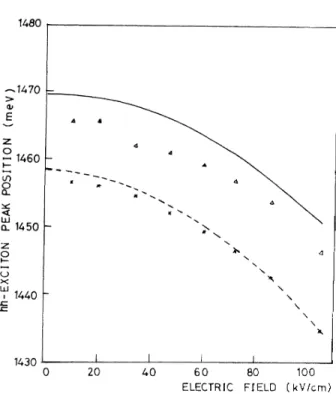
' Figure 4presents acomparison between ourcal-culated values and the measurements
of
the Stark shiftof
the heavy-hole-exciton and light-hole-exciton peak with the electric field applied in the GaAs-Al GaI As quan-tum well forx
=0.
32 andL
=95
A.
The agreement be-tween theory and experiment is better for theheavy-hole-exciton case. The discrepancy in the
light-hole-exciton case might be due to the overestimation
of
light-hole subband energy. Since the light-hole efFective mass is small, it has a larger ground-state energy; thus, the as-sumption that the barrier height is much larger than the carrier energy might not be very suitable for the caseof
the light-hole exciton.IV. SUMMARY
't430 l
20 40 60 80 100
ELECVRIC FrELO (&V&cm)
FIG.
4. Variations ofheavy-hole- (dotted line) and light-hole-(solid line) exciton peak positions (in meV) with electric field (inkV/cm) for temperature T
=300
K, well width L=95
A, and Al composition x=0.
32). The experimental data are taken from Ref. 37).The subband states and the exciton binding energies have been studied by an approximation method. The variations
of
the exciton binding energies with theelectric-field strength and the well width are obtained. The mean in-plane exciton extension is found to increase with the electric-field strength. The excellent agreement
of
our calculated heavy-hole-exciton peak position with the experimental data shows that our bound-state as-sumption is suitable forheavy holes.The electric-field dependence
of
the exciton binding en-ergy can also be understood by the variationof
the mean in-plane exciton extension(p)
=
(%',„,
~p~%',„,
).
Figure 3presents the well width and the electric-field dependence
of
the mean in-plane heavy-hole-exciton extension in aACKXOWI.EDCMEm'S
This work was supported partially by the National
Sci-ence Council, Taiwan,
R.
O.C.
G. Bastard,
E. E.
Mendez, L. L.Chang, and L.Esaki, Phys. Rev.B26, 1974 (1982); 28,3241(1983).~R.L.Green,
K. K.
Bajaj, and D.E.
Phelps, Phys. Rev. B29, 1807(1984).R.
C.Miller, A. C.Gossard, D. A. Kleinman, and O. Mun-teanu, Phys. Rev.B29, 3740 (1984).~R.C.Miller, D.A.Kleinman, and A.C.Gossard, Phys. Rev.B
29,7085(1984).
5N.C.Jarosik,
B.
D.McCombe,B.
V.Shanabrook,J.
Comas,J.
Ralston, and G.Wicks, Phys. Rev.Lett.25, 1283(1985).Y.
C.Chang andJ.
N.Schulman, Phys. Rev.B 31,2069(1985). 7Y.C.Chang,J.
N. Schulman, G.Bastard,Y.
Guldner, and M.Voos, Phys. Rev.B 31,2557(1985).
J.
W.W'u, Solid State Commun. 69,1057(1989).W.
T.
Masselink, P.J.
Pearah,J.
Klem, C.K.
Peng, H. Mor-koc,G.
D.
Sanders, andY.
C.Chang, Phys. Rev.B32,8027 (1985).T.
Kamizato and M.Matsuura, Phys. Rev.B4O,8378(1989).K.
J.
Moore, G. Duggan,K.
Woodbridge, and C.Roberts,Phys. Rev.B 41,1090(1990)„41,1095(1990).
~S. Rudin and
T.
L.Reinecke, Phys. Rev.B41, 3017 (1990). M. M.Dignam andJ.
E.
Sipe, Phys. Rev.8
41,1865(1990).C.Mailhiot,
Y.
C.Chang, andT.
C.McGill, Phys. Rev.8
26, 4449(1982).~5T.H. Wood, C.A.Burrus, D.A.
B.
Miller,D.
S.Chemla,T.
C. Damen, A. C. Gossard, and W. Wiegmann, Appl. Phys. Lett.44, 16(1984).6D.Ahn and S. L.Chuang, Phys. Rev.B34, 9034 (1986). 7M. M. Dignam and
J.
E.
Sipe, Phys. Rev. Lett. 64, 1797(1990).
D.
C.Reynolds,K. K.
Bajaj,G.Peters, C.Leak, W. M.Theis, W.P.Yu, H. Morkoc,K.
Alavi, C.Colvard, andI.
Shidlov-sky, Superlatt. Microstruct. 4,723(1988).
K.
Bajema,R.
Merlin,F.
Y.
Juang, S.CHong,J.
Singh, and P.K.
Bhattacharya, Superlatt. Microstruct. 3,685(1987).R. T.
Collins, L.Vina, W.I.
Wang,K.
von Klitzing, andK.
Ploog, Superlatt. Microstruct. 3,291(1987).
~G. D.Sanders and
K. K.
Bajaj,Phys. Rev.B35, 2308 (1987).J.
Singh andK. K.
Bajaj,J.
Appl. Phys. 57,5433(1985).~M.Cai and W.Liu, Solid State Commun. 71,1123(1989).
~~R.L.Greene and
K.
K.
Bajaj, Solid State Commun. 45,831 (1983).D.A.
B.
Miller, D. S.Chemla,T.
C.Damen, A.C.Gossard, W.Wiegmann,T.
H.Wood, and Burrus, Phys. Rev.Lett. 53,2173 (1984).
Y.
Chen, G. P.Kothigan,J.
Singh, and P.K.
Bhattacharya, Superlatt. Microstruct. 3,657(1987).P.W. Yu, G. D.Sanders,
K. R.
Evans,D.
C.Reynolds,K.
K.
Bajaj,C.E.
Stutz, andR.
L.Jones, Superlatt. Microstruct. 4, 281(1988).A.Hernandez and P.Aceituno, Solid State Commun. 65,1451 (1988).
S.C.Hong and
J.
Singh, Superlatt. Microstruct. 3,645(1987).D.
A. Broldo, Superlatt. Microstruct. 3,13(1987).J.
Singh, Appl. Phys. Lett.48,434{1986).3~J. Singh and S. C.Hong,
IEEE
J.
Quantum Electron. QE-22, 2017 (1986).C. Trallero Giner and
J.
Lopez Gondar, Physica B&,C 138, 287(1986).34S.C.Hong, M.Jeffe, and
J.
Sigh,IEEE
J.
Quantum Electron. QE-23, 2181(19871.F.
Ancilotto, Superlatt. Microstruct. 4,339 (1988).Y.Chiba and S.Ohnishi, Superlatt. Microstruct. 6,23(1989).
J.
A.Brum and G.Bastard, Phys. Rev.B 31,3893(1985).D.A.
B.
Miller, and D.S.Chemla,T.
C.Damen, A.C. Gos-sard, W. Wiegmann,T.
H. Wood, and Burrus, Phys. Rev. B32,1043(1985).
M.Matsuura and
T.
Kamizato, Phys. Rev.B33,8385(1986).G.Mo and C. C.Sung, Phys. Rev.B38,1978(1988).
I.
Galbraith and G.Duggan, Phys. Rev.B40, 5515 (1989).Y.
J.
Chen,B.
Elman, andE.
S.Koteles, Solid State Commun. 72, 25(1989).B.
Zhu, Phys. Rev. B38,13316 (1988).~Y.
C.Lee, W. N. Mei, andK.
C. Liu,J.
Phys. C 15, L469 (1982)."5M. Altarelli, in Interface Quantum Wells and Superlattices, edited by C.
R.
Leavens andR.
Taylor (Plenum, New York,1988).
46G. Bastard, Superlatt. Microstruct. 1,265(1985). 47T.
F.
Jiang and Y.Shan,J.
Phys. CI.S,3399 (1985).J.
H.Pei,C. M. Dai,and D.S.Chuu, Surf. Sci.222, 1(1989)~C.M. Dai,
J.
H.Pei,W. N.Mei, and D. S.Chuu,J.
Phys. C2, 2807(1990).soG. Bastard, in Interface, Quantum Wells and Superlattices, edited by C.
R.
Leavens andR.
Taylor (Plenum, New York,1988).
5~Y.C.Lee and W. N.Mei,
J.
Phys. C 15,L545(1982).s~Handbook
of
Mathematica! Functions, edited by M.Abramowitz and
I.
A.Stegun (Dover, New York, 1965).5 S.Adachi,
J.
Appl. Phys. 58,R1{1985).~4R.C.Miller, D.A. Kleinman, W.