Inapproximability Results for the Weight Problems
of Subgroup Permutation Codes
Min-Zheng Shieh and Shi-Chun Tsai, Member, IEEE
Abstract—A subgroup permutation code is a set of permutations on symbols with the property that its elements are closed under the operation of composition. In this paper, we give inapproxima-bility results for the minimum and maximum weight problems of subgroup permutation codes under several well-known metrics. Based on previous works, we prove that under Hamming, Lee, Cayley, Kendall’s tau, Ulam’s, and distance metrics, 1) there is no polynomial-time -approximation algorithm for the minimum weight problem for any constant unless (quasi-polynomial time), and 2) there is no polynomial-time -approximation algorithm for the
min-imum weight problem for any constant unless .
Under -metric, we prove that it is NP-hard to approximate the minimum weight problem within factor for any constant . We also prove that for any constant , it is NP-hard
to approximate the maximum weight within under
distance metric, and within under Hamming, Lee, Cayley, Kendall’s tau, and Ulam’s distance metrics.
Index Terms—Approximation algorithms, coding theory, com-putational complexity, subgroup code.
I. INTRODUCTION
I
N this paper, we investigate the complexity of determining the minimum weight and maximum weight of subgroup codes under various distance metrics. Related problems have been studied for linear codes for some time. Here, we focus on inapproximability results for subgroup permutation codes.A permutation code of length is a subset of all permutations
over . We say a permutation code has minimum
distance under some metric if for any pair of distinct per-mutations and in , . We call the set of such per-mutations an -PA. Recently, permutation codes have been found to be useful in several applications, such as power line communication (see [16] and [20]–[22]), multilevel flash mem-ories (see, e.g., [9], [10], and [18]), and cryptography (see [12], [13], and [15]). For these applications, researchers mainly focus on creating permutation codes within certain distance under Hamming, Kendall’s tau, Chebyshev distance metrics, etc.
Manuscript received March 14, 2011; revised December 11, 2011 and May 09, 2012; accepted July 09, 2012. Date of publication July 26, 2012; date of cur-rent version October 16, 2012. This work was supported in part by the National Science Council of Taiwan under Contracts NSC-97–2221-E-009–064-MY3 and NSC-98–2221-E-009–078-MY3. This paper was presented in part at the 2010 IEEE International Symposium on Information Theory.
M.-Z. Shieh is with the Intelligent Information and Communications Re-search Center, National Chiao Tung University, Hsinchu 30050, Taiwan, R.O.C. (e-mail: [email protected]).
S.-C. Tsai is with the Department of Computer Science, National Chiao Tung University, Hsinchu 30050, Taiwan, R.O.C. (e-mail: [email protected]).
Communicated by E. Arikan, Associate Editor for Coding Theory. Digital Object Identifier 10.1109/TIT.2012.2208618
We use to represent all of the permutations over . is also called the symmetric group in algebra. In this paper, we study permutation codes, which also form a subgroup of . We call them subgroup codes. A subgroup code is often defined by a generator set and all permutations in can be written in a sequence of compositions from elements in the generator set.
It is natural to ask how to determine the minimum distance of a code and how to compute the closest codeword for a cer-tain received string. Both problems have analogous versions for linear codes and lattices. For linear code, it is to determine the minimum distance when given the generator matrix of the code [2]. This problem under Hamming distance had been proved to be NP-complete by Vardy [19]. The analogous problem for lat-tice under Hamming distance is also NP-hard by Arora et al. [1]. The corresponding problems for lattices are the shortest lat-tice vector problem (SVP) and the closest vector problem. SVP under -norm is NP-hard, even for approximating within for any constant [11]. SVP under Chebyshev distance is also NP-hard, even for approximating within factor [6]. For the subgroup permutation code version, both problems are proved to be NP-complete under many distance metrics, such as Hamming, -norm, Kendall’s tau, etc. [3], [4].
For right-invariant metrics, the minimum distance problem of subgroup permutation codes is equivalent to finding the minimum weight permutation , where the weight of is defined as the distance between and the identity. Based on Vardy’s work[19], Cameron and Wu [4] proved that under Hamming, Lee, Cayley, Kendall’s tau, Ulam’s distance metrics, and -metric for , the minimum weight problem of subgroup permutation codes is NP-hard. Moreover, based on previous results[4], [5], [7], for the minimum weight problem of subgroup permutation codes over under the afore-mentioned distance metrics, we prove that 1) for any constant , the existence of a polynomial-time
-approxima-tion algorithm implies ; and 2) for
any , the existence of a polynomial-time -approximation
algorithm implies .
For -metric, Cameron and Wu [4] proved that the min-imum weight problem is NP-complete. However, their reduc-tion overlooked some details. We give a correct version to prove the NP-hardness and further prove that it is NP-hard to approx-imate the minimum weight within for any constant . As for the maximum weight problem, with Håstad’s result [8], we prove that for any constant , it is NP-hard to ap-proximate the maximum weight of a subgroup permutation code within under Hamming, Lee, Cayley, Kendall’s tau, and Ulam’s distance metrics. Under -metric for , we prove that it is NP-hard to approximate the maximum weight 0018-9448/$31.00 © 2012 IEEE
of a subgroup permutation code within . However, for the -metric, the maximum weight problem has a polynomial time algorithm[4].
The rest of the paper is organized as follows. We define some notations in Section II. We show the inapproximability results of the minimum weight problems in Section III. We give the inapproximability result of the maximum weight problem in Section IV. Finally, Section V concludes the paper.
II. PRELIMINARY
We use to indicate the set . A permutation
over is a bijective function from to . There are sev-eral representations for a permutation. Here we use a truth table
to denote a permutation , which can be
written as the product of cycles. A cycle
rep-resents a permutation with for . Any
permutation can be written in a product form of disjoint
cy-cles. For example, .
Usually, we ignore the cycle with only one element; therefore .
Let denote the set of all permutations over . It is well known that is a group with the composition operation. We define the product of permutations and as
. The identity permutation in is . indicates the th power of permutation , and
we define and for . We say that
is a generator set for a subgroup , if every permutation can be written as a product of a sequence of compositions from elements in the generator set.
We say is a right-invariant metric if
for all permutations , , and . In this paper, we adopt the following right-invariant metrics.
1) Hamming distance: .
2) -metric: .
3) -metric: .
4) Lee distance: .
5) Cayley distance: is the minimum number of trans-positions required to obtain from .
6) Kendall’s tau: is the minimum number of adjacent transpositions required to obtain from .
7) Ulam’s distance: where the longest
in-creasing subsequence in has length
.
We say that a permutation has weight under
a right-invariant metric . We define the maximum and min-imum weight problems for subgroup permutation code under a right-invariant metric as follows. We call it and for short, respectively. Both of them are in , since computing the weight of a permutation and verifying if is in the subgroup by Schreier–Sims algorithm [17] are in .
Definition 1 : Given a generator set
for a subgroup of and a positive in-teger , determine if there exists a permutation such
that .
It is already known that has a polynomial
time algorithm[4].
Definition 2 : Given a generator set
for a subgroup of and a positive in-teger , determine if there exists a permutation such
that .
We briefly review some handy tools from works by Cameron and Wu[4]. They gave a mapping from binary strings of length
to permutations over as . For
example, . There are close connections
between the weight of under various metrics and the Ham-ming weight of , i.e., the number of 1 in . We use to indicate the weight of under metric .
Fact 1 (see [4]): For every binary string of Hamming weight , we have the following relations.
1) 2)
3) for .
For a binary code , let . Cameron
and Wu[4] also showed a connection between binary linear codes and subgroup permutation codes.
Fact 2 (see [4]): Suppose a binary linear code has a
basis ; then is a subgroup permutation code
and generates . Moreover, if the
maximum and minimum Hamming weights of are and , respectively, then the following statements are true.
1) Under Cayley distance, Kendall’s tau distance and Ulam’s distance, the maximum and minimum weights of are
and , respectively.
2) Under Hamming distance and Lee distance, the maximum
and minimum weights of are and ,
respectively.
3) Under -metric for , the maximum and
min-imum weights of are and ,
respec-tively.
They used these facts to prove the NP-hardness of the min-imum weight problems of subgroup permutation codes under Hamming, Lee, Cayley, Kendall’s tau, Ulam’s, and distance metrics, by reductions from the minimum weight problem of bi-nary linear codes under Hamming distance, which was proved to be NP-hard by Vardy[19].
Theorem 1 (see [19]): The minimum weight problem for
bi-nary linear codes under Hamming distance is NP-hard.
Corollary 1 (see [4]): Under Hamming distance, Lee
dis-tance, Cayley disdis-tance, Kendall’s tau disdis-tance, Ulam’s disdis-tance,
and -metric for , the minimum weight problem
for subgroup permutation codes is NP-hard.
Definition 3: For , we say that an algorithm is an -approximation algorithm for a minimization (maximization) problem if always outputs a feasible solution whose cost is no more (less) than ( ) times of the minimum (maximum) cost on any input, respectively.
Note that cannot output an answer whose cost is less (more) than the minimum (maximum) cost, respectively, since it is not a feasible solution.
III. MINIMUMWEIGHTPROBLEMS
In this section, we first give inapproximability results for the minimum weight problems under various metrics mentioned in Section II except the -metric in Section III. Then, we clarify Cameron and Wu’s reduction in [4] for . At last, we show the inapproximability result for
by modifying the reduction in [4].
A. Under Non- -Metric
We can easily obtain inapproximability results from Fact 2, which actually provides a gap-preserving reduction and can be used for proving inapproximability results. Dumer et al. [7] gave some inapproximability results on the minimum weight problem for linear codes via randomized reductions, and these reductions were derandomized by Cheng and Wan [5].
Theorem 2 (see [5]): For any constant , the existence of a polynomial-time -approximation algorithm for the minimum Hamming weight problem of linear codes over any
finite field implies . Moreover, for
arbitrary constant , the existence of a polynomial-time -approximation algorithm for the minimum Hamming weight problem of linear codes over any finite field implies .
Corollary 2: For any constant , the existence of a polynomial-time -approximation algorithm for the minimum weight problem of subgroup permutation codes over , under Hamming, Lee, Cayley, Kendall’s tau, Ulam’s
distance metrics, and -metric for , implies
.
Proof: Assume is a polynomial-time -approxi-mation algorithm for . Then, we can approximate the minimum Hamming weight problem for binary linear codes by the following procedure.
1) On input basis , construct the generator set .
2) Output , where is the result of on input
.
Let the be the minimum Hamming weight of the binary linear code generated by . By Fact 2, we know the minimum weight of the subgroup permutation code
generated by is . Since is a
-approximation algorithm, the output is at most . This implies the procedure is a polynomial-time -approximation algorithm for the minimum Hamming weight problem of binary linear codes.
Therefore, we have by Theorem
2. For the rest metrics, the claim follows similarly. Moreover, we have the following corollary.
Corollary 3: For arbitrary constant , the existence of a polynomial-time -approximation algorithm for the minimum weight problem of subgroup permutation codes over , under Hamming, Lee, Cayley, Kendall’s tau, Ulam’s distance metrics,
and -metric for , implies .
Fig. 1. Sketch of the reduction in [4].
B. Cameron and Wu’s Reduction for
In the previous section, we obtain the inapproximability results of the minimum weight problem under various metrics based on Fact 1. The weight of under those metrics increases monotonically with the Hamming weight of the
binary string . Observe that for every
with nonzero Hamming weight. Thus, does not
increase monotonically with the Hamming weight of . This indicates that the reduction in Section III-A does not work under -metric. Therefore, we need a different approach to deal with the minimum weight problem under -metric.
Cameron and Wu [4] gave another reduction from
Not-All-Equal-SAT (NAESAT) to . NAESAT
is a classical NP-complete problem (e.g., see [14, p. 187]),
thus is also NP-hard. However, the reduction
in Cameron and Wu’s work[4] contains a flaw, which couldn’t prove the correctness of their claim. In this section, we fix the flaw in their proof and clarify their reduction.
We give the formal definition of Not-All-Equal-SAT problem as follows.
Definition 4 (NAESAT): Given a boolean formula in conjunctive normal form, which consists of exact-3-literal
clauses over variables , decide whether
there exists an assignment such that for every clause , not all literals in are assigned to the same truth value.
If a formula has such an assignment , then is sat-isfiable, and we say is a satisfying assignment. Other-wise, is unsatisfiable. Cameron and Wu’s reduction [4] maps an -variable- -clause formula into a generator set
where
permute elements in , which actually
should be .
To illustrate the permutations, we define two handy opera-tions as follows.
Definition 5: Let be a cycle of a permutation.
1) shift operation: .
2) stretch operation: .
Both operations can be applied to permutations, i.e., working on each cycle of the permutations. For example, let
, we have
and .
Note that shift operation does not change the weight under -metric since the differences between entries are preserved and for stretch operation the weight is amplified by times.
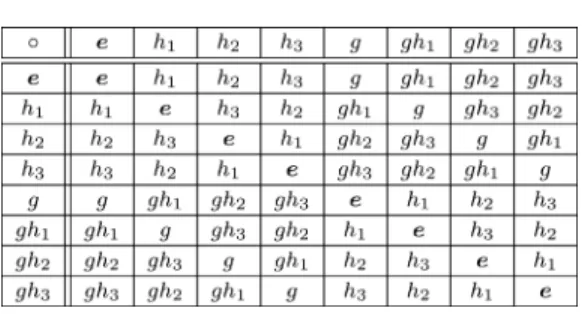
TABLE I OPERATIONS OF
Observe that both operations preserve the algebraic structure,
i.e., and for
arbi-trary permutations and any integer . We will use the shift and stretch operations for constructing permutations.
Before we go through Cameron and Wu’s reduction [4] in detail, we define some useful notations for construction. Given a binary string , we recursively define a permutation
and the set of such permutations as follows.
Definition 6: Let , . 1) 2) . 3) for . 4) . Examples:
In Cameron and Wu’s work [4], they used permutations in Klein four-group, which is exactly , as the main construc-tion blocks to obtain the NP-hardness results of the maximum weight problem under various metrics. They also modified this reduction to obtain the NP-hardness result for . We will show that their modified gadgets can actually be con-structed by permutations in . These families of permutations have many good properties. First of all, the weight of any per-mutation in can be identified with its subscript . An-other good property is that the algebraic structure of under composition is isomorphic to the group of binary strings of length under the bitwise-exclusive-ORoperation. The proofs for Proposition 1 and 2 can be found in the Appendix.
Proposition 1: Let denote the integer represented by the
binary string . .
Proposition 2: For , , we have that
where for .
By Proposition 2, is also commutative, and every element in is the inverse permutation of itself.
Proposition 3: For , we have
that .
Proof: By Proposition 2, for
for . Similarly, also equals
. Therefore, the proposition is true.
Proposition 4: .
Proof: Since , we have that
.
Now, we introduce the building blocks given by Cameron and Wu [4]. Let
By Proposition 2, we can derive that for
and . Moreover,
generates a commutative group , and it is easy to verify that every element in is the inverse of itself (see Table I).
By Proposition 1, we can easily characterize the weight of every element in
The variable gadget for the th variable is . The clause gadget for the th literal in the th clause is
de-fined as . Let is the
literal in , and is the literal in
. For an -variable- -clause E3CNF-formula
(exact-3-lit-eral-conjunctive-normal-form-formula) over
variables , Cameron and Wu constructed a generator
set , where the generators
for every and
It is clear that the construction of can be done in polyno-mial time. Here, we give a simple example as follows. Let
By their construction, the generator set consists of
Note that the variable and the clause gadgets use only , and with proper shift operations. Therefore, the generators inherit the commutative property and the self-inverse property from , and . This fact en-ables us to write every permutation in the subgroup
generated by as where
are determined by .
Cameron and Wu proved the minimum weight of the permu-tation code generated by is 5 if and only if is a sat-isfiable NAESAT instance. However, their proof, as mentioned earlier, has a flaw. Here, we give a correct proof.
Theorem 3: For an NAESAT instance , let be the group generated by . Under -metric, if is satisfiable, then the minimum weight of is 5, else it is 6.
Proof: Every nonidentity permutation in must have the minimum weight 5, since for every , elements in
are permuted by where .
Thus, the minimum weight of is 5 under -metric. Assume is satisfiable. There exists a satisfying assignment
. Let where if
and if for . For every
, must permute elements in
by , since are the only generators
per-muting and uses and exact one
of and . Assume the th literal of the th clause is as-signed true by . If the literal is or , then permutes with or , respectively. Since is satisfying, there are one or two literals assigned true in
each clause. Recall that for .
So we have that permutes by one of
for . Hence, .
Now we turn to unsatisfiable . Let be an nonidentity
per-mutation such that .
The weight of depends on . There are
three possible cases.
TABLE II VALUES OF
1) : For , can only be
permuted by , , and
their products, since does not use . We have .
2) and for some : Since
, we have , i.e., uses either both of and
or none of them. Recall that .
will cancel out the effect of on the positions in . Hence, must permute
by and .
3) and for every : Define an
assignment for by setting if and only if
. Since is unsatisfiable, there exists such that the th clause is not satisfied by , i.e., all literals in the
th clause are all assigned to the same value. Note that has a factor if and only if the th literal of the th clause is assigned true. Recall that , we have that must permute
by and .
Since , we conclude that has minimum weight 6
under -metric when is generated by for unsatisfiable .
C. Inapproximability of
Theorem 3 actually implies that it is NP-hard to
approxi-mate within for any constant .
We improve the factor to by relabeling the elements in the cycles of the building blocks , and .
Rale-bling a cycle with a function is defined as
. We define by
Table II.
For every binary string of length 3, let denote the result of relabeling the cycles of by . For example
It is clear that is a
group, and the weight distribution of is listed in Table III. Instead of , we use to construct the building blocks
TABLE III WEIGHTDISTRIBUTION OF
Note that all of , and act on permutations over
now. Let . We can construct a
generator set from a formula
over variables by setting
for every and
where and are as defined earlier. Similar to the argument in Section III-B, we have the following theorem.
Theorem 4: For an NAESAT instance , let be the group generated by . If is satisfiable, then the minimum weight of is under -metric, else the minimum weight is
.
By combining the NP-completeness of NAESAT and Theorem 4, we obtain an inapproximability result for
.
Corollary 4: For any constant , there does not exist a polynomial-time -approximation algorithm for com-puting the minimum weight of a subgroup code generated by a set of permutations under -metric unless .
Proof: Assume is a polynomial-time -approx-imation algorithm. Then, we can construct a polynomial-time algorithm for NAESAT with .
1) Set .
2) For formula , construct the generator set and run .
3) If outputs a number no more than ,
then accept ; reject otherwise.
Let be the subgroup code generated by . For a sat-isfiable formula , the minimum weight of is and , by assumption. Hence, would be accepted by the above algorithm. For unsatisfiable , the
min-imum weight of is . Since and an
approxi-mation algorithm cannot give an answer less than the minimum solution, we have
This implies that NAESAT is in P if such exists. Since NAESAT is NP-complete, the claim is true.
IV. MAXIMUMWEIGHTPROBLEMS
The results of the minimum weight problems basically follow from Cameron and Wu’s work[4]. Instead of using the approach in Section III-A, Cameron and Wu [4] gave another reduction from NAESAT to the maximum weight problem to obtain NP-hardness results for the maximum weight problems under various metrics. However, it is not clear how to obtain inapproxinable results via their reduction.
In this section, we provide a simple reduction from MAX-E3-LIN-2, which does not admit any polynomial-time -ap-proximation algorithm unless [8], to the maximum Hamming weight problem for binary linear codes. With this re-duction, we can apply Fact 2 to obtain inapproximability results
for where can be -metric for ,
Hamming, Lee, Cayley, Kendall’s tau, or Ulam’s distance met-rics. First, we give a formal definition of MAX-E3-LIN-2.
Definition 7 (MAX-E3-LIN-2): Given a system of linear equations over with exactly 3 variables in each equation, de-termine the maximum number of equations which can be satis-fied simultaneously.
An instance of MAX-E3-LIN-2 is in the following form:
..
. ...
Håstad [8] proved that it is NP-hard to approximate MAX-E3-LIN-2 within for any constant with the following theorem.
Theorem 5 (see [8]): Given an instance of MAX-E3-LIN-2
of variables and equations. For any constant , it is NP-hard to distinguish the following two conditions.
1) There are at least equations in that can be satisfied simultaneously.
2) There are at most equations in that can be satisfied simultaneously.
We prove the following theorem by a gap-preserving reduc-tion from MAX-E3-LIN-2 to the maximum Hamming weight problem for binary linear codes.
Theorem 6: For any constant and any binary linear codes of length , it is NP-hard to distinguish the fol-lowing two conditions.
1) The maximum Hamming distance is at least . 2) The maximum Hamming distance is at most .
Proof: First construct a basis from a system of MAX-E3-LIN-2 with variables and equations
..
The basis is defined as follows: if if and for if if otherwise.
Let be a vector that maximizes the number of satisfied
equa-tions in . Set . If there are at least
equations in satisfied with , then has at least ’s. This is due to the following.
1) The last bits must be 1’s from ,
2) If , then we have .
For the second item, by the definition of , we have
On the other hand, let be the codeword of maximum
Hamming weight generated by . For
con-venience, let be the set of elements that
generate , i.e., is the sum of elements in . Suppose has
the weight greater than . Then, , since have
1’s only at the first bits. Define by setting if and only if . By the definition of the th bit of , we have
It is easy to verify that the th equation
is satisfied by if and only if , so satisfies more than equations in . That is, if there are at most equations in satisfied simultaneously, then the maximum Hamming weight of the binary linear code generated
by is at most .
The reduction above can be done in polynomial time. This implies we can distinguish the two conditions in Theorem 5 in polynomial time if we can distinguish these two conditions for binary linear codes. Therefore, the theorem holds.
By Theorem 6, we have the following corollaries immedi-ately.
Corollary 5: For any constant , it is NP-hard to approx-imate the maximum Hamming weight of a binary linear code
within .
Proof: Suppose there is a polynomial time
-approxima-tion algorithm for this problem. By Theorem 6,
for any constant ; otherwise, it would
contra-dict Theorem 6. By choosing , we have .
By Fact 2, we have the following results.
Corollary 6: For any constant , it is NP-hard to ap-proximate the maximum weight of a subgroup permutation code within under Hamming, Lee, Cayley, Kendall’s tau and Ulam’s distance metrics.
Corollary 7: For any constant , it is NP-hard to ap-proximate the maximum weight of a subgroup permutation code
within under -metric for .
V. CONCLUSION
We prove that for every and , there does not exist polynomial time approximation algorithm for
and for within unless
and within unless ,
re-spectively. These results also apply to other distance metrics, such as Lee, Cayley, Kendall’s tau, and Ulam’s distance met-rics. These can be further refined by any improvement on the in-approximabilty of the minimum Hamming weight problem for binary linear codes.
For metric, we give a clarification of the NP-hardness
proof for in Cameron and Wu’s work [4].
More-over, we prove that does not admit any
poly-nomial-time -approximation algorithm for any constant
unless .
We show that it is NP-hard to approximate
within any constant factor less than for . It is also NP-hard to approximate within any constant factor less than 3/2, where can be Hamming, Lee, Cayley, Kendall’s tau, or Ulam’s distance metric.
APPENDIX
B. PROOF OFPROPOSITION1
We prove this by induction on . For , and are
the only two permutations. Since and
, the proposition is true for . Assume the proposition is true up to . There are three cases for .
1) : ,
be-cause only swaps adjacent positions.
2) : Note that permutes only odd
positions and permutes even ones only.
It is clear that and
permute disjoint positions. By the induction hypothesis,
we have ,
3) and : Let , i.e.,
, and . By definition,
we have
and
for every . Let
. Since
difference between and at the th posi-tion is
. If , then the difference between
and at the th position is
. We have
.
Hence, we conclude that by induction.
C. PROOF OFPROPOSITION2 We prove it by induction on . For , we have
The proposition is true for . Assume the proposition is
true for . For , let ,
and . By the induction hypothesis, we
have . There are four cases.
1) : By definition, we have
Since and permute disjoint positions,
we can exchange them. Thus, the second equality holds. The third equality is due to that shift and stretch operations do not change the algebraic structures.
2) and : By applying the result of the first case, we have
3) and : Let , i.e., is to
swap and for after applying .
Observe that
In other words, is also equal to . With this fact and the result in the second case, we have
4) : By definition, we have
The second equality is true, since
. The third equation holds, because swapping the same pair twice is equivalent to
identity, i.e., .
It is clear that in all cases. The
propo-sition is true.
REFERENCES
[1] S. Arora, L. Babai, J. Stern, and Z. Sweedyk, “The hardness of ap-proximate optima in lattices, codes, and systems of linear equations,”
J. Comput. Syst. Sci., vol. 54, pp. 317–331, 1997.
[2] E. R. Berlekamp, R. J. McEliece, and H. C. A. van Tilborg, “On the inherent intractibility of certain coding problems,” IEEE Trans. Inf.
Theory, vol. IT-24, no. 3, pp. 384–386, May 1978.
[3] C. Buchheim, P. J. Cameron, and T. Wu, “On the subgroup distance problem,” Discrete Math., vol. 309, pp. 962–968, 2009.
[4] P. J. Cameron and T. Wu, “The complexity of the weight problem for permutation and matrix groups,” Discrete Math., vol. 310, pp. 408–416, 2010.
[5] Q. Cheng and D. Wan, “A deterministic reduction for the gap minimum distance problem,” in Proc. Symp. Theory Comput., 2009, pp. 33–38.
[6] I. Dinur, “Approximating to within almost polynomial factors is NP-hard,” Combinatorica, vol. 23, pp. 205–243, 2003.
[7] I. Dumer, D. Micciancio, and M. Sudan, “Hardness of approximating the minimum distance of a linear code,” IEEE Trans. Inf. Theory, vol. 49, no. 1, pp. 22–37, Jan. 2003.
[8] J. Håstad, “Some optimal inapproximability results,” J. ACM, vol. 48, pp. 798–859, 2001.
[9] A. Jiang, R. Mateescu, M. Schwartz, and J. Bruck, “Rank modulation for flash memories,” in Proc. IEEE Int. Symp. Inf. Theory, 2008, pp. 1731–1735.
[10] A. Jiang, M. Schwartz, and J. Bruck, “Error-correcting codes for rank modulation,” in Proc. IEEE Int. Symp. Inf. Theory, 2008, pp. 1736–1740.
[11] S. Khot, “Hardness of approximating the shortest vector problem in lattices,” J. ACM, vol. 52, no. 5, pp. 789–808, 2005.
[12] T. Kløve, T.-T. Lin, S.-C. Tsai, and W.-G. Tzeng, “Permutation arrays under the Chebyshev distance,” IEEE Trans. Inf. Theory, vol. 56, no. 6, pp. 2611–2617, Jun. 2010.
[13] T.-T. Lin, S.-C. Tsai, and W.-G. Tzeng, “Efficient encoding and de-coding with permutation arrays,” in Proc. IEEE Int. Symp. Inf. Theory, 2008, pp. 211–214.
[14] C. Papadimitriou, Computational Complexity. Reading, MA: Ad-dison-Wesley, 1995.
[15] M.-Z. Shieh and S.-C. Tsai, “Decoding frequency permutation arrays under infinite norm,” IEEE Trans. Inf. Theory, vol. 56, no. 11, pp. 5730–5737, Nov. 2010.
[16] K. W. Shum, “Permutation coding and MFSK modulation for fre-quency selective channel,” in Proc. IEEE Int. Symp. Pers., Indoor
Mobile Radio Commun., Sep. 2002, vol. 13, pp. 2063–2066.
[17] C. Sims, “Computational methods in the study of permutation groups,” in Computational Problems in Abstract Algebra. Pergamon, Oxford, U.K.: , 1970, pp. 169–183.
[18] I. Tamo and M. Schwartz, “Correcting limited-magnitude errors in the rank-modulation scheme,” IEEE Trans. Inf. Theory, vol. 56, no. 6, pp. 2551–2560, Jun. 2010.
[19] A. Vardy, “The intractability of computing the minimum distance of a code,” IEEE Trans. Inf. Theory, vol. 43, no. 6, pp. 1757–01766, Nov. 1997.
[20] A. J. H. Vinck, “Coded modulation for powerline communications,”
Proc. Int. J. Electron. Commun, vol. 54, pp. 45–49, 2000.
[21] A. J. H. Vinck and J. Häring, “Coding and modulation for power-line communications,” presented at the Int. Symp. Power Line Commun., Limerick, Ireland, Apr. 2000.
[22] A. J. H. Vinck, J. Häring, and T. Wadayama, “Coded M-FSK for power line communications,” in Proc. IEEE Int. Symp. Inf. Theory, 2000, p. 137.
Min-Zheng Shieh received the B.S. and M.S. degrees in Computer Science
and Information Engineering and the Ph.D. degree in Computer Science and Engineering, all from National Chiao Tung University, Taiwan, in 2003, 2004 and 2011, respectively.
Since 2012, He has been an assistant research fellow of the Information and Communication Technology Laboratories, National Chiao Tung University. His main research interests include computational complexity, algorithms, coding theory and discrete mathematics.
Shi-Chun Tsai (M’06) received his BS and MS degrees in Computer Science
and Information Engineering from National Taiwan University, Taiwan, in 1984 and 1988, respectively; and Ph.D. degree in Computer Science from the Uni-versity of Chicago, USA, in 1996.
During 1993–1996, he served as a Lecturer in Computer Science Depart-ment of the University of Chicago. During 1996–2001, he was an Associate Professor of Information Management Department and Computer Science and Information Engineering Department of National Chi Nan University, Taiwan. In 2001, he joined the Department of Computer Science of National Chiao Tung University, Taiwan. He was promoted to full Professor in 2007. Since 2010, he has served as the Director of Information Technology Service Center, National Chiao Tung University. His research interests include Computational Complexity, Algorithms, Coding theory, Combinatorics and Design of Service Oriented Systems.
![Fig. 1. Sketch of the reduction in [4].](https://thumb-ap.123doks.com/thumbv2/9libinfo/7650461.139253/3.888.504.777.94.216/fig-sketch-of-the-reduction-in.webp)