Reflective second harmonic generation from ZnO thin films: A study on the Zn–O
bonding
Kuang Yao Lo, Yi Jen Huang, Jung Y. Huang, Zhe Chuan Feng, William E. Fenwick, Ming Pan, and Ian T. Ferguson
Citation: Applied Physics Letters 90, 161904 (2007); doi: 10.1063/1.2723671 View online: http://dx.doi.org/10.1063/1.2723671
View Table of Contents: http://scitation.aip.org/content/aip/journal/apl/90/16?ver=pdfcov Published by the AIP Publishing
Articles you may be interested in
Characterization of the quality of ZnO thin films using reflective second harmonic generation Appl. Phys. Lett. 95, 091904 (2009); 10.1063/1.3216848
Optical second harmonic generation from the twin boundary of ZnO thin films grown on silicon Appl. Phys. Lett. 92, 091909 (2008); 10.1063/1.2891334
Third harmonic generation in undoped and X doped ZnO films (X: Ce, F, Er, Al, Sn) deposited by spray pyrolysis J. Appl. Phys. 101, 063104 (2007); 10.1063/1.2711143
Efficient third-harmonic generation in a thin nanocrystalline film of ZnO Appl. Phys. Lett. 83, 3993 (2003); 10.1063/1.1623948
Large second harmonic response in ZnO thin films Appl. Phys. Lett. 80, 401 (2002); 10.1063/1.1435065
This article is copyrighted as indicated in the article. Reuse of AIP content is subject to the terms at: http://scitation.aip.org/termsconditions. Downloaded to IP: 140.113.38.11 On: Thu, 01 May 2014 00:32:35
Reflective second harmonic generation from ZnO thin films:
A study on the Zn–O bonding
Kuang Yao Loa兲and Yi Jen Huang
Department of Applied Physics, National Chiayi University, Chiayi, Taiwan 600, Republic of China and Institute of Optoelectronics and Solid State Electronics, National Chiayi University, Chiayi, Taiwan 600, Republic of China
Jung Y. Huang
Department of Photonics, National Chiao Tung University, Hsinchu, Taiwan 300, Republic of China
Zhe Chuan Fengb兲
Graduate Institute of Electro-Optical Engineering, National Taiwan University, Taipei, Taiwan 106, Republic of China and Department of Electrical Engineering, National Taiwan University, Taipei, Taiwan 106, Republic of China
William E. Fenwick, Ming Pan,c兲 and Ian T. Ferguson
School of Electrical and Computer Engineering, Georgia Institute of Technology, Atlanta, Georgia 30332
共Received 7 December 2006; accepted 15 March 2007; published online 16 April 2007兲
The structures of the Zn–O bonding in ZnO共0002兲 thin films prepared by metal organic chemical vapor deposition have been studied by reflective second harmonic generation共RSHG兲. The polar Zn–O bond on the top layer is not canceled out and presents 3 mm symmetrical structures on the well-grown ZnO共0002兲 surface. The average polar strength of the Zn–O bond is correlated with the quality of the ZnO 共0002兲 thin film. The mirror symmetry is caused by the nonvanished polar of twin boundary due to the mismatch between the ZnO film and sapphire substrate and analyzed using
s-polarized RSHG with s-polarized fundamental light irradiation. These results demonstrate that the
Zn–O heteropolar bonds on the smooth ZnO surface contribute to the SHG intensity. © 2007
American Institute of Physics. 关DOI:10.1063/1.2723671兴
Zinc oxide 共ZnO兲 is a II-VI semiconductor commonly with a hexagonal wurtzite crystal structure and possesses a room temperature共RT兲 direct wide band gap of 3.37 eV, a large exciton binding energy of 59 meV共⬎GaN of 28 meV兲 and other unique properties.1It offers great potential for the fabrication of optoelectronic devices, such as light emitting diodes共LEDs兲, lasers, solar cell, and transparent transistors,2 and a wide range of applications.3 Recently, research inter-ests have arisen on ZnO as a new nonlinear optical共NLO兲 material for potential application in integrated optics, in ad-dition to expensive NLO single crystals like LiNbO3,
KTiOPO4, and LiTaO3 and other ZnSe and GaAs based
semiconductor heterostructures.4,5The second harmonic gen-eration共SHG兲 effects were studied for ZnO thin films depos-ited on sapphire by pulsed laser ablation,4on fused silica by sputtering,5 on float glass by spray pyrolysis,6and on Si by magnetron sputtering.7SHG studies were also performed for bulk ZnO crystals in comparison with ZnO films.5
In previous publications,4–6 SHG intensity variations with the beam incident angle were studied. Thin ZnO films showed high SHG intensity and provided an even more efficient harmonic generation than bulk crystals which was interpreted to be due to the influence of intergrain boundaries.4–6Recently, we measured P-polarized reflective second harmonic generation共RSHG兲 intensity from thicker ZnO films共⬃1.6m兲 grown on Si by rf sputtering and drew the conclusions that the total RSHG intensity is contributed from the sum of the ZnO surface and ZnO bulk, and that the
contribution of the ZnO surface dominates the final results if the surface ratio is larger.7 However, further detailed inves-tigation about the fine structure of the ZnO surface is needed. In this letter, we perform a penetrating RSHG study of ZnO films with different material qualities, their surface and ZnO–O bonding structures, and related phenomena, which were not studied yet in the literature.
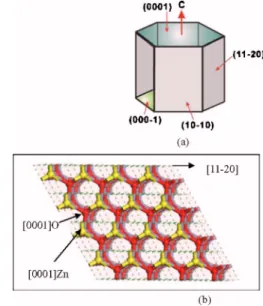
Let us discuss some related theoretical concepts first. ZnO is a hexagonal wurtzite crystal structure and its struc-ture belongs to a 6mm symmetry, as shown in Fig.1共a兲. The
a兲Electronic mail: [email protected]
b兲Author to whom correspondence should be addressed; electronic mail:
c兲Present address: Cermet, Inc., 1019 Collier Rd, Atlanta, GA 30318.
FIG. 1. 共Color online兲 共a兲 Hexagonal wurtzite crystal structure of ZnO 共0002兲; 共b兲 symmetrical structure of Zn–O bonding on the surface of ZnO 共0002兲.
APPLIED PHYSICS LETTERS 90, 161904共2007兲
0003-6951/2007/90共16兲/161904/3/$23.00 90, 161904-1 © 2007 American Institute of Physics
This article is copyrighted as indicated in the article. Reuse of AIP content is subject to the terms at: http://scitation.aip.org/termsconditions. Downloaded to IP: 140.113.38.11 On: Thu, 01 May 2014 00:32:35
bonds of Zn–Zn and O–O do not contribute to the SHG intensity since the covalent bonds are nonpolar. The nonlin-earity of the tetragonal bonding geometry between the layers of Zn and O can be deduced from the fit by using the bond additivity model.8ZnO bonds cannot generate SHG, except that ZnO bonds must be ordered in polar structure. Perfect ZnO 共0002兲 has the polar surface with alternate hexagonal Zn and O layers. Looking into the共001兲 surface of a wurtzite ZnO crystal, the threefold symmetry bonding of the first layer and another threefold symmetry with 180° rotation from the second layer are exhibited, as shown in Fig.1共b兲. Thus, the perfect surface of ZnO breaks the bulk symmetry and reduces to a 3mm symmetry, and therefore, the surface configuration is an influencing factor for RSHG measure-ment of ZnO thin films.
In order to clarify the variation of the structure, in this study, we employed the S-polarized RSHG light generated from S-polarized fundamental light incident on the samples 共SS-RSHG兲, recorded with the variation of the azimuthal angle, which can achieve a high discrimination to the surface structure of the well-grown ZnO film. However, our results will illustrate that the Zn–O heteropolar bonds on the smooth ZnO surface contribute to the SHG intensity and are different from the previous works on ZnO films which focuse on the amplitude of the RSHG intensity.
Experimental ZnO thin films 共undoped兲 were grown on
c-plane sapphire by metal organic chemical vapor deposition
共MOCVD兲 in a modified vertical injection commercial MOCVD reactor.9,10 Two samples were involved for this study, with film thicknesses of about 830 and 550 nm for samples A and B, respectively. They were characterized by x-ray diffraction共XRD兲 and photoluminescence 共PL兲. XRD 2- scans showed the wurtzite ZnO 共0002兲 peak at 2 of ⬃35 ° and the 共0004兲 peak at 2 of ⬃73°, without other orientation peaks. The full width at half maximum共FWHM兲 for the共0002兲 peak 共2兲 is 0.200° for sample A and 0.214° for sample B. Both samples possess a PL peak near 3.29 eV 共RT兲 from the direct band edge recombination of wurtzite ZnO, with a PL FWHM of 97 meV for sample A and 150 meV for sample B. These XRD and PL allow for a quality analysis and comparison of these two samples; i.e., the material quality of sample A is superior than that of sample B.
The RSHG experimental setup was described in Ref. 7. The laser source of the SHG experimental system herein is a pulsed Q-switched heodymium-doped yttrium aluminum garnet laser with a wavelength of 1.064m and a pulse du-ration time of 6 ns. The laser power was held under 40 MW/ cm2 to prevent surface damage.
The ZnO thin films are considered to have the same crystal structure as bulk ZnO, which has a hexagonal close packed structure, with the 6mm point group symmetry.11In the Kleinman approximation, the second-order susceptibility tensors of ZnO bulk have only two independent nonzero components:xzx共2兲=yzy共2兲=xxz共2兲=yyz共2兲=zxx共2兲=zyy共2兲 andzzz共2兲. Since the values ofzzz共2兲and zxx共2兲 measured by Neumann for ZnO thin films agree well with these bulk values,12 our RSHG results from ZnO thin films are interpreted based on this assumption. For ZnO 共0002兲, the relationship between the RSHG polarization and the azimuthal angle is
Ps共2兲,ZnO共0002兲bulk→s 共2兲 = 0, 共1兲
Ps共2兲,ZnO共0002兲bulk→p 共2兲 =zxx共2兲E02zˆ, 共2兲
where the subscript of the RSHG polarized light refers to the polarization of the fundamental and second harmonic genera-tion light, perpendicular to the incident plane共s polarized兲 or parallel to the incident plane 共p polarized兲. The azimuthal angleis the angle between the x axis parallel to the关21¯1¯0兴 direction of ZnO and the plane of incidence. Equations共1兲 and共2兲indicate that the p-polarized RSHG light is indepen-dent of the azimuthal angle, and the s-polarized RSHG light is zero if the direction of ZnO共0002兲 is the z axis of the ZnO thin film.
The s-polarized SHG intensity Is→s共2兲 for an s-polarized fundamental field Es共兲 is most sensitive to the
symmetry of the surface structure since this polarization combination contains only anisotropic nonlinear susceptibil-ity tensor elements.13 The SHG rotational anisotropy result of Is,s共2兲 is named as SS-SHG for the convenience of the
following discussion. In order to discover the surface con-figuration of the ZnO thin films, the SS-RSHG measurement is used here since the SS-RSHG intensity is zero for the bulk of ZnO共0002兲, as described in Eq.共2兲.
SS-RSHG patterns from these two samples are shown in Figs.2共a兲and 2共b兲. They reveal the 3mm-like symmetrical structure on the surface of ZnO共0002兲 and reflect the addi-tional contribution with mirrorlike symmetry. The final SS-RSHG intensity from ZnO共0002兲 is expressed as
FIG. 2. RSHG patterns from two ZnO films of共a兲 sample A and 共b兲 sample B. Theoretical fits of the SS-RSHG experimental patterns are drawn in solid line.
161904-2 Lo et al. Appl. Phys. Lett. 90, 161904共2007兲
This article is copyrighted as indicated in the article. Reuse of AIP content is subject to the terms at: http://scitation.aip.org/termsconditions. Downloaded to IP: 140.113.38.11 On: Thu, 01 May 2014 00:32:35
ISS=兩aeisin共兲 + b sin共3兲兩2, 共3兲
where is the azimuthal angle between the incident plane and x axis on the surface 关direction of 关112¯0兴 for the ZnO 共0002兲 hexagonal wurtzite structure兴, a is the strength of nonlinearity due to the formation of twin boundaries,14 b
is the polar strength of Zn–O bonding with 3mm symmetry, andis the relative phase difference of the SHG field from the 3mm symmetric structure of Zn–O bonding and twin boundary.
The theoretical fits of SS-RSHG experimental patterns for two ZnO thin films with different thicknesses are exhib-ited in Figs.2共a兲and2共b兲. It shows an excellent agreement of our experimental results with the theory. The fitting pa-rameters from Eq.共3兲are for sample A, a = 0.54, b = 2.15, and
= 30°, and for sample B, a = 0.56, b = 1.47, and= 50°. The SS-RSHG patterns are not zero, as described in Eq. 共1兲, which are contributed from the bulk ZnO共0002兲. The Zn–O bonding on the surface exhibits a 3mm symmetry in the op-tical scope. This result only appears on the smooth surface of high-quality ZnO共0002兲.
ZnO thin films epitaxied on sapphire 共0001兲 substrates are with a large lattice mismatch of⬃18%, but remain mul-ticrystalline in nature, with incoherent grain boundaries.15 The formation of twin boundaries is the regular growing to-gether of crystals of the same sort, sharing some of the same crystal lattice with a mirror symmetry operation. It can arise during crystal growth or through mechanical stress.16 Yan
et al.14 predicted that a nonvanishing polarity existed in the twin boundary, which exhibits a mirror relation across the boundary plane. Its corresponding second-order nonlinear optical susceptibility tensor components have an even-number y subscript with x along the关112¯0兴 direction, which leads to a tensor form with six independent components.17 These effects are described in Eq.共3兲, which depicts well the measured SS-RSHG intensity.
SS-RSHG reflects the surface structure of ZnO 共0002兲, which is influenced by the growth conditions rather than the thickness of ZnO. The value of b in sample A is larger than that in sample B. The nonlinear source generated from the polar surface with alternate hexagonal Zn and O layers is stronger from the surface of the better crystallized ZnO 共0002兲 film. This result is confirmed by eliminating the bulk contribution of ZnO共0002兲 and the domination of the grain boundary on the ZnO surface since the isotropic contribution is forbidden to the SS-SHG intensity. It also predicts a better crystalline quality for sample A than sample B, which is consistent with results from XRD and PL measurements. A detailed investigation of the correlation of the SHG and ZnO film quality will be reported in a future publication.
The values of a are close for both samples. The twin boundaries were only observed from the tunneling electron microscopy images,18 but the result herein reveals the trend of the twin boundary in the optical scale. This phenomenon is interesting for the growth mechanism of the thin film. The relative SHG phase differencebetween two samples is 20° which may be caused by the difference between the effective dipole of the Zn–O bond on the surface and that of the mir-rored structures formed by twin boundary.
In conclusion, RSHG technology has been employed to investigate the Zn–O bonding in ZnO 共0002兲 thin films
grown on sapphire by MOCVD. A technique using SS-RSHG is developed, which is different from previous work in the literature where the focus is more on the effective nonlinearity of ZnO films by varying the incident angle. The observation of the SS-SRHG pattern and its sensitivity to the surface structure reveal the polar strength and the symmetri-cal structure of the top layers of ZnO共0002兲. It is believed that polycrystalline ZnO films would not have this phenom-enon, which only appears in the smooth surface of ZnO 共0002兲. In the optical view, the SS-RSHG intensity is accu-mulated for an irradiated optical area and averaged over the nonlinear optical effect. If the polar direction of Zn–O bond-ing is weak in orderbond-ing, the average polar strength will be canceled out and the SS-RSHG field will be zero. However, the effect of the twin boundary is independent of the ZnO surface quality, and the mirror symmetry of these planar de-fects still exists in ZnO films. SS-RSHG reflects the surface structure of ZnO 共0002兲, which is influenced by the film crystalline quality, which is also confirmed from the experi-mental results of x-ray diffraction and photoluminescence. These results may deepen our understanding of physics on ZnO materials and SHG effects.
This work was supported by funds from National Sci-ence Council共NSC兲 95-2112-M-415-002 at National Chiayi University, NSC 94-2215-E-002-019, and 95-2221-E-002-118 at the National Taiwan University, and the U.S. Air Force Office of Scientific Research 共AFOSR兲 at Georgia Institute of Technology.
1T. Koid, S. F. Chichibu, A. Uedono, T. Sota, A. Tsukazaki, and M.
Ka-wasaki, Appl. Phys. Lett. 84, 1079共2004兲.
2J. D. Ye, S. L. Gu, S. M. Zhu, S. M. Liu, Y. D. Zheng, R. Zhang, Y. Shi,
Q. Chen, H. Q. Yu, and Y. D. Ye, Appl. Phys. Lett. 88, 101905共2006兲.
3U. Ozgur, Ya. I. Alivov, C. Liu, A. Teke, M. A. Reshchikov, S. Doğan, V.
Avrutin, S.-J. Cho, and H. Morkoç, J. Appl. Phys. 98, 041301共2005兲.
4H. Cao, J. Y. Wu, H. C. Ong, J. Y. Dai, and R. P. H. Change, Appl. Phys.
Lett. 73, 572共1998兲.
5G. Wang, G. T. Kiehne, G. K. L. Wong, and J. B. Ketterson, Appl. Phys.
Lett. 80, 401共2002兲.
6U. Neumann, R. Grunward, U. Griebner, G. Steinmeyer, and W. Seeber,
Appl. Phys. Lett. 84, 170共2004兲.
7K. Y. Lo, S. C. Lo, S. Y. Chu, R. C. Chang, and C. F. Yu, J. Cryst. Growth
290, 532共2006兲.
8S. V. Govorkov, V. I. Emel’yanov, N. I. Koroteev, G. I. Petrov, I. L.
Shumay, and V. V. Yakolev, J. Opt. Soc. Am. B 6, 1117共1989兲.
9M. Pan, W. E. Fenwick, M. Strassburg, N. Li, H. Kang, M. H. Kane, A.
Asghar, S. Gupta, R. Varatharajan, J. Nause, N. El-Zein, P. Fabiano, T. Steiner, and I. Ferguson, J. Cryst. Growth 287, 688共2006兲.
10W. E. Fenwick, M. H. Kane, Z. Fang, T. Zaidi, N. Li, V. Rengarajan, J.
Nause, and I. T. Ferguson, Mater. Res. Soc. Symp. Proc. 957, K04–10 共2007兲.
11F. Chaabouni, M. Abaab, and B. Rezig, Mater. Sci. Eng., B 109, 236
共2004兲.
12U. Neumann, R. Grunward, U. Griebner, G. Steinmeyer, and W. Seeber,
Appl. Phys. Lett. 84, 170共2004兲.
13O. A. Aktsipetrov, I. M. Baranova, and Y. A. II’inskii, Sov. Phys. JETP
64, 167共1986兲.
14Y. Yan, M. M. Al-Jassim, M. F. Chisholm, L. A. Boatner, S. J. Pennycook,
and M. Oxley, Phys. Rev. B 71, 041309共2005兲.
15A. Ohtomo, K. Tamura, K. Saikusa, K. Takahashi, T. Makino, Y. Segawa,
H. Koinuma, and M. Kawasaki, Appl. Phys. Lett. 75, 2635共1999兲.
16W. Borchardt-Ott, Crystallography共Springer, New York, 1995兲, Chap. 13,
p. 265.
17A. Yariv and P. Yeh, Optical Waves in Crystals共Wiley, New York, 1984兲,
Chap. 12, p. 508.
18F. Oba, H. Ohta, Y. Sato, H. Hosono, T. Yamamoto, and Y. Ikuhara, Phys.
Rev. B 70, 125415共2004兲.
161904-3 Lo et al. Appl. Phys. Lett. 90, 161904共2007兲
This article is copyrighted as indicated in the article. Reuse of AIP content is subject to the terms at: http://scitation.aip.org/termsconditions. Downloaded to IP: 140.113.38.11 On: Thu, 01 May 2014 00:32:35