Publisher: Taylor & Francis
Informa Ltd Registered in England and Wales Registered Number: 1072954 Registered office: Mortimer House, 37-41 Mortimer Street, London W1T 3JH, UK
Journal of Toxicology and Environmental Health, Part
A: Current Issues
Publication details, including instructions for authors and subscription information:
http://www.tandfonline.com/loi/uteh20
Traffic Air Pollution and Risk of Death from Gastric
Cancer in Taiwan: Petrol Station Density as an Indicator
of Air Pollutant Exposure
Hui-Fen Chiu a , Shang-Shyue Tsai b , Pei-Shih Chen c , Yen-Hsiung Liao c , Saou-Hsing Liou d , Trong-Neng Wu de & Chun-Yuh Yang cd
a
Department of Pharmacology, College of Health Sciences, Kaohsiung Medical University, Kaohsiung
b
Department of Healthcare Administration, I-Shou University, Kaohsiung c
Department of Public Health, College of Health Sciences, Kaohsiung Medical University, Kaohsiung
d
Division of Environmental Health and Occupational Medicine, National Health Research Institute, Miaoli
e
Graduate Institute of Public Health, China Medical University, Taichung, Taiwan Version of record first published: 28 Jul 2011
To cite this article: Hui-Fen Chiu, Shang-Shyue Tsai, Pei-Shih Chen, Yen-Hsiung Liao, Saou-Hsing Liou, Trong-Neng Wu & Chun-Yuh Yang (2011): Traffic Air Pollution and Risk of Death from Gastric Cancer in Taiwan: Petrol Station Density as an Indicator of Air Pollutant Exposure, Journal of Toxicology and Environmental Health, Part A: Current Issues, 74:18, 1215-1224
To link to this article: http://dx.doi.org/10.1080/15287394.2011.590100
PLEASE SCROLL DOWN FOR ARTICLE
Full terms and conditions of use: http://www.tandfonline.com/page/terms-and-conditions
This article may be used for research, teaching, and private study purposes. Any substantial or systematic reproduction, redistribution, reselling, loan, sub-licensing, systematic supply, or distribution in any form to anyone is expressly forbidden.
The publisher does not give any warranty express or implied or make any representation that the contents will be complete or accurate or up to date. The accuracy of any instructions, formulae, and drug doses should be independently verified with primary sources. The publisher shall not be liable for any loss, actions, claims, proceedings, demand, or costs or damages whatsoever or howsoever caused arising directly or indirectly in connection with or arising out of the use of this material.
Journal of Toxicology and Environmental Health, Part A, 74:1215–1224, 2011 Copyright © Taylor & Francis Group, LLC
ISSN: 1528-7394 print / 1087-2620 online DOI: 10.1080/15287394.2011.590100
TRAFFIC AIR POLLUTION AND RISK OF DEATH FROM GASTRIC CANCER IN TAIWAN: PETROL STATION DENSITY AS AN INDICATOR OF AIR POLLUTANT EXPOSURE
Hui-Fen Chiu1, Shang-Shyue Tsai2, Pei-Shih Chen3, Yen-Hsiung Liao3, Saou-Hsing Liou4,
Trong-Neng Wu4,5, Chun-Yuh Yang3,4
1Department of Pharmacology, College of Health Sciences, Kaohsiung Medical University, Kaohsiung
2Department of Healthcare Administration, I-Shou University, Kaohsiung
3Department of Public Health, College of Health Sciences, Kaohsiung Medical University, Kaohsiung
4Division of Environmental Health and Occupational Medicine, National Health Research Institute, Miaoli
5Graduate Institute of Public Health, China Medical University, Taichung, Taiwan
To investigate the relationship between air pollution and risk of death attributed to gastric cancer, a matched cancer case-control study was conducted using deaths that occurred in Taiwan from 2004 through 2008. Data for all eligible gastric cancer deaths were obtained and compared to a control group consisting of individuals who died from causes other than neoplasms and diseases that were associated with gastrointestinal (GIT) disorders. The con-trols were pair-matched to the cancer cases by gender, year of birth, and year of death. Each matched control was randomly selected from the set of possible controls for each cancer case. Data for the number of petrol stations in study municipalities were collected from two major petroleum supply companies. The petrol station density (per square kilometer) (PSD) for study municipalities was used as an indicator of a subject’s exposure to benzene and other hydrocarbons present in ambient evaporative losses of petrol or to air emissions from motor vehicles. The exposed individuals were subdivided into three categories (≤25th percentile; 25th–75th percentile; >75th percentile) according to PSD in the residential municipality.
Results showed that individuals who resided in municipalities with the highest PSD were at an increased risk of death attributed to gastric cancer compared to those subjects living in municipalities with the lowest PSD. The findings of this study warrant further investigation of the role of traffic air pollution exposure in the etiology of gastric cancer.
Ambient outdoor air pollution has been implicated as a cause of various health prob-lems including cancer (Tomatis 1990; Boffetta 2006; Curtis et al. 2006; Dominici et al. 2005; Samet and Krewski 2007). Air pollu-tion is a complex mixture of different gaseous and particulate components; thus, it is difficult to define an exposure measure of relevance
Received 21 February 2011; accepted 10 May 2011.
This study was partly supported by a grant from the National Science Council, Executive Yuan, Taiwan (NSC-97-2314-B-037-006-MY3).
Address correspondence to Chun-Yuh Yang, PhD, MPH, Department of Public Health, College of Health Sciences, Kaohsiung Medical University, 100 Shih-Chuan 1st RD, Kaohsiung, Taiwan 80708. E-mail: [email protected]
when the biological mechanisms are largely unknown (Boffetta and Nyberg 2003). Air pol-lution from motor vehicle exhaust has been one of the most studied environmental factors (Craig et al. 2008). Exhaust from traffic is a com-plex mixture of many chemical compounds, including benzene, polycyclic aromatic hydro-carbons (PAH), and benzo[a]pyrene (BaP). The
1215
International Agency for Research on Cancer (IARC) classified the emission of diesel exhaust engine compounds as probably carcinogenic (Group 2A) and gas engine exhaust compounds as possibly (Group 2B) carcinogenic to humans (IARC 1989; Krewski and Rainham 2007).
The evidence regarding air pollution and lung cancer has been the subject of sev-eral reviews (Katsouyanni and Pershagen 1997; Cohen 2000; Boffetta and Nyberg 2003; Vineis et al. 2004; Dominici et al. 2005). However, limited data are available for an association between air pollution exposure and develop-ment of gastric cancer.
Occupational studies serve to formulate hypotheses and guide research into risk fac-tors for carcinogenesis (Garcia-Perez et al. 2010). According to occupational epidemio-logic studies, excess risks of gastric cancer were reported to be associated with highway main-tenance workers (Maizlish et al. 1988), trans-port workers (Parent et al. 1998), gas station workers (Aragones et al. 2002), and profes-sional drivers (Guberan et al. 1992; Balarajan and McDowall 1988). Recent studies also indi-cated positive associations between exposure to diesel engine emissions and enhanced risk of stomach cancer development (Boffetta et al. 2001; Sjodahl et al. 2007). Nevertheless, work-ers in other occupations likely to encounter gasoline vapors exposure do not appear to experience a particularly higher risk of gas-tric cancer occurrence (Lagorio et al. 1994; Lynge et al. 1997). Although potentially car-cinogenic PAH and combustion particles might be involved in gastric carcinoma, the causality remains uncertain.
Recent epidemiological research predom-inantly focused on the effects of short-term exposures. However, several studies suggest that chronic exposure may be more important in terms of overall public health (Holgate et al. 1999; Pope et al. 2002; Vineis et al. 2004). To date, only ecologic studies examined the risk of gastric cancer occurrence and exposure to ambient air pollution (Hagstrom et al. 1967; Gardner et al. 1969; Winkelstein and Kantor 1969; Lave and Seskin 1970; Chinn et al. 1981). With respect to ambient air pollution
exposure an increase in stomach cancer inci-dence was related to higher SO2, particu-lates, or fuel consumption in several studies (Hagstrom et al. 1967; Gardner et al. 1969; Winkelstein and Kantor 1969; Lave and Seskin 1970) but was not found by Chinn et al. (1981). Benzene, total suspended particles (TSP), and NO2 are commonly used markers for traffic-related air pollution (Raaschou-Nielsen et al. 2001; Van Wijnen and Van der Zee 1998; Bedeschi et al. 2007; Muzykl et al. 1998). Measurements of the spatial distribution of benzene in the atmosphere showed that the highest outdoor concentrations within urban areas tended to occur adjacent to main roads (Leung and Harrison 1999). However, ben-zene levels were not recorded in fixed, outdoor monitoring stations in Taiwan. Previously Weng et al. (2008) used NO2 as a marker for traffic-related air pollution in 64 municipalities. Traffic counts and proximity to roads have commonly served as surrogates for exposure to traffic-related potential carcinogens (Reynolds et al. 2004). Concentrations of these compounds are higher within 500 to 1000 feet of busy roads and freeways, based on measured traffic-related air pollutant levels (Dubowsky et al. 1999; Raaschou-Nielsen et al. 2000; 2001). To our knowledge, it is not known which expo-sure assessment approach best reflects chronic personal exposure to traffic-related air pollu-tion (Raaschou-Nielsen and Reynolds 2006; Bedeschi et al. 2007).
Data reported here were designed as a cancer case-control study to explore further whether the risk of death attributed to gastric cancer is associated with exposure to vehicle exhaust emissions using petrol station den-sity (PSD) as an indicator of traffic-related air pollution in Taiwan.
MATERIAL AND METHODS Study Areas
Taiwan is divided into 359 administrative districts, which are designated in this report as municipalities and are the units subjected to statistical analysis.
AIR POLLUTION AND GASTRIC CANCER 1217
Subject Selection
Data on all deaths of residents living in the study areas from 2004 through 2008 were obtained from the Bureau of Vital Statistics of the Taiwan Provincial Department of Health, which is responsible for the death registration system in Taiwan. For each death, detailed demographic information, including gender, occupation, marital status, year of birth, year of death, cause of death, place of death (munic-ipality), and residential district (munic(munic-ipality), were recorded. The cancer case group con-sisted of all eligible deaths due to gastric cancer occurring in individuals between 50 and 69 yr of age ([ICD-9], code 151). Patients younger than age 50 yr were excluded because the characteristics of early-onset gastric cancer are postulated to differ from the more prevalent later-onset gastric carcinoma (Schottenfeld and Fraumeni 1996). Gastric cancer cases older than age 70 yr were excluded because of the difficulty in obtaining matched control subjects. Controls were drawn from all other deaths excluding deaths due to neoplasms and dis-eases which were associated with GIT disor-ders ([ICD-9] codes 140–239, 531–534, 578). Control subjects were pair-matched to can-cer cases by gender, year of birth, and year of death. Each matched control was selected randomly from the set of possible controls for each case. For controls, the most frequent causes of death were diabetes mellitus (13.9%), chronic liver disease and cirrhosis (8.8%), acute myocardial infarction (5.4%), motor vehicle traffic accidents of unspecified nature (5.4%), and intracerebral hemorrhage (4.5%).
Petrol Station Density (PSD)
Data on the number of petrol (gas) sta-tions in study municipalities were collected from two major petroleum supply corporations, Chinese Petroleum Corporation (CPC 2008) and Formosa Petrochemical Corporation (FPCC 2008). Total number of petrol stations in each of the two corporations were then summed and divided by the municipality’s land area (km2). This proportion (petrol station density) (PSD) was used as an indicator of a subject’s exposure
to benzene and other PAH present in ambient evaporative losses of petrol and/or air emis-sions from motor vehicles. The municipality of residence for all cancer cases and controls was identified from death certificates. The munic-ipality of residence formed the only basis for defining exposure to traffic air pollution. This index was used in previous studies (Weng et al. 2009; Chang et al. 2009; Ho et al. 2010).
Socioeconomic Factors
It was found that mortality attributed to cancer was associated with urbanization gradi-ents (Greenberg 1983; Miller et al. 1987; Yang and Hsieh 1998). In this study, an urbanization index (Tzeng and Wu 1986) was used to adjust for possible confounding resulting from differ-ent urbanization levels among the municipali-ties. The urbanization index used in this study serves as a proxy for a large number of explana-tory variables such as population density, age composition, mobility, economic activity and family income, educational level, environmen-tal factors, and health service-related facilities, which are related to the etiology of mortality. Each municipality in Taiwan was given a degree of urbanization category, 1–8. A municipality with the highest urbanization score, such as the Taipei metropolitan area, was classified in category 1, while mountainous areas with the lowest score were assigned to category 8. This index was used previously (Yang et al. 1999; Yang 2004; Chiu et al. 2006; Liu et al. 2008). For the analyses, the urban–rural classification was further subdivided into two categories: I, urban areas (categories 1–4); and II, rural areas (categories 5–8).
Statistics
In the analysis, subjects were assigned into one of the three exposure categories according to the levels of PSD in their residential munici-pality: low (the lowest 25th percentile;≤0.094); medium (25th–75th percentile; 0.095–0.523); and high (above 75th percentile; 0.526–2.692). Conditional logistic regression was used to esti-mate the relative risk in relation to the levels of
PSD (Breslow and Day 1980). Odds ratios (OR) and their 95% confidence intervals (95% CI) were calculated using the group with the low-est exposure as the reference group. All OR were adjusted for marital status (single, married, ever married) and urbanization level of residence (rural, urban). Tests for trend were conducted using the method described by Mantel (1963). Values of p < .05 were considered statistically significant.
RESULTS
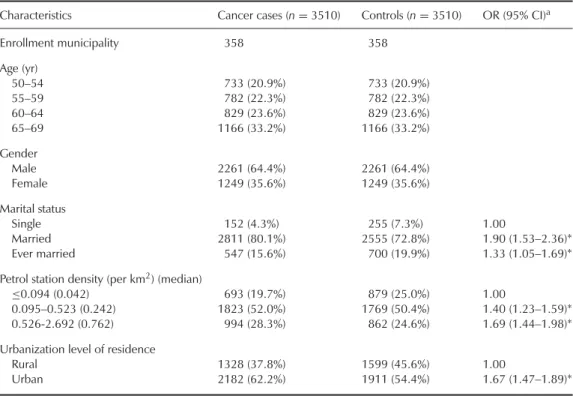
The distribution of cancer cases and con-trols by selected demographic and residen-tial characteristics is shown in Table 1. In total, 3510 gastric cancer cases with complete records were selected using the study criteria for the period 2004–2008. Subjects who were married or ever married had a significant excess risk of death due to gastric cancer compared to single individuals. Cancer cases demonstrated a significantly higher rate (62.2%) of residing in urban municipalities than controls (54.4%).
The crude OR were significantly higher than 1 for the groups with high levels of PSD in their residential municipality.
After adjustments for the urbanization level of residence and marital status, the adjusted OR were lower than the crude OR. The adjusted OR (95% CI) were 1.14 (0.98–1.32) for the group with PSD levels between 0.095 and 0.523 and 1.26 (1.04–1.53) for the group with PSD levels of 0.526 or more compared to the group with the lowest PSD levels. Trend analyses showed statistically significant trend in risk of death attributed to gastric cancer with increasing PSD level (Table 2).
DISCUSSION
This investigation used a death certificate-based cancer case-control study to examine the relationship between risk of death due to gastric cancer and exposure to traffic air pollutants using PSD as an indicator of pol-lutant exposure in Taiwan. The results of the present study showed that individuals who
TABLE 1. Characteristics of Study Population
Characteristics Cancer cases (n= 3510) Controls (n= 3510) OR (95% CI)a
Enrollment municipality 358 358 Age (yr) 50–54 733 (20.9%) 733 (20.9%) 55–59 782 (22.3%) 782 (22.3%) 60–64 829 (23.6%) 829 (23.6%) 65–69 1166 (33.2%) 1166 (33.2%) Gender Male 2261 (64.4%) 2261 (64.4%) Female 1249 (35.6%) 1249 (35.6%) Marital status Single 152 (4.3%) 255 (7.3%) 1.00 Married 2811 (80.1%) 2555 (72.8%) 1.90 (1.53–2.36)∗ Ever married 547 (15.6%) 700 (19.9%) 1.33 (1.05–1.69)∗
Petrol station density (per km2) (median)
≤0.094 (0.042) 693 (19.7%) 879 (25.0%) 1.00
0.095–0.523 (0.242) 1823 (52.0%) 1769 (50.4%) 1.40 (1.23–1.59)∗ 0.526-2.692 (0.762) 994 (28.3%) 862 (24.6%) 1.69 (1.44–1.98)∗ Urbanization level of residence
Rural 1328 (37.8%) 1599 (45.6%) 1.00
Urban 2182 (62.2%) 1911 (54.4%) 1.67 (1.47–1.89)∗
Note. Asterisk indicates significant difference at p< .05.
aOR (95% CI): odds ratio and 95% confidence interval.
AIR POLLUTION AND GASTRIC CANCER 1219
TABLE 2. Odds Ratios for Gastric Cancer Associated With PSD Levels Based on Multiple Logistic Regression Model
Petrol station density (PSD), (median)
≤0.094 (0.042) 0.095–0.523 (0.242) 0.526–2.692 (0.762) Number of cancer cases 693 (19.7%) 1823 (52.0%) 994 (28.3%) Number of controls 879 (25.0%) 1769 (50.4%) 862 (24.6%)
Crude OR 1.0 1.40 (1.23–1.59) 1.69 (1.44–1.98)
Adjusted ORa 1.0 1.14 (0.98–1.32) 1.26 (1.04–1.53)
χ2, trend= 29.59, p < .001
aOR adjusted for marital status and urbanization level.
resided in municipalities with the highest PSD levels were at a significantly increased risk of death attributed to gastric cancer. There was also a significant exposure-response relation-ship between PSD and risk of gastric can-cer development. This finding is consistent with previous studies (Hagstrom et al. 1967; Gardner et al. 1969; Winkelstein and Kantor 1969; Lave and Seskin 1970).
There have been a number of epidemio-logical studies that assessed the elevated risk of gastric cancer development due to living in an urban compared to rural area. In general, mor-tality due to gastric cancer was considerably higher in urban than nonurban populations (Goldsmith 1980; Greenberg 1983; Muir et al. 1987). The only “urban factor” consistently mentioned in the literature is air pollution, sug-gesting that residing in an urban area may be a reliable surrogate for enhanced air pollution exposure (Greenberg 1983).
The specific exposure chemicals responsi-ble for the elevation of gastric cancer have not been identified with certainty, but a possible candidate may be motor exhaust emissions. An effect of vehicle exhaust emissions on the GIT is plausible. Airborne particles emitted from petroleum or diesel engines contain numerous PAH and BaP. The mutagenic and carcinogenic effects of PAH and BaP are well documented in experimental studies (IARC 1989; Krewski and Rainham 2007). The postulation that a mecha-nism by which vehicle exhaust emissions might increase the risk of gastric cancer occurrence could be that airborne particles containing car-cinogens are inhaled, then swallowed, and thus act directly as carcinogens on the gastric
mucosa (Guberan et al. 1992; Sjodahl et al. 2007).
The petrochemical industry is considered to be the main source of industrial air pollu-tion in Taiwan (EPA/Taiwan 2002). The pollu-tants emitted by the petrochemical industries include not only PAH but also large quanti-ties of criteria pollutants, particularly SO2 and
NO2 (EPA/Taiwan 2002; Suess et al. 1985).
The average levels of air pollutants in the municipalities with higher petrochemical air pollution exposure indices were higher than in those municipalities with lower petrochem-ical air pollution exposure indices (Yang et al. 1999). It is possible that a positive associa-tion between PSD and risk of death attributed to gastric cancer may be, at least partially, related to air pollution from petrochemical industries.
The completeness and accuracy of the death registration system needs to be evalu-ated before any conclusion based on mortality analysis is made. In Taiwan, it is mandatory to register any birth, death, marriage/divorce, and migration in the household registration offices. Demographic and vital statistics data derived from the household registration system are reliable and accurate in Taiwan. Although causes of death may be misdiagnosed and/or misclassified, the problem has been mini-mized through the improvement in the veri-fication and classiveri-fication of causes of death in Taiwan since 1972. Furthermore, malig-nant neoplasms, including gastric cancer, were found to be among the most unambiguously classified causes of death in Taiwan (Chen and Wang 1990). Because of the potentially fatal
outcome for this disease, it is postulated that all gastric cancer cases exposed to either high or low levels of air pollution had access to medical care regardless of geographical loca-tion in recent years.
Since the measure of effect in this study is mortality rather than incidence, migration dur-ing the interval between cancer diagnosis and death also needs to be considered. During this period, cancer diagnosis may influence a deci-sion to migrate and possibly introduce bias. Data are not available for the differences in sur-vival rates of gastric cancer patients between high and low PSD areas. If there is a trend toward migration to more urban or high PSD areas because of proximity to medical care for example, a spurious association between PSD and cancer death would result. Three aspects of this study presumably minimize this possibility. First, migration due to gastric can-cer diagnosis would be less likely for married subjects (about 80% of cases and 73% of con-trols are married). For this cohort of decedents the subject’s occupational status would weigh against a move requiring a job change late in life. Second, urbanization level was included as a control variable in the analysis. Finally, the ages for both cancer cases and controls were between 50 and 69 yr, and it was presumed that the elderly are more likely to remain in the same residence.
Of greater concern is whether the relative levels of PSD in the period around 2008 cor-responded to the relative levels occurring in periods 20–30 yr earlier. This is important since it is likely that exposure to causal factors would precede cancer mortality. However, it is pos-sible that the correlation between the current PSD levels (2008) and levels in the past of 20–30 yr ago would be high since a munici-pality’s urban development is gradual. It was therefore assumed that levels of PSD in 2008 were a reasonable indicator of historical levels occurring over the past 20–30 yr.
Our study employed an ecologic design using group-level exposure data. It was pre-sumed that individuals residing in the munici-palities of higher levels of PSD experienced a greater exposure to benzene and other PAH
present in evaporative losses of petrol and/or to air emissions from motor vehicles. Nonetheless, significant air pollutant concentrations may differ substantially within a municipality and therefore group exposure levels may not neces-sarily correspond to individual exposure levels (Reynolds et al. 2003). Further, potential expo-sure misclassification may also have resulted from differing individual time–activity and per-sonal exposure from indoor sources (Elliott et al. 2000). While these sources of misclas-sification are important, such misclasmisclas-sification of exposure is most likely to be nondifferen-tial (i.e., unlikely to be associated with gastric cancer development), which would reduce the magnitude of association rather than introduce a positive bias in the association. Therefore, it is not likely that the observed positive associ-ation between PSD exposure and higher risk of death due to gastric cancer was a result of exposure misclassification. Similarly, a study of this nature can not account for variations in sus-ceptibility among individuals with comparable exposure.
Cigarette smoking, consumption of alco-hol, green tea, salted or cured meat, smoked or fried food, and fermented beans (Lee et al. 1990), and Helicobacter pylori (Wu et al. 2009) are documented risk factors for gastric cancer occurrence in Taiwan. There is, unfortunately, no information available on these variables for individual study subjects. These risk fac-tors represent potential confounders that need to be taken into account when investigating the role of traffic air pollution in gastric can-cer development. However, there is no reason to believe that there would be any correla-tion between these potential confounders and PSD levels, and therefore the estimated effects of traffic air pollution on gastric cancer are likely to be free of confounding by these vari-ables. Data on other suspected risk factors for gastric cancer, such as occupational expo-sure to carcinogens acting on the GIT and socioeconomic status (such as income levels) for the study subjects were not collected (Ji and Hemminki 2006). Areas with high indus-trial activity have higher air pollution levels and individuals who work in those industries
AIR POLLUTION AND GASTRIC CANCER 1221
tend to reside close to these sites. It is, there-fore, likely that people with high occupational exposures tend to reside in areas with higher air pollution levels. However, it is difficult to predict how the distributions of these vari-ables might have differed according to PSD and hence, acted to confound the associa-tions observed in the present study. For these reasons, the results of this study need to be con-sidered hypothesis driven. Even though more complete information would have been desir-able, one measure of the study’s internal valid-ity is that the observed associations for PSD pointed in the direction expected based on previous investigations.
In summary, the present study showed that individuals who resided in the group of municipalities with high PSD levels were at an increased risk of death attributed to gastric cancer compared to those living in municipal-ities with low PSD. The findings of this study warrant further investigation into the role of air pollutants in the etiology of gastric can-cer development. Future study would increase the precision of estimation of the individual’s air pollution exposure and take into account indoor as well as mobile pollution sources, and control for confounding factors such as smoking, diet, and occupation.
ACKNOWLEDGEMENTS
This study was partly supported by a grant from the National Science Council, Executive Yuan, Taiwan (NSC-97-2314-B-037-006-MY3).
REFERENCES
Argones, N., Pollan, M., and Gustavsson, P. 2002. Stomach cancer and occupation in Sweden: 1971–1989. Occup. Environ. Med. 59:329–337.
Balarajan, R., and McDowall, M. E. 1988. Professional drivers in London: A mortality study. Br. J. Ind. Med. 45:483–486.
Bedeschi, E., Campari, C., Candela, S., Collini, G., Caranci, N., Frasca, G., Galassi, C., Francesca, G., Vigotti, M.A. 2007. Urban air
pollution and respiratory emergency visits at pediatric unit, Reggio Emilia, Italy. J. Toxicol.
Environ. Health A 70:261–265.
Boffetta, P., Dosemeci, M., Gridley, G., Bath, H., Moradi, T., and Silverman, D. 2001. Occupational exposure to diesel engine emis-sions and risk of cancer in Swedish men and women. Cancer Causes Control 12: 365–374.
Boffetta, P. 2006. Human cancer from environ-mental pollutants: The epidemiologic evi-dence. Mutat. Res. 608:157–162.
Boffetta, P., and Nyberg, F. 2003. Contribution of environmental factors to cancer risk. Br.
Med. Bull. 68:71–94.
Breslow, N. E. and Day, N. E. 1980. Statistical
methods in cancer research: The analysis of case control studies. Lyon: International
Agency for Research on Cancer.
Chang, C. C., Tsai, S. S., Chiu, H. F., Wu, T. N., and Yang, C. Y. 2009. Traffic air pollution and lung cancer in females in Taiwan: Petro station density as an indicator. J. Toxicol.
Environ. Health A 72:651–657.
Chen, C. J., and Wang, C. J. 1990. Ecological correlations between arsenic level in well water and age-adjusted mortality from malignant neoplasms. Cancer Res. 50:5470–5474.
Chinese Petroleum Corporation. 2008. http:// www.cpc.com.tw/big5_BD/tmtd/station/gse arch-1.asp?pno=65 Accessed February 18, 2008.
Chinn, S., Florey, C. D., Baldwin, I. G., and Gorgol, M. 1981. The relation of mortal-ity in England and Wales 1969–1973 to measurements of air pollution. J. Epidemiol.
Commun. Health 35:174–179.
Chiu, H. F., Cheng, M. H., Tsai, S. S., Wu, T. N., Kuo, H. W., and Yang, C. Y. 2006. Outdoor air pollution and female lung cancer in Taiwan. Inhal. Toxicol. 18: 1025–1031.
Cohen, A. J. 2000. Outdoor air pollution and lung cancer. Environ. Health Perspect. 108(suppl. 4):743–750.
Craig, L., Brook, J.R., Chiotti, Q., Croes, B., Gower, S., Hedley, A., Krewski, D., Krupnick, A., Krzyzanowski, M., Moran,
M. D., Pennell, W., Samet, J. M., Schneider, J., Shortreed, J., and William, M. 2008. Air pollu-tion and public health: A guidance document for air quality management. J. Toxicol. Environ.
Health A 71:588–698.
Curtis, L., Rea, W., Smith-Willis, P., Fenyves, E., Pan, Y. 2006. Adverse health effects of outdoor air pollutants. Environ. Int. 32:815–830.
Dominici, F., McDermott, A., aniels, M., Zeger, S., and Samet, J. M. 2005. Revised analyses of the national morbidity, mortality, and air pollution study: mortality among res-idents of 90 cities. J. Toxicol. Environ. Health
A 68:1071–1092.
Dubowsky, S., Wallace, L., and Buckley, T. 1999. The concentration of traffic to indoor concentrations of polycyclic aromatic hydro-carbons. J. Expos. Anal. Environ. Epidemiol. 9:312–321.
Elliott, P., Wakefield, J. C., Best, N. G., and Briggs, D. J. 2000. Spatial epidemiology. New York: Oxford University Press.
Environmental Protection Administration, Taiwan. 2002. Annual report of air pollution
in Taiwan. Taipei: EPA.
Formosa Petrochemical Corporation. 2008. http://www.fpcc.com.tw/station/station.asp Accessed February 18, 2008.
Garcia-Perez, J., Lopez-Cima, M. F., Perez-Gomez, B., Aragones, N., Pollan, M., Vidal, E., and Lopez-Abente, G. 2010. Mortality due to tumors of the digestive sys-tem in towns lying in the vicinity of metal production and processing installations. Sci.
Total Environ. 408:3102–3112.
Gardner, M. J., Crawford, M. D., and Morris, J. N. 1969. Patterns of mortality in middle and early old age in the county boroughs of England and Wales. Br. J. Prev. Soc. Med. 23:133–140.
Goldsmith, J. R. 1980. The “urban factor” in cancer: Smoking, industrial exposures, and air pollution as possible explanations. J.
Environ. Pathol. Toxicol. 3:205–217.
Greenberg, M. R. 1983. Urbanization and Cancer Mortality: The United States Experience, 1950 1975. New York: Oxford University Press.
Guberan, E., Usel, M., Raymond, L., Bolay, J., Fioretta, G., and Puissant, J. 1992. Increased risk for lung cancer and for cancers of the gastrointestinal tract among Geneva professional drivers. Br. J. Ind. Med. 49: 337–344.
Hagstrom, R.M., Sprague, H.A., Landau, E. 1967. The Nashville air pollution study, VII: Mortality from cancer in relation to air pollu-tion. Arch. Environ. Health 15:237–248. Ho, C. K., Peng, C. Y., and Yang, C. Y. 2010.
Traffic air pollution and bladder cancer in Taiwan: using petrol station density as a pol-lutant indicator. J. Toxicol. Environ. Health A 73:23–32.
Holgate, S. T., Koren, H., Maynard, R., and Samet, J. 1999. Air pollution and health. London: Academic Press.
International Agency for Research on Cancer. 1989. Diesel and gasoline engine exhaust
and some nitroarenes. Lyon: IARC.
Ji, J., and Hemminki, K. 2006. Socio-economic and occupational risk factors for gastric can-cer: A cohort study in Sweden. Eur. J. Cancer
Prev. 15:391–397.
Katsouyanni, K., and Pershagen, G. 1997. Ambient air pollution exposure and cancer.
Cancer Causes Control 8:284–291.
Krewski, D., and Rainham, D. 2007. Ambient air pollution and population health: Overview. J. Toxicol. Environ. Health A 70:275–283.
Lagorio, S., Forastiere, F., Rapiti, E., Vanacore, N., Perucci, C. A., and Carere, A. 1994. Mortality of filling station attendants.
Scand. J. Work Environ. Health 20:331–338.
Lave, L. B., and Seskin, E. P. 1970. Air pollution and human health. Science 21:723–733. Lee, H. H., Wu, H. Y., Chuang, Y. C., Hang,
A. S., Chao, H. H., and Chen, K. Y. 1990. Epidemiologic characteristics and multiple risk factors of stomach cancer in Taiwan.
Anticancer Res. 10:875–881.
Leung, P. L., and Harrison, R. M. 1999. Roadside and in-vehicle concentrations of monoaromatic hydrocarbons. Atmos.
Environ. 33:191–204.
Liu, C. C., Tsai, S. S., Chiu, H. F., Wu, T. N., and Yang, C. Y. 2008. Ambient exposure to
AIR POLLUTION AND GASTRIC CANCER 1223
criteria air pollutants and female lung cancer in Taiwan. Inhal. Toxicol. 20:311–317. Lynge, E., Andersen, A., Nilsson, R., Barlow, L.,
Pukkala, E., Nordlinder, R., Boffetta, P., Grandjean, P., Heikkila, P., Hore, L., Jakobsson, R., Lundberg, I., Moen, B., Partanen, T., and Riise, T. 1997. Risk of can-cer and exposure to gasoline vapors. Am. J.Epidemiol. 145:449–458.
Maizlish, N., Beaumont, J., and Singleton, J. 1988. Mortality among California highway workers. Am. J. Ind. Med. 13:363–379. Mantel, N. 1963. Chi square tests with
one degree of freedom; Extensions of the Mantel–Hanszel procedure. J. Am. Stat.
Assoc. 58:690–700.
Miller, J., Stokes, C. S., and Clifford, W. B. 1987. A comparison of the rural–urban mor-tality differential for deaths from all causes, cardiovascular disease and cancer. J. Rural
Health 3:23–34.
Muir, C., Waterhouse, J., and Mack, T. 1987. Cancer incidence in five continents. Lyon: IARC.
Muzykl, W., Veimer, S., and Schmidt, N. 1998. Particle-bound benzene from diesel engine exhaust. Scand. J. Work Environ. Health 24:481–485.
Parent, M. E., Siemiatycki, J., and Fritschi, L. 1998. Occupational exposures and gastric cancer. Epidemiology 9:48–55.
Pope, C. A. 3rd, Burnett, R. T., Thun, M. J., Calle, E. E., Krewski, D., Ito, K., and Thurston, G. D. 2002. Lung cancer, cardiopulmonary mortality, and long-term exposure to fine particulate air pollution. J.
Am. Med. Assoc. 287:1132–1141.
Raaschou-Nielsen, O., Hertel, O., Vignati, E., Berkowicz, R., Jensen, S. S., Larsen, V. B., Lohse, C., and Olsen, J. H. 2000. An air pollution model for use in epidemiologi-cal studies: Evaluation with measured levels of nitrogen dioxide and benzene. J. Expos.
Anal. Environ. Epidemiol. 10:4–14.
Raaschou-Nielsen, O., Hertel, O., Thomsen, B. L., and Olsen, J. H. 2001. Air pollu-tion from traffic at the residence of chil-dren with cancer. Am. J. Epidemiol. 153: 433–443.
Raaschou-Nielsen, O., and Reynolds, P. 2006. Air pollution and childhood cancer: A review of epidemiological literature. Int. J. Cancer 118:2920–2929.
Reynolds, P., Behren, J. V., Gunier, R. B., Goldberg, D. E., Hertz, A., and Smith, D. F. 2003. Childhood cancer incidence rates and hazardous air pollutants in California: An exploratory analysis. Environ. Health
Perspect. 111:663–668.
Reynolds P., Von Behern J., Gunier, R. B., Goldberg, D. E., and Hertz, A. 2004. Residential exposure to traffic in California and childhood cancer. Epidemiology 15: 6–12.
Samet, J., and Krewski, D. 2007. Health effects associated with exposure to ambient air pollution. J. Toxicol. Environ. Health A 70: 227–242.
Schottenfeld, D., and Fraumeni, J. F. 1996.
Cancer epidemiology and prevention, 2nd
ed. New York: Oxford University Press. Sjodahl, K., Jansson, C., Bergdahl, I. A.,
Adami, J., Boffetta, P., and Lagergren, J. 2007. Airborne exposures and risk of gas-tric cancer: A prospective cohort study. Int. J. Cancer 120:2013–2018.
Suess, M. J., Grefen, K., and Reinisch, D. W. 1985. Ambient air pollutants from industrial
sources: A reference handbook. New York:
Elsevier.
Taiwan Water Supply Corporation. 1997. The
statistical data of water quality Taiwan.
Taichung: TWSC.
Tomatis, L. 1990. Air pollution and human
cancer. Berlin: Springer Verlag.
Tzeng, G. H., and Wu, T. Y. 1986. Characteristics of urbanization levels in Taiwan districts. Geogr. Res. 12:287–323. Van Wijnen, J. H., and Van der Zee,
S. C. 1998. Traffic-related air pollutants: Exposure of road users and populations liv-ing near busy roads. Rev. Environ. Health 13: 1–25.
Vineis, P., Forastiere, F., Hoek, G., and Lipsett, M. 2004. Outdoor air pollution and lung cancer: Recent epidemi-ologic evidence. Int. J. Cancer 111: 647–652.
Weng, H. H., Tsai, S. S., Chen, C. C., Chiu, H. F., Wu, T. N., and Yang, C. Y. 2008. Childhood leukemia development and correlation with traffic air pollution in Taiwan using nitrogen dioxide as an air pollutant marker. J. Toxicol. Environ. Health
A 71:434–438.
Weng, H. H., Tsai, S. S., Chiu, H. F., Wu, T. N., and Yang, C. Y. 2009. Childhood leukemia and traffic air pollution in Taiwan: Petrol station density as an indi-cator. J. Toxicol. Environ. Health A 72: 83–87.
Winkelstein, W., and Kantor, S. 1969. Stomach cancer: Positive association with suspended particulate air pollution. Arch. Environ.
Health 18:544–547.
Wu, C. Y., Kuo, K. N., Wu, M. S., Chen, Y. J., Wang, C. B., and Lin, J. T. 2009. Early Helicobacter pylori eradication decreased risk of gastric cancer in patients with peptic ulcer disease. Gastroenterology
137:1641–1648.
Yang, C. Y., and Hsieh, Y. L. 1998. The rela-tionship between population density and cancer mortality in Taiwan. Jpn. J. Cancer
Res. 89:355–360.
Yang, C. Y., Cheng, M. F., Chiu, J. F., and Tsai, S. S. 1999. Female lung cancer risk and petrochemical air pollution in Taiwan. Arch.
Environ. Health 54:180–185.
Yang, C. Y. 2004. Drinking water chlorina-tion and adverse birth outcomes in Taiwan.
Toxicology 198:249–254.