http://ips.sagepub.com/
International Political Science Review
http://ips.sagepub.com/content/32/5/598
The online version of this article can be found at: DOI: 10.1177/0192512111418079
2011 32: 598 International Political Science Review
Yu-tzung Chang, Yun-han Chu and Min-hua Huang
Procedural quality only? Taiwanese democracy reconsidered
Published by:
http://www.sagepublications.com
On behalf of:
International Political Science Association (IPSA)
can be found at:
International Political Science Review
Additional services and information for
http://ips.sagepub.com/cgi/alerts Email Alerts: http://ips.sagepub.com/subscriptions Subscriptions: http://www.sagepub.com/journalsReprints.nav Reprints: http://www.sagepub.com/journalsPermissions.nav Permissions: http://ips.sagepub.com/content/32/5/598.refs.html Citations: What is This? - Dec 2, 2011 Version of Record >>
International Political Science Review 32(5) 598 –619 © The Author(s) 2011 Reprints and permission: sagepub.co.uk/journalsPermissions.nav DOI: 10.1177/0192512111418079 ips.sagepub.com
Procedural quality
only? Taiwanese
democracy reconsidered
Yu-tzung Chang, Yun-han Chu and
Min-hua Huang
Abstract
Over the last decade, a growing number of students of democracy have sought to develop means of framing and assessing the quality of democracy and identifying ways to improve the quality of democratic governance. In this article, we review the recent efforts to conceptualize and measure quality of democracy by way of introducing a comprehensive method for measuring some essential properties of liberal democracy. Next, we present an empirical assessment of the quality of democracy in Taiwan based on the sub-dimensions formulated by Morlino – specifically, rule of law, accountability, participation, competition, freedom, equality, and responsiveness. We find that in the areas of accountability, participation, and freedom, Taiwan has made considerable progress. However, Taiwan’s young democracy still has room for improvement in the areas of the rule of law, equality, and responsiveness.
Keywords
quality of democracy, rule of law, accountability, responsiveness, Taiwan
Introduction
From the mid-1980s, three organizing concepts – democratic transition, democratic consolidation, and quality of democracy – have in turn guided the analysis of political change in the developing world. In the 1980s and early 1990s, much of the analysis of the concurrent movement toward democracy in the developing world was influenced by pioneering work by Guillermo O’Donnell and Juan Linz, as well as that of Adam Przeworski (O’Donnell et al., 1986; Przeworski, 1991). Their analyses of democratic transitions placed enormous emphasis on the choices and strategic interactions of contending elites in an authoritarian regime and its democratic opposition.
Over the last decade, many social scientists, democracy practitioners, and donor organizations have warned that many third-wave democracies might be stuck in a low-quality equilibrium and
Corresponding author:
Yu-tzung Chang, Department of Political Science, National Taiwan University, 21, Hsu-chow Road 100, Taipei, Taiwan Email: [email protected]
that attempts to deepen the democratic reform may have run out steam. This growing concern has spurred a stream of theoretical and methodological innovation in the study of quality of democracy. Students of democracy have sought to develop means of framing and assessing the quality of democracy and identifying ways to improve the quality of democratic governance (Beetham et al., 2001; Beetham, 2004; Diamond and Morlino, 2005; Roberts, 2010). Many empirical studies have shown that the gap between the reality and promise of democracy has been widening and there are widespread perceptions that democratically elected governments and officials are corrupt, incom-petent, unresponsive, and untrustworthy (Bratton et al., 2005; Chang et al., 2007; Lagos, 2003). In the bulk of third-wave countries, without concerted efforts to improve democratic quality it is unlikely that democracy can achieve a broad and durable legitimacy.
If deepening democratic reform is an imperative for all emerging democracies, it is even more so for young democracies in East Asia. In this region democracy not only faces growing problems of increased popular dissatisfaction or even disillusionment with democracy, but it must also deal with some fierce competitors. Democracy has to compete not only with the memory of the previ-ous regime (often reconstructed in a nostalgic way), but also with efficaciprevi-ous authoritarian and semi-authoritarian neighbors. In this context, the democratic future of East Asia depends very much on the emerging characteristics as well as the performance of the region’s existing democra-cies (Chang et al., 2006). If the perceived quality of democracy fails to live up to expectations, democracy will not be able to win over the hearts of the people in the long run. Also, if democracy does not shine in the eyes of the people of East Asia, its demonstration effect will be very limited and the prospects for further democratization in the region will be cast in doubt.
However, the relationship between democratic consolidation and the quality of democracy is a complex one. The conventional wisdom holds that popular commitment to democratic regimes will gain strength if the characteristics as well as the performance of the democratic regime are perceived to be superior to the old regime on some important indicators of good governance, such as political liberty, equality, rule of law, accountability, transparency, and responsiveness. On the other hand, symptoms of bad governance, such as rampant corruption, electoral fraud, and protracted political gridlock, corrode people’s trust in democratic institutions (Bratton and Mattes, 2001).
There are two ways to make sense of public evaluations of the quality of democracy. From the supply side, political leaders and institutions are oftentimes identified as major factors shaping the characteristics of a democracy. One can always trace the root cause of bad governance to corrupt politicians and faulty institutional design, which have failed to supply the valued properties of lib-eral democracy. The other side of the same equation, however, concerns the demand side. How people evaluate quality of democracy on various scores also depends on what and how much they expect out of a democratic regime. Some prior empirical research suggests that people with stronger beliefs in liberal democratic values may demand more out of a democratic regime and become more critical of the actual performance of their real-life democracy. In this sense, ‘democrats’ can be democracy’s tough customers. This is intrinsically not a bad thing because at the macro level the causal relationship may operate in a reverse way. At the macro level, strong aggregate demand based on widespread popular commitment to liberal democratic values may compel politicians and parties to deliver good governance, which in turn reinforces the legitimacy of the democratic regime.
In this article, we aim to accomplish a two-fold analytical task. First, we seek to evaluate the characteristics of Taiwan’s young democracy by applying the assessment methodology formulated by Morlino (see 2011). Second, we evaluate the impact of Taiwanese citizens’ perceived qualities on popular support for democracy based on the Asian Barometer Survey (ABS).1 Morlino’s assess-ment methodology represents a step forward in two important respects: first, it provides
a theoretical justification for identifying three spheres of democracy and their sub-dimensions; second, it enables the analyst to test empirically whether and to what extent these various dimen-sions of democracy are actually related to each other. Following his formulation, we evaluate the character of Taiwan’s democratic regime in terms of procedure, content, and outcome, and the eight related dimensions of rule of law, electoral accountability, inter-institutional accountability, political participation, political competition, freedom, equality, and responsiveness (Diamond and Morlino, 2005; Morlino, 2011).
In carrying out this assessment, we place more emphasis on public opinion surveys than on expert evaluation. From an epistemological point of view, public opinion research is an indispensa-ble tool in studying the quality as well as the legitimacy of a democratic regime. Regardless of how international donors or academic think tanks rate the extent of democracy in a given country, this form of regime will only consolidate if the bulk of the public believes that democracy actually is better for their society and that democracy of an acceptable quality is being supplied. In a nutshell, the citizens are the final judges of the legitimacy as well as the characteristics of their democracy. More specifically, public opinion surveys such as Asian Barometer offer a valuable vantage point on whether the citizenry considers that political institutions produce an acceptable degree of democ-racy and deliver an acceptable level of good governance.
We will begin our analysis with a brief review of Taiwan’s democratic transition and how much progress it has made on its way to democratic consolidation.
A brief review of Taiwan’s democratization
When Taiwan embarked on the process of transition from authoritarian rule in the late 1980s, the prospect of the island’s democratic future was not very promising because the democratization process had to wrestle with at least four structural obstacles. First, in Taiwan, regime transition entailed not redemocratization but democratization. Unlike many Third Wave democracies else-where, Taiwan was a society with no prior democratic experiences. It had been governed as a col-ony of Japan from 1895 to 1945 and then as a provincial-level unit of the Republic of China (ROC) under the authoritarian reign of Kuomintang (KMT) from 1945 onwards (Gold, 1986). Under the martial law imposed in 1949, many institutional elements for liberal democracy such as a free press, independent judiciary, autonomous civic associations, and opposition parties were absent (Chu and Lin, 2001).
Second, Taiwan’s authoritarian regime was deeply embedded in a Leninist-style party system that was well known for its resiliency and stability. The party was blended into the state in both organizational and personnel terms. Partisan control of the mass media, military, judiciary, and bureaucracy was institutionalized. This structural fact imposed dual impediments to Taiwan’s democratization – the need to separate the ruling party from the state apparatus and the need to depoliticize the military-security apparatus.
Third, unlike most Latin American and Eastern European cases, the political opening in Taiwan was not triggered by any major socio-economic crisis or external market shock. To be sure, it drew some of its momentum from the exogenous shock of diplomatic de-recognition when Washington normalized diplomatic relations with Beijing in 1979. But since the KMT’s management of the economy had continued to pay off in growth rates averaging almost 9% in the three decades lead-ing up to the transition,2 there was no popular demand for major socio-economic reform. Mass defection from the ruling party looked unlikely. The pro-democracy opposition lacked the leverage to impose political reforms on the incumbent elite by means utilized elsewhere, such as large-scale strikes or mass rallies of the economically disadvantaged. Instead, the incumbent elite controlled the scope and pace of democratization.
Finally, the transition to democracy in Taiwan involved more than just a legitimacy crisis of the regime. It also called into question the legitimacy of the state – its claims over sovereignty status, the boundary of its jurisdiction, and what its citizenship encompassed. At the start of the transition the Kuomintang considered Taiwan a province of China, not an independent state (a position that it would modify later, during the course of the transition under Lee Teng-hui). The opposition leaders had long linked the goal of democratization to the issue of Taiwanese identity, claiming that democracy entailed self-determination and the right to independence from China. This emerging issue made the transition more prone to polarized conflict because the identity issue involved a symbol of great worth and on which there was no compromise. Also involved was the question of whether a push for de jure independence might elicit a military reaction from China. Thus the democratic transition was complicated by the dual challenge of internal polarization and external intervention.
Despite these obstacles, three historical conditions made a peaceful extrication from authoritar-ian rule politically manageable. First, the Kuomintang’s official ideology, and the constitutional arrangements it brought over from the mainland, contained democratic elements. The constitution-ally mandated state structure included a hierarchy of local elections and a national-level legislature (the Legislative Yuan) that was, in principle, popularly elected, although its full re-election had been stalled due to the separation from the mainland. The suspension of these constitutional arrangements under martial law had been justified as a response to the national emergency caused by ‘communist rebellion’ but it grew less credible as mainland China entered the period of ‘reform and opening’ and started extending a peace overture toward Taiwan beginning in the early 1980s.
Second, the KMT started recruiting native Taiwanese members and establishing local electoral machines throughout the island as early as the 1950s, allowing it to face the prospect of electoral competition with strong roots in local political society. In the late 1970s the KMT began to promote Taiwanese to leading party and state positions and to allot a small portion of the seats in the Legislative Yuan for popular re-election under the so-called ‘Supplementary Election,’ giving it a high expectation of surviving democratic competition at the leadership level as well.
There was also a contingent factor that facilitated the transition. Chiang Ching-kuo, the last authoritarian strongman, lacked a credible successor within either his family or the broader main-land party elite. He had already appointed a native Taiwanese, Lee Teng-hui, as his vice president, and as illness encroached Chiang did nothing to disturb Lee’s claim to the succession. In keeping with the constitution, Lee succeeded Chiang as president, and ended up serving two and one half 4-year terms (1987–2000). To the surprise of many, Lee emerged as a potent democratic reformer, completing the transition that Chiang had begun. He carried out a series of democratizing reforms that would culminate in Chen Shui-bian’s presidential victory in 2000, while holding in check the tendency of the entrenched incumbent elite within his party and the party-state to restrict the scope of democratic reform. Meanwhile, in mainland China affairs, he redirected the ruling party away from its commitment to a broad Chinese nationalism toward fostering the growth of Taiwanese identity, and changed Taiwan’s stance on cross-Strait issues in ways that challenged the PRC’s sovereign claim on the island.
Thanks to these facilitating conditions, democratic transition proceeded more smoothly and quickly than observers expected (Winckler, 1992). First, in 1986 a genuine competitive party system came into being when Chiang Ching-kuo tolerated the formation of the Democratic Progressive Party (DPP) to compete in elections for so-called supplementary seats in the Legislative Yuan. Then, Chiang Ching-kuo declared the end of martial law in 1987. With the end of martial law, the provi-sions of the constitution were reinstated. That constitution had been written in China in 1946, setting up institutions to rule over the entire country. But Lee sponsored amendments which refitted the
constitution for rule over the actual territory of the Republic of China, consisting of Taiwan and some smaller islands. On that basis, Taiwan’s new democracy finally held a series of founding democratic elections, starting with the first re-election of the National Assembly (the constitution-amending body) in 1991, the first re-election of the Legislative Yuan in 1992, and then the first popular election for president in 1996, the first time that the head of state of the ROC was elected by the voters of Taiwan. Lee himself won this election by a landslide, but the next presidential election, in 2000, saw the first real transfer of power, the culmination of Taiwan’s democratic transition.
The smoothness and swiftness of the transition was not an unalloyed blessing. On the eve of the historical power rotation in 2000, a number of residual authoritarian elements were preserved and incorporated into the new regime, leaving a series of challenges for the new democracy to face as it slogged along the road toward consolidation. The first issue was the politicization of the mili-tary and security apparatus. Second, the new competitive party system retained the established patterns of ubiquitous presence of partisan politics in all organized sectors of the society (includ-ing the civil service, mass media, academia, religious groups, secondary associations, and unions), all-encompassing social mobilization in electoral contests, and a monopoly by political parties in elite recruitment and organizing the political process. The opposition parties (there were several besides the DPP) aimed to curtail the reach of the dominant party, but they themselves were forced to try to become mirror images of the KMT in order to compete with it.
A third problematic legacy was the lack of a level playing field for competitors in the party system. During the period of authoritarian repression the opposition had not been able to establish itself as a viable alternative to the KMT. It lacked both the grassroots electoral machinery and the national-level policy experience that made the KMT such a formidable organization. During and after the transition the KMT resisted pressure to relinquish its grip on the electronic mass media, especially the three television networks, and its ownership of large, privileged, profitable, quasi-public business enterprises. The KMT’s undisrupted hegemonic presence in many local electoral constituencies also aggravated the prevalent problem of so-called ‘money politics,’ with troubling implications for the legitimacy of Taiwan’s new democracy. With the opening of an electoral avenue to national power, structured corruption was quickly transmitted into the national repre-sentative bodies.
Fourth, as already noted, the issue of national identity shaped the new democratic system around the clash of apparently irreconcilable emotional claims about Taiwan’s statehood and the identity of its people. Externally, the PRC attempted to impose its one-country two-system model on Taiwan and vowed to use military force if necessary to stop any move toward independence. That threat in turn created an additional burden on the new democracy. The perceived need to deter the military threat and contain the political infiltration of the PRC has visibly clashed with respect for political pluralism, minority rights, and due process.
Last but not least, an important challenge that Taiwan’s new democracy faced at the end of Lee Teng-hui’s tenure was the underdevelopment of constitutionalism. From the late 1980s through the late 1990s, with the principle of popular accountability and open political contestation becoming steadily more legitimized and institutionalized, the KMT had kept its political dominance largely intact through an impressive streak of electoral successes (Tien and Chu, 1996). Under these cir-cumstances, Lee Teng-hui managed four phases of constitutional revision between 1990 and 1997. Lee installed a semi-presidential system that gave great authority to both the legislature and the cabinet but allowed the president to control these branches of government behind the scenes in his role as leader of the ruling party. The incumbent-initiated constitutional change carried too many elements of unilateral imposition as well as short-term partisan calculation to give the new demo-cratic institutions a broadly based legitimacy.
None of these lingering deficiencies would have been intractable had the KMT remained in power (Chu and Diamond, 2001). Thus, from the viewpoint of democratic development, Chen Shui-bian’s victory on 18 March 2000 was a historical event by any measure. It put an end to KMT’s 55 years of continuous rule over the island. It closed an epoch of one-party dominance and initiated a period of party dealignment and realignment. Furthermore, a peaceful transfer of power from the KMT-controlled government to a DPP administration was no small democratic accom-plishment in its own right. It established a series of new precedents and reinforced the popular belief in the legitimacy of the new democratic institutions. Most significantly, it opened up a his-torical opportunity to tackle the young democracy’s lingering deficiencies and weaknesses and push the island’s political system a major step forward toward democratic consolidation.
But the great expectations for the island’s first real power rotation after democratization soon turned sour. From the very beginning, the Chen Shui-bian administration’s governing capacity was severely circumscribed by the dual fact that Chen Shui-bian was elected as a minority president and the DPP controlled less than one-third of the seats in the parliament.3 The confrontation between a combative president and a hostile parliament quickly escalated from fierce competition over steer-ing the legislative agenda and settsteer-ing national priorities to a nasty and protracted political struggle.
For most of DPP’s 8-year reign (2000–2008), the island’s young democracy was mired in a series of governance crises: inconclusive and disputed electoral outcomes, endless partisan gridlock and bickering, recurring clashes over national identity, rampant corruption at the highest echelon, and massive capital outflow, slower growth and foggy economic outlooks. Deep and prolonged political chaos and paralysis that came with the power rotation has visibly dampened the people’s confidence in the legitimacy of the democratic system itself. According to Asia Barometer data, a year after the power rotation Taiwan registered the lowest level of popular belief in the superiority of democracy among the region’s emerging democracies. In 2001 only 45% of Taiwan’s electorate believed that ‘democracy is always preferable to any other kind of government.’ This was a sharp drop from a peak of 63% registered by a 1999 survey. The level of popular confidence in democracy since then has slowly climbed to 51% in 2006 and 53% in 2010. But it remains 12% lower than what it was a decade ago.
This sharp drop in democratic preference between 1999 and 2001 clearly stemmed in part from the fumbles and travails of democratic governance on many fronts (Chu, 2005). The first shock came from a seemingly unlikely quarter – the economy. In the public eye, Taiwan’s political sys-tem suddenly lost much of its capacity to steer the national economy and deliver material security, something citizens had almost taken for granted.4 Also, many citizens became disillusioned as the government run by the DPP (long the self-proclaimed party of clean politics) failed to end the long tradition of collusion between big business and politicians. Instead, Taiwan’s electorate was shaken by a series of shocking revelations that Chen Shui-bian’s wife routinely solicited enor-mous bribes for fixing merger and acquisition deals. The citizens’ confidence in democracy’s superiority was also shaken by the extremely nasty, endless, and paralyzing political battles between the DPP minority government and the KMT-controlled legislature. Excessive political mobilization by the contending elites has created a deep and unhealthy schism between the so-called ‘Blue Camp,’ the followers of the KMT and its allies, and the ‘Green Camp,’ the followers of the DPP and its allies. Furthermore, the excessive partisanship was also aggravated by the zero-sum nature of the conflict over national identity. The die-hard supporters of Taiwan independence pushed vigorously for a new Taiwanese nation and a new constitution. The followers of the KMT were reluctant to give up the symbols of the Republic of China and their Chinese identity. Lastly the lingering dispute over the legitimacy of Chen Shui-bian’s re-election in 2004 only deepened the acrimony between the two camps.5
The convincing victory of Ma Ying-jeou, the KMT’s candidate, in 2008 brought the tumultuous eight years of divided government to a temporary end. The island’s young democracy finally started pulling itself out of the worst political turmoil it has had to weather since the island became democratized in the early 1990s. After the second power handover, all major political actors on the island have finally come to the point where the possibility for further change to the constitution has been virtually exhausted. They have little choice but learn to live with this imperfect constitution. Making the existing constitution a living, active and authoritative legal document seems to be the only feasible recipe for strengthening Taiwan’s constitutional democracy. Also, after years of sagging economic performance and escalating tension in the Taiwan Strait, the great majority of Taiwan’s populace has visibly lost their appetite for ambitious political change, such as creating a new constitution or membership in the United Nations. They have grudgingly come to terms with the fact that Lee Teng-hui and Chen Shui-bian have probably pushed the political envelope of de
jure independence to its realistic limit. Taiwan’s young democracy has no choice but to preserve its inherited imperfect and sometimes precarious sovereign status. In a nutshell, Taiwan has consoli-dated its young democracy but not under the historical conditions of its own choice.
Assessing the qualities of democracy
By the time Taiwan underwent its second peaceful alteration in power in 2008, its young democ-racy had held free and competitive elections at all levels of government for more than a decade. There is little doubt that Taiwan’s political system fully meets the democratic principle of popular sovereignty featuring free and fair elections, universal adult suffrage, and multiparty competition. Various international assessments of democracy also confirm Taiwan’s steady progress toward liberal democracy. The Polity IV Project calculates polity scores by subtracting scores of the autoc-racy indicator from scores of the democautoc-racy indicator. The scores of each indicator range from 0 to 10 and the polity scores range from -10 to +10. Before 1992, Taiwan received a Polity score of -1. This subsequently increased to a score of 7 or higher. After 2005, Taiwan’s Polity score was +10, with 10 on the democracy indicator and 0 on the autocracy indicator.6 Also, Taiwan’s democracy has progressed beyond electoral democracy. Based on the Freedom House 0–7 scale of political rights and civil liberties, with 0 being the fullest measure of political rights and civil liberties, Taiwan received an average combined score of 3 between 1992 and 1996. Its record improved to an average combined score of 2 between 1996 and 2000 and to 1.5 after 2001. At this point, Taiwan’s score was close to that of long-established democracies in the West.7
However, as Morlino has pointed out, quality of democracy should be conceived as a multi-dimensional property – and not all the good things come together. It is necessary to move beyond these crude summary scores to examine ‘qualities’ over each of their multiple components. Furthermore, it is also important to investigate whether popular views of Taiwan’s democracy reflect such expert-based ratings. How do citizens evaluate political and civil rights, institutional practices and specific representative institutions? To what extent do they think that the current regime meets all the important principles of liberal democracy and upholds basic values, such as free-dom, equality, and justice? What qualities of democracy do Taiwan’s new democracy most lack? In the following section, we apply the assessment methodology formulated by Morlino to evalu-ate the character of Taiwan’s democratic regime in terms of procedure, content, and outcome, and seek to assess the island’s young democracy along the eight related dimensions of rule of law, electoral accountability, inter-institutional accountability, political participation, political competi-tion, freedom, equality, and responsiveness. We rely heavily on the Asian Barometer Round II, which was conducted between 14 January and 15 February 2006.8 In that survey, we developed and
employed a full array of indicators that correspond to the eight sub-dimensions identified above. For most of the eight dimensions, the ABS Round II typically designed two or more indicators. Some of these indicators are also employed in the ABS Round I (2001)1 survey and Round III (2010) survey. In addition, we supplement these subjective indicators with relevant objective indi-cators compiled by international organizations and experts.
Procedural qualities
According to Morlino, procedural requirements for high-quality democracy include rule of law, electoral accountability, inter-institutional accountability, political participation, and competition. In our survey, the rule of law dimension was assessed on the basis of government’s adherence to legally prescribed procedures and degree of corruption. Rule of law requires that all government actions are carried out within the bounds of certain legal norms, and illegal actions are disciplined by an independent judiciary (Maravall and Przeworski, 2003). The opposing state to the rule of law is the rule of man, which carries the constant threat of the abuse of power, corruption, and unequal access to justice (Méndez et al., 1999).
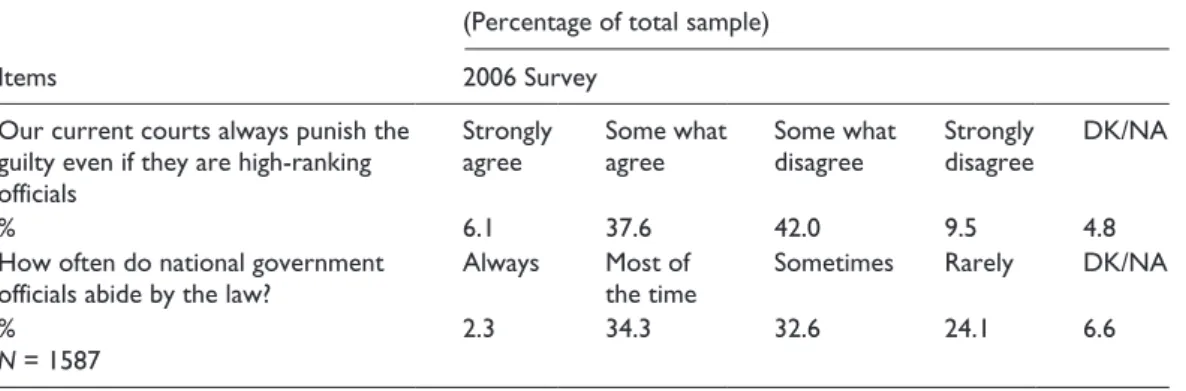
In ABS Round-II, there are two questions with regard to law-abiding government and two questions about corruption. As can be seen in Table 1, 6.1 percent and 37.6 percent of the respondents strongly agree or somewhat agree with the statements that Taiwan’s current courts always punish the guilty even if they are high-ranking officials. The sum of the 42 percent who somewhat disagree and 9.5 percent who strongly disagree is slightly higher than those who strongly agree or somewhat agree. It is striking that Taiwan is ranked high by Freedom House and the World Bank Governance Indicator, while nearly half the Taiwanese respondents do not think the system meets the requirement of rule of law.
The second indicator further confirms this perception. When respondents are asked, ‘How often do national government officials abide by the law?’, only 2.3 percent answer ‘always’ and 34.3 percent answer ‘most of the time.’ On the other hand, 32.6 percent answer ‘sometimes’ and 24.1 percent ‘rarely.’ This means that more than half the respondents gave a negative evaluation of the government on Chen Shui-bian’s watch. This disparaging assessment would not surprise most observers who have followed Taiwan’s politics closely. The Chen Shui-bian administration has been marked by incidences of violating binding resolutions by the Legislative Yuan, forcing lower-ranking officials to break the rules, and by perjury and the obstruction of justice. None of these unlawful actions were punished until after he left office.
Table 1. Evaluation of law-abiding government
(Percentage of total sample)
Items 2006 Survey
Our current courts always punish the guilty even if they are high-ranking officials
Strongly
agree Some what agree Some what disagree Strongly disagree DK/NA
% 6.1 37.6 42.0 9.5 4.8
How often do national government
officials abide by the law? Always Most of the time Sometimes Rarely DK/NA
% 2.3 34.3 32.6 24.1 6.6
N = 1587
Degree of corruption is another key element in the concept of rule of law. Table 2 shows the results of Transparency International’s (TI) survey on perception of corruption in East Asia between 1999 and 2009. Taiwan showed little change in perception of corruption over the period, with its score fluctuating between 5.6 and 5.9 – a little better than Korea, but worse than Japan, Hong Kong, and Singapore. Overall, Taiwan has only earned a middle ranking in East Asia over control of corruption.
Taiwan fares somewhat worse in the eyes of its citizens with regard to the extent of corruption. As can be seen in Table 3, more than half the people in our three ABS1 surveys (conducted in 2001, 2006 and 2010) consider that most or all officials are corrupt in both local and national govern-ment. In fact, there is little change in the distribution of responses to the two questions over the three surveys, and less than 30% of the respondents believe that corruption is not a serious prob-lem. This low assessment suggests that the contagion of money politics during the Lee Teng-hui years and the shocking incidents of rampant corruption at the highest echelon during the Chen Shui-bian administration have left Taiwan’s populace with such a bad and sour memory that it will take many more years of rectification and cleanup to restore people’s confidence in the integrity of government officials and elected politicians. This dark memory also helps explain why there is a substantial gap between expert evaluations and popular perceptions.
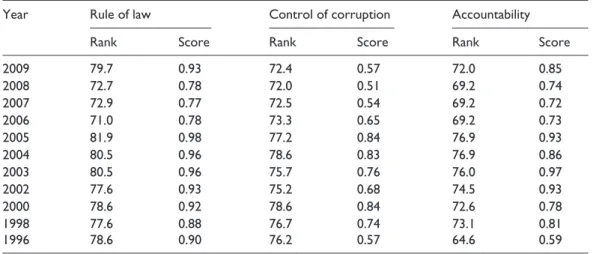
If we compare our survey results with another widely cited objective indicator compiled by the World Bank, the perception gap persists. The first two columns of Table 4 show relevant results from the World Bank Worldwide Governance Indicators (WGI). The World Bank findings are broadly similar to those of TI, with Taiwan around the middle in international rankings on rule of law and control of corruption. However, it is worth noting that in one aspect the WGI rating matches the ABS survey, i.e. there is no noticeable change over time. Taiwan was stuck in the mid-dle based on expert evaluation and has persistently been perceived more harshly by its citizens.
Accountability is another important dimension of the procedure of democracy. Parallel to Schedler (1999)’s distinction between horizontal accountability and vertical accountability,
Table 2. Corruption perceptions index
2009 2008 2007 2006 2005 2004 2003 2002 2001 2000 1999 Taiwan score 5.6 5.7 5.7 5.9 5.9 5.6 5.7 5.6 5.9 5.5 5.6 rank 37 39 34 34 32 35 30 29 27 28 28 Japan score 7.7 7.3 7.5 7.6 7.3 6.9 7.0 7.1 7.1 6.4 6.0 rank 17 18 17 17 21 24 21 20 21 23 25 South Korea score 5.5 5.6 5.1 5.1 5.0 4.5 4.3 4.5 4.2 4.0 3.8 rank 39 40 43 42 40 47 50 40 42 48 50 Hong Kong score 8.2 8.1 8.3 8.3 8.3 8.0 8.0 8.2 7.9 7.7 7.7 Rank 12 12 14 15 15 16 14 14 14 15 15 Singapore score 9.2 9.2 9.3 9.4 9.4 9.3 9.4 9.3 9.2 9.1 9.1 Rank 3 4 4 5 5 5 5 5 4 6 7
Morlino (2011) distinguishes between electoral accountability and inter-institutional accountabil-ity. The former refers to holding government accountable through free and fair elections at regular intervals, while the latter refers to the oversight capacity and the effectiveness of constraints on executive power. The left-most column in Table 4 shows WGI results for accountability, which, like the corruption score, give Taiwan a middle ranking.
If we use ABS data to assess citizens’ subjective evaluations of electoral and inter-institutional accountability, the picture is somewhat mixed (see Table 5). Around three in four respondents believe that elections make government more responsive to citizens’ demands, but only 50% of respondents agree that the legislature effectively oversees the actions of the government.
Table 3. Corruption of central and local government perception index (2001, 2006, 2010)
2001 2006 2010
How widespread do you think corruption and bribe-taking are in your local/municipal government?
1 Almost everyone is corrupt 7.6 8.6 7.2
2 Most officials are corrupt 62.8 58.0 58.8
3 Not a lot of officials are
corrupt 27.5 29.5 30.0
4 Hardly anyone is involved 2.2 3.8 4.0
Total 100.0 100.0 100.0
How widespread do you think corruption and bribe-taking are in the national government?
1 Almost everyone is corrupt 7.8 11.8 8.7
2 Most officials are corrupt 57.0 55.6 55.4
3 Not a lot of officials are
corrupt 32.7 29.6 32.5
4 Hardly anyone is involved 2.5 2.9 3.4
Total 100.0 100.0 100.0
Source: Asian Barometer Surveys
Table 4. Rule of law, control of corruption and accountability
Year Rule of law Control of corruption Accountability
Rank Score Rank Score Rank Score
2009 79.7 0.93 72.4 0.57 72.0 0.85 2008 72.7 0.78 72.0 0.51 69.2 0.74 2007 72.9 0.77 72.5 0.54 69.2 0.72 2006 71.0 0.78 73.3 0.65 69.2 0.73 2005 81.9 0.98 77.2 0.84 76.9 0.93 2004 80.5 0.96 78.6 0.83 76.9 0.86 2003 80.5 0.96 75.7 0.76 76.0 0.97 2002 77.6 0.93 75.2 0.68 74.5 0.93 2000 78.6 0.92 78.6 0.84 72.6 0.78 1998 77.6 0.88 76.7 0.74 73.1 0.81 1996 78.6 0.90 76.2 0.57 64.6 0.59
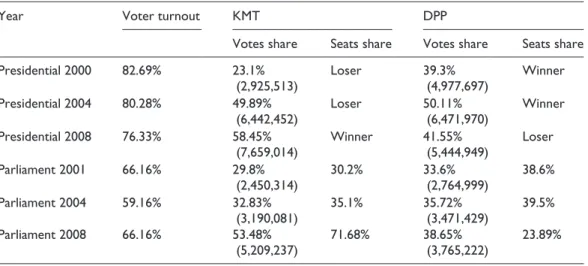
The citizens’ more favorable rating of Taiwan’s electoral accountability resonates well with their enthusiastic participation in the electoral process (see Table 6). All three direct presidential elections have seen turnouts above 75%, far above the turnout for legislative elections, which has been in the range of 58%–66%. When compared with Western democracies, Taiwan’s election turnout has been impressive. In terms of electoral competition, the KMT’s electoral dominance has substantially declined since 2000. The DPP and its allies pose a strong challenge to the KMT and its allies in elections at all levels. The DPP candidates typically enjoy a head-start in the south, the KMT candidates are favored in the north, and the central area has become the key battle ground.
Table 5. Accountability perceptions index (2010) Electoral accountability
How much do you feel that having elections makes the government pay attention to what the people think?
1 A good deal 14.6 2 Quite a lot 60.7 3 Not much 21.4 4 Not at all 3.3 Total 100.0 Inter-institutional accountability
To what extent is the legislature capable of keeping government leaders in check?
1 Very capable 2.0
2 Capable 48.4
3 Not capable 40.6
4 Not at all capable 9.0
Total 100.0
Source: Asian Barometer Surveys
Table 6. Participation and competition in presidential and legislative elections (2000–2008)
Year Voter turnout KMT DPP
Votes share Seats share Votes share Seats share Presidential 2000 82.69% 23.1% (2,925,513) Loser 39.3% (4,977,697) Winner Presidential 2004 80.28% 49.89% (6,442,452) Loser 50.11% (6,471,970) Winner Presidential 2008 76.33% 58.45% (7,659,014) Winner 41.55% (5,444,949) Loser Parliament 2001 66.16% 29.8% (2,450,314) 30.2% 33.6% (2,764,999) 38.6% Parliament 2004 59.16% 32.83% (3,190,081) 35.1% 35.72% (3,471,429) 39.5% Parliament 2008 66.16% 53.48% (5,209,237) 71.68% 38.65% (3,765,222) 23.89%
The current electoral system for the Legislative Yuan was adopted in 2006 under a grand compro-mise between the DPP and KMT at the expense of smaller parties. The DPP fared badly in 2008 under the new system, which is primarily a first-past-the-post single-member district system. This procedure tends to amplify the disproportionality between votes and seats. However, the DPP’s debacle in 2008 should be taken as an aberration rather than the norm for the future, as it was largely due to a strong popular backlash against Chen Shui-bian’s corruption scandal and reckless provocation toward Beijing.
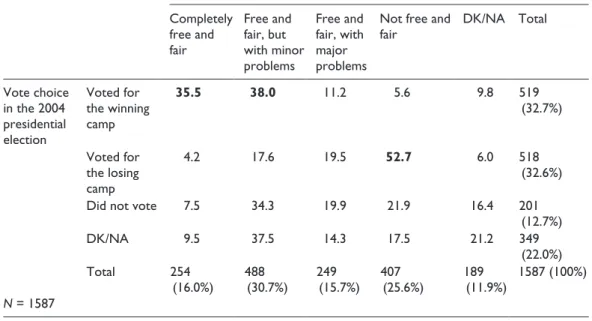
Nevertheless, Taiwan’s excessive partisanship still threatens to compromise the quality of electoral competition, at least in the eyes of the electorate. In particular, the acrimony surrounding the 2004 presidential election has left a deep scar between the Blue camp and the Green camp. In our 2006 ABS survey, only 16.0% of respondents judged that the 2004 election was completely free, while 30.7% of our respondents judged that the election was free and fair with only minor problems (see Table 7). At the same time, those who felt the election had major problems amounted to 15.7%, and those who felt that the election was not free and fair constituted a quarter (25.6%) of our respondents. So there were more people holding negative views about the 2004 election than people in positive territory.
If we break down the sample by people’s electoral choice, the polarizing effect of partisanship becomes alarmingly strong. As Table 7 shows, 73.5% of those who supported President Chen rated the election by and large free and fair, but only 21.8% of those who supported the Blue-camp presi-dential candidate held the same opinion. This result suggests that people’s perception of the free-ness and fairfree-ness of the election is highly dependent on their partisan attachment. The startling confidence gap between the losing and winning camps affects not only people’s evaluation of the quality of competition but their view of other aspects of democratic governance as well.
Table 7. Partisan choice and perception of fairness: Taiwan 2006 Survey Partisan choice Free and fair election
On the whole, how would you rate the freeness and fairness of the last national election? Completely free and fair Free and fair, but with minor problems Free and fair, with major problems
Not free and
fair DK/NA Total
Vote choice in the 2004 presidential election Voted for the winning camp 35.5 38.0 11.2 5.6 9.8 519 (32.7%) Voted for the losing camp 4.2 17.6 19.5 52.7 6.0 518 (32.6%) Did not vote 7.5 34.3 19.9 21.9 16.4 201
(12.7%) DK/NA 9.5 37.5 14.3 17.5 21.2 349 (22.0%) Total 254 (16.0%) 488(30.7%) 249(15.7%) 407(25.6%) 189(11.9%) 1587 (100%) N = 1587
Content qualities
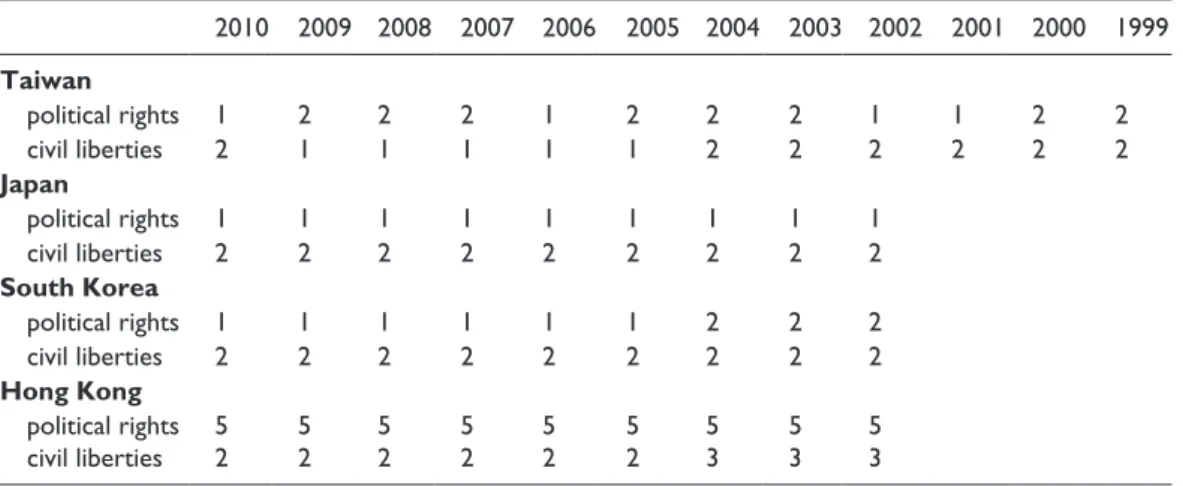
Morlino (2011) has argued that a high-quality democracy must include both freedom and equality. The dominant vision in the West assumes that democracy always means ‘liberal democracy,’ a political system characterized not only by popular accountability and public contestation through free and fair elections but also by rule of law, separation of powers, and protection of basic freedom of speech, assembly and religion, and private property rights (Zakaria, 2003: 17). Freedom House uses political rights and civil liberties to assess the level of democratic development. Table 8 reveals that over the past ten years Taiwan has achieved impressive evaluations on both political rights and civil liberties. Taiwan’s scores have been similar to those of Japan and South Korea, and much higher than Hong Kong’s.
It is also important to know if people’s evaluation of rights and freedom protection in Taiwan reflects expert-based assessments of democracy.
For the measurement of the freedom dimension, the paired set that ABS employed addresses freedom of speech and freedom of association separately (see Table 9). The data from our 2010
Table 8. Freedom in the world
2010 2009 2008 2007 2006 2005 2004 2003 2002 2001 2000 1999 Taiwan political rights 1 2 2 2 1 2 2 2 1 1 2 2 civil liberties 2 1 1 1 1 1 2 2 2 2 2 2 Japan political rights 1 1 1 1 1 1 1 1 1 civil liberties 2 2 2 2 2 2 2 2 2 South Korea political rights 1 1 1 1 1 1 2 2 2 civil liberties 2 2 2 2 2 2 2 2 2 Hong Kong political rights 5 5 5 5 5 5 5 5 5 civil liberties 2 2 2 2 2 2 3 3 3
Source: Freedom House, Freedom in the World Table 9. Freedom perception index (2010)
People are free to speak what they think without fear
1 Strongly agree 12.7
2 Somewhat agree 62.7
3 Somewhat disagree 22.0
4 Strongly disagree 2.6
Total 100.0
People can join any organization they like without fear
1 Strongly agree 12.6
2 Somewhat agree 68.5
3 Somewhat disagree 16.8
4 Strongly disagree 2.0
Total 100.0
ABS survey suggest that people’s subjective evaluations of freedom of speech and association by and large match Freedom House’s scores. Over three in four of our respondents agree with the statement that ‘people are free to speak what they think without fear’ as well as the statement that ‘people can join any organization they like without fear.’ For both questions, the number of nega-tive evaluations is always under one-quarter. It shows that freedom is a domain where people are quite satisfied.
As for the equality dimension, we first turn to the Gini coefficient (see Table 10). The United Nations has defined a Gini coefficient of less than 0.20 as absolute equality of income, 0.20–0.30 as relative equality of income, 0.30–0.40 as a reasonable level of distribution, 0.40–0.50 as a higher level of inequality, and over 0.60 as high disparity of incomes. Normally, a Gini coefficient of 0.40 is regarded is a demarcation line: Gini coefficients above 0.40 are a threat to social stability. During the 1970s, Taiwan’s economy grew rapidly, but its Gini coefficient was only around 0.30 and lower than that of most other countries. Taiwan was praised for achieving ‘growth with equality’ (The World Bank, 1994). Table 8 shows that Taiwan’s Gini coefficient is trending upwards, but has not yet reached a critical point.
The Gini coefficient, however, only captures income equality. Equality under a democracy also entails equal treatment by the government when it comes to entitlements and legal rights.
Table 11 reports the distribution on the paired questions on perceived equality. The result from the two questions suggests that, in Taiwan society, equal treatment remains an unfulfilled promise for most citizens. In terms of political equality, ABS data shows that less than half of respondents believe that the government treats all ethnic groups equally. When asked whether the government
Table 10. Gini coefficient (1998–2008)
Taiwan 2008 2007 2006 2005 2004 2003 2002 2001 2000 1999 1998 Gini coefficient 0.341 0.340 0.339 0.340 0.338 0.343 0.345 0.350 0.326 0.325 0.324 Ratio of income share 6.05 5.98 6.01 6.04 6.03 6.07 6.16 6.39 5.55 5.50 5.51
Source: www.stat.gov.tw
Table 11. Equality perception index (2010 survey)
All citizens from different ethnic communities in Taiwan are treated equally by the government 1 Strongly agree 5.4 2 Somewhat agree 42.0 3 Somewhat disagree 43.6 4 Strongly disagree 8.9 Total 100.0
Rich and poor people are treated equally by the government
1 Strongly agree 3.8
2 Somewhat agree 22.5
3 Somewhat disagree 52.7
4 Strongly disagree 21.0
Total 100.0
treats people of different income levels equally, less than 30% answered affirmatively. The data suggest that the old grievance that native Taiwanese have held toward the mainland has probably receded over time but that it has been replaced by discrimination against ethnic minorities (includ-ing the Hakka-speak(includ-ing Taiwanese, mainlanders, aboriginals, and recent immigrants from Southeast Asia) as well as socio-economically disadvantaged groups.
Outcome and quality
From the perspective of quality in terms of outcome, Morlino identifies the key dimension of responsiveness, which links the procedural dimensions to the substantive ones by measuring the extent to which public policies correspond to citizen demands and preferences, as aggregated through the political process (Morlino, 2004). The outcome might also be measured on the basis of the legitimacy of democracy, computed by calculating the percentage of survey respondents who are either satisfied or highly satisfied with the way democracy works in their country.
The ABS survey has employed three sets of items in tackling the outcome domain of democ-racy. The three sets address the perceived legitimacy, efficacy, and responsiveness of Taiwan’s democratic regime, respectively. Table 12 reports results from our three waves of survey over the last decade. Although popular support for democratic legitimacy has been trending upwards in our three ABS surveys, by 2010 it registers a support level of only 52%, placing it below many other emerging democracies. In terms of democratic efficacy, there has been steady improvement in people’s assessment. In 2001, 42% of our respondents believed that democracy is not capable of solving the society’s problems. The proportion of naysayers dropped to 35% in 2010. This per-ceived improvement in democracy’s efficacy corresponds well with the strong record of economic
Table 12. Perceived legitimacy, efficacy, and responsiveness of the democracy (2001, 2006, 2010)
2001 2006 2010
Which of the following statements comes closest to your own opinion?
1 Democracy is always preferable to any other kind of
government 45.1 50.3 52.3
2 Under some circumstances, an authoritarian government can
be preferable to a democratic one 25.9 22.8 25.0 3 For people like me, it does not matter whether we have a
democratic or a non-democratic regime 29.0 26.9 22.7
Total 100.0 100.0 100.0
Which of the following statements comes closer to your own view?
1 Democracy is capable of solving the problems of our society 57.6 61.8 65.3 2 Democracy cannot solve our society’s problems 42.4 38.2 34.7
Total 100.0 100.9 100.0
How well do you think the government responds to what people want?
1 Very responsive – 2.4 2.5
2 Largely responsive – 35.4 36.8
3 Not very responsive – 51.4 50.3
4 Not responsive at all – 10.8 10.4
Total – 100.0 100.0
performance under Ma Ying-jeou despite the 2008–2009 global financial crisis. However, percep-tions about whether the government is responsive to citizens’ demands remain very downbeat and have not improved much between our 2006 and 2010 surveys. In both surveys, over 60% of respondents believed that the government does not respond effectively to public demands. Overall, when it comes to outcomes, the popular viewpoint is that there is ample room for improvement.
Overall, our study shows that for the great majority of Taiwanese citizens, their political system is still far from being a high-quality democracy. In particular, three procedural dimensions: control-ling corruption, inter-institutional accountability, and rule of law are most lacking in Taiwan. Also, there is ample room for improvement on the responsiveness element of the result dimension. However, Taiwan has done well in terms of competition, freedom, electoral accountability, and participation. But in the eyes of its citizens, high-quality democracies must also deliver desired properties in terms of rule of law, controlling corruption, horizontal accountability, equality, and responsiveness. Democracy in Taiwan is indeed facing some tough critics.
Lastly, we apply regression analyses to explore whether regime legitimacy was affected by the subjective assessment of quality of governance. Three dependent variables are applied to measure regime legitimacy: satisfaction with democracy, support for democracy, and detachment from authoritarianism. Regarding explanatory variables, we include 11 variables that measure the differ-ent dimensions of quality of governance discussed earlier. We also add two more variables that measure people’s subjective evaluation of the country’s overall economic condition and their per-sonal economic condition.
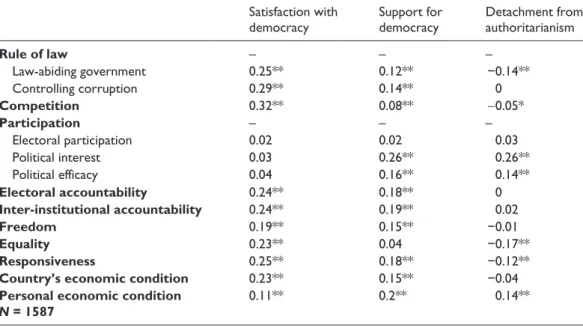
Table 13 presents the results of the three regression analyses. The dependent variable of the first regression is satisfaction with democracy. Since all of the scales have been standardized, we can
Table 13. Quality of democratic governance and regime legitimacy – regression analysis of Taiwan 2006
survey
Satisfaction with
democracy Support for democracy Detachment from authoritarianism
Rule of law – – – Law-abiding government 0.25** 0.12** −0.14** Controlling corruption 0.29** 0.14** 0 Competition 0.32** 0.08** -0.05* Participation – – – Electoral participation 0.02 0.02 0.03 Political interest 0.03 0.26** 0.26** Political efficacy 0.04 0.16** 0.14** Electoral accountability 0.24** 0.18** 0 Inter-institutional accountability 0.24** 0.19** 0.02 Freedom 0.19** 0.15** −0.01 Equality 0.23** 0.04 −0.17** Responsiveness 0.25** 0.18** −0.12**
Country’s economic condition 0.23** 0.15** −0.04
Personal economic condition 0.11** 0.2** 0.14**
N = 1587
**Correlation is significant at the 0.01 level (2-tailed). *Correlation is significant at the 0.05 level (2-tailed).
compare the magnitude of each factor’s influence by the beta coefficients. As can be seen, among the 13 explanatory variables introduced into the model, only three variables in the category of political participation do not have explanatory power. For the remaining variables, the findings show that the better the quality assessment, the higher the satisfaction with democracy. With regard to the magnitude of influence, there is not much difference between the variables, except for a slightly lower beta for freedom and personal economic condition.
Our second dependent variable is support for democracy.9 There are several significant findings. First, while electoral participation is not significant, political interest and political efficacy do have explanatory power on the level of support for democracy, and political interest is a very strong predictor. Second, almost all indicators of qualities of democracy except equality have a significant impact on the level of support for democracy. This indicates that Taiwan’s much lower aggregate level of democratic support is the direct result of a visible deterioration across a spectrum of quality dimensions after the 2000 power rotation. Third, there is significant variation in the relative mag-nitude of the beta coefficient of competition, which is the strongest predictor explaining satisfac-tion with democracy but a much weaker predictor for support for democracy. A plausible explanasatisfac-tion is that one incident of a disputed election affects people’s satisfaction with democracy but its dam-age on citizens’ confidence in democracy’s superiority is more limited.
The third regression analysis looks at the explanatory power of different measures of qualities for detachment from authoritarianism.10 The result is strikingly different from the previous two models. The most obvious difference is that the direction of influence is the opposite. What we found is that the more critical the subjective assessment, the stronger the detachment from authori-tarianism. For example, we can find a negative beta coefficient on law-abiding government, com-petition, equality and responsiveness. This suggests a syndrome of ‘critical democrats.’ People who register strong objection to non-democratic alternatives are also more critical of the perfor-mance of the democratic regime. At the same time, quite a few predictors of quality assessment, including controlling corruption, electoral accountability, inter-institutional accountability, free-dom, and the country’s economic condition, lose much of their explanatory power. There are two plausible explanations for this. First, detachment from authoritarianism is tenacious and gradually shaped in the process of life experience. Therefore, it is less likely to be affected by a short-term quality assessment. Second, people do not favor the non-democratic alternatives because they are no longer realistic options under the present-time domestic socio-economic conditions and in the prevailing international context. They reach this conclusion regardless of how well or how badly the democratic regime functions.
Conclusion
Perception is always context-dependent and susceptible to all kind of factors. While Taiwan’s democratic consolidation is one of the more successful cases in Asia, evidence from public opinion surveys does not always provide a reassuring picture. In this article, we investigated the question of why Taiwan seemed to perform fairly well in terms of quality of democracy according to ratings published by international organizations such as Freedom House and The World Bank, while its own citizens give much less optimistic assessments.
An important reason is that Taiwan’s citizenry tend to apply a very high benchmark and expect a lot more from their democracy. This means that Taiwan’s young democracy is still burdened with a widely shared nostalgia for the apparent efficacy and efficiency of the authoritarian era. In our latest survey, a very substantial portion (around 25 percent) of the Taiwanese population still believed that authoritarian government can be preferable under certain circumstances. This
sentiment of authoritarian nostalgia has persisted more than a decade after the country became democratized. This authoritarian legacy is often associated in people’s memory with a strong record in delivering economic prosperity, social stability, and clean politics; it shapes people’s historical benchmark when they evaluate the qualities of democracy.
Next, Taiwan’s young democracy has inherited some wrenching structural constraints – an unsettled sovereign status in the international system and a polarized conflict over national identity at home. As the zealots of the two camps – the Blue vs the Green – fiercely competed to gain con-trol of the state apparatus and use its power to steer the cross-Straits relations, erect a cultural hegemony, and impose their own vision of nation-building in the direction of either Taiwanization or Sinicization, they paid only lip service to civility, compromise, tolerance, due process, and rule of law, all essential elements in making a liberal democracy work.
Another reason is the challenge of economic globalization. The international economic environ-ment has not been very friendly to emerging democracies. Forces of globalization have aggravated socio-economic disparities and imposed grave risks of economic fluctuation and dislocation on to the great majority of citizens. On the other hand, globalization and the associated neo-liberal ideol-ogy hamper the capacity of the state to manage the national economy and provide an adequate social safety net. Taiwan, like many other new democracies, has to wrestle with the unforgiving nature of ‘global market forces,’ which penalize slow and inefficient democratic processes on a daily basis in terms of currency fluctuations, capital outflow and disappearing foreign buyers. Globalization has also accelerated the hollowing-out of national politics. It shifts the locus of governing power away from a national capital to international organizations (such as IMF), mul-tinational firms, foreign institutional investors and private transnational actors. It has been a pain-ful process for most Taiwanese citizens to realize that in a globalized world there is very little their democratically elected government can do to protect the solidarity of their community, their economic security, or their children’s future.
Last but not the least, there are some serious flaws in Taiwan’s semi-presidential system. The existing constitutional arrangements were not equipped to produce a definitive resolution of the conflict intrinsic to a semi-presidential system. To begin with, the constitution does not erect a threshold for electing the president. In a multi-candidate race, no candidate can get a convincing victory. Next, although the constitution stipulates that the cabinet should be held accountable to the Legislative Yuan, the president can appoint the premier, formally the head of the government, without parliamentary confirmation, making it possible for a minority president to produce a French-style ‘cohabitation’ at the cost of political gridlock, although for an opposite reason: in France the president is compelled to appoint a premier allied with the parliamentary majority, while in Taiwan a minority president can appoint a premier who is a political ally but opposed by the parliamentary majority.
Furthermore, the term of the president and that of the parliament vary (4 vs 3 years), and the two elections were not synchronized by default, thus making the occurrence of ‘divided government’ much more likely because the two electoral cycles may produce competing mandates. Once the syndrome of ‘divided government’ deteriorates into political immobilism, the constitution offers little timely remedy.
Most of the evaluations based on expert-judgment did not capture these subtle and complex historical conditions and contextual factors. On the other hand, citizens who have lived under these historical circumstances and experienced different stages of regime evolution and economic restructuring have difficulty learning how to live with the gap between the promises and realities of democracy. It is even harder to learn this because a decade after the country became democra-tized, the gap has not been narrowing in some key aspects of a well-governed democracy.
Appendix A. Variable construction
1. A composite index of law-abiding government: create a nine-point scale (+4 to − 4) by add-ing up II-Q104 (codadd-ing +2 for ‘strongly agree,’ +1 somewhat agree, −1 ‘somewhat disa-gree,’ −2 ‘strongly disadisa-gree,’ and 0 for DK/NA) and II-Q113 (coding +2 ‘always,’ +1 ‘most of the time,’ -1 ‘sometimes,’ −2 ‘rarely,’ and 0 for DK/NA). Convert this scale to a stand-ardized −1.0–1.0 scale by dividing the raw score by 4.
2. A composite index of controlling corruption: create a 13-point scale (+6 to −6) by adding up II-Q117 (coding +2 for ‘hardly anyone is involved,’ +1 ‘not a lot of officials are corrupt,’ −1 ‘most officials are corrupt,’ and −2 ‘almost everyone is corrupt,’ and coding 0 for DK/ NA), II-Q118 (same as before), and II-Q120 (coding +2 for ‘it is doing its best,’ etc.). Convert this scale to a standardized −1.0–1.0 scale by dividing the raw score by 6.
3. A composite index of competition: create a 13-point scale (+6 to −6) by adding up II-Q105 (coding +2 for ‘strongly agree,’ etc.), II-Q114 (coding +2 for ‘always,’ etc.) and II-Q43 (coding +2 for ‘complete free and fair,’ etc.). Convert this scale to a standardized −1.0–1.0 scale by dividing the raw score by 6.
4. A composite index of electoral participation: create a four-point scale (+3 to 0) by adding up II-Q38, II-Q40, and II-Q41 (coding 1 for ‘yes’ and 0 for all other answers). Convert this scale to a standardized -1.0–1.0 scale by subtracting it by 1.5 and then dividing the result by 1.5.
5. A composite index of political interest: create a nine-point scale (+4 to -4) by adding up II-Q104 (coding +2 for ‘very interested,’ +1 ‘somewhat interested,’ −1 ‘not very interested,’ −2 ‘not at all interested,’ and coding 0 for DK/NA) and II-Q50 (coding +2 for ‘every day,’ +1 for ‘several times a week,’ or ‘twice or once a week,’ −1 for ‘not even once a week,’ -2 ‘practically never,’ and 0 for DK/NA). Convert this scale to a standardized -1.0–1.0 scale by dividing the raw score by 4.
6. Create a composite index of political efficacy by constructing a nine-point scale (+4 to -4) by adding up II-Q127 (coding +2 for ‘strongly agree,’ +1 ‘somewhat agree,’ −1 ‘somewhat disagree,’ -2 ‘strongly disagree,’ and 0 for DK/NA) and II-Q128 (coding −2 for ‘strongly agree,’ −1 ‘somewhat agree,’ +1 ‘somewhat disagree,’ +2 ‘strongly disagree,’ and 0 for DK/ NA). Convert this scale to a standardized -1.0–1.0 scale by dividing the raw score by 4. 7. A composite index of vertical accountability: create a 13-point scale (+6 to −6) by adding
up II-Q 103 (coding +2 for ‘strongly agree,’ etc.), II-Q106 (coding -2 for ‘strongly agree,’ −1 for ‘somewhat agree,’ +1 for ‘somewhat disagree,’ +2 for ‘strongly disagree,’ and 0 for DK/NA) and II-Q112 (coding -2 for ‘always,’ −1 for ‘most of the time,’ +1 for ‘some-times,’ +2 for ‘rarely,’ and 0 for DK/NA). Convert this scale to a standardized -1.0–1.0 scale by dividing the raw score by 6.
8. A composite index of horizontal accountability: create a nine-point scale (+4 to - 4) by adding up II-Q107 (coding -2 for ‘strongly agree,’ −1 for ‘somewhat agree,’ +1 for ‘somewhat disagree,’ +2 for ‘strongly disagree,’ and 0 for DK/NA) and II-Q115 (coding +2 for ‘very capable,’ +1 for ‘capable,’ −1 for ‘not capable,’ −2 for ‘not at all capable,’ and 0 for DK/AS). Convert this scale to a standardized -1.0–1.0 scale by dividing the raw score by 4.
9. A composite index of freedom: create a nine-point scale (+4 to -4) by adding up II-Q110 (coding +2 for ‘strongly agree,’ etc.) and IIQ-111 (coding +2 for ‘strongly agree,’ etc.). Convert this scale to a standardized -1.0–1.0 scale by dividing the raw score by 4.
10. A composite index of equality: create a nine-point scale (+4 to -4) by adding up II-Q108 (coding +2 for ‘strongly agree,’ etc.) and II-Q109 (coding +2 for ‘strongly agree,’ etc.). Convert this scale to a standardized -1.0–1.0 scale by dividing the raw score by 4.
11. A composite index of responsiveness: create a nine-point scale (+4 to -4) by adding up II-Q116 (coding +2 for ‘very responsive,’ etc.) and II-Q102a (coding +2 for ‘very likely,’ etc.). Convert this scale to a standardized -1.0–1.0 scale by dividing the raw score by 4. 12. Satisfaction with democracy (II-Q93): use a +2 to −2 scale with DK/NA being recoded as
0.
13. Index of support for democracy: create a 5–0 scale based on the total number of positive answers to II-Q97 (any point ≥ 6 is counted as a positive answer), II-Q98 (any point ≥ 6 is counted as a positive answer), II-Q121, II-Q122, and II-Q123.
14. Index of objection to non-democratic alternative: create a 3–0 scale based on the total num-ber of objections (disapproval) to II-Q124, II-Q125, and II-Q126.
15. Diffuse regime support: II-Q129, ‘Whatever its faults may be, our form of government is still the best for us.’ (This indicator is especially important for a non-democratic regime such as China, Vietnam, and Cambodia and semi-democratic regimes such as Hong Kong, Singapore, and Malaysia.)
Notes
1. The Asian Barometer survey (ABS) represents the region’s first collaborative initiative to develop a regional network of democracy studies based on surveying ordinary citizens. The project is principally financed by Taiwan’s Ministry of Education, Academia Sinica, and National Taiwan University. It covers 13 countries and territories in the region. All ABS data were collected through face-to-face interviews of randomly selected eligible voters in each participating country. Interested readers are welcome to browse the project’s website (www.asianbarometer.org) for methodological details. 2. This is the average GNP growth rate between 1950 and 1988 calculated from Taiwan Statistics Data
Book 2005 published by the Council of Economic Planning and Development.
3. In a way the DPP unexpectedly won the presidency in 2000 with only 39.3% of the vote thanks to a split in the KMT camp.
4. Under the DPP rule the worst recession in almost three decades hit Taiwan in 2001, bringing 2.2 percent negative growth, falling incomes, rising unemployment, a loss in value of 12 percent for the currency, and a stock market drop of more than 40 percent.
5. A bizarre shooting incident took place on the eve of the March 2004 presidential election and changed the electoral fortune of CSB at the last minute (Chu, 2005).
6. See http://www.systemicpeace.org/polity/polity4.htm. 7. Freedom in the World 2010, see http://www.freedomhouse.org.
8. The ABS Round II covers the area of Taiwan, including two metropolises – Taipei City and Kaoshiung City. Data were gathered through face-to-face interviews of voting-age adults (20 years old and above) who had registered in the household system. The baseline information and addresses were drawn from the household information compiled by the Ministry of Interior and excluded residents in military organizations, hospitals, medical care centers, schools, vocational training centers, dormitories, deten-tion centers, and prisons. The sampling method applied to the Survey involves two sets of samples: one is the main sample that was selected according to cluster analysis and PPS; the other is an extension sample that compensated for the unsuccessful cases in the main sample to fulfill the required number of cases that can fully represent the population.
9. The support for democracy index is constructed with a five-item scale. The five items are designed to measure five sub-dimensions, namely the preference for democracy, the desire for democracy, the
suitability of democracy, the efficacy of democracy, and the priority of democracy. The preference for democracy refers to the belief that democracy is the most preferable form of government. The desire
for democracy refers to the level of democracy where citizens want their current political regime to be. Suitability of democracy refers to the degree to which citizens feel that democracy is appropriate for their country. Efficacy of democracy dwells on the effectiveness of the democratic regime in dealing with the country’s major problems. Priority of democracy focuses on how important democracy is as compared with other desirable societal objectives. Please refer to Appendix A for the exact wordings of the five-item battery.
10. For measuring detachment from authoritarianism, ABS asked respondents a set of three questions, exploring whether or not they would favor the return to any of the three conceivable authoritarian alternatives: strongman rule, single-party rule, and military rule.
References
Beetham D (2004) Towards a universal framework for democracy assessment. Democratization 11(2): 1–17. Beetham D, Weir S, Raching S and Kearton L (2001) International IDEA Handbook on Democracy
Assessment. The Hague: Kluwer Law International.
Bratton M and Mattes R (2001) Support for democracy in Africa: Intrinsic or instrumental? British Journal
of Political Science 31(3): 447–474.
Bratton M, Mattes R and Gyimah-Boadi E (2005) Public Opinion, Democracy, and Market Reform in Africa. London: Cambridge University Press.
Chang YT, Chu YH and Huang MH (2006) The uneven growth of democratic legitimacy in East Asia.
International Journal of Public Opinion Research 18(2): 246–255.
Chang YT, Chu YH and Park CM (2007) Authoritarian nostalgia in Asia. Journal of Democracy 18(3): 66–80.
Chu YH (2005) Taiwan’s year of stress. Journal of Democracy 16(2): 43–57.
Chu YH and Diamond L (2001) Anatomy of Taiwan’s political earthquake. Journal of East Asian Studies 1(1).
Chu YH and Lin JW (2001) Political development in 20th century Taiwan: State-building, regime transforma-tion and the constructransforma-tion of natransforma-tional identity. China Quarterly 165: 102–129.
Diamond L and Morlino L (eds) (2005) Assessing Quality of Democracy. Baltimore, MD: The Johns Hopkins University Press.
Gold T (1986) State and Society in the Taiwan Miracle. Armonk, NY: M.E. Sharpe. Lagos M (2003) A road with no return? Journal of Democracy 14(2): 163–173.
Maravall JM and Przeworski A (2003) Democracy and the Rule of Law. Cambridge: Cambridge University Press.
Méndez Juan E, O’Donnell G and Pinheiro PS (1999) The (Un)Rule of Law and the Underprivileged in Latin
America. Notre Dame, IN: University of Notre Dame Press.
Morlino L (2004) What is good democracy? Democratization 11(5): 10–32.
Morlino L (2011) Changes for Democracy; Actors, Structures, Processes. Oxford: Oxford University Press. O’Donnell G, Linz JJ and Whitehead L (1986) Transitions from Authoritarian Rule. Baltimore, MD: The
Johns Hopkins University Press.
Przeworski A (1991) Democracy and the Market: Political and Economic Reform in Eastern Europe and
Latin America. Cambridge: Cambridge University Press.
Roberts A (2010) The Quality of Democracy in Eastern Europe. Cambridge: Cambridge University Press. Schedler A (1999) Conceptualizing accountability. In: Schedler A, Diamond L and Plattner MF (eds) The
Self-Restraining State. Boulder, CO and London: Lynne Rienner Publishers, 13–28.
Tien H and Chu Y (1996) Building democratic institutions in Taiwan. China Quarterly 148 (December): 1103–1132.
Winckler E (1992) Taiwan transition? In: Cheng T and Haggard S (eds) Political Change in Taiwan. Boulder, CO and London: Lynne Rienner Publishers, 221–259.
The World Bank (1994) The East Asian Miracle: Economic Growth and Public Policy. New York: Oxford University Press.