國立交通大學
電子工程學系電子研究所碩士班
碩士論文
用於低功率限制下傳輸速率控制技術在無線近身網路
之演算法設計
Power-Constrained Rate Adaptation In Wireless
Body Area Networks
研究生:蔡易達
指導教授: 黃經堯 博士
蔣迪豪 博士
用於低功率限制下傳輸速率控制技術在無線近身網路之演算法設計
Power-Constrained Rate Adaptation In Wireless Body Area
Networks
研究生: 蔡易達 Student: Yi-Da Tsai
指導教授: 黃經堯 Advisor: Ching-Yao Huang
蔣迪豪 Ti-hao Chiang
國立交通大學
電子工程學系電子研究所碩士班
碩士論文
A Thesis
Submitted to Department of Electronics Engineering & Institute of Electronics College of Electrical and Computer Engineering
National Chiao Tung University in partial Fulfillment of Requirements
for the Degree of Master of Science in
Electronics Engineering June 2009
Hsinchu, Taiwan, Republic of China
i
用於低功率限制下傳輸速率控制技術在無線近身網路之演算法設計
學生 : 蔡易達 指導教授 : 黃經堯 博士
蔣迪豪 博士
國立交通大學
電子工程學系 電子研究所碩士班
摘 要
無線近身網絡(WBAN)是一種結合了裝置於人體身上的嵌入式感測器以便於 從多個病人身體上監測相關生理參數的無線網路. WBANs 增加了病患的舒適性 和便利的移動性,同時也允許在必要的時候可以進行遠程醫療看護的需求。本論 文提出新的速率適應性相關 MAC 通訊協定,針對 WBAN 所處的網路環境不同, 採用動態的調整無線傳輸調變技術來抵抗當時的雜訊,以期能藉由適時地選擇不 同的資料傳送速率方式,達到較高的資料傳送可靠度,並依此選出最有利之傳輸 速率,縮短傳輸所佔用之網路時間,以提升網路產能及改善整體傳輸時的能量消 耗 。 此 外 本 論 文 採 用 即 時 偵 測 所 得 到 的 接 收 端 訊 號 強 度 指 示 (Received-Signal-Strength-Indicator,RSSI),得知當下網路上通訊的品質, 並藉著平均 RSSI值 (Average-RSSI)的計算來判斷網路中訊號品質的波動,如此 將比傳統使用 RSSI 臨界值之方法,更能貼近網路品質狀況的真正表現。透過本 論文所提出的方法動態地選擇速率,可獲得更理想的傳輸效能。實驗結果呈現出, 我們所提出的方法考量了未來網路品質的變化,並快速地針對網路品質調整傳輸 方式,可得到較好的網路效能,以及更高的傳輸可靠度,並同時大幅地降低了資 料傳輸的能量消耗。ii
Power-Constrained Rate Adaptation In Wireless Body Area
Networks
Student : Yi-Da Tsai Advisor : Dr. Ching-Yao Huang
Dr.
Ti-hao Chiang
Department of Electronics Engineering
Institute of Electronics
National Chiao Tung University
ABSTRACT
A wireless body area network (WBAN) is a wireless network that incorporates embedded sensors on the human body with the aim to monitor physiological parameters from multiple patient bodies. WBANs increases the comfort and mobility of patients while allowing remote access of data whenever necessary. The paper proposes an adaptive rate switching MAC protocol for WBAN to resist the frequent changing of channel quality and meanwhile, the protocol increases the network throughput and decreases the energy consumption. In wireless environments of WBAN, channel quality varies with time. The proposed protocol dynamically detects the current RSSI to estimate the channel quality through the previous average RSSI value calculated. According to the results generated from the proposed protocol, the proposed protocol enables a transmitter WSN to select an appropriate transmission rate dynamically to transmit in order to both increase the reliability and shorten the channel access time of the transmission. The simulation results show our proposed protocol has better performance, higher transmission reliability, higher network throughput and lower transmission energy consumption by the rate matching.
iii
誌 謝
碩士班的兩年的時間過得很快,轉眼間碩士畢業了。在這兩年短短的時間裡, 除了有修課的壓力外更要學習如何發現、了解、和解決問題,這篇論文的產生感 謝老天在這兩年內,讓我如此幸運有你們陪伴著我,使我能夠順遂跟愉快的度過 這人生中最精華的時光。 首先,我要感謝黃經堯老師,在這兩年裡隨著每週實驗室的研討會以及日常的 修課及討論,讓我學習到許多無線通訊相關的知識和背景,為我日後論文的完成 紮下深受的根基。在我催生論文之時,老師也常與我討論也給我適當的建議,點 破我思考上的盲點,也讓我的研究內容能更趨完整與豐富,此外也謝謝蔣迪豪老 師在多媒體無線傳輸技術上的指導,讓我的論文更加充實,並且適時的給我鼓勵, 讓我的研究過程走得更加平順。 另外要感謝的,就是在實驗室的日子裡一同共同努力的學長與夥伴們,首先, 就是感謝實驗室裡有問必答的學長們,子宗、士恒、純孝、志展、東佑、宗耿、 烜立、CGI、理銓、勇嵐、傑堯、玠原、宗翰,再來是陪我一起走過兩年研究的 同學、學弟妹們,強哥、GARY、信駿、明憲、玉華、英昌、美玲、怡萱、傳佑。 除了在研究與學業上,有你們可以與我一起討論、聆聽我的問題並給我寶貴的意 見,也因為有你們的陪伴,使我在研究的生活能夠多采多姿,這份心中的感動, 一定是我畢生難忘的回憶。 最後,我要感謝我的家人,爸爸、媽媽、姊姊。因為有你們在背後的默默支持, 使我能夠無憂無慮放手的去完成我的學業,這一路走來,總是可以感受到來自於 你們的關心與祝福,不斷的支持並鼓勵我,讓我的心中被充滿著關懷的溫暖並使 我能夠順順利利的走過這兩年。 在此,僅以我的畢業論文獻給大家,希望你們能夠分享我的成果與喜悅,謝謝 你們。iv
蔡易達 謹誌 2009年6月,Wintech Lab,交大,新竹,台灣
v
CONTENTS
摘要 ………i ABSTRACT ………ii 誌謝 ………..iii CONTENTS ………v FIGURES ……….. vi Chapter 1 Introduction………...1Chapter 2 Background on WBAN……….3
Chapter 3 Overview of Rate adaptation………7
3.1 Basic Structure of Rate adaptation………..8
3.2 The ADAPTATIVE ARF Mechanism………...10
Chapter 4 System Architecture………12
Chapter 5 Simulation Results………...18
5.1 Simulation Model………..18
5.2 Simulation Results……….21
5.2.1 The walking mode for 41 seconds………..21
5.2.2 The walking mode for about 5 minutes………..27
5.2.3 The sleeping mode for 23 minutes or so………32
Chapter 6 Conclusion………37
vi
FIGURES
Figure 1 Body Area Network (BAN) Medial Service [10]……….4
Figure 2 Wireless body area network (WBAN) [12] (a) Topology of WBAN (b) Traffic load of WBAN………5
Figure 3 The Evolution of Rate Control [13]……….7
Figure 4 The control flow of RBAR [13]………...8
Figure 5 The structure of RBAR [13]………..9
Figure 6 The procedure of proposed Rate adaptation scheme………14
Figure 7 The channel measurement in the sleeping situation……….16
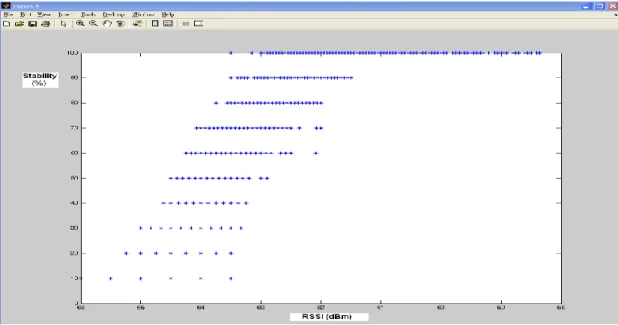
Figure 8 The stability and RSSI relationship in the sleeping situation……….16
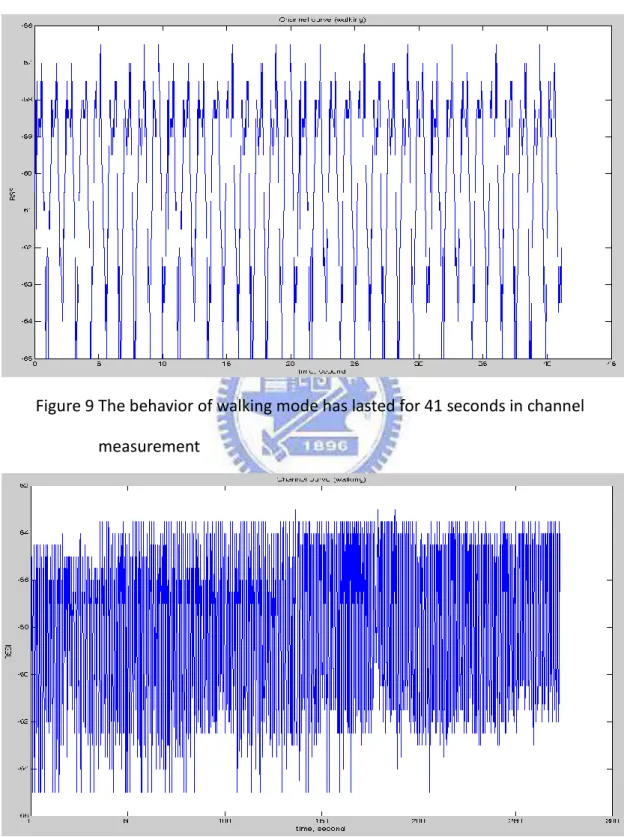
Figure 9 The behavior of walking mode has lasted for 41 seconds in channel measurement……….19
Figure 10 The behavior of walking mode has lasted for about 5 minutes in channel measurement……….19
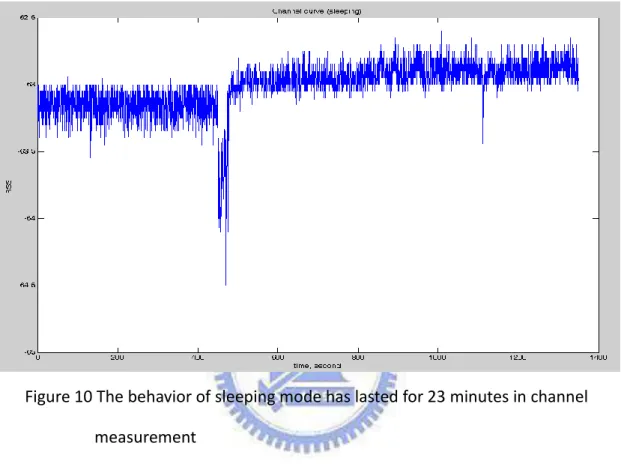
Figure 11 The behavior of walking mode has lasted for about 23 minutes in channel measurement……….20
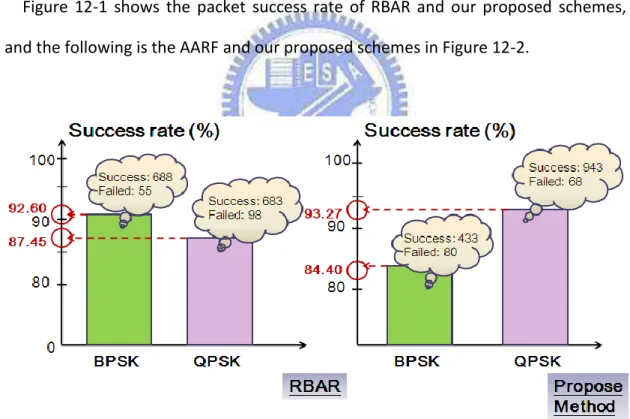
Figure 12-1 Packet success comparison with RBAR……….22
Figure 12-2 Packet success comparison with AARF……….23
Figure 13-1 The modulation scheme used under the RBAR in a certain channel region………..24
Figure 13-2 The modulation scheme used under the proposed scheme in a certain channel region………..24
Figure 13-3 The modulation scheme used under the RBAR throughout the whole channel………..24
Figure 13-4 The modulation scheme used under the proposed scheme throughout the whole channel………..25
Figure 14-1 The modulation scheme used under the AARF in a certain channel region………..25
Figure 14-2 The modulation scheme used under the proposed scheme in a certain channel region………..25
Figure 14-3 The modulation scheme used under the AARF throughout the whole channel………..26
Figure 14-4 The modulation scheme used under the proposed scheme throughout the whole channel………..26
Figure 15 Total energy consumption comparison……….27
Figure 16 Throughput comparison………..27
vii
Figure 17-2 Packet success comparison with AARF……….29
Figure 18-1 The modulation scheme used under the RBAR after the 200th second……….29
Figure 18-2 The modulation scheme used under the proposed scheme after the 200th second……….30
Figure 18-3 The modulation scheme used under the AARF after the 200th second……….30
Figure 18-4 The modulation scheme used under the proposed scheme after the 200th second……….30
Figure 19 Total energy consumption comparison……….31
Figure 20 Throughput comparison………..31
Figure 21-1 Packet success comparison with RBAR……….32
Figure 21-2 Packet success comparison with AARF……….33
Figure 22-1 The modulation scheme used under the RBAR between the 400th second and the 500th second………..33
Figure 22-2 The modulation scheme used under the proposed scheme between the 400th second and the 500th second……….34
Figure 22-3 The modulation scheme used under the AARF between the 400th second and the 500th second………..34
Figure 22-4 The modulation scheme used under the proposed scheme between the 400th second and the 500th second……….34
Figure 23 Total energy consumption comparison……….35
1
CHAPTER 1
INTRODUCTION
In recent year, Wireless Body Area Network (WBAN), a short distance wireless transmission for near or inner body applications, has become an emerging wireless system. The major application of WBAN is expecting to be widely used in ubiquitous health or telemedicine. WBAN can continuously monitor vital signals like ECG, blood pressure, and blood sugar, which can be reported to hospitals or clinics for further diagnosis. The prototypes of the health-care WBAN like HUMAN++ [1] and WiBoC [2] have already been promoted. Both these system provide better body monitoring and for potential high quality medical image applications. By using wireless technologies, WBAN allows patients to move their body during the measurement. However, the major drawback of cabling monitors is the limit in patients’ activities and the environment around. For instance, as the patient moving around different place, the transmission of the vital signals like ECG will suffer the different environment variation like someone walk around. Due to the body motions, a new floor reflection component and fluctuation in received energy in cabling monitors were observed. Thus, the low power design is essential for long-duration measurement in WBAN medical applications.
Among different wireless systems, WBAN designed for low-power transmission is especially suitable for healthcare applications which require lower transmission energy consumption and strict low packet error rates. For instance, a heart disease patient may need daily or monthly ECG monitoring. Since WBAN devices are physically on the surface or inside of a body, the lower power design can make user replace the device less frequently in order to be more convenient. Thus, in WBAN, user in the environment has been the most important factor for the performance
2
and the quality of the transmission. In order to improve system performance and quality, we should have the suitable understanding to the channel condition which encounters, and be appropriate measures to reach the required improvements. However, wireless medium is much unreliable compared with the wired medium due to its open nature. Thus, an estimator to estimate the channel quality and a predictor to predict the channel quality are very important for wireless transmission. Rate adaptation is the process of selecting the modulation and coding scheme to be used with each data burst, a feasible solution to resist the channel variation and increase or at least preserve the network performance in a time-varying wireless environment [3]. It is also a mechanism unspecified by the 802.11standards, yet critical to the system performance by exploiting the multi-rate capability at the physical layer. It can have a significant impact on overall system performance, affecting both transmission efficiency and the quality of service (QoS) . For instance, IEEE 802.11 a, b, and g provide several data transfer rates [4] [5] [6] [7], which allows dynamic rate switching to improve the performance. Therefore, adaptive rate switching are worth being considered, especially for WBAN due to the limited bandwidth and varied channel condition. The paper proposes a MAC scheme, which takes adaptive rate switching into consideration to instantly resist the channel variations and best utilize the channel bandwidth. Consequently, throughput and energy consumption can be improved by using the most suitable data transfer rate.
The rest of the paper is organized as follows: The overview of WBAN system and Rate adaptation will be discussed in Chapter 2 and Chapter 3 respectively. In Chapter 4, we provide the basic concept and design flow for adaptive rate switching in WBAN. Chapter 5 describes the simulation environment as well as settings and illustrates the simulation results. Finally, the conclusions are drawn in Chapter 6.
3
CHAPTER 2
BACKGROUND ON WBAN
A WBAN is a network of sensors attached to different parts of a patient’s body. Patients wearing a WBAN could carry on with their normal lives—the doctor remotely monitoring the data gathered by the network would simply contact them to arrange appointments when needed. WBAN, with sensors consuming extremely low power, is used to monitor patients in critical conditions inside hospitals. Outside the hospital, the network can transmit patients’ vital signs to their physicians over the Internet or private networks in real time. WBAN can use ZigBee, Bluetooth or UWB radio technologies. The main purpose of the medical applications is improving the quality of healthcare together with a significant reduction of the cost. Several technologies are needed for implementing a wearable healthcare system. That is, a physiological signal measurement technology to measure user’s physiological signals continuously and wireless communication technology to construct a WBAN.
WBAN have great potential for continuous monitoring in ambulatory settings, early detection of abnormal conditions, and supervised rehabilitation. The advances in WBAN technologies are driven by the developments in wireless communications. They share the same ultimate design goals: minimization of weight and size of sensors that are critical for user’s acceptance, portability, unobtrusiveness, ubiquitous connectivity, reliability, and seamless system integration. A typical WBAN consists of a number of inexpensive, lightweight, and miniature sensor platforms, each featuring one or more physiological sensors, such as motion sensors, electrocardiograms (ECG), SpO2, breathing sensors, blood pressure, electromyograms (EMG), electro-encephalograms (EEG), and blood glucose sensors. Typical example of this type of application is ambulatory monitoring of user’s activity
4
[8][9]. The sensors could be located on the body as tiny intelligent patches, integrated into clothing, or implanted below the skin or embedded deeply in tissues. For instance, a WBAN consists of a central processing node (CPN) and several wireless sensor nodes (WSNs), which is illustrated in Figure 1. Each WSN continuously transmits monitored signals from body to CPN and CPN can forward these signals to hospitals or clinics.
Figure1. Body Area Network (BAN) Medical Service [10]
In brief, a WBAN operated in an interconnected manner could offer significant advantage for remote health monitoring. A WBAN can operate in an ad hoc networking mode or in a centralized mode where each sensor nodes transmits its own sensor data to a service node. Figure 2 shows the basic topology of WBAN and has been considered to support most WBAN applications. However, in a patient monitoring system, data transmission reliability is extremely important. Considering the importance of the WBAN, IEEE has recently formed a specialist study group. Currently the IEEE802.15.6 group is working on the development of a body area network standard [11]. The new standard will define the PHY (Physical) and MAC (Medium Access Control) layer management issues which could be used to develop a
5
low cost, ultra low power and highly reliable wireless network. These functionalities are controlled primarily by PHY and MAC layers in conjunction with the application layers. The new WBAN standard is likely to be based on the IEEE 802.15.4 MAC layer and a new PHY layer. The Zigbee is a commercial standard which develops the application on top of the IEEE802.15.4 standard that defines the PHY and the MAC layer. It is possible to develop medical applications on a Zigbee standard by appropriately defining higher layer procedures.
Figure 2 Wireless body area network (WBAN) [12] (a) Topology of WBAN (b) Traffic load of WBAN
As mentioned earlier that it is likely that the forthcoming WBAN standard will be based on the IEEE802.15.4 MAC layer. IEEE 802.15.4 provides low power, low data rate wireless standard in relation to medical sensor body area networks. The star network topology of 802.15.4 standard at 2.4 GHz had been considered for WBAN. In the WBAN, all sensor nodes uses the random access protocol known as the CSMA/CA (Carrier Sense Multiple Access/ Collision Avoidance) medium access control protocol to transmit data to the master node. The advantage of a random access protocol is the simplicity of its implementation, lower system cost, and offers a low delay and
6
reliable data transmission. Zigbee devices can transmit up to 250 kbs at 2.4 GHz which is sufficient data rate for typical WBAN applications. Each node will encapsulate its sensor data into an 802.1.5.4 MAC frame and transmit it to the master node. Besides, power efficient communication in a WBAN system requires a careful design that takes into consideration application requirements, such as average application data bandwidth, maximum required data bandwidth and latency, etc. During the long-term monitoring and transmitting data, low power WSN becomes a crucial issue in WBAN. WBAN will address a unique solution for body area networks that provide short-range communications in and around human body with consideration for human body safety. It targets a convergence of sensors and wireless communication in healthcare and consumer devices. Though the WBAN development aims, mainly, to the medical applications, this technology can also be useful to a wide spectrum of other industries. Entertainment, military and first responders operations are examples of such applications. Though the WBAN market is still in its beginning stage, many vendors continue manufacturing WBAN elements using proprietary technologies and preparing to the market evolution.
7
CHAPTER 3
OVERVIEW OF RATE ADAPTATION
Rate Adaptation is the process of dynamically switching data rates to match the
channel conditions, with the goal of selecting the rate that will give the optimum throughput for the given channel conditions. In recent years, many researchers devote themselves to investigating adaptive rate switching in order to improve the efficiency of the channel utilization and increase the network throughput. Figure 3 shows the static rates and adaptive rate control to exploit variations in channel conditions.
8
3.1 Basic Structure of Rate adaptation
Broadly speaking, two main approaches can be indentified in the design of rate adaptation schemes : (i) signal-strength-based algorithm, and (ii) statistics-based algorithms. In the former case, the rate adaptation algorithm relies on wireless signal measurements, such as Signal-to-Noise Ratio (SNR) or Received Signal Strength Indicator (RSSI) to infer the transmission rate that would provide the best performance. For instance, in 802.11 wireless network, RBAR (Receiver-Based AutoRate) [13] use RTS frames to estimate the SNR at the receiver, and piggyback this information to the sender on subsequent CTS frames, so that the sender can adjust the rate accordingly.Since the transfer rate is not indicated in the RTS, RBAR adds a reservation subheader (RSH) field in front of the DATA frame to re-announce the duration of the transmission by the sender. One of most important features of the RBAR is the throughput fairness [14] because only one data packet is sent in each successful transmission. The control flow of RBAR is shown in Figure 4, and Figure 5 shows the structure of RBAR.
9
Figure 5 The structure of RBAR [13]
A transmitter can change its transmission rate with or without feedback from the receiver, where the feedback information is typically the desired transmission rate determined by the receiver. Depending on whether they use the feedback from the receiver, the rate adaptation schemes are also classified into two categories: closed-loop and open-loop approaches. RBAR is a well-known closed-loop rate adaptation scheme. As for the category of statistics-based algorithm, the rate adaptation schemes that collect information on frame transmissions (e.g., the number or retries, number of consecutive frame successes and failures, etc.) to guide the rate decision process. Among the existing statistics-based rate adaptation schemes, the earliest and the most widely used one is ARF (Auto Rate Fallback) [15]. ARF is also the representative open-loop rate adaptation scheme. With open-loop approaches, a transmitter makes the rate adaptation decision solely based on its ACK information. ARF was originally developed for Lucent Technologies’ WaveLAN-Ⅱ WLAN devices, and is also the most widely accepted rate adaptation scheme in the 802.11 market. It alternates the transmission rates by keeping track of a timing function as well as missing ACK frames. If two consecutive ACKs are not received
10
correctly by the transmitter, the second retry of the data frame and the subsequent transmissions are made at a lower transmission rate and a timer is started. When either the timer expires or the number of successfully received ACKs reaches ten, the transmission rate is raised to the next higher transmission rate and the timer is restarted. Basically, using ARF scheme a probe packet is sent after either ten consecutive transmission successes or a timeout. If the probe packet succeeds, ARF increases the transmission rate. On the contrary, ARF reduces the transmission rate upon two consecutive transmission failures. The decision whether to increase or decrease the transmission rate is based on the number of consecutive successfully or unsuccessfully transmission attempts, respectively. The main advantages of ARF are that it is easy to implement and it has very little state. Besides, ARF’s simple heuristic has inspired several subsequent schemes, such as AARF (Adaptive ARF) [16], AMRR (Adaptive Multi Rate Retry) [16] and ONOE [17], which tried to reduce the ARF’s probing overhead, and to make the rate adaptation process less vulnerable to short-term channel fluctuations.
3.2 The ADAPTIVE ARF Mechanism
Many commercial WLAN products have implemented ARF or similar schemes based on the same concept. Adaptive ARF (AARF) is proposed to alleviate the inefficiency of ARF due to the automatic attempt of new rates every ten successfully transmissions. This algorithm behaves like ARF with one difference: instead of trying the next higher rate every ten successfully transmissions, it doubles this number whenever the first transmission attempt with the higher rate fails. The number of successfully transmission attempts required to increase the rate is reset to ten every time the rate is decreased because of two consecutive failed transmission. AARF can increase throughput dramatically if packet failures take up a large amount of
11
transmission time. In all schemes above, time diversity can be gained, since the transmitter adapt transmission to the time-varying fading channels. The basic idea of these schemes is to estimate the channel quality and adjust the data transmission mode accordingly. However, a higher data rate does not necessarily yield a higher throughput. Only when the channel conditions are good, does a higher data rate give a higher throughput. Therefore, in order to accommodate different wireless channel conditions, the rate adaptation scheme is commonly employed. This is realized by dynamically adjusting the modulation and coding levels to optimize performance over time-variant wireless channel conditions.
12
CHAPTER 4
System Architecture
YES
13 NO YES NO
14
Figure 6 The procedure of proposed Rate Adaptation scheme
In this paper, the objective is how to obtain the minimal energy consumption while achieving the quality of service for data transmission in WBAN. To achieve the design objective, we propose a new rate adaptation scheme for improving the wireless link utilization. Based on the wireless channel conditions in WBAN, the proposed rate adaptation scheme decides the data transmission mode. Details of the proposed rate adaptation are described in Figure 6. We add additional signal-strength-based mechanism supporting the minimal energy consumption based on the WBAN. To provide maximal throughput in the signal-strength-based mechanism, we propose a method to calculate the optimal RSSI reference according to the previous RSSI record which use the same modulation scheme every time for switching to the higher modulation scheme. The method to obtain the optimal RSSI reference is to accomplish the effective throughput by calculating the average RSSI between the previous RSSI record stored in the used buffer due to the same
15
modulation scheme used and the same success transmission result and the RSSI record which under the same modulation scheme used but got the failed transmission result. Hence, we can obtain the minimal energy consumption from the maximal effective throughput.
However, the most important goal of the rate adaptation scheme is getting higher link utilization by adjusting the transmission mode. With this point of view, the signal-strength-based approach is better than the statistics-based one. But the signal-strength-based approach, for example RBAR scheme, which performs rate adaptation at the receiver instead of at the sender has some limitations. This is mainly because of that it requires the receivers to measure SNR, which may be difficult to realize in low cost WBAN devices. It is not trivial to obtain a reliable estimate of the SNR of a link. Therefore, the most important element of SNR when selecting a rate is the received signal strength (RSS). In practice, wireless nodes need to rely on the “Received Signal Strength Indicator “ (RSSI) value as a measure for the RSS. This quantity can be estimated at the receiver using the RSSI, but must be known at transmitter where the transmission rate is selected. In WBAN, the transmitting WSN can estimate the path loss and channel behavior relatively by keeping track of the RSS measured from the packet sent by the CPN. As long as the CPN used a fixed transmission power level for all its transmissions, the changes in the RSS should be indicative of the changes in the path loss and channel behavior. Furthermore, we find that the RSS has multiple relationship in average with the packet success rate by our simulation result. In our simulation result, the most common human behavior including walking and sleeping appears that the RSSI range has the multiple stability mapping. Stability is the probability of the success packet transmission. Figure 7 shows the channel measurement in the sleeping situation, human wears the transmitting WSN device in the left chest and the receiving CPN
16
device behind the human body, and then shows the stability and RSSI relationships in Figure 8. As shown in Figure 8, most of the RSSI range has the multiple stability mapping. The multiple stability mapping will cause the original RBAR scheme suffer many uncertainly effect such as the variation in mapped packet success rate, and the transmitter WSN will unable to select the transmission mode needed accurately.
Figure 7 The channel measurement in the sleeping situation
17
Therefore, based on the multiple stability mapping, our rate adaptation mechanism overcomes these problem by calculating the average RSSI value as the reference for switching the modulation scheme. The basic idea of our proposed scheme is that the transmitter WSN adapts the transmission rate depending on the RSSI calculated from the buffer which used to store the RSSI value. Changes in the RSSI indicate that the conditions in the wireless link between CPN and WSN are changing, and it might be necessary to adapt the transmission rate accordingly. Besides, for using lower modulation scheme like BPSK in the worse channel condition, once the transmission result appears failed after the continuous success result while using QPSK, our proposed mechanism will force the transmitter WSN to switch the lower modulation scheme. In order to switch to the higher modulation scheme like QPSK in the better channel condition, the rate adaptation mechanism make the transmitter WSN to follow the RSSI reference calculated in the used buffer and decide whether adapts the transmission rate. Morever, in order to catch up with the fluctuates in WBAN channel condition, we use the constructive attempt to switch the transmission mode. Hence, the PHY rate adaptation can be made when the RSSI measured from the received packet passes the average RSSI value calculated from the used buffer. On the other side, we also can judge the timing of getting into the worse channel condition, and the rate adaptation mechanism will get higher link utilization.
18
CHAPTER 5
Simulation Results
In this chapter, the comparisons of the mentioned rate adaptation schemes which include the RBAR (Receiver-Based Auto Rate) mechanism and the AARF (Adaptive ARF) mechanism are explored. The simulation model which includes the environment setting, the assumptions and the performance metrics will be addressed first to facilitate the understanding of the simulation. Then the complete simulations and mutual comparisons are depicted in section 5.2.
5.1 Simulation Model
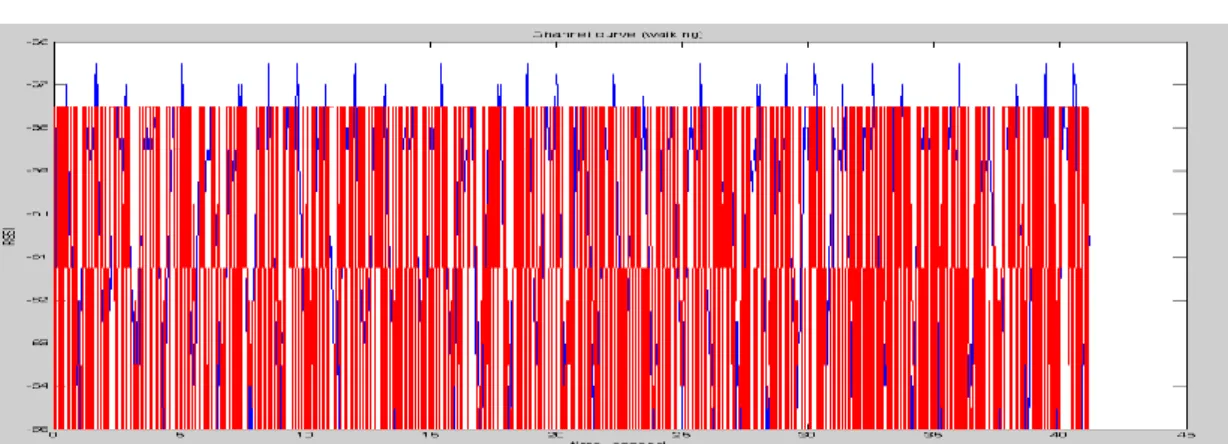
The simulation model of WBAN considers a fully connected network with a simple-star WBANs and multiple WSNs per WBAN. Each WSN has only traffic stream. The WSN continuously transmits the data signals to CPN. A simple non real-time service is considered in this study. In order to consider the most common WBAN channel condition including human body in walking mode and sleeping mode. In practice, we also consider the most common wearing habit under different WBAN environment. The transmitting WSN device is in the left chest and the receiving CPN device is behind the human body in the sleeping mode. Each WSN transmits signals at 3.8 Kbps (128 bytes per 270 ms packet). On the other side, while in walking mode, the transmitting WSN device is also in the left chest but the receiving CPN device is in the pocket which in the pants. Each WSN transmits signals at 38 Kbps (128 bytes per 27 ms packet). Because of the device limited, in order to make the simulation more precisely, the different transmission rate is considered to be concern. Figure 9 to Figure 11 indicate how WBAN channel differs in different conditions. As shown in Figure 9, the behavior in walking mode has lasted for 41 seconds, measured in the
19
normal walking. Figure 10 shows the behavior in walking mode has lasted for about 5 minutes, measured in the random walking.
Figure 9 The behavior of walking mode has lasted for 41 seconds in channel measurement
Figure 10 The behavior of walking mode has lasted for 5 minutes in channel measurement
20
In addition, Figure 11 shows the behavior of sleeping mode has lasted for about 23 minutes while in bed.
Figure 10 The behavior of sleeping mode has lasted for 23 minutes in channel measurement
According to the Figure shown above, whether the WBAN channel is in the walking mode or the sleeping mode, the changes in the RSSI indicate that the conditions in the wireless link between CPN and WSN are changing, and it might be necessary to adapt the transmission rate accordingly.
The performance metrics considered in the simulation are defines as follows: Total Energy consumption: The energy consumption between the successful
packet transmission and the retransmission of the failed packet transmission. Under using BPSK, total packet success rate: The fraction of total success packet
21
Under using QPSK, total packet success rate: The fraction of total success packet transmission caused by using QPSK modulation scheme.
Total throughput: The total throughput is the sum of the success using BPSK transmission and the success using QPSK transmission throughput of the non real-time data traffic.
Before discussing the simulation results, several assumptions are also made for this study:
The RSSI range has the multiple stability mapping will be considered for all of the comparisons.
The transmission channel is not error free. A packet loss happens depends on the using modulation scheme type and the mapped channel condition instantly. The retransmission of the loss packet will be considered as long as a packet loss
happens, and the BPSK modulation scheme is also be used immediately.
5.2 Simulation Results
Based on the model mentioned as the last sub-section, the simulations aimed to the comparisons among RBAR (Receiver-Based Auto Rate), AARF (Adaptive ARF), and the proposed rate adaptation mechanism in the three different conditions:
(1) the walking mode for 41 seconds.
(2) the walking mode for about 5 minutes, and (3) the sleeping mode for 23 minutes or so.
5.2.1 The walking mode for 41 seconds
Recall that there are two main approaches can be indentified in the design of rate adaptation schemes : (i) signal-strength-based algorithm, and (ii) statistics-based algorithms. In the former case, the rate adaptation algorithm relies on wireless signal
22
measurements, such as Signal-to-Noise Ratio (SNR) or Received Signal Strength Indicator (RSSI) to infer the transmission rate that would provide the best performance. Depending on whether they use the feedback from the receiver, the rate adaptation schemes are also classified into two categories: closed-loop and open-loop approaches. RBAR is a well-known closed-loop rate adaptation scheme and signal-strength-based algorithm, and ARF is the representative open-loop rate adaptation scheme. With open-loop approaches, a transmitter makes the rate adaptation decision solely based on its ACK information. Adaptive ARF (AARF) is proposed to alleviate the inefficiency of ARF due to the automatic attempt of new rates every ten successfully transmissions.
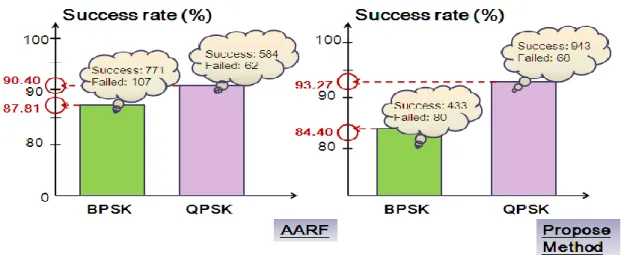
Figure 12-1 shows the packet success rate of RBAR and our proposed schemes, and the following is the AARF and our proposed schemes in Figure 12-2.
23
Figure 12-2 Packet success comparison with AARF
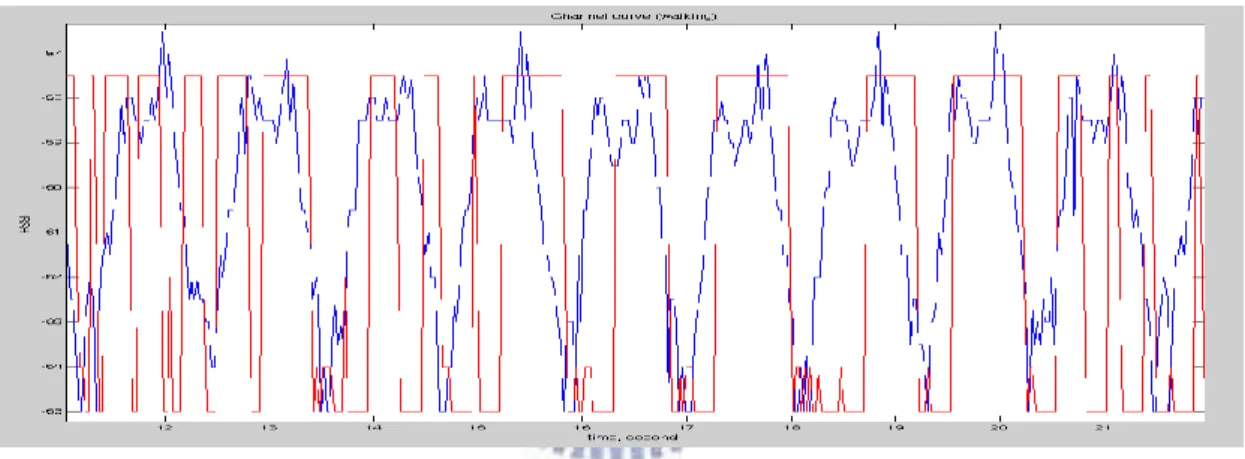
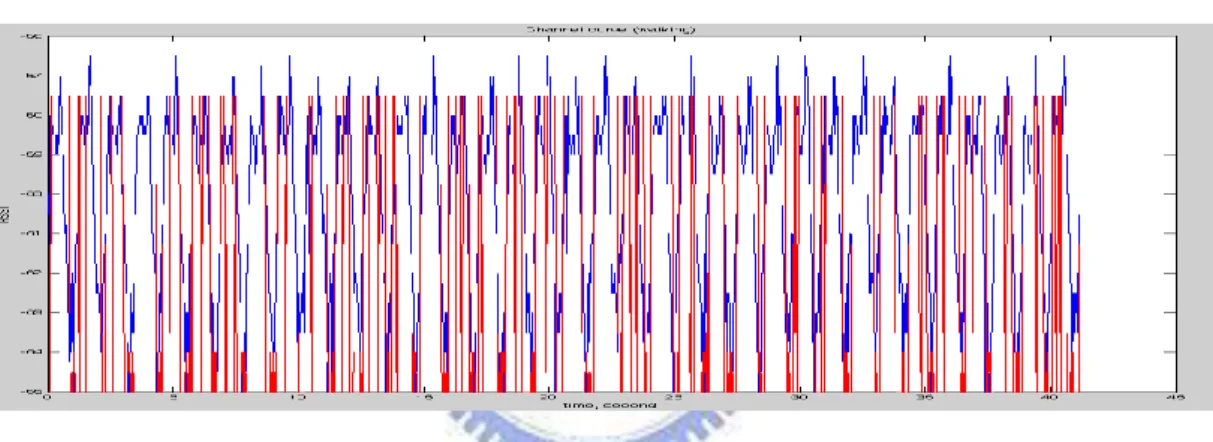
No matter comparison with the RBAR or AARF, our proposed mechanism can make the modulation scheme used under the desirable channel condition as far as possible. That is why the using times of QPSK and BPSK in our mechanism have some difference, but those remain maintain a certain success rate. Next, Figure 13-1 and Figure 13-2 illustrate the modulation schemes used in a certain channel region derived from the RBAR and the proposed scheme respectively, and Figure 13-3 and Figure 13-4 illustrate the modulation schemes used throughout the whole channel derived from the RBAR and the proposed scheme respectively,. Figure 13-3 and Figure 13-4 show the difference between RBAR and proposed scheme clearly. Our proposed scheme can judge the timing of getting into the worse channel condition or better channel condition, and the rate adaptation mechanism will get higher link utilization. On the other hand, Figure 14-1 to Figure 14-4 concerned with the comparison of modulation scheme under the AARF and the proposed scheme. Likewise, the results shown in Figure 14-1 and Figure 14-2 are derived from a certain channel region respectively; Figure 14-3 and Figure 14-4, throughout the whole channel. Either the RBAR or AARF, our rate adaptation mechanism always get higher link utilization.
24
Figure 13-1 The modulation scheme used under the RBAR in a certain channel region
Figure 13-2 The modulation scheme used under the proposed scheme in a certain channel region
Figure 13-3 The modulation scheme used under the RBAR throughout the whole channel
25
Figure 13-4 The modulation scheme used under the proposed scheme throughout the whole channel
Figure 14-1 The modulation scheme used under the AARF in a certain channel region
Figure 14-2 The modulation scheme used under the proposed scheme in a certain channel region
26
Figure 14-3 The modulation scheme used under the AARF throughout the whole channel
Figure 14-4 The modulation scheme used under the proposed scheme throughout the whole channel
Next, as we mentioned before, our mechanism which takes adaptive rate switching into consideration to instantly resist the channel variations and best utilize the channel bandwidth. Consequently, energy consumption and throughput can be improved by using the most suitable data transfer rate, which is shown in Figure15 and Figure16 respectively.
27
Figure 15 Total energy consumption comparison
Figure 16 Throughput comparison
5.2.2 The walking mode for about 5 minutes
It is found that our proposed rate adaptation mechanism can instantly resist the channel variations and best utilize the channel bandwidth. This sub-section further compares the proposed mechanism to the other mainly rate adaptation schemes
28
including RBAR and AARF in the walking mode for about 5 minutes. To highlight the feature of adaptive rate switching of the proposed rate adaptation mechanism, the simulation scenario of walking mode in 5 minutes is involved with the complicated walking motions, such as irregularly hand waving.
Figure 17-1 shows the packet success rate of RBAR and our proposed schemes, and the following is the AARF and our proposed schemes in Figure 17-2. Both Figure show that the using times of QPSK and BPSK in our mechanism have some difference, and those remain maintain a certain success rate.
29
Figure 17-2 Packet success comparison with AARF
As the simulation result before, Figure 17-1 and Figure 17-2 also show that our proposed mechanism can make the modulation scheme used under the desirable channel condition. Next we focus on the channel condition after the 200th second. The channel condition of this period mostly has the higher RSSI value, and the Figure 18-1 and Figure 18-2 show the difference of the RBAR scheme and the proposed scheme. Unlike the RBAR scheme, with the period of this channel condition, the proposed mechanism make the transmitter WSN using the QPSK modulation scheme. Figure 18-3 and Figure 18-4 also show the same result.
30
Figure 18-2 The modulation scheme used under the proposed scheme after the 200th second
Figure 18-3 The modulation scheme used under the AARF after the 200th second
Figure 18-4 The modulation scheme used under the proposed scheme after the 200th second
Obviously, the proposed scheme can judge the timing of getting into the worse channel condition or better channel condition, and the rate adaptation mechanism
31
will get higher link utilization. We check the performance of the RBAR and ARF schemes to compare with our proposed scheme. Under the same simulation environment, the performance revealed that our proposed scheme would first estimate the channel conditions, and then switch the transmission mode to the more power-efficient one. It immediately reacts to the change in the wireless channel conditions. Figure 19 and Figure 20 also show that the energy consumption and throughput can be improved by using the most suitable data transfer rate.
Figure 19 Total energy consumption comparison
32
5.2.3 The sleeping mode for about 23 minutes
The characteristics and the comparisons of both rate adaptation schemes have been addressed in the last two sub-sections. The simulations showed the proposed rate adaptation mechanism outperforms the RBAR and AARF scheme in the both walking conditions – the walking mode for 41 seconds and the walking mode for about 5 minutes. Nevertheless, we need to consider the channel condition of static state, which can make the proposed mechanism more reliable. As shown in Figure 21-1 and Figure 21-2, in the channel condition of sleeping mode, no matter
comparison with the RBAR or AARF, our proposed mechanism can make the modulation scheme used under the desirable channel condition as far as
possible. That is why the using times of QPSK and BPSK in our mechanism have some difference, but those remain maintain a certain success rate. Thus, our proposed mechanism can be adaptative to the transmission modes under the channel condition of the sleeping mode.
33
Figure 21-2 Packet success comparison with AARF
Next we focus on the channel condition between the 400th second and 500th second. The channel condition of this period has the lower RSSI value, and the Figure 22-1 and Figure 22-2 also show the difference of the RBAR scheme and the proposed scheme. Unlike the RBAR scheme, with the period of this channel condition, the proposed mechanism make the transmitter WSN using the BPSK modulation scheme. Figure 22-3 and Figure 22-4 also show the same result.
Figure 22-1 The modulation scheme used under the RBAR between the 400th second and the 500th second
34
Figure 22-2 The modulation scheme used under the proposed scheme between the 400th second and the 500th second
Figure 22-3 The modulation scheme used under the AARF between the 400th second and the 500th second
Figure 22-4 The modulation scheme used under the proposed scheme between the 400th second and the 500th second
35
Similarly, the evaluation results show that our proposed scheme can adaptively and instantly choose the best transmission rate to send. The channel in the proposed scheme can be utilized efficiently. We compare the RBAR and AARF schemes with our proposed scheme. After the comparisons, the result has proved again that our proposed scheme has ability to adjust its transmission mode according to the different channel conditions. It immediately reacts to the change in the wireless channel conditions. Therefore, Figure 23 and Figure 24 show that the energy consumption and throughput can be improved by using the most suitable data transfer rate. As shown in Figure 23 , our proposed mechanism can save the total energy consumption up to 50 percent compared with the AARF scheme.
36
37
CHAPTER 6
CONCLUSION
In the present study, we have proposed a innovative link adaptation algorithm for WBAN, which selects the best rate for a particular packet transmission based on the Received Signal Strength calculated in used buffer. The algorithm has been evaluated via simulation and compared with the analytical results. The simulation results showed that the proposed algorithm significantly outperforms the existing adaptive schemes in WBAN channels. We also have observed that our algorithm achieves the minimum energy consumption and maximum throughput based on the analysis in most cases. We suggests that the comparison between our proposed algorithm and some other existing algorithms be further examined in the future.
38
REFERENCES
[1] B. Gyselinckx, C. Van Hoof, J. Ryckaert, R. F. Yazicioglu, P. Fiorini, V. Leonov, "Human++: autonomous wireless sensors for body area networks." in Proc.
IEEE CICC’05, Sept. 2005, pp. 13-19.
[2] J. Y. Yu, C. Y. Yu, S. B. Huang et al., "A 0.5V 4.85Mbps Dual-Mode Baseband Transceiver with Extended Frequency Calibration for Bioteltmetry Applications," in Proc. 2008 ASSCC, Nov. 2008.
[3] P. Chevillat, J. Jelitto, and H. L. Truong. Dynamic data rate and transmit power adjustment in IEEE 802.11 wireless LANs. International Journal of Wire-
less Information Networks, 12(3), July 2005.
[4] IEEE 802.11 Working Group, “Part 11: Wireless LAN Medium Access Control (MAC) and Physical Layer (PHY) Specifications,” ANSI/IEEE Std. 802.11, Sept. 1999.
[5] IEEE 802.11 Working Group, “Part 11: Wireless LAN Medium Access Control (MAC) and Physical Layer (PHY) Specifications: Higher-speed Physical Layer Extension in the 2.4 GHz Band,” ANSI/IEEE Std. 802.11b-1999, 1999.
[6] IEEE 802.11 Working Group, “Part 11: Wireless LAN Medium Access Control (MAC) and Physical Layer (PHY) Specifications High-speed Physical Layer in the 5 GHz Band,” ANSI/IEEE Std 802.11a-1999, 1999.
[7] IEEE 802.11 Working Group, “Part 11: Wireless LAN Medium Access Control (MAC) and Physical Layer (PHY) Specifications Amendment 4: Further Higher Data Rate Extension in the 2.4 GHz Band,” ANSI/IEEE Std 802.11g-2003, 2003. [8] B.G. Steele, B. Belza, K. Cain, C. Warms, J. Coppersmith, J. Howard, “Bodies in
motion: Monitoring daily activity and exercise with motion sensors in people with chronic pulmonary disease,” Journal of Rehabilitation Research & Development, Sep/Oct 2003, Supplement 2, 40(5): 45 – 58.
[9] E. Jovanov, A. Milenkovic, C. Otto, P. De Groen, B. Johnson, S. Warren, and G. Taibi “A WBAN System for Ambulatory Monitoring of Physical Activity and Health Status: Applications and Challenges,” in this Proceedings.
[10] National Chiao Tung University, Hsinchu, Taiwan, “u-PHI Wireless Body Area Network Core Technology,” Ministry of Economic Affairs academic in
industrial technology development plan, July 2006
[11] Jamil Y. Khan, Mehmet R. Yuce, and Farbood Karami, “Performance evaluation of a Wireless Body Area sensor network for remote patient monitoring,” Engineering in Medicine and Biology Society, 2008. EMBS 2008. 30th Annual International Conference of the IEEE, Aug 2008
39
[12] ShihHeng Cheng and ChingYao Huang, “Power model for wireless body area network,” Biomedical Circuits and Systems Conference, 2008. BioCAS 2008. IEEE, Nov 2008
[13] G.Holland, N. Vaidya, and P. Bahl, “A rate-adaptive mac protocol for multi-hop wireless networks,” In Mo-biCom '01: Proceedings of the 7th annual interna-tional conference on Mobile computing and networking, pages 236-251. ACM, 2001.
[14] X. Qin, R. Berry, “Exploiting multiuser diversity for medium access control in wireless networks,” INFOCOM 2003, vol. 2, pp. 1084-1094,30 March-3 April
2003.
[15]A. Kamerman and L. Monteban. WaveLAN-II: A high-performance wireless LAN for the unlicensed band. Bell Labs Technical Journal, 2(3):118-133, 1997.
[16]M. Lacage, M. H. Manshaei, and T. Turletti, “ IEEE 802.11 Rate Adaptation: A Practical Approach,” In Proc. MSWiM’04, pages 126–134, Venice, Italy, 2004. [17]MadWifi driver documentation. Onoe Rate Control.
![Figure 2 Wireless body area network (WBAN) [12]](https://thumb-ap.123doks.com/thumbv2/9libinfo/8612097.190794/14.892.217.705.450.713/figure-wireless-body-area-network-wban.webp)
![Figure 5 The structure of RBAR [13]](https://thumb-ap.123doks.com/thumbv2/9libinfo/8612097.190794/18.892.232.666.156.394/figure-the-structure-of-rbar.webp)