Evaluation of Hirsutella sinensis mycelium on food safety and
anti-hepatoma activity in an animal model
HUNG-SHENG SHANG1, JASON CHOU2, MING-FANG WU5, YUNG-LUEN SHIH6,7,8, MING-YANG YEH 3, HSUEH-YU CHUNG9, HSU-FENG LU4,7, NIEN-CHIEH LIAO4, JIA YOU LIU4, SHU-CHING HSUEH 4* AND JING-GUNG CHUNG10,11*
1Department of Pathology, National Defense Medical Center, Division of
Clinical Pathology, Tri-Service General Hospital, Taipei, Taiwan; R.O.C; Departments of 2Anatomical Pathology, 3Department of Office of Director,
4 Clinical Pathology, Cheng Hsin General Hospital, Taipei, Taiwan,
R.O.C.;
5National Taiwan University College of Medicine Animal Medicine Center,
Taipei, Taiwan, R.O.C;
6Department of Pathology and Laboratory Medicine, Shin Kong Wu Ho-Su
Memorial Hospital, Taipei Taiwan, R.O.C.
7School of Medical Laboratory Science and Biotechnology, Taipei Medical
University, Taipei, Taiwan, R.O.C.
8School of Medicine, Fu-Jen Catholic University, New Taipei City, Taiwan,
R.O.C.
9Jen-The Junior College of Medicine, Nursing and Management, Miaoli
County, Taiwan, R.O.C
10Department of Biological Science and Technology, China Medical
University, Taichung Taiwan, ROC;
11Department of Biotechnology, Asia University, Taichung 413, Taiwan,
R.O.C.
Running title: Evaluation of Hirsutella sinensis mycelium.
*These Authors contributed equally to this work.
*Correspondence to: Jing-Gung Chung, Ph.D., Department of Biological
Science and Technology, China Medical University. No 91, Hsueh-Shih Road, Taichung 40402, Taiwan. Tel: +886 4 2205 3366 ext 2161, Fax:
+886 4 2205 3764, e-mail: [email protected]
Hospital, No. 45 Cheng Hsin St., Taipei 112, Taiwan, R.O.C. E-mail: [email protected]
Abstract. There is evidence that Hirsutella sinensis may have antitumor
activity. The aim of this study was to determine the anti- hepatoma effects and food safety assessment of Hirsutella sinensis mycelium in vivo and in vitro. Effects on mutagenicity were determined using a bacterial reverse mutation
assay employing the Salmonella typhimurium strains TA98, TA100, TA102, TA1535
and TA1537. There were no dose-dependent increases or decreases in the number of colonies both with and without metabolic activation S9 in AMES tests. Mice were inoculated with SK-Hep 1 cells and those developing tumors were treated with three different concentrations of Hirsutella sinensis mycelium. After 6 weeks blood samples were collected and liver pathology determined. AST levels were significantly different only in the low dose treatment group (106±27 IU/L, p=0.048) as compared with the control group (162±80 IU/L). The tumor weight was significantly different only in low dose treatment group. We found that necrosis, hemorrhages and calcifications were presented in control and experiment groups. Inhibition of tumor growth was observed only for the lowest dose.
Key Words: Hirsutella sinensis, hepatoma, mutagenicity, food safety, animal model.
Cancer is a major public health problem and its incidence and mortality rates continue to increase worldwide. A 2008 report of the World Health Organization (WHO) estimated that 12.7 million people were diagnosed with cancer and 7.6 million people died from cancer all over the world. The WHO predicts that by 2030 an estimated 21.4 million new cases of cancer and 13.2 million cancer deaths will occur annually around the world . Liver cancer is the sixth most common cancer in the world, with 750,000 new cases diagnosed in 2008. This accounted for about 6% of the total number of cases of cancer in 2008. Mongolia has the highest rate of liver cancer, followed by the Gambia and Taiwan . It has been shown that cancer treatment using herbal medicines in combination with chemo- or radio-therapy can enhance the efficacy of and diminish the side effects and complications caused by chemo- and radio-therapy . Over the past few years, the use of complementary and alternative medicine (CAM) has gained greater acceptance among cancer patients in Western countries with prevalence as high as 80% . Traditional Chinese medicine (TCM) and herbal medicines in particular have been used in the treatment of cancer for thousands of years in China, Japan, and other Asian countries. These medicines are widely accepted as current forms of CAM in cancer treatment in the United States and Europe .
Mushrooms have been used as an important nutritional food and therapeutic agent throughout the world . Mushroom extracts are common sources of immunological, hypocholesterolemic, antiviral, antibacterial, anti-carcinogenic, anti-inflammatory and antiparasitic activities . There are many reports on mushrooms containing more than one polysaccharide with
antitumor activity. The mushrooms credited with success against cancer belong to the genus Phellinus, Pleurotus, Agaricus, Ganoderma, Clitocybe, Antrodia, Trametes, Cordyceps, Xerocomus, Calvatia, Schizophyllum, Flammulina, Suillus, Inonotus, Inocybe, Funlia, Lactarius, Albatrellus, Russula, and Fomes . The mushroom anti-cancer compounds have multiple effects such as reactive oxygen species induction, mitotic kinase inhibitor, anti-mitotic, angiogenesis inhibitor, topoisomerase inhibitor leading to a
reduction in cancer proliferation .
Recent studies indicate that Hirsutella sinensis has a wide range of biological activities, including tumor, immunomodulatory,
anti-inflammatory, anti-oxidant, anti-infection, and anti-aging properties . Hirsutella sinensis possesses antitumor activity as seen in studies on
prostate (PC3), breast (MCF7), hepatocellular (HepG2, Hep3B), colorectal (HT-29) and HCT 116), and HL-60 cells (refs). There have not been any published reports on SK-Hep 1 hepatoma cells in SCID mice . The aim of the present study was to examine whether Hirsutella sinensis mycelium was effective against tumor-bearing mice and to determine whether the treatment effect was dependent on the concentration of Hirsutella sinensis mycelium.
Materials and Methods
Preparation of Hirsutella sinensis mycelium solution for AMES test. Hirsutella sinensis mycelium powder (500 mg) manufactured by Chang Gung Biotechnology Corporation, Ltd. In Taipei, Taiwan, R.O.C. and 10 ml distilled water were mixed thoroughly and filtered (0.22 μm pore size) to provide a
solution with a concentration of 50 mg/ml. A series of concentrations was prepared from this stock solution by dilution, namely 3 mg/ml, 6 mg/ml, 12 mg/ml, 25 mg/ml and 50 mg/ml.
Bacterial strains. Bacterial strains were provided by the Food Science Institute, Hsinchu, Taiwan. The strains used were Salmonella typhimurium TA98, TA100, TA102, TA1535, and TA1537. Strains were prepared by preculturing for 8 hr at 37˚C in a nutrient broth. Strain properties, including their susceptibility to mutagens, were confirmed prior to use in the assays by the National Taiwan University College of Medicine Animal Medicine Center, Taipei, Taiwan.
Preparation of liver S9 fractions. Rats treated with enzyme-inducing agent β-naphthoflavone were sacrificed by spinal dislocation. Briefly, rat livers were removed, placed in beakers on ice, rinsed with ice-cold homogenization KCl (1.15%) buffer, minced with scissors and then placed in 4 vol. of ice-cold KCl buffer and homogenized with a tissue grinder. The homogenate was transferred to a close-fitting (0.045 mm clearance) Perspex [poly (methyl methacrylate)]/glass homogenizer and homogenized. After diluting the homogenate to 10% with the homogenization buffer and centrifuged at 9000× g, the microsomal pellets were
suspended in KH2PO4 buffer PH 7.4 and stored at -80˚C.
Bacterial reverse mutation (Ames) assay. The Ames test was used to examine the mutagenicity of Hirsutella sinensis mycelium. For the plate incorporation method, without metabolic activation, 0.1 ml of the test solutions of various concentrations of Hirsutella sinensis mycelium, 0.1 ml of fresh bacterial broth and 0.5 ml of sterile buffer were mixed with 2.0 ml of overlay agar. For the assay
with metabolic activation, 0.5 ml of metabolic activation mixtures containing an adequate amount of post-mitochondrial fraction was mixed with the overlay agar (2.0 ml), together with the bacteria and test solution. The contents of each tube were mixed and poured over the surface of a plate with minimal glucose agar. The overlay agar was allowed to solidify before incubation. The plate was incubated for 48 h at 37˚C and the number of reverting colonies was then counted. All plates in a given assay were incubated at 37˚C for 48 h. After the incubation period, the number of reverting colonies per plate was counted. Agar solvent was used a negative control. The positive control without S9 fraction consisted of 0.5 μg/plate of 4-nitro-o-phenylenediamine for TA98; 4 μg/plate of sodium azide for TA100 and TA 1535 strains; 0.5 μg/plate of mitomycin C for TA102 strain; and 80 μg/plate of 9-aminocridine for TA1537 strain; for any with S9 fraction, 5 μg/plate of benzo[a] pyrene was used for TA98, TA102 and TA1537 strains, and 8 μg/plate of 2-aminoanthracene for TA100 and TA1535 strains. Mutagenicity was evaluated based on the rule reported previously by Claxton et al. . The value of the positive control should be significantly higher than that of the negative control. Mutagenicity was judged to be positive when the revertants in the test plates increased more than two-fold compared with those of the negative control.
Preparation of Hirsutella sinensis mycelium with three different doses for anti-hepatoma activity. We suspended Hirsutella sinensis mycelium powder (manufactured by Chang Gung Biotechnology Corporation, Ltd. In Taipei, Taiwan, R.O.C.), in 0.2 mL distilled water at 50˚C for 10 min, then cooled to room temperature and left for 1 h with 200 rpm stirring to form treatment three different doses of solutions (low dose 184.5 mg/kg/day;
medium dose 369 mg/kg/day; high dose 553.5 mg/kg/day) .
Animals. SCID mice aged 6 weeks and used in the present study were maintained according to the recommendations of the guidelines approved up by the National Science Council of the Republic of China and the Ethical and Health Research Committee of the Institute of Biosciences. Experiments are performed according to law, regulations and guidelines for animal experiments in Taiwan. The experimental protocol used complied with the principles for Institutional Animal Care and Use Committee of Chen Hsin General Hospital (Taipei, Taiwan, R.O.C.). SCID mice were obtained from the BioLASCO Taiwan Co., Ltd. Animals were earmarked, housed in an air conditioned animal room at 22±3˚C, relative humidity 55±15%, and kept under a 12:12 hours light/dark cycle (light from 9 a.m. to 9 p.m.) for a 2-week acclimatization period before the experimental treatments. Mice recived autoclaved water and laboratory pellet chow ad libitum .
Study design and Hirsutella sinensis mycelium treatment. Mice were subcutaneously (s.c.) inoculated with SK-Hep 1 cells (3×10⁷ cells/mouse) in the hind limb dorsal area. After 2-3 weeks (week 0) of cell implantation, mice with tumors of 1-3 mm in diameter were divided into 4 groups of 10 mice per group. Group 1 was the control group without any treatment. Groups 2-4 were administrated a low dose 184.5 mg/kg/day, medium dose 369 mg/kg/day or high dose 553.5 mg/kg/day dose of Hirsutella sinensis mycelium respectively. After 6 weeks surviving animals sacrificed. Levels
of GOT, GPT and VEGF (vascular endothelial growth factor) were determined in serum. Tumor properties (size, weight, pathology) was
determined.
Serum AST, ALT, T-bil, ALB, TP, T-CHO, TG, HDL-C, LDL-C and VEGF levels determination. Peripheral venous blood samples were drawn into sterile glass tubes (Vacutainer, Becton Dickinson, USA) in the morning around 8 or 9 hours after an overnight fast. Blood samples were allowed to coagulate at room temperature for 30 minutes then centrifuged at 1,800 ×g for 10 .Serum was separatedand stored at -70°C until assayed. A DxC 800 clinical chemistry analyzer and reagents manufactured by Beckman, Inc. (U.S.A.) were used to determine serum AST (aspartate aminotransferase), ALT (alanine aminotransferase), T-bil (total bilirubin), ALB (albumin), TP (total protein), T-CHO (total cholesterol), TG (triglyceride), HDL-C (high density lipoprotein-cholesterol), LDL-C (low density lipoprotein- cholesterol) levels. Murine serum VEGF concentrations were determined using a commercially available enzyme-linked immunoassay (ELISA) kit (900-M99 PeproTech U.S.A.) according to the manufacturer's instructions.
Tissue processing and histology. At the end of the experiments (after 6 weeks’ treatment), the survival rate will be assessed. Tumors were rapidly removed and fixed in formalin. The fixed tissue was embedded in paraffin wax, and sliced into transverse sections. Tissue samples were rinsed with 0.9% saline solution, fixed in 10% formalin and processed as follows: (1) 10% neutral buffered formalin for 1 h, twice; (2) 70% alcohol for 1.5 h; (3) 80%
alcohol for 1.5 h; (4) 90% alcohol for 1.5 h; (5) absolute alcohol for 1.5 h, twice; (6) xylene for 1.5 h, twice; (7) in molten wax at 65°C for 2.5 h. The processed tissue was embedded in paraffin and sectioned at 4 microns thickness, placed on frosted glass slides and dried on a 70°C hot plate for 30 minutes. The tumor slices were stained using the hematoxylin and eosin (H&E) stains and visualized using a Lecia TP1020 microscope.
Statistical analysis. Statistical analysis for comparison between two groups was performed using student’s t -test. Data are expressed as means ± standard deviations
(SD). The level of significance used was P <0.05.
Results
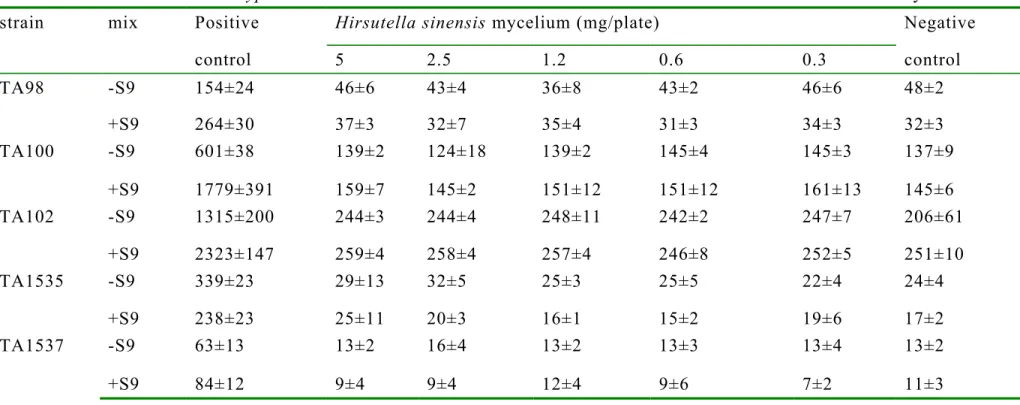
Table 1 shows the mean number of revertants/plate after treatment with the five concentrations of Hirsutella sinensis mycelium, observed in S. typhimurium strains TA98, TA100, TA102, TA1535 and TA 1537in the presence (+S9) and absence (-S9) of metabolic activation by the Ames test. There was no effect on bacterial growth and mutagenic activity was considered negative.
After six-week Hirsutella sinensis mycelium treatment of the mice , the survival rates were: control 100%; low dose 100%; medium dose 80%; and
high dose 80%.
Following SK-Hep 1 inoculation to initialize hepatoma (Figure 1A), mice were orally treated with different doses of Hirsutella sinensis mycelium. After 6 weeks of treatment, blood specimens were collected from all survivors and then sacrificed, and tumor characteristics determined (Figure 1B).
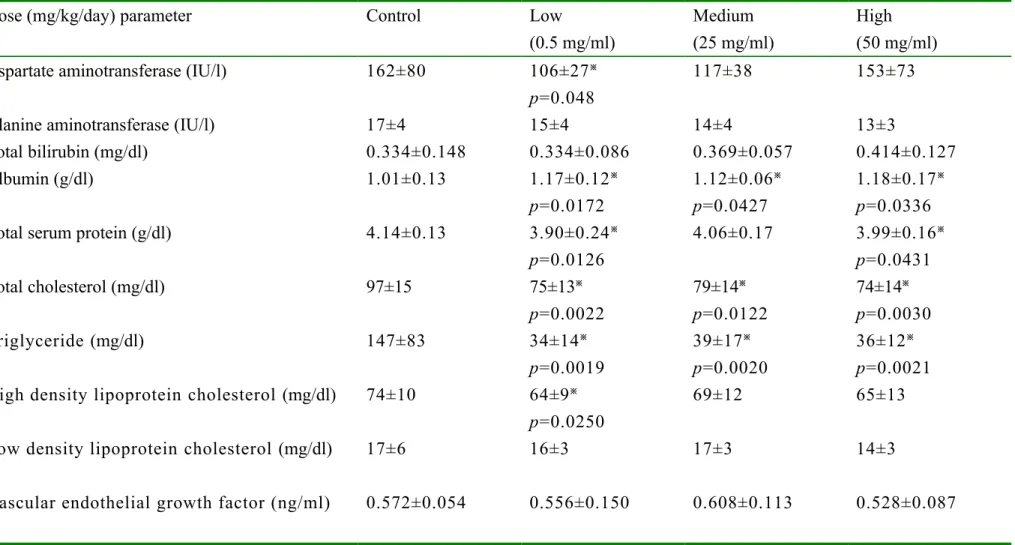
AST was significantly different only in the low dose treatment group (106±27 IU/L, p=0.048) compared with the control group (162±80 IU/L) after the 6-week treatment. Although the AST in the control and medium dose treatment (117±38 IU/L) were different, this was not statistically significant. Mice treated with increasing doses of Hirsutella sinensis mycelium did not exhibit any differences in serum ALT and T-bil concentrations as compared with control mice (Table 2). Albumin levels were higher in the Hirsutella sinensis mycelium treated mice than the control group (Table 2). The blood TP concentrations were significantly lower in the low high dose groups than the control group (Table 2). Hirsutella sinensis mycelium treatment also reduced serum T-CHO and TG concentrations. HDL-C and LDL-C concentration were generally not affected except a lower HDL-C levels at the low dose treatment (p=0.0250) as compared with control mice. VEGF levels were not altered by Hirsutella sinensis mycelium treatment (Table 2).
The average tumor weights of control, low, medium and high dose treatment groups were 4.81 ± 1.84g, 2.66 ±1.48, 3.62±1.83 and 3.59±2.23, respectively. Hirsutella sinensis mycelium treatment reduced tumor weight at all does but only the low dose was significantly different as compared with the control group (p=0.0078).
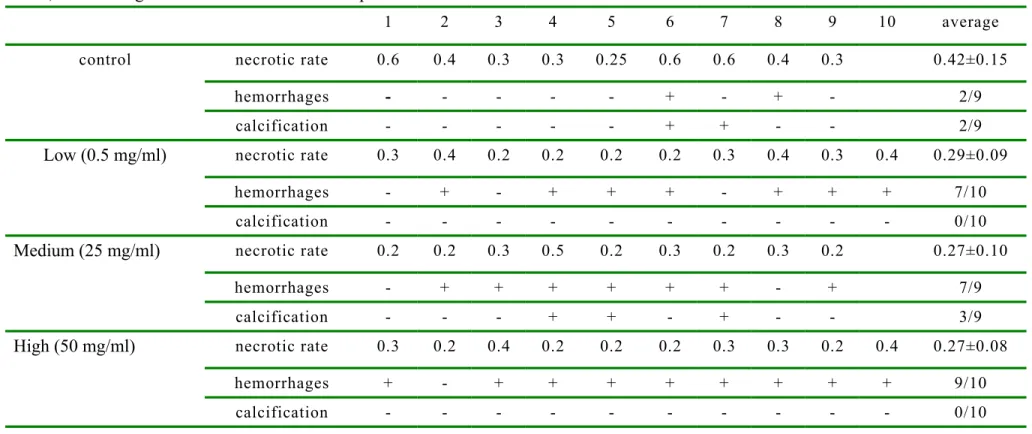
Representative parts of tumors were taken and stained with H&E. The tumor cells were arranged in trabecular, glandular or island patterns with hyperchromatic coarse chromatin and eosinophilic cytoplasm. Variable percentages of scattered necrotic areas characterized by eosinophilic cells debris palisaded by viable tumor cells were observed. Recent and old
hemorrhages and calcification were also found in the center of certain necrotic areas in some experimental groups (Table 3).
Discussion
Previously used in commercial products as potential carcinogens were evaluated via Ames test. Some certain identified mutagens were considered possible carcinogens, and previous studies showed that 90% of known carcinogens may be identified by this test . The test is useful as a screening tool for setting priorities because it is an inexpensive and quick way to help single out chemicals that should be subjects of further testing. We strongly suggest that mutagens identified in the Ames test required for further tests such as chromosome aberration tests, micronucleus test and mouse lymphoma assay because Salmonella typhimurium is not a eukaryote, and therefore it is considered to be not a perfect model for humans. In order to mimic the mammalian metabolic conditions, rat liver S9 fraction was applied but limited by its availability, previously. Fortunately, it is now available commercially and therefore may be more feasible.
Cancer is the largest single cause of death in both men and women, claiming over 6 million lives each year worldwide. Anti-cancer drugs such as 5-fluorouracil derivatives, cisplatin, mitomycin, adriamycin, taxol, etc., have been used extensively for the treatment of certain types of cancer. However, these drugs are associated with side effects such as severe gastrointestinal toxicity, and leucopenia and immune suppression that can impact on patient compliance. After the removal of a malignant tumor by surgical operation, radiation therapy and/or adjuvant therapy with cancer chemotherapy drugs may be curative. However, the removal of certain
cancers, for example, breast carcinoma, colon carcinoma and osteogenic sarcoma, may be followed by the rapid growth of distant metastases to lung, liver etc. Therefore, it is necessary to develop new anticancer agents with antitumor and antimetastatic activities but without adverse reactions such as gastrointestinal toxicity, myelotoxicity and immune suppression caused by cancer chemotherapeutic drugs.
Effectiveness is not only important for traditional Chinese medicine (TCM), but for all medical systems. Clinical research in TCM has been developed relatively later. Largely due to the many existing methodological defects of TCM trials, the efficacy of TCM remains controversial . All these issues have created a bottleneck in the development of TCM. There is a growing recognition that more attention has been paid to enhance the quality in clinical research of TCM. Especially in this decade, a new discipline, clinical evaluation of TCM, has formed into being and its development has been supported by the Chinese Major Science and Technology Projects. Owing to concerted efforts from a panel of experts with multidisciplinary background, the quality of clinical research of TCM has been improved, in terms of the construction of clinical research platform and the introduction of process
management.
Several recent studies report that Hirsutella sinensis may have tumor effects, immunomodulatory, inflammatory, oxidant, anti-infection, and anti-aging properties . In the present study, experiments were carried out to examine the effects of Hirsutella sinensis mycelium on inhibition of tumor growth in tumor-bearing mice. We observed that only a low dose treatment was capable of inhibiting tumor growth compared with higher doses. This study failed to find evidence that Hirsutella sinensis
mycelium is capable of inhibiting tumors induced by SK-Hep 1 cells in dose dependent manner. Overdose treatment may cause the opposite effect. Considering that medicinal herbs contain complex mixtures of thousands of components that can act alone or synergistically, we may say that not all the single compoents of Hirsutella sinensis mycelium will do us good for health. For instance, although Agaricus blazei Murrill Extract (ABM) is traditionally concerned to treat cancer, it contains a number of aromatic hydrazines, among which the most abundant is agaritine, β-N-(γ-L(+) glutamyl)-4-(hydroxymethyl) phenylhydrazine . Agaritine has been shown to induce adenomas
and adenocarcinomas in the lungs of mice .
There are several of natural and cultured Cordyceps species inclusive of militaris, sinensis, gracilis, ciecadae and so on. By using carbohydrate gel electrophoresis (PACE) and high performance thin layer chromatography (HPTLC) analysis, different species of natural and cultured Cordyceps can be differentiated based on the saccharide mapping . We cannot jump to the conclusion whether different species are able to
inhibit tumor growth or not.
There are a variety of liver medicines. Unfortunately, few of them are actually used successfully in humans . Over the past several years, my colleague tried our best to find some herbal therapies to cure patients with liver cancer, which is high prevalence rate in my country Taiwan. From the above, we may conclude that proper dose treatment will be more effective to inhibit tumor growth than overdose. Dedicated research should be undertaken to isolate, purify and structural investigation of novel anti-cancer and immune-stimulator compounds. Studies to date have identified a
number of compounds and elucidated underlying mechanism. However, research is needed to elucidate the different roles of multiple active compounds and the pathways involved. The present results and data might provide new insights into the possible therapeutic uses of Hirsutella sinensis mycelium and helpful suggestions for the design of anti-tumor drugs from Hirsutella sinensis mycelium combating cancer.
Acknowledgement
This study was supported by the grant CH10 2-59 from Cheng Hsin General Hospital.
Reference
1 Yeh MY, Wu MF, Shang HS, Chang JB, Shih YL, Chen YL, Hung HF, Lu HF, Yeh C, Wood WG, Hung FM and Chung JG: Effects of chitosan on xenograft models of melanoma in C57BL/6 mice and hepatoma formation in SCID mice. Anticancer Res 33: 4867-4873,
2013.
2 Prasad S, Ravindran J and Aggarwal BB: NF-kappaB and cancer: how intimate is this relationship. Mol Cell Biochem 336: 25-37,
2010.
3 Urruticoechea A, Alemany R, Balart J, Villanueva A, Vinals F and Capella G: Recent advances in cancer therapy: an overview. Curr Pharm Des 16: 3-10, 2010.
4 Xu W, Towers AD, Li P and Collet JP: Traditional Chinese medicine in cancer care: perspectives and experiences of patients and professionals in China. Eur J Cancer Care (Engl) 15: 397-403, 2006. 5 Cui X, Wang Y, Kokudo N, Fang D and Tang W: Traditional
Chinese medicine and related active compounds against hepatitis B virus infection. Biosci Trends 4: 39-47, 2010.
6 Wong R, Sagar CM and Sagar SM: Integration of Chinese medicine into supportive cancer care: a modern role for an ancient tradition.
Cancer Treat Rev 27: 235-246, 2001.
7 Gai RY, Xu HL, Qu XJ, Wang FS, Lou HX, Han JX, Nakata M, Kokudo N, Sugawara Y, Kuroiwa C and Tang W: Dynamic of modernizing traditional Chinese medicine and the standards system for its development. Drug Discov Ther 2: 2-4, 2008.
8 Murakawa K, Fukunaga K, Tanouchi M, Hosokawa M, Hossain Z and Takahashi K: Therapy of myeloma in vivo using marine phospholipid in combination with Agaricus blazei Murill as an immune respond activator. J Oleo Sci 56: 179-188, 2007.
9 Hetland G, Johnson E, Lyberg T, Bernardshaw S, Tryggestad AM and Grinde B: Effects of the medicinal mushroom Agaricus blazei Murill on immunity, infection and cancer. Scand J Immunol 68:
363-370, 2008.
10 Patel S and Goyal A: Recent developments in mushrooms as anti-cancer therapeutics: a review. 3 Biotech 2: 1-15, 2012.
11 Yalin W, Ishurd O, Cuirong S and Yuanjiang P: Structure analysis and antitumor activity of (1-->3)-beta-d-glucans (cordyglucans) from the mycelia of Cordyceps sinensis. Planta Med 71: 381-384, 2005.
12 Wu Y, Sun H, Qin F, Pan Y and Sun C: Effect of various extracts and a polysaccharide from the edible mycelia of Cordyceps sinensis on cellular and humoral immune response against ovalbumin in mice. Phytother Res 20: 646-652, 2006.
13 Koh JH, Yu KW, Suh HJ, Choi YM and Ahn TS: Activation of macrophages and the intestinal immune system by an orally administered decoction from cultured mycelia of Cordyceps
sinensis. Biosci Biotechnol Biochem 66: 407-411, 2002.
14 Shahed AR, Kim SI and Shoskes DA: Down-regulation of apoptotic and inflammatory genes by Cordyceps sinensis extract in rat kidney following ischemia/reperfusion. Transplant Proc 33: 2986-2987,
2001.
15 Rao YK, Fang SH and Tzeng YM: Evaluation of the anti-inflammatory and anti-proliferation tumoral cells activities of Antrodia camphorata, Cordyceps sinensis, and Cinnamomum osmophloeum bark extracts. J Ethnopharmacol 114: 78-85, 2007. 16 Yamaguchi Y, Kagota S, Nakamura K, Shinozuka K and Kunitomo
M: Antioxidant activity of the extracts from fruiting bodies of cultured Cordyceps sinensis. Phytother Res 14: 647-649, 2000.
17 Tsai CH, Stern A, Chiou JF, Chern CL and Liu TZ: Rapid and specific detection of hydroxyl radical using an ultraweak chemiluminescence analyzer and a low-level chemiluminescence emitter: application to hydroxyl radical-scavenging ability of aqueous extracts of Food constituents. J Agric Food Chem 49:
2137-2141, 2001.
18 Kuo CF, Chen CC, Luo YH, Huang RY, Chuang WJ, Sheu CC and Lin YS: Cordyceps sinensis mycelium protects mice from group A
streptococcal infection. J Med Microbiol 54: 795-802, 2005.
19 Buenz EJ, Bauer BA, Osmundson TW and Motley TJ: The traditional Chinese medicine Cordyceps sinensis and its effects on
apoptotic homeostasis. J Ethnopharmacol 96: 19-29, 2005.
20 Nakamura K, Yamaguchi Y, Kagota S, Kwon YM, Shinozuka K and Kunitomo M: Inhibitory effect of Cordyceps sinensis on spontaneous liver metastasis of Lewis lung carcinoma and B16 melanoma cells in
syngeneic mice. Jpn J Pharmacol 79: 335-341, 1999.
21 Ng TB and Wang HX: Pharmacological actions of Cordyceps, a prized folk medicine. J Pharm Pharmacol 57: 1509-1519, 2005. 22 Wu JY, Zhang QX and Leung PH: Inhibitory effects of ethyl acetate
extract of Cordyceps sinensis mycelium on various cancer cells in culture and B16 melanoma in C57BL/6 mice. Phytomedicine 14:
43-49, 2007.
23 Claxton LD, Allen J, Auletta A, Mortelmans K, Nestmann E and Zeiger E: Guide for the Salmonella typhimurium/mammalian microsome tests for bacterial mutagenicity. Mutat Res 189: 83-91,
1987.
24 Chen WT, Yang CL and Yin MC: Protective effects from Houttuynia cordata aqueous extract against acetaminophen-induced liver injury. Biomedicine 4: 24-28, 2014.
25 McCann J, Choi E, Yamasaki E and Ames BN: Detection of carcinogens as mutagens in the Salmonella/microsome test: assay of 300 chemicals. Proc Natl Acad Sci U S A 72: 5135-5139, 1975. 26 Zhang JH, Shang HC and Dai GH: [Key points of protocol design on
clinical therapeutic research of traditional Chinese medicine]. Zhongguo Zhong Xi Yi Jie He Za Zhi 27: 171-173, 2007.
27 Di MY and Tang JL: Adaption and Application of the Four Phase Trials to Traditional Chinese Medicines. Evid Based Complement Alternat Med 2013: 128030, 2013.
28 Wu MF, Lu HF, Hsu YM, Tang MC, Chen HC, Lee CS, Yang YY, Yeh MY, Chung HK, Huang YP, Wu CC and Chung JG: Possible reduction of hepatoma formation by Smmu 7721 cells in SCID mice and metastasis formation by B16F10 melanoma cells in C57BL/6 mice by Agaricus blazei murill extract. In Vivo 25: 399-404, 2011. 29 Liu JW, Beelman RB, Lineback DR and Speroni JJ: Agaritine
Content of Fresh and Processed Mushrooms [Agaricus bisporus (Lange) Imbach]. Journal of Food Science 47: 1542-1544, 1982. 30 Toth B, Nagel D, Patil K, Erickson J and Antonson K: Tumor
induction with the N'-acetyl derivative of 4-hydroxymethyl-phenylhydrazine, a metabolite of agaritine of Agaricus bisporus. Cancer Res 38: 177-180, 1978.
31 Wu DT, Cheong KL, Wang LY, Lv GP, Ju YJ, Feng K, Zhao J and Li SP: Characterization and discrimination of polysaccharides from different species of Cordyceps using saccharide mapping based on
PACE and HPTLC. Carbohydr Polym 103: 100-109, 2014.
32 Hadziyannis SJ: Milestones and perspectives in viral hepatitis B. Liver Int 31 Suppl 1: 129-134, 2011.
Figure legends
Figure 1. After 2-3 weeks of dorsal area injection of SK-Hep-1 cells to
initialize hepatoma to SCID mice, each mouse had a palpable tumor measuring about 1-3 mm in diameter. Mice of experimental groups were orally administered different doses of Hirsutella sinensis mycelium. After 6 weeks’ treatment, all the survivors were sacrificed, and the size of liver tumor was assessed. Alive mice and representative tumors were presented. Only low-dose treatment group can evidently reduce the tumor growth by comparison with control group.
Figure 2. Representative photomicrographs of tumors from mice treated with
treatment, tumor sections were stained with H&E and revealed necrosis on account of a good number of cavities. Tumor sections also showed dark eosinophilic cytoplasm and small or large, darkly stained nuclei because of exuberant cancer cell proliferation. Irregular shapes of focal necrotic areas, loss of normal architecture, were characterized necrotic cells with eosinophilic cell debris and peripheral viable tissues. F oci of hemorrhage and scarlet calcification were frequently observed in the center of certain
Table 1. The numbers of total colonies counts (CFU) including spontaneous revertant colonies that appeared on a plate were determined by the
measurement of the Salmonella typhimurium Reverse Mutation test in different concentrations of Hirsutella sinensis mycelium.
strain mix Positive
control
Hirsutella sinensis mycelium (mg/plate) Negative
control 5 2.5 1.2 0.6 0.3 TA98 -S9 154±24 46±6 43±4 36±8 43±2 46±6 48±2 +S9 264±30 37±3 32±7 35±4 31±3 34±3 32±3 TA100 -S9 601±38 139±2 124±18 139±2 145±4 145±3 137±9 +S9 1779±391 159±7 145±2 151±12 151±12 161±13 145±6 TA102 -S9 1315±200 244±3 244±4 248±11 242±2 247±7 206±61 +S9 2323±147 259±4 258±4 257±4 246±8 252±5 251±10 TA1535 -S9 339±23 29±13 32±5 25±3 25±5 22±4 24±4 +S9 238±23 25±11 20±3 16±1 15±2 19±6 17±2 TA1537 -S9 63±13 13±2 16±4 13±2 13±3 13±4 13±2 +S9 84±12 9±4 9±4 12±4 9±6 7±2 11±3
Table 2. Mean serum biochemical values of mice which were inoculated with SK-Hep 1 cells and then administered with different doses of
Hirsutella sinensis mycelium.
Dose (mg/kg/day) parameter Control Low
(0.5 mg/ml)
Medium (25 mg/ml)
High (50 mg/ml)
Aspartate aminotransferase (IU/l) 162±80 106±27※
p=0.048
117±38 153±73
Alanine aminotransferase (IU/l) 17±4 15±4 14±4 13±3
Total bilirubin (mg/dl) 0.334±0.148 0.334±0.086 0.369±0.057 0.414±0.127 Albumin (g/dl) 1.01±0.13 1.17±0.12※ p=0.0172 1.12±0.06※ p=0.0427 1.18±0.17※ p=0.0336
Total serum protein (g/dl) 4.14±0.13 3.90±0.24※
p=0.0126 4.06±0.17 3.99±0.16※ p=0.0431 Total cholesterol (mg/dl) 97±15 75±13※ p=0.0022 79±14※ p=0.0122 74±14※ p=0.0030 Triglyceride (mg/dl) 147±83 34±14※ p=0.0019 39±17※ p=0.0020 36±12※ p=0.0021 High density lipoprotein cholesterol (mg/dl) 74±10 64±9※
p=0.0250
69±12 65±13
Low density lipoprotein cholesterol (mg/dl) 17±6 16±3 17±3 14±3
Table 3. At the end of experiment, tumors were removed out and sections from each tumor mass were stained with H&E.
Necrosis, hemorrhages and calcifications were present in some animals.
1 2 3 4 5 6 7 8 9 10 average
control necrotic rate 0.6 0.4 0.3 0.3 0.25 0.6 0.6 0.4 0.3 0.42±0.15
hemorrhages - - - - - + - + - 2/9
calcification - - - + + - - 2/9
Low (0.5 mg/ml) necrotic rate 0.3 0.4 0.2 0.2 0.2 0.2 0.3 0.4 0.3 0.4 0.29±0.09
hemorrhages - + - + + + - + + + 7/10
calcification - - - 0/10
Medium (25 mg/ml) necrotic rate 0.2 0.2 0.3 0.5 0.2 0.3 0.2 0.3 0.2 0.27±0.10
hemorrhages - + + + + + + - + 7/9
calcification - - - + + - + - - 3/9
High (50 mg/ml) necrotic rate 0.3 0.2 0.4 0.2 0.2 0.2 0.3 0.3 0.2 0.4 0.27±0.08
hemorrhages + - + + + + + + + + 9/10