國立交通大學
英語教學研究所碩士論文
A Master Thesis
Presented to
Institute of TESOL,
National Chiao Tung University
In Partial Fulfillment of the Requirements
For the Degree of
Master of Arts
以活動理論檢視三位中學英語教師
對於資訊融入教學的理念與實踐
An Activity Theory Perspective to Examine Three Secondary School
English Teachers’ Beliefs and Practices in Technology Integration
研究生:林郁婷 Graduate: Yu-Ting Lin 指導教授:張靜芬博士 Advisor: Dr. Ching-Fen Chang
中華民國九十九年七月 July 2010
i 論文名稱:以活動理論檢視中學英語教師對於資訊融入教學的理念與實踐 校所組別:交通大學英語教學研究所 畢業時間:九十八學年度第二學期 指導教授:張靜芬博士 研究生:林郁婷 中文摘要 近年來的研究對於教師實施資訊融入教學的理念與實踐日益轉向於重視社 會與文化層面所帶給教師的影響。儘管之前相關的文獻已指出某些情境因素可能 會阻礙教師將資訊融入於教學中,但那些因素大部份仍然是被視為獨立的個體變 項,因此針對在中學教育現場裡僅出現少數資訊融入的現象,並無法提供完整的 解釋。 為了能夠有更全盤的理解,本研究採用了活動理論(activity theory)為研究的 理論架構,用來檢視中學英語教師在資訊融入教學所抱持的理念與實踐。活動理 論(Engeström, 1987, 1999)是隸屬於社會文化理論之下,其架構並可以被用來解釋 個人行為、心智與環境之間錯綜複雜的關係。透過活動理論,本研究以個案研究 的方式,探討三位在中學任教的英語教師對於資訊融入教學的信念,以及其個體 的活動系統(activity system)如何影響教師在資訊融入上的實行。研究資料擷取於 面談訪問與課室觀察,並藉由活動理論中的六個物件來進行更深入的分析,其中 包括對象(subject)、目標(object)、媒介工具(mediating artifact)、規則(rule)、角色 (division of labor)、以及教師所身處的社群(community)。 本研究結果發現教師在資訊融入的實行上,會受到個人信念與情境因素 (contextual factor)的影響。對於資訊在教學中所扮演的角色,每位教師皆抱持著 各自不同的信念;而此信念亦成為教師們在往後決定該如何融入資訊科技於實際 教學上所依據的首要標準。另外,存在於教師所在社群中的特定情境因素亦對於 教師本身的資訊融入教學具有莫大的影響力。這些情境因素若是與教師原先的信 念相矛盾,會迫使教師對現實情境產生妥協;相反地,若是與其相呼應,亦可使
ii 教師更加相信資訊在教學中所應扮演的角色。 此研究結果提供四個在教學實務上的建議。首先,教師應被引薦在資訊融入 教學上成功的例子,此舉可讓教師對於資訊融入在教學上的應用有較為正面的信 念與較高的意願。第二,教師之間可互相合作,共同運用科技來設計教學材料, 以達到省事省時的效果。教師亦需試著將課本視為參考而非唯一的教學來源,並 輔以資訊科技來豐富課本的內容。第三,教師、行政人員、家長與學生之間應該 有適當的溝通,以瞭解教師在資訊融入上所具有的須求及掛慮。最後,資訊融入 應當是在它的確能夠幫助學生做有意義的學習的前提之下所進行的,而非為達到 資訊融入而做資訊融入。 關鍵字:社會文化理論、活動理論、資訊融入、教師信念
iii
ABSTRACT
In the recent years research on the relationship between teachers‟ beliefs and practices in technology has undergone a redirection of foci on social and cultural factors. Previous studies have identified a variety of contextual factors which may impede teachers from integrating technology in their classroom. Those factors, however, mostly being treated as independent variables, fail to provide a more complete view for the limited integration of computer technology in the classroom, especially in secondary education.
To gain a holistic picture of secondary English teachers‟ beliefs and practices in technology integration, activity theory (Engeström, 1987, 1999), an important component of sociocultural theory, was adopted as the theoretical framework to map out the complexity of individuals‟ behaviors and capture the dynamic interplay between individual minds and social surroundings (Hopwood & Stocks, 2008; Kahveci, et al., 2008). Case study methodology was adopted to explore three secondary English teachers‟ beliefs toward technology integration and their activity systems that shaped their pedagogical practices regarding technology. Qualitative data were elicited from interviews and classroom observations. Data were analyzed based on the six components of an activity theory system, including personal agency, objects, mediating artifacts, rules, division of labors, and the community where the teachers were situated.
The findings revealed that the teachers‟ pedagogical practices in terms of
technology integration were affected by their beliefs as well as the situated contextual factors. As the subject of their activity systems, each participant carried their own beliefs regarding the role of computer technology in teaching, and such beliefs formed the fundamental subject agency that determined how technology could be integrated
iv
in their teaching. Furthermore, contextual factors also exerted strong influence upon their technology integration. These contextual factors, embedded within teachers‟ situated community, could contradict or reinforce their beliefs, causing them to either make compromises or solidify their belief as to the role of technology in the
classroom.
Four pedagogical implications derived from the study were provided. First, teachers can be introduced to feasible examples and demonstrations of effective technology integration so they can be more convinced of the potential and relevance of technology in teaching. Second, teachers can collaborate with one another to design classroom materials through technology to save the preparation time. Instead of total adherence to textbooks, teachers should also treat them as guidance and enrich its content through computer technology. Third, communication among all stakeholders should be in place to understand more about teachers‟ needs and concerns regarding technology integration. Finally, technology should be integrated under the premise that it can enhance students‟ learning in meaningful ways.
v
ACKNOWLEDGMENTS
The completion of this thesis would not have been possible without the help and support and help from many different people.
My deepest gratitude first goes out to my advisor, Dr. Ching-Fen Chang, for her continuous support and guidance throughout all stages of my thesis writing. She has been incredibly patient and generous in offering her insightful advice on every aspect of the thesis that might appear as problematic. Despite her tight schedule, she always managed to find time to discuss with me and revise my thesis. It is through her gradual guidance along the way that not only enhanced the quality of my writing but also expanded my limited capabilities as a novice researcher in the field.
I would also like to thank my committee members, Dr. Shiou-Wen Yeh and Dr. Stephanie W. Cheng. Their valuable comments and suggestions to my thesis revision undoubtedly contributed to its overall quality, complementing my thesis and making it more complete.
I am also deeply thankful for all of my three participants in this study. Their generous participation and unreserved sharing in both interviews and observations provided the thesis with substantial data. Without their total participation in this study, it would have been impossible to carry out this study at all.
Finally, I owe hearty thanks to my dearest parents, my friends, and my boyfriend. They were the source of my happiness that alleviated my pressure and stirred me on. Thanks to their never-ending support and encouragement, I was able to concentrate on my thesis and kept going without lingering too much upon frustrations encountered during the process. They are the most important group of people in my life, and to them I dedicate this thesis.
vi TABLE OF CONTENTS 中文摘要... i ABSTRACT ... iii ACKNOWLEDGMENTS ... v TABLE OF CONTENTS ... vi LIST OF TABLES ... ix LISTOF FIGURES ... ix
CHAPTER ONE INTRODUCTION ... 1
General Background of Technology Integration ... 1
Teacher, Teacher Beliefs, and Technology Integration ... 2
A Sociocultural Perspective to Technology Integration ... 3
Purpose of the Study ... 5
Research Questions ... 6
Organization of the Thesis ... 6
CHAPTER TWO LITERATURE REVIEW ... 7
Technology Integration ... 7
Conditions and Factors Affecting Technology Integration ... 9
Teachers‟ Beliefs and Practices in General ... 10
Definition and Characteristics of Teachers‟ Beliefs ... 11
The Relationship between Teachers‟ Beliefs and Practices ... 14
Teachers‟ Beliefs and Practices in Technology Integration ... 16
Sociocultural Theory in Language Education ... 19
Activity Theory... 21
Activity Theory in Language Teaching and Learning ... 25
CHAPTER THREE METHODOLGY ... 29
Participants ... 29 Teacher A ... 30 Teacher B ... 32 Teacher C ... 33 Data Collection ... 34 Classroom Observations ... 34
vii
Interviews ... 35
Interviews with participating teachers ... 35
Interviews with students and school administrators ... 36
Procedure ... 36
Data Analysis ... 39
Trustworthiness ... 40
CHAPTER FOUR RESULTS ... 42
Case One: Teacher A... 42
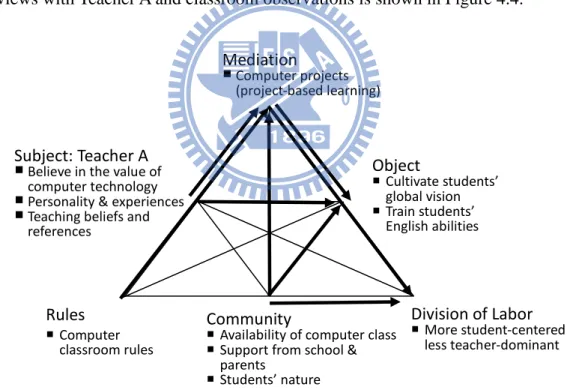
Teacher A‟s Teaching Beliefs ... 42
Teacher A‟s teaching beliefs in general ... 42
Teacher A‟s beliefs in technology integration ... 44
Teacher A‟s Instructional Practices ... 46
The spring semester of 2009 ... 46
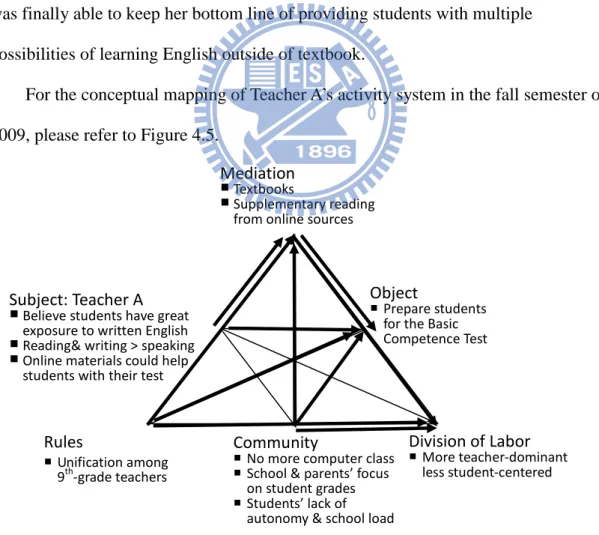
The fall semester of 2009 ... 52
Contextual Factors Affecting Teacher A‟s Technology Integration ... 54
The spring semester of 2009 ... 54
The fall semester of 2009 ... 55
Summary of Teacher A‟s Case through Activity Theory ... 58
Case Two: Teacher B ... 62
Teacher B‟s Teaching Beliefs ... 62
Teacher B‟s teaching beliefs in general ... 62
Teacher B‟s beliefs in technology integration ... 62
Teacher B‟s Instructional Practices ... 64
Contextual Factors Affecting Teacher B‟s Technology Integration ... 66
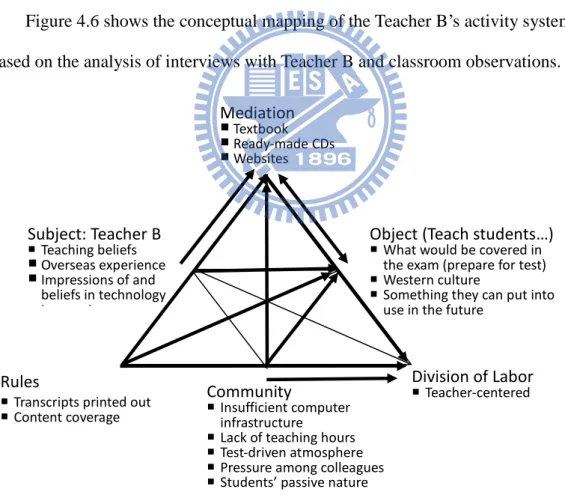
Summary of Teacher B‟s Case through Activity Theory ... 69
Case Three: Teacher C ... 72
Teacher C‟s Teaching Beliefs ... 72
Teacher C‟s teaching beliefs in general ... 72
Teacher C‟s beliefs in technology integration ... 73
Teacher C‟s Instructional Practices ... 76
Contextual Factors Affecting Teacher C‟s Technology Integration ... 77
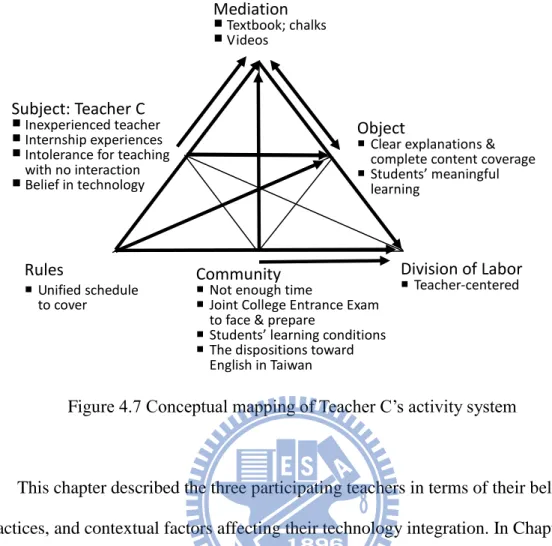
Summary of Teacher C‟s Case through Activity Theory ... 80
viii
Discussion ... 83
Research question 1: How do English teachers‟ beliefs lead to their practices regarding technology integration? ... 83
Research question 2: How do contextual factors interplay with English teachers‟ classroom practices in technology integration? ... 88
An Overview of Three Teachers‟ Activity Systems ... 94
Conclusion ... 95
Pedagogical Implications ... 96
Limitations of the Study ... 98
Suggestions for future research ... 99
REFERENCES ... 101
APPENDICES ... 112
Appendix A Consent Form for Teachers ... 112
Appendix B Consent Form for Students ... 113
Appendix C Consent Form for School Administrators ... 114
Appendix D Interview Questions for Interview #1 ... 115
Appendix E Interview Questions for Interview #2 ... 116
Appendix F Interview Questions for Interview #3... 117
Appendix G Interview Questions for Students ... 118
ix
LIST OF TABLES
Table 3.1 Basic demographic information of participating teachers ... 30
Table 3.2 Schedule for the interviews and classroom observations ... 38
LISTOF FIGURES Figure 2.1. Vygotksy‟s Mediational Triangle ... 22
Figure 2.2 The expanded activity system ... 24
Figure 3.1 Activity system in the current study ... 40
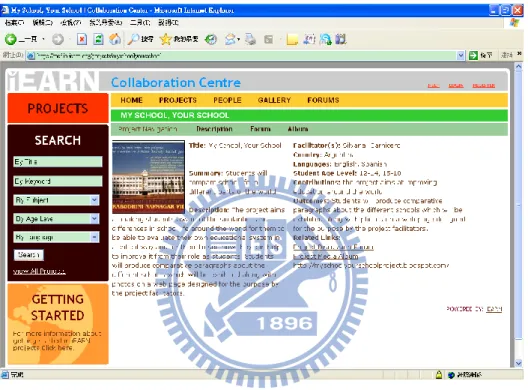
Figure 4.1 Screenshot of My School, Your School project ... 48
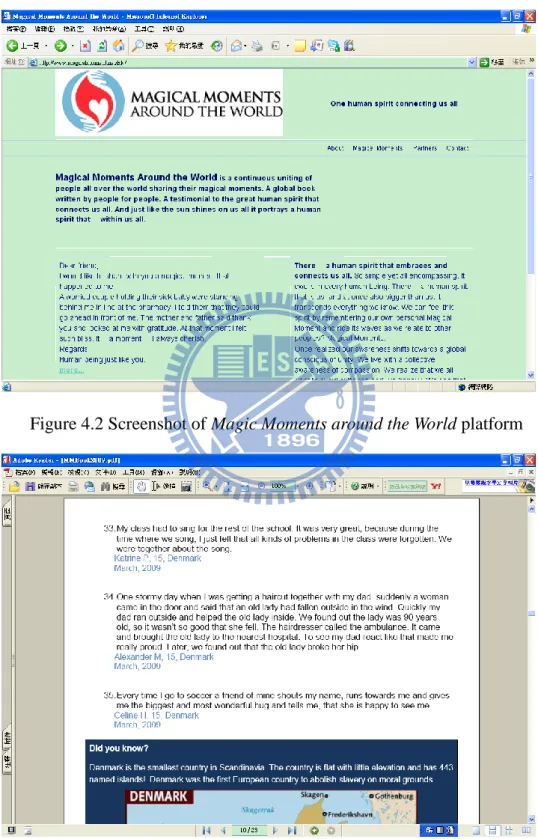
Figure 4.2 Screenshot of Magic Moments around the World platform ... 50
Figure 4.3 A compilation of stories in Magic Moments around the World ... 50
Figure 4.4 Conceptual mapping of Teacher A‟s activity system in the spring semester ... 59
Figure 4.5 Conceptual mapping of Teacher A‟s activity system in the fall semester . 61 Figure 4.6 Conceptual mapping of Teacher B‟s activity system ... 71
1
CHAPTER ONE INTRODUCTION
General Background of Technology Integration
When computer technology gains its momentum in the educational field in recent years, it is suggested that the nature of education is jointly undergoing massive transformation. Student-centered learning, for example, is advocated in place of traditional lectures and linear instruction, thus calling for shifts in teachers‟ roles from knowledge experts to facilitators and mentors (Carballo-Calero 2001; Chen, 2004; Hsu, 2003; Wang, 2005; Zhong & Shen, 2002). In addition, as a result of the growing prevalence and advancement in computer technology, pedagogical decisions also change in that they no longer dwell on adoption issues but instead shift to the implementation process (Ertmer, 1999). Rather than choosing whether or not to use computer technology in the classrooms, teachers are now more concerned with when and how technology can be used effectively and efficiently so as to best facilitate students‟ learning.
In response to such largely technology-driven trend in education, Taiwan has also started encouraging the integration of technology into the educational picture. In 1998, the Ministry of Education (hereafter referred to as MOE) launched an educational reform entitled „Grade 1-9 Curriculum Guidelines‟ (九年一貫課程綱要) (MOE, 1998). In this movement, information technology, or IT, is intertwined with almost every aspect of the reform such as its rationales, principles, objectives, and
implementations. In particular, IT is changed from an independent course subject to one that is integrated into different learning areas such as language arts and social studies. Technology then, according to the basic objectives raised in the reform, is used for active inquiry, problem-solving, communication, as well as cooperation in
2
various subjects (Chen, 2008; Hsu, 2003). Visioning technology integration realized in elementary as well as high schools, MOE later in 2001 also announced the
„Blueprint of Information Education for Elementary and High Schools‟ (中小學資訊 教育總藍圖), emphasizing increasing access to and the use of information technology to foster autonomous learning that ultimately promote lifelong learning (MOE, 2001).
Under such policies and the guidelines of educational reforms, teachers of each discipline here in Taiwan are expected to integrate information technology into their curriculum, EFL (English as a foreign language) teachers being no exceptions. With the need to facilitate national development and international relationship in Taiwan‟s national policy (Lin, 2007), it may be suggested that EFL teachers are confronted with multiple challenges. It is expected that they provide effective language instruction infused with various sources of information technology and multimedia, thereby preparing learners to learn English for purposes of cultivating learning interests and communication competence.
Teacher, Teacher Beliefs, and Technology Integration
Integration will not automatically take its course or bring any substantial changes in instruction even when a classroom is equipped with technology. It has been
suggested that in order for successful technology integration to take place, teacher is one of the crucial determinants (Burnett, 1999; Chen, 2004; Chen, 2008; Drenoyianni & Selwood, 1998; Ertmer, 2005). Given that teachers here hold the prominent key, it therefore becomes of great importance to examine how teachers come to
conceptualize their work and make instructional decisions regarding technology use. This is exactly where teacher beliefs come into picture.
Early studies have revealed that teachers‟ beliefs in technology play a pivotal role in teachers‟ decision-making process (Borg, 2003; Burnett, 1999; Chen, 2008;
3
Ertmer, 2005; Kagan, 1992; Levin & Wadmany, 2006; Theriot & Tice, 2009). Serving as references and filters that guide teachers through making instructional and
curricular decisions, teachers‟ beliefs affect how teachers ultimately act and teach, and they can either facilitate or impede teachers‟ technology use in the classrooms.
Likewise, when deciding the extent of technology integration, teachers would also draw on their beliefs that ultimately steer them toward how they conduct instructional practices with regard to technology.
A Sociocultural Perspective to Technology Integration
While teacher beliefs have been acknowledged for its significance in shaping teacher‟s pedagogy, there have been instances where teachers‟ beliefs do not necessarily transfer to their instructional practices (Belland, 2009; Drenoyianni & Selwood, 1998; Ertmer, 2005; Fang, 1996; Judson, 2006). In tracing the cause for the discrepancy, there is a redirection of foci on the contextual and social elements. Instead of viewing teachers as isolated individuals who make independent decisions based on their beliefs, more focuses are put on the social communities teachers
participate in. As stated by Windschitl and Sahl (2002), teachers‟ thinking in this view is “social in nature”, and it is affected by “both the social contexts in which they [teachers] operate and the institutional cultures that profoundly shape the meaning of their work” (p. 166). Such emphasis on the surrounding contexts resembles one of the central notions in sociocultural theory.
Sociocultural theory considers individuals as social beings influenced by sociocultural factors within specific contexts, and it contends that higher mental functions are socially mediated, i.e., it develops out of dynamic interaction between individual mind and social milieu (Lantolf, 2000). According to this theory, therefore, when teachers are engaged in teaching, their teaching practices would be strongly
4
mediated by contextual influences, and teachers‟ interpretation of how technology can be used or whether to use technology at all is then shaped by their participation in these contexts.
One of such sociocultural perspectives is activity theory, which “focuses on the interaction of human activity and consciousness (the human mind as whole) within its relevant environmental context” (Jonassen & Rohrer-Murphy, 1999, p. 62). Activity cannot be understood or analyzed outside the context in which it occurs, and this framework directs our attention to the activity systems where individual‟s behaviors are rooted. Furthermore, not only does it take into consideration all the structural, historical, and cultural elements needed for a more thorough understanding, but it is also able to capture the contradictions or tension arising within any activity systems (Hopwood & Stocks, 2008; Kahveci, Gilmer, & Southerland, 2008). Such analysis of human activity and context is essential if we are to understand teachers‟ instructional design process. Acknowledging the importance of social environment in relation to individual‟s development and choice of actions, activity theory therefore serves as a useful framework for interpreting how teachers decide the extent of technology integration to achieve their goals, as well as how they might be making any compromises during such decision-making process.
With attention now focused more upon identifying the relationship between teachers‟ integration of technology and a variety of contextual factors, it should be noted, however, that earlier studies may still exhibit several limitations. First, the factors identified in previous research were mostly treated as variables independent and irrelevant from one another, and they seemed to have failed to take into account the complex process in which teachers interact with and strive to negotiate between contextual realities and their beliefs (Ertmer, 2005; Windschitl & Sahl, 2002). Second, few efforts have been made to investigate teachers‟ beliefs and instructional use of
5
technology from the dimension of sociocultural theory. Even with those that did make such a connection, there seems to be a lack of concrete framework used to analyze the interaction among teachers‟ beliefs and instructional practices in relation to
sociocultural influences. Third, earlier studies tend to focus more on teachers in general, while research targeting second language or English teachers in particular seems to be scant.
Given that activity theory carries the potential to capture the dynamic interplay among individual minds, their behaviors, and social surroundings, the current study will adopt activity theory as the underlying theoretical framework to examine how English teachers, under sociocultural influences, come to construct their beliefs about technology, as well as how they decide the extent of technology integration in their instructions.
Purpose of the Study
The current research is a qualitative case study on English teachers in junior and senior high schools. Through a sociocultural perspective of activity theory, the
purposes of this study are first, to discover English teachers‟ beliefs toward the role of technology in their classroom practices; second, to disclose the underlying reasons that might attribute to English teachers‟ extent of technology integration in class; third, to investigate how English teachers deal with the conflicts arised when contextual realities constrain their implementation of beliefs in technology integration. One of the focuses here is how contextual and institutional influences interact with teachers‟ personal beliefs and their pedagogical practices regarding technology integration. In particular the researcher is concerned with any possible conflicts that may arise as they strive to negotiate between their personal agency (e.g., beliefs and goal) and contextual realities when deciding to integrate technology in their English classes.
6
Research Questions
The current study intends to address the following research questions: 1. How do English teachers‟ beliefs lead to their practices regarding technology
integration?
2. How do contextual factors interplay with English teachers‟ classroom practices in technology integration?
Organization of the Thesis
In addition to Chapter 1, the organization of this thesis is as follows. In Chapter 2, related literature of different areas are reviewed, including technology integration, teacher beliefs and practices, its relationship with technology integration, and finally, activity theory. In Chapter 3, the methods used for this study are described in detail, namely the participants, data collection, procedure, and data analysis. In Chapter 4, the results of the study are presented in response to the research questions. Finally, Chapter 5, as the last chapter, concludes the thesis by discussing and summarizing major findings, pedagogical implications, limitations of the study, as well as suggestions for future research.
7
CHAPTER TWO LITERATURE REVIEW
Serving as the research background on which this study is based, this review addresses the following three areas. First, the concept of technology integration is reviewed, including its definition, its application in Taiwan‟s compulsory education policy, as well as contributing factors affecting its success. Second, related literature on teachers‟ beliefs and practices in general are consulted; with its scope slowly narrowed down, studies on the relationships between teachers‟ beliefs and practices in technology integration will also be synthesized. Finally, sociocultural theory, or activity theory in particular, is reviewed, as it provides the theoretical framework needed for the design of this study.
Technology Integration
Despite high promotion of technology integration in the educational picture, so far there has not been a universally acceptable agreement as to the exact definition of technology integration itself. Some look at the issue from teachers‟ perspective, asserting technology integration as teachers‟ use of technology in preparation, in-class teaching, and after-class assessment (Chen, 2008; Newby, Stepic, Lehman, & Russell, 2006; Roblyer & Edwards, 2000). Some operationalize it as the use of technology to help learners solve problems and enhance learning in the content areas (Ertmer, 2005; Jonassen, Howland, Moore, & Marra, 2003; Sprague & Dede, 1999). Still some others define technology integration from the nature of technology itself, describing it as total infusion of technology into curriculum, materials, teaching and learning so that technology becomes an indispensible part of pedagogy (International Society for Technology in Education, 2000; Wang, 2004). While seemingly different, they are in
8
fact not so much contested or mutually exclusive when taken altogether.
Integration of technology is one of the central policies in Taiwan‟s educational reform. Since the Grade1-9 Curriculum Reform in 1999, Ministry of Education has redefined the role of technology in education. Information technology is no longer an independent course with sole focus on computer skills; instead, it is integrated into different learning areas, and teachers of various subjects are encouraged to
incorporate technology to facilitate teaching and learning. In addition, information technology is also listed as one of the ten basic skills students need to cultivate as well as one of the six major issues in education (Chen, 2004; Hsu, 2003). Under such policy, the curriculum emphasizes cultivation of students‟ abilities to solve problems and do active inquiry as well as social communication (Chen, 2008). Later in 2001, the importance of information technology is once again emphasized in the „Blueprint
of Information Education in Elementary and Junior High schools‟, as its goal is to
develop information literacy, critical and creative thinking, effective learning
strategies, active learning, collaborative learning, and lifelong learning (MOE, 2001). Along with the advent of technology, researchers have suggested a potential link between successful technology integration in teaching and constructivist pedagogy (Chen, 2008; Levin & Wadmany, 2006; Reigeluth, 1999). In constructive teaching, teachers conduct student-centered instructions that “engage students in active problem solving and genuine inquiry” (Chen, 2008, p. 68). It has also been suggested that when giving students the opportunity to actively explore and inquire with technology in ways that are meaningful to them, their motivation and understanding can be increased (Jacobsen, 2001; Jonassen, Peck, and Wilson, 1999; Sandholtz, Ringstaff, & Dwyer, 1997). Similarly, Levin and Wadmany (2006) also suggested that teachers holding constructivist views tend to integrate technology in the classroom, and vice versa. Technology in this view is not merely an added tool that may be taken away,
9
but instead, because of technology, students are allowed to learn in meaningful ways and construct their knowledge. Thus, it may well be concluded that Taiwan‟s
educational reforms and policies “encourage teachers in Taiwan to align technology integration with constructivist concepts” (Chen, 2008, p. 68).
Based on definition of earlier research and MOE‟s educational reform calling for constructivist approach, the researcher hereafter defines technology integration as teachers‟ use of technology, or computer technology to be more specific, to foster student understanding and raise motivation that promote constructive and meaningful learning on students‟ part.
Conditions and Factors Affecting Technology Integration
The success of technology integration can be determined by a variety of different terms and factors. In recent years researchers have focused particular attention upon the conditions set for an ideal technology integration (e.g., Bitner & Bitner, 2002; Bullock, 2004; Ertmer, 2005; Judson, 2006; Zhao & Cziko, 2001). In addition, a great number of studies have also been generated that looked into the specific factors accountable for teachers‟ extent of technology integration, (e.g., Bauer & Kenton, 2005; Ertmer, 1999; Hew & Brush, 2007; Lam, 2000).
Researchers have proposed features that characterize or facilitate ideal technology integration in the classroom (Bitner & Bitner, 2002; Becker, 2000;
Bullock, 2004; Judson, 2006; Zhao & Cziko, 2001). In examining preservice teachers‟ experiences in integrating technology, Bullock (2004) suggested that effective
mentoring and modeling, clear expectations, easy access to technology and
technology support, and positive experiences with technology in the classroom will serve as crucial enablers for preserve teachers to practice using technology. Becker (2000) also suggested that access, preparation, freedom in the curriculum, and
10
teachers‟ constructivist beliefs will altogether help to shape computers as “valuable and well-functioning instructional tool” (p. 29).
On the other hand, the above features that promote technology integration, once missing, can also turn from facilitations to inhibitions. Brickner (1995), for example, developed the idea of first-order and second-order barriers in technology integration. Simply put, first-order barriers are more external, dealing mostly with the outside obstacles in the current teaching practices, and they are typically described in terms of resources such as time, access, support and training. Some of the attributions in earlier studies of technology integration fall right into this category (Bullock, 2004; Chen, 2008; Cuban & Peck, 2001; Ertmer, 1999). Second-order barriers, on the other hand, are more internal, centering upon teachers‟ attitudes and beliefs that might impede integration of technology (Belland, 2009; Bullock, 2004; Zhao & Cziko, 2001). In confronting such barriers, Ertmer (1999) addressed and delineated effective strategies in response to the barriers, suggesting that these two types of barriers are in fact closely related. Going beyond mere acquisition of software and technical skills, it is recommended that skills in leveraging technology to facilitate and assess students‟ learning is also needed.
Teachers’ Beliefs and Practices in General
The process of teaching is said to comprise two major domains: teachers‟ thinking and their instructional practices (Clark & Peterson, 1986). In the traditional lines of research, most studies focused on the latter area, i.e., teachers‟ observable behavior or their teaching, exploring how it affects students‟ academic achievements (Fang, 1996). The basic tenet underlying such focus is the conviction that knowledge of qualities in „good‟ teaching will lead to enhanced instruction and ultimately students‟ improved performances. Recently, however, there has been a shift of
11
attention to the aspect of teacher thinking. Instead of trying to capture effective teaching, researchers have started to exhibit particular interest in how teachers conceptualize their teaching, and more specifically, its relationship with teachers‟ instructional practices in the classroom.
The main purpose for such research is to better understand why and how teachers‟ classroom behaviors are in certain ways rather than the others. Graden (1996), for instance, believed that any discrepancies that arise in between teachers‟ beliefs and practices should be addressed, so that teachers can be better informed and equipped to “reconcile beliefs and practices in order to provide more effective
instruction” (p. 387). Breen, Hird, Milton, Oliver and Thwaite (2001) went further to suggest four main reasons that account for the importance of knowing the principles that guide teachers‟ actions: (1) to achieve deeper understanding and find explanations that goes beyond mere descriptions of teacher actions; (2) to serve as a reference that guides teacher education and professional development; (3) to inform curriculum policy that allows greater feasibility of any innovations; (4) to contribute frameworks for language pedagogy that merges directly from classroom work. As illustrated in Borg‟s words (2003), “teachers are active, thinking decision-makers who make instructional choices by drawing on complex, practically-oriented, personalized, and context-sensitive networks of knowledge, thoughts, and beliefs” (p. 81). It is therefore worthwhile to examine the relationship between teachers‟ classroom practices and their pedagogical thoughts or beliefs.
Definition and Characteristics of Teachers’ Beliefs
The importance of examining teachers‟ beliefs or thought processes has been stressed in numerous studies and is said to be inextricable from teachers‟ decisions and practices (e.g., Burnett, 1999; Fang, 1996; Kagan, 1992; Levin & Wadmany, 2006;
12
Theriot & Tice, 2009).While recognizing the potential that resides in teachers‟ beliefs, at the same time, researchers have also confessed that such belief in and itself is difficult to define (Borg, 2003; Breen, Hird, Milton, Oliver & Thwaite, 2001; Chen, 2008; Ertmer, 2005; Kagan, 1992). As summarized in Chen‟s words (2008), “… [the study of teacher beliefs] faces the difficulty of being short on clear and commonly accepted definition and conceptualizations of beliefs and belief structures” (p. 66). With such confusion in definition, similar concepts are often described using different terms, while an identical term is defined in different ways. Such complication of terminologies is also synthesized by Borg (2003), who listed out all the different labels that have been used in research on language teacher cognition.
Despite the „messy construct‟ in defining teacher beliefs (Pajares, 1992), it is said to be different from teacher cognition. The latter refers to a more general concept that includes teachers‟ beliefs, knowledge, thoughts and reflections about teaching and learning (Borg, 2003; Calderhead, 1996; Kagan, 1990). The distinction between beliefs and knowledge, on the other hand, is not so clear-cut. Kagan (1990) considered these two interchangeable; still there are others who saw them as two completely different entities (Calderhead, 1996; Nespor, 1987; Kagan, 1992). According to the final view, beliefs, in contrast with the factual and therefore more objective nature that resides in knowledge, carry relatively more subjective color and does not require consensus among individuals. For example, teachers may have obtained shared knowledge regarding the benefits of technology in teaching and even witnessed how technology can be integrated in the classroom; nonetheless, they can still choose not to believe that computer technology is effective for their own classroom use. As inherent in beliefs is such an evaluative nature, beliefs are suggested to yield more power in predicting individuals‟ behaviors (Ertmer, 2005; Kagan, 1992; Nespor, 1987; Pajares, 1992). Additionally, Pajares (1992) went further
13
to urge that belief systems be specified in less general terms.
In the current research, the researcher adopted the definition of „teacher beliefs‟ developed by Kagan (1992), which included two different dimensions: teachers‟ sense of self-efficacy and content-specific beliefs. The former refers to “teachers‟
generalized expectancy concerning the ability of teachers to influence students, as well as the teachers‟ beliefs concerning his or her own ability to perform certain professional tasks” (p. 67). The latter is defined as “teachers‟ orientation to specific academic content”, which encompasses the teachers‟ “conceptions of the field to be taught, as well as his or her judgments about appropriate instructional activities, goals, forms of evaluation, and the nature of student learning” (p. 67).
Apart from its evaluative, affective color mentioned above, beliefs, as described by Nespor (1987), is said to hold yet several other characteristics. Firstly, beliefs resemble stories in that they draw references from episodic memories such as personal experiences and cultural sources of knowledge. They then serve as the filter for
upcoming new information and experience. Secondly, beliefs can be resistant to change in some cases. Ertmer (2005) also exemplified this, presuming that
affect-based beliefs are “more intimately connected to our personal identifies, reside in a more central position in our belief systems” (p. 32). Oftentimes filtered through individuals‟ earlier personal experiences, these affect-based beliefs thus become deeply engrained and harder to change as opposed to knowledge-based beliefs. Thirdly, beliefs can extend beyond contexts and be applied in ill-defined situations where no answers are available. Because of such flexibility, teachers can readily draw from their existing beliefs and extend them when they are confronted with problems that do not have an absolute solution. Finally, beliefs do not require group consensus, and thus may be quite idiosyncratic (Nespor, 1987).
14
also stressed that this does not mean beliefs are absolutely fixed; instead they can still possibly be changed if individuals are dissatisfied with their existing beliefs. Three prompts were suggested to stimulate such dissatisfaction: personal experiences, vicarious experiences, and socio-cultural influences. Also acknowledging changes of beliefs is another study conducted by Levin and Wadmany (2006). In their attempt to analyze the evolution of teachers‟ beliefs, they found the presence of substantial changes in teachers‟ beliefs and practices. In addition, the results also yielded variance in changes of beliefs across individuals, and teachers often hold multiple rather than unwavering, dichotomous beliefs. They concluded that teachers‟ beliefs, while in the process of developing may appear contrastive and inconsistent, should instead be viewed as complementary.
The Relationship between Teachers’ Beliefs and Practices
Researchers have explored the relationship between teachers‟ beliefs as well as practices, recognizing the two as intertwining with each other, with beliefs shaping teachers‟ instructions and vice versa. Previous studies have indicated that teachers‟ beliefs regarding learning and teaching are generated by their prior conceptions from a variety of personal experiences such as their upbringing as well as life and schooling experiences (Belland, 2009; Hollingsworth, 1989; Theriot &Tice, 2009). When
teachers teach, on the other hand, their accumulated experiences as teachers in turn will also shape the formation of their cognition, including their pedagogical beliefs (Borg, 2003).
In the study that documented four preservice teachers‟ preparation in the education programs, for instance, Hollingsworth (1989) demonstrated how their learning experiences as students have led them to hold respective beliefs as to how classes should be conducted. Lortie (1975) termed this „apprentice of observation‟,
15
explaining that teachers, through past experiences as learners of various subjects, know about teaching long even before they start to take formal educational courses. Likewise, Borg (2003) has also illustrated that, when working in the other way around, practices could exert influence upon teachers‟ beliefs as well. In his review he
summarized studies which manifested a clear difference between experienced teachers and novice ones. Not only do teachers‟ past teaching experiences serve as references for forming instructional ideas and beliefs, but they also allow teacher to be
experientially informed and act on interactive decision-making and improvise on the spot. Prabhu (1987) also coined the term „sense of plausibility‟ to refer to teachers‟ ability to, after years of teaching, know what works or does not work. What is regarded as plausible then becomes the criteria, which teachers can apply to subsequent teaching situations.
The correspondence between teachers‟ pedagogical beliefs and their instructional decisions has also been another area of interest for researchers, and efforts have been made to investigate whether one conforms to the other or if any inconsistency in between occurs (Belland, 2009; Chen, 2008; Ertmer, 2005; Fang, 1996; Judson, 2006; Levin & Wadmany, 2006). In a review conducted by Kagan (1992), research has shown that teachers‟ beliefs “usually reflect the actual nature of instruction the teacher provides to the students” (p. 73). This is supported in Fang‟s study (1996), in which the researcher did a metaanalysis in studies related to literacy instruction. Regardless of students‟ level, the results all demonstrated that teachers hold theoretical beliefs that mirror their instructional practices or methodological approach. Taken altogether, these empirical evidence all confirmed that teachers‟ pedagogy are indeed shaped by what teachers think about their roles as well as the beliefs values they hold.
Nonetheless, there are yet another group of studies yielded completely the
16
2006). In the attempt to compare foreign language teachers‟ beliefs and practices when teaching reading, Graden (1996) revealed large instances of inconsistency, which he attributed to teachers‟ compromise to accommodate students‟ actual needs. Due to students‟ poor performances in reading and their motivational needs, these teachers were compelled to prioritize students over their preferred instructions. Similar examples of inconsistency are also presented in Fang‟s review, in which he described a number of studies where teachers‟ professed beliefs do not indicate actual transfer to their instructional practices.
In response to such phenomenon, researchers have tried to trace down the underlying reasons responsible for the inconsistency. Some attributed this to potential flaws inherent in study design, asserting that teachers‟ self-reported data including surveys and written tasks render unreliable information (Fang, 1996; Judson, 2006). Other studies ascribed otherwise, looking at the influence of instructional contexts on teachers‟ pedagogical choices. Factors such as curriculum requirements, social pressure, time allocation, and availability of resources were all cited as explanations that result in the discrepancy (Borg, 2003; Chen, 2008; Ertmer, Gopalakrishnan, & Ross, 2001). Johnson (1996), for example, reported the struggles a student teacher experienced; in this study, her initial enthusiasm faded away when contextual realities forced her to conduct teacher-centered teaching, contrary to her own beliefs. Teachers are thus subject to a variety of different psychological, social and environmental realities inherent in schools and classrooms, thus constraining them from practicing what they believe in (Borg, 2003; Fang, 1996).
Teachers’ Beliefs and Practices in Technology Integration
With the increasing popularity of computer technology in our daily lives, access to and related training on computer technology also become less problematic.
17
Nonetheless studies have shown that despite the investment in and the increasing access to computer technology in schools, in general instances of technology integration seem to remain small in number, the extent of technology integration limited, and the educational system mostly unchanged (e.g., Belland, 2009; Cuban, Kirkpatrick & Peck, 2001; Ertmer, 1999, 2005; Levin & Wadmany, 2006; Zhao & Cziko, 2001). Given that these outside barriers in resources might no longer be regarded as significant, researchers have shifted their attention instead to the final barrier, i.e., teachers‟ beliefs, as predictor of teachers‟ use of technology integration (Anderson & Maninger, 2007; Brinkerhoff, 2006; Ertmer, 2005; Hsu, Wu, & Hwang, 2007; Lumpe & Chambers, 2001; Park & Ertmer, 2007). Such change of focus is based on the premise that “technology integration is behavior planned according to intentions, which are informed by professed beliefs” (Belland, 2009, p. 354). In line with this argument, Zhao and Cziko (2001) also commented on the importance of teachers‟ beliefs in relation to the use of technology, asserting that teachers must be considered as “goal-oriented, purposeful organism” (p. 6). They suggested that if technology integration is to be realized, teachers need to hold positive beliefs towards the effect of and their abilities to integrate technology.
Given the importance of teachers‟ beliefs, researchers have looked into its relationships with teachers‟ instructional practices in technology in the classroom (Burnett, 1999; Chen, 2008; Drenoyianni & Selwood, 1998; Judson, 2006; Lam, 2000; Levin & Wadmany, 2006; Windschitl & Sahl, 2002). Several studies have manifested a more or less transfer from beliefs into practices in technology. In Lams‟ study (2000), for example, rather than manifesting „technophobia‟ as were considered in previous literature, most of the English teachers instead were not convinced of the benefits of computer technology in L2 instruction, thus unwilling to allow any technology integration to take place. Winschitl and Sahl (2002) also confirmed such
18
transfer of beliefs, when the technological decisions of the three teachers in their study were influenced respectively by learners needs, nature of the subject matter, and the desire for classroom control. They thus concluded that teachers‟ integration of technology were “mediated in ways by teachers‟ interrelated beliefs systems about learners in that particular school, about what constituted „good teaching‟ in the context of the institutional culture, and about the role of technology itself in the lives of students” (p. 195).
There are however some researchers whose studies yielded different results. Investigating the relationship between how teachers integrate technology and their beliefs about learning, Judson (2006) found little connections in between. In his study, while teachers identified with and claimed to conduct student-centered instructions, classroom observations of their technology integration nonetheless said otherwise. Similarly, Chen (2008) also reported such inconsistency between teachers‟ manifested beliefs and what they actually practiced regarding technology integration. Despite governments‟ encouragement and teachers‟ convictions of constructivist teaching by integrating technology in the classroom, it remained true that not so many teachers had the abilities to do so in reality. Instructions were by and large traditional with only limited extent of technology integration.
With increasing attention to the social and contextual influences recently, institutional culture has also been identified as another factor that contributes to the extent of technology integration. In their study to investigate the paradox between high access and low use of technology in two high schools, Cuban et al. (2001) labeled historical legacy as well as structures and time as two major factors that lead to infrequent use of technology. It was suggested that established practices, culture, and teaching goals that have been practicing within the school for years is hard to be changed or questioned. Teachers working in schools that encourage the image of
19
academic specialists, for example, would probably be compelled to cover large body of information within limited amount of time; the possibility of using technology is thus reduced. The larger educational system has also been held accountable for limited technology integration (Chen, 2008). Chen, in particular, pointed out that the exam-oriented phenomenon in Taiwan, which very often drives teachers to cover as many materials as possible to help students obtain high scores in exams. This tendency thus discouraged them from integrating technology in constructive ways.
As the present study explores teachers‟ beliefs and practices in technology integration through a sociocultural perspective of activity theory, in the last section of this chapter, activity theory will be reviewed. The application of activity theory as a theoretical framework will also be discussed here.
Sociocultural Theory in Language Education
Early studies in the field of second or foreign language have always put the emphasis upon learners as individuals. Hence, learners are predominantly perceived as individuals working in isolation with minimal influences from the surrounding contexts, and Second Language Acquisition (SLA) has traditionally been treated as an “internalized, cognitive process” (Zuengler & Miller, 2006, p. 36). It was not until recently that SLA studies have given rise to an alternative approach, incorporating a larger view that includes the social aspect of learning a language. In this sense
learners are regarded as social beings whose actions are influenced by sociocultural as well as historical factors within specific contexts. Sociocultulray theory, originated from the works of Vygotsky (1978, 1987), takes on such an approach, and it sees human learning as a situated and mediated process interweaving between individual mind and social milieu (Lantolf, 2000).Whereas from the cognitive-acquisition perspective, language learning takes place solely within the mind of individual
20
learners alone, “within a sociocultural framework, however, learning, including the learning of second languages, is a semiotic process attributable to participation in socially-mediated activities” (Donato, 2000, p. 45). In other words, from a Vygotskian perspective, one of the central notions is that language learning, or any forms of higher mental functioning, involves individuals‟ participation in a given social practice, where individuals undergo constant negotiation of meanings.
Given that our mental work – thinking, reasoning, learning, for example – is socially mediated and largely decided by the social activities we engage in, it may be safe to conclude that the context in which those social activities take place is of great importance to our mental and cognitive development. In Rogoff‟s claim (1990), the social contexts are considered influential in affecting our cognitive activity, as our cognitions are constructed by the social interactional contexts we are situated in. Wertsch, in a similar vein, also stated the significance of context, asserting that sociocultural analysis aims to understand how mental functioning is associated with cultural, institutional, and historical context (1998). Thus, according to sociocultural theory, human action is always mediated as well as socially situated, and the specifics of its immediate sociocultural context is indispensable if a sweeping understanding of one‟s cognitive development is to be achieved. Moreover, it has also been suggested that learning and cognition is constructed and realized through social interactions in a given context (Mondada & Doehler, 2004). During social interactions, we become member of a particular culture, and, together with other members, we collaboratively construct exclusive, culture-specific experiences, which then not only shape and foster the development of our higher mental functioning, but they also affect our
interpretations of the social environment and the activity systems we undergo. Likewise, when applied to language teaching, sociocultural theory also assumes teaching as a practice situated in a particular setting. Teaching cannot be considered in
21
solitary; rather, they need to be understood in combination with the range of settings in which teachers engage during teaching and learning to teach (Newell, Gingrich, & Johnson, 2001). The schools teachers teach in, for example, carry context-specific institutional cultures that are constructed and developed under “historically and culturally grounded conditions” (Windschitl & Sahl, 2002, p. 166). These particular cultures then mediate teachers‟ cognition and practices. Furthermore, not only does mediation occur within a particular context, it also takes place across different activity settings. As exemplified by Johnson and Golombek (2003), teachers‟ collective roles as past learners in classrooms and schools, as student teachers in teacher education programs, and as current teachers in the institutions they work in, altogether
contribute to shaping teachers‟ thinking and behavior. Taken altogether, sociocultural theory is said to be capable in allowing teacher educators to see, in greater detail, teachers‟ cognitive processes at work (Johnson & Golombek, 2003), particular in relation to how they are mediated by the situated contexts teachers engage in – both previously and currently.
One of the central tenets of and also closely related to sociocultural theory is activity theory. In the following section, its history, definition, as well as application in language teaching and learning will be discussed.
Activity Theory
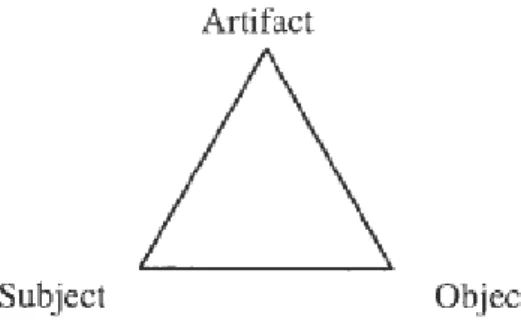
Activity theory first stemmed from Vygotksy‟s sociocultural theory that humans‟ higher mental functions are mediated by all kinds of signs, the process of which Vygotsky termed „tool-mediated functions‟ (Vygotsky, 1987). As graphed in Figure 1, subjects use symbolic, culturally created tools and signs, either concrete or abstract, to assist them working on the object. In other words, the relationship between the subject and the object is constantly mediated by various mediational artifacts in the social
22
context. Sociocultural theory thus emphasizes the mediated connection between the social and the mental, holding that human mental activities are constituted of our interactive experiences with others and with artifacts (Lantolf, 2000).
Figure 2.1. Vygotksy‟s Mediational Triangle (Vygotksy, 1978, 1987; Wells, 2002)
Being a close student and collaborator of Vygotksy‟s, Leont‟ev (1978, 1981) took a step further, changing the focus from mediation to objects of the activity or, more precisely in Leont‟ev‟s term, motives. Building upon Vygotsky‟s notion that human higher functions and activities are socially as well as historically mediated, Leont‟ev developed activity theory, contending that socially organized human activity is the primary unit of analysis. Note that the term „activity‟ here is operationally defined in different ways from „task‟. Taken in SLA research, the latter is often used to elicit linguistic data from participants and is controlled by research considerations, whereas the former “is the process, as well as the outcome, of a task” (Coughlan & Duff, 1994, p. 175). In their study that sets out to differentiate between the two, these two researchers asked the same group of participants to describe a picture several times; it was found that, rather than generating similar results as otherwise would have been anticipated, the task yielded different activities regardless of it being performed by different or the same individual(s) (Coughlan & Duff, 1994). Task and activity are therefore essentially and distinctively different.
23
acknowledges only minimal importance of social environment, activity theory on the other hand provides a theoretical framework that highlights the dialectic relationship between individuals and the social environment, focusing on the interaction of human activity and mind within its relevant environmental context. Thus, from the theoretical perspective of activity theory, in order to best understand individual‟s behaviors, one must take into consideration the specific social contexts involved, i.e., the activity systems in which individual‟s behaviors are rooted. In Leont‟ev‟s (1978, 1981) model of activity theory, three different levels can be identified: motives, actions, and
operations. According to this model, individuals are, within a particular activity system or context, driven by underlying motives, and these motives are realized in goal-oriented actions, which will then lead to executions of specific operations carried out to reach a desired outcome. Even with different actions, activities will be
considered identical provided that the motives are the same; conversely, even when the actions taken are the same, activities will be different if the underlying motives are distinct. Motives are therefore representative and of crucial importance in
understanding an activity system.
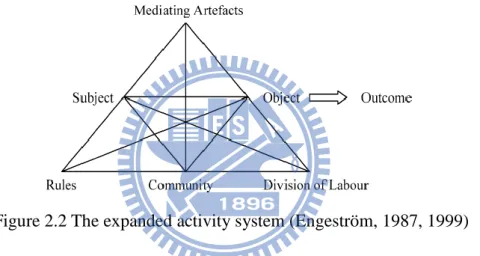
In better capturing the nature of a collective activity system, Engeström (1987; 1999), as shown in Figure 2, further expanded Leont‟ev‟s primitive model of activity theory into what he later termed „international activity-theoretical collaboration‟ (1999). The complexities of individuals‟ social practices are mapped out with respective elements, and rule, community, and division of labor are included in the lower triangle of the model to account for social, cultural, and historical influences. Whereas the upper triangle describes the tool-mediated relationship between subject and object, the lower part of the triangle adds community as another mediation that shapes the subject-object relationship. As cited elsewhere (Jurdak, 2006; Nelson & Kim, 2001), subject is the human agent undertaking the activity; object represents the
24
targeted point the subject is working towards, the process of which is mediated by different artifacts, tangible and intangible alike, to finally reach the desired outcome. Subjects who share the same object belong to one distinct community, and the rules refer to the norms, conventions, or regulations that regulate the actions and
interactions within that particular community. The division of labor refers to how tasks and power status are divided among members of that community. The
components described above are by no means fixed, but undergo constant changes as a result of the interaction among these elements.
Figure 2.2 The expanded activity system (Engeström, 1987, 1999)
One of the principal ideas of activity theory is internal contradictions or tensions inherent in any activity systems (Barab, Barnett, Yamagata-Lynch, Squire, & Keating, 2002; Blin & Munro, 2008; Engeström, 1999; Hopwood & Stocks, 2008). As
Engeström (1999) contends, he urged that activity system be considered from a broader perspective, arguing that disruptions and unexpected innovations are typical and representative of the activity system. As different elements within the activity system interact among one another, tension or even mismatch among elements may arise, which might prompt individuals to either give up or reform new motives and goals for their activity system and change their actions in order to resolve the crisis. As Cole and Engeström (1993) put it, “activity systems are best viewed as complex
25
formations in which equilibrium is an exception and tensions, disturbances, and local innovations are the rule and the engine of change” (p. 8). Accordingly, the
components described above are by no means fixed, but instead undergo constant changes as a result of such tension, conflict, and interaction that stimulate
developments and transformations. By evaluating through the lens of the activity theory, it is suggested that potential contradictions attributable to the changes can be spotted.
Activity Theory in Language Teaching and Learning
In recent years activity theory has been employed widely in a number of studies to explain behaviors or phenomena observed across different domains, including language teaching and learning. Researchers in this field have started to emphasize the influence of context on teaching and learning from a sociocultural perspective. Activity theory thus is adopted as an analytical framework to address the complexity of language learning as well as teaching process (e.g., Gao, 2008; Grossman,
Smagorinsky, & Valencia, 1999; Haneda, 2007; Jonassen & Rohrer-Murphy, 1999; Jurdak, 2006; Lantolf & Genung, 2002; Lantolf & Thorn, 2005; Nelson & Kim, 2001; Norton, McRobbie, & Ginns, 2007; Storch, 2004).
In a case study exploring the transformation of a student‟s course of actions, for instance, Lantolf and Genung focuses specifically on the conflicting power status as wielded by the instructor and perceived by the student (2002). Due to such
contradiction, the student considered her learning experiences as inhibition rather than facilitation to her Chinese learning. In defense for her own belief systems, the student struggled to challenge but failed, leading her ultimately to submit to the power and change her actions in order to meet her PhD requirement. It was later implied that the histories that students and teachers brought with them, accountable for the conflicts
26
arose here, can cause individuals to shift their motives, goals, and behaviors in response to the conflicts. This research accordingly confirms one of the central notions within the activity theory, which sees disruptions and changes as typical of any activity systems. In another similar study, appropriation, mediation, and
contradictions in the L2 writing classroom were explored (Nelson & Kim, 2001). The results magnified the significance of sociocultural influences, suggesting that
individual‟s goals and motives would differ even when they are situated within the same classroom. It was further proposed that learners‟ past as well as present learning activities served as a significant mediator on their appropriation, and the conflicts encountered led to changes in one‟s actions and generalizations into other activity systems.
Storch (2004), in a similar vein, also highlighted the importance of social and historical factors individuals brought upon their learning. In investigating the dyadic interactions between learners, Storch found variations in the patterns of students‟ interactions, which, through the analytical lens of activity theory, was attributed not to different task types, but to learners‟ own definition of the situation, their perceived goals and roles. Thus, in accordance with Coughland and Duff‟s (1994) finding, it was believed that student agency came into play where each individual, though given what might otherwise appear as identical task, underwent different activities,
depending on learners‟ previous as well as present learning experiences and their own activity systems embedded in a specific context. As illustrated by Donato (2000), “No amount of experimental or instructional manipulation […] can deflect the
overpowering and transformative agency embodied in the learner” (p. 47). By
underscoring the „situated definition‟ uniquely created by each individual, Storch‟s as well as Coughland and Duff‟s studies thereby coincide with one of the central notions underlying activity theory, which regards sociocultural and historical impact upon
27
individuals of paramount importance in their choice of actions.
Apart from explaining learners‟ behaviors, activity theory also contributes to language teaching (Grossman, Smagorinsky, & Valencia, 1999; Jonassen &
Rohrer-Murphy, 1999; Martin, 2008; Newell, Gingrich, & Johnson, 2001; Valencia, Martin, Place, & Grossman, 2009). Useful for understanding the process of teaching and learning to teach, activity theory has received particular attention on and also been employed in teachers‟ professional development. Jonassen and Rohrer-Murph (1999), for instance, used activity theory to explore its application in designing constructive learning environments. After careful examinations of factors underlying the activity systems, they concluded that activity theory was indeed with the potential to yield different perspectives for analyzing learning process and outcomes, thus proven valuable for designing instruction and building a constructive classroom.
Also acknowledging the values of activity theory is the research article done by Grossman, Smagorinsky, and Valencia (1999). In setting out to explain the
incongruity in the values and practices promoted between teacher education and practicing schools, they incorporated activity theory to examine the conceptual
development of teachers. By placing predominant emphasis upon the activity settings, they found activity theory‟s rich potential to illuminate how teachers‟ progression through different settings shaped their beliefs about teaching, learning, and
instructional practices. As Grossman et al. (1994) described, “Rather than seeking a uniform explanation for the reasons behind teachers‟ gravitation to institutional values, an approach grounded in activity theory is more concerned with issues of
enculturation and their myriad causes and effects” (p. 4). Conforming to this line of research, Newell et al. (2001) also recognized activity theory as a powerful theoretical framework in identifying and understanding student teachers‟ appropriation process as they struggled to negotiate among different beliefs, attitudes, and principles promoted
28 in various activity settings.
These studies, by adopting activity theory as the theoretical framework,
altogether highlight the importance of a given context as well as the impact of social, institutional, and historical factors upon individuals‟ choice of actions. Thus, activity theory provides a useful framework for analyzing teachers and students‟ behaviors.
In this chapter, the researcher first reviewed the concept of technology
integration. Then studies on teachers‟ beliefs and practices as well as its relationship with technology integration were also discussed. Finally, related literature on activity theory and its employment in previous research were continued to be reviewed. It should be noted nonetheless that, as shown in the discussion, practices of technology integration has mostly been treated in isolation; not much consideration were paid to how different sociocultural and contextual factors interact with one another to affect teachers‟ beliefs and practices in technology. While some attempts have been
undertaken to make such a connection (Chen, 2008; Cuban et al., 2001; Winschitl & Sahl, 2002), few were able to incorporate a concrete framework to analyze the dynamic interplay between individual minds and social milieu in a systematic and comprehensive fashion. Moreover, in earlier studies there seems to be only limited amount of research focusing on English teachers in particular. In trying to fill the gap, activity theory is adopted as the underlying theoretical framework, and the present study aims to examine how English teachers under various influences construct their beliefs and practices concerning technology integration.
Based on the literature reviewed, this study aimed to explore secondary English teachers‟ beliefs and practices in technology integration through the analytical lens of activity theory. In the next chapter, methods used in this study are described in detail.
29
CHAPTER THREE METHODOLGY
In this chapter, the methodology of this study is described in detail, including descriptions of the setting, participants, procedure, data collection, and data analysis.
Participants
The current study explored secondary English teachers‟ beliefs and practices regarding technology integration. Thus, the researcher intended to target English teachers in secondary schools who may or may not use technology in their classrooms. Through means of convenient sampling, three English teachers were targeted based on the following criteria. First, all teachers taught in public secondary schools. Second, all of them had taken courses related to CALL (Computer Assisted Language
Learning) application in the professional courses in graduate school. Third, they were all equipped with basic computer literacy. That is, they were able to operate basic computer systems, such as Microsoft word processor and Internet searching.
The three participants were first informed of the purpose of the study. Through a consent form (see Appendix A), they were then asked whether they were willing to participate in the current study, and all three of them agreed to be the participant for this study. Their identification is presented by codes to ensure confidentiality. Table 3.1 presents the basic demographic information for respective participants.
30 Table 3.1
Basic demographic information of participating teachers
Categories Teacher A Teacher B Teacher C
Gender Female Female Female
Age early 40s early 30s late 20s
1
Years of English
teaching experiences 16 years 10 years 4 years
School level Junior high school Junior high school Senior high school Location Taipei City Hsinchu County Hsinchu City Number of classes2 3, from 8th grade
to 9th grade
3, one 7th grade &
two 8th grade 3, all 11 th
grade3 4
Total teaching
hours/per week 18 hours 12 hours 16 hours
Note 1. Years of English teaching experiences account for the total years up to 2009 academic year. 2. The data collection time for Teacher A‟s case began from the spring semester to the fall semester,
and during this time her students turned from 8th grade to 9th grade. Note 3. 11th grade in Taiwan‟s educational system refers to 2nd year in senior high. Note 4. The total teaching hours account for those in an academic year.
Teacher A
Teacher A was a female English teacher at her early 40s. At the time of data collection (Spring semester to Fall semester in 2009), she had 16 years of English teaching experiences in total. She was teaching at School A, a junior high school in Taipei City.
Teacher A had two years of English teaching experiences in two other remote junior high schools and three years in an elementary school in Taipei City,
respectively. Then she transited to the current School A in Taipei City, where she had been teaching for 11 years. When Grade 1-9 Curriculum1 was first announced in 1999, Teacher A‟s teaching experiences in the elementary school enabled her to bridge
1
Grade 1-9 Curriculum refers MOE‟s effort in connecting years of education from elementary to junior high school level, making it more thorough and integrated instead of fragmented and disconnected.