
國
立
交
通
大
學
資訊科學與工程研究所
碩
士
論
文
無線多媒體感測網路下之高效能叢集式
多通道媒介存取控制協定設計
An Efficient Cluster-based Multi-channel MAC Protocol for
Wireless Multimedia Sensor Networks
研 究 生:徐逸懷
指導教授:王國禎 博士
無線多媒體感測網路下之高效能叢集式
多通道媒介存取控制協定設計
An Efficient Cluster-based Multi-channel MAC Protocol for
Wireless Multimedia Sensor Networks
研 究 生:徐逸懷 Student:Yi-Huai Hsu
指導教授:王國禎 Advisor:Kuochen Wang
國 立 交 通 大 學
資 訊 科 學 與 工 程 研 究 所
碩 士 論 文
A ThesisSubmitted to Institutes of Computer Science and Engineering Department of Computer Science
National Chiao Tung University in Partial Fulfillment of the Requirements
for the Degree of Master
in Computer Sciencmae June 2010
Hsinchu, Taiwan, Republic of China
i
無線多媒體感測網路下之高效能叢集式
多通道媒介存取控制協定設計
學生:徐逸懷 指導教授:王國禎 博士
國立交通大學資訊科學與工程研究所
摘 要
在無線感測網路中使用多媒體感測節點可以大幅提升對事件的描述能
力。因此,針對無線多媒體感測網路的研究日漸普及。傳送多媒體資料,
如影像或影音會有較大的資料量,所以在無線感測網路中利用低能量節點
要有效地傳送多媒體資料需要更大的頻寬支援。在本論文中,我們提出一
個在無線多媒體感測網路下之高效能叢集式多通道媒介存取控制協定設計
(EMC-MAC)來達到高產量,低媒介存取延遲時間,以及高節能的目標。我們
的方法整合了分時多工存取與載波感測多重存取兼碰撞避免協定的優點,
以達到讓節點有效地運用所分配到的頻道與時槽。EMC-MAC也運用一個有效
的節能機制來減少需要傳送資料給叢集首的節點數量,以及利用滑動競爭
窗來有效地使用控制頻道。模擬結果顯示,EMC-MAC的產量比COM-MAC高出
23.72%,平均媒介存取延遲時間比COM-MAC低44.59%,以及第一個節點能源
耗盡的回合數可以比COM-MAC多72.24%。
iii
An Efficient Cluster-based Multi-channel
MAC Protocol for Wireless Multimedia
Sensor Networks
Student: Yi-Huai Hsu Advisor: Dr. Kuochen Wang
Department of Computer Science National Chiao Tung University
Abstract
Using multimedia sensor nodes in wireless sensor networks (WSNs) can largely improve the capability of WSNs for event description. Thus, the research on wireless multimedia sensor networks (WMSNs) becomes much more popular recently. Since transmitting multimedia contents, such as video or audio clips, involves a large amount of data, WMSNs need large bandwidth to deliver multimedia contents effectively using energy-constrained sensor nodes. In this thesis, we propose an efficient multi-channel medium access control (EMC-MAC) protocol for cluster-based WMSNs to achieve high throughput, low medium access delay and high energy efficiency. Our proposed EMC-MAC integrates the benefits of TDMA and CSMA/CA to effectively utilize channels and timeslots assigned to sensor nodes. It also uses an energy efficient mechanism to reduce the number of nodes needed to send data to the cluster head and uses a sliding contention window to effectively utilize control channels. Simulation results show that the proposed EMC-MAC’s throughput is 23.72% higher than COM-MAC, its average medium access delay is 44.59% lower than COM-MAC, and the rounds till the first node death is 72.24% longer than COM-MAC. With the low medium access delay feature, our protocol is feasible for applications of real time multimedia traffic sensing and transmitting, such as remote monitoring of hospital patients and fire spots.
Keywords: Cluster-based, medium access control, multi-channel, wireless multimedia sensor
v
Acknowledgements
Many people have helped me with this thesis. I am in debt of gratitude to my thesis advisor, Dr. Kuochen Wang, for his intensive advice and guidance. I would also like to show my appreciation for all the classmates in the Mobile Computing and Broadband Networking
Laboratory for their invaluable assistance and inspirations. The support by the National
Science Council under Grant NSC 97-3114-E-009-001 and NSC 98-2218-E-009-010 are also gratefully acknowledged. Finally, I thank my father, my mother and my friends for their endless love and support.
Contents
Abstract (in Chinese)……….………...i
Abstract ... iii
Contents ... vi
List of Figures ... viii
List of Tables ... ix
Chapter 1 Introduction ... 1
1.1 Motivation ... 1
1.2 Classification of MAC protocols ... 1
1.3 Research objective ... 2
1.4 Thesis organization ... 2
Chapter 2 Related Work ... 3
2.1 Existing multi-channel MAC protocols ... 3
2.2 Comparison of multi-channel MAC protocols ... 4
2.3 Comparison of proposed EMC-MAC and COM-MAC ... 6
Chapter 3 Design of Proposed Efficient Multi-channel MAC Protocol ... 8
3.1 Network architecture ... 8
3.2 Hardware assumptions ... 10
3.3 Proposed EMC-MAC protocol ... 11
3.3.1 Control channel assignment phase ... 12
3.3.2 Request phase ... 12
3.3.3 Scheduling phase ... 14
3.3.4 Transmission phase ... 15
vii
4.1 Simulation setup and evaluation metrics ... 16
4.1.1 The rounds till the first node death ... 17
4.1.2 Throughput ... 17
4.1.3 Average MAC delay ... 17
4.2 Comparison between EMC-MAC and COM-MAC ... 18
Chapter 5 Conclusion ... 22
5.1 Concluding remarks ... 22
5.2 Future work ... 22
List of Figures
Figure 1: Network architecture. ... 8
Figure 2: Deployment of sensor nodes in a hospital. ... 9
Figure 3: States of cluster members. ... 10
Figure 4: Round structure. ... 11
Figure 5: Flowchart of node behavior in each round. ... 12
Figure 6: When multiple nodes sense the same event, only the node has the highest energy level needs to transmit multimedia data back. ... 14
Figure 7: The rounds till the first node death (FND) under different cluster sizes. .... 19
Figure 8: Throughput performance under different cluster sizes. ... 20
ix
List of Tables
Table I. Comparison of existing multi-channel MAC protocols with proposed
EMC-MAC. ... 5 Table II. Comparison of proposed EMC-MAC and COM-MAC. ... 7 Table III. Parameter settings of the enhanced MILD based sliding contention window. ... 13 Table IV. Simulation parameters [4, 16]. ... 16
Chapter 1
Introduction
1.1 Motivation
Traditionally, the wireless sensor network (WSN) is comprised of a large number of energy-constrained sensor nodes, which communicate with each other and have low processing ability. Nowadays, due to enhancements of sensor nodes and wireless communications, it is getting popular for WSNs to transmit multimedia streaming data, such as video or audio, because it can largely improve the event description for WSNs [1]. Different from the traditional wireless sensor network, the wireless multimedia sensor network (WMSN) usually needs large bandwidth and high network throughput to transmit large amount of multimedia data to the remote sink rapidly. Currently, sensor nodes such as MICAz [2] and WINS [1] already support multiple channels communication, for example, 40 channels in WINS [1]. Thus, if we can develop an efficient multi-channel MAC protocol, which can effectively utilize available channels and preserve more energy, we can achieve a better support for multimedia applications which require high network throughput.
1.2 Classification of MAC protocols
Current MAC protocols for wireless sensor networks can be divided into two categories:(1) time division multiple access (TDMA) based and (2) carrier sense multiple access (CSMA) based with collision avoidance (CA) [3]. TDMA is a contention free protocol which is suitable for networks with heavier traffic load. It creates a schedule for each node to transmit its data on a specific timeslot in a radio channel. Though no channel contention will occur, if there is a node which has no data to send, the timeslot is wasted. On the other hand,
2
CSMA/CA is a contention based protocol which is suitable for networks with light traffic load. Nodes do not need to be scheduled and thus no timeslot will be wasted, but if there are too many nodes which want to send their data, it may cause a severe channel contention.
1.3 Research objective
In this thesis, in order to support multimedia transmissions over WSNs effectively, we combine the benefits of CSMA/CA and TDMA protocols and propose an efficient multi-channel medium access control (EMC-MAC) protocol for cluster-based WMSNs. The WMSNs are organized as three-layer hierarchical clustering, a data sink at the top layer, a large number of cluster members in the bottom layer, and a relatively small number of cluster heads in the middle layer. Each cluster head has multiple transceivers and it can communicate with multiple nodes simultaneously, and it can use an out-of-bound channel to communicate with the sink. Sufficient power supply is assumed for each cluster head. Each cluster member has only one transceiver, but it is able to switch among channels managed by the cluster head. We assume all the cluster members can communicate with the cluster head directly [4]. Based on the above network architecture, we propose an enhanced backoff algorithm based on multiplicative increase linear decrease sliding contention window [7]. Then, we propose an energy efficient cluster-based multi-channel MAC protocol to increase network throughput, decrease medium access delay and prolong network life time.
1.4 Thesis organization
The rest of this thesis is organized as follows. In Chapter 2, we review existing multi-channel MAC protocols. We present the proposed EMC-MAC protocol in detail in Chapter 3. In Chapter 4, we show simulation results that include comparison with COM-MAC [4] in terms of network throughput, medium access delay and the rounds till the first node death. In Chapter 5, we conclude this thesis and outline future work.
Chapter 2
Related Work
2.1
Existing multi-channel MAC protocols can be classified into four categories based on their principles of operation: Dedicated Control Channel (DCC), Common Hopping (CH),
Spilt Phase (SP), and Parallel Rendezvous (PR) protocols [8]. In DCC, each node has two
radios. One is tuned to a control channel and the other switches among all data channels. The efficiency of this protocol is limited by the contention of the control channel and the number of data channels. Examples of DCC protocols are Dynamic Channel Allocation (DCA) [9], DCA with Power Control (DCA-PC) [10], and Dynamic Private Channel (DPC) [11]. In CH, each node follows a common hopping sequence through different channels. Once two nodes want to communicate with each other, they make an agreement before sending data and pause hopping then remain on the same channel during data transmission. After they finish data transmission, they rejoin the common hopping sequence. CH improves DCC in two aspects: it uses all channels for data transmission and it uses only one transceiver per device. Examples of CH protocols are Channel Hopping Multiple Access (CHMA) [12] and Channel Hopping Access with packet Trains (CHAT) [13]. In SP, time is divided into control and data exchange phases. During the control phase, all the nodes tune to the control channel and try to make agreements for channels to be used in the data exchange phase with other nodes. Once two nodes achieve agreement with each other, they can send data to each other during the data exchange phase. Examples of SP are Multi-channel MAC MMAC [5] and Multi-channel Access Protocol MAP [14]. In PR, all channels can be used as control channels and nodes can make agreements with each other simultaneously on distinct channels. In this way, it can
4
solve the bottleneck (only one control channel) of the above three protocols. Since it’s a parallel rendezvous protocol, it needs special coordination between two nodes that increases control overhead. An example of PR is Slotted Seeded Channel Hopping SSCH [15].
All these four kinds of protocols as mentioned above are based on the IEEE 802.11 model. Before sending data packets, a node needs to execute the DCF RTS/CTS hand shaking to coordinate the channel. But the handshaking may cause a lot of control messages and increase the overhead, so it is not suitable for WMSNs. COM-MAC [4] is the first cluster based multi-channel MAC protocol for WMSNs. Although COM-MAC belongs to a SP protocol, it still can support multimedia transmission over WSNs since it uses a cluster head to coordinate its cluster members and uses all channels as control channels and data channels.
2.2 Comparison of multi-channel MAC
The approaches mentioned in the previous section are qualitatively compared in terms of
protocol type, number of rendezvous, number of radios, basic idea, backoff mechanism and
control overhead, as shown in
protocols
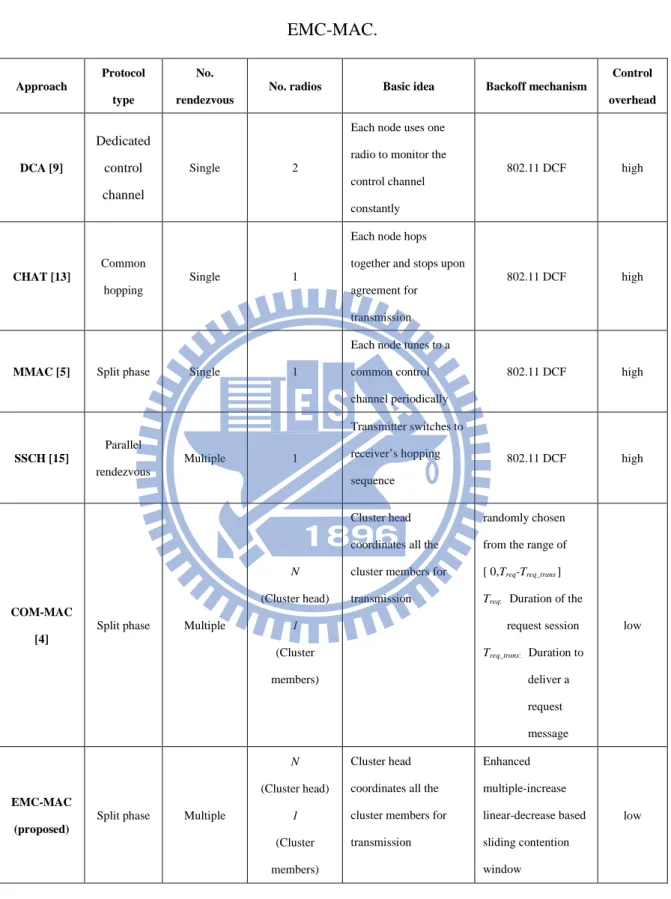
Table I. The proposed EMC-MAC is also included in the table, which will be described in Section 3. In Table I, the protocol type indicates the operation type of these multi-channel MAC protocols as classified in [8]. The number of rendezvous indicates the number of control channels that can be used for all the devices. The number of radios indicates how many transceivers equipped on each device. The basic idea indicates the main idea of each protocol. The backoff mechanism indicates how to backoff when channel contention occurred. The last metric, control overhead, indicates that the amount of exchanged control messages.
The first four approaches in Table I are contention-based multi-channel protocols. Most contention-based multi-channel MAC protocols are not suitable for delay-sensitive WMSN
Table I. Comparison of existing multi-channel MAC protocols with proposed EMC-MAC. Approach Protocol type No. rendezvous
No. radios Basic idea Backoff mechanism
Control overhead DCA [9] Dedicated control channel Single 2
Each node uses one radio to monitor the control channel constantly 802.11 DCF high CHAT [13] Common hopping Single 1
Each node hops together and stops upon agreement for transmission
802.11 DCF high
MMAC [5] Split phase Single 1
Each node tunes to a common control channel periodically 802.11 DCF high SSCH [15] Parallel rendezvous Multiple 1 Transmitter switches to receiver’s hopping sequence 802.11 DCF high COM-MAC [4]
Split phase Multiple
N (Cluster head) 1 (Cluster members) Cluster head coordinates all the cluster members for transmission
randomly chosen from the range of [ 0,Treq-Treq_trans ]
Treq: Duration of the
request session Treq_trans: Duration to deliver a request message low EMC-MAC (proposed)
Split phase Multiple
N (Cluster head) 1 (Cluster members) Cluster head coordinates all the cluster members for transmission Enhanced multiple-increase linear-decrease based sliding contention window low
6
because each packet has to contend for medium access and the delay for data delivery could be potentially unbounded. The amount of time required to resolve collisions depends on the load condition of the network, which makes it very difficult to guarantee a bounded delay [4]. In contrast, COM-MAC [4] and the proposed EMC-MAC use the cluster head to coordinate all its cluster members to reduce control messages and let multiple nodes transmit their multimedia data at the same time through multiple channels. In the request phase, both protocols use the contention-based protocol while in the transmission phase, they use the contention free protocol to transmit multimedia data. Therefore, both protocols can guarantee a bounded delay. In the next section, we will further compare the main differences between the proposed EMC-MAC and COM-MAC [4].
2.3
COM-MAC [4] bases traffic load to determine to use a contention free or contention based protocol at the control channel. However, it did not propose any mechanism to decide whether a node needs to send messages or not and it uses a static request session and the duration to transmit a request to define the backoff interval. It may cause some nodes unable to transmit its request at the current round; thus, the medium access delay increases and the network throughput decreases.
Comparison of proposed EMC-MAC and COM-MAC
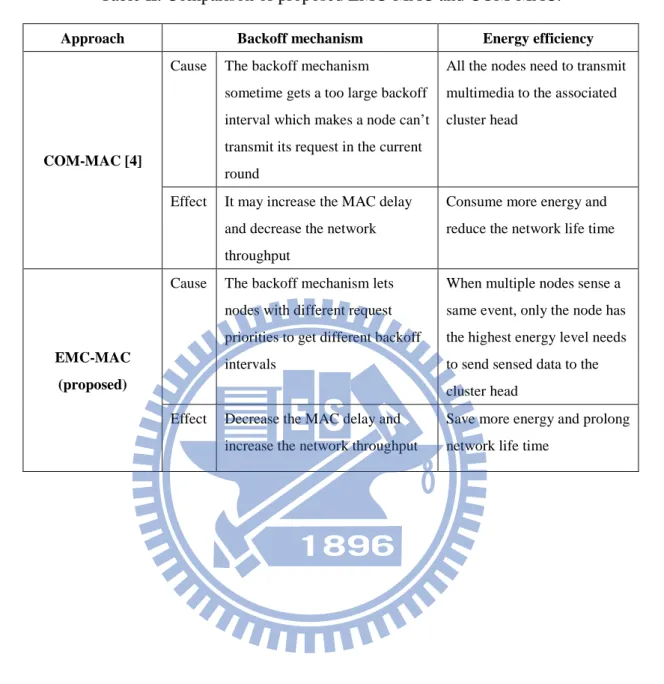
The above problems motivate us to design a more efficient multichannel MAC protocol for cluster based WMSNs. We propose an energy efficient mechanism to choose a node to send its multimedia data. In addition, an enhanced sliding contention window [7] is proposed to effectively use the control channel. Table II summarizes the main differences between COM-MAC and the proposed EMC-MAC.
Table II. Comparison of proposed EMC-MAC and COM-MAC.
Approach Backoff mechanism Energy efficiency
COM-MAC [4]
Cause The backoff mechanism
sometime gets a too large backoff interval which makes a node can’t transmit its request in the current round
All the nodes need to transmit multimedia to the associated cluster head
Effect It may increase the MAC delay and decrease the network throughput
Consume more energy and reduce the network life time
EMC-MAC (proposed)
Cause The backoff mechanism lets nodes with different request priorities to get different backoff intervals
When multiple nodes sense a same event, only the node has the highest energy level needs to send sensed data to the cluster head
Effect Decrease the MAC delay and increase the network throughput
Save more energy and prolong network life time
8
Chapter 3
Design of Proposed Efficient
Multi-channel MAC Protocol
3.1 Network architecture
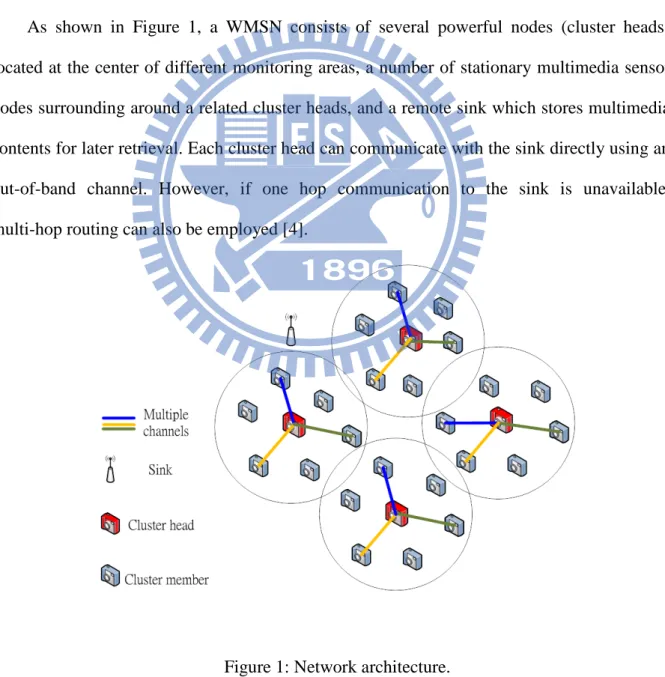
As shown in Figure 1, a WMSN consists of several powerful nodes (cluster heads) located at the center of different monitoring areas, a number of stationary multimedia sensor nodes surrounding around a related cluster heads, and a remote sink which stores multimedia contents for later retrieval. Each cluster head can communicate with the sink directly using an out-of-band channel. However, if one hop communication to the sink is unavailable, multi-hop routing can also be employed [4].
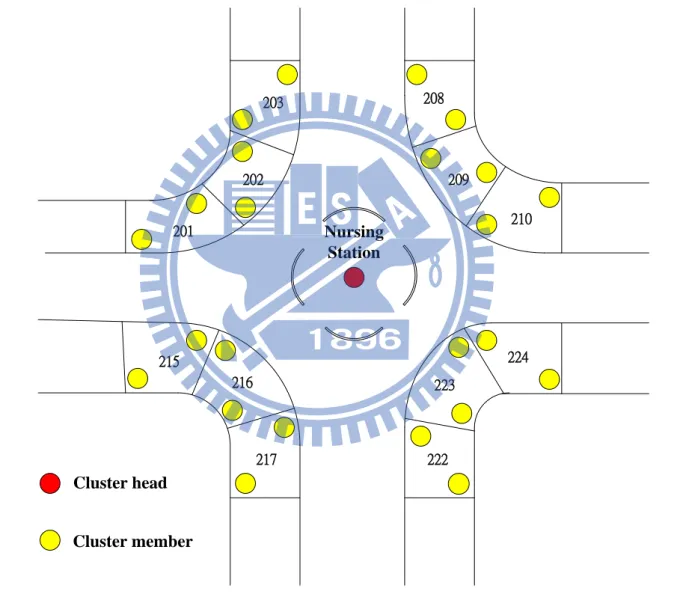
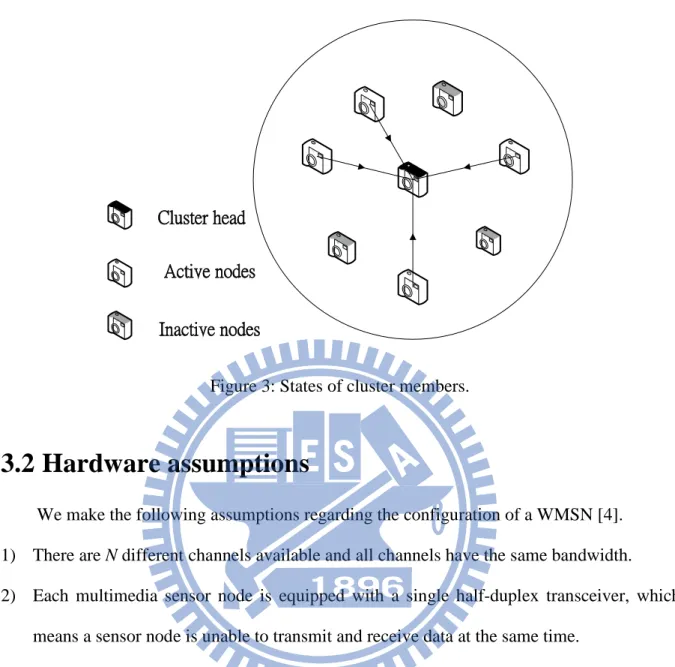
We apply this architecture in Figure 1 to an example environment, such as a hospital, to illustrate its possible application scenarios. In Figure 2, each floor forms a cluster and the cluster head is placed at the nursing station which is in the center of the floor. Each ward of the hospital is deployed with two multimedia sensor nodes for fault tolerance. A node within a cluster is either active or inactive. As shown in Figure 3, nodes which need to send multimedia data to the cluster head are active, while the others are inactive.
Nursing Station 201 202 203 208 209 210 215 216 217 222 223 224 Cluster head Cluster member
10
3.2 Hardware assumptions
We make the following assumptions regarding the configuration of a WMSN [4]. 1) There are N different channels available and all channels have the same bandwidth. 2) Each multimedia sensor node is equipped with a single half-duplex transceiver, which
means a sensor node is unable to transmit and receive data at the same time.
3) A multimedia sensor node can only transmit or receive on one channel at a time. It is able to switch among channels dynamically. The channel switching time is less than 224 µs according to [6].
4) Each cluster head is equipped with N half-duplex transceivers, which means a cluster head can transmit or receive on N channels simultaneously. In addition, each cluster head has sufficient power supply and better processing ability.
5) All the cluster members are synchronized by its related cluster head and each cluster member can communicate with its cluster head directly.
Cluster head
Inactive nodes Active nodes
3.3 Proposed EMC-MAC protocol
In this section, the proposed efficient multi-channel medium access control (EMC-MAC) protocol for WMSNs is described. We assume the clustering process has been completed by some existing clustering protocol and all the multimedia nodes have joined the nearest cluster head [4]. Within a cluster, the control channel assignment phase will be executed at first, then the following three phases, request phase, scheduling phase, and transmission phase, will be executed sequentially in a round, as shown in Figure 4. The length of a round would vary according to network traffic load. All these phases will be described in the next subsection.
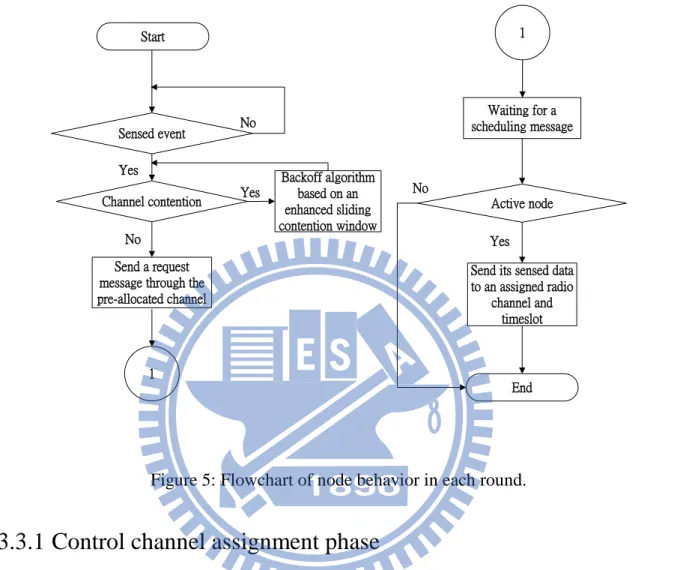
At first, each node receives a pre-allocated control channel assignment from its cluster head. Figure 5 shows the flowchart of node behavior in each round. Once a node sensed an event, the node starts to send its request message through a pre-allocated control channel. If control channel contention occurred, the contention nodes start to execute a backoff algorithm based on an enhanced sliding contention window [7], which will be discussed in Section 3.3.2. After the request message transmitted successfully, the node waits for a scheduling message
Request phase Scheduling phase Transmission phase
Round 1 Round 2
Round 3
Control channel assignment phase
Figure 4: Round structure.
12
from the cluster head and checks whether it is an active node or not. If yes, the node starts to transmit its sensed data to the cluster head in a given timeslot on an assigned radio channel.
3.3.1 Control channel assignment phase
In this phase, all the N channels can be assigned to different nodes as their control channels. To avoid possible channel contention, different channels will be assigned to adjacent nodes because these nodes are close to one another that tend to sense the same event and transmit sensed data at the same time.
3.3.2 Request phase
After the control channel assignment phase, any node that sensed an event can send a REQ message to the cluster head. This message contains the node ID, size of multimedia data to be transmitted, energy level, and priority of the data, which is decided by the emergency degree of data, for example, high priority for data from an intensive care unit. Each node
Sensed event
Send a request message through the pre-allocated channel Channel contention No Yes Yes No Backoff algorithm based on an enhanced sliding contention window Start Waiting for a scheduling message Active node No
Send its sensed data to an assigned radio channel and timeslot Yes End 1 1
sends an REQ message through the pre-allocated control channel in a contention-based manner. In order to avoid possible collisions, an enhanced MILD based sliding contention window mechanism is employed in each sensor node [7]. This mechanism lets a request message with a higher priority get a contention window that results in a smaller backoff interval, whereas a request message with a lower priority receive a contention window that results in a longer back off interval. In this way, the channel contention probability may decrease and the throughput may increase. The backoff interval for node i is initialized as follows. min
LB
CW [i]
CW = is the lower bound of the backoff interval. CWUB[i]=CWmin+2× SF
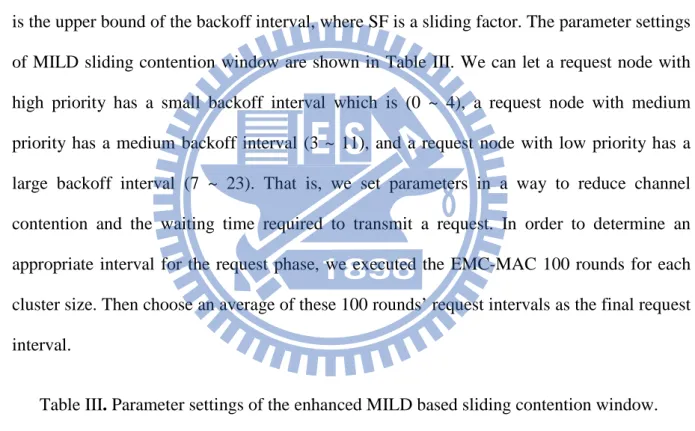
is the upper bound of the backoff interval, where SF is a sliding factor. The parameter settings of MILD sliding contention window are shown in Table III. We can let a request node with high priority has a small backoff interval which is (0 ~ 4), a request node with medium priority has a medium backoff interval (3 ~ 11), and a request node with low priority has a large backoff interval (7 ~ 23). That is, we set parameters in a way to reduce channel contention and the waiting time required to transmit a request. In order to determine an appropriate interval for the request phase, we executed the EMC-MAC 100 rounds for each cluster size. Then choose an average of these 100 rounds’ request intervals as the final request interval.
Table III. Parameter settings of the enhanced MILD based sliding contention window. Traffic priority SF (time slots) CWmin (time slots) CWmax (time slots) High 2 0 15 Medium 4 3 31 Low 8 7 63
14
3.3.3 Scheduling phase
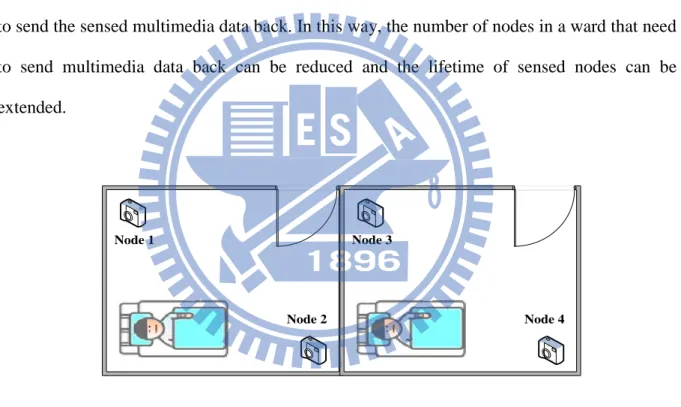
After the request phase, the cluster head start to select which nodes need to send sensed multimedia data and becomes active nodes according to the received REQ messages. We use the energy level of each node to select active nodes, as illustrated in Figure 6. In Figure 6, nodes 1 and 2 monitor the same ward, and nodes 3 and 4 monitor the same ward. If some emergent event happened, all nodes in the corresponding ward will send REQ messages to the cluster head. Assume node 1’s energy level is higher than node 2’s energy level and node 3’s energy level is higher than node 4’s energy level. The cluster head will choose nodes 1 and 3 to send the sensed multimedia data back. In this way, the number of nodes in a ward that need to send multimedia data back can be reduced and the lifetime of sensed nodes can be extended.
After a cluster head chooses active nodes for data transmission, the cluster head starts to schedule the data transmission of the active nodes. In order to achieve the QoS requirement, the active nodes with the same priority are grouped together. The group has the highest priority will send multimedia data first. In the same group, the order to transmit multimedia data is based on data transmission time. A node with the smallest data size will be assigned to
Node 1
Node 2
Node 3
Node 4
Figure 6: When multiple nodes sense the same event, only the node has the highest energy level needs to transmit multimedia data back.
a channel first. After the cluster head creates a schedule, it will broadcast this schedule to all the cluster members.
3.3.4 Transmission phase
After receiving a scheduling message from the cluster head, a cluster member will check if it is allowed to send back the sensed data. If yes, it becomes an active node and starts to send the sensed multimedia data on a specific radio channel and timeslot assigned by the cluster head; otherwise, it will ignore the scheduling message.
16
Chapter 4
Performance Evaluation
In this section, we first describe simulation setup and evaluation metrics. Then, we compare the proposed EMC-MAC with COM-MAC [4] in terms of the rounds till the first
node death, network throughput, and MAC delay.
4.1 Simulation setup and evaluation metrics
We have developed an object oriented simulator using C++ for WMSN MAC protocols. Related simulation parameters are shown in Table IV
The energy consumption model [16] has adopted and is described as follows. ETx( dk, )
denotes the energy consumption of a node to transmit a k-bit message over a distance d due to the energy consumption of the transmitter circuitry ETx−elec(k) and the transmitter amplifier
[20]. d) (k,
ETx−amp Thus, ETx( dk, ) is given by:
Table IV. Simulation parameters [4, 16]. Parameter Value
Number of channels 3
Channel bandwidth 250 Kbps
Packet size 525 bytes
Transmission range 10 m
Packet arrival rate Randomly choose from [0,10]
Initial node energy level 6 J
elec
E transmitter circuitry dissipation per bit 50 nJ/bit
amp
(1) ) , ( ) ( ) , ( 2 d k k E d k E k E d k E amp elec amp Tx elec Tx Tx × × + × = + = − − ε Similarly, ERx(k)represents the energy consumption of a node to receive a k-bit message due
to the energy consumption of the receiver circuitry ERx−elec(k).ERx(k)is given by:
(2) ) ( ) (k E k E k ERx = Rx−elec = elec×
4.1.1 The rounds till the first node death
We execute both the protocols, COM-MAC and EMC-MAC, until the first node death and record total rounds passed when this node is out of energy. This metric, the round till the first node death (FND), indicates the energy balancing capability of a protocol.
4.1.2 Throughput
We use successfully received data packets in the cluster head divided by the total elapsed time of the network as throughput (Mbps), which is defined as follows:
4.1.3 Average MAC delay
Average MAC delay is defined as the elapsed time between the first attemp time to send a REQ message to the time actually to send a REQ message, which is defined as follows:
Throughput = time elapsed Total packets data received ly Successful
18
4.2 Comparison between EMC-MAC and COM-MAC
Figure 7 shows the rounds till the first node death under different cluster sizes, where the cluster size is the total number of sensor nodes in a cluster. Therefore, the proposed EMC-MAC protocol achieves better consumed energy balancing than COM-MAC, since we base on the energy level of each node to select active nodes for multimedia data transmission. The round till the first node death of EMC-MAC is 72.24% larger than that of COM-MAC. It also implies that EMC-MAC is more energy efficient than COM-MAC.
avg D = m n T T j m j n i fi ei
∑
∑
= = − 1 1 ) (Where Davg= average MAC delay
Tfi= the time first attempt to send a request for node i
Tei= the time actually sending a request for node i
n = the number of nodes attempting to transmit REQ messages j = the jth round
For comparison of the throughput of EMC-MAC with that of COM-MAC under different cluster sizes was executed each protocols for 50 rounds. As shown in Figure 8, EMC-MAC is 23.72% better than COM-MAC in terms of throughput. This is because EMC-MAC has an enhanced sliding contention window that can effectively reduce the probability of channel contention. As a result, the time interval in the request phase can be reduced and a high throughput can be obtained.
Figure 7: The rounds till the first node death (FND) under different cluster sizes.
500 1000 1500 2000 2500 3000 3500 25 30 35 40 45 EMC-MAC (proposed) COM-MAC Cluster size
FND
20
Figure 9 shows the comparison of the average MAC delay between EMC-MAC and COM-MAC. The average MAC delay increases as the cluster size increase for both protocols. When the cluster size increases, channel contention increases. EMC-MAC is 44.59% better than COM-MAC in terms of average MAC delay. This is because EMC-MAC uses an enhanced sliding contention window in the backoff mechanism. The backoff mechanism let different priority nodes get different backoff intervals, so the channel contention probability can be reduced and nodes can send packets as soon as possible.
Figure 8: Throughput performance under different cluster sizes.
0.15 0.2 0.25 0.3 0.35 0.4 0.45 0.5 25 30 35 40 45 EMC-MAC (proposed) COM-MAC Cluster size
T
hr
o
ug
h
pu
t (
M
bp
s)
Figure 9: Average MAC delay performance under different cluster sizes. 0 0.1 0.2 0.3 0.4 0.5 0.6 0.7 25 30 35 40 45 COM-MAC EMC-MAC (proposed) Cluster size
A
v
er
a
g
e
M
A
C
d
elay(
se
c)
22
Chapter 5
Conclusion
5.1 Concluding remarks
In this thesis, we have presented an efficient cluster-based multi-channel MAC protocol for wireless multimedia sensor networks. We use the energy level of each node to select active nodes for multimedia data transmission and adjust the sliding contention window to effectively utilize control channels. Simulation results have shown that the proposed EMC-MAC’s throughput is 23.72% higher than COM-MAC’s, its average medium access delay is 44.59% lower than COM-MAC’s, and its rounds till the first node death is 72.24% longer than COM-MAC’s. With the low MAC delay feature, our EMC-MAC protocol is feasible for applications of real time multimedia traffic sensing and transmitting, such as remote monitoring of hospital patients and fire spots.
5.2 Future work
A cluster head may be enabled with more functionalities, such as classifying received data according to their priorities to allow high priority data to be transmitted to the sink first, so that the proposed EMC-MAC can be more suitable for real-time multimedia applications, such as streaming video. In addition, we can integrate the proposed EMC-MAC protocol to an efficient cluster-based routing protocol to transmit multimedia data from source to sink efficiently.
Bibliography
[1] I. F. Akyildiz, T. Melodia, and K. R. Chowdry, ‘‘A Survey on Wireless Multimedia Sensor Networks,’’ Computer Networks (Elsevier) Journal, March 2007, pp.921 – 960. [2] ‘‘XBOW MICA2 Mote Specifications,’’ [Online] Available: http://www.xbow.com/ [3] N. Saxena, A. Roy and J. Shin, “A QoS-based Energy-aware. MAC Protocol for Wireless
Multimedia Sensor Networks
[4] C. Li, P. Wang, H. Chen, and M. Guizani, "A Cluster Based On-demand Multi-Channel MAC Protocol for Wireless Multimedia Sensor Networks," in Proc. IEEE International Communications Conf. ICC’08, May 2008, pp. 2371 – 2376.
,”in Proc. IEEE Vehicular Technology Conf. VTC’08, spring 2008, pp.183 –187.
[5] J. So and N. Vaidya, ‘‘Multi-channel mac for ad hoc networks: Handling multi-channel hidden terminals using a single transceiver,’’ in Proc. ACM, Roppongi Hills, Tokyo, Japan, May 2004, pp. 222-233.
[6] IEEE 802.11 Working Group, ‘‘Wireless LAN Medium Access Control (MAC) and Physical Layer (PHY) specifications,’’ 1997.
[7] M. Bharatiya and S. Prasad, ‘‘MILD based sliding contention window mechanism for QoS in Wireless LANs,” in Proc. Wireless Communication and Sensor Networks,
WCSN’08, 2008, pp. 105-110.
[8] Jeonghoon Mo, Hoi-Sheung Wilson So and Jean Walrand, ‘‘Comparison of Multi-Channel MAC Protocols,” IEEE Trans. Mobile Computing, vol. 7, no. 1, pp. 50-65, Jan. 2008.
[9] S. L. Wu, Y. Lin, Y. C. Tseng, and J. P. Sheu, “A New Multi-Channel MAC Protocol with On-Demand Channel Assignment for Mobile Ad Hoc Networks,” in Proc.
24
IEEE International Symposium
[10] S. L. Wu, C. Y. Lin, Y. C. Tseng, C. Y. Lin, and J. P. Sheu, “A Multi-Channel MAC protocol with Power Control for Multi-Hop Mobile Ad Hoc Networks,” The Computer
Journal, vol. 45, no. 1, pp. 101-110, 2002.
on Parallel Architectures, Algorithms and Networks,
ISPAN ’00, Dec. 2000, pp.232 - 237.
[11] W. C. Hung, K. L. E. Law, and A. Leon-Garcia, “A Dynamic Multi-Channel MAC for Ad Hoc LAN,” In Proc. 21st Biennial Symp. Comm, June 2002, pp. 31-35.
[12] A. Tzamaloukas and J.J. Garcia-Luna-Aceves, “Channel-Hopping Multiple Access,” In
Proc. IEEE Int’l Conf. Comm. ICC ’00, June 2000, pp. 415-419.
[13] A. Tzamaloukas and J. Garcia-Luna-Aceves, “Channel-Hopping Multiple Access with Packet Trains for Ad Hoc Networks,” In Proc. IEEE Device Multimedia Comm.
MoMuC ’00, Oct. 2000.
[14] J. Chen, S. Sheu, and C. Yang, “A New Multichannel Access Protocol for IEEE 802.11 Ad Hoc Wireless LANs,” In Proc. 14th IEEE Int’l Symp. Personal, Indoor and Mobile
Radio Comm. PIMRC ’03, vol. 3, Sept. 2003, pp. 2291-2296.
[15] P. Bahl, R. Chandra, and J. Dunagan, “SSCH: Slotted Seeded Channel Hopping for Capacity Improvement in IEEE 802.11 Ad Hoc Wireless Networks,” In Proc. ACM
MobiCom’04, Sept. 2004.
[16] S. Misra, M. Reisslein and X. Guoliang, “A survey of multimedia streaming in wireless sensor networks,” IEEE Communications Surveys & Tutorials, Vol. 10, 2008, pp. 18-39.

![Table IV. Simulation parameters [4, 16].](https://thumb-ap.123doks.com/thumbv2/9libinfo/8594613.189904/27.892.131.805.489.893/table-iv-simulation-parameters.webp)
