001: 10.61511CERQ.2014.2204.04
II
The Effects of Background Knowledge
and L2 Reading Proficiency on
Taiwanese University Students'
Summarization Performance
Yi-Hsuan Un*
Chiou-Lan
Chern*'~Abstract
Undertaken from a cognitive perspective, this study investigates how lower level processing (L2 linguistic knowledge) and higher level processing (background knowledge) influence English reading comprehension of university EFL learners in Taiwan. In particular, the study examines the bilateral effects of these two knowledge bases on the students' performance of a summary writing after reading an article in English which contained subject matter information. A TOEFL reading proficiency test accompanied by a background knowledge test developed by field experts were used to measure the two variables. Seventy-one university students who exhibited different levels of L2 reading proficiency and background knowledge participated in the study. The effects of linguistic proficiency vs background knowledge were scrutinized through statistical measures.
The analysis revealed that the level of English proficiency and background knowledge both affected the participants' performances on summary writing into Ll; however, the role of background knowledge, being a more powerful predictor of performance, was an integral component of comprehension in academic reading. The concomitant effects of these two variables were not observed, suggesting one knowledge base could not compensate for deficiencies in the other. In addition, the study indicated that university students' understanding of
• Yi-Hsuan Lin, Ph.D. student, Department of English, TESOL Program, National Taiwan Nonnal University
E-mail: yihsuan24(a)hotmail.eom (Corresponding Author)
•• Chiou-Lan Chern, Professor, Department of English, National Taiwan Nonnal University E-mail: elchern(a)ntnu.edu.tw
«'@;f-l:;f6(~liH3'i;*tlj» m=+=~mIZ'JJtIj
,
20141f- 12fij ,~149-186 001:10.6151/CERQ.2014.2204.04subject matters may extend beyond their own disciplinary area, as English majors might be equipped with more background knowledge than their peers majoring in that specialized discipline; likewise, non-English majors might outperform their English major counterparts in English reading proficiency test. In general, the students performed relatively poor in summary writing since they failed to build a conceptual synthesis based on the reading article. Suggestions toward improvements on English reading and summary writing are proposed for EFL university students.
背景知識與英文閱讀能力對臺灣大學生
學術英語摘要能力的影響
林宜瑄* 陳秋蘭" 摘要 本文從認知的角度出發,探討閱讀理解中較低層次的語言知識與較高 層次的背景知識對臺灣大學生英語閱讀的影響。尤其在兩種知識的交互作用 下,檢視學生閱讀與學科內容相關的英語文章後撰寫摘要之表現。七十一-{Ir: 大學生分別具有高低不同之英語與背景知識,經出托福閱讀測驗與專家設計 之知識測驗分組役,以統計工具分析英文閱讀能力與背景知識對摘要擷取能 力的影響。 統計結果顯示,不論是英語閱讀能力或相關背景知識的高低,均對學生 以母語撰寫之摘要表現造成影響 o 但背景知識程度的高低,對摘要表現的預 測力勝過英語能力,背景知識在學術英語閱讀的作用不可或缺;兩種變數於 統計結果上並無交互作用,顯示兩種知識彼此間無法互補 o 此外,本研究結 果也發現大學生的閱讀能力不必然受限於所屬之科系,英文系學生在其他讀 域的知識程度可能超越該讀域之大學生;而非英文主修之學生亦可能具有高 英語閱讀能力。整體而言,大學生在學術英語文章的摘要撰寫表現上普遍不 佳,缺乏建構整體主要概念的能力。依據本文的研究結果,並對大學生閱讀 英文與摘要寫作訓練提出相關建議。 關鍵詞:背景知識、英文閱讀、摘要寫作 * 林宜瑄,國立臺灣師範大學英語學系英語教學組博士生(通訊作者) 電子郵件: [email protected] "陳秋蘭,國立臺灣師範大學英語學系教校 電子郵件 [email protected] 從稍一日期: 2013 年 9 月 2 Fl :修正 Fl 期: 2013 年 II 什 12 日;險'';l日期: 2014 年 5 月 21 日«~~~~~~*~»~=+=~~~m
152 Contemporary Educational Research Quarterly Vo1.22, NO.4
Introduction
In Taiwan, the academic training at the university level aims to nurture students to possess necessary grip of the subject matter. At a higher education level, English reading proficiency is vital as content of a subject matter is constantly presented in sources written in English. And English is used across disciplines to construct, obtain, or process that information, which reiterates the importance of English reading proficiency. English proficiency and content knowledge are needed to comprehend information written in L2. The English language encountered by EFL students has gone through a fundamental change at this stage of higher education. English is no longer merely the subject of study. Instead of focusing on language details used in the text, the attention is now on the information of content. English text has shifted from the dichotomy of being a TALa (Text as Linguistic Object) to become a TAVI (Text as a Vehicle ofInformation) (Dudley-Evans
& St. John, 1998).
When a reader is engaged in a text that involves conceptual understanding, an individual's personal stock of experiences (i.e., background knowledge) provides scaffolding for the comprehension of the text. Without activation of one's background knowledge, the framework embodied in a piece of writing cannot be fully constructed. With background knowledge, an individual could relate what is read to what s/he already knows for comprehension. This existing knowledge fills the gap in the reading process by connecting the information within the text to one's knowledge base. In a foreign or second language, a reader often has to go through a slow and laborious process -- dealing with feature recognition, lexical access, meaning integration, memory retrieval, etc. This process requires both linguistic and conceptual knowledge of a text, as the linguistic component is utilized for word recognition, and a conceptual component links this information to pre-existing knowledge structures (Le., schema). From a cognitive point of view, linguistics and conceptual components in a text are both critical in the reading comprehension process. At universities, the presence of background knowledge is even more critical in reading as it facilitates comprehension of specialized content information.
components for comprehension from either a local level process (bottom-up model), which starts with word recognition, or a global level process (top-down model), which starts with background knowledge. From the bottom-up point of view, the raw input is processed sequentially until the meaning of the text is grasped. Comprehension occurs as a result of automatic and accurate processing from data-driven decoding at the lower level. Therefore, comprehension difficulties are mainly attributed to linguistic deficiencies. The readers who lack proficiency in English are not fully equipped with the ammunition to deal with the data-driven decoding process; therefore, their performance is compromised. From the opposite perspective, the reverse model is proposed. The top-down model claims that the decisions made at the conceptual level are applied to guide choices at lower levels. In other words, comprehension occurs because the conceptual-driven predications made in higher level schemata are confirmed (e.g., Carrell & Eisterhold, 1983). EFL readers at the tertiary level who are trained in the related discipline could activate previously acquired background knowledge and combine it with information mentioned in the text to form an understanding. This process goes beyond mere linguistic processes in comprehending a text. Therefore, EFL students who do not possess the related knowledge are at a disadvantage because they cannot generate a proper schema.
Most researchers agree that second language reading is comprised of both bottom-up and top-down processes. Research evidence suggests that neither bottom-up nor top-down models can single-handedly explain the complexity of the reading process (Stanovich, 1980, 2000). An interactive model of both top-down and bottom-up processes has made a powerful impact on reading theory. It proposes that lower and higher level factors operate simultaneously to construct meaning. The interactions that occur during reading imply that the reading process is non-linear. Readers do not process the information in a series of discrete stages (e.g., Grabe, 1988; Kintsch, 1998; Nassaji, 2002). Cognitively speaking, nonlinearity in reading assumes that the process involves a compensatory mechanism, as knowledge at one level can be applied to compensate for the lack of knowledge at another level. Stanovich (1980) posits that neither the bottom-up nor the top-down process can precede or dominate the other, but work simultaneously to compensate for each other in comprehension. Reading comprehension,
«~~~~~~*~»~=+=~~~~
154 Contemporary Educational Research Quarterly Vol.22, No.4
consequently, depends in part on linguistic processing ability, and in part on the background knowledge that the reader already possesses.
Linguistic ability, manifested through L2 reading proficiency, and background knowledge, activated in interpreting disciplinary-related information, interacts during the reading of an article. This study attempts to elucidate how these two factors function in concert. Past research has made it clear that people with high background knowledge comprehend a text better than those who lack that knowledge (Alderson & Urquhart, 1985), When L2 proficiency comes into play, higher proficiency readers may compensate for their deficiency in knowledge by relying on their general reading proficiency. Following the same vein, higher background knowledge may also compensate for poorer reading skills.
Current models of second language reading attempt to depict how two factors work together to influence L2 reading comprehension (e.g., Bernhardt, 2005, 201l). Bernhardt's (2005) focus is on the contribution of the L1 language reading ability and second language knowledge (i.e., L2 language proficiency) to L2 reading. Others, such as Phakiti (2003, 2008), define the relationship between cognitive and metacognitive strategies used to assist with EFL students' reading comprehension. Very few studies, however, discuss the effects of background knowledge and L2 reading proficiency to L2 reading. What counts as text comprehension is how a reader comes to construct the text through these two sources to make the text comprehensible. In the EFL environment of Taiwan, it is important to account for how background knowledge and L2 linguistic proficiency influence the EFL readers since these are the two major factors causing comprehension difficulties at the university level.
Literature Review
This research encompasses the theoretical constructs of reading in two dimensions. The first dimension focuses on the role an individual's background knowledge plays, and the second one focuses on the role L2 proficiency plays. The researchers synthesize current theory on how these two variables function in reading comprehension. During reading, an individual's L2 proficiency frames the processing of linguistic components in
the text, and an individual's background knowledge frames the conceptual understanding of the text. Both dimensions influence the reader's comprehension. EFL students of various disciplinary trainings comprehend somehow differently about a specified text since they differ in their knowledge repertoires. Aside from investigating the theoretical construct of conceptual and linguistic knowledge bases, the study looks into the possible interactions of these two bases of knowledge. The discipline-related knowledge and L2 language proficiency are commonly believed to exert effects on an EFL readers' understanding; whether strength in one of the two factors can make up for lack of the other is an interesting issue. At the university level, summarization is an ability required in academic pursuits. The present study investigates the product of reading by summary writing. Since the ability is considered critical at university level, summarization should be measured. Relevant literature is thus discussed to validate the adoption of Ll summary writing in this study.
The Contribution of Background Knowledge
to Reading
Reading comprehension requires an interaction between the written text and prior knowledge accessible to the reader. Smith (1975) proposed in the 80's that comprehension is a reduction of uncertainty, that is, a reader must eliminate many alternatives to comprehend a text. Without the assistance of prior knowledge, various options might appear to be correct. A similar notion is established from the cognitive perspective, as what is read must be perceived or associated with the contents of the memory system to make sense (Rumelhart, 1980). Readers are engaged in decoding, memory storage, retrieval, integration, and updating, etc. Consequently, a learner comprehends a text via the interactions between the text and the reader's existing knowledge.
Activating Content Schemata from Related Disciplinary
Training
«~~~~*~~~»~=+=~~~~
156 Contemporary Educational Research Quarterly Vo1.22, No.4
explained by schema theory. Information that falls within an individual's schema is easily incorporated into one's knowledge base, as "people understand new experiences by activating relevant schema in their mind" (Cook, 1997: 86). Because schema is the reader's organized knowledge of the world, it might impact how this reader interprets the words on the page. Nunan (1999: 201) also stated that "schema theory is based on the notion that past experiences lead to the creation of mental frameworks that help us make sense of new experiences." Inquiries into how schema facilitates listening comprehension (Schmidt-Rinehart, 1994) or reading comprehension (Krekeler, 2006) have established that schemata bring about positive effects on language proficiency tests. Anderson, James and Larry (1983: 271) went further to conclude that, "there is good reason to believe that content schemata are more important to reading comprehension than textual schemata:' The quality of reading comprehension is determined in large part by the quality of information the reader brings to the text, which mostly refers to the readers' organized knowledge or mental model of that knowledge.
Content schema is usually thought of as an individual's understanding of a subject matter embodied in the related schemata to form the body of knowledge in a specific discipline. The relationship among background, content, and discipline knowledge is hierarchical. They are not separate entities. In the realm of knowledge, content knowledge is usually subsumed under background knowledge. Itcould be a form of specialized background knowledge to understand an article. Being a form of conceptual knowledge, content knowledge can be acquired in a learning environment. After systematic exposure, when a concept becomes a part of the formal system of learning which organizes around fundamental principles that define a specialized area, that conceptual knowledge turns into discipline knowledge. Therefore, the relationship among background, content, and discipline knowledge is based on their degrees of specialization. These entities of knowledge therefore unavoidably link to reading comprehension. Douglas (2000: 2) stated, "Background knowledge is a necessary, integral part of the concept of specific purpose language ability" Some schematic theorists suggest that the application of higher-level conceptual thinking is beneficial in the reading process (e.g., Carrell & Eisterhold, 1983). This top-down
process presumes that reading is conceptually driven, and that lower-level processes are subsidiary. Consequently, the local level features are important only as they can direct readers to certain concepts. Itis therefore plausible that readers who are equipped with background information in a specific discipline can compensate for linguistic insufficiencies, as content familiarity enhances their reading performance. On the contrary, lack of appropriate content schemata can be a source of a reading problem. Even though in general, research has shown that students appear to be at an advantage in reading comprehension when reading articles of their disciplines, a few studies (e.g., Koh, 1985) have shown that students do not necessarily respond best to articles of their domain specialty. Considering the inconsistent conclusions, the researchers found it necessary to provide a methodologically sound design in this study to see how background knowledge related to a specific discipline helps students develop content schemata in reading comprehension.
The Contribution of L2 Proficiency to Reading
Numerous L2 studies have highlighted and documented the importance of language profiCiency in achieving L2 reading comprehension. A certain level of proficiency has to be reached for a student to enter automatic decoding which allows for comprehension. When it comes to text comprehension, a mental model regarding what the text says is constructed as a text-base (Perfetti, Van Dyke, & Hart, 2001). In academic reading, the purpose is to build a meaningful text-base from the content information, without a text-base, a reader cannot develop understanding between the words, phrases, clauses, sentences, and paragraphs (Kintsch, 1998). Linking these linguistic and textual structures in the mental model is therefore fundamental to comprehension. Undoubtedly, L2 proficiency plays a significant role in the text-base building process that influences the outcome of comprehension.
In reading research, especially in an ESL or EFL environment, many argue for the transfer of L1 skills to L2. However, to transfer L1 skills, readers must first reach a certain level of L2 proficiency. The hypothetical existence of a linguistic threshold had been proposed (Alderson, 1984;
(.~.~W~*fl).=+=~.~~
158 Contemporary Educational Research Quarterly Vo1.22, No.4
Clarke, 1980; Cummins, 1991). Several studies also claimed that the variable which correlates best with effectiveness in second language reading is L2 proficiency (e.g., Bernhardt& Kamil, 1995). Clarke (1980) also indicated that with readers whose L2 proficiency falls below the threshold, no matter how proficient they are in their Ll reading, they cannot transfer their Ll reading skills to L2 reading until they cross the threshold.
Activating Linguistic and Textual Schemata from L2
Language Training
Two general kinds of language-related schemata are thought to be applied by readers in interpreting a text. The first is oftentimes referred to as the linguistic schema. The linguistic schema refers to readers' abilities to decipher linguistic elements, which are the base of other schemata. Without basic linguistic understanding to connect elements such as vocabulary, grammar, or syntax, a reader cannot comprehend the text. The second kind of language schemata refers to textual, also known as formal schemata (Carrell, 1984a, 1984b).Textual understanding refers to the knowledge of organizational structures in written texts. This refers to the knowledge at or above the discourse level, which usually helps guide readers' expectations in reading. For instance, a reader might use a narrative schema established previously to interpret the theme or plot of a story, or use the schema to interpret the writer's intentions. Therefore, when equipped with proper linguistic or textual schema, the reader would be more likely to acquire the message embedded in a text.
The Compensatory Nature in Reading
Comprehending words, sentences, and an entire text involves more than just one source of knowledge. According to the schema theory, comprehending a text is an interactive process between a reader's background knowledge and linguistic knowledge. When experiencing problems, a reader naturally falls back on other sources of knowledge available to them to compensate for deficiencies. L2 proficiency helps readers construct a linguistic and textual representation; on the other hand, background knowledge helps readers make inferences to construct meaning. The combination of these two sources leads to better reading
comprehension. Some attempts were made in exploratory research to reveal whether a stronger source can compensate for a weaker one. For example, in AI-Shumaimeri's (2006) study, it was found that at the conceptual level, background knowledge functions as a compensatory resource. In his study, background information impacted the high and the low proficiency adults differently in an EFL environment. The results indicated that readers with low L2 proficiency performed statistically better on comprehension when they had more background knowledge. Interestingly, high-proficiency level students' comprehension performances were not different statistically regardless of whether they had more background knowledge or not. Echoing this compensatory viewpoint, Stanovich (1980) posited that the bottom-up or the top-down process cannot precede or dominate one another, but work simultaneously to compensate each other in comprehension. The present study is a small step to empirically test how the lower and higher processing mechanisms work, and to explore whether there is a compensatory interaction between background knowledge and language knowledge on the readers' comprehension of an academic text through summary writing.
The Ability to Summarize into L1
At the university level, students must learn how to summarize a passage in their own words. During writing, they need to do away with all the irrelevant elements and identify the important ones. Ithas been accepted that the ability to summarize information is an important study skill in the academic community (Bensoussan & Kreindler, 1990). In the EFL environment of Taiwan, summarization into Ll does not involve English writing ability. It is a better way to tap into students' comprehension of academic reading. In addition, as writing summaries in L1 prevents students from copying directly from the source language, summary writing therefore helps to observe evidence of English reading comprehension.
Summarization Reflects Reading Comprehension
To understand what an EFL student has read from a text, a reading comprehension task is usually designed in a way that permits a researcher to measure student's understanding through a representation which can be
«~~~~~~*~»~=+=~~~~
Contemporary Educational Research Quarterly Vo1.22, NO.4
compared to the original text. In the present study, a summarization task is adopted as a measure for reading because reading inevitably involves summarization (Kintsch & van Dijk, 1978; van Dijk& Kintsch, 1983). In a world where the vast amount of written information is received, assessed, and reproduced, the ability to summarize is vital for academic success. University students are often required to summarize information in many academic areas. They are required to summarize information during a lecture, when writing papers, or even while taking tests. Without a full understanding of the text, the information cannot be rendered succinctly. Comprehension itself is essentially equivalent to some form of summarization task. Johns (1988: 97) claimed, "whatever a person's interest in studying a foreign language, there is no escape from the acquisition and development of summarizing skills:'
Similar to all reading-writing activities, to summarize a text is a recursive and interactive process. The task calls for the incorporation and conversion of the source input, requiring an individual to reread, rewrite, and continually reflect on the elements of the text. The operative demands of summary writing are dependent upon the type of summary to be produced (Hidi & Anderson, 1986). In the EFL environment, the students function mostly in their Ll. Therefore, for most academic requirements, the language used for producing a summary is usually the readers' Ll. That is to say, most of the summary writing is completed in Chinese even when the reading is in English. Furthermore, writing a summary in L1 was found to be a better measure of students' English reading abilities than writing a summary in L2 (Yu, 2008). This study adopted summary writing in L1 to reflect the reality in academic setting, as it might be a better a measure of domain area reading. Since contemporary theory is leaning toward a direction of permitting students to use the literacy skills of their L1 as a measure for reading comprehension (Bernhardt, 2005), applying L1 in the design of a reading comprehension test is gaining popularity over conventional comprehension tests such as doze tests or open-ended short answer tests. Contemporary theory claims the application of L1 "provide(s) a purer measure of comprehension, uncomplicated by linguistic performance and tester interference" (Bernhardt, 1991: 200).
The Cognitive Requirements for EFL Students to Summarize
Summarization is a demanding task in itself. When the concepts related to the subject area are expressed through English text, it adds to a reader's cognitive load. The cognitive operations involved in a summarization task begin with comprehension, and move to evaluation, condensation and transformation or translation of the original ideas. The reader has to examine the accuracy of the output in relation to the original text. Instead of composing from scratch, the production is based on the existing, already generated discourse from the target text. The major concerns for a reader are not about how to plan a new writing task but more on the evaluation and combination of information from the content of the text that already exists. Summarization represents macro-level comprehension (Brown& Day, 1983). Lacking L2 language competence or background knowledge might lead to inadequacy in identifying important ideas. It was discovered that the EFL students who were more proficient in English tended to summarize better. They would focus on the main ideas and were more capable of summarizing as though the text were written in their L1. The summarization scores correlated better with English performance than other reading measures such as the short answer questions (Bensoussan& Kreindler, 1990).One of the distinctive features in L2 reading at university level is that it requires both background knowledge and L2 reading proficiency for comprehension to take place. The present study sought to verify the effects of these two knowledge bases in the EFL environment of Taiwan. As reading comprehension was assessed through a summary writing in 11, how background knowledge shaped comprehension for students across different English reading proficiency levels and how these two factors interacted were issues worthy of investigation. Three research questions were developed to address these issues.
(l) Which of the two knowledge bases, background knowledge or L2 proficiency, is a better predictor of comprehension assessed by summary writing in 11 ?
(2) Do students of different levels of L2 reading proficiencies and background knowledge perform differently on the summarization task?
«~~~~~~*~»~=+=~~~M
162 Contemporary Educational Research Quarterly Vo1.22. NO.4
(3) Will higher background knowledge compensate for lower L2 reading proficiency in the summarization task, or will higher L2 reading proficiency compensate for the deficit in background knowledge for Taiwanese EFL students?
Method
Participants
The participants of the study were native Chinese speaking undergraduate students enrolled in two departments of a private university in Taipei; about half of the students were political science majors from the College of Social Science, and the other half were English literature majors from the College of Humanities. Recruiting students of political science and English literature majors ensured the largest possible populations of students who had the experience of reading in a specialized area. The name lists of the sophomore students from the department of political science and the department of English literature were obtained. The corresponding student numbers from the name list of each department were put into separate boxes. The researcher randomly picked 40 numbers out of a box consisting 88 numbers from one department. Another 40 numbers were drawn from a box consisting 91 numbers from the other department. The students undergoing studying therefore had a chance to be selected at random. To encourage their participation, an amount of work-study allowance (i.e., TWO$ 330) was paid for taking part of the experiment. This amount was 1.5 times higher than the going rate of the pay. The students were also informed that, after the experiment, a complementary session on TOEFL instruction and a discussion on the summary writing would be offered if they were interested. In the end, 33 students from the department of political science and 38 from the department of English Literature participated in the study.
It is generally assumed that students can be at an advantage when reading a text related to their own academic specialty. The aim of tertiary education is to prepare students for academic specialization; therefore, university students are expected to possess a certain degree of understanding
of their respective disciplines. The English major students thus were expected to perform better on TOEFL than political science majors. The reading in the present study is related to political science, thus political science majors were recruited. However, some studies still claim that the effects of discipline-related knowledge on academic reading are not clear (e.g., Ridgway, 1997). Therefore, although the participants were drawn from these two majors, a political background knowledge test and a reading section of TOEFL were also administered to determine the participants' levels in these two knowledge bases.
Materials
The participants were asked to complete a reading section of the TOEFL test, a political background knowledge test written in Chinese which required explicit answers, and a summary writing task based on a domain-specific article written in English. Reading proficiency in English was measured by a Reading Comprehension Section from the TOEFL IPT test (201l) published by ETS. This test was used to determine the participants' L2 academic reading levels. On the other hand, the political knowledge test was designed to determine the participants' background knowledge concerning politics and government (See Appendix A).
One long-running thread of political science research holds that individuals are incapable of being universally informed about politics (Shaker, 2009). Also, whether political knowledge tends to be general or domain-specific is debatable (Iyengar, 1990; Zaller, 1990). The present background knowledge test therefore was designed to measure the students' general political knowledge as part of the political literacy test. A political literacy test measures students' political awareness, similar to a political aptitude test. Along with the general political knowledge test, the content knowledge concerning the reading article was also measured.
Conventionally, political knowledge can be measured in different ways. A set of guideline proposed by Delli Carpini and Keeter (1993, 1997) regarding which items should be incorporated into a political knowledge test was adopted in the present study to generate the test items. The guideline stated that questions should include facts, surveillance, or civics
«.~.~~~*~).=+=~.~~
164 Contemporary Educational Research Quarterly Vo1.22, No.4
on the state, local, national/international levels (Delli Carpini & Keeter, 1991, 1993; Jennings, 1996). In other words, the test should include facts that were taught, and also survey people's political attentiveness and understanding. Following the guideline, Questions 1to 5 were designed to assess the perceived political knowledge, among which, Questions 1 and 5 were generated as the factual questions which included issues concerning government. Questions 2, 3, and 4 were generated to include surveillance questions covering current office holders and civics. The design of the first five questions for the present study overlapped with the questions generated in a few studies of social science (e.g., Jennings, 1996; Lamberta, Curtisa, Kaya, & Browna, 1988; Lin & Wang, 2007). Also, as the article chosen in this study for summarization was an analysis of the political situation in Northeast Asia, being a regional study on countries such as Japan and Korea, two domain-specific questions concerning this area were added, with question 7 directly related to the article to be summarized. The design of these 7 items was also a simplified and shorter version to mirror the format of the transfer examination in the field of political science for university students in Taiwan. From these collections of test items, the mission of the knowledge test is to sample the general and specified political knowledge which forms the background knowledge encapsulated within the field of political science. Having the prior knowledge might help readers to use the schema to comprehend the reading and pick up related cues to predict what they read.
Due to its content-specific nature, the researchers enlisted the assistance of two experts from political science, who examined all the political knowledge test questions and confirmed their validity. The article to be summarized by the participants was written by Michael Robert Auslin, an American Japanologist, now director of Japanese Studies at the American Enterprise Institute, a research-based organization producing leading research in key policy areas. The article was non-simplified, retaining the original linguistic complexities and disciplinary-specific rhetoric (See Appendix B). This way, the writing was close to the content reading required in an everyday academic setting. The article is 630 words long written in English, and the summary writing word count for this study is set to be 300 words. The Flesch-Kincaid Grade Level for the English text is 12.6.
Procedure
All testing procedures were conducted by the first researcher to assure uniformity in the presentation.Itwas designed as a two-phase experiment. The sequence for taking the tasks was counterbalanced. Half of the participants took the background knowledge test and the summarization task before they were given the TOEFL reading task, while the other half took the TOEFL reading test in the first testing session before completing the background knowledge test and the summarization task in the second phase. The background knowledge test must be conducted before the summary writing because the reading article for summarization provided clues to one of the questions in the knowledge test, which may influence the validity of the test results. The experimental protocol took place during the 12th and 13th weeks of the second semester of the 2012 academic year. The two-phased testing sessions lasted for two hours, with 55 minutes allotted to the TOEFL reading section in one phase and another 55 minutes for the background knowledge questions (5 minutes) and summarization task (50 minutes) in another phase. The students were required to hand in their knowledge test before they were given the summarization task. They took a 5 minute break between two sessions. In all testing sessions, the researcher explained the format of the tests to clarify any possible misunderstandings.
Scoring
L2 Proficiency and Background Knowledge
The reading section of TOEFL test was taken as a measurement of reading ability in the present study, and the participants were scored according to the number of questions answered correctly. As for the background knowledge test, the set contained 7 short answer questions. Each question had a definite correct answer. The participants were awarded one point for the correct answer, and 0 for a wrong answer, with 7 being the highest score each participant could have achieved in this knowledge test.
Summarization
c.~.~m~*fl).=+=~.~~
166 Contemporary Educational Research Quarterly Vo1.22, No.4
The researcher requested them to write the central idea of the English text for their classmates who had not read the article. The writing was scored on how accurately they stated specific and relevant information from the reading. In the literature, no standardized method was employed for scoring summary writing, especially summary writing into Ll. Therefore, the experts' L1 summary writings were employed. The credits were assigned based on a scoring template developed according to the writings of four experts, two receiving their Ph.D. degree from English departments, and two from political science departments. They were told to write a summary in Chinese without a time constraint after reading the English text. Among the four summaries, the key statements mentioned by all writers were adopted as the key statements of the main ideas following the suggestions by Kintsch and Kozminsky (1977). The statements that were mentioned by two or three writers were adopted as the supporting ideas. In the present study, a statement is loosely defined as the form of a complete clause or/and sentence. Thus, a statement is bigger than idea units in terms of the amount of information, and contains several idea units which essentially convey the same general concept. Based on the writings of the four expert writers, a preliminary template was generated containing the statements of main ideas and supporting ideas. The scoring scheme was examined by all the summary writers in order to seek agreement among them. After two revised versions with suggestions contributed from all the experts, a consensus regarding main ideas and supporting ideas was reached by the four experts.
Summarizing is an in-the-head activity during reading process. Readers have to organize the information while reading. Many students may process and interpret part of the main or supporting statements correctly, yet fail to provide a full and complete statement in the summary writing. Therefore, within the identified main ideas and supporting ideas, the sentences were divided into meaningful chunks to allow for partial credits to the statement they wrote. Johnson's (1970) scoring analysis was adjusted to develop a more detailed marking scheme for the study. From Johnson's study, marking schemes were based on pausal units. The experts' summaries therefore were divided into pausal units based on Chinese oral readings. Pausal units are breath units that can stand alone during normal-speed reading conditions (Bernhardt, 1991; Chang, 2006). The two raters
read the text aloud to themselves to set boundaries at where they paused, and then discussed and agreed upon the marks for the pauses in Chinese (e.g., the two Koreas'l political rhetoricl could possiblyl lead tol a worsenl bilateral relationship, see Appendix C). Each pausal unit was listed, and the students' summary writing was checked for the presence or absence of each unit. For the purpose of the study, the main ideas were rewarded more points than the supporting ideas. Two raters, one from English department, the other from political science department, graded the 71 summaries. They also discussed possible paraphrases for the units before scoring. After scoring the students' summary writings, the inter-rater reliability of the two raters was calculated using Pearson product-moment correlation and the coefficient alpha (Cronbach's alpha). Pearson product-moment correlation reflects the agreement of the paired ratings of the two raters' independent scores of the summaries; the Cronbach alpha demonstrates the degree of internal consistency. The former correlation was .92, and the latter was .95, statistically demonstrating high inter-rater reliability.
Data Analysis
In order to address the first research question, the scores obtained were submitted to linear regression analyses to determine the relationships between variables and to perform a prediction. The independent variables of the present study were the scores on the L2 reading proficiency test and the background knowledge test. The dependent variable was the average score from two raters on the summary writings. Statistical analyses were performed with SPSS 20 for Windows. Thep-Ievelset for significance wasp
=
.05. For the second and third question, a two-way ANOVA was adopted to compare the mean differences between the four groups, divided based on high or low scores achieved in background knowledge test, and high or low scores in English reading proficiency test. The researchers used the mean scores as cutoff points for the division between high and low background knowledge groups, and between high and low English reading proficiency groups. The four groups were high political knowledge and high English reading proficiency (HP/HE), low political knowledge and low English reading proficiency (LP/LE), low political knowledge and high Englishc.ft.~m~*~».=+=~.~~
168 Contemporary Educational Research Quarterly Vo1.22, No.4
reading proficiency (LP/HE), and high political knowledge and low English reading proficiency (HP/LE). Following the same analysis, in the third research question, the researchers attempted to understand whether there is an interaction between the two independent variables, political knowledge and English reading proficiency, and the dependent variable, i.e., summary performance.
Results
To understand whether political knowledge or L2 reading proficiency better helped Taiwanese EFL students' summary performance, a multiple regression was run. The stepwise method was adopted and the results indicated that political knowledge accounted better for the summary writing,
R2= .087, F (1,69) = 6.550, P <.001 (adjusted R2= .073). The variable of L2 proficiency, being not significant statistically, did not predict the participants' summary writing performance. The result suggested that the effect of L2 reading proficiency on reading comprehension as assessed by summarization was relatively weak when compared with political knowledge.
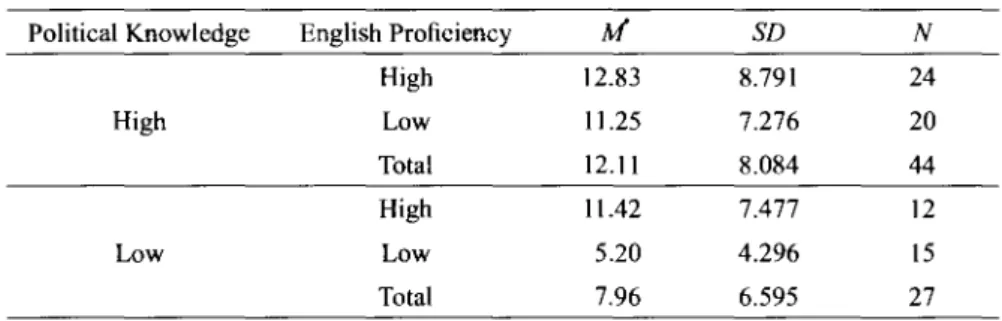
In the second question, we investigated whether the participants with high and low levels of political knowledge and English reading proficiency would perform differently. That is, we explored the statistical differences among the four groups: HP/HE, LP/LE, LP/HE, and HP/LE. Before conducting the main analyses related to the research question, the scores in summary writing, political background knowledge test and L2 reading comprehension test were found to be all normally distributed, as assessed by Shapior-Wilk's test (p <.05). For both knowledge test and English reading proficiency test, the participants were split into high and low groups based on their scores from the two tests. The descriptive statistics (See Table 1) provides the necessary information to describe high and low groups based on political background knowledge test and English reading proficiency. The students who scored above the mean score were categorized as the high performance groups, and the students who scored below that were categorized into the low performance groups. There was homogeneity of variances, as assessed by Levene's Test of Homogeneity of Variance (p =
Table 1 Summary Scores Grouped by Political Knowledge and English Proficiency
Political Knowledge English Proficiency AI SD N
High 12.83 8.791 24 High Low 11.25 7.276 20 Total 12.11 8.084 44 High 11.42 7.477 12 Low Low 5.20 4.296 15 Total 7.96 6.595 27
• The maximum score for summary writing is 60.
As generally expected, the political science majors indeed had the higher mean score than the English literature majors in terms of the background knowledge test; and predictably, the English literature majors in general performed better than the political science majors in terms of the English proficiency test (See Table 2 and Table 3). However, the high achievers sometimes did not necessarily associate to their major fields of study. Hence, to accurately measure the variables, in the present study, the researchers did not presuppose the participants' existing background knowledge based on their major field of study. Instead, background knowledge and English reading proficiency were measured. We found that even though the participants were recruited from two particular disciplines, it did not indicate that they lacked background knowledge or L2 proficiency outside their own majors. Table 2 and Table 3 show the descriptive statistics of students' majors when grouped only by the participants' English reading
Table 2 Distribution of Levels in Political Knowledge! English Proficiency for Political Major Students
Poli Major N Percentage Minimum Maximum Mean SD
Political High 26 60.47% 7(7) 6.32 [4.69] 0.80
knowledge Low 7 25 % 2(7) 2.80 [4.69] 0.83
English High 15 41.67% 48 (50) 33.26 [28.50] 2.89
Proficiency Low 18 51.42% 11(50) 22.11 [28.50] 5.40
Note: Statistics in parentheses refer to maximum possible mark; statistics in square brackets indicate the mean score of the total number of participants
«~~~~~~*~»~=+=~~~~
170 Contemporary Educational Research Quarterly Vo1.22, No.4
Table 3 Distribution of Levels in Political Knowledge/ English Proficiency for English Major Students
Eng Major N Percentage Minimum Maximum Mean SD
Political High 17 39.53% 7(7) 5.88 [4.69] 0.78
knowledge Low 21 75 % 0(7) 2.33 [4.69] 1.06
English High 21 58.33% 46 (50) 36.47 [28.50] 4.35
Proficiency Low 17 48.57% 15(50) 21.23 [ 28.50 ] 4.26
Note: Statistics in parentheses refer to maximum possible mark; statistics in square brackets indicate the mean score of the total number of participants
proficiency or only by their political knowledge test. As the study assessed both existing political knowledge and L2 proficiency, it was interesting to discover the presence of high political background knowledge or high English reading proficiency in students outside their disciplinary specialty. In Table 4, the groupings of combinations of political background knowledge and English reading proficiency (HP/HE, LP/LE, LP/HE, and HP/LE) were shown, indicating the distributions of the combinations of two abilities for political science major students and also for English literature major students.
Table 4 Distribution of Combined Levels in Political Knowledge and English Proficiency between Two Majors
Majors English(N) Political(N) Total(N) High Poli High Eng (HP/HE) 9 15 24 Low Poli Low Eng (LP/LE) 13 2 15 Low Poli High Eng (LP/HE) 9 3 12 High Poli Low Eng (HPILE) 7 13 20 Total number N 38 33 71
Next, two-way ANOVA analyses were performed to highlight the main effects of political knowledge and of English reading proficiency. As anticipated, there was a statistically significant difference in the summary scores between the students of high and low political background knowledge,
significant difference in the summary scores between the students of high and low English reading proficiency F
0,
67) = 4.613, P < .05, partial 112 = .064. As we proceeded to test the participants with high and low political knowledge, it was found that the high level participants performed better on summary writing than the low level participants; and again, the high L2 reading proficiency learners performed better than the low L2 reading proficiency learners. However, as for research question 3, there was no statistically significant interaction between political knowledge and English reading proficiency, F0,
67)=
1.628, P=
.206, partial 112=
.024. To be certain that compensation did not occur due to inappropriate groupings of the data, the researchers re-grouped the students by taking into account only the extreme data points. This time, the students whose test scores fell within one standard deviation from the mean were excluded from the analysis. Even with this method, an interaction between background knowledge and L2 proficiency was still not shown.In consideration of the fact that the knowledge test was designed by the experts, it might require a statistical validation to establish that the test measured the background knowledge required. Thus, correlation analyses were run. It was found that there was a degree of association between the performance of knowledge test and the summary performance. Besides running a statistical correlation on the overall set of questions, the test items were also broken down into 2 categories to see the correlations, as he first 5 questions concerned the general prior political knowledge, and Question 7 was directly related to the topic of reading passage. Itwas found that there was a moderate positive correlation between the overall knowledge test questions and summary performance, r = .345. When only considering the first 5 general political questions, the summary performance was also moderately correlated with these questions, r = .259. When question 7 was selected to run the correlations, it was found that there was a positive correlation, r = .365 between question 7 and the summary performance. Statistically, the students' performance of the knowledge test moved in tandem with the summary performance. All the statistical results indicated that, despite the literature suggesting a compensatory effect might occur, in the present study, compensation between the two factors, discipline-related background knowledge and English language proficiency, was not observed.
(.R••
M~*~).=+=~.~~172 Contemporary Educational Research Quarterly Vol.22, No.4
Discussion
The main picture emerging from the present study is that summary writing at the tertiary level is affected both by L2 reading proficiency and discipline-related background knowledge. As shown in the literature, the study again demonstrates that higher English reading proficiency group performed better in summary writing than lower reading proficiency group, and also, higher background knowledge group was more capable of writing summary than lower background knowledge group. As the summarization task was timed in the study, automaticity in decoding seemed important (LaBerge & Samuels, 1974). This study thus supports the bulk of existing literature which reveals the critical role of language proficiency in helping students decode and grasp meaning. There might be a threshold, a minimum required level of L2 proficiency needed for Taiwanese students to be successful in reading their academic English texts. On the other hand, as with respect to the effects of background knowledge, our data demonstrated that the students with higher political knowledge performed better in summary writing. This is likely because they benefited from conceptual processing. Since they were equipped with higher background knowledge and therefore able to identify ideas and connect propositions better. The knowledge base was used by the participants to integrate ideas in the current text; therefore, the "top-down" conceptual knowledge facilitated lower-level processing.
The political background knowledge, being a statistically more powerful predictor of summary performance, seems to exert a stronger effect on reading comprehension than L2 reading proficiency. The result implies that linguistic knowledge might assist the processing of an article, but the conceptual schemata were what the students relied upon more during reading. This finding reflects what Clapham (2001) suggests: as reading becomes more domain-specific, content knowledge tends to further influence students' reading performance. After all, linguistic structure can only provide a surface representation. A proper schema (in this case, the background knowledge in politics) is what matters for deeper understanding. This study further confirms the underlying truth, "Every act of comprehension involves one's knowledge of the world as well" (Anderson, Reynolds, Schallert, & Goetz, 1977: 369). The information can have meaning only when the idea
can be related to something the reader already knows.
The findings have also led us to believe that in the EFL environment, failure to comprehend a text cannot always be attributed to language specific deficits. Reading comprehension goes far beyond linguistic knowledge. A reader brings to summary writing a formidable amount of ideas. This knowledge is coupled with linguistic knowledge in order for readers to make sense out of a text. When a text is incomprehensible, it is not necessarily because a word was missing in the reader's vocabulary or because of improper grammar knowledge; it is most likely due to the unavailable conceptual knowledge. Even though the psycholinguistic perspective has viewed reading as an interaction of many factors, background knowledge should not be neglected in EFL reading. When processing the text against a certain schema, a number of related concepts come to the forefront. A reader will try to understand the text by relating the information to something familiar. The available schemata will account for the situation described. Since the concepts required to understand a text are not always explicitly stated in a text, sufficient emphasis should be placed on the role of background knowledge.
In the present study, the short answer questions were used to assess political knowledge, as political knowledge cannot be assumed on the basis of students' majors. The students who specialize in a particular disciplinary area do not necessarily lack background knowledge in another. Some of the participants in our study, though majoring in English, still obtained full scores on the political knowledge test. The same situation occurred for the L2 reading proficiency test, as the highest mark on the TOFEL reading test was obtained by a political science major student. In the study, even though both political knowledge and L2 reading proficiency were measured to increase the reliability of this experiment, the compensatory effect did not occur as the literature suggested (e.g., AI-Shumaimeri, 2006). Had the compensation hypothesis been true, either higher 12 ability or political knowledge should have helped the readers overcome the difficulties experienced when encountering the L2 political text. Two possible reasons are proposed. First of all, compensation may have existed between background knowledge and English reading proficiency, however, as Clarke (1980) suggested, the readers' English proficiency must reach a minimum threshold. The problem
«~~~~m~*~»~=+=~~~~
174 Contemporary Educational Research Quarterly Vo1.22, No.4
is that the required minimum threshold fluctuates as the nature of the material differs. Itis possible that the more academic-oriented the material, the higher the language threshold is required. In addition to the difficulties arising from content unfamiliarity, the lexical and syntactic complexity of the authentic text further undermined comprehension for some EFL students.It could have been that some of our participants did not reach the hypothetical threshold in English proficiency for this article; as a result, they could not comprehend the messages embedded in the article. Another possible reason could also be that the students recruited for the present study may not have developed sufficient disciplinary expertise to compensate for their lack of L2 reading proficiency.
The second explanation for not having the expected compensatory effect could have been the fact that some participants were not equipped with skills for summary writing, i.e., to appropriately condense information from a larger chunk of source information.Itseems that some students in this study were poor summarizers who failed to locate the main idea. Unfortunately, identifying the main idea is a major skill needed to summarize well (Casazz, 1993). These participants were struggling with summary writing even though the summary was to be produced in their Ll.
Pedagogical Implications
From the results of this study, it appears that providing students with solid background knowledge in the core areas of the discipline is of paramount importance in the university education for L2 reading comprehension. The present study has indicated that EFL students can read with better comprehension when equipped with proper prior knowledge. Background knowledge is a more powerful predictor of summary performance in this study, and it seems to be more critical than language proficiency in the reading of authentic content specific passages. Since English is important at the tertiary level, university instructors could prepare students for a smooth transition between learning to read and reading to learn (Lee& Schallert, 1997).
In reading an academic text, most EFL students have to deal with both linguistic complexities of the text and the content laden with unfamiliar
concepts. Not all students would be able to read in their L2 to gain information. To ease the burden, instructors could provide the specific background knowledge through pre-reading activities.Itis important for an instructor to enhance readers' knowledge before reading. Fortunately, in an EFL environment, Ll reading materials are handy, which provide an easier alternative to facilitate their L2 reading comprehension. With the medium of Chinese, students can obtain background knowledge without extra linguistic burden. Through Ll support, and with large exposure to L2 academic reading materials, EFL students would eventually reach the attainment of the academic language skills required.
A second pedagogical implication is related to summarization skills. As shown in this study, summary writing is an activity that has not been acquired or mastered by the participants. This important study skill could be a determiner of academic success. Almost all learning activities at university require students to extract main ideas, condense, and remember what has been read. Since some of the participants in this study used fragmented ideas in their summary writing which did not reflect an overall understanding of the text, it is suggested that instructors at the university level integrate more summarization activities into their curricula to enhance Taiwanese students' summarization skills. Instruction of summarization has been proven to improve students' organization of writing (Day, 1986; Hare & Borchardt, 1984); therefore, summary writing skills should be taught explicitly for students to have a clear understanding of the processes involved in writing a summary. Students benefit most when the instructors address the issues of how to recognize logical relationship and how to filter relevant information (Day, 1986). Explicit teaching therefore allows students to recognize the textual pattern and hone in on missing or misstated information; as a consequence, the improved summary writing can meet the pre-defined standard for university students.
Conclusion
The present study is an attempt to explore the effects of background knowledge and L2 reading proficiency on content specific reading.
«~ft~~m~*~»m=+=~m~~
176 Contemporary Educational Research Quarterly Vol.22, No.4
Its conclusion should be considered limited in two aspects. First, the participants of the study were recruited via random sampling. The method was used to create groups without involving any potential biases. Therefore, the participants were representatives of what was normally found in a university. This method did not involve prior screening tests to pre-select the top notch high achievers or those at the lower end of the achievement spectrum. If the study had pre-selected both the high and low achievers in English reading proficiencies and background knowledge levels for groupings, the result might have been different. Second, the focus of the current study is on the end result, not of the process involved in reading comprehension. The participants were not interviewed to provide data on how they used their political knowledge or their L2 reading proficiency to comprehend the text. Future research should include introspective measures to probe deeper into how a reader comprehends academic-related reading materials.
Even with the limitations, there is a reason to believe that the findings of this study are a step towards a better understanding on the effects of different knowledge bases on reading comprehension. For one reason, instead of assuming students' abilities based on the areas of their study, this study adopted a separate instrument to assess background knowledge.
It was discovered that some students did possess knowledge outside their majors, as clearly some of them read materials that are not related to their own academic training. Also, at university level the specialization in subject areas did not warrant that the students have built a solid knowledge base within their own studies. The research findings indicate that in research into the effect of discipline-related knowledge on academic reading abilities, a direct assessment, i.e., background knowledge assessment, is the best way to provide a complete picture of the students' knowledge bases. Secondly, the study empirically established that reading comprehension does not merely depend on linguistic knowledge. The interactions of language knowledge and background knowledge investigated in the present study helps to explain a significant amount of the success or failure of reading comprehension at higher education in Taiwan.
Acknowledgements
Grateful acknowledgement is made to my advisor, Professor Chiou-Lan Chern, for her instructive advice. I am also indebted to the anonymous reviewers for their insightful comments. A special thank you goes to those who contributed to this paper: Yu-Ching Kelly Tseng, Yi-Hung Eric Chiou, Yu-Hsien Eunice Chiou, Tzu-Chiao Su, Chen- Yu Jenny Chen, Mei-Rong Alice Chen, John-Michael Nix, Ya-Wen Fu, and Ying-Ping Grace Huang.
References
Alderson, J. C. (1984). Reading in a foreign language: A reading or a language problem? In J. C.Alderson& A. H.Urquhart (Eds.), Reading in a foreign language (pp. 1-24). London, UK: Longman.
Alderson, J.
c.,
& Urquhart, A. H. (1985). The effect of students' academic discipline on their performance on ESP reading tests.Language Testing, 2,192-204.
AI-Shumaimeri,Y.A. N. (2006). The effects of content familiarity and language ability on reading comprehension performance of low-and high-ability Saudi tertiary students studying English as a foreign language. Journal of King Saud University, Educational Sciences& Islamic Studies, /8(2),1-19.
Anderson, R. C., James, W. P., & Larry, L. S. (1983), Effects of the reader's schema at different points in time.Journal of Educational Psychology, 75,
271-279.
Anderson, R.
c.,
Reynolds, R. E., Schallert, D. L., & Goetz, E. T. (1977). Frameworks for comprehending discourse. American Educational Research Journal, 14, 367-381.Bartlett, F. C. (I932/reissued 1995).Remembering: A study in experimental and social psychology. Cambridge, UK: Cambridge University Press.
Bensoussan, M., & Kreindler, I. (1990). Improving advanced reading comprehension in a foreign language: Summaries vs. short-answer questions.Journal of Research in Reading, /3(1), 55-68.
C.~.~~~*fl).=+=~.~M
178 Contemporary Educational Research Quarterly Vol.22, No.4
Bernhardt, E. B. (1991). Reading development in a second language: Theoretical, empirical and classroom perspectives. Norwood, NJ: Ablex.
Bernhardt, E. B. (2005). Progress and procrastination in second language reading.Annual Review ofApplied Linguistics, 25, 133-150.
Bernhardt, E. B. (2011). Understanding advanced second-language reading.
New York: Routledge.
Bernhardt, E. B., & Kamil, M. L. (1995). Interpreting relationships between LI and L2 reading: Consolidating the linguistic threshold and the linguistic interdependence hypotheses.Applied Linguistics, 16(1), 15-34.
Brown, A. L., & Day, J. D. (1983). Macrorules for summarizing texts: The development of expertise.Journal of Verbal Learning and Verbal Behavior,
22(1), 1-14.
Carrell, P. L. (1984a). The effects of rhetorical organization on ESL readers.
TESOL Quarterly, 18,441-469.
Carrell, P. L. (I 984b). Evidence of a formal schema in second language comprehension.Language Learning, 34, 87-112.
Carrell, P. L., & Eisterhold, J. C. (1983). Schema theory and ESL reading pedagogy. TESOL Quarterly, 17,553-573.
Casazza, M. (1993). Using a model of direct instruction to teach summary writing in a college reading class.Journal ofReading, 37, 202-208.
Chang, Y. F. (2006). On the use of the immediate recall task as a measure of second language reading comprehension.Language Testing, 23, 520-543.
Clapham, C. (2001). Discipline specificity and EAP. In J. Flowerdew & M. Peacock (Eds.), Research perspectives on English for academic purposes
(pp. 84-100). Cambridge, UK: Cambridge University Press.
Clarke, M. (1980). The short circuit hypothesis of ESL reading -- Or when language competence intt:rferes with reading performance. The Modern Language Journal, 64,203-209.
Cook, G. (1997). Key concepts in ELT: Schemas.ELT Journal, 51(1), 86.
Cummins, J. (1991). Interdependence of first- and second-language proficiency in bilingual children. In E. Bialystok (Ed.), Language processing in bilingual children (pp. 70-89). Cambridge, UK: Cambridge University
Day, J. D. (1986). Teaching summarization skills: Influences of student ability level and strategy difficulty. Cognition and Instruction, 3,193-210.
Delli Carpini, M. X., & Keeter, S. (1991). Stability and change in the U.S. public's knowledge of politics.Public Opinion Quarterly, 55, 583-612.
Delli Carpini, M. X., & Keeter, S. (1993). Measuring political knowledge: Putting first things first. American Journal of Political Science, 37,
1179-1206.
Delli Carpini, M. X., & Keeter, S. (1997). What Americans know about politics and why it matters. New Haven, CT: Yale Univetsity Press.
Douglas, D. (2000). Assessing languagesfor specific purposes. Cambridge, UK:
Cambridge University Press.
Dudley-Evans,T.,& St. John, M. J. (1998). Developments in english for specific purposes: A multi-disciplinary approach. Cambridge, UK: Cambridge
University Press.
Grabe, W. (1988). Reassessing the term interactive. In P. L. Carrell, J. Devine, & D. E. Eskey (Eds.), Interactive approaches to second language reading
(pp. 56-70). Cambridge, UK: Cambridge University Press.
Hare, V.
c.,
& Borchardt, K. M. (1984). Direct instruction of summarization skills.Reading Research Quarterly, 20( I), 62-78.Hidi, S., & Anderson, V. (1986). Producing written summaries: Task demands, cognitive operations, and implications for instruction. Review of Educational Research, 56, 473-493.
Iyengar, S. (1990). Shortcuts to political knowledge: The role of selective attention and accessibility. In J. A. Ferejohn & J. H. Kuklinski (Eds.),
Information and democratic processes. Urbana, lL: University of Illinois
Press.
Jennings, M. K. (1996). Political knowledge over time and across generations.
Public Opinion Quarterly, 60, 228-252.
Johns, A. M. (1988). Reading for summarizing: An approach to text orientation and processing.Reading in a Foreign Language, 4(2), 79-90.
Johnson, R. E. (I970). Recall of prose as a function of structural importance of the linguistic units.Journal of Verbal Learning and Verbal Behavior, 9( I),
«~~~~~~*~»~=+=~~~~
180 Contemporary Educational Research Quarterly Vo1.22, No.4
Kintsch, W. (1998). Comprehension: A paradigm for cognition. New York:
Cambridge University Press.
Kintsch, W., & Kozminsky, E. (1977). Summarizing stories after reading and listening.Journal ofEducational Psychology, 69,491-499.
Kintsch, w., & van Dijk, T. A. (1978). Toward a model of text comprehension and production.Psychological Review, 85, 363-394.
Koh, M. Y. (1985). The role of prior knowledge in reading comprehension.
Reading in a Foreign language, 3, 375-380.
Krekeler, C. (2006). Language for special academic purposes (LSAP) testing: The effect of background knowledge revisited. Language Testing, 23(1),
99-130.
LaBerge, D., & Samuels, S. J. (1974). Towards a theory of automatic information processing in reading.Cognitive Psychology, 6, 293-323.
Lamberta, R. D., Curtisa, J. E., Kaya, B. J., & Browna, S. D. (1988). The social sources of political knowledge. Canadian Journal of Political Science/ Revue canadienne de science politique, 21,359-374.
Lee,J.-w., & Schallert, D. L. (1997). The relative contribution of L2 language proficiency and L I reading ability to L2 reading performance: A test of the threshold hypothesis in an EFL context. TESOL Quarterly, 31, 713-739.
Lin, T.-J., & Wang, S.-H. (2007). Changes and sources of political knowledge in taiwan. SoochowJournal ofSocial and Political Sciences, 25(3), 93-129.
Nassaji, H. (2002). Schema theory and knowledge-based processes in second language reading comprehension: A need for alternative perspectives.
Language Learning, 52, 439-481.
Nunan, D. (1999).Second language teaching and learning. Boston, MA: Heinle
&Heinle.
Perfetti, C. A., Van Dyke, J. A., & Hart, L. (200 I). The psycholinguistics of basic literacy.Annual Review ofApplied Linguistics, 21, 127-149.
Phakiti, A. (2003). A closer look at the relationship of cognitive and metacognitive strategy use to EFL strategy reading comprehension test performance.Language Learning, 53, 649-702.
Phakiti,A. (2008). Construction validation of Bachman and Palmer's (1996) strategic competence model over time in EFL reading tests. Language Testing, 25, 237-272.
Ridgway, T. (1997). Thresholds of background knowledge effect in foreign language reading.Reading in a Foreign Language, 11(1), 151-166.
Rumelhart, D. (1980). Schemata: The building blocks of cognition. In R. J. Spiro, B. C. Bruce, & W. F. Brewer (Eds.), Theoretical issues in reading comprehension (pp. 33-58). Hillsdale, NJ: Lawrence Erlbaum.
Schmidt-Rinehart, B. C. (1994). The effects of topic familiarity on second language listening comprehension. Modern Language Journal, 78,
179-189.
Shaker, L. (2009). Citizens' local political knowledge and the role of media access.Journalism and Mass Communication Quarterly, 86, 809-826.
Smith, F. (1975). Comprehension and learning. New York: Holt, Rinehart, &
Winston.
Stanovich, K. E. (1980). Toward an interactive-compensatory model of individual differences in the development of reading fluency. Reading Research Quarterly, 16(1), 32-71.
Stanovich, K. E. (2000). Progress in understanding reading: Scientific foundations and new frontiers. New York: Guilford Press.
Van Dijk, T.A., & Kintsch, W. (1983). Strategies of discourse comprehension.
New York: Academic Press.
Yu, G. (2008). Reading to summarize in English and Chinese: A tale of two languages?Language Testing, 25, 521-551.
Zaller, J. (1990). Political awareness, elite opinion leadership, and the mass survey response.Social Cognition, 8, 125-153.
«~~~~~~*~»m=+=~m~M
182 Contemporary Educational Research Quarterly Vol.22, No.4
Appendix A
Background Knowledge Test
1.~~ru~fill~~IE)~TI:)~~ ~t8{IWJ1.:J~if-