
An Improved Stimulus-based Adaptive Sleeping
Method for Wireless Sensor Networks
Ying-Hong Wang, Hui-Chien Liao, Wei-Chia Huang Department of Computer Science & Information Engineering
Tamkang University, Tamshui, Taiwan
[email protected], [email protected], [email protected]
leakage of gas is an example and the liquid pollution monitor of the DS. It is something challenge for applications of the DS, which is usually time-sensitive, if want to monitor the dynamics of the DS in real-time, such as how it grows. In this paper discusses many solutions for wireless sensor network monitor diffusion stimulus requirement.
2. Related work
There have three wireless sensor network solutions application in diffusion stimulus. Independent Sleeping (INS), Bliended
Conservative Sleeping (BCS), Stimulus-Based Adaptive Sleeping (SAS).
2.1 Independent sleeping (INS)
With INS,every sensor sleeps from time to time. Each time a node wakes up, it starts to sense. If no stimulusis detected, it computes the duration for next sleep based on a certain probability distribution, and then goes back to sleep. If it detects the presence of the stimulus, it starts to become active and does not go back to sleep any longer. In this scheme, every sensor independently determinesits sleep intervals and interaction with other neighbors may not be required. Therefore, it is very robustand scalable. But it is weak in reducing
Abstract
Due to the cost and size reasons of sensor node in wireless sensor network (WSN), the limitation of electric power resource is a main problem of WSN. Especial wireless sensor network apply to monitor difussion stimulus (DS). Thus, how to manage the power energy of sensor node is an important issue in WSN. The sleep mechanism is an effective and electric mechanism of management often use, it can effectively save the electricity and lengthen the wireless sensor network life cycle. Although SAS sleep mechanism of wireless sensor network save the electricity and lengthen the wireless sensor network life cycle, but because each node timer is inconsistent, so the sleep time possible error make detection delay. This thesis proposes a correcting mechanism, it is improvement SAS sleep mechanism of wireless sensor network and control the accuracy of sleep module. It can reduce detection delay through this sleep mechanism, and increase the wireless sensor network life cycle.
1. Introduction
Wireless sensor network (WSN) apply to monitor diffusion stimules (DS) domain, the
BCS is expected to have good
performance in minimizing event detecting delays. However, it is not energy efficient due to its blindness. Even when a neighboring sensor has detected the stimulus, it is still possible that the stimulus will take a long time to reach some of its neighboring sensors. The worst case is that the stimulus may not spread in a certain direction, which means the
stimulus will never reach those sensors in that direction. Consequently, those sensors are simply wasting their energy to stay awake too early. [1]
2.3 Stimulus-based adaptive sleeping
(SAS)
In SAS solution each sensor estimates the arrival time of stimulus boundary, and adaptively adjusts its sleep time. If it takes a longtime for the stimulus boundary to reach the sensor, the sensor can safely sleep longer for energy efficiency. Otherwise, the sensor should be cautious. It should sleep shorter or even keep active for the upcoming stimulus. This sleeping time estimation is a localized operation which based on the local observations from the neighbors.The stimulus-based algorithm enables sensors to reduce power consumption while minimizing detection delays. [1]
2.3.1 SAS sensor states
SAS is building a close relationship between sensor’sapplication state and the stimulus. There are three possible applicationstates for the sensors:
Covered: Sensors which have detected the
stimulus. It is possible that a sensor is still sleeping
while the stimulus has spread over it. In this case, after the sensor has waken up, it detects the stimulus and then reports back to the gateway. However, this report may be significantly delayed, which will result in violating the realtime requirement. Someone may argue that INS can greatly reduce event detecting delays by shortening the average sleep time of each sensor. By this way, the average delay could be reduced; however, it leads to another serious problem – low energy efficiency. There are notable wakeup overheads in power consumption. [1]
2.2 Blinded conservative sleeping
(BCS)
In contrast to INS, BCS adds cooperation between neighboring sensors. With BCS, whenever a sensor wakesup, it broadcasts an ENQUIRE message to all its neighbors, expecting to check if any of its neighbors has detected the presence of the stimulus. When a sensor, which has detected the stimulus and therefore remains active, receives an ENQUIRE message, it immediately replies with an AFFIRMATION message. If the sensor gets an AFFIRMATION reply, it starts to remain active and does not sleep any longer. If a neighbor has detected the stimulus, it implies that the stimulus border will spread to nearby sensors soon. It follows that nearby sensors should stay alert for the potential upcoming arrival of the stimulus. In this way, the sensor having detected the stimulus will soon wake up all its sleeping neighboring sensors. [1]
Restricted: Sensors which have not detected
the stimulus yet but are being notified by its neighbors that stimulus are approaching. They are usually near the boundary of the stimulus.
Non-restricted: Sensors which have not
detected the stimulus yet and have not been notified anything about the stimulus. They are usually far away from the boundary. [1]
Figure 1: Transition of SAS sensor states
Figure1 shows the transition of different SAS sensor states.All sensors are initially in non-restricted state. The sensor will change from the state of non-restricted or restricted to covered when it has detected the stimulus. Non-restricted sensor will change its state to restricted when it receives the PRESENT message from a covered sensor. The diagram also shows the transition back to non-restricted state when the stimulus has passed away. When the stimulus has left from a covered sensor, it will wait for a detection timeout. If there is no detection of stimulus, it returns as a non-restricted sensor. If the restricted sensor has not detected the stimulus after a predefined time, it will also change back to non-restricted state. [1]
2.3.2 SAS fore message types
SAS has a few messages to be exchanged with sensors in varies operations:
WAKEUP and PRESENT: Every sensor
which has just changed from sleeping to active
should broadcast a WAKEUP message with its location information. If covered sensors have received the WAKEUP message, they will send back a PRESENT message to indicate that the boundary of stimulus is near to this node. It will then change from the state of non-restricted to restricted. The message will contain the expected arrival time of the stimulus.
DETECTION and ELAPSED: When a sensor
has just detected the stimulus, it will change its state to the covered and broadcast a DETECTION message. All non-restricted sensors which have received this message should change the state to restricted. These sensors are close to the boundary of the stimulus. All covered sensors receiving the DETECTION message should send back the ELAPSED message with elapsed time after their first detection of the stimulus. [1]
2.3.3 Adaptive sleeping
The spreading of the stimulus is non-uniform. The sensors adapt to the localized boundary behaviours and have different sleeping times. The expected arrival timeis computed based on the previous knowledge of the stimulus over a nearby region. It may not be an accurate arrival time of the stimulus. If it is used as the sleeping time directly, it is highly probable that the sensor will miss the first detection of stimulus which will result in detection delay. This is because a sensor can only be wakenup by its internal timer after it has entered the sleep state. To tackle the problem, a sensor will sleep for a shorter time which is a fraction of the expected arrival time, maybe the sleeping time will be MIN(expected arrival time) * 1/3. [1]
3. Improved SAS sleeping mechanism
(ISAS)
In SAS solution sensor nodes timing is not sync, when it expected arrival time and go to sleeping, it is highly probable that the sensor will miss the first detection of stimulus which will resulting in detection delay. The detection delay decrease availability and reliability of wireless sensor network monitoring diffusion stimulus.
In this thesis propose an improved mechanism call the An Improved Stimulus-based Adaptive Sleeping Method for Wireless Sensor Networks (ISAS). It can solve sensor nodes no sync problem.
3.1 Timing analsys and adjustment
The quartz oscillator in used to wireless sensor network node, it is frequency of timing as 14.31818MHZ, but it has frequency error by different environmental factor, for a example, the electric power or the temperature affect the quartz oscillator to frequency error, the error range is 1/100000 to 1/10000, so the maximum error is 8.64 seconds one day.
In SAS solution minimum sleeping interval is 500ms (millisecond), if it is require timing accuracy in 250ms (millisecond) less then, it must correct once within every 5000 cycles. The next section propose an improved mechanism in the ISAS flowchart.
4. Simulation
4.1 Performance evaluation
In this section the performance evaluation is reference to IEEE paper, SyncWUF: An Ultra Low-Power MAC Protocol for Wireless Sensor Networks [2] work and sleep power consumptiom. The work power is 86.525mW and sleep power is 0.1185mW. The transmission range is 5meter, 10meter, 20meter, 30meter, 40meter. The wind velocity is 0.25meter per second, 0.5meter per second, 1.5meter per second and diffusion stimulus timming 300second, 600secomd, 900second. In these criteria compare power consumptiom of SAS and ISAS.
4.1.1 Compare power consumption of SAS and ISAS 1
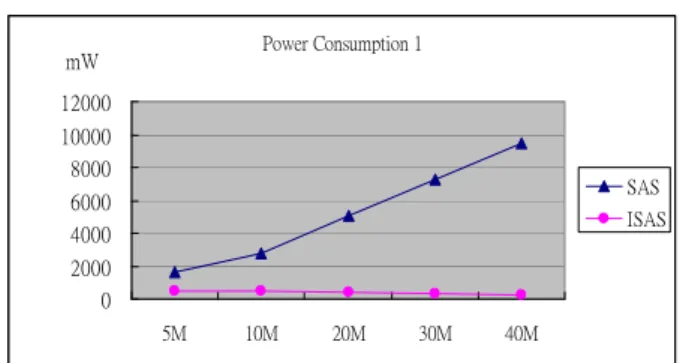
The figure 4-1~ 4-3 is wind velocity 0.25 meter per second, the transmission range 5meter, 10meter, 20meter, 30meter, 40meter and figure 4-1 diffusion stimulus timming is 300second, figure 4-2 diffusion stimulus timming is 600second, figure 4-3 diffusion stimulus timming is 900second. In the criteria ISAS solution has good efficient power consumption than SAS, because the SAS too early awake and it is waiting stimulus a long time. Power Consumption 1 0 2000 4000 6000 8000 10000 12000 5M 10M 20M 30M 40M mW SAS ISAS
Figure 4-1:Compare power consumption of SAS and ISAS, wind velocity 0.25 meter per second and diffusion stimulus timing = 300 Second (1) Power Consumption 2 0 2000 4000 6000 8000 10000 12000 5M 10M 20M 30M 40M mW SAS ISAS
Figure 4-2:Compare power consumption of SAS and ISAS, wind velocity 0.25 meter per second and diffusion stimulus timing = 600 Second (2) Power Consumption 3 0 2000 4000 6000 8000 10000 12000 5M 10M 20M 30M 40M mW SAS ISAS
Figure 4-3:Compare power consumption of SAS and ISAS, wind velocity 0.25 meter per second and diffusion stimulus timing = 900 Second (3)
4.1.2 Compare power consumption of SAS and ISAS 2
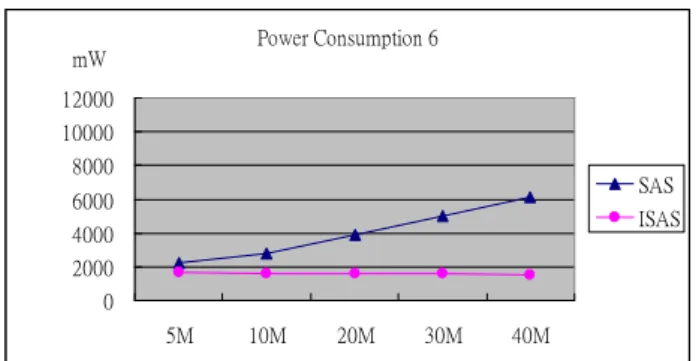
The figure 4-4~ 4-6 is wind velocity 0.5 meter per second, the transmission range 5meter, 10meter, 20meter, 30meter, 40meter and figure 4-4 diffusion stimulus timming is 300second, figure 4-5 diffusion stimulus timming is 600second, figure 4-6 diffusion stimulus timming is 900second. In the wind velocity 0.5 meter per second criterion ISAS solution is still good efficient power consumption than SAS.
5meter, 10meter, 20meter, 30meter, 40meter and figure 4-7 diffusion stimulus timming is 300second, figure 4-8 diffusion stimulus timming is 600second, figure 4-9 diffusion stimulus timming is 900second.
Power Consumption 7 0 2000 4000 6000 8000 10000 12000 5M 10M 20M 30M 40M mW SAS ISAS
Figure 4-7:Compare power consumption of SAS and ISAS, wind velocity 1.5 meter per second and diffusion stimulus timing = 300 Second (1) Power Consumption 8 0 2000 4000 6000 8000 10000 12000 5M 10M 20M 30M 40M mW SAS ISAS
Figure 4-8:Compare power consumption of SAS and ISAS, wind velocity 1.5 meter per second and diffusion stimulus timing = 600 Second (2) Power Consumption 9 0 2000 4000 6000 8000 10000 12000 5M 10M 20M 30M 40M mW SAS ISAS
Figure 4-9:Compare power consumption of SAS and ISAS, wind velocity 1.5 meter per second and diffusion stimulus timing = 900 Second (3) Power Consumption 4 0 2000 4000 6000 8000 10000 12000 5M 10M 20M 30M 40M mW SAS ISAS
Figure 4-4:Compare power consumption of SAS and ISAS, wind velocity 0.5 meter per second and diffusion stimulus timing = 300 Second (1) Power Consumption 5 0 2000 4000 6000 8000 10000 12000 5M 10M 20M 30M 40M mW SAS ISAS
Figure 4-5:Compare power consumption of SAS and ISAS, wind velocity 0.5 meter per second and diffusion stimulus timing = 600 Second (2) Power Consumption 6 0 2000 4000 6000 8000 10000 12000 5M 10M 20M 30M 40M mW SAS ISAS
Figure 4-6:Compare power consumption of SAS and ISAS, wind velocity 0.5 meter per second and diffusion stimulus timing = 900 Second (3)
4.1.3 Compare power consumption of SAS and ISAS 3
The figure 4-7~ 4-9 is wind velocity 1.5 meter per second, the transmission range
Reference
[1] Hoilun Ngan, Yanmin Zhu, Lionel M. Ni and Renyi Xiao; “Stimulus-based adaptive sleeping for wireless sensor networks “, In Proc. of International Conference on Parallel Processing 14-17 , pp.381 – 388, June 2005.
[2] Xiaolei Shi and Guido Stromberg, “SyncWUF: An Ultra Low-Power MAC Protocol for Wireless Sensor Networks”, In Proc. of IEEE Transactions on Volume 6, Issue 1, pp. 115 - 125, Jan. 2007.
5. Conclusion and future work
5.1 Conclusion
Wireless sensor network monitor diffusion stimulus field. INS save the electricity, but it has obvious detection delay. BCS better improvement detection delay, but waste power energy to effect wireless sensor network life cycle. SAS node is not sync become a time problem, it does not greatly reduce detection delay. In the thesis propose an ISAS improved mechanism to solve problem, it save power energy for good efficient and accuracy compute sleeping and awake. The ISAS increase availability and reliability.
5.2 Future work
In this work find the wind velocity effect power energy, but what is relation in wind velocity with detection delay? It is a future work in my research.
![[102-2] WNFA lab4 - A Tiny Wireless Sensor Network 2014/5/12 Chih-Hsien Ou](data:image/gif;base64,R0lGODlhAQABAIAAAP///wAAACH5BAEAAAAALAAAAAABAAEAAAICRAEAOw==)