行政院國家科學委員會專題研究計畫 成果報告
搜尋引擎的時間性與空間性:網路新聞事件的歷史記敘
研究成果報告(精簡版)
計 畫 類 別 : 個別型 計 畫 編 號 : NSC 98-2410-H-004-116- 執 行 期 間 : 98 年 08 月 01 日至 100 年 01 月 31 日 執 行 單 位 : 國立政治大學新聞學系 計 畫 主 持 人 : 吳筱玫 計畫參與人員: 碩士班研究生-兼任助理人員:詹璇依 碩士班研究生-兼任助理人員:郝天行 報 告 附 件 : 出席國際會議研究心得報告及發表論文 處 理 方 式 : 本計畫可公開查詢中 華 民 國 100 年 04 月 30 日
行政院國家科學委員會補助專題研究計畫成果報告
搜尋引擎的時間性與空間性:網路新聞的歷史記敘
研究成果報告(精簡版)
計畫類別:個別型計畫
計畫編號:NSC
98-2410-H-004-116-執行期間:98 年 8 月 1 日至 100 年 1 月 31 日
執行機構及系所:國立政治大學新聞學系
計畫主持人:吳筱玫
計畫參與人員:碩士班研究生
郝天行、詹璇依
處理方式:本計畫可公開查詢
中
華
民
國 100 年 4 月 30 日
2 2011 年國科會專題計畫研究期末報告
搜尋引擎的時間性與空間性:網路新聞的歷史記敘
壹、前言 空間與時間,是除了主體以外,我們理解社會真實最基本的兩個面向,而傳播科技 對於社會真實的影響,便在於重建了我們的空間感與時間感。以往,我們總透過實體媒 介去還原、了解歷史上的事件,網路興起後,基於可用性與廣泛性,已然成為另一個學 習的重要管道。研究發現,當一個新聞事件發生,人們多半從網路找尋與此事件之相關 訊息,而他們最常做的,不再是依賴大眾媒體的仲介與詮釋,而是主動使用搜尋引擎, 利用搜尋引擎找尋資訊,已然成為一種日常生活的實踐。然而,搜尋引擎對資訊的陳列, 蘊藏了什麼樣的時間性與空間性?卻是過往研究鮮少討論的。 和傳統以專家為本的媒體不同,搜尋引擎強調群眾書寫,充斥一般俗民對新聞事件 的回應,其所列出之頁面排序,夾雜著官方、業界與個人網頁。此外,搜尋引擎也偏好 時間點較新的資訊,網頁更新不夠頻繁、點閱率不夠高,即便曾經排序較高的頁面,隨 時都可能遭替換,在這樣一個競逐空間中,專業網站不比部落格更有優勢,而頁面排序 之更迭,正意味著人們對歷史事件的群體記憶,隨著時序不同而有所流動。 可以說,以人機互動為本的網路科技提供了另一種可能,陳述著與人際、大眾媒體 不同的社會性記憶。當人們從網路主動搜尋歷史事件的相關文本,其所做的歷史記敘, 便有了不同的面貌,進而衝擊的,是我們對史實的理解。我們可以經由「搜尋」發現什 麼?此發現與傳統之歷史記敘有何不同?如何用「時間性」與「空間性」加以分析?皆 是本計畫探討的議題。 貳、文獻簡述 一、歷史記敘、時間、空間 現代性時期,歷史記敘的重點在「時間」,而還原歷史的主要策略,一般稱為編年 紀事(chronicle)。Lévi-Strauss 在〈歷史與辯證法〉中談到,編年紀事代表一種複雜的 編碼系統,由兩個最基本的時間符碼組成,一是「年代序列」,二是年代、日期之間的 「距離」。年代或日期本身不能單獨成為符碼,要讓它產生符碼只有兩種可能:一是某 個關鍵史實的「提示」(譬如 911 事件),另一則是經由年代或日期的排列,彰顯事件群 組之間的前後關係,此時「在前」的事件總被視為「在後」事件的某個因子,兩者地位 不能翻轉,所以時間乃線性不可逆。 至於「距離」,則泛指同一歷史領域裡事件被記錄的「頻率」,不同頻率形塑出不同 意指系統,史前與當代的歷史領域的頻率不同,其歷史符碼就不一樣。問題是,不管記 錄多麼頻繁,自稱為通史的歷史,空缺之處仍比充實之處多,再努力的歷史學者也無法 窮盡,只能選擇地區、時期、人群和人群中的個人,做為還原歷史之標的。因此,歷史記敘也有其空間性。如 White 所言,編年紀事並無開始,亦無結束,它是書寫者在特定 時間、空間之內經營的一塊歷史場域,依據此場域,書寫者將未經剪裁的歷史紀錄予以 篩選、整理,並依其前後關係進行詮釋,成為一可辨識的故事。這時,史實變成一種選 擇,每一個人都以自我獨特的方式整合著歷史進程,de Certeau 下了這樣的結論:表面 上,歷史以時間為本,實質上在書寫的當下,完全處於空間競逐的狀態。透過歷史記敘, 時間被建立,也被抹去,因為書寫所再現的時間,不過是場域鬥爭的結果,書寫者滲入 自我的意識型態,透過其書寫之策略,進行一場權力爭奪。因此,歷史永遠關乎詮釋, 將非連續的事件、人物,以時間為連續體之背景呈現出來。這種由諸「歷史領域」組成 的「非連續體集合」,各領域有其「特殊頻率」和「在前」與「在後」的因果編碼,便 是當代歷史書寫的知識構則(episteme)。 二、存有與在場 相較於 de Certeau 等人,Heidegger 用另一種方式鋪陳歷史與時間、空間的關係, 在《存在與時間》一書中,揭露時間是探索存有最重要的一個概念,而時間是指:由人 (Dasein)的時間性所展露出來的時間,換句話說,時間不是什麼客觀的存在,它永遠 與存有相連。Heidegger 認為,存有乃「使之在場」(letting-presence),在場是一種延續, 由某一點伸展到另一點,因此存有不在時間流中,反而是時間在存有之在場中呈現。這 樣的呈現,便是「現在」。既然有「在場」,自然也有「不在場」(absence),不在場有 幾種情況,一是曾經在場、現在不在場,便是「曾經」或「過去」,另一是不曾在場、 未來可能在場,便是「未來」。 在場乃延續、開放的場域,所以現在、過去和未來並不是三個獨立的時態,而是具 有相互超越的一體性。「現在」不僅封閉在「現在」的時態裡,在「現在」之中,仍有 很多已經呈現過的東西,它們不再呈現於當前,但它們仍以「不在」的方式呈現自己。 因此,「不在」並不是消失不見,它仍然可以「使之在場」。考慮在場的情境之後,時間 不再只是時間,而是時間—空間的連續體,在場成了時間的第四個向度,Heidegger 以 為,這個第四向度,才是我們真正要思考的事物。 依此,過去、現在、未來不僅是時態上的差異,其在場的方式也不相同,過去與未 來皆不在,它們和現在有著時間的距離(temporal distance),要使之在場,便要克服此 時間之距離,使其與現在做連結。如此,不同時態之間之事物得以相互超越以達於一體, 這種時間距離的克服,Gadamer 稱之為「共在」(contemporary)。共在的概念顯示著, 我們對事物的了解,永遠不可能符作者之原意,因為和我們產生關係的不是作者,而是 文本。在解讀歷史文本時,詮釋者和文本之間自然形成時間的距離,詮釋者總要想辦法 征服這個距離感,讓不在場之事物變得在場。此時作者或文本都不具有主體性,成就主 體者乃該事物在我們當下所具有的歷史意涵。 三、分析架構 綜上所述,歷史建構關乎存有對史料進行選擇,以此為本建立共在感,以克服時間 的距離。資訊數位化之前,實體媒介界定了時間與空間,我們可以從紙張的泛黃程度判
4 定時間與空間的線索,諸如資訊的年代、產地、書寫者等等,由於實體媒介經年累月之 後逐漸毀損,能夠保留下來的資訊彌足珍貴,材料相對有限。搜尋引擎上的資訊完全顛 覆了這個法則,資料量龐大,由資料與專業所支撐的專家權威,被群眾有意或無意的角 力所取代,且虛擬的上載時間替換了實體的資料紀時,在這樣的情境下,空間性和時間 性有何變化?是本計畫切入的重點,依此擬定之分析架構如下: (一)空間性分析:搜尋引擎優先陳列的資訊,來自於哪些場域?使用什麼媒材? 陳述哪些資訊?資料排序狀況為何?是否運用超連結?連結之網頁是否仍在?書寫之 語氣為何?這些優先陳列的資訊,展現何種事件面貌? (二)時間性分析:搜尋引擎上的時間感為何?年代序列如何呈現?距離為何? (三)共時分析:各案例之間的異同為何?是否在不同時間點下,其異同有所變化? (四)跨時分析:同一案例不同搜尋時間點的資料結構,是否有所變化?這些變化 有何意義? 參、研究方法 本研究以 Google 為本進行樣本蒐集,選取四個主要案例,分別是 1998 年「印尼華 裔婦女受暴事件」、2001 年「網路泡沫化」、2003 年「SARS 風暴」,與 2005 年「東海 大學劈腿事件」。研究者自 2009 年 9 月 18 日起,針對台灣 Google 輸入「印尼排華 + 1998」、「網路泡沫化 + 2001」、「SARS + 2003」、「東海大學劈腿事件」等字串,搜尋繁 體中文網頁,之後每隔三個月隨機觀察一次,持續至 2010 年 6 月底。 在搜尋策略上,由於搜尋結果動輒幾千幾萬筆,使用者不可能讀完所有頁面,因此 本研究以排序前 20 筆資料為本。在原始設計中,此前 20 筆資料以內容不重覆者為原則, 但在實地搜尋後,發現網路上內容相互轉貼、拷貝的結果,「內容重覆」難以定義,幾 乎沒有內容是完全重覆或不重覆,為避免橫生枝節,仍以前 20 筆資料為基礎樣本,但 剔除網站重複者、無法連結者或內容不相關者,再以有效之網頁樣本為核心向外進行串 連,檢測其超連結之內容,與連結是否有效。 接著,研究者對資料進行初步分析與結構之比對,發現「網路泡沫化」樣本不佳, 由於字詞本身並非指向單一事件,搜尋結果難以建構 2001 年的網路泡沫化現象,於是 選擇將這個案例剔除。此外也發現,每個案例的資料結構,在一年內的變化不大,次次 分析成本太高,也沒有必要,幾經考量,最終採取以下分析策略: 一、共時分析上,研究者選擇相差約半年之兩組日期,分別是 2009 年 12 月 19 日 與 2010 年 6 月 11 日,對三個案例進行編碼,比較在同一時間點之下,案例所呈現的面 貌,是否因案例本身性質之不同而有所差異?換了一個時間點後,這樣的差異是否一 致? 二、跨時分析上,則對不同案例進行不同處理,其中僅「SARS 風暴」採用前述兩 組日期的資料相互比較。由於研究者在執行本計畫之前,曾對「印尼華裔婦女受暴事件」 與「東海大學劈腿事件」的前 20 筆資料進行過編碼,於是決定將保存之列印資料,依 本計畫之研究問題重新編碼,以做為跨時比較之基準。依此,「東海大學劈腿事件」有
三組資料比較,分別是 2008 年 1 月 5 日、2009 年 12 月 19 日與 2010 年 6 月 11 日。「印 尼華裔婦女受暴事件」較複雜,為了測試「時間距離」可能帶來的影響,研究者選擇同 時拉大與縮短分析日期,去觀察資料結構之變化,最終分析的四組資料日期為 2007 年 11 月 7 日、2009 年 10 月 23 日、2009 年 12 月 19 日與 2010 年 6 月 11 日。 表 3-1 案例編號 2007.11.7 2008.1.5 2009.10.23 2009.12.19 2010.6.11
印尼事件 I-A I-B I-C I-D
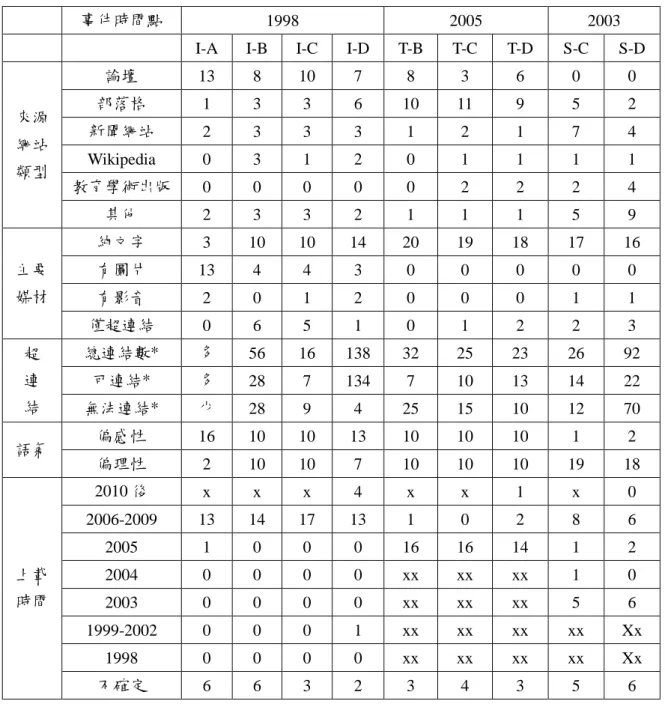
東海劈腿 T-B T-C T-D SARS 風暴 S-C S-D 各組資料編碼代號如表 3-1;各組下每筆資料之基本編碼項目包括「編號」、「標題」、 「來源」、「網站類型」、「超連結數量」、「超連結可連結狀況」、「作者名」、「轉貼」、「語 氣」、「內文時間點」、「上載時間點」、「主標籤」,對於 2007 年與 2008 年的兩筆資料, 則以「網頁目前狀況」一欄取代「主標籤」進行編碼,附錄列出其中一組資料範例。 肆、研究結果 一、資料分析 表 4-1 列出不同案例兩次時間點之樣本比較(共時分析),表 4-2 則進行同一案例 不同時間點之樣本比較(跨時分析)。這兩個表只能顯示初步數據,實際分析還須考量 資料之排序、來源網站之「主流」程度、作者、超連結後可連結網頁之內容呈現等等。 質化之分析說明如下: (一)來源網站方面,各案例之間有很大不同,且此不同在不同時間點相當一致, 顯示其差異來自於案例本身。以 C 群排序前 10 筆資料為例,「印尼」幾乎都 是論壇,只有 Wikipedia 位居第一筆;「東海」以部落格為主,但有趣的是第 一筆資料為論壇;「SARS」排在前面的都是新聞網站,但除一筆為《自由時 報》外,皆非主流媒體之網站。 (二)主要媒材,清一色以文字為本,受案例本質影響,「東海」完全沒有圖片,「印 尼」有比較多的圖片,且以文字為本的網頁中,配上一、兩張圖片的比例也 不小;「SARS」除一筆連向 Youtube,介紹所有相關影音之外,其他都以文 字為本,且多數與醫療知識相關。 (三)超連結方面,歧異度很高,兩次時間點呈現的結構也不相同。經質化分析發 現,大量的連結數(I-D、S-D)皆來自某一特定網站,而其可連結與否,跟 該網站是否有人持續更新有關。 (四)語氣之理性與感性,受時間與案例本身特質影響,與媒材無關。這三個案例
6 在發生當時,都有非常多的「情感」或「情緒」內容,但事過境遷後,有著 不同的展現,「SARS」遺留的多是理性資訊;「東海」表面上各佔一半,實 際上感性資訊的排序都在前面;「印尼」還是有很多情緒內容。一般認為, 視覺資訊會引領較多的感性內容,在這些案例中無法得到證實,因為「東海」 全屬純文字資訊,感性內容卻很多。 表 4-1 不同案例兩次時間點之樣本比較 I-C T-C S-C I-D T-D S-D 論壇 10 3 0 7 6 0 部落格 3 11 5 6 9 2 新聞網站 3 2 7 3 1 4 Wikipedia 1 1 1 2 1 1 教育學術出版 0 2 2 0 2 4 來源網 站類型 其他 3 1 5 2 1 9 純文字 10 19 17 14 18 16 圖片 4 0 0 3 0 0 影音 1 0 1 2 0 1 主要 媒材 僅超連結 5 1 2 1 2 3 總連結數 16 25 26 138 23 92 可連結 7 10 14 134 13 22 超連結 無法連結 9 15 12 4 10 70 偏感性 10 10 1 13 10 2 語氣 偏理性 10 10 19 7 10 18 (五)雖然事件本身時間點明確,內文多半有提及,卻可能在很後面的位置。在這 個情況下,上載時間的能見度遠超過事件本身時間。而資料的時間性又因案 例之不同,呈現完全不同的面貌。「東海」是一個非常封閉的小事件,上載 時間幾乎都停留在事件原時間點,也就是 2005 年 3 月 2 日前後,不超過五 天;「SARS」比較平均,各個時間點都有;「印尼」則一面倒,都是更新過 的資訊。雖然時間點不斷翻新,連結的卻幾乎是同一批內容,等於這個事件, 處於不斷用同樣資料重新編寫的狀態。 (六)同一案例不同時間點之資料結構上,只有超連結的情況比較混亂,其他資訊 穩定度頗高。然而,「時間距離」有相當影響,距離最近的 I-B 及 I-C,資料 結構幾乎一樣,I-C 與 I-D 變化也不大,但最遠的 I-A 與 I-D,則呈現完全不 同的樣貌,且同一網站在不同時間點重複出現的情況較少;「東海」情況雷 同,T-B 和 T-C 有較大差異。
表 4-2 同一案例不同時間點之樣本比較
事件時間點 1998 2005 2003
I-A I-B I-C I-D T-B T-C T-D S-C S-D
論壇 13 8 10 7 8 3 6 0 0 部落格 1 3 3 6 10 11 9 5 2 新聞網站 2 3 3 3 1 2 1 7 4 Wikipedia 0 3 1 2 0 1 1 1 1 教育學術出版 0 0 0 0 0 2 2 2 4 來源 網站 類型 其他 2 3 3 2 1 1 1 5 9 純文字 3 10 10 14 20 19 18 17 16 有圖片 13 4 4 3 0 0 0 0 0 有影音 2 0 1 2 0 0 0 1 1 主要 媒材 僅超連結 0 6 5 1 0 1 2 2 3 總連結數* 多 56 16 138 32 25 23 26 92 可連結* 多 28 7 134 7 10 13 14 22 超 連 結 無法連結* 少 28 9 4 25 15 10 12 70 偏感性 16 10 10 13 10 10 10 1 2 語氣 偏理性 2 10 10 7 10 10 10 19 18 2010 後 x x x 4 x x 1 x 0 2006-2009 13 14 17 13 1 0 2 8 6 2005 1 0 0 0 16 16 14 1 2 2004 0 0 0 0 xx xx xx 1 0 2003 0 0 0 0 xx xx xx 5 6 1999-2002 0 0 0 1 xx xx xx xx Xx 1998 0 0 0 0 xx xx xx xx Xx 上載 時間 不確定 6 6 3 2 3 4 3 5 6 * 由於網頁已不存在,紙本資料無法判定超連結數量,僅能就當時紀錄判定超連結數量極多,18 個有效網頁中 16 個網頁都有超連結,且除一個網頁為部分可連結外,其他網頁之連結皆有效。 x 搜尋時間點在上載時間之前 xx 該上載時間點,事件尚未發生 三、對時間性與空間性之反思 (一)時間性界線的瓦解 以往我們對時間性的理解,就是區分為過去、現在、未來三個時態,頂多加上「速 度」一項。因為有清楚的區隔,才有「重建」、「想像」之必要,讓詮釋學者穿越、往返, 以建立共在感。做為「使之在場」的數位科技,搜尋引擎淡化了時間標記的影響,其所
8 呈現的「多元現時」,讓歷史記敘從「重建過去」變成「論述現在感的曾經」,一切都向 「現在」壓縮的情況下,我們對於過去與現在,不再有那麼清楚的區辨力。本研究以為, 過去、現在、未來的區分並不是必然的,它與訊息載體(媒介)的物質性所衍生的心理 動力有關。 (二)空間性界線的瓦解 空間性瓦解展現在各個層面,包括寫者、網站類型、資料串連方式等等,這裡僅以 網站類型為例。傳統在區分網站時,習慣以「論壇」、「部落格」、「新聞」、「教育」這樣 的類別進行區分。這種分類方式,其實也隱含了某種心理機制:教育資訊最嚴謹,新聞 次之,部落格可以主觀一點,論壇言論則幾乎不受限制。但實際上,網路上的資料呈現, 早已經不再忠實反映這種形象。以「印尼」I-D 為例,有 120 個超連結來自兩個主要網 頁,一個屬於論壇(23 個),另一個則是新聞(97 個),而且至今皆可連結,表示兩者 都經過精心編輯。這些超連結把真實事件與偽造圖片混在一起,把殘酷的假圖片編成史 實的一部分。而這樣的動作,並不因為其屬性為「論壇」或「新聞」有所差別,正意味 著網路逐漸瓦解了傳統分類的界線。 (三)歷史知識構則的轉變 如前所述,當代歷史記敘的知識構則,乃詮釋者將非連續的事件、人物,以時間為 連續體之背景呈現出來,每個事件有其「特殊頻率」和「在前」與「在後」的因果編碼。 在搜尋引擎的資訊陳列中,事件時間幾乎指向同一點,上載時間又不具連續體意義。這 時候,空間符碼將被強化,以事件的完成性與開放性為例,開放事件即便已經十年,都 像是昨日之事,沒有什麼時間距離需要克服,封閉事件則定在某個時間點,沒有因果關 係需要建立,在這種情形下,以編年紀事為本的因果陳述,失去其知識的價值,也挑戰 了既有的知識構則,取而代之的,是由超連結引導、歷史知識的「非連續性」和「分類 性」。未來,我們可能要透過「論述」分析,才能釐清資訊產生的時間點,而歷史記敘, 也將從重視編年的陳列,轉回強調紀傳的表現。 伍、主要參考文獻 王晴佳、古偉瀛(2000)。《後現代與歷史學:中西比較》。台北:巨流。 李維史特勞斯著、李幼蒸譯(1989)。〈歷史與辯證法〉。《野性的思維》(頁 309-341)。 台北:聯經。(原書 Lévi-Strauss, C. [1972]. The savage mind. Chicago: The University of Chicago Press.) 吳筱玫(2009)。〈PageRank 下的資訊批判:新 228 事件回顧〉。傳播與社會學刊》,9: 121-152。 吳筱玫(2008)。〈真實與虛構之混成:以印尼華裔婦女受暴事件為例〉。《新聞學研究》, 95: 111-143。 唐君毅(1995)。〈海德格〉。陳鼓應編,《存在主義》增訂本(頁 117-179)。台北:台灣
商務印書館。
陳榮華(2004)。〈海德格與高達美的時間概念〉。《台大哲學論評》,28: 1-38。下載自
http://www.press.ntu.edu.tw。
梅奎爾著、陳瑞麟譯(1998)。《傅柯》。台北:桂冠圖書。(原書 Merquior, J. G. [1985].
Foucault. London: Fontana Press.)
傅柯著、王德威譯(1993)。《知識的考掘》。台北:麥田。(原書 Foucault, M. [1972]. The
archaeology of knowledge. New York: Harper & Row.)
維希留著、楊凱麟譯(2001)。《消逝的美學》。台北:揚智文化。(原書 Virlio, P. [1991].
The aesthetics of disappearance. New York: Semiotext(e).)
Barthes, R. (1997). The discourse of history. In K. Jenkins (Ed.), The postmodern history
reader (pp.120-123). London & New York: Routledge.
de Certeau, M. (1988). The writing of history. New York: Columbia University Press. Goldman, E. (2006). Search engine bias and the demise of search engine utopianism. Yale
Journal of Law and Technology, 8 (3), 111-123.
Gupta, A., Bhide, M., & Mohania, M. (2004). Web page ranking based on events.
E-commerce and web technologies, 3182, 287-295.
Hellsten, I., Leydesdorff, L., & Wouters, P. (2006). Multiple presents: How search engines rewrite the past. New Media & Society, 8 (6), 901-924.
Hess, A. (2007). In digital remembrance: Vernacular memory and the rhetorical construction of web memorials. Media, Culture & Society, 29 (5), 812-830.
Jascó, P. (2008). The pros and cons of computing the h-index using Google Scholar. Online
Information Review, 32 (3), 437-452.
Kern, S. (1983). The culture of time and space 1880-1918. Cambridge, MA: Harvard University Press.
Machill, M., Beiler, M., & Zenker, M. (2008). Search-engine research: A European-American overview and systematization of an interdisciplinary and international research field.
Media, Culture & Society, 30(5), 591-608.
Palmer, R. E. (1969). Hermeneutics: Interpretation theory in Schleiermacher, Dilthey,
Heidegger, and Gadamer. Evanston: Northwestern University Press.
Schatzki, T. R. (2003). Living out of the past: Dilthey and Heidegger on life and history.
Inquiry, 46, 301-323.
Vaughan, L., & Thelwall, M. (2004). Search engine coverage bias: Evidence and possible causes. Information Processing & Management, URL (consulted November 2006):
http://www.scit.wlv.ac.uk/~cm1993/papers/search_engine_bias_preprint.pdf.
White, H. (1973). Metahistory: The historical imagination in nineteenth-century Europe. Baltimore: The Johns Hopkins University Press.
10 附錄二 編碼範例(I-B) 編號 標題 來源 網站類型 超連結 主媒材 作者名 轉貼 語氣 時間點 主標籤 總 可 文本 上載 1 黑色五月暴動 Wikipedia Wiki 5 5 文字 維基人 理性 1998.5.1 3-16 NA 針對華人、婦女遭強姦殺 害、有組織的行動、軍方 參與暴亂 1-1 98 年印尼反華暴亂的 詳細始末 辣椒城 NA 0 文字 (簡體) NA 理性 不明, 只提到 「5 月」 2004.8.7 有組織的煽動、軍方策 動、強姦婦女、蘇哈托女 婿 1-2 印尼華人對傳統中華 文化興趣淡薄 聯合早報 新聞 7 7 文字 (簡體) 許家 理性 6.28,判 斷是 2001 年 2001.8.31 華人遭政權壓迫、應恢復 中文姓名、復甦華校、認 同 1-3 印尼 1998 年“5.13”大 排華紀實(1) 中華網 軍事頻道 新聞 0 文字 (簡體) 小麻蝦 理性 1998.5 2006.5.13 華僑求援信、針對華裔、 婦女遭強姦殺害、到場警 方未鎮壓 1-4 印尼將以普通案處理 1998 排華暴亂 曾致 千人喪生 搜狐新聞 新聞 10 10 文字 (簡體) 張勇 理性 1998.5 2007.5.16 印尼檢察官、普通侵犯人 權案、有組織的迫害、婦 女遭強姦殺害 1-5 “排華”騷亂已過 10 年 真相在印尼仍受質疑 環球時報 新聞 0 文字 (簡體) NA 理性 1998.5 2008.6.24 婦女遭強姦殺害、印尼官 員質疑真實性、神父對質 疑感到不滿、軍隊運作 2 1998 印尼排華 SiteTag NA 6 2 僅超連結 與 Tags NA 感性 1998 NA 1998 年印尼排華、恐怖無 碼、印尼排華事件影片、 印尼排華事件照片、印尼 無碼影片 2-1 1998 印尼排華最完整 影片 優仕網 共產檔 NA 0 YouTube 影 片 NA 感性 1998 2009.4.21 強姦、燒殺 2-2 排華事件 同 2-1 3 1998 印尼排華 SiteTag NA 6 2 僅超連結 與 Tags NA 同 2 感性 1998 NA 1998 年印尼排華、恐怖無 碼、印尼排華事件影片、 印尼排華事件照片、印尼 無碼影片 4 18 禁 1998 印尼排華 事件簿 2 捷克論壇 論壇 25 9 超連結與 回應 致命引 力 感性 NA 2008.9.27 印尼狗、遭天譴、殘忍、 內戰 4-1 無 圖庫 0 單張照片 NA 感性 NA NA 強姦、燒殺、砍頭
4-2 無 圖庫 0 單張照片 NA 感性 NA NA 4-3 無 圖庫 0 單張照片 NA 感性 NA NA 4-4 無 圖庫 0 單張照片 NA 感性 NA NA 4-5 無 圖庫 0 單張照片 NA 感性 NA NA 4-6 無 圖庫 0 單張照片 NA 感性 NA NA 4-7 無 圖庫 0 單張照片 NA 感性 NA NA 4-8 無 圖庫 0 單張照片 NA 感性 NA NA 4-9 18 禁 1998 印尼排華 事件簿 2 (恐怖請考慮 後在入) 捷克論壇 論壇 0 圖片 8 張 NA 感性 NA 2008.9.27 5 1998 年印尼排華事件 Wikilib Wiki 6 4 文字 NA 雷同 1 理性 1998.5.1 3-16 NA 針對華人、婦女遭強姦殺 害、有組織的行動、軍方 參與暴亂 5-1 98 年印尼反華暴亂的 詳細始末 同 1-1 5-2 印尼華人(早報) 同 1-2 5-3 新聞檔案:印尼 1998 年「5.13」大排華紀實 同 1-3 5-4 **無法連結 同 6-2 5-5 **連結後無內容 同 6-1 5-6 印尼將以普通案處理 1998 排華暴亂 曾致 千人喪生 同 1-4 6 1998 印尼排華事件 無名小站 部落格 3 1 超連結與 回應 hhenry 感性 1998 2008.1.29 野獸、血腥、攻打印尼 6-1 **連結後無內容 6-2 **無法連結 6-3 黑色五月暴動 同 1 7 1998 印尼排華事件(慎 入-靈異檔案) 台灣論壇 論壇 1 0 超連結與 回應 yghn 引言同 1 感性 1998.5.1 3-16 2007.9.15 強姦、誇張 7-1 **連結後無內容 8 1998 年 5 月 13 日印尼 排華事件 Uwants 論壇 0 文字 NA 雷同 1 理性 1998.5.1 3-16 2007.11.10 針對華人、婦女遭強姦殺 害、有組織的行動、軍方 參與暴亂 9 (轉貼)1998 年印尼排 華事件!中華兒女永 不忘記!(圖片)18+ PCDISCUS S 論壇 論壇 1 0 僅超連結 NA 2006.8.6
12 9-1 **需帳號密碼 PCDISCUS S 論壇 論壇 RAS1 2006.5.29 10 **無連結,需加入會員 Im.tv 部落格 11 1998 年印尼排華事件 (限制級) myblog 部落格 2 0 文字 圖片 18 張 NA 雷同 1,但 有更多文 字資訊、圖 片、影片 (無法連結) 感性 1998.5.1 3-16 2009.8.9 針對華人、婦女遭強姦殺 害、有組織的行動、軍方 參與暴亂、強姦、燒殺、 砍頭 12 **無法連結 13 1998 年 5 月 13 日印尼 排華事件 香港全城 討論區 論壇 0 文字 圖片 15 張 andycom 28 同 1, 有圖片 感性 1998.5.1 3-16 2007.5.13 針對華人、婦女遭強姦殺 害、有組織的行動、軍方 參與暴亂、強姦、燒殺、 砍頭 13-1 1998 年 5 月 13 日印尼 有組織地迫害華人、強 奸華人婦女 香港全城 討論區 論壇 0 文字 andycom 28 感性 1998.5.1 3 2007.5.13 有組織的行動、強姦婦 女、印尼人渣、薇薇安被 輪奸 14 1998 年印尼排華事件 “全圖”—(18 禁中的 18 禁,慎入!!!!) 皓景討論 區 論壇 0 文字 圖片 23 張 NA 理性 1998 2008.5.23 奸殺、媒體少關注、國家 強大才能不被欺負、強 姦、燒殺、砍頭 15 印尼排華,點解你地班 好事愛國唔出來遊行 香港討論 區 論壇 0 文字 NA 感性 1998.5.1 3 2009.10.4 愛國、遊行 16 黑色五月暴動 wapedia Wiki 5 5 文字 維基人 同 1 理性 1998.5.1 3-16 NA 針對華人、婦女遭強姦殺 害、有組織的行動、軍方 參與暴亂 16-1 98 年印尼反華暴亂的 詳細始末 同 1-1 16-2 印尼華人對傳統中華 文化興趣淡薄 同 1-2 16-3 印尼 1998 年“5.13”大 排華紀實(1) 同 1-3 16-4 印尼將以普通案處理 1998 排華暴亂 曾致 千人喪生 同 1-4 16-5 排華騷亂已過 10 年 真相在印尼仍受質疑 同 1-5 17 1998 年印尼排華原來 身邊不少朋友跟我一 twitter 社群 1 1 文字 littleoslo 感性 1998 NA 事件嚴重、兇殘
樣不知道… 17-1 印尼排華~~可能會引 起不安(18 禁)-恐怖貼 圖 台灣論壇 論壇 0 圖片 12 張 眉*少 感性 1998 2007.5.9 強姦、燒殺、砍頭 18 10 年前印尼排華遭強 姦‧受害者仍不敢作 證 星州日報 新聞 0 文字 NA 理性 1998.5 2008.5.17 人權組織、女性遭強姦、 受害人不敢作證、因為是 華人 19 印尼排華暴亂成無頭 案 世界新聞 報 新聞 0 文字 圖片 1 張 安燕鵬 理性 1998.5 2007.5.23 起訴困難、針對華裔、燒 殺掠奪、輿論譁然 20 1998 年印尼排華大暴 動? Mobile01 討論群組 論壇 1 1 文字 綠色 幸福 理性 1998 2008.9.22 真實事件?、照片怎麼來 的?連結回 wiki 21 印尼「排華」騷亂已過 10 年真相在印尼仍受 質疑 台灣 udn 部 落格 部落格 0 文字 萬和 內容同 1-5 理性 1998.5 2008.5.14 婦女遭強姦殺害、印尼官 員質疑真實性、神父對質 疑感到不滿、軍隊運作 22 **需帳號密碼 23 印尼「排華」騷亂已過 10 年 真相在印尼仍 受質疑 中國網 新聞 0 文字 NA 內容同 1-5 理性 1998.5 2008.5.13 婦女遭強姦殺害、印尼官 員質疑真實性、神父對質 疑感到不滿、軍隊運作
Subjective tags and its implications on
information indexing
Hsiaomei Wu Associate Professor
Department of Journalism, National Chengchi University 64, Sec. 2, Chinan Rd., Wenshan 116, Taipei, Taiwan
Paper presented to the International Association for Media and Communication Research Conference at Braga, Portugal
Subjective tags and its implications on information indexing
Abstract
The rise of Web 2.0 reveals a participant-centered social network. One of its key concepts, tagging, encourages users to create keywords with natural thoughts. Once tags serve as the ‘nodes’ for information indexing, users are allowed to associate information in a subjective manner. And the urgent task for current research is to understand how users index or associate things. This study believes that a fundamental research on tags will enhance our understanding on collaborative indexing.
The researcher conducted a qualitative study to explore the characteristics of tagging. Based upon the data retrieved from Taiwan flikcr homepages by the date January 8, 2010, 19 photos and a total number of 356 tags are analyzed. Each tag is assigned a priority meaning, which depends upon a thorough analysis on its context. Nine categories of tagging are then extracted: (1) Main description of the photo (34%), including What (19%), Where (10%), When (2%), and Who (2%); (2) Secondary description of the photo like shape, size, color, and brand (7%); (3) Information about the camera type (8%); (4) Groups, or the communities self-organized by users (30%); (5) Personal albums (5%); (6) Individual use (3%); (7)
Appraisal or subjective comment on the photo (5%); (8) Feelings such as empty, alone, etc. (3%); and (9) Association of experiences recollected by the photo (5%).
The result clearly shows that the proportion of traditional indexing nodes such as spatiality (Where), temporality (When), and intentionality (Why) are relatively low in flickr tagging activities. Categories 4-9 are very subjective and affective, implying that both
rational and sentimental dimensions are equally significant for information indexing (49% vs. 51%). Accordingly, the study recommends several possible projects regarding the
applications of subjective tagging: (1) a restaurant pageranking system embedded in
Facebook, to retrieve information from worldwide blogs and rank them primarily by the joint evaluation of connected friends, (2) a sentimentally classified music system which
customizes different colors to manifest a person’s emotions. By this way, users can
immediately retrieve a set of songs following their moods, or discover potential friends who share similar emotional tags on the same songs in the web community, and (3) an
experience-oriented university memory sharing system illustrated with a school map and timeline design. Students can stamp the place and time and share their subjective experiences. The emotionality of the collective experiences will be displayed again by the depth of
different colors.
Subjective tags and its implications on information indexing - 2
INTRODUCTION
The rise of Web 2.0 reveals a participant-centered social network. One of its key concepts, tagging, encourages users to create keywords with natural thoughts. Once tags serve as the nodes for information indexing, users are allowed to associate information in a subjective manner.
Traditionally we search information objectively. The library indexing model arranges catalogs alphabetically or numerically, while the event-indexing model adopts protagonist, spatiality, temporality, intentionality, and causality as the nodes for event updating (Zwaan, Langston and Graesser, 1995). These taxonomical models demonstrate the rational part of our epistemology, but human mind does not run this way. As the computer pioneer Vannevar Bush (1945) pointed out, human mind operates by association. While grasping an item, the next item will emerge along with the complex nodes and paths elicited by association of thoughts. And the urgent task for current research is to understand how users index or associate things. This study believes that a basic research on tags will enhance our understanding on collaborative indexing.
A qualitative research on Taiwan flickr homepage photos is conducted to explore the characteristics of tagging activities. The study then places its interests to the discussion of subjective tags, since they are beyond our knowledge of classification which may create new possibility for information indexing. Based on the research findings, the researcher suggests several ideas for web platform design to facilitate the reorganization of web content and user communities.
LITERATURE REVIEW
Why tagging matters? Foucault (1994) in his famous book the order of things gave us a distinct example. Cited from Jorge Luis Borges, he discussed a bizarre classification system in the alleged Chinese encyclopedia, in which animals are divided into: (a) belonging to the Emperor, (b) embalmed, (c) tame, (d) sucking pigs, (e) sirens, (f) fabulous, (g) stray dogs, (h) included in the present classification, (i) frenzied, (j) innumerable, (k) drawn with a very fine camelhair brush, (1) et cetera, (m) having just broken the water pitcher, (n) that from a long way off look like flies. Such a classification system might not exist at all since there is no evidence to prove that Chinese ever had published that encyclopedia. But it demonstrates the possibility of people from different worlds with different order of things. Therefore,
classification is not simply a technology. It is a philosophy for information organization. The taxonomy to which we are used has no truth value. It looks like the truth simply because we take it for granted without challenging its legitimacy. If we abandon this faith on traditional taxonomy, classification can be very flexible, just like tagging.
Subjective tags and its implications on information indexing - 3
Tagging and folksonomy
The idea ‘tagging’ has received a great deal of attention since the rise of Web 2.0. Being an approach to collecting metadata, tagging allows users to choose their keywords freely (O’Reilly, 2005). Once users need not follow the canonical rules of classification, their tagging activities will go beyond taxonomy on which our knowledge is based and lead to a grassroots concept called folksonomy (Tapscott & Williams, 2006).
The goal of taxonomy such as biological Linnaean System or Dewey Decimal Classification System is to organize all human knowledge into a parent-child structure. Taxonomical vocabulary is controlled, adopting a top-down, one-thing-in-one-place model (Smith, 2008). Such characteristics like hierarchy and exclusiveness have deeply rooted in our schema, formulating our epistemology of perceiving the real world. Folksonomy, however, directs us to a different kind of classifying practice. With a bottom-up, organic nature, tagging encourages users to keyword their content with natural thoughts. Users do not have to set up keywords objectively. Rather, they create a connection with the content based upon their subjective experiences. Just like folk classifications that have long existed in our everyday life, tagging demonstrates our brains’ links between formal structure and social context (Ellen & Reason, 1979).
The experts of taxonomy attribute relationships between terms or between concepts referred to by terms. The relationships between tags are inferred based on their usage patterns. As a result, there are no formal relationships in a folksonomy, other than perhaps degree of social relatedness (Smith, 2008), implying that tags are used not only to connect content, but also to connect people. Tapscott and Williams (2006) revealed that people who use similar tags are likely to have overlapping interests or experiences. These shared interests and experiences provide an incentive to find out who might be other like-minded people? Where they are and what experiences they can share with people? From this point of view, tagging is not simply a keyword system for classification. It is an activity of categorization and
collaborative filtering (Mathes, 2004). And this potential of collectivity is changing our perceptions on the world.
Previous research on tagging
That a large proportion of previous research on tagging is to solve the issue of semantic ambiguity is not the current concern for this research, since it is not interested in relationships between terms of tags. In addition to such a focus, researchers aimed to explore another two issues: Do different users have similar tagging patterns regarding the same URL or the same content? Can we categorize tags and what are the implications of this categorization (Golder & Huberman, 2006; Marlow, Naaman Boyd & Davis, 2006; Quintarelli, Rosati & Resmini, 2006)?
Subjective tags and its implications on information indexing - 4
To answer the first question, Golder and Huberman (2006), based upon a study on del.icio.us, confirmed that there are regular patterns in user activities, tag frequencies, and the tags in use. Yi and Chan (2009) compared a selected sample of del.icio.us (user vocabulary) with Library of Congress Subject Headings (LCSH, controlled vocabulary), concluding that approximately two-thirds of all tags involved is matched with taxonomical terms, which means it is possible to link a folksonomy to an authority-maintained system. Heckner and associates (2006) also supported the possibility of establishing a stable folksonomy despite they found there is a distinction between personal tagging activities and expert keyword system. Accordingly, Quintarelli and associates (2006) developed a social tagging system accommodating top-down and bottom-up features in order to meet both the professional and the amateur needs.
Regarding the second question, previous research suggested tags are better categorized in terms of function rather than of things. Golder and Huberman (2006) identified seven functions tags perform for bookmarks: (1) Identifying what (or who) it is about; (2) Identifying what it is; (3) Identifying who owns it; (4) Refining categories; (5) Identifying qualities or characteristics; (6) Self reference; (7) Task organizing. Smith (2008) summarized these concepts to another seven types: (1) Descriptive; (2) Resource; (3) Ownership/Source; (4) Opinion; (5) Self-reference; (6) Task organizing; (7) Play and performance. The first three were for public sharing, while the latter four emphasized personal dimensions. Viewing tags as functional implies that tagging is goal-oriented. If the goal of tagging is to share, the user will use a common term. If the goal is quite personal or is for the use of specific community, the user will use a jargon instead (Lange, 2007).
Research questions
All the above studies were looking for the ‘stable’ dimension of tagging activity, exploring folksonomy on the foundation of taxonomy. As a result, researchers rationally categorized adjectives like scary, funny, stupid, and inspirational as ‘qualities and characteristics’ (Golder and Humberman, 2006). This is somewhat problematic because folksonomy does not only construct objective relationships for terms as taxonomy does. It constructs the subjective relationship between the user and the terms he tags. From this point of view, the use of adjectives is completely fresh to our knowledge of classification. On the one hand, qualities, characteristics, and what Smith (2008) termed as ‘opinion’ cannot
manifest the descriptive dimension of adjectives, verbs, or even adverbs. On the other hand, it is very difficult to distinguish public from private in a folksonomy since the private use of the same tags by more than one individual can yield a collective classification schema, which is publicly shared. Therefore, it is necessary to take human spirit into account while exploring a folksonomy. And an examination of tags will be a good starting point to realize the new order of things.
Subjective tags and its implications on information indexing - 5
The study chooses flikcr, an album management platform, as the case for analysis, since users will have more subjective experiences when tagging their own photos. It aims to discuss the following research questions:
Q1: What are the categories of tagging in flickr? Q2: What are the characteristics of tagging in flickr?
Q3: What are the implications of subjective tags? What projects can we design for further applications?
METHOD
It is expected that the photos placed on the homepage will be a qualified sample for study since they collect higher page views. Since early June 2008, the researcher has kept tracking the homepage photos and its tags from Taiwan flickr website. Surprisingly, those photos displayed on the homepages were quite consistent at all times, accommodating 19 photos randomly appearing at the homepage once relocating the webpage. Therefore, this study selected all tags from these 19 photos, with a total number of 356, as the sample for analysis based upon the data till January 8, 2010.
The researcher began with an open coding process of the 19 photos, on which a table was created to include title, author, description of photo, URL of photo, and tags. The next step was to determine the possible meaning of each tag. A semantic issue immediately arose since most tags were polysemic by nature. In order to find the exact meaning of each tag, the researcher conducted a detailed analysis on the context of tags, taking into account the title, the text description of the photo, the forum messages covering the author’s replies, and the possible match with the names of groups and personal albums. Nine major categories of tagging were finally extracted: (1) Main description of the photo, with What, Where, When, and Who as subcategories (4W); (2) Secondary description of the photo like shape, size, color, brand, or action; (3) Information about the camera type; (4) Groups, the communities
self-organized by users, such as ABigFave, SuperShot, AnAwesomeShot, etc.; (5) Personal albums named arbitrarily by users for personal archival; (6) Purely for individual use; (7) Appraisal or subjective comment on the photo; (8) Feelings such as empty, alone, etc.; (9) Association of experiences recollected by the photo. Usually these tags pointed to people (Who) or objects (What) which seemed not related to the photos.
Once the categories were formulated, another problem emerged since many tags were multi-categorical. To facilitate the distribution analysis of tagging activities, the total number of tags (356) had to remain unchanged. The researcher then assigned a priority category to each tag based upon the following criteria: (1) Main description and Secondary description were always the priority categories over Groups or Albums, except for few tags obviously belonging to Groups or Albums according to tag context analysis. (2) When a tag could be
Subjective tags and its implications on information indexing - 6
assigned to Camera, Groups, or Albums, the priority order was set as Albums, Groups, and Camera. (3) The names of Appraisal, such as beautifulcapture and welltaken, were often the names of Groups. If so, the tag was assigned as Groups, since the primary goal of these tags were to be invited by Groups. Those tags which did not match with Groups were Appraisal. (4) Feelings and Experiences, like 4W, also possessed priority over Groups or Albums.
In short, each tag is assigned to one of the following categories: What, Where, When, Who, Secondary, Camera, Groups, Albums, Individual, Appraisal, Feelings, and Experiences.
RESULTS
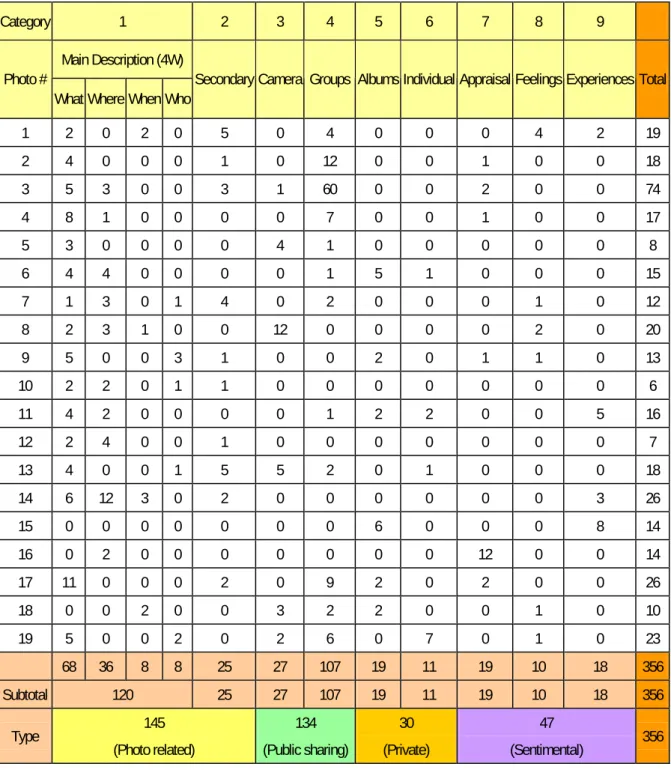
This study collects 19 photos and 356 tags. Table 1 demonstrates the number of tags of each photo for the 9 major categories. Detailed information of each tag and its priority category is provided in Appendix I.
General analysis
Due to the user-centered tagging strategy, the number of tags of each photo varies significantly, from the least 6 (photo 10) to the most 74 (photo 3). Regarding its distribution of each category or subcategory, the traditional 4W only accounts for 34% of tagging activity. The rest 66% exposes some emerging categories, among which Groups accounts for 30% of overall tagging, a quite impressive percentage since it was assigned no priority under research design, revealing that the function of tags are meant for public sharing no less than for photo description. Camera is a unique category specifically for flickr, where attracts a good number of professional photographers who would like to share detailed information of camera types and accessories. Further, even if tagging is bottom-up, user-centered activity, and it is found that a user may have created dozens of personal albums, the number of tags for albums or for individual purposes only occupies a very small proportion, 5% and 3% respectively,
indicating that tagging is not the major mechanism for photo management even if flickr is famous with its powerful design on photo collections. Categories 7-9, consisted of Appraisal, Feelings, and Experiences, are emotional tags contributed by few users. Although the total number of these tags is not impressive, only 13% of the overall tagging activities, it will have significant effect on classifications. As mentioned earlier, previous research categorized these tags objectively, described by Golder and Huberman (2006) as ‘qualities and characteristics’ and by Smith (2008) as ‘opinion.’ Such categorization ignores the user’s involvement while tagging. The term like alone, great, or emo is tagged for representing the user’s emotional connection to the photo, and the arousal of these emotions is based upon the user’s past experiences. Users don’t have to tag things or objects for the photos. They can tag their thoughts, feelings, and comments.
Subjective tags and its implications on information indexing - 7
Table 1: Distribution of Tags
Category 1 2 3 4 5 6 7 8 9 Main Description (4W)
Photo #
What Where When Who
Secondary Camera Groups Albums Individual Appraisal Feelings Experiences Total
1 2 0 2 0 5 0 4 0 0 0 4 2 19 2 4 0 0 0 1 0 12 0 0 1 0 0 18 3 5 3 0 0 3 1 60 0 0 2 0 0 74 4 8 1 0 0 0 0 7 0 0 1 0 0 17 5 3 0 0 0 0 4 1 0 0 0 0 0 8 6 4 4 0 0 0 0 1 5 1 0 0 0 15 7 1 3 0 1 4 0 2 0 0 0 1 0 12 8 2 3 1 0 0 12 0 0 0 0 2 0 20 9 5 0 0 3 1 0 0 2 0 1 1 0 13 10 2 2 0 1 1 0 0 0 0 0 0 0 6 11 4 2 0 0 0 0 1 2 2 0 0 5 16 12 2 4 0 0 1 0 0 0 0 0 0 0 7 13 4 0 0 1 5 5 2 0 1 0 0 0 18 14 6 12 3 0 2 0 0 0 0 0 0 3 26 15 0 0 0 0 0 0 0 6 0 0 0 8 14 16 0 2 0 0 0 0 0 0 0 12 0 0 14 17 11 0 0 0 2 0 9 2 0 2 0 0 26 18 0 0 2 0 0 3 2 2 0 0 1 0 10 19 5 0 0 2 0 2 6 0 7 0 1 0 23 68 36 8 8 25 27 107 19 11 19 10 18 356 Subtotal 120 25 27 107 19 11 19 10 18 356 Type 145 (Photo related) 134 (Public sharing) 30 (Private) 47 (Sentimental) 356
Overall speaking, four main functions of tagging are identified: (1) those related to the descriptions of the photos (categories 1 & 2, 41%); (2) those tagged for public sharing (categories 3 & 4, 38%); (3) those meant for private collections (categories 5 & 6, 8%), and (4) sentimental tags (categories 7, 8 & 9, 13%). The result clearly shows that the proportion of traditional indexing nodes such as spatiality (Where), temporality (When), and
intentionality (Why) are relatively low in flickr tagging activities. The terms of Groups, Albums, and emotional tags are very subjective, implying that both rational and sentimental
Subjective tags and its implications on information indexing - 8
dimensions are equally significant for information indexing (49% vs. 51%).
Several characteristics of tagging
After examining the terms of these 356 tags, several characteristics of folksonomy can be identified. First of all, tagging is not nouns only. In principle, things are classified as nouns in taxonomy. This is the reason why we use objective concepts to keyword a document, a photo, or an audiovisual material. Folksonomy does not follow this rule completely. For example, the author of photo number 1 tags vibrant, red, alone to demonstrate a pair of red shoes on the green grass. Similarly, the author of photo number 3 uses looking up to describe the posture of the cosmos flower. The use of adjectives, verbs, and even adverbs is not common in each photo, but suggests that not only nouns are allowed to exist in folksonomy. Also, a tag can be a combination of multiple words rather than a single word, such as
youareamazingphotographer, the very best of flickr, and AnAwesomeShot, etc. It would be a
mistake to think that only few users adopt these multiple variations. Once we click on these tags, we will discover their clusters accommodating hundreds or thousands of photos, proving that the abnormal tags in our epistemology will become normal as long as they are
acknowledged by groups or user communities.
Secondly, tagging is de-hierarchical, destroying the so-called parent-child structure. In taxonomy, if Dog is the ‘parent’ level of classification, Pekingese would be the next level of it for it is the ‘breeds’ of dog. Similarly, the term china and beijing should be labeled as first
China then Beijing, since the level of ‘country’ is always higher than that of ‘city.’ Tagging in
flickr, however, switches this vertical hierarchy to horizontal juxtaposition. The author of photo number 10 not only tags china and beijing together but also adds another two similar terms: chinese and 北京(‘Beijing’ in Chinese). Another example would be the photo number 7, in which plano, school, and planoseniorhighschool are all placed in the tagging pool.
Tagging is redundant, against the rules of one-thing-in-one-place and controlled
vocabulary. A user may tag all possible terms or language for the same object. fleur and fleurs of photo number 17 are identical words of flowers. mediterranian of photo number 14 is equal to mediterrani and mediterraneo, and the same circumstance is island, isla, and illa, which are all tagged together. The author of photo number 6 use several tags to identify a trade fair in Canton, including Canton, Trade, Fair, Canton Trade Fair, China Import and
Export Fair, and Guangzhou (another term of Canton). The reason why users tag redundantly
is self-explanatory. They hope their photos being easily indexed in web searching. Further, tagging emphasizes the connection between the user and the photo. In
traditional classification we objectified the subjects. A pair of red shoes on the green grass is naturally tagged as red, shoes, green, and grass. But this photo may recall some deep feelings in the user’s mind. Consequently, in flickr we see these tags like lonely, alone, vibrant, fun,
emo, and scene. The objects (What) of the photo, the red shoes and the green grass, are thus
Subjective tags and its implications on information indexing - 9
subjectified. The number 10 photo is interesting, too. The content of it is a corner tower of Beijing Imperial Palace, but the author completely ignores the primary keywords like tower and palace. Instead, he only tags its background, blue and sky. The other example is the number 15 photo, in which a naked man photographs himself indoors with a digital camera in front of a mirror. The tags of this photo are full of imagination, including SKY, CLOUDS,
BEACH, SUN, VACATION, etc. All these tags are not the content of the photo. They are
experiences recollected by the photo from the researcher’s point of view.
Finally, instead of maintaining a unified term, tagging actually encourages to create variations of terms. This is particularly manifest in Groups, the self-organized photo
communities among users where different tags are used for describing similar meanings. For example, to tag a photo as the favorite, one may use the following terms: ABigfav, ABigFave,
mostfavorite, FiveFilckrFavs, FrHwoFavs, etc. To appreciate a photo as a good shot,
different groups are formulated, such as the very best of flickr, AnAwesomeShot, BRAVO,
SuperShot, GreatShot, beautifulcapture, welltaken. These terms are used to distinguish this
special group from the other ones. They are the logos for group identity rather than for a unified definition.
FURTHER APLLICATIONS OF SUBJECTIVE TAGS
Just like Ellen and Reason (1979) pointed out, different classifications reflect different aspects of reality. The rise of the subjective tags provides us a unique comprehension on information organization. In the networked society, tags are not only used for classification, they serve an indexing purpose, facilitating search and navigation of resources. And empirical findings show that except for rational knowledge, users like to search the subjective
dimension of information online. They are willing to read the messages from people who may have similar experiences or stories from friends to share (Veinot, 2009). In order to find the exact messages they want, users have developed their own keyword strategies. Usually, the keyword (or tag) used for search is not formal. Daily language is widely used instead. For example, in the formal knowledge network like Wikipedia, insomnia is the item for
sleeplessness. Sleepless itself is referred to as a term in films, televisions, novels, or music. In reality, however, users would hardly search insomnia on Google unless they are working on medical papers. The terms they might key in are sleepless plus depressed, both subjective and emotional. With such a strategy, users can target those web pages containing private
experiences from millions of search results.
Up to this moment, the researcher started to think if there is a way to implement this subjective indexing to our web design. In a graduate class at fall 2009, students were asked to develop team projects regarding the applications of subjective tagging, and here are three related prototypes:
Subjective tags and its implications on information indexing - 10
1. Gourmet Search, a restaurant pageranking program plugged in Facebook. This prototype adopts two concepts of tagging: Appraisal and Groups, allowing information to be retrieved from worldwide blogs and ranked primarily by the joint evaluation of connected friends, who are more reliable to the users (Figure 1).
Figure 1: Gourmet Search
Designed by T. Li, J. Sung, M. Tsai, and Y. Tseng
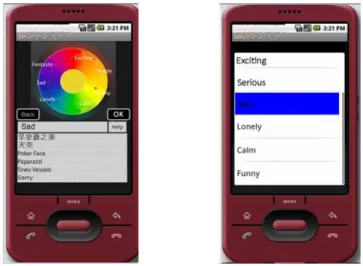
2. Sentimental Music Player, an emotionally classified music platform on mobile phones. Using ‘color’ to identify feelings, a user can choose a color from a color palette and add some tags to symbolize his personal emotion to a song. By this way, users can immediately retrieve a set of songs following their moods. Moreover, they can discover potential users who have exactly the same emotional tags on the same songs. These like-minded people at the current moment may establish a new form of community online (Figure 2).
Figure 2: Sentimental Music Player
Designed by S. Tseng, C. Chen, T. Chan, G. Chiu, and X. Fu
Subjective tags and its implications on information indexing - 11
3. Mappory, or map your memory, an experience-oriented university memory sharing platform. Illustrated as a school map, this prototype adopts the strategies of Experiences, Feelings, and Groups. Students can stamp the place and share their subjective experiences. The emotionality of the collective experiences is displayed again by the depth of different colors. Dark blue means very sad experiences, while light yellow is happier experiences in a collective point of view (Figure 3).
Figure 3: Mappory
Designed by Y. Chen, M. Yeh, W. Hsieh, and G. Lo
In conclusion, this research on tagging suggests that both rational and sentimental dimensions are equally significant for information indexing in a networked society. For the first time in human history, emotions or experiences can be statistically aggregated and collectively shared by thousands of people, which reveals the possibility of organizing information based upon their subjective needs. Such developments stimulate many fruitful thoughts for indexing programs. As the technologists promote the user-center design, what are the users’ subjective needs online and how they associate their subjective experiences via search engines or answers.com remain unclear at present. Therefore, further research should focus on how users tag and search information subjectively.
REFERENCES
Bush, V. (1945). As we may think. The Atlantic Monthly, July. URL (consulted 10 July 2009):
Subjective tags and its implications on information indexing - 12
Ellen, R., & Reason, D. (1979). Classifications in their social context. New York: Academic Press.
Foucault, M. (1994). The order of things: An archaeology of the human sciences. New York: Vintage Books.
Golder, S. A., & Huberman, B. A. (2006). Usage parrterns of collaborative tagging systems.
Journal of Information Science, 32 (2), 198-208.
Heckner, M., Ibacher, S. M., & Wolff, C. (2007). Tagging tagging.: A classification model for user keywords in scientific bibliography management systems. URL (consulted 1 April 2008):
http://www.comp.glam.ac.uk/pages/research/hypermedia/nkos/nkos2007/papers/heckner. pdf.
Lange, P. G. (2007). Publicly private and privately public: Social networking on YouTube.
Journal of Computer-Mediated Communication, 13 (1), article 18. URL (consulted 11
April 2008): http://jcmc.Indiana.edu/vol13/issue1/lange.html.
Marlow, C., Naaman, M., Boyd, d., & Davis, M. (2006). Position paper, tagging, taxonomy, flickr, article, toread. URL (consulted 5 July 2008):
http://www.danah.org/papers/WWW2006.pdf.
Mathes, A. (2004). Folksonomies: Cooperative classification and communication through shared metadata. Computer Mediated Communication – LIS590CMC. URL (consulted 19 February 2008):
http://www.adammathes.com/academic/computer-mediated-communication/folksonomies .html.
O’Reilly, T. (2005). What is web 2.0: Design patterns and business models for the next generation of software. URL (consulted 11 June 2006):
http://oreilly.com/web2/archive/what-is-web-20.html.
Quintarelli, E., Rosati, L., & Resmini, A. (2006). Facetag: Integrating bottom-up and top-down classification in a social tagging system. URL (consulted 1 April 2008):
http://www.facetag.org/download/facetag.pdf.
Smith, G. (2008). Tagging: People-powered metadata for the social web. Berkeley, CA: New Riders.
Tapscott, D., & Williams, A. D. (2006). Wikinomics: How mass collaboration changes
everything. New York: Portfolio.
Veinot, T. C. (2009). Interactive acquisition and sharing: Understanding the dynamics of HIV/AIDS information networks. Journal of the American Society for Information
Science and Technology, 60 (11), 2313-2332.
Yi, K., & Chan, L. M. (2009). Linking folksonomy to Library of Congress subject headings: An exploratory study. Journal of Documentation, 65 (6), 872-900.
Zwaan, R. A., Langston, M. C., & Graesser, A. C. (1995). The construction of situation model
Subjective tags and its implications on information indexing - 13
in narrative comprehension: An event-indexing model. Psychological Science, 6 (5), 292-297.
APPENDIX I: Detailed information of tags and their priority categories
#
Title Author Description of Photo URL
Tags Priority Category
1 Running ahead of oneself orangeacid Red color converse on the grass.
http://www.flickr.com/photos/orangeacid/4592079 03/
emo scene
shallow depth of field shoes red green lonely polkadot alone summer spring converse grass vibrant fun 50mm myspace
Flickr Front Page ABigFave Experiences Experiences Secondary What Secondary Secondary Feelings Secondary Feelings When When Secondary What Feelings Feelings Groups Groups Groups Groups 2 Lapsana apogonoides jam343 Yellow flowers off the road.
http://www.flickr.com/photos/jam343/1703693/ flowers spring scenery lapsana great fotolog ThinkFlickrThink SuperShot 1mill PhotographyAndExpressions What What What What Appraisal Groups Groups Groups Groups Groups
Subjective tags and its implications on information indexing - 14 AlemdagQualityOnlyClub yellow GreatShot 500v50f ReflectYourWorld l'image-color SuperEco perspective Groups Secondary Groups Groups Groups Groups Groups Groups 3 Sunny Side Up code poet Cosmos looking up the sky.
http://www.flickr.com/photos/alphageek/23347209 3/ cosmos flower pink looking up sun sky blue clouds 10-22mm lexington kentucky arboretum
top-f25, top-v111, top-v333, top-f50, top-v555, top-v777, top-c25 … top-v77777 (skipped, all top-fxx, top-cxx, top-vxx,or 100.., 500..) beautifulcapture
mashallah welltaken
youareamazingphotographer the very best of flickr infinestyle GoldenAperture masterpiece What What Secondary Secondary What What Secondary What Camera Where Where Where Groups (54 in total) Groups Groups Groups Appraisal Groups Groups Groups Appraisal 4 Is there anybody out there?
Ende Sight seeing of sand beach.
http://www.flickr.com/photos/ende/7521239/ mare cabine spiaggia beach sea What What Where What What 14
Subjective tags and its implications on information indexing - 15 sand net volley beachvolley 10-25-fav mostfavorite wow top-f25 welltaken beautifulcapture the very best of flickr AnAwesomeShot What What What What Groups Appraisal Groups Groups Groups Groups Groups Groups 5 K-9 junku-newcleus
A black-and-white dog in front of a police car.
http://www.flickr.com/photos/junku-newcleus/417 646359/ leica film neopan1600 summaron dogworld pembroke welsh
corgi (welsh corgi=pembroke)
Camera Camera Camera Camera Groups What What What 6 Canton Trade Fair
tarotastic Arc corridor with walking passengers.
http://www.flickr.com/photos/tjt195/380173157/
canton trade fair
Canton Trade Fair Guangzhou China Pazhou
China Import and Export Fair FiveFlickrFavs 100+ startpage 500+ 600+ 700+ 1000+ Where What What What Where Where Where What Groups Albums Individual Albums Albums Albums Albums 7 the sea of maroon
nutmeg
Fans, colored red and white over faces and bodies,
plano planoseniorhighschool pride Where Where Feelings
Subjective tags and its implications on information indexing - 16 cheering at a game. http://www.flickr.com/photos/absolutely_loverly/1 20000855/ school footballgame fans stands cheering maroon action welltaken beautifulcapture Where What Who Secondary Secondary Secondary Secondary Groups Groups 8 Wasteland xdjio
Stairways and scattered railings toward the underground stadium. http://www.flickr.com/photos/xdjio/226228060/ stairs stadium bcplace distagon35 railing empty alone vancouver day bw film bathroomdarkroom rodinal ilford fp4 contax rtsii stand development standdevelopment What Where Where Camera What Feelings Feelings Where When Camera Camera Camera Camera Camera Camera Camera Camera Camera Camera Camera 9 the smile of a man with a wild fan base
notsogoodphotography Live music show: The actors and the crowds.
http://www.flickr.com/photos/notsogoodphotograp hy/503637906/ traphic jam live music live show alimas carnival show rock kayaano crowd surfing fans Who What What What What What Who Secondary Who 16
Subjective tags and its implications on information indexing - 17 chaos sound of a nation Music Maldives Feelings Appraisal Albums Albums 10 97220015 nuomi
A corner tower of Beijing Imperial Palace.
http://www.flickr.com/photos/nuomi/77156587/ china chinese beijing sky blue 北京 Where What Where What Secondary Where 11 Shanghai Skyscape pmorgan Skyscrapers of Shanghai. http://www.flickr.com/photos/pmorgan/32606683/ Shanghai China shanghaiist urban adobeelements experiments architecture Code 46 everything2 COTC:mostfavorited flickrhomepage buildings haze jin mao Hyatt post modern Where Where What What Individual Albums Albums Experiences Experiences Groups Individual What What Experiences Experiences Experiences 12 Trees Snow and Shadows
ccgd
Beautiful snow landscape with trees at the right corner. http://www.flickr.com/photos/ccgd/107274692/in/s et-72157601948177769/ Cromarty Scotland Highlands Snow tree blue
sutor (a place of Cromarty)
Where Where Where What What Secondary Where 13 back at ya rappensuncle
Motocross roosting dirt to the camera lens.
http://www.flickr.com/photos/rappensuncle/18368 9226/ 35mm color film kodachrome nikon coolscan V Camera Camera Camera Camera Camera
Subjective tags and its implications on information indexing - 18 motocross roosting dirt in your face rappensuncle honda minolta action XR 500 welltaken mashallah
os-bmx and motocross vintage What What What What Who Secondary Secondary Secondary Secondary Groups Groups Individual Secondary 14 wham:a different corner
visualpanic Two people swimming in the water.
http://www.flickr.com/photos/visualpanic/2335086 14/ menorca macarelleta water sea beach agost 2006 blue mar blau illes balears minimal summer mediterrani mediterraneo mediterranian island isla illa aigua agua Cala Macarelleta Balearic Islands Holydays Vacances Where Where What What What When When Secondary Experiences Experiences Experiences Secondary When Where Where Where Where Where Where Where Where Where Where What What 18
Subjective tags and its implications on information indexing - 19
Vacaciones What 15 Self Portrait in Barbados
jenschapter3
A naked man picturing himself in front of a mirror.
http://www.flickr.com/photos/chapter3/328919634 / 2004 (2004 NOV… SET2) NOV BARBADOS OVER THANKSGIVING SET2 SKIES SKY CLOUDS BEACH VIVID SUN PALM VACATION Albums Albums Albums Albums Albums Albums Experiences Experiences Experiences Experiences Experiences Experiences Experiences Experiences 16 Last Tango in Buenos Aires
welsh boy
Dancers dancing in the square; Another girl dancer Staring ahead without a target.
http://www.flickr.com/photos/jonowales/95283121 / Buenos Aires Argentina deleteme deleteme2 deleteme3 deleteme4 deleteme5 saveme deleteme6 deleteme7 deleteme8 deleteme9 saveme2 deleteme10 Where Where Appraisal Appraisal Appraisal Appraisal Appraisal Appraisal Appraisal Appraisal Appraisal Appraisal Appraisal Appraisal 17 Lift Off- Best Viewed Large
aussiegall
A bee flying above the flower, associated with beautiful sky and clouds.
http://www.flickr.com/photos/aussiegall/34500921 0/ bee flower clouds sky fly buzz My winner AnAwesomeShot ABigfav What What What What Secondary Secondary Appraisal Groups Groups
Subjective tags and its implications on information indexing - 20 ABigFave A photo day Project 365 Eyecatcher Free DP shield of excellence BRAVO macro nature fleur fleurs flowers insecte insect animal FrHwoFavs abeille Groups Groups Albums Groups Groups Appraisal Groups Albums Groups What What What What What What Groups What 18 - +lyn
A fuzzy photo taken inside an umbrella against the railing of an overhead bridge
http://www.flickr.com/photos/lynhana/416152814/ 2006/06 film kodak gm400 lomo lc-a beautifulcapture expired 2001 mashallah When Camera Camera Camera Albums Albums Groups Feelings When Groups 19 Judah-Jack-Donald-Krug kk+
A close-up of a lovely boy with big glasses and rosy cheeks. http://www.flickr.com/photos/kk/14443265/ film judahjackdonaldkrug rosycheeks portrait son glasses rouge static family kktop20interesting kktop20favs kktop20comments What Who What What Who What What Feelings Individual Individual Individual 20
Subjective tags and its implications on information indexing - 21 welltaken beautifulcapture Flickrcolour 50mm lens GoldenHeartAward staticportrait kittymoo GününEnİyisi TheBestOfDay kkiphotoportrait bkcutportrait Groups Groups Groups Camera Camera Groups Individual Individual Groups Groups Individual Individual