Effects of compressive epitaxial strain on the magnetotransport properties of
single-phase electron-doped La 0.7 Ce 0.3 MnO 3 films
W. J. Chang, C. C. Hsieh, J. Y. Juang, K. H. Wu, T. M. Uen, Y. S. Gou, C. H. Hsu, and J.-Y. Lin
Citation: Journal of Applied Physics 96, 4357 (2004); doi: 10.1063/1.1792808
View online: http://dx.doi.org/10.1063/1.1792808
View Table of Contents: http://scitation.aip.org/content/aip/journal/jap/96/8?ver=pdfcov
Published by the AIP Publishing
Articles you may be interested in
Magnetic properties and transport of epitaxial La 0.47 Ce 0.20 Ca 0.33 Mn O 3 films
J. Appl. Phys. 105, 07D701 (2009); 10.1063/1.3054360
Transport and magnetic properties of La 0.9 Ce 0.1 Mn O 3 thin films
J. Appl. Phys. 97, 033905 (2005); 10.1063/1.1844621
Structural, electrical transport, magnetization, and 1 f noise studies in 200 MeV Ag ion irradiated La 0.7 Ce 0.3 Mn O 3 thin films
J. Appl. Phys. 96, 7383 (2004); 10.1063/1.1818719
Jahn–Teller distortion and magnetoresistance in Sr 1x Ce x MnO 3
AIP Conf. Proc. 554, 379 (2001); 10.1063/1.1363100
Transport and magnetic properties of laser ablated La 0.7 Ce 0.3 MnO 3 films on LaAlO 3
J. Appl. Phys. 86, 5718 (1999); 10.1063/1.371584
Effects of compressive epitaxial strain on the magnetotransport properties
of single-phase electron-doped La
0.7Ce
0.3MnO
3films
W. J. Chang, C. C. Hsieh, J. Y. Juang, K. H. Wu, T. M. Uen, and Y. S. Gou
Department of Electrophysics, National Chiao Tung University, Hsichu, Taiwan
C. H. Hsu
National Synchrotron Radiation Research Center, Hsinchu, Taiwan
J.-Y. Lin
Institute of Physics, National Chiao Tung University, Hsinchu, Taiwan (Received 16 April 2004; accepted 25 July 2004)
Single-phase electron-doped manganite thin films with nominal composition of La0.7Ce0.3MnO3共LCeMO兲 have been prepared on SrTiO3共100兲 substrates by pulsed laser deposition. The conditions for obtaining purely single-phase LCeMO films lie within a very narrow window of substrate temperature 共Ts⬃720 °C兲 and laser energy density 共ED⬃2 J/cm2兲 during deposition. In situ postdeposition annealing, mainly to relax the possible epitaxial in-plane tensile strain between the film and the substrate, leads to an increasing c-axis lattice constant accompanied by the formation of secondary CeO2phase and higher metal-insulator transition temperature. This is indicative of a strong coupling between the electron and lattice degree of freedom. © 2004
American Institute of Physics.[DOI: 10.1063/1.1792808]
I. INTRODUCTION
Owing to the colossal magnetoresistance(CMR) for the practical application potential in the so-called “spintronics” and the rich phase diagrams arising from competing order parameters, the hole-doped manganites, in the forms of
R1−xAxMnO3 (R, rare-earth ion; A, divalent cation), have been attracting a rapt attention over the last decade or so. One of the most salient features exhibited by this class of materials is the paramagnetic-ferromagnetic transition ac-companied by an insulating to metallic transition (MIT) at nearly the same temperatures characterized as Curie tem-perature 共TC兲 and insulator-metal transition temperature
共TIM兲, respectively. The origin of these effects, after tremen-dous evidences cumulated from both theoretical and experi-mental studies, appears to be well beyond the framework of the ubiquitously adopted double-exchange (DE) mech-anism,1,2 in that the hopping of eg1 electron between Mn3+ and Mn4+ is the only significant prevailing process. For in-stance, the large resistivity value above TC (Ref. 3) and the nanoscale phase separation in nominally homogeneous samples4,5cannot be comprehended by the DE mechanism.
On the other hand, it has been widely anticipated that electron-doped RMnO3 compounds obtainable by replacing the divalent dopants with tetravalent ones (e.g., cerium or tin) should also possess similar CMR effects.6–10The intui-tive argument for this direct analogy is that Mn2+and Mn4+ are non-Jahn-Teller ions and the hopping of eg2electron be-tween spin-aligned Mn2+and Mn3+ should be similar to that between Mn3+ and Mn4+. Earlier studies6–10
of these electron-doped manganites indeed reproduced most of the electric and magnetic properties of their hole-doped counter-parts; e.g., La0.7Ce0.3MnO3共LCeMO兲 displayed similar tem-perature dependent resistivity 关R共T兲兴 and magnetization
关M共T兲兴 behaviors with almost the same TIMand TCas that of
the hole-doped La0.7Ca0.3MnO3 共LCMO兲. Based on the con-sideration of ion size constraints, however, Joseph Joly, Joy, and Date11 have argued that it is generally impossible to substitute the trivalent La3+ with a tetravalent ion, such as Ce4+ and Sn4+ via conventional solid-state reaction pro-cesses. They further questioned that the single-phase poly-crystalline and expitaxial LCeMO films reported by Mitra et
al.8 might have been the self-doped La1−xMnO3−␦ manganites.12,13 The issues, nevertheless, have been pretty much settled by a series of papers published by Mitra et
al.,14–16 wherein direct observation of electron doping in LCeMO by x-ray absorption spectroscopy (XAS),14 the current-voltage characteristics from LCeMO/ LCMO p-n junctions,15and LCeMO/ STO/ LCMO tunnel junctions16all evidencing that LCeMO is indeed an electron-doped manga-nite.
Despite these remarkable progresses in this relatively new material, there are some issues that remain to be clari-fied. For instance, Mitra et al.8 argued that it is desirable to use high laser energy density 共ED⬃3 J/cm2兲 and high
Ts共⬎750 °C兲 to obtain single-phase LCeMO films. This is
somewhat mysterious considering that both factors are in favor of forming the more stable CeO2. In addition, it is also suggested that the double-peak MIT transition frequently ob-served in mixed-phase LCeMO bulks is mainly due to the presence of the unreacted CeO2. In this study, we perform a detailed study on the formation of LCeMO phase by system-atically varying the Ts, ED, as well as the duration of in situ annealing carried out immediately after deposition. The re-sults clearly demonstrate that single-phase LCeMO films can only be obtained at much lower Ts(⬃720 °C as compared to
⬎750 °C) with a smaller ED (⬃2 J/cm2 as compared to 3 J / cm2).17
Furthermore, we note that, while the in situ post-depositon annealing has inevitably induced the formation of CeO2 phase, it also raises TC and TM with apparent c-axis
0021-8979/2004/96(8)/4357/5/$22.00 4357 © 2004 American Institute of Physics
lattice parameter relaxation towards the bulk value. The compressive strain originated from the epitaxial relation
aSTO⬎aLCeMOand the associated suppression in TIMand TC suggested the prominent coupling between the electron and lattice degree of freedom in CMR effect.
II. EXPERIMENT
Target with nominal composition of La0.7Ce0.3MnO3was prepared by mixing stoichiometric amount of CeO2, La2O3
(which had been preheated), and MnCO3powders in a mor-tar. The mixture was heated in air at 1100 ° C for 20 h. The agglomerated substance was then ground, palletized, and sin-tered at 1400 ° C for 27 h. The last step was repeated once to maximize reactions between the ingredients. The target thus obtained was a mixed-phase material and exhibited a broad double-peak MIT transition at 200 and 240 K, respectively. These characteristic properties are similar to that of the typi-cal polycrystalline bulks reported previously.18 Epitaxial LCeMO films were grown on STO substrate by pulsed laser deposition, using a KrF 共248 nm兲 excimer laser with a rep-etition rate of 5 Hz. We first scan deposition parameters such as oxygen pressure, Ts and EDto give a rough optimization on TC and TIM of the films. For this study, while other pa-rameters were varied for investigating the issues mentioned above, an oxygen pressure of 0.35 Torr was set for all ex-periments as it gave the best results. Moreover, in order to delineate possible strain effects, the films thickness was kept at 100 nm for all the films used in this study. For in situ annealing(see below), the chamber was filled with pure oxy-gen to about 500 Torr immediately after deposition while keeping the substrate temperature at 720 ° C for various pe-riods of time before cooling to room temperature. As re-vealed by x-ray diffraction(XRD), all the films display well-oriented characteristic with c-axis normal to film plane. In order to check the film/substrate epitaxial relation, we also performed the reciprocal lattice scattering with synchrotron radiation x-ray and in-plane-scan experiments. The results clearly indicate the highly epitaxial characteristic between the films and the substrate. The transport关R共T兲兴 and magne-tization 关M共T兲兴 properties as functions of temperature and applied field were carried out in a Quantum Design® PPMS system.
III. RESULTS AND DISCUSSION
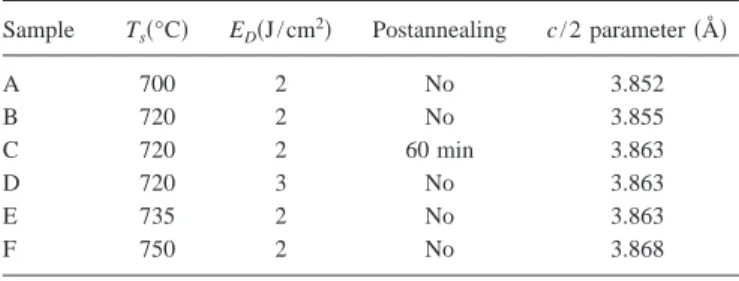
Figure 1 shows a summary of XRD results demonstrat-ing how the formation of sdemonstrat-ingle-phase LCeMO and accom-panying CeO2phases were dependent on Ts, ED, and in situ annealing. The deposition and treatment conditions of the LCeMO films together with the crystalline parameters were collected in Table I. The enlarged XRD trace shown in the upper right inset of Fig. 1 shows the high c-axis oriented characteristic of the films. It is also evident from Fig. 1 that single-phase LCeMO can only be obtained within a very narrow window around Ts⬃720 °C with ED= 2 J / cm2.
Merely raising or lowering Ts by 10 ° C or increasing EDto
3 J / cm2leads to the formation of CeO
2phase. These results show some disagreements with the conjecture reported by Mitra et al.,8 where high laser energy density and high Ts
were considered to be desirable for obtaining single-phase LCeMO films. Although, the discrepancy may be simply due to the systems used. However, since there is a clear tendency of expanding c-axis parameter with increasing Ts (see the upper left inset of Fig. 1 and the last column of Table I) we argue that the strain state of the growing film might have played a very important role. To further delineate the argu-ment, the film/substrate epitaxial relation has been carefully checked with more delicate synchrotron x-ray scattering as well as-scan measurements.
As shown in Fig. 2, x-ray scattering results show that the deposited LCeMO indeed forms a high quality epitaxial film on the STO substrate. The dash and solid lines in Fig. 2(a) depict the distribution of scattered x-ray intensity along
(001) direction (l-scan) in the neighborhood of 共002兲 and 共112兲 Bragg peaks. The stronger peaks centered at l=2 rlu (reciprocal lattice unit) are originated form the STO substrate
and the weaker peaks centered at 2.016 rlu are coming from the LCeMO epitaxial film. The larger l value of the film peaks reveals that its lattice constant along the c axis is 0.8% shorter than that of the substrate. The difference, though is slightly smaller than that estimated from the XRD results for sample B 共⬃1.2%兲 using the bulk lattice constants of the relevant phase involved here, namely, a = 3.902 Å for STO,
a = 5.403 Å, b = 5.518 Å, c = 7.759 Å for bulk LCeMO.18 It is, nevertheless, much larger than the difference of about 0.58% between 共c/2兲LCeMO and cSTO expected with the ab-sence of epitaxy-induced compressive strain along the c axis. The in-plane crystallographic orientation of the film with
FIG. 1. XRD results of sample A to F. Notice trace amount of CeO2phase
can be identified in all cases, except for B. The upper-left inset denotes the variation of c-axis lattice constant with the relaxation of in-plane tensile strain induced by the increase of Ts, annealing(sample C), and high ED
deposition(sample D). The upper-right inset shows excellent epitaxial rela-tion between LCeMO共002兲 and STO substrate.
TABLE I. Summary of deposition conditions for the representative films studied. All films were deposited at fixed PO2= 0.35 Torr.
Sample Ts共°C兲 ED共J/cm2兲 Postannealing c / 2 parameter共Å兲
A 700 2 No 3.852 B 720 2 No 3.855 C 720 2 60 min 3.863 D 720 3 No 3.863 E 735 2 No 3.863 F 750 2 No 3.868
4358 J. Appl. Phys., Vol. 96, No. 8, 15 October 2004 Changet al.
respect to the substrate was further examined by the intensity map of the off-specular 共112兲 Bragg peaks and the -scan measurements around共001兲 axis across the 共1 1 2.016兲 peak. As shown in Fig. 2(b), in addition to the strong substrate peak centered at共112兲, a weak bump centered at (1 1 2.016) rlu, which is associated with the 共112兲 Bragg peak of the LCeMO film was clearly observed. Figure 2(c) shows the contour mapping of the scattering intensity and displays es-sentially the same features. Furthermore, the -scan mea-surements around 共001兲 axis across the substrate 共112兲 and film共1 1 2.016兲 peaks are displayed in Fig. 2(d) for compari-son. It is clear that both scans show four distinct peaks lining up with each other. All this information confirmed that the lattice of the LCeMO film is in good registry with that of the STO substrate and their in-plane axes are aligned with each other. These independent measurements thus lend strong support to the conjecture that the epitaxy-induced strain and its effects on the film c-axis parameter are indeed very sensitive to deposition and treatment conditions.
It is also interesting to note that for films grown at higher
Ts both 共111兲 and 共200兲 orientations of CeO2 are present, while only 共200兲 orientation appears in films deposited at
Ts= 700 ° C. It turns out that by rotating the a-b plane of both
LCeMO and CeO2, they can actually get quite good lattice matching with STO substrate. Early developments of biepi-taxial high-Tcsuperconducting grain boundary junctions
us-ing CeO2as the buffer layer to provide a 45° rotation 19
and the TiO2-buffered biepitaxial La0.7Ca0.3MnO3 step junctions20have all utilized exactly this effect. This rotation, though gives good epitaxial relations between the relevant phases, still results in a slight in-plane tensile stress to the films. At higher Tsand/or after prolonged annealing, the
ac-cumulated strain starts to relax by generating dislocation-related extended defects or by forming the secondary CeO2 phase, leading to the relief of in-plane tensile stress. As the in-plane tensile stress is relaxed, the c-axis lattice constant of LCeMO films approaches toward its bulk value. Similarly, films prepared with ED= 3 J / cm2(trace D) and that subjected to long time annealing (trace C) behave well along the ex-pected trend. Moreover, the fact that CeO2 phase does not appear in every case indicates that it may not form directly from the target residues.8 Rather, the formation of CeO2 should be a direct consequence of strain relaxation, which could occur during deposition or be promoted by annealing afterward. At low enough Ts, CeO2maintains epitaxial rela-tion with STO substrate and is formed preferably along共100兲 orientation. While at higher temperatures the substrate effect is diminished, leading to a structure with randomized grain orientation, as seen in traces E and F of Fig. 1.
Having disclosed the detailed crystalline structure for films grown under various conditions, we turn to discuss how the strain state affects the electric and magnetic proper-ties of the LCeMO. Figure 3(a) shows the R共T兲 results of the as-deposited film (B) and films annealed at 720 °C and 500 Torr of oxygen for 10, 30, and 60 min共C兲, respectively. We note that for this series of films only the C film shows trace of CeO2phase in XRD(trace C in Fig. 1). As is evident from the R共T兲 curves, there is only one MIT transition in each sample and TIMis progressively improved from 255.5
FIG. 2. (a) X-ray intensity distribution along the共001兲 direction of both 共002兲 and off-specular 共112兲 Bragg peaks. (b) The 3D distribution of the
scattered x-ray intensity on the[110] plane near the (112) Bragg peaks. (c) The contour plot of the intensity distribution around the共112兲 Bragg peak.
(d)⌽ scans around the 共001兲 axis across the 共1 1 2.016兲 peak of the LCeMO
film(lower curve), and that across the (112) peak of the substrate (upper
curve), showing the excellent in-plane alignment between the film and the
substrate.
to 270.2 K with increasing annealing time. We believe that the latter should be the more significant one. Haghiri-Gosnet
et al.21reported how the tensile and compressive strains alter the easy magnetization orientation in La0.7Sr0.3MnO3 films. Though they did not make detailed comparison of the effect on TIM, the deviation of Mn-O bond angle from its normal configuration and, hence, the CMR properties can be ex-pected, at least qualitatively. To this end, we further analyzed how the change of c-axis lattice constant affects TIM. The results are shown as the solid circles in the inset of Fig. 3(a). The relaxation of the in-plane tensile strain(reflected by in-creasing c parameter) evidently enhances TIM. Shown also in the inset of Fig. 3(a) are the results from films deposited at different Ts’s (solid triangles) and that taken from Ref. 7 (open circles) for LCeMO films deposited on LaAlO3 sub-strates which gives in-plane compressive strain on the films. The relaxation of strain in Ref. 7 was obtained by increasing the film thickness, thus might not be complete. Although the absolute TIMis apparently system dependent and there might still be some subtle calibrations needed to get the c param-eters derived form both experiments in order, it nevertheless, indicates a generic tendency of how strain state affects the CMR properties of the electron-doped LCeMO manganites. It appears that in-plane tensile strain tends to deteriorate TIM while the compressive strain does the opposite. This is in-dicative of a strong coupling between the electron and the lattice degree of freedom existent in this system.
Finally, R共T兲 and M共T兲 with that of films B and C are illustrated in Figs. 3(a), 3(b), and 3(c). It is clear that unlike those found in bulk LCeMO, there is no sign of double tran-sition in R共T兲 curves in all cases. In addition, except for the
slight differences in TIM(255 and 270 K for B and C, respec-tively), the presence of CeO2 in the films does not seem to result in any noticeable influence on the R共T兲 transitions. Although this is in contrast to the speculation of attributing the double transition to the existence of CeO2originally pro-posed by Mitra et al.,8it might be due to the small amount of CeO2 existent in our films. Interesting features to be noted are the subtle differences in the M共T兲 curves. First, the satu-ration magnetization is about 30% – 40% smaller in the as-deposited single-phase LCeMO(B) as compared to that of C, wherein CeO2is present. In that, the small shift of M共T兲 has been attributed to a ferromagnetic spin canting transition commonly observed in poorly oxidized manganites and can be removed by postannealing to increase the Mn4+/ Mn3+ ra-tio. It is not clear at present whether similar argument applies to the electron-doped case or not. Alternatively, it is often suggested that prolonged oxygen annealing may result in hole-doped La-deficient 共La1−xMnO3兲 phase with predomi-nate existence of Mn3+ and Mn4+ ions.12,13,22
In such cases, though it may partially account for the magnetization en-hancement, significant hysteresis between field-cooled and zero-field-cooled M共T兲 curves have been ubiquitously observed.23,24This apparently is not observed in the present study, implying that our annealing scheme does not lead to the formation of La-deficient or oxygen excessive phase. The other issue of relevance is whether or not Ce4+ ions really replace the La ions to make it electron doped? Or can the existence of CeO2 actually change the electronic states and lead to some specific magnetic phase locally, while giving rise to similar metallic characteristics? Recent measurements,14,25including ours,26by XAS showed charac-teristics of the existence of Mn2+, and did not reveal any electronic inhomogeneity. However, to further delineate the electronic structure of material, analyses on the valence state of other elements are desired. Detailed studies on oxygen absorption edge and their temperature dependence are under-way and will be reported elsewhere.
IV. CONCLUSION
In summary, we have demonstrated that the conditions of growing single-phase electron-doped LCeMO manganite thin films can be very sensitive to both the substrate tempera-ture and laser energy density. In our case, the optimal condi-tions are Ts= 720 ° C and ED= 2 J / cm2, which are lower than
that used by Mitra et al.8 In situ annealing on the
single-phase LCeMO films at 720 ° C and 500 Torr of oxygen pro-gressively enhances TIMfrom as-deposited 255 to 270 K af-ter 60 min of annealing. This enhancement is accompanied by an increase of c-axis lattice parameter arisen from relax-ation of in-plane tensile strain and is indicative of strong correlation between electron and lattice degree of freedom. The success of preparing the single-phase electron-doped manganite should provide good opportunity for analyzing the role of eg2 electrons in CMR effect as well as for exploring new device structures by combining with its hole-doped counterparts.
FIG. 3. (a) Effect of in situ annealing on the MIT behavior of single-phase LCeMO films. TIM’s are 255.5, 255.7, 263.2, and 270.2 K for films annealed
by 0, 10, 30, and 60 min(denoted in order from I to IV), respectively. The inset illustrates the relaxation of tensile in-plane strain induced by annealing
(solid circles) and higher Ts(solid triangles) can lead to c-parameter
expan-sion with enhanced TIM. Open symbols are taken from Ref. 17 for
compar-ing the effect of compressive in-plane strain on TIM.(b), (c) R共T兲 and M共T兲
curves of sample B and sample C, respectively. Notice that there are no apparent hystereses between field-cooled and zero-field-cooled M共T兲’s.
4360 J. Appl. Phys., Vol. 96, No. 8, 15 October 2004 Changet al.
ACKNOWLEDGMENT
This work was supported by the National Science Coun-cil of Taiwan under the Grant No. NSC92-2112-M-009-033.
1
C. Zener, Phys. Rev. 82, 403(1951).
2
P. G. de Gennes, Phys. Rev. 118, 141(1960).
3
A. J. Millis, P. B. Littlewood, B. I. Shraiman, Phys. Rev. Lett. 74, 5144
(1995).
4
E. Dagotto, Nanoscale Phase Separation and Colossal Magnetoresistance
(Springer, Berlin, 2003), and references therein.
5
S. F. Chen, P .I. Lin, J. Y. Juang, T. M. Uen, K. H. Wu, Y. S. Gou, and J. Y. Lin, Appl. Phys. Lett. 82, 1242(2003).
6
J. Philip and T. R. N. Kutty, J. Phys.: Condens. Matter 11, 8537(1999).
7
P. Raychaudhuri, S. Mukherjee, A. K. Nigam, J. John, U. D. Vaisnav, R. Pinto, and P. Mandal, J. Appl. Phys. 86, 5718(1999).
8
C. Mitra, P. Raychaudhuri, J. John, S. K. Dhar, A. K. Nigam, and R. Pinto, J. Appl. Phys. 89, 524(2001).
9
Z. W. Li, A. H. Morrish, and J . Z. Jiang, Phys. Rev. B 60, 10284(1999).
10
X. Guo, S. Dai, Y. Zhou, G. Yang, and Z. Chen, Appl. Phys. Lett. 75, 3378(1999).
11
V. L. Joseph Joly, P. A. Joy, and S. K. Date, J. Magn. Magn. Mater. 247, 316(2002).
12
S. Pignard, H. Vincent, J. P. Senateur, K. Flohlich, and J. Souc, Appl. Phys. Lett. 73, 999(1998).
13
S. S. Manoharan, D. Kumar, M. S. Hedge, K. M. Satyalakshmi, V. Prasad,
and S. V. Subramanyam, J. Solid State Chem. 117, 420(1995).
14
C. Mitra et al., Phys. Rev. B 67, 092404(2003).
15
C. Mitra, P. Raychaudhuri, G. Köbernik, K. Dörr, K.-H. Müller, L. Schultz, and R. Pinto, Appl. Phys. Lett. 79, 2408(2001).
16
C. Mitra, P. Raychaudhuri, K. Dörr, K. -H. Müller, L. Schultz, P. M. Oppeneer, and S. Wirth, Phys. Rev. Lett. 90, 017202(2003).
17
The laser energy density cited here does not take into account the possible reflections(about 5%) and absorptions (about 10%) by the lens system
used in guiding and collimating the laser beam.
18
P. Mandal and S. Das, Phys. Rev. B 56, 15073(1997).
19
K. Char, M. S. Colclough, L. P. Lee, and G. Zaharchuk, Appl. Phys. Lett. 59, 2177(1991).
20
S. F. Chen, W. J. Chang, S. J. Liu, J. Y. Juang, J.-Y. Lin, K. H. Wu, T. M. Uen, and Y. S. Gou, Physica B 336, 267(2003).
21
A. M. Haghiri-Gosnet, J. Wolfman, B. Mercey, C. Simon, P. Lecoeur, M. Korzenski, R. Desfeux, and G. Baldinozzi, J. Appl. Phys. 88, 4257(2000).
22
T. Yanagida, T. Kanki, B. Vilquin, H. Tanaka, and T. Kawai, Solid State Commun. 129, 785(2004).
23
B. C. Hauback, H. Fjellvag, and N. Sakai, J. Solid State Chem. 124, 43
(1996).
24
G. J. Chen, Y. H. Chang, and H. W. Hsu, J. Magn. Magn. Mater. 219, 317
(2000).
25
S. W. Han et al., Phys. Rev. B 69, 104406(2004).
26
J. Y. Lin. W. J. Chang, J. Y. Juang, T. M. Wen, K. H. Wu, Y. S. Gou, J. M. Lee, and J. M. Chen, J. Magn. Magn. Mater.(to be published).