Investigating Persuasion in Female Cycling Design
Investigating Persuasion in Female Cycling Design
Student Yu-Hung Chou
Advisor Dr. Yi-Shin Deng Ph.D.
A Thesis
Submitted to Institute of Applied Arts
College of Humanities and Social Science
National Chiao Tung University
in Partial Fulfillment of the Requirements
For the Degree of Master of Arts in Design
April 2010
I
(Diary Study) (In-depth Interview)
(Means-end analysis)
(Focus group) (Persuasive features)
II
Abstract
According to conscious of environment has arisen with issues of global warming and energy deficiency recently, cycling plays an essential role as a lifestyle in many countries all over the world. Not only regarded as transportation, riding bikes is getting important as one of the popular exercises and recreations in leisure times. With the well-developed facility and policy providing for plenty populations of cycling, the phenomenon of imbalanced participant population between gender deserves further investigation to persuade female participate in cycling through developing a persuasive system design. The purpose of this research is to proceed a user study process and conduct the results through means-end analysis and assigning persuasive features of system for delivering persuasion strategies before undertaking concept development.
The research is undertaken through diary study and in-depth interview included in user study to investigate two groups of participant with a group of female participants and the other one who do not participate in cycling activity. Based on a week of diary studies, their values are reflected in two different results. Through means-end analysis, their daily activities with and without cycling are classified and connected systematically. Expectations, needs, problems and practical experiences are also extracted and conducted in results. According to the cycling experiences, different grades of persuasive features are assigned to each cycling attributes through the focus group formed of senior system designers and producers.
The finding is delivered with six persuasion strategies which are defined with a systematic chain formed with persuasive feature, consequences and values for persuading female participate in cycling. Through discussing in different perspectives, the most emphasized persuasive features are proposed based on appreciated female cycling experiences firstly. Also, employing the identical values are proposed the more acceptable influence approach as persuasion strategies. Finally, the persuasion strategies are proposed with breakthroughs based on focusing on the frustrations on the sequence of participating cycling.
The research findings reveal persuasion strategies are proposed through systematic user study process with discovering specific user groups and approaches for conducting study results with implications. Persuasion strategies are proposed to provide persuasive features and core values to help with developing persuasive system design. This research extends a systematic persuasion strategy from user
III
study process, which bridges the connection among persuasion issue, users, persuasive tools and system designer and also supports clarifying problems and scope for developing system design.
Keywords:
IV
致謝
能夠進到交大應藝所學習三年然後畢業,我覺得自己既幸運又幸福。首要感謝口試委員莊老師、李老師 與鄧老師抽空翻閱我厚厚一本論文,並給予我許多精闢又寶貴的建議,使我有更進一步的機會去理解與 思考。 很謝謝我的指導老師 鄧怡莘老師教導並帶領我從頭開始學起,不厭其煩的透過各種研究案實做、比賽 從旁一點一點扎實的訓練、時時鼓勵我要多讀書多學習,私底下也非常關心日常生活。不論是與您學習 或是聊天,總是讓我忘了時間。儘管畢業了,日後仍然要繼續與老師和師母聊好多好多的事情、向老師 不斷地學習,無論是生活或是工作。我也要謝謝莊老師、林老師與所有老師用心地安排協助、並教導我 學業與生活,使我來到這裡可以沒有顧慮的從基礎學習成長。 在應藝所認識的同學也是我最大的收穫。在你們的身上我學到很多過去不知道的,無論是課業、設計、 或是其他方面哈。太多太多人要感謝所以從最親近的開始,遠在東京形影不離的親密小老師千慧、一起 打氣一起畢業才回到星國的秒咪國佳欣老師、在我心目中永遠是神的最佳夥伴翁神、善良又聰明貼心的 巧克力歐佩、喜歡笑咪咪一點也不凶狠的大姊頭陳姵、像爸爸一樣叮嚀指導的可愛課課長、一起渡過無 數辛苦日子耐心鼓勵我的大碰友瑞大、總是幫助我加油的細心王佳志、一起過生日一起為了計劃案跑兩 年的沉陷少、照顧我很多的iF 嘉、樂觀可愛的粘 b;采芳、士堯、鵬鵬、可薰、螞蟻等平易近人的好學 長姊照顧,和聰明王、夏神、菁妏、科虎與如薇一起努力的難忘時光。真的好慶幸我有IAA 這麼好的大 家一起走過一千多個日子,也包括這段時間認識的Yahoo!夥伴們、華憫學姐和 Sean 學長,很開心擁有 這麼多不捨又珍貴的回憶:D 最後,最感謝的是支持我的爸爸與媽媽,在我最挫折難過的時候給我鼓勵,在苦悶的時候照顧我幫我打 氣,才讓我在這條路上繼續前進。也很感謝Gage 陪伴我這麼多辛苦的日子,永遠給我最多的勇氣,沒 有你們,我也無法順利完成論文。 周雨虹 謹誌 中華民國九十九年五月V
CONTENTS
... I
Abstract ... II
致謝 ... IV
CONTENTS ... V
FIGURES ... VIII
TABLES ... X
Chapter 1
Introduction ... 1
1.1. Background ... 1 1.2. Motivations ... 4 1.3. Objectives ... 6 1.4. Research issues ... 7 1.5. Outline of thesis ... 8Chapter 2
Literature Reviews ... 9
2.1 Related works ... 92.2 Persuasion strategies from traditional behavior change and cognitive theories ... 10
2.2.1 From the perspective of traditional behavior change theories ... 11
2.2.2 Persuasive design from the perspective of cognitive processes ... 13
2.3 How technologies are used to persuade people ... 15
2.3.1 Persuasion strategies through different functions ... 17
2.3.2 Increasing persuasion through system credibility and social influences ... 20
2.3.3 Comprehensive design features of persuasive technology ... 21
2.3.4 The heuristic persuasive design from users’ point of view ... 22
2.3.5 Developing processes of persuasive technologies design ... 25
2.4. Research methodology ... 27 2.4.1. Diary studies ... 27 2.4.2. In-depth interview ... 28 2.4.3. Means-end analysis ... 28 2.4.4. Focus group ... 30 2.5. Summary ... 30
Chapter 3
Methodology ... 32
3.1. Framework ... 32VI
3.2.1 The user to study ... 35
3.2.2 Recruiting the participants... 36
3.2.3 Producing probe tool kit for diary studies ... 37
3.2.4 In-depth interview phase after diary studies ... 39
3.3 Results consolidated from user study ... 40
3.3.1 Conduct study results through means-end analysis ... 41
3.3.2 Identify the characters as persuasive features of cycling through focus group ... 42
Chapter 4
Results and findings ... 45
4.1. Results of the females who do not participate in cycling activities ... 45
4.1.1. Daily life picture through means-end analysis ... 46
4.1.2. Six values from participants’ life style on affinity diagram ... 47
4.1.3. Summary ... 50
4.2. Results of female cycling participants ... 50
4.2.1. Sequence model of cycling activities ... 50
4.2.2. ACV results of cycling activities ... 52
4.2.3. The relationship between cycling characters and persuasion ... 54
4.2.4. Different attributes in three cycling participation phases ... 58
4.2.5. Values in female cycling participants ... 60
Chapter 5
Research discussions ... 64
5.1. Persuasion strategies from female cycling participation ... 65
5.1.1. The influential persuasive features for female cycling comprehensively ... 66
5.1.2. Strategies change among cycling participation phases ... 73
5.1.3. Particular persuasion strategies in three phases ... 83
5.1.4. Summary ... 88
5.2. Persuasion strategies result from participants’ values ... 88
5.2.1. Proposing persuasion strategy from Identical values ... 89
5.2.2. Persuasion strategies proposed from the group of identical values ... 90
5.2.3. Persuasion strategies focus on appreciated values of cycling ... 94
5.2.4. Summary ... 97
5.3. Breakthrough the problems of persuading cycling activities ... 98
5.3.1. The preventions of participating cycling activities ... 98
5.3.2. Persuasive features to encourage participation of cycling activities ... 100
5.3.3. Summary ... 106
5.4. Comparison of persuasion strategies with theories... 106
5.5. Summary of persuasion strategies for female cycling ... 108
VII
5.5.2. Persuasion for making female involving in cycling ... 109
Chapter 6
Conclusions ... 112
6.1. Conclusion of findings ... 112
6.2. Limitations of persuasion strategies in female cycling activity... 113
6.3. Recommendation to future works and contributions ... 114
References ... 116
Appendix A ... 120
Appendix B ... 121
Appendix C ... 123
Appendix D ... 133
VIII
FIGURES
Fig. 1-1 The well-developed countries of cycling which is regarded as necessity in lives ... 2
Fig. 1-2 Participation of cycling activity in Taiwan ... 2
Fig. 1-3 Applications of persuasive design ... 3
Fig. 1-4 The shaded area called Captology, which is overlapped by both technology and persuasion ... 4
Fig. 1-5 Each role of persuasive design user study process for developing design strategy ... 7
Fig. 2-1 The FBM and subcomponents of each factor (Fogg, 2009) ... 15
Fig. 2-2 Three types of persuasion (Harjumma and Oina-Kukkonen, 2007) ... 16
Fig. 2-3 Three functional roles of persuasive technology (Fogg, 1998) ... 17
Fig. 2-4 Analysis of the persuasion context (Oinas-Kukkonen and Harjumaa, 2009) ... 23
Fig. 2-5 Three steps of seductions for target behaviors (Fogg, 2007) ... 24
Fig. 2-6 Frameworks for developing persuasive system (Oinas-Kukkonen and Hajumaa, 2009) ... 25
Fig. 2-7 Eight-steps in early-stage persuasive design (Fogg, 2009) ... 26
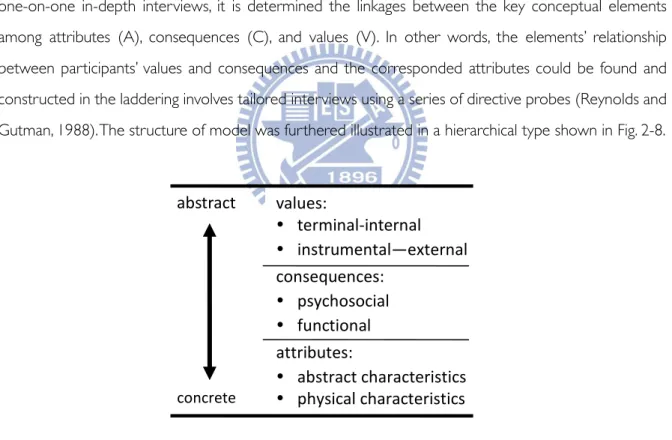
Fig. 2-8 Customers’ MEC model in hierarchical (Lin, 1990) ... 29
Fig. 3-1 Research structure ... 33
Fig. 3-2 The user study framework for persuasive design ... 34
Fig. 3-3 Tools for user study process ... 35
Fig. 3-4 Probe tool kit ... 38
Fig. 3-5 Diagram represents relationship between values-consequence and consequence-attributes. ... 42
Fig. 3-6 The structural diagram of relationship connected between cycling attributes and persuasive features ... 43
Fig. 4-1 Means-end analysis of participants’ daily activities ... 46
Fig. 4-2 Affinity diagram of participants’ values reflected from their lifestyle ... 48
Fig. 4-3 Sequence model of female cycling participation... 51
Fig. 4-4 The connections with different weight between each attribute and persuasive feature ... 55
Fig. 5-1 Diagram of persuasion strategy ... 64
Fig. 5-2 Three different perspectives of persuasion strategy for female cycling discussed in chapter five ... 65
Fig. 5-3 Movie “Island Etude” motivates participant to start her cycling activities ... 69
Fig. 5-4 Process to build the connection between values and persuasive features ... 90
Fig. 5-5 Persuasive feature-consequence-values connection as persuasion strategy ... 93
Fig. 5-6 Persuasion strategy focused on overlapped values between appreciated values and existing values ... 95
Fig. 5-7 Problematic sequence model of female without cycling activities ... 99
Fig. 5-8 The first phase of breakdowns and the corresponding consequence-persuasive features ... 101
IX
X
TABLES
Table 2-1 Persuasion strategy from five stages of transtheoretical model (Consolvo et al, 2009) ... 12
Table 2-2 Persuasion implication from presentation of self in everyday life (Goffman, 1959) ... 13
Table 2-3 Three types of persuasive intent with examples (Fogg, 1998) ... 16
Table 2-4 Classification of persuasive technology as tools in seven types (Fogg, 2003 p.32-53) ... 18
Table 2-5 Classification of persuasive technology as mediums in three types (Fogg, 2003 p.62-79) ... 19
Table 2-6 Classification of persuasive technology as social actor in five types (Fogg, 2003 p.90-114) ... 19
Table 2-7 Three principles of in-group motivators for persuasion (Fogg, 1998, p.205) ... 21
Table 2-8 Systematic persuasive design features (Oinas-Kukkonen and Harjumaa, 2009) ... 22
Table 3-1 User study contents for deriving the persuasion context... 34
Table 3-2 Profile of two groups of participant ... 37
Table 3-3 Contents of probe tool kit of two groups of participants ... 38
Table 3-4 Sets of questions of script in the interview ... 40
Table 3-5 Design features of persuasive system (Oinas-Kukkonen and Harjumaa, 2009) ... 43
Table 4-1 Consequence-attribute relationship matrix table ... 53
Table 4-2 Values-consequence relationship matrix table ... 54
Table 4-3 Persuasive features-attributes relationship matrix table and weight of persuasive feature ... 56
Table 4-4 Persuasive features-consequence relationship matrix with scores ... 57
Table 4-5 Attribute-persuasive feature relationship matrix with scores in preliminary participate phase 58 Table 4-6 Persuasive features-attribute relationship matrix with scores in gradual involvement phase ... 59
Table 4-7 Persuasive features-attribute relationship matrix with scores in habitual activity phase ... 60
Table 4-8 The cyclists’ values corresponded to consequence in the rank of weight ... 61
Table 5-1 The proportion of weight in persuasive feature (%) ... 66
Table 5-2 The scores of persuasive feature corresponded with consequence ... 67
Table 5-3 The proportion of twenty-eight persuasive features in three cycling phases (%) ... 73
Table 5-4 Five trends of persuasive feature weight changing among three cycling phases ... 74
Table 5-5 Consequence components of tailoring with scores change along three phases ... 75
Table 5-6 Persuasive features with increasing influences along three phases (%) ... 76
Table 5-7 Consequence components of reduction with scores change along three phases ... 77
Table 5-8 Persuasive features with decreasing influences along three phases (%) ... 78
Table 5-9 Consequence components of rewards with scores change along three phases ... 79
Table 5-10 Consequence components of simulation with scores change along three phases ... 80
Table 5-11 Consequence components of tunneling with scores change along three phases ... 82
Table 5-12 Persuasive features in convex trend along three phases (%) ... 83
Table 5-13 Persuasive features-consequence relationship with scores in preliminary participate phase .. 84
XI
Table 5-15 Persuasive features-attribute relationship matrix with scores in habitual activity phase ... 87 Table 5-16 Values difference in two groups of participants ... 89 Table 5-17 Comparison of values with/without cycling in category ... 91 Table 5-18 Weight of persuasive features versus four values overlapped between female with and
without cycling (%) ... 92 Table 5-19 Integrated relationship of persuasive feature-consequence to depict the persuasion strategy
for values of warmness, social contact, enjoyment, and relaxation... 94 Table 5-20 Female cyclists’ emphasized five values with most of weight in rank ... 95 Table 5-21 Weight of persuasive features versus the three emphasized values of female cycling (%) ... 96 Table 5-22 Integrated relationship of persuasive feature-consequence to depict the persuasion strategy
1
Chapter 1
Introduction
With the intention to change user’s attitude or behavior or both, a persuader sends persuasive messages to an audience in a communication process of persuasion traditionally. Along with the development of science and technology rapidly nowadays, applications of computer technology are taking on the role of persuader to influence people and help people change their behaviors through the design of interaction which is referred as human-computer persuasion. Information technology systems and services are appeared generally to apply and design for persuasive purposes, such as commerce, education, environmental preservation, healthcare, fitness, in different domains and applications in late 20th century. For the great development of cycling in Taiwan, the persuasion of getting female onto participating biking in their life is focused and investigated to propose persuasive strategies when developing system design in our research.
1.1. Background
Influenced by the global warming issues, activities for sustainability with energy saving and carbon reduction are arisen. To actualize these activities, cycling is one of the ways to go green for helping environment all over the world. The policies with rewards and public environments are constructed with encouragements in the well-developed countries of cycling in Netherlands, Denmark, France, Japan and Australia. According to an investigation in Fig.1-1, there are about 11.5% Taiwanese indicating that biking is the most common exercise in their lives (He, 2008).
2
Fig. 1-1 The well-developed countries of cycling which is regarded as necessity in lives
With the growing number of purchasing and utility rate of bicycles, our government also has paid much attention to cycling recently in Taiwan. According to the investigation, the quantity of bicycle sales reached 1400 thousand, and the cycling population was 10.3 million out of 23 million until 2009. Exercises, recreations and travelling are the primary cycling activities in 60.5% while daily activities are secondary in 26.4%. For facilitating the population of cycling with friendly supplying and supports in their activities, the large growing number of bike lanes is about 48.4% from 2008 to 2009 among cities in Taiwan (MOTC, 2010).
Fig. 1-2 Participation of cycling activity in Taiwan
From eco life to healthy recreation, cycling provides people another choice for enlivening their life in a health way. Having varied purposes in large cycling population in Taiwan, however, cycling uses are different from gender. The participation of Taiwanese male in cycling is more over 30% than female (Social indicators, 2005). The gender imbalance in cycling in Taiwan suggests a potential issue for cycling providers, sustainable supporters and health promoters to investigate and further increase female’s participation in cycling. The female’s problems or frustrations toward cycling should be investigated and
3
proposed with solutions.
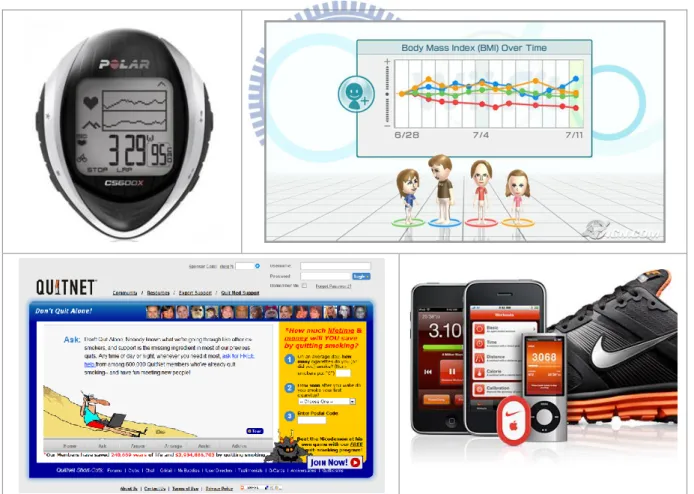
To understand the persuasion of female cycling, there has already a great variety of development for discovering human behavior change. In the field of social science and psychology, the traditional behavioral theories were well-developed for explaining what human perceived of cognitive process during behavior change. Based on varied aspects of research field, different theories have been proposed to apply in education, health care, fitness, environmental preservation and many other issues. They proposed different strategies to influence and try to change people’s attitude or behaviors to reach their purposed issue. It’s also used in commerce and marketing field to influence consumer to accept and further purchase their products or services. For example, the provider, Polar, presents series monitoring devices for helping people to get fit and improving their physical performance of cycling or jogging; while Nike+iPod plus is the similar product providing to monitor and train in jogging or physical activity. WiiFit is another example of persuasive technology on the video game platform with exercise activity (Fig. 1-3).
Fig. 1-3 Applications of persuasive design: Polar CS600X-Maximize road cycling performance (top left), WiiFit: video game with exercises (top right), Nike iPod plus: monitoring and training devices for jogging and activity (down right), QUITNET web service for helping people quit smoking online (down left)
4
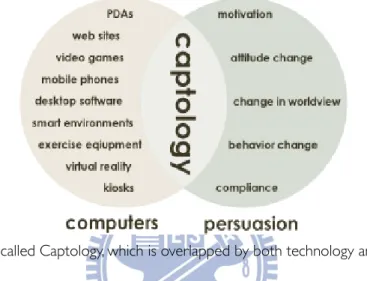
According to the recent decades of development with computer science, a variety of persuasive design cases in Human Computer Interaction (HCI) field also have applied the social psychological theories in their design strategy. Special interest in exploring the domain of computers and persuasion appeared at CHI97, which is called “captology”. It was later defined “captology focuses on the design, research, and analysis of interactive computing products created for the purpose of changing people’s attitudes or behaviors,” which is the overlapped area of technology and persuasion with the graphic in Fig. 1-4 (Fogg, 2003, p.5)
Fig. 1-4 The shaded area called Captology, which is overlapped by both technology and persuasion (Fogg, 2003, p.5)
The applications of HCI technologies provide an interactive and ubiquitous approach with persuasion in widely developments. The Web, Internet, mobile and other ambient technologies provide a reachable path for users to interact with. The design technology gives influence and tries to change attitudes and behaviors on target audiences with health diet, fitness, and environmental preservation through the process of human-computer interaction. Fogg proposed that there are three functional roles in computing technologies persuade: as a tool, media, and as social actors (Fogg, 1998). For example, computer can be tool or instrument to provide personal health information for better diet decision making. The technology can be a personal health information tracker, or computerized software with analysis and supportive advices to motivate exercises or jogging through Nike+iPod and Nike plus systems.
1.2. Motivations
5
for wide population of both male and female in different age. It is promoted as health and environmental activities, cycling for transport, recreation and exercises. However, the participation in varied developed countries is different with gender. “In the U.S., men’s cycling trips surpass women’s by at least 2:1”, “in the Netherlands, where 27 percent of all trips are made by bike, 55 percent of all riders are women”; while “In Germany 12 percent of all trips are on bikes, 49 percent of which are made by women.” (Baker, 2009) Under the development of cycling behaviors in Australian cities and towns, the facilities are increasingly being used by cyclists but most of the cyclists are male. Therefore, the researchers proposed findings and guidelines as interventions to motivate females’ participation through creating supportive physical, social and cultural environments for cycling (Garrard et al., 2006). To advocate overall cycling behaviors for developing facilitations, investigations of frustrations and unwillingness are must be taken account of female populations in Taiwan.
To figure out the primary phenomenon in female cycling, we turn to persuasive researches before proposing corresponding strategies. While a number of persuasive design system or services for changing users’ attitudes or behavior are growing, several behavioral theories from social psychology are often drawn and extensively applied to the study such as Transtheoretical Model of Behavior Change, Goal-Setting Theory, Presentation of Self in Everyday Life or Cognitive Dissonance Theory. Those theories provide the rule of thumb that what will be reflected and interacted in individual for developing persuasive technologies design strategies.
Since captology presents a new perspective on the role of computers, the design space is large and relatively unexplored. The persuasive system domains or issues which are interested could be varied (Fogg, 1998), which is also can be employed in the issue of female cycling. However, it is identified and conducted that applications of traditional behavioral theories to digital environmental are often not able to cope with and give support for the vast amount of dynamics involved (Brown, 2008). For the technologies could immigrate into individual’s life and behavior change lead to intervene in individual’s social world, designers must therefore consider the social implications for the individual’s daily experience (Consolvo et al, 2009). In order to encourage designer’s access to design strategy process of persuasive technologies, the offer of target individual’s need, interests, and choices in behavior is essential and supportable.
Moreover, for cycling persuasive design, it could be more supportive to develop a systematic process and then give explicit design strategies for practical applying. In order to develop a more
6
expectable and specific strategies for target audiences, one of the direction is to proceed user study of exploring user’s real behaviors in their living context. Compare with traditional behavioral theories, user study is a research based on user’s perspective through understanding the life they interact and react to. The collection and construction of information of behaviors from users’ experience conduct how users think and what’s their feel in their use experience. One of the main issues in this research is if user study could support the persuasive design and develop a practical study process.
In our research, the persuasion issue of cycling activity is confined as cycling recreation in female’s leisure times. For persuading more cycling activities, recreation such as riding in a leisure way along or traveling with friends is our target persuasion behavior. Therefore, using cycling only as a commuting tool but without other activities is not our expected behavior for persuasion. Based on understandings the reasons of both agreement and disagreement with cycling recreation activities, it’s possible to screen the audiences which designers target firstly. Through exploration with those audiences, frustrations and unwillingness behind them could be further appeared. In addition, the acceptable reasons from people who already changed to the purposed behaviors may provide proper approaches according to their real cases. Works of user study connect to the persuasive framework, which is the skeleton in persuasive design body, precise strategies and inspire persuasive design for female cycling.
1.3. Objectives
For helping and operating persuasive design in female cycling issue, there are already numerous developed theories and studies suggested designers the proper persuasive design principles. In particular, user study process promotes the exploration of problems and context of persuasion and proposes effective strategies for system development. With the point of view, three objectives in this thesis are focused as follows:
A. Apply a user study process for the developing of female cycling persuasive system
Before the concept development of persuasive design, a systematic user study process could be helpful to collect evidences which are obtain from user and analyzed for practical design supports. Through this research, the methodologies for user studies are proposed and applied through a persuasive case to conduct persuasion strategies for system evaluation or development.
7
B. Conduct the user study results and provide the supportive design strategies for female cycling After the process user study, the results should be interpreted and analyzed to propose for conducting the persuasion strategies for design. The integration of the study results and the persuasive theories are proposed to deliver the design strategies. Therefore, the processes to conduct persuasion strategies are essential for delivery.
C. Define the roles of using persuasive tools in persuasive design
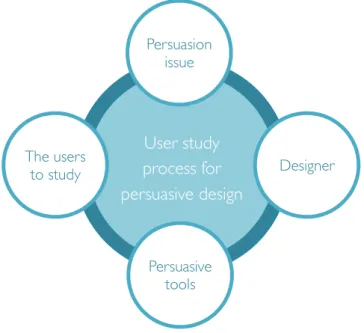
Moreover, it’s essential to identify the process of applying user study and persuasive related theories in persuasive design. In Fig.1-5, the four roles are defined as target persuasive issue, users to study, persuasive tools, and system designer and proposed to identify the relationship among each role in research process. It’s essential to figure out how user study connect each roles in persuasive design.
Fig. 1-5 Each role of persuasive design user study process for developing design strategy
In sum, the research aim is applying the user study process to derive design strategies guide to help the process of female cycling persuasive design.
1.4. Research issues
In this research, the issues of user study process for persuasive design have several aspects which corresponded to three objectives.
User study
process for
persuasive design
The users to study Persuasive tools Designer Persuasion issue8
A. How to undertake a user study process
Firstly, user study is proposed to obtain what information and opportunity could be adopted persuasion techniques on the appropriate audiences. The constructing of study process should clarify each step in the planning of user study for the following interpretations.
B. What is persuasion strategy for persuasive system design
Along with user study process, the study results are corresponded to the persuasive theories and are conducted with persuasion strategies. The strategies would be evaluated through the study experiments and delivered in a specific format to help designer interpret for concept development.
C. How to apply persuasive tools in system design and what it helps
In this research, user study is proposed to help explore persuasion contexts. For outputting persuasive design strategies, the four roles of persuasion issues, users, persuasive tools and designers are connected and cooperated in research process. The utilization of persuasive theories combined in user study process with our persuasive issue is also interested for delivering design strategy.
1.5. Outline of thesis
There are six chapters in this thesis. In chapter one, which is introduction, presents the background, motivation, objective and issues of this research. In chapter two, the literature reviews follow with the persuasion theories and development for clarifying the scope and contribution in this research. In chapter three, the methodologies of user study process and analysis are bought up for research development. In chapter four, the research findings are delivered and proposed and contributed for discussing with the research results in the following chapter five. Finally, results of conclusion, limitation, contribution and future works upon this research are proposed as the end of this thesis.
9
Chapter 2
Literature Reviews
For the development of persuasive technologies applied in practical issue with female cycling persuasion, there were numerous literatures proposing strategies which came up from different aspects. From the psychology field, scholars applied the investigations of behaviors or cognitive theories in human beings to give design principles and suggestions. The reviews and observations over developed technologies also provide lots of results for evaluating the implement of persuasion. Recently, with the researches of persuasive design through user study, design, prototyping and evaluation, there are lots of implications for persuasive design in a wide range of domains, from environmental conservation to activity encouragement. However, for facilitating the developing of persuasive technologies systematically, the design or evaluation processes are proposed.
For the research aim to propose persuasion strategy for developing persuasive design with encouraging female cycling, the investigation processes based on this research purposes contains four parts: related works, persuasive theory and strategy, persuasive system design process and evaluation tools, and the research methodologies for user study and analysis.
2.1 Related works
Since cycling is an activity lifestyle which is related to health and environment, different issues are studied in varied field. Studies of female cycling are therefore proposed in transport, physical activities and recreation. For cycling use may differ from age, income levels, and geographic areas, there are several studies focus on the differences by gender (Krizek et al.,2004). To inspect the difference firstly, safety concerns include road and parking are the main obstacle to cycling in both U.S. and Australia (Garrard, 2003; Krizek et al.,2004). The risk perceptions of injuries in cycling are also level down females’ willingness. It indicated that personal experience of cycling is effective way of bridging the gap between perception and actual situations (Garrard, 2003).
10
qualitative and quantitative surveys were proposed for identifying a series of findings of female cycling in 2006. Not only the motivations, supports, and constraints within female cycling participation were identified, the recommendations for strategies or programs were also developed for increasing participation (Garrard, Crawford, and Hakman, 2006). Guidelines based on this research were presented for encouraging female to cycle. The Australia research results delivered valuable references of encouraging female cycling participation through solid studies. In order to producing strategies for developing persuasive system design in this research, there are some related persuasive technologies researches and works produced for encouraging physical activity.
The persuasive technology design work was proposed with a mobile phone-based fitness journal device called Houston for encouraging physical activity by providing personal awareness of physical level and the as media with physical activity related social interaction among friends. Four design requirements for technologies that encourage physical activities are conducted with (1) give users proper credit for activities (2) provide personal awareness (3) support social influence (4) consider the practical constraints of users’ lifestyle (Consolvo et al., 2006). On the other hand, employing goals in persuasive technologies are proposed to be effective way to encourage behavior change through studying the UbiFit system on mobile phone for encouraging physical activity. Their three-month field study presented findings that goal sources (who should set the goal) and goal timeframe (over what time period should an individual have to achieve the goal) can be specifically implemented (Consolvo et al., 2009).
Under the goal to develop a persuasive system for encouraging female cycling in Taiwan, literatures related to persuasive theories, tools, or processes are collected for helping to propose the persuasion strategies through user study processes.
2.2 Persuasion strategies from traditional behavior change and cognitive theories
To explore the developments of persuasion, the literatures from traditional cognitive and behavior theories are reviewed for understanding fundamentally. For suggesting study of person’s attitudes toward behavior and the subjective norms of how a person will act, there are abundant and well-developed theories and studies in the field of both psychology and social psychology using in persuasive design. Through the overview of theory-driven design strategies, we will review some theories which are frequently used in persuasive design.
11
2.2.1 From the perspective of traditional behavior change theories
Goal-setting theory had been purposed since 1960s to describe how people respond to different types of specific goals, be stimulated human motivation and further promote higher task performances. Fundamentally, self-efficacy, normative information of expected performance level, and the satisfaction from achieving the goal are three ways to specify how to stimulate high performance. The goal, which is challenging but realistically achieved, should be easy to gauge the progress and know when people meet the goal. However, Group Goals which is associated with higher performance than individual goals tends to disappear when the size of group increasing. For recommend to the online communities designs, these communities should set specific and challenging contribution goals for all members (Beenen etal., 2004). It was considered an effective way for designing and evaluating a mobile UbiFit system to encourage physical activities in specific implements with goal-setting strategy. In this study, the five goal sources, (1) self-set, (2) assigned, (3) participatory, (4) guided, and (5) group-set, are employed for persuasive technology design used in physical activity which is originally identified and represented by Shiltz, Horowitz, and Townsend (Consolvo etal., 2009).
The Transtheoretical Model (Prochaska and DiClemente, 1982) is often referred to the studies of health promotion field. It constructed to represent the individual process of change, including the stages to intentionally modify addictive or other problematic behaviors. Based on the transtheoretical model, according to the work of Consolvo, McDonald, and Landay (2009), they suggested that a persuasive technology should focus on different stages and give the validate strategies on individuals, which is presented in Table 2-1.
12
Table 2-1 Persuasion strategy from five stages of transtheoretical model (Consolvo et al, 2009) As a role of persuasive
technology Description in each stage Strategies 1
Precontemplators No intention to change in the foreseeable future Education 2
Contemplator Contemplation—seriously considering changing, but has not committed to taking action Techniques for overcoming barriers or rewards for performing the desired behavior 3
Preparation stager Intends to take action in the next month and has unsuccessfully taken action in the past year
Rewarding behaviors, even when the behavior is not consistent and increasing awareness of patterns of the behavior to encourage consistency
4
Action stager Has performed the desired behavior consistently for less than six months;
Keeping track of progress to maintain consistency and possibly incorporate
elements of social influence 5
Maintainer Has consistently performed the desired behavior for six or more months
Coping strategies for problems encountered previously and helping the individual realize how she is becoming “the kind of person one wanted to be”
Adams and White (2005) integrated number of reasons why stage-based interventions to promote physical activity don’t work, and then concluded that the interventions based on Transtheoretical Model may have failed to appreciate the true complexity of task:
Exercise behavior is a complex of different behaviors, not a single behavior such as cigarette smoking. Determining current stage of change is crucial to intervention delivery, yet few validated algorithms
are used.
Exercise behavior is influenced by numerous external factors not considered by the TTM.
The TTM suggests that stage progression is a significant outcome, but this is not always associated with behavior change.
Stage-based interventions are highly complex and may require more than one level of development and evaluation.
According to other researches, the TTM theory does not account for individual’s different levels of exercise and address the possibility for skipping between the stages (Maitland etal., 2006).
Cognitive Dissonance Theory is developed to explain what happens when an individual realizes the attitudes and behaviors are inconsistent. The motivation to reduce the experience of psychological discomfort, which is also the dissonance they experienced, depends on the importance of the beliefs or behaviors for individual (Festinger, 1957). Reviewer proposed the persuasive technology should help the individual to remain focused on their commitment to change by providing the awareness persistently available and easy to access (Consolvo, McDonald, and Landay, 2009).
13
Turn to social larger social context. Social Cognitive Theory based on the ideas that people learn by watching others do and learn actions through observations with positive reinforcement (Miller and Dollard, 1941). Giving advice from professionals, sharing activity information, and providing personal relevant tailored information are the evidences of simulating and increasing activity affected by wider social interaction (Maitland etal., 2006). According to Karau and Willams’ collective effort model (1993), people work harder individually than in group. Give the believing that their contribution is important to the group’s performance and identifiable when they like the group they are working with (Beenen etal., 2004).
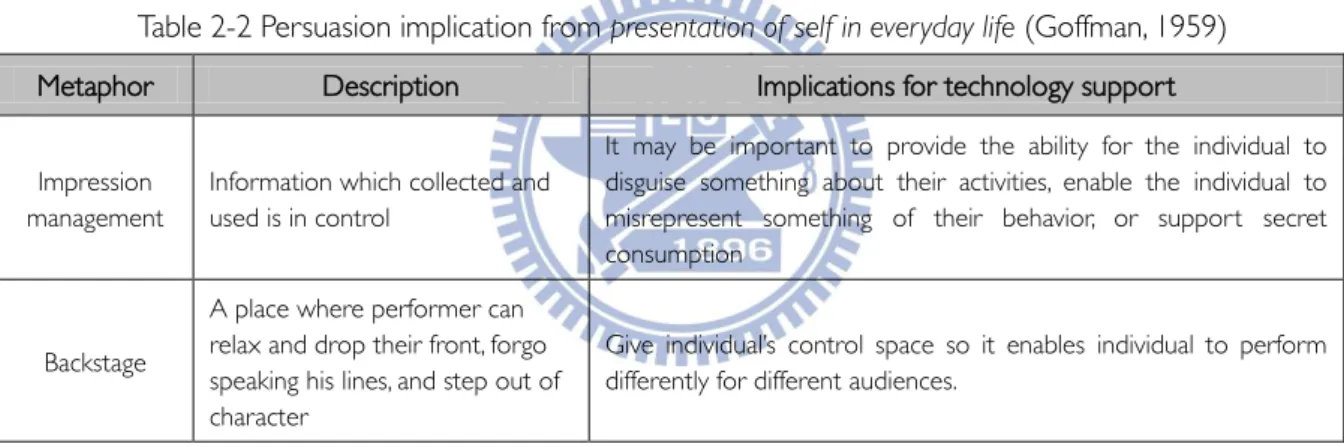
Consolvo, McDonald, and Landay (2009) adopted and illustrated the valuable ideas for persuasive technologies from Presentation of Self in Everyday Life (Goffman, 1959) to address social interaction that individual manage daily. It is used the metaphor of the theater stage to describe how people interact with others. To encourage lifestyle behavior change, there are some implications when using technology:
Table 2-2 Persuasion implication from presentation of self in everyday life (Goffman, 1959)
Metaphor Description Implications for technology support
Impression management
Information which collected and used is in control
It may be important to provide the ability for the individual to disguise something about their activities, enable the individual to misrepresent something of their behavior, or support secret consumption
Backstage
A place where performer can relax and drop their front, forgo speaking his lines, and step out of character
Give individual’s control space so it enables individual to perform differently for different audiences.
Understanding and applying the behavior change theories and studies help to address individual or social aspects in varied design cases. However, the uses of traditional psychology theories are proven not controllable and enough to cope with. Beenen etal. (2004) tried to build a link between social science theories and CSCW design in tests and found social science theories may not cover the real design tasks when multiple features vary simultaneously. The norm in social psychological research is abstracting the contextual details away. Designers are therefore forcing to improvise when attempting to apply social psychological knowledge to solve design problems.
2.2.2 Persuasive design from the perspective of cognitive processes
14
Cognitive consistency theories are fundamental used to explain the individual’s process when perceiving persuasion information in human mind. The Elaboration Likelihood Model and influence techniques suggested by Cialdini further purposed for promising persuasive communication approaches (Harjumma and Oina-Kukkonen, 2007).
Elaboration Likelihood Model was proposed by Petty and Cacioppo (1986) and fundamentally illustrated a individual’s think process when receive a message and try to understand the communication. They suggested there are a central route and a peripheral route to persuasion. A person may possibly be persuaded through the central route who involves in the elaboration of persuasive message and carefully think about the content, while a person may be persuaded through the peripheral route who only perceives surface characteristics of persuasive message and not think carefully but only skims over it. The routes are flexible since people can also swing between the two. Therefore, persuasion message should be considered when designers decide which information they want to process.
On the other hand, Cialdini (1998), who is the well known psychologist and also the author of Influence: The psychology of persuasion. In his book, he verified people tend to response and make decision through mental process. It was proposed as weapons to give stronger influences to persuasive message so can be related to persuasive technology for changing a target behavior. The six principles of influencing persuasion include:
1. Reciprocity: give what people want and they likely return a favor.
2. Commitment and Consistency: people are likely to be honor for their commitment even without their original motivation.
3. Social Proof: the similar others’ behaviors and attitudes could be easily followed for expecting social norm if it’s OK to do in their circumstances.
4. Authority: people are likely to obey expert’s opinions for their reliability of expertise. 5. Liking: it’s easily to persuade people by others who they like or attract to.
6. Scarcity: things seem more important when they are limited or unavailable.
Recently, Fogg (2009) presented a new model, Fogg Behavior Model (or FBM), to illustrate the drivers of human behaviors in a visualization (Fig. 2-1).
15
Fig. 2-1 The FBM and subcomponents of each factor (Fogg, 2009)
The FBM is composed by two axes to form the plane. Using the horizontal axis representing ability, vertical axis representing motivation, the star representing the target behavior, the model emphasize the relation among motivation, ability, and target behavior. Trigger is also shown on the plane when target behavior occurred. In FBM, motivation, ability, and trigger each factor has its subcomponents. That means if users are likely to perceive behavior triggers and then perform target behaviors when they have a high motivation and a high ability of target behaviors. The FBM framework identifies problems and helps designers or researchers think systematically when developing a persuasive system.
In conclusion, numerous literatures have been studied from human’s cognitive and behaviors in traditional psychology field to help the development of persuasive designs. It represented the phenomenon in persuasive design are widely concerns. However, different from the perspectives from studying human beings’ cognitive and behaviors theories, there are also persuasion studies from developing of technologies.
2.3 How technologies are used to persuade people
Since the employments of persuasions are widely utilizing in varied issues from health, environment to marketing, based on using computer to persuade people, this field named “captology”, which is proposed in 1.1previously, has been developed years after it was opened up. To understand captology domain and explore the insights for further research and design, there are different ways to inspect and classify. Since machine does not have intentions, Fogg, who is the chief researcher from the Stanford
16
Persuasive Technology Lab, opened and coined captology field of research, suggests “the context of creation, distribution, and adoption classifies a computer as persuasive.” (1998) He argued that persuasion implies intent to change attitude or behaviors and he proposes three types of intent which could be used by computer technologies (Table 2-3).
Table 2-3 Three types of persuasive intent with examples (Fogg, 1998)
Type of intent Where intent comes from Example Endogenous
(from within) Those who create or produce the interactive technology Health-Hero video games are designed to persuade children to develop good health habits
Exogenous
(caused by external factors) Those who give access to or distribute the interactive technology to others A mother may give her son a Palm Pilot PDA in hopes that he will become more organized
Autogenous
(self-produced) The person adopting or using the interactive technology
A person may buy and use a calories-counting computer device to help change his or her own eating behavior.
By viewing numerous works of persuasion scholars, Fogg (1998) synthesized and defined “persuasion as an attempt to shape, reinforce, or change behaviors, feelings, or thoughts about an issue, object, or action.” To clarify the type of persuasion, which attempt to change people’s attitudes or behaviors through persuader sending a persuasive message to a persuadee or audience, Harjumma and Oina-Kukkonen (2007) drew the relationship and explained differences shown in Fig. 2-2.
Fig. 2-2 Three types of persuasion (Harjumma and Oina-Kukkonen, 2007)
They indicated that people may be persuaded through interpersonal persuasion occurs when two or more people interact with each other, also by other computer-mediated communications such as weblog. However, persuasive technology is about human-computer interaction, which is defined as the study of how people are persuaded when interacting with computer technology (Fogg, 2003) and referred as human-computer persuasion here. It was helpful for clarifying the fundamental structure of persuasion.
17
Since persuasive system can be used either computer-human persuasion or computer-mediated persuasion, it’s complex to develop the design of persuader. For the differences between human and computer communications, it’s essential to realize how people reacted to computer communications. Through the experiment for studying the human-computer interaction when experienced computer users apply social rules, it was shown their relationship was social and related to the literatures of social psychology, communications and sociology. (Nass, Steuer, and Tauber, 1994) Also in the study of evaluating the effects of computer that flatter, it’s the same flattery produced from computer as from humans. (Fogg & Nass, 1997) The studies reported the patterns of social psychology are similar to human-computer interaction.
2.3.1 Persuasion strategies through different functions
Fogg (1998) proposed persuasive computer in three functional roles: as tools, as medium and as social actor different ways and gave each role examples in Fig 2-3.
Fig. 2-3 Three functional roles of persuasive technology (Fogg, 1998)
In the publication of Persuasive Technology-Using computer to change what we think and do (2003), Fogg worked in the investigating of how were the computers be use and what were they performed when using in persuasive technology. He elaborates how computer be a persuasive tools, a persuasive media, a persuasive social actors, and develops the credibility of computer for increasing persuasion through mobility and connectivity approaches afterward in the book.
18
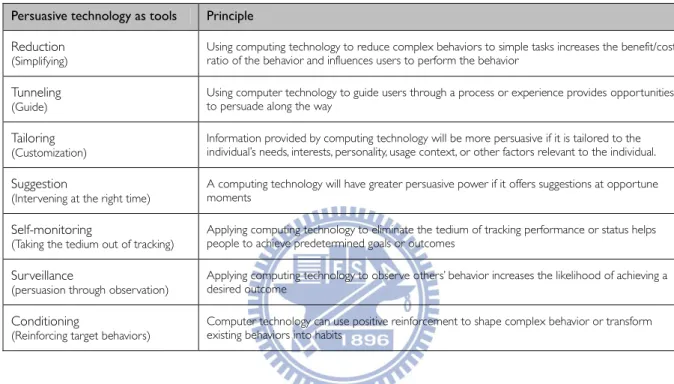
attitudes or behaviors or both by making desired outcomes easier to achieve.” Using computers as persuasive tools facilitates the increases of capability. He mentions a tool can be persuasive by “making target behavior easier to do”, “leading people through a process”, and “performing calculations or measurements that motivate.”(p.32) Fogg identified seven types of persuasive technology tools and illustrates each one explicitly and summarized in table 2-4 below:
Table 2-4 Classification of persuasive technology as tools in seven types (Fogg, 2003 p.32-53)
Persuasive technology as tools Principle Reduction
(Simplifying)
Using computing technology to reduce complex behaviors to simple tasks increases the benefit/cost ratio of the behavior and influences users to perform the behavior
Tunneling
(Guide)
Using computer technology to guide users through a process or experience provides opportunities to persuade along the way
Tailoring
(Customization) Information provided by computing technology will be more persuasive if it is tailored to the individual’s needs, interests, personality, usage context, or other factors relevant to the individual.
Suggestion
(Intervening at the right time) A computing technology will have greater persuasive power if it offers suggestions at opportune moments
Self-monitoring
(Taking the tedium out of tracking)
Applying computing technology to eliminate the tedium of tracking performance or status helps people to achieve predetermined goals or outcomes
Surveillance
(persuasion through observation)
Applying computing technology to observe others’ behavior increases the likelihood of achieving a desired outcome
Conditioning
(Reinforcing target behaviors) Computer technology can use positive reinforcement to shape complex behavior or transform existing behaviors into habits
There were various researches proposed practical employments through employing persuasive technologies as tools. Through SMS text messages, sending educating, notifying, and reminding Info are proposed to suggest users in particular timings; while gathering Info in collecting data and journaling by individuals are also proposed in self-monitoring of users for improve health behaviors. (Fogg and Allen, 2009) Also, the application on mobile phone of Houston was utilize as the personal journal to give deceptive measurements and sufficient information of activity results; while it also provide personal awareness of activity level with history of past behavior, current status, and activity level performance to encourage more activity with self-monitoring and surveillance tool. It is also proposed the consideration with practical constrains of user’s lifestyle (Consolvo et al., 2006). UbiFit is another interactive application and fitness device system designed of self-monitoring for encouraging individuals’ physical activity (Consolvo et al., 2009).
On the other hand, when using a medium as persuasive technology, it provides experience to “allow people to explore cause-and-effect relationships”, “provide people with vicarious experiences
19
that motivate”, “help people rehearse a behavior.” (p.62)
Table 2-5 Classification of persuasive technology as mediums in three types (Fogg, 2003 p.62-79) Persuasive technology as
mediums Principle Sources
Cause-and-effect scenarios
Persuade people to change their attitude or behaviors by enabling them to observe immediately the link between cause and effect
1. Enables users to explore and experiment in a safe, nonthreatening environment.
2. Shows the link between cause and effect clearly and immediately
3. Persuades in subtle ways, without seeming to preach.
Environmental simulations
Providing a motivating simulated environment in which to rehearse a behavior can enable people to change their attitudes or behavior in the real world
1. Can create situations that reward and motivate people for a target behavior
2. Allows rehearsal- practicing a target behavior 3. Can control exposure to new or frightening situations 4. Facilitates role-playing-adopting another person’s
perspective Object simulations
(Providing experiences in everyday contexts)
Portable simulation technologies designed for use during everyday routines can highlight the impact of certain behaviors and motivate behavior or attitude change.
1. Fits into the context of a person’s everyday life 2. Less dependent on imagination or suspension of disbelief 3. Makes clear the impact on everyday life
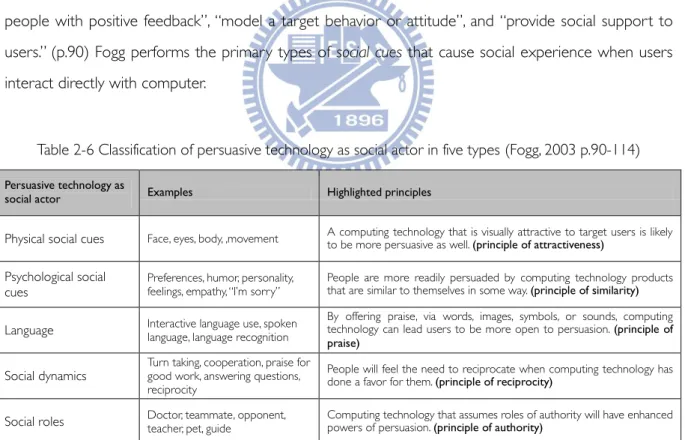
Since a persuasive technology acts as a social actor, it creates relationships with users. It may “reward people with positive feedback”, “model a target behavior or attitude”, and “provide social support to users.” (p.90) Fogg performs the primary types of social cues that cause social experience when users interact directly with computer.
Table 2-6 Classification of persuasive technology as social actor in five types (Fogg, 2003 p.90-114) Persuasive technology as
social actor Examples Highlighted principles
Physical social cues Face, eyes, body, ,movement A computing technology that is visually attractive to target users is likely to be more persuasive as well. (principle of attractiveness)
Psychological social
cues Preferences, humor, personality, feelings, empathy, “I’m sorry” People are more readily persuaded by computing technology products that are similar to themselves in some way. (principle of similarity)
Language Interactive language use, spoken language, language recognition By offering praise, via words, images, symbols, or sounds, computing technology can lead users to be more open to persuasion. (principle of praise)
Social dynamics Turn taking, cooperation, praise for good work, answering questions, reciprocity
People will feel the need to reciprocate when computing technology has done a favor for them. (principle of reciprocity)
Social roles Doctor, teammate, opponent, teacher, pet, guide Computing technology that assumes roles of authority will have enhanced powers of persuasion. (principle of authority)
Practically employing SMS text messages to providing social cues through providing user questions and expert responses and people-to-people connections are also proposed to improve health behaviors. (Fogg and Allen, 2009) Otherwise, EatWell is also the persuasive system with social support that allows people create voice memories of eating healthfully to share experiences and listen to the
20
memories created from others in a local context. (Grimes, Bednar, Bolter, and Grinter, 2008 )
2.3.2 Increasing persuasion through system credibility and social influences
In addition to the three different types of roles, Fogg mentioned the importance of credibility in persuasive technology. He suggested that “credibility is a perceived quality that has two dimensions: trustworthiness and expertise.” (p.122) Trustworthiness includes truthful, fair and unbiased, while expertise indicates knowledge, experience, and competence. Although not all the technology matter with credibility, there are seven situations are essential for persuasive technology.
1. When computers instruct or advise users
2. When computers report measurements
3. When computers provide information and analysis 4. When computers report on work performed 5. When computers report about their own state 6. When computers run simulations
7. When computers render virtual environments
To make sure the success of persuasion, the seven contexts should be operated and perceived credible in persuasive technologies.
Finally, for people are in a great opportunity to work together and interact with each other through Internet or many connected products, the influences of other people play a more important role nowadays. The leveraging of social influence is explored to apply in connected persuasive technology product for the ubiquitous network development. Fogg proposed the following four prominent theories to explain the approaches to apply to connected persuasive technologies. (p.197) (1) The principle of social facilitation is originally describes that the present, participate, or observe of other people makes people have a better performance. With the using of connected products which allow people to present virtually, people may be observed or discern others who are performing the behavior along with. Under this condition, people are more likely to perform a well-learned target behavior. For applying this principle, designers’ can use simple avatars to represent other people. (2) Social comparison theory described people determine how they compare with others and what they should think. It could change people’s attitude and behaviors since they seek to know similar other’s
21
performance and then they could be motivated to perform target behavior. It’s different to put peer pressure but provide similar other’s information help people shape decisions and behaviors.
(3) Different from social comparison, principle of normative influence tend to change attitudes and behaviors to match the expectations, attitudes and behaviors from groups. The groups can be classmates, a team, a family, a work group. Therefore, the leverage of normative influence or peer pressure promotes people to adopt or avoid target behaviors can be also applied in persuasive technology.
(4) Social learning theory is one of the most popular and effective ways for changing behaviors. (p.201) People observe other’s action and note the consequences of the action, such as reward, and they are likely to be motivated to change behaviors. Forums, clubs, buddies area and other applications of community provide opportunities to see others’ progress, success and interact could be help for encouragement.
For example, the research of mobile audio support as “Jogging over a Distance” is proposed to encourage joggers and support the social communication between them (Mueller, O’brien, and Thorogood, 2007). The mobile phone, Houston, is also applied social pressure, social support, and communication to affect participants (Consolvo et al., 2006).
In addition to social influence, intrinsic motivators in group are also the energizing force to arise activities, includes competition, cooperation, and recognition. The following are principles inferred by Fogg (p.205):
Table 2-7 Three principles of in-group motivators for persuasion (Fogg, 1998, p.205)
In-group motivators Principle
Competition By leveraging human being’s natural drive to compete, computing technology can motivate uses to adopt a target attitude or behavior. Cooperation Be leveraging human being’s natural drive to cooperation, computing technology can motivate users to adopt a target attitude or behavior Recognition By offering public recognition (individual or group), computing technology can increase the likelihood that a person or group will adopt a target attitude or behavior.
2.3.3 Comprehensive design features of persuasive technology
22
and evaluating, Oinas-Kukkonen and Harjumaa proposed a systematic design features for evaluation persuasive system content and software functionality (2009). The specification covered the requirements with descriptions of how a system should behave, qualities it should have, and constraints on design and development process, which are related to the persuasiveness. They categorized the system features as providing primary task, dialogue, system credibility, and social support. It established conceptual but gave practical implications. Compare to the works with Fogg, they disassembled the functional triad and its design principles to categorize system features comprehensively in the table below:
Table 2-8 Systematic persuasive design features (Oinas-Kukkonen and Harjumaa, 2009)
Primary task support Dialogue support System credibility support Social support
Reduction Praise Trustworthiness Social learning
Tunneling Rewards Expertise Social comparison
Tailoring Reminders Surface credibility Normative influence Personalization Suggestions Real-world feel Social facilitation
Self-monitoring Similarity Authority Cooperation
Simulation Liking Third-party endorsement Competition
Rehearsal Social role Verifiability Recognition
For investigating the research knowledge about persuasive systems produced during 2006-2008, it was used to further review and analyze the literatures of Persuasive Technology Conferences. They found the most used design principles. The most used ways for persuasion to support accomplishing one’s primary task are tailoring, tunneling and reduction. In addition, suggestion is used to support the user-system dialogue, while social comparison and normative influence are the means to provide social support. It was concluded with a main finding of the phenomenon of blanking in dissemination work itself, and they suggested a heuristic to reflect variables for making persuasive system clearer. (Torning and Oinas-Kukkonen, 2009) To process a heuristic, there are some literatures inferred and going to be shown in the following section.
2.3.4 The heuristic persuasive design from users’ point of view
There were eight dimensions of taxonomy framework was constructed for looking the problems to support investigate human interruption. Including the source, individual characteristic, method of
23
coordination, meaning of interruption, method of expression, channel of conveyance, human activity changed by interruption, and effect of interruption. (McFarlane, 1998) Incorporating into cognitive theory, Norman’s 7-stage action model (Norman, 1988) was established to explain the individual’s action when interruptions exist and the impacts. Based on the model, the cognitive theory of persuasive interruptions was developed. It also illustrated individuals’ action cycle framework and applied taxonomy to assess individuals’ context, included user properties, task properties, presentation, and interruption effectiveness. (Walji etal., 2004)
The similar framework was used in persuasive context. The investigation helped to provide a heuristic of persuasive technology design through understanding users’ thinking, discern opportune moments for delivering messages, and persuade effectively. Also, it proposed to recognize the obstructions of target behaviors. Oinas-Kukkonen and Harjumaa demonstrated the system of persuasive context to analyze through three stages: the intent, the event, and the message routes, which is illustrated in Fig. 2-4(Oinas-Kukkonen and Harjumaa 2009).
Fig. 2-4 Analysis of the persuasion context (Oinas-Kukkonen and Harjumaa, 2009)
In addition to exploring the persuasive or interruption context, the aspect of seduction was also proposed in captology. Seduction is the aware of emotion process that has a beginning, middle, and an end when people use or interact with products or technologies. The first three basic steps of seductions are:
(1)Enticement, the operation to attract users’ attention and make the emotional promise;
(2)Relationship, the progress to give users some fulfillments and more promises, which is continuing indefinitely; and
24
(3)Fulfillment, to fulfill users’ final promises and end the experience in a memorable way.
The process can be modified to extend details in each step and explain works in both physical and software products. Stack’s juicer and Plumbdesign’s Thesaurus were examined in the paper. (Khaslavsky and Shedroff, 1999)
Later in 2007, Fogg examined how Web services influence users sequentially through outlining the behavior chain, which is also in the series pattern of developing the three steps of seductions for target behaviors (Fig. 2-5).
Fig. 2-5 Three steps of seductions for target behaviors (Fogg, 2007)
Begins with the first phrase of behavior chain, Discovery phrase is the stage to attract users to use and further guide them about what services the system provides. In practical use, most Web site operators seek ways to motivate people to learn about and visit their site, which is the general target behavior in this phrase. After the first phrase, users have the idea of services so they may decide whether to involve in the services if it can fulfill their expectations in Superficial Involvement phrase. Web services influence users to decide to try and to get started with the service for reaching their compliance. In this phrase, it’s the goal to gain users’ compliance to prepare the path for the long-term behavior change in True Commitment phrase. Go beyond the one-time compliance, in this phrase, creating habits is the aim of Web services. For example, services persuade users to frequently comment in responding to their contents. Another contribution in phrase 3 is introducing and moving other users through the
25
chain, which includes a path from phase 3 to phrase 1. Fogg suggested the concept of behavior chain is helpful for apply in other domains for mapping and compared to understand the structure of persuasion.
2.3.5 Developing processes of persuasive technologies design
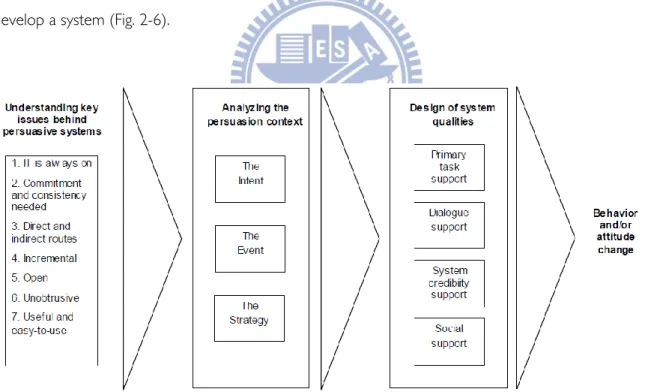
In order to develop persuasive technology systems, scholars studied the theories in psychology field to find users’ perspective toward persuasion or technologies; meanwhile, they reviewed system features and evaluated the utilization through years of development. There were also some useful frameworks for developing persuasive technologies. However, for providing a better approach to direct apply in the developing or evaluating of persuasive systems, Oinas-Kukkonen and Hajumaa (2009) demonstrated a framework to development of persuasive system. It was consisted by three phrases: obtain sufficient understanding of system for analyzing or designing, recognize the users’ intention, ability of persuasive event, and appropriate strategies through context, and finally define the system qualities for designers to develop a system (Fig. 2-6).
Fig. 2-6 Frameworks for developing persuasive system (Oinas-Kukkonen and Hajumaa, 2009)
On the other hand, in order to give a process to be practical utilize for developing successful persuasive technologies, Fogg published the paper also in 2009 to share and explain the eight-step process drawing on his 15 years of studying experiences of creating persuasive technologies to influence people. The process is shown in Fig. 2-7.