行政院國家科學委員會專題研究計畫 成果報告
不對稱資訊下之政府 BOT 政策
計畫類別: 個別型計畫 計畫編號: NSC91-2211-E-002-091- 執行期間: 91 年 08 月 01 日至 92 年 07 月 31 日 執行單位: 國立臺灣大學土木工程學系暨研究所 計畫主持人: 荷世平 報告類型: 精簡報告 處理方式: 本計畫可公開查詢中 華 民 國 93 年 4 月 8 日
行政院國家科學委員會補助專題研究計畫期中進度報告
不對稱資訊下之政府 BOT 政策
計畫類別:個別型計畫
計畫編號:NSC 91-2211-E-002-091
執行期間:91 年 08 月 01 日至 92 年 07 月 31 日
計畫主持人:荷世平
共同主持人:
計畫參與人員:湯立宇,呂冠龍
成果報告類型(依經費核定清單規定繳交):精簡報告
本成果報告包括以下應繳交之附件:
□赴國外出差或研習心得報告一份
□赴大陸地區出差或研習心得報告一份
□出席國際學術會議心得報告及發表之論文各一份
□國際合作研究計畫國外研究報告書一份
處理方式:除產學合作研究計畫、提升產業技術及人才培育研究計
畫、列管計畫及下列情形者外,得立即公開查詢
□涉及專利或其他智慧財產權,□一年□二年後可公開查
詢
執行單位:國立台灣大學土木工程學系暨研究所
不對稱資訊下之政府 BOT 政策
荷世平
*摘要
全球之公共建設民營化金額自西元 1984 年以來平均約每年 2 兆 1 千億元。 自 1989 年至今,至少有 300 個重大 BOT 工程案正在進行或已完成。由於民營化 公共工程案較一般工程案複雜至多,因此政府於評選適當之開發者時倍為困難。 因此,許多 BOT 工程案未能成功的達成預期理想而受擾於嚴重的成本超支或工期 延誤。再者,大量的政府或民間資金投入於民營公共工程之中,因此工程案的失 敗將導致社會之重大資源之損失。 政府評選 BOT 工程案開發者的困難之癥結點在於大部分關於開發者的品質 重要資訊無法為政府所知悉。政府無法從業者提案中完全了解開發者的開發能力, 因為業者有可能隱藏許多對業者不利之訊息。此種現象學者稱之為“不對稱資 訊” (information asymmetry) 現象。例如業者在工程案中的成本與利潤結構、工 程之商業及技術的風險等資訊有可能為業者所隱瞞,若其資訊對業者在提案之評 估中不利。此類業者自知而非政府可察之資訊稱之為“私有資訊”。因此,若政 府未能採用有效之評選政策用以評估業者及其提案,政府極有可能選中不良之業 者而造成後患無窮與社會資源之浪費。 有鑑於此,政府極需一套有效的政策或機 制以使不同品質之業者依其品質的私有資訊而“自我選擇” (self-select into) 入 政府的評估標準,以致最佳之業者會得到最佳之評估分數。換言之,在此評選機制 或政策下,業者若隱瞞其真實品質資訊將對業者自身之獲利狀況有所損害。 此本研究計劃以近代“賽局理論” (Game theory)來分析及建立在資訊不對 稱情況下之 BOT 工程案政策。此模式將考慮業者工程財務特性及政府評選政策 之互動情形。模式之建立將提供政府制定 BOT 評選標準與政策之理論基礎與指 導方針。本計劃亦運用所建之模型檢視並指出當今政府 BOT 政策調整之方針,並 提出更有效之策略,以為全球各政府於 BOT 開發建立一決策理論基礎。 關鍵字:BOT, 不對稱資訊, 政府政策, 賽局理論, 公共工程民營化。Government’s BOT Policies under Asymmetric Information
S. Ping Ho
*Abstract
The complexity of privatized infrastructure projects typically makes it difficult for the government to select the most appropriate project developers; therefore, many projects failed or had serious cost overruns and schedule delays.
The most fundamental problem is that most developer specific and critical information regarding the infrastructure development may not be fully revealed to the government in the development proposal. In other words, such information is
asymmetric. For example, the developer’s cost and profit structures, and project’s
commercial and technical risk assessment information may not be fully revealed in, or consistent with, the developer’s proposal. If the government adopts an ineffective policy and selects the developer accordingly, it may be that the developer is not the best developer that the government hopes to team up with. Government needs to have effective policies so that different types of developer will “self-select” into the evaluation scheme/criteria according to the developer’s private information and then the best developer will earn highest evaluation points. In this project, we build a framework for effective project evaluation/screening. We develop a Game Theoretic model to analyze government’s tendering policies under asymmetric information. This model considers the interactions between the project developer’s financial positions and government policies. The results may provide theoretic foundations and guidelines for examining the effectiveness of government’s infrastructure privatization tendering policies.
Keywords: BOT, Asymmetric Information, Government Policy, Game Theory, Infrastructure Privatization.
1 Government Roles, BOT Policies, and Developer’s Financial Decisions
In this research, it is assumed that the BOT project is mainly financed by equity and bank loan/debt, and therefore the financing decision will be in terms of the equity investment level. In other words, the developer’s optimal equity investment level should maximize the BOT investment’s full NPV. However, if the government imposes certain procurement policies, the developer’s optimal investment level will be complicated by the policies. For example, if the government is constrained by a law that forbids any forms of subsidy toward a failing BOT project, the developer should consider using the “no rescue” equilibrium in the valuation process of the profit structures. Otherwise, if the project is developer-led and it is difficult to identify a clear client-contractor relationship, the developer may assume that the BOT project has a “rescue” equilibrium and evaluate the investment accordingly. The impacts of government policies on the BOT procurement process and the developer’s valuation process will be discussed in the following sections.
1.1 Government Roles and Policies
Smith (1999) argued that “by the beginning of the twentieth century, the relationship
between the private sector and government in infrastructure procurement had begun to reach some kind of maturity.” Smith (1999) further argued that a new role of
government today is
promoter of privately financed projects.
developing stages, the emphases on the government’s roles are different. Government policies will be formed according to the major roles. As a result, different roles expected upon the government by the people will result different policies, and different policies will have critical impacts on the BOT tendering or infrastructure privatization process. A government that mainly acts as a protector of public interest may have tighter regulations on the BOT project’s tendering and management process in order to protect public interest from potential corruption, over-subsidization of the project, or project’s unreasonably high profitability. In some infrastructure projects, the government may be the major consumer/buyer of the project outputs, and the government will act as a customer. To summarize, a good policy in one country may not be an appropriate policy for another. The judging criteria of the policies depend on the roles of the government.
1.2 Assumptions of Government Roles and Tendering Scheme
This research mainly focuses on the government roles as a facilitator and protector of the public interest. Under the two roles, the government’s priority is to provide the infrastructure systems as planned while the public interest is safeguarded by ensuring that the tendering process is fair and capable of selecting the most qualified developer, and the rescue action is justifiable. In general, the competitive bidding/tendering scheme is recognized as the most suitable one to ensure procedural clarity and fairness, to promote competition, and to minimize the time and cost of developing BOT projects (UNIDO, 1996). Therefore, it is assumed that the competitive bidding scheme will be used by government in BOT projects.
1.3 Government BOT Policies and Developer’s Financial Decisions
As the awarding of a project under competitive scheme will be given to the proposal with the highest evaluation points instead of lowest bid, the evaluation criteria for assigning points to a proposal will be crucial to the developer’s decision making. Therefore, a portion of the government’s BOT policies will be transformed into the evaluation criteria. Among those critical success factors in winning a BOT project, the “financial viability” was recognized as one of the most important factors (Tiong, 1996). In other words, the government typically will weigh the project’s financial viability heavily in evaluating a proposal. In evaluating a project’s financial viability, if the government considers equity investment level to be essential, the government may specify how the points are increased along with the level of equity. It is worth noting that the validity of this policy or evaluation criterion is subject to be examined later by the real options and game theoretic analysis. Other evaluation criteria regarding the financial viability may include the expected net profit, construction cost, financing packages, and operating plans.
Not all BOT policies can be transformed into the proposal evaluation criteria. Some BOT policies may not be included in the evaluation criteria, such as policies regarding the project procurement approach, and the prohibition or allowance of future subsidy. However, these types of policies may have material impacts on the developer’s financial decisions. For example, the government’s subsidy policy will affect the developer’s assuming BOT game equilibrium, and therefore the developer’s investment valuation process.
As a result, various forms of policies may have significant impacts on the developer’s financial decisions. It is essential to understand the purpose of each particular BOT policy and its impacts on the developer’s decision making. For example, suppose that in a BOT project, the competitive tendering scheme is applied and the equity level is an important evaluation criterion specified by the government. It may be easy to understand that the purpose of this evaluation criterion is to choose a developer who has the highest value of equity investment payoff, the equity value minus the equity investment. However, it is complicated to understand the impacts of the high equity ratio criterion on the developer’s financial decisions. In other words, it is not clear whether the developer who uses the highest equity ratio will actually have the highest value of equity investment payoff. One of the main purposes of this research is to investigate the impacts of a specific evaluation criterion and the criterion’s effectiveness.
2 Signaling Game and BOT Tendering
2.1 Signaling Games in BOT Projects
Signaling games are the most widely applied class of dynamic games of incomplete information. Usually there are two moves and two classes of players involved in a signaling game. The first move of the game is initiated by one class of player, “Sender.” The Sender has private information regarding his type, for example, low productivity or high productivity on his job performance. If possible, the Sender will send certain message or “signal” to the other class of players, “Receiver,” to convince
the Receiver regarding the Sender’s type. The “Receiver” will play in the second move depending on the signal received from the Sender. The main idea is that effective communication can occur if one type of player is willing to send a signal that would be too expensive for the other type of player to send (Gibbons,1992). The most effective communication is the “separating equilibrium,” in which different types of “Senders” will send different signals and the “Receiver” will believe the signal and act accordingly. On the other hand, the “pooling equilibrium” is an ineffective communication. In pooling equilibrium, both types of Senders will send the same signal. As a result, the Receiver will not believe the signal received, and will not be able to differentiate effectively the Sender’s type. Cho and Kreps (1987) argued that with more strict equilibrium requirements, the pooling equilibrium cannot exist. Thus, we will ignore the pooling equilibrium in this research.
In a BOT project, the developer is the Sender, and the developer will send signals to the government, the Receiver, in order to convince the government regarding the developer’s type. The developer’s type may be “have a financially viable project” or “not have a financially viable project.” The signals may be the equity level of the project cost, the viability figures shown in the proposal, or the self-exclusion of being a construction contractor. In other words, the proposal itself
is a collection of signals. The actions of the government after receiving the “signals”
or proposals would be the proposal evaluation points, that is, the decision of project awarding.
Note that since the profit structures are different in each BOT project, the results from signaling game analysis may be different as well. For example, the equity level
criterion may be an effective criterion in one project, but may not be effective in another one. Furthermore, there are so many choices of possible signals that it is impossible to analyze all possible signals. Therefore, only limited signals will be discussed. The BOT signaling game analysis is expected to provide both the developers and government with deeper insights toward the bidding/financing investment strategies and government procurement policies.
2.2 Job Market Signaling Game and Its Equilibrium
Spence (1973) was the first to show how signaling could be a solution to the asymmetric information problem. After Spence, much literature on signaling games emerged and was applied in many asymmetric problems. For example, in financial literature, Leland and Pyle (1977) and Myers and Majluf (1984) successfully applied signaling games in the analysis of capital structure and corporate financing decisions. This section will discuss the job market signaling game to illustrate the essence of the signaling game. Then the key elements of signaling game will be applied to the BOT project.
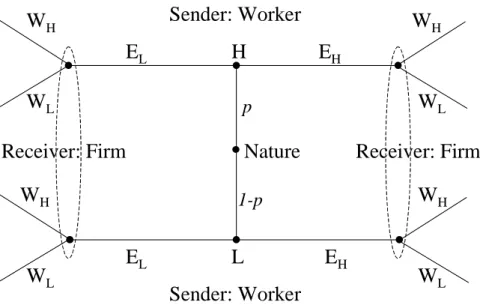
Figure 1 gives the extensive form (without payoff matrices) of a simplified job market game. First, nature determines the worker’s productivity ability: high (H) or low (L), with probability p of high productivity. Here we name the high-ability workers as “worker H” and low-ability worker as “worker L.” Second, the worker learns his ability and chooses his education level: high education (E ) or low H
worker H and worker L, respectively. Third, the firm observes the worker’s education level and offers the wage level: high wage (W ) or low wage (H W ). The L
dot lined ellipses in Fig. 1 indicate that the firm has no knowledge of which node the firm is at, i.e., the type of the worker is private information.
There are two types of equilibria:
1. Pooling equilibrium:
Obviously, if the low-ability worker can obtain a high level of education as easily as the high-ability worker, the low-ability worker would want to obtain a high education level to convince the firm that he is high-ability worker. In this case, the firm cannot believe the signal sent by the workers, and therefore, will not offer a high wage level to the worker with a high education level.
2. Separating equilibrium:
The conditions for the signal to be effective must be that it is not in the low-ability worker’s interest to imitate the high-ability worker. In this case, the firm will believe the signal regarding productivity ability and offer wages accordingly. These conditions can be expressed mathematically. First, in order for the worker L not to imitate the worker H on the education level, conditions must satisfy
L L H C W
Fig. 1 Extensive Form of a Simplified Job Market Game
Equation (1) is obtained on the basis of specifies worker L’s payoff maximization rationale. Under this rationale, it is better for worker L to have a low education level and receive wage W if equation (1) is satisfied. Second, to motivate the worker H L
to obtain high education to signify that he is a high-ability worker, conditions must satisfy
L H H C W
W − > (2)
Combining equations (1) and (2), we may obtain
L L H
H W W C
C < − < (3)
The interpretation of equation (3) is straightforward. From the perspective of the firm, the difference of the high-wage offer and low-wage offer must be large enough to compensate worker H’s extra education cost, but not large enough to compensate
Sender: Worker
Sender: Worker
H
L
E
HE
HE
LE
LW
HW
HW
HW
HW
LW
LW
LW
LReceiver: Firm
Receiver: Firm
Nature
p
worker L is willing to incur extra education cost, the signal would become ineffective. From the perspective of the worker, worker H’s signaling cost, C , must be less than H
worker L’s signaling cost, C . If the difference of wage offer is fixed, then worker L H’s signaling cost must be low enough and worker L’s signaling cost must be high
enough so that equation (3) is satisfied. If C H ≥ C , the signal will be ineffective. L
The separating equilibrium will be the only possible equilibrium because of the refinement of Cho and Krep (1987). Detailed and rigorous discussion regarding the job market signaling game can be found in Spence (1973,1974) and Cho and Krep (1987).
7.2.3 Implications on BOT Investments
In a BOT project, the developer’s payoff is the full NPV. The full NPV depends on the type of the developer and the developer’s type (H or L) is unknown to the government. Suppose that developer H is favored by the government over developer
L. In a signaling game, developer H may try to send some costly signal to signify
the developer’s type. The cost of the signal is reflected on the reduction of the full NPV. As equation (3) shows, for the signal to be effective, the cost of developer H’s signal must be significantly lower than developer L’s cost for sending the same signal. The cost of the signal must also be fully compensated by government’s corresponding action after the signal is received. The action by the government is based on the belief of the government toward the signals.
The government’s main action toward a project bidding is to decide each developer’s possibility of winning or the evaluation points of the proposal. The
evaluation points or probability of winning will then determine the developer’s expected payoff. An effective evaluation criterion is expected to give the developer
H higher expected payoff, W , and the developer L lower expected payoff, H W . L
The expected payoffs, W and H W , should satisfy equation (3). L
As a result, developer H will try to send effective signals to show that the project’s equity investment payoff is sufficiently high. For example, if developer H’s major profit is mainly from equity value instead of construction and operating related contract value, developer H may announce that the developer will not be the major contractor. Meanwhile, developer L may not be able to make the same announcement, since to forego the construction contracts, developer L may suffer from equity loss while receiving no compensation from the profit of the construction contracts. In this case, the announcement of not being the contractor may be an effective signal. Note that this signal may be effective only under the game equilibrium, that is, both players are playing the signaling game. For example, if the government does not recognize the effectiveness of the signal, then developer H may not be willing to convey the costly signal.
3 Screening Game and BOT Tendering
3.1 Screening Game Versus Signaling Game
“Screening” was used to refer to the market process identified by Rothchild and Stiglitz (1976). The information problem in the Rothchild and Stiglitz’s (1976)
insurance model was almost identical to that in Spence’s (1973) job market model. However, in the screening game, the Receiver initiates the move and the Sender responds. An effective screening scheme design can induce the Sender to reveal private information or types. For example, in the job market analysis, the firm may make the first move by specifying a menu of contracts regarding the education levels and wage offers. The workers will then respond by selecting their preferred contracts. In the job market, an effective screening menu of contracts would induce the worker H to select the contract with a high education level and a high wage, and the worker L to select a low education level and a low wage contract. On the other hand, an ineffective screening scheme cannot induce the workers to reveal their types. For instance, if the difference of the wage level is too large, it may be optimal for worker L to invest more on education and obtain the high wage. If the difference of the wage level is too small, it may be optimal for worker H to select low education, thus eliminating the need to incur high education cost.
3.2 Implications on Government’s BOT Policies
In BOT projects, the government can freely specify any combination of evaluation criteria and their weights. The evaluation criteria are similar to the education levels, and the criteria’s weights or points are similar to the wage levels. If the government clearly specifies the criteria and weights in the Request for Proposals (RFPs), the RFPs are very similar to the menu of contracts in a screening game. An effective screening scheme may induce each developer to self-select into the contract or evaluation scheme so that the best developer will earn highest evaluation points. Nevertheless, building an effective evaluation/screening scheme for BOT projects is a
difficult task. One major reason is that there are many evaluation criteria and there is no framework that can assess the impacts of each criterion on the developer’s profit structures. If the government adopts an ineffective screening scheme and selects a developer accordingly, the developer may very well not be an optimal partner with the government. Therefore, the government must understand and even quantify the impacts of each evaluation criterion on the developer’s profit structures. One of the most important contributions of this research is to develop a framework to evaluate the developer’s profit structures. Built upon this contribution, the government can make effective screening policies based on clear understanding of the developer’s profit structures.
RFPs are not always clear in their evaluation criteria, and thus, developers are unable to self-select into the evaluation scheme. Even under this circumstance, i.e., the screening game is unclear, the developer can still use the signaling game.
4 Examination of Some Typical Government BOT Policies
In light of the theory of dynamic game with incomplete information, an effective policy should be able to screen out unwanted developers or identify a good developer according to certain valid signals. In the real world, the developer’s most likely estimated figures are unknown to the government, and the figures in the developer’s proposal may be skewed/manipulated toward winning the BOT project. For example, if false representation about the developer’s most likely estimated cost will
incentive to adopt the optimistic project cost estimates in order to enhance the financial viability “figures” and winning probability. Therefore, effective policies should consider the developer’s incentives of intentional use of optimistic estimations in the proposal. Tiong (1996) listed some typical government evaluation criteria toward a BOT project’s financial package:
high equity level low construction cost acceptable tolls/tariff levels short concession period.
The effectiveness of some typical BOT policies and proposal evaluation criteria will be discussed.
4.1 High Equity Level Evaluation Criterion
According to Tiong (1995a), equity level or equity-to-debt ratio requirements are commonly specified in RFPs. Some RFPs may further state that the level of equity is an important criterion in selecting proposals. Tiong (1995a) argued that the rationales behind this criterion are (1) high equity will reduce the project’s debt burden; (2) it signifies the developer’s faith in the project’s viability; and (3) it may motivate the developer to complete the project on time and on budget. From the perspective of game theory, these rationales mean that high equity may either be a valid signal to signify the developer’s private information, such as project’s viability, or be able to screen out unqualified developers. The BOT airport example in Chapter 6 will be used to illustrate the validity of the high equity level criterion.
4.2 “No Rescue” Policy
Another BOT game equilibrium is the “no rescue” equilibrium. Under the “no rescue” policy, the government cannot and will not provide any forms of subsidies should any critical adverse events occur. No subsidy to the project after the project awarding can be justified. In the “no rescue” equilibrium, the BOT firm will be bankrupted or taken over whenever severe adverse events occur. The developer cannot continue to benefit from the construction contract, nor can the developer obtain subsidy from the government to continue the project and gain the possibility of future changes that favor the project development. Therefore, the profit structures may be reduced significantly.
Note that from the analysis above, the non-confusion of the BOT policy is no less important than the policy itself. If the government does not specify the policy regarding the post-awarding subsidy, there may be two possible consequences. First, some prudent and responsible developers may assume that there will be no post-awarding subsidy and evaluate the investment accordingly. Second, some aggressive developers may assume that the BOT project will have a “rescue” equilibrium. As a result, in the proposal selection, the government may favor the aggressive developer’s proposal since the proposal’s figures are based on the “rescue” equilibrium and appear to be more viable. In this case, the government will fail in selecting a responsible developer. On the contrary, if the government clearly specifies the conditions of post-awarding subsidies or formally prohibits any post-awarding subsidies, all developers will explicitly evaluate the value of the subsidy on the same ground, that is, under “no rescue” equilibrium. In this case, the
government will have a better chance in awarding the project to the best developer.
4.3 “Low Project Cost” Evaluation Criterion
It is reasonable that the government prefers those proposals that suggest lower project cost. However, when the project cost becomes an evaluation criterion, the developer may have incentives to understate the figure in order to enhance winning probability
unless understating the project cost will significantly reduce the developer’s net
payoff.
5 Conclusions
The tendering/procurement framework concerns the developer’s bidding strategies and the government’s proposal evaluation and procurement polices. The BOT tendering framework under asymmetric information was developed by applying game theory to investigate how a developer determines financing strategies under different government tendering policies. The conventional wisdom regarding the developer’s BOT equity level decision and the government BOT tendering policies is reexamined. New implications are given on government’s BOT procurement policies based on the analysis.
6 References
1. Cho, I.-K., and Kreps, D. (1987). “Signaling games and stable equilibria.”
Quarterly Journal of Economics, 102, 179-221.
2. Gibbons, R. (1992). Game Theory for Applied Economists. Princeton University Press, Princeton, NJ.
3. Leland, H., and Pyle, D. H. (1977). “Informational asymmetries, financial structure, and financial intermediation.” Journal of Finance, 32, No. 2, 371-387. 4. Myers, S. C., and Majluf, N. (1984). “Corporate financing and investment
decisions when firms have information that investors do not have.” Journal of
Financial Economics, 13, 187-221.
5. Rothchild, M., and Stiglitz, J. (1976). “Equilibrium in competitive insurance markets: an essay on the economics of imperfect information.” Quarterly Journal
of Economics, 90, 629-649.
6. Smith, A. J. (1999). Privatized Infrastructure: the Role of Government. Thomas Telford Publishing, London E14 4JD.
7. Spence, A. M. (1973). “Job market signaling.” Quarterly Journal of Economics, 87, 355-374.
8. Spence, A. M. (1974). Market Signaling: Informational Transfer in Hiring and
Related Screening Processes. Harvard University Press, Cambridge,
Massachusetts.
9. Tiong, R. L. K. (1995). “Competitive advantage of equity in BOT tender.” Journal
of Construction Engineering & Management, ASCE, 121, 282-288.
10. Tiong, R. L. K. (1996). “CSFs in competitive tendering and negotiation model for BOT projects.” Journal of Construction Engineering & Management, ASCE, 122(3), 205-211.
11. United Nations industrial development organization (1996). UNIDO BOT
計畫成果自評
本計畫依照原研究計畫內容執行。本研究已栽培一碩士班學生進行其碩士論文研 究並已有初步成果,此成果已整理成研討會報告並投稿於國際學術期刊並已被接 受。被接受之論文乃基於賽局理論於 BOT 計畫之應用而推導出大型計畫之備標補 償策略,論文全稱為: “Bid Compensation Decision Model for Projects with Costly Bid Preparation.” 並將刊登於 ASCE Journal of Construction Engineering and Management.