
運輸建設計畫之整合性評估-坪林交流道之個案研究
104
0
0
全文
(2) 運輸建設計畫之整合性評估-坪林交流道之個案研究 An Integrated Evaluation of Transportation Infrastructur --A Case Study of Pinglin Interchange. 研 究 生:王淑美. Student:Shu-Mei Wang. 指導教授:馮正民 博士. Advisor:Dr. Cherng-Ming Feng. 國 立 交 通 大 學 交通運輸研究所 博 士 論 文. A Dissertation Submitted to Institute of Traffic and Transportation College of Management National Chiao Tung University in Partial Fulfillment of the Requirements for the Degree of Doctor of Philosophy in Management June 2007 Hsinchu, Taiwan, Republic of China 中華民國九十六年六月.
(3) 運輸建設計畫之整合性評估-坪林交流道之個案研究 學生:王淑美. 指導教授:馮正民 博士. 國立交通大學 交通運輸研究所 摘要 在目前的交通運輸評估的方式當中,多數的政府都是以環境影響評估搭配成 本效益分析的結果作為主要的決策參考依據。交通建設對環境的影響不能與其他 的影響效果不能放在同一天平上作評量,係肇因於過去缺乏將環境財貨貨幣化的 方法。近年來,環境財貨估價的方法日趨成熟,故本文擬建立一個整合環境財貨 價值的成本效益分析架構,改善過去成本效益分析無法納入環境影響效果的缺 失。 在眾多環境財估價方式當中,假設市場評估法是唯一可以同時估計市場財貨 及非市場財貨的方法,尤其適合運用於涉及多種環境影響的交通運輸計畫。然因 假設市場評估法的操作方式多元,且需逐一矯正工具偏誤,因此本文將以實例驗 證,逐步地執行操作方式,探討各個步驟當中應該注意的課題。並將假設市場評 估法所推估出的環境財貨貨幣價格納入成本效益分析架構中,重新檢視環境財貨 貨幣化對既有成本效益結果的影響。 本文係以坪林交流道作為案例分析,根據政府所做的成本效益評估顯示,若 是開放坪林交流道不作任河流量限制實,則每年可以創造社會總體效益為 5.5 億 元台幣;但經本文估算環境成本,並且納入原來的成本效益分析,結果發現與政 府所做的分析呈現完全相反的結論。根據本文的估計,開放坪林交流道每年會對 社會總體造成新台幣 19 億元的負擔。 這個實證結果顯示,現行使用環境影響評估搭配成本效益分析的決策分析方 式,無法有效達成社會效益極大化的政策協助效果,更可能發生完全相反的決策 建議。規劃者實有必要發展一套整合假設市場評估法與成本效益評估的政策架.
(4) 構,彌補現行分析技術的缺失。 政府在從事公共建設之際,其主要的目的是要創造社會總體效益的極大化, 然在社會效益增益當中所造成的分配不公平,也是政府必須同時解決的問題。然 而在過去經驗中顯示,政府的確忽略了這個部份。這正是為何常常發生政府立意 良好的建設,卻造到所謂「受害」民眾攔街抗議的景況。 本文更進一步將成本效益分析法從社會總體結果論之視野,移轉到利益團體 的效益分配的角度。本文將交通建設計畫可能的影響及其各自關聯的團體建立對 應關係,並以利益團體為主體來進行成本效益的收納。透過這個對應與歸納的架 構,可以清晰勾勒出在特定的交通建設計畫中,成本與效益可能由不同的團體來 負擔。由於有著貨幣價格的依據,政府可以利用經濟手段進行社會利益重新分 配,從而避免社會效益建築在犧牲少數人利益的困境。 根據本文實證分析的結果,若對於使用坪林交流道的使用者課以使用費,則 可以減少 25%的使用人次,降低坪林地區的環境負荷。文中更進一步分析付費使 用者的社經特性及其動機。結果顯示比較在乎交通建設會影響環境進而損害自身 健康者(如女性及高收入者),願付價格較高;而對政府執法無信心者(如私部門 工作者、60 歲以上的長者及教育程度較高者)付費意願較低。這些資訊顯示,政 府若以收費或課稅等方式進行重分配之手段時,必須讓施政對象了解政策對其直 接的關連性及增加民眾對政府的施政信心。 最後本文幾項對後續研究者的建議,1.可以同時採取多種詢價方式,由此勾 稽彼此的結果,可以提升估價的可信度;2.可以進行事前、事後的比較,藉以降 低估價的偏誤;3.在問卷中要明定支付的載具,避免受訪者的誤解;4.建立敘述 性偏好及實際性偏好資料間的關連性,可以提升敘述性偏好的可性度;5.在污染 量的估計方面,增加運具的變相,可以提升估計的信度。 關鍵字:假設市場評估法,願付價格,雙價法.
(5) An Integrated Evaluation of Transportation Infrastructur --A Case Study of Pinglin Interchange Advisors : Dr. Cheng-Min Feng Student : Shu-Mei Wang Institute of Traffic and Transportation National Chiao Tung University ABSTRACT The purpose of the study is to develop and experiment with an integrated cost-benefit model for an environment-sensitive transportation project. It is well known that the current methodologies of assessing environment-sensitive projects have limitations. In this regard, the widely-adopted exercise which involves the “Environmental Impact Assessment (EIA) and the traditional Cost Benefit Analysis (CBA) in a sequential way may be flawed with a failure to calculate the resultant economic and environmental impacts in a same setting and at the same time. Contingent Valuation Methods (CVM) could take environmental factors into account and by far is the most frequently applied methodology. However, the CVM mainly deals only with the environmental impacts, paying not much attention to the economic impacts and still falling short of expectations. Given the above weakness it is necessary to develop a process which integrates the CBA with CVM to evaluate the overall effects. Consequentially, this study sets to go a step further than the previous research by developing a step-by-step process which integrates the CBA with the CVM to assess the overall effects (both the environmental and economic impacts) for a transportation project. In studying this issue, the Pinglin Interchange appears to provide an interesting case. Although within this issue, such a high-profile case as Taiwan high speed railway, the biggest BOT case, is large in scale and draws much attention, this is obviously not the case in the Pinglin Interchange. However, the Pinglin Interchange does provide a manageable case to experiment with the development of an integrated CBA with environmental factors for an environment-sensitive project. Indeed, the.
(6) paper goes a step further than the previous research by exploring the issue at the practice level, which may hopefully be more insightful. The empirical results show that an integrated CBA may produce an entirely different conclusion from the one resulting from the common evaluation exercise of combining the EIA and the traditional CBA. Specifically speaking, while the common evaluation exercise led to a favorable conclusion, in the case of the Pinglin Interchange, the net annual benefit was estimated at NT$550 million per year when the environmental effects are excluded. On the other hand, the results of our integrated CBA suggest that the construction of the Pinglin Interchange may not be cost-effective, in terms of the joint effects of the environmental and economic impacts. If the environmental effects are monetised and taken into consideration, the net deregulated effect will become negative NT$1,954 million per year. By implication, an environmentally acceptable transportation project, such as the Pinglin Interchange, though is justifiable in terms of the EIA, may not necessarily be a social optimal project. Therefore, to make the socially optimal decision for an environment-sensitive project has been troublesome for the planners because they have to take into account both the resultant environmental impacts and economic impacts. Instead of developing something new, the study arguably has managed to find a short-cut to the above mentioned problem by integrating the CVM and traditional CBA on a same scale. This study further examines the role of the use fee in controlling pollution. It is well known that levy user fees in environment sensitive area will normally lead to a reduction in the number of tourists, thereby reducing environmental pollution. In this regard, the study applies the DB-DC approach to evaluate the effect of collecting user fee on the number of tourists in Pinglin. The results show that the government could set user fee at NT$62 and could reduce 24% of the tourists and the level of pollution will be reduced accordingly. In addition, the logic model is also used to examine the effects of socioeconomic characteristics on tourists’ WTP.. The estimated results. demonstrate that female, high income, metropolitan residents, low level of.
(7) education, public employee and people under the age of 60 tend to have higher WTP.. Moreover in-depth interview indicates that regardless of the. socioeconomic characteristics, public’s confidence in the capability of government enforcement affects people’s WTP distinctly. In summary, this study addresses the need to develop an integral plan for WTP approach in project appraisal. The results of this research can be transferred to other areas of policy-making definitely, such as recreation industry and transportation constructions which are trying to avoid environmental damages. On this regard, identifying interested parties motivations is a very key factor of enforcing public polices. It is necessary for the government authorities to recognize related parties’ concerns and create fine communicative atmosphere. As a result, it could facilitate the process of pursuing sustainable development. Finally, this thesis has shown that it is imperative to encompass a wide range of environmental factors in the project appraisal process. There are a number of issues arising from this work that require further exploration which includes: (1) extending elicitation techniques in CV approach; (2) controlling the survey period to mitigate bias; (3) identifying the tools of environment protection; (4) combining stated preference and revealed preference data; (5) pricing automotives as an alternative to alleviate pollution.. Keywords: Contingent valuation method (CVM), Willingness-to-pay (WTP), Double bounded dichotomous choice (DB-DC).
(8) TABLE OF CONTENTS. CHAPTER 1 INTRODUCTION .................................................................. 1 1.1 Motivation and Object ...................................................................................1 1.2 Scope of Research..........................................................................................3 CHAPTER 2 LITERATUR E REVIEW…………………………………..6 2.1 The Applications of CBA in Transportation Projects………………………...........6 2.2 Environmental economic value …………………………………………………...9 2.3 Review for Contingent Valuation Method………………………………………..12 2.4 Summary …………………………………………………………………...........28. CHAPTER 3 DESIGN OF SURVEY…………..…………….…………...30 3.1 Research Framework of the Study……………………………………………….30 3.2 Background Information of the Pinglin Case…………………………………….37. CHAPTER 4 RESULTS AND DISCUSSIONS ......................................... 40 4.1 Preliminary Test of CVM………………………………………………………...40 4.2 Survey Conducting……………………………………………………………….43 4.3 The Empirical Results…..……………………………………………………….47. CHAPTER 5 EXTENSIONS ...................................................................... 54 5.1 Elicitation…………..…………………………………………………………….54 5.2 Results……………………………………………………………………………57.
(9) 5.3 Socioeconomic Factors Affecting WTP…………………………………………59 5.4 Conclusions………………………………………………………………………63. CHAPTER 6 CONCLUSIONS AND RECOMMENDATIONS.............. 64 6.1 Conclusions………………………………………………………………………64 6.2 Recommendations………………………………………………………………..67 6.3 Future Research Directions…………..…………………………………………..68. BIBLIOGRAPHY ........................................................................................... 72 APPENDIX ...................................................................................................... 79.
(10) LIST OF FIGURES. Figure 1.1 Structure of the Dissertation……………………...………………………..5 Figure 2.1 Environmental economic values………………...………………………..10 Figure 2.2 The taxonomy of valuation techniques…………...………………………11 Figure2.3 Environmental improvement: compensating and equivalent surplus…….13 Figure2.4 Primary elements of CVM. 15. Figure 2.5 Elicitation method: double choice format ……………………………….20 Figure 3.1 Research Framework of the Dissertation…………………………………31 Figure 3.2 Identify sources of pollution and pertinent interest groups………………32 Figure 3.3 Elicitation questions for the survey: double choice format ……………...33 Figure 3.4 The appropriate adjustment of CVM……………………………………..36 Figure 3.5 The redistribution mechanism………………………………….………...37 Figure 3.6 The location of Pinglin interchange…..………………………………….38 Figure 4.1 WTP bid structure for pollution protection for the Pinling interchange….44 Figure 5.1 The framework of user fee in pollution control.. ..……………………… 54 Figure 5.2 The bidding structure of user fee…………….... ..……………………….56 Figure 5.3 The frequency of WTP for user fee…………….... ..…………………….58 Figure 6.1 An integrated evaluation framework……………………………………..65.
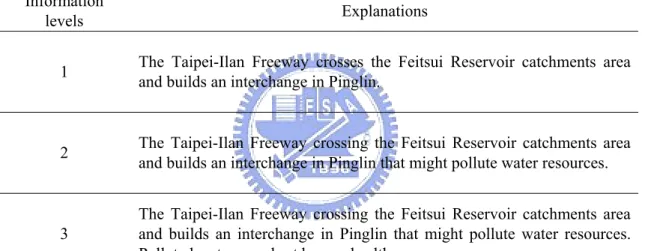
(11) LIST OF TABLES. Table 2.1 Impact categories of transportation project for CBA……….………………7 Table 2.2 Classification of affected groups for the transportation projects…………...8 Table 2.3 CVM bias and improvement methods……………………………………..26 Table 3.1 The sources of pollution and affected interest group………….…..……….32 Table 3.2 The Outline of information levels…………………………….…..……….35 Table 3.3 The official CBA results for the Pinglin interchange opening ……………39 Table 4.1 The information levels ……………………………………………………41 Table 4.2 Socio-economic background of the respondents (information levels)…….42 Table 4.3 ANOVA results of information levels……………………………………..43 Table 4.4 Statistics of the WTP for the environmental effects (Starting Point: NT$100)………………………………………………………………..45 Table 4.5 Statistics of the WTP for the environmental effects (Starting Point: NT$500)………………………………………………………………..46 Table 4.6 Statistics of the WTP for the environmental effects (Starting Point: NT$1000)…………………………………………………………….. 46 Table 4.7 Statistics tests of the WTP for the water pollution………………………..47 Table 4.8 Statistics tests of the WTP for the air pollution……………………………47 Table 4.9 Statistics tests of the WTP for the noise pollution……………………...…47 Table 4.10 The increase of environment index value of Pingling interchange use….48 Table 4.11 Socio-economic background of the respondents (pollution)…………….50 Table 4.12 The monetary values of environmental effects…………………………..51 Table 4.13 The result of the official CBA and the integrated CBA…………...……..51.
(12) Table 4.14 Net benefit for elated groups……………………………………………..53 Table 4.15 Average net benefit for residents and water user..………………………..53 Table 5.1 Distribution of WTP for user fee………………....………………………..56 Table 5.2 Socio-economic background of the respondents (user fee)……………….57 Table 5.3 Pinglin tourists and disposal volumes…………....………………………..58 Table 5.4 Disposal and pollution volumes of Pinglin tourists in different control tools…………………………………………………………………….59 Table 5.5 WTP equation of WTP for user fee……………....………………………..59 Table 5.6 Socio-economic characteristic of the respondents (in-depth interviews)….60.
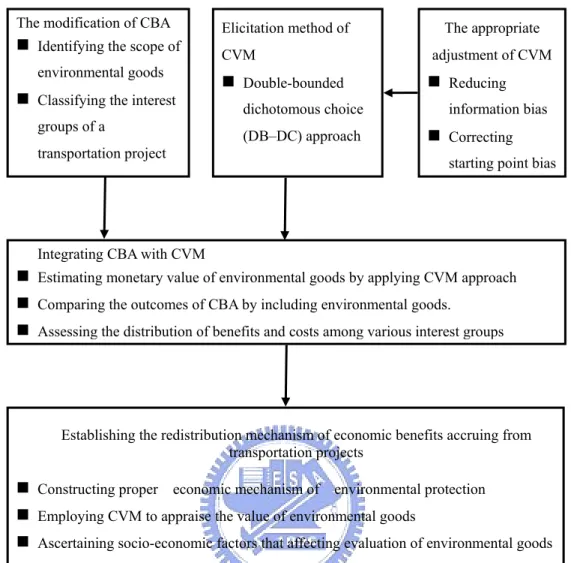
(13) 謝. 誌. 能夠拿到博士學位真是一個奇蹟!以我個人的資質與努力,實在要感 謝太多人的牽成。 首先要感謝我親愛的馮正民老師,馮老師從不嫌我笨、不嫌我慢,不 給我壓力,總是用微笑包容我所有的不足。連我都否定自己的時候,馮老 師還是堅定地相信我的能力。我不是千里馬,所以無法驗證馮老師是不是 伯樂。我只是誤闖學術叢林的迷途羔羊,還好遇見馮老師這位善牧者,引 領我、關照我。 一定要感謝的是徐淵靜老師及胡均立老師在專業領域及論文寫作上 給我的特別關照。從論文計畫書到學位口試,我從兩位老師身上獲得的不 只是學術的指導,更是如父兄般的寵愛與包容。當然還要感謝林建元老師 及詹士樑老師對我的論文指導,兩位老師在口試時用問題引導我思考,並 且對論文提出最精闢的建議,協助論文撰寫更加精緻化。能在艱辛與緊張 的口試中,感受到口試委員的關愛之意,在愛與關懷的氛圍中,有效地提 升論文品質,真的覺得自己好幸福喔! 接著要感謝的是黃台生所長、黃承傳老師、汪進財老師、許鉅秉老師 和藍武王老師,交研所的老師們各有不同的教學風格,這六年的學習或心 酸或喜樂,真是點滴在心頭。我的駑鈍與無俚頭應該造成很多老師的困擾 吧!謝謝老師們的愛心教誨,我從各位身上所學習到的不只是專業知識, 更是為人師表的風範及研究者的專注。我期許自己能夠好好的記住,然後 在生命中落實。 所辦的洪姐、柳小姐和玉鳳是我這六年來最好的姐妹淘,學校裡男多 女少,能談心的對象實在不多。還好遇見妳們可以談談心事,聊聊八卦。 不但要感謝妳們在學生事務上的協助,最真心感謝的是這一路走來我遇見 生命中許多的小顛仆,還好有妳們的關懷、鼓勵和分享協助我度過。尤其.
(14) 是口試當晚,洪姐的情義相挺,真的讓我銘記在心,再一次謝謝! 我們馮家班的新薰學長、至宏學長、光遠學長、在莒學長、杰炤學長 和劍雲學姊都已經是更擁一片天的卓越人士。他們位高權重、實在很忙 碌,但他們總是主動的關心、照顧我,讓我享有許多當學妹的優渥和寵溺。 尤其要謝謝在莒學長,在學習、處事及品味上的教誨與照料;還有光遠學 長多次在職場上的推薦與幫助。 我們同班同學銘德、輝煌和 Percy,謝謝你們的幫助,我也畢業了! 明智,請繼續加油! 還有 JP,不管有沒有學位,你都是我們的好同學。我 們幾個人的個性都不同,領域也不同,平時的往來也不像上一屆那樣密 切;但是在重要的時候,我們總是可以有效的互助合作,這是因為我們有 著堅實的革命情感吧。 大頭、Jacky、彥衡、文健與承憲雖然都是我的弟弟,但平日無論是 學業或生活都仰賴大家的照顧。姐姐如果在歷經六年磨難後,還能保有些 許貌美都要感謝你們的悉心照料。奕妏和昱凱雖然也是學弟妹,但你們的 進度實在太快了,還好你們的努力逼著我上進。小昭是唯一像學妹的,你 是我在研究室的購物頻道。 感謝陳信宏博士與溫蓓章博士對我在學術奮戰中的不離不棄,以及化 腐朽為神奇的能力。情深義重豈能以文字承載;但學識淵博可以凝脂為證。 劉大年博士是最反對我來念博士班的人,因為他知道其中的艱辛;他 是最愛督促我唸書的人,因為他比我更重視學習表現。劉大年博士在我撰 寫論文時的表現,讓我一定要推崇他為我拿到博士學位的重要推手!真的 感謝你,你總是在關鍵時刻拯救了我。 謝謝我的弟弟,雖然他永遠不會翻閱我的論文。 2007.06.27.
(15) Chapter 1. INTRODUCTION. 1.1 Motivation and Objective A well-developed transportation infrastructure is vital to a country’s economic development. Therefore, transportation has always been an important priority in national development plan. As for the case of Taiwan, it can be seen that from the early “Ten Major Construction Projects” in the 1970s to the most recent “Challenge 2008 National Development Plan”, improving the transportation infrastructure was made one of Taiwanese government's major tasks. Moreover before the government undertakes transportation programs it is essential to undertake the feasibility study. This is mainly because the transportation programs naturally are predominantly funded by central governments, the parliaments often explicitly call for feasible studies to seek justifications for spending taxpayer funds. The fundamental principle to conduct the feasible study is to compute potential positive and negative impacts accurately. In order to reach a conclusion as to the desirability of a project all aspects of the project, economic and non-economic, must be expressed in terms of their equivalent money values. A project's proponents will anticipate the overall positive effects for the validation to carry out the project. Despite the fine process of evaluating a project, there have been numerous disputes resulting from project implementation. The controversies primarily could be attributed to two reasons. The first explanation is insufficient framework in project assessment. It is well known that cost-benefit analysis (CBA) is the most frequently used technique in project evaluation. In fact CBA has come to dominate other methods of evaluations in the project appraisal CBA estimates and totals up the equivalent money value of the benefits and costs to the community of projects to establish whether they are worthwhile. The accuracy of the outcome of a CBA hinges on how precisely costs and benefits have been estimated. The formal CBA approach generally focuses on computing the impact of economic variables and is lacking adequate tools to handle non-economic variables. In particular for an environment-sensitive transportation project the CBA approach has difficulty calculating the effects from the environmental aspects. Neglecting environmental dimension in CBA analysis may be argued to be a substantial risk in planning, because inaccuracies are likely to lead to inefficient decisions. Given the problems in the CBA assessment, there was an attempt to develop the “Environmental Impact Assessment (EIA)” to supplement the CBA. The EIA principally includes environmental features in the evaluation process. However, the 1.
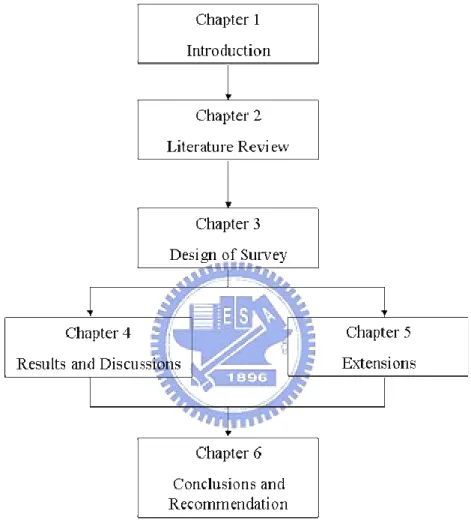
(16) widely-adopted exercise which involves the “EIA and the traditional CBA in a sequential way may be flawed with a failure to calculate the resultant economic and environmental impacts in a same setting and at the same time. In addition great efforts have been devoted to constructing the Contingent Valuation Method (CVM). CVM could take environmental factors into account and by far is the most frequently applied methodology. Actually CVM has emerged as an alternative instrument in project assessment. Nonetheless, the CVM mainly deals only with the environmental impacts, paying not much attention to the economic impacts and still falling short of expectations. In summary the current evaluation methodologies have been conducted with restrictions. There is a need to develop an integrated cost-benefit model for an environment-sensitive transportation project. Specifically when the subject of sustainable development has become an increasing concern around the globe, it is imperative to build up a comprehensive method in project appraisal. The second reason for controversies in project enforcement is inappropriate classification of interest groups. This is predominantly prevalent in the environment-sensitive transportation projects. In recent years protecting the environment and natural resources has become a central concern around the world. Environmental protection is extremely important for sustainable economic growth and social progress. The elements of environmental protection objective involve reducing the direct and indirect impacts of transport facilities and their use on the environment of both users and non-users. The environment impacts of concern include noise, atmospheric pollution of differing kinds, vibration, and other pollutants. While some of these can be quantified and monetized, others are much more difficult to define and analyze. Given the difficulty in sorting and quantifying pollution factors the interest of specific groups which are influenced by pollution will inevitably be overlooked. It will lead to certain interest groups have not been identified in the project evaluation process. This problem could be further amplified by the fact that the current procedure could not handle environmental factors properly. Consequently it is necessary to classify interest groups appropriately in project appraisal Based on the above descriptions, this study aims to fill the gap of the framework of project appraisal. It will explore the often neglected but important environmental impacts of project evaluation. Accordingly the purposes of this study could be illustrated as follows: 2.
(17) (1) Developing an advanced methodology of project evaluation: Given current limitations of project evaluation this study seeks to construct a complete technique of project evaluation. It first emphasizes on identifying the scope of environmental goods and the interest groups. This will be followed by incorporating existing CBA and CVM. We will employ CVM to appraise the value of environmental goods. It should help the transportation planners to deal with widening scope of environmental subjects more confidently in the future. (2) Establishing the redistribution mechanism of economic benefits accruing from transportation projects It is common that more interest groups are affected by the transportation projects due to the widespread effects of environmental factors. There is a perceived need to develop methods and procedures that can be used by transportation planners to evaluate the distributional impacts of projects. This study is set to construct redistribution mechanism of economic benefits accruing from transportation projects. This should enable us to ascertain socio-economic factors that affecting evaluation of environmental goods. As a result it can alleviate the dissatisfaction from the affected interest groups and to facilitate the project enforcement. Accordingly, the contribution of the study is twofold. Firstly, this study has developed an efficient process in evaluating an environment-sensitive project. As we know environmental impacts are qualitative in nature and are hardly and difficult to be converted into monetary terms. By monetizing the environmental impacts, the study shows that it is feasible to integrate the CBA with the environmental factors on an equal basis. The second contribution of the study comes from the empirical case. This study employed the Pinglin Interchange for the case study. The empirical results show that an integrated CBA may produce an entirely different conclusion from the one resulting from the common traditional environmental assessments. This inspiring result may be served as an important milestone for social planners in evaluating the environmental-sensitive projects in the future.. 1.2 Research Scope As described earlier this study sets to improve the current project evaluation methodology and derive the redistribution system accordingly. Therefore the scope of the research consists of two parts. The first part is to go a step further than the previous research by developing a step-by-step process which integrates the CBA with the CVM to assess the overall effects (both the environmental and economic 3.
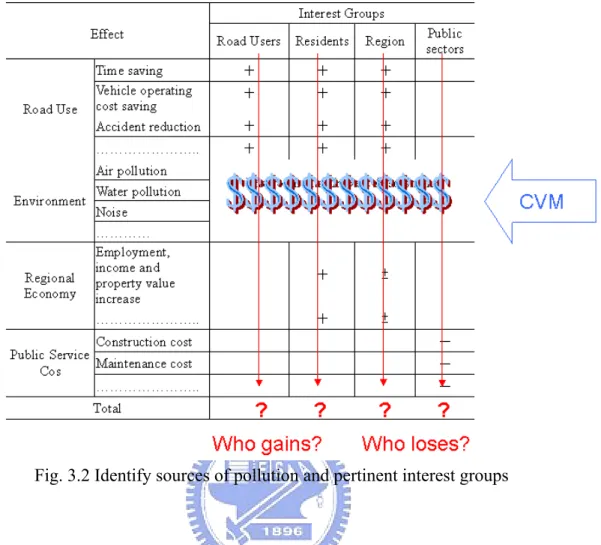
(18) impacts) for a transportation project. The second part of the research scope is to apply a case for the illustration. The empirical base of the study draws on the case of the Pinglin Interchange in Taiwan. Pinglin, as a tiny rural town in northern Taiwan with only about six thousand residents, is famous for its green tea and rapidly-growing tourism business. The debate was originated from the contraction of No. 5 highway. Ever since the plan was announced for the No. 5 Freeway, which will connect Taipei to Yilan through one of the world's longest tunnels, Pinglin residents have been agitating for a full-fledged interchange at their town. The predominant motivation for them was economic consideration. They alleged that if there is no full function interchange in Pinglin, most of the travelers will not stop in Pinglin and Pinglin may lose its tourists to Yilan. On the other hand the official evaluation reports did not support the full function interchange for the environmental reason. This is because the interchange lies within the catchments area of the Feitsui Reservoir, which supplies drinking water to near five million inhabitants within the Taipei metropolitan area. However since the government reports did not identified and monetized environment factors appropriately, the impacts of pertinent groups have not revealed consequently. The credibility of the reports has been questioned to a great extent. For the purpose of this study we will develop an integrated cost-benefit method. Following the methodology the subject of Pinglin interchange will be selected as an instructive example. The survey was conducted over the period from April to October in 2004 and in the end 466 reliably questionnaires were obtained. Admittedly, the case of the Pinglin Interchange is relatively small and simple, but the process presented in the study may serve as a reference point for a bigger and more complex case. In order to resolve the problems occurred in the governmental reports in the following work we will classify the sources of pollution into three pollutants: air pollution, water pollution and noise. The people are affected by the pollutants can be categorizes into two groups accordingly. The first group is Pinglin residents and passengers who are mainly affected by air and noise pollutants. Taipei metropolitan residents who rely on Feitsui Reservoir for drinking water can be regarded as second group, since Pinglin interchange may contaminate Feitsui Reservoir pollution. According to the above descriptions this study is organized as follows. Chapter 1 is the introduction, which describes the motivation, objective and scope of this dissertation. Chapter 2 will first reviews the evolution of methods in evaluating environment-sensitive projects. This will be followed by the overview of the CVM approach. Chapter 3 illustrates the methodology of the survey. Chapter 4 provides an 4.
(19) overview of the Pinglin case and the survey results are discussed subsequently. In chapter 5 we further extend the case study by examining the impacts of imposing user on pollution reduction. The conclusions and the directions for future research are presented in the finial chapter. In summary the structure of this dissertation is shown in Figure 1.1.. Figure 1.1 Structure of the Dissertation. 5.
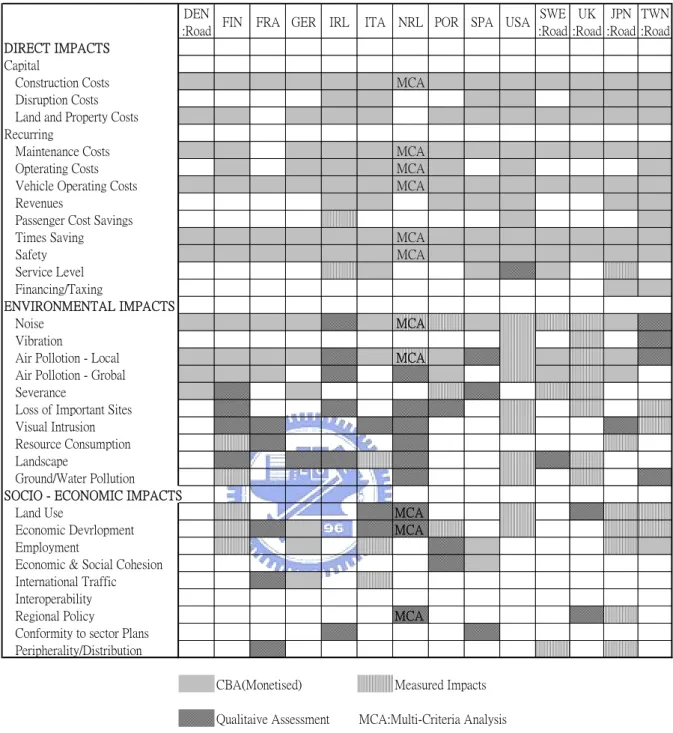
(20) CHAPTER 2 LITERATURE REVIEW The primary objective of this study is to develop an integrated transportation project appraisal methodology by incorporating cost-benefit analysis (CBA) with Contingent Valuation Method (CVM). Therefore it would be necessary to understand the current progress of related works. In this chapter we will first outline the current applications of CBA. This will be followed by the overview of CVM.. 2.1 The Applications of CBA in Transportation Projects CBA is the most frequently used method in transportation project evaluation. Actually CBA has dominated other evaluation methods in the transportation project appraisal.. 2.1.1 Environmental factor values embedded into formal CBA hardly Table 2.1 lists the categories of transportation project for CBA evaluation in different countries. It can be seen that direct impacts, environmental impacts and socio-economic impacts are major dimensions in evaluating transportation projects. In principle there is a high degree of consensus among countries on calculating direct impacts. The items included in the direct impacts are rather easy to measure. On the other hand, the range of environmental impacts varies considerably across countries. Noise and local air pollution are always included in the environmental impacts, but other factors are not necessarily incorporated in the environmental scope. The main reason for that is some environmental factors are hard to quantify. In many countries the CBA is supplemented by a quantitative and/or qualitative appraisal to include environmental factors which are not monetized for technical reasons. Finally, it is a lot more complicated to evaluate socio-economic impacts. There are some countries even excluding socio-economic impacts from project evaluation. The socio-economic impacts are difficult to identify and measure in nature. The recent development on this aspect is to estimate socio-economic impacts based on economic efficiency and focus on user's benefits. Nonetheless, there is still a lot more work to be accomplished in this area. It will never be possible in practice to value all impacts, but we should aim to extend valuation to as many as we can.. 6.
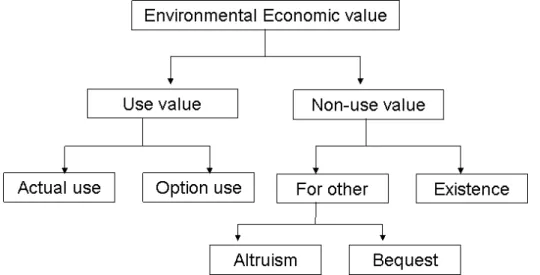
(21) Table 2.1 Impact categories of transportation project for CBA evaluation DEN FIN :Road. FRA GER IRL. DIRECT IMPACTS Capital Construction Costs Disruption Costs Land and Property Costs Recurring Maintenance Costs Opterating Costs Vehicle Operating Costs Revenues Passenger Cost Savings Times Saving Safety Service Level Financing/Taxing ENVIRONMENTAL IMPACTS Noise Vibration Air Pollotion - Local Air Pollotion - Grobal Severance Loss of Important Sites Visual Intrusion Resource Consumption Landscape Ground/Water Pollution SOCIO - ECONOMIC IMPACTS Land Use Economic Devrlopment Employment Economic & Social Cohesion International Traffic Interoperability Regional Policy Conformity to sector Plans Peripherality/Distribution. ITA NRL POR SPA USA. SWE UK JPN TWN :Road :Road :Road :Road. MCA. MCA MCA MCA. MCA MCA. MCA MCA. MCA MCA. MCA. CBA(Monetised) Qualitaive Assessment. Measured Impacts MCA:Multi-Criteria Analysis. Source: Complied from Bristow and Nellthorp, 2000; Morisugi, 2000; MOTC, 2005.. 2.1.2 Geography identifying the gains and loses inside the totality The Benefit Incidence Table (BIT) is the normally useful framework. As shown in Table 2.2, BIT enables the user to qualitatively identify the origin, transfer and incidence of the various impacts of the project, without double counting and leakage, and provides good foundation in project assessment (Morisugi, 2000). BIT can be narrowed down to a practical scale, which can help planner to recognize associated 7.
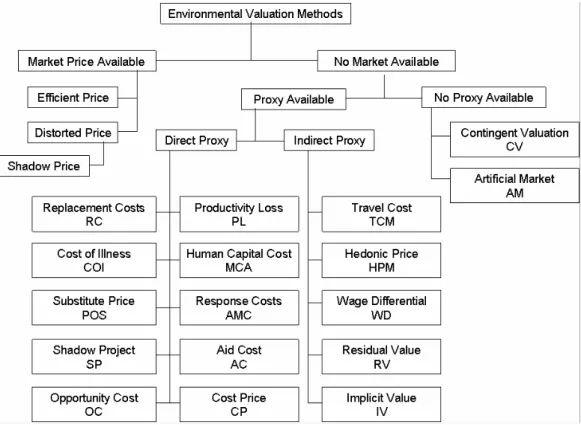
(22) interest groups. Furthermore, in addition categorizing the source of impacts, efforts have been made to identify affected groups of the transportation projects. The effects of transportation infrastructure are related the road use and location. The classification of Table 2.2 does not submit to the characterization of transportation infrastructure.. Road use. reduction of traffic accidents. +◎. +◎. +◎. enhancement of driving comfort. +○. +○. +○. +◎. +◎. +◎. +◎. +△. +△. +◎. -◎. change in air pollution. +◎. +○. +◎. change in noise. +◎. +○. +◎. +○. +○. change in scenery. ±○. ±○. ±○. change in ecological system. ±○. ±△. ±△ ±△. global warming. ±◎ ±◎. Reginal economy. Civic life. utilization of road space. +△. Tax Fiscal revenue expenditure Public subsidy. +△. network redundancy for emergency. +△ +△ +△. +△. enlargement of communocation opportunity. +△ +△. +△. enhancement for publicservice availability. ±△. ±△. upkeep of population. ±△. ±△. production increase with industrial location. +○. increase in employment and income. +○. change in price of commodity and service. -○. 0. -○. +○. 0. -○. increase in asset value. Toll revenue. total. +◎. toll payment. Project cost. world. nation. prefecture. municipality. government land owner. road space pccupier. industry in other regions. land user. employer. resident. producer. land user. employee. consumer. industry. savings in travel time savings in vehicle operaing cost. enhancement of safety and comfort on sidewalk. Emvironment. household pedensttain. alternative existing road. road user road under plan. road corporation. Table 2.2 Classification of affected groups for the transportation projects. -○. savings in public service cost. 0 -○. +○. -○. local tax. -○. -○. -○. national tax. -○. -○. -○. 0. +○ +○ +○. 0. +○ +○. 0 +○. 0. +◎. -◎. 0. investment. +◎. -◎ -◎ -◎. 0. toll revenue. +◎. +◎. construction cost. -◎. -◎. maintenance cost. -◎. -◎. subsidy. +: positive effect ◎: measurable in monetary terms. -: negative effect ○: roughly measurable. ±: unknown sign △: difficult to measure. Source: Morisugi, 2000 8.
(23) The interest groups for interchange use can be classified into three types: road users, roadside communities and regions, and public sectors (Lee Jr., 2000; Morisugi, 2000; Quinet, 2000; Rothengatter, 2000). We will amend classification of affected groups in common use BIT.. 2.1.3 Formal CBA ignoring the gain-loss distribution among interest groups The formal CBA evaluates from totality of society benefit and ignores distributions among stakeholders. The pluralism considers the policy design of environmental issue should be refer to the multi-valuation and the environmental right of all interest groups. Anderson and Leal (1991) provide “free market environmentalism (FME)”. They consider “free market environmentalism is a system of well-specified property rights to natural and environmental resources”. Property rights provide the foundation for markets, and so establishing property rights in environmental resources enables individuals and organizations to pursue environmental goals in the marketplace. FME seeks to create and expand markets in environmental resources through the extension of market institutions to cover environmental resources that were heretofore external to market processes. In 1991, FME may have been “more theoretical than applied”. Now there are models that illustrate the FME paradigm in practice. Anderson and Leal take advantage of this fact, providing numerous examples of FME principles put to practice in the real world. The result is a blend of theory and implementation that provides a highly useful introduction to the power of market institutions to advance environmental protection. This study tries to build up a base for further development of a redistribution mechanism. Pricing policy has not been suggested as an efficient alternative for environment protection, but the revenue from user fee can be provided for funding additional measures of environmental protection Downing, 1984; Urry, 1990). This kind of solutions have put into practice in many regions around the world, notable examples being Sofia Bay, Bulgaria (McClelland, 1997), the Gold Coast, Sydney (Pradeaux, 2000), the British National Parks and the Lake District National Park (Transport for London, 2001), and Hurricane Mitch, Nicaragua (Johnson and Baltodano, 2004).. 2.2 Environmental economic value Environmental economic value (EEV) can be characterized differently according to the type of economic value arising. It is usual to divide EEV into use and non-use values. Use values relate to actual use of the good in question (for example, a visit to 9.
(24) a national park), planned use (a visit planned in the future) or possible use. Actual and planned uses are fairly obvious concepts, but possible use could also be important since people may be willing to pay (WTP) to maintain a good in existence in order to preserve the option of using it in the future. Option value thus becomes a form of use value. Non-use value refers to willing to pay to maintain some good in existence even though there is no actual, planned or possible use. The types of non-use value could be various, but a convenient classification is in terms of (a) existence value, (b) altruistic value, and (c) bequest value. Existence value refers to the WTP to keep a good in existence in a context where the individual expressing the value has no actual or planned use for him/herself or for anyone else. Motivations here could vary and might include having a feeling of concern for the asset itself (for example, a threatened species) or a “stewardship” motive whereby the value feels some responsibility for the asset. Altruistic value might arise when the individual is concerned that the good in question should be available to others in the current generation. A bequest value is similar but the concern is that the next and future generations should have the option to make use of the good. Figure 2.1 shows the characterization of EEV by types of value. SP techniques are suited to eliciting all these kinds of value, although in practice it is usually not possible to disaggregate individual types of non-use value, nor is it usually relevant to a decision to secure that breakdown. But differentiating use and non-use values can be important because, as will be seen, the latter can be large relative to the former, especially when the good in question has few substitutes and is widely valued. In addition, non-use value remains controversial, so that it is important to separate it out for presentational and strategic reasons.. Fig. 2.1 Environmental economic values Source: Bateman et. al., 2002 10.
(25) How do stated preferences relate to the concept of EEV? Figure 2.2 shows how the various valuation techniques apply to the major component pats of EEV. Non-use values, which are likely to be especially important in contexts where the good being valued has few or no substitutes, can only be estimated using stated preference techniques. Since non-use values tend not to leave a “behavioral trail”, that is, some behavioral change which affects a price or quantity which can be observed, revealed preference techniques are unlikely to elicit non-values.. Fig. 2.2 The taxonomy of valuation techniques Source: World Bank, 2002 Contingent valuation (CV) is a method of estimating the economic value of non-market environmental goods (and public goods in general) through survey questions that elicit individuals’ preferences. Respondents express their preferences in terms of willing to pay to purchase or restore that good, or, alternatively, what they would be willing to accept to no longer be able to purchase or fully utilize that good. To elicit these values, individuals are presented with a hypothetical market for the good, thus the resulting “willingness to pay” and “willingness to accept” values are contingent upon the interviewer’s description of the hypothetical market, and the approach became known as the contingent valuation method. 11.
(26) The major advantage of this approach compared to proxy methods, such as Hedonic price method, Travel cost method and so on, is that the CV method can elicit both use and non-use values, and indeed it is the only possible technique for the evaluation of non-use values. Another attraction of this method is that it may be applied at varying levels of complexity according to the time and financial resources available for the research and according to the mode of survey used to capture the individual’s value.. 2.3 Reviews for Contingent Valuation Method CV asks consumers to directly state their values within a hypothetical context rather than inferring values from actual market behavior, it is perhaps the most controversial of all methods used to value non-market environmental goods. Of course, CV is not the only empirical method that uses data from surveys; many large data sets commonly used by economists consist of survey data (i.e. census surveys, consumer expenditure surveys). CV surveys differ from traditional data surveys in that the respondents are asked to make a hypothetical value trade-off rather than simply report their own characteristics or actual expenditures. The hypothetical nature of CV introduces unique challenges when respondents do not correctly understand the good or service being valued, or when they cannot accurately state their willingness to pay in monetary terms. Nonetheless, as mentioned earlier, CV is the only economic method available for measuring non-use values associated with nature. There are many researches regarding CVM in Taiwan, but few are in transportation field. These are national park effect (Wu, 2005), leisure effect (Jeng, 2003), wildlife conservation economic effect (Lo, 2003), water quality improvement effect (Hung and Shaw, 2005) and air quality improvement effect (Shaw et. al., 1996). Transportation researchers may employ CVM in related fields.. 2.3.1 Economic Concept of CVM The CVM is a technique that allows the value of an environmental good or service to be estimated. Individuals are asked to value their willingness to pay (WTP) or willingness to accept (WTA) for a change in the provision of an environmental good, usually by way of a questionnaire survey. The individual maximum WTA or the minimum WTA compensation for an environmental change is assumed to be the value the individual attaches to such a change. An individual can be asked to express his/her subjective valuation of possible environmental changes in different ways: 12.
(27) 1. Environmental improvement. The value of the environmental improvement in such a situation can be measured either by: (1) The individual’s maximum willingness to pay (max WTP) to obtain the environmental improvement (estimated by the compensating surplus-CSU); or by (2) The individual’s minimum willingness to accept (min WTA) as compensation to forgo the environmental improvement (estimated by the equivalent surplus-ESU). 2. Environmental damage. The value of the environmental damage in such a situation can be measured either by: (1) The individual’s maximum WTP to avoid the environmental damage (estimated by the ESU); or by (2) The individual’s minimum WTA as compensation to agree to the environmental damage (estimated by the CSU). One basic issue in CV method studies for the estimation of environmental values is the choice of whether to ask individuals their maximum WTP or their minimum WTA for a given environmental change. To understand the conceptual difference between the maximum WTP and the minimum WTA, let us focus on the case of the valuation of an environmental improvement. With an environmental improvement the individual, currently at the utility level U0, ceteris paribus, is brought to U1, as shown in Figure 2.1. The maximum amount of money the individual is willing to pay to secure this improvement is such that after the payment s/he would at most be back to U0, (s/he should not be prepared to pay any amount of money such that s/he falls below the utility level U0). This maximum amount of money is the compensating surplus (CSU).. Note: The segments in bold are the budget sets and the points in bold are budget constraints for different levels of environmental good. The good X is money allocated to consumption.. Fig. 2.3 Environmental improvement: compensating surplus and equivalent surplus 13.
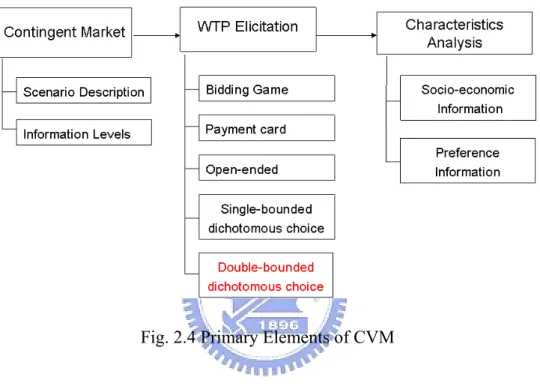
(28) If, however, the same individual is already enjoying (or has a right to) the improvement, ceteris paribus, and has the utility level U1, then s/he considers it a loss to have to give up the environmental improvement and asks to be compensated for this loss. To calculate how much to ask as minimum compensation s/he look at the utility level attainable with the environmental damage (that is, without the environmental improvement). This is U0. S/he will then ask at least a monetary compensation high enough to reach the level of utility U0 gain back to the level U1. This is the equivalent surplus (ESU). It is apparent that the appropriate measure of the value of an environmental asset is related to the property rights of the individual on such an asset. The CSU measure assumes the individual has no consolidated rights in the environmental improvement, assuming therefore as a benchmark the utility level without environmental improvement U0. The ESU measure assumes instead that the individual somehow deserves, or has a right to, the environmental improvement, and puts the individual at the higher utility level U1 attained (or attainable) with the environmental improvement. Randall and Stoll (1980), suggested that the possible different between the compensating surplus and equivalent surplus are barely significant in most practical situations. However, Hanemann (1991) shows that this is not always the case, especially when the environmental good/service has no close substitutes. In such cases, the minimum WTA can exceed the maximum WTP several times over. Carson (1991) also argues that when individuals are asked to state their minimum WTA, they tend to state their expectation of the maximum they could hope extract as compensation, rather than their true minimum WTA. On these grounds also Mitchell and Carson (1989) and Pearce and Turner (1990) advise caution on the use of the WTA approach. From the above discussion, it leads to the following conclusions: WTP measure rather than the WTA measure is the proper measure of value that should be used in the CV studies (Cummings et al., 1986; NOAA, 1993).. 2.3.2 Primary Elements of CVM A contingent valuation survey consists of three primary elements (Figure 2.4). The first is a carefully crafted description of the good or commodity to be valued. This description should detail the baseline existing situation, the features of the good itself, its extent or magnitude and duration, the parties responsible for its provision, its expected consequences, a description of a default scenario if the good were not provide, the availability of substitutes for the good, and how it would be paid for. A 14.
(29) thorough examination of the elements required in a commodity description is provided by Fischhoff and Furby (1988). The validity of the CV results depends mainly on the level and nature of information provided to the respondents through the scenarios. The nature of the information provided has been found to affect the results both positively as well as negatively (see Bergsrtom et al., 1990). One crucial question that has not yet been properly addressed in the CV literature is that what is the optimum level of information, since the information provided in the CV scenarios do affect the WTP values.. Fig. 2.4 Primary Elements of CVM. The second primary element in a CV questionnaire is elicitation. The respondent is asked either to provide the actual maximum amount that he would pay for the commodity described (an open-ended response format) or to indicate whether or nor he would vote in a public referendum for it to be provided if it cost hid household a specific dollar amount (the referendum format). The value of the good/service in the CV technique is elicited through an elicitation technique which is an important component of any CV method (Portney, 1994; Mitchell and Carson, 1989). The elicitation technique (or approach) used in CV studies is of different types. As of now, there are four major types of elicitation techniques available in the literature, namely, the bidding game, payment card (PC), open-ended (OE), and dichotomous choice (DC) approach (Boyle et al., 1996). The dichotomous choice approach is further divided into two types as: single-bounded dichotomous choice or take-it; and double-bounded dichotomous choice or take-it-or-leave-it with follow-up. It is a question to choice elicitation technique from above. 15.
(30) The third element of a CV survey are questions that probe respondent characteristics and behaviors that may influence their preferences for the good being valued. Socio-economic information, previous purchasing experience with goods relevant to the commodity in question and indicators of use of the good itself are elicited to provide insight into respondents’ valuation responses. A valuation function is estimated using these indicators that are predicted by economic theory to explain respondent preferences for the good. The better the ability of the data to explain the observed preference information, the greater the confidence in the results of the survey.. 2.3.3 Elicitation Method The value of the good/service in the CV method is elicited through an elicitation technique which is an important component of any CV method (Portney, 1994; Mitchell and Carson, 1989). The elicitation technique (or approach) used in CV studies is of different types. As of now, there are four major types of elicitation techniques available in the literature, namely, the bidding game, payment card (PC), open-ended (OE) and dichotomous choice (DC) approach (Boyle et al., 1996). The dichotomous choice approach is further divided into two types as: single-bounded dichotomous choice or take-it-or-leave-it; and double-bounded dichotomous choice or take-it-or-leave-it with follow-up. An extended version of the latter approach which is called ‘triple bounded dichotomous choice’ that extends the double-bounded DC ‘for a further question’ has also been used in some of the CV studies (see Bateman et al., 1999). Let us discuss briefly each one of the elicitation techniques mentioned above. The bidding game is the oldest elicitation technique among all the techniques (Mitchell and Carson, 1989). The bidding game approach goes as follows: the respondent in a CV study would be randomly assigned a particular bid from a range of predetermined bids. The bid assigned may be either a lower or higher level bid. The respondents would then be asked to say ‘yes’ or ‘no’ to that particular bid, and the process would continue until ‘the highest positive response is recorded’ (Randall et al., 1974). Davis was the one who first used the bidding game approach for estimating the benefits from goose hunting in 1963. This approach has been later on used by many authors for estimating the value of public goods (e.g. Randall et al., 1974; Brookshire et al., 1982). Moreover, this is the approach which has been widely used in a relatively large number of CV studies conducted in developing countries (e.g. Whittington et al., 1990, 1992). Using the bidding game approach for estimating the benefits from the abatement of aesthetic environmental damage associated with power plant and coal mine, 16.
(31) Randall et al. (1974) conclude that the bidding game was successful in meeting the valuation objective. However, the authors suggest that considerable amount of care should be taken in designing the bidding game so as to obtain reliable results. The results of many of the developing country CV studies on water supply (Whittington et al., 1991, 1992; Briscoe et al., 1990) that utilized bidding game approach suggest that this approach works well in developing countries. One of the advantages of this approach is that it provides relatively better results since it gives a ‘market-like’ situation to the respondents in which they could research their preferences (Cummings et al., 1986). Another advantage of this approach is that the researcher could obtain maximum willingness to pay value (Cummings et al., 1986). However, Cummings et al. (1986) argue that the cost of implementing the bidding game is comparatively higher in the sense that it involves presence of interviewers during the interview, etc. Another problem with bidding game is that the starting points used in the bidding game might influence the final value of the stated WTP. Apart from these problems, Loomis (1990) argues that the bidding is impracticable in mail surveys. The second oldest technique is payment card approach, introduced by Mitchell and Carson (1984). The payment card would contain a range of WTP values for the public good under question from which the individuals have to choose their maximum WTP value. The respondents are facilitated with another benchmark version of the payment card that contains the average WTP amount paid by households for other public goods. Even though the payment card approach has some advantages such as its ability to elicit the maximum willingness to pay value, the problem with the payment card is that there is a chance that the WTP values would be possibly affected by range bias and centering bias (Mitchell and Carson, 1989). Moreover, the payment card approach may have limited use especially in rural areas of developing countries where the people have very limited experience with using payment cards. The open-ended elicitation technique involves asking the maximum amount that the individuals are willing to pay for a public good or policy. The open-ended approach is convenient to answer, does not require an interviewer and does not result in any starting point bias (Walsh et al., 1984). For those studies which aim at deriving a value that would provide a conservative estimate, the open-ended approach would be efficient in the sense that this approach would provide a lower level conservative value than the bidding game approach (Walsh et al., 1984). However, this approach is prone to criticisms. Desvousges et al. (1993) point out that the open-ended approach tends to create large number of nonresponses or protest bids since respondents either find it difficult to answer or do not have incentive to provide true answer (Carson et al., 1996). Hanemann (1994) argues that the open-ended questions may attract 17.
(32) strategic bias and people may tell the cost rather than true value. Due to problems with the techniques mentioned above, Bishop and Heberlein (1979) introduced take-it-or-leave-it approach (or single-bounded dichotomous choice approach). It involves assigning a single bid from a range of predetermined bids that potentially reflect the maximum willingness to pay amounts of the respondents for a particular good. The respondents are asked to state only ‘yes’ or ‘no’ to that bid on all or nothing basis (Mitchell and Carson, 1989). The major advantage of the single-bounded dichotomous choice approach is that it facilitates the respondents to complete the valuation process. Moreover, the strategic bias in the WTP values may be minimised since this approach is an incentive compatible one (Carson et al., 1996; Hanemann, 1994). Despite its advantages, the single-bounded dichotomous choice approach has some disadvantages as well. One of the disadvantages is that one can derive only the maximum willingness to pay/minimum willingness to accept value from this approach but not the actual willingness to pay amount (Boyle et al., 1996). This approach also attracts starting point bias (Ready et al., 1996). On the property of incentive compatibility, this approach may not work in two circumstances: when the public good is provided through voluntary contribution and when a new private or public good is provided (Carson et al., 1996). Moreover, this approach is less applicable in areas where the households have already decided about their willingness to pay value (Venkatachalam, 2004). Another problem is that it requires a large number of observations for identifying the distribution of values (Alberini, 1995; Cameron and Quiggin, 1994). A modified version of the take-it-or-leave-it approach has been introduced by Hanemann (1984, 1985) and Carson (1985) which is called, ‘double-bounded dichotomous choice (DB-DC) approach’ (or ‘take-it-or-leave-it-with follow up’). This involves assigning one more bid to the initial bid (in the single-bounded approach), whose direction depends on the ‘yes’ or ‘no’ answer to the initial bid. This approach has been first applied by Carson and Steinberg (1990) and Hanemann et al. (1991). The major advantage of this approach is that one could identify the location of the maximum willingness to pay value from the data derived from this approach. This approach is an incentive compatible one. The DB-DC approach is statistically more efficient than the single-bounded dichotomous choice approach (Kanninen,1993; Hanemann,1991). Conducting an econometric analysis of the simulated data, Alberini (1995) concludes ‘to obtain more powerful goodness-of-fit tests so that a poor specification of the model can be detected and corrected in the early stages of the data analysis, the CV researchers are advised to plan discrete choice surveys with a follow-up bid . . .’. A problem with this form of dichotomous choice approach is that 18.
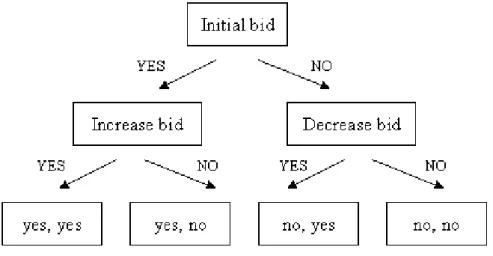
(33) it requires a larger sample size, sophisticated econometric techniques, etc. which results in increased cost of the survey. Moreover, the results derived from the DB-DC approach are vulnerable for starting point bias and ‘yea-saying’ problem (Ready et al., 1996). Many studies have provided results which suggest that, in general, the WTP value elicited using DC are greater than that of OE method (Carson et al.1996). This phenomenon is attributed to various reasons: (a) occurrence of strategic bias (especially, understatement) in OE, whereas this is not the case in DC which is considered to be incentive compatible; (b) ‘yea-saying’ in the case of DC format; and (c) tendency of the respondents to provide a lower WTP value when faced with a more difficult open-ended WTP questions (see, Brown et al., 1996). In recent years, a shift from using OE to DC is taking place in the CV literature but this shift demands for a sophisticated statistical analysis of the CV data. Modeling the DC data within the framework of random utility model (RUM) is a rigorous exercise and different kinds of DC formats require different kind of statistical analysis. Hanemann and Kanninen (1999) provide excellent description about various models, which could be used for analyzing the DC data to arrive at relevant measures. It should be noted from the above discussion that different elicitation techniques have got different kinds of advantages and disadvantages. This being the case, the question one has to address in a CV survey is which one of these techniques should be used to elicit the value of public goods. Mitchell and Carson (1989) report that the open-ended method works smoothly in situations where the respondents are familiar with paying for the goods under question while many others conclude that DC approach is more incentive compatible than other elicitation techniques especially in the case of non-use values (NOAA, 1993; Hanemann, 1991; Hanemann and Kanninen, 1999).. 2.3.4 Estimation of willingness-to-pay In a DB–DC response model respondents are asked whether they would be willing-to-pay a specific amount (‘yes–no’) in support of a water quality improvement policy. If the answer is “yes”, then a follow-up question with a higher amount will be raised. On the contrary, if the respondents refuse the initial bid, then in the second round they will be tested with a smaller amount. The underlying idea is to reflect the respondents’ evaluation of their environmental utility. If the respondents think that their WTP for the described scenario exceeds the stated bid, and then they will agree to pay, otherwise they will reject the bid. The observed respondents’ decisions regarding the two bid amounts are offered in sequence as a proxy variable for the 19.
(34) unobserved values. For each respondent, five possible response outcomes are produced: “yes–yes”, “no–no”, “yes–no”, “no–yes” and 0. The complete elicitation procedure is shown in Fig.2.5.. Fig. 2.5 Elicitation questions for the survey: double dichotomous choice format The probability (Pr) of respondents’ ‘yes’ to a given bid amount can be expressed as a difference between indirect utility functions: Pr{response=' yes'. } = Pr{υ ( p, y − A, s; q1j ) + ε 1 ≥ ( p, y, s; q 0j ) + ε 0 }. (2-1). where υ (.) is the indirect utility function derived from the consumer’s utility maximization problem,. q ij. is a environmental quality attribute where index I. indicates different states of the world and index j the water body in question; prices of market goods, p; the individual’s income, y; the hypothetical bid amount or proposed cost of the policy to the individual household, A; a set of individual characteristics, s; and a stochastic term, ε . The stochastic term is due to characteristics of the individual’s preferences which are physically unobservable, giving rise to the nomenclature ‘random utility model’. In our case of WTP for an environmental quality improvement we observe the economic welfare measure compensating variation (C) defined as; Pr{response=' yes'. } = Pr{c(q 0j , q1j , p, y, s,η ) ≥ A}. (2-2). where C(.) is itself a random variable with η = ε 0 − ε 1 . In order to model WTP we 20.
(35) must assume a probability distribution function. fη (.). for η , the coefficients of which. can then be estimated using the contingent valuation data. In the DC–DB model the first question is followed up by a second yes–no question. Respondents’ unobserved WTP (w) can then be identified as belonging to intervals bounded by the bids to which they replied ‘yes’ and ‘no’. Model coefficients are estimated using maximum likelihood techniques (Greene, 1993). The log-likelihood function for the DC–DB model is defined as follows: ln L = I 0 ln F (0) + I nn ln[F ( A1 ), F (0)] + I ny ln[F ( A), F ( Al )] + I yn ln[F ( Ah ), F ( A)] + I yy ln[1, F ( Ah )]. (2-3). Here I is an indicator function taking the value of one when responses are in relevant category (y=‘yes’, n=‘no’, 0=true zero) and zero otherwise, while F is the chosen cumulative density function. In this study the lognormal and truncated normal distributional assumptions were selected for estimating WTP. Because the DC–DB model is not a normally distribution, up-bound and low-bound may bias E(w), we have to defined WTP as:. truncated normal:. E [W ] = µ + σ. φ (− µ / σ ) 1 − Φ (− µ / σ ). (2-4). where E[w] is the expected WTP; µ is a location parameter; σ is a scale parameter; φ is a standard normal probability density function (p.d.f.); and Φ is a standard normal cumulative density function (c.d.f.) (Barton,2002). Explanatory factors for WTP model depends context. Various variable types can be added such as choice characteristics, site characteristics or environmental conscience variables. WTP models contain social and economic variables. WTP model on the other hand, are more or less interpreted in a fashion analogous to simple regression results. It has been modeled as shown in Equation 2-5: log WTP i = β 0 + β k χ ik + µ i. (2-5). with all indexes interpreted as previously. Policy makers would like to respond to the variables that appear to affect negatively the WTP, e.g. by improving education or by providing more information to certain groups of people (Safarikas et al., 2005).. 2.3.5 Reliability of CV Results Despite the efforts to find elicitation formats that allow the controlling of some biases, other biases can occur in CV studies and be tackled with appropriate 21.
(36) questionnaire design. Among these the most important are information bias, hypothetical bias, strategic bias and starting point bias (Venkatachalam, 2004). (1) Information bias The ‘information’ in a CV method plays a crucial role. The CV results depends mainly on the level and nature of information provided to the respondents through the scenarios. The nature of the information provided has been found to affect the results both positively as well as negatively (see Bergsrtom et al., 1990). The scenario in a CV study contains two major elements, namely, (a) the value-enhancing element (for instance, different levels of quantity of water supplied); and (b) the value neutral elements (such as photographs shown to describe, say, the visibility). Considerable amount of research has been carried out in the case of value-enhancing elements (e.g. Whitehead and Blomquist, 1990). The value enhancing-element in CV studies is of three types, namely, (i) the information about the good to be valued; (ii) the budget constraints and other peoples’ CV values; and (iii) the information about the related environmental goods that are supposed to affect the WTP values for the good under consideration. For instance, information about related environmental goods that may be substitutes or complements has been found to influence stated willingness to pay. If substitutes are not presented, then the stated WTP becomes an overstated one while the absence of a reminder of complementary goods leads to understate the stated WTP (Whitehead and Blomquist, 1990). Does reminding of the budget constraint and substitute goods affect the WTP value? An empirical study by Whitehead and Blomquist (1990) looks into the impact of the information about the related environmental goods (substitutes and complements) on WTP values. The study found that information about the substitutes reduces the WTP while information about complements increases it. In Adamowicz et al.’s (1993) study found that the information about the substitute goods has led to reduction (especially in the Hockey ticket treatment) in the disparity between the WTP and WTA values. Neill (1995) and Ajzen et al. (1996) also demonstrated that reminding of budget constraint and availability of substitutes influence the WTP values in laboratory experiments. The results regarding the information effect are mixed. But an important aspect to be noted is that the influence of the additional information on the WTP value depends mainly on the level of information possessed by the individuals. This implies that the CV studies should be capable of addressing the linkage between the levels of information possessed and the WTP value influenced by the additional information provided. In other words, if there exists asymmetric information across individuals, 22.
數據
+7

相關文件
It is hereby certified all the goods were produced in Taiwan and that they comply with the origin requirements specified for those goods in the generalized system of
You are given the wavelength and total energy of a light pulse and asked to find the number of photons it
Wang, Solving pseudomonotone variational inequalities and pseudocon- vex optimization problems using the projection neural network, IEEE Transactions on Neural Networks 17
Define instead the imaginary.. potential, magnetic field, lattice…) Dirac-BdG Hamiltonian:. with small, and matrix
incapable to extract any quantities from QCD, nor to tackle the most interesting physics, namely, the spontaneously chiral symmetry breaking and the color confinement..
Miroslav Fiedler, Praha, Algebraic connectivity of graphs, Czechoslovak Mathematical Journal 23 (98) 1973,
Microphone and 600 ohm line conduits shall be mechanically and electrically connected to receptacle boxes and electrically grounded to the audio system ground point.. Lines in
When ready to eat a bite of your bread, place the spoon on the When ready to eat a bite of your bread, place the spoon on the under plate, then use the same hand to take the
