
台灣學生「道歉」語言行為之中介語研究
172
0
0
全文
(2) 摘要 關於道歉中介語 (interlanguage apology) 的研究已探討過許多種語言中的道歉語言 行為,但是這些研究當中卻沒有探討過學習英語為第二語言的台灣學生 (Chinese EFL learners in Taiwan) 所做的道歉中介語。因此,為了更瞭解台灣學生在使用英語道歉時之 語言表現和美國人有何差異,本研究分別比較其英語道歉行為。受試者分為三組,第一 組為 60 位美國大學生,主要收集英語基準語料 (English baseline data);第二組為 60 位 台灣大學生,主要收集漢語基準語料 (Chinese baseline data);第三組為 60 位學習英語為 第二語言的台灣大學生,主要收集中介語語料。各組男女各半,且第三組當中包含 30 位主修英語的台灣大學生,及 30 位非主修英語的台灣大學生。語料收集的工具為言談情 境填充問卷(Discourse Completion Test),藉由此份問卷收集受試者在「冒犯程度 (severity of offense)」、「對話者的性別 (gender) 」、「對話者的社會地位 (social status)」 、「社會距 離遠近 (social distance) 」四項變數下的語言行為表現 (speech act production) 的語料, 共 3600 筆。就道歉策略的使用而言,結果顯示:這三組受試者在上述四項變數的影響下, 道歉策略的選擇非常相似。直接道歉策略 (direct expression of apology) 是最常被使用的 策略,而保證下次不會再犯 (promise of forbearance) 則是最少被使用的策略。然而,就 各策略的使用頻率而言,這三組則在某些策略的使用頻率上有顯著的差異。另外,研究 結果也顯示:台灣大學生的英語程度確實會影響其道歉中介語的語用能力 (pragmatic competence) 及語言正確性 (linguistic accuracy)。最後,值得注意的是:本研究只探討學 習英語為第二語言的台灣學生與美國人的道歉語言行為表現 (production of the apology speech act),將來的研究應該進一步分析他們對道歉的回應 (responses to apologies) ,以 對道歉中介語有更全面的瞭解。. ii.
(3) ABSTRACT Researches on interlanguage speech act of apology have been conducted in a variety of cultures and languages, while little attention has been paid to interlanguage apology made by Chinese EFL learners. Therefore, aiming to obtain a better understanding about how Chinese EFL learners differ from English native speakers in their speech act performance of apology, this study compared the apologies made by native speakers of Chinese and English and Chinese EFL learners at two English proficiency levels. Data for analysis in this study consist of 3600 expressions of apology performed by informants including 60 English native speakers, 60 Chinese native speakers, and 60 Chinese EFL learners—30 English-major EFL learners and 30 non-English-major EFL learners. As far as the apology strategies used by the four groups are concerned, results showed, as found by Fraser (1981) and Olshtain (1983, 1989), that the four groups of informants exhibited cross-linguistically valid apology strategies and similar patterns of apology strategy selection and preference order, even when contextual factors were involved. However, the frequency with which apology strategies are used reveals some deviations between EFL learners and NS-E for a number of strategies. Furthermore, proficiency effect is found operative in EFL learners’ interlanguage apology production. Results of this study revealed a positive correlation between EFL learners’ English proficiency and their interlanguage pragmatic competence and their linguistic accuracy in apologizing. For future studies, in order to determine how native speakers and EFL learners function in natural face-to-face interactions, the replication of study in an oral mode, a role-play for example, should be conducted, and either the data gathered from DCTs or from role-plays should be compared with the data gathered through the observation of natural language events to arrive at a more accurate analysis of the apologizing behavior of native speakers and EFL learners. Besides, this study focused specifically on the production of the apology speech act by native speakers of Chinese and English and Chinese EFL learners; however, based on Olshtain’s. iii.
(4) (1989) claim that the understanding of intercultural differences cannot be limited to production features only without considering the perlocutionary aspect of the speech act from the hearer’s point of view, further work should include the analysis of the responses to apologies to gain a better understanding and present a fuller picture of interlanguage speech act of apology.. iv.
(5) ACKNOWLEDGEMENTS This study is a product of the “Interlanguage Speech Act Project” conducted by Professor Yuh-Huey Lin, which is financially supported by National Science Council (NSC 93-2411-H017-011; NSC 94-2411-H-110-010) and National Sun Yat-sen University. Therefore, I would like to give my deepest gratitude to my advisor, Professor Yuh-Huey Lin, not only for her inspiring teaching on “Sociolinguistics”, “Pragmatics”, and “Interlanguage” which greatly aroused my interest to conduct this study, but also for her letting me participate in the “Interlanguage Speech Act Project” and offering me expert guidance and continuing support that are undoubtedly the most crucial to the completion of this thesis. My special thanks also goes to the other committee members of the oral defense, Professor Feng-Fu Tsao and Professor Syu-Ing Shyu, whose invaluable comments and suggestions have not only significantly improved the study but also provided considerable insight for my future research. I am also grateful to all the people who helped accomplish this study: all the informants of this study, for their generous help and enthusiastic participation; my classmates and the other members at the Center for Speech Act Studies at the Department of Foreign Languages and Literature of National Sun Yat-sen University, Chia-Hui, Miao-Tzu, Po-Chin, Sami, Xiang-Ling, for their practical advice and help whenever I need; and all my dear friends, for their support and encouragement that have accompanied me through all the happiness and difficulties in writing this thesis. And a special word of thanks is due to Sami for designing the questionnaires for this study and for building up the apology strategy coding system used for this study. Last but not least, I would like to thank my dearest family. This thesis would not have been possible without your love, enthusiasm, patience, and unstinting support for all these years. Thank you!. v.
(6) TABLE OF CONTENTS ABSTRACT............................................................................................................................... iii ACKNOWLEDGEMENTS .......................................................................................................v TABLE OF CONTENTS.......................................................................................................... vi LIST OF TABLES.......................................................................................................................x LIST OF FIGURES ................................................................................................................. xii LIST OF ABBREVIATIONS...................................................................................................xv CHAPTER 1. INTRODUCTION............................................................................................1. 1.1. Background and Motivation .....................................................................................1. 1.2. Purpose of the Study.................................................................................................2. 1.3. Overview of Chapters...............................................................................................3. CHAPTER 2. LITERATURE REVIEW ................................................................................4. 2.1. Communicative Competence and Sociolinguistic Rules .......................................4. 2.2. Communicative Competence and Pragmatics .......................................................5. 2.3. Pragmatics and SLA.................................................................................................7. 2.4. 2.3.1. Interlanguage Pragmatics in SLA ...................................................................7. 2.3.2. Pragmatic Universality and Culture-specificity..............................................9. 2.3.3. Pragmatic Transfer........................................................................................10. 2.3.4. Types of Pragmatic Transfer: Pragmalinguistics and Sociopragmatics........12. 2.3.5. Transferability Constraints of Pragmatic Transfer........................................13. 2.3.6. Cross-cultural Pragmatic Failure and Implication to Language Teaching....17. The Speech Act of Apology.....................................................................................19 2.4.1. Speech Act Theory........................................................................................19. 2.4.2. Application of Speech Act Theory................................................................21. 2.4.3. The Communicative Act of Apologizing ......................................................22. vi.
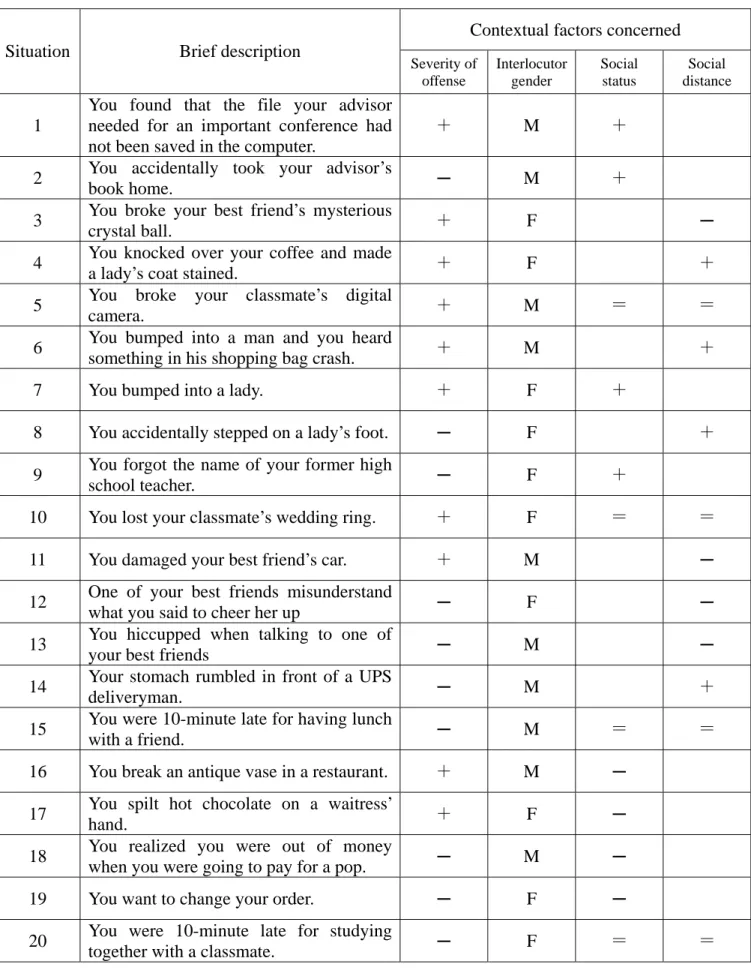
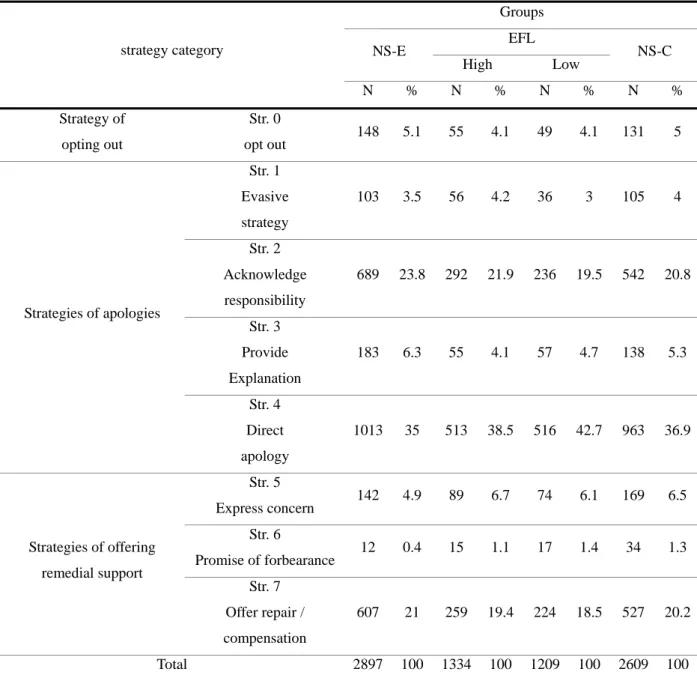
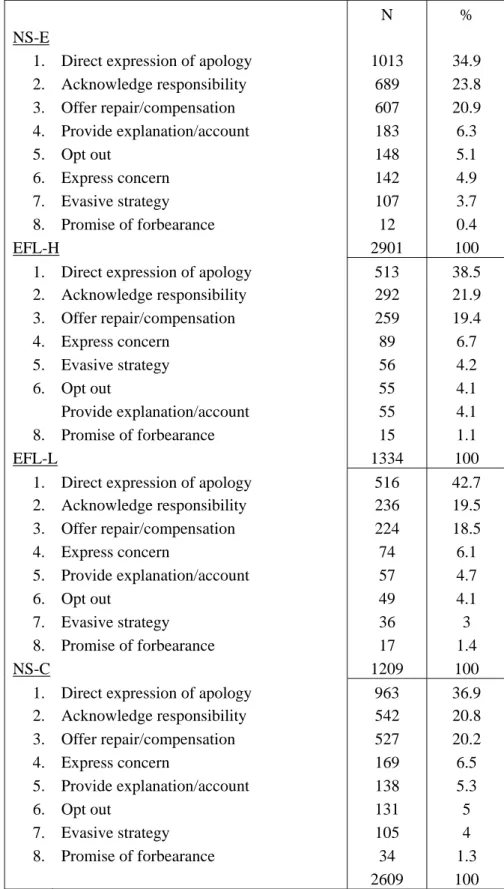
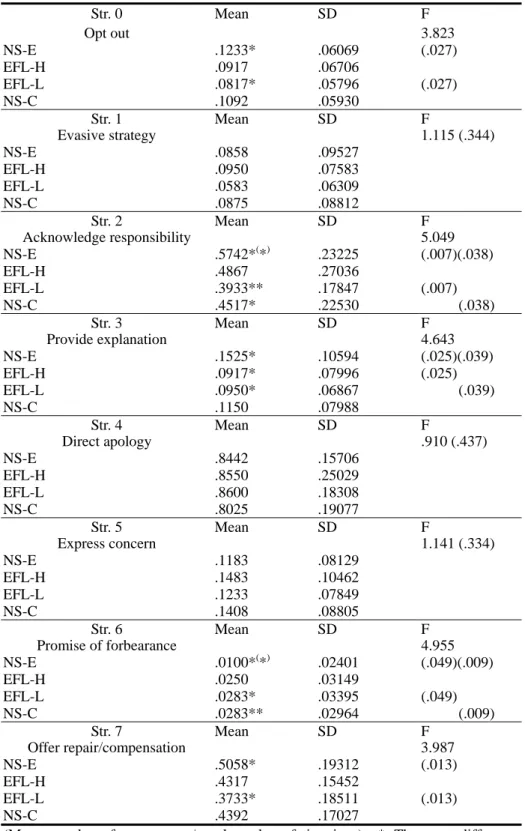
(7) 2.5. Previous Studies on The Speech Act of Apology ..................................................24 2.5.1. Studies on English Apology..........................................................................24. 2.5.2. Studies on Interlanguage Apology................................................................26 2.5.2.1. Instrument ............................................................................................27. 2.5.2.2. Universality and Specificity of the Speech Act of Apology ................27. 2.5.2.3. Effects of Contextual Factors on the Speech Act of Apology .............30. 2.5.2.4. L2 Proficiency Effect on Interlanguage Apology ................................31. 2.5.3. Studies on Chinese Apology .........................................................................32. 2.5.4. Summary of Previous Studies on the Speech Act of Apology......................33. CHAPTER 3. METHOD........................................................................................................35. 3.1. Informants ...............................................................................................................35. 3.2. Instrument ...............................................................................................................36 3.2.1. Rationale for Using DCT..............................................................................36. 3.2.2. Instrument in This Study...............................................................................37. 3.3. Procedures ...............................................................................................................41. 3.4. Coding System.........................................................................................................41 3.4.1. Strategy of Opting Out—Str. 0 .....................................................................42. 3.4.2. Strategies of Apologies—Str.1, Str. 2, Str.3, and Str. 4.................................44 3.4.2.1. Evasive Strategy—Str. 1 ......................................................................44. 3.4.2.2. Acknowledging Responsibility—Str. 2 ...............................................46. 3.4.2.3. Providing Explanation or Account—Str. 3 ..........................................48. 3.4.2.4. Direct Expression of Apology—Str. 4 .................................................49. 3.4.3. Strategies of Offering Remedial Support—Str.5, Str.6, and Str.7.................50. 3.4.3.1. Expressing Concern for the Hearer—Str. 5 .........................................50. 3.4.3.2. Offering Promise of Forbearance—Str. 6 ............................................51. vii.
(8) 3.4.3.3. Offering Repair or Compensation—Str. 7 ...........................................51. CHAPTER 4 RESULTS AND DISCUSSION .....................................................................53 4.1. Apology Strategy Use by NS-E, EFL, and NS-C..................................................53 4.1.1. The Number of Apology Strategies Used .....................................................53. 4.1.2. Overall Patterns of Apology Strategy Use by NS-E, EFL, and NS-C ..........55. 4.1.3. Direct Expression of Apology in English and Chinese.................................60. 4.1.4. Apology Strategy Use of NS-E vs. EFL .......................................................63. 4.1.5. Contextual Factors and Apology Strategy Use .............................................68. 4.1.5.1 Severity of Offense ..............................................................................68 4.1.5.2. Speaker Gender....................................................................................76. 4.1.5.3. Interlocutor Gender..............................................................................81. 4.1.5.4 Social Status.........................................................................................88 4.1.5.5 4.2. Social Distance ....................................................................................94. Effects of L2 Proficiency on Interlanguage Apology .........................................101 4.2.1. Apology Strategy Use.................................................................................101. 4.2.2. Negative Pragmatic Transfer ......................................................................102. 4.2.2.1. Negative Sociopragmatic Transfer.....................................................102. 4.2.2.2. Negative Pragmalinguistic Transfer ..................................................105. 4.2.3 CHAPTER 5. Syntactic and Lexical Errors.......................................................................110 CONCLUSION.............................................................................................116. 5.1. Summary ...............................................................................................................116. 5.2. Pedagogical Implications......................................................................................118. 5.3. Suggestions for Further Study .............................................................................119. REFERENCES .......................................................................................................................121 APPENDIX..............................................................................................................................133. viii.
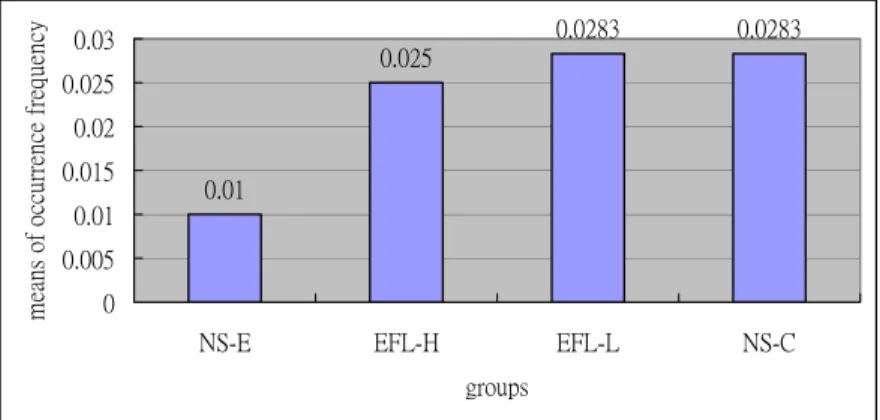
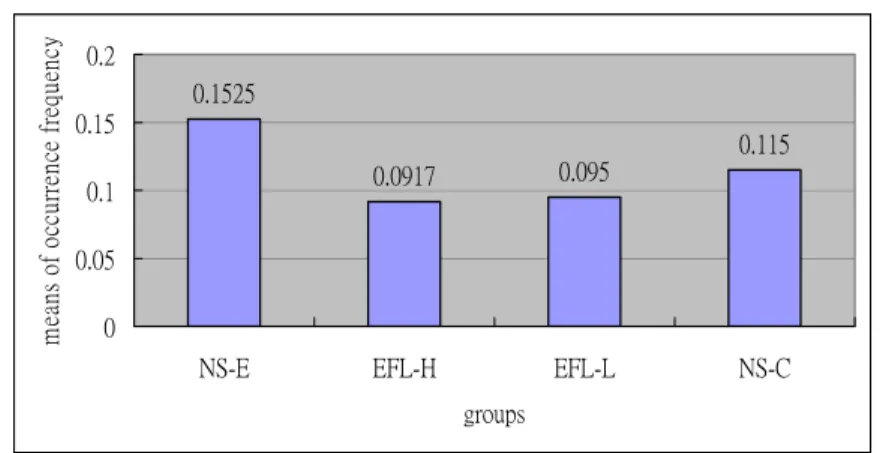
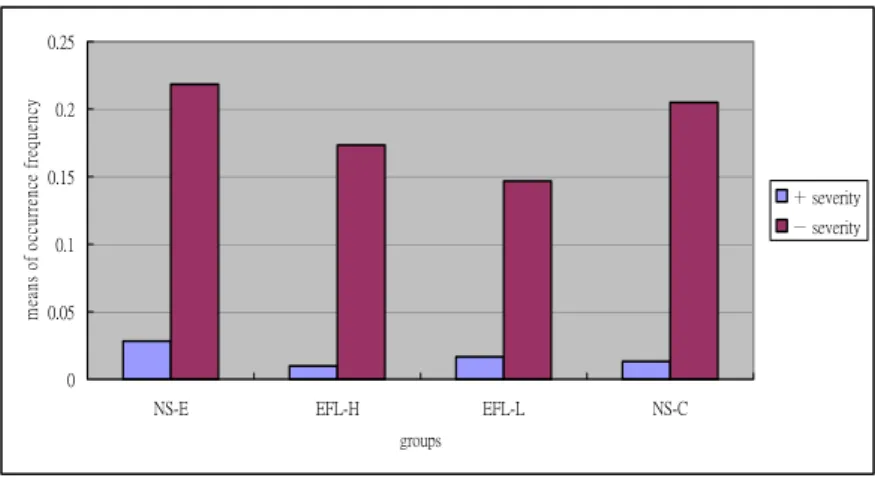
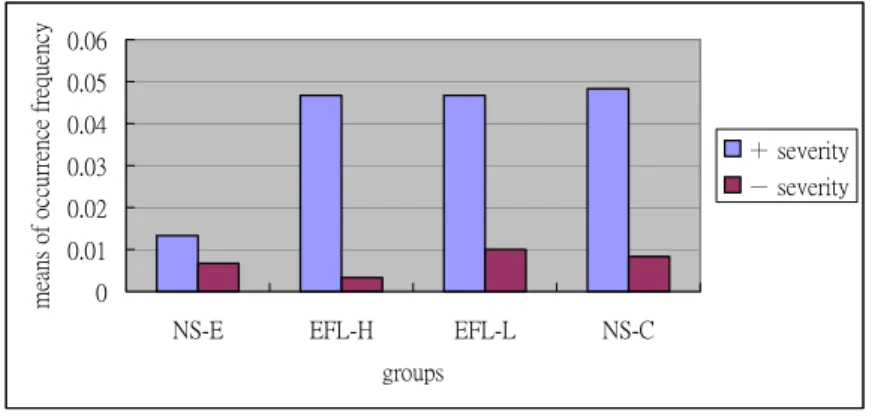
(9) APPENDIX A: Questionnaire: Chinese Version for NS-C .........................................133 APPENDIX B: Questionnaire: English Version for EFL............................................141 APPENDIX C: Questionnaire: English Version for NS-E ..........................................149. ix.
(10) LIST OF TABLES Table 1 The distribution of the contextual factors concerned in this study............................39 Table 2 Number of apology strategies used by NS-E, EFL-H, EFL-L, and NS-C ................54 Table 3 Means for the ratings to “likelihood to apologize” by NS-E and NS-C....................54 Table 4 Overall occurrence number and percentage frequency of the eight main apology strategies used by NS-E, EFL (EFL-H and EFL-L), and NS-C ................................56 Table 5 Overall apology strategy preference order of NS-E, EFL-H, EFL-L, and NS-C......59 Table 6 Means of occurrence frequency of apology strategies used by NS-E, EFL-H, EFL-L, and NS-C overall .......................................................................................................64 Table 7 Occurrence number and percentage frequency of apology strategies used by NS-E, EFL (EFL-H and EFL-L), and NS-C in relation to severity of offense ....................69 Table 8 Means of occurrence frequency of apology strategies used by NS-E, EFL-H, EFL-L, and NS-C in relation to severity of offense ...............................................................70 Table 9 Apology strategy preference order of NS-E, EFL-H, EFL-L, and NS-C in relation to severity of offense .....................................................................................................75 Table 10 Occurrence number and percentage frequency of apology strategies used by NS-E, EFL (EFL-H and EFL-L), and NS-C in relation to speaker gender ..........................76 Table 11 Means of occurrence frequency of apology strategies used by NS-E, EFL-H, EFL-L, and NS-C in relation to speaker gender........................................................77 Table 12 Apology strategy preference order of NS-E, EFL-H, EFL-L, and NS-C in relation to speaker gender.......................................................................................................80 Table 13 Occurrence number and percentage frequency of apology strategies used by NS-E, EFL (EFL-H and EFL-L), and NS-C in relation to interlocutor gender....................81 Table 14 Means of occurrence frequency of apology strategies used by NS-E, EFL-H, EFL-L, and NS-C in relation to interlocutor gender .................................................82. x.
(11) Table 15 Apology strategy preference order of NS-E, EFL-H, EFL-L, and NS-C in relation to interlocutor gender ................................................................................................87 Table 16 Occurrence number and percentage frequency of apology strategies used by NS-E, EFL (EFL-H and EFL-L), and NS-C in relation to social status...............................89 Table 17 Means of occurrence frequency of apology strategies used by NS-E, EFL-H, EFL-L, and NS-C in relation to social status ............................................................90 Table 18 Apology strategy preference order of NS-E, EFL-H, EFL-L, and NS-C in relation to social status ...........................................................................................................93 Table 19 Occurrence number and percentage frequency of apology strategies used by NS-E, EFL (EFL-H and EFL-L), and NS-C in relation to social distance...........................95 Table 20 Means of occurrence frequency of apology strategies used by NS-E, EFL-H, EFL-L, and NS-C in relation to social distance ........................................................96 Table 21 Apology strategy preference order of NS-E, EFL-H, EFL-L, and NS-C in relation to social distance......................................................................................................100 Table 22 Numbers of negative pragmalinguistic transfer in EFL learners’ interlanguage apologies..................................................................................................................106 Table 23 Numbers of syntactical and lexical errors in EFL learners’ interlanguage apologies .................................................................................................................................110. xi.
(12) LIST OF FIGURES Figure 1 Occurrence frequency of the eight main apology strategies used by NS-E, EFL (EFL-H and EFL-L), and NS-C...............................................................................57 Figure 2 Occurrence number of 對不起, 抱歉, and 不好意思 ..........................................61 Figure 3 Occurrence number of 對不起、抱歉 and 不好意思 in relation to severity of offense......................................................................................................................62 Figure 4 Means of occurrence frequency of “offering promise of forbearance” used by the four groups...............................................................................................................65 Figure 5 Means of occurrence frequency of “providing explanation or account” used by the four groups...............................................................................................................66 Figure 6 Means of occurrence frequency of “offering repair or compensation” used by the four groups...............................................................................................................66 Figure 7 Means of occurrence frequency of “acknowledging responsibility” used by the four groups ......................................................................................................................68 Figure 8 Means of occurrence frequency of “opting out” used by the four groups in relation to severity of offense................................................................................................71 Figure 9 Means of occurrence frequency of “providing explanation or account” used by the four groups in relation to severity of offense...........................................................72 Figure 10 Means of occurrence frequency of “direct expression of apology” used by the four groups in relation to severity of offense ..................................................................72 Figure 11 Means of occurrence frequency of “expressing concern” used by the four groups in relation to severity of offense ..............................................................................73 Figure 12 Means of occurrence frequency of “promise of forbearance” used by the four groups in relation to severity of offense ..................................................................73 Figure 13 Means of occurrence frequency of “offering repair” used by the four groups in xii.
(13) relation to severity of offense ..................................................................................73 Figure 14 Means of occurrence frequency of “acknowledging responsibility” used by the four groups in relation to severity of offense...........................................................74 Figure 15 Means of occurrence frequency of “opting out” used by the four groups in relation to speaker gender ........................................................................................78 Figure 16 Ratings of "severity of the offense" by NS-E and NS-C in relation to speaker gender ......................................................................................................................79 Figure 17 Means of occurrence frequency of “opting out” used by the four groups in relation to interlocutor gender..................................................................................83 Figure 18 Ratings of "severity of the offense" by NS-E and NS-C in relation to interlocutor gender ......................................................................................................................84 Figure 19 Means of occurrence frequency of “expressing concern” used by the four groups in relation to interlocutor gender .............................................................................85 Figure 20 Means of occurrence frequency of “promise of forbearance” used by the four groups in relation to interlocutor gender..................................................................85 Figure 21 Means of occurrence frequency of “offering repair” used by the four groups in relation to interlocutor gender..................................................................................86 Figure 22 Means of occurrence frequency of “opting out” used by the four groups in relation to social status.............................................................................................88 Figure 23 Means of occurrence frequency of “evasive strategy” used by the four groups in relation to social status.............................................................................................91 Figure 24 Means of occurrence frequency of “acknowledging responsibility” used by the four groups in relation to social status .....................................................................91 Figure 25 Means of occurrence frequency of “providing explanation or account” used by the four groups in relation to social status .....................................................................92. xiii.
(14) Figure 26 Means of occurrence frequency of “opting out” used by the four groups in relation to social distance.........................................................................................97 Figure 27 Means of occurrence frequency of “evasive strategy” used by the four groups in relation to social distance.........................................................................................98 Figure 28 Means of occurrence frequency of “acknowledging responsibility” used by the four groups in relation to social distance .................................................................98 Figure 29 Means of occurrence frequency of “providing explanation or account” used by the four groups in relation to social distance .................................................................98 Figure 30 Means of occurrence frequency of “direct expression of apology” used by the four groups in relation to social distance.........................................................................99. xiv.
(15) LIST OF ABBREVIATIONS NS-C: Native speakers of Chinese NS-E: Native speakers of English Chinese EFL learners: Chinese learners of English L1: First language L2: Second language SRQ: Scaled-response questionnaires DCT: Discourse Completion Tests. xv.
(16) CHAPTER 1. 1.1. INTRODUCTION. Background and Motivation. One of the significant implications of cross-cultural researches on pragmatics in recent years is that in intercultural communication, foreign language speakers not only need to acquire grammatical competence to achieve linguistic accuracy, but also need to internalize sociolinguistic rules to help them use appropriate linguistic forms. Foreign language speakers who have enough grammatical competence but have a lack of sociolinguistic awareness may encounter communicating problems with native speakers because of their being incompetent to use sociolinguistic rules properly or interpret those words correctly. Thus for foreign language speakers, internalizing those rules is important if they want to employ correct linguistic forms and know when or how to use these forms. Many empirical studies of speech acts have been conducted in this trend to gather information on what appropriate use of linguistic forms in different sociocultural contexts actually comprises (e.g., Beebe, Takahashi, & Uliss-Weltz, 1990; Bergman & Kasper, 1993; Blum-Kulka, 1991; Blum-Kulka, House, & Kasper, 1989; Cohen & Olshtain, 1981; Eisenstein & Bodman, 1986; Ellis, 1992; García, 1989; Liao & Bresnahan, 1996; Nakabachi, 1996; Trosborg, 1987, 1995; Yu, 1999a, 1999b, 2005). Those studies have contributed greatly to a better understanding of the use of linguistic forms in different languages and cultures and further to avoiding cross-cultural miscommunication. Speech acts in a variety of cultures and languages have been examined, including English, Hebrew, Russian, Danish, German, Spanish, Japanese (e.g., Bardovi-Harlig & Hartford, 1991; Beebe, Takahashi, & Uliss-Weltz, 1990; Boxer, 1993; Cohen & Olshtain, 1981, 1993; García, 1989, 1992, 1993; Gass & Houck, 1999; Holmes, 1989, 1990; House, 1988; Ide, 1998; Murphy & Neu, 1996; Olshtain, 1983; Trosborg,. 1.
(17) 1987, 1995), and so on. However, cross-cultural studies have paid relatively little attention to native Chinese speakers’ speech act behavior. To know more about the similarities and differences of sociolinguistic rules of Chinese and English and how Chinese EFL (English as a Foreign Language) learners differ from English native speakers in realization of sociolinguistic rules, this study examines the performance of native speakers of Chinese and English and Chinese EFL learners in apologizing.1 The reason why apologizing is chosen to be investigated in this study is that this speech act is often considered as playing an important politeness role in communication because it softens the threat to face and aims to maintain social harmony (Aijmer, 1996; Brown and Levinson, 1987; Edmondson, 1981; Holmes, 1990) and is thus necessary for successful cross-cultural communication. Furthermore, one of the issues investigated in cross-cultural pragmatic researches on pragmatics is the effect of target language proficiency levels on foreign language learners’ pragmatic development (e.g., Blum-Kulka & Olshtain, 1986; Maeshiba, Yoshinaga, Kasper, & Ross, 1996; Scarcella, 1979; Takahashi & Beebe, 1987; Trosborg, 1987, 1995), which, however, leads to contradicting findings. Therefore, the effect of target language proficiency levels on foreign language learners’ pragmatic development is also a factor explored in this study.. 1.2. Purpose of the Study. The objective of this study is to investigate Chinese EFL learners’ interlanguage apology through analyzing their apology strategy use in relation to particular contexts. More specifically, this study will examine the extent to which Chinese EFL learners differ from or. 1. Throughout this paper, Chinese refers to Mandarin Chinese. And the Chinese subjects and EFL subjects in this study come from Taiwan. Thus the claims made about their behaviors are based on the Taiwanese data and may not fit the behavior of Mainland Chinese speakers. Besides, the use of native speakers of English is specified to refer to Americans whose mother tongue is American English. 2.
(18) conform English native norms in terms of apologizing and investigate the effect of English proficiency on pragmatic performance of Chinese EFL learners in apologizing. Within the domain of Second Language Acquisition (SLA), this study will contribute to the understanding of cross-cultural communication by providing better understanding of the accessibility of apology strategies to Chinese EFL learners, and thus help language teachers figure out effective instruction methods to promote Chinese EFL learners’ pragmatic competence in apologizing. This study addresses the following questions: (1) How do Chinese EFL learners differ from English native speakers in their pragmatic speech act behavior as defined by apology communicative strategies in relation to different contextual factors? (2) To what extent does English proficiency affect Chinese EFL learners’ ability to approximate English native speakers in expressing apology?. 1.3. Overview of Chapters. Chapter two introduces the theoretical framework for this study by reviewing related literature on interlanguage pragmatics, speech act theory, and studies of apologies. Chapter three describes the informants, instruments, procedures, and coding system for this study. Chapter four presents the results of this study and offers some interpretations of the results. Finally, a summary of the main findings of this study, pedagogical implications of this study, and suggestions for further research are provided in Chapter five.. 3.
(19) CHAPTER 2. 2.1. LITERATURE REVIEW. Communicative Competence and Sociolinguistic Rules. The idea of communicative competence is originally derived from Chomsky’s (1965) distinction between competence and performance. He introduced the notion of “competence” to mean the shared knowledge of “the ideal speaker-listener in a completely homogeneous speech community” (Chomsky, 1965: 3). Such underlying knowledge enables a user of a language to understand and produce an infinite set of sentences out of a finite set of rules. On the other hand, according to Chomsky (1965), “performance” is concerned with the process of applying the underlying knowledge to the actual language use. However, based on the fact that performance can never completely reflect competence except under the ideal circumstances (e.g., the speaker and listener know and use language perfectly without making any mistakes), Hymes (1972) pointed out that Chomsky’s view of competence did not account for sociocultural factors or differential competence in a heterogeneous speech community and further introduced the notion of “communicative competence” to cover the knowledge a fluent speaker of a language must possess in order to understand and produce contextually comprehensible and appropriate utterances in a language. Applying this notion to the field of TESOL, Paulston (1974), as one of the earliest specialists in language teaching, suggested that second language classroom teaching should not merely stress on the grammatical accuracy but also incorporate rules of speaking into it. In 1980, Canale and Swain proposed their own theory of communicative competence, including four components—grammatical competence, strategic competence, discourse competence, and sociolinguistic competence (Canale and Swain, 1980). Grammatical competence includes knowledge of lexical items, morphology, syntax, semantics, and. 4.
(20) phonology in a language. Strategic competence consists of verbal and non-verbal communication strategies that may be used to compensate for communication breakdowns due to limiting conditions in actual communication or to insufficient grammatical competence. Discourse competence concerns mastery of how to combine grammatical forms and meanings to achieve a spoken or written text. Finally, sociolinguistic competence addresses the extent to which utterances are produced and interpreted appropriately in different sociolinguistic contexts. Canale (1983) went on to point out that appropriateness involves both appropriateness of meaning (i.e. when it is proper to perform a particular illocutionary act) and appropriateness of form (i.e. the extent to which a given act is realized in a verbal or non-vernal form proper for a given situation). By then, as Wolfson (1989) said, “the recognition of the need and usefulness of moving away from context-free grammar exercises and working to guide students to learn to communicate in meaningful ways was a critical step for applied linguistics” (Wolfson, 1989: 48). That is, the focus of second language teaching in the past was only on grammatical accuracy and forms of the language; however, with different propositions of communicative competence models or theories, the notion of communicative competence started to get more and more attention than before, and systematic instruction of speaking also started to gain its importance in second language classroom teaching.. 2.2. Communicative Competence and Pragmatics. The modern usage of pragmatics was first introduced by Morris (1938), who used this term broadly to refer to the study of “the relation of signs to interpreters” (Morris, 1938: 6). In 1962, Austin proposed a theory of pragmatic functions in his famous work How to do things with words, claiming that we do not just use language to say things but also to do things (Austin, 1962). With an attempt to differentiate pragmatics from other linguistic disciplines, Levinson. 5.
(21) (1983) claimed that pragmatics comprises the study of language usage, to be distinguished from syntax, which is the study of combinatorial properties of words and their parts, and from semantics, which is the study of meaning. Based on Levinson’s claim, Leech (1983) redefined pragmatics as “any background knowledge assumed to be shared by the speaker and the hearer and contributes to the hearer’s interpretation of what the speaker means by a given utterance” (Leech, 1983: 13) and he also distinguished “pragmatic meaning” which is relative to a speaker or user of a language from “semantic meaning” which is purely a property of expressions in a given language. Pragmatic competence was considered as a component of communicative competence by Bachman (1990). In his communicative competence model, pragmatic competence includes illocutionary competence to express and understand the illocutionary force of language functions and sociolinguistic competence to make contextually appropriate utterances. And in this trend, Crystal (1985) proposed: “pragmatics is the study of language from the point of view of users, especially of the choices they make, the constraints they encounter in using language in social interactions, and the effects their use of language has on other participants in the act of communication” Crystal, 1985: 240). In other words, pragmatics is the study of communicative action in its sociocultural context. Bialystok (1993) further claimed that acquiring pragmatic competence requires language learners to have the ability to make use of different language functions, the ability to understand the speakers’ underlying intention; and the ability to modify the speech according to contexts. Actually, there has been a great deal of overlap between sociolinguistic competence and pragmatic competence due to the fact that they both make reference to the appropriateness of language use depending on different contexts. Paralleling this fact, Leech (1983) and Thomas (1983) divided pragmatics into two components: one is pragmalinguistic, referring to the pragmatic strategies, routines, and a large of linguistic forms to convey communicative action,. 6.
(22) and the other is sociopragmatics, referring to the social perceptions underlying participants’ interpretation and performance of communicative action. Moreover, in Bachman’s (1990) model of communicative competence as mentioned above, pragmatic competence was broadened to include both illocutionary competence and sociolinguistic competence. Similarly, Cohen (1996) proposed two distinct levels of abilities required for pragmatic competence: one is sociocultural ability to choose speech act appropriate for the given contexts and the other is sociolinguistic ability to choose the actual language forms for realizing the speech act. To sum up, pragmatics can be summarized as that “it is the study of how language is used in communication”, and “it covers a wide range of phenomena including the ways in which language encodes features of the context of utterance, conversational implicatures and presupposition, the use of language to perform speech acts, conversational structure, and the conversational work undertaken to deal with miscommunications of various kinds” (Ellis, 1994: 23).. 2.3 2.3.1. Pragmatics and SLA Interlanguage Pragmatics in SLA. Early work in SLA research focused on explaining how learners acquired grammatical competence but paid little attention to pragmatic aspects of interlanguage. Only recently have researchers considered the acquisition of pragmatic competence in its own right and been giving attention to pragmatic aspects of interlanguage. According to Ellis (1994), this has been motivated not only by the belief that a full understanding of how formal properties are learnt will not be achieved without examining the way in which these properties are used in actual communication, but also by the belief that the study of interlanguage requires a consideration of pragmatic aspects.. 7.
(23) The growing interest in interlanguage pragmatics reflects the enormous developments in the theoretical and empirical study of pragmatics (see Levinson, 1983, Hatch, 1992, for review). In Kasper and Rose’s (1999) article “Pragmatics and SLA”, they claimed, “Pragmatics has two roles in SLA: It acts as a constraint on linguistic forms and their acquisition, and it represents a type of communicative knowledge and object of second language (L2) learning in its own right” (Kasper & Rose, 1999: 81). Focusing on language learners’ knowledge, use, and acquisition of L2 pragmatics, they also introduced the term “interlanguage pragmatics” to refer to “the study of nonnative speakers’ use and acquisition of L2 pragmatic knowledge” (Kasper & Rose, 1999: 81). A lot of researches on interlanguage pragmatics have been conducted by now (see Ellis, 1994; Kasper & Rose, 1999 for review). Most of them have focused on L2 pragmatic use, investigating. cross-cultural. perception. and. comprehension. of. illocutionary. force,. cross-cultural pragmatic success and failure, and the impact of contextual factors on selection of semantic formulas, realization strategies, and linguistic forms and have found that languages differ significantly as to when a particular form should be performed and with what strategy (e.g., Blum-Kulka & Olshtain, 1986; Koike, 1996; Maeshiba et al., 1996; Olshtain & Blum-Kulka, 1985; Scarcella, 1979; Takahashi, 1996; Takahashi & Beebe, 1987; Trosborg, 1987, 1995). And the finding that different cultures have different conventional language use implies that L2 learners have to learn the conventions of language use in order to behave appropriately in terms of use of native-like routines and the social values of the target language community. Therefore, for applied linguists, especially for those concerned with L2 learning and teaching, these cross-cultural researches in pragmatics are essential because they have contributed greatly to a better understanding of the conventions of language use in different languages and cultures.. 8.
(24) 2.3.2. Pragmatic Universality and Culture-specificity. When it comes to linguistic behavior like speech acts, the issue of language universality versus language culture-specificity has been of great interest to cross-cultural research on pragmatics. Some scholars have claimed that speech acts are operated by universal pragmatic principles and by some general mechanisms such as cooperative principles, conversational maxims, or politeness principles. For example, Austin (1962) claimed that speech acts are semantic universals and thus not cultural-bound. Searle (1975), supporting Austin’s claim, maintained that in different languages and cultures, there are general norms for realizing and producing speech acts. Besides, in the study investigating cross-cultural apology behavior, Cohen and Olshtain (1981) found that nonnative speakers utilized the same semantic formulas as native speakers when their proficiency permitted it. Furthermore, Fraser (1985), by comparing request strategies in different languages, argued for a universalistic stand in speech act as well. And on the basis of the similarity found to be shared by speech act realizations in across languages or cultures, he suggested that L2 learners do not have to be taught how to “code their intentions” in L2 learning (Fraser, 1985). In addition, the pragmatic universality in the realization patterns of speech acts was also examined by Blum-Kulka, House, and Kasper (1989). They engaged in a comprehensive speech act study—the Cross Cultural Speech Act Realization Project—to examine the universal pragmatic realization patterns of requests and apologies, and their findings supported the claim for universal categories of main request and apology strategies. The universality in speech act realization was also claimed by Kasper (1992), who argued for a universal availability of general pragmatic knowledge and suggested that as L2 learners’ language proficiency permits it, they have access to the same range of strategies used by native speakers. Yet, other scholars reported contradicting findings by maintaining that speech acts vary in. 9.
(25) both conceptualization and verbalization across languages or cultures and the speech act performance is mainly influenced by differences of cultural conventions and social values. For example, by comparing indirect strategies cross-linguistically, Blum-Kulka (1982) argued: “conventional indirect speech acts represent a special case of interdependence between conventions of language and conventions about the use of language” (Blum-Kulka, 1982:33). And in the comprehensive speech act study conducted by Blum-Kulka, House, and Kasper (1989), though the findings supported the claim for universal pragmatic realization patterns of request and apology strategies, however, the findings also indicated not only that the particular manifestations of these strategies were not similar across languages, but that these strategies carried different social meanings across cultures. Moreover, the culture-specificity of speech acts was also claimed by Weirzbicka (1991), who, by providing examples from Polish and Japanese, argued that when and how to perform certain speech acts is based on cultural norms and values rather than on universal principles. Summarized from those comparative studies investigating the speech act performance in different languages or cultures, it has become evident that although the categories of speech acts appear to be universal, their conceptualization and verbalization can vary to a great extent across languages or cultures. That is, speakers of different languages may have access to the same range of speech acts, but they may differ in their strategy selection in relation to different contexts. Accordingly, cross-cultural miscommunication may result not from poor linguistic competence but from a lack of understanding of cultural differences. In this respect, L2 learners must be aware of L2 sociocultural constraints on speech acts in order to be pragmatically competent.. 2.3.3. Pragmatic Transfer. The notion of “transfer” was first introduced during the 1940s and 1950s. The amazing effect. 10.
(26) that first language (L1) had on L2 use led researchers to forward the contrastive analysis hypothesis. In those days, there were two widely held beliefs. Firstly, that the L1 strongly influenced the L2, and secondly, that the influence of L1 on L2 was negative. In this respect, contrastive analysts (e.g., Fries, 1945; Lado, 1957) believed the L1 interfered with L2 learning and claimed: “those elements that are similar to L2 learner’s native language will be simple for him, and those elements that are different will be difficult” (Lado, 1957:2). This claim that linguistic differences could be used to predict language learning difficulty produced the notion: “where two languages were different, there would be negative transfer or interference and that where two languages were similar, there would be positive transfer” (Larsen-Freeman & Long, 1991: 53). As soon as the 1970s, Chomsky’s claims for a cognitive approach to SLA which emphasized the developmental nature of language acquisition led to two different ways to account for the role of the L1 in SLA. In one, transfer was treated as one of several processes involved in SLA (e.g., James, 1971; Nemser, 1971; Selinker, 1972). In the other one, the emphasis is on the contribution of universal processes of language learning and the similarity between L1 and L2 acquisition (e.g., Flynn & O'Neil, 1988, White, 1989). However, either of the two ways of dealing with “transfer” was concerned with learners’ phonological, morphological and syntactic knowledge, i.e., their linguistic competence. With the adaptation of communicative competence to L2 learning and teaching, “transfer” has a much broader scope, including learners’ pragmatic and discourse knowledge. It is hard to reach a comprehensive and sound definition of “pragmatic transfer” because “both component parts of the phrase are problematic as they have been used with different meanings or with similar meanings but under different labels” (Bou, 1998: 8). For example, pragmatic transfer has been referred to as sociolinguistic transfer by Wolfson (1989), has been referred to as L1 sociocultural competence or cross-linguistic influence by Beebe et al. (1990),. 11.
(27) and has been referred to as transfer of conversational features or as discourse transfer by Odlin (1989). However, up to now, “pragmatic transfer” has been maintained in recent studies (e.g., Bardovi-Harlig, 1999; Kasper & Rose, 1999; Takahashi, 1996) as it is understood by Kasper (1992) who used this term to refer to the influence that previous pragmatic knowledge has on the use and acquisition of L2 pragmatic knowledge.. 2.3.4. Types of Pragmatic Transfer: Pragmalinguistics and Sociopragmatics. Under the claim of pragmatic transfer, it is assumed that cross-cultural miscommunication is often caused by the interference of learners’ L1 sociocultural norms and conventions with the realization of speech acts in a target language (Takahashi, 1996). A lot of interlanguage pragmatic studies have been conducted to examine what is negatively transferred from L1 to L2 contexts. Some of them investigated L1 transfer in learners’ perception as to a certain speech act and overall speech style (e.g., Beebe et al. 1990; Bergman & Kasper, 1993; Cohen & Olshtain, 1981; House, 1988; Olshtain, 1983; Scarcella, 1983). Others investigated L1 influences on learners’ production of speech acts in L2 (e.g., Beebe et al., 1990; Bergman & Kasper, 1993; Blum-Kulka, 1982, 1983; Faerch & Kasper, 1989; House, 1988; House & Kasper, 1987; Maeshiba et al., 1996; Olshtain, 1983; Olshtain & Blum-Kulka, 1985; Takahashi & Dufon, 1989; Takahashi, 1996; Trosborg, 1987, 1995). These studies clearly demonstrated that transfer exists at the pragmatic level, but in different types. Based on the inseparable relationship between language and culture, Kasper (1992). identified. two. types. of. pragmatic. transfer:. sociopragmatic. transfer. and. pragmalinguistic transfer. This sociopragmatic and pragmalinguistic dichotomy is not only useful in cross-cultural pragmatic research and in language learning and teaching, but it also provides an adequate framework for the study of pragmatic transfer in interlanguage pragmatics (Bou, 1998).. 12.
(28) Sociopragmatic transfer has been found to be operative in learners’ perceptions of contextual factors, such as imposition, social status, and social distance (Beebe et al., 1990; Takahashi & Beebe, 1993); learners’ assessment about whether a particular linguistic action is socially appropriate (Robinson, 1992), and learners’ overall politeness style adopted in contexts (Blum-Kulka, 1982; Garcia, 1989; Olshtain & Cohen, 1989). Therefore, Kasper (1992) claimed that both context-external factors and context-internal factors have effects on sociolinguistic transfer and claimed: “sociopragmatic transfer is operative when the social perceptions underlying language learners’ interpretation and performance of linguistic action in L2 are influenced by their assessment of subjectively equivalent L1 contexts” (Kasper, 1992: 209). On the other hand, pragmalinguistic transfer has been found to be operative in learners’ use of conventional means and forms, affecting the illocutionary force and politeness values of interlanguage utterances (Beebe et al., 1990; Bodman & Eisenstein, 1988; House, 1988; House & Kasper, 1987). And Kasper (1992), dealing with illocutionary force and politeness values, provided “pragmalinguistic transfer” a definition as “pragmalinguistic transfer shall designate the process whereby the illocutionary force or politeness value assigned to particular linguistic material in L1 influence learners’ perception and production of form-function mappings in L2 (Kasper, 1992: 209).. 2.3.5. Transferability Constraints of Pragmatic Transfer. Interlanguage and cross-cultural pragmatic studies have investigated the influence of L2 learners’ L1 pragmatic knowledge on their comprehension and production of L2 pragmatic performance in a wide range of areas of speech acts (see Kasper, 1992 for a review). Although, there is no agreement as to which or to what extent conditions operate in the process of pragmatic transfer, some of the conditions have been identified to affect the occurrence of. 13.
(29) pragmatic transfer. And according to Bou (1998), the conditions that promote or inhibit the transfer are called “transferability constraints” (Bou, 1998: 9). One of the constraints affecting pragmatic transferability is learner’s perception of pragmatic universality or specificity (e.g., Blum-Kulka, 1982, 1983; Bodman & Eisenstein, 1988; House & Kasper, 1987, Olshtain, 1983; Takahashi, 1992, 1993). Some studies investigating the influence of L1 pragmatic knowledge on L2 pragmatic performance demonstrated that learners may not transfer L1 pragmatic features to the L2 if they perceive L1 pragmatic features as language-specific (e.g., House & Kasper, 1987). Other studies demonstrated that transfer from the L1 to the L2 occurs when learners perceive L1 pragmatic features as universal (e.g., Olshtain, 1983). Another transferability constraint that has been used to explain the occurrence of pragmatic transfer is the length of stay in the L2 community. As to length of stay in the L2 community, some researches have demonstrated that this is a positive factor in L2 pragmatic development. For example, Blum-Kulka and Olshtain (1986) reported an increase in acceptance of direct request strategies by nonnative speakers of Hebrew as their length of stay in Israel increased. Besides, in a longitudinal study of nonnative speakers who had just arrived at an American university, Bardovi-Harlig and Hartford (1993) found that nonnative speakers showed an increase in the use of speech acts favored by native speakers in the academic context and showed a decrease in speech acts not used by native speakers as length of stay increased. Similarly, Bouton (1992, 1994) also found that ESL learners enrolled at an American university without any specific pragmatic training became increasingly target-like in their implicature interpretation as length of stay increased. In contradiction, Kasper (1992) made an opposite claim that long length of stay in the L2 community does not guarantee high levels of pragmatic competence because “extended residence in the target community does not in and of itself make negative pragmatic transfer go away” (Kasper, 1992: 220).. 14.
(30) In addition, the constraint “cultural information” is also considered as an influential factor on the amount of transfer. For example, in their study on expressions of gratitude by native and nonnative speakers of English, Eisenstein and Bodman (1986) found that advanced nonnative English speakers had considerable difficulty adequately expressing gratitude in English. Some problems were pragmalinguistic in nature, exhibiting divergence from native use on lexical and syntactic levels. However, in their judgment, sociopragmatic limitations were more severe, because the sociocultural incongruities nonnatives revealed created the potential for more serious misunderstandings. Finally, another transferability constraint concerned to have effects on pragmatics transfer is L2 linguistic proficiency, which is also the transferability constraint concerned in this study. There have been many studies that have examined the relationship between L2 learners’ pragmatic performance of a particular speech act and their L2 proficiency (see Bardovi-Harlig, 1999; Kasper, 2001; Kasper & Ross, 1999, for a comprehensive review of the literature). For example, in the study on interlanguage apology made by Hebrew speakers who were intermediate-level learners of English, Cohen & Olshtain (1981) found that when compared with native speakers, the nonnatives occasionally underutilized some apology strategies and used less modifications of the main strategies to intensify their expression of apology. However, in their study on Hebrew speakers who were advanced-level learners of English, this was not found to be the case. Most likely the negative transfer was no longer prevalent among the more advanced learners (Cohen, Olshtain, & Rosenstein, 1986). In another study on interlanguage apology, Trosborg (1987) compared the apologies of native speakers of English and Danish and Danish EFL learners at three levels. She found that the use of modality markers by EFL learners increased with their English proficiency, and she also noted that EFL learners’ repertoires of pragmatic forms and linguistic means of speech act realization expanded with their increasing English proficiency. In addition, in the study on. 15.
(31) English directives performed by Japanese EFL learners at different English proficiency levels, Takahashi and DuFon (1989) found that as learners’ English proficiency increased, they moved from a preference for more indirect request strategies to more direct, native-like strategies. Furthermore, in the study about effects of English proficiency on interlanguage apologizing of Japanese EFL learners, Maeshiba, Yoshinaga, Kasper, & Ross (1996) found that where Japanese’s and Americans’ perceptions about contextual factors converged, advanced learners were better than intermediate learners to use the same strategies in their interlanguage apologizing. However, other studies have reported contradicting findings. In the study on Japanese learners of English, Takahashi & Beebe (1987) found that high-proficiency Japanese learners of English as a second language (ESL) transferred more L1 sociocultural norms to L2 and made more pragmatic errors in their refusals than the low-proficiency Japanese ESL learners, which suggests that a high level of L2 proficiency may be correlated positively with negative pragmatic development. Besides, in the study examining the transferability of Japanese indirect request strategies to corresponding English request contexts, Takahashi (1996) reported that “little proficiency effect seemed to be operative in the learners’ transferability perception of L1 request strategies” (Takahashi, 1996: 208). That is, regardless of their L2 proficiency, learners tended to rely on L1 request conventions when making requests in the L2. And in Kasper and Schmidt’s (1996) review of developmental issues in interlanguage pragmatics, they claimed that there is no clear tendency for a positive or negative correlation between learners’ L2 proficiency and the transferability at the pragmatic level. That is, learners’ L2 proficiency may have little effect on their interlanguage pragmatic performance. The different results of the effect of L2 proficiency on interlanguage pragmatics suggest that proficiency effects on transfer and transferability should be further examined from different perspectives, such as, based on Takahashi’s (1996) suggestion, sociopragmatic. 16.
(32) knowledge versus pragmalinguistic knowledge and perception of L2 information versus L2 productive use.. 2.3.6. Cross-cultural Pragmatic Failure and Implication to Language Teaching. Thomas (1983) introduced the term “pragmatic failure” to refer to the inability to understand “what is meant by what is said” (Thomas, 1983: 91). According to Thomas (1983), there are two main types of pragmatic failure: sociopragmatic failure and pragmalinguistic failure. Sociopragmatic failure refers to the mismatches which arise from different assessments of some contextual factors in different cultures, such as size of imposition, social status, social distance, and relative rights and obligation, etc. That is, “sociopragmatic failure takes place when a learner fails to perform the illocutionary act required by the situation (i.e. deviates with regard to appropriateness of meaning)” (Ellis, 1994: 165). An example of sociopragmatic failure is how L2 learners typically respond to compliments. Wolfson (1989) found that compliments are used frequently to establish and maintain solidarity by native English speakers and the compliment/response sequences involving native speakers are usually long and elaborate; however, learners often fail to give compliments or to give appropriate responses to compliments and their compliment/response sequences are thus typically short. On the other hand, pragmalinguistic failure refers to communicative breakdown which “occurs when the pragmatic force mapped by nonnative speakers onto a given utterance is systematically different from the force most frequently assigned to it by native speakers of the target language, or when speech act strategies are inappropriately transferred from L1 to L2” (Thomas, 1983: 99).. That is, “pragmalinguistic failure occurs when a learner tries to perform. the right speech act but uses the wrong linguistic means (i.e. deviates with regard to appropriateness of form)” (Ellis, 1994: 167). For example, Can you X? is a highly conventionalized form in English, likely to be interpreted by English native speakers as a. 17.
(33) request to do X, rather than as a question about one’s ability to do X. However, the opposite is the case in other languages like French and Russian. Pragmatic failure is a major source of cross-cultural communication breakdown; however, language teachers and textbook writers have paid very little attention to it (Thomas, 1983). According to Thomas (1983: 97), the reasons why cross-cultural pragmatic instruction has been ignored are as follows: “Firstly, pragmatic description has not yet reached the level of precision which grammar has attained in describing linguistic competence. Secondly, pragmatics is a delicate area and it is not immediately obvious how it can be taught.” Pragmatic failure is thus an area of cross-cultural communication breakdown which has received very little attention from language teachers. In order to cultivate language learners’ pragmatic competence, some scholars proposed the following aspects to adhere to in the process of language teaching and learning. Firstly, Feez (1998) proposed the text-based language learning by means of authentic materials. He claimed that text-based language learning puts much emphasis on the contexts and cultural information of the target language which is required for learners’ L2 pragmatic development. Secondly, Thomas (1983) suggested that in L2 classroom teaching and learning, it is important to study not only the target language itself, but the utterance meanings in relation to different contexts, that is, the illocutionary force of utterances under various circumstances. Finally, House and Kasper (1981) claimed for explicit teaching of the use of politeness markers in the target language. They suggested that language teachers have to explicitly point out to learners that politeness markers are an integral part of the foreign cultural system, and should neither be used nor interpreted by reference to learners’ native system. Besides, they further suggested that more effective teaching of the appropriate behavior in foreign cultures may minimize native cultural interference and prevent impolite, ineffective, or otherwise inappropriate behavior on the part of the learner.. 18.
(34) 2.4. The Speech Act of Apology. 2.4.1. Speech Act Theory. Fascinated with how speakers can produce an infinite number of sentences when given a finite set of rules for sentences, some scholars (e.g. Austin, 1962; Searle, 1969; Hymes, 1972) have tried to understand how an infinite number of sentences can reflect a finite set of rules. Based on the assumption that the minimal units of human linguistic communication are not linguistic expressions, but rather the performance of certain kinds of acts, such as making statements, asking questions, giving directions, these scholars have offered insight into speech act theory with an attempt to explain how speakers use language to accomplish intended actions and how hearers infer intended meaning from what is said. Austin (1962), in his famous work How to do things with words, claimed that communication is a series of communicative acts which are used systematically to accomplish particular purposes, and that all utterances perform specific actions by having a specific force assigned to them. According to Austin, the performance of a speech act involves the performance of three types of act: (1) Locutionary act: the utterance of a sentence with determinate sense and reference, that is, the literal meaning of the utterance (2) Illocutionary act: “the making of a statement, offer, promise, etc., in uttering a sentence by virtue of the conventional force associated with it or with its explicit performative paraphrase”, that is, the illocutionary act carried out by an utterance enables the saying of something to convey more than what it literally said (3) Perlocutionary act: the bringing about of effects on the audience by means of uttering the sentence, such effects being special to the circumstances of utterance. Building on Austin’s work, Searle (1969) claimed that the basic unit of human linguistic communication is illocutionary acts which are rule-governed forms of behavior. He presented. 19.
(35) five basic kinds of actions that one can perform in an utterance: (1) Representatives which commit the speaker to the truth of the expected proposition (i.e., asserting, concluding) (2) Directives which are attempts by the speaker to get the addressee to do something (i.e., requesting, questioning) (3) Commissives which commit the speaker to some future course of action (i.e., promising, threatening, offering) (4) Expressives which express a psychological state (i.e., thanking, apologizing, complimenting, welcoming) (5) Declarations which affect immediate change in the institutional state of affairs and which tend to rely on elaborate extra-linguistic institutions (i.e., christening, declaring war) Based on Austin and Searle, Hymes (1972) proposed a distinction between speech situation, speech events, and speech acts. This distinction provides a framework for studying communicative competence. And in this framework, speech situation is placed at the top, speech events comes second, and speech acts are at the bottom. According to this framework, there are many speech situations in a speech community (e.g., meals, parties, auctions, and conferences); however, they are not governed by consistent rules. Speech events are restricted to activities directly governed by rules of speech (e.g., lectures, introductions, advertising). Speech acts, as at the bottom of this scale, refer to the acts performed by speaking (e.g., giving reports, giving advice, agreeing, complaining, apologizing), and are thus defined in terms of discourse functions. Scholars, like Austin, Searle, and Hymes, made great contribution to building up the preliminary speech act theory. From their theories, it is realized that when people communicate with others by issuing utterances, they not only make prepositional statements. 20.
(36) about objects, contents, and situations, but also fulfill social functions, such as greeting, inviting, refusing, apologizing, complaining, through the use of a string of fabricated words, namely speech acts (Nunan, 1999). Therefore, to summarize, though there are different speech act theories proposed by different scholars, all these theories have the attempt to explain how people use language to accomplish certain communicative goals.. 2.4.2. Application of Speech Act Theory. After the pioneering work mentioned in the previous section, studies of speech acts turned into a search for the sequences and responses of each speech act (e.g., Beebe & Takahashi, 1989; Boxer, 1993; Edmundson, 1992; Eisenstein & Bodman, 1995; García, 1992, 1993; Holmes, 1989, 1990), and the results of these empirical studies have provided pedagogical implications to language teaching. First, empirical studies of speech acts which have been undertaken to gather information on what appropriate use of linguistic forms in different sociocultural contexts actually comprises have shown that nonnative speakers may fail to communicate effectively in a given context by uttering inappropriate linguistic forms even though their command of grammar and vocabulary is fine (Blum-Kulka, 1982; Eisenstein and Bodman, 1986; Rintell, 1981; Rubin, 1983; Thomas, 1983; Wolfson, 1981). It is thus claimed by Olshtain and Cohen (1983) that the most important realization for language teaching is the fact that effective communication involves the processing of social knowledge as well as linguistic knowledge. Second, since speech act theory looks beyond the level of the sentence to the question of what sentences do and how they do it, its application to SLA gave birth to the notional functional syllabus in language teaching which focuses on functions as the organizing elements of the language curriculum instead of grammar (e.g., Finnochiaro & Brumfit, 1983; Paulston, 1981). This brought about a major change in language teaching methodology away. 21.
(37) from an emphasis on linguistic form to language use.. 2.4.3. The Communicative Act of Apologizing. There have been a variety of studies exploring the formulas, functions and preconditions of the speech act apology (e.g., Blum-Kulka & Olshtain, 1984a, 1984b; Borkin & Reinhart, 1978; Edmondson & House, 1981; Fraser, 1981; Goffman, 1971; Holmes, 1989; Leech, 1983; Norrick, 1978; Olshtain & Cohen, 1983; Owen, 1983; Searle, 1969; Trosborg, 1987, 1995). Firstly, according to Blum-Kulka and Olshtain (1984a), there are three preconditions for the apology act to take place (Blum-Kulka & Olshtain, 1984a: 206): (1) The apologizer2 did a violation or abstained from doing a violation (or is about to do it). (2) A violation is perceived by the apologizer only, by the hearer only, by both the apologizer and the hearer, or by a third party as a breach of a social norm. (3) A violation is perceived by at least one of the parties involved as offending, harming, or affecting the hearer in some way.. Simplified by Trosborg (1995), the precondition for the apology act is as follows: “There are two participants: an apologizer and a recipient of the apology. When a person has performed an act (action or utterance), or failed to do so, which has offended another person, and for which he/she can be held responsible, the offender needs to apologize. That is, the act of apologizing requires an action or an utterance which is intended to set things right.” (Trosborg, 1995: 373). Secondly, as far as the functions of apology are concerned, apologies, in a general sense, are expressive illocutionary acts, the goal of which coincides with the social goal of 2. The word “apologizer” refers to the person who is supposed to give an apology no matter he/she gives the apology or not, and on the other hand, the word “hearer” refers to the person who is offended in the situation and deserves an apology. 22.
(38) maintaining harmony between speaker and hearer (Leech, 1983). On the one hand, apologies can be viewed as a remedial act. For example, Edmondson (1981) highlighted the central function of apologies as to provide a remedy for an offense and store social equilibrium or harmony; in addition, Olshtain and Cohen (1983) claimed that apologies are called for when social norms have been violated because apologies have the effect of paying off a debt. On the other hand, apologies can also be viewed as a face-saving act. As Trosborg (1995) claimed, in apologies, “there is an element of face-saving involved with regard to a protective orientation towards saving the interlocutor’s face and also with regard to a defensive orientation towards saving one’s own face” (Trosborg, 1995: 374). Based on different functions of the apology act, the broad definition of an apology can be summarized as that “an apology is a speech act addressed to the hearer’s face-needs and intended to remedy an offense for which the apologizer takes responsibility, and thus to restore equilibrium between the apologizer and the hearer” (Holmes, 1989: 196). Finally, as far as the formulas of apology are concerned, one of the studies concerning with this was conducted by Goffman (1971). He distinguished between positive ritual and negative ritual and claimed that positive rituals occur because of a need for mutual support, while negative rituals occur when infractions have been done. In the former case, an expression of gratitude should be provided, while in the latter case, remedial explanations, accounts, repair, or assurances should be offered, and thus a “remedial interchange” occurs. In what he called “remedial interchange”, Goffman observed that speakers attempt to remedy unpleasant social situations by offering an apology and observed that apologies occur in many different formulas according to different situations. Borkin and Reinhart (1978) further examined two different but often functionally similar phrases “excuse me” and “I’m sorry”. They found that though both of these two formulas can be used as remedies in what Goffman (1971) calls “remedial interchanges”, they actually have. 23.
(39) different apologizing effects and their distribution is governed by some social generalizations. Based on extensive observation, Borkin and Reinhart defined “excuse me” as a formula to “remedy a past or immediately forthcoming breach of etiquette or other light infraction of a social rule on the part of the speaker”, while “I’m sorry” was defined as “an expression of dismay or regret at an unpleasantness suffered by the speaker and/or the addressee” (Borkin & Reinhart, 1978: 61). The accuracy of Borkin and Reinhart’s analysis has been supported by Owen (1983) and Fraser (1981). Owen claimed that the primary remedial formulas in a remedial interchange varies from ritual to substantive and that the most frequent expression of a primary remedial formulas in English is to include the key word sorry in it. Moreover, by analyzing the strategies used in apologizing, Fraser found that in cases where social norms are broken, people tend to give apologies by providing explanation or account for why the infraction happened in the first place. However, in cases where injury or some sort of serious inconvenience is caused, people tend to offer some form of redress instead of simply accounting for their action.. 2.5. Previous Studies on The Speech Act of Apology. There have been a lot of studies conducted to investigate the speech act of apology. In this section, these studies are introduced in the sequence of studies on English apology, studies on interlanguage apology, and studies on Chinese apology.. 2.5.1. Studies on English Apology. One of the studies on English apology was conducted by Borkin and Reinhart in 1978. They examined the use of two apology formulas, excuse me and I’m sorry, which are used very frequently and have very similar functions, and based on their extensive observation about. 24.
數據

+7

相關文件
Teachers may consider the school’s aims and conditions or even the language environment to select the most appropriate approach according to students’ need and ability; or develop
In 2006, most School Heads perceived that the NET’s role as primarily to collaborate with the local English teachers, act as an English language resource for students,
關於理解和連結的後設認知、以及對數學價值 的賞識態度。包括「為什麼要這樣」、「為什 麼是這樣」等問題的理解。「識」很難被翻譯
It provides ethnic minority parents (hereafter referred to as “parents”) with useful information including Hong Kong’s education system, major education policies
Base on the transformational leadership theory, proposed by Bass in 1985, from the subordinate viewpoint, this research discusses how the leaderships, in high command service
In the processing following action recognition, this paper proposes a human behavior description model to describe events occurring to human and exerts as decision and
In this study, the combination of learning and game design a combination of English vocabulary and bingo multiplayer real-time and synchronized vocabulary bingo game system,
The isothermal and anisothermal mechanical behavior were analyzed by using finite element method (FEM) in this study to simulate the stress/strain behavior of the solder balls
