Pergamon P I I : S 0 0 3 8 – 0 9 2 X ( 0 0 ) 0 0 1 5 3 – 5 All rights reserved. Printed in Great Britain 0038-092X / 01 / $ - see front matter www.elsevier.com / locate / solener
PERFORMANCE EVALUATION OF SOLAR PHOTOVOLTAIC / THERMAL
SYSTEMS
†
B. J. HUANG , T. H. LIN, W. C. HUNG and F. S. SUN
Department of Mechanical Engineering, National Taiwan University, Taipei 106, Taiwan Received 6 September 1999; revised version accepted 19 September 2000
Communicated by DOUG HITTLE
Abstract—The major purpose of the present study is to understand the performance of an integrated
photovoltaic and thermal solar system (IPVTS) as compared to a conventional solar water heater and to demonstrate the idea of an IPVTS design. A commercial polycrystalline PV module is used for making a PV/ T collector. The PV/ T collector is used to build an IPVTS. The test results show that the solar PV/ T collector made from a corrugated polycarbonate panel can obtain a good thermal efficiency. The present study introduces the concept of primary-energy saving efficiency for the evaluation of a PV/ T system. The primary-energy saving efficiency of the present IPVTS exceeds 0.60. This is higher than for a pure solar hot
*
water heater or a pure PV system. The characteristic daily efficiency hs reaches 0.38 which is about 76% of *
the value for a conventional solar hot water heater using glazed collectors (h 5 0.50). The performance of as
PV/ T collector can be improved if the heat-collecting plate, the PV cells and the glass cover are directly packed together to form a glazed collector. The manufacturing cost of the PV/ T collector and the system cost of the IPVTS can also be reduced. The present study shows that the idea of IPVTS is economically feasible too. 2001 Elsevier Science Ltd. All rights reserved.
1. INTRODUCTION inlet temperature. If the PV/ T were combined with a water tank to make a PV/ T system with The present commercial solar cell converts solar
water heating in a closed system, the inlet tem-energy into electricity with a relatively low
ef-perature will vary during a day and the thermal ficiency, less than 20%. More than 80% of the
efficiency should be rated based on a daily test absorbed energy is dumped to the surroundings
result. The daily thermal efficiency of a PV/ T again after electric energy conversion. To raise
system is not yet very clear. One of the purposes the energy efficiency, many researchers attempted
of the present study is to show how much to develop hybrid PV and thermal (PV/ T)
collec-difference in thermal efficiency there is between a tors (Bergene and Bjerke, 1993; Bergene and
PV/ T system and a conventional solar water Lovik, 1995; Fujisawa and Tani, 1997; Garg et
heater.
al., 1990; Hayakashi et al., 1990; Lalovic, 1986 /
Besides, we have noted that many conventional 87).
solar water heaters with natural circulation need The PV/ T collector generates electric power
parts assembled in situ. The concept of integrated and simultaneously produces hot water. The
over-design for water heating in a PV/ T, i.e. integrated all efficiency thus increases. Bergene and Lovik
PV/ T system (IPVTS), is thus proposed in the (1995) have shown theoretically that a total
present study (Fig. 1). IPVTS can be entirely efficiency of 60–80% can be achieved with a
manufactured in a factory with good quality PV/ T collector. The recent test result (Fujisawa
control and cost reduction due to mass production. and Tani, 1997) shows that a thermal efficiency of
An IPVTS will be installed directly at the applica-about 60% can be obtained for a PV/ T collector.
tion site with minimal mounting work and free of However, all the aforementioned results for
ther-assembly. The only on-site work is the connection mal efficiency were the instantaneous efficiency
of the hot and cold water supply lines. Hence, that is calculated or measured under the
con-IPVTS has the advantage of reducing the installa-ditions of once-through flow at low and constant
tion cost. IPVTS also can reduce the space needed for installation and the casing cost since the PV
† and the thermal units are integrated within a
Author to whom correspondence should be addressed. Tel.:
single casing.
1886-2-2363-4790; fax: 1886-2-2364-0549; e-mail:
[email protected] For demonstration purposes, we designed an
Fig. 1. Schematic diagram of integrated PV/ T system (IPVTS).
IPVTS and measured the thermal performance primary-energy saving efficiency E for a PV/ Tf using the daily-efficiency test procedure for a system should exceed 0.50 in order to compete solar hot water heater (Huang and Du, 1991). The with a pure solar hot water system.
overall evaluation of an IPVTS is also carried out using the concept of primary-energy saving.
3. IPVTS HARDWARE DESIGN AND TESTS
The PV/ T collector made in the present study
2. PV/ T SYSTEM EVALUATION comprises a commercial PV module and a
heat-collecting plate (Fig. 2). A Solarex MSX60 poly-Many researchers (Bergene and Bjerke, 1993;
crystalline solar PV module (467 mm31105 mm) Bergene and Lovik, 1995; Fujisawa and Tani,
(rated 60 Wp, 17.1 V peak voltage) was adopted to 1997; Garg et al., 1990; Hayakashi et al., 1990;
be combined with a heat-collecting plate. The Lalovic, 1986 / 87) used the total efficiency ho
heat-collecting plate adheres directly to the back which is defined in Eq. (1), for evaluating the
of the commercial PV module. Thermal grease PV/ T systems:
was used between the plate and the PV module for
h 5h 1h .o th e (1) better contact. Below the heat collecting plate, a
PU thermal insulation layer is attached using a It is known that the value of electric power and fixing frame.
thermal energy differs due to the form of energy. Two types of tube-in-sheet heat-collecting Electric energy is a high-grade form of energy plates with W/D 56.2 and 10 have been made in since it is converted from thermal energy. Hence, the present study (Huang et al., 1999). The first to correctly evaluate the energy saving of a PV/ T one (W/D 56.2) is made from extruded tube-in-system, we define the energy-saving efficiency, in sheet aluminum, the latter (W/D 510) uses copper terms of the primary-energy saving, as tube which is attached to an aluminum plate using thermally conductive adhesive. However, the
E 5h /hf e power1hth (2)
performance of the PV/ T collectors with these two heat-collecting plates is not satisfactory. We where he is the electric power generation
ef-thus designed a heat-collecting plate using a ficiency for solar PV; hpower is the electric power
corrugated plate made of polycarbonate material. generation efficiency for a conventional power
The flow channels in the heat-collecting plate are plant; hth is the heat collection efficiency of the
in the corrugated structure with W/D 51.0 (Fig. PV/ T system. hpower is taken as 0.38 in the
3). The heat transfer can be greatly enhanced. The present study. For simplicity the efficiency of
flow channel dimension is 6 mm in width, 4 mm conventional heating systems has been assumed to
in height, 0.6 mm in thickness, and 6 mm in rib be 100%. It has been found by Huang (1993) that
spacing. the daily efficiency for most solar hot water
An IPVTS was first built using the PV/ T heaters with a cold-water start (low initial water
collector combined with a water storage tank, temperature daily) is around 0.50. This value will
which is insulated with 50-mm-thick PU foam. To provide a criterion for checking the overall
per-enhance the heat transfer of the heat-collecting formance of a PV/ T system. It is expected that the
Fig. 2. Schematic diagram of PV/ T collector.
plate, we installed a 3 W DC pump to circulate intensity I , and the thermal parameters of theT the water from the tank through the PV/ T collec- solar collector (ratio of radiation heat absorption tor (Fig. 1). to convective heat loss) (Duffie and Beckmen, For a solar water heater, there exists a critical 1980). Once the water temperature in the storage
1 1
inlet water temperature Tin that is proportional to tank Tw ( 5 T ) is higher than T , the solarin in the ambient temperature T , the solar radiationa collector will have a negative efficiency for solar
experiment.
The water volume stored in the tank in the 2 IPVTS is 45 l, which makes V /A 582 l / m . Thet c IPVTS is tested using the testing standard for conventional solar hot water heaters (Huang and Du, 1991). The electrical power generation
ef-ficiency of the PV module is 0.09, which is Fig. 5. Daily efficiency test results of IPVTS.
obtained from a separate measurement.
Fig. 4 shows that the temperature of the PV the PV/ T collector of the IPVTS is an unglazed module is very close to that of the water tempera- collector.
ture in the tank, within 48C difference. This means that very good heat transfer is obtained
4. DISCUSSIONS AND CONCLUSIONS
between the PV module and the heat-collecting
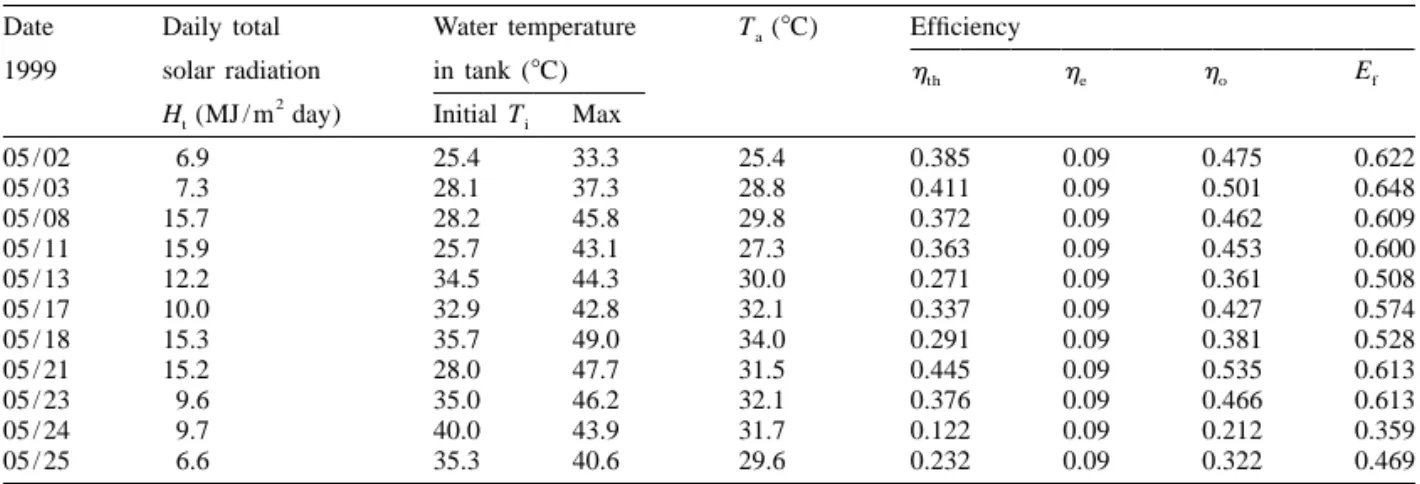
plate. The water temperature starts to saturate at In the present study, a commercial polycrystal-15:00 h. line PV module is used for making a PV/ T The daily test results are shown in Fig. 5 and collector. The PV/ T collector is then used to build Table 1. It can be seen that the primary-energy an integral-type solar system (IPVTS). We use the saving efficiency E exceeds 0.60 for cold-startf testing method for conventional solar hot water conditions (low initial temperature). As shown in heaters for the thermal performance rating of the Fig. 5, the characteristic efficiency of the solar IPVTS. It is concluded that the solar PV/ T
*
PV/ T system IPVTS is h 50.38. This is abouts collector made from a corrugated polycarbonate 76% of the value for a conventional solar hot panel can obtain a good thermal efficiency, with
*
water heater (h 50.50). This is acceptable sinces very similar temperatures (within 48C difference)
2
Table 1. Test results of IPVTS (V /A 582 l / m )t c
Date Daily total Water temperature T (8C)a Efficiency
1999 solar radiation in tank (8C) hth he ho Ef
2
H (MJ / m day)t Initial Ti Max
05 / 02 6.9 25.4 33.3 25.4 0.385 0.09 0.475 0.622 05 / 03 7.3 28.1 37.3 28.8 0.411 0.09 0.501 0.648 05 / 08 15.7 28.2 45.8 29.8 0.372 0.09 0.462 0.609 05 / 11 15.9 25.7 43.1 27.3 0.363 0.09 0.453 0.600 05 / 13 12.2 34.5 44.3 30.0 0.271 0.09 0.361 0.508 05 / 17 10.0 32.9 42.8 32.1 0.337 0.09 0.427 0.574 05 / 18 15.3 35.7 49.0 34.0 0.291 0.09 0.381 0.528 05 / 21 15.2 28.0 47.7 31.5 0.445 0.09 0.535 0.613 05 / 23 9.6 35.0 46.2 32.1 0.376 0.09 0.466 0.613 05 / 24 9.7 40.0 43.9 31.7 0.122 0.09 0.212 0.359 05 / 25 6.6 35.3 40.6 29.6 0.232 0.09 0.322 0.469
between the water in the tank and the PV module. a glazed collector. This design can be easily Further improvement of the performance of the implemented in the manufacturing process. That IPVTS is however possible with good insulation is, the PV/ T collector actually combines the design of the PV/ T collector, a better control manufacturing of the PV module and the thermal scheme for the DT controller, and the packaging collector in a single manufacturing process. The of the PV module and the heat-collecting plate. manufacturing cost can be reduced. If the PV/ T The present study introduces the concept of collector is integrated with a storage tank to make primary-energy saving efficiency for the evalua- an IPVTS, the system cost can also be reduced tion of a PV/ T system from the point of view of further. The present study shows that the idea of primary energy gain. The present test results show an IPVTS is economically feasible too.
that the primary-energy saving efficiency of an Finally, we would like to point out that the IPVTS exceeds 0.60, that is, larger than for a pure overall performance of a PV/ T system, including solar hot water heater or a pure PV system. The thermal and electric conversion, is affected by
*
characteristic daily efficiency hs reaches 0.38, many factors. The thermal efficiency decreases which is about 76% of the efficiency of a conven- with increasing hot water temperature. Increasing tional solar hot water heater using a glazed hot water temperature in order to meet some
*
collector (h 50.50).s application requirements would in turn cause the We chose a commercial PV module for making power generation efficiency of solar PV to de-a PV/ T collector since the mde-ajor purpose of the crease. Besides, the unit costs of thermal energy present study is to understand the performance of collection and electric power generation are dif-an IPVTS as compared to a conventional solar ferent. A new cost function that takes into account water heater and to demonstrate the idea of an the energy gain per unit investment is necessary IPVTS design. The present PV/ T collector is an for system optimization including economic unglazed collector and thus has an additional feasibility. A system simulation using thermal resistance of the silicone-encapsulated meteorological data for a particular design of EVA material at the back surface and the thermal PV/ T system can help to obtain the optimum grease for good thermal contact between the solar system design based on the total primary-energy PV module and the heat-collecting plate. A lower gain per unit investment. This remains for further thermal performance is expected. However, the studies in the future.
present test results show that the characteristic
*
daily efficiency hs of the IPVTS is 0.38, which is NOMENCLATURE about 76% of the efficiency of a conventional
solar hot water heater using a glazed collector 2
Ac collector area (taken as PV module area), m *
(h 50.50). This indicates that the performances D tube diameter, m
of a PV/ T collector can be improved if the heat- Ht accumulated solar incident radiation upon
col-22
collecting plate is in direct thermal contact with lector surface, MJ m
T ambient temperature, 8C
the PV cells and the heat-collecting plate is used a
Ti initial water temperature in tank, 8C
as the base plate of the PV cells. In addition, the
Tin inlet water temperature of PV/ T collector, 8C
glass cover and the PV cells can be separated to T final water temperature in tank, 8C
f
make an air-insulating layer between the glass and Tout outlet water temperature of PV/ T collector, 8C
Hayakashi B., Mizusaki K., Satoh T. and Hatanaka T. (1990) Research and development of photovoltaic / thermal hybrid
Acknowledgements—The present study was supported by the
solar power generation system. Proceedings1989 Congress National Science Council, Taiwan, ROC, through grant no.
ISES Vol. 1, 302–306.
NSC87-TPC-E-002-016.
Huang B. J. and Du S. C. (1991) A performance test method of solar thermosyphon systems. ASME J. Solar Energy Eng.
113, 172–179.
Huang B. J. (1993) Performance rating method of ther-REFERENCES
mosyphon solar water heaters. Solar Energy 50(5), 435– 440.
Bergene T. and Bjerke B. (1993) Thermodynamic
considera-Huang B. J., Lin T. H. and Hong W. T. (1999) Solar photo-tions concerning the efficiency and possible utilization of
voltaic / thermal co-generation collector. In ISES Solar combined quantum / thermal solar energy converters.
World Congress, Jerusalem, Israel, July 4 –9.
Proceedings ISES Solar World Congress, Budapest Vol. 4,
Lalovic B. (1986 / 87) A hybrid amorphous silicon photo-25–30.
voltaic and thermal solar collector. Solar Cells 19, 131–138. Bergene T. and Lovik O. (1995) Model calculations on a