行政院國家科學委員會專題研究計畫 成果報告
基於電力學方法之混凝土結構非破壞性檢測
研究成果報告(精簡版)
計 畫 類 別 : 個別型 計 畫 編 號 : NSC 99-2221-E-151-025- 執 行 期 間 : 99 年 08 月 01 日至 100 年 07 月 31 日 執 行 單 位 : 國立高雄應用科技大學土木工程系 計 畫 主 持 人 : 侯琮欽 計畫參與人員: 碩士班研究生-兼任助理人員:吳國偉 碩士班研究生-兼任助理人員:胡天雷 報 告 附 件 : 出席國際會議研究心得報告及發表論文 處 理 方 式 : 本計畫可公開查詢中 華 民 國 100 年 10 月 30 日
1
國
國
科
科
會
會
專
專
題
題
研
研
究
究
計
計
畫
畫
成
成
果
果
報
報
告
告
撰
撰
寫
寫
格
格
式
式
99 年 5 月 5 日本會第 304 次學術會報修正通過 一、說明 國科會基於學術公開之立場,鼓勵一般專題研究計畫主持人發表其研究成果,但主持 人對於研究成果之內容應負完全責任。計畫內容及研究成果如涉及專利或其他智慧財產 權、違異現行醫藥衛生規範、影響公序良俗或政治社會安定等顧慮者,應事先通知國科會 不宜將所繳交之成果報告蒐錄於學門成果報告彙編或公開查詢,以免造成無謂之困擾。另 外,各學門在製作成果報告彙編時,將直接使用主持人提供的成果報告,因此主持人在繳 交報告之前,應對內容詳細校對,以確定其正確性。 本格式說明之目的為統一成果報告之格式,精簡報告內容之篇幅以 4 至 10 頁為原則, 完整報告內容之篇幅不得少於 10 頁。 成果報告繳交之期限及種類(精簡報告、完整報告、期中精簡報告、期中完整報告等), 應依本會補助專題研究計畫作業要點及專題研究計畫經費核定清單之規定辦理。 二、報告格式:依序為封面、目錄(精簡報告得省略)、中英文摘要及關鍵詞、報告內容、參 考文獻、計畫成果自評、可供推廣之研發成果資料表、附錄。 (一)報告封面:請至本會網站(http://www.nsc.gov.tw)線上製作(格式如附件一)。 (二)中、英文摘要及關鍵詞 (keywords)。 (三)報告內容:包括前言、研究目的、文獻探討、研究方法、結果與討論(含結論與建議)… 等。 (四)計畫成果自評部分:請就研究內容與原計畫相符程度、達成預期目標情況、研究成果 之學術或應用價值(簡要敘述成果所代表之意義、價值、影響或進一步發展之可能性)、 是否適合在學術期刊發表或申請專利、主要發現或其他有關價值等,作一綜合評估, 並請至本會網站線上製作。(格式如附件二) (五)頁碼編寫:請對摘要及目錄部分用羅馬字 I 、II、 III……標在每頁下方中央;報告內 容至附錄部分請以阿拉伯數字 1.2.3.……順序標在每頁下方中央。 (六)附表及附圖可列在文中或參考文獻之後,各表、圖請說明內容。 (七)可供推廣之研發成果資料表: 1.研究計畫所產生之研發成果,應至國科會科技研發成果資訊系統(STRIKE 系統, https://nscnt66.nsc.gov.tw/strike/)填列研發成果資料表(如附件三),循執行機構行政 程序,由研發成果推廣單位(如技轉中心)線上繳交送出。 2.每項研發成果填寫一份。 (八)若該計畫已有論文發表者(頇於論文致謝部分註明補助計畫編號),得作為成果報告內 容或附錄,並請註明發表刊物名稱、卷期及出版日期。若有與執行本計畫相關之著作、 專利、技術報告、或學生畢業論文等,請在參考文獻內註明之。 三、計畫中獲補助國外或大陸地區差旅費、出席國際學術會議差旅費或國際合作研究計畫差旅 費者,頇依規定分別撰寫心得報告,並至本會網站線上繳交電子檔,心得報告格式如附件 四、五、六。 四、報告編排注意事項 (一)版面設定:A4 紙,即長 29.7 公分,寬 21 公分。 (二)格式:中文打字規格為每行繕打(行間不另留間距),英文打字規格為Single Space
。2 體大小以 12 號為主。
行政院國家科學委員會補助專題研究計畫
■成果報告
□期中進度報告
基於電力學方法之混凝土結構非破壞性檢測
計畫類別:■個別型計畫 □整合型計畫
計畫編號:NSC 99-2221-E-151-025
-
執行期間: 99 年 08 月 01 日至 100 年 07 月 31 日
執行機構及系所:國立高雄應用科技大學土木工程系
計畫主持人:侯琮欽
共同主持人:
計畫參與人員:吳國偉、胡天雷
成果報告類型(依經費核定清單規定繳交):■精簡報告 □完整報告
本計畫除繳交成果報告外,另頇繳交以下出國心得報告:
□赴國外出差或研習心得報告
□赴大陸地區出差或研習心得報告
■出席國際學術會議心得報告
□國際合作研究計畫國外研究報告
處理方式:
除列管計畫及下列情形者外,得立即公開查詢
□涉及專利或其他智慧財產權,□一年□二年後可公開查詢
附件一3
中 華 民 國 100 年 10 月 30 日
國科會補助專題研究計畫成果報告自評表
請就研究內容與原計畫相符程度、達成預期目標情況、研究成果之學術或應用價
值(簡要敘述成果所代表之意義、價值、影響或進一步發展之可能性)
、是否適
合在學術期刊發表或申請專利、主要發現或其他有關價值等,作一綜合評估。
1. 請就研究內容與原計畫相符程度、達成預期目標情況作一綜合評估
■ 達成目標
□ 未達成目標(請說明,以 100 字為限)
□ 實驗失敗
□ 因故實驗中斷
□ 其他原因
說明:
2. 研究成果在學術期刊發表或申請專利等情形:
論文:■已發表 □未發表之文稿 □撰寫中 □無
專利:□已獲得 □申請中 □無
技轉:□已技轉 □洽談中 □無
其他:
(以 100 字為限)
附件二4
3. 請依學術成就、技術創新、社會影響等方面,評估研究成果之學術或應用價
值(簡要敘述成果所代表之意義、價值、影響或進一步發展之可能性)(以
500 字為限)
一、研究內容與原計畫相符程度:
1. Reference search and review (100%)
2. Experimental preparation 1 (90%)
3. Experimental preparation 2 (90%)
4. Polarization effects of structural elements with steel rebar (40%)
5. Polarization effects of structural elements without steel rebar (100%)
6. Contact impedance of structural elements with steel rebar (40%)
7. Contact impedance of structural elements with steel rebar (80%)
8. Annual report composition (100% upon online submission)
二、研究成果之學術或應用價值:相關成果已投稿於國際期刊(A)計 1 篇,國
際研討會論文(B)計 2 篇
A1. Pyo S., Loh, K. J., Hou, T. C., Jarva, E., and Lynch J. P., "A Wireless
Impedance Analyzer for Automated Tomographic Mapping of a Nanoengineered
Sensing Skin," Smart Structures and Systems, 7(6), TechnoPress
B1. Hou, T. C., Chiou Y. H., Pan, H. H., and Chang C. H., "Electrical Resistivity
Measurement of Cement-Based Binders Using Embedded Four-Terminal Probe
Method," Proceedings of the 4th ACF International Conference, Taipei, Taiwan
B2. Hou T. C. and Pan, H. H., "Comparison of Electrode Instrumentations for
Electrical Measurement of Cement-based Materials," Proceedings of the 4th
Structural Engineers World Congress, Milan, Italy
5
B1. Hou, T. C., Chiou Y. H., Pan, H. H., and Chang C. H., "Electrical Resistivity Measurement of Cement-Based Binders Using Embedded Four-Terminal Probe Method," Proceedings of the 4th ACF International Conference, Taipei, Taiwan
ABSTRACT: This paper uses embedded four-terminal probe method to study the electrical
resistivity of cement binders. There are four kinds of materials being studied including plain cement, 15% weight of fly ash, 30% weight of slag, and 1% volume of graphite mixed binders. Resistivities of the specimens are measured under static and loading states. For the static tests, the measured resistivities and polarization histories are used to detect the hydration degree and age of the cement-binders. The experimental results show that the volumetric resistivities grow with the materials’ age due to hydration process. The induced polarization effects are prominent at the early age (1 day) but moderate after 7 days. It is also found that the saturation time of polarization would decrease with the age of cement binders. For the loading tests, resistivity measurements are shown to be capable of identifying the occurrence of critical damages under compression and flexure. By adding conductive particles such as graphite powders into the cement mixtures, electrical resistivity can be lowered.
1. INTRODUCTION
Concrete is a composite material composed of cement, water, aggregates, and other additives. Although the mechanical strengths and composing ratio are higher of aggregates, cement binders still play a critical role that governs the overall performance, such as compressive and flexural strengths of concrete. Since concrete stands a major part of most civil infrastructures, it is necessary to develop certain practical techniques that could provide promising understanding of concrete elements’ compositions, chemical properties, and the corresponding physical behaviors.
Electrical measurement has shown to be efficient and economic an approach for detecting concrete’s physical conditions such as temperature, stress, strain, and cracking, etc [1]. In this paper, we employed electrical resistivities of concrete under constant electric fields (DC) to study its material properties. Compared with other physical parameters, electrical resistance is relatively a quantity simple to acquire. The measured resistance is then converted into resistivity that could represent the scaleless material parameter. Electrical measurement also ensures the structural integrity of the objects and thus, belongs to one of the non-destructive examination (NDE) techniques.
Instead of using conventional four-terminal approach with which probes are installed on objects’ surfaces or perimeters [2-3], we have adopted embedded four-terminal probe method to obtain the electrical resistivity of cement binders. The purposes of using this probing approach are to provide the concrete specimens a more homogeneous electric field for electrical measurement while causing no significant deterioration to the structural integrity. The static tests studied the hydration degree and concrete age by observing the
polarization characteristics. Similarly, the loading tests examined the changes of resistivity with respect to stress, strain, and the occurrence of critical damage.
2. EXPERIMENTS
6
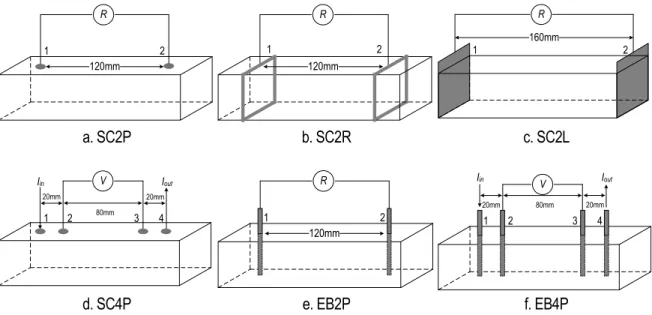
There are four approaches for resistance measurements in fields: two-terminal direct current method, two-terminal alternating current method, three-terminal direct current method, and four-terminal probe method [4]. Among those, four-terminal probe method has shown to be of less measuring inaccuracy by offering the electric current through the two outmost electrodes and measuring the voltage responses from the two inner electrodes [5]. In recent years, researchers have applied this method for resistance measurements of cementitious materials by either wiring copper probes along the objects’ surfaces [1,6], or embedding metal plates into the objects’ interiors [7].
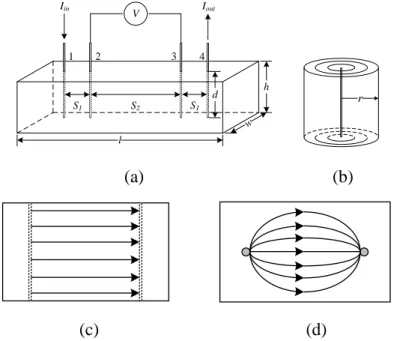
In this paper, we have adopted the four-terminal probe method by embedding round copper sticks as terminals into cement binder specimens, as shown in Figure 1. The purposes of using this probing approach are to provide the specimens a more homogeneous electric field for electrical measurement while causing no significant deterioration to the structural integrity. Therefore, this approach can then quickly deploy into fields for practices. w 1 2 3 4 Iin Iout V S1 S2 S1 d h l r (a) (b) (c) (d)
Figure 1 (a) embedded four-terminal probe method, (b) the induced electric field at electrode 1 and 4, (c) current paths side view, (d) current paths top view
2.2 Finite Boundary Resistivity
A commonly used approach for computing electrical resistivity of a finite boundary object is Smits equation [8]. However, this equation is applicable for surface-contact electrodes with a semi-infinite
conducting field, which is not the case of this study. Therefore, we have modified Smits equation to obtain a finite boundary resistivity (FBR) equation for the embedded probe method. The modification is based on the following assumptions:
1. current moves along the latitude of probe array, as shown in Figure 1(c) and (d) 2. current density is evenly distributed along the probe longitude
3. the interior electric field of each probe is neglected
7
With a current, I, injected at a certain electrode, the generated current density, j, at distance, r, from the electrode is:
rd π I
j /2 (1)
where d is the embedded length of the electrode. The corresponding electric field of the electrode can then be expressed as: rd π I x ρ x σ j x E( ) / ( ) ( ) /2 (2)
where σ(x) is the electrical conductivity of the material and ρ(x) is the resistivity; ρ(x) = 1/σ(x). Accordingly, the potential function, V(x), at distance, r, from the electrode is:
C r d π I x ρ rdr d π I x ρ dr x E x V( )
( ) ( ) /2
1/ ( ) /2 ln (3)Assuming the resistivity is constant along the current paths, ρ(x) = ρ, electrode 1 is subjected to current input, and electrode 4 is subjected current output, the electric potential can thus be expressed as:
C r r d π I ρ V /2 (ln 4 ln 1) (4)
where r4 is the distance from electrode 4 and r1 is the distance from electrode 1. Therefore, the potential difference, ΔV, between electrode 2 and 3 is:
) / ) ln(( / 1 2 1 3 2 V ρI πd S S S V V (5)
where S1 and S2 can be referred in Figure 1. With the measured voltage of the inner electrode pair, the electrical resistivity of the conducting medium can then be determined.
) / ) ln(( / /I πd S1 S2 S1 V ρ (6) 2.3 Experimental Preparation
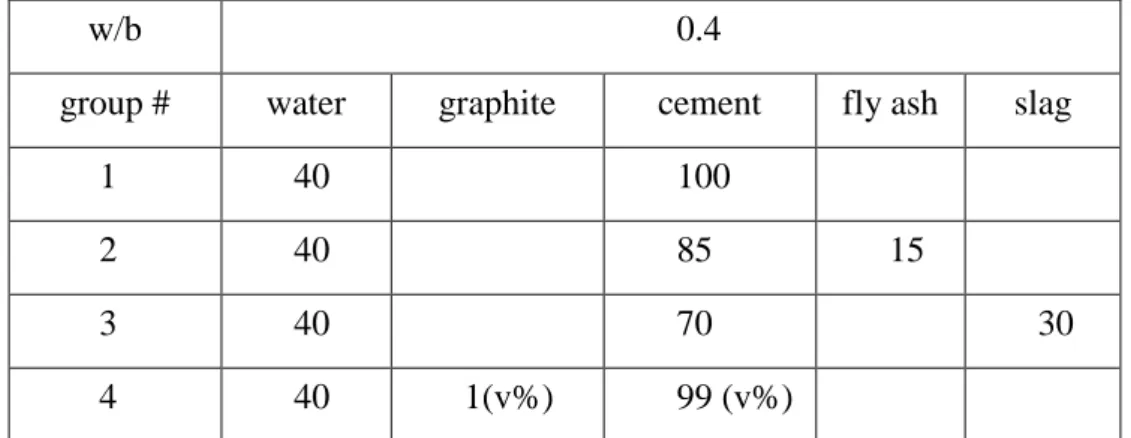
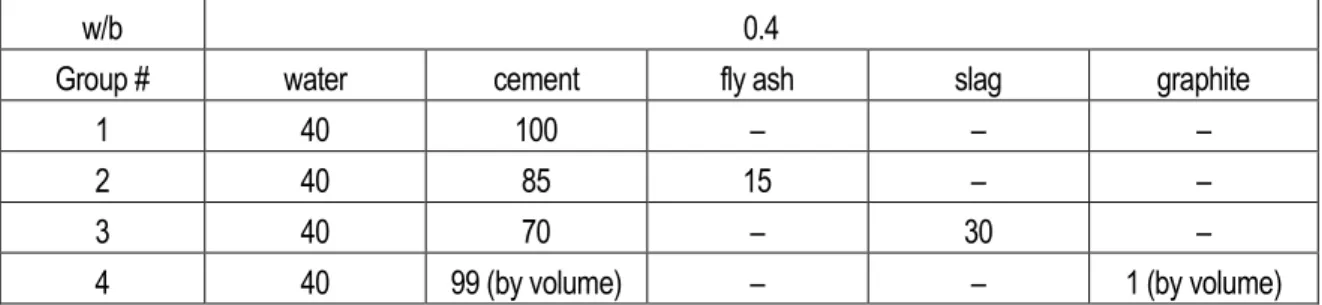
There were four groups of cement-based binders being studied in this paper, including plain cement (Group 1), 15% weight of fly ash (Group 2), 30% weight of slag (Group 3), and 1% volume of graphite (Group 4) binders. CNS 61 Type I Portland cement, F grade fly ash, and ASTM C989 standard slag were selected and used in the preparation of specimens, respectively. The particle size of graphite powder is 30nm in diameter, and is supplemented with specified dispersant. Specimens of the dimension (height by width by length) 50x50x50mm and 40x40x160 were prepared and cured in sealed bag at room temperature for 1, 7, 14, 21, 28 days before tests. The mixing proportion for all groups is summarized in Table 1.
8
Table 1 Mixing proportion by weight (%)
w/b 0.4
group # water graphite cement fly ash slag
1 40 100
2 40 85 15
3 40 70 30
4 40 1(v%) 99 (v%)
As for the metal probes, round copper sticks of 1mm in diameter were used. The electrodes are installed with S1 = 20mm, S2 = 80mm, and d = 40mm for the rectangular specimens; S1 = 5mm, S2 = 30mm, and d = 50mm for the cubes. In this study, all the probes were installed upon the casting work of cement mixtures; however, it is expected that post-instrumentation of the electrodes can rapidly be applied to existing concrete structures. Samples of the completed testing specimens are shown in Figure 2. Keithley 2611 System
SourceMeter was employed for both current supply and voltage measurements. Porous structures of the binder specimens were also observed using optical microscope (OM).
(a) (b)
Figure 2 Prepared (a) rectangular and (b) cubic binder specimens
3. RESULTS AND DISCUSSION
3.1 Static Test – DC Resistivity
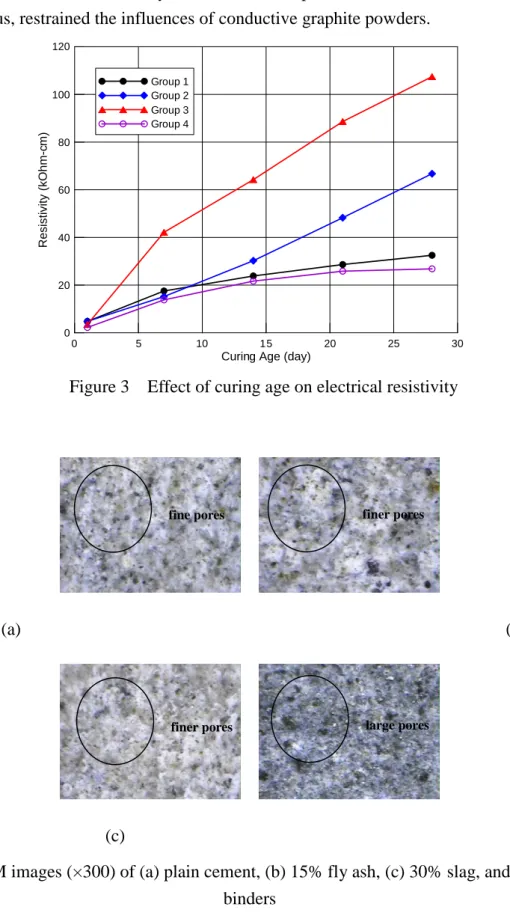
Rectangular specimens were used for static DC resistivity test. Electrical measurements were carried at various curing age (1, 7, 14, 21, 28 days) with direct current of 10mA as the input. As expected in Figure 3, resistivity grew with age due to hydration effects of the binders, such as reduction of ionic concentration, vaporization of water, formation of porous structures, etc. After 1 day of curing, resistivities of the four binders stand close still, but grew individually with different rates after 7 days. Among those, group 2 and 3 shows relatively larger resistivity values than plain cement binders. The 28-day resistivity of group 3 has reached 107.45kOhm-cm, which is 3.3 times the value of group 1 (32.52kOhm-cm). Similarly, the 28-day resistivity of group 2 is about 2.1 times the value of group 1. These consequences were attributed to the replacement of cement by fly ash and slag, which would reduce the concentration of hydroxyl ions (OH–) of the binders and thus, shrink the size of pore distribution [9-10]. The OM images taken at 28 days of curing
9
age (Figure 4(a), (b), and (c)) have further confirmed this observation.
In addition to the higher growing rates of resistivity, Figure 3 also illustrate that both the resistivity of group 1 and 4 appear to stabilize after 28 days; while group 2 and 3 keep rising continuously. Although our results indicate that fly ash and slag may cause similar effects on resistivity growth of cement binders, further investigation in this phase is required. It should also be mentioned that highly conductive graphite was supposed to reduce the resistivity of cement binders; however, this effect was not significant as shown in Figure 3. Large porous structures caused by the addition of dispersant were found within the binder specimens (Figure 4(d)) and thus, restrained the influences of conductive graphite powders.
0 5 10 15 20 25 30
Curing Age (day)
0 20 40 60 80 100 120 R e s is ti v it y (k O h m -c m ) Group 1 Group 2 Group 3 Group 4
Figure 3 Effect of curing age on electrical resistivity
(a) (b)
(c) (d) Figure 4 OM images (×300) of (a) plain cement, (b) 15% fly ash, (c) 30% slag, and (d) 1% graphite
binders
fine pores finer pores
10
3.2 Static Test – Dielectric Effects
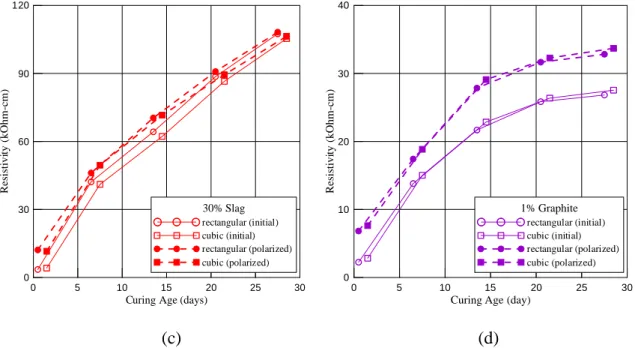
Since cement-based materials are known to be dielectric, ionic polarization would occur more or less when exposed to an electric field. Similar to DC resistivity, this inherent nature has also been proposed for self-sensing applications of cement-based materials [11]. In this test, resistivities of each specimen were recorded both before and after saturation of polarization. DC current of 10mA was supplied to each specimen for 3600 seconds in order to ensure a complete saturation of polarization was reached. The initial and
polarized resistivities for both rectangular and cubic specimens at 1, 7, 14, 21, and 28 days of curing age were presented in Figure 5.
For plain cement binders, polarization has resulted in a similar amount of resistivity shift (1-3kOhm-cm) through the curing age. This phenomenon may suggest that under the specified curing condition (room temperature in sealed bags); hydration process is regularly affecting the ionic concentration as well as free water of cement binders. Similarly, the steady shift of resistivity can also be observed in group 2 specimens (5-7kOhm-cm) except for the first day, where the applied electric excitation has resulted in much larger shift of resistivity. Fly ash replaced certain amount of cement, restrained the hydration of C3A and C3S at very early age, and resulted in vast amounts of free water [12]. The excessive free water is thus responsible for the significant polarization.
A steady shift of resistivity can also be observed for group 3 binders before 14 days (4-8kOhm-cm). After that, the effect appears to be nullified as applied electric excitation caused no polarization effect. The reason remains unclear while the high growth rate of initial resistivity indicate that the ionic concentration of
slag-cement binders is lower than fly ash-cement binders after 21 days of curing age. For group 4 binders, an increasing resistivity shift with respect to curing age was observed. The addition of conductive graphite particles did reduce and stabilize the electrical resistivity. Our results have suggested that the hydration of cement was not affected by graphite powder while the supplemented dispersant caused large porous structures trapping most ions at late curing age. As a result, these trapped ions then reacted to the constantly applied electric excitation (DC current), leading to a slight increasing of polarization effect after 14 days.
0 5 10 15 20 25 30
Curing Age (day)
0 10 20 30 40 R es is ti v it y (k O h m -c m ) Plain Cement rectangular (initial) cubic (initial) rectangular (polarized) cubic (polarized) 0 5 10 15 20 25 30
Curing Age (day)
0 20 40 60 80 R es is ti v it y (k O h m -c m ) 15% Fly Ash rectangular (initial) cubic (initial) rectangular (polarized) cubic (polarized) (a) (b)
11
0 5 10 15 20 25 30
Curing Age (days)
0 30 60 90 120 R e si st iv it y (k O h m -c m ) 30% Slag rectangular (initial) cubic (initial) rectangular (polarized) cubic (polarized) 0 5 10 15 20 25 30
Curing Age (day)
0 10 20 30 40 R es is ti v it y (k O h m -c m ) 1% Graphite rectangular (initial) cubic (initial) rectangular (polarized) cubic (polarized) (c) (d)
Figure 5 Effect of polarization on resistivity shift of (a) plain cement, (b) 15% fly ash, (c) 30% slag, and (d) 1% graphite binders
It should be mentioned that the measured electrical resistivities of cubic binder specimens were very close to the value of rectangular specimens. This observation has further validated the applicability of using finite boundary approach for computing electrical resistivity of embedded four-terminal probe method. Although there still exists a slight discrepancy (either initial or polarized resistivity) between rectangular and cubic specimens, it is highly anticipated that this approach can rapidly be deployed for field practices.
3.3 Static Test – Saturation of Polarization
When direct currents were constantly applied to cement-based materials, electrical resistivity would grow with charge time until all the ions were fully dipoled. The duration required for polarization saturation varied with compositions and mixing proportion of cement-based materials [13]. Table 2 has listed the saturation time of all the binder specimens investigated in this study. The duration of polarization saturation reduced with the curing age; while also varied with respect to material composition and specimen geometry. The reduction of saturation time is primarily associated with the completion of hydration process and pore distribution. As the pore structures were maturely formed, determined conduction paths were then served as shortcuts for those ions within pore water to quickly polarize under external electric fields.
Unlike the resistivity growth discussed previously, fly ash and slag seemed to cause no significant effects on saturation time of cement binders. The inclusion of conductive graphite particles, on the other hand, appeared to effectively shorten the saturation time before 14 days; while the duration stayed at 700 seconds after 21 days. Since graphite powders did not cause severe disturbances to the hydration process of cement, the large pores formed in between 14 to 21 days may be responsible for this. It should be mentioned that a reported saturation time for plain cement binder with w/b = 0.35 is 200 seconds [13], which is very close to the value of group 1 specimens (300 seconds, plain cement binders with w/b = 0.4) in this study. Based on
12
our limited results, the geometry and size effects on saturation time remained unclear. Table 2 Saturation time of polarization (sec) Group # specimen type 1 day 7 days 14 days 21 days 28 days 1 rectangular 1500 1200 1000 700 300 cubic 1500 1300 1100 800 400 2 rectangular 1300 1200 1000 400 300 cubic 1500 1300 1100 500 300 3 rectangular 1500 1200 800 700 500 cubic 1400 1300 800 500 300 4 rectangular 1000 900 800 700 600 cubic 1100 1000 900 700 700
3.4 Loading Test – Compression
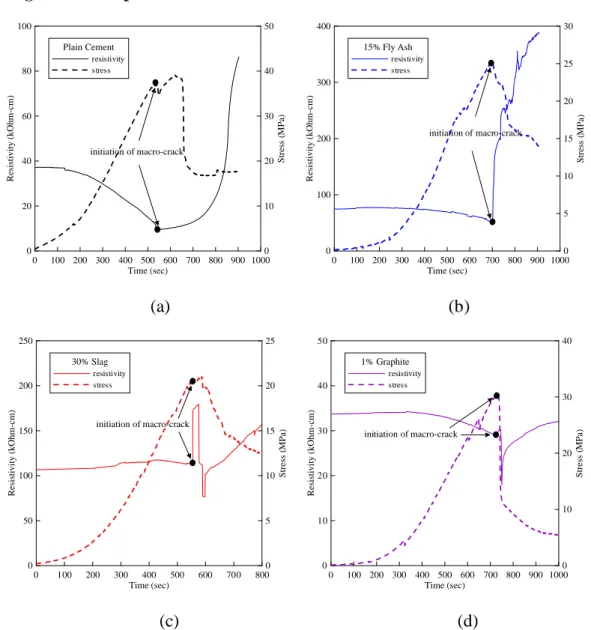
0 100 200 300 400 500 600 700 800 900 1000 Time (sec) 0 20 40 60 80 100 R es is ti v it y (k O h m -c m ) 0 10 20 30 40 50 S tr es s (M P a) Plain Cement resistivity stress initiation of macro-crack 0 100 200 300 400 500 600Time (sec) 700 800 900 1000 0 100 200 300 400 R es is ti v it y (k O h m -c m ) 0 5 10 15 20 25 30 S tr es s (M P a) 15% Fly Ash resistivity stress initiation of macro-crack (a) (b) 0 100 200 300 400 500 600 700 800 Time (sec) 0 50 100 150 200 250 R es is ti v it y (k O h m -c m ) 0 5 10 15 20 25 S tr es s (M P a) 30% Slag resistivity stress initiation of macro-crack 0 100 200 300 400 500 600Time (sec) 700 800 900 1000 0 10 20 30 40 50 R es is ti v it y (k O h m -c m ) 0 10 20 30 40 S tr es s (M P a) 1% Graphite resistivity stress initiation of macro-crack (c) (d)
Figure 6 Effect of compression on electrical resistivity of (a) plain cement, (b) 15% fly ash, (c) 30% slag, and (d) 1% graphite binders
13
Cubic specimens were used for the uniaxial compression test after 28 days of curing. Each specimen was supplied with a 10mA DC current for quite a few minutes. This will ensure the saturation of polarization was reached before any mechanical load was applied. The four electrodes were arranged parallel to the loading direction of MTS machine, and the electrical measurements were recorded with a sampling rate of 1Hz during the loading test. Figure 6 shows the test results of all the four binder cubes. In each case, resistivity was shown to precisely capture the initiation of macro-crack with the occurrence of sharp fluctuation. Resistivity then grew with another rate as the macro-crack propagated. Since the locations and propagation of macro-cracks were not controllable in prior, the growth of resistivity would thus develop into various patterns, as shown in the figure. Nevertheless, electrical resistivity measurement using embedded four-terminal probe method was shown to provide cement-based materials a self-sensing capability.
It must be noted that as the compression began to load onto the cubes, a slight decreasing of resistivity can also be observed. This was primarily caused by the compressive strain which would shorten the distance between pores within the materials, and thus decrease the electrical resistivity. It can also be observed that there exists certain ratio (gage factor, GF) in between the percent change of electrical resistivity and the compressive strain of cement binders. However, further study is required for quantifying the gage factors with respect to different type of materials at specific strain levels.
3.5 Loading Test – Flexure
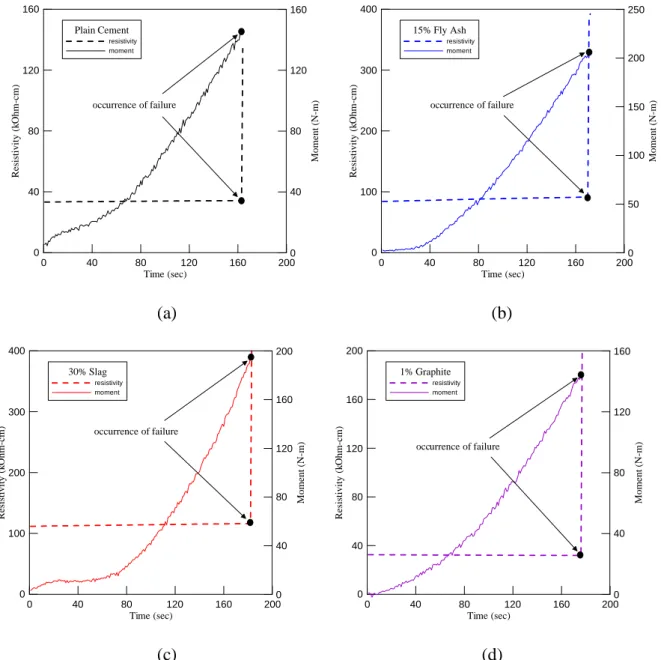
Similar to the cubes used in compression test, rectangular specimens cured for 28 days were employed for the flexure test. In this test, the location and propagation of macro-crack can be predicted in prior; the four electrodes were then placed perpendicular to the loading direction with the inner pair cross the potential location of macro-crack. Saturation of polarization is also completed before three-point flexural loading was applied. Figure 7 shows the effect of flexure on electrical resistivity of all the four cement binders. In each case, resistivity was again shown to precisely capture the occurrence of macro-crack with a sudden increasing of resistivity. This result was expected since the failure crack would locate at the center of the specimen and thus, block the current paths.
Unlike the effect of compression, flexural strain appeared to be of subtle influence to the electrical
resistivity. As shown in Figure 7, resistivity experienced only very few amount of growth before macro-crack was quickly generated. The combined tensile and compressive strain has caused a more complicated
mechanism of electric conduction. Therefore, we suggested a further study of four-terminal probe method to the effect of flexure on cement resistivity.
14 0 40 80 120 160 200 Time (sec) 0 40 80 120 160 R es is ti v it y (k O h m -c m ) 0 40 80 120 160 M o m en t (N -m ) Plain Cement resistivity moment occurrence of failure 0 40 80Time (sec)120 160 200 0 100 200 300 400 R es is ti v it y (k O h m -c m ) 0 50 100 150 200 250 M o m en t (N -m ) 15% Fly Ash resistivity moment occurrence of failure (a) (b) 0 40 80 120 160 200 Time (sec) 0 100 200 300 400 R es is ti v it y (k O h m -c m ) 0 40 80 120 160 200 M o m en t (N -m ) 30% Slag resistivity moment occurrence of failure 0 40 80Time (sec)120 160 200 0 40 80 120 160 200 R es is ti v it y (k O h m -c m ) 0 40 80 120 160 M o m en t (N -m ) 1% Graphite resistivity moment occurrence of failure (c) (d)
Figure 7 Effect of flexure on electrical resistivity of (a) plain cement, (b) 15% fly ash, (c) 30% slag, and (d) 1% graphite binders
4. CONCLUSION
Based on our investigations on electrical resistivity measurement of cement-based binders using embedded four-terminal probe method, the following conclusion can be made:
1. Replacement of cement by certain amount of fly ash and slag would significantly increase the binder resistivity. On the other hand, inclusion of conductive graphite particles would slightly reduce the binder resistivity.
2. Polarization effect of cement binders can be nullified by slag at the late age (28 days); while be amplified by fly ash at the early age (1 day). Graphite powder does not directly affect the polarization of cement binders.
3. The duration of polarization saturation reduced with the curing age; while also varied with material composition and specimen geometry. Fly ash and slag caused no significant effects on saturation time of cement binders.
15
4. Resistivity measurement using embedded four-terminal probe method can precisely capture the initiation of macro-crack of cement binders under compression. This can also be used to identify the flexural failure of cement binders.
5. There exists certain gage factors in between the percent change of electrical resistivity and compressive strain of cement binders. However, this relationship is not significant in the case of flexural strain.
5. REFERENCES
[1] Wen, S. and Chung, D. D. L., “Damage monitoring of cement paste by electrical resistance measurement,” Cement and Concrete Research, Vol. 30, 2000, pp.1979-1982
[2] Gowers, K.R. and Millard, S.G., “Measurement of concrete resistivity for assessment of corrosion severity of steel using Wenner Technique,” ACI Materials Journal, Vol. 96, No. 5, 1999, pp.536-542 [3] Millard, S.G., “Reinforced concrete resistivity measurement Techniques,” Proceedings, Institute of Civil Engineers, Part 2, 1991, pp.71-88
[4] Whiting, D. A., and Nagi, M. A., “Electrical resistivity of concrete - a literature review,” PCA R&D Serial No. 2457, Portland Cement Association, 2003
[5] Wenner, F., “A method of measuring earth resistivity,” Bulletin of the Bureau of Standards, Vol. 12, No. 4, 1916, pp. 469-478
[6] Hou, T. C. and Lynch J. P., “Conductivity-based strain monitoring and damage characterization of fiber reinforced cementitious structural components,” Proceedings of SPIE 12th Annual International Symposium on Smart Structures and Materials, 2005
[7] Chiarello, M. and Zinno, R., “Electrical conductivity of self-monitoring CFRC,” Cement and Concrete Composites, Vol. 27, 2005, pp.463-469
[8] Smits, F. M., “Measurement of sheet resistivities with the four-point probe,” The Bell System Technical, 1958, pp.711-718
[9] Ehtesham, S. and Rasheeduzzafar, H., “Corrosion resistance performance of fly ash blended cement concrete,” ACI Materials Journal, Vol. 91, No. 3, 1994, pp.264-271
[10] Hope, B.B. and Ip, A.K., “Corrosion of steel in concrete made with slag cement,” ACI Materials Journal, Vol. 84, No.6, 1987, pp.525-531
[11] Wen, S. and Chung, D. D. L., “Cement-based materials for stress sensing by dielectric measurement,” Cement and Concrete Research, vol. 32, 2002, pp.1429-1433
[12] Baweja, D., Roper, H., and Sirivivatnanon, V., “Corrosion of steel in marine concrete: long-term half-cell potential and resistivity Data,” Proceedings, Third ACI International Conference on Concrete in Marine Environment, SP-163, 1996, pp. 89-110
[13] Wen, S. and Chung, D. D. L., “Electric polarization in carbon fiber-reinforced cement,” Cement and Concrete Research, Vol. 31, 2001, pp.141-147
16
國科會補助專題研究計畫項下出席國際學術會議心得報告
日期: 年 月 日一、參加會議經過
今年 SEWC 研討會議時間是在 2011 年 04 月 04 日至 04 月 06 日期間展開,地
點為義大利米蘭市郊--科莫市,因路途遙遠,因此我們研究團隊在會議前三天(即 03
月 31 日)搭乘國泰航空於晚間 8 點餘由高雄小港國際機場起飛,於晚間 9 點餘抵達
香港等待轉機,之後同樣搭乘國泰航空於晚間 11 點餘由香港出發,並於 4 月 1 日米
蘭當地時間早上 7 點餘抵達義大利米蘭國際機場;接著我們搭乘機場公車前往米蘭
市區稍作休息,隔天我們即搭火車前往會場報到註冊,並展開為期 3 天的研討會。
計畫編號
NSC 99-2221-E-151-025-
計畫名稱
基於電力學方法之混凝土結構非破壞性檢測
出國人員
姓名
侯琮欽
服務機構
及職稱
國立高雄應用科技大學土木工程系 助理教授 (執行期間) 國立成功大學土木工程系 助理教授 (現任)會議時間
2011 年 4 月 4 日
至
2011 年 4 月 6 日
會議地點
義大利科莫 (Como, Italy)
會議名稱
(中文) 2011 結構工程世界會議
(英文) Structural Engineers World Congress 2011
發表論文
題目
(中文) 電極埋設法於水泥基材料電性量測之比較性研究
(英文) Comparison of Electrode Instrumentations for Electrical
Measurement of Cement-based Materials
附件四17
此次會議我們研究團隊共發表兩篇論文,其中一篇為本研究計畫之成果,由本人
負責報告,其論文被安排在 4 月 6 日上午 10 點 45 分展開,主題屬於 TESTS ,主
持人為 Miha Tomaževič,總報告時間為十五分鐘。會議期間亦遇到同來自台灣,國
家地震工程研究中心的蕭輔沛博士,彼此交換心得,並進行相關議題的討論。此外
會議期間亦遇到義大利鐵路罷工事件,雖計畫行程稍受影響,但因為我們團隊提早
出發,因此對參與會議之行程並無造成延宕,也很幸運我們每個人都平安健康。回
程則先搭乘歐洲之星返回米蘭市區,接著搭乘國泰航空經由香港轉機再回到台灣,
結束此次的國際會議行程。
二、與會心得
結構工程世界會議(Structural Engineers World Congress, SEWC)是每隔兩年都會定
期舉辦的一個大型研討會,也是現今結構工程領域中在學術與應用地位極高的國際
會議之一,其主要的研討方向為結構工程新工法與新材料,所接受的論文也相當廣
泛,例如從 Concrete Theory、Steel Structures、Lightweight Structures、Seismic
Engineering、Analysis、Bridges、Form Finding 以及 Tensegrity,甚至延伸至 Dynamics
and Devices、Assesment and Retrofiting、Sustainable Structures、Glass 以及 Tests 等等,
因此每年都吸引大量的專家學者從世界各地前往參與,而台灣也有相關學者專家以
及研究生參加。
18
世界上各個結構與材料工程的研究趨勢,也看到了不同領域的研究成果,並藉此吸
取他人的經驗。同時在全體出席的 Plenary Lecture 中由 R. Lagos 所報告的主題
“Performance of High Rise Buildings under the February 27
th2010 Chilean Earthquake”
以及由 W. B. Kratzig 所報告的主題 ”Solar Updraft Power Plants and Solar Chimneys
(Power Towers)” 過程中,亦激發出許多新的研究想法,從中也了解到自己研究長處
以及一些研究的盲點,在此除了感到獲益良多之外,也特別要感謝國科會在經費上
的補助。
三、考察參觀活動(無是項活動者略)
無
四、建議
參加此類國際知名大型研討會,不僅可以了解世界上相同領域的研究方向以及研
究深度之外,並且能提升研究水準與拓展國際視野,因此有志於長期研究的學者或
是研究生更應鼓勵多參與國際性的研討會,藉由和與會的學者互相討論也可以激發
出嶄新的研究想法。所以,若能夠持續在經費上得到國科會的適當補助,對於研究
學者或是研究生將會有極大的幫助。
五、攜回資料名稱及內容
由於今年 SEWC 倡導 Green Technology,所以當天註冊完只有一支 2GB 的隨身
19
六、其他
附上此次會場部分的記錄照片
Paper Presentation
1
國科會補助專題研究計畫項下出席國際學術會議心得報告
日期: 年 月 日一、參加會議經過
今年 SEWC 研討會議時間是在 2011 年 04 月 04 日至 04 月 06 日期間展開,地
點為義大利米蘭市郊--科莫市,因路途遙遠,因此我們研究團隊在會議前三天(即 03
月 31 日)搭乘國泰航空於晚間 8 點餘由高雄小港國際機場起飛,於晚間 9 點餘抵達
香港等待轉機,之後同樣搭乘國泰航空於晚間 11 點餘由香港出發,並於 4 月 1 日米
蘭當地時間早上 7 點餘抵達義大利米蘭國際機場;接著我們搭乘機場公車前往米蘭
市區稍作休息,隔天我們即搭火車前往會場報到註冊,並展開為期 3 天的研討會。
計畫編號
NSC 99-2221-E-151-025-
計畫名稱
基於電力學方法之混凝土結構非破壞性檢測
出國人員
姓名
侯琮欽
服務機構
及職稱
國立高雄應用科技大學土木工程系 助理教授 (執行期間) 國立成功大學土木工程系 助理教授 (現任)會議時間
2011 年 4 月 4 日
至
2011 年 4 月 6 日
會議地點
義大利科莫 (Como, Italy)
會議名稱
(中文) 2011 結構工程世界會議
(英文) Structural Engineers World Congress 2011
發表論文
題目
(中文) 電極埋設法於水泥基材料電性量測之比較性研究
(英文) Comparison of Electrode Instrumentations for Electrical
Measurement of Cement-based Materials
附件四2
此次會議我們研究團隊共發表兩篇論文,其中一篇為本研究計畫之成果,由本人
負責報告,其論文被安排在 4 月 6 日上午 10 點 45 分展開,主題屬於 TESTS ,主
持人為 Miha Tomaževič,總報告時間為十五分鐘。會議期間亦遇到同來自台灣,國
家地震工程研究中心的蕭輔沛博士,彼此交換心得,並進行相關議題的討論。此外
會議期間亦遇到義大利鐵路罷工事件,雖計畫行程稍受影響,但因為我們團隊提早
出發,因此對參與會議之行程並無造成延宕,也很幸運我們每個人都平安健康。回
程則先搭乘歐洲之星返回米蘭市區,接著搭乘國泰航空經由香港轉機再回到台灣,
結束此次的國際會議行程。
二、與會心得
結構工程世界會議(Structural Engineers World Congress, SEWC)是每隔兩年都會定
期舉辦的一個大型研討會,也是現今結構工程領域中在學術與應用地位極高的國際
會議之一,其主要的研討方向為結構工程新工法與新材料,所接受的論文也相當廣
泛,例如從 Concrete Theory、Steel Structures、Lightweight Structures、Seismic
Engineering、Analysis、Bridges、Form Finding 以及 Tensegrity,甚至延伸至 Dynamics
and Devices、Assesment and Retrofiting、Sustainable Structures、Glass 以及 Tests 等等,
因此每年都吸引大量的專家學者從世界各地前往參與,而台灣也有相關學者專家以
及研究生參加。
3
世界上各個結構與材料工程的研究趨勢,也看到了不同領域的研究成果,並藉此吸
取他人的經驗。同時在全體出席的 Plenary Lecture 中由 R. Lagos 所報告的主題
“Performance of High Rise Buildings under the February 27
th2010 Chilean Earthquake”
以及由 W. B. Kratzig 所報告的主題 ”Solar Updraft Power Plants and Solar Chimneys
(Power Towers)” 過程中,亦激發出許多新的研究想法,從中也了解到自己研究長處
以及一些研究的盲點,在此除了感到獲益良多之外,也特別要感謝國科會在經費上
的補助。
三、考察參觀活動(無是項活動者略)
無
四、建議
參加此類國際知名大型研討會,不僅可以了解世界上相同領域的研究方向以及研
究深度之外,並且能提升研究水準與拓展國際視野,因此有志於長期研究的學者或
是研究生更應鼓勵多參與國際性的研討會,藉由和與會的學者互相討論也可以激發
出嶄新的研究想法。所以,若能夠持續在經費上得到國科會的適當補助,對於研究
學者或是研究生將會有極大的幫助。
五、攜回資料名稱及內容
由於今年 SEWC 倡導 Green Technology,所以當天註冊完只有一支 2GB 的隨身
4
六、其他
附上此次會場部分的記錄照片
Paper Presentation
5
註:因本次研討會作業關係,並未對所有論文發表者寄送 ”論文被接受發表之大會
證明文件”,因此改為附上大會議程表(本文原定於 April 6
th下午 Session: Test 中發
表,會議期間臨時調動為 April 6
th上午 Session: Test 中發表),以茲證明該論文確實
SESSIONS - LIST OF PAPER
4
thApril
PLENARY LECTURES APRIL 4TH
MARTINEZ CALZON, J. FORMS STRUCTURES AND ENERGY 9:20 9:35
CHIORINO, M.A. PIER LUIGI NERVI: ARCHITECTURE AS CHALLENGE 9:35 10:00
MOTRO, R. ART AND STRUCTURAL ENGINEERING – ART OF STRUCTURAL ENGINEERING 10:00 10:25
BURKARD, F. SUSTAINABLE ENGINEERING TECHNOLOGIES - 100 YEARS EXPERIENCE 10:25 10:50
SIVIERO, E. ENGINEERING VERSUS ARCHITECTURE 14:00 14:25
MAJOWIECKI, M. STRUCTURES IN ARCHITECTURE 14:25 14:45
ALUMINUM STRUCTURES --- SOETENS F. ROOM =D= APRIL 4TH
VAN DER MEULEN, O.R. CLASSIFICATION OF ALUMINIUM BEAMS IN FIRE, ANALYTICAL AND EARLY NUMERICAL RESULTS 11:20 11:40
DE MATTEIS, GIANFRANCO PURE ALUMINIUM HYSTERETIC DEVICES FOR SEISMIC PROTECTION OF BUILDINGS 11:40 12:00
MAZZOLANI, FEDERICO TWO TWIN ALUMINIUM DOMES OF THE ENEL PLANT 12:00 12:20
VAN HOVE, DIANNE STRENGTH PROPERTIES OF PINNED CONNECTIONS IN ALUMINIUM TRUSS GIRDERS 12:20 12:40
MANDARA, ALBERTO THE NEW EUROPEAN CODIFICATION ON ALUMINIUM SHELL BUCKLING 12:40 13:00
STACEY, MICHAEL ALUMINIUM, ARCHITECTURE AND HUMAN ECOLOGY 14:55 15:15
GIULIANI, GIAN CARLO THE ALUMINUM STAIR AND LIFT LOAD-BEARING CORE OF THE BARCELONA AIRPORT TOWER 15:15 15:35 ARCHINEERING --- FAIRBANKS B. & SAMYN P. ROOM =B= APRIL 4TH
SAMYN, PHILIPPE 11:20 11:40
SAMYN, PHILIPPE DREAMS, GENIUS LOCI AND STRUCTURES 11:40 12:00
MELE, ELENA BUBBLE FRAME: ASSESSMENT OF A NEW STRUCTURAL TYPOLOGY STARTING FROM THE WATER CUBE 12:00 12:20
YANG, BIN APPLYING A PARALLEL PARTICLE SWARM OPTIMIZER TO TRUSS TOPOLOGICAL DESIGN 12:20 12:40
TROMBETTI, TOMMASO ARCHINGEERING? ENGISTAR? WHICH NAME FOR THE BIRTH OF AN ENGINEERING CULTURE? 12:40 13:00
FAIRBANKS, BRUCE 14:55 15:15
FAIRBANKS, BRUCE STRUCTURE AND THE ARCHITECTURAL CONCEPT 15:15 15:35
ARIAS, RUBEN GEOMETRIC DESIGN OF PATCHED SPATIAL STRUCTURES VIA WRD 15:35 15:55
SESSIONS - LIST OF PAPER
4
thApril
CONCRETE COMPOSITES --- POGGI C. ROOM =C= APRIL 4TH
WATANABE, SEIICHI RESEARCH ON ADHESIVE STRENGTH OF CONCRETE PLACING JOINT PLANE 14:50 15:10
RAO TIPPABHOTLA, D.G. HIGH STRENGTH SFRC: PURE TORSION 15:10 15:30
ALMERICH CHULIA, ANA I DEVELOPMENT AND APPLICATIONS OF GLASS FIBER BARS AS A FRAME IN CONCRETE STRUCTURES 15:30 15:50
OGASAWARA, TETSUYA STRENGTHENING TECHNIQUE OF THE MARINE PIER BEAM BY DFRCC 15:50 16:10
SRIMAN NARAYAN, HN FRACTURE ENERGY OF FIBER REINFORCED HIGH STRENGTH CONCRETE BEAMS 16:45 17:05
CHI, TONY THE DEVELOPMENT OF PRECAST CONCRETE TECHNIQUES - TECHNOLOGIES IN SOUTHEAST ASIA & ASIA 17:05 17:25
CONCRETE TECHNOLOGY --- BIANCHI F. & PALOMBA S. ROOM =C= APRIL 4TH
BAMAGA, SALEH STRENGTH AND CHLORIDE RESISTANCE OF CONCRETE CONTAINING PALM OIL FUEL ASH 11:20 11:40
KATAKALOS, KONSTANTINOS
INVESTIGATION OF TWO DIFFERENT ANCHORING DEVICES AND THEIR INFLUENCE ON CONCRETE SURFACE TREATMENT WHEN
EITHER CFRP OR SRP ARE BEING APPLIED FOR STRENGTHENING R/C STRUCTURAL MEMBERS 11:40 12:00
ARUNACHALAM, K EXPERIMENTAL INVESTIGATION OF ULTRA HIGH STRENGTH CONCRETE 12:00 12:20
VISHWANATHAN, S QUALITY IMPROVEMENT IN CONCRETE MAKING PROCESS 12:20 12:40
RAMACHANDRA, V WHITETOPPING OF ROADS – A CASE STUDY 12:40 13:00
FIRE ENGINEERING --- CAJOT L.G. & GAMBAROVA P. ROOM =D= APRIL 4TH
GAMBAROVA, PIETRO FIRE ENGINEERING 16:45 17:05
CLEMENT, FRANK IMPACT OF A FIRE ON STRUCTURAL CONCRETE 17:05 17:25
ZANON, RICCARDO NEW ANALYTICAL MODEL FOR THE CALCULATION OF STEEL COLUMNS SUBJECTED TO LOCALISED FIRE 17:25 17:45 PUSTORINO, SANDRO PERFORMANCE-BASED FIRE SAFETY APPROACH – APPLICATION TO OPEN CAR PARKS ACCORDING TO THE NEW ITALIAN
REGULATION 17:45 18:05
SESSIONS - LIST OF PAPER
4
thApril
HIGH RISE BUILDINGS --- GIULIANI M.E. & LAGOS R. ROOM =A= APRIL 4TH
PRAKASH, SURYA TALL COMMUNICATION TOWERS - RETROFITTING AND STABILITY CONSIDERATIONS 11:20 11:40
MEHROTRA, SC EARTHQUAKE RESISTANT DESIGN AND CONSTRUCTION OF BUILDINGS IN INDIA 11:40 12:00
TORENO, MAURIZIO AN OVERVIEW ON DIAGRID STRUCTURES FOR TALL BUILDINGS 12:00 12:20
SUN MOON, KYOUNG DIAGRIDS FOR STRUCTURAL DESIGN AND CONSTRUCTION OF COMPLEX-SHAPED TALL BUILDINGS 12:20 12:40
HIRAKAWA, KIYOAKI PERFORMANCE BASED DESIGN APPROACH TO 300 METER HIGH TOWER BUILDING 12:40 13:00
XUE, WANLI DYNAMIC ELASTO-PLASTIC TIME-HISTORY ANALYSIS FOR OUT-OF-CODES HIGH-RISE STRUCTURE 14:55 15:15
KIM, YONG-KU PINNACLE LIFT-UP OF BURJ KHALIFA 15:15 15:35
RYANG CHUNG, KWANG EFFECT OF HIGH-STRENGTH STEEL FOR SUPER TALL BUILDING 15:35 15:55
DE ANGELIS/VESA , HIGH RISE BUILDINGS.SEQUENTIAL LOADING AND LONG TERM EFFECTS ON VERTICAL SHORTENING 15:55 16:15
GIULIANI, MAURO EUGENIO HADID TOWER IN MILANO: A TORSION RESISTING STRUCTURE 16:45 17:05
CAPSONI, FABIO HADID TOWER IN MILANO - DIMENSIONING AND ANALYSIS OF THE STRUCTURES 17:05 17:25
RAGHU PRASAD, BK EARTHQUAKE AND WIND EFFECTS ON TALL OVERHEAD WATER TANK 17:25 17:45
REHABILITATION & REPAIR --- BINDA L. ROOM =B= APRIL 4TH EL-MAADDAWY, TAMER INVESTIGATION INTO THE PERFORMANCE OF CONCRETE BEAMS WITH RECTANGULAR OPENINGS STRENGTHENED IN SHEAR WITH
CFRP COMPOSITES 16:45 17:05
GARAVAGLIA, ELSA MODELLING OF THE DAMAGE EVOLUTION OVER TIME OF JOINTS AND MORTAR/BRICK INTERFACES UNDER SALT CRYSTALLISATION
TESTS 17:05 17:25
BANSAL, DEEPAK DRY STACKED INTERLOCKING BLOCK MASONRY-SUSTAINABLE & STRUCTURALLY VIABLE OPTION 17:25 17:45 MEDA, ALBERTO
REPAIR AND STRENGTHENING OF REINFORCED CONCRETE COLUMNS AND BEAMS WITH VERY LOW THICKNESS OF HIGH
PERFORMANCE FIBER REINFORCED CEMENTITIOUS COMPOSITES COMPLYING TO THE STRUCTURAL ANTISEISMIC REINFORCEMENT PROJECT
17:45 18:05
MORANDINI, GIULIO EXPERIMENTAL CAMPAIGN ON TUFF MASONRY STRENGTHENED WITH FRG 18:05 18:25
WIND ENGINEERING --- SOLARI G. ROOM =E= APRIL 4TH
SOLARI, GIOVANNI NEW CHALLENGES IN WIND-INDUCED FATIGUE OF STRUCTURES 16:45 17:05
DOMANESCHI, MARCO SEMI-ACTIVE SYSTEMS FOR THE WIND EFFECTS MITIGATION OF A SUSPENSION BRIDGE 17:05 17:25
LIU, HUIQUN THE AMBIENT EXCITATION TESTING AND SIMULATION OF THE NATURAL VIBRATION CHARACTERISTICS OF TRANSMISSION LINE 17:25 17:45
XIN, ZHAO WIND ENGINEERING AND STRUCTURAL DESIGN OF SHANGHAI TOWER 17:45 18:05
SESSIONS - LIST OF PAPER
4
thApril
WOOD STRUCTURES --- FRAGIACOMO M. ROOM =E= APRIL 4TH
TLUSTOCHOWICZ, GABRIELA PREFABRICATED STABILISING WALLS FOR MULTI-STOREY TIMBER BUILDINGS - GENERAL CONCEPTS AND PRELIMINARY DESIGN 11:20 11:40 VAN BEERSCHOTEN,
WOUTER EXPERIMENTAL INVESTIGATION ON THE STIFFNESS OF BEAM-COLUMN CONNECTIONS IN POST-TENSIONED TIMBER FRAMES 11:40 12:00 TOMASI, ROBERTO EXPERIMENTAL INVESTIGATION ON CONNECTIONS BETWEEN WOOD FRAMED SHEAR WALLS AND FOUNDATIONS 12:00 12:20 TOMASI, ROBERTO EXPERIMENTAL INVESTIGATION OF THE BEHAVIOUR OF DIFFERENT TYPE OF CONNECTIONS BETWEEN THE XLAM PANELS AND THE
CONCRETE SLAB 12:20 12:40
SARTI, FRANCESCO SIMPLIFIED DESIGN TOOLS FOR POST-TENSIONED TIMBER BEAMS AND WALLS 12:40 13:00
CRISTINI, TIZIANA POST-TENSIONING IN TIMBER SLABS 14:55 15:15
PALERMO, ALESSANDRO APPLICATION OF POST-TENSIONING TECHNIQUES TO PEDESTRIAN TIMBER BRIDGES 15:15 15:35
VALDEZ-CHACON, ROBERTO EXPERIMENTAL STUDY OF WALLS OF BLOCKS UNDER LATERAL LOADS 15:35 15:55
SESSIONS - LIST OF PAPER
5
thApril
PLENARY LECTURES APRIL 5TH
PANZA, G. SCENARIO BASED TIME DEPENDENT DEFINITION OF SEISMIC INPUT 8:30 8:55
GOEPPERT, K. NEW STADIUM STRUCTURES 8:55 9:20
BELLINI, M. STRUCTURAL ENGINEERING OF ARCHITECTURE AND ARCHITECTURAL LANGUAGE OF STRUCTURES 14:20 14:45
STRASKY, J. RECENT DEVELOPMENTS IN DESIGN OF STRESS RIBBON PEDESTRIAN BRIDGES 14:45 15:10
ANALYSIS --- MAIER G. ROOM =E= APRIL 5TH
BELLMANN, JUERGEN NONLINEAR HALFSPACE CONTACT 9:25 9:45
ESLAMI, HASHEM MATHEMATICAL SOLUTION FOR WAVE DIFFRACTION BY A CYLINDRICAL INCLUSION IN TRANSVERSELY ISOTROPIC MEDIA 9:45 10:05
SULLIVAN, TIM DEVELOPMENT OF DIRECT DISPLACEMENT BASED DESIGN SOFTWARE 10:05 10:25
CÁRDENAS, SELENE LIMIT ANALYSIS OF RIGID BLOCK MODELS FOR REINFORCED CONCRETE FRAMES UNDER LATERAL LOADS 10:25 10:45
LIANG, HUANG A QUANTIFICATION METHOD OF STRUCTURAL ROBUSTNESS 10:45 11:05
WANG, XIAO A NEW SPATIAL BEAM ELEMENT WITH CLOSED THIN-WALLED SECTION 11:35 11:55
WANG, ZHONGQUAN A STATIC RELAXATION ALGORITHM FOR MOTION-DEFORMATION ANALYSIS OF CONSTRUCTION SIMULATION 11:55 12:15 HÜLYA ÇALIK KARAKÖSE,
ÜLKÜ BUCKLING ANALYSIS OF BUILT-UP AND COMPOSITE COLUMNS USING EQUIVALENT HOMOGENEOUS FRAME MEMBERS 12:15 12:35
BRIDGES --- STRASKY J. ROOM =B= APRIL 5TH
SIVIERO, ENZO BRIDGES AND ARCHITECTURE 15:15 15:35
ROSSI, FRANCESCO
DESIGN ISSUES AND CONSTRUCTION METHOD OF A NEW CONCRETE RAILWAY BRIDGE OVER THE SWISS A2 MOTORWAY IN
CAMORINO (ALPTRANSIT LOT 771) 15:35 15:55
RIZZI, EGIDIO FEM MODELLING OF THE PADERNO D’ADDA BRIDGE (ITALY, 1889) 15:55 16:15
CHEN, AIRONG WAVE INDUCED VIBRATION ANALYSIS OF A STEEL CURVED BRIDGE CONSIDERING SCOURING EFFECT 16:15 16:35
WANG, REN-ZUO EXPERIMENTAL AND NUMERICAL ANALYSIS OF A BRIDGE FOR HIGH-SPEED TRAINS 16:35 16:55
SU, QINGTIAN EFFECTIVE WIDTH OF CONTINUOUS COMPOSITE GIRDER OF ARCH BRIDGE 17:25 17:45
RECCIA, EMANUELE MULTI-SCALE ANALYSIS OF VENICE TRANS-LAGOON BRIDGE 17:45 18:05
SESSIONS - LIST OF PAPER
5
thApril
CONCRETE THEORY 1 --- CHIORINO M.A. & MÜLLER H. ROOM =B= APRIL 5TH
CHIORINO, MARIO A. ANALYSIS OF STRUCTURAL EFFECTS OF TIME DEPENDENT BEHAVIOR OF CONCRETE: AN INTERNATIONALLY HARMONIZED FORMAT 9:25 9:45 ASLANI, FARHAD
EVALUATION AND COMPARISON OF THE ANALYTICAL MODELS TO PREDICT CREEP AND SHRINKAGE BEHAVIOUR OF
SELF-COMPACTING CONCRETE 9:45 10:05
CHOI, IN-RAK CREEP EFFECTS IN CONCRETE-FILLED STEEL TUBE COLUMNS WITH HIGH-STRENGTH STEEL AND CONCRETE 10:05 10:25 GRANDIC, DAVOR
DEFLECTION OF REINFORCED CONCRETE BEAMS SIMULTANEOUSLY SUBJECTED TO SUSTAINED LOAD AND REINFORCEMENT
CORROSION 10:25 10:45
LI, WENCONG HYSTERESIS RESPONSE OF EXTERIOR BEAM-COLUMN JOINTS WITH SELF-CENTERING BEHAVIOR 10:45 11:05
LIANG, HUANG CYCLIC BEHAVIOR OF HIGH-REDUNDANCY REINFORCED CONCRETE WALLS 11:30 11:48
PANTOJA, JOÃO
THE IMPACT OF UNCERTAINTIES MODEL CONSIDERED IN RELIABILITY ANALYSIS OVER THE DESIGN OF REINFORCED CONCRETE
DEEP BEAMS BY STRUT-AND-TIE MODEL. 11:48 12:06
CASALEGNO, CARLO TIME-DEPENDENT EFFECTS IN CONCRETE STRUCTURES: A GENERAL COMPUTATIONAL APPROACH 12:06 12:24
MOLA, FRANCO NEW THEORETICAL ASPECTS IN LINEAR VISCOELASTIC ANALYSIS OF CONCRETE STRUCTURES 12:24 12:42
KVITSEL/MÜLLER , CREEP AND SHRINKAGE OF HIGH PERFORMANCE LIGHTWEIGHT AGGREGATE CONCRETE 12:42 13:00
CONCRETE THEORY 2 --- MOLA F. ROOM =E= APRIL 5TH
MOLA, FRANCO CONCEPTUAL APPROACH AND ANALYSIS IN THE STRUCTURAL DESIGN OF RC TALL BUILDINGS 15:15 15:35
OKA, HIDEO LIGHTWEIGHT SANDWICH SLABS CONSISTING OF AN ALC CORE ADHESIVELY BONDED WITH STEEL SKINS 15:35 15:55 LANG, CHRISTIAN NATURAL DRAFT COOLING TOWER DESIGN AND CONSTRUCTION IN GERMANY - PAST (SINCE 1965), PRESENT AND FUTURE 15:55 16:15
VALENTE, MARCO SEISMIC PERFORMANCE AND RETROFITTING OF PRECAST INDUSTRIAL BUILDINGS 16:15 16:35
MOLA, FRANCO EFFECTS OF COLUMN SHORTENING IN R.C. TALL BUILDINGS 17:25 17:45
MORO, S. ULTRA HIGH PERFORMANCE CONCRETE: FROM MATERIAL OPTIMIZATION TO STRUCTURAL APPLICATIONS 17:45 18:05
CHOWDHURY, SHARMIN ANALYTICAL MODELING OF BOND SLIP RESPONSES IN REINFORCED CONCRETE COLUMNS 18:05 18:25
YONAMINE, HITOSHI HOTO FUDO - HOLISTIC DESIGN OF A SANDWICH RC SHELL STRUCTURE - 18:25 18:45
FORM FINDING --- MAJOWIECKI M. ROOM =C= APRIL 5TH
GROHMANN, MANFRED FORM FINDING OF THE SPHERE AT THE DEUTSCHE BANK HEADQUARTERS IN FRANKFURT, GERMANY 15:15 15:35 BOBER, WALDEMAR SPACE STRUCTURES FROM APERIODIC PATTERNS – APPLICATION OF AMMANN BAR GRIDS CONCEPT 15:35 15:55 TARCZEWSKI, ROMUALD GENERATION OF STRUCTURAL LATTICES BY MEANS OF MULTIPLICATION OF PLANAR GRAPHS 15:55 16:15
GRANATA, MICHELE FABIO STRUCTURAL IMPLICATIONS IN FIUMARA D’ARTE PYRAMID 16:15 16:35
SESSIONS - LIST OF PAPER
5
thApril
LIGHTWEIGHT STRUCTURES --- OBREBSKI J. & SAITOH M. ROOM =D= APRIL 5TH
OBREBSKI, JAN LIGHTWEIGHT STRUCTURES - FROM THEORY TO DESIGN 9:25 9:45
QIAO, LEI ANALYSIS AND DESIGN OF LONG-SPAN CABLE- MEMBRANE STRUCTURES INTEGRATED WITH SUPPORTED STRUCTURE 9:45 10:05
KIDO, TAKAHIRO DESIGN AND CONSTRUCTION OF THE COMPLEX-BEAM STRING STRUCTURE 10:05 10:25
SUZUKI, MINORU RECENT EXAMPLES OF CABLE STRUCTURES -DESIGN AND CONSTRUCTION FOCUSED ON INITIAL TENSILE FORCE- 10:25 10:45
HIDEKI, TABATA CONSTRUCTION OF TENSION STRUCTURES BASED ON THE ERECTION PROCESS ANALYSIS 10:45 11:05
SAITOH, MASAO CONCEPTUAL DESIGN OF HYBRID STRING STRUCTURES 11:35 11:55
KIMURA, SEIGO A STRUCTURAL DESIGN OF TWO-WAY, SINGLE LAYER LATTICED DOME 11:55 12:15
STOBIECKI, PRZEMYSLAW A SPECIAL CASE OF A NON-DEVELOPABLE SURFACE AND ITS APPLICATIONS 12:15 12:35
REICHHART, ADAM DESIGNING OF SHELL SHAPED ROOFS MADE OF PROFILED SHEETS 12:35 12:55
SEISMIC ENGINEERING --- MEDEOT R. ROOM =A= APRIL 5TH
ESER, MUBERRA SOIL STRUCTURE INTERACTION EFFECTS ON RESPONSE OF MULTISTOREY STRUCTURES 11:35 11:55
TANIGUCHI, YOSHIYA SEISMIC MOTION LEVEL OF DYNAMIC COLLAPSE OR LIMIT STATE DEFORMATION FOR LATTICE ARCH AND CYLINDRICAL ROOF 11:55 12:15 SOMMAVILLA, MAURO INERD SOFTWARE: A NEW DESIGN TOOL TO IMPROVE THE ROBUSTNESS OF RCMRF UNDER EARTHQUAKE LOADING 12:15 12:35
BAIRD, ANDREW NUMERICAL MODELLING OF LOCAL CLADDING-STRUCTURE INTERACTION 12:35 12:55
DIAFERIA, RICCARDO NUMERICAL STUDY ON THE SEISMIC INTERACTION BETWEEN 2D SEISMIC RESISTING FRAMES AND CLADDINGS 12:55 13:15 YAMAGA, NOBUHIDE DESIGN OF HIGH-RISE BASE ISOLATED STRUCTURE WITH A COMPLEX SHAPE AND LONG SPAN 15:15 15:35 IKEDA, KOTARO
INFLUENCES OF CHANGING RIGIDITY CENTER WITH VIBRATION ON EARTHQUAKE RESISTANCE OF THE STEEL FRAME WITH
DIFFERENT HYSTERESIS MODEL 15:35 15:55
PAGANOTTI, GIACOMO DEVELOPMENT OF TYPICAL CEILING SYSTEM SEISMIC FRAGILITIES 15:55 16:15
BIONDINI, FABIO ON THE ACCURACY OF RESPONSE SPECTRUM ANALYSIS IN SEISMIC DESIGN OF CONCRETE STRUCTURES 16:15 16:35 NOGUCHI, HIROSHI
ANALYTICAL STUDY ON EARTHQUAKE RESISTANCE OF ULTRA HIGH STRENGTH REINFORCED CONCRETE COLUMNS CONTAINING
STEEL FIBER 16:35 16:55
POLYCARPOU, PANAYIOTIS NUMERICAL INVESTIGATION OF STRUCTURAL POUNDING OF SEISMICALLY ISOLATED BUILDINGS DURING STRONG EARTHQUAKES 17:25 17:45
MUSTAFY, TANVIR SEISMIC RESPONSE ANALYSIS OF BRIDGE WITH DIFFERENT ISOLATORS 17:45 18:05
TIAN, JIE STUDY ON NONLINEAR EARTHQUAKE RESPONSE OF RC FRAME AND STEEL PLATE SHEAR WALL 18:05 18:25
MORITA, AKIRA STRUCTURAL DESIGN OF SPACE STRUCTURES CONSIDERING DYNAMIC FORCES 18:25 18:45
STADIA --- GOEPPERT K. ROOM =A= APRIL 5TH
WATANABE, TOMOHIRO STRUCTURAL DESIGN OF STADIUM ROOF IN JAPAN AND CHINA 9:25 9:45
KIM, JONG-HO STRUCTURAL DESIGN OF THE STADIUM IN KOREA - YONGIN CITIZEN SPORTS PARK 9:45 10:05
SESSIONS - LIST OF PAPER
5
thApril
STEEL STRUCTURES --- ZHANG Q. ROOM =C= APRIL 5TH
ZHANG STEEL STRUCTURES 9:25 9:45
GOWDA, BHARATH NEW BOLTED SPACEFRAME SYSTEM 9:45 10:05
DUTHINH, DAT A SIMPLIFIED LINEAR MODEL FOR GUSSET PLATE CONNECTIONS 10:05 10:25
GERBER, BRIAN
ACCEPTANCE CRITERIA FOR STEEL DECK FLOOR AND ROOF SYSTEMS TO SHOW COMPLIANCE WITH THE INTERNATIONAL BUILDING
CODE 10:25 10:45
IMABAYASHI, MITSUHIDE ROOF STRUCTURE BETWEEN TWO BUILDINGS IN SEVERE EARTHQUAKE PRONE COUNTRY 10:45 11:05
JIEMIN, DING PRELIMINARY DESIGN OF THE STEEL ROOF STRUCTURE FOR A RAILWAY STATION 11:35 11:55
TASAKA, MASANORI A LONG SPANNING STEEL ROOF DESIGN IN VIETNAM 11:55 12:15
JEON, BONG-SOO DESIGN AND CONSTRUCTION OF 85M CANTILEVERED ROOF OF THE BUSAN CINEMA CENTRE, REP. OF KOREA 12:15 12:35
BECCI, BRUNO INSTALLING AN AUTOMATIC OVERHEAD CRANE IN COMPLEX CONDITIONS 12:35 12:55
LIANG, FENG BEARING CAPACITY AND FATIGUE PERFORMANCE OF REVERSE BALANCE FLANGE IN WIND TURBINE TOWE 12:55 13:15
KRSTICH, MISHO MODULARIZATION,WHY,WHERE,HOW? 17:25 17:45
BONESCHI, VITTORIO STAINLESS STEEL: A STRUCTURAL ANTI-SEISMIC AND FIRE RESISTANT MATERIAL 17:45 18:05
RAMASWAMY, MS DESIGN OF A LARGE SPAN TRUSS USING COLD FORMED STEEL SECTIONS 18:05 18:25
THANABAL, K. USE OF ALTERNATIVE STEEL IN BS5950 DESIGN 18:25 18:45
TENSEGRITY --- MOTRO R. ROOM =D= APRIL 5TH
GOMEZ-JAUREGUI,V. NEW CONFIGURATIONS FOR DOUBLE-LAYER TENSEGRITY GRIDS 15:15 15:35
RHODE-BARBARIGOS,L. DEPLOYMENT ASPECTS OF A TENSEGRITY-RING PEDESTRIAN BRIDGE 15:35 15:55
TIBERT, GUNNAR DESIGN AND FORM-FINDING ANALYSIS OF TENSEGRITY POWER LINES 15:55 16:15
DALILSAFAEI, SEIF APPLICATION OF FLEXIBILITY ANALYSIS FOR DESIGN OF TENSEGRITY STRUCTURES 16:15 16:35
JÉRÔME, QUIRANT MECHANICAL BEHAVIOUR OF A FOLDABLE TENSEGRITY RING: PARAMETRIC STUDY 16:35 16:55
FISEL, DOMINIK
PROPOSITION OF AN INDEX DESCRIPTION SYSTEM FOR GEOMETRIC AND MECHANICAL PROPERTIES OF SPATIAL TENSEGRITY
STRUCTURES 17:25 17:45
AVERSENG, JULIEN INTERACTIVE DESIGN AND DYNAMIC ANALYSIS OF TENSEGRITY SYSTEMS 17:45 18:05
MICHELETTI, ANDREA STRUCTURAL PERFORMANCES OF SINGLE-LAYER TENSEGRITY DOMES 18:05 18:25
BIENIEK, ZBIGNIEW CHOSEN IDEAS OF GEOMETRICAL SHAPING OF MODULAR TENSEGRITY STRUCTURES 18:25 18:45
SESSIONS - LIST OF PAPER
6
thApril
PLENARY LECTURES APRIL 6TH
LAGOS, R. PERFORMANCE OF HIGH RISE BUILDINGS 8:30 8:55
MAIER, G. DIAGNOSES OF STRUCTURES BY INVERSE ANALYSIS 8:55 9:20
KRAETZIG, W.B. SOLAR UPDRAFT POWER PLANTS AND SOLAR CHIMNEYS 14:10 14:35
GIULIANI, M.E. ABOUT STRUCTURAL DETAILS 14:35 14:35
ASSESMENT & RETROFIT --- MURTHY K. ROOM =B= APRIL 6TH
KANEBAKO, YOSHIHARU SEISMIC RETROFIT DESIGN WITH THE STEEL FRAMES INTEGRATED STRUCTURAL ELEMENT AND FACADE DESIGN 9:25 9:45 CAGNAN, ZEHRA COMPUTER MODELLING AND SEISMIC PERFORMANCE ASSESSMENT OF A GOTHIC CATHEDRAL IN CYPRUS 9:45 10:05 CAUSEVIC, AMIR EVALUATION OF STABILITY OF SACRAL AND HISTORICAL TOWERS DEPENDING ON SEISMIC ZONE 10:05 10:25 PALERMO, MICHELE THE INFILLS EFFECTS ON THE SEISMIC BEHAVIOR OF R.C. STRUCTURES: A CASE STUDY ON A BUILDING IN L’AQUILA, ITALY 10:25 10:45
IHSAN UNAY, ALI ASSESSMENT OF SEISMIC RESISTANCE OF SURP NIGOGOYAS CHURCH UNDER EARTHQUAKE 10:45 11:05
VAFAEI, MOHAMMADREZA REAL-TIME SEISMIC DAMAGE DETECTION OF FOUNDATIONS USING ARTIFICIAL NEURAL NETWORKS 11:30 11:50
HSIAO, FU-PEI VERIFICATION OF SEISMIC EVALUATION FOR RC SCHOOL BUILDINGS 11:50 12:10
ZENG, MINGGEN ANALYSIS ON SUSPENDER REPLACEMENT PLAN OF THE TIED ARCH BRIDGE 12:10 12:30
RATNAVEL, SANNA DISTRESSED BUILDINGS IN SOUTH INDIA - A CASE STUDY 12:30 12:50
MURTHY, KESHAVA “KEY” TO STRUCTURAL HEALTH OF BUILDINGS 12:50 13:10
DYNAMICS - DEVICES --- MARTELLI A. ROOM =A= APRIL 6TH
MARTELLI, A. RECENT WORLDWIDE APPLICATION OF SEISMIC ISOLATION AND ENERGY DISSIPATION AND CONDITIONS FOR THEIR CORRECT USE 9:25 9:45 WATANABE, TETSUMI APPLICATION OF ACTIVE BASE ISOLATION SYSTEM USING ABSOLUTE VIBRATION CONTROL TECHNOLOGY 9:45 10:05
NISHIMURA, ISAO BASE ISOLATION OF LIGHTWEIGHT STRUCTURE BY LAMINATED RUBBER BEARINGS 10:05 10:25
BIANCHI, GIORGIO HIGH DAMPING RUBBER BEARING (HDRB) ISOLATING DEVICES FOR NUCLEAR POWER PLANTS: FE MODELLING AND DAMAGE/FAILURE CHARACTERIZATION
10:25 10:45
WEISZ, GABRIELE SHOCK TRANSMITTERS APPLICATION TO A REINFORCED CONCRETE PRECAST BUILDING 10:45 11:05
MEDEOT, RENZO EXPERIMENTAL VALIDATION OF THE RE-CENTRING CAPABILITY EVALUATION METHOD ADOPTED IN THE EUROPEAN STANDARD ON ANTI-SEISMIC DEVICES
11:30 11:50 MORITA, KEIKO LONG-TERM PERFORMANCE TEST OF LAMINATED RUBBER BEARING FOR SEISMIC ISOLATION SYSTEM 11:50 12:10 AIDA, HIROMASA EVALUATION OF THE VIBRATION CONTROL PERFORMANCE BASED ON VIBRATION TEST FOR ACTUAL BUILDINGS WITH OIL DAMPER 12:10 12:30 TOMIZAWA, TETSUYA CONSTRUCTION OF CIVIL BUILDING USING THREE-DIMENSIONAL SEISMIC ISOLATION SYSTEM 12:30 12:50
SESSIONS - LIST OF PAPER
6
thApril
DYNAMICS - DEVICES --- MARTELLI A. ROOM =A= APRIL 6TH
HUBER, PETER CHARACTERISTICS OF CURVED SURFACE SLIDING ISOLATORS FOR SERVICE AND SEISMIC LOAD CASES 15:05 15:25 GABRIELLA CASTELLANO,
MARIA
TESTING OF ELASTOMERIC ISOLATORS FOR NUCLEAR POWER PLANTS 15:25 15:45
X.Q., LUO DAMAGE CONTROL STUDY FOR SPATIAL TRUSS STRUCTURES USING BRBS UNDER STRONG EARTHQUAKES 15:45 16:05 USTUNDAG, CENK STUDIES ON THE DESIGN AND APPLICATION OF SPHERICAL AND ELASTOMERIC BEARINGS SUBJECTED TO COMPRESSION AND
UPLIFT FORCES
16:05 16:25 MAALEK, SHAHROKH THE PRESENTATION OF A CIRCULAR PASSIVE ENERGY DISSIPATION DEVICE FOR USE IN STEEL BRACED FRAMES 16:25 16:45
GLASS --- TBD ROOM =D= APRIL 6TH
GOVINDARAJAN, JANAKIRAMAN
DEVELOPMENTS OF GLASS IN ARCHITECTURAL AND STRUCTURAL APPLICATIONS 9:25 9:45
VIDAL MAORAL, ALBERT CAN GLASS COMPETE WITH ACRYLICS IN LARGE AQUARIUM ENCLOSURES ? 9:45 10:05
GUITART, NÚRIA COMPOSITE STEEL-GLASS FINS FOR THE LOBBY FAÇADE OF IBERDROLA TOWER 10:05 10:25
GIULIANI, GIAN CARLO A WIDE SPAN GLAZED ROOF IN A SEISMIC AREA 10:25 10:45
REHABILITATION & REPAIR --- BINDA L. ROOM =D= APRIL 6TH DA PORTO, FRANCESCA NEW INTEGRATED KNOWLEDGE BASED APPROACHES TO THE PROTECTION OF CULTURAL HERITAGE FROM EARTHQUAKE-INDUCED
RISK
15:05 15:25
VALENTE, MARCO SEISMIC RETROFITTING STRATEGIES FOR AN UNDER-DESIGNED R/C STRUCTURE 15:25 15:45
CARDANI, GIULIANA METHODOLOGY FOR ON SITE EVALUATION OF PHYSICAL AND MECHANICAL PROPERTIES OF HISTORIC MASONRY 15:45 16:05 LORENZONI, FILIPPO THE SPANISH FORTRESS IN L’AQUILA: EMERGENCY ACTIONS, INVESTIGATIONS AND MONITORING 16:05 16:25
SPECIAL CONCRETE STRUCTURES --- GIULIANI G.C. & SUNDARAM R. ROOM =B= APRIL 6TH
BOLLINGER, KLAUS FORM FINDING FOR THE ROLEX LEARNING CENTER AT EPFL LAUSANNE 15:05 15:25
BOLLINGER, KLAUS CONSTRUCTION OF THE ROLEX LEARNING CENTER AT EPFL LAUSANNE 15:25 15:45
SUNDARAM, R. CONCRETE SHELL ROOFS 15:45 16:05
GIULIANI, GIAN CARLO SOME SHELLS BUILT IN ITALY 16:05 16:25
GIULIANI, GIAN CARLO HEAVY DUTY LARGE SPAN PRECAST FLOORS 16:25 16:45
SUSTAINABLE STRUCTURES --- HOSKERE V. & MONTICELLI C. ROOM =C= AND =D= APRIL 6TH
MONTICELLI 9:25 9:45
INADA, TATSUO STUDY ON THE WAY OF BUILDING CONSTRUCTION IN SUSTAINABLE SOCIETY 9:45 10:05
ANANTHARAMAN, SRINIDHI SUSTAINABLE PROCESSES IN STEEL CONSTRUCTION 10:05 10:25
OBREBSKI, MICHAL RISK MANAGEMENT FOR INVESTMENT IN COMMERCIAL OBJECTS 10:25 10:45
SESSIONS - LIST OF PAPER
6
thApril
SUSTAINABLE STRUCTURES --- HOSKERE V. & MONTICELLI C. ROOM =C= AND =D= APRIL 6TH HOJO, TOSHIO A STUDY ON STRENGTHENING OF EXISTING RC BEAM -FOR REUSE OF UNDERGROUND STRUCTURE- 11:30 11:50 MIRCEA, ANDREEA-TEREZIA THE ENVIRONMENTAL DEMAND FOR EFFICIENT RECYCLING OF MATERIALS FROM DEMOLITION SITES 11:50 12:10
ROSANI, DIEGO HIGH PERFORMANCE CONCRETE FOR SUSTAINABLE CONSTRUCTION 12:10 12:30
KOKAWA, TSUTOMU ICE SHELL CONSTRUCTION IN HOKKAIDO 12:30 12:50
TESTS --- TOMAŽEVIC M. ROOM =C= APRIL 6TH
TOMAŽEVIC, MIHA SEISMIC STRENGTHENING OF BRICK MASONRY WALLS WITH COMPOSITES: AN EXPERIMENTAL STUDY 11:30 11:50 FONT, ALEXANDER THE USE OF PIEZOELECTRIC TRANSDUCERS AND FIBER OPTIC SENSORS IN STRUCTURAL HEALTH MONITORING OF CONCRETE
STRUCTURES: A STATE OF THE ART
11:50 12:10 MANTEGAZZA, DAVIDE IN SITU CONCRETE STRENGTH TESTING BY NON-DESTRUCTIVE COMBINED METHODS WITH ONE, TWO AND THREE VARIABLES
(REBOUND NUMBER, ULTRASONIC PULSE VELOCITY, WINDSOR PROBE)
12:10 12:30 PAN, HUANG-HSING DETERMINATION OF INTERFACIAL TRANSITION ZONE IN CEMENTITIOUS MATERIALS BY DYNAMIC DISPLACEMENT 12:30 12:50
GENTILE, C. DYNAMIC ASSESSMENT AND HEALTH MONITORING OF AN HISTORIC IRON ARCH BRIDGE 12:50 13:10
RICCI, ILARIA SQUAT CONCRETE WALLS: RESULTS OF PSEUDO-STATIC TESTS WITH CYCLIC HORIZONTAL LOAD ON CAST IN SITU SANDWICH PANELS
15:05 15:25 HOU, TSUNG-CHIN COMPARISON OF ELECTRODE INSTRUMENTATIONS FOR ELECTRICAL MEASUREMENT OF CEMENT-BASED MATERIALS 15:25 15:45
Sponsors
![Figure 2: current paths of the embedded four-terminal probe [12]](https://thumb-ap.123doks.com/thumbv2/9libinfo/8832328.235716/45.893.201.383.491.623/figure-current-paths-embedded-terminal-probe.webp)