
Image Authentication Using Subband Coding
8
0
0
全文
(2) should be perceptually invisible. The data embedding process should not introduce any perceptible artifacts into the original image nor should the digital watermark degrade the perceived quality of the image. 4. Robustness: The digital watermark is still present in the image after distortion and can be detected by the watermark detector, especially on the attack from compression. Possible distortions include linear or nonlinear filtering, image enhancements, requantization, resizing, and image compression. The watermark should utilize robust image processing which preserves the desired quality of the image. In the literature, several digital watermarking algorithms have been proposed with different contributions. Roughly speaking, these contributions can be categorized according to their casting/processing domain, signal type of the watermark and hiding position. A variety of watermarking scheme have been reported in recent years. Such techniques can be broadly classified in two categories: the spatial domain, for example [1-6], and the frequency domain watermarks, for example [7-15]. The earlier watermarking techniques reported were spatial-based approach, the simplest beings the ones to modify the least significant bits (LSB) of an image’s pixel data [1]. Improvements of these techniques are proposed in [2-6] to be robust against image compression and filtering. Bender et al. described a watermarking approach by modifying a statistical property of the image [2]. But such techniques still have relatively low-bit capacity and are not resistant enough to lossy data compression and image processing. For example, a common image cropping operation may eliminate the watermark. Other than spatial-domain-based watermarking, transform-domain-based techniques that can embed a large number of bits of watermark have also been proposed. In [7], the spread spectrum communication is used in multimedia watermarking. They embed a set of independent and identical distributed sequences drawn from a Gaussian distribution into the perceptually most significant frequency components of the data. Results reported with the top (largest in absolute magnitude) thousand coefficients (excluding the DC coefficient) of the DCT of the image show the technique to be. remarkably robust against various image-processing operations. Since this is only a small fraction of the number of significant coefficients in a typical image, there is not much perceptual degradation of the image. C-T Hsu et al. embed the watermarks with visually recognizable patterns into the images by selectively modifying the middle-frequency parts of the image. The embedding and extracting methods of the DCT-based approach have been described [9]. Another method, to hide data into the frequency domain to provide extra robustness against attacks is the discrete wavelet transform (DWT) [10-13]. It is known that the wavelet image/video coding, such as embedded zero-tree wavelet (EZW) coding, has potential to play an important role in upcoming image/video compression standards, such as JPEG2000 and MPEG4 due to its excellent performance in compression. In most of the previous wavelet-based works, for example [10-12], the watermark is a random sequence of bits, and can only be detected by employing the detection theory. Detection involves retrieving the watermark by subtracting the original image from the watermarked image and correlating the retrieved watermark with the original watermark. Therefore, an experimental threshold is chosen and compared to a sharp peak in the cross correlation coefficient to determine whether the image is watermarked. In this paper, we propose a technique for embedding grey-level digital watermarks with visually recognizable patterns into the image. Such kinds of visually recognizable patterns are more intuitive for representing an organization’s logo. Moreover, during the verification phase of our work, an extracted visual pattern in conjunction with the similarity measurement will be provided for verification. In this paper, we propose a wavelet-transform-based watermarking method by adding visually recognizable image to the large coefficients at all frequency bands of the DWT of an image. The first advantage is that the extracted watermark is visually recognizable to claim one’s ownership. The second advantage is that the watermarking method is hierarchical and has multiresolution characteristics. The third advantage is that the human eyes are not sensitive to the small changes in edges of an.
(3) image. The large coefficients in these bands usually indicate edges in an image. Therefore, it is difficult for human to perceive when adding watermarks on these large coefficients. The fourth advantage is that this approach matches the upcoming image/video compression standards. The watermark is then embedded by modifying significant coefficients at the coarser scale in perceptually important spectral components of image. Our experimental results show that the watermarking method we propose is very robust to image compression and complex image distortions.. subband LH3. Furthermore, from these DWT coefficients, the original image can be reconstructed. This reconstruction process is called the inverse DWT (IDWT). Let I [m, n] represent an image. The DWT and IDWT for I [m, n] can be similarly defined by implementing the DWT and IDWT for each dimension m and n separately: DWTn [DWTm I [m, n]]. Fig. 2 shows the original and DWT decomposition of 512 512 Lena image.. ¯. DWT. 2. PRELIMINARIES The wavelet transform is identical to a hierarchical subband system, where the subbands are logarithmically spaced in frequency. The basic idea in the DWT for a two dimensional image is as follows. An image is first decomposed into four parts of high, middle, and low frequencies, i.e., LL1, HL1, LH1, HH1 subbands, by cascading horizontal and vertical two channel critically subsampled filter banks. The subbands labeled HL1, LH1, and HH1 represent the finest scale wavelet coefficients. To obtain the next coarser scale of wavelet coefficients, the subband LL1 is further decomposed and critically subsampled. This process is continued an arbitrary number of times, which is determined by the application at hand. Fig. 1 shows an image is decomposed into ten subbands for three levels. Each level has various band-information such as low-low frequency band, low-high frequency band, high-low frequency band, and high-high frequency band. LL3 HL3 HL2 LH3 HH3. DWT. LH2. HL1. HH2. Host Image. LH1. HH1. (a) Fig. 2. (a) The original and (b) DWT decomposition of 512 512 Lena image.. ¯. 3. THE WATERMARKING ALGORITHM The proposed embedded digital watermarking can hide visually recognizable patterns into the image. The goal of digital watermarking is invisible to human eyes but also robust under different attacks. In the proposed method, watermarks are redundantly embedded into the host image by modifying them in the location of context-based wavelet coefficients (CBWC). The magnitude set of M of the current pixel cx,y is estimated using the weighed values of bucket coefficients that have been entropy encoded in the current subband. The energy of a context-based wavelet coefficient is defined as follows. ∑ log(c) * 0.4 + log(c ) * 0.6 E x, y = (1) x, y 24 where Ex, y is the energy of the center coefficient cx,y of size 5×5 block coefficients. 3.1 Watermark Embedding Method. Fig. 1. DWT decomposition of an image: Note that the arrow points from the subband of the parents to the subband of the children. The lowest frequency subband is the top left, and the highest frequency subband is at the bottom right. Also shown is a wavelet tree consisting of all the descendants of a single coefficient in the. The algorithm to embed watermark into the host image is as follows: Step1: Let I be a greyscale image or the luminance component of a color image. In the embedding part, we first decompose the host image to produce a sequence of three.
(4) levels with ten subbands of a pyramid structure MI, corresponding to the vertical, horizontal and diagonal details at each of the k resolution levels, and a gross approximation of the image at the coarsest resolution level. We denote the detail image component at the kth resolution level of the host by HLk, LHk, HHk and k = 1, 2, 3. The gross approximation is represented by LL3.. coefficients are chosen at the component of host image as follows. Nsn = int(Ksn / 9) + 1 //fixed quantization blocks If K sn mod 9 ≠ 0 then Nsn = Nsn + 9 - (Ksn mod 9) Nsn = Nsn +1 End Nsn =Nsn +Ksn. Step2: Let watermark W be a greyscale image to be embedded. Firstly, an index rank MW is recorded after sorting the coefficients of W in the spatial domain in descending order to produce a sequence of W’ such that. After that, sort the absolute values of top Nsn in descending order and record the index so that Xsn(MIsn(i) is a coefficient such that. W’(1,1)≥ W’(1,2)≥…≥ W’(1, n) ≥… ≥ (2) W’(m, n) Where (i, j) is a coordinate at W’. Then, we compute the third-level discrete wavelet decomposition of W’. Consider each resolution subband s at scale n, sort the detail coefficients in descending order so that Vs(MWasn(p, q)) is a coefficient such that Vsn(MWasn(1, 1)) ≥ …≥ Vsn(MWasn(1, q)) (3) ≥…≥ Vsn(MWasn(p, q)) Where sn ⊂ {LL3, HL1,2,3, LH1,2,3, HH1,2,3}. To embed the watermark, consider each resolution subband s at scale n, sort the absolute values of the detail coefficients in descending order so that Vsn(MWbsn(p, q)) is a coefficient such that Vsn(MWbsn(1, 1))≥…≥ Vsn(MWbsn(1, q)) (4) ≥…≥ Vsn(MWbsn(p, q)) Where sn ⊂ {LL3, HL1,2,3, LH1,2,3, HH1,2,3}. Step3: To embed the watermark, calculate the energy of CBWC of each subband of the third-level discrete wavelet decomposition of host image I to produce a sequence of MI. Consider each image component at the n-th resolution level, choose top Nsn of CBWCn, where Nsn is the number of watermark coefficients at the n-th resolution component and quantization bounds. A quantization bound is a coefficient to be recognized without casting watermarks. Let the number of watermark coefficients to be embedded into one subband is Ksn and a fixed quantization range is nine, then Nsn. Xsn(MIsn(1) ≥ Xsn(MIsn(2) ≥…≥ Xsn(MIsn(i) (5) ≥…≥ Xsn(MIsn(Nsn) Where sn ⊂ {LL3, HL1,2,3, LH1,2,3, HH1,2,3}. To extract the watermark without original image, quantize CBWC. In the quantization stage, let Xsn(MIsn(i)) and Xsn(MIsn(i+10)) be quanatization bounds over coefficients range Xsn(MIsn(i+1)) and Xsn(MIsn(i+9)), a + quantization value (|Xsn(MIsn(i))| |Xsn(MIsn(i+10))|)/2 is set to the ranges. An example is illustrated as follows. Let the number of watermark coefficients to be embedded into a subband is Ksn = 26, a fixed quantization range is nine, then Nsn = 31 are chosen at the component of host image. Consider a sequence at a corresponding subband to be cast, Xsn(MIsn) = {1 2 3 5 7 9 11 13 15 16 17 24 28 29 30 31 32 33 36 39 41 42 47 48 50 51 52 55 56 58 61}, After quantization, sequence,. we. have. a. new. Xsn(MIsn) = {1 9 9 9 9 9 9 9 9 9 17 29 29 29 29 29 29 29 29 29 41 51 51 51 51 51 51 51 51 51 61} Restore the sequence of key quantization bound {1, 17, 41, 61} can easily determine the quantized coefficients value to be cast. Step 4: The equations used for watermark casting are as follows..
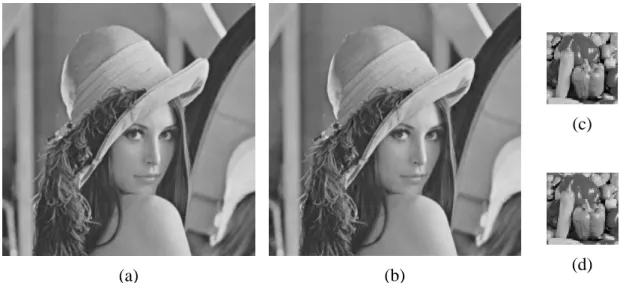
(5) index = 1 For i = 1 to Nsn –10 step 10 If i = Nsn –10 For p = i+ 1 to (Ksn mod 9) Xsn(MIsn(p)=Xsn(MIsn(p))+αsVsn(MWasn(p)) Else For p = i+ 1 to (i+ 9), q = index+1 to index+9 Xsn(MIsn(p))= Xsn(MIsn(p))+ αsVsn(MWasn(q)) End index=index+9 End. Where Xsn(MIsn(p) is a coefficient at sn subband, c denotes coefficient of watermark at subband, and sn αs|s=LL,HL,LH,HH indicates scaling parameter to adjust casting energy. In the casting stage, watermarks Vsn(MWasn(p)) are redundantly embedded into top MIsn(Nsn) of corresponding component at the n-th resolution level, CBWCsn, where sn ⊂ {HL1-3, LH1-3, HH1-3}. Watermark coefficients at the gross approximation is randomized before casting to CBWCLL3 for robustness. Step5: Save the scaling parameter αs|s=LL, HH, HL, MW, MWasn|s=LL,HH,HL,LH, n=1,2,3, LH, and MWbsn|s=LL,HH,HL,LH, n=1,2,3, MIsn|s=LL,HH,HL,LH, n=1,2,3 as key indexes to extract watermarks without original image. Take the two dimensional IDWT of the modified DWT coefficients and the unchanged DWT coefficients can easily form watermarked image. 3.2 Watermark Extracting Method On the other hand, the watermark are detected by using the embedded position indexes and scaling parameter α after the wavelet decomposition of the watermarked image and the original image, as follows: Step1: We first decompose a watermarked image, X’ with DWT into three levels of ten subbands.. Step2: Restore the scaling parameter ., sorting index of watermark’s coefficients MWasn and sorting index of host image’s coefficients. The method to extract watermarks is as follows. index = 1 For i = 1 to Nsn –10 step 10 value=( |Xsn (MIsn(i))|+ |Xsn(MIsn(i+10))| )/2 If i = Nsn –10 For p = i+ 1 to (Ksn mod 9) Vsn(MWasn(p))=(Xsn(MIsn(p))-value) /αs Else For p = i+ 1 to (i+ 9), q = index+1 to index+9 V sn(MWasn(q))=(Xsn(MIsn(p))-value) /αs End index=index+9 End Step4: Take the two dimensional IDWT of Vsn, , where sn ⊂ {HL1-3, LH1-3, HH1-3}, we have the extracted watermarks W’. Step5: In our scheme, the extracted watermark is a visually recognizable image. However, the subjective measurement is dependent on factors such as views. Therefore, we measure the similarity of original watermarks W and extracted watermarks by the standard correlation coefficient as correlation =. ∑ ( x − x )( y − y ) ∑ (x − x ) ∑ ( y − y) 2. 2. ,. 4. EXPERIMENTAL RESULTS Fig. 3 shows the original lena image, its watermarked copy and the watermark pepper in the spatial domain. We see that the watermarked image is not distinguishable from the original image. The following shows an example of embedding results, where a grey-level image pepper is used as the watermark..
(6) (c). (a). ¯. (d). (b). Fig. 3: (a) original lena image with size of 512 512 (b) lena watermarked with our method, PSNR = 40.9342 (c) original pepper image as watermarks with size 64 64 (d) extracting results from (a) without any attack using the proposed method, correlation=0.9990. 4.1. On the Robustness Against JPEG Lossy Compression Table I shows the extracted results from JPEG compressed version of the watermarked images with compression ratio 9.7, 13.4, 18.3, and 26.2. The quality of watermarked images is. ¯. still in good situation even under the high compressed ratio. The extracted watermarks and the original watermarks are with high correlation. In the proposed method, the extracted watermark is visually recognizable under the compression ratio, 26.2.. TABLE I CHANGES OF CORRELATION UNDER JPEG LOSSY COMPRESSION. AS THE COMPRESSION RATIO INCREASES TO 26.2, THE EXTRACTED WATERMARK IS VISUALLY RECOGNIZABLE. Compression JPEG JPEG JPEG JPEG Ratio (CR=9.7) (CR=13.4) (CR=18.3) (CR=26.2) Extracted watermarks. Correlation. 4.2 On the Robustness Procession Operation. 0.9439. Against. 0.9198. Image. Sharpen operations are used to enhance the subjective quality. Table II shows the extracted results of applying enhanced operation to a watermarked image. The extracted results are still highly similar to the original watermark.. 0.8915. 0.8118. Smoothing operations such as median filter are used to decrease spurious effects that may are present in images from a poor transmission channel. Table II shows the extracted results of applying median filter to a watermarked image. The extracted watermark is still visually recognizable..
(7) TABLE II THE EXTRACTED OF WATERMARKS, CORRELATION AND ERROR RATE VALUES UNDER SHARPEN AND SMOOTHING OPERATION. Image Median filter Sharpen Blur Resize processing Extracted watermarks Correlation. 0.9050. 0.9298. 4.3 On the Robustness Against JPEG Lossy Compression and Mixed Image Processing Sharpen and blur operations are used to a watermarked image. Table III shows the extracted results are still highly similar to the original watermark.. 0.9675. 0.5754. Table III also shows the extracted results of applying median filter and sharpen image operations to a watermarked image under the JPEG compression ratio, 26.2, the extracted watermark is still visually recognizable.. TABLE III THE EXTRACTED OF WATERMARKS, CORRELATION AND ERROR RATE VALUES UNDER SHARPEN PLUS SMOOTHING OPERATION. Image Sharpen+ JPEG13.4+shar JPEG18.3+shar JPEG26.2+shar processing median filter pen+median pen+median pen+median filter filter filter Extracted watermarks. Correlation. 0.8638. 0.8703. 5. CONCLUSION This paper has presented a new technique for embedding visually recognizable grey-level watermark, which is seldom discussed in the literature, into the image based on the context-based wavelet coefficient (CBWC). The embedding and extracting methods of the DWT-based approach have been described scrutinizingly in this paper. The experimental results show that the proposed method provides extra robustness against JPEG compression, image procession operation, and even compound attacks. 6. REFERENCES [1] R. G. van Schyndel, A. Z. Tirkel, and C. F.. 0.8465. 0.7751. Osborne, “A digital watermark,” in proc. IEEE Int. Conf. Image Processing, vol. 2, 1994, pp. 86-90. [2] W. R. Bender, D. Gruhl, and N. Morimoto, “Techniques for data hiding,” in Proc. SPIE: Storage and Retrieval of Image and Video Database, vol. 2420, Feb. 1995, pp. 164-173. [3] N. Nikolaidis and I. Putas, “Copyright protection of images using robust digital signatures,” in Proc. IEEE int. Conf on Acoustics, Speech and Signal Processing, vol. 4 May 1996, pp. 2168-2171. [4] G. Langolaar, van der Lubbe, and J. Biemond, “Copy protection for multimedia data base on labeling techniques,” Available WWW: http://www-it.et.tudelft. nl/pda/smash/public/beneluxcr.htnl, 1996..
(8) [5] R. Wolfgang and E. Delp, ”A watermark for digital image,” in Proc. Int. Conf. on Image Processing, vol. 3, pp. 211-214, 1996. [6] I. Pitas, “A method for signature casting on digital Image,” in Proc. Int. Conf. on Image Processing, vol. 3, pp. 215-218, 1996. [7] I. J. Cox, J. Kilian, F. T. Leighton, and T. Shamoon, “Secure spread spectrum watermarking for multimedia,” IEEE Trans. Image Processing, vol. 6, no. 12, Dec. 1997. [8] Chiou-Ting Hsu and Ja-Ling Wu, “DCT-based watermarking for video,” IEEE Trans. Consumer Electronics, vol. 44, no. 1, pp. 206-216, 1998. [9] Chiou-Ting Hsu and Ja-Ling Wu, “Hidden digital watermarks in images,” IEEE Trans. Image Processing, vol. 8, no. 1, pp. 58-68, 1999. [10] Christine I. Podilchuk and Wenjun Zeng, “Image-adaptive watermarking using visual models,” IEEE J. Selected Areas in Communications, vol. 16, no. 4, pp. 525-539, 1998. [11] Z. H. Wei, P. Qin and Y. Q. Fu, “Percept digital watermark of images using wavelet transform,” IEEE Trans. Consumer Electronics, vol. 44, no. 4, pp. 1267-1272, 1998. [12] Rakesh Dugad, Krishna Ratakonda and Narendra Ahuja, “A new wavelet-base for watermarking image,“ in Proc. Int. Conf. on Image Processing, vol. 2, pp. 419-423, 1998. [13] Chiou-Ting Hsu and Ja-Ling Wu, “Multiresolution watermarking for digital images,” IEEE Trans. Consumer Electronics, vol. 45, no. 8, pp. 1097-101, 1998. [14] Scott Craver, Nasir Memon, Boon- Lock Yeo, “Resolving rightful ownerships with invisible watermarking techniques: limitations, attacks, and implications,” IEEE J. Selected Areas in Communications, vol. 16, no. 4, pp.573-586, 1998. [15] H. Inoue, A. Miyazaki, A. Yamamoto and T. Katsura, “A digital watermark based on the wavelet transform and its robustness on. image compression,” in proc. IEEE Int. Conf. Image Processing, vol. 2, pp. 391-395, 1998. [16] Jerome M. Shapiro, “Embedded image coding using zerotrees of wavelet coefficients,” IEEE Trans. Signal Processing, vol. 41, no. 12, pp. 3445-3462, 1993..
(9)
數據
相關文件
image processing, visualization and interaction modules can be combined to complex image processing networks using a graphical
(It is also acceptable to have either just an image region or just a text region.) The layout and ordering of the slides is specified in a language called SMIL.. SMIL is covered in
# Elderly dependency ratio refers to the number of persons aged 65 or over per 1 000 persons aged between 15 and 648. Sources: cadenza.hk Image
contributions to the nearby pixels and writes the final floating point image to a file on disk the final floating-point image to a file on disk. • Tone mapping operations can be
The research outcome shows that the reliability of the fac- tor of teacher empowering and school ’s image enhancement is the highest, and the factor loading of item 47- “if it
The result shows that the coporates which employ disabled workers exceedingly could affect CSR obviously and positively, and indirectly affect its corporate image, and therefore
The regression analysis results indicated that after the corporate image, service quality, satisfaction, perceived value and loyalty between each dimension and is
Results of this study show: (1) involvement has a positive effect on destination image, and groups with high involvement have a higher sense of identification with the “extent
