Editorial Manager(tm) for Fibers and Polymers Manuscript Draft
Manuscript Number:
Title: Manufacture Technique and Electrical Properties Evaluation of Bamboo Charcoal Polyester/Stainless Steel Complex Yarn and Knitted Fabrics
Article Type: Regular articles
Corresponding Author: Associate Professor Ching-Wen Lou, Ph.D.
Corresponding Author's Institution: Central Taiwan University of Science and Technology First Author: Jia-Horng Lin
Order of Authors: Jia-Horng Lin; An-Pang Chen; Chin-Mei Lin; Ching-Wen Lin; Chien-Teng Hsieh; Ching-Wen Lou, Ph.D.
Abstract: There are derivative problems of electromagnetic wave radiation accompanying the
advances of science and technology nowadays and secure protection are also emphasized gradually. To shield these electromagnetic wave radition jeopardizing people's health, in this study, stainless steel wires were the core yarn and bamboo charcoal polyester textured yarns were the wrapped yarn and the bamboo charcoal/stainless steel complex yarns were manufactured using a rotor twister machine. And then bamboo charcoal/stainless steel complex knitted fabrics were weaved employing a circular knitting machine. The manufacture parameters were the wrapped counts of bamboo charcoal of 2 to 6 turns/cm, the laminated counts of bamboo charcoal/stainless steel knitted fabrics of 1 to 6 and laminated angles of 0°/0°/0°/0°/0°/0°, 0°/45°/90°/-45°/0°/45° and 0°/90°/0°/90°/0°/90°. The knitted fabric obtained the lowest surface resistance as 32.3Ω/sq. Optimum electromagnetic shielding effectiveness (EMSE) was 45 dB when the knitted fabrics were with 0°/45°/90°/-45°/0°/45°
laminating in 1.54 GHz.
Suggested Reviewers: Chiu Kuang Lu
a professor, Chinese Institute of Textile Engineers [email protected]
professor Lu is an excellent and experienced textile professional especifically in electricity and mechanics.
Chia-Chang Lin Ph. D. Taiwan Police College [email protected]
Dr. Lin is an excellent criminal investigation police professional. His specialty is functional textiles in forensic Science.
1 2 3 4 5 6 7 8 9 10 11 12 13 14 15 16 17 18 19 20 21 22 23 24 25 26 27 28 29 30 31 32 33 34 35 36 37 38 39 40 41 42 43 44 45 46 47 48 49 50 51 52 53 54 55 56 57 58 59 60 61
Manufacture Technique and Electrical Properties Evaluation of Bamboo Charcoal Polyester/Stainless Steel Complex Yarn and Knitted Fabrics
Jia-Horng Lin 1,2, An-Pang Chen1, Chin-Mei Lin3, Ching-Wen Lin3, Chien-Teng Hsieh4, Ching-Wen Lou5*
1
Laboratory of Fiber Application and Manufacturing, Graduated Institute of Textile Engineering,Feng Chia University, Taichung 407, Taiwan, R.O.C.
2
School of Chinese Medicine, China Medical University, Taichung 404, Taiwan, R.O.C.
3
Graduate Institute of Fashion Design, Ling Tung University, Taichung 408 Taiwan, R.O.C.
4
Department of Fashion Design and Merchandising, Shih Chien University Kaohsiung Campus 845, Taiwan, R.O.C
5*
Institute of Biomedical Engineering and Material Science, Central Taiwan University of Science and Technology, Taichung 406, Taiwan, R.O.C. Manuscript
1 2 3 4 5 6 7 8 9 10 11 12 13 14 15 16 17 18 19 20 21 22 23 24 25 26 27 28 29 30 31 32 33 34 35 36 37 38 39 40 41 42 43 44 45 46 47 48 49 50 51 52 53 54 55 56 57 58 59 60 ABSTRACT
There are derivative problems of electromagnetic wave radiation accompanying the advances of science and technology nowadays and secure protection are also emphasized gradually. To shield these electromagnetic wave radition jeopardizing people’s health, in this study, stainless steel wires were the core yarn and bamboo charcoal polyester textured yarns were the wrapped yarn and the bamboo charcoal/stainless steel complex yarns were manufactured using a rotor twister machine. And then bamboo charcoal/stainless steel complex knitted fabrics were weaved employing a circular knitting machine. The manufacture parameters were the wrapped counts of bamboo charcoal of 2 to 6 turns/cm, the laminated counts of bamboo charcoal/stainless steel knitted fabrics of 1 to 6 and laminated angles of 0°/0°/0°/0°/0°/0°, 0°/45°/90°/-45°/0°/45° and 0°/90°/0°/90°/0°/90°. The knitted fabric obtained the lowest surface resistance as 32.3Ω/sq. Optimum electromagnetic shielding
effectiveness (EMSE) was 45 dB when the knitted fabrics were with 0°/45°/90°/-45°/0°/45° laminating in 1.54 GHz.
1 2 3 4 5 6 7 8 9 10 11 12 13 14 15 16 17 18 19 20 21 22 23 24 25 26 27 28 29 30 31 32 33 34 35 36 37 38 39 40 41 42 43 44 45 46 47 48 49 50 51 52 53 54 55 56 57 58 59 60 61
Keywords: bamboo charcoal polyester textured yarn, stainless steel wires, electromagnetic shielding effectiveness (EMSE), surface resistivity
Introduction
In recent years, with the prosperous development of digital technology, computer, telecommunication net, cellular phone, air conditioner, induction cooker, microwave oven are pervasively used. While they bring people tremendous convinience, the electromagnetic radition is exposed to our living environment. Medical research has not concluded specifically if electromagnetic wave endangers human health; however, in some animal experiments, some scientists consider electromagnetic wave jeopardizes animal organs in different degrees or even causes cancer by its frequency and strength [1-5]. When electromagnetic radiation reaches a certain degree, it gives rise to biological hazard to human. Ways to shiled electromagnetic wave radiation and prevent people from being harmed have gained attention widely. The protective outfit is an effect way against electromagnetic wave radiation [6-9].
The fabrics made of metal wires and common yarns were often used as EMSE fabrics. Metal wires were primarily produced with copper, nickel,
1 2 3 4 5 6 7 8 9 10 11 12 13 14 15 16 17 18 19 20 21 22 23 24 25 26 27 28 29 30 31 32 33 34 35 36 37 38 39 40 41 42 43 44 45 46 47 48 49 50 51 52 53 54 55 56 57 58 59 60
stainless steel and other alloy [10]. On the other hand, particles or powders with EMSE functions were often mixed with common fibers and then underwent spinning in order to produce the electricity conductive fibers [11]. Moreover, chemical plating was also frequently used to produce electricity conductive fabrics. Han et al. (1999, 2001) found that chemical electroplate with copper was a good way to manufacture fabrics with good EMSE [12-13].
PET fibers are good insulated materials and if PET fibers were added with bamboo charcoal particles in the spinning, the fibers had lower surface resisivity and not good electrical conductivity. Thus, if PET fibers which were added with bamboo charcoal particles could be fabricated with stainless steel wires, the comlex yarns acquired the electrical conductivity. Ueng and Chen (2001) fabricated woven fabrics with PET fibers and stainless steel using an open-end friction spinning machine and the woven fabrics were with good EMSE and static electricity resisttance [14]. Gao and Zhang (2007) found that knitted material which was made of acrylic composite yarn and stainless steel filament wrapped yarn was anti-electrostatic [15]. Liu et al. (2006) indicated that surface density of charge of the acrylic fabrics containing 7.68% of the stainless steel filament decreased by 96. 11 % as compared with the pure acrylic fabric [16].
1 2 3 4 5 6 7 8 9 10 11 12 13 14 15 16 17 18 19 20 21 22 23 24 25 26 27 28 29 30 31 32 33 34 35 36 37 38 39 40 41 42 43 44 45 46 47 48 49 50 51 52 53 54 55 56 57 58 59 60 61
The aim of this study was to manufacture functional knitted fabrics possessing various functions, such as electromagnetic shielding and anti static. In this paper, bamboo charcoal/stainless steel complex yarns were manufactured with stainless steel wires as the core yarn and bamboo charcoal polyester textured yarn as the wrapped yarn using a rotor twister machine. Knitted fabrics were manufactured with complex yarn by a circular knitting machines, followed by an evaluation to assess the performances of knitted fabrcis on electromanetic shielding effectiveness and surface resistivity.
Experimental
Materials
Bamboo charcoal/metal complex wrapped yarns were fabricated with stianless steel wires as the core yarn and bamboo charcoal polyester textured yarn as the wrapped yarn. The 75 d/ 72 f/ 2 bamboo charcoal polyester textured yarn was offered by Hua Mao Nano-Tech Co., Ltd. The 40 μm stainless steel wires was provided by King's Metal Fiber Technology Co., Ltd.
Preparation of bamboo charcoal/stainless steel complex yarns
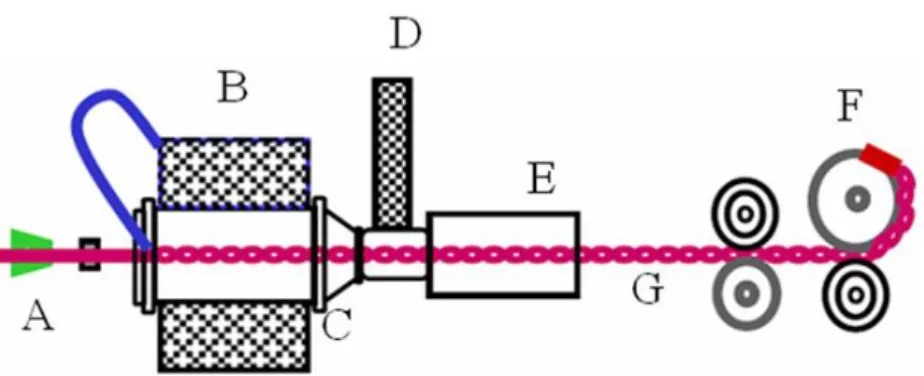
Figure 1 shows the configuration of the rotor twister machine on which the major manufacturing technique is dependent. The bamboo charcoal polyester textured yarn (B) was placed over the rotor twister (C) which was operated by the tangent belt (D) activated by a motor. Stainless steel wires went
1 2 3 4 5 6 7 8 9 10 11 12 13 14 15 16 17 18 19 20 21 22 23 24 25 26 27 28 29 30 31 32 33 34 35 36 37 38 39 40 41 42 43 44 45 46 47 48 49 50 51 52 53 54 55 56 57 58 59 60
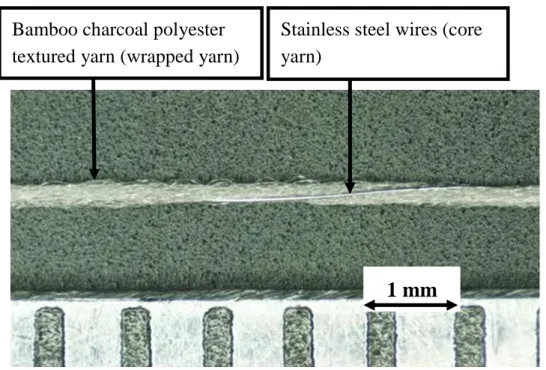
through the collector (A) and formed the bobbin yarn (F) by the traction of the winding roller. Meanwhile, the bamboo charcoal polyester textured yarn wrapped the stainless steel wires when the rotor twister rotated. When speed of the rotor twiser and speed of the winding roller changed, the wrapped counts changed accordingly. When the speed of the rotor twister was constant and the speed of the winding roller was slower, we could obtain more wrapped counts of the BC/SS complex ply yarns. Figure 2 shows the illustration of the bamboo charcoal/ stainless steel complex yarns. And the relation between the wrapped counts of the complex yarns per centimeter and the speed of the rotor twister can be found as
(1)
where T is the speed of the winding roller (rpm), R is the speed of the rotor twister (rpm), T1 is the wrapped counts of the complex ply yarns, and D is the diameter of the winding roller (cm). In this study, the wrapped counts were varied as 2 to 6 turns/ cm for an evaluation of surface resistivity of the knitted fabrics.
1 2 3 4 5 6 7 8 9 10 11 12 13 14 15 16 17 18 19 20 21 22 23 24 25 26 27 28 29 30 31 32 33 34 35 36 37 38 39 40 41 42 43 44 45 46 47 48 49 50 51 52 53 54 55 56 57 58 59 60 61
Figure 1. The configuration of the rotor twister machine.
Note. A: thread eyes; B: bamboo charcoal polyester textured yarn; C: a rotor
twister; D: tangent belt driven by a motor; E: bearing; F: winding roller; and G: bamboo charcoal/stainless steel complex yarns.
1 2 3 4 5 6 7 8 9 10 11 12 13 14 15 16 17 18 19 20 21 22 23 24 25 26 27 28 29 30 31 32 33 34 35 36 37 38 39 40 41 42 43 44 45 46 47 48 49 50 51 52 53 54 55 56 57 58 59 60
Figure 2. The illustration of the bamboo charcoal/stainless steel complex yarns. The core yarn is the 40 μm stainless steel wires and the wrapped yarn is the 75 d/ 72 f/ 2bamboo charcoal txtured yarns. The speed of the rotor twister is 8000 rpm and the wrapped counts are 2 turns/cm.
Preparation of bamboo charcoal/stainless steel complex knitted fabrics The complex yarn was then weaved into bamboo charcoal/ stainless steel knitted fabrics by a circular knitting machine whose needle density was 20 G/ inch. The fabric organization was consisted of plane weave. The EMSE of the knitted fabrics were measured with various laminated counts of 1 to 6 and different laminatings of 0°/0°/0°/0°0°/0°, 0°/45°/90°/-45°/0°/45°, and
Bamboo charcoal polyester textured yarn (wrapped yarn)
Stainless steel wires (core yarn)
1 2 3 4 5 6 7 8 9 10 11 12 13 14 15 16 17 18 19 20 21 22 23 24 25 26 27 28 29 30 31 32 33 34 35 36 37 38 39 40 41 42 43 44 45 46 47 48 49 50 51 52 53 54 55 56 57 58 59 60 61
0°/90°/0°/90°/0°/90°. Figure 3 shows the illustration of the complex knitted fabrics.
Figure 3. The illustration of the bamboo charcoal/stainless steel knitted fabrics. The complex yarns have the 40 μm stainless steel wires as core yarn and the 75 d/ 72 f/ 2bamboo charcoal txtured yarns as wrapped yarn. The needle density of the circular knitting machine is 20 G/inch, the speed of the rotor twister is 8000 rpm, and the wrapped counts are 4 turns/cm.
Bamboo charcoal polyester textured yarns
1mm Stainless steel wires (0.04 mm)
1 2 3 4 5 6 7 8 9 10 11 12 13 14 15 16 17 18 19 20 21 22 23 24 25 26 27 28 29 30 31 32 33 34 35 36 37 38 39 40 41 42 43 44 45 46 47 48 49 50 51 52 53 54 55 56 57 58 59 60 Measurement
Electromagnetic shielding effectiveness (EMSE)
A coaxial transmission line method specified in ASTM 4935-99 was used to test the EMSE of the knitted fabrics. The spectrum analyzer (Burgeon Instrument Co., Ltd, Advantest R3132A) and shielding effectiveness test fixture (Electro-Metrics, Inc., EM-2107A) were used to measure the EMSE based on the measurement of decibels (dB).
Surface resistivity
The surface resistivity was measured by RT-1000, supplied by USA, Static Solutions Inc. The surface resistivity measurement was according to JIS L1094. A specimen was put on the insulation, which was to avoid a static interference. Then a 5 lb counterweight was laid on the surface resistivity tester to ensure the probes a good contact with the surface of specimen. The surface resistivity of knitted fabrics was tested twenty times at different position to get the mean.
Results and Discussion
EMSE of various knitted fabrics with different lamination counts in incident frequency range of 300 KHz to 3 GHz
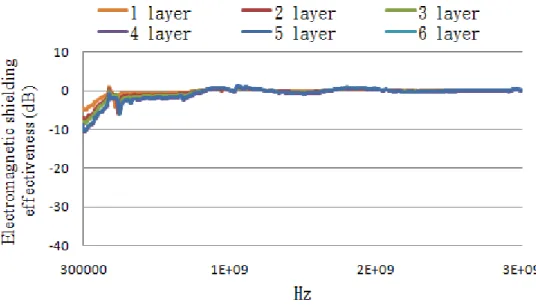
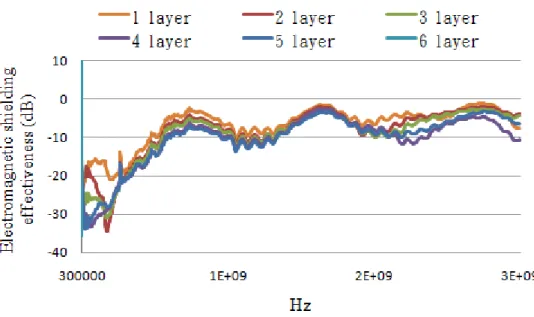
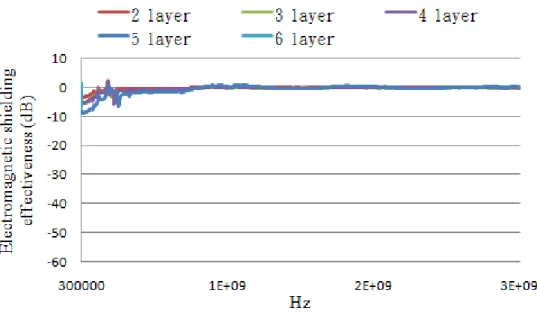
PET-K means polyester knitted fabrics, BC-K refers to bamboo charcoal polyester knitted fabrics, and B/S-K stands for bamboo charcoal/stainless steel complex knitted fabrics. Figures 4 to 6 shows the EMSE of various knitted fabrics with laminated counts varying from 2 to 6. The lamination angle was fixed as 0°/0°/0°/0°/0°/0°. B/S-K had a greater EMSE than PET-K and BC-K
1 2 3 4 5 6 7 8 9 10 11 12 13 14 15 16 17 18 19 20 21 22 23 24 25 26 27 28 29 30 31 32 33 34 35 36 37 38 39 40 41 42 43 44 45 46 47 48 49 50 51 52 53 54 55 56 57 58 59 60 61
in the frequency range of 300 KHz to 3 GHz because PET-K and BC-K did not contain conductive materials. B/S-K could reflect electromagnetic waves, which brought about an increase of EMSE. In addition, Figure 6 shows that EMSE of B/S-K increased slightly with the laminated counts and the differences between all EMSE of B/S-K was less than 5 dB. It may be due to the same laminated angle of 0°/0°/0°/0°/0°/0°, the stainless steel wires had the same laminated angle, which failed in reducing the electric web holes to prevent the electromagnetic wave from penetrating the knitted fabrics. The knitted fabrics could not interfere with electromagnetic wave effectively and thus this design had no significant effect on electromagnetic shielding effectiveness of knitted fabrics. When incident frequency was between 1.03 and 1.40 GHz, EMSE of the knitted fabrics was between 7 dB and 12 dB, inferring the general usage of “moderate”.
1 2 3 4 5 6 7 8 9 10 11 12 13 14 15 16 17 18 19 20 21 22 23 24 25 26 27 28 29 30 31 32 33 34 35 36 37 38 39 40 41 42 43 44 45 46 47 48 49 50 51 52 53 54 55 56 57 58 59 60
Figure 4. EMSE of PET knitted fabrics in the incident frequency range of 300 KHz to 3 GHz.
Figure 5. EMSE of bamboo charcoal polyester knitted fabrics in the incident frequency range of 300 KHz to 3 GHz.
1 2 3 4 5 6 7 8 9 10 11 12 13 14 15 16 17 18 19 20 21 22 23 24 25 26 27 28 29 30 31 32 33 34 35 36 37 38 39 40 41 42 43 44 45 46 47 48 49 50 51 52 53 54 55 56 57 58 59 60 61
Figure 6. EMSE of the bamboo charcoal/stainless steel complex knitted fabrics in the incident frequency range of 300 KHz to 3 GHz. The wrapped counts are 4 turns/cm
EMSE of various knitted fabrics with different laminated counts, and laminated angles in incident frequency range of 300 KHz to 3 GHz
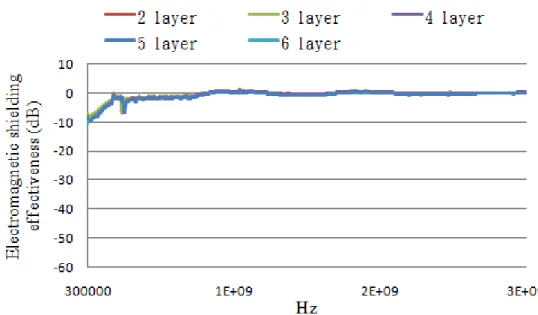
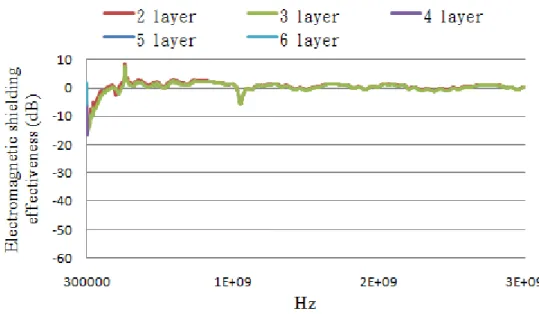
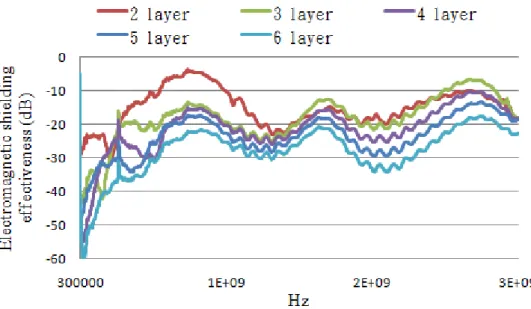
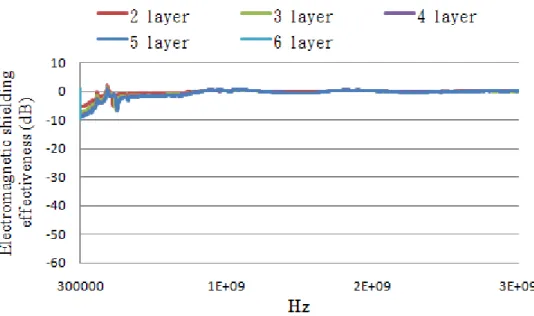
Figures 7 to 12 display that the EMSE of various knitted fabrics with laminated angles of 0°/90°/0°/90°/0°/90° and 0°/45°/90°/-45°/0°/45° and with laminated counts of 2 to 6. According to Figures 7 to 12, B/S-K had better EMSE than PET-K and BC-K because B/S-K contained stainless steel wire which could reflect electromagnetic waves and heighten the EMSE of the B/S-K. Permeability coefficient of the shielding materials was the key in
1 2 3 4 5 6 7 8 9 10 11 12 13 14 15 16 17 18 19 20 21 22 23 24 25 26 27 28 29 30 31 32 33 34 35 36 37 38 39 40 41 42 43 44 45 46 47 48 49 50 51 52 53 54 55 56 57 58 59 60
magnetic field shielding and when the permeability coefficient was higher, the shielding material had more magnetic flux and was able to shield higher magnetic field intensity. When the incident frequency was constant and wrapped counts remained as 4 turns/cm, B/S-K with laminating of 0°/45°/90°/-45°/0°/45° had higher EMSE than 0°/90°/0°/90°/0°/90° by 20dB. This result may be due to the change of laminated angles, the holes size of electric web became smaller so that the EMSE increased. The optimum manufacture parameter was laminated angle of 0°/45°/90°/-45°/0°/45°, with the optimum EMSE as 45 dB in the frequency range of 1.54 GHz. When incident frequency was over 2000 MHz, the EMSE decreased. Because wavelength became shorter as incident frequency increased and thus incident wave was easier to penetrate slits in shielding materials and would cause leaky waves phenomena.
In figures 9 and 12, the B/S-K had laminated count of 2 to 6 layers and laminated angle of 0°/90°/0°/90°/0°/90° and 0°/45°/90°/-45°/0°/45°. B/S-K with 0°/45°/90°/-45°/0°/45° laminating have better EMSE than 0°/90°/0°/90°/0°/90°. When laminated counts were 2 and incident frequency was 720 MHz, EMSE of B/S-K differed by 5dB between 0°/45°/90°/-45°/0°/45° laminating and 0°/90°/0°/90°/0°/90°. In addition, the
1 2 3 4 5 6 7 8 9 10 11 12 13 14 15 16 17 18 19 20 21 22 23 24 25 26 27 28 29 30 31 32 33 34 35 36 37 38 39 40 41 42 43 44 45 46 47 48 49 50 51 52 53 54 55 56 57 58 59 60 61
EMSE of the B/S-K might reach 45 dB, provided laminated counts were 6, laminated angle was 0°/45°/90°/-45°/0°/45°, and incident frequency was 1.54 GHz. The reason may due to the change of bamboo charcoal/stainless steel knitted fabric’s angle have resulted in a reduction of hole of electric web. That
could reflect electromagnetic wave effectively.
Figure 7. EMSE of the polyester knitted fabrics (PET-K). The laminated counts are 2 to 6, laminated angle is 0°/90°/0°/90°/0°/90°, wrapped counts are 4 turns/cm, and incident frequency is of 300 KHz to 3 GHz.
1 2 3 4 5 6 7 8 9 10 11 12 13 14 15 16 17 18 19 20 21 22 23 24 25 26 27 28 29 30 31 32 33 34 35 36 37 38 39 40 41 42 43 44 45 46 47 48 49 50 51 52 53 54 55 56 57 58 59 60
Figure 8. EMSE of the bamboo charcoal polyester knitted fabrics (BC-K). The laminated counts are 2 to 6, laminated angle is 0°/90°/0°/90°/0°/90°, wrapped counts are 4 turns/cm, and incident frequency is of 300 KHz to 3 GHz.
1 2 3 4 5 6 7 8 9 10 11 12 13 14 15 16 17 18 19 20 21 22 23 24 25 26 27 28 29 30 31 32 33 34 35 36 37 38 39 40 41 42 43 44 45 46 47 48 49 50 51 52 53 54 55 56 57 58 59 60 61
Figure 9. EMSE of the bamboo charcoal/stainless steel complex knitted fabrics (B/S-K).The laminated counts are 2 to 6, laminated angle is 0°/90°/0°/90°/0°/90°, wrapped counts are 4 turns/cm, and incident frequency is of 300 KHz to 3 GHz.
1 2 3 4 5 6 7 8 9 10 11 12 13 14 15 16 17 18 19 20 21 22 23 24 25 26 27 28 29 30 31 32 33 34 35 36 37 38 39 40 41 42 43 44 45 46 47 48 49 50 51 52 53 54 55 56 57 58 59 60
Figure 10. EMSE of the polyester knitted fabrics (PET-K). The laminated counts are 2 to 6, laminated angle is 0°/45°/90°/-45°/0°/45°, wrapped counts are 4 turns/cm, and incident frequency is of 300 KHz to 3 GHz.
1 2 3 4 5 6 7 8 9 10 11 12 13 14 15 16 17 18 19 20 21 22 23 24 25 26 27 28 29 30 31 32 33 34 35 36 37 38 39 40 41 42 43 44 45 46 47 48 49 50 51 52 53 54 55 56 57 58 59 60 61
Figure 11. EMSE of the bamboo charcoal polyester knitted fabrics (BC-K). The laminated counts are 2 to 6, laminated angle is 0°/45°/90°/-45°/0°/45°, wrapped counts are 4 turns/cm, and incident frequency is of 300 KHz to 3 GHz.
1 2 3 4 5 6 7 8 9 10 11 12 13 14 15 16 17 18 19 20 21 22 23 24 25 26 27 28 29 30 31 32 33 34 35 36 37 38 39 40 41 42 43 44 45 46 47 48 49 50 51 52 53 54 55 56 57 58 59 60
Figure 12. EMSE of the bamboo charcoal/stainless steel complex knitted fabrics (B/S-K). The laminated counts are 2 to 6, laminated angle is 0°/45°/90°/-45°/0°/45°, wrapped counts are 4 turns/cm, and incident frequency is of 300 KHz to 3 GHz.
Surface resistivity of various knitted fabrics with different wrapped counts In table 1, PET-K was polyester knitted fabrics, BC-K was bamboo charcoal polyester knitted fabrics, B/S-K series was bamboo charcoal/stainless steel complex knitted fabrics with wrapped counts of 2 to 6, for example B/S-K2 was with wrapped counts of 2.
Table 1 shows that the surface resistivity of polyester and bamboo charcoal polyester knitted fabrics exceed 1010 Ω/Sq. However, B/S-K series have lower surface resistivity than PET-K and BC-K but the difference is not
1 2 3 4 5 6 7 8 9 10 11 12 13 14 15 16 17 18 19 20 21 22 23 24 25 26 27 28 29 30 31 32 33 34 35 36 37 38 39 40 41 42 43 44 45 46 47 48 49 50 51 52 53 54 55 56 57 58 59 60 61
significant. It may be due to an addition of bamboo charcoal particles in the spinning of bamboo charcoal polyester textured yarn; however, the content of bamboo charcoal particles had to be 1.2%. Table 1 show as the wrapped counts of the complex yarns increased and heightened the surface resistivity of B/S-K accordingly. Seeing that more wrapped counts resulted in an increase of bamboo charcoal polyester filaments (i.e., the wrapped yarn of the complex yarns) and a decrease the probability that stainless steel wires exposure on the surface of the bamboo charcoal/ stainless steel complex yarns. Therefore, the probe is become difficult to contact the stainless steel wires as the wrapped counts increased.
Table 1 also shows that B/S-K series have lower surface resistivity coursewise than walewise. The knitted fabrics were formed by looping and connecting each other. Therefore, loops were continuously formed in crabwise direction, which caused a lower course surface resistivity and higher wale surface resistivity of B/S-K series. Based on equation of Ohm's law, surface resistivity and length of conducting wire were directly rated. Hence, the distance for electron pass loop walewise was longer, which resulted in a higher surface resistivity of B/S-K series. Compared to PET-K and BC-K, B/S-K series containing stainless steel wires had lower surface resistivity.
1 2 3 4 5 6 7 8 9 10 11 12 13 14 15 16 17 18 19 20 21 22 23 24 25 26 27 28 29 30 31 32 33 34 35 36 37 38 39 40 41 42 43 44 45 46 47 48 49 50 51 52 53 54 55 56 57 58 59 60
Table 1. Surface resistivity of PET-K, BC-K, and B/S-K series
Knitted fabrics Course (Ω/Sq.) Wale (Ω/Sq.)
PET-K 2.00×10¹⁰±1.4 2.51×10¹⁰±1.36 BC-K 1.26×10¹⁰±1.24 1.58×10¹⁰±1.23 B/S-K2 32.3±1.49 4.06×10⁵±1.74 B/S-K3 67±1.05 3.19×10⁵±3.91 B/S-K4 129±1.87 2.11×10⁵±1.41 B/S-K5 507±1.15 2.77×10⁶±1.24 B/S-K6 517±1.27 2.83×10⁶±1.47 Conclusion
In this research, we successfully fabricated the electricity conductive bamboo charcoal/stainless steel complex yarns with bamboo charcoal polyester textured yarn and stainless steel wires using a novel rotor twister machine.
EMSE of the B/S-K increased slightly with the change of lamination counts and with lamination angle (0°/0°/0°/0°/0°/0°). EMSE rose as laminated counts increased and the difference of EMSE between each laminated counts was less than 5 dB. In particular, the EMSE reached 45 dB when laminated angle were 0°/45°/90°/-45°/0°/45° and incident frequency was 1.54 GHz.
B/S-K had a lower course surface resistivity than the warp one. The optimum surface resistivity of B/S-K was 32.3Ω coursewise when the wrapped
1 2 3 4 5 6 7 8 9 10 11 12 13 14 15 16 17 18 19 20 21 22 23 24 25 26 27 28 29 30 31 32 33 34 35 36 37 38 39 40 41 42 43 44 45 46 47 48 49 50 51 52 53 54 55 56 57 58 59 60 61
counts were 2 turns/cm. It has a lower surface resistivity about 2×10¹⁰ Ω/ Sq than polyester knitted fabrics.
References
1. A. S. Orbach, S. Abgrall, C. A. Bravo, Radio Waves and Stray Currents, Pathos Boil, 47, 1085-1093 (1999).
2. A. V. Kramarenko, U. Tan, Int. J. Neurosci., 113, 1007-1019 (2003).
3. M. Wojewódzka, I. Buraczewska, , M. Kruszewski, Mutat. Res., 518, 9-20 (2002).
4. H. Lai, N. P. Singh, Int. J. Radiat. Biol., 69(4), 513-521, (1996).
5. J. G. Robison, A. R. Pendleton, K. O. Monson,
Bioelectromagnetics, 23(2), 106-112 (2002).
6. T. Maeda, S. Sugimoto, T. Kagotani, N. Tezuka, K. Inomata, J. Magn.
Magn. Mater., 281(2-3), 195-205 (2004).
7. S. K. Dhawan, N. Singh, S. Venkatachalam, Synth. Met., 129(3), 261-267 (2002).
8. S. M. Abbas, A. K. Dixit, R. Chatterjee, T. C. Goel, Mater. Sci. Eng. B,
123(2), 167-171 (2005).
1 2 3 4 5 6 7 8 9 10 11 12 13 14 15 16 17 18 19 20 21 22 23 24 25 26 27 28 29 30 31 32 33 34 35 36 37 38 39 40 41 42 43 44 45 46 47 48 49 50 51 52 53 54 55 56 57 58 59 60
10. S. S. Shang, Advanced Textile Technology, 4(10) (2002) 49-50.
11. H. F. Juen, Y. M. Jang, J. P. Wang, Technical textile, 19(6) (2001) 7-9. 12. E. G. Han, K. W. Oh, E. A. Kim, Clothing and Textiles, 23(5) 694-699
(1999).
13. E. G. Han, E. A. Kim, K. W. Oh, Synth. Met., 123, 469-476 (2001). 14. T. H. Ueng, K. B. Chen, Compos. Part A, 32, 1491-1496 (2001).
15. G. Y. Gao, Y. Q. Zhang, Progress in Textile Science and Technology, 5, 33-35(2007).
16. Z. Q. Liu, G. H. Chen, L. Q. Xie, L. B. Xu, H. W. Guo, Journal of