Formation and Function of Three Lineages in Hunan
(湖南三家族的形成與功能)
Ts’ui-jung Liu*
The article was originally published in Family Process and Political Process in Modern Chinese
History (近世家族與政治比較歷史論文集), edited by the Institute of Modern History, Academia
Sinica, (Taipei: Institute of Modern History, Academia Sinica, June 1992), pp. 327-375.
摘要 本文以湖南三個家族:衡陽魏氏、清泉(湘東桃橋)李氏、邵陽李氏的族譜為 基本資料,由家族人口的動態來探討家族形成的過程以及功能的發揮。本文的結 論主要有三點:(1)一個家族形成的必要條件是由一位共同的祖先所繁衍的子孫 達到相當大的數目。在中國傳統的分家習慣下,同一祖先的後代可能隨時分成支 派,但要將共同祖先的族人結合起來,形成有組織的家族團體,就必須有相當多 的人口方才可能,而要具備此一人口條件則需經相當長的時間。(2)一個家族能 夠推動集體活動,一方面固然需具有利的人口數目和結構,另一方面則需有一些 具社會聲望且富而好義的人士出而領導。這些人在家族人口中只是少數,但其角 色極為重要。(3)一個家族絕不可能孤立在地方社會之外,家族功能的適當發揮 不但有利於家族本身,對於地方社會的穩定也有助益。在中國傳統帝制末期,家 族團體的蓬勃活躍反映的正是當時的社會和政治環境極有利於這種發展。 INTRODUCTION
This paper is attempted to analyze the formation and function of three lineages in Hunan: the Heng-yang Wei衡陽魏, the Ch’ing-ch’uan Li清泉李, and the Shao-yang Li邵陽李. According to a definition given by Watson and commonly accepted by historians, “A lineage is a corporation in the sense that members derive benefits from jointly-owned property and shared resources; they also join in corporate activities on a regular base. Furthermore, members of a lineage are highly conscious of themselves as a group in relation to others whom they define as outsiders. A lineage is not, therefore, a loosely-defined collection of individuals.”1 This definition, however, is a rather static description about organizational form of a lineage as long as it is already in existence. Any descent group could not be called a “lineage” strictly by this definition throughout all the time tracing from the beginning of its common ancestor. In other words, a lineage should be formed through a dynamic process. This paper
* Research Fellow, the Institute of Economics, Academia Sinica. 1
P. Ebrey and J. Watson eds., Kinship Organization in Late Imperial China, 1000-1940 (Berkeley: University of California Press, 1986), p. 5.
will try to investigate this dynamic process with the data organized from the genealogies of the three lineages in Hunan.
The Heng-yang Wei genealogy had been compiled five times in 1724, 1797, 1844, 1882 and 1914.2 The Ch’ing-ch’uan Li genealogy was complied twice, the one in 1858 and the other in 1893.3 The Shao-yang Li had several old records for individual branches since 1691, but the joint lineage genealogy was compiled first in 1869 and again in 1904.4 This paper uses the last compilation of the three genealogies.
Each of the three genealogies started records from the ancestor who first moved to Hunan where their descendants became prolific. From the prefaces of these genealogies, we can gather the origins of the three lineages. The founding father of the Heng-yang Wei, named Ch’ing-she 請社 (1120-1201), was a native of Chu-lu 鉅 鹿, Hopei. He moved to south with the Sung court and was dispatched to Lung-li-wei 龍里衛 in Kueichow by Emperor Sung Kao-tsung 宋高宗 in 1152 as a Commander (Chih-hui-shih 指揮使); and in 1170, Emperor Sung Hsiao-tsung 宋孝宗 ordered him to move to Heng-yang to cultivate a piece of land as a military colonist. The Heng-yang Wei genealogy provided records of Ch’ing-she’s descendants down to the twenty-ninth generation with those from the fifth generation onwards dividing into five branches.
The Ch’ing-ch’uan Li’s first ancestor, Hsiu-te 秀德 (1364-1431), was a native of Lu-ling 廬陵 in Kiangsi. He was a Manager of Affairs in the Board of Rites (Li-pu chu-shih 禮部主事) during the Ming Chien-wen reign (1399-1402), but he discarded his position and moved to the eastern part of Heng-yang where Ch’ing-ch’uan county was located. Hsiu-te had one son who, in turn, had seven sons and the Ch’ing-ch’uan Li genealogy recorded the descendants of five of these seven sons (with brothers 5 and 6 missing afterwards) from the third generation to the twenty-first generation in five branches.
The Shao-yang Li lineage traced its founders to two brothers, Yun 雲 (1296-1388) and Shih 什 (1298-1384), who moved from Chi-chou 吉州 in Kiangsi to northern part of Shao-yang at the end of the Yuan dynasty. Yun had four sons and one of them became heirless, thus form the third generation onwards the descendants were divided into three branches. Shih had one son and one grandson who, in turn, had three sons, thus the descendants were also divided into three branches from the fourth generation onwards. Altogether, the Shao-yang Li lineage records consisted of
2
Heng-yang Wei-shih tsung-p’u 衡陽魏氏宗譜 (The genealogy of the Heng-yang Wei lineage, 1914). 41 chuan.
3
Hsiang-tung T’ao-ch’iao Li-shih tsung-p’u 湘東桃橋李氏宗譜 (The genealogy of the Ch’ing- ch’uan Li lineage, 1893). 9 chuan.
4
Hu-nan Shao-i Li-shih tsu-p’u 湖南邵邑李氏族譜 (The genealogy of the Shao-yang Li lineage, 1904). 40 chuan.
six branches down to the twenty-fourth generation. (See Appendix A for a list of number of males in each generation and the birth years recorded.)
Since a lineage could be formed only when the descendants of a common ancestor became quite proliferated, this paper will try to trace formation of these three Hunan lineages by analyzing the dynamics of their populations. In addition to demographic aspects related to the formation of these lineages, this paper will also try to discuss functions of these lineages through their collective activities. The following paper will first provide information related to the social background, then present some information related to the population dynamics, and finally discuss the functions of these three lineages. With these data and discussions, this paper may provide some relevant facts for enhancing our understanding of relations between the lineage and politics in late imperial China.
1. SOCIAL BACKGROUND
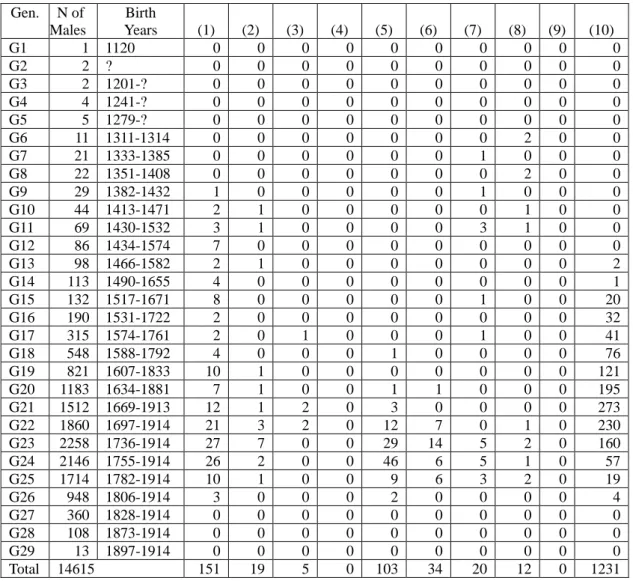
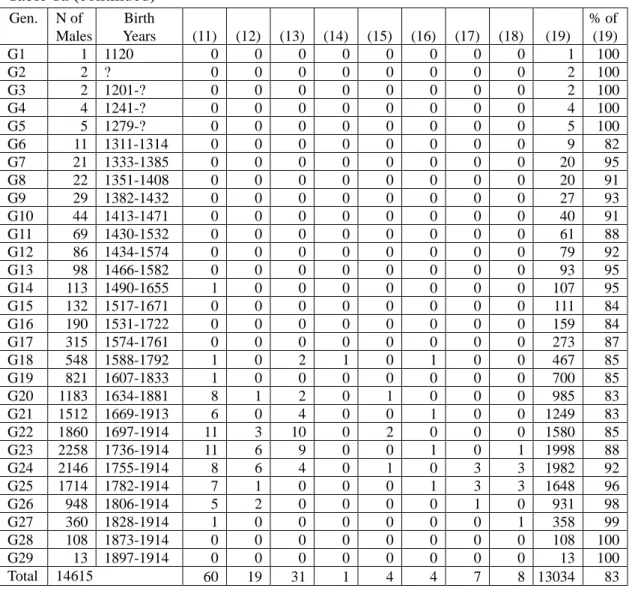
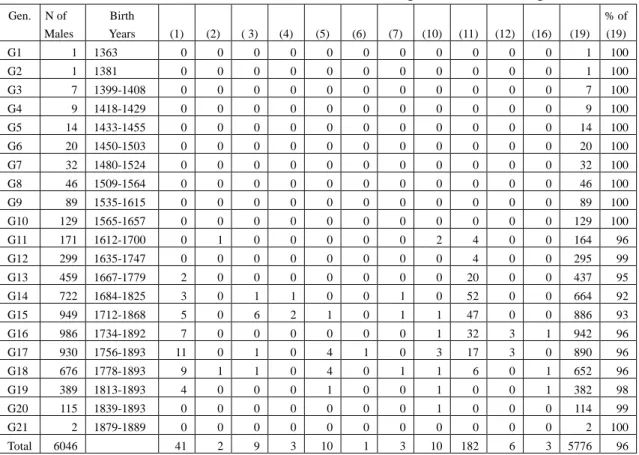
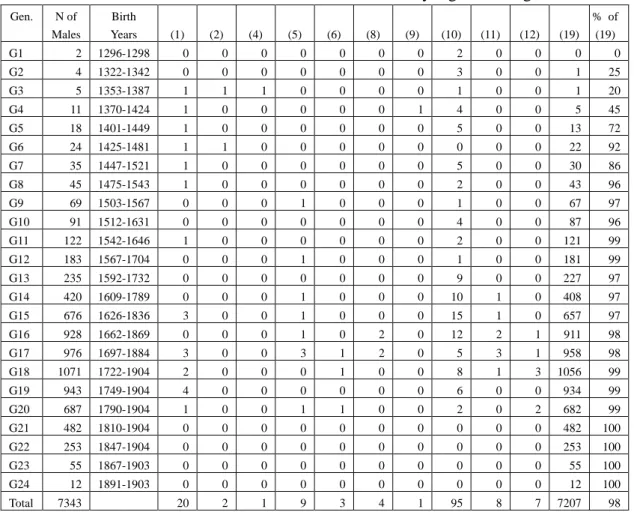
From the three genealogies, we can organize information related to social status of male members in these lineages as shown in Tables 1abc. The social status was indicated by several categories presenting a simplification of the original records. The first four categories related to the degree holders of traditional examination system, Sheng-yuan 生員, Kung-sheng 貢生, Chu-jen 舉人, and Chin-shih 進士, who might also became an official, representing a formal channel of upward social mobility. The purchased titles included all kinds of civil service titles purchased by these lineage members, representing an informal channel of upward social mobility. The military merit titles included all ranks belonging to category of Chun-kung 軍功, some might be obtained through actual military contribution, some might just through purchasing. The local sub-officials included all positions below the magistrate, such as Hsien-chen 縣丞, Hsun-chien 巡檢, Chiao-yu 教諭, and Hsun-tao 訓導. The local military officers included all military positions, such as Yu-chi 游擊, Tu-ssu 都司, Shou-pei 守備, in local areas. The category of officials in Peking referred to positions in central government offices. These categories of local and central government official positions were retained only for those who did not have any record about formal degrees. The honor bestowed included civil and military honorary titles which one might obtained due to have distinguished offspring or simply due to reaching very old age. Other categories, such as merchant, soldier, teacher, medical experts, and monk were some professional status that could be identified. The category of literate referred to those who were known of being an expert in writing or painting but without earning any formal degree. The graduates from the new school system in the beginning of the twentieth-century were identified with separate categories. The last category contained those who had no remark.
With the above explanation of different categories, the headings of the 19 columns in Tables 1abc are as follows:
(1) Sheng-yuan (11) Merchant (2) Kung-sheng (12) Soldier (3) Chu-jen (13) Literate (4) Chin-shih (14) Teacher
(5) Purchased titles (15) Medical profession (6) Military merit titles (16) Monk
(7) Local sub-officials (17) Graduates of elementary and middle schools (8) Local military officials (18) Graduates of vocational schools and colleges (9) Officials in Peking (19) No remark
(10) Honor bestowed
We can thus proceed to investigate the social status of males in these lineages. From Table 1a, we can see that there was no Chin-shih (col. 4) among the Heng-yang Wei males. There were five men who became Chu-jen (col. 3) in 1681, 1779, 1799, 1807, and 1822 respectively.
Table 1a: Social Status of Males in the Heng-yang Wei Lineage
Gen. N of Males Birth Years (1) (2) (3) (4) (5) (6) (7) (8) (9) (10) G1 1 1120 0 0 0 0 0 0 0 0 0 0 G2 2 ? 0 0 0 0 0 0 0 0 0 0 G3 2 1201-? 0 0 0 0 0 0 0 0 0 0 G4 4 1241-? 0 0 0 0 0 0 0 0 0 0 G5 5 1279-? 0 0 0 0 0 0 0 0 0 0 G6 11 1311-1314 0 0 0 0 0 0 0 2 0 0 G7 21 1333-1385 0 0 0 0 0 0 1 0 0 0 G8 22 1351-1408 0 0 0 0 0 0 0 2 0 0 G9 29 1382-1432 1 0 0 0 0 0 1 0 0 0 G10 44 1413-1471 2 1 0 0 0 0 0 1 0 0 G11 69 1430-1532 3 1 0 0 0 0 3 1 0 0 G12 86 1434-1574 7 0 0 0 0 0 0 0 0 0 G13 98 1466-1582 2 1 0 0 0 0 0 0 0 2 G14 113 1490-1655 4 0 0 0 0 0 0 0 0 1 G15 132 1517-1671 8 0 0 0 0 0 1 0 0 20 G16 190 1531-1722 2 0 0 0 0 0 0 0 0 32 G17 315 1574-1761 2 0 1 0 0 0 1 0 0 41 G18 548 1588-1792 4 0 0 0 1 0 0 0 0 76 G19 821 1607-1833 10 1 0 0 0 0 0 0 0 121 G20 1183 1634-1881 7 1 0 0 1 1 0 0 0 195 G21 1512 1669-1913 12 1 2 0 3 0 0 0 0 273 G22 1860 1697-1914 21 3 2 0 12 7 0 1 0 230 G23 2258 1736-1914 27 7 0 0 29 14 5 2 0 160 G24 2146 1755-1914 26 2 0 0 46 6 5 1 0 57 G25 1714 1782-1914 10 1 0 0 9 6 3 2 0 19 G26 948 1806-1914 3 0 0 0 2 0 0 0 0 4 G27 360 1828-1914 0 0 0 0 0 0 0 0 0 0 G28 108 1873-1914 0 0 0 0 0 0 0 0 0 0 G29 13 1897-1914 0 0 0 0 0 0 0 0 0 0 Total 14615 151 19 5 0 103 34 20 12 0 1231
Table 1a (continued) Gen. N of Males Birth Years (11) (12) (13) (14) (15) (16) (17) (18) (19) % of (19) G1 1 1120 0 0 0 0 0 0 0 0 1 100 G2 2 ? 0 0 0 0 0 0 0 0 2 100 G3 2 1201-? 0 0 0 0 0 0 0 0 2 100 G4 4 1241-? 0 0 0 0 0 0 0 0 4 100 G5 5 1279-? 0 0 0 0 0 0 0 0 5 100 G6 11 1311-1314 0 0 0 0 0 0 0 0 9 82 G7 21 1333-1385 0 0 0 0 0 0 0 0 20 95 G8 22 1351-1408 0 0 0 0 0 0 0 0 20 91 G9 29 1382-1432 0 0 0 0 0 0 0 0 27 93 G10 44 1413-1471 0 0 0 0 0 0 0 0 40 91 G11 69 1430-1532 0 0 0 0 0 0 0 0 61 88 G12 86 1434-1574 0 0 0 0 0 0 0 0 79 92 G13 98 1466-1582 0 0 0 0 0 0 0 0 93 95 G14 113 1490-1655 1 0 0 0 0 0 0 0 107 95 G15 132 1517-1671 0 0 0 0 0 0 0 0 111 84 G16 190 1531-1722 0 0 0 0 0 0 0 0 159 84 G17 315 1574-1761 0 0 0 0 0 0 0 0 273 87 G18 548 1588-1792 1 0 2 1 0 1 0 0 467 85 G19 821 1607-1833 1 0 0 0 0 0 0 0 700 85 G20 1183 1634-1881 8 1 2 0 1 0 0 0 985 83 G21 1512 1669-1913 6 0 4 0 0 1 0 0 1249 83 G22 1860 1697-1914 11 3 10 0 2 0 0 0 1580 85 G23 2258 1736-1914 11 6 9 0 0 1 0 1 1998 88 G24 2146 1755-1914 8 6 4 0 1 0 3 3 1982 92 G25 1714 1782-1914 7 1 0 0 0 1 3 3 1648 96 G26 948 1806-1914 5 2 0 0 0 0 1 0 931 98 G27 360 1828-1914 1 0 0 0 0 0 0 1 358 99 G28 108 1873-1914 0 0 0 0 0 0 0 0 108 100 G29 13 1897-1914 0 0 0 0 0 0 0 0 13 100 Total 14615 60 19 31 1 4 4 7 8 13034 83
The highest official position held by these men was a Sub-prefect (T’ung-chih 同知) in Tan-shui 淡水, Taiwan, held by Wei Ying 魏瀛 (1775-1845) in 1840 after serving as a magistrate at various counties in Shantung and Fukien. Another four men only held a magistrate office at various counties in Chihli, Honan, Shansi, and Szechwan. In addition to Chu-jen, there were 19 Kung-sheng and 151 Sheng-yuan among the Wei males; altogether, these 175 men accounted for only 1.2% among all males in records. There were 103 persons who purchased at least a civil title, and 20 who served as sub-officials below the magistrate; these 123 men accounted for only 0.8% among all males. There were 34 men who had military merit titles, 12 men served as local military officers, and 19 men who were soldiers; these 65 men related to military career accounted for only 0.4% among all males. Moreover, there were 60 merchants, 31 literate, 1 teacher, 4 medical experts, 4 monks, and 15 graduates from the new school system. It is notable that there were 1,231 men (or 8.4%) who had obtained honorary titles, most of these were due to an honor bestowed for old age such as Teng-shih-lang 登仕郎 for those above age 70 and Hsiu-chih-lang 修職郎
for those above age 80. these simple statistics tended to suggest that the Heng-yang Wei could be quite influential at local community as it had quite a number of members who were rather eminent or rather wealthy, but a great majority of the Wei males were just common people.
From Table 1b, we see that three men from the Ch’ing-ch’uan Li lineage became Chin-shih. They were Li Ch’ao-i 李朝儀 (1813-1881, G14), Li Tuan-fen 李端棻 (1833-1907, the genealogy did not record his year of death), and Li Tuan-chu 李端榘 (1849-?); they became Chin-shih in 1845, 1863, and 1886 respectively. It is notable that Ch’ao-i was the uncle of Tuan-fen and the father of Tuan-chu.
Table 1b: Social Status of Males in the Ch’ing-ch’uan Li Lineage
Gen. N of Males Birth Years (1) (2) ( 3) (4) (5) (6) (7) (10) (11) (12) (16) (19) % of (19) G1 1 1363 0 0 0 0 0 0 0 0 0 0 0 1 100 G2 1 1381 0 0 0 0 0 0 0 0 0 0 0 1 100 G3 7 1399-1408 0 0 0 0 0 0 0 0 0 0 0 7 100 G4 9 1418-1429 0 0 0 0 0 0 0 0 0 0 0 9 100 G5 14 1433-1455 0 0 0 0 0 0 0 0 0 0 0 14 100 G6 20 1450-1503 0 0 0 0 0 0 0 0 0 0 0 20 100 G7 32 1480-1524 0 0 0 0 0 0 0 0 0 0 0 32 100 G8 46 1509-1564 0 0 0 0 0 0 0 0 0 0 0 46 100 G9 89 1535-1615 0 0 0 0 0 0 0 0 0 0 0 89 100 G10 129 1565-1657 0 0 0 0 0 0 0 0 0 0 0 129 100 G11 171 1612-1700 0 1 0 0 0 0 0 2 4 0 0 164 96 G12 299 1635-1747 0 0 0 0 0 0 0 0 4 0 0 295 99 G13 459 1667-1779 2 0 0 0 0 0 0 0 20 0 0 437 95 G14 722 1684-1825 3 0 1 1 0 0 1 0 52 0 0 664 92 G15 949 1712-1868 5 0 6 2 1 0 1 1 47 0 0 886 93 G16 986 1734-1892 7 0 0 0 0 0 0 1 32 3 1 942 96 G17 930 1756-1893 11 0 1 0 4 1 0 3 17 3 0 890 96 G18 676 1778-1893 9 1 1 0 4 0 1 1 6 0 1 652 96 G19 389 1813-1893 4 0 0 0 1 0 0 1 0 0 1 382 98 G20 115 1839-1893 0 0 0 0 0 0 0 1 0 0 0 114 99 G21 2 1879-1889 0 0 0 0 0 0 0 0 0 0 0 2 100 Total 6046 41 2 9 3 10 1 3 10 182 6 3 5776 96
There were nine men who became Chu-jen but did not succeed in becoming a Chin-chih. Of these nine men, one was Li Ch’ao-hsien 李朝顯 (1791-1837), the eldest brother of Ch’ao-i, who earned his degree in 1816, one was Li Tuan-yuan 李端 源 (1826-1884), the nephew of Ch’ao-i, who earned his degree in 1851; five were Ch’ao-I’sons who respectively earned their degrees in 1875, 1885, 1888, and 1891 (two in the same year); and the other two men, who belonged to different branches, earned their degrees in 1851 and 1873 respectively. It is also notable that Ch’ao-i moved to Kueichow with his mother and brothers after the death of his father. (The father was buried locally while the mother was buried in Kueichow as the genealogy recorded). Because Li Ch’ao-i served at various positions in Chihli for 37 years and
was a very successful local official, the Governor-General of Chihli, Li Hung-chang 李鴻章 (1823-1901), memorialized to have Chao-i’s’ biography included in the official Ch’ing History. (Li Hung-chang’s memorial was included in the first chuan of the Li genealogy). Li Tuan-fen, who was a scholar at the Han-lin-yuan 翰林院, was born in Kueichow, lived in Peking, and never returned to his ancestor’s native land in Hunan (see his preface to the Li genealogy). These examples showed that the Ch’ing-ch’uan Li lineage gained its importance through some distinguished members who actually had moved out. In addition to Chin-shih and Chu-jen, there were also 2 Kung-sheng and 41 Sheng-yuan; altogether these 55 men succeeded in examinations accounted for 0.9% among all males in the record. Moreover, there were ten men who had purchased a civil title, one who had military merit title, three who were local sub-officials, ten who had been bestowed honorary titles, six literate and three monks. It is notable that there were 182 merchants who counted for 3% among all males. As in the case of Heng-yang Wei, most males in the Ch’ing-ch’uan Li lineage were just common people.
From Table 1c, we see there was only one Chin-shih in the third generation of the Shao-yang Li lineage.
Table 1c: Social Status of Males in the Shao-yang Li Lineage
Gen. N of Males Birth Years (1) (2) (4) (5) (6) (8) (9) (10) (11) (12) (19) % of (19) G1 2 1296-1298 0 0 0 0 0 0 0 2 0 0 0 0 G2 4 1322-1342 0 0 0 0 0 0 0 3 0 0 1 25 G3 5 1353-1387 1 1 1 0 0 0 0 1 0 0 1 20 G4 11 1370-1424 1 0 0 0 0 0 1 4 0 0 5 45 G5 18 1401-1449 1 0 0 0 0 0 0 5 0 0 13 72 G6 24 1425-1481 1 1 0 0 0 0 0 0 0 0 22 92 G7 35 1447-1521 1 0 0 0 0 0 0 5 0 0 30 86 G8 45 1475-1543 1 0 0 0 0 0 0 2 0 0 43 96 G9 69 1503-1567 0 0 0 1 0 0 0 1 0 0 67 97 G10 91 1512-1631 0 0 0 0 0 0 0 4 0 0 87 96 G11 122 1542-1646 1 0 0 0 0 0 0 2 0 0 121 99 G12 183 1567-1704 0 0 0 1 0 0 0 1 0 0 181 99 G13 235 1592-1732 0 0 0 0 0 0 0 9 0 0 227 97 G14 420 1609-1789 0 0 0 1 0 0 0 10 1 0 408 97 G15 676 1626-1836 3 0 0 1 0 0 0 15 1 0 657 97 G16 928 1662-1869 0 0 0 1 0 2 0 12 2 1 911 98 G17 976 1697-1884 3 0 0 3 1 2 0 5 3 1 958 98 G18 1071 1722-1904 2 0 0 0 1 0 0 8 1 3 1056 99 G19 943 1749-1904 4 0 0 0 0 0 0 6 0 0 934 99 G20 687 1790-1904 1 0 0 1 1 0 0 2 0 2 682 99 G21 482 1810-1904 0 0 0 0 0 0 0 0 0 0 482 100 G22 253 1847-1904 0 0 0 0 0 0 0 0 0 0 253 100 G23 55 1867-1903 0 0 0 0 0 0 0 0 0 0 55 100 G24 12 1891-1903 0 0 0 0 0 0 0 0 0 0 12 100 Total 7343 20 2 1 9 3 4 1 95 8 7 7207 98
This man, named Li Hsien 李憲 (1360-1437), probably earned his degree through special election rather than through examination as the Li genealogy said he was elected (hsuen 選) a Chin-shih in 1407. He was a Sub-prefect of Cheng-tu 成都 Prefecture in Szechwan and died while still at incumbent. There were only 2 Kung-sheng and 20 Sheng-yuan; altogether, the 23 men who had formal degrees account for merely 0.3% among all males in this lineage. Moreover, there were nine men who had purchased civil titles, three who had military merit titles, four who were local military officers, one who was a police-master of the Court of Censors (Tu-ch’a-yuan Tien-shih 都察院典史) in Peking, eight merchants and seven soldiers. There were 95 men (or 1.3%) had been bestowed with honorary titles. It is notable that a sixteenth-generation man, Li Ch’en-tien 李臣典 (1838-1864), who was a Brigade-General (Tsung-ping 總 兵 ), died after being injured at the battle that recovered Nanking from the Taiping rebels in 1864. Not only that he himself was bestowed with great honor by the Kuang-hsu Emperor in 1895 but his father, uncle, grandfather and great grandfather were all bestowed with honors. Thus this event promoted the social status of the Shao-yang Li lineage. However, a great majority of the Shao-yang Li males was just common people as in the cases of other two lineages.
In short, each of the three lineages could be recognized as a group of some importance because it did have some distinguished members whose achievements conformed to cultural values of traditional China. These distinguished men accounted for less that one percent among their fellow lineage members if only the formal ladder of success was considered. But a lineage was formed and functioned not just for this very small number of men. A great majority of lineage members was just common people whose involvement made it possible for a lineage to emerge and function as a social group.
2. DYNAMICS OF LINEAGE POPULATION
The dynamics of a lineage population may be investigated from aspects of marriage, fertility, mortality, migration, and population growth if its genealogy provides enough useful records. If a genealogy recorded only the lineage members’ names without providing their vital dates, we may just count the number of males recorded in each generation as shown in Appendix A. With these numbers, we can still see that, for each branches, the number of males increased generation by generation up to a certain point and then decreased. However, this pattern of change is actually due to the fact that the records of these genealogies ended in the year of compilation, and thus the decline in number after certain generation was simply because those who born after that particular year did not have a chance of being recorded. With the reference of birth years in record, we can see that generations are over-lapping each
other in time.5 The span of a generation (the interval between the first and the last birth year in each generation), becomes longer and longer until the last birth happened to be in the year when the genealogy was compiled. The difference of the first birth year between the neighboring two generations reflects more or less the time gap between the father and the son.6 It is quite clear that a genealogy without records of vital dates is not very useful for the study of lineage population.
As a matter of fact, most of the genealogies did not provide the vital dates of all persons in records. A survey over 49 genealogies belonging to families and lineages in 12 provinces showed that on the average, 80 percent of the male birth date, 68 percent of the female (in-married women) birth date, and 39 percent of both male and female death date were known.7 For the three Hunan lineages studied in this paper, the available male birth date accounted for 90%, 76%, and 87% for the Heng-yang Wei, the Ch’ing-ch’uan Li, and the Shao-yang Li respectively; the male death date for 47%, 46%, and 36%; the female birth date for 81%, 72%, and 83%; and the female death date for 45%, 46%, and 41%. Thus, the three Human genealogies provided quite good data for investigating the dynamics of lineage populations.
The follow paper will not repeat the details about out-migration of the members of these lineages as those related to the Heng-yang Wei and the Shao-yang Li had been discussed elsewhere. It was found that out-migration had help relieve the population pressure within these lineages and there was a tendency for members of the same branch to move in the same direction, reflecting a push and pull effect among the lineage members.8 The discussion below will concentrate on statistics about marriage, fertility, mortality, and growth of the three lineage population. These demographic analyses may help in revealing the process of formation of these lineages.
(1) Marriage
Statistics related to martial status of members in the three lineages are listed in Table 2abc. Heading of columns in Table 2abc are as follows:
5
For a discussion on the nature of generation overlapping see, John C. H. Fei and Ts’ui-jung Liu, “The Growth and Decline of Chinese Family Clans,” Journal of Interdisciplinary History, XII: 3 (Winter 1982), pp. 375-408.
6
It should be noted that a deviation from this regularity can be found in second branch of the Wei lineage during G17-G20. Here we see that the first birth year of these generations are very close to each other. Checking the original records, I found that there were lots of blanks across these generations and these available dates happened to be there. Thus I would think that this is simply a result due to missing records.
7
These percentages are calculated from the genealogies under investigation for presenting in a book on lineage population by this author.
8
Liu Ts’ui-jung 劉翠溶, “Ming-Ch’ing jen-kou chih tseng-chih yu ch’ien-i 明清人口之增殖與遷移 (Population Growth and Migration during the Ming and Ch’ing Periods),” in Cho-yun Hsu et al., (eds.), Papers from Seminar on Chinese Social and Economic History (Taipei, 1983), pp. 303-314.
(1) Number of the First Wife = Number of Male Married (2) Number of the Second Wife
(3) Number of the Third Wife
(4) Number of the Fourth Wife and above (5) Number of Concubine
(6) Total Number of Consort (7) Number of Male Betrothed (8) Number of Male Unmarried
(9) Number of Male Unmarried with Age at Death Unknown (10) Number of Male Unmarried with Age at Death above 50 (11) Number of Consort Remarried out of the Lineage
(12) % of Male Remarried Once = (2)/(1) x 100 (13) % of Male Remarried Twice = (3)/(1) x 100 (14) % of Concubine = (5)/(6) x 100
(15) % of Consort Remarried Out = (11)/(6) x 100
(16) % of Male Unmarried above Age 50 = (10)/N Male x 100
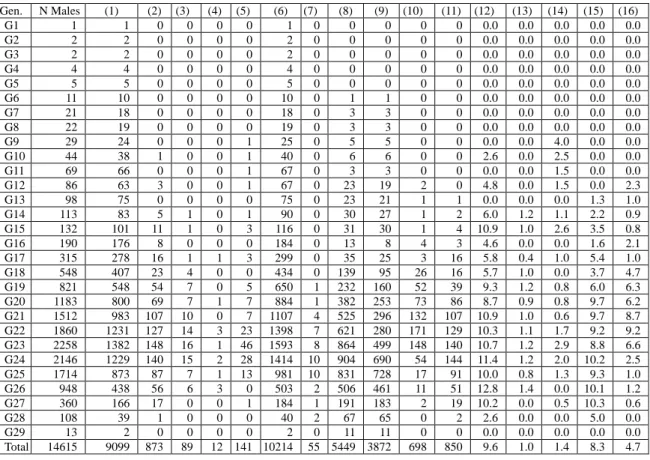
Table 2a: Marital Status of Lineage Members: Heng-yang Wei
Gen. N Males (1) (2) (3) (4) (5) (6) (7) (8) (9) (10) (11) (12) (13) (14) (15) (16) G1 1 1 0 0 0 0 1 0 0 0 0 0 0.0 0.0 0.0 0.0 0.0 G2 2 2 0 0 0 0 2 0 0 0 0 0 0.0 0.0 0.0 0.0 0.0 G3 2 2 0 0 0 0 2 0 0 0 0 0 0.0 0.0 0.0 0.0 0.0 G4 4 4 0 0 0 0 4 0 0 0 0 0 0.0 0.0 0.0 0.0 0.0 G5 5 5 0 0 0 0 5 0 0 0 0 0 0.0 0.0 0.0 0.0 0.0 G6 11 10 0 0 0 0 10 0 1 1 0 0 0.0 0.0 0.0 0.0 0.0 G7 21 18 0 0 0 0 18 0 3 3 0 0 0.0 0.0 0.0 0.0 0.0 G8 22 19 0 0 0 0 19 0 3 3 0 0 0.0 0.0 0.0 0.0 0.0 G9 29 24 0 0 0 1 25 0 5 5 0 0 0.0 0.0 4.0 0.0 0.0 G10 44 38 1 0 0 1 40 0 6 6 0 0 2.6 0.0 2.5 0.0 0.0 G11 69 66 0 0 0 1 67 0 3 3 0 0 0.0 0.0 1.5 0.0 0.0 G12 86 63 3 0 0 1 67 0 23 19 2 0 4.8 0.0 1.5 0.0 2.3 G13 98 75 0 0 0 0 75 0 23 21 1 1 0.0 0.0 0.0 1.3 1.0 G14 113 83 5 1 0 1 90 0 30 27 1 2 6.0 1.2 1.1 2.2 0.9 G15 132 101 11 1 0 3 116 0 31 30 1 4 10.9 1.0 2.6 3.5 0.8 G16 190 176 8 0 0 0 184 0 13 8 4 3 4.6 0.0 0.0 1.6 2.1 G17 315 278 16 1 1 3 299 0 35 25 3 16 5.8 0.4 1.0 5.4 1.0 G18 548 407 23 4 0 0 434 0 139 95 26 16 5.7 1.0 0.0 3.7 4.7 G19 821 548 54 7 0 5 650 1 232 160 52 39 9.3 1.2 0.8 6.0 6.3 G20 1183 800 69 7 1 7 884 1 382 253 73 86 8.7 0.9 0.8 9.7 6.2 G21 1512 983 107 10 0 7 1107 4 525 296 132 107 10.9 1.0 0.6 9.7 8.7 G22 1860 1231 127 14 3 23 1398 7 621 280 171 129 10.3 1.1 1.7 9.2 9.2 G23 2258 1382 148 16 1 46 1593 8 864 499 148 140 10.7 1.2 2.9 8.8 6.6 G24 2146 1229 140 15 2 28 1414 10 904 690 54 144 11.4 1.2 2.0 10.2 2.5 G25 1714 873 87 7 1 13 981 10 831 728 17 91 10.0 0.8 1.3 9.3 1.0 G26 948 438 56 6 3 0 503 2 506 461 11 51 12.8 1.4 0.0 10.1 1.2 G27 360 166 17 0 0 1 184 1 191 183 2 19 10.2 0.0 0.5 10.3 0.6 G28 108 39 1 0 0 0 40 2 67 65 0 2 2.6 0.0 0.0 5.0 0.0 G29 13 2 0 0 0 0 2 0 11 11 0 0 0.0 0.0 0.0 0.0 0.0 Total 14615 9099 873 89 12 141 10214 55 5449 3872 698 850 9.6 1.0 1.4 8.3 4.7
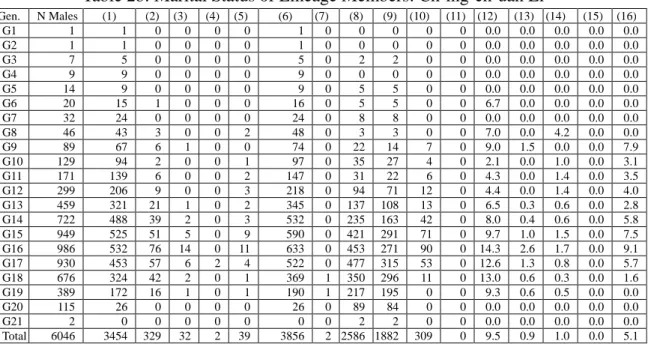
Table 2b: Marital Status of Lineage Members: Ch’ing-ch’uan Li Gen. N Males (1) (2) (3) (4) (5) (6) (7) (8) (9) (10) (11) (12) (13) (14) (15) (16) G1 1 1 0 0 0 0 1 0 0 0 0 0 0.0 0.0 0.0 0.0 0.0 G2 1 1 0 0 0 0 1 0 0 0 0 0 0.0 0.0 0.0 0.0 0.0 G3 7 5 0 0 0 0 5 0 2 2 0 0 0.0 0.0 0.0 0.0 0.0 G4 9 9 0 0 0 0 9 0 0 0 0 0 0.0 0.0 0.0 0.0 0.0 G5 14 9 0 0 0 0 9 0 5 5 0 0 0.0 0.0 0.0 0.0 0.0 G6 20 15 1 0 0 0 16 0 5 5 0 0 6.7 0.0 0.0 0.0 0.0 G7 32 24 0 0 0 0 24 0 8 8 0 0 0.0 0.0 0.0 0.0 0.0 G8 46 43 3 0 0 2 48 0 3 3 0 0 7.0 0.0 4.2 0.0 0.0 G9 89 67 6 1 0 0 74 0 22 14 7 0 9.0 1.5 0.0 0.0 7.9 G10 129 94 2 0 0 1 97 0 35 27 4 0 2.1 0.0 1.0 0.0 3.1 G11 171 139 6 0 0 2 147 0 31 22 6 0 4.3 0.0 1.4 0.0 3.5 G12 299 206 9 0 0 3 218 0 94 71 12 0 4.4 0.0 1.4 0.0 4.0 G13 459 321 21 1 0 2 345 0 137 108 13 0 6.5 0.3 0.6 0.0 2.8 G14 722 488 39 2 0 3 532 0 235 163 42 0 8.0 0.4 0.6 0.0 5.8 G15 949 525 51 5 0 9 590 0 421 291 71 0 9.7 1.0 1.5 0.0 7.5 G16 986 532 76 14 0 11 633 0 453 271 90 0 14.3 2.6 1.7 0.0 9.1 G17 930 453 57 6 2 4 522 0 477 315 53 0 12.6 1.3 0.8 0.0 5.7 G18 676 324 42 2 0 1 369 1 350 296 11 0 13.0 0.6 0.3 0.0 1.6 G19 389 172 16 1 0 1 190 1 217 195 0 0 9.3 0.6 0.5 0.0 0.0 G20 115 26 0 0 0 0 26 0 89 84 0 0 0.0 0.0 0.0 0.0 0.0 G21 2 0 0 0 0 0 0 0 2 2 0 0 0.0 0.0 0.0 0.0 0.0 Total 6046 3454 329 32 2 39 3856 2 2586 1882 309 0 9.5 0.9 1.0 0.0 5.1
Table 2c: Marital Status of Lineage Members: Shao-yang Li
Gen. N Males (1) (2) (3) (4) (5) (6) (7) (8) (9) (10) (11) (12) (13) (14) (15) (16) G1 2 2 0 0 0 1 3 0 0 0 0 0 0.0 0.0 33..3 0.0 0.0 G2 4 4 0 0 0 1 5 0 1 1 0 0 0.0 0.0 20.0 0.0 0.0 G3 5 5 0 0 0 1 6 0 0 0 0 0 0.0 0.0 16.7 0.0 0.0 G4 11 11 1 0 0 0 12 0 0 0 0 0 9.1 0.0 0.0 0.0 0.0 G5 18 16 1 0 0 0 17 0 2 2 0 0 6.3 0.0 0.0 0.0 0.0 G6 24 21 1 0 0 2 24 0 3 3 0 0 4.8 0.0 8.3 0.0 0.0 G7 35 32 2 0 0 0 34 0 3 3 0 0 6.3 0.0 0.0 0.0 0.0 G8 45 44 6 1 0 1 52 0 1 0 0 0 13.6 16.7 1.9 0.0 0.0 G9 69 55 4 0 0 0 59 0 15 14 0 0 7.3 0.0 0.0 0.0 0.0 G10 91 75 5 0 0 0 80 0 16 14 1 0 6.7 0.0 0.0 0.0 1.1 G11 122 101 2 0 0 3 106 0 21 16 2 0 2.0 0.0 2.8 0.0 1.6 G12 183 143 9 0 0 1 153 0 40 32 3 0 6.3 0.0 0.7 0.0 1.6 G13 235 188 7 0 0 0 195 0 47 41 1 0 3.7 0.0 0.0 0.0 0.4 G14 420 315 15 1 1 2 334 0 104 98 5 0 4.8 6.7 0.6 0.0 1.2 G15 676 476 32 2 0 2 512 0 198 161 22 4 6.7 6.3 0.4 0.8 3.3 G16 928 581 39 1 0 5 626 0 346 292 35 22 6.7 2.6 0.8 3.5 3.8 G17 976 606 50 7 0 9 672 0 369 290 39 50 8.3 14.0 1.3 7.4 4.0 G18 1071 614 60 7 0 2 683 0 457 386 37 36 9.8 11.7 0.3 5.3 3.5 G19 943 508 47 3 0 3 561 1 432 362 25 24 9.3 6.4 0.5 4.3 2.7 G20 687 364 32 2 1 2 401 4 318 282 7 19 8.8 6.3 0.5 4.7 1.0 G21 482 235 14 0 0 3 253 3 243 230 1 10 5.9 0.0 1.2 4.0 0.2 G22 253 83 4 0 0 1 88 2 168 161 0 3 4.8 0.0 1.1 3.4 0.0 G23 55 19 0 0 0 0 19 3 33 33 0 0 0.0 0.0 0.0 0.0 0.0 G24 12 0 0 0 0 0 0 2 10 10 0 0 0.0 0.0 0.0 0.0 0.0 Total 7348 4499 331 24 2 39 4895 15 2827 2431 178 168 7.4 0.5 0.8 3.4 2.4
From these tables, facts about marriage may be summarized as follows:
The number of the first wife in column 1 equaled the number of men who had married. When this number was compared with the total number of consort in column 6, we can see that on the average, each married man had more than one consort. On the average, the Heng-yang Wei and the Ch’ing-ch’uan Li had 1.12 and the Shao-yang Li had 1.09 consorts. In other words, remarriage of men was not unusual. The percentage of men remarried once (column 12) in the three lineages was 9.6%, 9.5%, and 7.4% respectively, and that for men remarried twice (column 13) was only 1.0%,
0.9%, and 0.5%. (Note that if the percentage of remarried twice is counted against those who remarried once, the result is 10.2%, 10.0%, and 7.3% respectively.) In addition to get remarried after a wife’s death, men in traditional Chinese society could also have concubines. Comparatively, concubines of these three lineages in Hunan were not large in number (column 5) as they accounted for only about one percent among the consort (column 14). This percentage was smaller than an average of four percent calculated from 23 lineages in south China.9 In any case, remarriage and concubinage of men was mainly for the sake of preventing from becoming heirless. For instance, the family instructions of the Wei lineage included one item that encouraged men over age 30 while still sonless to get concubines for producing offspring.10
As for the unmarried male, they can be counted from the genealogy with those who did not have any record about consort as shown in column 8. But this counting apparently exaggerated the situation of unmarried for most of these men had no record of age at death as shown in column 9 and many of them belonging to later generations were still rather young when the genealogy was compiled. Thus, we may count only those who died above age 50 and unmarried listed in column 10 as being not married at all and they accounted for about 4.8%, 5.1%, and 2.4% among all males (column 16) in the three lineages respectively. When we look at column 16 generation by generation, it is notable that men of the earlier generations all got married, while in later generations in which the number of males gradually became large, the percentage of unmarried also increased and was larger than that calculated by the total number. For instance, the percentage reached 9.2% in the 22nd generation of the Heng-yang Wei as well as 16th generation of the Ch’ing-ch’uan Li lineage. The increasing unmarried ratio in later generations would influence the speed of lineage population growth.
As for the remarriage of women, we can see from Tables 2a and 2c that in the cases of Heng-yang Wei and Shao-yang Li, the consort remarried out of the lineage accounted for 8.3% and 3.4% respectively. Since the Heng-yang Wei and the Shao-yang Li genealogies set out a rule that in-married women who got remarried should be remarked as kai-shih 改適, the counting for these two lineages should be quite reliable. As for the case of Ch’ing-ch’uan Li, its genealogy set out a rule that a woman remarried should not be recorded unless she brought her son along and under the son’s name a remark of sui-mu-ch’u 隨母出 was made. There was such a case recorded in the Ch’ing-ch’uan Li genealogy in the 12th generation. No matter recorded or not, remarriage of woman was not at all prohibited even though the
9
Ibid., p. 288. 10
society cherished chastity. Since most of the remarried women had their husbands died rather young at age, a consideration over support might be rather crucial for their remarriage although it was not clearly stated. It is also notable that a woman remarried out of the Wei lineage while her husband (a 25th generation man) had committed shameful behavior and his birth and death dates were purposefully omitted as a punishment by the Wei genealogy. Moreover, since quite a large number of men got remarried, a demand for re-marriageable women must be existed there in the marriage market.
The above investigation on marriage based on records generation by generation included everyone regardless whether the vital dates were available. Because the life span of members in different generations overlapped in time, it is rather difficult to trace changes through time by taking generation as a periodization unit. Thus, in the following, investigations on fertility and population growth, observations will be grouped by birth cohorts.
(2) Fertility
Since the Chinese genealogies usually did not record vital dates of daughters and the number was usually under-recorded, statistics organized for analyses on fertility and population growth should be based only on male births. Here, the fertility will be investigated simply in terms of average number of son per father without going through the process of estimating age specific fertility rate. The fathers observed were grouped into nine broad cohort groups from 1300 to 1849, the first three groups each consisted of 100 years, the next four each 50 years, and the last two each 25 years. This arrangement is taken simply because the number in observation was rather small for the first three hundred years. The cohorts after 1850 were not taken into consideration to avoid bias of low estimates as most of them did not complete their reproductive period when the three genealogies were compiled. The statistics for the three lineages are listed in Tables 3abc.
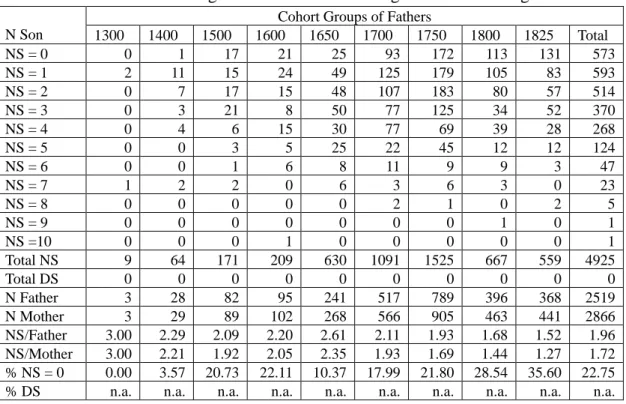
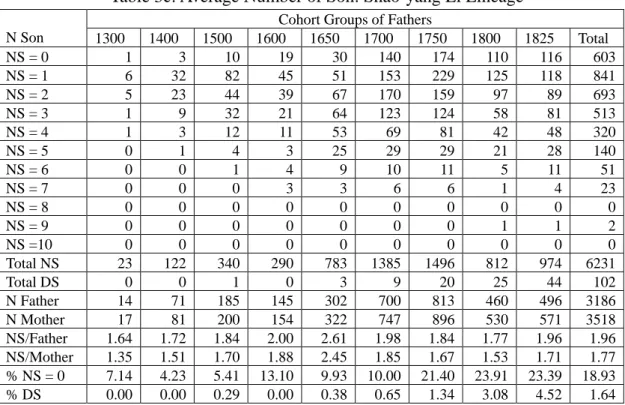
In Table 3abc, the number of fathers was distributed with number of sons that one had. For instance, in the case of Wei, 6 fathers belonging to the 1300 cohorts had no son (NS=0). The largest number of sons that a father had in these three lineages was 10, but fathers who had more than three sons were rather small in number. Since some men remarried, the number of mother was larger than the number of father and thus, the average number of sons per father and per mother differed proportionately.
Table 3a: Average Number of Son: Heng-yang Wei Lineage
N Son
Cohort Groups of Fathers
1300 1400 1500 1600 1650 1700 1750 1800 1825 Total NS = 0 6 11 19 24 73 278 420 193 208 1232 NS = 1 1 30 44 56 111 278 366 235 225 1346 NS = 2 9 28 39 54 122 260 319 164 215 1210 NS = 3 4 10 19 39 89 210 256 123 142 892 NS = 4 0 5 9 16 83 128 172 95 111 619 NS = 5 2 0 3 10 47 67 82 47 58 316 NS = 6 1 0 1 4 23 41 40 25 27 162 NS = 7 0 0 1 4 11 7 13 5 9 50 NS = 8 0 1 0 0 2 1 1 3 3 11 NS = 9 0 0 0 0 0 0 2 1 3 6 NS =10 0 0 0 0 0 0 0 1 1 2 Total NS 47 144 243 447 1420 2578 3227 1775 2101 11982 Total DS 0 0 1 0 11 45 223 184 279 743 N Father 22 85 135 207 561 1270 1671 892 1002 5845 N Mother 22 91 148 227 611 1401 1881 1017 1202 6601 NS/Father 2.04 1.69 1.80 2.16 2.53 2.03 1.93 1.99 2.10 2.05 NS/Mother 2.04 1.58 1.64 1.97 2.32 1.84 1.72 1.75 1.75 1.82 % NS = 0 26.09 12.94 14.07 11.59 13.01 21.89 25.13 21.64 20.76 21.07 % DS 0.00 0.00 0.41 0.00 0.77 1.75 6.91 10.37 13.28 6.20
Table 3b: Average Number of Son: Ch’ing-ch’uan Li Lineage
N Son
Cohort Groups of Fathers
1300 1400 1500 1600 1650 1700 1750 1800 1825 Total NS = 0 0 1 17 21 25 93 172 113 131 573 NS = 1 2 11 15 24 49 125 179 105 83 593 NS = 2 0 7 17 15 48 107 183 80 57 514 NS = 3 0 3 21 8 50 77 125 34 52 370 NS = 4 0 4 6 15 30 77 69 39 28 268 NS = 5 0 0 3 5 25 22 45 12 12 124 NS = 6 0 0 1 6 8 11 9 9 3 47 NS = 7 1 2 2 0 6 3 6 3 0 23 NS = 8 0 0 0 0 0 2 1 0 2 5 NS = 9 0 0 0 0 0 0 0 1 0 1 NS =10 0 0 0 1 0 0 0 0 0 1 Total NS 9 64 171 209 630 1091 1525 667 559 4925 Total DS 0 0 0 0 0 0 0 0 0 0 N Father 3 28 82 95 241 517 789 396 368 2519 N Mother 3 29 89 102 268 566 905 463 441 2866 NS/Father 3.00 2.29 2.09 2.20 2.61 2.11 1.93 1.68 1.52 1.96 NS/Mother 3.00 2.21 1.92 2.05 2.35 1.93 1.69 1.44 1.27 1.72 % NS = 0 0.00 3.57 20.73 22.11 10.37 17.99 21.80 28.54 35.60 22.75 % DS n.a. n.a. n.a. n.a. n.a. n.a. n.a. n.a. n.a. n.a.
Table 3c: Average Number of Son: Shao-yang Li Lineage
N Son
Cohort Groups of Fathers
1300 1400 1500 1600 1650 1700 1750 1800 1825 Total NS = 0 1 3 10 19 30 140 174 110 116 603 NS = 1 6 32 82 45 51 153 229 125 118 841 NS = 2 5 23 44 39 67 170 159 97 89 693 NS = 3 1 9 32 21 64 123 124 58 81 513 NS = 4 1 3 12 11 53 69 81 42 48 320 NS = 5 0 1 4 3 25 29 29 21 28 140 NS = 6 0 0 1 4 9 10 11 5 11 51 NS = 7 0 0 0 3 3 6 6 1 4 23 NS = 8 0 0 0 0 0 0 0 0 0 0 NS = 9 0 0 0 0 0 0 0 1 1 2 NS =10 0 0 0 0 0 0 0 0 0 0 Total NS 23 122 340 290 783 1385 1496 812 974 6231 Total DS 0 0 1 0 3 9 20 25 44 102 N Father 14 71 185 145 302 700 813 460 496 3186 N Mother 17 81 200 154 322 747 896 530 571 3518 NS/Father 1.64 1.72 1.84 2.00 2.61 1.98 1.84 1.77 1.96 1.96 NS/Mother 1.35 1.51 1.70 1.88 2.45 1.85 1.67 1.53 1.71 1.77 % NS = 0 7.14 4.23 5.41 13.10 9.93 10.00 21.40 23.91 23.39 18.93 % DS 0.00 0.00 0.29 0.00 0.38 0.65 1.34 3.08 4.52 1.64
It is notable that average number of sons per father (mother) reached a peak with the 1650 cohorts in the three lineages. This suggests that from about 1675 to about 1750 when these cohorts were well in their reproductive ages, the fertility of these lineage populations reached a peak; a remarkable recovery after the Ch’ing dynasty was solidly established. This high fertility of the 1650-99 cohorts was also found with the estimates of age specific fertility and total fertility in terms of male births by using data of families which had complete vital dates of their members.11 This fact of increasing fertility supported the decision of K’ang-hsi Emperor to relieve all adult males born after 1711 from paying a ting 丁 (adult male) tax.12 Other than this peak of fertility of 2.5 sons per father, the average was around 2 sons for other cohorts in the three lineages. It is also notable that the percentages of sonless fathers fluctuated; however, about one fifth of the fathers belonging to cohorts after 1700 had no son at all, while the 1650 cohorts had the smallest percentage of sonless father.
Furthermore, in the case of Heng-yang Wei and Shao-yang Li, sons who died young (DS) were recorded to some extent. It should be noted that the genealogies did not follow the same rule consistently to record child death. For example, the Heng-yang Wei genealogy recorded those who died young with a remark of shang 殤 below his name listed under his father; the Ch’ing-ch’uan Li genealogy did not record
11
Liu Ts’ui-jung, “Ming-Ch’ing chia-tsu te hun-yin hsing-t’ai yu sheng-yu-lu 明清家族的婚姻型態 與生育率 (Pattern of marriage and fertiliy of families and lineages in the Ming and Ch’ing periods),“ paper presented at the Internation Conference on Social and Cultural History in Early Modern China, Taiepi, Institute of History and Philology, Acdemia Sinica, July, 1990, Table 21. 12
those who died young (shang-che-pu-shu 殤 者 不 書 ); and the Shao-yang Li genealogy set a rule in the last compilation that even those who died very young should be recorded (yu-shang pi-shu 幼殤必書). The statistics showed that the percentage of sons died young in the Shao-yang Li lineage was much smaller than that in Heng-yang Wei lineage for fathers from the 1650 cohort onwards. It is difficult to decide whether the case of Wei was an accurate record about male child death, but it is quite certain that the record of the Shao-yang Li tended to be too low. This finding about the sons who died young could be explained in two ways. On the one hand, it could be that the records became more and more complete as time was closer to the last compilation of the genealogy; on the other hand, it could be that the child mortality was actually increasing especially in the nineteenth century. Since our knowledge about child mortality of the Chinese historical population was still rather vague, it may be just right to keep this hypothesis for future study.
The above investigation on fertility suggested that a crucial period of population growth in Ch’ing China was around the last quarter of the seventeenth century and the first quarter of the eighteenth century. This could be further investigated with the estimated male population of the three lineages.
(3) Mortality
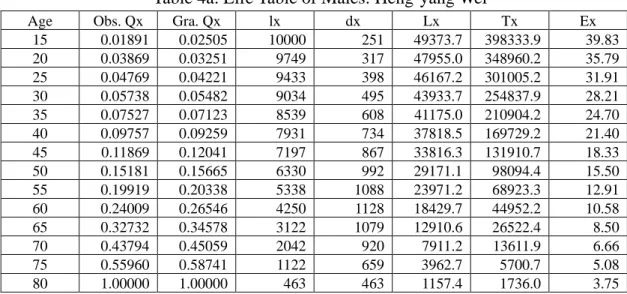
The male population of a lineage can be estimated with the records of births in different years and a set of survival ratios at different ages. Using the data of persons whose vital dates were recorded, we may organize the number of male births in five-year intervals according to the year of birth and the number of male deaths at five-year age groups according to the age at death. The number of male births in five-year intervals can be derived simply by counting (see Appendix B), while the survival ratios should be obtained through estimation of mortality.
With the distribution of number of deaths at each age group, we may construct a life table for a cohort, and from the life table we can derive a set for survival ratio. For this study, a life table was constructed for the male of each lineage based on a set of Qx (the probability of dying at age x), which was derived from a summation of number of deaths at each age of various cohort groups.13 As can be seen from appendix C, the age at death of the earliest three cohort groups tended to be at higher age groups, while that of the latest cohort groups tended to be at lower age groups. Thus, a combination of all cohort groups may avoid bias to either too low or too high estimate of the mortality. Life tables thus constructed for males of the three lineages
13
A polynomial regression formula: log Qx = a + bx + cx2 is applied to graduate the observed Qx, see I-chin Yuan, “Life Tables for a Southern Chinese Family from 1365-1849,” Human Biology, 3: 2 (May 1931), p. 1161. For formulas of calculating other variables of a life table, see Ansely Coale and Paul Demeny, Regional Model Life Tables and Stable Populations (Princeton, 1966), Part I, p. 20.
are listed in Table 4abc.
Table 4a: Life Table of Males: Heng-yang Wei
Age Obs. Qx Gra. Qx lx dx Lx Tx Ex
15 0.01891 0.02505 10000 251 49373.7 398333.9 39.83 20 0.03869 0.03251 9749 317 47955.0 348960.2 35.79 25 0.04769 0.04221 9433 398 46167.2 301005.2 31.91 30 0.05738 0.05482 9034 495 43933.7 254837.9 28.21 35 0.07527 0.07123 8539 608 41175.0 210904.2 24.70 40 0.09757 0.09259 7931 734 37818.5 169729.2 21.40 45 0.11869 0.12041 7197 867 33816.3 131910.7 18.33 50 0.15181 0.15665 6330 992 29171.1 98094.4 15.50 55 0.19919 0.20338 5338 1088 23971.2 68923.3 12.91 60 0.24009 0.26546 4250 1128 18429.7 44952.2 10.58 65 0.32732 0.34578 3122 1079 12910.6 26522.4 8.50 70 0.43794 0.45059 2042 920 7911.2 13611.9 6.66 75 0.55960 0.58741 1122 659 3962.7 5700.7 5.08 80 1.00000 1.00000 463 463 1157.4 1736.0 3.75
Table 4b: Life Table of Males: Ch’ing-ch’uan Li
Age Obs. Qx Gra. Qx lx dx Lx Tx Ex
15 0.02273 0.02788 10000 279 49303.0 401830.6 40.18 20 0.04079 0.03460 9721 336 47765.1 352527.6 36.26 25 0.04452 0.04325 9385 406 45909.3 304762.5 32.47 30 0.05907 0.05444 8979 489 43672.6 258853.3 28.83 35 0.07339 0.06899 8490 586 40986.4 215180.7 25.34 40 0.08445 0.08803 7904 696 37782.5 174194.3 22.04 45 0.11673 0.11312 7209 815 34004.2 136411.8 18.92 50 0.13156 0.14636 6393 936 29626.3 102407.6 16.02 55 0.19022 0.19069 5457 1041 24685.3 72781.2 13.34 60 .023322 0.25018 4417 1105 19321.2 48096.0 10.89 65 0.33589 0.33049 3312 1094 13822.5 28774.8 8.69 70 0.46952 0.43960 2217 975 8649.4 14952.3 6.74 75 0.53106 0.58884 1243 732 4383.5 6302.8 5.07 80 1.00000 1.00000 511 511 1277.2 1919.3 3.76
Table 4c: Life Table of Males: Shao-ynag Li
Age Obs. Qx Gra. Qx lx dx Lx Tx Ex
15 0.00733 0.01243 10000 124 49689.2 427594.5 42.76 20 0.02488 0.01833 9876 181 48926.0 377905.3 38.27 25 0.03349 0.02669 9695 259 47826.6 328979.3 33.93 30 0.04703 0.03838 9436 362 46274.4 281152.7 29.80 35 0.05887 0.05452 9074 495 44132.2 234878.3 25.89 40 0.07590 0.07649 8579 656 41254.9 190746.2 22.23 45 0.11100 0.10599 7923 840 37515.1 149491.3 18.87 50 0.12878 0.14504 7083 1027 32847.4 111976.2 15.81 55 0.16067 0.19605 6056 1187 27310.8 79128.9 13.07 60 0.25574 0.26172 4869 1274 21157.3 51818.0 10.64 65 0.30864 0.34508 3594 1240 14870.9 30660.8 8.53 70 0.45238 0.44938 2354 1058 9q25.5 15789.9 6.71 75 0.53804 0.57797 1296 749 4608.0 6664.4 5.14 80 1.00000 1.00000 547 547 1367.6 2056.4 3.76
These life tables showed that the expectation of life at age 15 was 39.83, 40.18, and 42.76 years respectively for males of the three lineages. These estimates are comparable to levels 8-10 of the west model life tables (E15 = 39.18, 40.47, 41.74).14 These estimates of the expectation of life for the three lineages in Human were the highest among some southern Chinese lineages that had been investigated.15 This finding about a lower mortality among these Hunan males would not be a surprise if we take into consideration the favorable agricultural resources along the Hsiang湘and Tzu資 river basins where these lineage people spent their lifetime.16
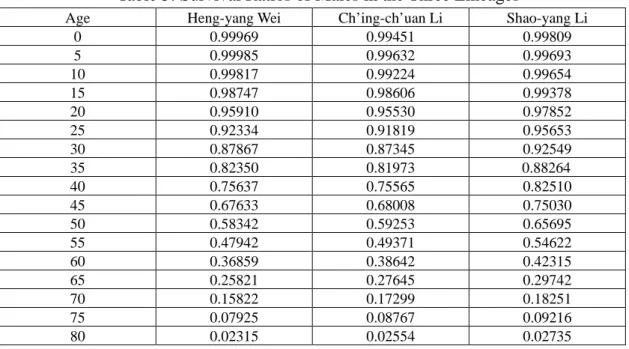
From a life table, the survival ratio can be obtained by taking Lx/50000. It should be noted here that the above three life tables are constructed using only the data with age at death known. As can be seen from Appendix C, there are quite a number of males whose ages at death were unknown. We may apply different methods to do repairs.17 Here, since only those data with vital dates known are used, for the sake of simplification, we may derive survival ratios for ages below 15 by deducting the ratio of recorded deaths from 1. For instance, as listed in Appendix C, there are 2 deaths at ages 0-5 in the Wei lineage, these 2 men accounted for 0.00031 among 6574 men known to be survived at that age, thus, the survival ratio of this age group is 0.99969. Thus, a complete set of survival ratios from age 0 to age 80 can be obtained (see Table 5). But, the survival ratios for ages below 15 so derived are higher than those derived by extrapolating from age 15 using a model life table as a base.18 Since we are using only the data with vital dates known, we may take a risk to make a high estimation of male population by using this set of survival ratios.
14
Anseley Coale and Paul Demeny, Regional Model Life and Stable Populations, Part I, pp. 11-13. 15
Liu Ts’ui-jung, “The Demographic Dynamics of some Clans in the Lower Yangtze Area, ca. 1400-1900,” Academia Economic Papers, Vol. 9 No. 1 (March 1981), pp. 152-156; Ts’ui-jung Liu, “I Kuang-tung Hsiang-shan Hsu-chih tsung-p’u wei-i shih-lun Chung-kuo chia-tsu ch’eng-chang chih kuo-ch’eng chi ch’i kung-neng chih fa-hui 以廣香山徐氏宗譜為例試論中國家族成長之過程 及其功能之發揮 (A discourse on the growth and functions of a Chinese lineage: the case of Hsu lineage in Hsiang-shan, Kwangtung),” in The Proceedings of the Third Conference on Asian Clan
Genealogy (Taipei, 1987), pp. 393-394; Liu Ts’ui-jung, “I-huang Pei-shan Huang-shih chih
ch’eng-chang yu she-hui ching-chi huo-tung 宜黃北山黃氏之成長與社會經濟活動 (The growth and socio-economic activities of the Huang lineage of Pei-shan in I-huang),” in The Proceedings of
the Second International Conference on Sinology, Section of the Ming, Ch’ing and Modern History
(Taipei, 1989), pp. 256-257. 16
Peter Perdue, Exhausting the Earth: State and Peasant in Hunan 1500-1850 (Cambridge, Mass., 1987), pp. 25-39.
17
Ts’ui-jung Liu, “The Demography of Two Chinese Clans in Hsiao-shan, Chekiang, 1650-1850,” in Susan B. Hanley and Arthur P. Wolf (eds.), Family and Population in East Asian History (Stanford, 1985), p. 45. Stevan Harrell, “The Rich Get Children: Segmentation, Stratification, and Population in three Chekiang Lineages, 1550-1850,” in Susan Hanley and Arthur Wolf (eds.), pp. 84-85. Ted Telford, “Patching the Holes in Chinese Genealogies: Mortality in the Lineage Population of Tongcheng County, 1300-1880,” Late Imperial China, 11.2 (1990), pp. 116-136.
18
See Ts’ui-jung Liu, “The Demographic Dynamics of some Clans in the Lower Yangtze Area, ca. 1400-1900,” Academia Economic Papers, Vol. 9 No. 1 (March 1981), pp. 152-156.
Table 5: Survival Ratios of Males in the Three Lineages
Age Heng-yang Wei Ch’ing-ch’uan Li Shao-yang Li
0 0.99969 0.99451 0.99809 5 0.99985 0.99632 0.99693 10 0.99817 0.99224 0.99654 15 0.98747 0.98606 0.99378 20 0.95910 0.95530 0.97852 25 0.92334 0.91819 0.95653 30 0.87867 0.87345 0.92549 35 0.82350 0.81973 0.88264 40 0.75637 0.75565 0.82510 45 0.67633 0.68008 0.75030 50 0.58342 0.59253 0.65695 55 0.47942 0.49371 0.54622 60 0.36859 0.38642 0.42315 65 0.25821 0.27645 0.29742 70 0.15822 0.17299 0.18251 75 0.07925 0.08767 0.09216 80 0.02315 0.02554 0.02735
(4) The Growth of Male Population
With a set of survival ratios for each lineage and the counting of male births in each five-year interval, we can estimate the male population for a certain year. For example, for the year 1390, we take the number of male births in a set of 17 five-year intervals from 1310 to 1390 and multiply each number by a survival ratio of corresponding age group from age 80 down to age 0, then sum up the 17 products of multiplication we obtain an estimate of male population. The estimation is done for every five year from 1310 to 1890. To save the space, details of branches and distribution by age are omitted, only the estimated male population in every ten year of the entire lineage and the annual growth rate are listed in Table 6 and the age structure represented by three broad age groups are listed in Table 7.
As mentioned in the introduction, the Heng-yang Wei started with an ancestor born in 1120, the Ch’ing-ch’uan Li with an ancestor born in 1364, and the Shao-yang Li with two ancestors born in 1296 and 1298. We can see from Table 6, in 1390 there were 21 Wei males, 2 Ch’ing’-ch’uan Li males, and 10 Shan-yang Li males. It took 270 years for the Wei to grow from one man to 21 men, 26 years for the Ch’ing-ch’uan Li to grow from one man to two men, and 92 years for the Shao-yang Li to grow form two men to 10 men. The annual growth rate for the males was 1.14%, 2.67%, and 1.75% for the three lineages respectively for the time before 1390. In the early stage of the formation of a lineage, the population growth rate should be higher than just for the replacement, otherwise, since the number was still very small the risk of being perished would be rather high and a lineage might never be formed.
Table 6: Estimated Male Population and Growth Rate
Year Est. MP GR % Est. MP GR % Est. MP GR %
1360 11 1 8 1370 13 0.67 1 -0.08 9 4.14 1380 17 2.72 2 13.64 9 -1.10 1390 21 -0.04 2 -0.52 10 -1.36 1400 20 -0.37 6 14.18 11 2.26 1410 24 2.04 6 -0.46 15 1.65 1420 27 -0.63 9 1.62 17 2.64 1430 32 3.35 11 1.05 23 0.88 1440 37 1.52 11 -1.09 28 1.40 1450 41 1.19 13 1.86 32 1.01 1460 43 0.54 13 -0.03 35 0.68 1470 53 2.29 13 1.23 40 0.32 1480 53 0.07 16 2.35 43 0.99 1490 59 2.00 17 0.96 48 0.29 1500 60 0.11 18 0.81 52 1.77 1510 61 0.29 23 1.49 58 0.07 1520 60 0.25 30 2.48 64 1.26 1530 61 0.83 29 0.14 71 2.25 1540 60 -0.21 30 0.11 82 1.79 1550 60 0.12 34 0.85 88 0.80 1560 61 -0.17 36 1.87 98 0.79 1570 66 0.77 49 4.00 114 0.93 1580 79 2.33 49 -0.55 121 0.23 1590 87 1.52 58 1.53 127 0.55 1600 107 2.52 71 2.12 143 1.34 1610 126 0.98 81 1.64 151 0.71 1620 142 2.35 87 0.79 170 1.01 1630 179 2.90 96 1.38 178 0.64 1640 221 2.24 112 1.76 179 0.09 1650 241 1.45 122 1.14 182 0.67 1660 294 1.87 143 1.72 219 2.51 1670 365 2.28 167 1.83 230 0.23 1680 436 2.05 205 2.21 257 1.67 1690 575 2.50 254 2.31 313 1.96 1700 725 2.47 310 1.97 373 2.04 1710 903 2.42 391 2.18 475 2.51 1720 1162 2.42 469 2.07 598 2.05 1730 1343 1.49 544 1.62 702 1.55 1740 1552 1.51 632 1.26 823 1.99 1750 1785 1.28 716 1.45 949 1.19 1760 2022 1.03 803 1.29 1094 1.54 1770 2252 0.87 909 1.23 1181 0.66 1780 2446 0.93 1020 1.14 1257 0.64 1790 2662 0.80 1124 0.90 1337 0.71 1800 2772 0.31 1207 0.61 1443 0.78 1810 2864 0.19 1301 0.87 1509 0.51 1820 2954 0.28 1361 0.27 1565 0.14 1830 2991 0.07 1386 0.10 1576 0.02 1840 3098 0.37 1419 0.20 1621 0.19 1850 3219 0.37 1431 0.06 1675 0.23 1860 3331 0.16 1403 -0.55 1751 0.51 1870 3479 0.39 1354 -0.23 1850 0.39 1880 3684 0.51 1327 -0.46 1947 0.55 1890 3876 0.44 1257 -0.81 2012 0.45
Table 7: Age Structure of Male Populations of the Three Lineages in Human
Heng-yang Wei Ch’ing-ch’uan Li Shao-yang Li Year 0-14 15-64 65+ 0-14 15-64 65+ 0-14 15-64 65+ 1360 45.98 54.02 0.00 100.00 0.00 0.00 39.66 60.32 0.00 1370 23.36 76.64 0.00 100.00 0.00 0.00 33.30 66.70 0.00 1380 40.32 57.86 1.82 51.01 48.99 0.00 33.00 67.00 0.00 1390 42.02 57.77 0.22 53.18 46.82 0.00 20.40 75.86 3.73 1400 10.07 86.53 3.40 69.93 30.07 0.00 26.66 71.23 2.11 1410 33.95 63.08 2.96 61.84 38.16 0.00 47.96 48.55 3.49 1420 40.86 54.86 4.27 33.57 66.43 0.00 35.77 60.65 3.38 1430 31.19 66.27 2.34 35.93 62.51 1.56 48.28 50.39 1.33 1440 45.44 51.64 2.92 18.19 81.57 0.23 32.62 64.87 2.51 1450 33.84 61.26 4.90 29.72 68.99 1.29 31.35 66.32 2.33 1460 28.06 70.48 1.46 29.56 68.20 2.25 28.20 70.44 1.36 1470 39.24 58.97 1.79 22.74 70.53 6.73 30.01 66.61 3.38 1480 30.03 65.36 4.59 44.66 50.73 4.60 27.62 70.09 2.29 1490 30.71 67.17 2.12 40.49 54.27 5.24 33.33 61.49 5.18 1500 34.77 60.96 4.28 28.16 68.16 3.68 28.88 66.89 4.23 1510 26.04 70.08 3.88 43.30 53.80 2.90 37.66 58.63 3.71 1520 25.00 71.67 3.33 43.00 54.35 2.65 27.92 68.68 3.40 1530 29.45 65.55 5.00 24.28 74.63 1.09 32.54 63.52 3.95 1540 30.05 65.06 4.89 26.10 70.87 3.03 40.24 56.86 2.90 1550 26.85 69.60 3.55 29.54 66.60 3.85 32.86 63.23 3.91 1560 29.73 64.42 5.85 24.69 72.90 2.41 31.56 65.99 2.45 1570 33.07 62.73 4.20 50.52 45.69 3.79 34.26 61.50 4.25 1580 39.36 57.80 2.84 36.71 58.38 4.91 28.10 68.88 3.03 1590 38.10 59.18 2.73 32.35 65.29 2.36 25.13 72.50 2.37 1600 41.90 55.29 2.81 39.32 58.45 2.23 32.75 63.51 3.75 1610 40.52 57.36 2.12 36.79 59.90 3.31 31.67 64.54 3.79 1620 31.68 66.02 2.30 31.86 66.55 1.59 33.96 62.36 3.69 1630 44.63 53.25 2.13 31.17 65.51 3.32 29.13 66.24 4.63 1640 44.33 53.67 2.00 39.04 57.44 3.52 25.07 70.51 4.41 1650 34.00 63.98 2.04 35.03 62.11 2.86 24.60 71.87 3.53 1660 39.47 58.36 2.18 37.49 59.22 3.29 39.22 57.03 3.75 1670 41.61 55.84 2.55 38.69 58.25 3.06 36.49 59.53 3.98 1680 40.10 58.51 1.39 41.32 56.19 2.49 31.40 64.26 4.35 1690 45.03 53.16 1.81 42.28 55.85 1.87 41.10 55.62 3.28 1700 43.02 54.89 2.09 40.79 56.93 2.28 38.51 59.08 2.41 1710 41.93 56.65 1.41 41.68 56.40 1.93 41.79 56.63 1.58 1720 43.52 54.95 1.53 38.79 59.29 1.91 42.02 55.89 2.09 1730 36.89 61.34 1.77 36.74 61.27 1.99 35.68 61.83 2.49 1740 34.65 63.60 1.75 36.04 61.75 2.21 34.28 64.03 1.69 1750 35.61 62.11 2.29 33.73 63.74 2.53 35.41 62.19 2.40 1760 34.54 63.01 2.45 34.68 62.55 2.77 33.27 64.34 2.39 1770 33.15 64.26 2.58 35.35 61.49 3.16 31.16 65.90 2.95 1780 31.46 65.28 3.26 34.79 62.14 3.07 27.78 68.38 3.84 1790 32.62 64.22 3.16 33.17 63.75 3.08 29.00 67.26 3.73 1800 29.27 67.61 3.12 30.66 65.86 3.49 30.96 65.64 3.40 1810 27.56 68.75 3.69 30.43 66.30 3.26 29.27 66.39 4.34 1820 28.07 67.81 4.12 30.03 66.45 3.52 28.16 67.48 4.36 1830 27.97 67.63 4.41 26.33 69.56 4.11 24.61 70.68 4.71 1840 29.29 66.56 4.15 27.40 68.05 4.55 26.08 69.66 4.26 1850 30.76 64.73 4.51 27.52 67.62 4.87 27.69 67.94 4.37 1860 30.00 65.64 4.36 25.37 69.60 5.04 29.05 66.10 4.85 1870 29.27 66.66 4.05 21.96 72.83 5.21 30.95 64.37 4.68 1880 30.79 65.33 3.88 26.01 68.04 5.96 29.24 66.04 4.73 1890 30.50 65.72 3.78 22.55 71.73 5.72 27.71 68.16 4.13
From Table 6, we can see that when the number of a lineage population was still rather small, the growth rate was much subject to irregular events. For example, in the case of Ch’ing-ch’uan Li, seven sons were born in the third generation (see Table 1b) and the number of males increased from 2 to 6 during 1390-1400, thus the growth rate was as high as 11%. In a rather long period before 1650, although the male populations of the three lineages were increasing, the trends of growth were quite irregular, a high growth rate around 2% usually did not last for more than 20 years and sometimes a negative growth rate was found. It is rather difficult to interpret all fluctuations during this long period before 1650 as the three lineage populations did not fluctuate with the same momentum. Some fluctuations, however, were concurrent in time with occurrences of natural disaster. For instance, a low growth rate of the Heng-yang Wei and Ch’ing-ch’uan Li during 1530s-1540s was concurrent with a flood in 1534, a famine during 1537-38, and an epidemic in 1544 in the Heng-yang area where Ch’ing-ch’uan also located.19
A low growth rate of the Shao-yang Li in the 1590s was concurrent with consecutive years of famine in 1592-95; a very low growth rate in the 1640s was concurrent with a crop failure in 1641, a serious famine in 1642, a drought in 1646 and another serious famine in 1647 in Shao-yang.20 These coincidences suggested that short term population fluctuation in traditional agricultural society was indeed affected by natural disasters to some extent. But, as the number of male populations in the three lineages under investigation was still rather small, the trends of growth could be subjected to irregular factors.
After 1650, however, a trend of upward population growth could be more clearly perceived for all the three lineages and a peak was commonly found around 1690. A rather high growth rate around 2% lasted until about 1720, and then the growth rate decreased continuously until 1890. This finding of rapid population growth rate in 1650-1750, particularly in 1690-1720, was conforming to the peak of fertility rate found for the 1650 cohorts as mentioned above (see Tables 3abc). It should be noted that the growth rate estimated from the survival male populations of the three lineages must be higher than a rate that the population in general could actually have achieved. For example, estimates of the population in Hunan in 1685 was 2,870,000 and in 1724 was 3,381,000; implying a growth rate of 0.42% per annum during these 39 years.21 These estimates for the Hunan population during early Ch’ing were perhaps too low. In any case, this investigation over the three lineages in Hunan suggests that a crucial period of the population growth could be
19
Heng-yang hsien-chih 衡陽縣志 (Gazetteer of Heng-yang county), (1872), chuan 2. 20
Shao-yang hsien-chih 邵陽縣志 (Gazetteer of Shao-yang county), (1884), chuan 1. 21
Chao Wen-lin 趙文林 and Hsieh Shu-chun 謝淑君, Chung-kuo jen-kou shih 中國人口史 (A history of Chinese population), (Peking, 1988), pp. 595-597.
clearly marked out. This finding can be helpful for our understanding of the population growth in early Ch’ing as there was no reliable registration except for the ting figures kept for the fiscal purpose.22
From 1760 on, the growth rates of the three lineages male populations all tended to decline. The number was still increasing but the speed of growth was slowing down. The growth rate during the years after 1800 was only about a half or a third of that of 1760. It is notable that in the 1830s, the three lineages all witnessed a very low rate of growth which was concurrent with a famine in both Heng-yang and Shao-yang in 1834, an epidemic in 1836 in Shao-yang and a flood in 1839 in Heng-yang. The low growth rate in the 1860s was concurrent with some disasters such as, a famine in 1862 in both Heng-yang and Shao-yang, a drought in 1865 in Heng-yang and another famine in 1869 in Shao-yang.23 The number of male population of the Ch’ing-ch’uan Li reached a peak in the 1850s and then declined. The same pattern was not found in the other two lineages. This peak of the Ch’ing-ch’uan Li seemed to be right in time as the available national data and some lineages in the lower Yangtze area also peaked around that year.24 But after 1850 a negative growth rate lasted over 40 years for the Ch’ing-ch’uan Li lineage seemed to be a bias due to the fact that this lineage genealogy was compiled in 1893 and records about newly born males around that year were not yet complete.
A lineage could be formed only if descendants of a common ancestor became prolific. The above investigation on the growth of lineage male population testified this basic condition. An event of branching could take place in very early stage of a lineage population growth as long as there were more than two males in a certain generations. For example, the Heng-yang Wei was segmented into five branches in the fifth generation; the Ch’ing-ch’uan Li was divided into five branches in the third generation; the Shao-yang Li’s elder branch was subdivided into three in the second generation and its younger branch was subdivided into three in the third generation. Under the tradition of family division in Chinese society, the process of segmentation could go on forever as long as a generation had more than two males; however, it took several hundred years for a man’s descendants to increase to a large number. It was only when the number of descendants became rather large that some measures were taken to bring them together.25 This process of fusion was most concretely
22
Ping-ti Ho, Studies on the Population of China, 1368-1953, pp. 24-35. 23
Heng-yang hsien-chih, chuan 2; Shao-yang hsien-chih, chuan 1. 24
Ping-ti Ho, Studies on the Population of China, 1368-1953, pp. 281-282; Chao Wen-lin and Hsieh Chu-chun, Chung-kuo jen-kou shih, p. 542; Ts’ui-jung Liu, “The Demographic Dynamics of Some Clans in the Lower Yangtze Area,” pp. 126-128.
25
Segmentation and fusion of a lineage are subjects that have invited many studies, see for instance, Maurice Freedman, Lineage Organization in Southeastern China (London, 1958); Jack Potter, “Land and Lineage in Traditional China,” in Maurice Freedman (ed.), Family and Kinship in Chinese
demonstrated in the compilation of a genealogy. It is notable that for the three lineages under studied, it was only when the male members were well over one thousand that the lineage genealogies were first compiled. For example, the Heng-yang Wei’s genealogy was first complied in 1724 while the males estimated in the 1720s were 1,162; the Ch’ing-ch’uan Li tried twice but failed to compile a genealogy during the Ch’ien-lung and Tao-kuang periods before the first compilation was finally successful in 1858 when it had well over 1,400 males; the Shao-yang Li first compiled its joint genealogy in 1869 when is male members were more than 1,700 persons.
The sheer number was important because expenditures of compiling a genealogy were shared by all males. For example, the Wei genealogy required each male to share a fee (ting-fei 丁費) when it was compiled and this fee increased along with the time of compilation: 0.06 tael of silver in the first time, 100 copper cast in the second time, 160 cash in the third and the forth time, and 200 cash in the fifth time.26 The Shao-yang Li lineage set up a rule that at a banquet held annually on the 15th of the lunar eleventh month, heads of lines (fang-shou 房首) should bring with them records about new male births, marriages, and deaths; for each new male birth and marriage an amount of 48 cash and for each death an amount of 24 cash should be paid and these money were reserved for the purpose of compiling the genealogy.27
Moreover, not only the number was important but the age structure would affect the efficiency of a lineage to perform its functions. It also took a long time for the age structure of a man’s descendants to adjust to a pattern that would be more favorable for a lineage to perform its functions. The age structure of males in the three lineages could be seen from Table 7. We can see that in early years of a lineage, the age structure of its male population could be rather bias to young ages. For example, the Ch’ing-ch’uan Li with its first ancestor born in 1364, while in 1410 a large proportion of its male population was still below age 15 and none was above age 65. The age structure of these lineage populations was not at all maintained stable during 500 years under observation. This can be seen from fluctuations in the percentages of three broad age groups in all these three cases. It is quite clear that in the years of a higher growth rate, there would be a higher percentage for those below age 15. This was commonly found in the three lineages during 1690s-1720s when the growth rate was the highest. It is also notable that the percentage of adult males, represented by the age group 15-64, was mostly above 50% throughout the long period under
Marriage,” in Ibid., p. 168. But these studies have not tried to discuss the process from the population aspect. For a study of segmentation and lineage population see Stevan Harrell, “The Rich Get Children,” pp. 81-109.
26
Heng-yang Wei-shih tsung-p’u, chuan shou. 27
observation except for a few decades in each case before 1580. This meant that the dependency ratio, calculated with the percentage of age group 15-64 as a denominator and the sum of other two age groups as a numerator, was usually less than one. This was a favorable demographic indicator for a lineage to perform its functions.
3. PERFORMANCE OF LINEAGE FUNCTIONS
Except for compiling a genealogy to help reinforcing consciousness of membership, the three lineages also had some kinds of collective activities that identified them as a corporate group. With documents available in the three genealogies, these collective activities may be discussed below.
Ancestral worship was one of the important collective activities of any lineage. Individual lines might separately worship their direct ancestors; however, a joint ancestral hall for a lineage was usually established long after the death of the first ancestor. For example, three sub-branches of the Heng-yang Wei, resided at Yu-t’ang 畬堂, proposed to build a joint ancestral hall in 1816 and completed it in 1817; a lag of 616 years after the death of their founding ancestor. In 1866, the Wei lineage used a corporate fund to purchased an estate with buildings in five courtyards in Heng-yang city and made it into a family shrine (chia-miao 家廟) for the entire lineage. The Ch’ing-ch’uan Li lineage constructed the main part of their ancestral hall in 1707, a lag of 276 years after the death of their founding ancestor; and it took another hundred more years to complete the supplementary parts to the right and left of the main building in the 1820s and in 1856. The Shao-yang Li lineage completed a joint ancestral hall for its elder branch in 1802, a lag of 414 years after the death of their first ancestor; and in 1899 the hall was rebuilt. It is not clear whether there was a joint ancestral hall for the younger branch or one for the entire Shao-yang Li lineage. These evidences suggested that collective ancestral worship was an activity that a lineage performed only when descendants were already quite large in number and it took times.
Moreover, to construct a joint ancestral hall required members of a lineage to share expenditures. For example, the Heng-yang Wei ancestral hall “spent more than one thousand tales” to complete construction in 1817. In addition to fees allocated to males and private lands (ting-fei丁費, t’ien-fei田費), an amount of 458,340 cash was contributed by 127 individual members. It is notable that individual contributions ranged from 100 to 119,600 cash with the largest amount contributed by a twenty-second generation member, Wei Chin魏晉 (1759-1831), who was a Chu-jen in 1779 and 100,000 cash of his contribution was made when he served as a