ContentslistsavailableatScienceDirect
Sensors
and
Actuators
B:
Chemical
j ou rn a l h o m ep a g e :w w w . e l s e v i e r . c o m / l o c a t e / s n bA
sensitive
and
selective
fluorescent
sensor
for
Zinc(II)
and
its
application
to
living
cell
imaging
Hao-Ming
Liu,
Parthiban
Venkatesan,
Shu-Pao
Wu
∗DepartmentofAppliedChemistry,NationalChiaoTungUniversity,Hsinchu300,Taiwan,RepublicofChina
a
r
t
i
c
l
e
i
n
f
o
Articlehistory: Received29May2014
Receivedinrevisedform10July2014 Accepted12July2014
Availableonline21July2014 Keywords: Sensors Zn(II) Fluorescence Imagingagents
a
b
s
t
r
a
c
t
Anewdipyrromethenederivative(DP1)exhibitsanenhancedfluorescenceinthepresenceofZn2+ions
andahighselectivityforZn2+ionsovercompetingmetalionsinmethanol;Ag+,Ca2+,Co2+,Cr3+,Fe2+,Fe3+,
Hg2+,K+,Mg2+,Mn2+,Ni2+,andPb2+producedonlyminorchangesinthefluorescenceofDP1.Thebinding
ratiooftheDP1–Zn2+complexeswasdeterminedfromaJobplottobe1:1.Thebindingconstant(K
a)of
Zn2+bindingtoDP1wasfoundtobe6.12×104M−1,withadetectionlimitof0.236M.Fluorescence
microscopyimagingusingRAW264.7cellsshowedthatDP1couldbeusedasaneffectivefluorescent probefordetectingZn2+inlivingcells.
©2014ElsevierB.V.Allrightsreserved.
1. Introduction
Thedevelopmentoffluorescentchemosensorsfordetecting bio-logicallyimportantmetalions,suchasFe3+,Cu2+,andZn2+,has beenanimportantresearchtopic.Amongthetransitionmetalions, zincisthesecondmostabundantinthehumanbody,afteriron. Zincionsaremostlyboundwithinproteinsandplayvariouskey rolesinbiological systems,includingneuralsignaltransmission [1],enzymeregulation[2],apoptosis[3],andgenetranscription [4]. Disorders in Zn2+ metabolism have been linked to several severeneurologicaldiseases,includingAlzheimer’sdisease(AD) [5,6],cerebralischemia[7],andepilepsy[8].Therefore,the mea-surementofZn2+isimportantinmonitoringbiologicalprocesses.
Severalmethods forZn2+ detectionin various sampleshave beendeveloped,suchasatomicabsorption-emissionspectroscopy [9], inductively coupled plasma-atomic emission spectrometry (ICP-AES) [10,11], andvoltammetry [12].Although these meth-ods providequantitative data, mostof them require expensive instruments,andarenotappropriatefordirectanalysis.Recently, moreattentionhasbeenfocusedonthedevelopmentof fluores-centprobesfordetectingZn2+ionsinbiologicalandenvironmental samples[13–28].
Inthisstudy,afluorescentchemosensorDP1hasbeendesigned for metaliondetection. DP1consistsof a dippyrometheneand
∗ Correspondingauthor.Tel.:+88635712121x56506;fax:+88635723764. E-mailaddresses:[email protected],[email protected]
(S.-P.Wu).
a benzoimidazolemoiety(Scheme1).ThemetalionsAg+,Ca2+, Cd2+,Co2+,Cu2+,Fe2+,Fe3+,Hg2+,Mg2+,Mn2+,Ni2+,andPb2+were testedwithchemosensorDP1;Zn2+wastheonlyionthatcaused strongfluorescentenhancementuponbindingwithchemosensor
DP1,producinga“turn-on”typechelation-enhancedfluorescence (CHEF)sensor.
2. Materialsandmethods
2.1. Materialsandinstrumentation
Allreagentswereobtainedfromcommercialsourcesandused as received without further purification. UV–vis spectra were recordedonanAgilent8453UV–visspectrometer.Fluorescence spectrawererecordedinaHitachiF-4500spectrometer.1Hand13C NMRspectrawererecordedonBrukerDRX-300NMR spectrome-terandVarianUnityInova500NMRspectrometer.Fluorescence imagingswereobtainedonaZEISSAxioScopeA1Fluorescence Microscope.
2.2. Synthesisof5-(pyren-1-yl)-4,6-dipyrromethane(1):
To a stirred solution of 1-pyrenecarboxyaldehyde (1.25g, 6.05mmol)in pyrrole(21mL,0.3mol)at23◦C underN2 atmo-sphere,trifluoroaceticacid(0.180mL,2.40mmol)wasadded.After 30minthereactionmixturewasevaporatedunderreduced pres-sure.Theresiduewasdissolvedindichloromethane(70mL)and washed with a 1.0M aqueous solution of NaOH (100mL). The aqueouslayerwasextractedwithdichloromethane(70mL)and http://dx.doi.org/10.1016/j.snb.2014.07.049
Scheme1. SynthesisofDP1.
thecombined organiclayers were concentrated under reduced pressure.Theresiduewaspurifiedbysilicagelchromatography (EtOAc/Hexane=1/6)togiveacompound1asawhitesolid(yield: 1.25g,60%).Meltingpoint:207–208◦C.1HNMR(300MHz, DMSO-d6):ı10.74(s,2H),8.45(d,J=9.3Hz,1H),8.28(d,J=3.6Hz,1H), 8.26(d,J=3.3Hz,1H),8.22(d,J=8.4Hz,2H),8.16–8.13(m,2H), 8.07(t,J=7.6Hz,1H),7.69(d,J=7.8Hz,1H),6.66(d,J=1.2Hz,2H), 6.52(s,1H),5.92(d,J=2.7Hz,2H),5.62(s,2H).13CNMR(75MHz, DMSO-d6):ı138.8,134.1,131.7,131.1,130.3,128.7,128.3,127.6, 127.0,126.9,126.0,125.7,125.6,124.9,124.8,124.3,117.8,107.9, 107.8,40.6.MS(EI):m/z(%)=346(100),278(82),HRMS(EI):calcd. forC25H18N2(M+)346.1470;found:346.1467.
2.3. Synthesisof1-formyl-5-(pyren-1-yl)-4,6-dipyrromethane (2):
Benzoylchloride(0.57mL,4.7mmol)wasaddedtoacooledDMF (2.0mL,26mmol)andstirred30min.Compound1(1.0g,2.9mmol) inDMFwereaddedinthereactionmixtureunderN2atmosphere. Themixturewasstirredat 0◦C for 2handthen another2hat roomtemperature.Thereactionmixturewasquenchedby addi-tionof Na2CO3 (2.0g) dissolved in 50% aquous EtOH (150mL). Theresulting solution wasextracted with CH2Cl2 (100mL×2). TheorganiclayerwasdriedoveranhydrousMgSO4 andthe sol-ventwasevaporatedunderreducedpressure.Thecrudeproduct waspurified bysilica gelchromatography (EtOAc/Hexane=1/6) togivea compound2 asagray solid(yield:0.61g,57%). Melt-ingpoint:177–178◦C.1HNMR(300MHz,CD 3CN):ı9.39(s,1H), 8.39(d,J=9.6Hz,1H),8.28(d,J=6.3Hz,1H),8.25(d,J=5.1Hz,1H), 8.21(d,J=7.8Hz,1H),8.17(d,J=9.3Hz,1H),8.12(d,J=1Hz,2H), 8.06(t,J=7.5Hz,1H),7.69(d,J=8.1Hz,1H),6.96(dd, J=3.8Hz, J=2.4Hz, 1H), 6.73 (dd, J=4.2Hz, J=2.7Hz, 1H), 6.67 (s, 1H), 6.07 (dd, J=5.7Hz, J=2.7Hz, 1H), 5.98 (dd, J=3.6Hz, J=2.4Hz, 1H), 5.79 (s, 1H). 13C NMR (75MHz, CDCl 3): ı 179.1, 143.2, 134.1,132.7,131.7,131.3,131.0,130.9,129.1,128.8,128.1,127.8, 126.6,126.6,126.0,125.8,125.5,125.4,125.1,122.9,122.7,118.3, 111.7,109.2,108.7,41.2. MS(EI):m/z(%)=374(98), 278(100), 201(41).HRMS(EI):calcd.forC26H18N2O(M+):374.1419;found: 374.1411.
2.4. Synthesisof1-(2-benzoimidazoyl)-5-(pyren-1-yl)-4, 6-dipyrromethane(3):
Compound 2 (150mg, 0.4mmol) and o-phenylenediamine (43mg,0.4mmol)werethoroughlymixedin5mlofEtOH.Sodium hydrogen sulfite (62mg, 0.6mmol) was added to mixture and stirred at 80◦C for 8h. The reaction mixture was cooled to room temperature, and concentrated at reduced pressure. The crude product was purified by column chromatography (ethyl acetate/hexane, 1:6) togivea red-orange solid. (Yield:130mg, 70%).Meltingpoint250–251◦C.1HNMR(300MHz,DMSO-d
6):ı 12.4(s,1H),11.9(s,1H),10.8(s,1H),8.55(d,J=9.6Hz,1H),8.30 (d,J=8.7Hz,1H),8.28(d,J=6.0Hz,1H),8.26(d,J=1.5Hz,1H),8.23 (d,J=9.0Hz,1H),8.14–8.11(m,2H),8.08(t,J=7.8Hz,1H),7.77(d, J=8.1Hz,1H),7.49(d,J=3.9Hz,1H),7.40(d,J=3.9Hz,1H),7.12(d, J=2.4Hz,1H),7.09(d,J=2.4Hz,1H),6.77(t,J=3.0Hz,1H),6.71(s, 1H)6.70(d,J=1.8Hz,1H),5.95(dd,J=5.4Hz,J=3.0Hz,1H),5.81 (d,J=2.4Hz,1H),5.70(s,1H).13CNMR(75MHz,CDCl 3):ı146.8, 143.8,138.1,135.1,134.0,132.0,131.6,130.9,130.7,128.6,127.9, 127.4,126.3,126.2,125.5,125.4,125.3,125.1,124.9,122.8,121.8, 121.5,121.2,117.7,117.3,114.4,110.5,110.4,108.6,108.2,40.7. MS(EI):m/z(%)=462(100),395(32),278(60),261(34).HRMS(EI): calcd.forC32H22N4(M+):462.1844;found:462.1847.
2.5. SynthesisofDP1
2,3-Dichloro-5,6-dicyano-1,4-benzoquinone (DDQ; 110mg, 0.5mmol)dissolvedinTHF(5mL)wasaddedtoasolutionof com-pound3(130mg,0.28mmol)inTHF(10mL).Afterthesolution wasstirredfor30min,thereactionmixturewasevaporatedunder reduced pressure. The crude product was purified by column chromatography(ethylacetate/hexane,1:2)togivearedsolidDP1
(yield:87mg,67%).Meltingpoint:239–240◦C,1HNMR(300MHz, CD3OD):ı8.37(d,J=7.5Hz,1H),8.33(d,J=7.5Hz,1H),8.24(d, J=6.9Hz,3H),8.10–8.06(m,2H),8.05–8.01(m,2H),7.71(m,2H), 7.59(s,1H),7.39(d,J=2.7Hz,1H),7.30(d,J=3.3Hz,1H),7.19(d, J=4.5Hz,1H),6.56(d,J=4.8Hz,1H),6.30(t,J=2.7Hz,1H),6.11 (d,J=3.3Hz,1H).13CNMR (125MHz,DMSO-d 6):ı157.3,149.3, 147.9,144.2,140.6,135.2,134.7,133.4,132.1,131.5,131.1,130.9, 130.3,129.8,128.3,128.1,128.0,127.4,126.7,126.6,125.9,125.0,
124.1,124.0,123.7,123.6,122.9,122.1,119.6,115.8,112.6,111.8. MS(EI):m/z(%)=460(11),335(7.8),277(21).HRMS(EI):calcd. forC32H20N4(M+)460.1688;found:460.1673.
2.6. Determinationofthebindingstoichiometryandthe associationconstantsforthebindingofZn(II)toDP1
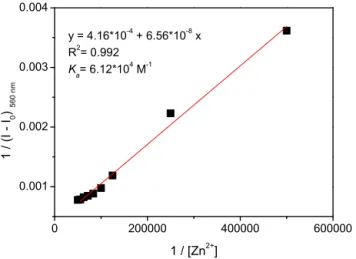
ThebindingstoichiometryofDP1–Zn2+complexeswas deter-minedfromaJobplot.Thefluorescenceintensityat560nmwas plottedagainstthemolarfractionofDP1withatotal concentra-tionofthesensorandZn2+ionof80.0M.Themolarfractionat maximumemissionintensityrepresentsthebinding stoichiome-tryoftheDP1–Zn2+complexes.Themaximumemissionintensity wasreachedatamolarfractionof0.5.Thisresultindicatesthat chemosensorDP1formsa1:1complexwithHg2+.Theapparent associationconstant(Ka)ofDP1–Zn2+complexeswasdetermined bytheBenesi–HildebrandEquation(1)[29].
1 (F−F0)= 1 {Ka×(Fmax−F0)×[Zn2+]} +(F 1 max−F0) (1)
whereFisthefluorescenceintensityat560nmatanygivenZn2+ concentration,F0 is thefluorescenceintensityat 560nm inthe absenceofZn2+,andF
maxisthemaximafluorescenceintensityat 560nminthepresenceofZn2+insolution.Theassociationconstant Kawasevaluatedgraphicallybyplotting1/(F−F0)against1/[Zn2+]. DatawerelinearlyfittedaccordingtoEquation(1)andtheKavalue wasobtainedfromtheslopeandinterceptoftheline.
2.7. Cellculture
ThecelllineRAW264.7cellswasprovidedbytheFood Indus-tryResearchandDevelopmentInstitute(Taiwan).RAW264.7cells weregrown in H-DMEM(Dulbecco’sModified Eagle’s Medium, highglucose)supplementedwith10%FBS(FetalBovineSerum) inanatmosphereof5%CO2at37◦C.
2.8. Fluorescenceimaging
ThecellsculturedinDMEMweretreatedwith10mMsolutions ofZn2+(2L;finalconcentration:20M)dissolvedinsterilized PBS(pH7.4)andincubatedat37◦Cfor30min.Thetreatedcells werewashedwithPBS(2mL×3)toremoveremainingmetalions. DMEM(2mL)wasaddedtothecellculture,whichwasthentreated witha10mMsolutionofchemosensorDP1(2L;final concen-tration:20M)dissolvedinDMSO.Thesampleswereincubated at37◦C for30min.The culturemediumwasremoved,and the treatedcellswerewashedwithPBS(2mL×3)beforeobservation. FluorescenceimagingwasperformedwithaZEISSAxioScopeA1 FluorescenceMicroscope.Thecellswereexcitedwithawhitelight laserat480nm,andemissionwascollectedat535±25nm.
2.9. Computationalmethods
Quantumchemicalcalculationsbasedondensityfunctional the-ory (DFT) were carried out using a Gaussian 09 program. The ground-statestructuresofDP1andtheDP1–Zn2+complexeswere computedusingthedensityfunctionaltheory(DFT)methodwith thehybrid-generalizedgradientapproximation(HGGA)functional B3LYP.The6-31Gbasissetwasassignedtononmetalelements(C, H,andN).FortheDP1–Zn2+complex,theLANL2DZbasissetwas usedforZn2+,whereasthe6-31Gbasissetwasusedforotheratoms.
3. Resultanddiscussion
3.1. SynthesisofDP1
The synthesis ofchemosensor DP1 is outlinedin Scheme1. Compound 1 was prepared by the condensation of 1-pyrenecarboxaldehyde and pyrrole. Compound 2 was obtained by the Vilsmeier–Haack reaction using benzoyl chloride and DMFtoformmonoformylateddipyrromethane.Inthenextstep, condensation ofo-phenylenediamine withcompound 2yielded
Fig.1. (Top)PhotographicimagesofDP1inthepresenceofvariousmetalions.(Bottom)FluorescencechangeofDP1(20M)uponadditionofvariousmetalions(20M) inmethanol.
compound3.Furtheroxidationofcompound 3usingDDQgave theproductDP1.
3.2. MetalionsensingabilityofDP1
ThesensingabilityofDP1wastestedbymixingitwiththemetal ionsCa2+,Cd2+,Co2+,Cu2+,Fe2+,Hg2+,Mg2+,Mn2+,Ni2+,andZn2+.
Fig.1showstheeffectofthemetalionsontheappearanceofDP1in solution.Zn2+wastheonlyionthatcausedayellow-greenemission bandat560nm.Theothermetalionsdidnotproduceagreatchange intheemissionspectra.DuringZn2+titrationwithchemosensor
DP1,anewemissionbandcenteredat560nmwasformed(Fig.2). AftertheadditionofmorethanoneequivalentofZn2+,the emis-sionintensityreachedamaximum,withaquantumyield˚=0.103, whichis20timeshigherthanthatofDP1,at˚=0.005.Forthe UV–visabsorptionspectra,theabsorbance at477nmdecreased inintensity,and anewbandcenteredat540nmappeared dur-ingZn2+titrationwithDP1(Fig.2).Thecolorchangefromyellow topurpleclearlyindicatesthe63nmblueshift.Theseobservations suggestthatZn2+istheonlymetalioncausingsignificant fluores-cenceenhancement,therebypermittinghighlyselectivedetection ofZn2+.
TostudytheinfluenceofothermetalionsonZn2+bindingwith chemosensorDP1,weperformedcompetitiveexperimentswith othermetalions(20M)inthepresenceofZn2+(20M)(Fig.3). ThefluorescenceenhancmentcausedbythemixtureofZn2+with mostothermetalionswassimilartothatcausedbyZn2+alone.A smallerfluorescenceenhancementwasobservedwhenZn2+was
Fig.2.Absorption(Top)andfluorescence(Bottom)changesofchemosensorDP1
(20M)inthepresenceofvariousequivalentsofZn2+inmethanol.Theexcitation
wavelengthwas535nm. 0 500 1000 DP1+Metal ions
Intensity (560 nm)
Zn2+Ag+Ca2+Cd2+Co2+Cu2+Fe2+Fe3+Hg2+K+Mg2+Mn2+ Ni2+ Pb2+ DP1+Metal ions+Zn2+Fig.3. Fluorescence response(560nm)ofchemosensor DP1(20M)to Zn2+
(20M)or20Mofothermetalions(theblackbarportion)andtothemixture ofothermetalions(20M)with20MofZn2+(thegraybarportion).
1.0 0.8 0.6 0.4 0.2 0.0 0 100 200 300 400
Fig.4.JobplotoftheDP1–Zn2+complexinmethanol.Thetotalconcentrationof
CBSandZn2+was80M.Themonitoredwavelengthwas560nm.
mixedwithCo2+orHg2+.Fluorescencequenchingwasobserved whenZn2+wasmixedwithCu2+.ThisindicatesthatCo2+,Hg2+, andCu2+cancompetewithZn2+forbindingwithDP1.Mostofthe othermetalionsdonotinterferewiththebindingofDP1withZn2+.
Fig.5. Benesi–HildebrandplotofDP1withZn2+inmethanol.Theexcitation
wave-lengthwas535nmandobservedwavelengthwas560nm.Thebindingconstantwas 6.12×10⁴M−1forZn2+bindinginDP1.
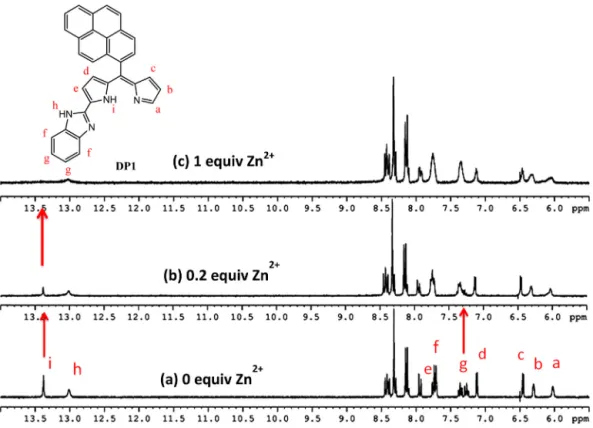
Fig.6.1HNMRspectraofDP1(5mM)upontitrationwith(a)0equiv,(b)0.2equiv,(c)1equivofZn2+inDMSO-d 6.
Thisindicatesthattheothermetalionsdonotinterferesignificantly withthebindingofchemosensorDP1withZn2+.
In order to understand the binding stoichiometry of the
DP1–Zn2+complexes,Jobplotexperimentswerecarried out.In
Fig.4,theemissionintensityat560nmisplottedagainstthemolar fractionofDP1underaconstanttotalconcentrationofDP1and Zn2+.Maximum fluorescent enhancement occurredat theratio 0.5.Thisresultindicatesa 1:1ratioforDP1–Zn2+complexes,in whichoneZn2+ionbindstoonechemosensorDP1.Inaddition,the formationof1:1DP1–Zn2+complexeswasalsoconfirmedusing ESI-MS,inwhichthepeakatm/z541.1indicatesa1:1 stoichiome-tryforDP1–Zn2+complexes(seeFig.S9inthesupplementarydata). TheassociationconstantKawasevaluatedgraphicallybyplotting 1/(F−F0)against1/[Zn2+](Fig.5).Thedatawerelinearlyfitandthe
Fig.7.DFT-optimizedstructuresofDP1–Zn2+complexes.Blueatom,N;redatom,
O;grayatom,Zn2+.(Forinterpretationofthereferencestocolorinthisfigurelegend,
thereaderisreferredtothewebversionofthearticle.)
Kavaluewasobtainedfromtheslopeandinterceptoftheline.The associationconstant(Ka)ofZn2+bindingtochemosensorDP1was foundtobe6.12×104M−1.ThedetectionlimitofchemosensorDP1 asafluorescentsensorforthedetectionofZn2+wasdetermined fromaplotoffluorescenceintensityasafunctionofthe concen-trationofZn2+.ItwasfoundthatchemosensorDP1hasadetection limitof0.236M(seeFig.S10inthesupplementarydata),which allowsforthedetectionofZn2+inthemicromolarconcentration range.
TogainaclearerunderstandingofthestructureofDP1–Zn2+ complexes,1H NMRspectroscopy(Fig.6)wasemployed.In the 1HNMRspectraofDP1,theprotonsignalsat13.4and13.0ppm decreaseduponadditionofZn2+.ThisindicatesthatZn2+binding occursmainlyatthenitrogenatomsinpyrroleandbenzoimidazole.
2
4
6
8
10
12
0
400
800
DP1 DP1 + Zn2+Int
ensi
ty
(560
nm
)
pH
Fig.8. Fluorescenceresponse(560nm)offreeDP1(20M)andafteradditionof Zn2+(20M)inmethanol–water(v/v=9:1,10mMbuffer,pH2–4:sodium
cit-rate/citraticacid;pH4.5–6:MES;pH6.5–8.5:Hepes;pH9–12:Tris–HCl)solution asafunctionofdifferentpHvalues.Theexcitationwavelengthwas530nm.
Fig.9. FluorescenceimagesofRAW264.7cellstreatedwithDP1andZn2+.(Left)Brightfieldimage;(middle)fluorescenceimage;(right)mergedimage.
TheseobservationsrevealthatZn2+bindingwithDP1isthrough twonitrogensatpyrrole,andonenitrogenatbenzoimidazole.
To elucidate the structures of the DP1–Zn2+ complexes, density functional theory (DFT) calculations were undertaken using the Gaussian 09 software package. The DP1–Zn2+ com-plexesweresubjectedtoenergyoptimizationusingB3LYP/6-31G and B3LYP/LANL2DZ. The global minima structure for the
DP1–Zn2+complexesisshowninFig.7.ThedistancesofZn2+from thethreenitrogenatomsareabout2.0and2.1 ˚A.
WeperformedpHtitrationofchemosensor1todeterminea suitablepHrangeforZn2+sensing.InFig.8,theemission intensi-tiesofmetal-freechemosensor1atmostpHvaluesarelow.After mixingchemosensor1withZn2+,theemissionintensityat560nm suddenlyincreasedinthepHrangeof5.0–10.0.WhenthepHwas lowerthan5,theemissionintensityat560nmdecreasedslightly, comparedtothatatpH7.0.Thisisduetoprotonationonthe nitro-genatom,preventingtheformationoftheCu2+–1complex.
3.3. Livingcellimaging
ThepotentialofDP1forimagingZn2+inlivingcellswasthen investigated.First,imagesofcellswereobtainedusinga fluores-cencemicroscope.WhenRAW264.7cellswereincubatedwithDP1
(10M),nofluorescencewasobserved(Fig.9a).Aftertreatment withZn2+,brightgreenfluorescencewasobservedintheRAW264.7 cells(Fig.9b).Anoverlayofthefluorescenceandbright-fieldimages showsthatthefluorescencesignalsarelocalizedinthe intracel-lulararea,indicatingasubcellulardistributionofZn2+andgood cell-membranepermeabilityofDP1.
4. Conclusion
Inconclusion,wedevelopedafluorescentchemosensorforZn2+ detection.Weobservedsignificantfluorescenceenhancementin thepresenceofZn2+.However,othermetalions,suchasAg+,Ca2+, Cd2+,Co2+,Cu2+,Fe2+,Fe3+,K+,Mg2+,Mn2+,Ni2+,andPb2+,barely affectedthefluorescence.Inaddition,thischemosensorDP1serves asaneffectiveprobeforZn2+detectioninlivingcells.
Acknowledgments
WegratefullyacknowledgethefinancialsupportofMinistryof ScienceandTechnology(Taiwan,101-2113-M-009-016-MY2)and NationalChiaoTungUniversity.
AppendixA. Supplementarydata
Supplementarymaterialrelatedtothisarticlecanbefound,in theonlineversion,athttp://dx.doi.org/10.1016/j.snb.2014.07.049.
References
[1]E.L.Que,D.W.Domaille,C.J.Chang,Metalsinneurobiology:probingtheir chem-istryandbiologywithmolecularimaging,Chem.Rev.108(2008)1517–1549.
[2]W.Maret,Y.Li,CoordinationdynamicsofZincinproteins,Chem.Rev.109 (2009)4682–4707.
[3]P.D.Zalewski,I.J.Forbes,W.H.Betts,Correlationofapoptosiswithchangein intracellularlabileZn(ll)usingZinquin [(2-methyl-8-p-toluenesulphonamido-6-quinolyloxy)aceticacid],anewspecificfluorescentprobeforZn(ll),Biochem. J.296(1993)403–408.
[4]K.H.Falchuk,Themolecularbasisfortheroleofzincindevelopmentalbiology, Mol.CellBiochem.188(1998)41–48.
[5]A.I.Bush,W.H.Pettingell,G.Multhaup,M.D.Paradis,J.Vonsattel,J.F.Gusella,K. Beyreuther,C.L.Masters,R.E.Tanzi,RapidinductionofAlzheimerAamyloid formationbyZinc,Science265(1994)1464–1467.
[6]P.O.Tsvetkov,I.A.Popov,E.N.Nikolaev,A.I.Archakov,A.A.Makarov,S.A.Kozin, IsomerizationoftheAsp7residueresultsinZinc-induced oligomerization ofAlzheimer’sdiseaseamyloid(1–16)peptide,Chem.BioChem.9(2008) 1564–1567.
[7]G.Wei,C.J.Hough,Y.Li,J.M.Sarvey,Characterizationofextracellular accumu-lationofZn2+duringischemiaandreperfusionofhippocampusslicesinrat,
Neuroscience125(2004)867–877.
[8]J.Kapur,R.L.Macdonald,Rapidseizure-inducedreductionofbenzodiazepine andZn2+sensitivityofhippocampaldentategranulecellGABAAreceptors,J.
Neurosci.17(1997)7532–7540.
[9]C.R.T.Tarley,F.N.Andrade,F.M.deOliveira,M.Z.Corazza,L.F.M.deAzevedo, M.G.Segatelli,Synthesisandapplicationofimprintedpolyvinylimidazole -silicahybridcopolymerforPb2+determinationbyflow-injectionthermospray
flamefurnaceatomicabsorptionspectrometry,Anal.Chim.Acta703(2011) 145–151.
[10]H.Karami,M.F.Mousavi,Y.Yamini,M.Shamsipur,On-linepreconcentration andsimultaneousdeterminationofheavymetalionsbyinductivelycoupled plasma-atomicemissionspectrometry,Anal.Chim.Acta509(2004)89–94.
[11]L.Zhao,S.Zhong,K.Fang,Z.Qian,J.Chen,Determinationofcadmium(II), cobalt(II),nickel(II),lead(II),zinc(II),andcopper(II)inwatersamplesusing dual-cloudpointextractionandinductivelycoupledplasmaemission spec-trometry,J.Hazard.Mater.239–240(2012)206–212.
[12]F.Tormaa,M.Kadar,K.Toth,E.Tatar,Nafion®/2,2-bipyridyl-modifiedbismuth
filmelectrodeforanodicstrippingvoltammetry,Anal.Chim.Acta619(2008) 173–182.
[13]J.Wu,W.Liu,X.Zhuang,F.Wang,P.Wang,S.Tao,X.Zhang,S.Wu,S.Lee, Fluorescenceturnonofcoumarinderivativesbymetalcations:anewsignaling mechanismbasedonC Nisomerization,Org.Lett.9(2007)33–36.
[14]H.S.Jung,K.C.Ko,J.H.Lee,S.H.Kim,S.Bhuniya,J.Y.Lee,Y.Kim,S.J.Kim,J.S.Kim, Rationallydesignedfluorescenceturn-onsensors:anewdesignstrategybased onorbitalcontrol,Inorg.Chem.49(2010)8552–8557.
[15]Z.Li,M.Yu,L.Zhang,M.Yu,J.Liu,L.Wei,H.Zhang,A“switchingon”fluorescent chemodosimeterofselectivitytoZn2+anditsapplicationtoMCF-7cells,Chem.
Commun.46(2010)7169–7171.
[16]Z.Xu,K.Baek,H.N.Kim,J.Cui,X.Qian,D.R.Spring,I.Shin,J.Yoon,Zn2+-triggered
amidetautomerizationproducesahighlyZn2+-selective,cell-permeable,and
[17]G.Sivaraman,T.Anand,D.Chellappa,Turn-onfluorescentchemosensorfor Zn(II)viaringopeningofrhodaminespirolactamandtheirlivecellimaging, Analyst137(2012)5881–5884.
[18]A.Ganguly,B.K.Paul,S.Ghosh,S.Kar,N.Guchhait,Selectivefluorescence sensingofCu(II)andZn(II)usinganewSchiffbase-derivedmodelcompound: nakedeyedetectionandspectraldecipheringofthemechanismofsensory action,Analyst138(2013)6532–6541.
[19]W.Lin,D.Buccella,S.J.Lippard,Visualizationofperoxynitrite-inducedchanges oflabileZn2+intheendoplasmicreticulumwithbenzoresorufin-based
fluo-rescentprobes,J.Am.Chem.Soc.135(2013)13512–13520.
[20]H.Woo,S.Cho,Y.Han,W.Chae,D.Ahn,Y.You,W.Nam,Syntheticcontrolover photoinducedelectrontransferinphosphorescenceZincsensors,J.Am.Chem. Soc.135(2013)4771–4787.
[21]S.Cui,G.Liu,S.Pu,B.Chen,AhighlyselectivefluorescentprobeforZn2+based
onanewphotochromicdiarylethenewithadi-2-picolylamineunit,DyesPigm. 99(2013)950–956.
[22]T.Zhang,F.Wang,M.Li,J.Liu,J.Miao,B.Zhao,Asimplepyrazoline-based fluorescentprobeforZn2+inaqueoussolutionandimaginginlivingneuron
cells,Sens.ActuatorsB186(2013)755–760.
[23]Y.Ma,F.Wang,S.Kambam,X.Chen,Aquinoline-basedfluorescent chemosen-sorfordistinguishingcadmiumfromzincionsusingcysteineasanauxiliary reagent,Sens.ActuatorsB188(2013)1116–1122.
[24]J.Ma,R.Sheng,J.Wu,W.Liu,H.Zhang,Anewcoumarin-derivedfluorescent sensorwithred-emissionforZn2+inaqueoussolution,Sens.ActuatorsB197
(2014)364–369.
[25]Y.J.Lee,C.Lim,H.Suh,E.J.Song,C.Kim,Amultifunctionalsensor:chromogenic sensingforMn2+andfluorescentsensingforZn2+andAl3+,Sens.ActuatorsB
201(2014)535–544.
[26]S.S.Mati,S.Chall,S.Konar,S.Rakshit,S.C.Bhattacharya,Pyrimidine-based fluorescent zinc sensor: photo-physicalcharacteristics, quantum chemical interpretationandapplicationinrealsamples,Sens.ActuatorsB201(2014) 204–212.
[27]M.Iniya,D.Jeyanthi,K.Krishnaveni,A.Mahesh,D.Chellappa,Triazolebased ratiometricfluorescentprobeforZn2+anditsapplicationinbioimaging,
Spec-trochim.ActaPartA120(2014)40–46.
[28]G.Sivaraman,T.Anand,D.Chellappa,Pyrenebasedselective–ratiometric flu-orescentsensingofzincandpyrophosphateions,Anal.Methods6(2014) 2343–2348.
[29]H.A.Benesi,J.H.Hildebrand,Aspectrophotometricinvestigationofthe inter-actionofiodinewitharomatichydrocarbons,J.Am.Chem.Soc.71(1949) 2703–2707.
Biographies
Hao-MingLiuhadMSin2012,DepartmentofAppliedChemistryatNationalChiao TungUniversity.
ParthibanVenkatesanisstudyingforPh.D.intheDepartmentofAppliedChemistry atNationalChiaoTungUniversity.
Dr.Shu-PaoWuhadPh.D.in2004,DepartmentofChemistry,TheOhioState Uni-versity,USA.Currently,heisworkingasanAssociateProfessorinDepartmentof AppliedChemistryNationalChiaoTungUniversity,Taiwan,RepublicofChina. Cur-rentinterests:metalionchemosensorsandAlkB.