Electronic structure and transport properties of La
0.7Ce
0.3MnO
3W. J. Chang,1J. Y. Tsai,2H.-T. Jeng,3J.-Y. Lin,2Kenneth Y.-J. Zhang,4H. L. Liu,4 J. M. Lee,5 J. M. Chen,5 K. H. Wu,1 T. M. Uen,1Y. S. Gou,1and J. Y. Juang1
1Department of Electrophysics, National Chiao Tung University, Hsinchu 30050, Taiwan 2Institute of Physics, National Chiao Tung University, Hsinchu 30050, Taiwan 3Physics Division, National Center for Theoretical Sciences, Hsinchu 30013, Taiwan
4Department of Physics, National Taiwan Normal University, Taipei 11677, Taiwan 5National Synchrotron Radiation Research Center (NSRRC), Hsinchu 30076, Taiwan
共Received 27 May 2005; published 24 October 2005兲
X-ray absorption spectroscopy共XAS兲, optical reflectance spectroscopy, and the Hall effect measurements were used to investigate the electronic structure in La0.7Ce0.3MnO3thin films共LCeMO兲. The XAS results are consistent with those obtained from LDA+ U calculations. In that the doping of Ce has shifted up the Fermi level and resulted in marked shrinkage of hole pockets originally existing in La0.7Ca0.3MnO3共LCaMO兲. The
Hall measurements indicate that in LCeMO the carriers are still displaying the characteristics of holes as LDA+ U calculations predict. Analyses of the optical reflectance spectra evidently disapprove the scenario that the present LCeMO might have been dominated by the La-deficient phases.
DOI:10.1103/PhysRevB.72.132410 PACS number共s兲: 75.47.Gk, 71.30.⫹h, 78.70.Dm
Over the last decade, researches on the rare-earth manga-nese perovskites R1−xAxMnO3共R: rare-earth ion, A: alkaline earth cation兲, have been largely devoted to the characteristics related to the electric transport and magnetic properties, e.g., colossal magnetoresistance, phase separation, and the com-petition between the charge, spin, and orbital order parameters.1 In these compounds, the charge state of Mn displays a mixed-valence characteristic of Mn3+ and Mn4+, and the ratio of Mn3+/ Mn4+depends strongly on the doping level of the divalent cation. Intuitively, substituting the diva-lent cation with the tetravadiva-lent cation, such as Ce, Sn, etc., should impel the valence state of Mn to a mixed-valence state of Mn2+ and Mn3+.2,3 It then raises curiosities on how the electric transport and magnetic properties of tetravalent cation doped manganites would prevail, as compared with the divalent-doped system.
Previously, the transport properties and the electronic structure of LCeMO had been reported with results obtained from the tunneling junction, photoemission, and x-ray ab-sorption spectroscopy 共XAS兲 experiments.4–8 The results showed that the valence state of Mn is indeed a mixed-valence of Mn2+/ Mn3+, and it is probably electron doped. However, there are discrepancies among the reported results. For instance, the tunneling junction experiments suggested that the itinerant carriers in LCeMO are the minority spin carriers,4which was in sharp contrast to the conclusion of the majority spin carriers drawn from XAS experiments and the-oretical calculations.8,9On the other hand, some reports even proposed that it is the La-deficient phase existent in LCeMO that gives rise to the metal-insulator transition.10 In this pa-per, we have utilized various independent experimental and theoretical approaches to systematically examine the LCeMO system. Our results unambiguously clarified some of the outstanding controversies in this system.
Details of preparing the single phase LCeMO on 共100兲 SrTiO3 substrates by pulsed-laser deposition and the associ-ated structure-property analyses were reported in Ref. 11. The x-ray scattering and x-ray diffraction results indicated
that the obtained LCeMO films were highly epitaxial single-phase samples with negligible traces of impurity single-phases such as CeO2 and MnO. The O K edge and Mn L edge XAS spectra were carried out using linear polarized synchrotron radiation from a 6-m high-energy spherical grating mono-chromator beamline located at NSRRC in Taiwan. Details of XAS experiments can be found in Ref. 12. Being different from previous XAS measurements at 300 K,6–8 the O 1s XAS spectra of LCeMO and LCaMO were taken by x-ray fluorescence yield at 30 K, which directly probed the elec-tronic structure in the ferromagnetic state for both samples. The longitudinal resistivityxxand Hall resistivity xywere measured by the four-probe and six-probe techniques, re-spectively. All of xx, xy, and the magnetization M were measured in an 8-T QUANTUM DESIGN® physical prop-erties measuring system共PPMS兲. Near-normal optical reflec-tance spectra were measured over a broad frequency range 共from 50 to 52 000 cm−1兲 at temperatures between 10 and 330 K. The thin-film optics and the Drude-Lorentz analysis were used to modeling the optical properties of these samples.13 The band structure calculations were performed using the full-potential projected augmented wave method14 as implemented in the Vienna ab initio simulation package 共VASP兲 共Ref. 15兲 within the local-density approximation plus on-site Coulomb interaction U共LDA+U兲 scheme.16 In the LDA+ U calculations, we used Coulomb energy U = 5.0 eV and exchange parameter J = 0.95 eV for Ce共La兲-4f electrons, while U = 4.0 eV and J = 0.87 eV were used for Mn-3d electrons.8
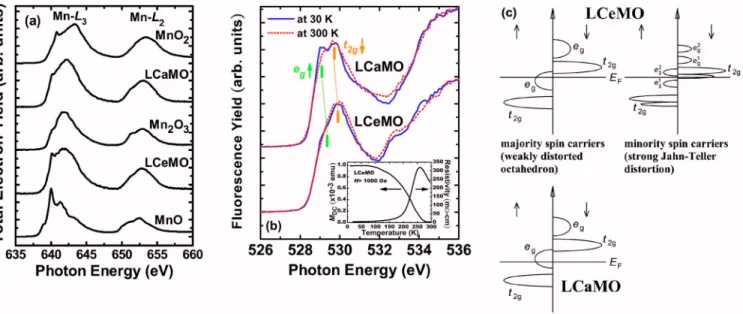
To characterize the valence state of manganese in LCeMO, Mn L-edge XAS spectra of MnO2, Mn2O3, MnO, LCaMO, and LCeMO were measured and are shown in Fig. 1共a兲 for comparison. The spectral weight of Mn L-edge for LCeMO evidently exhibits the characteristics of both Mn2+ and Mn3+, which has been previously interpreted as a mani-festation of Mn2+/ Mn3+ mixed-state in LCeMO.6,7 In Fig. 1共b兲, O K-edge XAS spectrum of LCeMO reveals a shoulder
PHYSICAL REVIEW B 72, 132410共2005兲
near absorption edge as compared with the first pronounced peak of LCaMO at 529 eV. These results suggest that there are fewer unoccupied states in eg↑ band of LCeMO than in that of LCaMO due to extra electrons doped into the egband of LCeMO, presumably originated from substituting Ca2+ with Ce4+. Based on these XAS results, the electronic struc-ture of LCeMO appears to be consistent with the scenario of the majority spin carriers associated with strong Hund’s rule effects. On the other hand, for the minority spin scenario to prevail one would expect otherwise a strong O K-edge spec-tral weight in the vicinity of the absorption edge. The elec-tronic structure diagrams for the scenarios discussed above are depicted schematically in Fig. 1共c兲. The density of states spectra obtained from LDA+ U calculations共Fig. 2兲 also re-vealed that both LCeMO and LCaMO are majority spin half-metals with fewer unoccupied eg↑ states in LCeMO. This is in good agreement with the observed XAS spectra men-tioned above. The above analyses unambiguously demon-strate that electrons are indeed doped into LCeMO. More-over, as displayed in the inset of Fig. 1共b兲, the mixed-valence Mn2+/ Mn3+ also leads to typical magneto-transport proper-ties of CMR manganites, with TC and TIM being around 260 K, which is also consistent with most of the previous reports.2–8
The next question of whether the doped electrons actually drive the itinerant carriers to become electrons remains to be confirmed. To examine this scenario, the Hall measurements are indispensable. In ferromagnets, the Hall resistivity can be expressed by xy共B,T兲=RH共T兲B+0RS共T兲M共B,T兲, where RH is the ordinary Hall coefficient, RS the anomalous Hall coefficient,0the vacuum permeability, and magnetic induc-tion B =0关H+共1−Nd兲M兴 with the demagnetization factor Nd⬃1 in our film geometry. In order to improve the accu-racy of the experimental data, values ofxywere obtained by averaging the results acquired from two scans of B. The field
scans range from 8 to − 8 T. Combining with the measure-ments of M共B兲, RH and RS were then obtained by fitting xy共B兲 to the abovementioned Hall resistivity equation. As shown in Fig. 3, the positive slope dxy/ dB in the high field regime, where M共B兲 saturates, strongly suggests that the itin-erant carriers in the present LCeMO films, similar to that in LCaMO films, are holes. In addition to the ordinary Hall effect discussed above, the extraordinary Hall effect is gen-erally associated with large and localized magnetic moments existent in the material.17 As is evident in Fig. 3, LCeMO appears to have a more significant extraordinary Hall effect than LCaMO even at 10 K. The difference might be due to
FIG. 1.共Color online兲 共a兲 Spectra of Mn L-edge XAS for Mn ions with various valence states by total electron yield. 共b兲 Spectra of O
K-edge XAS共by florescence yield兲 of LCaMO and LCeMO at 300 and 30 K, respectively. The absorption peaks at 529 and 530 eV were
assigned to the unoccupied states of eg↑ and t2g↓ orbitals, respectively. Inset: 共T兲 and M共T兲 of LCeMO, showing the typical CMR
magnetotransport characteristics.共c兲 Left: Schematic band diagrams describing the majority spin scenario for LCeMO 共upper panel兲 and LCaMO共lower panel兲. Right: Schematic diagram, quoted from Ref. 4, depicting the minority spin carriers scenario in LCeMO.
FIG. 2.共Color online兲 DOS of Mn 3d in LCaMO and LCeMO calculated by LDA+ U method. The parameters used in these cal-culations are described in the text.
BRIEF REPORTS PHYSICAL REVIEW B 72, 132410共2005兲
strain-induced effects and could be either intrinsic共ion size difference兲 or extrinsic 共extent of lattice mismatch with sub-strate兲. It might also be due to the difference in electronic bandwidth for the itinerant carriers, which in turn will affect the efficiency of ferromagnetic transition via the double-exchange mechanism.
We now return to the issue of the p-type behavior re-vealed by Hall measurements. Starting from the ionic band structure of parent LaMnO3, due to the strong Jahn-Teller effect, the eg↑ band splits into two subbands eg
1↑ and e g 2↑ and results in the commonly observed insulator behavior.18,19 Therefore, electron doping in LCeMO presumably could have led to electron carriers in this model. To unravel the origin of why the carriers are still holes in LCeMO, we per-formed band structure calculations for both the hole-doped LCaMO and electron-doped LCeMO by using the LDA+ U method. As shown in Fig. 4, LCaMO is clearly a p-type metal with significant hole pockets near the Fermi surface as expected. Surprisingly, the band dispersions of LCeMO evi-dently also show nontrivial hole pockets around the Fermi surface, in spite of the electron doping from Ce4+ions. None-theless, the Fermi level has been raised significantly in the latter case. It has been pointed out that the strong Jahn-Teller distortion due to the local lattice distortion of Mn3+ in LaMnO3 is largely exempted in both of the Mn3+/ Mn4+and
Mn2+/ Mn3+ cases.1 Consequently, the splitting between eg 1 and eg2 induced by the Jahn-Teller effect is gradually dimin-ished when LaMnO3 is doped with either divalent Ca or tetravalent Ce. The evolution of the electronic structure of La1−xSrxMnO3, which relates Jahn-Teller distortion to the hole doping level, has demonstrated the closing of the band gap between eg
1↑ and e g
2↑ subbands with increasing doping.19 We believe that it is the similar effects that lead the Fermi level of both LCaMO and LCeMO to lie in the eg↑ band, making the transport carriers exhibit holelike behaviors in both cases.
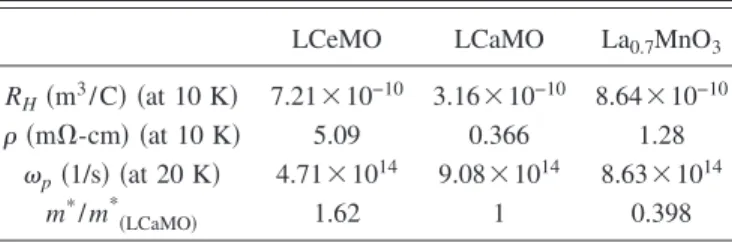
The next issue to be addressed is whether or not all of these are just the manifestations of La-deficient phase. Since it is rather difficult to make clear-cut distinction between them by merely relying on magnetotransport and XAS mea-surements, we performed independent optical reflectance measurements to provide additional information for this pur-pose. Figure 5 shows the measured optical reflectance of the 共100兲 SrTiO3substrate at 300 K and the LCeMO, La0.7MnO3 film共as grown兲 at 20 K. Both LCeMO and La0.7MnO3 film have approximately the same Curie temperature around 260 K. There are several important features to these spectra. First, the far-infrared spectrum of the LCeMO film can be described by a weak, overdamped Drude contribution typical of a poor conductor. As a consequence, the effect of multiple reflection of light in the film on the substrate is clearly seen in the midinfrared frequency region. Second, the spectral weight of the infrared reflectance of the La0.7MnO3 film is substantially increased, indicative of increased carrier con-centrations. Third, from the Hall measurements and optical data, we derive the carrier effective mass of the three man-ganites studied by the relationp2= 4e / m*R
H. As listed in Table I, the ratio of the effective mass m*/ m*共LCaMO兲are 1.62 and 0.398 for LCeMO and La0.7MnO3 film, respectively. Consequently, LCeMO is apparently having much heavier holes and appears to be a narrow band manganite as com-pared to LCaMO. This is in contrast to that implied by the result of m*/ m*
共LCaMO兲for La0.7MnO3film shown in Table I, and virtually rules out the scenario that the LCeMO films studied in the present work is of La-deficient nature. Al-though Yanagida et al.10 reported the coexistence of
nano-FIG. 3. 共Color online兲 The Hall measurements of LCeMO and LCaMO. The lines are from the fits to the equation mentioned in the text. Inset: the T dependence of RHand RS.
FIG. 4. The results of LDA+ U band structure calculations for LCaMO and LCeMO. Only the majority spin part is shown.
FIG. 5. 共Color online兲 The reflectance spectra of the LCeMO and an as-grown La0.7MnO3film measured at 20 K. For
compari-son, the room-temperature reflectance data of the共100兲 SrTiO3 sub-strate is also included.
BRIEF REPORTS PHYSICAL REVIEW B 72, 132410共2005兲
cluster cerium oxides with minor phases of La-deficient La1−xMnO3 and A-site cation-deficient 共La,Ce1−␦兲MnO3 in their post-annealed films which showed similar metal-insulator transition, their as-grown film, albeit in single phase, was an insulator. This is different from the present as-grown LCeMO films, which are metallic even without post annealing. The differences are presumably due to differ-ent film growth processes.
In summary, we have presented the detailed results of Mn L-edge and O K-edge XAS which suggest that at low tem-peratures LCeMO is a majority spin carrier ferromagnet. The results also display clear evidence of electron doping into the eg↑ subband of LCeMO. However, both Hall measurements and LDA+ U band structure calculations indicate that the doped electrons did not drive LCeMO into a n-type manga-nite and the itinerant carriers are still holes, but with a much less concentration as compared with that of LCaMO. Finally, the results of optical reflectance spectra, together with the Hall measurements, evidently dismiss the scenario that the present as-grown LCeMO films are dominated by La-deficient phases.
This work was supported by the National Science Council of Taiwan, under Grant Nos. NSC 2112-M-009-015, 93-2112-M-009-016, 94-2119-M-007-001, and 93-2112-M-003-005.
1M. Imada, A. Fujimori, and Y. Tokura, Rev. Mod. Phys. 70, 1039
共1998兲; E. Dagotto, T. Hotta, and A. Moreo, Phys. Rep. 344, 1 共2001兲.
2P. Raychaudhuri, S. Mukherjee, A. K. Nigam, J. John, U. D.
Vaisnav, R. Pinto, and P. Mandal, J. Appl. Phys. 86, 5718 共1999兲.
3Z. W. Li, A. H. Morrish, and J. Z. Jiang, Phys. Rev. B 60, 10 284
共1999兲.
4C. Mitra, P. Raychaudhuri, K. Dörr, K.-H Müller, L. Schultz, P.
M. Oppeneer, and S. Wirth, Phys. Rev. Lett. 90, 017202共2003兲.
5C. Mitra, P. Raychaudhuri, G. Köbernik, K. Dörr, K.-H Müller, L.
Schultz, and R. Pinto, Appl. Phys. Lett. 79, 2408共2001兲.
6C. Mitra, Z. Hu, P. Raychaudhuri, S. Wirth, S. I. Csiszar, H. H.
Hsieh, H.-J. Lin, C. T. Chen, and L. H. Tjeng, Phys. Rev. B 67, 092404共2003兲.
7J.-Y. Lin, W. J. Chang, J. Y. Juang, T. M. Wen, K. H. Wu, Y. S.
Gou, J. M. Lee, and J. M. Chen, J. Magn. Magn. Mater. 282, 237共2004兲.
8S. W. Han, J.-S. Kang, K. H. Kim, J. D. Lee, J. H. Kim, S. C. Wi,
C. Mitra, P. Raychaudhuri, S. Wirth, K. J. Kim, B. S. Kim, J. I. Jeong, S. K. Kwon, and B. I. Min, Phys. Rev. B 69, 104406 共2004兲.
9Q. Zhang and W. Zhang, Phys. Rev. B 68, 134449共2003兲.
10T. Yanagida, T. Kanki, B. Vilquin, H. Tanaka, and T. Kawai,
Phys. Rev. B 70, 184437共2004兲.
11W. J. Chang, C. C. Hsieh, J. Y. Juang, K. H. Wu, T. M. Uen, Y. S.
Gou, C. H. Hsu, and J.-Y. Lin, J. Appl. Phys. 96, 4357共2004兲.
12I. P. Hong, J.-Y. Lin, J. M. Chen, S. Chatterjee, S. J. Liu, Y. S.
Gou, and H. D. Yang, Europhys. Lett. 58, 126共2002兲; H. D. Yang, H. L. Liu, J.-Y. Lin, M. X. Kuo, P. L. Ho, J. M. Chen, C. U. Jung, Min-Seok Park, and Sung-Ik Lee, Phys. Rev. B 68, 092505共2003兲.
13H. L. Liu, M. X. Kuo, J. L. Her, K. S. Lu, S. M. Weng, L. M.
Wang, S. L. Cheng, and J. G. Lin, J. Appl. Phys. 97, 113528 共2005兲.
14G. Kresse and D. Joubert, Phys. Rev. B 59, 1758共1999兲. 15G. Kresse and J. Furthmüller, Phys. Rev. B 54, 11 169共1996兲. 16A. I. Liechtenstein, V. I. Anisimov, and J. Zaanen, Phys. Rev. B
52, R5467共1995兲.
17Colin M. Hurd, The Hall Effect in Metals and Alloys共Plenum
Press, New York, 1972兲.
18S. Satpathy, Zoran S. Popović, and Filip R. Vukajlović, Phys.
Rev. Lett. 76, 960共1996兲.
19T. Saitoh, A. E. Bocquet, T. Mizokawa, H. Namatame, A.
Fuji-mori, M. Abbate, Y. Takeda, and M. Takano, Phys. Rev. B 51, 13 942共1995兲.
TABLE I. Summary of RH,, p, and m*/ m*共LCaMO兲for listed
samples.
LCeMO LCaMO La0.7MnO3 RH共m3/ C兲 共at 10 K兲 7.21⫻10−10 3.16⫻10−10 8.64⫻10−10
共m⍀-cm兲 共at 10 K兲 5.09 0.366 1.28 p共1/s兲 共at 20 K兲 4.71⫻1014 9.08⫻1014 8.63⫻1014
m*/ m*
共LCaMO兲 1.62 1 0.398
BRIEF REPORTS PHYSICAL REVIEW B 72, 132410共2005兲