Liquid crystal alignment on ZnO nanostructure films
Yueh-Feng Chung
a,
Mu-Zhe Chen
a,
Sheng-Hsiung Yang
b,
and Shie-Chang Jeng*
ca
Institute of Photonics System, bInstitute of Lighting and Energy Photonics, and cInstitute of Imaging and Biomedical Photonics, National Chiao Tung University, Tainan 711, Taiwan
ABSTRACT
The study of liquid crystal (LC) alignment is important for fundamental researches and industrial applications. The tunable pretilt angles of liquid crystal (LC) molecules aligned on the inorganic zinc oxide (ZnO) nanostructure films with controllable surface wettability are demonstrated in this work. The ZnO nanostructure films are deposited on the ITO-glass substrates by the two-steps hydrothermal process, and their wettability can be modified by annealing. Our experimental results show that the pretilt angles of LCs on ZnO nanostructure films can be successfully adjusted over a wide range from ~90° to ~0° as the surface energy on the ZnO nanostructure films changes from ~30 to ~70 mJ/m. Finally, we have applied this technique to fabricate a no-bias optically-compensated bend (OCB) LCD with ZnO nanostructure films annealed at 235 °C.
Keywords: ZnO films, liquid crystal devices, pretilt angles, annealing
1. INTRODUCTION
The control of liquid crystal (LC) molecules on solid films is very important. LC orientation is determined by the interactions between the alignment film and the LC molecules and the topography of the alignment film.The pretilt angle of a traditional LC device (LCD) is determined by the commercial homogeneous and homeotropic polyimide (PI) materials, and the obtained pretilt angles are either near zero degrees or 90 degrees, respectively. The control of the LC alignment is very important to obtain a defect-free LCD and also to improve LCD performances, such as response time and driving voltage. The techniques for producing homogeneous and homeotropic alignment are mature in the LC display (LCD) industry. However, the required pretilt angles of LCDs depend on their operation modes, e.g. near zero degrees for in-plane switching, several degrees for the twisted nematic mode, 45o - 60o for no-bias optically-compensated
bend (OCB) LCD, and near 90 degrees for the vertical alignment mode [1,2]. There are many methods have been developed to control the pretilt angle of LC, such as: polymer-stabilized alignment [3,4], nanostructured surfaces [5,6], and hybrid mixture of two materials [7-9]. However, the reliability and mass production for those developed techniques are questionable. For example, the reliability of organic PI operated at high temperature and UV irradiation is still a problem.
Applications of inorganic films for aligning LCs are very promising for LCDs operated in severe conditions, where a highly durable material is needed [10]. The ion beam (IB) bombardment on inorganic films, such as Zn-doped GaO, ZnO and Y2Sn2O7, as an alternative alignment approach has been reported by Seo’s group recently [11-13]. Their results, such
as fast response and low residual DC, are very promising.However, only a limited range of pretilt angle control (few degrees) was obtained.
Recently, our group and Lim et. al. found that the LC molecules can be aligned vertically to the ZnO nanowire arrays synthesized by the solution-based hydrothermal method [14,15]. This low cost method owns the advantages of low manufacturing temperature and well-controlled nanostructure of variable size and shape on different substrates [16,17]. The ZnO are attractive inorganic materials for applications in photonic devices due to the excellent thermal stability and high transparency. Instead of using organic PI films, applications of inorganic ZnO films for LCDs operated in a severe environment are promising, where a highly reliable material is required. While annealing the ZnO nanowire arrays at different temperatures, we found that the surface wettability of ZnO nanowire arrays changes with temperature. The control of surface wettability is very important for both fundamental research and practical applications. Photo-induced wettability transitions of ZnO nanostructured films from super-hydrophobic surfaces to super-hydrophilic surfaces have *[email protected]
Invited Paper
Emerging Liquid Crystal Technologies XI, edited by Liang-Chy Chien, Dick J. Broer, Hirotsugu Kikuchi, Nelson V. Tabiryan, Proc. of SPIE Vol. 9769, 97690X © 2016 SPIE · CCC code: 0277-786X/16/$18 · doi: 10.1117/12.2211567
Proc. of SPIE Vol. 9769 97690X-1
ITO substrate
..
Drop the precursor
on ITO glass Spin coating
90°C
Annealed at
NMI
111
170 300 °C1111111.111
Dip in the bath solution ZnO SL /ITO for 15 min
200 t /air 60 min
ZnO NRAs/ITO
been investigated [18]. In this work, we report that the wettability of the ZnO nanostructured films grown by the solution-based hydrothermal process can be modified by annealing temperature. Many studies in LC alignment films have shown that the pretilt angle of LC directors on alignment films strongly depends on their surface energy [9,19,20]. Therefore, it is expected that the pretilt angle of the LC molecules can be controlled by adjusting the surface property of the ZnO nanostructured films. Experimental results show that the pretilt angle of LCs is a function of the surface energy of the ZnO nanostructured films, and it can be tuned continuously over a wide range from ~90° to ~0° as the surface energy on the ZnO nanostructure films changes from ~30 to ~70 mJ/m..
2. EXPERIMENTAL SECTION
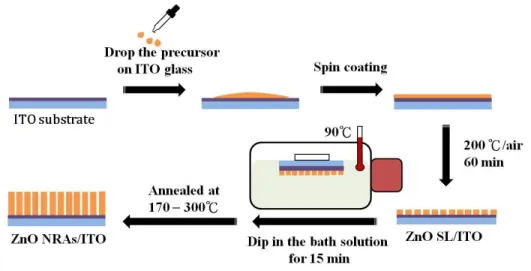
The ZnO nanostructured films were synthesized by the hydrothermal method with the two-steps process as shown in Fig. 1. A solution of zinc acetate dihydrate (0.22 g, 1 mmol) in 10 mL of isopropanol was stirred vigorously at 120 °C for 10 minutes. 2-(Dimethylamino)ethanol (0.089 g, 1 mmol) was slowly added to the above solution and stirred at the same temperature for an additional 2 h to form a homogeneous precursor solution. The solution was then cooled to room temperature and spin-cast on the ITO glass substrate. The coated thin film was annealed at 200 °C in air for 60 min to obtain a ZnO seed layer. A bath solution consisting of zinc sulfate heptahydrate (0.144 g, 0.5 mmol) and ammonium chloride (1.07 g, 20 mmol) in de-ionized water (50 mL) was prepared. 2M NaOH aqueous solution was then slowly added for adjusting the pH value of the solution to 10.3. The ITO glass substrate with a ZnO seed layer was immersed in the above bath solution (ZnO seed layer downward) and placed in a preheated oven at 90 °C for 15 min for obtaining nanostructured films. The growth time of 15 min is shorter than that for growing the ZnO nanowire arrays [14]. The ITO glass substrate with ZnO nanostructured films was then washed with de-ionized water, acetone, and isopropanol, followed by annealing in air for 60 minutes to form the as-prepared ZnO nanostructured films. Annealing processes were carried out on the as-prepared ZnO nanostructured films at either 170, 200, 220, 230, 235, 240, 250, 270, or 300 °C. The surface of the ZnO nanostructured film was then subjected to rubbing treatment using a nylon cloth in such a way that the nanostructured film was rubbed once in each direction.
Figure 1. The schematic illustration of fabrication process of the ZnO nanostructured films on the ITO glass substrate.
In order to determine electro-optical properties of LC molecules on ZnO nanostructured films, the antiparallel LC cells were fabricated witha cell gap of ~ 5.1 μm and capillary filled with LC molecules (E7, Δε = 14.1, ε⊥= 5.2, ne = 1.74, no =
1.52, Daily Polymer Corp.). A no-bias OCB LC cells witha cell gap of ~ 8.5 μm with ZnO nanostructure films annealed at 235 °C was also fabricated and capillary filled with LC E7.
The morphology of ZnO nanostructured films was observed by using a SEM (Hitachi SU8000). The wettability of rubbed- nanostructured films was evaluated by measuring the contact angle of distilled water on their surfaces using a contact angle analyzer (Creating Nano Technologies, CAM-100). The surface energy of the ZnO nanostructured films can be further determined by measuring the contact angle of distilled water and methylene iodide on the films according
Proc. of SPIE Vol. 9769 97690X-2
(a)
I pm
(b)
ZnO Seed Layer
ITO
Glass 500 mil
NawiS.ardA
to the Owen-Wendt model [21]. The pretilt angles of LC cells were measured by the modified crystal rotation method [22], where a laser interferometer (Agilent 5530) was used to determine the phase retardation [23]. The electro-optical properties of the LC cells and no-bias OCB cells were also evaluated by means of the polarizing optical microscope (POM) and transmittance-voltage measurements. The voltage-dependent optical transmission of the LC cell, placed between crossed polarizers, was measured using a 635-nm diode laser, and the applied voltage was a 1-kHz square wave. The polar anchoring energy of the ZnO nanostructured films was measured by using the high electric field method [24].
3. RESULTS AND DISCUSSION
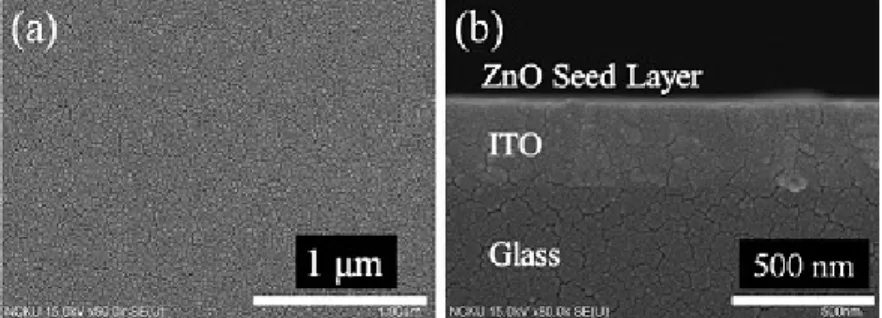
The typical nanostructure and the morphology of the as-prepared ZnO seed layers observed by SEM are shown in Fig. 2, where the annealing temperature is 200 °C. The thickness of the ZnO films is around 15 nm. Fig. 3 shows the typical ZnO nanostructured films annealed at 200 °C after the second step of hydrothermal method. In this work, we controlled the growth time in the second step for obtaining the particle-like geometry rather than the nanowire arrays used in our previous work [14]. Most of ZnO nanoparticle shown in Fig. 3 is regularly grown on the substrate with diameters of ∼50 nm.
Figure 2. SEM images of the ZnO seed layers annealed at 200 °C. (a) Top view and (b) cross section view.
Figure 3. SEM images of the ZnO nanostructured films annealed at 300 °C. (a) Top view and (b) cross section view.
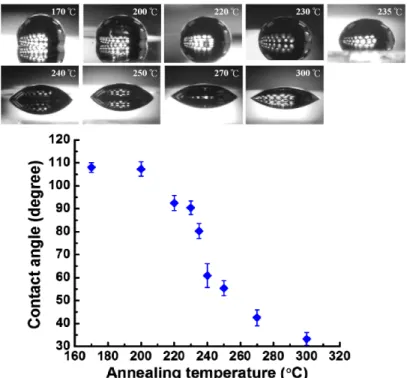
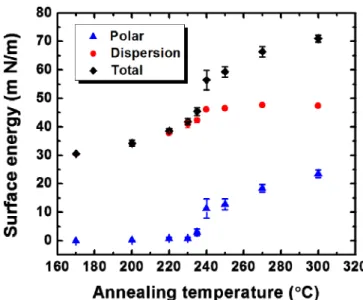
The results of the contact angles of distilled water and methylene iodide drops on the ZnO nanostructured films annealed at different temperatures are shown in Fig 4 and Fig. 5, respectively. The surface energy, including polar and dispersive, of ZnO nanostructured films determined by contact angle measurement is shown in Fig. 6. The increase of annealing temperature increases the surface energy of ZnO nanostructured films. Fig. 7 shows the pretilt angle of ZnO nanostructured films as a function of surface energy. A wide range of pretilt angle from ~ 90° to ~ 0° can be generated by varying the surface energy of ZnO nanostructured from ~30 to ~70 mN/m. The LC alignment on ZnO nanostructured films can be explained by the empirical Friedel-Creagh-Kmetz (FCK) rule [25].According to the FCK rule, the pretilt angle of LC molecules on the alignment film depends on its surface energy. An alignment film with a higher surface energy will induce a lower pretilt angle and vice versa.
(a)
(b)
Proc. of SPIE Vol. 9769 97690X-3
300 C 60 30 20
I
4
f
È 190 180 200 220 240 260 280 300 320 Annealing temperature 4 °C) 120 110 100 4, ßê# ,... a> 80c 70
60c
50o
40if
7 30 . . . I . .. 7 .
160 180 200 220 240 260 280 300 320
Annealing temperature (OC)
Figure 4. Contact angles of distilled water drop on ZnO nanostructured films annealed at different temperatures.
Figure 5. Contact angles of methylene iodide drops on ZnO nanostructured films annealed at different temperatures.
Proc. of SPIE Vol. 9769 97690X-4
Stì
-á
80+ i
E::
T
0 50
+
0
C 40
o
30 .t
`0
1-1--1 10 4 . !1.4W 20 30 40 50 80 TO SßSurface energy (m Nfm)
80 70 80 80 40 30 20 10 0 V ,1 V V I V V Polar Dispersion TotalI
1I
I
IL-*
4 **111 t I t I 9 I 9 I 9 I 9 0 9 0 9180 180 200 220 240 280 280 300 320
Annealing temperature (°C)
Figure 6. Surface energy of ZnO nanostructured films annealed at different temperatures.
Figure 7. Pretilt angle of LCs as a function of surface energy.
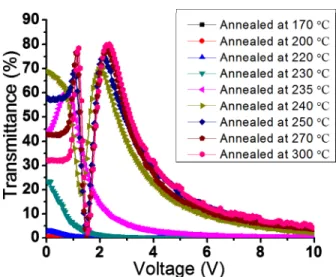
The voltage-dependent transmittance of antiparallel LC cells with ZnO nanostructured films annealed at different temperatures are shown in Fig. 8. In the voltage-off state, the LC molecules are mainly aligned by ZnO nanostructured films with a pretilt angle θp. The very small transmittance below the threshold voltage appeared at the low annealed
temperatures indicates that the liquid crystal pretilt angle is near ~90°, and the transmittance does not change with the applied voltage for using the positive dielectric anisotropic LC. The anchoring energy of ZnO nanostructured alignment films annealed at different temperatures is shown in Fig. 9. The anchoring energy is around 3×10⁻⁴ J/m2. No relationship
between the annealing temperature and the anchoring energy is observed. The moderate anchoring energy of ZnO nanostructured alignment films for each pretilt angle makes this novel method good for many LCDs requiring a specific pretilt angle.
Proc. of SPIE Vol. 9769 97690X-5
,,
ß
g g g g g P E7
= 4
CO CDs
Qo
,
,It
180 180 200 220 240 280 280 300 320
Annealing temperature (DC)
{`
f
f
..
90 ,.-,.8ße
70 ,...8 60
i 50
2 30
tvÑ 20
10 ß Annealed at 170 °C Annealed at 200 °C Annealed at 220 °C -v- Annealed at 230 °C I- Annealed at 235 °C - Annealed at 240 °C t Annealed at 250 °C T Annealed at 270 °C Annealed at 300 °C 4 6Voltage (V)
Figure 8. Voltage dependent transmittance curves of antiparallel LC cells with ZnO nanostructured films annealed at different temperatures.
Figure 9. Anchoring energy as a function of ZnO nanostructured alignment films annealed at different temperatures.
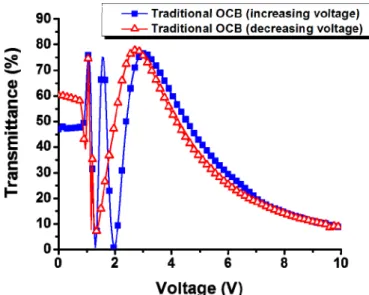
To verify the proposed technique for controlling pretilt angle in this work, one traditional OCB LCD with ZnO nanostructured alignment films annealed at 270 °C (θp~ 2°) and one on-bias OCB LCD with ZnO nanostructured
alignment films annealed at 235 °C (θp~ 52°) were fabricated for comparison as shown in Fig. 10 and Fig. 11,
respectively. The voltage dependent transmission properties of each OCB LCD were measured by applying forward voltage (0V to 10 V) and backward voltage (10V to 0 V) where there was no bias voltage applied on the OCB LCDs. Due to the energy barrier between the splay and bend state of a traditional OCB LCD, some transient time is required to switch a traditional OCB LC cell between those two states. Therefore, the voltage dependent transmission curves for forward and backward voltages do not overlap as shown in Fig. 10. The OCB LC cell with a high pretilt angle could overcome the energy barrier and show a better electro-optical property than the traditional one as shown in Fig. 11.
Proc. of SPIE Vol. 9769 97690X-6
-
I IdUILIundi t.J D kuiuedsiny VUILdye)-a- Traditional OCB (decreasing voltage)
10 80 70
...
ó
60= 60
i 40
E E 30Ñ
20 10 0-.- Proposed OCB (increasing voltage)
-a- Proposed OCB (decreasing voltage)
Figure 10. Voltage dependent transmission curves of the traditional LCD by applying forward (0 V to 10 V) and backward (10 V to 0V) voltages.
Figure 11. Voltage dependent transmission curves of the no-bias OCB LCDs by applying forward (0 V to 10 V) and backward (10 V to 0V) voltages.
4. CONCLUSION
This work demonstrates that annealing treatment can be applied to modify the surface energy of the ZnO nanostructured alignment films prepared by the two-steps hydrothermal method. The relationship between surface energy of nanostructured alignment films and LC pretilt angle is studied. We find that the pretilt angle strongly depends on the surface energy. The pretilt angle of LCs can be tuned continuously from ~90 to ~0° as the surface energy changes from ~30 to ~70 mJ/m. The no-bias OCB LCD requiring the medium pretilt angle has also been demonstrated by using ZnO nanostructure films. The proposed approach for controlling the pretilt angle is simple and may provide a new reliable inorganic alignment film for LCDs.
Proc. of SPIE Vol. 9769 97690X-7
ACKNOWLEDGEMENT
The authors thank the Ministry of Science and Technology of Taiwan for financially supporting this research under contract MOST 103-2112-M-009-013-MY3 and NSC102-2113-M-009-007.
REFERENCES
[1] D.-K. Yang and S.-T. Wu, [Fundamentals of Liquid Crystal Devices], John Wiley & Sons, Ltd, West Sussex (2006). [2] F. S. Yeung and H.-S. Kwok, “Fast-response no-bias-bend liquid crystal displays using nanostructured surfaces,” Appl. Phys. Lett. 88, 063505 (2006).
[3] T. J Chen and K. L Chu, “Pretilt angle control for single-cell-gap transflective liquid crystal cells,” Appl. Phys. Lett.
92, 091102 (2008).
[4] B.-Y. Liu and L.-J. Chen, “Role of surface hydrophobicity in pretilt angle control of polymer-stabilized liquid crystal alignment systems,” J. Phys. Chem. C 117, 13474 (2013).
[5] T. Maeda and K. Hiroshima, “Vertically aligned nematic liquid crystal on anodic porous alumina,” Jpn J. Appl. Phys.
43, L1004 (2004).
[6] C. Hong, T. T. Tang, C. Y. Hung, R. P. Pan, and W. Fang, “Liquid crystal alignment in nanoporous anodic aluminum oxide layer for LCD panel applications,” Nanotechnology 21, 285201 (2010).
[7] H.S. Kwok and F.S.Y. Yeung, Nano-Structured Liquid-Crystal Alignment Layers,” J. Soc. Inf. Disp. 16, 911 (2008). [8] D. Ahn, Y.-C. Jeong, S. Lee, J. Lee, Y. Heo, and J.-K. Park, “Control of liquid crystal pretilt angles by using organic/inorganic hybrid interpenetrating networks,” Opt. Express 17, 16603 (2009).
[9] S.-J. Hwang, S.-C. Jeng, and I.-M. Hsieh, “Nanoparticle-Doped Polyimide for Controlling the Pretilt Angle of Liquid Crystals Devices,” Opt. Express 18, 16507 (2010).
[10] C.-H. Wen, S. Gauza, and S.-T. Wu, “Photostability of liquid crystals and alignment layers,” J. SID 13, 805-811 (2005).
[11] Y.-G. Lee, G.-S. Heo, H.-G. Park, H.-C. Jeong, J. H. Lee, and D.-S. Seo, “Solution-Derived Zn-Doped GaO Films as Alignment Layers for Twisted-Nematic Liquid Crystal Displays Using Ion-Beam Bombardment,” IEEE Electron Device Lett. 36, 817 (2015)
[12] J.-J. Lee, H.-G. Park, J.-J. Han, D.-H. Kim and D.-S. Seo, “Surface reformation on solution-derived zinc oxide films for liquid crystal systems via ion-beam irradiation,” J. Mater. Chem. C 1, 6824 (2013).
[13] Y. Liu, H.-G. Park, J. H. Lee, S. B. Jang, Y. H. Jung, H.-C. Jeong, and D.-S. Seo, “Homogeneous Liquid Crystal Alignment on Ion Beam-Induced Y2Sn2O7 Layers,” IEEE Electron Device Lett. 36, 363 (2015)
[14] M.-Z. Chen, W.-S. Chen, S.-C. Jeng, S.-H. Yang and Y.-F. Chung, “Liquid crystal alignment on zinc oxide nanowire arrays for LCDs applications,” Opt. Express 21, 29277 (2013).
[15] Y. J. Lim, Y.E. Choi, S.-W.Kang, D.Y. Kim, S.H. Lee, and Y.-B. Hahn, “Vertical alignment of liquid crystals with zinc oxide nanorods,” Nanotechnology 24, 345702 (2013).
[16] S. Yamabi, and H. Imai, “Growth condition for wurtzite oxide films in aqueous solutions,” J. Mater. Chem. 12, 3773 (2002).
[17] L. Vayssieres, “Growth of arrayed nanorods and nanowires of ZnO from aqueous solutions,” Adv. Mater. 15, 464 (2003).
[18] X. J. Feng, L. Feng, M. Jin, J. Zhai, L. Jiang, and D. Zhu, “Reversible super-hydrophobicity to super-hydrophilicity transition of aligned ZnO nanorod films,” J. Am. Chem. Soc. 126, 62 (2004).
[19] S.-H. Paek, C. J. Durning, K.-W. Lee, and A. Lien, “A mechanistic picture of the effects of rubbing on polyimide surfaces and liquid crystal pretilt angles,” J. Appl. Phys. 83, 1270 (1998).
[20] B. S. Ban, and Y. B. Kim, “Surface Free Energy and Pretilt Angle on Rubbed Polyimide Surfaces,” J. of Appl. Polym. Sci. 74, 267 (1999).
[21] P.C. Hiemenz and R. Rajagopalan, [Principles of Colloid and Surface Chemistry], Marcel Dekker, Inc., New York (1997).
Proc. of SPIE Vol. 9769 97690X-8
[22] K.-H. Chen, W.-Y. Chang, J.-H. Chen, “Measurement of the Pretilt Angle and the Cell Gap of Nematic Liquid Crystal Cells by Heterodyne Interferometry,” Opt. Express 17, 14143 (2009).
[23] S. J. Hwang, “Precise optical retardation measurement of nematic liquid crystal display using the phase-sensitive technique,” J. Disp. Technol. 1, 72 (2005).
[24] Yu. A. Nastishin, R. D. Polak, S. V. Shiyanovskii, V. H. Bodnar, and O. D. Lavrentovich, “Nematic polar anchoring strength measured by electric field techniques,” J. Appl. Phys. 86, 4199 (1999).
[25] J. Cognard, [Alignment of nematic liquid crystals and their mixtures], Gordon and Breach Science Publishers, New York (1982).
Proc. of SPIE Vol. 9769 97690X-9