行政院國家科學委員會專題研究計畫成果報告
新型非線性光學與寬能帶半導體材料之光電物理性質研究
Studies on new nonlinear optical mater ials and wide bandgap
semiconductor s
計畫編號:NSC 88-2112-M009-035
執行期限:87 年 8 月 1 日至 88 年 7 月 31 日
主持人:謝文峰教授 國立交通大學光電工程研究所
一、中文摘要
本報告研究溶膠凝膠法製備的鈦酸鍶
鋇微晶粉末的線性與非線性光學性質。從
粉末 X 光繞射、雙折射和二階非線性光學
量測的結果顯示,室溫的順電至鐵電相變
發生在 Ba
0.75Sr
0.25TiO
3的成分。鐵電 BST
的二階非線性光學係數為 7.9 pm/V。折射
率為 2.2,雙折率約 0.05,顯示為不錯的
非線性光學材料。我們也發現新的排列的
秩序相變可能發生於 x 約為 0.4 到 0.5 之
間。
關鍵詞:鈦酸鍶鋇、光學材料、溶膠凝膠
法、鐵電性、非線性光學性質、相變。
Abstr act
The linear and nonlinear optical properties
of sol-gel prepared BaxSr1-xTiO3 (BST)
crystalline powders were reported. The results from powder x-ray diffraction, birefringence, and second-order optical nonlinearity measurements indicate that the paraelectric-ferroelectric phase
transition of Ba0.75Sr0.25TiO3 occurs near room
temperature. The second-order optical
nonlinearity of the ferroelectric BST is about 7.9 pm/V. The index of refraction, n=2.2, and
birefringence, ∆nB∼0.05, are also appropriate for
practical nonlinear optical applications. We also found a new order transition may occur at x~0.4-0.5.
Keywords: Ba
xSr
1-xTiO
3(BST), optical
materials, sol-gel growth, ferroelectricity,
nonlinear optical properties, phase transition
二、緣由與目的
Ferroelectric materials possess useful
properties, which relate to their field-reversible spontaneous polarization below the Curie
temperature Tc. Two remanant polarizations
with opposite polarity are available. The lower frequency transverse optical phonons of some ferroelectrics soften near the ferro-paralectric phase transition [1] and give rise to highly nonlinear dielectric constant. Ferroelectric materials have been widely used in many applications ranging from sensors and actuators [2], new nonvolatile random access memory [3] to various microwave devices such as frequency-agile filters, phase shifters and tunable high Q-resonators [3-5]. An ideal material for these applications must possess high dielectric constant, low dielectric loss, and tunability in material properties.
Ternary and more complex oxides with
perovskite structure such as BaxSr1-xTiO3
represent an important class of ferroelectric materials, whose electrical properties are tunable with their compositions and structures. Barium
titanate (BaTiO3) belongs to the displacement
type of ferroelectric material, for which the origin of ferroelectricity derives from the displacement of ions relative to each other with a
Curie temperature of 393 oK [6], while SrTiO3 is
paraelectric and never becomes ferroelectric
even at 0oK. It is known that the dielectric
constant of BaxSr1-xTiO3 (BST) varies with
x=Ba/(Ba+Sr) and becomes anomalously large at the structural phase transition [7]. The mechanism giving rise to the giant dielectric constant has remained unclear. The large dielectric constant of BST thin films can also be tuned with an external electric field, which makes the material attractive for the development of various microwave devices [3].
The electrical properties of BST films had been subjected to detailed investigation, however
little has been done to reveal their optical properties at various compositions [8]. Optical applications with BST are interesting in view that many advanced nonlinear optical devices with BST films can be realized by using periodic poling technique [9,10].
三、研究報告應含的內容
2.1 Preparation of BST powders with a sol-gel method
Sol-gel technique [11] was employed for
preparing BaxSr1-xTiO3 crystalline powders in
order to yield samples with high composition
accuracy. We first boiled acetic acid to 120oC
for producing dehydrated solvent. A proper amount of barium acetate and strontium acetate (99% purity from Gransman Inc.) was dissolved
in dehydrated acetic acid at 90oC and was
sufficiently stirred for 20 min. Titanium isopropoxide and some di-ethanol were then added to the solution and were stirred for another 20 min. We dried and solidified the solution by illuminating with a 400-W infrared lamp for two days. The resulting white solid was heated to 165℃ for an hour and then was ground into powders. We then sintered the powders at 1000 ℃ for 150 min.
The powders were pressed into pellets with a pressure of 10,000 psi and the pellets were
sintered again at 1350oC. The surfaces of the
resulting pellets were polished for measuring the indices of refraction and powder x-ray diffraction patterns. For powder SHG measurements, the pellets were ground and then sieved to obtain powder samples with particle sizes of 45, 60, 100, 140, 270 and 400 meshes.
2.2 Linear optical measurement
To rapidly test and screen a library of new nonlinear optical materials, it is highly desired to develop some simple methods for evaluating the linear and nonlinear optical properties of powder samples.
Stagg and Charampopoulos [12] devised a technique for measuring the index of refraction,
κ
i
n
n
=
−
, of a powder sample. They foundthat the power reflectance from a rough surface
at an incident angle, θ, can be described with
)
,
(
)
,
(
)
,
,
(
n
θ
σ
λ
ρ
θ
σ
λ
R
0n
θ
R
=
. (1)Here R0 represents the reflectance from an ideal
smooth surface, and ρ is the scattering factor
from surface roughness. Assuming the rough
surface can be modeled with a surface profile that follows Gaussian distribution with a
root-mean-squared (rms) roughness of σ/λ, the
scattering factor can then be derived with Kirchhoff’s scalar diffraction theory. For a
surface with roughness σ/λ<1 and correlation
length Lc/λ<1, the scattering factor can be
simplified to a polarization-independent term [12]
(
,
)
exp[
(
4
cos
)
2]
λ
σ
θ
π
λ
σ
θ
ρ
=
−
. (2)Therefore, the ratio of two power reflectances
with p- and s-polarized light becomes
)
,
(
)
,
(
)
,
,
(
)
,
,
(
, 0 , 0θ
θ
λ
σ
θ
λ
σ
θ
n
R
n
R
n
R
n
R
r
s p s p=
=
. (3)This ratio can be related to the complex index of
refraction
n
~=n
−i
κ
of material byθ
θ
θ
θ
θ
θ
θ
θ
2 2 2 2 2 2 2 2tan
sin
tan
sin
2
tan
sin
tan
sin
2
+
+
+
+
−
+
=
a
b
a
a
b
a
r
where2
2=
(
2−
κ
2−
sin
2θ
)
2+
4
2κ
2+
(
2−
κ
2−
sin
2θ
)
n
n
n
a
and 2b
2= (n
2−κ
2−sin2θ
)2+4n
2κ
2−(n
2−κ
2−sin2θ
) (4)2.3 Characterization of second-order nonlinear optical properties
Kurtz and Perry [13] were the first to investigate the second-order NLO responses of
crystalline powders. Considering a
fundamental beam with wavelength λ normally
incidents on a crystal plate with thickness L, the total second-harmonic intensity can be expressed as [14] 2 2 2 2 2 2 2 2 2 5 2
]
2
[
]
2
[
sin
128
kL
kL
c
n
n
L
I
d
I
eff∆
∆
=
ω ω ω ω ωλ
π
, (5)where
∆
k
=
k
(
2
ω
)
−
2
k
(
ω
)
, Iω is the intensityof the incident fundamental beam, nω, n2ω, and
deff are the indices of refraction and the effective
nonlinearity of the crystal plate. When the plate is made with crystalline powders, then the second-harmonic intensity becomes [15]
(
)]
2
[
sin
512
2 2 2 2 2 2 2 2 3 2 c eff cl
r
r
L
d
c
n
n
l
I
I
π
λ
π
ω ω ω ω ω=
〈
〉
. (6)Here
r
denotes the averaged particle size,〉
−
〈
=
λ
ω4
(
n
2ωn
ω)
l
c is the coherent length,and
〈
d
eff2〉
the square of the effectivenonlinearity averaged over the orientation distribution of crystalline powders. When the
second-harmonic generation is not phase matchable, Eq. (6) leads to the following asymptotic forms [15]
⋅
>>
〉
〈
<<
⋅
〉
〈
→
c eff c c effl
r
r
L
d
c
n
n
l
I
l
r
r
L
d
c
n
n
I
I
,
256
,
128
2 2 2 2 2 2 2 3 2 2 2 2 2 2 5 2 ω ω ω ω ω ω ω ω ωλ
π
λ
π
(7)If the second-harmonic generation satisfies the type-I phase matching condition, we can rewrite Eq. (5) as [16] 2 2 2 2 2 2 2 2 5 2
)]
(
2
[
)]
(
2
[
sin
128
)
,
(
pm pm pm pm effl
r
l
r
r
L
c
n
n
I
d
r
I
θ
θ
π
θ
θ
π
λ
π
θ
ω ω ω ω ω−
−
⋅
〉
〈
=
, (8)where
l
pm=
λ
ω[
4
|
∆
n
B,2ω|
sin
2
θ
pm]
, andpm
θ
is the phase matching angle. Hereω ω ω E,2 O,2 2 B,
n
n
n
=
−
∆
denotes thebirefringence of material at the second-harmonic
wavelength. In the event that
r
l
pm orr
l
pm, Eq. (8) can be simplified to
⋅
<<
⋅
〉
〈
>>
⋅
〉
〈
→
pm eff pm pm effl
r
r
L
d
n
n
I
l
r
l
L
d
n
n
I
I
,
128
,
256
2 2 2 2 2 2 5 2 2 2 2 2 2 4 2 ω ω ω ω ω ω ω ω ωλ
π
λ
π
(9)We derived a useful empirical formula, which possesses the correct asymptotic forms in Eq. (9), to depict the overall variation in second
harmonic intensity with particle size
r
pm eff pm
l
A
and
d
l
L
c
n
n
I
I
with
A
r
I
I
9
256
]
)
(
exp[
1
2 2 2 2 2 2 4 0 2 0 2≈
⋅
>
<
=
−
−
=
ω ω ω ω ωλ
π
(10)An experimental arrangement for
measuring the second-harmonic scattering
pattern from crystalline powders is described in Fig. 1. In this setup, the fundamental beam normally incidents on the sample cell. A liquid light guide with its input end attached on a rotation stage is employed to collect the second harmonic intensity at various scattering angles. We can integrate the second harmonic pattern
over scattering angle to yield the total second
harmonic intensity, I2ω.
四、結果與討論
3.1 Structural determination of BaxSr1-xTiO3 with
powder X-ray diffraction
We first employ x-ray diffraction (XRD)
for probing the unit cell dimensions of BaxSr
1-xTiO3 with various x-values. The resulting
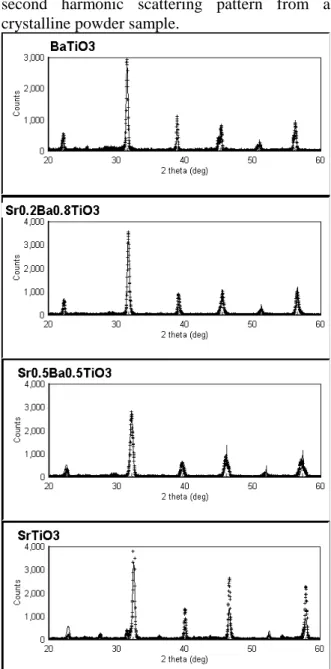
XRD patterns were then analyzed with Rietvelt refinement procedure [17]. In Fig. 2, the XRD patterns from four powder samples (x = 1, 0.8, 0.5, and 0, from top to bottom) are presented. The averaged cell dimension as a function of x is summarized in Fig. 3.
The unit cell of our synthesized BaTiO3
crystalline powder has an averaged dimension of
(a+c)/2 = (3.986+4.020)/2 = 4.003 Å . The data
agrees well with the published results, where a is
found to range from 3.9915 to 3.9998 Å and c
from 4.018 to 4.025 Å ) [18]. For SrTiO3, our
measured result (a=b=c=3.897 Å ) is slightly
smaller than the published data (a varies from
3.900 to 3.905 Å ) [18], but the difference is within our experimental error. It can also be seen that Vegard’s linear scaling law [8] is not satisfied but a square law with a jump around x~0.4-0.5. This jump may be attribute to ordering phase transition.
3.2 Linear optical properties of BaxSr1-xTiO3
To estimate the measuring accuracy of index of refraction from Eq. (4), we first apply this linear optical technique on some well-known
NLO materials. The results of KH2PO4 (KDP)
crystalline powder at λ=0.633 µm are presented
in Fig. 4. By using Eq. (4), the index of refraction of KDP was determined to be 1.49,
which is fairly close to the averaged value of nE
and nO of KDP single crystal (see Table I) [19].
We then apply this method to probe linear optical properties of BST powders with various Ba/(Ba+Sr) ratios. The results show the index of refraction of BST is fairly constant
(∼2.20). The value is about 8% lower than that
taken from single crystal BaTiO3 (nav=2.39) and
SrTiO3 (n=2.39) [20]. The deviation is most
likely originated from larger light scattering loss from our powder samples.
3.3 Nonlinear optical properties of BaxSr1-xTiO3
For calibration, the nonlinear optical (NLO) characterization apparatus described in
Fig. 1 was first applied to investigate NLO
responses of KDP and β-BaB2O4 (BBO) powders.
The results show that second harmonic generation from these two standard materials is
phase matchable at 1.06 µm. The NLO
response from BBO is about four times of KDP, which agrees very well with the published values [19].
We then apply this experimental setup to measure NLO properties of BST powders. The results are shown in Fig. 5. The second harmonic generation from BST is also
phase-matchable at 1.06 µm. The effective
second-order nonlinearities of BaxSr1-xTiO3 with x=0.8
and 0.7 were found to be about 7.2 pm/V and 3.5
pm/V, respectively. The effective
nonlinearities,
〈
d
eff2〉
, and birefringence, ∆nB= nE,2ω- nO,2ω, of BST with various x are
summarized in Fig. 6. It is interesting to note
that the
〈
d
eff2〉
and ∆nB exhibit adiscontinuous change with x=0.75 and x~0.45.
This supports that BST with Ba/(Ba+Sr)∼0.75
undergoes a structural phase transition near room temperature and ordering transition at x~0.45.
五、結論
As pointed out previously that barium
titanate (BaTiO3) belongs to the displacement
type of ferroelectric material for which the origin of ferroelectricity derives from the displacement of ions relative to each other. It is believed that BST undergoes the same sequence of structural
phase transitions as that pure BaTiO3 does, but at
progressively lower phase transition
temperatures as the concentration of Ba is
reduced. The Ti-O6 octahedron in the
ferroelectric BaTiO3 is distorted with C4v
-symmetry. The resulting spontaneous
polarization, Ps, can be expressed as [21]
P
s=
P
⋅
∆
z
'
0 , (11)
where ∆z denotes the displacement of ions from
the symmetric positions which are occupied in
the paraelectric phase. Ps serves as an order
parameter of the phase transition and therefore above the transition the parameter varies with temperature by [22]
P
s=
a
T
c−
T
. (12)Recently, Wang [23] had proposed a simple two-band model suited for describing polarization in a ferroelectric crystal. With the model, the
second-order NLO coefficient of a ferroelectric crystal had been derived to be
eff
P
sE
E
E
n
C
d
)
4
(
)
(
18
)
2
(
2 2 2 0 2 2 2 2 0 6 0 2 2ω
ω
π
ωη
η
−
−
+
=
. (13)Here E0 is the energy gap of the ferroelectric
material and C denotes a simple constant. By
combining Eqs. (11) and (13), we then have
z
d
d
eff=
'
⋅
∆
. (14)Note that the displacement of ions may lead to a change in unit cell dimension. Based on the model, birefringence can also be related to
spontaneous polarization by
∆
n
B=
B
⋅
P
s2[23].Therefore, we are expecting to observe that both the second-order optical nonlinearity and birefringence vary with the mole fraction of Ba. Indeed, this is what we have observed shown in Fig. 6.
We should point out that the linear optical
dispersion from 1.064 µm to 0.532 µm in a single
crystal BaTiO3 is about 0.13 [20], which is larger
than the birefringence (∆nB=-0.06). Therefore
the type-I phase matching condition should not
be satisfied in BaTiO3 at 1.064 µm. However,
note that single crystal BaTiO3 usually contains
various transition metal impurities, which often results in red shift of the absorption edge. Our BST crystalline powders prepared with sol-gel method do not contain such unintended dopants. Therefore our samples more accurately reflect the intrinsic properties of the materials and possess smaller dispersion in the visible light spectrum region. This can lead to the observed
type-I phase matched second-harmonic
generation in BST shown in Fig. 5.
Note that the index of refraction at the
zero frequency limit (
η
ω
<<
E
0) can beexpressed as [24]
=
+
∑∑
k vc cv cv vck
E
k
p
k
p
V
m
e
n
)
(
)
(
)
(
8
1
3 2 2 2 2π
η
. (15) It is dominated by those interband transitionswhich lie near band gap (smaller Ecv) and possess
large momentum matrix elements, pcv. In BST,
oxygen’s 2p and titanium’s 3dorbitals dominate
these transitions, where Ba and Sr do not play an important role. This lead to that the index of refraction of BST should be irrelevant to the concentration of Ba. Indeed this exactly agrees with our observation. It should be pointed out that Ba/Sr play the major role in causing unit cell distortion, which more sensitively reflects in
second-order optical nonlinearity and birefringence.
The birefringence of BST shown in Fig. 7 varies from 0.03 to 0.06 as the mole fraction of Ba is increased from 0 to 1. Note that to achieve high conversion efficiency both of the
phase matching condition (∆
k
=0) and largeangular acceptance (
δθ
≈
0
.
443
λ
ω(
L
⋅
|
∆
n
B|
)
)have to be achieved. The measured linear and nonlinear optical properties of BST warrant a high efficacy in second-order nonlinear optical applications.
In summary, we investigate linear and
nonlinear optical properties of BaxSr1-xTiO3 with
various mole fractions of Ba. Our results indicate ferroelectric BST possess an effective second-order nonlinearity of about 7.9 pm/V,
which is comparable to LiNbO3. In addition,
the index of refraction, n=2.2, and birefringence,
∆nB∼0.05, are also appropriate for practical NLO
applications. By combining with their excellent electrical and mechanical characteristics, BST could serve as an ideal multifunctional, smart material in micro optical electro-mechanical systems (MOEMS) [25.26] 六、自我評估 本年度中我們以溶膠凝膠法製備一系列 鈦酸鍶鋇的微晶粉末,並以 X 光繞射、折射率 和粉末二倍頻量測,發現除了結構相變發生在 x=0.75 與文獻相符外,在 x 0.45 時新發現排 列秩序相變。進行中的拉曼與紅外光譜研究生 子再相變時軟化希望進一步確定這個相變與 結構相變對光學與非線性光學性質之影響。 七、參考文獻
[1] E. C. S. Tavares, P. S. Pizani, and J. A. Eiras, Appl. Phys. Lett. 72, (1998) 897.
[2] J. M. Herbert, Ferroelectric Transducers and
Sensors (Gordon and Breach, London, 1982). [3] J. F. Scott, Ferroelectrics Rev. 1, (1998) 1. [4] L. A. Knauss, J. M. Pond, J. S. Horwitz, and
D. B. Chrisey, Appl. Phys. Lett. 69, (1996) 25.
[5] P. Bhattacharya, T. Komeda, K. Park, and Y. Nishioka, Jpn. J. Appl. Phys., Part 1 32, (1993) 4102.
[6] H. P. Roaksby and H. D. Megaw, Nature 155, (1945) 484.
[7] F. N. Bunting, G. R. Shelton, and A. S. Creamer, J. Am. Ceram. Soc. 30, (1947) 114. [8] P. Pasierb, S. Komornicki, and M. Radecka,
Thin Solid Film 324, (1998) 134.
[9] L. E. Myers, G. D. Miller, R. C. Eckardt, M. M. Fejer, R. L. Byer and W. R. Bosenberg, Opt. Lett. 20, (1995) 52.
[10] H. Karisson, F. Laurell, L. K. Cheng, Appl. Phys. Lett. 74, (1999) 1519.
[11] L. L. Hench and J. K. West, Chem. Rev. 90, (1990) 33072.
[12] B. J. Stagg and T. T. Charalampopoulos, Appl. Opt. 30, (1991) 4113.
[13] S. K. Kurtz and T. T. Perry, J. Appl. Phys. 39, (1968) 3798.
[14] R. W. Boyd, Nonlinear Optics (Academic
Press, Boston, 1992).
[15] A. Graja, Acta Physica Polonica A37, (1970) 539.
[16] P. N. Prasad and D. J. Williams,
Introduction to Nonlinear Optical Effects in Molecules and Polymers (John Wiley and Sons, Inc., N.Y., 1991), Chap. 6.
[17] A computer program for Rietveld analysis of x-ray and neutron powder diffraction patterns, by C.J. Howard and B.A. Hunter, February 1997, Australian Nuclear Science and Technology Organization, Lucas Heights Research Laboratories, Private Mailbag 1, Menai 2234, N.S.W., Austalia.
[18] For BaTiO3 (P4MM) see, for example, R.
Waesche, W. Denner, H. Schulz, Mater. Res. Bull. 16, (1981) 497; and R. H. Buttner, E. N. Maslen, Acta Crystallographica B 48, (1992)
764. For SrTiO3 (PM-3M): Yu A. Abramov,
V. G. Tsirelson, V. E. Zavodnik, S. A.
Ivanov, and I. D. Brown, Acta
Crystallographica B 51, (1995) 942; and S. A. Howard, J. K. Yau, H. U. Anderson, J. Appl. Phys. 65, (1989) 1492; for BST ceramics see M. McQuarrrie, J. Am. Ceram. Soc. 38 (1955) 444.
[19] V. G. Dmitriev, G. G. Gurzadyan, and D. N.
Nikogosyan, Handbook of Nonlinear Optical
Crystals, Springer Series in Optical Sciences Vol. 64 (Springer-Verlag, Berlin, 1991).
[20] E. D. Palik, Handbooks of Optical
Constants of Solids II, (Academic Press, Inc., San Diego, CA, 1991), pp. 789-804 and pp. 1035-1048
[21] W. Zhong, R. D. King-Smith, and D. Vanderbilt, Phys. Rev. Lett. 72, (1994) 3618. [22] G. A. Smolensky, J. Phys. Soc. Japan,
Suppl. 28, (1970) 26.
[23] F. Wang, Phys. Rev. B59, (1999) 9733. [24] B. Adolph, V. I. Gavrilenko, K. Tenelsen, F.
(1996) 9797.
[25] A. W. Sleight, J. L. Gillson, P. E. Bierstedt, Solid State Commun. 17, (1975) 27.
[26] P. F. Baude, C. Ye, and D. L. Polla, Appl. Phys. Lett. 64, (1994) 2670.
Fig. 1 Experimental set-up used for measuring
second harmonic scattering pattern from a crystalline powder sample.
Fig. 2 Powder x-ray diffraction patterns (symbols)
of BaxSr1-xTiO3 with x=1, 0.8, 0.5, and 0 (from
top to bottom). The solid curves are resulted from the Rietvelt refinement procedure.
F ig. 3 A veraged unit cell dim ension, (a + c)/2,
deduced from the R ietvelt refinem ent procedure is plotted as a function of x. T he point group sym m etry of the unit cell is taken to be C4 v for x≥0.75 and Oh for x< 0.75.
0.0 0.5 1.0 Mole Fraction of Ba 3.89 3.95 4.01 C e ll D im e n si o n 0.0 45.0 90.0 Incident Angle ( o ) -0.1 0.5 1.1 Pow e r R e fl e c ti vit y ( a ) Rp Rs 0.0 45.0 90.0 Incident Angle ( o ) 0.0 0.5 1.0 Rp / R s n = 1.49 ± 0.01 ( b )
Fig. 4 (a) Power reflectances with
s- (filled
symbols) and
p-polarized (open squares)
beams as a function of incident angle from a
KDP powder pellet; (b) The ratio of the
power reflectances with the
p-polarized to
s-polarized incident beams is presented
(symbols). The solid curve is the theoretical
fit to Eq. (4) with n=1.49 and
κ
=
0
.
0.0 0.2 0.4 Particle Size ( mm ) 0.0 14.0 28.0 S H G I n te n si ty ( a rb . u n its)
Fig. 5 Effective second-order optical nonlinearities of
BBO (open circles), BaxSr1-xTiO3 (x=0.7, filled
triangles) and BaxSr1-xTiO3 (x=0.8, filled squares)
are plotted as a function of particle size. The solid curves are the theoretical fit to Eq. (10).
F ig. 6 The m easured 〈deff2 〉 and ∆nB of
BaxSr1-xTiO3are plotted as a function of x.
0.0 0.5 1.0 Ba/(Ba+Sr) 0.02 0.04 0.06 ∆ n ( b ) 0.0 0.5 1.0 Ba/(Ba+Sr) 0 6 12 deff ( p m /V ) ( a )