ABSTRACT: Blends of liquid crystalline poly ( oxybenzoate- co-oxynaphthalate ) ( Vectra A950 ) and polycarbonate ( PC ) were prepared by adding a compatibilizer to the two polymers in a melt-blending process. The compatibilizer was based on controlled trans-esterification between synthesized poly ( oxybenzoate- co-terephthalate ) ( 40 / 60 ) and PC. The compatibilizer exhibited birefringence, and its thermal property was analyzed by differential scanning calorimetry. The maximum increase in tensile modulus and tensile strength of these compatibilized Vectra blends were 24% and 54%, respectively, as compared with those of binary Vectra blend without compatibilizer resulting from an injection-molding process. The tensile properties of the compatibilized Vectra blends decreased once the concentration of the compatibilizer exceeded 2 phr.q 1997 John Wiley & Sons, Inc. J Appl Polym Sci 63: 1527 – 1533, 1997
Key words: liquid crystalline polyester ; blends; tensile modulus
INTRODUCTION
compatibility of liquid crystalline polymer and en-gineering polymer is a major obstacle in LCP blends’ application. Introducing some kind of in-Blends of liquid crystalline polymers ( LCPs ) andteraction between these two dissimilar polymers engineering plastics have been studied
exten-is necessary to improve their compatibility. The sively. Their major advantage is the possibility
previous work by our group was concerned with of the inclusion of a rigid-rod ( liquid crystalline )
the compatibility by the transesterification be-polymer in an isotropic matrix for forming in situ
tween polycarbonate ( PC ) and liquid crystal-composites, as described by Kiss.1
Additionally,
line poly(oxybenzoate-co-ethylene terephthalate) the LCP can reduce the overall viscosity of the
( POB-PET, 40 / 60 ) .5
The main result was that the blend and serve as a processing aid, as evidenced
compatibility between the two polymers increased by the work of several groups.2,3
Liquid crystalline
with ester exchange reaction. However, as trans-polymer chains are very stiff and of rigid-rod
na-esterification continued the blend converted first ture. The mixing of a rigid-rod polymer with a
to block copolymer and finally to random copoly-flexible-coil polymer is not favorable in
thermody-mer.6
When the blends were in the form of random namics. Consequently, phase separation of the
copolymer, the benefits of adding LCP to the ma-LCP blend occurs during processing, where high
trix polymer were lost. We also attempted to con-stress and high temperature exist.4The
homoge-trol the ester exchange reaction with inhibitors,7
neity of a polymer blend determines the
mechani-but had limited success when both LCP concen-cal properties of the blend. From this view, the
tration and high temperature exposing time in-creased. Therefore, this in situ compatibilization of binary liquid crystalline polymer blends
suf-Correspondence to: K.-H. Wei.
q 1997 John Wiley & Sons, Inc. CCC 0021-8995/97/121527-07 fered the drawback of not having consistent
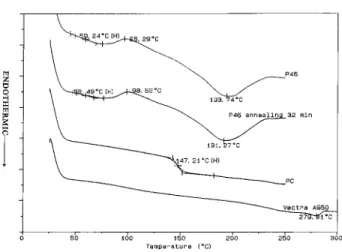
Figure 1 The DSC curves of PC, Vectra A950, P46, Figure 3 The DSC curves of solution blends of P46 / PC annealed at 2607C for different times.
and P46 annealed at 2607C for 32 min.
rial properties as ester exchange continued during
forming a compatibilizer. The other, with higher further processing.
rigid-rod molecule content ( POB-PNA, 73 / 27 ) , is These results lead us to explore the possibility
intended for reinforcing polycarbonate matrix. We of developing a compatibilizer based upon
con-are interested in the mechanical properties of trolled transesterifiaction between a matrix
poly-LCP blends consisting of PC, reinforcing poly-LCP, and mer and a second liquid crystalline polymer. After
the compatibilizer. Previously we studied the ef-controlled transesterification, a polymer
con-fect of the compatibilizer based on limited transes-taining both liquid crystalline and flexible-coil
structures would form. This resultant polymer terification between POB-PET ( 60 / 40, 40 mol % can have better interaction between matrix poly- PET ) with PC, and found increased tensile mer and reinforcing LCP due to similarities in the strength as well as impact properties in these ter-two chemical structures. The polymer ( compatibi- nary blends.8
Since the transesterification took lizer ) can be added to matrix polymer and rein- place mostly among PC and the PET segments forcing liquid crystalline polymer, and partially in the POB-PET copolymer, we wondered if the miscible ternary blends can then form. In this mechanical properties of these ternary blends study, we used two liquid crystalline copolyesters. can be further enhanced by having greater in-The one with higher flexible-coil copolyester teraction ( transesterification among 60 mol % ( POB-PET, 40 / 60 ) content is designed to carry PET and PC ) .
out transesterification with polycarbonate for
Figure 2 The DSC curves of P46 / PC ( 60 / 40 ) blend Figure 4 The DSC curves of inhibited P46 / PC ( 60 / 40 ) blend being melt-mixed for different times at 2607C. after being melt-mixed for different times at 2607C.
speed was 80 rpm. To understand the effect of the 27, trade named Vectra A950, obtained from concentration of the compatibilizer, three compo-Hoechst Celanese Corp., USA. sitions were made: 20 / 80 / 2, 20 / 80 / 3, and 20 / 80 / 5 for Vectra / PC / compatibilizer. A blend with a composition of 20 / 80 Vectra / PC was made for
Methods
comparison. These blends were molded with a
Compatibilizer Toshiba IS55EPN injection-molding machine.
The melt temperature was 3007C and the mold-The method of preparing melt blends has been
ing-process cycle time was 30 s. Tensile tests were described in our previous two papers.4,6
Blends
performed according to ASTM D638 at 237C using were prepared by mixing P46 / PC at a weight ratio
a Testometric Micro 500 machine. Reported data of 60 / 40 in a Brabender mixer at 2607C. The
solu-were obtained at a crosshead speed of 1.3 mm/ tion blend of 60 / 40 P46 / PC was prepared by
dis-min. Unnotched I-Zod tests were performed ac-solving 2 g of polymers at the proper weight ratio
cording to ASTM D256 specification. For each in a 100-cm3
mixed solvent of 50 / 50 phenol /
tetra-data point, six specimens were tested and the av-chloroethane by weight. Then the solution was
erage value was taken. precipitated in a 10-fold volume of methanol. The
precipitated polymers were washed 4 times in hot methanol. The blend was dried in a vacuum oven
RESULTS AND DISCUSSION
at 1007C for 4 days prior to a thermal analysis. Thermal analysis of the blend at different times
was carried out with a Dupont 2910 differential The thermal analysis curves of P46, Vectra A950, and PC are shown in Figure 1, where the glass scanning calorimeter. The samples were heated
from 307C to 2607C at a heating rate of 207C per transition temperature ( Tg) and the melting tem-perature ( Tm) of P46 were 59.247C and 193.747C, min. At 2607C the samples were annealed for 1
min. Subsequently, the samples were cooled to respectively. The crystallization temperature ( Tc) for P46 was 96.297C. The Tgof the P46 has been 1707C and annealed for 10 min. The samples were
quenched to 257C and heated again to 2757C at attributed to the presence of a PET-rich phase in P46.11
To check its thermal stability, P46 was the same heating rate. The differential scanning
calorimetry ( DSC ) curves of the samples were annealed at 2607C for 32 min. After the annealing, the Tcand the Tmof P46 had changed only about taken the second time when the samples were
heated at the rate of 207C per min. Without an- 27C. Vectra A950 has a melting point of 279.817C. Thermal gravity analysis of these three polymers nealing, the DSC curves of the blends did not
ex-hibit separate crystallization ( from P46 ) and that were annealed at 2607C for 32 min showed no appreciable weight loss. The thermal analysis glass transition ( from PC ) .10Annealing at 1707C
for 10 min avoided the problem by allowing the of the blend P46 / PC ( 60 / 40 ) at different blending times is shown in Figure 2. All these thermograms sample to crystallize. For controlling ester
ex-change in the blend, 0.5% triphenyl phosphate displayed two Tgs. The lower Tg represents the amorphous phase of P46 in the blend, whereas was added into a blend consisting of 60 / 40 P46 /
PC as described in out previous paper.6
The inhib- the higher Tgstands for the PC component in the blend. After 4 min blending, the two Tgs were ited P46 / PC ( 60 / 40 ) blend was used as a
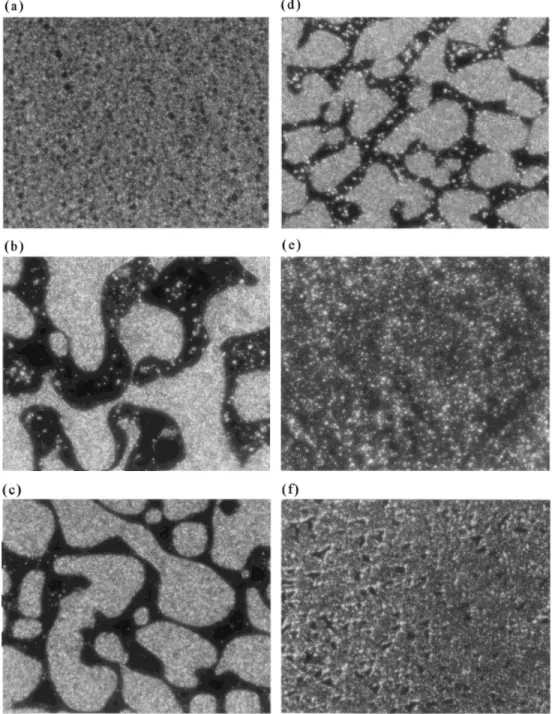
in-Figure 5 The birefringence pattern of ( a ) P46, ( b ) 60 / 40 P46 / PC melt-mixed for 4 min, ( c ) 60 / 40 P46 / PC melt-mixed for 8 min, ( d ) 60 / 40 P46 / PC melt-mixed for 16 min, ( e ) 60 / 40 P46 / PC melt-mixed for 32 min, and ( f ) inhibited 60 / 40 P46 / PC melt-mixed for 16 min.
creased to 8 min, the two Tgs became 547C apart. difference between the two Tgs with annealing time was mostly not a result of morphological ef-After 32 min blending, the two Tgs were 297C
apart. The same trend can be observed in thermal fect. It can be explained by the occurrence of an increase in the compatibility between the amor-analysis of the solution blend of 60 / 40 P46 and
PC, as shown in Figure 3. In Figure 3, the two phous phase of P46 and PC. For the inhibited blend, the two Tgs remained 607C apart for 32 Tgs are about 637C apart after 4 min annealing
at 2607C, then 467C apart after 32 min annealing. min blending time, as shown in Figure 4. This represents that the ester exchange between PC Therefore, this phenomenon of reduction in the
tensile modulus and tensile strength can be as high as 24% and 54%, respectively, as compared with those of binary Vectra blends. However, the tensile modulus of the blend decreases when the compatibilizer concentration is greater than 2
Figure 6 The changes in the intrinsic viscosity of 60 /
phr. This corresponds to the fact that better adhe-40 P46 / PC melt blend and inhibited 60 / adhe-40 P46 / PC
sion between Vectra and PC in the 2-phr-compati-melt blend with mixing time.
bilizer case was observed in the scanning electron microscopy ( SEM ) micrographs displayed in Fig-ure 7. In FigFig-ure 7 ( a ) , the fractFig-ured surface of the and the amorphous phase of P46 has been
effec-20 / 80 Vectra / PC blend displays uneven breaking. tively stopped.
In Figure 7 ( b – d ) , the interfacial distance be-Further evidence of the inhibition effect can
tween the Vectra droplet and the PC matrix in-be confirmed through the birefringence pattern
crease with the compatibilizer concentration, in-exhibited by the compatibilizer. In Figure 4 ( a ) ,
dicating decreasing adhesion. This might be ex-the birefringence pattern of ex-the biphasic P46 can
plained by the theory that critical micelle be observed. Figure 4 ( b – e ) shows the transition
concentration has been reached for the 2-phr-com-of the birefringence pattern 2-phr-com-of the 60 / 40 P46 / PC
patibilizer case,12
in which compatibilizer itself blend. The dark areas in the pictures represent
aggregates rather than attaching to the interface the isotropic phase in the blend. The overall area
between PC and Vectra droplets. The impact of the isotropic phases spread with blending time.
strength of the blends decreases with the increas-The birefringence of the blend almost disappeared
ing tensile strength for these ternary blends, as after 32 min of thermal treatment, as shown in
listed in Table I. This can be explained by the fact Figure 5 ( e ) . The compatibilizer retained much of
that LCP fibers embedded in the matrix had a the liquid crystalline characteristics under
inhibi-preferred orientation in the tensile direction as a tion, as shown in Figure 5 ( f ) . Transesterification
result of the injection-molding process. The better led to chain scission of polymer molecules.
Inhibi-tion effect can also be checked by the change in alignment of these LCP fibers in the tensile
direc-Table I The Tensile and Impact Properties of Injection-molded Tensile Bars from Various Blends Followed ASTM D256 Specifications
Tensile Modulus Ultimate Tensile Strength Impact
Blend (N/mm2) (N/mm2) (ft lbs in01) PC 1391.2 56.74 a PC/Vectra (80/20) 1504.4 63.38 12 PC/Vectra/comp. (80/20/2) 1873.8 97.61 7.47 PC/Vectra/comp. (80/20/3) 1753.5 91.10 7.72 PC/Vectra/comp. (80/20/5) 1712.4 90.80 7.83
Figure 7 SEM micrograph of fractured surface of injection-molded tensile bar from ( a ) 20 / 80 Vectra / PC blend, ( b ) 20 / 80 / 2 Vectra / PC / compatiblizer, ( c ) 20 / 80 / 3 Vectra / PC / compatiblizer, and ( d ) 20 / 80 / 5 Vectra / PC / compatiblizer.
tion caused weak mechanical properties in the those of the binary Vectra blend even under the injection-molding process. The compatibilizer transverse direction.
was prepared based on a controlled transesteri-fication between synthesized POB-PET ( 40 / 60 ) copolymer and PC, to which a phosphate
com-CONCLUSION
pound was added as an inhibitor. The tensile properties of these blends decreased with in-The compatibilized, wholly aromatic Vectra / PC
( 20 / 80 ) blend displayed enhanced tensile prop- creasing compatibilizer concentration when the compatibilizer’s concentration exceeded 2 phr. erties, such as a 24% increase in modulus and
3. A. M. Sukhadia, D. Done, and D. G. Baird, Polym. ( 1993 ) .
12. L. Leibler, Macromolecules, 15, 1283 ( 1982 ) .