
基於社群感知之耐延遲網路群播路由機制 - 政大學術集成
56
0
0
全文
(2) 基於社群感知之耐延遲網路群播路由機制 A Social-Aware Multicast Scheme in Delay Tolerant Networks 研 究 生:林煜泓. Student:Yu-Hong Lin. 指導教授:蔡子傑. Advisor:Tzu-Chieh Tsai. 治. 立. 政 國立政治大學 資訊科學系. 大. ‧. ‧ 國. 學. 碩士論文. A Thesis. Nat. sit. y. submitted to Department of Computer Science. er. io. National Chengchi University. n. in partialafulfillment of the Requirements iv l. Cforhthe degree ofU n engchi Master in. Computer Science. 中華民國一零二年七月 July 2013.
(3) 基於社群感知之耐延遲網路群播路由機制 摘要 在耐延遲網路環境下節點的相遇情況不是很頻繁,這可能導致節 點間的連線斷斷續續,使得有效地將訊息傳遞成為一件困難的事情。 藉由社群感知轉送機制的中間度指標特性,可以來提升傳送成功率。. 政 治 大. 雖然大多數研究幾乎都是將訊息轉送到單一目的地或是多個且已知. 立. 的目的地。然而,一些應用像是廣告的散佈,要將訊息送給對訊息有. ‧ 國. 學. 興趣的人,但卻不知道是誰。因此,關鍵的問題為如何建立社群網路. ‧. 關係的親密度機制,來選擇作為轉送訊息的節點,並利用群體廣播的. Nat. io. sit. y. 方式盡可能有效地傳播至最多可能目標目的地,進而提升效能。. er. 本論文以群播機制和社群感知當作基礎概念,來設計新的轉送訊. al. n. v i n Ch 息的方法和公式化選擇中繼節點的機制。最後,我們使用政治大學實 engchi U 際軌跡來模擬,將模擬結果與其它路由演算法比較,其結果證明我們 所提出的方法能提高訊息傳送成功率和正確率,降低傳送延遲時間和 傳送訊息的成本。. 關鍵字:耐延遲網路、社群網路分析、群播機制、路由協定. i.
(4) A Social-Aware Multicast Scheme in Delay Tolerant Networks Abstract In delay tolerant networks (DTNs), nodes infrequently encounter with each others. This results in intermittent connectivity of the nodes, and makes it difficult to deliver the message effectively. A social-aware forwarding scheme can help for successful delivery ratio by utilizing the. 政 治 大 focus on message delivery to single destination or some priori known 立. characteristic of their centrality metric. Most of the previous studies. However,. some. applications. like. advertisement. 學. ‧ 國. destinations.. dissemination may not know who will be the interested persons to be. ‧. delivered. Therefore, the key challenge is how to establish the social. y. Nat. relationship strategy to select appropriate nodes as relays, and. er. io. sit. furthermore to use multicasting to disseminate effectively as many “target” destinations as possible to improve the performance.. al. n. v i n This thesis developed C ah new strategy which has a new forwarding engchi U. message scheme and formulates the selection of the relay nodes based on the concept of the multicasting and the social network. Finally, we used the reality trace data of National Chengchi University to simulate. The simulation results are compared to others DTNs routing protocols as well as other social-aware forwarding schemes. The results showed that our proposed approach can enhance the successful delivery ratio and delivery accuracy, decrease the delivery delay and reduce the delivery overhead. Keywords: Delay Tolerant Networks, Social Network Analysis, Multicasting, Routing Protocol ii.
(5) 致謝辭. 首先特別感謝蔡子傑老師在這兩年對於我的幫助與教導,無論是課業或者是 論文及生活經驗給予莫大的協助,而老師總會與我們分享做事的態度,讓我學到 很多,非常感謝老師總是能不厭其煩地指導我、鼓勵我,並時常給予我信心和建 議,讓我能順利的完成碩士論文,謝謝蔡子傑老師。. 感謝口試委員周承復老師、吳曉光老師和陳伶志老師百忙之中能抽空前來,. 政 治 大. 給我寶貴的建議和指導,使得論文能更加完整。謝謝實驗室學長姊的照顧和指導,. 立. 讓我能盡速地適應研究所生活,不會感到陌生與無助,也謝謝學長姊們總是找我. ‧ 國. 學. 去運動和打球,讓我的研究所生活顯得多采多姿;感謝學弟妹們平時的幫忙,並 帶給我許多樂趣;最後謝謝在政大每位同學的陪伴和鼓勵,很慶幸能與你們當同. ‧. 學,讓我在研究所生活中不致特別孤單,謝謝你們;謝謝我的朋友們,總是給我. y. Nat. n. er. io. al. sit. 加油打氣,讓我能繼續勇往直前不退縮。. i n U. v. 我要感謝我的家人,在我求學過程中,總是無條件地幫助我,讓我能無憂無. Ch. engchi. 慮的專心學習,而在我心情低落時,總是鼓勵我和包容我,有您們的支持是我最 大的勇氣與動力,謝謝您們。一路上遇到許多貴人相助,讓我感受到莫大的溫暖 與幸福,謝謝你們。最後我要謝謝大家對我的包容和體諒,以及對我的關心,祝 福大家順利健康快樂,謝謝你們,我愛你們。. iii.
(6) TABLE OF CONTENT CHAPTER 1 Introduction....................................................................................... 1 1.1 Background ...................................................................................................... 1 1.2 Motivation ........................................................................................................ 2 1.3 Purpose............................................................................................................. 4 1.4 Organization ..................................................................................................... 4. CHAPTER 2 Related Work .................................................................................... 5. 政 治 大 2.2 Social-based Multicasting 立 Scheme .................................................................. 6 2.1 Common DTN Routing Protocol ..................................................................... 5. ‧ 國. 學. 2.3 Social-based DTN Routing Protocol ............................................................... 7. CHAPTER 3 Methodology .................................................................................... 9. ‧. 3.1 System Environment ........................................................................................ 9. sit. y. Nat. 3.1.1 Scenario............................................................................................... 10. n. al. er. io. 3.1.2 Technical Challenges .......................................................................... 10. i n U. v. 3.1.3 Operating Environment ....................................................................... 11. Ch. engchi. 3.2 Grouping ........................................................................................................ 12 3.2.1 Similarity............................................................................................. 12 3.3 Social-Aware Local Utility Calculation (SALUC) Routing Protocol ............ 14 3.3.1 Centrality Metric ................................................................................. 17 3.3.2 Probability ........................................................................................... 20 3.3.3 Formulation ......................................................................................... 21 3.4 Buffer Management Strategy ......................................................................... 24. CHAPTER 4 Simulation Results ........................................................................ 26 4.1 Simulation Setup ............................................................................................ 28 iv.
(7) 4.2 Simulation Results ......................................................................................... 31 4.2.1 Common DTNs Routing Protocol ...................................................... 31 4.2.2 Social-based Forwarding Scheme ....................................................... 36. CHAPTER 5 Conclusions and Future Work .................................................... 43 REFERENCES ........................................................................................................ 44. 立. 政 治 大. ‧. ‧ 國. 學. n. er. io. sit. y. Nat. al. Ch. engchi. v. i n U. v.
(8) LIST OF FIGURE Figure 1 Disconnected Grouping ................................................................................. 11 Figure 2 The flow of forwarding message ................................................................... 12 Figure 3 A Randomly Distributed in the Networks ..................................................... 15 Figure 4 Message Forwarding Process – Direct .......................................................... 16 Figure 5 Message Forwarding Process – Indirect ........................................................ 17 Figure 6 social relation of node ................................................................................... 18. 政 治 大 Figure 8 The Main Flow of立 Buffer Management Strategy .......................................... 24 Figure 7 The Main Flow of the Local Utility Calculation Routing Protocol............... 23. ‧ 國. 學. Figure 9 The NCCU Campus Map .............................................................................. 29 Figure 10 The ONE Simulator ..................................................................................... 30. ‧. Figure 11 Delivery Success Ratio ................................................................................ 32. sit. y. Nat. Figure 12 Delivery Delay............................................................................................. 33. n. al. er. io. Figure 13 Delivery Overhead....................................................................................... 33. i n U. v. Figure 14 Delivery Accuracy ....................................................................................... 33. Ch. engchi. Figure 15 Delivery Success Ratio V.S Multicast Destinations .................................... 34 Figure 16 Delivery Delay V.S Multicast Destinations ................................................. 35 Figure 17 Delivery Overhead V.S Multicast Destinations ........................................... 35 Figure 18 Delivery Accuracy V.S Multicast Destinations ........................................... 35 Figure 19 Delivery Success Ratio – Social-based ....................................................... 36 Figure 20 Delivery Delay – Social-based .................................................................... 38 Figure 21 Delivery Overhead – Social-based .............................................................. 38 Figure 22 Delivery Accuracy – Social-based............................................................... 39 Figure 23 Delivery Success Ratio – Social-based V.S Multicast Destinations ............ 40 vi.
(9) Figure 24 Delivery Delay – Social-based V.S Multicast Destinations ........................ 40 Figure 25 Delivery Overhead – Social-based V.S Multicast Destinations .................. 40 Figure 26 Delivery Accuracy – Social-based V.S Multicast Destinations ................... 41 Figure 27 Delivery Success Ratio – SALUC V.S SNAMD ......................................... 41 Figure 28 Delivery Delay – SALUC V.S SNAMD ..................................................... 41 Figure 29 Delivery Overhead – SALUC V.S SNAMD ............................................... 42 Figure 30 Delivery Accuracy – SALUC V.S SNAMD ................................................ 42. 立. 政 治 大. ‧. ‧ 國. 學. n. er. io. sit. y. Nat. al. Ch. engchi. vii. i n U. v.
(10) LIST OF TABLE Table 1 The Summary of the three real trace data ....................................................... 29 Table 2 The Parameters Setting in Simulation ............................................................. 30. 立. 政 治 大. ‧. ‧ 國. 學. n. er. io. sit. y. Nat. al. Ch. engchi. viii. i n U. v.
(11) CHAPTER 1 Introduction. 1.1 Background. 立. 政 治 大. Nowadays, the applications of smartphones not only adapt the requirement of users. ‧ 國. 學. but also contribute to the mature technique of mobile network.. The latest. ‧. smartphones, such as iPhone 5 of Apple, Galaxy S3 Samsung, and so forth, combine Users. sit. y. Nat. the new technique of mobile network naming Long Term Evolution (LTE).. io. er. can get faster rate for transmission and downloading by using the technique. User can use the smartphones and the tablet computers and the new technique of mobile. n. al. network naming LTE to. v i n C h the webs, connect browse the engchi U. social network and. communicate with the friends, and the services of navigation and so forth.. Further,. user can use the service of mobile to find the requirements of users, such as finding the restaurants, parking and so on.. The above Android 4.0 version of smartphones. and the tablet computers have open the function of Wi-Fi Direct [4].. User can open. the Wi-Fi Direct, set the function of Wi-Fi Direct and can search the neighbor users, and then users can pair among the neighbor users.. After paring with neighbor users,. the users can share the information with each other and the communication with short distance.. Thereby, the parts of users who have the technique of the LTE can connect. to the internet to update the information. 1. While, the users who do not have the.
(12) technique of the LTE can connect with the neighbor users through the technique of Wi-Fi Direct, and can get the required information which those neighbor users have. In the environment of the delay tolerant networks (DTNs), the connection of communication among the nodes not always stays connected, while it connects intermittently.. The time of connection exist few minutes between those nodes, hence. it is very important to delivery message through the cooperation from the others. However, the sender may not know the position of the destination or can’t move to the position of the destination for encountering.. Therefore, it needs other neighbor users’. Owing to the environment of DTNs, 政 治 大 the message is stored firstly, and then they request the adapt people to deliver the 立. cooperation to help them to delivery message.. message after they are paired or encounter to the adapt person.. When general. ‧ 國. 學. researches study the problem which delivers the message with DTNs, they trend to. ‧. use the position of the encounter. They consider whether to request the other users to. sit. y. Nat. deliver the message while they encounter with the other users, and they also refer and. io. adapt nodes to deliver the message in the future.. n. al. Ch. engchi. er. use the history to predict and distinguish that whether they may encounter with the. i n U. v. 1.2 Motivation In the environments of the delay tolerant networks, the unpredictable mobility of the nodes lead to the nodes infrequently encounter with each other.. Due to the network. connection among the nodes are unstable or unconnected, and further it obstruct the effectiveness of forwarding message. The research issue of this thesis is that as possible as it can forward the message to other nodes that have interest to the message within the constraint time.. Thus, how to select the least relay nodes to dimension the. message to other nodes that have interest to the message becomes the important 2.
(13) research issue of this thesis. The message can be effectively delivered and spread by using the multicasting, and the social network can be realized in the real word.. For example, the. information of traffic can be immediately transmitted among the vehicles in the sparse VANET; we may unknown the information of other partners, so the information may be shared with the partner in order to be the battle plan in the war; for the way of sending the advertisement handbills, using this strategy to send the advertisement handbills can save the total cost.. For example, reduce the waste of the paper with. 政 治 大 the work with the Green environmental protection issues which the message can be 立 the issue of the environmental protection which rising every day, and become one of. known for many people.. ‧ 國. 學. In this thesis, the proposed method used the multicasting and the point of view. ‧. with social network to constructs and analyzes the model of social network in the. Therefore, this thesis hope. io. er. the appropriate nodes in order to transmit the message.. sit. y. Nat. environment of the delay tolerant networks. Then, achieving the opportunity selects. that the features of the social network are applied in the environment of the delay. n. al. i n Ctohthe need of real world. tolerant networks, and it is suited engchi U. v. This thesis proposed the method combing multicasting and the social network. analysis in the environments of the delay tolerant networks. The strategy calculating the intimate degree of community relations among the nodes delivers message to different nodes or destinations in order to achieve as possible as it can effective transmission.. Besides, it can increase the destination delivering message to improve. the delivery success ratio and delivery accuracy and to reduce the data forwarding overhead and the delivery delay.. 3.
(14) 1.3 Purpose Due to the limitation of the resources and the connectivity between nodes intermittently in the environments of the delay tolerant networks, the efficiency of forwarding messages reduces greatly.. In spite of many researches use the social. network analysis methods to solve the forwarding messages problem, most of them focus on forwarding messages to single destination or relay nodes.. Further, most of. those studies are confined to forward message to the destinations which are knowable.. 政 治 大 uncertain destinations by multicasting. Besides, the information of the community 立 The main object of this thesis is that user can forward message to multiple. relations between users and each nodes or destination is investigated and applied to. ‧ 國. 學. calculate the intimate degree.. Further, the nodes which can forward the messages. Furthermore, our scheme enhances the delivery. sit. y. Nat. have interest to the messages.. ‧. quickly are found and as much as possible forward the messages to the users who. io. er. success ratio of the entire system, can reduce the delivery delay, and can help to reduce the delivery overhead.. n. al. Ch. engchi. i n U. v. 1.4 Organization The rest of thesis is organized as follows.. Chapter 2 introduces the overviews of the. related works, including the Common DTN Routing Protocol, Social-based Multicast Scheme and the Social-based DTN Routing Protocol. Chapter 3 shows the details of different components and main features of the methodology.. Chapter 4 presents,. analyzes, and discusses the simulation results. Finally, the conclusions and future work are presented in Chapter 5. 4.
(15) CHAPTER 2 Related Work. 政 治 大. In this chapter, we will introduce the research of routing protocols. Here, we were. 立. divided into three parts, including the Common DTN Routing Protocol, Social-based. ‧ 國. 學. Multicast Scheme and the Social-based DTN Routing Protocol.. ‧. 2.1 Common DTN Routing Protocol. y. Nat. n. al. er. io. Routing, Spray-and-Wait Routing and PRoPHET Routing.. sit. In this section, we will introduce common DTN routing protocol including Epidemic. i n U. v. Epidemic Routing [11], provide a message of delivery in disconnected delay. Ch. engchi. tolerant networks, in which the basic idea deliver the message to other nodes, if the node encounter with other nodes. nodes as relay nodes in the network.. In other words, the Epidemic routing select all Upon encounter with two nodes exchange their. summary vector to decide which nodes will not be seen. should be delivered to everywhere all in the network.. In this way, the message. Theoretically, the Epidemic. routing would the biggest delivery ratio and lowest delivery delay, but the delivery overhead is highest when the buffer is unlimited. Spray-and-Wait Routing, flooding based, presented by Spyropoulos et al. [13] the copies of message should be restricted to a fixed number, called L copies. Then, 5.
(16) delivery copies of message to a number carrying nodes until a carrying nodes encounter with the destination.. In this war, the Spray-and-Wait routing can reduce. the delivery overhead. A number of the solutions is to reduce the delivery overhead that employed some form of probability and these metrics are based on contact history between nodes encounter. PRoPHET Routing [22], is a probability-based that uses contact history to calculate the probability of future encounters.. Therefore, selecting relay nodes to. 政 治 大 network. Based on the number of encounter the transitive nature of encounter is 立. forward message based on the encounter of the nodes in a randomly distributed. exploited. Hence, forward message if the contact probability is higher than the. ‧ 國. 學. others as relay nodes.. er. io. sit. y. ‧. Nat. 2.2 Social-based Multicasting Scheme. In this section, we will introduce social-based Multicasting scheme including The. al. n. v i n Ch Social-Aware Multicast in Disruption-Tolerant Networks and Social Network Aided engchi U Multicast Delivery Scheme For Contact-Based Networks.. The Social-Aware Multicast in Disruption-Tolerant Networks [9]. This paper studies to the social network perspective based on delay tolerant network architecture. For use multicasting way to select a relay node and analytical models, and further explore the unicast and multicast difference. This research proposed a new method to select appropriate relay nodes to multiple destinations based on quantitative data social networks. The design of focuses on the concept of node centrality and social community both quantitative data and to ensure that be able to deliver the message to the destination within the time constraint. The simulation results present that the 6.
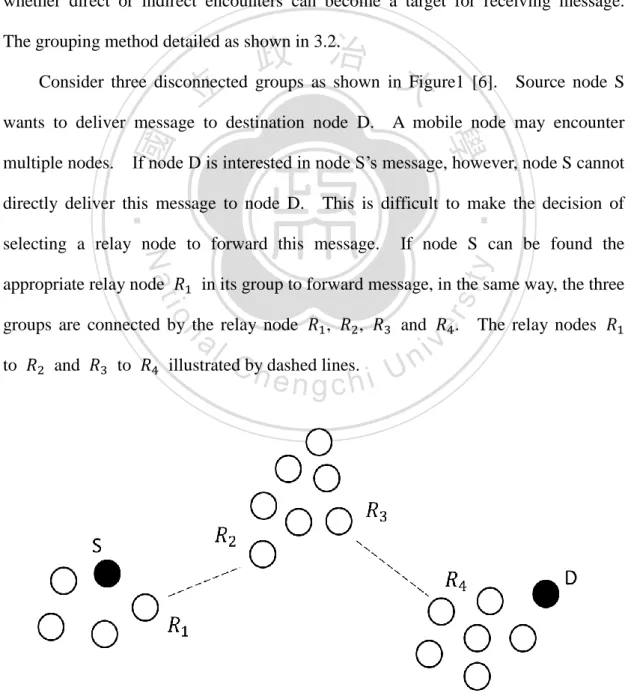
(17) delivery ratio and delivery delay of proposed mechanism is similar to Epidemic routing. However, in this paper mentioned that the most important is to reduce delivery overhead by decrease the relay nodes used. Social Network Aided Multicast Delivery Scheme For Contact-Based Networks [23].. This paper should design more efficient dimension strategy.. In real world,. people who are in multiple grouping are good message sender. Thus, the ability to determine the different groupings from the different communities traces.. In this. paper, the author use human mobility trace data from the real world to simulate to. 政 治 大 The Social Network Aided Multicast Delivery Scheme For Contact-Based Networks 立. evaluate the performance of multicast delivery scheme in human-contact based DTNs.. algorithm is, first determine the communities which node belong to this scheme use. ‧ 國. 學. K-clique algorithm to detect the community. Then, we identify the connectors help The simulation result which delivery performance is similar. ‧. us to forward message.. n. 2.3 Social-based DTN aRouting Protocol l. Ch. engchi. er. io. sit. y. Nat. to multi-copy epidemic scheme, but the overhead is smaller.. i n U. v. In this section, we will introduce social-based DTN routing protocol including Social Network Analysis for Routing in Disconnected Delay-Tolerant MANETs and BUBBLE Rap: Social-based Forwarding in Delay Tolerant Networks. Social Network Analysis for Routing in Disconnected Delay-Tolerant MANETs [6]. Message delivery in sparse hoc networks (MANETs) is difficult thing. Node can move freely so the key problem is to find a route through to provide the better performance.. This paper expressed in the network, there are various ways of. learning to do to solve the information transmitted.. To achieve this purpose, a. number of relay nodes can use centrality to connect the adjacent node and exchange 7.
(18) their information if nodes encounter.. In other words, if the nodes encounter. indirectly relevant to neighbors, it can use relay nodes to help us to forward message. Because the complexity of centrality metrics based on the concept of the ego networks, the nodes can not to exchange their information about the entire network. This paper proposed the SimBet routing scheme which is pre-estimated betweenness centrality metrics and social similarity. This paper simulations use reality trace data to present the delivery ratio is similar to Epidemic routing and decrease delivery overhead.. Besides, studies show that where the nodes have low connectivity, the. 政 治 大 BUBBLE Rap: Social-based Forwarding in Delay Tolerant Networks [8]. 立. SimBet is outperforms PRoPHET routing.. It is. use for unicast message delivery. The BUBBLE Rap considered the node centrality. ‧ 國. 學. and hierarchical community based on social community knowledge.. The BUBBLE. ‧. Rap proposed a forwarding message scheme based on the social network.. The. sit. y. Nat. BUBBLE Rap algorithm, first of forwarding scheme is deliver message to other node. io. communities, and use them as relay node.. n. al. randomly distributed and. er. that is more popular than itself. Then, this scheme is to determine the nodes of This scheme is implemented in a. v i n C h to the PRoPHET compare routing. engchi U. However, the. BUBBLE Rap could the limit the performance metrics, because the node centrality cannot represent the contact probability which does not represent the capability of nodes to contact others.. The simulation uses the trace data from the real world.. 8.
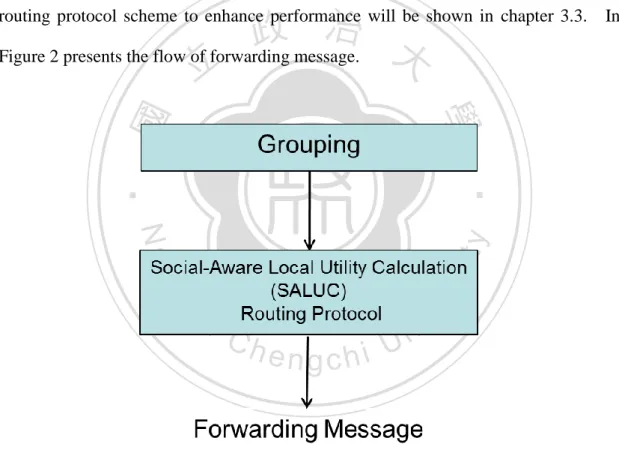
(19) CHAPTER 3 Methodology. 政 治 大. In this chapter, we will show the details of different components and main features of. 立. We develop a new forwarding message approach in DTNs to. 學. ‧ 國. the methodology.. solve the delivery message problem based on the social networks and multicasting concept of the data source reach to multiple and uncertain recipients.. ‧. Here, our mechanism is divided into three parts, we are the first to introduce the. y. Nat. io. sit. system environment and scenario, the second explains how to group nodes in the. n. al. er. distributed community, and the last investigate to select the appropriate nodes as relays and formulate our own strategy. three parts in detail.. Ch. i n U. v. In the following, we will explain each of the. engchi. 3.1 System Environment This research that we are taking into consideration the situation in real world, we often do not know the destination of the road pedestrian encounter, or the direction where they want to go, causing the people mobility is unpredictable.. That is, we. assumed that the unknown circumstances, each node could not know each other the destination and direction of movement, and the node that is randomly distributed can 9.
(20) be moved.. A node is a pedestrian who carries a mobile device with short-distance. transmission capacity, for example Bluetooth and Wi-Fi Direct.. In a limited range of. communication, node can transmit message to each other.. 3.1.1 Scenario We use the NCCU reality traces data, so our scenario assumed in the NCCU campus, but our mechanism can be used in any environment.. The Securities Research. 政 治 大 officer, should need to deliver this message to students, teachers and the community, 立 Society wants to hold a financial management seminar. Student S, is public relations. but not the school’s wireless work smooth.. As many people could connect to the. ‧ 國. 學. Internet, wireless network congestion often occur, resulting in cannot surf the Internet. ‧. or network connection have intermittent condition, so S can use multicasting scheme. sit. y. Nat. and social relations to deliver quickly this information to everyone who may be. io. al. n. people know this message.. er. interested in this message. This scenario similar to distribute flyers that hope more. Ch. engchi. i n U. v. 3.1.2 Technical Challenges In the current delay tolerant networks (DTNs) organization and the research of social networks, most message forwarding schemes deliver message to single and certain destination, but in reality we are almost impossible to know directly the nodes’ destination and direction of movement, it must be formed according to social relations among people. The key challenge is how to establish the social relationship strategy to select appropriate nodes as relays, and furthermore to use multicasting to disseminate effectively as many destinations as possible to improve performance of 10.
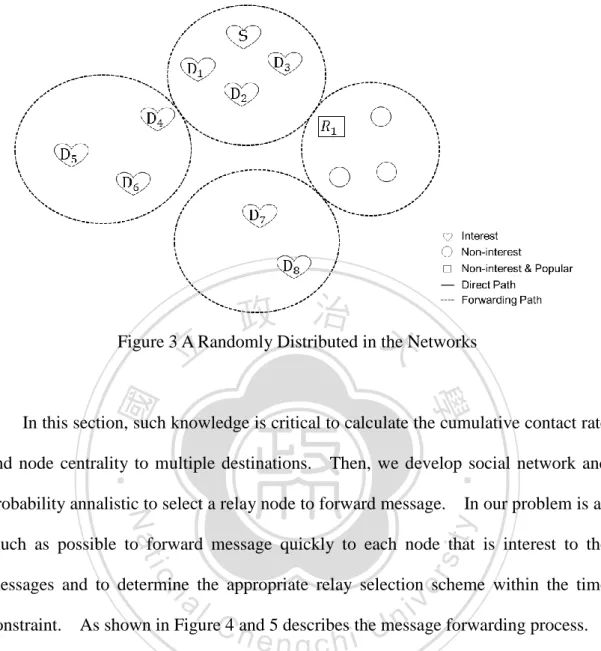
(21) delivery success ratio and delay latency and delivery cost and delivery accuracy.. 3.1.3 Operating Environment Consider distributed communities in DTNs of real world, nodes all had its own living sphere, for example, interest as the classification, formed a grouping.. Some. networks can consist of grouping where metrics based on direct or indirect encounters, whether direct or indirect encounters can become a target for receiving message.. 政 治 大 Consider three disconnected groups as shown in Figure1 [6]. 立. The grouping method detailed as shown in 3.2.. Source node S. wants to deliver message to destination node D. A mobile node may encounter. ‧ 國. 學. multiple nodes.. If node D is interested in node S’s message, however, node S cannot. If node S can be found the. y. Nat. selecting a relay node to forward this message.. ‧. directly deliver this message to node D. This is difficult to make the decision of. er. io. sit. appropriate relay node 𝑅1 in its group to forward message, in the same way, the three groups are connected by the relay node 𝑅1 , 𝑅2 , 𝑅3 and 𝑅4 .. n. al. Ch. n U engchi. to 𝑅2 and 𝑅3 to 𝑅4 illustrated by dashed lines.. iv. Figure 1 Disconnected Grouping 11. The relay nodes 𝑅1.
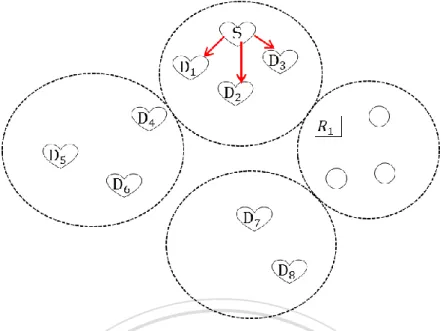
(22) 3.2 Grouping In real world, the people there are mobile nodes are randomly distributed in the network.. Each node more has its own local community, so we use similarity. detection scheme which allows each mobile node will be effective to determine whether nodes are in the same grouping. In the following, one special component focuses on grouping discussed in section 3.2.1, and the other proposed social-aware local utility calculation (SALUC). 政 治 大 Figure 2 presents the flow of forwarding message. 立. routing protocol scheme to enhance performance will be shown in chapter 3.3.. In. ‧. ‧ 國. 學. n. er. io. sit. y. Nat. al. Ch. engchi. i n U. v. Figure 2 The flow of forwarding message. 3.2.1 Similarity The similarity component is the special one of the proposed method.. Such as. centralized scheme are prior to do mobile nodes classification for offline data analysis. 12.
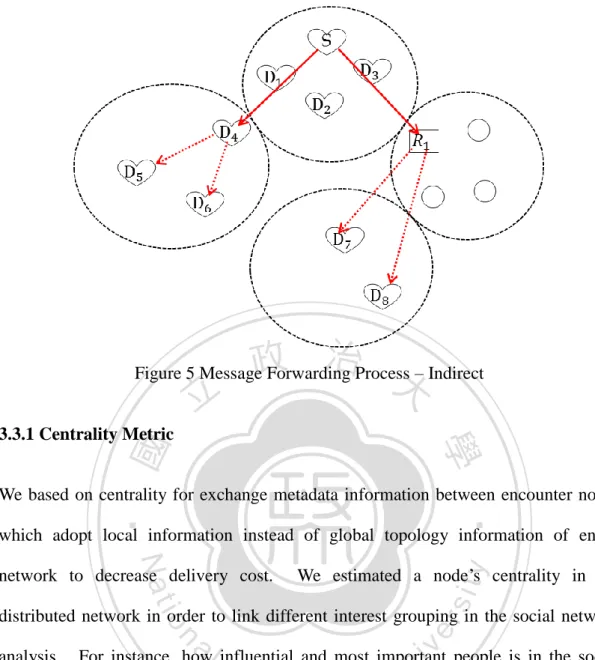
(23) However, the real world nodes are randomly distributed community, it will be most important to use effective determine strategy to detect grouping.. Here, we use. instant grouping, rather than pre-grouping, because should more close to the reality of the situation. The nodes have the same grouping, when there is a high degree of similarity between two nodes. Therefore, we can determine these nodes in the same grouping. In our research scenario, mobile nodes all have its interest, so we group according to the interest of each node.. If the nodes encountered, we will quantify the interest. 政 治 大 are more representative of the same grouping. 立. similarity value.. If the higher degree of interest similarity between the nodes, they. We defined two nodes that are 𝑛𝑖 and 𝑛𝑗 .. The node 𝑛𝑖 and 𝑛𝑗 indicates. ‧ 國. 學. interest information use m-dimensional vector space indicator, they are ⃑⃑⃑ 𝑛𝑖 and ⃑⃑⃑ 𝑛𝑖. ‧. respectively. The interest similarity value of two nodes 𝑛𝑖 and 𝑛𝑗 was calculated. y. sit. io. n. al. er. formula (1).. Nat. by formula (1) [27, 28]. The interest similarity of node 𝑛𝑖 is defined as shown in. Ch. 𝑛𝑖 ∙ ⃑⃑⃑ ⃑⃑⃑ 𝑛𝑗 𝑆𝑖𝑚𝑖𝑛𝑡𝑒𝑟𝑒𝑠𝑡 (𝑛𝑖 , 𝑛𝑗 ) = 𝑚. engchi. i n U. v. (1). −1 ≤ 𝑆𝑖𝑚𝑖𝑛𝑡𝑒𝑟𝑒𝑠𝑡 (𝑛𝑖 , 𝑛𝑗 ) ≤ 1. The resulting interest similarity ranges from -1 to 1.. The value expressed in. percentage, it can help us convenience determine the grouping.. When the higher. degree of interest similarity between two nodes that may belong to the same grouping. By this way, we hope that if node 𝑛𝑖 met node 𝑛𝑗 and can use the interest similarity value (𝑆𝑖𝑚𝑖𝑛𝑡𝑒𝑟𝑒𝑠𝑡 (𝑛𝑖 , 𝑛𝑗 )) to determine whether the node 𝑛𝑖 and node 𝑛𝑗 has a high degree of interest similarity, that is node 𝑛𝑖 and node 𝑛𝑗 are in the same grouping. 13.
(24) If 𝑆𝑖𝑚𝑖𝑛𝑡𝑒𝑟𝑒𝑠𝑡 (𝑛𝑖 , 𝑛𝑗 ) ≥ threshold, node 𝑛𝑖 and node 𝑛𝑗 are in the same grouping. The method depends on local information calculations not makes assumption of global knowledge, so it can reduce the cost.. For example, we divided five kinds of. interests, including art, service, entertainment, sports and academic. We denote two 𝑛𝑖 = (1, −1,1,1,0) and ⃑⃑⃑ 𝑛𝑗 = (1, −1,0,1,1). vectors ⃑⃑⃑. The values of vector denote. -1 meaning exactly non-interest, 1 meaning exactly interest, with 0 usually indicating 3. not has any option.. According to formula (1), the interest similarity value is 5.. However, the common approach is only taking into account single-oriented.. We. 政 治 大 Thus, it can be more realistic and increase also includes negative perspective. 立. refer to this interest similarity method that not only provides positive perspective but. ‧. ‧ 國. 學. delivery success ratio.. 3.3Social-Aware Local Utility Calculation (SALUC) Routing Protocol. sit. y. Nat. er. io. From the aspect of social networking analysis, the DTNs comprise a set of people. n. aInl the previously mentioned to ithe v purpose of community n C h in section 3.2.1. U determine is to search these groupings In the following, we focus engchi forming social grouping.. on lower degree of interest similarity of each mobile node to propose a new forwarding message approach to improve the performance.. In the Figure 3. illustrated the randomly distributed in the networks of real world.. The heart. indicates the node that is interest to the message was grouped by similarity detail in 3.2.1, called interest node. interest to the message.. The circle which is called non-interest node is not. The square which is called non-interest and popular node. isn’t interest to the message, but it’s a popular node which has higher weights of local utility with similarity, calculation centrality and probability than others nodes. 14. The.
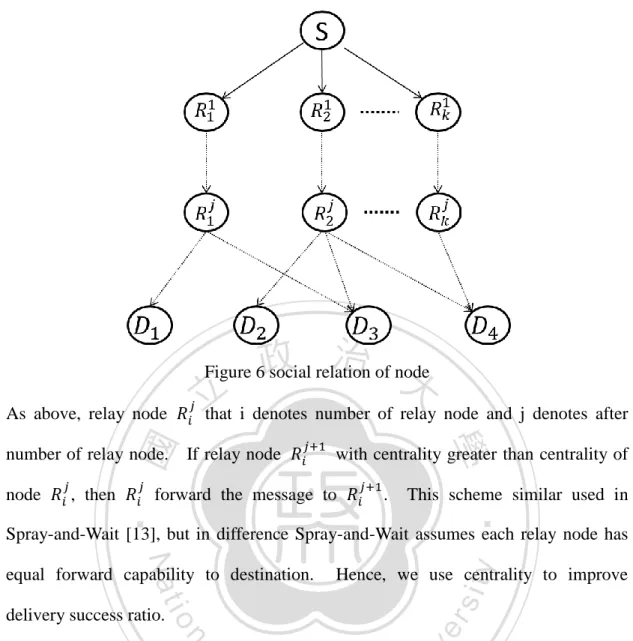
(25) weights of local utility detailed in section 3.3.3.. 政 治 大 Figure 3 A Randomly Distributed in the Networks 立. ‧ 國. 學. In this section, such knowledge is critical to calculate the cumulative contact rate. In our problem is as. sit. y. Nat. probability annalistic to select a relay node to forward message.. ‧. and node centrality to multiple destinations. Then, we develop social network and. io. er. much as possible to forward message quickly to each node that is interest to the messages and to determine the appropriate relay selection scheme within the time. al. n. v i n As shown in FigureC4 and 5 describes theU h e n g c h i message forwarding process.. constraint.. 15.
(26) 政 治 大 In Figure 4 icon definition same with Figure 3, the node S delivers the message 立 Figure 4 Message Forwarding Process – Direct. directly encounter are in the same grouping.. 學. ‧ 國. to the interest nodes who are interested in this information, when nodes who can. The result which the node S may. On the other hand, if the nodes. sit. y. Nat. in Figure 5 icon definition same with Figure 3.. ‧. broadcast message to destinations 𝐷1 , 𝐷2 and 𝐷3 in the same grouping. As shown. io. popular nodes or non-interest and popular nodes.. al. The node S can be multicast to. v i n C h if the destinationU 𝐷5 and 𝐷6 For example, engchi. n. multiple destinations.. er. indirectly encounter the node S that is with a message, it can be helped by interest and. didn’t encounter. the node S, message can be transmitted via node 𝐷4 . Although the relay node 𝑅1 isn’t interest to the message, but it is a popular node which has higher weights of local utility than others nodes can be an appropriate relay node.. If any the destination 𝐷7. and 𝐷8 didn’t encounter the node S, message can be transmitted via relay node 𝑅1 . The solid line denotes direct encounter and dashed line denotes indirect encounter which should use social forwarding.. The main flow of forwarding message detailed. in section 3.3.3.. 16.
(27) 政 治 大. Figure 5 Message Forwarding Process – Indirect. 立. ‧ 國. 學. 3.3.1 Centrality Metric. We based on centrality for exchange metadata information between encounter nodes. ‧. We estimated a node’s centrality in the. io. sit. Nat. network to decrease delivery cost.. y. which adopt local information instead of global topology information of entire. n. al. er. distributed network in order to link different interest grouping in the social network analysis.. i n U. v. For instance, how influential and most important people is in the social. Ch. engchi. network. The centrality of node is measured the node’s capability of forwarding message and centrality metric can be calculated by the message source encounter other nodes based on the local information as its relay node. According to centrality features, we can select the appropriate relay node that has a higher degree of centrality as a bridge to link different groupings.. Therefore, we could compare node centrality. to each other to choose the least node as relay nodes to forward message, if the nodes didn’t belong to the same grouping.. In Figure 6, described social relation of node. [9].. 17.
(28) 政 治 大. Figure 6 social relation of node. 𝑗. 立. number of relay node. 𝑗. 𝑗+1. If relay node 𝑅𝑖. 𝑗. 學. with centrality greater than centrality of 𝑗+1. node 𝑅𝑖 , then 𝑅𝑖 forward the message to 𝑅𝑖. .. This scheme similar used in. ‧. ‧ 國. As above, relay node 𝑅𝑖 that i denotes number of relay node and j denotes after. Spray-and-Wait [13], but in difference Spray-and-Wait assumes each relay node has. y. Nat. n. al. er. io. delivery success ratio.. Hence, we use centrality to improve. sit. equal forward capability to destination.. i n U. v. There are common centrality degree, closeness and betweenness measures [24, 25].. Ch. engchi. Degree centrality is measured as the number of node can be directly connected. to the node [6, 25]. Degree centrality, 𝐶𝑑𝑒𝑔𝑟𝑒𝑒 (𝑛𝑖 ), was calculated for node 𝑛𝑖 as follows:. 𝐶𝑑𝑒𝑔𝑟𝑒𝑒 (𝑛𝑖 ) =. deg(𝑛𝑖 ) (𝑁 − 1). (2). where deg(𝑛𝑖 ) is a degree number of 𝑛𝑖 ; 𝐶𝑑𝑒𝑔𝑟𝑒𝑒 (𝑛𝑖 ) is a degree weights of 𝑛𝑖 with large number is regarded as a popular node that is link to many nodes. On the contrary, it’s located in the margin. 18.
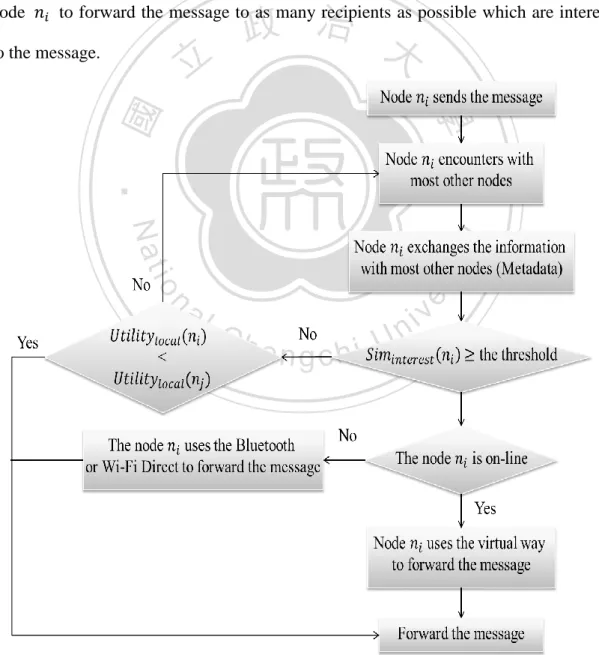
(29) Closeness centrality quantifies the distance of the shortest path which a node is reached to all other nodes [6, 25].. A highly closeness centrality may be an important. point, because it is close from node to other nodes, and furthermore it can quickly affect other nodes or be affected by others. Closeness centrality, 𝐶𝑐𝑙𝑜𝑠𝑒𝑛𝑒𝑠𝑠 (𝑛𝑖 ), was calculated for node 𝑛𝑖 as follows:. 𝐶𝑐𝑙𝑜𝑠𝑒𝑛𝑒𝑠𝑠 (𝑛𝑖 ) =. 𝑁−1. (3). ∑𝑁 𝑗=1 𝑠(𝑛𝑖 , 𝑛𝑗 ). 政 治 大 𝑛 , and N is the number of 立 node in the distributed network and i ≠ j.. where 𝑠(𝑛𝑖 , 𝑛𝑗 ) denotes the distance of the shortest path between node 𝑛𝑖 and node 𝑗. ‧ 國. 學. Betweenness centrality quantifies the number of the shortest path which a node is directly connected to all other nodes [6, 24]. However, betweenness centrality is. ‧. considered an important node to be a bridge to encounter other nodes.. Betweenness. n. al. Ch. 𝐶𝑏𝑒𝑡𝑤𝑒𝑒𝑛𝑛𝑒𝑠𝑠 (𝑛𝑖 ) =. er. io. sit. y. Nat. centrality, 𝐶𝑏𝑒𝑡𝑤𝑒𝑒𝑛𝑛𝑒𝑠𝑠 (𝑛𝑖 ), is calculated for node 𝑛𝑖 as follows:. 𝑔𝑠𝑡 (𝑛𝑖 ) 𝑔𝑠𝑡 𝑁(𝑁 − 1)/2. 𝑠−1 ∑𝑁 𝑠=1 ∑𝑡=1. engchi. i n U. v. (4). where 𝑔𝑠𝑡 denotes the number of the shortest path from node n𝑠 to node n𝑡 and 𝑔𝑠𝑡 (𝑛𝑖 ) denotes the number of the shortest path include node n𝑖 between node n𝑠 and node n𝑡 , and 𝐶𝑏𝑒𝑡𝑤𝑒𝑒𝑛𝑛𝑒𝑠𝑠 (𝑛𝑖 ) is betweenness value of 𝑛𝑖 . node in the distributed network.. N is the number of. Betweenness centrality measures the importance of. the communication capability of node among other nodes.. From our social relation. calculation define as higher degree of betweenness centrality as possible easy to connect different groupings.. In our forwarding message scheme, we should use 19.
(30) betweenness centrality features which can higher chance to encounter the other nodes in the shortest path due to regard as an important node, and furthermore quickly find the better nodes as the appropriate relay nodes to effectively forward message to interest nodes.. Betweenness centrality based on the local information measures does. not correspond to all nodes in the network. Consequently, nodes can compare their local information betweenness centrality value between each other which with the high betweenness centrality value.. In the most important of all that we hope using. these features to improve the performance in our scheme.. 立. 3.3.2 Probability. 政 治 大. ‧ 國. 學. In this section, we describe that compute the contact probability between two nodes.. ‧. Although the between centrality measures which a node with shortest path to. sit. y. Nat. encounter other nodes, and a node with higher betweenness centrality value has better In. io. er. capability to facilitate delivery message to other nodes in the different grouping.. the fact, the betweenness centrality node cannot represent the probability of the node. n. al. whether the node contact. v i n to C other nodes. Therefore, h e n g c h i U we. propose a formula of. probability based on the Poisson modeling of social network in the distributed network. The cumulative contact probability, 𝑃𝑐𝑜𝑛𝑡𝑎𝑐𝑡 (𝑛𝑖 ), is calculated for node 𝑛𝑖 as follows [9]:. 𝑃𝑐𝑜𝑛𝑡𝑎𝑐𝑡 (𝑛𝑖 ) = 1 −. ⋋𝑖,𝑗 𝑡 ∑𝑁 𝑗=1 𝑒. 𝑁−1. (5). where 𝑃𝑐𝑜𝑛𝑡𝑎𝑐𝑡 (𝑛𝑖 ) indicates the expected average probability of node 𝑛𝑖 contacted to a random node that is in the randomly network within the time constraint t, and N is 20.
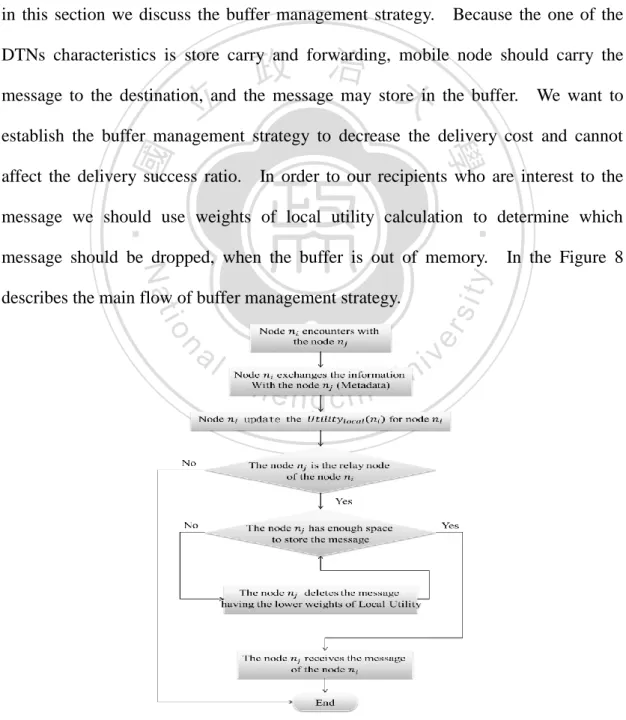
(31) the number of node in the distributed network and i ≠ j, 1 − 𝑒 −⋋𝑖,𝑗𝑡 is probability from 𝑛𝑖 contact to 𝑛𝑗 within time constraint t.. Suppose ⋋𝑖,𝑗 is the cumulative. contact rate between a node 𝑛𝑖 to the node 𝑛𝑗 since the network dynamic updates between two nodes.. In our system which is in the randomly distributed network for. DTNs and unknown destinations which are interest to the message, we should combine contact probability and betweenness centrality to determine whether the node can contact directly and be an important node called popular node as better appropriate relay node to forward message to other nodes who is interest to the For example, assume node 政 治 大 is an important node, if node 𝑛 has high probability encounter node 𝑛 rather 立. message maximum possibly within the time constraint t. 𝑛𝑗. 𝑖. 𝑗. as possible disseminate message within the time constraint.. 學. ‧ 國. than no chance encounter to waste the time. Thus, our scheme can ensure that as far. ‧. Nat. er. io. sit. y. 3.3.3 Formulation. This section describes utility-based forwarding scheme. We propose a social-aware. al. n. v i n Crouting local utility calculation (SALUC) which develop forwarding message U h e nprotocol i h gc. strategy selecting the minimum number of relay nodes for multicast is expected to satisfy forwarding message as many destinations as possible are interest to message. This local utility mechanism is for reference SimBet utility [6], because this paper is consisting of two components: similarity utility and centrality utility, but its utility formula cannot expect contact probability.. Therefore, assume node has higher. similarity utility and centrality utility, but nodes cannot encounter to exchange their local information (metadata) to forward between two nodes. strategy could increase delivery delay.. Unfortunately, the. For the above reasons we propose local. utility calculation mechanism which combine three kind of utility there are similarity 21.
(32) utility, centrality utility and probability utility.. We proposed local utility calculation. mechanism to compute the weight value of social relations to select the great weights of local utility calculation as the better relay nodes to dimension message.. The node. change degree, 𝐶𝑑𝑒𝑔𝑟𝑒𝑒 (𝑛𝑖 ), is variation of social relations which possibly change. The similarity utility, centrality utility and probability are expressed as 𝑆𝑖𝑚𝑖𝑛𝑡𝑒𝑟𝑒𝑠𝑡 (𝑛𝑖 , 𝑛𝑗 ), 𝐶𝑏𝑒𝑡𝑤𝑒𝑒𝑛𝑛𝑒𝑠𝑠 (𝑛𝑖 ) and 𝑃𝑐𝑜𝑛𝑡𝑎𝑐𝑡 (𝑛𝑖 ). The weights of local utility calculation, 𝑈𝑡𝑖𝑙𝑖𝑡𝑦𝑙𝑜𝑐𝑎𝑙 (𝑛𝑖 ), is calculated for node 𝑛𝑖 as follows:. 𝑈𝑡𝑖𝑙𝑖𝑡𝑦𝑙𝑜𝑐𝑎𝑙 (𝑛𝑖 ) = 𝑆𝑖𝑚𝑖𝑛𝑡𝑒𝑟𝑒𝑠𝑡 (𝑛𝑖 , 𝑛𝑗 ) × 𝐶𝑏𝑒𝑡𝑤𝑒𝑒𝑛𝑛𝑒𝑠𝑠 (𝑛𝑖 ) × 𝑃𝑐𝑜𝑛𝑡𝑎𝑐𝑡 (𝑛𝑖 ). 政 治 大 + (1 − 𝑆𝑖𝑚 (𝑛 , 𝑛 )) × 𝐶 (𝑛 ) 立 𝑖𝑛𝑡𝑒𝑟𝑒𝑠𝑡. 𝑖. 𝑗. 𝑑𝑒𝑔𝑟𝑒𝑒. (6). 𝑖. ‧ 國. 學. where 𝑈𝑡𝑖𝑙𝑖𝑡𝑦𝑙𝑜𝑐𝑎𝑙 (𝑛𝑖 ) is a weight value between 0 and 1.. Selection appropriate. ‧. relay nodes forwarding message scheme which we hope to select the maximum In Figure 7. sit. y. Nat. weights of local utility calculation of node for deliver the message.. io. protocol.. er. presents the main flow of the social-aware local utility calculation (SALUC) routing. al. n. v i n Cflow As shown in Figure 7, this node 𝑛𝑖 should deliver message to h edescribes ngchi U. select relay nodes for multicasting forward message to different destinations that are interest to message.. In a randomly distributed network, the node 𝑛𝑖 wants to. dimension message, then node 𝑛𝑖 may encounter with multiple nodes and exchange their information.. The lists of information which used to update interest similarity,. betweenness centrality and contact probability as detailed in 3.2.1, 3.3.1 and 3.3.2 respectively. The node 𝑛𝑖 should exchange information with metadata. First, 𝑛𝑗 is a success destination which 𝑛𝑖 is interest to the message or not. success destination, then forward the message to node 𝑛𝑗 . 22. If node 𝑛𝑗 is. If 𝑛𝑗 is not a success.
(33) destination, then the value of 𝑆𝑖𝑚𝑖𝑛𝑡𝑒𝑟𝑒𝑠𝑡 (𝑛𝑖 , 𝑛𝑗 ) which is node 𝑛𝑖 with interest vector to calculate interest similarity for node 𝑛𝑗 which determine node 𝑛𝑖 and node 𝑛𝑗 whether is in the same grouping.. If 𝑆𝑖𝑚𝑖𝑛𝑡𝑒𝑟𝑒𝑠𝑡 (𝑛𝑖 , 𝑛𝑗 ) ≥ threshold and node. 𝑛𝑗 is off-line node, the node 𝑛𝑖 uses Bluetooth or Wi-Fi Direct to forward the message to interest node 𝑛𝑗 .. If 𝑆𝑖𝑚𝑖𝑛𝑡𝑒𝑟𝑒𝑠𝑡 (𝑛𝑖 , 𝑛𝑗 ) < threshold, two nodes 𝑛𝑖 and. 𝑛𝑗. social-aware. compute. weights. of. local. utility. calculation. (SALUC),. 𝑈𝑡𝑖𝑙𝑖𝑡𝑦𝑙𝑜𝑐𝑎𝑙 (𝑛𝑖 ) and 𝑈𝑡𝑖𝑙𝑖𝑡𝑦𝑙𝑜𝑐𝑎𝑙 (𝑛𝑗 ) respectively to compare which weights is bigger.. If 𝑈𝑡𝑖𝑙𝑖𝑡𝑦𝑙𝑜𝑐𝑎𝑙 (𝑛𝑖 ) < 𝑈𝑡𝑖𝑙𝑖𝑡𝑦𝑙𝑜𝑐𝑎𝑙 (𝑛𝑗 ), the node 𝑛𝑗 is a relay node help. 政 治 大. node 𝑛𝑖 to forward the message to as many recipients as possible which are interest to the message.. 立. ‧. ‧ 國. 學. n. er. io. sit. y. Nat. al. Ch. engchi. i n U. v. Figure 7 The Main Flow of the Local Utility Calculation Routing Protocol 23.
(34) And the other node, the non-interest and popular node means that is not interest to message. The 𝑆𝑖𝑚𝑖𝑛𝑡𝑒𝑟𝑒𝑠𝑡 (𝑛𝑖 ) has lower threshold means node 𝑛𝑗 is interest to message, the node 𝑛𝑖 deliver message to node 𝑛𝑗 . Conversely, the node 𝑛𝑖 should use forwarding scheme to find the appropriate node as relays node.. 3.4 Buffer Management Strategy The previously mentioned that we focus on forwarding message scheme. in this section we discuss the buffer management strategy.. However,. Because the one of the. 政 治 大 message to the destination, and the message may store in the buffer. 立. DTNs characteristics is store carry and forwarding, mobile node should carry the We want to. affect the delivery success ratio.. 學. ‧ 國. establish the buffer management strategy to decrease the delivery cost and cannot In order to our recipients who are interest to the. ‧. message we should use weights of local utility calculation to determine which In the Figure 8. sit. y. Nat. message should be dropped, when the buffer is out of memory.. io. n. al. er. describes the main flow of buffer management strategy.. Ch. engchi. i n U. v. Figure 8 The Main Flow of Buffer Management Strategy 24.
(35) In Figure 8, if then node 𝑛𝑖 may encounter with node 𝑛𝑗 , two nodes exchange their information.. Therefore, node 𝑛𝑖 updates the weights of local utility. calculation for the node 𝑛𝑗 .. If node 𝑛𝑗 is the relay node of the node 𝑛𝑖 , our. scheme should determine whether node 𝑛𝑗 has enough space to store the message. However, if the node 𝑛𝑗 has enough space to store the message, node 𝑛𝑗 receives the message.. Otherwise, node 𝑛𝑗 will need to delete the message with the lowest. weights of local utility calculation.. We hope that use this buffer management. strategy to decrease the delivery cost and cannot affect the delivery success ratio.. 立. 政 治 大. ‧. ‧ 國. 學. n. er. io. sit. y. Nat. al. Ch. engchi. 25. i n U. v.
(36) CHAPTER 4 Simulation Results. 政 治 大 calculation (SALUC) routing 立protocol scheme to compare performance to the others. In this chapter, we evaluate the performance of our social-aware local utility. ‧ 國. 學. DTNs routing protocol as well as others social-based forwarding scheme routing protocol by real trace which is NCCU Reality Trace Data based simulations.. We. ‧. compare to existing forwarding message scheme including Epidemic [11], PROPHET We also compare. sit. y. Nat. [22] and Spray-and-Wait [13] of common DTNs routing protocol.. n. al. er. io. our forwarding scheme to social-based schemes including SimBet [23], BUBBLE. i n U. v. Rap [8] and SNAMD multicast Scheme [6] to show the advantage of our relay selection strategy.. Ch. engchi. Because our forwarding scheme uses multicasting to dimension. message, we want to make a little variation on unicast for the transmission of SimBet and BUBBLE Rap modified to multicast for the transmission of the social schemes in the delay tolerant networks architecture.. In the following, we describe our. simulation setup in section 4.1 and discuss the simulation results compare to common DTN routing protocol and social-based forwarding scheme in section 4.2. We use the following performance metric to evaluate and count the delivered success destinations which node is interest to the message that are the destinations having received the message.. We define the performance metric of delivery success 26.
(37) ratio, delivery delay and delivery average overhead and M is the number of multicast destinations.. We will detail these performance metric how to define as follows:. (1) Delivery Success Ratio, the ratio of the number of delivered success destinations to the number of success destinations.. Because our. destinations are interest to the message, the delivered success destinations that have been received the message. However, the success destinations mean should be received the message that are called success destination. The delivery success ratio was calculated by: Delivery Success Ratio =. ∑𝑀 𝑖=1 #. 政 治 大. 𝑠𝑢𝑐𝑐𝑒𝑠𝑠𝑓𝑢𝑙 𝑑𝑒𝑙𝑖𝑣𝑒𝑟𝑦 ⁄# 𝑔𝑒𝑛𝑒𝑟𝑎𝑡𝑒𝑑 𝑚𝑒𝑠𝑠𝑎𝑔𝑒 𝑓𝑜𝑟 𝑑𝑒𝑠𝑡𝑖𝑛𝑎𝑡𝑖𝑜𝑛𝑖 𝑀. 立. ‧ 國. 學. (2) Delivery Delay, the average delay for all delivered success destinations to receive the interest message.. Delivery delay also called latency of successful. sit. n. al. er. ∑𝑀 𝑖=1 𝑑𝑒𝑙𝑎𝑦 𝑜𝑓 𝑠𝑢𝑐𝑐𝑒𝑠𝑠𝑓𝑢𝑙𝑙𝑦 𝑑𝑒𝑙𝑖𝑣𝑒𝑟𝑒𝑑 𝑚𝑒𝑠𝑠𝑎𝑔𝑒 𝑓𝑜𝑟 𝑑𝑒𝑠𝑡𝑖𝑛𝑎𝑡𝑖𝑜𝑛𝑖 ∑𝑀 𝑖=1 # 𝑠𝑢𝑐𝑐𝑒𝑠𝑠𝑓𝑢𝑙 𝑑𝑒𝑙𝑖𝑣𝑒𝑟𝑦 𝑓𝑜𝑟 𝑑𝑒𝑠𝑡𝑖𝑛𝑎𝑡𝑖𝑜𝑛𝑖. io. Delivery Delay =. y. The delivery delay was calculated by:. Nat. delivery.. ‧. been received the message.. The delivered success destinations that have. i n U. v. (3) Delivery Overhead, the average number of relays used for one delivered. Ch. engchi. success destination to receive a message. The relay destinations help to forward message. received the message.. The delivered success destinations that have been Delivery overhead was calculated by:. Delivery Accuracy =. 𝑇𝑜𝑡𝑎𝑙 # 𝑟𝑒𝑙𝑎𝑦 𝑚𝑒𝑠𝑠𝑎𝑔𝑒 − ∑𝑀 𝑖=1 # 𝑠𝑢𝑐𝑐𝑒𝑠𝑠𝑓𝑢𝑙 𝑑𝑒𝑙𝑖𝑣𝑒𝑟𝑦 ⁄# 𝑔𝑒𝑛𝑒𝑟𝑎𝑡𝑒𝑑 𝑚𝑒𝑠𝑠𝑎𝑔𝑒 𝑓𝑜𝑟 𝑑𝑒𝑠𝑡𝑖𝑛𝑎𝑡𝑖𝑜𝑛𝑖 ∑𝑀 # 𝑠𝑢𝑐𝑐𝑒𝑠𝑠𝑓𝑢𝑙 𝑑𝑒𝑙𝑖𝑣𝑒𝑟𝑦 ⁄# 𝑔𝑒𝑛𝑒𝑟𝑎𝑡𝑒𝑑 𝑚𝑒𝑠𝑠𝑎𝑔𝑒 𝑓𝑜𝑟 𝑑𝑒𝑠𝑡𝑖𝑛𝑎𝑡𝑖𝑜𝑛𝑖 𝑖=1. (4) Delivery Accuracy, the ratio of the number the destination had received the message. Delivery accuracy was calculated by:. 27.
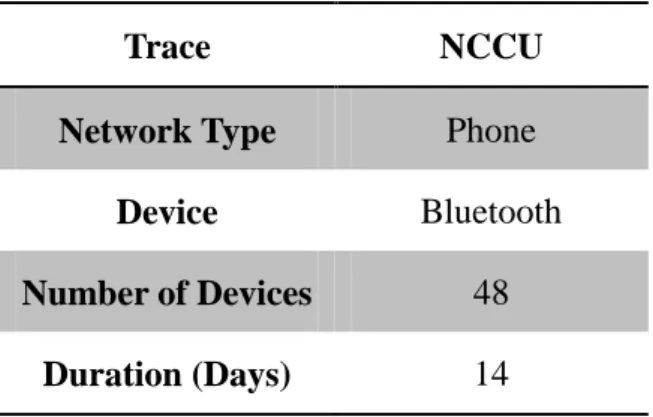
(38) Delivery Accuracy =. ∑𝑀 𝑖=1 # 𝑠𝑢𝑐𝑐𝑒𝑠𝑠𝑓𝑢𝑙 𝑑𝑒𝑙𝑖𝑣𝑒𝑟𝑦 𝑓𝑜𝑟 𝑑𝑒𝑠𝑡𝑖𝑛𝑎𝑡𝑖𝑜𝑛𝑖 ∑𝑀 𝑖=1 #. 𝑠𝑢𝑐𝑐𝑒𝑠𝑠𝑓𝑢𝑙 𝑑𝑒𝑙𝑖𝑣𝑒𝑟𝑦 𝑓𝑜𝑟 𝑑𝑒𝑠𝑡𝑖𝑛𝑎𝑡𝑖𝑜𝑛𝑖 + ∑𝑁−𝑀 𝑖=1 # 𝑛𝑜𝑛 − 𝑠𝑢𝑐𝑐𝑒𝑠𝑠𝑓𝑢𝑙 𝑑𝑒𝑙𝑖𝑣𝑒𝑟𝑦 𝑓𝑜𝑟 𝑑𝑒𝑠𝑡𝑖𝑛𝑎𝑡𝑖𝑜𝑛𝑖. 4.1 Simulation Setup We implemented our forwarding message scheme in The ONE (Opportunistic Network Environment Simulator) Simulator [26]. Because The ONE simulator can import mobility trace data from real world, we refer to the MIT Reality Mining [1] and Cambridge [5].. In MIT reality trace, 100 smart phones were deployed to. 政 治 大 The smart phones with Bluetooth can communication 立with other students and record location of each student. students and staff in MIT for the duration of nine months.. ‧ 國. 學. In Cambridge, this experiment was made by the University of Cambridge Computer Laboratory. The students were divided into two groups of freshman and sophomore. ‧. students also some master and PhD students, which lasted eleven days and total of 54. n. al. Therefore, we want to collect our. er. io. students and record activity range of each student.. sit. y. Nat. students with iMote device. The iMote with Bluetooth can communication with other. i n U. v. reality trace data of National Chengchi University to establish our social relations.. Ch. engchi. In our NCCU Reality Trace, the 48 students were deployed smart phone and install the application (app) in the mobile phone for duration of fourteen days. The students with smart phones with Bluetooth can communication with other students. We use application (app) to record location of students which log information every two minutes and questionnaires survey to collect interest of students.. Table 1. summarizes characteristic of MIT, Cambridge and NCCU reality trace.. The. simulation use trace-driven which the mobile nodes movement based on NCCU Reality Trace File. The simulation map is in the NCCU campus as shown in Figure 10 and the number of nodes is 48 students. 28.
(39) Table 1 The Summary of the three real trace data Trace. NCCU. Network Type. Phone. Device. Bluetooth. Number of Devices. 48. Duration (Days). 14. In our simulation, the nodes similarity values bigger and equal than threshold The 政 治 大 other parameters setting are shown in Table 2. The destination is uncertain which we 立. which the threshold of interest similarity is set to 0.6 are the same grouping.. ‧ 國. 學. develop a new forwarding message approach in DTNs to solve the delivery message problem based on the social networks and multicasting concept of the data source. ‧. reach to multiple and uncertain recipients within in time constraint. Hence, the. io. al. n. ONE simulator.. The Figure 10 shows a snap shot of the. er. The Figure 9 shows a NCCU campus map.. sit. y. Nat. simulation time can be adjusted which to compare the performance in time constraint.. Ch. engchi. i n U. v. Figure 9 The NCCU Campus Map 29.
(40) Table 2 The Parameters Setting in Simulation Map. NCCU Campus. Warm-up Time. 1000 Sec. Transmission Rate. 750 Kbps. Transmission Range. 10m. Node Speed. 1.8 ~ 5.4 km/h. Buffer Size. 5MB ~ 10MB. Message Size. 500KB ~ 1MB 120 ~ 180 Sec 政 治 大 18000 Sec. Interval of Message Creation. 立. Time to Live. ‧. ‧ 國. 學. n. er. io. sit. y. Nat. al. Ch. engchi. i n U. Figure 10 The ONE Simulator 30. v.
(41) 4.2 Simulation Results In this section, we should discuss the performance of simulation results.. Then, we. compare and analyze to the common DTNs routing protocol as well as social based forwarding scheme based the three performance metric, as shown in the section 4.2.1 and 4.2.2 respectively.. 4.2.1 Common DTNs Routing Protocol. 政 治 大 We use the NCCU Reality trace to evaluate our social-aware local utility calculation 立 (SALUC) routing protocol.. Because our scheme uses multicasting to dimension. ‧ 國. 學. message, the number of success destinations which are interest to the message should. ‧. be received the message. In our simulation, we assume 30 success destinations.. The. sit. y. Nat. size of each message ranges from 500KB to 1MB, and the buffer size of each mobile. io. the relay is unable to carry all data simultaneously.. n. al. Ch. management strategy to decrease delivery overhead.. engchi. er. node range from 5MB to 10MB. Each relay node should be carry single message, so Therefore, we use buffer. i n U. v. In the simulation results, we proposed a local utility calculation discuss with Epidemic routing, PRoPHET and Spray-and-Wait.. For multicast dimension scheme,. PRoPHET multicasting is separate unicast process for each success destinations. For Spray-and-Wait, we use the number of data copies equal to the number of the relay nodes selected by our forwarding scheme.. In Figure 11 plots the results for the. delivery success ratio relates to the time constraint.. Our scheme can achieve the. delivery success ratio reaching to about 50%, when the time constraint is at 14 days. However, in the Figure 11 can be found the delivery success ratio of Epidemic routing and our SALUC routing is relatively close, but the SALUC scheme is slightly better 31.
(42) performance at time constraint about 10 hours and outperforms than PRoPHET and Spray-and-Wait all the time constraint.. The mainly is Epidemic routing which. propose when the node encounter with other node, it must be deliver a message, but our SALUC scheme which is conditional deliver message to the other nodes that are interest in the message is similar to hair flyer.. Meanwhile, we may select the. appropriate relay nodes to forward message which use interest similarity to group and local utility calculation scheme to decrease overhead, rather than just send if nodes encounter.. So, in Figure 14 shows the delivery accuracy better than others.. The. 政 治 大 than that of Epidemic routing, PRoPHET and Spray-and-Wait as shown in Figure 12 立 average delivery delay and delivery forwarding cost of our scheme is much lower. and Figure 13 respectively.. At time constraint 14 days, the delivery overhead of our. ‧ 國. 學. approach is 78% of that of the PRoPHET and 35% of that of the Epidemic routing.. ‧. In the simulation results report, we proposed the forwarding scheme of local utility. sit. y. Nat. calculation routing not only has the best delivery success ratio but also lowest. io. n. al. er. delivery delay and delivery overhead.. Ch. engchi. i n U. Figure 11 Delivery Success Ratio. 32. v.
(43) Figure 12 Delivery Delay. 立. 政 治 大. ‧. ‧ 國. 學 er. io. sit. y. Nat. n. aFigure l C 13 Delivery Overheadn i v hengchi U. Figure 14 Delivery Accuracy 33.
(44) We evaluate and count the delivered success destinations which node is interest to the message that are the destinations having received the message.. In our. simulation result, we randomly selected multicast destinations which the nodes interest to the message.. Therefore, we simulate six different number of multicast. destinations were 1, 10, 20, 30, 40 and 48 which were randomly selected. Our simulation time is 7 days.. In Figure 15, the number of multicast destinations. increases from 30 multicast destinations to 48 multicast destinations, the SALUC delivery success ratio gradually approaching to Epidemic routing.. However, the. 政 治 大 The delivery overhead of SALUC is lower than 100% Epidemic 立. Epidemic routing which propose when the node encounter with other node, it must be deliver a message.. routing as shown in Figure 17.. In Figure 16 and Figure 17 shows the delivery delay. ‧ 國. 學. and delivery accuracy of SALUC is better than others common routing protocols.. ‧. The simulation results show our social-aware local utility calculation (SALUC). n. al. er. io. sit. y. Nat. scheme can improve the performance.. Ch. engchi. i n U. v. Figure 15 Delivery Success Ratio V.S Multicast Destinations. 34.
(45) Figure 16 Delivery Delay V.S Multicast Destinations. 立. 政 治 大. ‧. ‧ 國. 學 er. io. sit. y. Nat. Figure 17 Delivery Overhead V.S Multicast Destinations. n. al. Ch. engchi. i n U. v. Figure 18 Delivery Accuracy V.S Multicast Destinations. 35.
(46) 4.2.2 Social-based Forwarding Scheme We implement a variety of forwarding message scheme based on social networks in a trace-driven that is NCCU Reality trace simulator.. We compare the performance to. other social-based forwarding scheme including SimBet [6], BUBBLE Rap [8] and Social Network Aided Multicast Delivery (SNAMD) [23].. For SimBet and. BUBBLE Rap scheme use unicast to delivery, so we should do a little variation on unicast for the transmission of SimBet and BUBBLE Rap modified to multicast for the transmission of the social schemes in the delay tolerant networks architecture.. 政 治 大. For Social Network Aided Multicast Delivery (SNAMD) scheme which use K-clique. 立. scheme to detect the social communalities and centrality based on the social network.. ‧ 國. 學. The SimBet strategy considered the betweenness centrality and similarity and use utility formula to select the relay node.. We proposed the forwarding scheme with. ‧. similarity, centrality and probability and use multicasting to dimension message.. Nat. y. In. io. In Figure 27, 28, 29 and 30 plots the results compare the. n. al. er. time constraint.. sit. Figure 19 plots the results for the delivery success ratio of social-based relates to the. performance with SNAMD.. Ch. engchi. i n U. v. Figure 19 Delivery Success Ratio – Social-based 36.
(47) In Figure 19 shows the delivery success ratio of the social-aware local utility calculation (SALUC) is better than others forwarding scheme based on social network. The SimBet utility scheme is calculated by similarity and centrality. However, the mobile nodes there are randomly distributed in the network of DTNs. have low contact frequency and node mobility is unpredictable.. The nodes. The SimBet does. not consider the contact probability of between nodes. Hence, the SimBet has the lower the delivery success ratio relates within the time constraint.. Then, the. BUBBLE Rap scheme use K-clique community detection to group the mobile nodes as grouping.. 政 治 大 However, The BUBBLE Rap also does not consider the contact 立. The BUBBLE Rap hopes that use grouping for easy to find the relay. node to forward.. rate of between nodes, so the performance of delivery success ratio is lower than our. ‧ 國. 學. scheme which is SALUC routing. For Social Network Aided Multicast Delivery. ‧. (SNAMD) is similar to the BUBBLE Rap use the K-clique community detection to. sit. y. Nat. group the mobile nodes as grouping can easy to select the relay nodes and it is also. io. er. use multicasting to deliver the message. Comparatively, our scheme use interest similarity was calculated by cosine similarity theorem to determine whether the. al. n. v i n C h But, we consider mobile nodes are in the same grouping. the various aspects for the engchi U. grouping, and Social Network Aided Multicast Delivery (SNAMD) only considers the single oriented. destinations.. A more ambiguous than we can increase the deliver to the success. In this similarity scheme, we can increase the chance of transmission. to the success destinations and to decrease the delivery overhead. Our scheme better than others because we cumulatively calculate the contact rate or contact probability of the node can encounter with other nodes and with centrality and similarity to select the appropriate relay nodes to forward the message to the success destinations. Hence, our social-aware local utility calculation (SALUC) scheme can improve the performance metric of delivery success ratio, delivery delay, delivery overhead and 37.
(48) delivery accuracy as shown in Figure 19, Figure 20, Figure 21 and Figure 22 respectively.. 學 Figure 20 Delivery Delay – Social-based. ‧. ‧ 國. 立. 政 治 大. n. er. io. sit. y. Nat. al. Ch. engchi. i n U. v. Figure 21 Delivery Overhead – Social-based. 38.
(49) 政 治 大. Figure 22 Delivery Accuracy – Social-based. 立. nodes interest to the message.. 學. ‧ 國. In our simulation result, we randomly selected multicast destinations which the Therefore, we simulate six different number of. The research issue of this thesis is that as possible as. sit. y. Nat. Our simulation time is 7 days.. ‧. multicast destinations were 1, 10, 20, 30, 40 and 48 which were randomly selected.. io. er. it can forward the message to other nodes that have interest to the message within the constraint time. We evaluate and count the delivered success destinations which. al. n. v i n node is interest to the message C that are the destinations h e n g c h i U having received the message.. In Figure 23, the delivery success ratio of SALUC is better than 100% others forwarding scheme.. In Figure 24 shows the delivery delay of SALUC is better than. others forwarding scheme. Because the multicast destinations 48 which represent all destinations interest to the message, delivery overhead of multicast destinations 48 is 0 as shown in Figure 25.. In Figure 26, the delivery accuracy of SALUC is better. than 100% others forwarding scheme. The simulation results show our social-aware local utility calculation (SALUC) scheme can improve the performance.. 39.
(50) Figure 23 Delivery Success Ratio – Social-based V.S Multicast Destinations. 立. 政 治 大. ‧. ‧ 國. 學. n. er. io. sit. y. Nat. al. Ch. engchi. i n U. v. Figure 24 Delivery Delay – Social-based V.S Multicast Destinations. Figure 25 Delivery Overhead – Social-based V.S Multicast Destinations 40.
(51) Figure 26 Delivery Accuracy – Social-based V.S Multicast Destinations. 立. 政 治 大. ‧. ‧ 國. 學 er. io. sit. y. Nat. Figure 27 Delivery Success Ratio – SALUC V.S SNAMD. n. al. Ch. engchi. i n U. v. Figure 28 Delivery Delay – SALUC V.S SNAMD 41.
(52) 政 治 大. Figure 29 Delivery Overhead – SALUC V.S SNAMD. 立. ‧. ‧ 國. 學. n. er. io. sit. y. Nat. al. Ch. engchi. i n U. v. Figure 30 Delivery Accuracy – SALUC V.S SNAMD. 42.
(53) CHAPTER 5 Conclusions and Future Work. 政 治 大. In this thesis, we proposed a new forward message scheme which has new forwarding. 立. the concept of the multicasting and the social network.. 學. ‧ 國. message scheme and formulates the selection of the appropriate relay nodes based on We formulate social-aware. local utility calculation (SALUC) mechanism which combines three kind of utility. ‧. there are similarity utility, centrality utility and probability utility.. Nat. y. Therefore, the. io. sit. local utility calculation routing scheme to compute the weight value of social relations. n. al. er. to select the great weights of local utility calculation as the better relay nodes to dimension message. destinations.. i n U. v. We focus on forwarding messages to multiple uncertain. Ch. engchi. Therefore, the research topic of this thesis is that as much as possible. deliver the message to other nodes that are interest to the message within the time constraint. We evaluate the performance of our social-aware local utility calculation (SALUC) routing protocol scheme to compare performance to the others common DTNs routing protocol as well as others social-based forwarding scheme routing protocols by real trace which is NCCU Reality Trace Data based simulations. Furthermore, our scheme enhances the delivery success ratio of the entire system, can reduce the delivery delay, and can help to reduce the delivery overhead. 43.
(54) REFERENCES [1] N. Eagle and A. Pentland. Reality mining: sensing complex social systems. Personal and Ubiquitous Computing, Vol 10(4):255–268, May 2006. [2] Zhensheng Zhang. Routing in Intermittently Connected Mobile Ad Hoc. 政 治 大 Communications Surveys 立 & Tutorials, 8(1):24–37, 2006.. Networks and Delay Tolerant Networks: Overview and Challenges. IEEE. ‧ 國. 學. [3] Christoph P. Mayer. Hybrid Routing in Delat Tolerant Networks. KIT Scientific Publishing, July 3, 2012.. ‧. [4] Wi-Fi alliance : http://www.wi-fi.org/index.php. sit. y. Nat. [5] Social Network Analytics : http://crawdad.cs.dartmouth.edu/. al. er. io. [6] E. Daly and M. Haahr, “Social network analysis for routing in disconnected. v. n. delay-tolerant MANETs,” in Proc. ACM MobiHoc, 2007, pp. 32–40.. Ch. engchi. i n U. [7] W.Gao,Q.Li, B. Zhao, andG. Cao, “Multicasting in delay tolerant networks: A social network perspective,” in Proc. ACM MobiHoc, 2009, pp. 299–308. [8] P. Hui, J. Crowcroft, and E. Yoneki, “Bubble Rap: Social-based forwarding in delay tolerant networks,” in Proc. ACM MobiHoc, 2008, pp. 241–250. [9] Wei Gao, Qinghua Li, Bo Zhao and Guohong Cao, “Social-Aware Multicast in Disruption-Tolerant. Networks,”. in. IEEE/ACM. TRANSACTIONS. ON. NETWORKING, VOL. 20, NO. 5, OCTOBER 2012 [10] Jiuxin Cao, Liu Yang, Xiao Zheng, Bo Liu, Lei Zhao, Xudong Ni, Fang Dong and Bo Mao, “Social attribute based web service information publication 44.
(55) mechanism in Delay Tolerant Network,” in IEEE International Conference on Computational Science and Engineering CSE/I-SPAN [11] VAHDAT, A., AND BECKER, D. Epidemic routing for partially connected ad hoc networks. Technical Report CS-200006, Duke University (2000). [12] LINDGREN, A., DORIA, A., AND SCHELÉ N, O. Probabilistic routing in intermittently connected networks. Lecture Notes in Computer Science 3126 (2004), 239–254. [13] SPYROPOULOS, T., PSOUNIS, K., AND RAGHAVENDRA, C. S. Spray and. 政 治 大 In proc. WDTN ’05 (2005), ACM Press, pp. 252–259. 立. wait: an efficient routing scheme for intermittently connected mobile networks.. [14] K. Jahanbakhsh, G.C. Shoja, V. King, Social-greedy: a socially-based greedy. ‧ 國. 學. routing algorithm for delay tolerant networks, MobiOpp’10: Proceedings of the. y. Nat. New York, NY, USA (2010), pp. 159–162. ‧. Second International Workshop on Mobile Opportunistic Networking, ACM,. er. io. sit. [15] J. Leguay, T. Friedman, and V. Conan, “Evaluating mobility pattern space routing for DTNs,” in Proceedings of the 25th IEEE International Conference on. al. n. v i n Computer CommunicationsC(INFOCOM), Barcelona, h e n g c h i U Spain, April 2006.. [16] E. Bulut and B. K. Szymanski, “Friendship based routing in delay tolerant mobile social networks,” in Proceedings of IEEE Global Telecommunications Conference (GLOBECOM),, Dec, 2010. [17] A. Mei, G. Morabito, P. Santi and J. Stefa, “Social-aware stateless forwarding in pocket switched networks,” in Proceeding of the 30th IEEE Conference on Computer Communications(INFOCOM) mini-conference, 2011. [18] F. Fabbri and R. Verdone, “A sociability-based routing scheme for delay-tolerant networks,” In EURASIP Journal on Wireless Communications and Networking, vol. 2011, January, 2011. 45.
(56) [19] P. Hui, A. Chaintreau, J. Scott, R. Gass, J. Crowcroft, and C. Diot, “Pocket switched networks and the consequences of human mobility in conference environments,” in WDTN ’05: Proceedings of the 2005 ACM SIGCOMM workshop on Delay-tolerant networking, 2005. [20] Ying Zhu, Bin Xu, Xinghua Shi, and Yu Wang. A Survey of Social-based Routing in Delay Tolerant Networks: Positive and Negative Social Effects. IEEE Communications Surveys & Tutorial, Volume: pp , Issue: 9, April,2012 [21] P. Hui, E. Yoneki, S.Y. Chan, and J. Crowcroft, “Distributed community. 政 治 大. detection in delay tolerant networks,” in Proc. of ACM SIGCOMM Workshop, MobiArch’07, 2007.. 立. Networks,. ”. ACM. SIGMOBILE. Mobile. Computing. and. ‧. Communications Review, 7(3), 2003.. 學. Connected. ‧ 國. [22] A.Lindgren, A.Doria, and O. Schel’en, “Probabilistic Routing in Intermittently. sit. y. Nat. [23] M. C. Chuah. Social network aided multicast delivery scheme for human. io. Complex Network for Practitioners (Simplex), 2009.. n. al. [24] FREEMAN, L. C. A. er. contact-based networks. In Proceedings of the 1st Workshop on Simplifying. v i n setCof measures of centrality h e n g c h i U based. on betweenness.. Sociometry (1977), 35–41.. [25] FREEMAN, L. C. Centrality in social networks conceptual clarification. Social networks (Soc. networks) (1979), 215–239. [26] Ari Keränen, Jörg Ott and Teemu Kärkkäinen: The ONE Simulator for DTN Protocol Evaluation. SIMUTools'09: 2nd International Conference on Simulation Tools and Techniques. Rome, March 2009. [27] Deza, M.M., Deza, E.: Encyclopedia of Distances. Springer, Berlin (2009) [28] Mei, A., Morabito, G., Santi, P., Stefa, J.: Social-Aware Stateless Forwarding in Pocket Switched Networks. In: Proc. IEEE Infocom, MiniConference (2011) 46.
(57)
數據

+7
相關文件
• Contact with both parents is generally said to be the right of the child, as opposed to the right of the parent. • In other words the child has the right to see and to have a
If we want to test the strong connectivity of a digraph, our randomized algorithm for testing digraphs with an H-free k-induced subgraph can help us determine which tester should
object of supreme nonconceptual gnosis = true suchness,’ ‘that which conforms to the ultimate truth = prajñā,’ and ‘the supreme object = true suchness,’ and we can see
questions and we are dedicated to are dedicated to are dedicated to are dedicated to future research and development to bring you the future research and development to bring you the
In Activity 6, students are required to decide whether Model D should be sold during the Lunar New Year Fair. Students should note that only future variable costs and
After the desired content has been identified, the control point needs to determine which transfer protocol and data format should be used to transfer the content from the
If we would like to use both training and validation data to predict the unknown scores, we can record the number of iterations in Algorithm 2 when using the training/validation
For a directed graphical model, we need to specify the conditional probability distribution (CPD) at each node.. • If the variables are discrete, it can be represented as a
