
A TinyWeb Server on Embedded System
6
0
0
全文
(2) served. It is very important because not all the user have the same speed Internet connection. The slower should not delay other visitors from downloading a web page. Hence, threads are often used to serve dynamic content for better performance because of the large number of discrete objects. This model is illustrated as Figure 2.. Generally, there are four kinds of server model, and each model has their own advantage on speed, file size or efficiency. 1. Finite State Machine Servers To maximize the scalability, many small web servers are implemented as a single process and a finite state machine. Every task is split into two or more small steps that are executed as needed as Figure 1. When a request comes, the web server will analyze what client asks for and lets application handle function responds to their request, just like finite state machine. To personal web server, because most of requests are for static web pages, response time can be shortening without redundant context switches. Besides, by keeping the state of each connection and asynchronous I/O, it is possible to implement ultra fast web servers, at least for serving static content such as static web pages and graphic files. In addition, this kind of model holds the minimum memory size rather than other model.. Process withmultithread. Request. Header Analyzer. Handle Function 1. Reply. Thread2. Handle Function 2. Reply. Thread3. Handle Function 3. Reply. Threadn. Reply. MainThread. Figure 2: Process with Multithread Implement 3. Process-based Servers. Process. MultiProcess Handle Function 1. Request. Thread1. .. 2.1 Server Model. hold. is implemented. We can refer the way a web server is implemented to several models, and we introduce in next section.. Handle Function 2 Header Analyzer. Reply. Request. Handle Function 1. Reply. Fork. Handle Function 2. Reply. Fork. Handle Function 3. Reply. .. Handle Function 3. Header Analyzer. Fork. Reply. .. Fork. Figure 1: Single Process Implement Figure 3: Multiple Process Implement 2. Thread-based Servers Except for the single process, multithread is another common used model. Multithread means that inside each server’s process, at least one threads are run, and each one able to execute its own task and the local variable independently from the others. After thread finish its task, the memory it occupied would be free. When a user visits the web site, web server will use a thread to serve the page to that user. If another user visits the site while the previous user is still being served, the web server can serve the next visitor by using a different thread. Thus, the next user does not have to wait for the first visitor to be. For reliability and security reasons, some web servers use multiple processes rather than multiple threads within a single process. Usually, a pool of processes is used until a certain threshold of requests has been served by process before replaced by a new one. Because threads share a main process context such as global variable, if a thread crash its own task and the error variable may jam other thread, this may easily crash the whole application, and a buffer overflow can have disastrous consequences. Moreover, memory leak is usually out of the control for third party libraries such as PHP, the application programmer cannot deal with it using threads, but can use a pool of 2. - 893 -.
(3) processes with a limited lifetime because of OS automatically frees all the allocated memory when process dies. Furthermore, global variable addresses in a process also differ from each process, even if one process has crash, the others do not be interfered. Multiprocess illustrated as Figure 3.. 4. LightTPD [11] LightTPD is a security, speed and flexibility web server. As its name, it is designed for high performance environments. Compared to other web servers, there are effective management of the CPU-load and advanced feature such as output-compression, URLrewriting and fast CGI with a small memory usage. 5. Shttpd [12] Shttpd is simple web server. The main design goals are the ease of use and the ability to embed. Ideal for personal use, web-based software demos (like PHP, Perl etc), quick file sharing.. 4. Mixed Module Servers To integrate all advantages of the former model, many web servers implement a mixture of all these programming techniques such that serving client according to the different task. For example, static web page implement with single process and thread, . For serving static or dynamic content, etc.).. Although most of web servers are used on PC now, tiny web server would become more and more practical and common on embedded system for widely application increasingly. In next paragraph, we give an example that how to implement the web server more efficiently.. 2.2 Application Actually, we can only classify it according to the function at most. Here, we refer the web server to two types, the full-featured and tiny web server. We can clearly know what the full-featured server is by its name, this type web servers support a lot of plugin for third party program and function about Internet optimization setting. Relative to full-featured server, tiny web server is light and simple, and some of them only support the basic HTTP 1.1 even because for the embedded support. The following tiny web servers are often used on embedded system:. 3 BBS httpd Web Server (Bhttpd) We have introduced some tiny web server before, and those web servers are famous as light, simple and tiny for embedded system use. In fact, except for those feature, there is still a key point. Usually, when clients ask for request, web server just takes the content by path. If we can embed the web page data in source code, it would reduce the loading time due to I/O buffer. Maybe it is strange and seldom to do as this way because of it is hardly to modify the most of web server’s source code. We design a web server that callled “BBS Httpd (Bhttpd)” is not only easy to be embedded web page in its function, but also can bundle web server with application [13], [14]. Originally, this web server is written for web BBS use, so we call it “Bhttpd”.. 1. Thttpd [8] According to official website declaration, it is a tiny, turbo and throttling HTTP server. It handles only the minimum necessary to implement HTTP/1.1, and has a very small run-time size, since it does not fork and is very careful about memory allocation. In typical use, it is about as fast as the best full-featured server such as Apache. Under extreme load, it is much faster. 2. Corehttp [9] Corehttp is designed to be a minimalist http server focusing on speed and size. Similarly, asynchronous I/O handling, single-process select client concurrency model without forking and thread, it is easy for portability and efficiency. Besides, many configuration options cannot slow the program down. 3. Boa [10] Boa is a single-threaded HTTP server. Unlike traditional web servers, it does not fork for each incoming connection, nor does it fork many copies of itself to handle multiple connections, and forks only for CGI programs, so the load on the server never exceeded over 1%. The design goal of Boa is security, portability and speed, and is not intended as a fullfeature server.. 3.1 Feature. Web Browser Response. Request Web Server. Fill Header. Parse Header. Virtual Path. Function. .... Application. .. .. Call. Figure 4: Process of Bhttpd. 3. - 894 -.
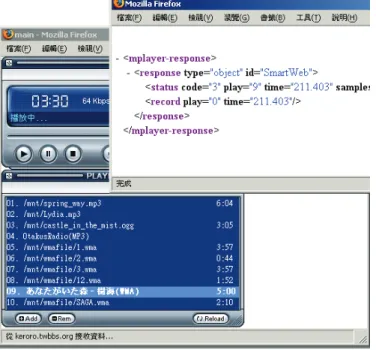
(4) and speed ? As Figure 5, we add Bhttpd to Mplayer [15] for the interactive web-based interface. When browser request for the web page by AJAX technique [16], web server read the playing status in shared memory and return that message directly. When web browser tries to connect to server first time, server would send web page data which includes the graphic or playlist URL back. Except for those URL, there is some control code be used to communicate with web server. In fact, the control code just only asks for response repetitively. Every time web server receives a request, it read the playing status in shared memory and has the message return in XML format. This is known as AJAX technique today. The completed process is illustrated as Figure 6. In general, it is a troublesome method because you have to rewrite part of source code for new function. However, when this method is applied on embedded system, it would be more practical and useful since different embedded system devices have their own demand for web-based interactive, if we can modify the Bhttpd standard source code easily, it could become an advantage instead. Besides, we can embed the function on web pages in Bhttpd web server whether the server is applied on embedded system or not, the speed of data access must faster than I/O buffer reading. Therefore, if there are a large number of client request such as previous instance, the response time would be shorter and required data would be smaller when we combine the method with AJAX technique especially.. As another single-task web server, Bhttpd is also a small web server. The entire size it consumed is only 14KB with flow control, keep-alive and HTTP/1.1 supporting. Besides, it is easy and convenient to add a new web page as a function to source code as Figure 4, and it is important because this make web developments on embedded system simpler. However, we still have to know how the function works before using.. 3.2 Instance of Bhttpd Server. 4 Experiment Result Before compare with other web server, we introduce the hardware platform. The enviroment we used is SBC-2410x embedded system as shown in Table 1.. Figure 5: Web-Based Interactive Interface. Application. Signal (Control Code) XML. Shared Memory. Platform. SBC-2410x. CPU. S3C2410@200MHz 100MIPS. Memory. 64MB SDRAM 64MB NAND Flash 1MB NOR Flash. AJAX. Report Status. Web Browser. Web Server. Table 1: Hardware Platform. Figure 6: Implementation of Bhttpd. For objectivity, we compare Thttpd, Boa, Corehttp, LightTPD and Shttpd with Bhttpd because both of their features are similar. We can understand this point by the server model, all the web server is implemented with single-task program for the speed and size. As Table 2, except for Corehttp, it is obvious that Bhttpd has the smallest memory size at run-time and thttpd is biggest. How Bhttpd differs from others is that it is mainly aimed for easy rewrites. This feature is an advantage especially on embedded system. For example, if we want to design an web-based interface for media player such that user can control the play, pause and stop message by browser. Besides, the detail as time, sample rate, and CPU utilization could be refreshed, how can we implement for efficiency 4. - 895 -.
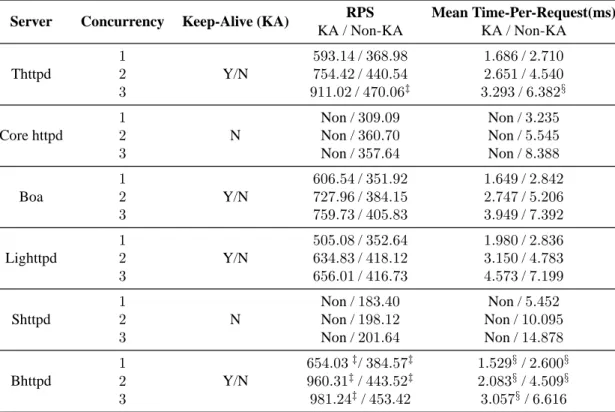
(5) Software. Feature. Size. Server. Version. Release. Model. Flow Control. Code (B). Modules (B). Memory (KB). Thttpd. 2.21b. 02/Jun/2006. select. Yes. 1, 748, 716. X. 1, 856. Core http. 0.5.3a. 05/Aug/2005. select. No. 18, 179. X. 284. Boa. 0.94.13. 23/Feb/2005. select. No. 57, 143. X. 428. Lighttpd. 1.4.11. 09/Mar/2006. select. No. 139, 760. 352, 380∗. 632. Shttpd. 1.35. 07/Arp/2006. select. No. 68, 716. X. 556. Yes. †. X. 240†. 1.3b. Bhttp ∗ †. 01/Aug/2006. select. 14, 394. Runing server needs load modules. Smallest size. Table 2: Feature Comparison Server. Concurrency. Keep-Alive (KA). RPS KA / Non-KA. Mean Time-Per-Request(ms) KA / Non-KA. Thttpd. 1 2 3. Y/N. 593.14 / 368.98 754.42 / 440.54 911.02 / 470.06‡. 1.686 / 2.710 2.651 / 4.540 3.293 / 6.382§. Core httpd. 1 2 3. N. Non / 309.09 Non / 360.70 Non / 357.64. Non / 3.235 Non / 5.545 Non / 8.388. Boa. 1 2 3. Y/N. 606.54 / 351.92 727.96 / 384.15 759.73 / 405.83. 1.649 / 2.842 2.747 / 5.206 3.949 / 7.392. Lighttpd. 1 2 3. Y/N. 505.08 / 352.64 634.83 / 418.12 656.01 / 416.73. 1.980 / 2.836 3.150 / 4.783 4.573 / 7.199. Shttpd. 1 2 3. N. Non / 183.40 Non / 198.12 Non / 201.64. Non / 5.452 Non / 10.095 Non / 14.878. Bhttpd. 1 2 3. Y/N. 654.03 ‡ / 384.57‡ 960.31‡ / 443.52‡ 981.24‡ / 453.42. 1.529§ / 2.600§ 2.083§ / 4.509§ 3.057§ / 6.616. ‡ §. Largest request per second (RPS) . Least mean time per request. Table 3: Efficiency Comparison. maybe it is bundled with PHP module. Both of them have the flow control function, but Bhttpd is much smaller than thttpd. Here we do not mention other feature such as authentication because there is no need for personal use. The maximum user number is also unmeaning if we do not act after connecting to server. Therefore, we use Apache HTTP server benchmark tool [2] to measure the efficiency difference between them [17], [18].. As Table 3, we compare the Request-Per-Second (RPS) and the mean Time-Per-Request with keep-alive or not. The more RPS has represents the server could accept more request at the same time. In here, Bhttpd is still the most one. From mean Time-Per-Request (TPR), we can know the average time of server response to clients. As previous, Bhttpd is the smallest one. All the data we test are based on static web pages. 5. - 896 -.
(6) 5. Conclusion. [8] “THTTPD - tiny/turbo/throttling HTTP server.” http: //www.acme.com/software/thttpd.. According to the comparison, Bhttpd is really a superior tiny web server. Not only the response time and size, as well as the feature for rewriting source code are its advantage. For the use of embedded system, it could be implemented as part of system, and this does make the web server required development easier. Even on general purpose, advantage of its rewrite could make being embedded in application easier. In other words, it is not restricted to any hardware platform. Anyway, Bhttpd is certainly different from other tiny web server.. [9] “CoreHTTP web server.” http://corehttp.sourceforge. net. [10] “Boa Webserver.” http://www.boa.org. [11] “LightTPD: Light HTTPD.” http://www.lighttpd.net. [12] “SHTTPD: Simple sourceforge.net.. HTTPD.”. http://shttpd.. [13] T. Berners-Lee, R. Fielding, and H. Frystyk, “Hypertext Transfer Protocol – HTTP/1.0.” http://www.faqs. org/rfcs, May. 1996. RFC 1945. [14] R. Fielding, J. Gettys, J. Mogul, H. Frystyk, and L. Masinter, “Hypertext Transfer Protocol – HTTP/1.1.” http://www.faqs.org/rfcs, Jun. 1999. RFC 2616.. References [1] “Netcraft.” http://news.netcraft.com.. [15] “Mplayer: The Movie Player.” http://www.mplayerhq. hu.. [2] “The Apache Software Foundation.” http://www. apache.org.. [16] B. McLaughlin, Head Rush Ajax. O’Reilly and Associates, first ed., Mar 2006. [17] J. Hu, S. Mungee, and D. Schmidt, “Techniques for developing and measuring high performance Web servers over high speed networks,” in IEEE INFOCOM Computer and Communications Societies, pp. 1222– 1231, Mar 1998.. [3] “Samsung-electronics.” http://www.samsung.com/tw. [4] “SiS: Silicon Integrated Systems Corp.” http://www. sis.com. [5] M.-J. Choi, H.-T. Ju, H.-J. Cha, S.-H. Kim, and J. W.K. Hong, “An efficient embedded Web server for Webbased network element management,” in IEEE/IFIP Network Operations and Management Symposium, pp. 187–200, Apr 2000.. [18] J. Hu, I. Pyarali, and D. Schmidt, “Measuring the impact of event dispatching and concurrency models on Web server performance over high-speed networks,” in IEEE GLOBECOM Global Telecommunications Conference, pp. 1924–1931, Nov 1997.. [6] “Microsoft Corporation.” http://www.microsoft.com. [7] “Mozilla Firefox.” http://www.mozilla.com/firefox.. 6. - 897 -.
(7)
數據

相關文件
Persistent Connections (HTTP 1.1):HTTP 1.1改進 了HTTP 1.0 的缺點,藉由PersistentConnections減 少TCP connections,以增加WEB Server
Overview of a variety of business software, graphics and multimedia software, and home/personal/educational software Web applications and application software for
1) Ensure that you have received a password from the Indicators Section. 2) Ensure that the system clock of the ESDA server is properly set up. 3) Ensure that the ESDA server
Propose eQoS, which serves as a gene ral framework for reasoning about th e energy efficiency trade-off in int eractive mobile Web applications. Demonstrate a working prototype and
• A simple look at a website can reveal many potential web accessibility issues for persons with disabilities. Can the content be
[r]
• Information retrieval : Implementing and Evaluating Search Engines, by Stefan Büttcher, Charles L.A.
The client’s web browser sends a request to the server for a web page that runs a Java servlet.
