
Mobility Management Schemes with Fast Handover in Integrated Wi-Fi and WiMAX networks
6
0
0
全文
(2) 2:. 3:. Network Architecture. Based on previous research [6] in the integration of 2G/3G cellular networks and Wi-Fi networks, the tight coupling mechanism can connect the Wi-Fi networks with the 3G networks by the same management mechanism. From the view of the 2G/3G network, Wi-Fi networks serve as a 2G/3G Base Station (BS) coverage area. As a result, all the data and signaling traffic, generated in the Wi-Fi networks, are injected into the 2G/3G cellular networks. On the contrary, the loose coupling mechanism separates the data path for the Wi-Fi and 2G/3G networks. A Wi-Fi gateway connects to the internet and all data traffic is transmitted into the IP backbone network, instead of into the 2G/3G core network, while signaling traffic may optionally go through either the 2G/3G networks or through core internet. Because the IEEE 802.16e may compete with 3G and B3G cellular networks, we propose a two-tier network that uses the 802.16e as an overlay cell and the 802.11e as a underlay cell cluster. We can use the algorithms of internetworking and mobility management based on these previous proposed architectures [12], then, internetworking architecture will have the benefit of the previous architectures, also increase system capacity, performance and coverage. A two-tier network is illustrated in Fig. 1, where each WiMAX cell overlays a few Wi-Fi cells. In such an architecture, a group of cells (Wi-Fi or WiMAX) called a cluster is governed by a virtual Base Station Control (BSC). When roaming from WiMAX networks to Wi-Fi networks, it is not reasonable to initialize handover too soon when Wi-Fi is available because both WiMAX and Wi-Fi networks can provide high bandwidth and good performance. The information of received signal strength level from physical layer and available bandwidth of network layer are common parameters to determine when to initialize handover. The proposed scheme can choose the best Wi-Fi access point (AP) to provide higher bandwidth and reduce the unnecessary handover probability due to the signal strength dropping down [11]. There are qualitative analysis in refs.[9],[10],[13] showing that the effects of MIPv6 and FMIPv6. From the analysis, it is evident that link-layer triggers are required to aid the IP handover preparation and execution, and cross-layer information exchange can speed up the handover procedure. Because of the requirement of fast handover, we propose using cross-layer concept in handover layer to holistically consider many parameters of PHY, MAC, and network layers. In the simulation analysis, we will use residential time, WiMAX-cell capacity, blocking and dropping probability as overflow thresholds to improve the performance of the integrated network.. The wireless network protocol stack. It is widely accepted that the next generation heterogeneous networks will be all IP-based. Thus, we propose a concept model of the integrated network architecture in Fig.2. Beginning from the bottom layers, there are three main 802.11 physical layers – 802.11b, 802.11g, 802.11n. The maximum data rates of 802.11b, 802.11g, 80211n are 11, 54, 250Mbps, respectively. The cost of the 802.11b is dropped rapidly, even close to the devices of wireless personal area networks (WPAN). The IEEE 802.16 defines several physical layers, and vendors are left free to whatever they need. The maximum data rates of 802.16, and 802.16e are 134, 30Mbps, respectively. An 802.11e QoS framework defines a hybrid coordination function (HCF), which multiplexes between two medium access modes: a distributed channel access (EDCA), and a centralized scheme called HCF controlled channel access (HCCA). Both access schemes enhance or extend functionality of the original access schemes, distributed coordination function (DCF) and point coordination function (PCF) , specified in the 802.11a/b/g.[7] The MAC layer of the 802.16 is connection-oriented. The MAC layer includes convergence sub-layer (CS), common part sub-layer (CPS) and security sub-layer. The CS handles higher-layer protocol placed above the MAC. The CPS handles channel access, connection establishment and maintenance. To maintain uninterrupted user connections during handovers across different networks, the IEEE 802.21[8] defines a common media independent handover (MIH) function between Layer 2 and Layer 3 of the OSI network stack, which enables mobility across heterogeneous networks. By allowing client devices and networks to work cooperatively during these network transitions, the IEEE 802.21 provides mechanisms for optimizing handovers across Wi-Fi, WiMAX and cellular radios that will dramatically enhance the user ’s mobile experience. Fast Mobile IPv6 protocol [15] and its related drafts are proposed to support fast handover in all IP networks. The enhancements offered by Fast MIPv6 operation toward seamless handover support are strongly dependent on the timely availability of handoff-related information. A non-exhaustive list of generic link-layer triggers used for this purpose, as identified by the IEEE 802.21[8]. Management entities, spanning the entire layered architecture, consist of all necessary functions for provisioning, maintenance, operation and administration of this integrated network. Besides, management entities communicate with the servers with functions of QoS policy, mobility decision and profiles storage.. - 611 -.
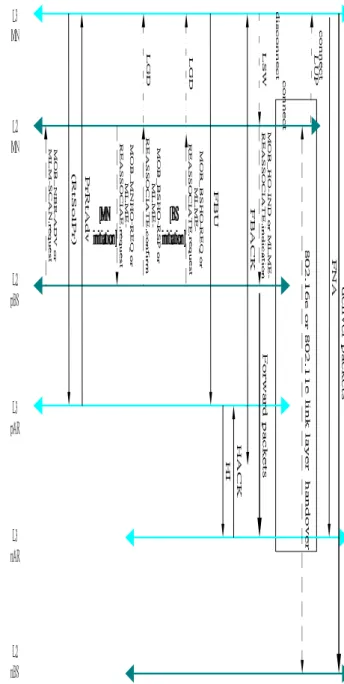
(3) Applying a two-tier network architecture to a more realistic scenario involving a mobile node’s mobility management across hybrid Wi-Fi and WiMAX wireless networks, we propose Wi-Fi networks being in the micro-cell area, WiMAX being in the Macro-cell area and consider these QOS metrics as the PHY/MAC trigger through IEEE 802.21 to make Mobile IP fast handover. The IEEE 802.21 also provides a unified framework to help MIP nodes to across the internetworking environment. We propose to making unified layer 2 abstractions in the IEEE 802.21 to support layer 3 fast handover. Then the interaction between 802.11e / 802.16e and Fast Mobile IP is presented with the primitives proposed by IEEE 802.21 for the close interaction between layer 2 and layer 3. We will combine the IEEE 802.11 and 802.16e trigger-assisted proactive fast MIPv6 handover scenario from refs. [9], [14] to provide session continuity during handover. The IEEE 802.16e and 802.11e trigger-assisted proactive fast MIPv6 handover scenario is illustrated in Fig. 3.. 4:. Mobility Management Scheme. A simple solution to mobility management would be the use of Mobile IPv6 but with move detection optimizations [13]. These optimizations include triggers from the link layer. Our mobility management scheme is based on Fig.3 to find suitable “Link Parameters” such as signal strength, velocity of mobile nodes, relative delay, service level prediction, etc. It is evident that such cross layer optimization can reduce handover latency to an acceptable range. The residential time threshold in our proposed handover scheme can be specified in “Link Parameters Change” trigger defined in the 802.21, and Link handoff triggers are analogous to the handover decision procedure in our proposed scheme. An abstract representation of the network in which call-level QoS parameters, namely call blocking and dropping probabilities are considered. We focus on the suitable mobility management schemes of our two-tier network at first. The speed-sensitive cell selection is defined to direct the mobile hosts to the appropriate cell layer according to their speeds to improve the system performance in terms of blocking and dropping probabilities [12]. The arrival and departure cases regarding mobile hosts in a two-tier cellular network are illustrated in Figure 4. There includes three types of arrival hosts in the Wi-Fi cell in terms of from neighbor Wi-Fi cells, overlaid WiMAX cell and initial session itself. The scheme used by most cellular telephone companies is location-based. A user generated in micro cell (or macro cell) is served by micro cell BS (or macro cell BS), respectively. In the overlay region, the user is served by micro cell BS if there is no enough capacity. in macro cell. The original mobility management scheme of a two-tier cellular network is illustrated in Fig 5. The process in our proposed scheme is illustrated in Figure 6. According to the arrival cases, if a filtered mobile host arrives in the Wi-Fi cell including from neighboring WiMAX cells and overlaid WiMAX cell, the scheme keeps the previous state. When a non-filtered mobile host arrives in the Wi-Fi cell including from overlaid WiMAX cell and initial session itself, and if the residential time is longer than the residential time threshold and if the WiMAX cell has enough capacity, then it will be overflowed into the WiMAX cell to reduce the handoff probability. Otherwise, it will be assigned to the Wi-Fi cell, accordingly. The overflow threshold is presented to avoid too many overflows occurred to reduce the blocking and dropping probabilities. When a non-filtered mobile host arrives in the Wi-Fi cell and the blocking and dropping probabilities of the WiMAX cell are less than the overflow threshold, it will be overflowed into the WiMAX cell. Otherwise, it will be assigned to the Wi-Fi cell, accordingly. Because the dropping of a handoff call is more unacceptable than the blocking of a new call, we add a handoff protection mechanism in scheme II that made reserves two free guard channels for handoff usage in advance.. 5:. Numerical Results 5.1: The simulation model. The simulation model is a two-tier cellular network that each WiMAX cell overlays 7 Wi-Fi cells as shown in Fig.2, and some assumptions involved in this model are stated below. There are three speed types of mobile hosts in terms of fast, middle and slow following Poisson distribution with average speeds of 40 km/hr, 20 km/hr and 5 km/hr, respectively. The cell radius of WiMAX cell and Wi-Fi cell are 3000m and 500m, respectively. The number of fast type mobile hosts is 5% of the total hosts, middle type mobile hosts occupy 15% and slow hosts occupy 80%. There are three schemes that will be investigated to evaluate the system performance in this paper Scheme O: The original scheme is described in Fig. 5. Scheme I: The proposed scheme is described in Fig. 6. Scheme II: A handoff protection mechanism is added to the scheme I where two free guard channels are reserved for handoff usage in advance.. - 612 -.
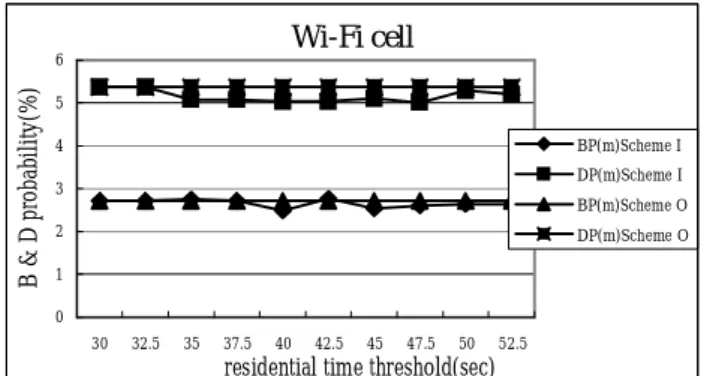
(4) 5.2: Numerical Results Fig. 7 presents the decrement of accessing times in the network. It shows that the decrement increases with increasing high residential time threshold due to the fact that fast mobiles are served preferably by WiMax cells. Due to the overflow admission control adopted in Scheme I, the decrement increases slowly for high residential time threshold. Compared with Scheme I, reduced access times in Scheme II will smaller than Scheme I due to that more guard channels are reserved for handoff calls. Fig. 8 shows the average number of handoff experienced by mobile hosts. It decreases as residential time threshold increases. The reason is that mobile hosts are more often served by WiMax cells. Fig. 9~Fig.12 presents blocking and dropping probabilities versus residential time thresholds. The system includes 7 Wi-Fi cells and a WiMAX cell overlays these 7 Wi-Fi cells. We can see that the scheme I and II performs better than the original scheme generally. Due to the handoff call protection mechanism, the dropping probability is smaller than the blocking probability in Scheme II. Due to fast mobile hosts are easily overflowed into WiMAX cell, thus blocking and dropping probabilities are higher in WiMAX cell than in Wi-Fi cell. The blocking probability increases with the increasing of residential time threshold. In addition, it increases slowly with high residential time threshold. The amount of overflow is presented in Fig. 13. The amount of overflow in Scheme II is smaller than that in Scheme I. The difference among three schemes increases with the increasing residential time thresholds.. 6:. CONCLUSIONS. In this paper, we proposed a two-tier network architecture between Wi-Fi and WiMAX networks with seamless handover and proposed a concept model of protocol stack. Although this paper does not deal with detailed handover and QoS algorithms, we concentrate on mobility management mechanisms and investigate network architecture for supporting mobility management. Our future works will involve other performance evaluation by comparing more parameters such as handover latency, packet loss, cost, throughput etc. through discussing more PHY and MAC characteristics.. REFERENCES [1]. "IEEE Standard for Information technology. - 613 -. Telecommunications and information exchange between systems Local and metropolitan area networks Specific requirements Part 11: Wireless LAN Medium Access Control (MAC) and Physical Layer (PHY) Specifications”, ANSI/IEEE Std 802.11, 1999 Edition (R2003), pp. 1-528 [2]. “IEEE Standard for Information technology Telecommunications and information exchange between systems Local and metropolitan area networks Specific requirements Part 11: Wireless LAN Medium Access Control (MAC) and Physical Layer (PHY) specifications Amendment 8: Medium Access Control (MAC) Quality of Service Enhancements ”, IEEE Std 802.11e-2005, pp. 1-211 [3]. "IEEE Trial-Use Recommended Practice for Multi-Vendor Access Point Interoperability via an Inter-Access Point Protocol Across Distribution Systems Supporting IEEE 802.11 Operation ",IEEE Std 802.11F-2003 [4]. "IEEE Standard for Local and metropolitan area networks Part 16: Air Interface for Fixed Broadband Wireless Access Systems", IEEE Std 802.16-2004,pp.1-893 [5]. "Draft IEEE Standard for Local and metropolitan area networks Part 16: Air Interface for Fixed and Mobile Broadband Wireless Access Systems Amendment for Physical and Medium Access Control Layers for Combined Fixed and Mobile Operation in Licensed Bands”, IEEE P802.16e/D11, September 2005,pp.1-688 [6]. C. Liu, C. Zhou, “HCRAS: A novel hybrid internetworking architecture between WLAN and UMTS cellular networks”, Consumer Communications and Networking Conference, 2005. CCNC. 2005 Second IEEE, 3-6 Jan. 2005 Page(s):374 - 379 [7]. N. Ramos, D. Panigrahi, and S. Dey, “Quality of service provisioning in 802.11e networks challenges, approaches, and future directions”, IEEE Network, July/August 2005, pp. 14-20. [8]. "Draft IEEE Standard for Local and Metropolitan Area Networks: Media Independent Handover Services", IEEE P802.21/D00.01,July 2005,pp.1-171. [9]. L. Dimopoulou, G. Leoleis, and I. S. Venieris, "Fast Handover Support in a WLAN Environment: Challenges and Perspectives” , IEEE Network, May/June 2005, pp. 14-20..
(5) [10]. L. Dimopoulou, G. Leoleis, and I. S. Venieris, "Analysis and Evaluation of Layer 2 Assisted Fast Mobile IPv6 Handovers in a WLAN Environment”, IEEE Symposium on Computers and Communications. ISCC 2005, pp. 327-332 [11]. Jing Nie, JiangChuan.Wen, Qi Dong, Zheng Zhou ,“A seamless handoff in IEEE 802.16a and IEEE 802.11n hybrid networks”, Communications, Circuits and Systems, 2005. Proceedings. 2005 International Conference on Volume 1, 27-30 May 2005 Page(s):383 - 387 Vol. 1 [12]. B. Jabbari and W.F. Fuhrmann, “Teletraffic modeling and analysis of flexible hierarchical cellular networks with speed-sensitive handoff strategy” IEEE Journal on Selected Areas in Communications, Vol. 15, No. 8, pp. 1539 –1548, Oct. 1997. [13]. M. Siksik, H. Alnuweiri, S. Zahir, ”Performance Evaluation of Micro-Mobility Management Using Mobile IPv6”, Internal Conference on Wireless Networks, Communications and Mobile Computing”, IEEE WirelessCom 2005, Page(s): 316- 322 [14]. H. Jang, J. Jee, Y.H. Han, S.D. Park, J.Cha,, “Mobile IPv6 Fast Handovers over IEEE 802.16e Networks”, Internet-Draft, July 2005. [15]. R. Koodli, Ed. “Fast Handovers for Mobile IPv6”, TETF RFC4068, July 2005. Fig. 1 network architecture. Fig.2 A concept model of the wireless network protocol stack. Fig. 3 IEEE 802.16e &802.11e trigger-assisted proactive fast MIPv6 handover scenario. Fig. 4 - 614 -. Arrival and departure cases.
(6) Wi-Fi cell. B & D probability(%). 6 5. BP(m)Scheme I. 4. DP(m)Scheme I. 3. BP(m)Scheme O. 2. DP(m)Scheme O. 1. Fig. 5 Original mobility management scheme. 0 30. 32.5. 35. 37.5. 40. 42.5. 45. 47.5. 50. 52.5. residential time threshold(sec). Fig.10 Blocking & Dropping probability in Wi-Fi cell with scheme I and scheme O. B & D probability(%). system 12 10 8 4 2. DP(M). 0 30. Fig. 6 Proposed mobility management scheme. 32.5. 35. 37.5. 40. 42.5. 45. 47.5. 50. 52.5. residential time threshold(sec). Fig.11 Blocking & Dropping probability in the system with Scheme II. 25 Reduced accessed time ratio(%). BP(M). 6. 20 scheme I. 15. scheme II. 10 5. Wi-Fi cell. 0 1. 2. 3. 4. 5. 6. 7. 8. 9. 10. residential time threshold(sec). Fig.7.The decrement of accessing times (by percent) in the mobile node. Av erag e h ando ff t ime s. 0.3. B & D probability(%). 8 6. BP(m). 4 2. DP(m). 0 1. 0.29. 2. 3. 4. 5. 6. 7. 8. 9. 10. residential time threshold(sec). 0.28. Scheme I. 0.27. Scheme O. Fig.12 Blocking & Dropping probability in Wi-Fi cell with Scheme II.. 0.26 0.25 30. 32.5. 35. 37.5. 40. 42.5. 45. 47.5. 50. 52.5. reside ntia l ti me thre shold(sec). system B & D p roba bili ty(% ). 5 4 BP (schemeO). 3. DP (schemeO). 2. DP (schemeI ). 150 scheme I. 100. scheme II. 50 0. BP (schemeI ). 1. 200 overflowed MN. Fig.8. The average handoff times (number) vs. residential time threshold. 30 32.5 35 37.5 40 42.5 45 47.5 50 52.5. 0 30. 32.5. 35. 37.5. 40. 42.5. 45. 47.5. 50. residential time threshold(sec). 52.5. re side nti al t ime threshold(sec ). Fig.9 Blocking & Dropping probability in the system with Scheme I and Scheme O - 615 -. Fig.13. Overflowed MN vs. residential time threshold..
(7)
數據
相關文件
Similar to the last school year, schools that have undergone ESR or FI in 2018/19 are generally able to keep pace with trends in education development and cater for students’
Wi-Fi Supported Network Environment and Cloud-based Technology to Enhance Collaborative Learning... • Curriculum is basically a lesson plan that functions as a map
Wi-Fi Supported Network Environment and Cloud-based Technology to Enhance Collaborative Learning.. Centre for Learning Sciences and Technologies (CLST) The Chinese University of
Overview of NGN Based on Softswitch Network Architectures of Softswitch- Involved Wireless Networks.. A Typical Call Scenario in Softswitch- Involved
Provide all public sector schools with Wi-Fi coverage to enhance learning through the use of mobile computing devices, in preparation for the launch of the fourth IT in
Provide all public sector schools with Wi-Fi coverage to enhance learning through the use of mobile computing devices, in preparation for the launch of the fourth IT in
Negative selection: if the antibodies of a B cell match any self antigen in the bone marrow, the cell dies. Self tolerance: almost all self antigens are presented i n
We also propose a Unified Code Management Schemes to eliminate code blocking completely and the reassignment cost will be reduced as far as possible based on CIDP.. Our schemes
