The Political Economy of
Develop-ment between China and ASEAN
States: An Emerging New Form of
Economic Integration and Political
Discrepancy
Jenn-jaw Soong
Distinguished Professor, Department of Political Science, National Cheng Kung University
Abstract
There are two major purposes of this paper. One is to analyze how mainland China maps out her development scheme of the “Major power relation strategy” via a new form of regional economic inte-gration by the implementation of the strategic framework of the OBOR. The other is to deal with the economic and political relations between mainland China and ASEAN under the framework and network of the OBOR development. Two theoretical concepts will be raised here as well. One is that mainland China is rebuilding its own economic integration regime in the region, by starting with the ASEAN region as a fundamental economic base. The other is that the OBOR development strategy will be implemented as a compre-hensive mechanism to transform mainland China’s core status and its interests in the region, which will enlarge the political discrepancy between mainland China and ASEAN.
Keywords: Mainland China, OBOR Initiative, Economic Integration,
ASEAN
I. Introduction: A New Form of Economic Integration
and Political Discrepancy?
Under the new concept of a model of “Major Power Relation Strategy (新型大國關係),” mainland China has come into a new stage of economic and political development in the Asia Pacific region. This can be considered a kind of “Walk-Out”(走出去) policy, actively pursuing mainland China’s core interests, which is totally different from the past Chinese foreign policy persistence of “hide and bide” (Taoguang Yanghui, 韜光養晦). Xi Jinping’s new strategy has started to change the regional status quo, along with shaping the regional political and economic orders in the Asia-Pacific region.1Even though mainland China does not seek to become a he-gemon in Asia-Pacific and beyond, the rising hehe-gemonic power of the China phenomenon in the region is undeniable and visible.
The major power relation strategy has given President Xi Jinping an opportunity to play a dominant and aggressive, or even provocative and coercive, role in the region, both economically and politically.2 Xi Jinping’s new model of major power relations strategy creates his own China development dream, which also is considered a great dream for the whole of China. The notion of Xi’s “China dream”
re-Alastair Iain Johnston, “How New and Assertive Is China’s New Assertiveness?”
International Security, Vol. 37, No. 4, Spring 2013, pp. 7-48.
Suisheng Zhao, “A New Model of Big Power Relations? China-US Strategic Rivalry and Balance of Power in the Asia-Pacific,” Journal of Contemporary
China, Vol. 23, Issue 89, October 8, 2014, <http://dx.doi.org/10.1080/10670
presents a significant intention of economic and political expansion. Of course, this walk out policy on the basis of major power relation strategy challenges U.S. power and American allies in the Asia-Pacific region.
As found at the November 2014 Asia-Pacific Economic Coope-ration (APEC) Summit in Beijing, two points should be raised about the importance of mainland China’s core interest of power. One is that the era of the G2 (U.S. and mainland China) is coming, which leaves Japan far behind. The other is that mainland China has made a great effort to promote the FTAAP (Free Trade Area in Asia-Pacific) in order to maintain the key position. The promotion of the FTAAP will counter the importance of the Trans-Pacific Partnership (TPP) and include most of the members of the TPP and RCEP (Regional Comprehensive Economic Partnership).3 Geographically speaking, the Asia-Pacific region has become the major arena of two great powers. Mainland China has started to walk out from focusing on its domestic economy to the whole Asia-Pacific region, making the China market the core for regional economic integration. In contrast, the U.S. has returned to the Asia-Pacific region out of the Arab world, i.e. the Middle East and Central Asia, by way of military and political consideration with less economic interest, perhaps with a kind of Cold War strategy of containment.
Nowadays, mainland China has strived to obtain regional domi-nance in the Asia-Pacific region by way of an economic integration
TPP is also indicated as the Trans-Pacific Strategic Economic Partnership Agree-ment. Regarding the TPP, see Evelyn S. Devadason, “The Trans-Pacific Partnership (TPP): the Chinese Perspective,” Journal of Contemporary China, Vol. 23, No. 87, January 17, 2014, pp. 462-479, <http://dx.doi.org/10.1080/10670 564.2013.843890>.
mechanism that is perfect for its geo-economic development strategy. In order to achieve the goals of being a regional major power and being a core economy, mainland China has actively roped ASEAN states into the regional economic integration with closer trade, big investment, and more financial assistance as the first key step to mar-ching out. As a matter of fact, accompanying its economic rise, ma-inland China increasingly has behaved in a peaceful and constructive manner towards the development of ASEAN countries. Trying to tie with the ASEAN economy as a greater economic community between mainland China and ASEAN is intended to confirm China’s dream of being true to the Asia-Pacific region.
Why are ASEAN states so crucial for mainland China? First, ASEAN states connected to southern China territory share adjacent economic benefits. Two, ASEAN contains ten countries, as well as more than 600 million people, which makes it a big market. Three, mainland China has enjoyed long-term conventional friendly diplomatic relations with ASEAN. Four, mainland China is the first country outside ASEAN to sign the Treaty of Amity and Cooperation in Sou-theast Asia (TAC). Finally, ASEAN countries supply raw materials that are badly needed for mainland China’s development.
Clearly, mainland China aggressively has engaged a new form of China-centered regime for regional economic integration, as a kind of new core Continental Economic Empire. Building and resuming a great Chinese economy is intended to craft a new hopeful dream for all Chinese, both economically and politically. In order to construct and implement a new form of economic integration in the region, mainland China has initiated a regional strategy framework of “One Belt and One Road” (OBOR, 一帶一路) in order to gain the core hub status of the Asia-Pacific region, which could be carried out as an economic network instrument of “mutual connectivity and mutual
communication”(互聯互通).
There are two major purposes of this paper. One is to analyze how mainland China has mapped out a development scheme ap-proaching the “major power relation strategy” via a new form of re-gional economic integration regime by way of implementation of the strategic framework of the OBOR. The other is to deal with the eco-nomic and political relations between mainland China and ASEAN under the framework of the OBOR development. Two theoretical concepts will be raised as well. One is that mainland China is rebuilding its own economic integration regime in the region, originally via the ASEAN region, and the other is that the OBOR development strategy will be implemented and applied as a mechanism to transform mainland China’s core status and interests in the region in order to confront the U.S.
II. The Strategic Development Scheme of One Belt and
One Road: Political and Economic Intentions
Xi Jinping came to the power as the president of the PRC in March 2013. Politically, Xi has made the construction of Silk Roads a priority for mainland China’s foreign policy, which is recalled easily with the simple catchphrase: “One Belt and One Road (OBOR).” Economically, Xi has taken the Belt as a network of overland corridors by building new roads and rail links from its eastern seaboard to far-flung regions in western and southwestern regions in China. Broadly speaking, the OBOR initiative is aimed at restructuring the Eurasian economy and resuming geo-political core power. The idea of the OBOR is to build a comprehensive trans-Eurasia network of economic connectivity that will sustain mainland China’s growth momentum and reshape the Eurasian regional order into the economic and geo-political gravitational pull of mainland China.4
Simply put, on the economic side, the OBOR initiative, on the surface, is soft power to connect its neighbor countries to the heartland of China with highways, railroads, and pipelines. On the political side, however, the OBOR strategy would be treated as hard power to expand mainland China’s economic power across the Eurasian landmass and resume the historic glory of the Han and Tang dynasties. Nevertheless, from what we can observe at this initial moment, the OBOR initiative is all about economic connectivity, rather than ma-inland China engaging in active diplomacy, using the New Silk Roads to reach beyond Washington’s geopolitical influence.
In 2013, Xi Jinping, the President of PRC, put forward the two concepts of “Silk Road Economic Belt” and “21stCentury Maritime Silk Road” during his visits to Central Asia and Southeast Asia.5The Silk Road Economic Belt is a land-based belt from China via Central Asia and Russia to Europe, while the 21st Century Maritime Silk Road is a sea route from the South China Sea, via the Strait of Malacca, to India, the Middle East, and East Africa. The OBOR ini-tiative has greatly helped to promote mainland China’s cooperation and connectivity with countries from Central Asia and Southeast Asia. The OBOR blueprint is characterized by openness and reciprocity to all countries along the routes. Also, mainland China welcomes
David Arase, “China’s Two Silk Roads: Implications for Southeast Asia,”
ISEAS Perspective (Singapore), No. 2, January 22, 2015, pp. 1-2, <http://www.
iseas.edu.sg/documents/publication/ISEAS_perspective_2015_02.pdf>. The belt initiative to revive the ancient Silk Road from China via Central Asia and Russia to Europe was put forward by President Xi Jinping during a visit to Kazakhstan in September 2013. Kazakhstan and many other countries have responded positively to the initiative. Kazakhstan hopes to link her own deve-lopment plan to the initiative and become a major passageway in Eurasia. Mainland China and Kazakhstan have been cooperating well within the framework of the belt initiative.
all sides’ participation in the plan and sharing of the benefits. Xi’s dream on the OBOR development is to emulate the historic silk roads with connectivity from China to the Mediterranean, as well as building a transportation corridor from the Pacific to the Baltic Sea.
Indeed, “connectivity” and “cooperation” are the key concepts of Xi’s OBOR initiative to prioritize infrastructure. Only with good infrastructure and traffic connectivity among countries can there be convenient transportation and closer interaction of people-to-people exchanges for trade, service, investment, and even monetary coope-ration. Reviving the ancient Silk Road must take shape with a focus on infrastructure and connection as the fundamental construct. The OBOR initiative will start with and improve connectivity and infra-structure along the routes. The basic logical concept for revival of the Silk Roads is “no road, no flow, and no development.” Only by building a road will the economy increase and reach out along the trade route.
Generally speaking, mainland China’s OBOR initiative is much more ambitious than the Marshall Plan, which has been called the “European Recovery Program.”6Nevertheless, China is only a rising power, facing tremendous security and sociopolitical challenges from
The Marshall Plan (officially called the European Recovery Program, ERP) was the American initiative to aid Europe, in which the U.S. gave $ 17 billion (ap-proximately $ 160 billion in current dollar value) in economic support to help rebuild European economies after the end of World War II. The plan was in operation for four years, beginning in April 1948, in order to rebuild war-devastated regions, remove trade barriers, modernize industry, and make Europe prosperous again. See Charles L. Mee, The Marshall Plan: The Launching of
the Pax Americana (New York: Simon & Schuster, 1984); Michael J. Hogan, The Marshall Plan: America, Britain, and the Reconstruction of Western Europe, 1947-1952 (Cambridge: Cambridge University Press, 1989), pp. 1-500.
the U.S. global hegemony. The OBOR initiative is still distrusted by many countries in the region, even if its intentions are benign. China’s neighboring countries will wait and see how the OBOR initiative works and if it is advantageous.
The OBOR and the Marshall plan are similar in that they export capital, technology, and capacity to other countries. That is why the OBOR initiative is seen as China’s “Marshall Plan.”7Yet, the OBOR initiative is quite different from the U.S. Marshall Plan in terms of its nature and purpose. In nature, mainland China is a socialist market-economy state approaching a major power status while the U.S. is a capitalist and democratic state on the seat of global hegemony. In purpose, the OBOR initiative is open and worldwide, having a greater global impact than the Marshall plan, which was limited to Europe with a regional influence.8For mainland China’s side, the OBOR is used for achieving a win-win situation between mainland China and other partners. Mainland China emphasizes the OBOR initiative is open to all interested countries to join, regardless of their regime types, unlike the Marshall Plan, which excluded the communist coun-tries. Besides, it is estimated that the total value of mainland China’s OBOR initiative could reach US$ 21 trillion.
There are four major financial pillars for supporting the OBOR development, the Asian Infrastructure Investment Bank (AIIB), Silk Road Fund, New Development Bank of BRICs, and the Shanghai Cooperation Organization (SCO) Development Bank. All these, except
Michele Penna, “China’s Marshall Plan: All Silk Roads Lead to Beijing?” The
World Politics Review, December 9, 2014, <http://www.worldpoliticsreview.
com/articles/14618/china-s-marshall-plan-all-silk-roads-lead-to-beijing>. Dingding Chen, “China’s Marshall Plan Is Much More,” The Diplomat, November 10, 2014, <http://thediplomat.com/2014/11/chinas-marshall-plan-is-much-more/>.
the SCO development bank, were established in 2014 with a massive contribution from mainland China. Therefore, in 2014, mainland China’s foreign policy can simply be described as a year of “big strokes” (da shou bi, 大手筆) that mainly lie in monetary terms.9 Mainland China has pledged US$ 10 billion and US$ 41 billion for the BRICs Development Bank and the BRICs Emergency Fund, re-spectively. Mainland China also sponsored an initial contribution of US$ 50-100 billion for the AIIB as well as contributing US$ 40 billion to establish the Silk Road Fund. In December 2014, mainland China also provided a US$ 10 billion Chinese credit line for infra-structure development, a US$ 3 billion Chinese equity investment fund. All over these, mainland China has put fo rward practical mea-sures to boost cooperation on security, trade, investment, finance, agriculture, infrastructure, and people-to-people exchanges.
Indeed, Asia has a massive demand for infrastructure funding. The Asian Development Bank (ADB) has pegged the capital need at a minimum of US$ 8 trillion from 2010 to 2020 for Asian infrastructure investment, which indicates annual demand on Asian infrastructure investment at least US$ 800 billion. Yet, the ADB can only supply new loans for Asia of about US$ 13 billion annually. The existing international financial system is insufficient to meet this huge demand. This gap definitely will give mainland China ample scope to play a crucial role in the field of development bank operation.10
Xie Tao, “China’s Foreign Policy in 2014: A Year of Big Strokes,” The Diplomat, December 27, 2014, <http://thediplomat.com/2014/12/chinas-foreign-policy-in-2014-a-year-of-big-strokes/>.
Yuge Ma, “The Environmental Implication of China’s New Bank,” The Diplomat, December 5, 2014, <http://thediplomat.com/2014/12/the-environmental-implica-tions-of-chinas-new-bank/>.
The AIIB, with 21 initial nation members, is worthy of mention for its regional influence. AIIB will lend money to build roads, mobile phone systems, and other forms of infrastructure in poorer parts of Asia. The AIIB should launch and be running before the end of 2015 under mainland China’s lead with 50% of the ownership. Mainland China is creating a new development bank for Asia with the purpose of competing with the ADB. Although mainland China is the biggest economy in Asia, the ADB is still directed by Japan, with twice the voting share of mainland China, so the ADB’s president has always been Japanese. It is anticipated that mainland China will help supply the capital of US$ 100 billion for infrastructure construction. Compared to ADB capital base of US$ 160 billion and World Bank capital base of US$ 223 billion, the AIIB capital base is relatively small but still a helpful boost. Yet, the ADB and World Bank loans mostly support environmental protection and gender equality, in contrast to mainland China’s fund on infrastructure.11Economically, the AIIB is considered as complement to the World Bank and the ADB, rather than a rival, and as crucial infrastructure integration. Nevertheless, politically, mainland China will use the new bank to expand its influence at the expense of Japanese and U.S. power in the Asia-Pacific region. Also, mainland China via AIIB will form a new international standard of foreign aid against ADB and WB.
Finally, some phenomena could be seen here. One, the OBOR initiative is entering a new development stage of more practical ful-fillment against the World Bank and ADB. Two, the OBOR initiative could be open to all of the countries for more infrastructure building to expand market scale. Three, the OBOR initiative would speed up
S. R., “Why China Is Creating A New World Bank for Asia?” The Economist
Explains, November 11, 2014,
the economic development via strengthening cooperation with the countries involved.12Four, the OBOR initiative spurs mainland China’s overseas investment growth because the OBOR policy will provide many chances for infrastructure-related Chinese business amid weak foreign demand.
III. The Development of Economic Integration Between
Mainland China and Southeast Asian Countries
un-der the OBOR Policy
Looking at the economic relations between mainland China and ASEAN, mainland China has been ASEAN’s largest trading partner since 2009 and ASEAN has been mainland China’s third largest trading partner since 2011. Bilateral trade volume reached US$ 443.6 billion in 2013, accounting for 14% of ASEAN’s total trade and re-presenting an increase of about 9.7% year on year.13 Moreover, bilateral trade between ASEAN and mainland China grew 7.3-fold from US$ 54.7 billion in 2002 to US$ 400.1 billion in 2012, and bilateral trade volume is expected to reach US$ 500 billion in 2015 and US$ 1 trillion in 2020. In addition, two-way investment between mainland China and ASEAN should reach US$ 150 billion dollars by 2020.14
“Silk Roads Initiatives Enters New Phase: Think Tank,” Xinhua, December 15, 2014, <http://news.xinhuanet.com/english/china/2014-12/15/c_133856803.htm>; “China’s Belt and Road Initiatives Open to World: Expert,” Xinhua, December 4, 2014, <http://news.xinhuanet.com/english/indepth/2014-12/04/c_133832704. htm>; “China to Speed Up Construction of New Silk Road: Xi,” Xinhua, November 6, 2014, <http://news.xinhuanet.com/english/china/2014-11/06/ c_133770684.htm>.
“ASEAN-China Trade Expected to Reach US$ 500 Bn by 2015,” Xinhua, No-vember 12, 2014, <http://news.xinhuanet.com/english/china/2014-11/14/ c_133788265.htm>.
Basically, there are four impressive and crucial developments for ASEAN that have attracted mainland China to be involved with ASEAN for economic and political purposes. First, there is the de-velopment of ASEAN, established in 1967. The most important econo-mic issue is the formation of the ASEAN Free Trade Area in 1992 and the ASEAN Economic Community (AEC) that will be forming in 2015.15The development of the ASEAN economy effectively has been drawing worldwide attention. According to the ASEAN Secre-tariat, 82.1% of required measures for the ASEAN Community have been completed so far. The envisaged single ASEAN market will cover some 620 million people with a combined GDP of US$ 2.5 trillion and trade of US$ 1 trillion in 2015.16
Second is the implementation of Greater Mekong Subregion (GMS) economic cooperation, initiated by the ADB and always domi-nated by Japan. The GMS is the major economic corridor connecting mainland China and ASEAN markets. Via GMS, mainland China can easily integrate the economy of the Indochina Peninsula.
“ASEAN-China Trade Expected to Reach US$ 500 Bn by 2015.”
Sanchita Basu Das, ed., Can the ASEAN Economic Community be Achieved by
2015: Challenges for Member Countries & Businesses? (Singapore: ISEAS
Publishing, 2012), pp. 1-347.
“ASEAN Summit Ends with Reaffirmed Commitment to Community by 2015,”
Xinhua, November 14, 2014,
<http://news.xinhuanet.com/english/bilin-gual/2014-11/14/c_133790205.htm>; ASEAN Secretariat, “Chairman’s Statement of the 25th ASEAN Summit: Moving Forward in Unity to a Peaceful and Prosperous Community,” Association of Southeast Asian Nations, November 12, 2014, <http://www.asean.org/images/pdf/2014_upload/Chairman%20Sta-tement%20of%20the%2025th%20ASEAN%20Summit.pdf>; Jon Fernquest, “ASEAN Economic Community 2015: Ready or not, here it comes,” Bangkok
Post, January 6, 2015, <http://www.bangkokpost.com/learning/work/454697/
Third is the formation and domination of Regional Comprehensive Economic Partnership (RCEP), which is based on ASEAN plus 6 at the original bilateral FTA framework of “ASEAN plus one.” Mainland China intends to use RCEP against the U.S.-led TPP.
Fourth is the promotion of a China-ASEAN FTA since January 1, 2010, which provides zero-tariff treatment for over 90% of products for both sides. The China-ASEAN FTA is used fully by mainland China as an instrument of interface with the AEC, RCEP, and GMS development.17 The China-ASEAN FTA has become an effective economic integration mechanism toward the operation of GMS, AEC, and RCEP. Simply put, the pragmatic application of the China-ASEAN FTA can connect well with the grand scheme of the OBOR, which will tie ASEAN countries more closely to mainland China.
As noted above, Xi articulated the idea of a 21stCentury Maritime Silk Road in order to connect the Pacific and Indian Oceans, or more specifically, China’s coastline with Southeast Asia, the Indochina subcontinent, the Persian Gulf, and the East Coast of Africa.18 Xi’s 21st Century Maritime Silk Road Initiative has gained a positive re-sponse and considerable attention from ASEAN countries. Mainland China intends to build from a continental power into a modern maritime power following the renowned ancient Chinese navigator Zheng He’s(鄭和)seven-time fleet visit routes for economic and political purposes. Mainland China wants to build hard and soft
mari-Kuo-hsiang Sun, “Review of Beijing’s Neighborhood Policy: Analysis of, and Prospects for, Relations between Mainland China and ASEAN Countries,”
Pros-pect Journal, No. 12, October 2014, pp. 119-152.
“Countries Share Dream of New Silk Road for the 21stCentury,” China Daily, September 15, 2014, <http://www.chinadaily.com.cn/cndy/2014-09/15/con-tent_18596503.htm>.
time infrastructure through the Indo-Pacific area, including new ports and special economic zones around sea routes. Indeed, mainland China has announced a fund of US$ 500 million to promote the Mari-time Silk Road in Southeast Asia.19The 21st Century Maritime Silk Road is also called a “Diplomatic Strategy of Zheng He Style.”
Basically, there are many advantages for China-ASEAN economic cooperation, such as highlighting a joint-venture logistics base, streng-thening connectivity via highways, railways, high speed rail, ports, air routes, and oil and gas pipelines. The construction of infrastructure is a highlight of the economic and trade cooperation between mainland China and ASEAN. Mainland China has put forward practical measures to boost cooperation with ASEAN members on security, trade, in-vestment, finance, agriculture, infrastructure, and people-to-people exchanges, with a view to the long-term development of economic integration. In doing so, mainland China’s version of the Marshall Plan has been driven into Southeast Asia.
On the one hand, the Association of Southeast Asian Nations (ASEAN) will benefit a lot from the 21stCentury Maritime Silk Road since ASEAN is the first stop of the sea route from the South China Sea via the Strait of Malacca to India, the Middle East, and East Africa. On the other hand, the Southward Land Silk Road will also enclose the GMS region and South Asia by way of Pan-Asia rail and transportation infrastructure of logistics bases. Via land and sea silk roads, China-ASEAN regional connectivity will become stronger with the fast-developing transport network and several commendable proposals initiated by mainland China under the implementation of
C. Raja Mohan, “Chinese Takeaway: One Belt, One Road,” The Indian Express, August 13, 2014, <http://indianexpress.com/article/opinion/columns/chinese-takeaway-one-belt-one-road/>.
OBOR.
Land connectivity plus maritime cooperation between ASEAN and mainland China will constitute a vital link in connectivity and reciprocity. Mainland China’s proposal to build a 21stCentury Maritime Silk Road will be also a potential boost and catalyst for infrastructure development in the ASEAN region. In the meantime, it fits into ASEAN’s own integration and connectivity strategies for the ASEAN Economic Community, which should be complete by the end of 2015.20 The establishment of the ASEAN Economic Community in 2015 will be a milestone of ASEAN economic integration.
After well-constructed infrastructure under the OBOR investment, mainland China’s two Silk Roads, regional trade will grow rapidly between mainland China and ASEAN. This momentum will match the development stage of upgrading the China-ASEAN FTA from the “Golden Decade” of 2002-2012 to the new stage of the “Diamond Decade” (2012-2022) to accelerate trade liberalization and economic integration of the China-ASEAN FTA. Undoubtedly, expanding the Maritime Silk Road will enhance trade and investment between ma-inland China and ASEAN.
Just as mainland China and ASEAN enjoyed a “Golden decade” in their relations after they forged a strategic partnership in 2002, the year 2013 also marks the beginning of a “Diamond Decade.” Both sides will jointly work to build a “community of common destiny”(命運共同體)to share peace and prosperity.21 In other
“21stCentury Maritime Silk Road to Benefit ASEAN: experts,” Xinhua, December 13, 2014, <http://news.xinhuanet.com/english/china/2014-12/13/c_133852978. htm>.
words, mainland China vows to build a community of common destiny with ASEAN as a result of security considerations and fulfillment of the “China Dream” in order to restore Sino-centric Asian order.22 This is a vision of Xi Jinping for ASEAN members to establish a China-centered regional community by way of soft power. As the sense of community of common destiny takes deep root in ASEAN neighbors, the China-centered regional order will confirm and enhance its geo-economic and geo-political advantages.
Under the scheme of the OBOR development, four major tasks must be considered for mainland China and ASEAN development: building a common destiny with strategic mutual trust, deepening economic and trade cooperation with an upgraded China-ASEAN free trade area, enhancing connectivity with the 21stCentury Mari-time Silk Road, and working toward an ASEAN community with practical cooperation.23For all these tasks, mainland China’s leadership strongly believes that mainland China and ASEAN would work together to cope with risks and challenges and strive to maintain stable economic cooperation and healthy development, which are the common and supreme interests of all the parties. Furthermore, this accomplishment will be taken as an ideal development model for the other regional countries to coordinate closely with the OBOR policy. During the Asia-Pacific Economic Cooperation (APEC) Summit
Xinhua, November 13, 2014, <http://news.xinhuanet.com/english/china
/2014-11/14/c_133788239.htm>.
David Arase, “China’s Two Silk Roads: Implications for Southeast Asia,” p. 7. These four issues were discussed at the first ASEAN Forum 2014 which was held at Hong Kong’s Island Shangri-La Hotel on December 13, 2014. These four issues at forum are so important so that the author would like to take these issues as the major tasks for mainland China and ASEAN countries to work to-gether.
in Beijing in November 2014, Xi Jinping announced China will con-tribute US$ 40 billion to set up a Silk Road Fund, which will support infrastructure, resources, industrial cooperation, financial cooperation, and other projects among countries along the “Belt and Road.” The most favored region from the Silk Road Fund will be ASEAN. The ASEAN countries will benefit a lot from the Fund support. In fact, mainland China and ASEAN have been cooperating and coordinating well within the framework of the Belt initiative.
Malaysia is ready for greater cooperation and collaboration with China and the countries along the maritime silk road, such as port economic connectivity in the process between Qinzhou Port (of China) and the Kuantan Port (of Malaysia). The Kunming-Singapore railway and the proposed High Speed Train between Kuala Lumpur and Sin-gapore are possible projects that would derive benefits from the Mari-time Silk Road Initiative.24 Cambodia also has made joint effort to create an upgraded China-ASEAN FTA and take a positive view to-wards the building of the Silk Road. Singapore thinks the OBOR is the most important initiative in the Asia-Pacific region, which will give a strong force to facilitate regional integration as well as intensify bilateral economic relations. Under the Maritime Silk Road’s pro-motion, closer bilateral cooperation will revitalize and reinforce the China-ASEAN economic architecture of “community of common destiny.”
A proposal made by Li Keqiang, the Premier of PRC, during
Mainland China is currently in high-speed rail negotiations with 28 nations, most of which are along the routes, with total length of track over 5,000 km on the agenda. See “Malaysia Ready for Greater Cooperation with China in Maritime Silk Road: Former Ambassador,” Xinhua, December 13, 2014, <http://news.xinhuanet.com/english/china/2014-12/13/c_133852521.htm>.
the East Asian Summit on regional cooperation held in Nay Pyi Taw, Myanmar, in November 2014, to expedite interconnectivity with ma-inland China’s diplomatically prioritized neighbors in the ASEAN bloc is expected to boost bilateral relations and generate new mo-mentum for growth. Premier Li stressed that interconnectivity was a prerequisite for healthy regional trade and for investment liberali-zation. Li also signed a US$ 10.6 billion financial deal to build the Thai segment of a railway that will connect Bangkok to China. Li pledged US$ 3 billion at the 5thGMS Economic Cooperation Summit to finance infrastructure connectivity. Furthermore, mainland China and ASEAN countries are ready to upgrade their partnership in the upcoming “Diamond Decade,” which would bring more benefits to their citizens and make further contribution to regional development. Moreover, mainland China has made a firm offer of over US $20 billion in loans to support Southeast Asian interconnectivity, which includes a preferential loan worth US$ 10 billion for the ASEAN member bloc and a US$ 10 billion loan, set up by the mainland China Development Bank, for regional infrastructure de-velopment.25The financial support from mainland China was welcomed by ASEAN, not just for improving infrastructure, but also for economic growth, the success of which may show further that China-ASEAN cooperation in building interconnectivity can truly improve infra-structure, boost regional economic development, and create jobs.
Most important, three fundamental pillars of infrastructure go-vernance between mainland China and ASEAN will focus on trade, interconnection, and transportation. The AIIB and the Silk Road
“News Analysis: Interconnectivity Building to Harness China-ASEAN Relations,”
Xinhua, November 14, 2014, <http://news.xinhuanet.com/english/china/
Fund, with a total amount of capital of up to US$ 140 billion, would assist with the capital bottleneck faced by ASEAN countries. Besides, mainland China’s Reform and Development Bank Council is con-sidering investment of as much as US$ 800 billion over the next ten years for the two Silk Roads of the OBOR.26This huge infrastructure investment capital contribution from mainland China will be helpful in breaking the bottleneck in ASEAN’s connectivity by building a financial platform. If implemented effectively in ASEAN, the OBOR, or two Silk Roads, could be the vehicle of cooperation on trade, in-terconnection, and transportation infrastructure.
Currently, mainland China and ASEAN countries are striving for economic cooperation on infrastructure construction and trans-portation. This would ensure sufficient and smooth sea, air, and land transportation links; enhanced planning and construction in telecom-munications, electric power, and Internet infrastructure; and improved convenience in customs clearance and in market regulation, supervision, and standardization.
This interconnection is a pillar for China-ASEAN relations in the future for business to business, people to people, and market to market exchanges under the implementation of telecommunication network development, which could create new growth opportunities on internet of things (IOT) and logistics operations for the entire China-ASEAN market.
China-ASEAN friendly cooperation has maintained sustainable and stable development, and it can be used as a good example of
re-“The Chinese Premier’s US$ 140 Billion Trips Abroad,” China Development
Gateway, December 26, 2014,
gional cooperation in East Asia. The strategic partnership between mainland China and ASEAN has entered a new stage that provides more treasured opportunities for their comprehensive cooperation. The PRC government has placed enhancing the China-ASEAN rela-tionship as a priority in its neighborhood diplomacy in order to tie economic integration and to ameliorate the “China Threat.” Mainland China firmly supports the building of the ASEAN Economic Com-munity and supports ASEAN’s leading role in East Asian cooperation because of the fitness with her China’s pragmatic economic interest as well as its invisible political purpose.
In addition, the China-ASEAN plan also highlights the progress of agreement negotiations on the Regional Comprehensive Economic Partnership (RCEP), which would be built upon the ASEAN Plus China Free Trade Agreements as the core platform, rather than upon the ASEAN Plus One used for the other five countries, such as Japan, Korea, India, Australia, and New Zealand. Under such a circumstance, mainland China would enjoy domination of the RCEP as the hub economy as the result of the close link between mainland China and ASEAN and the deeply rooted development of GMS.
On the ASEAN side, the RCEP promulgation will further con-tribute to economic integration and equitable economic development and will strengthen economic cooperation among participating coun-tries. The ASEAN countries also agreed to accelerate negotiations on RCEP for greater economic integration in East Asia. Moreover, ASEAN emphasized underscored the value of regional economic in-tegration and an encouraging process toward further trade liberalization, including the upgrading of the China-ASEAN Free Trade Area (CAFTA) as well as ASEAN Plus One FTA. Doing it this way, the ASEAN economy would not be dominated fully by mainland China and would enjoy relative economic autonomy from mainland China.
IV. The Development of Political Disparity and Economic
Security between China and Southeast Asian
Coun-tries under the OBOR Policy
The development on political disparity and economic security in China-ASEAN political relations can be discussed in two levels of attributed analysis. One is at the international level and the other is at the China-ASEAN level of political consideration. The former will be more concerned with political disparity and core interests be-tween mainland China and the U.S. in regards to ASEAN, while the latter will be more concerned with economic security and autonomy between mainland China and the ASEAN countries. Political dis-crepancy here will be the impact of political disparity and economic security. Political disparity denotes the conflict of national sovereignty and political interests. Economic security is defined as economic ad-vantage plus interdependence and integration, less economic depen-dency.
First of all, at the level of International confrontation between China and the U.S. in regards to ASEAN, it can be understood that mainland China intends to resume its historical regional core power against American hegemonic power in the Asia-Pacific region. The grand scheme of OBOR development could be considered a great strategy of mainland China approaching the level of a regional core power, resuming its historical glorious status. Even though the OBOR development brings economic advantages and enhances mutual econo-mic integration, the ASEAN countries still are insecure about too much economic dependence on mainland China decreasing their econo-mic autonomy from mainland China. Especially, since the OBOR strategy is inspired by China’s rise to great power status, the so-called Chinese form of the Marshall Plan is full of political considera-tions.27
Of China’s neighbors, only Southeast Asia has had close historical and diplomatic relations with China. Also, ASEAN is growing its centrality in a rising Asia that China expects to embrace for deve-lopment and security.28Without holding and stabilizing its southern backyard, mainland China likely would be constrained in further out-ward development. So, the meaning of Southeast Asia to mainland China is not only economic interests, but also political purposes, in terms of security, diplomacy, and even military deployment.29Naturally, Southeast Asia has become a geographic fortress for great powers. It also has become an economic and political arena for mainland China, the U.S., and even Japan to compete and cooperate. Of course, politically and diplomatically, the ASEAN countries will not totally lean towards and depend much on mainland China, but they will make effort to approach the U.S. and Japan for some interests of ex-change. Only by applying equal distance and a balance of diplomacy toward m ainland China and the U.S. can the ASEAN countries gain not only a balance of the two powers but also acquire extra economic and political advantages from both sides.
In some sense, under globalization, the ASEAN region has become the security foundation of mainland China to stretch its in-fluence in Asia. To stabilize and ally with the ASEAN region would give mainland China considerable opportunity of reaching the first step of regional hegemony. The OBOR initiative could provide a
Michele Penna, “China’s Marshall Plan: All Silk Roads Lead to Beijing?” Benjamin Ho, “ASEAN’s Centrality in a Rising Asia,” RSIS Working Paper (Singapore), No. 249, September 13, 2012, pp. 1-39, <http://www.rsis.edu.sg/ wp-content/uploads/rsis-pubs/WP249.pdf>.
Mely Caballero-Anthony, “Understanding ASEAN’s Centrality: Bases and Pros-pects in an Evolving Regional Architecture,” The Pacific Review, Vol. 27, No. 4, June 13, 2014, pp. 563-584.
sound foundation for the ASEAN countries to be tied closely with mainland China on economic security as well as enhancing economic interdependence in exchange for the suspicious anxiety of political threat. Under the OBOR initiative, mainland China will move on more infrastructure investment and donate foreign aid to the ASEAN countries to compete with the American rebalancing policy in Asia and containment strategy.
From the view of geo-politics, mainland China’s eastward de-velopment to the Pacific has been blocked by an American alliance with the first and second military defense-line of island chains along the China coast line. This policy was marked as “containment” during the Cold War. In the post-Cold War period, the entity of mainland China is still treated as an enemy in the Asia-Pacific region, psycho-logically and politically.30Faced with these maritime challenges from the U.S. rebalancing policy and treaty of Mutual Cooperation and Security between the U.S. and Japan, if mainland China would like to escape the eastward obstacles of U.S. force, southward development to Southeast Asia and westward expansion become crucial. At a result, it is understandable that mainland China has brought up geo-political regional strategy on OBOR and especially concentration on Southeast Asia as a milestone for achieving OBOR economic empire. In order to prevent U.S. and Western powers from dominating Southeast Asia, mainland China has claimed that Asian affairs should not be intervened in by non-Asian countries and that Asian security should be protected by Asian countries, accompanied by the Chinese version of the “Monroe Doctrine”(門羅主義), which seems to be
Biwu Zhang, “Chinese Perceptions of US Return to Southeast Asia and the Prospect of China’s Peaceful Rise,” Journal of Contemporary China, Vol. 24, No. 91, June 25, 2014, pp. 176-195.
kind of Chinese “New Asian Security Strategy”(亞洲新安全觀).31 The Chinese mode of Monroe Doctrine is paralleled by its “Major Power Relation Strategy” as well as “Walk-out Policy.” The ASEAN region has become the target for mainland China’s Monroe Doctrine against the American rebalancing policy and psychological containment policy in Asia. Under the doctrine, the ASEAN region is treated as a determined object by mainland China rather than a deciding subject. Deep inside of its strategic thought, mainland China would like to adopt its own “Monroe Doctrine” in Southeast Asia to kick the U.S. out of Asia, especially the ASEAN region. On the other hand, mainland China h as included the ASEAN region under her protection against American power so that China’s defense line would move from the southern border territory into the Indo-China Peninsula.32Furthermore, using the 21stCentury Maritime Silk Road from the South China Sea to the Strait of Malacca and onward to the Indian Ocean would firmly protect mainland China’s core interests on the peninsula and would create a defense security frontline into the sea area. Clearly, the Monroe Doctrine under the OBOR strategy would fulfill mainland China’s economic and political purposes in the ASEAN region against the U.S. and Japan’s influence. This can be seen as the first level political discrepancy on economic security and political confrontation among regional great powers in the ASEAN region.
Last but not least, there is a seeming confrontation and competition between mainland China and Japan investment in the ASEAN region.
The Monroe Doctrine, published in 1823, reveals the attitudes of the U.S. back then, such as those against Europe’s great powers colonizing America or Europe’s right to set foot in America or Mexico.
Roger Cohen, “China’s Monroe Doctrine,” The New York Times, May 8, 2014, <http://www.nytimes.com/2014/05/09/opinion/cohen-chinas-monroe-doctrine. html?_r=0>.
In the past, the whole ASEAN economy was dominated by Japan in terms of trade, investment, financial support, and even foreign aid (ODA). Yet, since the new century was born, primarily after 2010 with the start of the China-ASEAN FTA, the influence of mainland China’s power in the regional economy gradually has surpassed Japan’s. Under the development scheme of the OBOR, the AIIB has been taken as a financial instrument by mainland China to compete with the role of the ADB, dominated by Japan, in the ASEAN region, chiefly in the GMS development.
In addition, at the China-ASEAN level of bilateral relations, the ASEAN countries also have faced several severe challenges from mainland China beyond economic security, such as the high speed rail (HSR) expansion policy, a forming perception of a tribute system (or tutelage system) between suzerain and vassal states, and sovereignty disputes in the South China Sea. Especially, the good transportation infrastructure linkages can be thought of as a crucial and pragmatic tactic for mainland China to embrace the ASEAN region.
China has approached the ASEAN region with a new diplomatic strategy of high speed rail expansion in order to reach this area quickly, as well as form ties with this area for economic integration. The Pan-Asia HSR has been planned to cover the ASEAN region, via Yunnan to Vietnam, Kampuchea, Thailand, Malaysia, and Sin-gapore. Since 2009, mainland China has emphasized its HSR con-struction stretching out to neighbors. The HSR diplomacy is used to construct and serve the grand scheme of the OBOR development. Additionally, the highway construction from Kunming, Yunnan, to Bangkok, Thailand, was completed at the end of 2013. Aside from this, the highway also connects from Nanning, China, to Hanoi and then to Ho Chi Minh city, Vietnam. This highway line is also accom-panied by rail construction that will expand to Phnom Penh and
Bang-kok or Vientiane, Laos. More superhighways are under construction between mainland China and the Indochina Peninsula. These trans-portation improvements will contribute to mainland China’s economic integration with the ASEAN region and will decrease the perception of ASEAN’s economic autonomy.
Moreover, from a political view, anxious feelings about the for-mation of a tribute or tutelage system are raising, which is the political relationship of suzerain and vassal states. Deepening economic in-terdependence between ASEAN and mainland China also has amplified the economic cost for the ASEAN countries to use traditional military means to deal with China’s rise.33It is clear, as the degree of economic interdependence between mainland China and ASEAN increases, there will be a higher degree of anxiety in the ASEAN countries with high economic dependence on Chinese economy that will easily bring back the historical relationship of a tribute system with mainland China that is kind of vertical tutelage relation, even though there is still economic and political autonomy.34 As China is rising and in-fluential in military power, the ASEAN countries feel nervous about their economic and national security with mainland China, which en-larges political discrepancy. As a result, the ASEAN countries h ave increased their strategic willingness to invite other regional powers to become more involved in regional security matters, such as ASEAN Regional Forum (ARF) and the Treaty of Amity and Cooperation (TAC) with ASEAN, and accelerate their economic integration via ASEAN plus one or plus three, and even implementing RCEP (ASEAN Plus Six), ASEAN-EU, and ASEAN-USA FTA.35
Kai He, “Facing the Challenges: ASEAN’s Institutional Responses to China’s Rise,” Issues & Studies, Vol. 50, No. 3, September 2014, pp. 137-168.
For example, Vietnamese creation story is one of a 1,000-year struggle to free itself from China’s rule.
Simultaneously, mainland China is asserting sovereignty of some reef islands in the South China Sea, which has always angered the Philippines and Vietnam. The high profile of China’s sovereignty persistence on South China Sea has threatened the regional security stability, which will hinder economic integration as well as increase political distrust with mainland China.36
In Vietnam, owing to the sovereignty dispute on the Spratly and Parcel Islands and the oil rig issue from mainland China, anti-Chinese social riots have begun.37 Vietnam would hedge against mainland China by strengthening ties with the U.S., especially with a signed comprehensive partnership across trade, investment, education, and defense, even with a joint U.S. exercise with the Vietnamese navy. Therefore, Vietnam will look to the U.S. as its offshore balancer. Vi-etnam has emerged as a front-line state in ASEAN with a stake in maintaining maritime security and freedom of navigation in the Asia-Pacific region. Vietnam welcomes the benefits heading its way from renewed U.S. attention. Nevertheless, Vietnam wants to avoid being caught between the two powers and very cautiously is trying to prevent falling into the situation of Ukraine as a consequence of an unbalanced foreign policy.38
Kai He, “Facing the Challenges: ASEAN’s Institutional Responses to China’s Rise”; Ralf Emmers & See Seng Tan, “The ASEAN Regional Forum and Pre-ventive Diplomacy: Built to Fail?” Asian Security, Vol.7, No.1, February 25, 2011, pp. 44-60.
Robert Sutter & Chi-hao Huang, “China-Southeast Asia Relations: China Gains and Advances in South China Sea,” Comparative Connections, Vol. 14, No. 3, January 2013, pp. 69-77.
Zachary Keck, “China ‘Internationalizes’ South China Sea Dispute: By raising the oil rig dispute with Vietnam at the UN, China risks setting a dangerous pre-cedent for itself,” The Diplomat, June 10, 2014, <http://thediplomat.com/2014/06/ china-internationalizes-south-china-sea-dispute/>.
In the Philippines, by support of American power, the Philippine government has sent an appeal of rights on island sovereignty issue into the international maritime court in The Hague. Also, there is new strategic cooperation agreement of military partnership and alliance between the Philippines and the U.S. that may welcome U.S. forces back into the Philippines.39
Mainland China has advocated putting sovereignty disputes aside and engaging in cooperation and development in the South China Sea since 1992. Nowadays, faced with maritime disputes, all the parties involved should find a way to defuse the ongoing tensions, to narrow the differences, and to resolve the issues by amicable and peaceful means. Nevertheless, mainland China still plays a key role in the South China Sea and will determine this region’s stability and security. As shown, mainland China supports and advocates the “dual-track approach” for dealing with the South China Sea issue, namely, relevant disputes being addressed by countries directly concerned through consultations and negotiations in a peaceful way, while strongly objecting to involvement by outside great powers.
The concrete development strategy towards ASEAN can be mark-ed by the six-point proposal Li Keqiang made to achieve three goals for improving the ASEAN economy in the 17thASEAN-China Summit in Nay Pyi Taw, Myanmar on November 13, 2014.40 This gives a
Phuong Nguyen, “Vietnam’s Careful Dance With the Super Powers,” East Asia
Forum, January 21, 2015,
<http://www.eastasiaforum.org/2015/01/21/vietnams-careful-dance-with-the-superpowers/>.
Veeramalla Anjaiah, “South China Sea in 2015: Fears of War,” Jakarta Post, January 22, 2015, <http://www.thejakartapost.com/news/2015/01/22/south-china-sea-2015-fears-war.html #sthash.1Yo8KaXW.dpuf>.
“China, ASEAN to Upgrade Partnership in ‘Diamond Decade’: Premier Li,”
strong message that China is willing to expand pragmatic cooperation with ASEAN countries in various fields, continuously deepen inte-gration of interests of both sides, and forge a closer China-ASEAN community with a common destiny. Mainland China will put aside political conflicts and differences with ASEAN to pursue a win-win situation.
First, mainland China is willing to outline the grand strategy for further developing China-ASEAN relations with the third plan of action to implement the joint declaration on the China-ASEAN Strategic Partnership for Peace and Prosperity (2016-2020). Mainland China also has negotiated a good-neighbor cooperation treaty between mainland China and ASEAN countries. Second, mainland China is going to work together with ASEAN to upgrade the China-ASEAN free trade zone and complete the related negotiations before the end of 2015. Third, in order to accelerate the building of a basic connectivity network via land and maritime connections, mainland China will pro-vide financial support to strengthen planning and building of tele-communications, electric power, and Internet sectors, as well as improve convenience of customs clearance, market supervision and standardization, and regulation.
Fourth, in order to underline maritime cooperation between ma-inland China and ASEAN, the two sides should take this opportunity to strengthen the dialogue between their maritime law enforcement organs, set up a maritime cooperation center, and implement the pan-Beibu Gulf economic cooperation roadmap and the projects under the China-ASEAN Maritime Cooperation Fund. Fifth, mainland China will work with ASEAN to ensure both traditional security and
traditional security, as well as to explore possibilities of building a China-ASEAN defense hotline. Also, both sides will conduct joint exercises and deepen the law enforcement cooperation in the Mekong River Basin with cooperation projects for disaster management. Last, mainland China will actively explore new areas of cooperation in culture, people-to-people exchanges, science and technology, envi-ronment, education, rural poverty reduction, public health, personnel training, scientific research, and environmental protection.41
Last, two aspects of conflicts can be blamed for expanding the political discrepancy, one is among the ASEAN countries and the other is between mainland China and ASEAN under the OBOR strategy. The former is that some economic and political conflicts and problems still exist among ASEAN countries, so mainland China has to pay considerable attention. One, ASEAN intends to move to-wards a single market by the end of 2015 but the AEC has not yet reached its end-goal since both border and beyond-the-border res-trictions continue to prevail in the region.42Two, some economic dis-parities of development still exist among the ASEAN countries, such as human resources, institutions, poverty, physical infrastructure, fi-nance, and information & community technology. Three, even though the foreign direct investment flowing into the ASEAN region as a
“Remarks by H. E. Li Keqiang Premier of the State Council of the People’s Republic of China At the 17th ASEAN-China Summit,” Ministry of Foreign
Affairs of People’s Republic of China, November 14, 2014, <http://www.fmprc.
gov.cn/mfa_eng/topics_665678/lkqzlcxdyhzldrxlhybdmdjxzsfw/t1212266.shtml>; “China’s Premier Li Keqiang Calls for Peace, Stability at East Asia Summit,”
Current Affairs, November 13, 2014, <http://www.in.com/news/current-affairs/
chinas-premier-li-keqiang-calls-for-peace-stability-at-east-asia-summit-52999501-in-1.html>.
Mie Oba, “ASEAN and the Creation of a Regional Community,” Asia-Pacific
whole increased from US$ 21.8 billion in 2000 to US$ 110.3 billion in 2012, the investment is too concentrated in Singapore, which, in turn, will accelerate the uneven de velopment among the ASEAN countries and hinder ASEAN as a whole.43
Some economic and political conflicts have been raised under the OBOR development between mainland China and ASEAN. One, the development of the OBOR implies the reality of China’s rise and even brings up the China dream, which is a threat for ASEAN. Two, the OBOR initially indicates not only soft power but also hard power. It is linked well with overseas Chinese economic power and networks in the ASEAN region. Three, the OBOR grand scheme deeply connects with the culture, history, economy, and diplomacy of the old Silk Road, which easily reflects an impression of a tribute system between mainland China and ASEAN. Four, the OBOR initiative is a unilateral development strategy where mainland China never consulted with the ASEAN countries and possibly has neglected respect for ASEAN. Finally, the first step development of a 21st Century Maritime Silk Road has to face the challenge of national sovereignty disputes in the South China Sea, especially from Vietnam and the Philippines.
V. Conclusion: Building an Economic Regime of Mutual
Benefit between Mainland China and Southeast
Coun-tries as First Priority
China’s rise signifies a gradual transformation of Asia-Pacific political and economic orders from uni-polarity to an order of major powers relations, mainly via mainland China and ASEAN further
en-Sanchita Basu Das, “The ASEAN Economic Community: An Economic and Strategic Project,” ISEAS Perspective (Singapore), No. 4, January 29, 2015, pp. 1-12.
hancing mutual understanding, deepening mutual political trust, and expanding people-to-people and cultural exchanges. These great efforts have contributed to the development of China-ASEAN economic relations, particularly deepening the China-ASEAN strategic part-nership.
In general, transportation infrastructure projects, such as bridges, roads, rails, and ports, are necessary for ASEAN countries, as Indonesia alone demanded infrastructure improvement requiring at least US $800 billion loan support. Those infrastructure investments will unleash massive growth potential. Many ASEAN countries now have high demand for more infrastructure projects; however, they lack sufficient funding. Mainland China will play an active financial role through AIIB, Silk Road Fund, and foreign aid that can be used to improve the region’s battered infrastructure and to keep ASEAN’s economies booming.
Mainland China and ASEAN also will push forward a good-neighbor cooperation treaty with each other and further upgrade the ASEAN-China strategic partnership in a bid to safeguard regional peace, stability, and development under the OBOR initiative. In ad-dition, they will build on the achievements from the past “Gold Decade” of China-ASEAN partnership to a more favorable and up-grading relationship in the upcoming “Diamond Decade.” Moreover, ASEAN is willing to increase mutual political trust, implement a mutual cooperation framework, deepen pragmatic cooperation, expand two-way trade and economic cooperation and investment, and facilitate regional interconnectivity with mainland China. This also will be mainland China’s first priority to promote economic integration rather than to deteriorate political discrepancy.
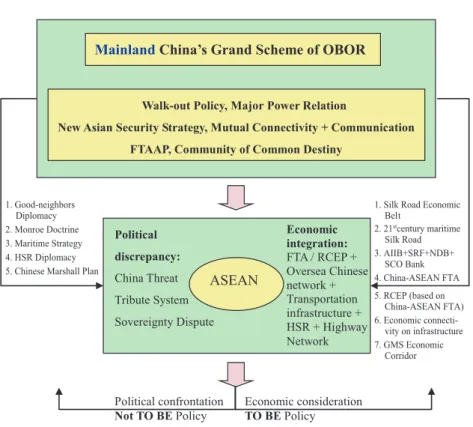
for China-ASEAN economic and political development under the OBOR initiative ahead. Under the grand scheme of the OBOR, ma-inland China can be realized as a “to be” economic power with the formation of regional economic regime by economic integration and security with ASEAN in a new form of core-periphery economic order. The ASEAN countries would enjoy a lot of economic advantages with mainland China from the “to be” new economic regime of “Com-munity of Common Destiny.” Yet, the ASEAN countries would be politically cautious “not to be” in a trap of a tribute system of suzerain and vassal states and “to be” keeping closer with the U.S. (see Figure 1).
MainlandChina’s Grand Scheme of OBOR
Walk-out Policy, Major Power Relation
New Asian Security Strategy, Mutual Connectivity + Communication FTAAP, Community of Common Destiny
ASEAN Political discrepancy: China Threat Tribute System Sovereignty Dispute Economic integration: FTA / RCEP + Oversea Chinese network + Transportation infrastructure + HSR + Highway Network 1. Good-neighbors Diplomacy 2. Monroe Doctrine 3. Maritime Strategy 4. HSR Diplomacy 5. Chinese Marshall Plan
1. Silk Road Economic Belt 2. 21stcentury maritime Silk Road 3. AIIB+SRF+NDB+ SCO Bank 4. China-ASEAN FTA 5. RCEP (based on China-ASEAN FTA) 6. Economic connecti-vity on infrastructure 7. GMS Economic Corridor Political confrontation Not TO BE Policy Economic consideration TO BE Policy
References
Books
Das, Sanchita Basu, ed., 2012. Can the ASEAN Economic Community be Achieved by 2015: Challenges for Member Countries & Busi-nesses? Singapore: ISEAS Publishing.
Hogan, Michael J., 1989. The Marshall Plan: America, Britain, and the Reconstruction of Western Europe, 1947-1952. Cambridge: Cambridge University Press.
Mee, Charles L., 1984. The Marshall Plan: The Launching of the Pax Americana. New York: Simon & Schuster.
Journal Articles
Anthony, Mely Caballero, 2014/6/13. “Understanding ASEAN’s Cen-trality: Bases and Prospects in an Evolving Regional Architecture,” The Pacific Review, Vol. 27, No. 4, pp. 563-584.
Das, Sanchita Basu, 2015/1/29. “The ASEAN Economic Community: An Economic and Strategic Project,” ISEAS Perspective (Sin-gapore), No. 4, pp. 1-12.
Emmers, Ralf & See Seng Tan, 2011/2/25. “The ASEAN Regional Forum and Preventive Diplomacy: Built to Fail?” Asian Security, Vol. 7, No. 1, pp. 44-60.
He, Kai, 2014/9. “Facing the Challenges: ASEAN’s Institutional Re-sponses to China’s Rise,” Issues & Studies, Vol. 50, No. 3, pp. 137-168.
Johnston, Alastair Iain, “How New and Assertive Is China’s New Assertiveness?” International Security, Vol. 37, No. 4, Spring 2013, pp. 7-48.
Oba, Mie, 2014/6/17. “ASEAN and the Creation of a Regional Com-munity,” Asia-Pacific Review, Vol. 17, No. 1, pp. 63-78.
Sun, Kuo-hsiang, 2014/10. “Review of Beijing’s Neighborhood Policy: Analysis of, and Prospects for, Relations between Mainland China and ASEAN Countries,” Prospect Journal, No. 12, pp. 119-152.
Sutter, Robert & Chi-hao Huang, 2013/1. “China-Southeast Asia Re-lations: China Gains and Advances in South China Sea,” Com-parative Connections, Vol. 14, No. 3, pp. 69-77.
Zhang, Biwu, 2014/6/15. “Chinese Perceptions of US Return to Sou-theast Asia and the Prospect of China’s Peaceful Rise,” Journal of Contemporary China, Vol. 24, No. 91, pp. 176-195.
Online Resources
2014/9/15. “Countries Share Dream of New Silk Road for the 21st Century,” China Daily, <http://www.chinadaily.com.cn/ cndy/2014-09/15/content_18596503.htm>.
2014/11/6. “China to Speed Up Construction of New Silk Road: Xi,” Xinhua, <http://news.xinhuanet.com/english/china/2014-11/06/ c_133770684.htm>.
2014/11/13. “China’s Premier Li Keqiang Calls for Peace, Stability at East Asia Summit,” Current Affairs, <http://www.in.com/ news/current-affairs/chinas-premier-li-keqiang-calls-for-peace-stability-at-east-asia-summit-52999501-in-1.html>.
2014/11/14. “ASEAN Summit Ends with Reaffirmed Commitment to Community by 2015,” Xinhua, <http://news.xinhuanet.com/ english/bilingual/2014-11/14/c_133790205.htm>.
2014/11/14. “ASEAN-China Trade Expected to Reach US$ 500 Bn by 2015,” Xinhua, <http://news.xinhuanet.com/english/china/ 2014-11/14/c_133788265.htm>.
2014/11/14. “China, ASEAN to Upgrade Partnership in ‘Diamond Decade’: Premier Li,” Xinhua, <http://news.xinhuanet.com/eng-lish/china/2014-11/14/c_133788239.htm>.
China-ASEAN Relations,” Xinhua, <http://news.xinhuanet.com/ english/china/2014-11/14/c_133790755.htm>.
2014/11/14. “Remarks by H. E. Li Keqiang Premier of the State Council of the People’s Republic of China At the 17th ASEAN-China Summit,” Ministry of Foreign Affairs of People’s Republic of China, <http://www.fmprc.gov.cn/mfa_eng/topics_665678/ lkqzlcxdyhzldrxlhybdmdjxzsfw/t1212266.shtml>.
2014/12/4. “China’s Belt and Road Initiatives Open to World: Expert,” Xinhua, <http://news.xinhuanet.com/english/indepth/2014-12/04/ c_133832704.htm>.
2014/12/13. “21st Century Maritime Silk Road to benefit ASEAN: experts,” Xinhua, <http://news.xinhuanet.com/english/chi-na/2014-12/13/c_133852978.htm>.
2014/12/13. “Malaysia Ready for Greater Cooperation with China in Maritime Silk Road: Former Ambassador,” Xinhua, <http:// news.xinhuanet.com/english/china/2014-12/13/c_133852521. htm>.
2014/12/15. “Silk Roads Initiatives Enters New Phase: Think Tank,” Xinhua, <http://news.xinhuanet.com/english/china/2014-12/15/ c_133856803.htm>.
2014/12/26. “The Chinese Premier’s US$ 140 Billion Trips Abroad,” China Development Gateway, <http://en.chinagate.cn/2014-12/26/ content_34416924.htm>.
Anjaiah, Veeramalla, 2015/1/22. “South China Sea in 2015: Fears of War,” Jakarta Post, <http://www.thejakartapost.com/news/2015/ 01/22/south-china-sea-2015-fears-war.html#sthash.1Yo8KaXW. dpuf>.
Arase, David, 2015/1/22. “China’s Two Silk Roads: Implications for Southeast Asia,” ISEAS Perspective (Singapore), No. 2, pp.1-11, <http://www.iseas.edu.sg/documents/publication/ISEAS_pers-pective_2015_02.pdf>.
ASEAN Summit: Moving Forward in Unity to a Peaceful and Prosperous Community,” Association of Southeast Asian Nations, <http://www.asean.org/images/pdf/2014_upload/Chairman% 20Statement%20of%20the%2025th%20ASEAN%20Summit. pdf>.
Chen, Dingding, 2014/11/10. “China’s Marshall Plan Is Much More,” The Diplomat, <http://thediplomat.com/2014/11/chinas-marshall-plan-is-much-more/>.
Cohen, Roger, 2014/5/8. “China’s Monroe Doctrine,” The New York Times, <http://www.nytimes.com/2014/05/09/opinion/cohen-chinas-monroe-doctrine.html?_r=0>.
Devadason, Evelyn S., 2014/1/17. “The Trans-Pacific Partnership (TPP): the Chinese Perspective,” Journal of Contemporary China, Vol. 23, No. 87, pp. 462-479, <http://dx.doi.org/10.1080/ 10670564.2013.843890>.
Fernquest, Jon, 2015/1/6. “ASEAN Economic Community 2015: Ready or not, here it comes,” Bangkok Post, <http://www.bang- kokpost.com/learning/work/454697/asean-economic-commun-ity-2015-ready-or-not-here-it-comes>.
Ho, Benjamin, 2012/9/13. “ASEAN’s Centrality in a Rising Asia,” RSIS Working Paper (Singapore), No. 249, pp. 1-39, <http://www.rsis. edu.sg/wp-content/uploads/rsis-pubs/WP249.pdf>.
Keck, Zachary, 2014/6/10. “China ‘Internationalizes’ South China Sea Dispute: By raising the oil rig dispute with Vietnam at the UN, China risks setting a dangerous precedent for itself,” The Diplomat, <http://thediplomat.com/2014/06/china-internationa-lizes-south-china-sea-dispute/>.
Ma, Yuge, 2014/12/5. “The Environmental Implication of China’s New Bank,” The Diplomat, <http://thediplomat.com/2014/12/ the-environmental-implications-of-chinas-new-bank/>.
Mohan, C. Raja, 2014/8/13. “Chinese Takeaway: One Belt, One Road,” The Indian Express, <http://indianexpress.com/article/
opinion/columns/chinese-takeaway-one-belt-one-road/>. Nguyen, Phuong, 2015/1/21. “Vietnam’s Careful Dance with the
Super Powers,” East Asia Forum, <http://www.eastasiaforum. org/2015/01/21/vietnams-careful-dance-with-the-superpowers/>. Penna, Michele, 2014/12/9. “China’s Marshall Plan: All Silk Roads Lead to Beijing?” The World Politics Review, <http://www.world- politicsreview.com/articles/14618/china-s-marshall-plan-all-silk-roads-lead-to-beijing>.
S. R., 2014/11/11. “Why China Is Creating A New World Bank for Asia?” The Economist Explains, <http://www.economist.com/ blogs/economist-explains/2014/11/economist-explains-6>. Tao, Xie, 2014/12/27. “China’s Foreign Policy in 2014: A Year of
Big Strokes,” The Diplomat, <http://thediplomat.com/2014/12/ chinas-foreign-policy-in-2014-a-year-of-big-strokes/>.
Zhao, Suisheng, 2014/10/8. “A New Model of Big Power Relations? China-US Strategic Rivalry and Balance of Power in the Asia-Pacific,” Journal of Contemporary China, Vol. 23, Issue 89, <http://dx.doi.org/10.1080/10670564.2014.953808>.