行政院國家科學委員會專題研究計畫 成果報告
由富勒的社會法理學論資訊隱私權及其規制(II)
研究成果報告(精簡版)
計 畫 類 別 : 個別型 計 畫 編 號 : NSC 97-2410-H-004-073- 執 行 期 間 : 97 年 08 月 01 日至 98 年 07 月 31 日 執 行 單 位 : 國立政治大學法律學系 計 畫 主 持 人 : 陳起行 計畫參與人員: 碩士級-專任助理人員:楊鎧嘉 碩士班研究生-兼任助理人員:林倍志 報 告 附 件 : 國外研究心得報告 出席國際會議研究心得報告及發表論文 處 理 方 式 : 本計畫涉及專利或其他智慧財產權,2 年後可公開查詢 中 華 民 國 98 年 08 月 05 日行政院國家科學委員會補助專題研究計畫成果報告
由富勒的社會法理學論資訊隱私權及其規制(II)
計畫類別:X 個別型計畫 □ 整合型計畫 計畫編號: -NSC 972410H004 073 -執行期間: 97 年 8 月 1 日至 98 年 7 月 31 日 計畫主持人:陳起行 共同主持人: 計畫參與人員: 成果報告類型(依經費核定清單規定繳交):精簡報告 本成果報告包括以下應繳交之附件: █赴國外出差或研習心得報告一份 □赴大陸地區出差或研習心得報告一份 █出席國際學術會議心得報告及發表之論文各一份 □國際合作研究計畫國外研究報告書一份 處理方式:除產學合作研究計畫、提升產業技術及人才培育研究 計畫、列管計畫及下列情形者外,得立即公開查詢 執行單位:國立政治大學法律系 中 華 民 國 98 年 8 月 4 日中文摘要 本計畫為期三年,以富勒所開啟的社會交往法律理論及其發展脈絡為中心, 批判並再建構自發性法律規制模式,並將該模式試行於資訊隱私權規制之上。第 一年的工作以闡明富勒的法律思想為主; 第二年的計畫整理近幾年資訊隱私權 的法理研究,並掌握新興科技對資訊隱私所造成的挑戰; 第三年以富勒的社會法 律理論脈絡批判並重建自發性法律理論,並整合資訊隱私權法理研究成果後,針 對資訊隱私之規制提出建設性規劃。一方面,由於研究計畫執行順利, 今年度(執 行計畫之第二年), 已經進入第三年部分的研究。 民國九十七年底國科會進行的擴大延攬人才方案, 提供本計畫一名專任助 理, 也是本計畫得以順利展開相關網站設計的因素.本計畫因此提出兩篇論文,分 別發表於國際研討會; 一篇由與富勒人際互動法律理論相近的史特恩所提出「制 度公民」的理論,論性騷擾規制網站的設計, 另一篇則是針對資訊工程界提出的 由電子性騷擾規制論未來法律典範一文. Abstract
This is a three-year research project. The main objective for the project is to analyze the social interaction theory of Lon Fuller and use it to reconstruct the reflexive model of regulation. This project then applies the improved regulatory model, with the insight of information privacy jurisprudence, to derive a better approach for information privacy regulation.
In the first year, the main emphasis is on the elaboration of Lon Fuller’s legal theory. In the second year, theories of information privacy and literatures on the development of technologies and their impacts on information privacy are analyzed. In the third year, insights obtained from the previous two years are used to develop an improved regulatory scheme for information privacy.
This is the second year of the three year project. Due to the support from the National Science Council during the end of the 2008, this project obtains a full time research assistant, and the project is able to enter part of the third year
research topic and starting designing a regulatory web for sexual harassment. Two papers related to this development are presented at the international conferences; one of them using Sturm’s institutional citizenship idea, which is parallel to the human interaction theory of Fuller, to design a regulatory web for sexual harassment; the other paper is aimed at the information engineering community, and discusses the next legal paradigm and its impacts on the design for e-harassment regulatory web.
一。前言 本年度主題是承接上年度對富勒人際交往法律理論的理解, 試圖探討資訊 隱私規制上的課題, 以及人際交往觀的規制方式是否能改善資訊隱私的規範困 境. 執行本年度的計畫,十分順利。除大量閱讀資訊隱私所涉及的法律課題的文 獻外, 由於 2008 年底,國科會實施擴大內需專案,本計畫因此獲得一名有資訊 科技技術背景的專任助理. 一方面本計畫所研究的資訊隱私之保障, 有日益與 資訊科技結合的趨勢; 二方面,本計畫核心旨趣所在,是要設計一個重視人際交 往的規制網站平台. 聘用技術背景的專任助理之後, 本計畫如魚得水¸積極展開規制網站的設計 工作, 本年度赴國外所發表的兩篇論文, 也與此一主題相關. 二。研究目的 本年度的重點在於掌握資訊科技帶來隱私課題在法律哲學思想上,法律制度 面,以及運用科技保護隱私等的發展。在法哲學領域,發現確實有重視隱私意義 脈絡的理論,日形重要。此一觀點並不將隱私視為私領域,不應為人知的個人部 分,而著重隱私是人際互動過程,極具脈絡意義的良善相互關係上的議題。因此 一方面摒棄隱私為物(privacy as a thing)的想法,其應予保障與否,也特別 重視在人際互動的意義脈絡下對於良善人際關係的影響。 如何掌握此一人際互動上的隱私保護意義,以及經由對話,讓良善人際關係 得以反映,作為隱私是否受侵害的判斷依據,成為本年度計畫探討的重點。本年 度,個人十分努力地由史特恩教授的三篇實證研究論文中,解讀出其理論的基本 原則。並運用所掌握的基本原則,展開規制網站的設計。 三。文獻探討 資訊隱私部分,本年度個人十分廣泛地蒐集了資訊隱私保護相關的法哲 學,法學,社會科學,以及新文事實等領域的相關文獻。可以說完成了一個小 型的資訊隱私數位論文資料庫。當然,由於此類議題發展快速,此一小型數位 資料庫有賴日後持續更新。
關於規制網站設計方面,一方面個人有計畫蒐集了史特恩教授的論著,並 仔細鑽研其三個實證研究,從中理出了其理論的基本原則。這個部分,個人曾 購買 Debrief 軟體,協助分解,重組,並整理出史特恩教授理論的架構。 最後有關規制網站設計的部分,前幾年受國科會補助赴美國加州柏克萊大 學法學院研究期間,就蒐集了完整的規制,電子參與等課題的文獻超過一千餘 篇。本年度所閱讀,整理的文獻資料,可謂相當豐富。 四、研究方法與結論 人際互動的忽視,以及在快速社會發展之下,法規範的形成上,確實出現困 境。重視人際間對話,經由彼此理解而形成行為上可期待的規範,是報告人研究 的主軸。本年度終於由理論的探討與批判,落實至法律制度面的反思,以及資訊 科技的運用,建構網路規制平台等面向。 一方面,人際交往的法律理論以及制度上的影響,一直不被重視,因此可以 預見,未來仍有一番積極對話與論戰的過程。所發展出來的規制平台,若能展現 值得參考的價值,應當有助於理論,制度以及科技運用至法形成等發展領域,這 也是報告人未來幾年的工作重點,期望透過經驗分享,實作成果的呈現,令更多 人支持此一發展路徑。 六.自我評估 多年在資訊法律及法形成理論上的鑽研,報告人認為今後除了持續在法律爭 議及理論上的辯論持續深入之外,也可以開始思考實際經由電子參與理論及實踐 上的研究成果,試著將報告人這幾年的專題研究成果融入一項實驗性的網路對話 平台,實際觀察理論及實踐上的課題。本年度是此一努力近程上的一個里程碑。 本計畫終於在理論及制度面的探索之後, 正式進入規制網站平台的設計,並將此 一設計帶到國際語法學者以及資訊工程界對話,成果豐碩。
行政院國家科學委員會補助國內專家學者出席國際學術會
議報告
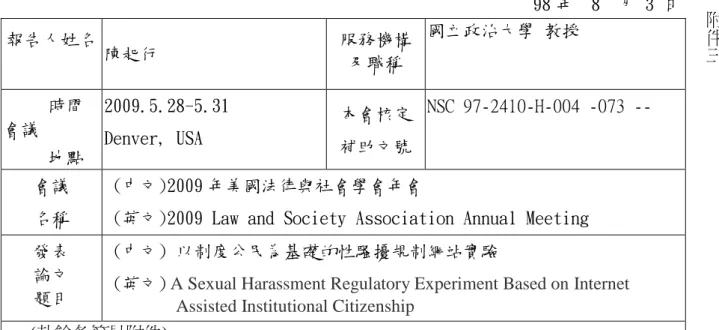
98 年 8 月 3 日 報告人姓名 陳起行 服務機構 及職稱 國立政治大學 教授 時間 會議 地點 2009.5.28-5.31 Denver, USA 本會核定 補助文號 NSC 97-2410-H-004 -073 -- 會議 名稱 (中文)2009 年美國法律與社會學會年會(英文)2009 Law and Society Association Annual Meeting 發表
論文 題目
(中文) 以制度公民為基礎的性騷擾規制網站實驗
(英文)A Sexual Harassment Regulatory Experiment Based on Internet Assisted Institutional Citizenship
(其餘各節見附件)
一、參加會議經過
五年前,個人參與美國法律與社會學會(Law and Society Association, LSA) 所規劃的跨領域研究網絡(Collaborative Research Network,CRN)中的政府規 制 CRN, 並參與此一 CRN 的郵件討論社群。藉此,瞭解此一快速發展領域的相 關國際間發展。 LSA 的政府規制 CRN, 是一個不折不扣的國際化又跨領域的研究社群。有 來自不同國家以及不同專業背景,如社會,經濟,政治,公共行政,以及法學學 者參與研討,是交換學術意見,擴大學術視野的好場所。尤其從此一領域專業期 刊的增加以及參與成員的人數觀之,政府規制是各國越來越重視的研究議題。個 人覺得一方面,社會快速而結構性的變遷,帶來規制上的嚴峻挑戰; 另一方面, 網際網路及資訊科技等相關領域快速開展,使得新的規制理論及實踐,十分值得 投入研究,往後此一領域所帶來規制觀念及制度上的變革,值得重視。 不過今年, 由於規制與治理 CRN 的協調人(coordinator)換人, 由澳洲的一 位法學教授擔任. 她給我的信件中, 告知今年參與人數少, 很難將我的文章排入, 所以我改由大會分發我的講次. 個人的觀察, 似乎在聯絡方式上, 就出了些問題; 不向過去, 很早就收到提計畫書或摘要的請求, 很晚才收到這項訊息. 其結果, 雖然排在發表的第一篇文章(資料如下), 但是並不以規制及治理為研討主軸. 未來若仍然如此運作, 個人會尋找其他更合適的國際研討會, 或者已經有研究上 合作關係的學者主辦的研討會, 提出研究成果.
Problems and Possibilities for Safe and Equal Workplaces 3113 Sponsor:
Keyword Area: GENDER AND SEXUALITY
Schedule Information:
Scheduled Time: Sat, May 30 - 8:15am - 10:00am Building/Room: Conf / TBA 13
Title Displayed in Event Calendar: Problems and Possibilities for Safe and Equal Workplaces 3113
Session Participants:
Session Organizer: Nancy Reichman (University of Denver) [email protected]
Chair: Jill Weinberg (University of Chicago) [email protected]
A Sexual Harassment Regulatory Experiment Based on Internet Assisted Institutional Citizenship
*Chishing Chen (National ChengChi University)
Liminal Identities, “Regarded As,” and the End of the Protected Class
*M. Christine Fotopulos (Pennsylvania State University)
Legal Mobilization for Workplace Equality in Four European Countries
Employer Reports of Sexual Harassment: Impact of Gendered Organizations and Rights Consciousness
*Ganga Vijayasiri (University of Illinois, Chicago)
Jane (Formerly Known as John): Labor Market Discrimination of Transgender Individuals
*Jill Weinberg (University of Chicago)
二、與會心得 跨領域的法學研究, 雖然是未來的發展趨勢, 但是法學界在這方面發展的 成熟度, 仍有很大的改進空間. 美國法律與社會學會, 已經是這方面的領先者, 每年吸引全球各地不同背景的學者及專業工作者參與. 但時仍然無法充分反映 出科際整合的價值. 個人多年的努力, 嘗試結合法律理論, 法律制度, 以及資訊 科技在法律形成上的運用等領域, 發展出能為未來規制及治理上具有貢獻的模 式. 然而在今年, 初步可以提出整體想法時, 卻無法與過去幾年一起探討的學 術社群進一步交換想法, 十分可惜. 簡言之, 今年被安排的場次, 是以性騷擾 等實體法律為主軸, 參與者不太能領略個人提出論文,在規制及治理上的意義. 較令人欣慰者, 是今年執行計畫在理論上的進展, 指向未來法律倫理, 或者 德行法理日益重要的趨勢. 也難怪新興課題, 如生物倫理(bio-ethics), 的主要 訴求, 不再是生物法(bio-law). 反映出個人在規範上的理解與判斷上的掌握, 日益重要. 本年度參 與會議之 前, 就拜讀了美國伊利諾大學香檳校區的 Lawrence Solum 教授的作品:Virtue Jurisprudence: A virtue-Centered Theory of Judging. 這 篇論文可以放在整個思潮中, 有一股復古風, 欲重新檢視希臘哲學重視德行的 一面, 稱做德行轉折(the aretaic turn).Solum 教授過去的作品, 就充滿了文化 批判的色彩, 我曾經在政大法律研究所法理學專題研討課程中, 帶同學們讀過. Solum 用哈伯瑪斯的論述理論為基礎, 批判美國主流的言論自由法理, 提出應 當 重 視 論 述 的 自 由 (Freedom of Discourse), 而 非 表 意 自 由 ( Freedom of Expression). 後者毫不將相對人放在眼裡, 只重視個人的表達. 論述本身就帶 有很強的相互理解上的態度, 因此更應當是法律強力保護的對象. 與會期間, 有幸親自與 Solum 會面, 彼此理念相近, 因此每分鐘的交談都十 分令人回味.Solum 並表示他的學生多在大陸, 有興趣來台灣訪問, 進一步相互 理解. 日後會考慮在頂尖大學計畫之下, 邀請 Solum 來台灣, 與國內哲學, 史學 及法學學者互動. 四、建議
全球化衝擊國際間學術的發展, 許多改變都在快速進行中, 其中最值得我國 注意者, 應當事蹟及參與國際學術活動, 進而結合理念相近或有意願在特定法學 領域合作的學者及學校. 無論是研究上或者是教學上的合作, 逐漸形成若干合作 學校群體, 實質上, 可以不被快速發展的國際法學學術社群拋棄, 並且能夠受到 國際間最新發展的刺激, 使得國內向來不弱的法學水準能持續升級; 形象上, 對 於台灣在國際間的地位, 也提供一項重要的指標. 建議國內加強對於學術交流的 投資, 以及, 更重要者, 提供經驗上的指導, 以免每位學者都得經過長期的摸索. 五.攜回資料名稱及內容
Law and Society Association, 2009 annual meeting, Final Program:每個場次的主 題,報告者及時間等資訊,每位參與學者的通訊資料也整理於該 Proceedings 之後。
表 Y04
行政院國家科學委員會補助國內專家學者出席國際學術會議報告
98 年 8 月 3 日 報告人姓名 陳起行 服務機構 及職稱 國立政治大學 教授 時間 會議 地點 2009.5.28-5.31 Denver, USA 本會核定 補助文號 NSC 97-2410-H-004 -073 -- 會議 名稱 (中文)2009 年美國法律與社會學會年會(英文)2009 Law and Society Association Annual Meeting 發表
論文 題目
(中文) 以制度公民為基礎的性騷擾規制網站實驗
(英文)A Sexual Harassment Regulatory Experiment Based on Internet Assisted Institutional Citizenship
(其餘各節見附件)
表 Y04
一、參加會議經過
五年前,個人參與美國法律與社會學會(Law and Society Association, LSA)所規劃的跨領 域研究網絡(Collaborative Research Network,CRN)中的政府規制 CRN, 並參與此一 CRN 的郵件討論社群。藉此,瞭解此一快速發展領域的相關國際間發展。 LSA 的政府規制 CRN, 是一個不折不扣的國際化又跨領域的研究社群。有來自不同國家 以及不同專業背景,如社會,經濟,政治,公共行政,以及法學學者參與研討,是交換學術 意見,擴大學術視野的好場所。尤其從此一領域專業期刊的增加以及參與成員的人數觀之, 政府規制是各國越來越重視的研究議題。個人覺得一方面,社會快速而結構性的變遷,帶來 規制上的嚴峻挑戰; 另一方面,網際網路及資訊科技等相關領域快速開展,使得新的規制理 論及實踐,十分值得投入研究,往後此一領域所帶來規制觀念及制度上的變革,值得重視。 不過今年, 由於規制與治理 CRN 的協調人(coordinator)換人, 由澳洲的一位法學教授 擔任. 她給我的信件中, 告知今年參與人數少, 很難將我的文章排入, 所以我改由大會分發我 的講次. 個人的觀察, 似乎在聯絡方式上, 就出了些問題; 不向過去, 很早就收到提計畫書或 摘要的請求, 很晚才收到這項訊息. 其結果, 雖然排在發表的第一篇文章(資料如下), 但是 並不以規制及治理為研討主軸. 未來若仍然如此運作, 個人會尋找其他更合適的國際研討會, 或者已經有研究上合作關係的學者主辦的研討會, 提出研究成果.
Problems and Possibilities for Safe and Equal Workplaces 3113 Sponsor:
Keyword Area: GENDER AND SEXUALITY
Schedule Information:
Scheduled Time: Sat, May 30 - 8:15am - 10:00am Building/Room: Conf / TBA 13
Title Displayed in Event Calendar: Problems and Possibilities for Safe and Equal Workplaces 3113
Session Participants:
Session Organizer: Nancy Reichman (University of Denver) [email protected]
Chair: Jill Weinberg (University of Chicago) [email protected]
A Sexual Harassment Regulatory Experiment Based on Internet Assisted Institutional Citizenship
*Chishing Chen (National ChengChi University)
Liminal Identities, “Regarded As,” and the End of the Protected Class
*M. Christine Fotopulos (Pennsylvania State University)
Legal Mobilization for Workplace Equality in Four European Countries
*Gesine Fuchs (University of Zurich)
Employer Reports of Sexual Harassment: Impact of Gendered Organizations and Rights Consciousness
*Ganga Vijayasiri (University of Illinois, Chicago)
Jane (Formerly Known as John): Labor Market Discrimination of Transgender Individuals
表 Y04 二、與會心得 跨領域的法學研究, 雖然是未來的發展趨勢, 但是法學界在這方面發展的成熟度, 仍有 很大的改進空間. 美國法律與社會學會, 已經是這方面的領先者, 每年吸引全球各地不同背 景的學者及專業工作者參與. 但時仍然無法充分反映出科際整合的價值. 個人多年的努力, 嘗試結合法律理論, 法律制度, 以及資訊科技在法律形成上的運用等領域, 發展出能為未來 規制及治理上具有貢獻的模式. 然而在今年, 初步可以提出整體想法時, 卻無法與過去幾年 一起探討的學術社群進一步交換想法, 十分可惜. 簡言之, 今年被安排的場次, 是以性騷擾 等實體法律為主軸, 參與者不太能領略個人提出論文,在規制及治理上的意義. 較令人欣慰者, 是今年執行計畫在理論上的進展, 指向未來法律倫理, 或者德行法理日 益重要的趨勢. 也難怪新興課題, 如生物倫理(bio-ethics), 的主要訴求, 不再是生物法 (bio-law). 反映出個人在規範上的理解與判斷上的掌握, 日益重要. 本年度參與會議之前, 就拜讀了美國伊利諾大學香檳校區的 Lawrence Solum 教授的作 品:Virtue Jurisprudence: A virtue-Centered Theory of Judging. 這篇論文可以放在整個思潮中, 有一股復古風, 欲重新檢視希臘哲學重視德行的一面, 稱做德行轉折(the aretaic turn).Solum 教授過去的作品, 就充滿了文化批判的色彩, 我曾經在政大法律研究所法理學專題研討課程 中, 帶同學們讀過. Solum 用哈伯瑪斯的論述理論為基礎, 批判美國主流的言論自由法理, 提出應當重視論述的自由(Freedom of Discourse), 而非表意自由(Freedom of Expression). 後 者毫不將相對人放在眼裡, 只重視個人的表達. 論述本身就帶有很強的相互理解上的態度, 因此更應當是法律強力保護的對象. 與會期間, 有幸親自與 Solum 會面, 彼此理念相近, 因此每分鐘的交談都十分令人回 味.Solum 並表示他的學生多在大陸, 有興趣來台灣訪問, 進一步相互理解. 日後會考慮在頂 尖大學計畫之下, 邀請 Solum 來台灣, 與國內哲學, 史學及法學學者互動. 四、建議 全球化衝擊國際間學術的發展, 許多改變都在快速進行中, 其中最值得我國注意者, 應 當事蹟及參與國際學術活動, 進而結合理念相近或有意願在特定法學領域合作的學者及學校. 無論是研究上或者是教學上的合作, 逐漸形成若干合作學校群體, 實質上, 可以不被快速發 展的國際法學學術社群拋棄, 並且能夠受到國際間最新發展的刺激, 使得國內向來不弱的法 學水準能持續升級; 形象上, 對於台灣在國際間的地位, 也提供一項重要的指標. 建議國內加 強對於學術交流的投資, 以及, 更重要者, 提供經驗上的指導, 以免每位學者都得經過長期的 摸索. 五.攜回資料名稱及內容
表 Y04
Law and Society Association, 2009 annual meeting, Final Program:每個場次的主題,報告者及 時間等資訊,每位參與學者的通訊資料也整理於該 Proceedings 之後。
Welcome: Chishing Chen My Schedule
View Paper Session Session
Much of the information on this page is clickable. For example, clicking on a person's name will display all of that person's participations in the program. Author names preceded by an asterisk * were designated as presenting authors during the submission process.
Problems and Possibilities for Safe and Equal Workplaces 3113
Add to My Schedule
Sponsor:
Keyword Area
GENDER AND SEXUALITY
Schedule Information:
Scheduled Time: Sat, May 30 - 8:15am - 10:00am Building/Room: Conf / TBA 13
Title Displayed in Event Calendar: Problems and Possibilities for Safe and Equal Workplaces 3113 Session Participants:
Session Organizer: Nancy Reichman (University of Denver) [email protected]
Chair: Jill Weinberg (University of Chicago) [email protected]
A Sexual Harassment Regulatory Experiment Based on Internet Assisted Institutional Citizenship
*Chishing Chen (National ChengChi University)
Liminal Identities, “Regarded As,” and the End of the Protected Class
*M. Christine Fotopulos (Pennsylvania State University)
Legal Mobilization for Workplace Equality in Four European Countries
*Gesine Fuchs (University of Zurich)
Employer Reports of Sexual Harassment: Impact of Gendered Organizations and Rights Consciousness
*Ganga Vijayasiri (University of Illinois, Chicago)
Jane (Formerly Known as John): Labor Market Discrimination of Transgender Individuals
*Jill Weinberg (University of Chicago)
©2008 All Academic, Inc.
Search Schedule Events Calendar Main Menu Logout Help
第 1 頁,共 1 頁 The Law and Society Association 2009
2009/3/19 http://convention3.allacademic.com/one/lsa/lsa09/index.php?click_key=1&cmd=Multi...
A Sexual Harassment Regulatory Experiment Based on Internet Assisted Institutional Citizenship
Chishing Chen*
I. Sturm’s Institutional Citizenship Approach Toward Governance Institutional Citizenship is a key concept of Sturm’s governance theory, although she may not agree to use it to identify her overall theory. As a veteran scholar regarding within-institution equality issues, such as sexual harassment,1 gender equality,2 and co-authorship among co-researchers with different
ranking,3
Institutional citizenship connotes a strong conception of full participation, mutual responsibilities, and shared benefits. It involves creating conditions so that people of all races, genders, and backgrounds can realize their capabilities as they understand them and participate fully in the life of the institution.
she finds that the following assertion holds true:
4
However, it is worth pursuing the idea of a fair interactive relationship between individuals inside an organization, between groups inside an
organization, and between individuals or organizations external to an institution.5 Institutional citizenship provides us a needed concept of a complementary network of law-making environments consisting of both state-made law and social institutional norm formation.6
*
Professor, National ChengChi University.
1
Sturm, S., Second Generation Employment Discrimination: A Structural Approach, 101:3 Columbia Law Review 458 – 568 (2001).
2
Sturm, S., the Architecture of Inclusion: Advancing Workplace Equity in Higher
Education, 29 Harvard Journal of Law & Gender 247 (2006). See also Sturm, S., Conclusion to Responses, the Architecture of Inclusion: Interdisciplinary Insights on Pursuing Institutional Citizenship, 30 Harvard Journal of Law & Gender 409 (2007).
3
Sturm & Gadlin, Conflict Resolution and Systemic Change, 2007:3 Journal of Dispute Resolution 1 – 63 (2007). However, it should be noted that authorship dispute is only one of the systemic disputes studied in the paper.
4
See Supra note 2, Sturm, Conclusion to Responses, at 413.
5
This point will be further elaborated later in this paper in the discussion on the complementary relationship between what Sturm called the detached neutrality approach of national law making efforts and the multi-perspective approach of social institutional law making.
The relationship
6
Speaking in a conflict-resolution sense, Sturm rejects Richard Reuben’s promotion of a unified public-justice system. See Sturm, supra note 3, footnote 11. And see
between communities in charge of state-made law and the social institutions that elaborate social norms is not one of command and control, but a dialogical and complementary one. Institution citizenship also connotes a strong sense of democracy, both on the national level and on the social institutional level.7
Sturm conducted three extensive empirical studies. One of these studies concerns sexual harassment problem-solving and dispute-resolution processes in three companies: Deloitte & Touche, Intel Corporation, and Home Depot.
This type of citizenship requires that an inclusive institution provide pertinent agents various equal participatory opportunities to enter the institution, as well as to express themselves and to be understood therein during the formation of
institutional norms. In other words, democracy and rule of law, the established values of a democratic nation state, and not the efficiency or effectiveness of the regulation, ought to help guide the social institutional law making, both on the level of administrative regulatory control and on the micro level of social norm derivation inside an institution.
8
A second study concerns “systemic-conflict resolution” structures and processes at the National Institutes of Health (NIH).9 And the third study concerns the
Increasing the Participation and Advancement of Women in Academic Science
and Engineering Careers program (ADVANCE),10 developed by the National
Science Foundation (NSF) to promote gender equality within universities.11
I will summarize and discuss Sturm’s original scholarly contribution to institutional citizenship from the following three aspects: A) the dilemma addressed; B) the idea of an inclusive institution as a response to the problems;
In each of these three studies, Sturm elaborates on the dilemma embedded in and the critical points that are overlooked by the traditional regulatory approach. She also documents the details of the more responsive approaches and the theoretical bases that ensure their success.
Reuben, R. Constitutional Gravity: A Unitary Theory of Alternative Dispute
Resolution and Public Civil Justice, 47 UCLA L. REV. 949, 956 (2000).
7
“‘Institutional citizenship’ carries a second meaning, focused on the position of institutions in a broader democracy…. They must, then, define their membership in light of a university’s responsibilities to serve the public values of the broader
community.” Sturm, supra note 2, Conclusion to Responses, at 413. See also Sturm’s discussion of Grainne de Burca, who argues for the development of democracy beyond the state, at 416 – 7.
8
Sturm, supra note 1, at 491–.
9
Sturm, supra note 3.
10
See supra note 2, at 251 and note 3.
11
and C) the practice of an inclusive institution. Although the practice of an inclusive institution deals primarily with issues associated with institutional norm formation and systemic-conflict resolution on the internal-institutional level, we need significant changes on the inter-institutional level to make an inclusive institution possible, for the purposes of either knowledge sharing or external accountability; and finally, empowerment from the
national-institutional level is essential for efforts to start transforming a non-inclusive social institution into an inclusive one, efforts not unlike those characteristic of the Supreme Court’s handling of Harris.12
A. The Dilemma
We will focus on the Harris decision (C.1); the ADVANCE program administered by NSF (C.2); and the operation of the Center for Cooperative Resolution/Office of the
Ombudsman (CCR) inside the NIH (C.3). This reconstruction of Sturm’s theory and empirical findings should illuminate a rigorous overall picture of what we can learn from Sturm’s works and should clarify the rich findings in her three different empirical studies.
Institutional citizenship is an ideal that Sturm endeavors to achieve, not a prevalent principle of institutional practice. The concept is constructed out of extensive empirical studies and serves to address the regulatory dilemma
revealed. The root of the dilemma is the existence of a gap between the problem definition of regulatory issues and institutional context; the fabric of the
difficulty, however, is rich and deserves further analysis.
For example, traditional legal methodology tends to approach sexual-harassment conflicts by first searching for what constitutes sexual harassment and then determining whether there is a match between the defined concept and the fact-related pattern of an alleged incident of harassment.
However, no concept can be constructed out of a vacuum; therefore, insufficient factual inputs can foretell the difficulty of a successful resolution. Actually, the term ‘input’ still connotes divided spheres between the center and the margins, the primary and secondary, and the sovereign and the subject. It is in this context that we need to transfer something from the external world to the internal, without recognizing the equally respectful and mutually influencing
12 Harris v. Forklift Sys., Inc., 510 U.S. 17 (1993), where the Supreme Court treats sexual harassment as a form of sex discrimination, but refuses to make an
across-the-board definition as to what constitutes sexual harassment. See Sturm, supra note 1, pp. 480 – 4; and section I.C.3 of this paper.
and building relationship between the regulating and the regulated.
As a result, courts taking an outsider point of view tend to overlook the full interactive patterns surrounding a sexual-harassment incident, and the courts’ inquiries are limited by only the two disputing parties, who will present two conflicting pictures of the episode based on the parties’ respective inevitably subjective point of view. Lots of vital information is filtered out during the process wherein a given court tries to determine which version of the incident ought to be the basis for adjudication.
Detached from the institutional context of sexual-harassment issues, the outsider point of view also lacks the incentive to plan for and the instrument to carry out a preventive mechanism whose function is either to eliminate the causes of institution-based sexual harassment or to reduce the harassment’s harm in an institution. The means to these ends rest on immediate and effective resolution channels inside the institution. Unresponsive and ineffective
after-the-fact enforcement is usually the only choice left. Reversing the outsider point of view and approaching the
sexual-harassment issues inside the institution itself do not make the problem any easier. Embedded in the situation where certain intangible but real cultural factors hold fast, the harassing or the harassed party, or both of them, may not realize the unlawful nature of the acts in question. Reflective opportunities may be difficult to come by owing to such cognitive failure. Often times, however, corrective measures may not be able to function even when acts of harassment are recognized, because the unequal relationship between the parties may unfortunately thwart the disadvantaged parties resorting to the institution’s internal remedial channels. To recognize both the importance of regulatory bodies’ concept-development efforts and the importance of within-institution context-reframing tasks is the root of the dilemma. Taking institutional
normative development seriously is the needed first step in moving toward a balanced approach that emphasizes the dialectical and mutually enabling relationships between the state’s law-making bodies and the self-regulatory institution.
Sturm explores further the difficulty of institutional norm derivation and revision in her empirical study of the ADVANCE program initiated by the NSF. She found three general problems associated with the enforcement of the
gender-equality rules and regulations in the universities and other academic institutions. These dilemmas can be summarized as the difficulty of sustaining an initiative, the difficulty of walking a legal tightrope, and the difficulty of
establishing and maintaining public accountability.
The sustaining-initiative question basically has to do with the dilution of the gender-equality issues as they propagate through the entire structure of the organization. The commitment of the organization to gender equality is perhaps not in doubt, but must be realized through the complex interaction among
different actors and divisions of the organization. The decision-making process may also involve power sharing, and hence the diverse local goals, concerns, and criteria of measurement baselines held by the different levels of the institution may easily dilute the dedication of the organization and may leave the local bias unchecked. For example, reacting to gender-equality initiatives,
[u]niversities’ decentralized administrative structure complicates efforts to achieve institutional mindfulness. Power is highly distributed in academia, and change is often difficult to achieve. Decision making power resides in departments with considerable autonomy and weak performance metrics. This fragmented
authority structure limits the power of any one level or actor to accomplish institutional change, including those at the top.13
For example, Sturm points out that in Gratz v. Bollinger,
The legal tightrope refers to another inevitable consequence due to the separation of problem definition and institutional context. In general, unclear legal concepts contribute to unsatisfactory enforcement, but are not the most significant factor therein. One-sided views of law making and law practice focus only on concept formation, and overlook vital clues hidden perhaps in the institutional context. Organizations are therefore only the recipients of law and never the active, positive contributors to the law-making process. Putting
organizations in such passive roles leads to another undesired consequence: the organizations become excessively cautious and self-forbidding. What is more, the organizations will refuse to study the issues in fear of the legal liability drawn out of the empirical findings of institutional internal illegal practice.
14
the Supreme Court invalidated the University of Michigan’s undergraduate admissions program because “the automatic assignment of points to members of particular racial groups failed to provide for the individualized consideration of each applicant, made race a dispositive factor in every case, and thus was not narrowly tailored to achieve the asserted compelling interest in diversity.”15
13
Sturm, The Architecture of Inclusion, supra note 2, at 258.
14
539 U.S. 244 (2003).
15
Sturm, The Architecture of Inclusion, supra note 2, at 260.
a consequence, in order not to invite legal challenges, “[s]ome general counsel have advised extreme caution in the wake of this legal uncertainty.”16
[f]requently, affirmative action officers have backgrounds in law or human resource management and are not
members of the faculty or senior administrators with high-level authority to review faculty appointments…. Outside auditors who are unfamiliar with academic and departmental culture can find it difficult to know the right questions to ask, or how to get access to information about dynamics, pools, and barriers
‘Race’ or ‘gender’ becomes a taboo word, and no universities dare to use it in their
programs. Also, many universities decide not to conduct studies on their own admissions practices, studies that could reveal problem spots. Such studies, if conducted rigorously, could yield empirical findings that might very well establish both the existence of discrimination in, and associated legal liability for, the universities themselves. As a result, it is difficult to expect institutions to develop a self-correcting within-institution mechanism that would advance gender equality.
Effective public accountability is the third challenge facing an institution. Sectors within an institution differ from one another regarding their proper expertise and regarding their proper functions. An effective system of public accountability would require a performance metric that is both common (no bias favoring or discriminating against various sectors) and tailored to micro-level variation (the latter feature serving to encourage local experimentation and innovation). In an institution consisting of a complex network of organizational sub-units, effective public accountability creates serious challenges. The
division of labor within the institution raises the likelihood that differences of expertise between the parties that are accountable and the parties to which accountable parties are answerable may lessen or wipe out the success of the evaluation process. In her empirical study of the ADVANCE program, Sturm finds that,
17
Using Mitchell’s concept of “structural holes,” . 18 16 Id. 17
Sturm, supra note 2, at 265.
18
Lawrence E. Mitchell, Structural Holes, CEOs, and the Missing Link in Corporate Governance, 11 Pub. Law & Legal Theory, Working Paper No. 77(2003). See also Sturm, supra note 2, footnote 31.
Sturm points out that a critical factor residing in the process of institutional-norm derivation may cause
failure. An institution has to be bureaucratic according to the principle of
division of labor. Units of the organization must be differentiated along the lines of expertise to efficiently exercise the right concentrated force; in this way, the units can fulfill their respective specialized tasks that, together, represent the overall mission of the institution. The organizational chart reflects the model of interaction within the organization. Difficulty in achieving an adequate level of communication and mutual understanding can reveal structural deficits among networks of people within the institution, and many of these deficits are due to a lack of intermediaries, either personal or institutional. Such intermediaries
would help connect any two within-organization networks of people to each other. Therefore, effective communication among well-connected networks of people is the first criterion for identifying the presence of a successful
intermediary, and there should be little doubt that these intermediaries are crucial to an institution’s successful derivation of norms.
In the following two sub-sections, I will introduce the overall ideas and practices of institutional citizenship that Strum applied to the dilemma discussed above.
B. The Idea of Institutional Citizenship
As discussed in the beginning of this section, institutional citizenship
represents a movement to expand the democratic ideal from the level of national law-formation to the social-institutional level. For example, in terms of
adjudication, institutional citizenship equally emphasizes the processes of court adjudication and alternate dispute resolution (ADR). It also calls attention to the complementary and mutually enabling relationship between the courts and ADR. Furthermore, the ADR corresponding to institutional citizenship has not only a much broader scope of inquiry than what we generally recognize, but a different foundation of legitimacy, as well. Here, I will discuss these points in turn.
For the traditional pattern of within-institution interaction to evolve into a pattern that is democratic (that offers full and equal opportunity to participate in within-institution collective decision making), courts need to enable and initiate the change. This evolution may require that the courts practice self-restraint and refrain from handing down substantive rulings; at the same time, the courts could acknowledge a principle that helps guide the within-institution structural
changes leading to the establishment or the reshaping of dispute-settlement policy, in line with what the Supreme Court did in Harris.19
In legal terms, who can participate in a legal procedure usually depends upon whether the party wanting to join the procedure has legal interests or not; or simply whether the person is affected by the procedure. Again, this limitation due to the legal tightrope represents another constraint harmful to the reflective process that facilitates efforts to unravel the social, cultural, and organizational causes of biased patterns of within-institution interaction. Institutional
mindfulness therefore demands that the design of the institutional structure ought to be more open, allowing for insights from all related parties, whether internal or external to the institution. The parties could facilitate institutional transformation, both conceptually and practically. Such expansion of
On the institutional level, institutional citizenship represents needed conceptual, as well as cultural, changes. Sturm points out the importance of institutional mindfulness, i.e., the self-consciousness, the self-criticism, and the self-adjustment attributable to an institution’s decision-making structure and process. This mindfulness, or a lack of it, may lead to biased or decriminalized decisions at the expense of the non-dominant group. As with the dilemma of the legal tightrope, discussed in the previous subsection, institutional mindfulness cannot be adequate if the institution has only in mind the immediate legal consequences of a legal decision, and if the institution arranges its rules and mechanisms accordingly. The emancipation initiated by the courts cannot take hold without the institution’s adopting a wider scope of inquiry that incorporates social, cultural, and organizational issues such as potential causes of bias into the self-consciousness, the self-criticism, and the self-adjustment processes.
Institutional mindfulness also demands a different scale of dialog and interaction both quantitatively and qualitatively. Full participation means enlarged bodies of participants that engage in dialog and in other forms of interaction. The context of full participation improves the chances of successful self-criticism and correction. This is the ideal situation, however, and seems too good to be true. Indeed, Sturm provides two further ideas to qualify the patterns of interaction (including dialog) that emerge in such enlarged participatory bodies: the idea of intermediaries and the idea of multi-partiality. But before introducing these two ideas, we still need to observe a difference between affected people and related people to fully appreciate Sturm’s idea of institutional mindfulness.
19
involvement also contributes to the pooling of vital information across different social sectors, a step that is necessary for an effective response to any sustained practices rooted in unequal relationships.
This necessary broadening of input from indirectly affected parties can occur in two ways in the institution. In terms of dispute resolution, Sturm uses the term ‘systemic conflict’, or as some scholars call it, ‘structural conflict’, to represent those conflicts “rooted in conditions sustained by institutional
practices.”20
expands the field of “regulatory” participants to include the long-neglected activities of legal actors within workplaces and significant nongovernmental organizations, such as professional associations, insurance companies, brokers, research consortia, and advocacy groups. These actors have already begun to play a significant role in pooling information, developing standards of effectiveness, and evaluating the adequacy of local
problem-solving efforts.
In a regulatory sense, inclusion of parties whose legal interests are not directly affected by the sexual-harassment practices in the workplaces
21
Intermediaries are persons or organizations that function as bridges to connect different social networks, and that even help bridge dichotomous couplings such as the public and the private, the legal and the non-legal, the general and the contextual, and the coercive and the cooperative. Intermediaries can serve those vital functions because the information- or knowledge-pooling of these intermediaries enables them to filter through the context of interaction without being wholly subject to embedded cultural, social, or organizational factors. The intermediaries usually build up their working relationships with multiple social networks in the institution. These long-standing connections usually provide the basis for communication and mutual understanding. The factor best able to strengthen within-institution intermediaries and to remove
Emancipation brought forward by institutional citizenship has opened up tremendous information, communication, and interaction as never before. How to properly channel them in support of reflective processes and how to justify the decisions reached as the result of the processes are two critical issues that, if rigorously addressed, would greatly strengthen the theory of institutional
citizenship. Sturm presents the ideas of intermediaries and of multi-partiality for just such purposes.
20
Sturm, supra note 3, at 7.
21
such obstacles as traditional institutional practices is intermediaries’ access to external intermediaries, whether organizations or individuals, that can pool together cross-contextual perspectives. Examples of how intermediaries
function and their contributions will be further discussed in the next subsection. Multi-partiality is another conceptual change important to people’s
embrace of institutional citizenship. Basically, Sturm is right to point out the fact that the long-accepted ‘detached-neutrality’ is not the only way to justify the impartiality of our decisions. Instead, we should admit the fact that multiple perspectives do exist in an institution, and that their existence should be treated as a virtue and not a vice. What we need is an institutional design granting each perspective a fair chance to be a candidate for selection and to undergo
thoughtful examination accordingly. Such examination should be an obligation. In other words, we could build participatory accountability that requires
“ongoing examination and justification to participants and a community of practitioners”22; of course, these actors may very well hold different
perspectives owing to their different professional experiences, scholarly disciplines, or values. Conflict resolvers also should “subject their analysis to the scrutiny of their peers and to explain and justify their choices as part of doing their work.”23
They also emerge when relevant institutional actors develop values or remedies through an accountable process of
principled and participatory decision making, and then adapt these values and remedies to broader groups or situations. ADR can play a significant role in developing legitimate and effective solutions to common problems and, in the process, produce generalizable norms.
Multi-partiality therefore opens up a new cradle for the cultivation of public norms. And it is worth noting that public norms can derive from sources other than the traditional adjudication process.
24
Institutional citizenship emphasizes the importance of law making, both on the national level and the social institutional level. Institutional citizenship also represents a fundamental change that needs conceptual refocusing, so other
C. The Practice of Institutional Citizenship
22
Sturm, supra note 3, at 4.
23
Id.
24
individual and organizational intermediaries could have a role to play, both in bridging the divide between the law-making efforts at the national level and those at the institutional level and in bridging the divide between previously isolated networks of institutional practices. Again, the goals would be the
pooling and the sharing of both information and knowledge, full participation of all perspectives as required by multi-partiality, and public accountability. In her three empirical studies, Sturm demonstrates how on the national level, a court or administrative agency could adopt the idea of institutional citizenship to kick off the institutional law-making process. This subsection discusses the Harris25
Once empowered, an institutional intermediary must actively engage
different networks of practices within an organization to initiate changes, which rest on the pooling and the sharing of information and knowledge. The changes are of two types: adjustments to institutional structures and the formation of institutional norms. In this regard, Sturm observes and analyzes the operation of the Center for Cooperative Resolution/Office of the Ombudsman (CCR) at the National Institutes of Health (NIH).
case handed down by the U.S. Supreme Court, and the way the ADVANCE program is administered by the NSF, which is actually a national institutional intermediary.
26
1. The Harris Case
I will summarize, at the end of this subsection, how the CCR resolves ordinary as well as systemic conflict inside the NIH; how the CCR, using its ombudsman’s capacity, accumulates its experience and knowledge and provides feedback upward to lead to structural changes; and how multi-partiality is maintained during the process to justify the legitimacy of the CCR’s decisions and rules of regulation that lead to the
settlement of conflicts and regulatory changes within the NIH.
Harris is significant and, indeed, could legitimately serve as a
demonstrative case where the idea of institutional citizenship took root and flourished. The reason for this significance concerns the absence in Harris of Court-established substantive rules or Court-established constructions regarding the precise criteria for identifying the presence of sexual harassment. After the Supreme Court established that sexual harassment constitutes sex
25
See supra note 11.
26
discrimination,27 Harris built on this definition by outlining “a framework that is capable of providing for dynamic interactions between general legal norms and workplace-based institutional innovation. ”28 In addition, Justice Ginsburg elaborated a reciprocal test: ““[t]he critical issue, Title VII’s text indicates, is whether members of one sex are exposed to disadvantageous terms or
conditions of employment to which members of the other sex are not exposed.”29
The Harris court and the following courts have refused to define what constitutes a hostile environment of sexual harassment; however, the courts have provided companies with an affirmative defense if they “exercised reasonable care to avoid harassment and to eliminate it when it might occur.”
Such a guideline is significant, since it directs attention to the examination of patterns of interaction and to other organizational, social, and cultural factors that may twist an interactional pattern into one that is biased but unnoticed.
30
27
42 U.S.C. § 2000e-2(a)(1) (1994), treats sexual harassment as a violation of said paragraph: it is “an unlawful employment practice for an employer ... to discriminate against any individual with respect to his compensation, terms, conditions, or
privileges of employment, because of such individual’s race, color, religion, sex, or national origin.”; see Harris, 510 U.S. at 21; see Meritor Sav. Bank v. Vinson, 477 U.S. 57, 63 (1986); see also Sturm, supra note 1, footnote 61 and accompanying text.
28
Sturm, supra note 1, at 479.
29
Sturm, supra note 1, at 480. It is worth pointing out here that such a reciprocal test is exactly part of what Fuller has called morality of duty. The reciprocal concern within or outside an institution has been the social area that the majority of the legal community has overlooked. Sturm’s institutional citizenship is exactly an effort to so shake up the dominant view that it integrates democracy and rule of law into the workplace and other social institutions where an emphasis on examining patterns of interaction and multi-partiality, instead of an emphasis on allegedly detached applications of a legal concept, can yield acceptable institutional norms. See also Chen, c.s., Human Interaction and Legal Principle, presented first at the 2008 Law and Society Annual Meeting at Montreal, to be published (Dworkin must incorporate Fuller’s interactional point of view to render workable his theory of community of principle, which he brought forward in Law’s Empire. From a unity point of view, such incorporation involves not only the elaboration of two kinds of
justice—distributive and commutative—but also the identification of their complementary nature).
30
See Burlington Industries, Inc. v. Ellerth, 524 U.S. 742 (1998); Faragher v. City of Boca Raton, 524 U.S. 775 (1998), and Sturm supra note 1, at 481.
Together, the courts have fostered both a need and an incentive for companies to open themselves to outside intermediaries, like lawyers, consultants,
non-profit organizations, and insurance companies: the premise is that this kind of exposure would help the companies institutionally regulate and prevent
sexual harassment; and the courts have encouraged or demanded that companies implement effective procedures for settlement of internal
sexual-harassment claims. In this way, better practices should become more prevalent, since institutional internal data are accessible to intermediaries, who hence, could properly understand the problem. The pooling and the sharing of information, knowledge and experience among intermediaries also have improved the overall society’s focus on the issue.
2. NSF as a National Institutional Intermediary
The issues that institutional citizenship addresses can be approached from the point of view of information flow and accumulation. The complex
institutional structure shaped by long term cultural, social, and organizational factors may prevent information from reaching the right people in the
organization, hence further obstructing the knowledge accumulation that an institution needs in order to undertake important transformational tasks. The legal tightrope further limits both the search for new knowledge and the
revelation of such knowledge to the outside world. The problem from then on is not just one limited to the social institution itself; rather, it becomes one of a society-wide scale. Harris demonstrates how, in the judiciary, a court could initiate the process of institutional citizenship, where an institution opens itself to outside intermediaries like lawyers and consultants, who help restructure and, thereby, help improve the company’s handling of sexual harassment problems. The ADVANCE program initiated by the NSF can serve as a good starting point for a reexamination of the administrative processes leading to institutional citizenship.
Rather than promulgate general rules and regulations whose function is to strengthen gender equality among institutions of higher education, the NSF provides funds to a pool, or a community, of universities that is representative of the even larger university community. A recipient university could use the funds to lead the way to gender reform. The criteria underlying the distribution of funds include the qualifications, the position, and the structure of the
implementation team within the given university. These criteria reflect the mindfulness of the university and its capacity to lead in the direction of change. Other criteria require examinations of the primary investigators’ administrative experience, academic quality, working relationships with other parts of the
university, and professional legitimacy.31
After selecting the participating universities, the NSF works with these universities to devise periodically revised metrics of evaluation used in the peer-review process, which connects external accountability and internal reflection to each other.32 The network of universities not only explores different ways of improving gender equality33 in their hiring and admission practices, but also promotes the accumulation and the sharing of knowledge by the networked universities and indeed by other universities. In essence, what the NSF does is primarily to help develop a community of practices that derive from within the community, not from high up or afar, so that the community
continuously harnesses the resulting communication channels.34
3. CCR – the Intermediary inside the NIH
By referring simply to its name, we know that the Center for Cooperative Resolution/Office of the Ombudsman (CCR) serves both a conflict-resolution function and an ombudsman function. This is a characteristic worth
emphasizing, since on the national level, the administrative and judicial
functions, even within an administrative agency, are usually separated with little coordination.35
(1) dispute resolution through neutral, confidential, and informal processes; (2) conflict management and prevention through training and education; and (3) dispute systems designed to create or improve mechanisms to effectively
Inside the National Institutes of Health (NIH), the CCR is responsible for
31
Sturm, supra note 2, pp. 280, 289,
32
Id.
33
Id., see pp. 282-7, for a discussion of the development at the University of
Michigan; and footnotes 18, 19, and p. 331 for the Columbia University information.
34
Id., 328.
35
Sturm, supra note 3, footnote 49 and accompanying text. Citing Aimee Gourlay & Jenelle Soderquist, Mediation in Employment Cases Is Too Little Too Late: An Organizational Conflict Management Perspective on Resolving Disputes, 21 HAMLINE L. REV. 261, 264, Sturm points out that “administrative agencies also tend to separate their dispute resolution activities from their preventive and standard-setting work.” Id., at 11. Better coordination of the functions of both
administration and dispute resolution on the institutional level provides another reason for the partnership view of law-making, on the national as well as on the institutional levels.
handle disputes.36
In terms of effectiveness, the issue of whether or not an institutional intermediary is located at the intersection of multiple inter-related systems constitutes the key to success. The CCR powerfully exemplifies this
observation. The CCR maintains efficient flows of information, working experience, and knowledge by directly connecting to groups of people who occupy the same professional position and who include scientists, institute directors, and nurses within various units of the NIH. The CCR is also part of the network of federal, university, and national ombudsman offices, and thus is in a position to diffuse its practices to, and to receive constructive input from, those communities: “CCR staff members regularly speak at conferences and workshops about their approach linking individual and systemic change.”
As the coordinator of conflict resolution within the NIH, the CCR
handles hundreds of cases, both ordinary and systemic, the latter being similarly patterned disputes involving more than just two disputing parties. In either case, structural and cultural changes may be crucial to a successful settlement of the conflicts. The CCR’s pooling of experience and knowledge is valuable not only for dispute settlement, but also for filtering upper management’s options to change NIH policy or structure; in turn, CCR’s effort will further improve the general environment of the NIH and prevent the re-occurrence of disputes.
37
The CCR is also indirectly interrelated to scientists who belong to wider
norm-related communities, in both the public sector and the private sector, and who are frequently recipients of NIH grants.38
As to the accountability issue, this paper points out in the subsection on the idea of institutional citizenship that multi-partiality, instead of
detached-neutrality, provides the basis of legitimacy at the institutional level. The CCR can serve as a prime example in support of this assertion. Networked in a highly decentralized organization, such as the NIH, the CCR has long-term deep connections with repeat clients inside the NIH, and these connections may contribute to possible bias on the part of the CCR. It is therefore significant to have two institutional designs to help maintain the accountability of the CCR. External accountability is sustained by “bringing in outsiders to do reflective practice work with the organization”
39
36
Sturm, supra note 3, at 15.
37
Sturm, supra note 3, at 41.
38
Id.
39
Sturm, supra note 3, at 50.
its nature, and requires constant peer reviewing to bring different backgrounds and perspectives into the decision-making process.40 In order to achieve such participatory accountability, members of the CCR together present an
impressive combination of professional backgrounds, ranging from the sciences, counseling, and organizational processes, to law and literature.41
II. Institutional Citizenship on the Web – Sexual Harassment
Information is vital to the success of institutional citizenship. First of all, information should be easily accessible, especially when the information reveals unequal within-organization power relationships that are due to social, cultural, and organizational factors and due even to the power itself. If we are unconscious of the existence of such abusive relationships, no reflective effort could be initiated. Second, the revealed information reflecting the context of abusive relationships and the reality of abusive actions should be sufficient for the formulation of problem-solving approaches. Third, the information should be channeled to the person who can both conceptualize the related issues and then either formulate a resolution or forward the information to someone who can do so.
Certainly, the difficulty is more than simply producing, accumulating, and communicating the related information. In a pluralistic society, diverse perspectives can reflect different ethnic origins, education backgrounds, and work experiences. Serving as the institutional basis of legitimacy under the institutional citizenship framework, multi-partiality serves to capture the essence of a snippet of reality, and thus further requires the channeling of information to a network of related parties of diverse interests. And the actual dialog and the exchange of opinions and perspectives based on the revealed information become equally important.
How the Internet could be designed and used to facilitate a process leading to institutional citizenship is in need of exploration. As we know, the Internet is an excellent medium by which to transmit information; it could also
40
Id., at 48.
41
“Howard brings a certain sensitivity to the scientific mission and a commitment to critical reframing. Kathleen offers a counseling framework, emphasizing the power of relational systems in shaping interaction. Doris comes to problems with a background in organizational systems and processes. Kevin brings advanced degrees in law and literature, thus combining literary, legal, and policy orientations.” Id., footnote 128.
be set up as a platform for dialogical purposes. In addition, we believe that institutional citizenship provides good design principles to guide the
development of an effective system for institutional renovation. For example, a community of intermediaries, coming possibly from the government,
primary organizations associated with the issues, and other non-government organizations devoted to related causes, could band together through the Internet to exchange ideas and to act together in directing the reflective
processes of the communities of organizations. This multi-partiality relative to the community of intermediaries also enhances accountability on a
fundamental level.
Drawing on the vision of a multi-level communication system, we first locate three levels of communication. The national institutional level is where the adjudicative and administrative processes take place. The universities under the ADVANCE program and other related interests group and research foundations, as discussed in the previous section, can be called the
organizational level. And the internal institutional level refers to all the units within an organization, like CCR of the NIH; a administrative office or academic department in a university; or human resource office inside a corporation. These institutions and organizations of different levels form an environment inter-connected by the Internet and directed primarily by a community of intermediaries.
How the Internet system (in essence, a multi-level communication system) may function is what I plan to elaborate on in this section. I will use sexual harassment as a test case to illustrate how the system works and the rationale behind its functions.
A. A General Design of a Web System for Sexual-harassment Norms
As I point out, information and communication constitute the basis of reflective efforts. I believe that, in an Internet multi-level communication system, we need three basic functions to direct the flow of information and associated types of communication to frame an effective system that can lead to better institutional norm derivation and circulation relative to sexual
harassment. The first function we need is to reveal experiences of sexual harassment and to accumulate a record of these experiences. A worker faces a real or potential threat of sexual harassment, or a member of the management
encountering real or potential conflicts of sexual harassment within the
organization, may bring his or her case to the web anonymously. Helpers from the non-government organization, under the supervision of the community of intermediaries, provide consultation to the help seekers. If the individual is willing to make his or her case known to the public, with proper treatment of the case to protect personal privacy, publication of the case will reveal proper details to the rest of the organization and the wider society. The publication of the cases not only helps other people in a similar situation deal with it but also can initiate Web-based conversation that brings to light possibly hidden
aspects of the case or other perspectives about how the case ought to be handled. All these cases and their associated dialog serve another important function: they are the test cases for any proposed solutions to or advocated opinions on other parts of the system.
The second function we need for the system is a dialog platform that could bring all the public discussions on board in order to generate
deliberative and reflective thinking. Each speaker can self-identify the characteristic of his or her statement, like agreement or disagreement; and each speaker can connect his or her statement to other statements on the Web. Through these tags of identification and connection, we can observe both the interaction patterns and the development of issues. Members of the
community of intermediaries may actively step in to direct the conversation and lead the way to further exploration.
The third function we need for the Internet multi-level communication system is a platform for argumentation. On this platform, we have a more structural setting in which participants can lead the dialog toward a deeper penetration of issues. An issue under dispute can undergo further analytical decomposition into a set of minor issues. By articulating the reasons for their own opinions, people entering the argument platform can provide reasons to support any side of the issue. This communication system, moreover, will encourage people to reveal the basis of their advocacy; for example, opinion holders can declare whether they base their thesis on their personal experience, some empirical findings, or educated opinions. Available to the users is
document-deposit function that enables them to link their statements to
documented facts or scholarly opinions. Throughout these functions, members from the community of intermediaries are vital to sustaining the argument process.
argument platform can serve as a conflict-resolution channel inside an organization. However, the only people who can gain access to such an
internal dispute-resolution platform are the parties immediately affected by the conflict.
表 Y04
行政院國家科學委員會補助國內專家學者赴國外出差或研習報告
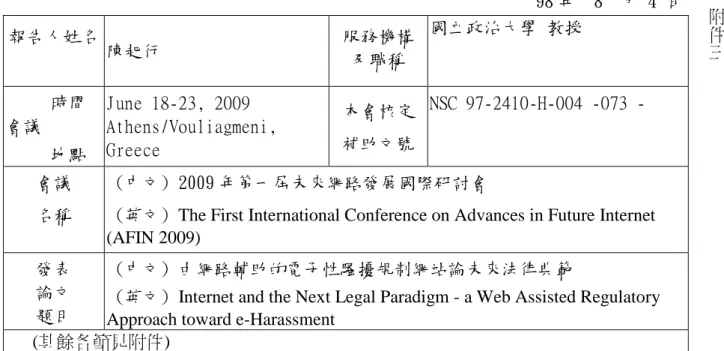
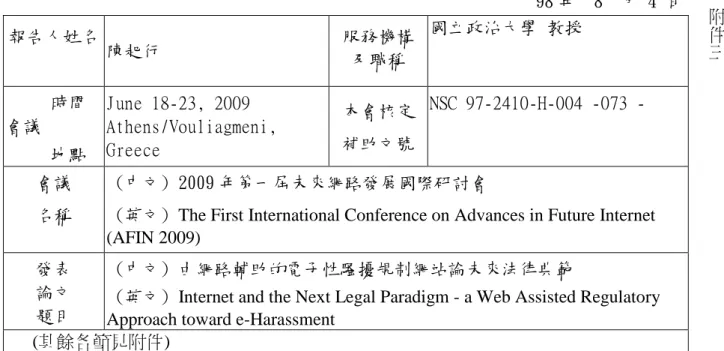
98 年 8 月 4 日 報告人姓名 陳起行 服務機構 及職稱 國立政治大學 教授 時間 會議 地點 June 18-23, 2009 Athens/Vouliagmeni, Greece 本會核定 補助文號 NSC 97-2410-H-004 -073 - 會議 名稱 (中文) 2009 年第一屆未來網路發展國際研討會(英文) The First International Conference on Advances in Future Internet (AFIN 2009)
發表 論文 題目
(中文) 由網路輔助的電子性騷擾規制網站論未來法律典範
(英文) Internet and the Next Legal Paradigm - a Web Assisted Regulatory Approach toward e-Harassment
(其餘各節見附件)