國 立 交 通 大 學
經 營 管 理 研 究 所
碩 士 論 文
探 索 明 治 維 新 傳 統 改 變 與 複 雜 系 統 之 理 論
The Application of Conventional and Complex
Change Theories to the Meiji Restoration Period
研 究 生:羅倫斯
指導教授:毛治國
教授
探 索 明 治 維 新 傳 統 改 變 與 複 雜 系 統 之 理 論
探 索 明 治 維 新 傳 統 改 變 與 複 雜 系 統 之 理 論
探 索 明 治 維 新 傳 統 改 變 與 複 雜 系 統 之 理 論
探 索 明 治 維 新 傳 統 改 變 與 複 雜 系 統 之 理 論
The Application of Conventional and Complex
Change Theories to the Meiji Restoration Period
研 究 生︰羅倫斯
Student︰Laurence Farley
指導教授︰毛治國
Advisor︰Chi-Kuo Mao
國立交通大學
經營管理研究所
碩士論文
A Thesis
Submitted to Institute of Business and Management
College of Management
National Chiao Tung University
in Partial Fulfilment of the Requirements
for the Degree of
Master of Business Administration
June 2007
Taipei, Taiwan, Republic of China
中華民國九十六年六月
The Application of Conventional and Complex Change Theories to the
Meiji Restoration Period
Student: Laurence Farley
Advisor: Prof. Chi-Kuo Mao
Institute of Business and Management
National Chiao Tung University
ABSTRACT
The county of Japan implemented a nationwide process of modernization after the Tokugawa Shogun lost the ruling of government to the Emperor Meiji. During this seventy-year period of radical reform, Japan modernized into a strong industrial nation. This occurred while the sovereign state was exposed to new technologies and cultural influences from the dominant western powers of the day. This thesis presents a macro analysis framework for the organizational transformation during the Japanese Meiji Restoration period. The concepts used to model changes from the target period of Japan’s opening to the world include conventional organization change theories, such as: Lewin’s Unfreeze, Change and Refreeze, and Kotter’s Eight Steps. Complex change system theories are also used for modelling this change progress, which include: Bifurcation and Cusp Catastrophe.
This thesis puts the point forward that complex change system theories can be used to gain some insight of possible outcomes of a specified event. This can be achieved by recognizing, analyzing and influencing the self-organizing process at certain stages of implementation.
Acknowledgments
I wish to thank Professor Mao for his constant encouragement and advice over the course of this thesis project.
Contents Page Abstract i Acknowledgements ii Contents iii List of Tables vi List of Figures vi Chapter 1 Introduction 1 1.1 Preface: 1
Introduction to change systems
1.2 Background: 1
Japanese history before, during and after the change of government
1.3 Motivation: 1
Review of other work coving the Meiji Restoration
1.4 Research Goals 3
1.5 Structure of the Thesis 7
Chapter 2 Document Research 4
2.1 Review of the Tokugawa period 4
2.1.1 Tokugawa History 4
2.1.2 Economic Progress in the Tokugawa Period 4 2.1.3 Tokugawa Social Structure 8 2.1.4 Social Progress in the Tokugawa Period 11 2.1.5 Education under the Tokugawa Government 12 2.2 Review of the Meiji period 12
2.2.1 Meiji History 12
2.2.2 Economic Progress in the Meiji Period 12
2.2.3 Meiji Social Structure 12
2.2.4 Social Progress in the Meiji Period 13 2.2.5 Education under the Meiji government 13 2.3 Review of Conventional Organization Change Theories 13 2.3.1 Lewin’s Unfreeze, Change and Refreeze Model 13 2.3.2 Kotter’s Eight Steps Model 17 2.3.3 The Motivation, Ability and Opportunity Model 18 2.3.4 Peter Senge’s Five Disciplines 18 2.4 Review of Complex Change System Theories 19
2.4.3 Bifurcation Model 19
Chapter 3 Theories Applied in the Research 22 3.1 Conventional Change Theories 22 3.1.1 Lewin’s Unfreeze, Change and Refreeze Model 22 3.1.2 Kotter’s Eight Steps Model 22 3.1.3 Motivation, Ability and Opportunity Model 22 3.1.4 Senge’s Five Disciplines 22 3.2 Complex Change Theories Application 23
3.2.1 Bifurcation Theory 23
3.2.2 Cusp Catastrophe Theory 23
3.3 Research framework 24
Chapter 4 Case Analysis by Theories 25 4.1 Conventional Change Theories 25 4.1.1 Lewin’s Unfreeze, Change and Refreeze Model 25 4.1.1.1 Lewin’s Unfreeze State 25 4.1.1.2 Lewin’s Change State 26 4.1.1.3 Lewin’s Refreeze State 27 4.1.2 Kotter’s Eight Steps Model 27 4.1.3 Motivation, Ability and Opportunity Model 28 4.1.4 Senge’s Five Disciplines 29
4.2 Complex Change Theories 30
4.2.1 Bifurcation Theory 30
4.2.2 Cusp Catastrophe Theory 32 4.2.2.1 List of Cusp Catastrophe Dissipative Phase States 33 4.2.2.2 Cusp Catastrophe Phase State Theory Applied to
Historical Timeline 35
Chapter 5 Conclusions and Recommendations for Further Research 49
5.1 Research Conclusions 49
5.1.1 Research Conclusions of Conventional Organization
Change Theories 49
5.1.2 Research Conclusions of Complex Change System
Theories 49
5.2 Limits of Thesis Research and Change Theory Application 50 5.3 Suggestions for Further Research 52
Bibliography 53
Appendixes 56
7.1 Appendix A: Change Theory Process Models 56 Figure 10. Bifurcation Change Process of an Organized Structure Model 56 Figure 11. The Cusp Catastrophe Change Process Model 56
Figure 12. Cusp Catastrophe State Process: Direct Approach 57 Figure 13. Cusp Catastrophe State Process: Indirect Approach 58 Figure 14. The Motivation, Ability and Opportunity (M-A-O) Model 58
7.2 Appendix B: Letters 59
7.2.1Correspondence between William II of Holland and Tokugawa Ieyoshi, the Shogun of Japan, 1844 59 7.2.2 The Tokugawa Reply to the Dutch Government 61 7.2.3 President Fillmore's Letter to the Emperor of Japan 62 7.2.4 Observations of Tokugawa Nariaki on Coastal Defence, 1853 65 7.2.5 Observations of Ii Naosuke, Lord of Hakone, Oct. 1853 67 7.2.6 Japanese Reply (1854) to President Fillmore’s Letter
of Response from Commodore Perry 69 7.2.7 Response of Commodore Perry to Japanese Reply 70 7.3 Appendix C: Treaties and Acts of Law 73 7.3.1 Empire of Japan Treaty, 1854, between USA and Japan 73 7.3.2 The Treaty of Amity and Commerce between the 76
United States and Japan, 1858 (The Harris Treaty)
7.3.3 The Emperor’s Charter Oath, 1868 78 7.3.4 The Meiji Constitution, 1889 79 7.3.5 The Imperial Re-script on Education, 1890 83
List of Tables
Table 1. Number of Schools by Date of Establishment 13
List of Figures
Figure 1. Hierarchy of the Japanese during the Tokugawa Period 9 Figure 2. Cusp Catastrophe Dissipative Phase State ‘A’ 35 Figure 3. Cusp Catastrophe Dissipative Phase State ‘B’ 35 Figure 4. Cusp Catastrophe Dissipative Phase State ‘C’ 37 Figure 5. Cusp Catastrophe Dissipative Phase State ‘D’ 39 Figure 6. Cusp Catastrophe Dissipative Phase State ‘E’ 42 Figure 7. Cusp Catastrophe Dissipative Phase State ‘F’ 44 Figure 8. Cusp Catastrophe Dissipative Phase State ‘G’ 45 Figure 9. Cusp Catastrophe Dissipative Phase State Process Restarts 47 Figure 10. Bifurcation Change Process of an Organized Structure Model 56 Figure 11. The Cusp Catastrophe Change Process Model 56 Figure 12. The Cusp Catastrophe Dissipative Phase State Process:
Direct Approach 57
Figure 13. The Cusp Catastrophe Dissipative Phase State Process:
Indirect Approach 58
Figure 14. The Motivation, Ability and Opportunity (M-A-O) Model 58 Figure 15. The Meiji Constitution, 1889 83 Figure 16. The Meiji Constitution, 1889 83 Figure 17. The Imperial Re-script on Education, 1890 85
CHAPTER 1: Introduction
1.1 Preface
Change within a society cannot be measured in quantitative terms; only the effects of change can be observed and analyzed. This specialized relationship of cause and effect has been witnessed and recorded throughout human history. However, the ability to determine the rate and transitional flow of change has proved difficult when the effects do not occur immediately after the factors instigating them.
1.2 Background
The county of Japan implemented a nation-wide process of modernization after the last Tokugawa Shogun lost the ruling of government to the Emperor Meiji. During this seventy-year period of radical reform, Japan modernized into a strong industrial nation. This occurred while the sovereign state was exposed to new technologies and cultural influences of the dominant western powers of the day. The area of reform psychology is a vast and highly subjective topic; there are simply no standard cross-cultural guidelines that can be applied to the change client in assessing whether the process of transformation is ethically correct or not. This moral grey-area becomes even harder to successfully navigate when generational issues and paradigm shifts are taken into account, such as when analyzing a pre-industrial Japan in a nascent industrialization period.
1.3 Motivation
Many different articles and books have been written on this intriguing period of Japanese history. My research up until now suggests that the authors have only attempted to determine a linear, short term change, factor to effect relationship. At
present there is no published academic or popular literature examining complex system change effects observed during this period. This thesis presents a macro analysis framework for the organizational transformation during the end of the Tokugawa shogunate (government administration) and Meiji Restoration periods. The concepts used to model changes from the target period of Japan’s opening to the world include conventional organization change theories and complex change system theories.
A simple change system that has been adapted from Kurt Lewin’s work on dynamic stability is the ‘Unfreezing, Changing and Refreezing’ theory. However, this analytical tool is simply one example from the past decades of work in the relatively new discipline of change management. The Lewin model happens to have gained popularity with both scholars in the field and high-ranking executives. The unfreeze stage moves people or groups away from their comfortable stasis zone of stable conditions and emotions. This in turn opens the recipient up for change and possible beneficial (but still subjective) alternatives to thinking or performing a process; the recipient becomes ‘change ready’. This stage can be readily observed as the tipping point of the arrival of America’s infamous black ships on the shores of Japan in 1853. Other conventional organization change theories, such as Kotter’s eight steps will be used to model and explain this period of history. Though the above organizational change theories are highly useful in analyzing change within a closed system after the event, they do little in way of calculating the probabilities of future outcomes occurring. Lewin’s system, for example, requires the states of a system to be clearly defined before action is taken. Some processes are constantly in a state of flux (such as the weather cycle), so the freeze phase of the three steps cannot be applied. Therefore I predict that the simple change models will only be able to superficially detail the transformations apparent in the Meiji Restoration period.
The more complex systems analysis I will use to model change from the end of the Tokugawa period leading up to the Meiji Restoration includes cusp catastrophe and bifurcation theories. These complex systems are by their very nature, difficult to comprehend and correctly apply to measure a system in change. However, they do provide the distinct advantage of being grounded in mathematic principles, and therefore are able to offer some degree of measurable outcome predictability. The disadvantage is apparent when attempting to model even relatively simple processes within a closed system; convoluted mathematical structures soon obscure the reason of change process. However, as factors influencing change during the Meiji Restoration are well-recorded, I hope to demonstrate how complex systems can be applied to provide better models of change.
To my knowledge and after considerable research, this thesis topic is unique as I was unable to locate any other work on the application complex change theories to the Meiji Restoration period.
1.4 Research Goals
In summary, this thesis puts the case forward that complex change system theories can be used to gain some insight of possible outcomes of a specified event. This can be achieved by recognizing, analyzing and influencing the self-organizing process at certain stages of implementation.
The information resources that have been used throughout include books and articles on both simple and complex change systems, as well as the history of Japan during the end of the Tokugawa shogunate period and the Meiji Restoration period. The articles have been electronically downloaded from the Proquest, Oxford Journal and the Science Direct On-Site (SDOS) electronic online professional journal databases.
1.5 Structure of the Thesis
This paper on the application of change theories on the period before and during the Meiji Restoration has been broken down into several sections as follows. Chapter 1 introduces the topic and research goals. Chapter 2 reviews the work of books and academic journal articles reverent to both change systems and Japanese history. Chapter 3 discusses the research theories used to review the relevant literature and suitability for further analysis by application of varying change systems. Chapter 4 looks as the outcomes when different change systems are applied to the time period stated. Chapter 5 discusses the results obtained in the chapter previous and discusses possible explanations for the outcomes, sources of error and experimental interpretation and possible future research. The last two sections of this thesis are the bibliography and the appendixes. The appendixes consist of three different sections: change theories models, letters from notable Japanese and foreign dignitaries in the period, and finally, some of the new laws and treaties that were passed in the Meiji period.
CHAPTER 2 Document Research
2.1 Review of the Tokugawa Period 2.1.1 Tokugawa History
The Tokugawa (1700-1868) period lead directly into the widely acclaimed Meiji Restoration. However, the pre-Meiji shogunate society set up Japan for many of the factors that would later affect the rate of its modernization.
2.1.2 Economic Progress in the Tokugawa Period
The shogun implemented a law of alternate year attendance in the capital Edo (now Tokyo) for daimyo. This ensured a useful incentive for the lower echelons of the power base to remain loyal, as their families always remained in Edo. Therefore if a daimyo rebelled against the state, his wife and successors would be forfeit. Thus the daimyo and the government retainers (hired samurai) were well motivated and used their collective influence to develop extensive infrastructure which in turn helped the expansion of communications and populous dwellings, such as towns and smaller cities. Seeing as the daimyo needed to maintain two locations as households, one in Edo the other in their fiefdom, their income suffered and greater taxes needed to be levied on their fief’s serfs. The daimyo’s money was also spent on various social events to complete in fame with the other daimyos.
Tokugawa period urbanization gave a foundation for a national economy that was controlled from Edo under one fiscal system. Increased demand for agricultural and other goods stimulated production in rural areas, which in turn kick-started the commercial economy in Japan. The Tokugawa period saw a consistent move towards the urbanizing of towns and cities. By 1720, Japan’s capital (Edo) grew into a great urbanized city with a population of over one million. Due to the wealth the daimyos
brought into the fiefdoms, each of the towns in which was located the daimyos’ main castle (when not living in Edo) became cities, such as Osaka, Nagoya and Hiroshima. Overall strong city economy’s make a stabile basis for Japan's modernization after the Tokugawa period.
The existence of the daimyo and the rest of the samurai class created an economy to contend with their demands. Financial markets developed from the ruling class’s demand for certain high end service and goods. Peasants within the different fiefdoms also began the leap from subsistence farming to commercial farming during this period; crops went on sale in new the newly system of markets. During the Tokugawa period industries, such weaving and sake brewing, steadily increased in demand. These industries were well established in a number of towns by the time the Emperor Meiji took power from the shogun government. Banking systems also began during the shogun reign, and loans were given to both daimyo and samurai classes. These early banking systems would later become collaborated into financial institutions known in Japan as Zaibatsu. The influence of Zaibatsu during the Meiji Restoration underpinned the basis for much of Japan's ability to ascend to an industrialized world power status.
During the Tokugawa period fundamental skills developed that would later assist the fast economic growth in the Meiji period. This can be seen in the broadening roles of certain members of different class structures at the time. The bureaucratic class usually consisted of the samurai elite who governed the castle towns, while financial experience and management knowledge was gained by the merchants in their day-to-day dealing with the common peasants and the ruling samurai (or their representatives). All of theses skills concerning the ruling of financial systems and the populous would become essential knowledge in the expansion of Japan that was to follow.
The early Tokugawa shogunate was a time of great peace for the Japanese people that lasted for over two centuries. During this period of history Europe was being ravaged by a series of wars which culminated with the rise of Napoleon. Japan’s nearest neighbour, China, was frequently attacked by the Manchus. The Tokugawa period saw the establishment of the country’s first stable system of a ranking system for its many classes of lords. The daimyo were the highest class of samurai and were directly invested by the shogun. Three-quarters of Japan came under their control though the number of domains continually changed in this period, with a peak of five hundred and an average of two-hundred and fifty domains. These domains varied in size and social structure depending on the samurai percentage of the population. Samurai traditionally resided in the main city or castle town of the domain. Only if their number was so great were they permitted to live in the countryside by their lord (the daimyo).
Although the Tokugawa state effectively controlled three-quarters of Japan for over two hundred years, this control was limited. There was no national centralised treasury system, national schooling system or national judiciary system. In fact, matters of justice were often settled privately such as in the case of violent feuds that crossed domain borders.
The bakufu (government administration, similar to ‘shogunate’) system did manage to construct and maintain control over five national highways that crossed domain borders, but failed in attempts to establish either a national police force or communications system. The bakufu retrained trade between domains through slow economic change increased integration in central Japan. The lack of greater political cohesion despite increasing economic cohesion between the domains could be attributed in part to a lack of an external military threat to the country. The occasional insurrection from peasants (usually unarmed) in a domain could be handled by the
daimyo and his samurai in that domain. There was therefore little political pressure to join any competitive state system.
During the eighteenth century insurrection from peasants was becoming a more frequent event so the bakufu began ordering nearby domains to assist in quashing these mini-rebellions. During the middle of the eighteenth century the bakufu issued several regulations with the purpose of preventing large unauthorised gatherings.
Although during the Tokugawa years the Japanese people were forbidden to leave and then re-enter the country (the punishment was death), the country was not mentally closed. Chinese scholars, painters as well as religious men visited Nagasaki during the two-hundred year Tokugawa rule to ply their trades. Due to the trading export of copper the Dutch began to make inroads into Nagasaki and later Japanese culture. During the 1820’s a Dutch language school was opened in Nagasaki by a Dr. Philipp Franz von Siebold. However there were strict rules placed on all Dutch scholars and traders about the proliferation of Christianity in any form: all religious teachings from the west were banned outright. This paranoid was so well enforced that new books (even from Chinese sources) entering the domain were checked for references to Christianity.
2.1.3 Tokugawa Social Structure
Ideally the samurai served the daimyo indifferent to personal gain or danger. In the Tokugawa period samurai enjoyed different legal privileges from the common Japanese peasants: such the right to wear two swords. Other than being constantly armed the samurai were distinct from commoners in clothes and the special top-knot method hairstyle. Though any social benefits afforded to the samurai caste is contrasted by the manner in which suicide by self-immolation (seppuku) could be ordered by the lord of the domain (the daimyo) for any trifling reason in the name of
honour. This code is known as Bushido.
From the numerous Chinese scholars and books that came to Nagasaki one Chinese concept that was take up and remained with the Japanese was that of a particular type of social ordering. People could to be ranked according to broad social classes under the emperor who at that time was a mere figurehead, the supreme power lay with the shogun. The daimyo and their samurai constituted the ruling samurai class: they held all political power within the domains they ruled. The samurai also performed in the function of administrators that carried out the will of the local lord and many scholars were also samurai. The next groups were the farmers that provided the domain with rice (and possibility a few other luxury crops) and taxes, followed by the artisans that made goods and supplied services for all of the other classes. Finally the lowest class in Tokugawa society was the merchant class that merely traded in goods produced by the higher classes.
Figure 1. Hierarchy of the Japanese during the Tokugawa Period
From the Japanese picture to the right we can see the class system of the Japanese.
From the top the translation for the seven different classes goes:
1. Emperor.
Three Classes of samurai: 2. Shogun
3. Daimyo (lord of a domain) 4. Warrior samurais and scholars
Followed by the lower, mostly uneducated classes: 5. Farmers
6. Artisans 7. Merchant
The samurai ruling class was constantly searching for excessive production within the agricultural system: this is no more evident than in village life. Farmers in a Tokugawa village were oppressed by the samurai to such an extent that displays of benefits afforded to them by the work were banned. Examples of sumptuary laws in village life included:
1. Farmers were prohibited from wearing cotton rain capes 2. Farmers were prohibited from using cotton umbrellas 3. Sandals with leather soles were banned
4. Farmers were prohibited from using tortoise-shell combs 5. Farmers need to leave their heads uncovered
6. Farmers needed to bow when samurai crossed their path
7. Tatami floor mats and sliding doors were restricted for the lower classes in some domains.
The concentration of samurai in castle towns led to the artisans and merchants service classes increasing their number in these areas alone. There was an entire industry set up around the ruling lords of a domain, and the samurai that carried out the lord’s orders. To ensure continued loyally from a domain the shogun instituted a system of dual residence. The family of a domain’s lord, including the lord’s heir, spent all their time as ‘guests’ of the shogun in the capital Edo (now called Tokyo). They effectively could then become hostages in the event of rebellion from the lord.
The lord of each domain needed to spend every other year residing with his family in Edo. This rotation schedule ensured continued loyalty from the lords to the shogun. It also meant that the shogun always maintained a certain amount of leverage over each domain under his control. Domains could be brought together as an army to do the shogun’s bidding without much residence: there was an ever-present threat from the armies in neighbouring domains in the event of a lord’s insurrection.
While in Edo, the lords spent sizable amounts of the taxes taken from the farmers, artisans and wealthier merchants from their domains on petty displays of wealth to compete in fame with the other lords. Spring and autumn were the peak seasons for the daimyo to travel. At these times peasant farmers from the villages (known as ‘assisting villages’) close to the travel routes were enlisted as helpers. This usually entailed becoming a porter of the daimyo’s possessions: the porters were expected to work for no compensation. As the economy grew more and more villages lost their farm workers during peaks seasons of the agricultural calendar, which became a growing source of unrest within the peasant class.
2.1.4 Social Progress in the Tokugawa Period
The hierarchical system during the Tokugawa Period is as follows: emperor, shogun, daimyo, samurai, peasants, artisans, and finally merchants (see Figure 1 in ref. 2.1.3). This system was known throughout Japan and its largest islands; the same social ideology was ubiquitous. This hierarchal system maintained a relativity peaceful stability for over 200 years. Therefore the Japanese were already used to serving an emperor well before the Emperor Meiji came to power. This is important as is proves how the Restoration period was in no way a political revolution, merely a rebellion as the only the people in positions in government changed. During the transition phase to the new government, most of the resistance came from small
entrenched pockets of the samurai class, geographically far away from Tokyo.
2.1.5 Education under the Tokugawa Government
At the start of the Tokugawa period the level of education was low to such an extent that even the samurai generals were barely literate. Education reforms were not lead by a central body, and tended to only focus on the needs of educating the new ruling class, the young samurai. However, by 1715 only twenty domains had official schools to teach samurai, and the teachers were either private tutors that only the rich could afford or Buddhist monks. Towards the end of the eighteenth century there was a far greater onus on getting samurai to at least a literate level of education. Young samurai started with the Chinese calligraphy, followed by the Confucian Four Books (The Analects of Confucius, The Book of Mencius, Great Learning and Doctrine of the Mean) to teach loyalty and morals. The correct way to perform the tea ceremony was also taught at an early age. In the samurai’s teenage years swordsmanship, archery, horse riding, wrestling and military strategy were taught to prepare him for a life of service as both a warrior and administer. An adult samurai should also have some knowledge of a Japanese gentleman’s leisure pursuits, which included: Japanese and Chinese poetry, chess and backgammon.
By the end of the Tokugawa period schools were flourishing. The ruling samurai class saw a need to train not only their young samurai but also children from the lesser classes as well, although the syllabus ranged greatly depending on the factors of the social class of the students and the domain in which they were taught.
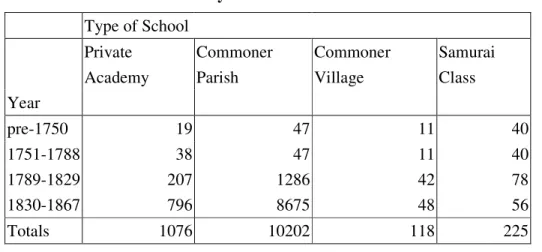
Table 1. Number of Schools by Date of Establishment Type of School Private Academy Commoner Parish Commoner Village Samurai Class Year pre-1750 19 47 11 40 1751-1788 38 47 11 40 1789-1829 207 1286 42 78 1830-1867 796 8675 48 56 Totals 1076 10202 118 225
Source: Rubinger, R., Private academies of Tokugawa Japan.
The great respect for learning in Japanese society had already produced a progressive and widespread educational system in the Tokugawa period. Schools for samurai and children of the lower hierarchal classes had already been established by the start of the Meiji Restoration. National reading rates were already being tested and recorded before 1868.
The shogunate even displayed an interest in knowledge obtained form outside Japan. This can be observed in the ‘Dutch study’ program they set up. This program was used to obtain translations of many areas of western knowledge including: military tactics, medicine and the sciences. Therefore Japan had already become accustomed to idea of foreign knowledge well before the Meiji Restoration. The Ministry of Education in was established in 1871, and build upon many of the ideas encouraged by the Tokugawa. The following year, the bill to make education universal throughout Japan was well received due to the people’s well engrained respect for the need of education.
2.2 Review of the Meiji period 2.2.1 Meiji History
The Meiji Restoration would mark the beginning of Japan’s opening to the world as this period marks the start of the country’s growth into an economic world leader.
2.2.2 Economic Progress in the Meiji Period
The employment in Japan of over three thousand international experts from the US, Britain and Europe to lecture the Japanese in the areas of modern science, engineering and military matters was a master stroke of the Meiji government. It forced the local government officials to learn a foreign language and the latest developments in their chosen areas of expertise at the same time. The concept of seeking foreign knowledge is referred to in the Emperor’s Charter Oath of 1868 (ref. 7.3.3, Appendix C of this thesis). This aided the process of modernisation and industrialisation as the Japanese officials learned of the necessary information directly from the source, not from outdated or poorly translated books. Many Japan officials and students also went to study in the west for the same reason.
The economy prospered as the old stigmas against the merchant class, the lowest caste under Tokugawa rule, were dropped. New roads and railroads were built around the country to facilitate trade. The new leaders were able to make informed and knowledgeable choices on how best to improve the county though industrialisation; Japan became the leading economic force in Asia and a benchmark of a developing county for the whole world.
2.2.3 Meiji Social Structure
With the Tokugawa government out of the way the old lord and samurai social caste system was abolished. The Meiji Constitution of 1889 (ref. 7.3.4, Appendix C of
this thesis) meant that everyone had to operate and live under the same laws.
Though times were hard for the ex-daimyo and ex-samurai, everyone else enjoyed an unprecedented era of development and economic growth. Better farming methods and machinery brought over from the west also saw to the end of large famines.
2.2.4 Social Progress in the Meiji Period
The merchant class were oppressed and heavily taxed (along with the farmers and artisans) under Tokugawa rule. The new emphasis on trade and the importing of foreign ideas and machinery opened up new sources of revenue for the traders. Due to the lifting of heavy and arbitrarily imposed taxes, most were better off under the Meiji government rule.
Bans against leaving the county and certain types of religious worship were now lifted.
2.2.5 Education under the Meiji government
The re-script on education (ref. 7.3.5, Appendix C of this thesis) meant the every child in Japan, not just the sons of daimyo, samurai and rich merchants, was entitled to an education. In fact the imperial edict made it mandatory. Therefore, it was long before the general education level, including the reading rate, of the general public increased. This is turn aided Japan’s economy by having a source of educated labour to rely on.
2.3 Review of Conventional Organization Change Theories
2.3.1 Lewin’s Unfreeze, Change and Refreeze Model
"If you want truly to understand something, try to change it" is quoted from the German born psychologist, Kurt Lewin. He was one of the first scholars that studied the organizational change process in different social groups. His work lead him to identify a three stage change mechanism: unfreeze, change and refreeze. The unfreeze stage moves people away from their comfortable stasis zone of stable conditions and emotions. This in turn opens the recipient up for change and possible beneficial (but still subjective) alternatives to thinking or performing a process; the recipient becomes ‘change ready’. According to Lewin’s work, change is a journey that needs to be undertaken. As in all journey’s one may get lost, but through trial and error and spending time on exploration, the correct route will be uncovered. This is the transition phase of Lewin’s theory. Finally, once the destination is reached and the goal achieved, the traveller must re-establish a new comfortable stasis zone. In this way the change is engrained within the person or organization.
We can apply Lewin’s Change theory to the Meiji Restoration when we analyse the social and political situation from a broader perspective. If we limit the model to a smaller timeframe: the unfreeze state occurring with the arrival of the black ships, and the refreeze state manifesting when the emperor Meiji took political power, then too many import factors are ignored. Though to simplify this paper’s investigation into the change system effects observed during the restoration is tempting, it is perhaps over-generalising the social and political system present in Japan before the black ships appeared. The arrival of foreigners in the black battle ships was definitely an extremely important point of modern Japanese history as the ramifications of strong foreign power wielding influence on both foreign and internal political policy can be
observed in Japan to this very day. However, it would be hubris by the author of this thesis to view Japan’s entire political system to be affected by foreign powers alone.
When using Lewin’ unfreeze, change and refreeze theory to effectively analysis the political upheaval in Japan in the middle of the nineteenth century, we must adopt a larger perspective of Japanese history. We must also speculate that similar political and afterwards social change would have occurred without the arrival of the black ships to act as a catalyst. As the general populous of the country was becoming less and less content with the state of their treatment, as could be observed by the increasing number of riots and acts of civil unrest, eventually another catalyst for change would have emerged. The Tokugawa government’s grip on power was becoming increasing weak as the nineteenth century progressed, and some kind of political change was looming on the horizon.
2.3.2 Kotter’s Eight Steps Model
Kotter’s work on the processes that brings about successful change within an organization is summarized in both his 1995 book ‘Leading Change’, and his 2002 book ‘The Heart of Change’. The eight steps are as follows: 1. change motivation and increasing the sense of urgency; 2. build the guiding team; 3. consensus on vision; 4. removal of barriers, by communicating the change vision; 5. resource commitment and empowering the people that can make the change happen; 6. focus on short-term victories; 7. performance assessment and consolidation of gains made; and finally step 8. institutionalization of change, by anchoring new systems in the culture of the organization.
Kotter’s eight steps can be simplified into an easier and more concise system through integration with Lewin’s Unfreeze, Change and Refreeze Model (Thesis reference 2.3.1). Lewin’s unfreeze phase can include the first four steps of Kotter’s
model. The change phase can include steps five to seven of Kotter’s model. While finally Kotter’s anchoring of new systems step is equivalent to Lewin’s refreeze phase.
2.3.3 The Motivation, Ability and Opportunity Model
The motivation, ability and opportunity model can be seen in Appendix A, Figure 14. This very simple model states that there are three necessary elements required for change. The motivation is the willingness of a person or people to undergo change within an organization. The ability is the aptitude of the person or people to make the change process happen. The opportunity can be viewed as the chance of favourable circumstances being present to facilitate the change process.
2.3.4 Peter Senge’s Five Disciplines
Peter Senge proposed his ‘Five Disciplines’ theory of change in his book ‘The Fifth Discipline’ in 1994. This systems theory consists of five different constituents necessary for organizational change. These elements are as follows: personal mastery, where the subject of the change process displays the willingness to change; mental model, a perspective change of the organization; shared vision, the perspective of the organization is disseminated throughout the organization; team learning, where the organization grows together and shares in the growth process; and finally systems thinking. The last discipline, systems thinking, can be seen as an integration of the other four previous elements to construct a more organic and evolving organization; it is more holistic way to perceive an organization that is always in a state of flux.
2.4 Review of Complex Change System Theories
2.4.3 Bifurcation Model
The bifurcation model displays a series of states along which change of a process of situation can occur (see Appendix A, Figure 10). Change of state can occur on the diagram at one of the distinct nodes. The first part of the diagram shows the existing state which enters the first change node. From here the situation enters a state of chaos in which it becomes ‘change ready’. From hereon there are two routes the changing system can take: it can either carry on to a new state or return to the previous state, in the latter case the original system is conserved, and the change has failed. For the disorganized state stage the system can travel one of three possible routes to re-stabilisation. The first possible outcome is that the system changes according to a pre-determined plan or vision, ‘system changed according to plan’. The second outcome is that the system is changed but the outcome was not the envisioned one, ‘system changed, but not as expected’. The third and final possible outcome is that the ‘system disintegrates’, and possibly returns to a state similar to the initial system.
2.4.4 Cusp Catastrophe Model
History
The French Theorist René Thom coined the term ‘Catastrophe theory’ in the late 1960’s to describe a series of mathematical models he was working on. Using today’s mathematical classification, Catastrophe theory is technically an area of bifurcation theory. Rapid shifts in behaviour or output of a system in Bifurcation theory are linked to testable variations. These variations (or factors) can often occur at a slow rate, but the accumulated effects of two or more such factors can have massive (and
even unforeseen) consequences on the entire system.
Explanation
This rather abstract idea of a ‘Catastrophe theory’ is often found to be difficult to expound. An effective well used analogy to simplify the concept of cusp catastrophe is the behaviour example of an antagonized dog. A dog may react to added stress, such as being beaten, by either becoming scared (more cowardly) or becoming angry (more vicious). In this example the dog should display a natural (or measured) response from scared to viscous as more stress is applied, so long as the stress starts at a restrained low level. However, when the scared dog is irritated in increasing amounts (or a faster rate), it eventually reaches the 'fold' point of the catastrophe cusp. At this point the dog will apparently (and without an increase of irritation from the provoker) suddenly snap into a vicious response. From hereon the dog will continue to be angry, even if the direct irritation cause (the action of the provoker) is significantly reduced. This is an example of hysteresis.
As highlighted in the above example the parameters that need to be measured can affect the analysis of the complete system. To put this in another way, the lack of dependability in weather predictions will always occur due to myriad of possible factors. This is also known as the ‘Chaos Effect’ as first documented by the meteorologist Edward Lorenz, or as the ‘Butterfly effect’, the example of which was given in the lecture from Ian Stewart’s book, ‘Does God Play Dice? The Mathematics of Chaos’. This concept of unpredictability within a closed (isolated) system is due to sensitive dependence on initial conditions. Small factor variation within a system may cause a domino relay effect to dramatic changes. Natural disasters such as earthquakes are of the culmination of tiny movements of tectonic plates, which in turn may cause landslides or even possibly tsunamis.
This Cusp Catastrophe diagram can be seen in Appendix A, Figure 11. The two possible routes for the system process, direct and indirect, are also shown in Appendix A, Figures 4 and 5 respectively.
The indirect approach (the green line) which is seen in Figures 3 and 5 is the more traditional way to view a change process. The old system (State I) moves to the target system (State III) in a predictable and smooth manner though a state of indirect change (State II). The red ball shown in Figure 13 indicated the state of the phase change, while the curved blue line indicates the pull of the attracting forces. The indirect approach shows a smooth transition from one state to the next; there is no hysteresis effect present. Hysteresis is ‘the lagging of an effect behind its cause, as when the change in magnetism of a body lags behind changes in the magnetic field’ as defined by the American Heritage dictionary.
The hysteresis effect can be seen the direct approach (the red line) of the cusp catastrophe model in Figures 3 and 4. Instead of a uniform rate of change the ball reached the threshold point (as indicated as the ‘fold point’ or red doted lie in Figure 11 and the yellow burst shape in Figure 12) as the change process is sped up and will not return to its pervious state beyond this point. As the system moves through the change process from state A to state G, the pull of the two different attractors varies greatly. We observe the hysteresis effect between the states E and F (Figure 12): when in the chaos zone the pull from the new attractor is much greater than that of the old attractor but the state of the system, as indicated by the red ball, has not yet passed into the new state. From then on the final pulling force from the new attractor forces the state over the axis into a new organizational system; the red ball of the phase state rolls into the system.
Chapter 3 Theories Applied in the Research
3.1 Conventional Change Theories
3.1.1 Lewin’s Unfreeze, Change and Refreeze Model
Due to this model’s simplicity it will be one of the easiest theories to apply to the historical data in thesis. Three different points in time that conform with the unfreeze, change and refreeze stages need to be identified over the course of the change between the Tokugawa and Meiji organizational systems in Japan.
3.1.2 Kotter’s Eight Steps Model
As Kotter’s system model is more of an elaboration of Lewin’s unfreeze, change and refreeze phase states model the same process of investigation can be applied. Special care will be taken to try and identify some of the causes behind the process of organizational reform at different stages. These will also be used in conjunction with the timeline in ref. 4.2.2.2 of this thesis.
3.1.3 Motivation, Ability and Opportunity Model
As this model calls for the application of completely abstract goals to be used to determine the mindsets of groups of people that have long since passed away, the results gained are completely open to interpretation. The motivation and ability of the groups within both the Tokugawa and Meiji organizations have been recorded and analyzed by a number of historians over the years, but all we really have to work on is second hand evidence at best.
3.1.4 Senge’s Five Disciplines
discipline). Here synergy can be observed as the overall effect of the systems thinking approach to view the organizational change, is greater than the sum of the other four disciplines.
3.2 Complex Change Theories Application 3.2.1 Bifurcation Theory
The bifurcation process model works well in describing different possible outcomes of the Meiji Restoration other than the current historical interpretation. The weakness in the model lies in the interpretations of the stages being broken down into only four distinct phase changes: lose of stability, chaos zone, change and result (see Appendix A, Figure 10). As we already know the result of the change in governments between the Tokugawa and Meiji systems due to historical recording, the only remaining process is to envision any other possible outcomes from the interaction of these two organizations.
3.2.2 Cusp Catastrophe Theory
Catastrophe theory shows us that smooth change history in a system does not necessarily lead to the continued rate of change in the future. People that invest in stock markets are well aware of this; the crash can always be around the next corner. The only precaution one can take is to be ready for change; to ‘expect the unexpected’ as the phrase goes. As well as being applied to every-day life scenarios, the seven Catastrophe systems (fold, cusp, swallowtail, butterfly, hyperbolic umbilic, elliptic umbilic and parabolic umbilic) are also evident in physics, ecology, biology and psychology. The Application of the various catastrophe models will present a useful reference point from which to interpret the Meiji Restoration period. Due to the nature of this experiment, the ability of each model to represent historical circumstances
during the Restoration period can only be judged subjectively.
3.3 Research Framework
After consulting with numerous historical books and first and second hand historical sources (as in Appendixes B and C) a timeline was constructed to aid the analysis of this thesis. This timeline can be found in ref. 4.2.2.2 of this thesis. Both the conventional and complex change theories will be applied to the historical research data in the timeline in an attempt to find the most suitable in modelling the organisational change event. Appendix A consists of the graphical models of the complex change theories that are used in this thesis.
CHAPTER 4 Case Analysis by Theories
4.1 Conventional Change Theories
4.1.1 Lewin’s Unfreeze, Change and Refreeze Model
When comparing the situation of both Japan’s internal and external political struggles there are three major turning points that seem to conform well to the three stages of Lewin’s theory. Though each of the three dates I have given is widely open to personal interpretation, I will attempt to justify my decision with appropriate supporting evidence.
4.1.1.1 UNFREEZE STATE (starting from between 1807 and 1825, on ref. 4.2.2.2 timeline and ending around 1850)
This was a period of massive civil unrest for Japan. Due to increasing occurrences of rice crop failures the public were revolting more frequently. Though an unusually bad spate of unpredictable weather cycles and flooding could not be blamed on the Tokugawa government, they did precious little to ease the people’s suffering.
In my cases the pomp of the shogun and the travelling daimyo on their way to and from the capital Edo exacerbated this situation. Ordinary farmers were expected to work for free as luggage carriers for the daimyo lords and retainers. If did not anger the peasant farmers enough, the timed of travel from and to Edo often conflicted with the farming planting and reaping cycles, so less food could be produced for the already downtrodden and hungry masses.
The local peasant farmers were however exposed to increasing displays of wealth displayed by the daimyo lords and their samurai, which was designed to impress other visiting daimyo. As the farmer, artisan and merchants were heavily taxed in this period of Japanese history relative to their total income the undercurrent
of discontent must have been accumulating, and waiting for a chance to vent out against their masters.
Here we can observe the organization entering a state of ‘change readiness’ as tensions between the highly segregated classes are coming to ahead.
4.1.1.2 LEWIN’S CHANGE STATE (starting around 1850 and on ref. 4.2.2.2 timeline and ending around 1876)
This is the chaos state in which either of the two government organizations, Tokugawa or Meiji, could have come out on top. Although the arrival of Commodore Perry’s black ships was a catalyst for change in troubled Japan the event it did occur when the country was already in a state of turmoil. Therefore, it would be arrogant to assume the political revolution came about solely due to foreign inference in state affairs, though the pressure the United States and other trading nations exerted at the time was a contributing factor in the change process.
Though the Tokugawa government tries to react to stabilise this new chaotic state most of there actions are looking towards the past, not the possible future. As under the Tokugawa Japan was never really a unified country, more of a series of vassal states (fiefdoms) that had to pay homage to the shogun. When outside and internal pressure was placed on this system there was simply not enough internal cohesion, (as governmental influence) so the system failed as was left wide open to possible change from a variety of different sources.
The Meiji government organization took advantage of this situation to install the young monarch and re-establish an imperial ruling system. To maintain power during this volatile time they promoted peace by both signing trade and amity treaties with a number of nations, as well as solidify their rule through numerous laws and edicts.
4.1.1.3 LEWIN’S REFREEZE STATE (starting around 1876 and on ref. 4.2.2.2 timeline)
Due to the Meiji government’s short but highly impressive reign over Japan the chaotic change process has taken only around twenty to thirty years to complete. In this short time the foundations have been laid to maintain a new order for the next phase of Japan’s history. As the political stability is returned to the country, a new social stability follows as well; for the first time Japan is truly a unified nation. Over the next fifty years to follow the ‘refrozen’ Japan will take its place as the leader of the Asian economies, due to its forward thinking and adaptability to meet the modern world, and its social challenges, head on.
4.1.2 Kotter’s Eight Steps Model
The first step is to increase the sense of urgency; this was certainly true towards the end of the Tokugawa reign as the number of riots and cases of insurrection by the general public was rising sharply. Therefore the Meiji organization had no part in the first step; it was merely a by-product of the inadequate rule of the Tokugawa.
The second and third steps are building the guiding team and getting a consensus on vision. This was a very import part for the new Meiji government to master; they not only had to assemble enough politically sharp and powerful people, but also make sure that the common goal was shared amongst the members. Political change can be a dangerous time, especially if the new government doesn’t merely replace the old one, but introduces a new political system at the same time. Many of the old Tokugawa government or the daimyo lords and samurai could and probably did hold large grudges against the new rulers. This is the type of situation where a coup from either the old rulers or a new political faction is the most likely. The new Meiji organization solved this problem by removal of unnecessary political barriers by
communicating the new Japan with new laws and edicts. As in step four of Kotter’s model. This concludes the unfreeze state in relation to the first four steps.
From hereon the Meiji government instituted a new of positive long-term moves to solidify their powerbase. A good example of the fifth step for resource commitment empowerment is when the Meiji government sent around thirty of its officials to the US, Britain and Europe. Their varying tasks were basically to learn how these modern counties political and economic systems worked, as well as observing the benefits of advanced technologies. Short-term victories (the sixth step) were brought to Meiji Japan by way of imported expertise and equipment in the forms of modern weaponry, transportation and infrastructure. Imported foreign science and technology played a large part in the rapid advancement of the county. The Japanese people of that period living in the cities would have had no problem in understanding the gains (seventh step) and advancement to their lives after the emperor took power. The seventh step ends the relation to the change phase of Lewin’s phase theory.
Finally, the step eighth step, Institutionalization of change by anchoring new systems in the culture of the organization, can be equated to Lewin’s ‘refreeze’ phase state. Here we can observe a Japanese country, not a fiefdom, which is able to make edicts and pass laws that benefit and affect its entire people. Examples of this can be found in the Meiji constitution (1889) and the re-script on education (1890), both of which can be seen in Appendix C. It was at this time that Japan became a sovereign nation, and entered the world political stage.
4.1.3 Motivation, Ability and Opportunity Model
When using this model we need to assume the thoughts and goals of people that lived in a different era, it is the most imprecise. The opportunity arose from around the period of increased civil unrest in Japan. As rice crop failures grew the peasants
started revolting as they blamed the Tokugawa lords for making them work for free as luggage carriers for the daimyo and retainers during the crucial annual planting and harvesting times. There was high animosity towards the Tokugawa government already, which created an opportunity for change.
The ability of the people within the Meiji organization is apparent after the change of government event. In less then fifty years under the Meiji rule, the country of Japan had changed from a series of agricultural based fiefdoms into an international first-world nation. The Meiji emperor was surrounded by many notable and loyal people, both inside and outside the diet, which worked for the state towards a common goal.
The motivation of the people that worked in and for the Meiji government is difficult to ascertain. Although we can guess that the reasons behind the motivation lay in the incentive of building a stronger and more stable Japan, we can never really be certain of the theses people’s aims. I would like to think that at this period of history the Meiji protagonists felt that they had a sense of pulling together and working towards a common goal, but it is risky to try and empathize with a people from a different era and culture.
4.1.4 Senge’s Five Disciplines
This systems theory consists of five different elements of organizational change. The personal mastery exhibited in motivating the group has already been discussed in section 4.1.3 of this thesis. The mental model of establishing a new world view for Japan, and than allowing others to grow with this view was brought about through increased trade and contact with other nations. In permitting interaction with other nations, Japan and its people were permitted to flourish and compare themselves with their international peers.
Sharing this new vision of growth and country-wide prosperity was aided by the unification of the country under a singular ruler and a single rule of law. Previously the farmers, artisans and merchants needed to abide to the whims of their local lord, and these arbitrary laws changed from domain to domain.
Organizational or team learning was achieved though better country-wide infrastructure, newspapers, and later on, a new constitution (7.3.4 in Appendix C) and a re-script on education (7.3.5 in Appendix C).
Systems thinking can be understood as the holistic sum of the other four disciplines. As the Meiji government manages to creative order from chaos in such a short space of time, and then put forward and anchored a vision of a new Japan we can assume the synergism of the different elements was positive; the Meiji government displayed a systems thinking approach to organizational change.
4.2 Complex Change Theories
4.2.1 Bifurcation Theory
Though it would seem that the Tokugawa government lost control and entered the chaos zone with the arrival of Commander Perry’s black ships in 1853-4, in actual fact the government had been in turmoil for some time. The arrival of the black ships was a catalyst that forced the equilibrium of control further onto the Meiji government’s side. From the lose of stability zone the Bifurcation process enters the chaos zone from between 1807 and 1825 on ref. 4.2.2.2 timeline, which ends around 1850, the same as Lewin’s Unfreeze phase. The reasons given for this change are the same as in 4.1.1.1, earlier on in this thesis; basically the Tokugawa government did little to ease the people’s suffering during times of crisis. Perhaps their mismanagement of the domains added to causes behind the crisis such as the famines
and riots. From this point the process (see Figure 10 in Appendix A) can either carry on into the disorganized state or restore to the original state (system conserved, change failed). Fortunately the bifurcation process carried on into the disorganized state.
Once Japan entered the chaos zone of the bifurcation process the system becomes disorganized and change could occur. The change zone occurs from around the early 1850’s on ref. 4.2.2.2 timeline, the same as Lewin’s change phase. The reasons given for this change are the same as in 4.1.1.2, earlier on in this thesis; the Meiji organization took control of the chaos to place the young monarch in a position of political power and re-establish an imperial ruling system. The Meiji government promoted peace by both signing trade and amity treaties with other nations to ensure no outside interference with their new state of sovereignty.
When we refer to the bifurcation model (Figure 10 in Appendix A) we can see that from the change zone there are only three more routes that this change process can take: system changed according to plan (white circle with a black dot in the middle); system changed, but not as planned (blue circle with a white dot in the middle); and system disintegrates (red circle with black cross). As the result of system disintegration is the re-establishment of the old system (the black dotted line in Figure 10), we know this did not happen as the Tokugawa did not regain power. As the Meiji took power and installed their reign relatively peacefully over a short time period, this demonstrates how the system was changed according to plan (as shown as a possible outcome in the result zone). This final result zone according to the bifurcation model occurs from around 1876 on ref. 4.2.2.2 timeline, the same as Lewin’s refreeze phase. The reasons given for this change are the same as in 4.1.1.3, earlier on in this thesis; a nation is established, not a series of domains. Political stability is returned to the country and new order of law is formed as its basis for a legal framework. The unfair
class system is revolutionised to take power away from the daimyo lords and their samurai.
4.2.2 Cusp Catastrophe Theory
The complex cusp catastrophe theory can provide an insightful demonstration of the possible extremes of change within an isolated system such as Japan before it ‘opened’ to western powers. However, defining what an isolated system is with respect to external influence and the universal constant of entropy can prove difficult. For example, though a simple insect’s reflexes to a certain situation could be mapped and analyzed, an individual’s reactions to a similar situation would not be so apparent. Human reaction to conflict could be a precursor to war (when the group size is sufficiently large), which can not be so easily understood, given people’s underlying needs for both safety and security. Human behaviour in both individuals and societies can often reach the phase ‘fold’ point, as laid out in the catastrophe theory, but the reasons for these changes can’t be processed until after the event. This objectivity that must be employed to analyse the historically relevant Meiji Restoration will not affect the outcome of this paper’s results as the major of the events occurred over one hundred and fifty years ago, therefore this time delay side effect of applying a complex change system becomes a moot point in this case
When we refer to Figure 12 in Appendix A, we see that the direct approach (the red line in Figures 3 and 4) has seven stages labelled A though G. The first stage A appears on the left-hand side of Figure 12 at the old state. The graph then flows from left to right to approach the new target state. On the time line in ref. 4.2.2.2, I have attempted to identify each of these seven stages. However, as with the other models in this thesis the stages of development are not distinct as there is no definite cut off stage. Therefore my interpretation of the events and my analysis of the historical data
are from a subjective stance. Below is a list of the seven cusp catastrophe dissipative phase states and some of the more notable historical instances that occurred in each state. For a more thorough list, refer to the timeline in ref. 4.2.2.2.
4.2.2.1 List of Cusp Catastrophe Dissipative Phase States Exiting State
State A: before 1784 - Tokugawa shogunate rules county for over 200 years. Disorganization Zone
State B: around 1780’s - Temmei famine kills as many as one and a half million. Peasants protest heavy taxation
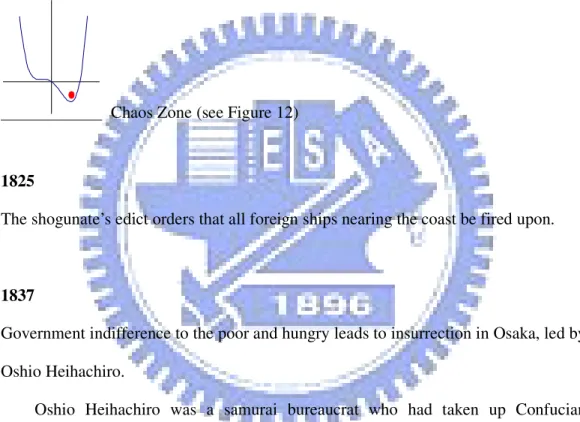
Chaos Zone
State C: around 1820’s - Government indifference to the poor and hungry leads to increased insurrection. Financial burdens on daimyos by shogun increase without government support. Many samurai suffer hardships throughout Japan. Support starts to drift away from Tokugawa rule, but no clear new ruling organization is observable yet. Shogunate’s edict orders that all foreign ships nearing the coast be fired upon.
State D: around 1840’s - Cold weather and natural disasters severely damage the annual rice harvests. Tokugawa does little in response.
State E: around 1850’s - Daimyos reinforce coastal defences. Black ships arrive. Ultimatum from US to open Japan to trade.
Reorganization Zone
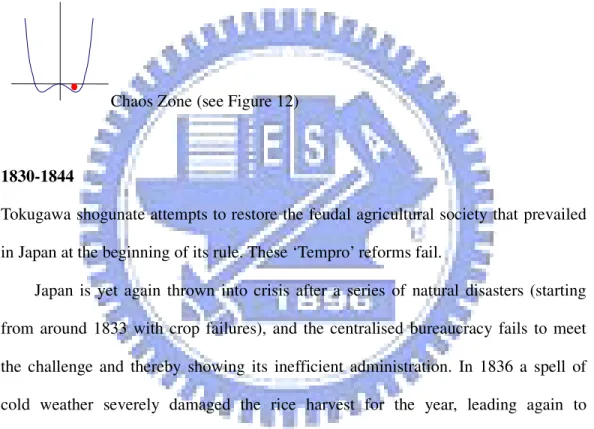
forces in Kyoto. This can be identified as fold point: the time in which the red bad falls into the new state (see Figure 7).
Restoration of imperial rule by Emperor’s Charter Oath. First Japanese diplomatic mission to the United States. Target Zone
State G: around late 1860’s - The Meiji Constitution and Imperial re-script on education.
If we imagine the pressure to change the system building up in the chaos zone (states C to E) then the only way the energy can be released is by forcing the system (the red ball in Figure 12) into the next state to release the energy, as seen in Figure 12, state F. The Tokugawa (old state) and Meiji (new state) attractors are continually pulling against each other. The delayed reaction response of the red ball to fall into the new Meiji system is an example of hysteresis. Though the Meiji system eventually wins over the Tokugawa there is a residual drag factor from the old attractor trying to regain power and restore the old system state.
4.2.2.2 Cusp Catastrophe Phase State Theory Applied to Historical Timeline
Twenty great famines resulting from drought and crop shortages led to mass starvation in Japan between 1675 and 1837. Peasants responded through protests concerning food shortages coupled with increasing taxes.
Figure 2. Cusp Catastrophe Dissipative Phase State ‘A’
Existing State (see Figure 12)
1738
Over eighty-thousand peasants protest heavy taxation in Iwaki province.
1754
Over one hundred and sixty-thousand peasants protest heavy taxation on Kyushu Island.
Figure 3. Cusp Catastrophe Dissipative Phase State ‘B’
1781 - 1789
Temmei famine kills as many as one and a half million.
At the same period of increased taxation and political extravagance in the form of gift giving to buy favours and power, a new agricultural drainage system meant to bring about increased crops failed. Large crop failures were then compounded by a series of droughts and floods which drastically diminished the harvest for a number of years. The whole of Japan suffered from peasant uprisings due to the continual state of famine. This period in Tokugawa history saw some of the worst famines during its reign.
1789
Disturbances in Ezo region.
1790
Nagasaki foreign trade limited to ten Chinese and two Dutch ships per year.
1791
New proclamation states regulations for all foreign ships. All ships to be sent to Nagasaki if in distress. If resistance is met then aggressor foreign vessel is to be fired upon until destroyed.
1804
The Russian envoy, Rezanov, demands opening of trade relations. His demands are refused and Rezanov leaves Nagasaki in 1805.