Available online at www.sciencedirect.com Available online at www.sciencedirect.com
Procedia
Engineering
Procedia Engineering 00 (2011) 000–000www.elsevier.com/locate/procedia
The Twelfth East Asia-Pacific Conference on Structural Engineering and Construction
Development of Fatigue Test System for Small Composite
Wind Turbine Blades
Feng-Min Lai
1*, Shin-Han Yang
2, Jia-Hroung Wu
3, Chun-Teng Hsueh
4,
Chao-Chieh Yang
4, Bao-Hui Wang
4, Chun-Hsiang Lan
41 Dept. of Industrial Engineering and Technology Management, Da-Yeh University, Taiwan 2Dept. of Mechanical Engineering, National Chiao Tung University, Taiwan 3 Dept. of Industrial Engineering & Management, Hsiuping Institute of Technology, Taiwan 4Dept. of Industrial Engineering and Technology Management, Da-Yeh University, Taiwan
Abstract
The research was to develop a small blade fatigue test system which met the criterion of the IEC (TR 61400-23) for the small composite wind turbine blades (SCWTBs). The fatigue test machine consisted of the servo motor, linear guide, transmission, controlling system and clamping apparatuses. These components were used to balance the weights loaded on the blades. Weights were added to change the different mass at each saddle for the loading tests. Amplitude of fatigue can be manipulated by rotating the eccentric holes of the flywheel. The kinetic power of the SCWTBs was translated from the circular motion to linear motion. The fatigue test system was able to test 1m-3m SCWTBs with single or multiple samples tested simultaneously. Because vibration frequency of the fatigue test system was limited to 3-6 Hz, this research also tested the repaired samples after breaking them intentionally for the tests. Finally, the paper drew the linear formulation of the Goodman diagram. The experimentally determined S-N curve for R= –1 was used to define the intercepts of the constant life curves of the vertical axis of the SCWTBs.
© 2011 Published by Elsevier Ltd. Selection and/or peer-review under responsibility of [name organizer] Keywords: fatigue, small blades, composite, clamping apparatuses, test system
1. INTRODUCTION
Three developmental techniques of failure mechanisms for the SCWTBs, namely, clamping apparatuses, fatigue machine and fatigue test methods were discussed according to different international
1877–7058 © 2011 Published by Elsevier Ltd. doi:10.1016/j.proeng.2011.07.252
standards. The research process included the testing of the SCWTBs platform and fatigue life. The Goodman chart could be plotted through the fatigue tests and the testing results. Finally, the paper would estimate the fatigue life of the 1m SCWTBs.
2. CITATIONS AND REFERENCES
A loading test and a whiffle tree test according to the criterion of the IEC (IEC-61400 1995; JB/T-10194 2000 and JB /T-10300 2001) were developed for the fatigue test of the composite blades. The design and the fabrication of the clamping apparatuses for the composite blades were developed, and a number of techniques had been proposed for wind turbine blades analysis (Habali and Saleh 2000). A simulation of fatigue techniques (Shokrieh and Rafiee 2005) and an improved design for the clamping apparatus of blades (Sutherland 1999) had been proposed for a composite wind blade.
3. EXPERIMENTAL PROCEDURE
3.1. Design fatigue test machine
Because the MTS-810 machine (Figure 1) was at a higher cost, the paper developed small blade fatigue test system according to the relevant IEC (TR 61400-23, JB/T-10194) standards for the fatigue test system of SCWTBs (Figure 2).
The servo motor provided the kinetic energy for the fatigue test. The servo motor was comprised of the dial and the linear guide which changed the circular motion to linear motion for the modes of the vibration. A computer-aided model was designed by utilizing the commercial software called Solidworks to simulate the stress distribution for the different components of the fatigue system, and the simulative result was used to design the fatigue system as the feedback.
Feng-Min Lai et al. / Procedia Engineering 14 (2011) 2003–2013 2005
Author name / Procedia Engineering 00 (2011) 000–000 3
Figure 2: Design diagram of fatigue machine
3.2. Testing-platforms
The fatigue test machine was comprised of the servo motor, linear guide, transmission, controlling system and clamping apparatuses. These components were used to balance the weights at the three different saddles (Figure 3).
Weights were added to change the mass at each saddle for the loading tests. The transmission could control the amplitude of the fatigue from the different eccentric holes of the flywheel. The blades of the SCWTBs worked linearly by fixing the clamping apparatuses and the linear guide.
The fatigue test system was capable to test 1m-3m the SCWTBs and the rotor with single or multiple blades. The composite blades were tested in two kinds of conditions. One was the repaired blade after being broken intentionally, and the other was the unbroken blade for comparison. Both of the experimental results and failure modes were discussed for different SCWTBs. If traditional technique had been employed, one test would require more than one hundred days to be completed. Thus, it would be very difficult and time-consuming to establish an appropriate database for wind turbine applications with the vibration frequency limited in 3-6Hz.
3.3. Developed clamping apparatuses for blades
Quality of the clamping apparatus was a serious factor for measuring the vibration. Therefore, stiffness of the clamping apparatus should be strong enough in order to measure the vibration frequency of blade accurately. The vertical vibration could be controlled by MTS-810, and the clamping apparatus was used to connect blades and MTS-810. The clamping apparatus including three blades (Figure 4) and saddles (Figure 5) could be fixed in three blades of the main structure and the saddles put on the clamping apparatus to cause a larger effect for the failure.
Figure 4: Clamping apparatus of blades Figure 5: Saddle entity
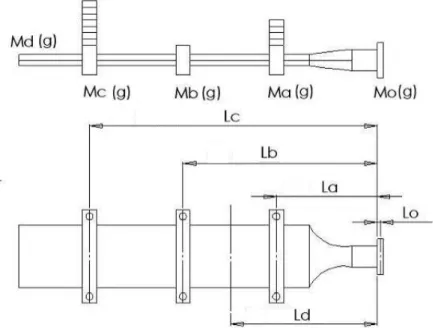
A saddle could be placed at three points of the composited blade, and the different mass of weighs was added on the saddle to increase the mass of blades (show in Figure 6). The definition of each saddle and the weight were demonstrated in Table 1. Weight a and weight c were the main counterweight position and weight b was the mass center of blades. The new mass center could be calculated by the equation (1).
Feng-Min Lai et al. / Procedia Engineering 14 (2011) 2003–2013Author name / Procedia Engineering 00 (2011) 000–000 2007 5
Figure 6: Three-point with saddle and proof mass in the SCWTBs
Mo
Md
Mc
Mb
Ma
Lo
Mo
Ld
Md
Lc
Mc
Lc
Mc
Lb
Mb
La
Ma
X
cm+
+
+
+
×
+
×
+
×
+
×
+
×
+
×
=
(1)Table 1: Define proof mass and distance
La The distance between a and fulcrum
Lb The distance between b and fulcrum
Lc The distance between c and fulcrum
Ld The distance between the mass center of Blade and fulcrum
Lo Width of Ring
Ma Mass of the weight b
Mb Mass of the weight b
Mc Mass of the weight c
Md Blade mass
Mo Clamping apparatus mass
3.4. S-N Curve and linear Goodman Diagram
The strain gauges were pasted on the wing root; thus, the motion brought the sine wave about the relationship between the strain and time. Strain width (S) to number of cycles to failure (N) diagrams could be established for each R-ratio by testing at different Strain widths. The fatigue behavior was
characterized by the mean S-N curve, and the scatter was discussed in the experiment. The difference between R-ratios and the fatigue strength was estimated by linear interpolation method. In current method was described for transforming fatigue cycles with random R ratios into one of the R-ratios given in the Goodman Diagram (GD). A linear formulation of the Goodman diagram was used here, and the experimentally determined S-N curve for R= –1 was used to define the intercepts of the constant life curves with the vertical axis. The values were derived from the formulation and material constants cited.
4. RESULTS AND DISCUSSION
4.1. Manufacturing techniques and experimental setup
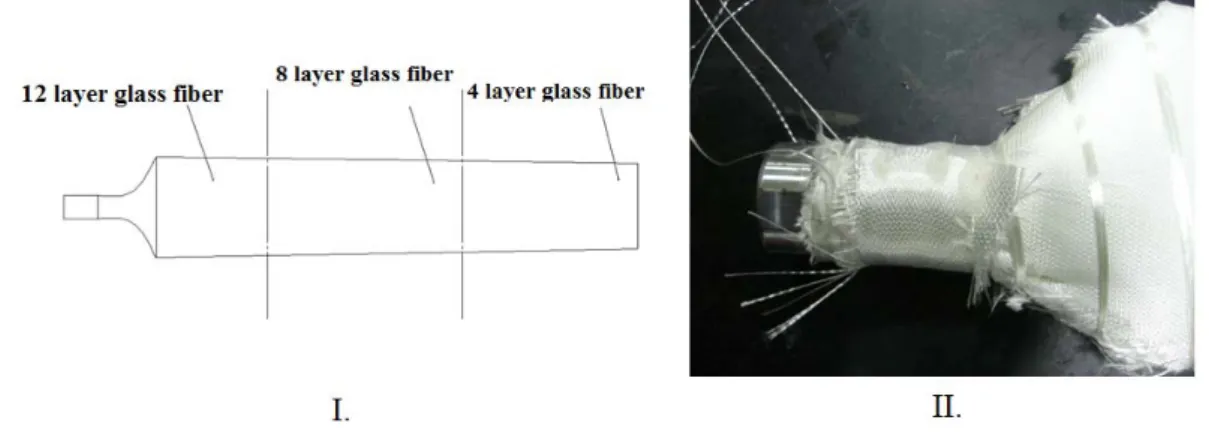
The study had the results about how the blades broke and where the failure occurred. According to the results, two kinds of repairing methods, three processes multi-layer glass fiber and multi-layer glass fiber at the neck-shaped part of the blades, were provided in this study to reinforce the structure of the blades demonstrated in Figure 7.
Figure 7: The different reinforcement methods
The vibration data of the fatigue was measured by the strain gauge and accelerometer. The experimental results, including the strain value and the accelerometer value, were shown in Figure 9 and
Figure 10. The distance between the strain gauge and the end of the blades was 300mm, and the distance between the accelerometer and the end of the blade 485mm was shown in Figure 8. The experimental results containing the train value and the accelerometer value were shown in Figure 9 and
Figure 10, respectively.
4.2. Fatigue experiment of SCWTBs
This study used the blade (1.781kg) to test on the fatigue test, and the setup test data of fatigue test machine and three-point load in SCWTBs were shown in Table 2. The movement distance and fatigue life were 10cm and about 504 times, respectively, through observing the experiments. The failure occurred at the neck-shaped part of the SCWTBs as shown in Figure 11.
Feng-Min Lai et al. / Procedia Engineering 14 (2011) 2003–2013Author name / Procedia Engineering 00 (2011) 000–000 2009 7
Figure 8: Accelerometer and strain gauge of location
Figure 9: Strain value for 300mm Figure 10: Accelerometer (mV/g) values Table 2: The fatigue test machine management of vibration data
Weight (g) 1.781 kg
Increase of the weight 9.88 kg
Experimental frequency 4 Hz
Figure 11: Destruction of root and metal joints
Figure 12 demonstrated the processes of repairing the broken part of the SCWTBs. The repairing processes increased life time from 504 to 1361 times. The setup test data of fatigue machine was shown in
Table 3.
Figure 12: SCWTBs in root repair Table 3: The fatigue test machine management of vibration data
Process Hand lay-up technique + RTM
Weight (g) 1.914 kg
Increase of the weight 9.88 kg
Experimental frequency 3 Hz
Feng-Min Lai et al. / Procedia Engineering 14 (2011) 2003–2013Author name / Procedia Engineering 00 (2011) 000–000 2011 9
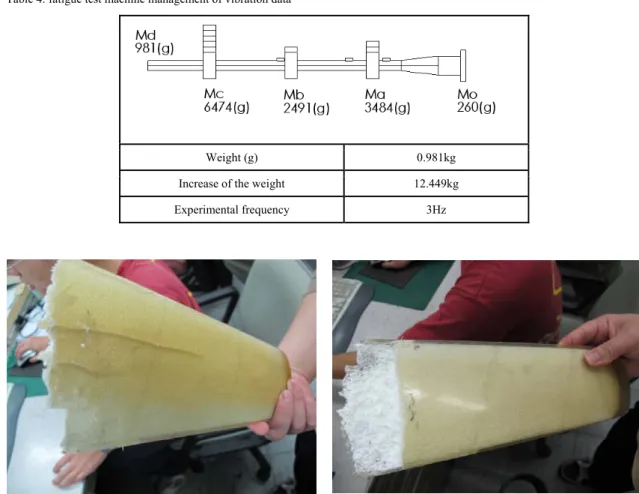
Another set of experiments, the test data of fatigue machine, was shown in Table 4 for SCWTBs. In the experiment, the failure occurred at the Mc of the blade as shown in Figure 13. In this set, the fatigue life time is 1800 times when the blade was broken.
Table 4: fatigue test machine management of vibration data
Weight (g) 0.981kg
Increase of the weight 12.449kg
Experimental frequency 3Hz
Figure 13: Blade destruction (1) Leeward & (2) Windward
4.3. Goodman Guidelines
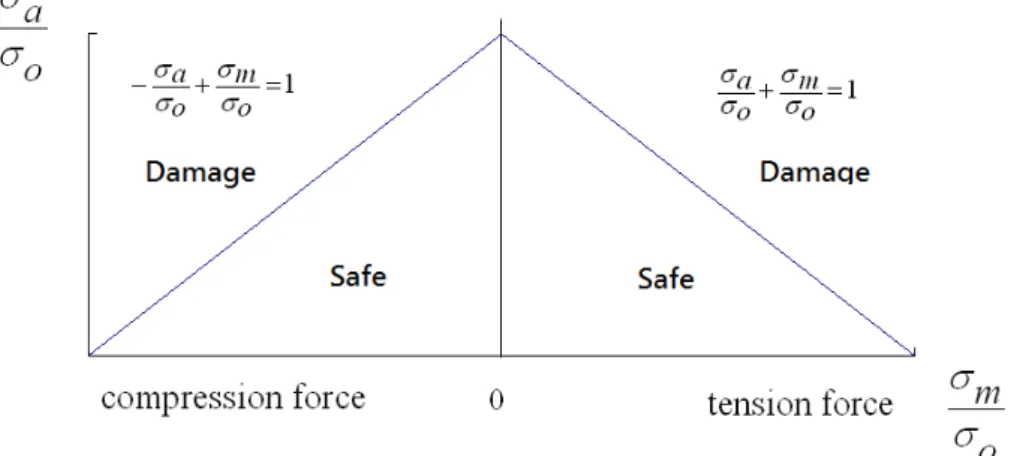
Based on Equation (2), if the right side of the equation is smaller than 1, the specimen is under the safe range; otherwise, the specimen breaks. In Figure 14, the area under the triangle area is the safe area for the specimen; however, on the other hand, the area above the triangle is the damaged area for the specimen. This research utilized equation (3) to confirm the accuracy of data from different stress (strength) ratio to understand under different cycles, and to establish a small blades Goodman curve chart.
1
=
+
o m o aσ
σ
σ
σ
(2)where σa was the alternating stress (force) of the fatigue cycle, σo was ultimate tensile strength (force)
or ultimate strength (force), and σm was mean stress (force) of fatigue cycle.
m p o a
C
N
1 −=
σ
σ
(3) where N was number of cycles, m was fatigue index, and CP was material constant.Figure 14: Goodman Guidelines
5. CONCLUSION
The study utilized clamping apparatuses to test composite wind turbine blades and successfully developed the clamping apparatuses, fatigue testing system, experimental processes of the SCWTBs and the fatigue periods. In the end, the paper successfully established the S-N curve charts of the SCWTBs.
Acknowledgements
We would like to express our deep sense of gratitude to the National Science Council who kindly provide funding and research-related support (Project Number: 97-ET-7-009-006-ET), and we are also grateful to the sub-project directors who generously provide invaluable information for the completion of this research.
References
[1] IEC standards and literature reference for wind turbine, IEC-61400, 1995.
[2] S.M. Habali and I.A. Saleh(2000), Local Design, Testing and Manufacturing of Small Mixed Airfoil Wind Turbine Blades of Glass Fiber Reinforce Plastic Part I:Design of the blade and root, Energy Conversion & Management, 41, pp.249-280.
Feng-Min Lai et al. / Procedia Engineering 14 (2011) 2003–2013 2013
Author name / Procedia Engineering 00 (2011) 000–000 11 [3] Mahmood M. Shokrieh and Roham Rafiee (2005), Simulation of Fatigue in a Full Composite Wind Turbine Blade,
Composite Structures, pp.42.
[4] Sutherland and H.J. (1999), On the Fatigue Analysis of Wind Turbines, SAND99-0089, Sandia National Laboratories, Albuquerque, NM, pp.132.
[5] Wind turbine generation system, JB/T-10194, 2000.