EFFECTS OF HUMIC SUBSTANCE CHARACTERISTICS ON
UF PERFORMANCE
CHENG-FANG LIN1*M, TZE-YAO LIN1 and OLIVER J. HAO2M
1Graduate Institute of Environmental Engineering, National Taiwan University, Taipei, Taiwan,
Republic of China and2Department of Civil Engineering, University of Maryland, College Park,
MD 20742, USA
(First received 1 November 1998; accepted in revised form 1 June 1999)
AbstractÐThe role of humic substances in general and hydrophobicity of humic substances in particular on membrane permeate ¯ux is unclear. The main goal of the present study is to evaluate the eect of fractionated humic substances on ultra®ltration (UF) performance. A commercial humic solution was subjected to a hydrophobic resin for fractionation of the hydrophobic and hydrophilic fraction. These fractions were further fractionated into dierent molecular wight groups, using gel ®ltration chromatography. The hydrophobic fraction accounts for 85% organic carbon recovered and has a signi®cantly high THM (trihalomethane) formation potential, or 190 mg/mg C. The hydrophilic fraction exhibits the worst ¯ux decline despite little solute rejection. The results of molecular weight fractionation of both hydrophobic and hydrophilic fractions further indicate that those molecules with the largest molecular weight (6.5±22.6 kDa) exhibit the worst ¯ux decline. The UF system evaluated is unable to remove a signi®cant portion of THM precursors, resulting in potentially high THMs in the permeate. The use of powdered activated carbon (PAC) for the pretreatment of hydrophobic/ hydrophilic humic substances or in an integrated PAC-UF system exhibits an enhanced membrane fouling. # 2000 Elsevier Science Ltd. All rights reserved
Key wordsÐultra®ltration, humic acids, hydrophobicity, molecular weight, activated carbon, ¯ux
INTRODUCTION
Some of the natural organic matter (NOM) present in raw water will form carcinogenic byproducts during disinfection process. For example, Krasner et al. (1996) indicate that humic acids of the NOM have the highest relative THMFP (trihalomethane formation potential); fulvic and hydrophilic acids show comparable THM (trihalomethane) and or-ganic halide formation potentials; and hydrophobic neutral solutes exhibit a much lower THMFP. Also, the assimilable organic carbon present in the NOM may be responsible for bacterial regrowth potential in distribution systems (Noble et al., 1996). As a result, removal of NOM in general and DBP (disinfection-by-products) precursors in par-ticular is of signi®cant importance in meeting the stringent DBP regulations proposed in the near future.
Recently, dierent membrane processes have received worldwide applications at least in small systems because of lower membrane costs, simpli-city of operation, and development of higher ¯ux membranes with low fouling potentials (Adham et
al., 1996). Unfortunately, the ultra®ltration (UF) system, due to its high membrane-molecular-weight-cuto, may not be eective for removal of DBP precursors (Laine et al., 1993; Jacangelo et al., 1995), although it is ecient in reducing turbidity, particles, suspended solids, total coliforms (Jacangelo et al., 1989), hydrocarbons (Elmaleh and Ghaor, 1996) as well as oil and grease (Santos and Wiesner, 1997).
In order to further enhance UF removal capa-bility of DBP precursors, the use of PAC (powdered activated carbon) in conjunction with dierent UF systems has been successfully demonstrated for removal of synthetic organic chemical (3,4,6-tri-chlorophenol) and NOM at bench scale (Laine et al., 1990) and at pilot plants (Adham et al., 1991; Jacangelo et al., 1995). For example, at PAC dosage of 90 mg/l, removals as high as 97% of simulated distribution system THM could be achieved (Jacangelo et al., 1995). Other investi-gators have also reported the eectiveness of ad-dition of inorganic particles for enhancing contaminant removal in membrane systems, e.g., iron oxide for NOM removal (Chang and Benjamin, 1996; Chang et al., 1998) and MnO2for increased rejection of solids (Al-Malack and Anderson, 1997). Unfortunately, many studies also
# 2000 Elsevier Science Ltd. All rights reserved Printed in Great Britain 0043-1354/00/$ - see front matter
1097 www.elsevier.com/locate/watres
PII: S0043-1354(99)00273-0
*Author to whom all correspondence should be addressed. Tel.: +886-2-2362-7427; fax: +86-2-2392-7653; e-mail: c¯[email protected]
indicate signi®cant membrane fouling problems either with the use of PAC-pretreatment UF tems or addition of PAC in combined PAC-UF sys-tems.
The gross parameter of DOC (dissolved organic carbon) was often used in most membrane studies to evaluate NOM removal eciency. Few investi-gators considered the important characteristics of the NOM in terms of molecular weight distribution, hydrophobic/hydrophilic components, and anionic/ cationic/non-ionic fractions for determining UF performance. For example, if UF is unable to remove anionic fraction of the NOM, the permeate may exhibit a higher THMFP as well as high biode-gradable DOC (Afcharian et al., 1997). The eect of apparent molecular weight (AMW) fractions on UF performance has been partially addressed (Lin et al., 1999); the fraction with the largest AMW (6.5±22.6 kDa) exhibits the worst ¯ux decline with the best permeate quality, whereas the smallest AMW fraction (160±650 Da) exerts little eect on ¯ux decline. Although, the UF system is able to remove a signi®cant portion of THM precursors present in larger MW fractions, the permeate THM yield (mg THMs/mg C) is still high.
This paper presents the results of the eects of hydrophobic and hydrophilic fractions of humic substances on UF performance. The ®rst phase of the present study was to characterize the dierent fractions of a commercial humic product with respect to their THMFPs. These fractions included hydrophobic and hydrophilic fractions and AMW subfractions of each hydrophobic/hydrophilic frac-tion. In the second phase study, these fractions were fed into an UF system to observe their eects on membrane permeate ¯ux. Additionally, dierent factions were initially pretreated with PAC or dosed with PAC in a combined PAC-UF system to ob-serve the role of PAC in reducing membrane ¯ux, if any.
MATERIALS AND METHODS Feed water
The diluted humic acid solution (sodium salt, Aldrich) and its dierent fractions with respect to AMW and hydrophobicity were used as the feed water. A stock sol-ution (DOC 1 50 mg/l) was prepared by dissolving 150 mg humic acid in 1 l deionized water (Milli-Q), and ®ltering through 0.45 mm cellulose nitrate membrane ®lter (Whatman). Additionally, PAC-treated humic acid frac-tions were also used as UF feed solufrac-tions. All these sol-utions were supplemented with NaCl to maintain a relatively similar conductivity (11500 mmho/cm) to the extent possible, adjusted pH to 7 with HCl and/or Na2HPO4(10ÿ3M), and diluted to DOC about 5 mg/l.
Fractionation of humic acid
The DAX-8 hydrophobic resin (0.24±0.32 mm size, 160 m2/g mean surface area, 0.023 mm mean pore
diam-eter, Supelite) was initially washed with methanol and deionized water before packing in a 35 cm column (C 16/ 70, Pharmacia Biotech, Sweden). The acidi®ed stock
humic solution (pH 2) was pumped into the column at the rate of 5±6 ml/min for the collection of hydrophilic frac-tion, whereas the hydrophobic fraction was collected after the resin was subsequently eluted with 0.1 M NaOH. These two collected fractions were further subject to gel ®ltration chromatography (GFC) for AMW fractionation. The materials used and procedures for GFC have been described elsewhere (Lin et al., 1999). Each of the hydro-phobic and hydrophilic fraction collected as well as their four separate AMW fractions was analyzed for DOC, UV absorbance, and THMFP.
PAC
PAC obtained from Sigma was used either for sample pretreatment or as an additive in combined PAC-UF stu-dies. The BET surface area is approximately 730 m2/g
with the average pore diameter 0.025 mm. The size ranges from 10 to 150 mm with D50=50 mm.
UF operation
A single hollow ®ber membrane (hydrophobic with negatively charged polysulfone; A/G Technology) with a length of approximately 30 cm and diameter 1 mm was used. The nominal molecular-weight-cuto is 100 kDa. The cross¯ow mode was operated in the UF system by recirculating only concentrate stream to simulate the actual UF plant con®guration. In a few experiments, the system was also operated by discarding both permeate and concentrate streams to maintain a relatively constant feed DOC concentration. For the combined PAC-UF system, PAC at 40 mg/l was directly added into the feed tank, mixed for 24 h, and the mixture was then subject to the UF system.
Throughout the experiments, the transmembrane press-ure was maintained at about 160 kPa, and permeate ¯ux was monitored. Permeate of some experiments was ana-lyzed for DOC. The schematic diagram of the overall ex-periment is illustrated in Fig. 1.
Analysis
DOC was analyzed on ®ltered samples (0.45 mm) in an organic carbon analyzer (O.I. model 700). UV absorbance was measured in a UV/VIS spectrophotometer (Jasco, PTL-3965) at the wavelength 254 nm. The procedures for Fig. 1. Schematic diagram of the overall experimental
the THMFP test followed the section 5710B of the Standard Methods (APHA, 1987): pH=7.0, T = 258C, and a Cl2residual of 3±5 mg/l after 7 days. Four THMs
were quanti®ed in a Hewlett Packard GC unit (model 5892 II) with a fused silica capillary column and an elec-tron capture detector.
Occasionally, membrane specimen was prepared for morphological observation using a Hitachi S520 scanning electron microscope (SEM). The method was similar to those described in Lin et al. (1993). The SEM was oper-ated at 20 keV accelerating voltage.
RESULTS AND DISCUSSION
Characteristics of humic acid fractionation
The THMFP characteristics of hydrophobic and hydrophilic fractions as well as unfractionated humic substances are shown in Table 1. The overall recovery of organic carbon from the DAX-8 is about 90%, and the majority of the recovered DOC of the commercial humic product is present in the hydrophobic fraction (86%). For comparison, Nilson and DiGiano (1996) reported a recovery of almost equal DOC portion of hydrophobic and hydrophilic fractions in natural waters, using XAD-8 resins, while Collins et al. (19XAD-86) found that hydrophilic portion accounted for 65% of the sample DOC. The con¯icting information is not unexpected since the commercial humic acids may not represent actual humic materials in natural en-vironment (Malcolm and MacCarthy, 1986), where humic components also vary with season and en-vironmental source, among other factors. The ratio of THMFP/DOC for hydrophobic fraction is the highest (190 mg/mg), but that of hydrophilic frac-tion is also high, or 130 mg/mg; these values are much higher than those reported values from natu-ral water samples, e.g., 55±114 mg/mg (Collins et al., 1986) and 59±110 mg/mg C for eight surface water sources (Krasner et al., 1996). The high reac-tivity of hydrophilic fraction to from THMs is of signi®cance in determining UF permeate quality.
The THMFP characteristics of humic substances and their fractions after 24 h contact with PAC (40 mg/l) are shown in Table 2. The DOC removal eciency (20±23%) is similar to all three cases of
unfractionated, hydrophobic, and hydrophilic frac-tions. PAC indeed removes some of THM precur-sors since the ratios of THMFP/DOC (90±105 mg/ mg) are much lower than those values shown in Table 1. Particularly, UV absorbance at 254 nm in hydrophobic fraction has been signi®cantly reduced, resulting in a reduction of approximately 45% of THM yield. Nonetheless, the PAC-treated factions still contain high THM yields as UV/DOC ratios are relatively high.
The hydrophobic and hydrophilic fractions as well as unfractionated humic substances were further subjected to AMW classi®cation. The AMW distribution for unfractionated humic sub-stances is shown in Fig. 2, which indicates the high-est DOC (16.5 mg/l) and UV absorbance (1.2) occurring at about 14 kDa. The results of these AMW fractions with respect to several important water quality parameters are shown in Tables 3±5. For all these three cases, the trend of DOC distri-bution and THMFP/DOC yield among dierent AMW groups is quite similar, i.e., the DOC content and THMFP/DOC ratio present in the largest AMW fraction (6.5±22.6 kDa; A-1, B-1 and C-1 in Tables 3±5, respectively) are the highest as com-pared to those values in other AMW fractions. Further, the DOC contents of smaller fractions (<2.2 kDa) make up less than 44% of the commer-cial humic substances. This ®nding is in contrast to some reports that the majority of the THM precur-sors are present in the AMW fraction less than 1 kDa (e.g., Amy et al., 1992). Again, these THM yield values are much higher than those of natural water samples (Nilson and DiGiano, 1996).
In general, those fractions with lower AMW exhi-bit lower color index and long chain aliphatic car-bons with lower carbohydrate content (Newcombe et al., 1997a). Also, samples with high ratios of UV/DOC as in our cases indicate a high reactivity to form THMs (Krasner et al., 1996). Since UF sys-tems with a high molecular-weight-cuto membrane cannot remove all humic substances resulting in some fractions remaining including those of dier-ent AMW groups and hydrophobic/hydrophilic re-siduals, the data in these tables clearly demonstrate the fact that the UF permeate may still contain po-tential THMs. Furthermore, if the low AMW frac-tion, which can not be removed by the UF systems, is present in a large quantity, it may contribute to the so-called assimilable organic carbon and, hence, it is certainly responsible for bacterial regrowth po-tential in distribution systems. Incidentally, the
low-Table 1. Characteristics of fractionated and unfractionated humic substances
Parameter DOC mg/l THMFP/DOC mg/mg
Unfractionated 50.7 165
Hydrophobic 39.2 190
Hydrophilic 6.5 130
Table 2. Characteristics of PAC-treated humic substances with initial DOC=5 mg/l and PAC=40 mg/l
Classi®cation UV254 abs DOC mg/l UV/DOC l/mg THMFP/DOC mg/mg
Unfractionated 0.323 4.02 0.080 100
Hydrophobic 0.254 3.91 0.065 105
est AMW fraction has the highest UV/DOC read-ing among fractionated groups for all three cases, ranging from 0.075 to 0.094 l/mg.
Eect of humic substance hydrophobicity
The normalized permeate ¯uxes for these frac-tions at a constant feed DOC (5 mg/l) are shown in Fig. 3(a). The initial values of all ¯ux data includ-ing those presented later were relatively constant, or 330 2 15 l/m2 h. The NOM-free water, due to its relatively high conductivity, exhibits slightly more than 10% ¯ux decline after 30-h operation. The hydrophilic fraction represents the worst ¯ux decline as only 48% of the original ¯ux remains after 30 h. However, Nilson and DiGiano (1996) reported that hydrophilic NOM exhibited little permeate ¯ux decline and hydrophobic NOM was responsible for nearly all permeate ¯ux decline in a nano®ltration unit.
After PAC pretreatment of these fractions, the hydrophilic fraction still exhibits the worst ¯ux decline (Fig. 3(b)). Furthermore, the membrane permeate ¯ux is worse for all three cases of PAC-treated humic substances (e.g., drop to 38% of the original ¯ux after 30-h operation for hydrophilic fraction), despite the fact that the feed DOC con-centrations are less than 5 mg/l (Table 2). It is unclear as to the reason for the enhanced mem-brane fouling with the PAC-pretreated fractions. Clearly, the interaction between membrane and the remaining PAC-nonadsorbable organic carbon must
play a role in facilitating ¯ux decline. Since this sys-tem is not a representative of the actual UF oper-ation, the subsequent experiments have all been conducted with recirculating only concentrate stream.
The data of each fraction subject to UF in a recirculating system are shown in Fig. 4, in which the ¯ux results from PAC-pretreated fractions and combined PAC-UF systems are also included for comparison. Both hydrophobic and hydrophilic fractions as well as unfractionated humic substances have a similar ¯ux pattern (i.e., about 60% of the original ¯ux after 8-h operation); yet DOC removal of the hydrophilic fraction after 8 h is only 10% as compared to 30% for hydrophobic component (Fig. 5). In other words, the degree of membrane fouling in this particular case does not necessarily relate to the extent of DOC removal. The membrane fouling due to hydrophilic component even with little rejec-tion is more of a problem in terms of permeate quality and ¯ux decline.
In all three cases, those feed solutions without PAC addition or PAC- pretreatment exhibit the lowest ¯ux decline (Fig. 4). For both hydrophobic and hydrophilic fractions, the combined PAC-UF system yields the worst ¯ux decline, whereas the PAC-pretreated system yields the largest ¯ux decline for the unfractionated humic substances. Although some studies in combined PAC-UF sys-tems (Adham et al., 1991; Jacangelo et al., 1995), iron oxide-UF systems (Chang and Benjamin, 1996;
Fig. 2. GFC chromatograms of commercial humic substances.
Table 3. Characteristics of AMW fractionated humic substances
Fractionated group AMW Da UV254 abs DOC mg/l DOC % UV/DOC l/mg THMFP/DOC mg/mg
A-1 6500±22,600 0.691 11.2 32 0.062 175
A-2 2200±6500 0.648 8.9 26 0.073 160
A-3 650±2200 0.556 7.7 22 0.072 140
Chang et al., 1998), and PAC-pretreatment UF sys-tem (Laine et al., 1990) have indicated reduced membrane fouling, other investigators report more ¯ux decline in a PAC-pretreatment nano®ltration system (Nilson and DiGiano, 1996) and combined PAC-UF system (Lin et al., 1999).
The con¯icting results may be due to the type and the amount of PAC added (Jacangelo et al.,
1995), type of NOM as well as DOC concentration (Chang et al., 1998), solution chemistry (Braghetta et al., 1997), pH (Chang et al., 1998), and charac-teristics of the membrane used. It is unclear as to the reason that the addition of PAC in the inte-grated PAC-UF system aects ¯ux decline. Previously, it has been demonstrated that PAC alone in the deionized water does not aect ¯ux at
Table 4. Characteristics of AMW fractionationed hydrophobic substances
Fractionated group AMW Da UV254 abs DOC mg/l DOC % UV/DOC l/mg THMFP/DOC mg/mg
B-1 6500±22,600 0.715 12.1 36 0.059 220
B-2 2200±6500 0.667 8.9 27 0.075 170
B-3 650±2200 0.545 6.9 21 0.079 155
B-4 180±650 0.501 5.4 16 0.094 150
Table 5. Characteristics of AMW fractionated hydrophilic substances
Fractionated group AMW Da UV254 abs DOC mg/l DOC % UV/DOC l/mg THMFP/DOC mg/mg
C-1 6500±22,600 0.601 9.8 33 0.061 175
C-2 2200±6500 0.562 7.5 26 0.075 160
C-3 650±2200 0.519 6.1 21 0.085 140
C-4 180±650 0.536 6.0 20 0.089 115
Fig. 3. Permeate ¯ux of unfractionated, hydrophobic, and hydrophilic humic substances operated at the constant feed concentration mode: (a) untreated samples (DOC=5 mg/l) and (b) PAC-treated sample.
all; the ¯ux after 350 min operation is still the same as the original data (Lin et al., 1999). The high a-nity of non-adsorptive humic substances for UF membrane as in the case of PAC-pretreatment as well as the potentially modi®ed carbon surface characteristics resulting from adsorption of organic matter (Newcombe et al., 1997b) may be partially responsible for the observed phenomenon. Further, DOC removal data in Fig. 5 clearly indicate that the PAC-mediated cases all result in enhanced DOC removal. Thus, more adsorbed solutes may in fact explain facilitated membrane fouling and
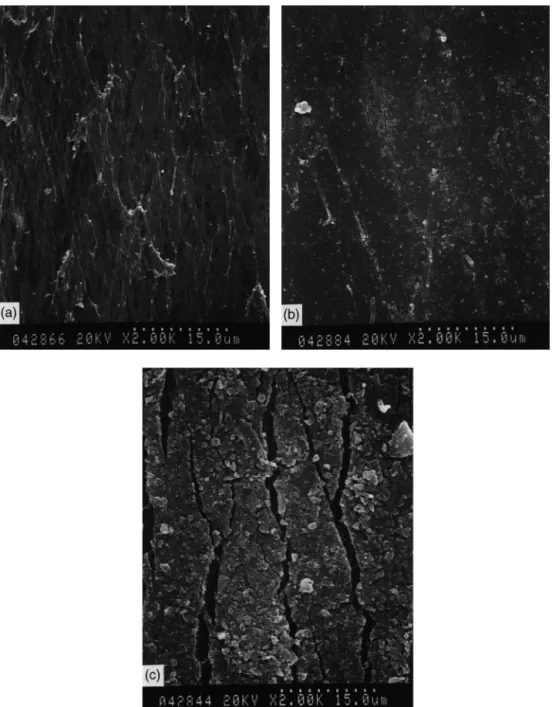
event-ual ¯ux decline. Qevent-ualitative information in support-ing the membrane foulsupport-ing is shown in SEM pictures; SEM graph for the clean membrane is included for comparison (Fig. 6(a)). There are noticeable humic substances deposited on the sur-face of membrane (Fig. 6(b)), and a serious scale problem is present in the PAC-UF system (Fig. 6(c)). In short, the results of the present study demonstrate that the use of this particular PAC either as a pretreatment agent or as an additive in the integrated PAC-UF system is ineective to alle-viate membrane fouling.
Fig. 4. Permeate ¯ux of unfractionated, hydrophobic, and hydrophilic humic substances operated with only concentrate stream recycling to the feed: (a) hydrophobic, (b) unfractionated and (c) hydrophilic
It is noted that unfractionated humic substances have the worst ¯ux decline in the PAC-pretreatment system. The humic substances that are not recov-ered (10%) during the resin fractionation may be responsible for the membrane fouling. Incidentally, the ¯ux pattern in Fig. 4 is similar to that of a nano®ltration study of eects of hydrophobic/ hydrophilic fractions isolated from Suwannee River humic substances (Braghetta et al., 1998).
Eect of AMW fractionation
Each of the AMW fraction of the three cases (unfractionated raw humic substances, hydrophobic, and hydrophilic fractions) was diluted to the same DOC concentration (5 mg/l) and fed to the UF sys-tem to observe AMW eects on permeate ¯ux. The results of membrane ¯ux with respect to AMW fac-tions are shown in Fig. 7. In all cases, the largest AMW fractions (6.5±22.6 kDa; A-1, B-1 and C-1 in
Fig. 5. DOC removal of unfractionated, hydrophobic, and hydrophilic humic substances: (a) hydro-phobic, (b) unfractionated and (c) hydrophilic fraction.
Fig. 7) exert the worst ¯ux decline, and smallest fractions (<650 Da) the least ¯ux decline. Previously, it has been demonstrated (Lin et al., 1999) that permeate quality for the unfractionated humic substances is the best in the largest AMW fraction, and DOC removal of this fraction results in irreversible membrane fouling. The organic mol-ecules with smaller AMW fractions could easily be passed through membrane pore size resulting in a lesser membrane fouling and higher permeate DOC. Speci®cally, data in Tables 3±5 indicate a higher THM yield at these smaller AMW fractions. Thus, the UF system used is ineective to remove DBP precursors. It is interesting to note that ¯ux decline
for both hydrophobic and hydrophilic fractions in the smallest AMW fraction is worse than that of unfractionated humic substances.
CONCLUSIONS
Unlike natural humic substances, the majority of the DOC of the commercial humic product is pre-sent in the hydrophobic fraction. Both hydrophobic and hydrophilic fractions exhibit signi®cantly higher THMFPs. For the unfractionated, hydrophobic, and hydrophilic fractions, the trend of DOC distri-bution and THMFP/DOC yield among four dier-ent AMW groups is quite similar, i.e., the DOC
Fig. 6. SEM graphs: (a) clean membrane, (b) unfractionated humic acid and (c) unfractionated humic acid with PAC.
content and THMFP/DOC ratio present in the lar-gest AMW fraction (6.5±22.6 kDa) are the highest as compared to those THM yield values in other AMW fractions. Further, the DOC contents of smaller fractions (<2.2 kDa) make up less than 44% of the commercial humic substances.
Although UF is eective in reducing turbidity, particulates, organics, and bacteria, the results of the present study rearm the previous ®ndings in that humic substances are not being removed eec-tively and these substances also signi®cantly facili-tate ¯ux decline. Speci®cally, the hydrophilic component exhibits more ¯ux decline, despite little
rejection of hydrophilic molecules. Consequently, the permeate may still contain a signi®cant high ratio of THM yield (mg THMs/mg DOC). Further, those DOC groups with the largest AMW fractions (6.5±22.6 kDa) of both hydrophobic and hydrophi-lic components exhibit the worst ¯ux decline. Even the smallest AMW fractions (160±650 Da) still exert some eects on ¯ux decline, or 65±70% of the initial ¯ux after 8 h.
The use of PAC for pretreament of hydrophobic and hydrophilic fractions of humic substances, or in an integrated PAC-UF system, in fact, facilitates membrane fouling.
Fig. 7. Permeate ¯ux of molecular wight fractions: (a) unfractionated; (b) hydrophobic and (c) hydro-philic.
AcknowledgementsÐThis study was funded by the National Science Council of Republic of China in Taiwan under contract NSC 88-2211-E-002-015. The author (OJH) is grateful to the NSC for providing a visiting appointment (NSC 87-2811-E-002-0004) at the National Taiwan University during which time this study was undertaken.
REFERENCES
Adham S. S., Snoeyink V. L., Clark M. M. and Bersillon J-L. (1991) Predicting and verifying organics removal by PAC in an ultra®ltration system. J. Am. Water Works. Assoc. 83, 81±91.
Adham S. S., Jacangelo J. G. and Laine J-M. (1996) Characteristics and costs of MF and UF plants. J. Am. Water Works. Assoc. 88, 22±31.
Afcharian A., Levi Y., Kiene L. and Scribe P. (1997) Fractionation of dissolved organic matter from surface waters using macroporous resins. Water Res. 31, 2989± 2996.
Al-Malack M. H. and Anderson G. K. (1997) Cross¯ow micro¯itration with dynamic membranes. Water Res. 31, 1969±1979.
Amy G. L., Sierka R. A., Bedessem J., Price D. and Tan L. (1992) Molecular size distributions of dissolved or-ganic matter. J. Am. Water Works. Assoc. 84, 67±75. APHA (1987) Standard Methods for the Examination of
Water and Wastewater, 17th ed. Am. Public. Health Assoc, Washington, DC.
Braghetta A., DiGiano F. A. and Ball W. P. (1997) Nano®ltration of natural organic matter: pH and ionic strength eects. J. Environ. Engrg 123, 628±641. Braghetta A., DiGiano F. A. and Ball W. P. (1998) NOM
accumulation at NF membrane surface: impact of chem-istry and shear. J. Environ. Engrg 124, 1087±1098. Chang Y. and Benjamin M. M. (1996) Iron oxide
adsorp-tion and UF to remove NOM and control fouling. J. Am. Water Works. Assoc. 88, 74±88.
Chang Y-J., Choo K-H., Benjamin M. M. and Reiber S. (1998) Combined adsorption-UF process increases TOC removal. J. Am. Water Works. Assoc. 90, 90±102. Collins M. R., Amy G. L. and Steelink C. (1986)
Molecular weight distribution, carboxylic acidity, and humic substances content of aquatic organic matter: im-plications for removal during water treatment. Environ. Sci. Technol. 20, 1024±1032.
Elmaleh S. and Ghaor N. (1996) Upgrading oil re®nery euents by cross-¯ow ultra®ltration. Water Sci. Technol. 34, 231±238.
Jacangelo J. G., Laine J-M., Cummings E. W. and Adham S. S. (1995) UF with pretreatment for removing DBP precursors. J. Am. Water Works. Assoc. 87, 100± 112.
Jacangelo J. G., Aieta E. M., Carns K. E., Cummings E. W. and Mallevialle J. (1989) Assessing hollow-®ber UF for particulate removal. J. Am. Water Works. Assoc. 81, 68±75.
Krasner S. W., Croue J-P., Bue J. and Perdue E. M. (1996) Three approaches for characterizing NOM. J. Am. Water Works. Assoc. 88, 66±79.
Laine J-M., Clark M. M. and Mallevialle J. (1990) Ultra®ltration of lake water: eect of pretreatment on the partitioning of organics, THM formation potential, and ¯ux. J. Am. Water Works. Assoc. 82, 82±87. Laine J-M., Jacangelo J. G., Cummings E. W., Carns K.
E. and Mallevialle J. (1993) In¯uence of bromide on low-pressure membrane ®ltration for controlling DBPs in surface waters. J. Am. Water Works. Assoc. 85, 87± 99.
Lin T-T., Lin C-F., Wei W-C. J. and Lo S-L. (1993) Mechanisms of metal stabilization in cementitious metals: interaction of tricalcium aluminate and copper oxide/hydroxide. Environ. Sci. Technol. 27, 1312±1316. Lin C-F., Huang Y-J. and Hao O. J. (1999) UF processes
for removing humic substances: eect of molecular weight fractions and PAC treatment. Water Res. 33, 1252±1264.
Malcolm P. L. and MacCarthy P. (1986) Limitations in the use of commercial humic acids in water and soil research. Environ. Sci. Technol. 20, 904±911.
Newcombe G., Drikas M., Assemi S. and Beckett R. (1997a) In¯uence of characterised natural organic ma-terial on activated carbon adsorptionÐI: characteris-ation of concentrated reservoir water. Water Res. 31, 965±972.
Newcombe G., Drikas M. and Beckett R. (1997b) In¯uence of characterised natural organic material on activated carbon adsorptionÐII: eect of pore volume distribution and adsorption of 2-methylisoborneol. Water Res. 31, 1065±1073.
Nilson J. A. and DiGiano F. A. (1996) In¯uence of NOM composition on nano®ltration. J. Am. Water Works. Assoc. 88, 53±66.
Noble P. A., Clark D. L. and Olson B. H. (1996) Biological stability of groundwater. J. Am. Water Works. Assoc. 88, 87±96.
Santos S. M. and Wiesner M. R. (1997) Ultra®ltration of waste generated in oil and gas production. Water Environ. Res. 69, 1120±1127.