
英語學習動機模式之建立: 以台北市大一學生為例 - 政大學術集成
121
0
0
全文
(2) 立. 政 治 大. ‧. ‧ 國. 學. n. er. io. sit. y. Nat. al. Ch. engchi. i n U. v.
(3) The Development of English Learning Motivation Model: A Study on College Freshmen in Taipei City. A Master Thesis Presented to Department of English,. 立. 政 治 大. National Chengchi University. ‧. ‧ 國. 學. n. er. io. sit. y. Nat. al. Ch. engchi. i n U. v. In Partial Fulfillment of the Requirements for the Degree of Master of Arts. by Gui-Ru Lin. January, 2012.
(4) 立. 政 治 大. ‧. ‧ 國. 學. n. er. io. sit. y. Nat. al. Ch. engchi. i n U. v.
(5) Acknowledgement This thesis would not have been possible without the support and help of many individuals. I would like to extend my sincere thanks to all of them. I am indebted to my advisor, Dr. Samuel P-H Sheu for his guidance and valuable suggestions throughout the time of completing the present research. My appreciation also goes to the members of my thesis committee, Dr. Ming-chung Yu and Dr. Chih-chiang Yang. They have generously given their time and expertise to help me revise and complete this work.. 政 治 大 and the college instructors 立 who helped me collect the data. Their assistance allowed. I am grateful to the Office of Academic Affairs in National Cheng-Chi University. ‧ 國. 學. me to collect the data efficiently. Particularly, I want to express my gratitude to Susan Liao for her encouragement and timely help when I encounter difficulties.. ‧. I would like to give my gratitude to my classmates in graduate school, Ann, Anna,. sit. y. Nat. Dora, Joy, and Sonia, for their advice and support. I also need to express my gratitude. n. al. er. io. to my colleagues, Ying-chieh, Yi-hua, Chia-fen, Ai-ting, and Director Ya-ying Yu.. i n U. v. This work would not have been done without their consideration and support.. Ch. engchi. Especially, I am indebted to Angela Sheu, who generously helped me deal with statistical problems and constantly encouraged me to complete this work. Last but not the least, I would like to give my special thanks to my family and my boyfriend, Shao-Jung Hsu. Their support and assistance enabled me to complete this work.. iii.
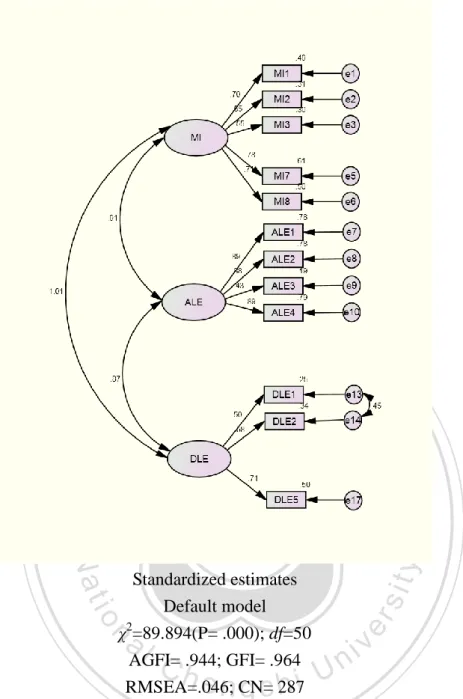
(6) Table of Contents. Chinese Abstract........................................................................................................x English Abstract.........................................................................................................xi Chapter One: Introduction..........................................................................................1 Background and Motivation...................................................................... 1. 政 治 大. The Purposes of Study and Research Questions........................................5. 立. Definition of Terms....................................................................................6. ‧ 國. 學. Significance of the Study...........................................................................7. ‧. Chapter Two: Literature Review.........................................................................…...8. Nat. io. sit. y. Definition of Motivation.............................................................................8. er. Second Language Motivational Theories.................................................12. al. n. v i n Ch Components of Motivation.......................................................................18 engchi U Related Studies on Motivational Constructs.............................................23 Limitations of Previous Studies…………………………………………...32 Chapter Three: Methodology......................................................................................35 The Structure and Hypothesis of This Study...............................................35 Participants...................................................................................................37 Instrument....................................................................................................39 iv.
(7) Procedures.................................................................................................62 Data Analysis............................................................................................64 Chapter Four: Results................................................................................................65 The Development of the Model.................................................................65 The Effect among the Variables................................................................77 Chapter Five: Discussion and Conclusion................................................................79. 政 治 大. Discussion.................................................................................................79. 立. Conclusion.................................................................................................85. ‧ 國. 學. References……………………………………………………………………..……90. ‧. Appendixes…………………………………………………………………………97. Nat. io. sit. y. Appendix A: Studies on Motivation Models…………………………….97. er. Appendix B: Questionnaire for Pilot Study……………………………...101. al. n. v i n C h for Formal Study…………………………...104 Appendix C: Questionnaire engchi U. v.
(8) List of Tables Table 1. The Structure of the Questionnaire in Pilot Study…….……..………..……39 Table 2. Item Analysis of Motivational Behaviors Scale…….……………...……….41 Table 3. The Goodness of Fit Indices of the Measurement Model of Motivational Behaviors……………………………………………………...………..….44 Table 4. The Factor Loadings, Squared Multiple Correlations, Average Variance. 政 治 大. Extracted and Composite Reliability of Motivational Behaviors. 立. Scale……………………………………………………………………….45. ‧ 國. 學. Table 5. Item Analysis of Integrativeness Scale…….………………………………46. ‧. Table 6. The Goodness of Fit Indices of the Measurement Model of. Nat. io. sit. y. Integrativeness…….……………………………………………………...49. er. Table 7. The Factor Loadings, Squared Multiple Correlations, Average Variance. al. n. v i n C hReliability of Integrativeness Extracted and Composite engchi U. Scale…….………………………………………………………….……..49 Table 8. Item Analysis of Instrumentality Scale…….…………………………........51 Table 9. The Goodness of Fit Indices of the Measurement Model of Instrumentality…….……………………………………………….……..53 Table 10. The Factor Loading, Squared Multiple Correlations, Average Variance Extracted and Composite Reliability of Instrumentality vi.
(9) Scale…….………………………………………………………………54 Table 11. Item Analysis of Intrinsic Orientation Scale…….………………..…...…54 Table 12. The Goodness of Fit Indices of the Measurement Model of Intrinsic Orientation…….………………………………………………………..57 Table 13. The Factor Loading, Squared Multiple Correlations, Average Variance Extracted and Composite Reliability of Intrinsic Orientation. 政 治 大. Scale…….…………………………………………………………….…57. 立. Table 14. Item Analysis of Extrinsic Orientation Scale…….………………….…...58. ‧ 國. 學. Table 15. The Goodness of Fit Indices of the Measurement Model of Extrinsic. ‧. Orientation…….………………………………………………………..61. Nat. io. sit. y. Table 16. The Factor Loading, Squared Multiple Correlations, Average Variance. er. Extracted and Composite Reliability of Extrinsic Orientation. al. n. v i n Ch Scale…….………………………………………………………………..61 engchi U Table 17. The Summary of the Fit Indices for the Modified model…….………...…69 Table 18. Values of Estimated Parameters and the Test of Significance…………….73 Table 19. Factor Loadings, Squared Multiple Correlations (SMC), Composite Reliability(CR), and Average Variance Extracted (AVE) of the Observed Variables….…………………………………………………….…….......75 Table 20. The Effects among Variables….…………………………………………..77 vii.
(10) Table 21. The Correlations among Variables….………………………...………..78. 立. 政 治 大. ‧. ‧ 國. 學. n. er. io. sit. y. Nat. al. Ch. engchi. viii. i n U. v.
(11) List of Figures Figure 1. Tremblay and Gardner’s (1995) Motivation Model………………….…..24 Figure 2. Gardner, Tremblay & Masgoret’s (1997) Model of Second Language Learning…………………………………………………………………25 Figure 3. Noels’ (2003) Model…………………………………………………..….27 Figure 4. Yashima, Zenuk-Nishide & Shimizu’s (2004) L2 Communication. 政 治 大. Model……………………………………………………………………28. 立. Figure 5. Csizer and Dornyei’s (2005) Motivation Model…………………….....…29. ‧ 國. 學. Figure 6. Chen and Sheu’s (2005) Model of English Learning. ‧. Motivation………………………………………………………………31. Nat. io. sit. y. Figure 7. The Proposed Model……………………………………………………...37. er. Figure 8. The Measurement Model of Motivational Behaviors………………….....49. al. n. v i n C hof Integrativeness………………………….…..46 Figure 9. The Measurement Model engchi U Figure 10. The Measurement Model of Instrumentality……………………….........53 Figure 11. The Measurement Model of Intrinsic Orientation…………………….…56 Figure 12. The Measurement Model of Extrinsic Orientation…………………..…..60 Figure 13. Path Diagram of the Hypothesized Motivational Model……………..….66 Figure 14. Path Diagram of the Modified Motivational Model………….……….…68. ix.
(12) 摘要. 本研究旨在探討影響台灣非英語系大學生英語學習動機之因素,並建構動機 模式。透過文獻探討,此動機模型包含以下五種動機成分:「融合取向」 (Integrativeness)」、「工具取向(Instrumentality)」、「內在取向(Intrinsic Orientation)」、「外在取向(Extrinsic orientation)」及「動機行為(Motivational Behaviors) 」。本研究之研究對象為 302 位來自台北市 8 所大學的非英語系大一 生。研究工具為包含「融合取向」(Integrativeness)」 、 「工具取向(Instrumentality)」 、 、 「外在取向(Extrinsic orientation)」及「動機行 「內在取向(Intrinsic Orientation)」 為(Motivational Behaviors) 」五個量表的動機問卷。資料分析方法為結構方程模 式(Structural Equation Modeling)。首先探討初始假設模型與樣本的適配情形,其 次根據修正指標及相關理論進行模式修正,修正後之模式與資料適配。修正後的 模式中, 「融合取向」(Integrativeness)」 、 「工具取向(Instrumentality)」 、 「內在取向. 立. 政 治 大. ‧. ‧ 國. 學. (Intrinsic Orientation)」、 「外在取向(Extrinsic orientation)」彼此相關。然而,在此 四變項中,僅「融合取向」(Integrativeness)」對於「動機行為(Motivational Behaviors) 」有顯著影響。此結果顯示「融合取向」(Integrativeness)」之定義可 能已有所轉變。而研究對象之背景、變項之間的相互抵銷作用以及中介變項可能 是其餘三變項對於「動機行為(Motivational Behaviors) 」無顯著影響之因。文末. n. al. er. io. sit. y. Nat. 進一步提出相關建議,以期能作為台灣英語教師及未來研究參考。. Ch. engchi. x. i n U. v.
(13) Abstract. The purpose of this study was to investigate what kinds of motivational component influence motivational behaviors of Taiwanese non-English majors, and to propose an empirically grounded model of English learning motivation which presented the relationship among these components. The components in the model are Integrativeness, Instrumentality, Intrinsic Orientation, Extrinsic orientation and Motivational Behaviors. The participants in the study were 302 freshmen studying in. 政 治 大 Integrativeness, Instrumentality, Intrinsic Orientation, Extrinsic orientation and 立 Taipei City. The instrument was an adapted questionnaire composed scales of. Motivational Behaviors. Structural Equation Modeling (SEM) was applied to analyze. ‧ 國. 學. the data. The hypothesized model was tested and modified using the 302 samples of. ‧. the participants. In the final model, the four components, Integrativeness,. sit. y. Nat. Instrumentality, Intrinsic Orientation, and Extrinsic Orientation were found to. io. er. correlate with one another. However, among the hypothesized influences on Motivational Behaviors, namely, the influences from Integrativeness, Instrumentality,. al. n. v i n C hOrientation on Motivational Intrinsic Orientation, and Extrinsic Behaviors, only the engchi U path between Integrativeness and Motivational Behaviors was left in the modified. model. The result may indicate the transfer of the definition of Integrativeness, and the two removed paths and one no significant path may be explained by the background of the participants, the compensatory effects, and the existence of mediating variables. Finally, it is expected that the results of the present study offer a new perspective to understand Taiwanese EFL learners’ English learning motivation, and provide pedagogical implications for English instructors in Taiwan and future studies.. xi.
(14) 立. 政 治 大. ‧. ‧ 國. 學. n. er. io. sit. y. Nat. al. Ch. engchi. i n U. v.
(15) CHAPTER ONE INTRODUCTION. Background and Motivation Motivation has been defined as the extent to which an individual works or strives to learn the language because of a desire to do so and the satisfaction experienced in this activity (Gardner, 1985). In the process of language learning, it provides impetus initiating the learning process and helps learners devote efforts,. 政 治 大 and tedious. Moreover, it has been suggested that all the other factors in language 立. overcome difficulties, and actively engage in the learning process which is often long. learning such as aptitude and learning environments presupposed motivation to some. ‧ 國. 學. extent (Dörnyei, 1998). Therefore, motivation has been widely recognized by both. ‧. teachers and researchers as one of the most important factors contributing to the. sit. y. Nat. success of language learning.. io. er. Because of its importance, there has been a considerable amount of research that investigates the role of motivation in language learning. Findings of these studies. al. n. v i n C hmany aspects in language show that motivation influenced learning, such as engchi U. achievement, persistence in language study, strategy use, and behavior in language classroom (Ely, 1989; Gardner, 2001; Gardner & MacIntyre, 1993; Oxford & Nyikos, 1989). In addition, there are also some studies investigating variables that would have a positive impact on learners’ motivation; the reported variables are gender, family background, second language competence, and learning environment. In an attempt to better understand the nature of motivation, several researchers developed theoretical constructs of motivation in which variables supporting or affecting motivation are presented in a single model. Among them, the most influential one and that have been widely adopted is Gardners’ (1985) 1.
(16) social-psychological model, which incorporate three main variables: integrative orientation, instrumental orientation, and attitudes toward the learning situation. Another theoretical construct which is also important is self-determination theory (Deci & Ryan, 1985). In this theory, motivation was classified into intrinsic motivation and extrinsic motivation, which can be further divided into subtypes. Still another theory that has been investigated is the expectancy-value theory drawn from cognitive psychology, in which motivation was conceptualized as the product of two key factors: the expectancy of success in a given task and the value attached to the. 政 治 大 These three theoretical constructs has led to the development of various 立. success (Dörnyei, 1998).. motivational models aiming at expanding the existing motivational constructs or. ‧ 國. 學. exploring the relationship among the components in the constructs. Although these. ‧. constructs of motivation differ in their emphases and components, they have some. sit. y. Nat. similarities in the motivational components, which were mainly adopted from the. io. er. three theoretical constructs mentioned above. The components that have been frequently adopted and incorporated are: integrative orientation, instrumental. al. n. v i n C h situation, intrinsicUmotivation, extrinsic orientation, attitudes toward the learning engchi motivation, valence, and self-efficacy.. Although there are slight differences across different models in the definition of a certain component, empirical investigations generally support the relationship between the seven components and motivation. The relationship among some of these components has also been demonstrated in some studies. For example, a link between integrative orientation and intrinsic motivation has been supported (Noels, 2003); attitudes toward the learning situation have also been found to relate to valence and self-efficacy (Chen & Sheu, 2005); and it has been proposed that integrative motivation affect valence (Tremblay & Gardner, 1995). However, there has thus far 2.
(17) been relatively little research considering all of these frequently investigated motivational components together in the same sample of language learners. As discussed above, much research has been done in the development of various motivational constructs. However, they were derived mainly from studies conducted in ESL contexts, which are different from Taiwan in several aspects (Warden & Lin, 2000). First, the cultural norm in Taiwan is distinct from that in the North America and Europe where most research was conducted (Chen, Warden & Chang, 2005). Second, the role of English in Taiwan is also different from that in ESL environments.. 政 治 大 use English outside the classroom, English tends to be treated as a school subject 立. Because Taiwan is an EFL environment where learners have little or no opportunity to. rather than a communication tool for surviving (Chen, Warden & Chang, 2005;. ‧ 國. 學. Warden & Lin, 2000). Third, the situation of teaching in Taiwan is emphasizing on. ‧. grammar and reading (Campbell & Yong, 1993), and is teacher-centered (Warden &. sit. y. Nat. Lin, 2000); and English teachers in Taiwan, especially in universities, often face large. io. er. classes (Chen, Warden & Chang, 2005), which is different from contexts typically found in language learning motivation research (Chen, 2002).. al. n. v i n C h literature is thatUmany studies on motivation in Another limitation in existing engchi. Taiwan have chosen students majoring in English as participants (Huang & Lin, 2007; Huang, 2007; Peng, 2002). However, there is still a large group of non-English majors who are required to study English and thus their attitudes toward learning English might be different from those of the participants in previous studies. In conclusion, while much work has been done to examine the role of motivation in language and develop motivational constructs, it appears that few studies have been done to explore the relationship among major motivational components (Csizér & Dörnyei, 2005). In addition, substantial studies have been conducted in contexts different from Taiwan, and those conducted in Taiwan have mainly dealt with English 3.
(18) majors. It seems that the literature is less clear about the motivation of non-English majors in Taiwan. More studies need to be conducted because it has been noted that contextual factors may lead to differences in motivation (Dörnyei, 1990). Therefore, the goal of this research was to examine the motivation of non-English majors in Taiwan by verifying a proposed motivation model which presents the relationship among several motivational components.. 立. 政 治 大. ‧. ‧ 國. 學. n. er. io. sit. y. Nat. al. Ch. engchi. 4. i n U. v.
(19) The Purposes of Study and Research Questions The purpose of this study was to propose an empirically grounded model of English learning motivation which presented the relationship among these components by using structural equation modeling so as to have better understanding about what kinds of motivational component influence motivational behaviors of Taiwanese non-English majors and how to foster learners’ motivation more effectively. More specifically, this study was designed to answer the following question:. 政 治 大 effectively explain the relationship among all the components of Taiwanese EFL 立 Can the model developed in this study be supported by empirical data, and. learners’ motivation?. ‧. ‧ 國. 學. n. er. io. sit. y. Nat. al. Ch. engchi. 5. i n U. v.
(20) Definition of Terms Language Learning Motivation The term generally refers to “the extent to which an individual works or strives to learn the language because of a desire to do so and the satisfaction experienced in the activity” (Gardner, 1985, p.10). In this study, the components of motivation include (Deci & Ryan, 1985; Gardner, 1985) 1. Integrativeness: to integrate himself into the culture of target language group and to engage in the social interchange of that group.. 政 治 大. 2. Instrumentality: to attain instrumental goals, such as academic and. 立. career-related purposes.. ‧ 國. 學. 3. Intrinsic Orientation: to performing behavior for its own sake in order to experience pleasure and satisfaction.. ‧. 4. Extrinsic orientation: to performing behavior in order to receive some. sit. al. er. io. Motivational Behaviors. y. Nat. extrinsic reward or to avoid punishment.. v. n. This term refers an individual’s efforts made in learning a language, the desire of. Ch. engchi. i n U. achieving learning goals, and a positive attitude toward learning the language. It was assessed by “motivational intensity”, “desire to learn the language”, and “attitudes toward learning the language” (Gardner, Tremblay & Masgoret, 1997, p.345). It has been found to be affected by instrumental orientation, integrative orientation, and some other motivational components (Gardner, Tremblay & Masgoret, 1997). English as a Foreign Language (EFL) The term refers to the role of English in countries where it is learned as a school subject but not used as a language for communication (e.g. education, business, government, or industry) within the country (Richard, Platt & Platt, 1992). 6.
(21) Significance of the Study This study has both theoretical and pedagogical significances as follows. First, the study provided empirical data for understanding EFL learners’ motivation. Although research has been done on this issue, the current study proposed a model of interrelationship among motivational components. Since the relationship was found to be considered independent in different social contexts, this study aimed to understand the relationship among some motivational components and their relative predictive power on motivational behaviors. It was hoped that by constructing a. 政 治 大 theories and presents their interrelationship, the nature of these components and the 立. motivational model, which incorporates motivational components from different. motivation of Taiwanese EFL learners would be understood more clearly.. ‧ 國. 學. Second, English instruction in Taiwan tends to be exam-oriented, emphasizing. ‧. the importance of memorizing vocabulary and grammar rules, and this often leads to. sit. y. Nat. decreasing students’ interests in learning English. Motivation contributes to the. io. er. success of language learning, and its importance on learning achievement has be wildly recognized. Therefore, if what kind of motivational components influence. al. n. v i n C hthey are related toUeach other could be understood, motivational behaviors and how engchi. we might enhance learners’ motivation in more effective ways, such as designing appropriate learning tasks and materials and adopting better approaches that suit learners’ needs.. 7.
(22) CHAPTER TWO LITERATURE REVIEW. This chapter will discuss definition of motivation, second language motivational theory, motivational components, previous research concerning second language motivational construct and the relationship among motivational components. A proposed model of motivational construct will also be presented in this chapter.. 政 治 大 Although the significance of motivation on language learning has been widely 立 Definition of Motivation. recognized, there has been little agreement on the exact meaning of motivation, and. ‧ 國. 學. researchers from different psychological perspectives defined it differently. In this. ‧. section, definitions of motivation in Behaviorism will discussed first, followed by the. y. sit. io. er. given.. Nat. definitions of motivation in Cognitivism. Definitions in other fields will be finally. Definition of Motivation in Behaviorism. al. n. v i n Behaviorism focus completelyC on what can be directly h e n g c h i Uobserved from a person’s. behaviors, and the distinction between the inner drive of a person and his outward behaviors that express the drive was minimized. Therefore, motivation was. considered nearly the same as the behaviors that reflect motivation by Behaviorists. The most common version of behavioral perspective on motivation is the theory of operant conditioning proposed by B. F. Skinner (1938). From this perspective, motivation was defined as an anticipation of reinforcement (Brown, 1994). For example, if a teacher praises a student each time he answers a question, and the likelihood of the student’s answering questions is increasing, we may say that the student was motivated to answer the question (a behavior) because he anticipate the 8.
(23) teacher’s praise (the reinforcement). Withdrawing the reinforcement from the learner may decrease the behaviors previously learned by reinforcement. Though Behaviorism was frequently used in shaping behaviors, it was not without flaws. The theory was mainly criticized because there are still distinctions between outward behaviors and inner motives, for example, the same outward behavior may be considered as an expression of a number of different inner motives (DeGrandpre, 2000). Definitions of Motivation in Cognitivism. 政 治 大 thoughts, the activation of behavior or action. In a Cognitivist perspective, an 立. Cognitive psychologists considered motivation as a function of an individual’s. individual is motivated by the result of his active analysis and processing of. ‧ 國. 學. information available, rather than a mechanical process. Therefore, reinforcement. ‧. does not always leads to desired behaviors.. sit. y. Nat. Motivation was defined differently in different cognitive theories of motivation. io. er. according to their different emphasis. For example, Expectancy-value theory, which focus on an individual’s expectations for completing a task successfully, and. al. n. v i n C h as one’s expectation motivation was therefore defined of doing certain action engchi U. successfully times the value he places on success (Eggen, Kauchack, 2004). For example, if a person thinks the possibility that he pass an examination is high, and passing the examination is also important to him, he will be motivated to take the examination. In self-determination theory, motivation was defined as doing something because it is inherently interesting or because it leads to external rewards (Dornyei, 1998). For instance, if a person works because his job is interesting to him, he is intrinsically motivated; if he works for being paid, he is extrinsically motivated. In self-efficacy theory, one’s motivation is determined by his capability of completing certain tasks (Eggen, Kauchack, 2004). A person may not be persevering or willing to 9.
(24) doing something if he considered himself as incapable of doing it. Other Definitions of Motivation Some other researchers define motivation by describing its features or elements. Crookes and Schmidt (1991) suggested that language learning motivation incorporates four internal and three external features. The internal factors are: interest in the target language, relevance involving the perception that personal needs are being met by learning the language, expectancy of success and failure, and outcomes (i.e., the extrinsic rewards). The external behavior characteristics includes the fact that. 政 治 大 learning, and maintains a high activity level. 立. a learner decides to choose and engage in language learning, persists in the process of. From the perspective of social psychology, Gardner (1985) proposed that. ‧ 國. 學. motivation is composed of four elements: a goal (to interact with the target language. ‧. group or utilitarian purposes), a desire to attain the goal, positive attitudes toward. sit. y. Nat. learning the language, and effortful behavior. In his later work, motivation was. io. er. suggested as generated from three elements: attitudes toward the learning situation, integrative orientation, and instrumental orientation (Gardner, 2001).. al. n. v i n Cmotivation Dornyei (1998) conceptualized three components: h e n gascincluding hi U. motivational intensity, desire to learn the language, and an attitude toward the act of learning. Drawing from these definitions, it could be concluded that language learning motivation generally composes the following elements: 1. Motivational behaviors such as intensity, desire to learn, and attitude toward learning. 2. The reasons or purposes of learning. (In social-psychological theory, the reasons can be integrating into the target language culture or pragmatic benefits, namely, integrativeness and instrumentality. In self-determination 10.
(25) theory, the reasons include inside and outside rewards, namely, intrinsic orientation and extrinsic orientation.) 3. Attitudes toward the learning situation. 4. An individual’s judgment of his/her capability to reach a certain level of achievement (self-efficacy). 5. The value associated with a particular outcome (valence). Specifically, the present study focused on the first three elements, which include five motivational components: motivational behaviors, integrativeness,. 政 治 大 In conclusion, although motivation can be defined in various ways from 立. instrumentality, intrinsic orientation and extrinsic orientation.. different theoretical perspectives, and there is still no agreement on the exact. ‧ 國. 學. definition of motivation, it seemed that cognitive ways of definitions have been. ‧. adopted by many studies, and describing the components of motivation may help. sit. y. Nat. constructing a complete motivational model. In the field of second language,. io. er. motivation was thought of as an important factor that influences success of language learning. In the following session, theories of second language motivation will be. n. al. discussed.. Ch. engchi. 11. i n U. v.
(26) Second Language Motivational Theories Second language motivational theories mainly seek to explain how learners learn a second language and what kinds of factors drive and direct their learning (Dornyei, 1998). Because of the importance of motivation in the success of language learning, the motivation to learn a second language has drawn much attention. Theories of second language learning motivation are varied, and each attempts to draw a clear picture of second language learning motivation. Some of the most important theories will be presented chronologically and discussed in this section.. 政 治 大 In the past few decades, researchers 立 have developed various theoretical. Motivation Theory before the 1990s. ‧ 國. 學. constructs of second language motivation. The most influential construct that dominated this field since the 1950s is the social psychological approach proposed by. ‧. Gardner and his associates (Crookes & Schmidt, 1991; Dornyei, 1998, 2001, 2003).. sit. y. Nat. The rationale of this approach is that second language acquisition is a. n. al. er. io. social-psychological phenomenon incorporating alternating self-image and adapting. i n U. v. new social behaviors and cultural norms (Au, 1988; Gardner, 1985; Williams, 1994).. Ch. engchi. Therefore, this approach suggested that students’ attitude toward the target language community will influence the success of learning the language (Gardner, 1985). The emphasis on the significance of an integrative social dimension led Gardner and Lambert (1972) to conceptualize integrative/instrumental dichotomy in their motivational model. Before discussing the dichotomy, a distinction between motivation and orientation has to be clarified. While motivation refers to “the extent to which an individual works or strives to learn the language because of a desire to do so and the satisfaction experienced in this activity” (Gardner 1985, p.10), orientation refers to the 12.
(27) goal for learning the language (Dornyei, 1998) which serves as motivational antecedents arousing and directing motivation. The integrative and instrumental orientations are two orientations that received most empirical attention (Noels, 2003). The integrative orientation refers to learning a language for facilitating communication or interaction with a valued target language community (Gardner, Smythe, Clement, & Gliksman, 1976). The instrumental orientation, however, is learning for utilitarian or pragmatic benefits of language proficiency, such as getting a better job, improving social status,. 政 治 大 Dornyei, 1990). In their theory, integrative orientation is believed to be more 立. passing an examination, and other academic- or career-related benefits (Brown, 1994;. important for successful language learning than instrumental orientation, because it. ‧ 國. 學. was found to accompany with higher scores on foreign language proficiency tests. ‧. (Brown, 2000; Dornyei, 1990).. sit. y. Nat. The dichotomy has been commented as a milestone in the history of second. io. er. language motivation research in that it is more elaborate and advanced than many other contemporary mainstream psychological models of motivation and that it is. al. n. v i n empirically testable and canC explain a considerableUamount of variance in motivation hengchi and achievement (Dorneyi, 1994). A large number of researchers have centered their. studies on the dichotomy (Belmechri & Hummel, 1998; Clement, Dornyei, & Noels, 1994; Gardner & MacIntyre, 1991; Gardner & Tremblay, 1994, etc.), however, the results of these studies were conflicting. Researchers with accumulated evidences began to challenge their theory by suggesting the existence of other kinds of orientation, presenting how the definitions of orientations may shift according to contextual factors, and questioning the conclusion that integrative orientation is more important than instrumental orientation. Some researchers also suggested that EFL contexts can hardly benefit from Gardner’s social-psychological approach because 13.
(28) this approach was grounded in a social milieu rather than an EFL classroom setting. For instance, the results of Warden and Lin’s (2000) study showed the absence of integrative orientation within a sample of EFL learners in Taiwan. Expansion of Motivational Construct During the 1990s, a number of researchers in different parts of the world advocated a shift to expand the theoretical scope of motivation (e.g. Crookes & Schmidt, 1991; Dornyei, 1994; Oxford & Shearin, 1994). Their avocations shared three underlying themes: (a) complimenting the social psychological approach with. 政 治 大 theories, and self-efficacy theories, 立 (b) conceptualizing situation- or task-specific concepts from mainstream psychology such as need theories, expectancy-value. ‧ 國. 學. motivation, (c) calling for a more pragmatic approach to motivation for classroom application (Dornyei, 1998).. ‧. Dornyei (1994) synthesized various motivational components and developed a. sit. y. Nat. framework consisting of three levels: the language level (which was further divided. n. al. er. io. into instrumental and integrative subsystems), the learner level (including dimension. i n U. v. of need for achievement and self-confidence), and the learning situation level. Ch. engchi. (containing course-, teacher-, and group-specific motivational components). Dornyei (1998) suggested that although this detailed kind of framework is “useful in emphasizing the multidimentional nature of second language motivation” (p. 26), it lacks the relationship among components, and the components are diverse in nature, causing difficulties in submitting it to empirical testing. Also, the integrative/instrumental motivational dichotomy at the language level may mislead people into simplifying social dimension of second language motivation (Dorneyi, 1998). In addition, based on Gardner’s social psychological construct, Tremblay and 14.
(29) Gardner (1995) conducted a study to examine the relationship between a number of new measures of motivation and the existing measures of attitude and motivation. Based on the research, they proposed an extended model in which new elements from expectancy-value and goal theories were incorporated into the original social psychological construct of second language motivation, as a response to calls for adoption of a wider vision of motivation in the 1990s. In this model, a distinction between motivational behavior (variables which can be observed externally, such as attention, effort, and persistence) and motivational antecedents (factors which cannot. 政 治 大 and the motivational antecedents, including goal salience, valence, and self-efficacy, 立. be perceived by an external observer but influence motivational behaviors) was made,. mediated the relationship between language attitudes and motivational behaviors.. ‧ 國. 學. Adaptive attributions, derived from expectancy-value theory, mediated the. ‧. relationship between French language dominance and motivational behavior. This. sit. y. Nat. empirically grounded model demonstrates how cognitive motivational theories and. io. al. n. (Dornyei, 1998).. er. Gardner’s earlier motivational construct can be synthesized into one framework. Ch. engchi. i n U. v. Deci and Ryan’s Self-Determination Theory in L2 Research Deci and Ryan (1985) introduced the self-determination theory as an elaboration of the theory of intrinsic versus extrinsic motivation, which is one of the most general and widely explored distinctions in motivation theories (Dornyei, 1998). According to self-determination theory, there are two types of motivation, intrinsic motivation (IM) and extrinsic motivation (EM), which are locate on a continuum of self-determination (Noels Pelletier, Clement, & Vellerand, 2000), and vary depending on how much a learner engages in an activity “with a full sense of wanting, choosing, and personal endorsement” (Deci, 1992, p.44). 15.
(30) Intrinsic motivation refers to the desire to engage in an activity in anticipation of internally rewarding consequences such as pleasure, satisfaction, and feelings of competence. Extrinsic motivation, on the other hand, refers to the desire to engage in an activity in anticipation of reward which is external to the activity per se, from outside and beyond the self. Extrinsic motivation, the motivation for achieving some instrumental end, has been categorized into three levels according to the extent to which performing an activity is self-determined. They are external regulation, introjected regulation, and identified regulation, from the lowest to the highest level of. 政 治 大 The potential utility of the self-determination theory for understanding language 立. self-determination (Noels, 2003; Vallerand, 1997).. learning motivation has been demonstrated by several studies (Noels, 2003). In. ‧ 國. 學. addition, it offers several advantages. First, the intrinsic/extrinsic motivational. ‧. construct has been validated by a number of studies in various cultural contexts. For. sit. y. Nat. example, researchers have found support among Anglophone learners of French and. io. er. Spanish, and learners in Taiwan (e.g. Chang & Huang, 1999; Liao, 2000; Noels, Pelletier, Clement, & Vallerand, 2000). Second, it organized a large number of second. al. n. v i n language learning orientation into aC systematic framework. h e n g c h i UThird, the continuum of. self-determination suggests a process by which orientations may change. Fourth, there are empirical evidences supporting that the subtypes of intrinsic and extrinsic motivation can be used to describe language learning motivation (Noels, Pelletier, Clement, & Vallerand, 2000). Although the self-determination theory may be useful, Noels (2003) noted that it does not incorporate the issue of intergroup contact and ethnic identification subsumed by the integrative orientation in Gardner’s construct. As mentioned above, the development of motivational theories has been influenced by two main theories, Gardner’s (1985) social psychological approach, which led to the expansion of motivational construct, and Self-determination theory 16.
(31) proposed by Deci and Ryan (1985). By conceptualizing motivation in different ways, the researchers proposing these theories had explored various components of language learning motivation. And some of the components will be discussed in the following section.. 立. 政 治 大. ‧. ‧ 國. 學. n. er. io. sit. y. Nat. al. Ch. engchi. 17. i n U. v.
(32) Components of Motivation From the discussion of definitions of motivation, we may conclude that it mainly incorporates five components, motivational behaviors, integrativeness, and instrumentality, intrinsic orientation and extrinsic orientation. The nature of these components and the relationship among them will be discussed as follows. Motivational Behavior Motivational behavior has been defined by Gardner as a combination of efforts, desire to achieve the goal of learning the language, and positive attitude toward. 政 治 大 currently assessed by three scales in AMTB: attitudes toward learning the language, 立. learning the language (Gardner, 1985; Gardner, Tremblay & Masgoret, 1997). It was. desire to learn the language, and motivational intensity (Gardner, Tremblay &. ‧ 國. 學. Masgoret, 1997). It has been found to be affected by attitudes toward the learning. ‧. situation, instrumental orientation, and integrative orientation, valence, and. sit. y. Nat. self-efficacy expectancy, and perceived ability (Chen & Sheu, 2005; Csizer &. io. al. n. Masgoret, 1997).. er. Dornyei, 2005; Gardner, 2001; Tremblay & Gardner, 1995; Gardner, Tremblay &. Ch. Integrativeness and Instrumentality. engchi. i n U. v. Integrativeness and instrumentality are two components drawn from social psychological approach proposed by Gardner (1985), which is the most influential construct that has dominated this field since the 1950s (Crookes & Schmidt, 1991; Dornyei, 1998, 2001, 2003). Integrativeness Integrativeness, a key component in Gardner and Lamberts’ (1959, 1972; Gardner, 1985) influential conceptualization, was among the most often research concepts and a principle building block of several theoretical constructs of L2 motivation (Dornyei, 2003). It reflects a positive outlook on the target language and its culture, to the extent 18.
(33) that learners may want to integrate themselves into the target language culture and become similar to the target language group (Csizer & Dornyei, 2005). Integrativeness is currently assessed by three measures in the AMTB: attitude toward the target language group, interest in the foreign languages, and integrative orientation. Although integrativeness has been adopted in abundant of research, it is not without criticism. Some researchers argued that EFL contexts can hardly benefit from this concept, contending that Gardner’s social-psychological approach was grounded in a social milieu distinct from EFL classroom settings. For instance, the results of Warden. 政 治 大 of EFL learners in Taiwan. Still other researchers proposed that the concept of 立. and Lin’s (2000) study showed the absence of integrative orientation within a sample. integrativeness should be altered according contexts. For example, Dornyei (1991). ‧ 國. 學. proposed that in EFL settings where learners have little opportunity to interact with. ‧. the target language community, integrative orientation can be generalized from. sit. y. Nat. identifying with the target language group to identifying the cultural and intellectual. io. er. values attached to the language, and even the language itself. Noneless, integrativeness has been incorporated into many motivational models to examine its. al. n. v i n C h variables and U relationship with other motivational numerous studies have associated engchi integrativeness with motivation and other variables in different motivational. constructs (Tremblay & Gardner, 1995). For example, Csizer and Dornyei (2005) found that integrativeness was influenced by instrumentality and attitude toward L2 speakers directly and self-confidence indirectly. Chen and Sheu (2005) reported that valence and instrumental orientation influencd integrative orientation. Noels (2003) found that integrative orientation was associated with more self-determined motivations in self-determine theory. Intrumentality Intrumentality has been the other most frequently highlighted variable in 19.
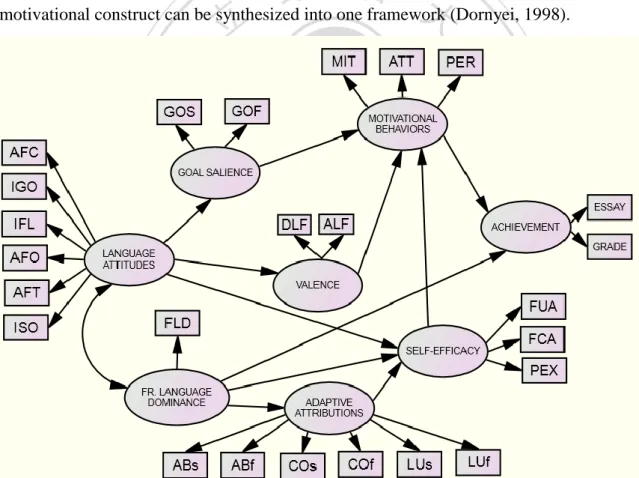
(34) motivational research (Csizer & Dornyei, 2005; Dornyei, 1990; Gardner, 1985; Gardner & MacIntyre, 1991; Tremblay& Gardner, 1995; Warden & Lin, 2000; Wen, 1997). It generally refers to the pragmatic benefits of L2 proficiency perceived by the learner, such as getting a better job or passing an examination, and it reflects that the usefulness of L2 proficiency provides the greatest driving force for many language learners. Although the definition of instrumental dimension seemed to be straightforward, empirical studies suggested that it can be conceptualized ambiguously. For instance, in Csizer and Dornyei (2005)’s conceptualization of. 政 治 大 proficiency in becoming educated were included. Their study also showed that 立. instrumentality, the importance of the L2 in the world and the contribution of its. instrumentality was one of the antecedents of integrativeness, and it was influenced. ‧ 國. 學. by variables such as learners’ immediate environment and the perceived importance of. ‧. the L2 community. Chen and Sheu (2005), in their study on EFL college students’. sit. y. Nat. motivation, found that instrumental orientation was influenced by valence, and it. io. er. influenced integrative orientation and motivation. MacIntyre and his colleagues (2001) found that instrumentality correlated significantly with integrateveness.. n. al. Ch. Intrinsic and Extrinsic Orientations. engchi. i n U. v. Intrinsic and extrinsic orientations are two core components in self-determination theory proposed by Deci and Ryan (1985), which is one of the most general and widely explored distinctions in motivation theories (Dornyei, 1998). According to Self-Determination Theory, there are two types of motivation, intrinsic motivation (IM) and extrinsic motivation (EM), which are locate on a continuum of self-determination (Noels Pelletier, Clement, & Vellerand, 2000), and vary depending on how much a learner engages in an activity “with a full sense of wanting, choosing, and personal endorsement” (Deci, 1992, p.44).. 20.
(35) Intrinsic Orientation Intrinsic motivation refers to the desire to engage in an activity in anticipation of internally rewarding consequences or for learning something new, taking challenges, satisfying curiosity, and developing expertise (Dornyei, 1998; MacIntyre, MacMaster, & Baker, 2001). Intrinsic motivation was generally considered as a significant factor in the success of language learning, because it has found to correlate with continuing study (Ramage, 1990), interests in English, (Tachibana, Matsukawa, & Zhong, 1996), speaking and reading proficiencies (Ehrman, 1996), greater interest in course. 政 治 大. materials, and higher academic performance (Noels, Clement, & Pelletier, 1999). Extrinsic Orientation. 立. Extrinsic motivation, often presented as “the opposite of” intrinsic orientation,. ‧ 國. 學. refers to the desire to engage in an activity in anticipation of reward which is external. ‧. to the activity per se, such as good grades, higher pay, and comparing one’s. sit. y. Nat. performance to that of others(MacIntyre, MacMaster, & Baker, 2001). Extrinsic. io. er. motivation has been classified into three levels (Vallerand, 1997), external regulation, introjected regulation, and identified regulation, from the lowest to the highest level of. al. n. v i n self-determination. ExternalC regulation is defined as h e n g c h i Uactivities determined by means external to the person, such as tangible benefits or punishments. If the reason for. learning the language is withdrawn, there is no incentive to continue to engage in the learning process. Introjected regulation refers to performing an activity because of externally imposed rules or pressure that individual has incorporated into the self and accepted as norms. An introjected-regulated individual may compel himself/herself to carry out the activity. Although the reasons involved in introjected regulation are more internalized than that in external regulation, introjected regulation is not self-determined because individuals are reacting to the pressure instead of personal choice. Idenified regulation, the most self-determined form of extrinsic motivation, 21.
(36) refers to performing an activity out of personal choice for self-related reasons. This type of regulation occurs when a person begins to identify with and accepts the regulatory process for its usefulness. Learners would perform an activity because they see the importance of achieving a valued goal. Relationship with other Motivational Variables Intrinsic and extrinsic motivation has been referred to as intrinsic and extrinsic orientation in some motivational constructs, and they have been found to relate to other motivational variables. For example, both of them have been found to. 政 治 大 effort (Noels, 2003). Intrinsic orientation has been related to variables such as anxiety, 立 independently predict the intensity of learners’ efforts and intention to sustain the. self-efficacy, and greater interest in English culture and people (Noels, 2003). A. ‧ 國. 學. subtype of extrinsic orientation, External regulation, was found to highly correlate. ‧. with instrumental orientation (Noels, Pelletier, Clement, & Vallerand, 2000). Although. sit. y. Nat. it has been suggested that the intrinsic/ extrinsic framework compliment Gardner’s. io. er. social psychological approach (Noels, 2003), there seemed to be few studies examining the relationship between the two conceptualizations. Gardner (1985;. al. n. v i n C h that they are not U Gardner & Tremblay, 1994) emphasized parallel sets of constructs, engchi and that both integrative and instrumental orientations are extrinsic in that the. language was learned for goals apart from enjoyment of the activity per se. Noels (2003) found that integrative orientation most strongly related to more self-determined orientations and that extrinsic/intrinsic orientations are related. From the previous discussion, we can see that the five major motivational components, motivational behaviors, integrativeness, instrumentality, intrinsic orientation and extrinsic orientation seemed to have some relationship with one another. The following section presents related studies on motivational constructs in which the relationship of these components was analyzed. 22.
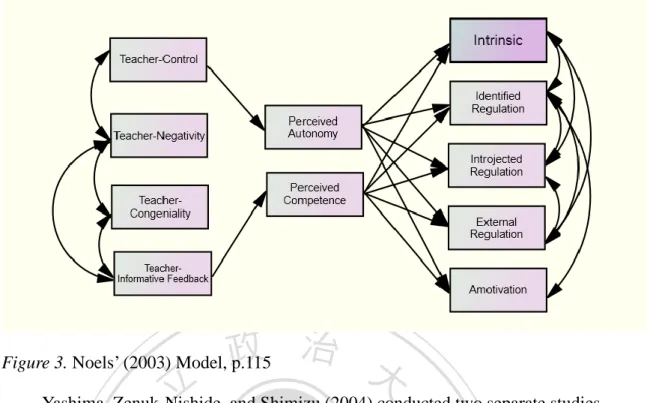
(37) Related Studies on Motivational Constructs The above-mentioned eight components from the three most influential theories, Gardner’s (1985) social psychological approach, Deci and Ryan’s (1985) Self-determination theory, and expectancy-value theory, has led to the development of various studies aiming at expanding the existing motivational constructs or establishing motivational models which present the relationship among the components. Among the studies that evaluate the relationship among components in. 政 治 大 (SEM), a statistical procedure that is rather complex into data analysis. Through SEM, 立 motivational construct, a number of them adopted structural equation modeling. a technique used to interpret relationship among several variables in a single. ‧ 國. 學. framework, the directional paths between the variable can be drawn. The results of the. ‧. studies that aimed at explaining the internal structure of motivational construct was. sit. y. Nat. summarized as Appendix A, and will be briefly described as follows.. io. er. Tremblay and Gardner (1995) conducted a study to examine the relationship between a number of new measures of motivation and the existing measures of. al. n. v i n attitude and motivation. TheC participants were 75 students h e n g c h i U in a secondary French class in a bilingual school. Based on the research, they proposed an extended model in. which elements from expectancy-value and goal theories were incorporated into the original social psychological construct of second language motivation, as a response to calls for adoption of a wider vision of motivation in the 1990s. In this study, a distinction between motivational behavior (variables which can be observed externally, such as attention, effort, and persistence) and motivational antecedents (factors which cannot be perceived by an external observer but influence motivational behaviors) was made, and the motivational antecedents, including goal salience, valence, and self-efficacy, was hypothesized to mediate the relationship between 23.
(38) language attitudes and motivational behaviors. Adaptive attributions, derived from expectancy-value theory, was hypothesized to mediate the relationship between French language dominance and motivational behavior. After modifying the hypothesized model according to the modification indicies, a correlation between French Language Dominance and Language Attitudes was made. Another modification was a direct path between French Language Dominance and Self-efficacy. The modified model (see Figure 1) was an adequate fit, with 453.50 chi-square value and 260 degrees of freedom, p<.01. This empirically grounded. 政 治 大 motivational construct can be synthesized into one framework (Dornyei, 1998). 立. model demonstrates how cognitive motivational theories and Gardner’s earlier. ‧. ‧ 國. 學. n. er. io. sit. y. Nat. al. Ch. engchi. i n U. v. ABF: Ability-Failure; ABS: Ability-Success; AFC: Attitudes toward French Canadians; AFO: Attitudes toward the French Course; AFT: Attitudes toward the French Teacher; ALF: Attitudes toward Learning French; ATT: Attention; COF: Context-Failure; COS: Context-Success; DLF: Desire to Learn French; FCA: French Class Anxiety; FLD: French Language Dominance; FUA: French Use Anxiety; GOF: Goal Frequency; GOS: Goal Specificity; IFL: Interest in Foreign Languages; IGO: Integrative Orientation; ISO: Instrumental Orientation; LUF: Luck-Failure; LUS: Luck-Success; MIT: Motivational Intensity; PER: Persistence; PEX: Performance Expectancy.. Figure 1. Tremblay and Gardner’s (1995) Motivation Model, p.514 Gardner, Tremblay, and Masgoret (1997) investigated a large number of 24.
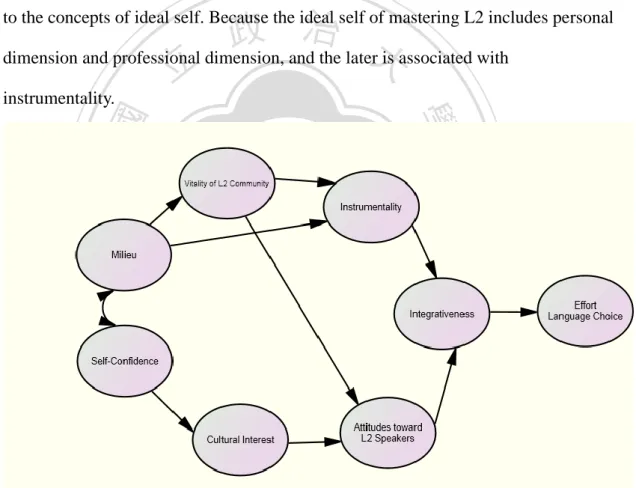
(39) individual difference measures which has been reported to influence achievement in language learning. The study was based on a sample of 102 university students enrolled in introductory French. The hypothesized model which indicated links among the affective measures and achievement was first proposed. In the model, Motivation directly influenced Achievement, and was influenced by Language Attitudes. In the revised model (see Figure 2), a direct causal path from Achievement to Confidence was added. The chi-square per degree of freedom ratio was 1.74, showing the goodness of fit of the revised model was reasonable. The result of the. 政 治 大. study is consistent with precious studies on attitudes and motivation.. 立. ‧. ‧ 國. 學. n. er. io. sit. y. Nat. al. Ch. engchi. i n U. v. APT: Language Aptitude; SC: Spelling Clues; WS: Words in Sentences; PA: Paired Associates; FIELD: Field Independence; GEF: Group Embedded Figures Test; ATTS: Language Attitudes; FTE: French Teacher Evaluation; FCE: French Course Evaluation; AFC Attitudes toward French Canadians; IFL: Interest in Foreign Languages; INT: Integrative Orientation; STRA: Language Strategies; LS1: Remembering More Effectively; LS2:Using Mental Processes; LS4: Organizing and Evaluating Learning; LS5: Managing Emotion; LS6: Learning with Others; MOT: Motivation; ALF Attitudes toward Learning French; MIT: Motivational Intensity; DLF: Desire to Learn. 25.
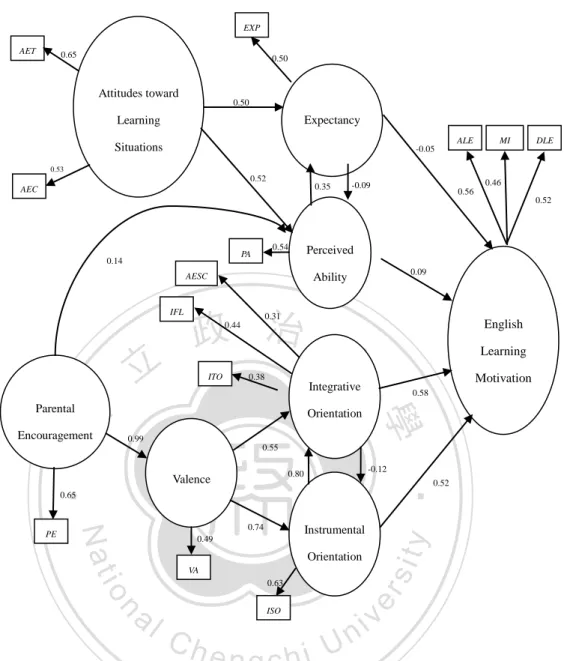
(40) French; ACH: Language Achievement; THM: Theme Test; FAT: French Achievement Test; CAT: Thing Category Test; CZE: Cloze Test; GRA: grades in French; CONF: Self-Confidence; ANX: Language Anxiety; CFD: Self-Confidence; CDO: Self-Rated Proficiency (Can Do).. Figure 2. Gardner, Tremblay & Masgoret’s (1997) Model of Second Language Learning, p.354 Noels (2003) examined a model in which perceptions of autonomy support and informative feedback provided by teachers sustain feelings of autonomy and competence, which in turn influence intrinsic and extrinsic motivation. The participants were 322 native English-speaking university students in first-year Spanish course. Because the initial model was not good-fitting, it was modified by. 政 治 大 types of teacher’s feedback, Teacher-Control and Teacher-Informative feedback 立. deleting nonsignificant paths. The modified model (see Figure 3) showed that two. ‧ 國. 學. influenced students’ perceived autonomy and competence, which in turn influenced intrinsic orientations, extrinsic orientations and amotivation. The model also indicated. ‧. that positive and uncritical feedback and allowing independent learning result in. sit. y. Nat. increased perception of competence, and that the less the teacher was perceived as. io. er. controlling, the more students felt learning language of their own accord. Moreover,. al. students’ perception of autonomy and competence were associated with more. n. v i n C h orientation.UIntrinsic orientation and the self-determined motivations, so as integrative engchi three types of Extrinsic Orientations were inter-correlated. The author also suggested that intrinsic motivation and integrative orientation independently predicted the intensity of motivation, which indicated that there are at least two motivational substrates, one pertaining to the immediate learning situation, and the other relating to inter-group issues in the broader society.. 26.
(41) 政 治 大. Figure 3. Noels’ (2003) Model, p.115. 立. Yashima, Zenuk-Nishide, and Shimizu (2004) conducted two separate studies. ‧ 國. 學. with Japanese adolescent learners of English to investigate results and antecedents of willingness to communicate (WTC). A model incorporating WTC, frequency of. ‧. communication, international posture, L2 communication confidence, and motivation. y. Nat. io. sit. to learn L2 was proposed (see Figure 4). The hypothesized paths in the model were all. n. al. er. significant and kept in the final model, and the goodness of fit of the model to the data. i n U. v. was confirmed. The authors suggested that attitude toward the international. Ch. engchi. community, labeled as international posture, predicted frequency of communication, WTC, and motivation to learn L2, which in turn influenced L2 communication confidence. Specifically, learners who are more internationally oriented are more willing to communicate in L2, and are more motivated, and higher motivation contributes to increased self-confidence.. 27.
(42) 立. 政 治 大. ‧ 國. 學. Figure 4. Yashima, Zenuk-Nishide & Shimizu’s (2004) L2 Communication Model,. ‧. p.134. Csizer and Dornyei (2005) evaluated a model concerning the internal structure. y. Nat. er. io. sit. of L2 motivation and its impact on motivated behavior, language choice, and learning effort (see Figure 5). Based on a two-phase survey among 8593 Hungarian students. n. al. Ch. i n U. v. aged from 13 to 14 years old, the researchers proposed a model including seven. engchi. components which are interrelated. The hypothesized model was then submitted to evaluation, and the results showed that the model was acceptable but some paths (Self-Confidence to L2 Choice, Self-Confidenct to Attitudes toward the L2 Speakers/Community, Instrumentality to L2 Choice, and Cultural Interest to Integrativeness.) were not significant and deleted: Because the sample size was large, after deleting the nonsignificant paths, it was concluded from most of the fit indices that the final model was an adequate representation of the data, although the chi-square per degree of freedom ratio was well above the recommended value of 2. In the model, integrativeness, influenced by instrumentality and attitudes toward L2 28.
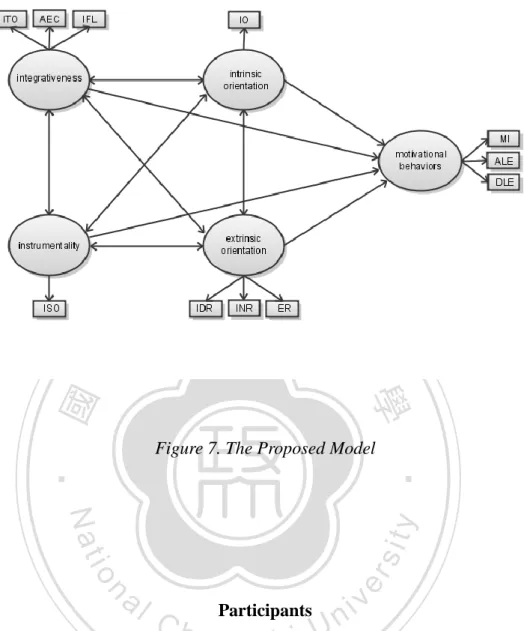
(43) speaker, is the only one factor directly influenced language choice, a result in accordance with Gardner’s (1985, 2001) theory. Instrumentality was found to be influenced by the influence from immediate social environment, labeled as milieu, and the perceived importance of the L2 community, labeled as vitality of the L2 community. Attitude toward the L2 speakers was influenced by cultural interest and vitality of L2 community. Milieu influenced self-confidence, which in turn influenced cultural interest. Specifically, to explain why instrumentality serves as the antecedent of integrativeness, the authors suggested that the idea of integrativeness can be related. 政 治 大 dimension and professional dimension, and the later is associated with 立. to the concepts of ideal self. Because the ideal self of mastering L2 includes personal. instrumentality.. ‧. ‧ 國. 學. n. er. io. sit. y. Nat. al. Ch. engchi. i n U. v. Figure 5. Csizer and Dornyei’s (2005) Motivation Model, p.27 Chen and Sheu (2005) examined the relationship among attitude, motivation, parental encouragement, and expectancy-value theory. Based on data collected from 451 college students, a motivational model was constructed (see Figure 6) and the 29.
(44) multi-sample procedure was used to examine its stability. The chi-square per degree of freedom of the final model was considered as adequate, and it was thus concluded that the model was an acceptable fit to the data. In the model, English learning motivation was influenced by external influences, including attitude toward the learning situation and parental encouragement, internal influences, including expectancy, perceived ability, integrative and instrumental orientation, and by valence. Specifically, external influences indirectly influenced motivation. Parental encouragement influenced valence, which in turn influenced integrative and. 政 治 大 on expectancy and perceived ability. The results of the study showed that high 立. instrumental orientation. Attitudes toward the learning situation had a slight influence. parental encouragement increased children’s belief in the value of learning the. ‧ 國. 學. language and it further influenced orientations and motivation. The findings also. ‧. revealed that instrumental orientation increased integrative orientation while the later. sit. y. Nat. decreased the former. Finally, the result that attitude increased expectancy and. io. al. n. differences.. er. perceived ability, but not motivation was suggested as resulted from contextual. Ch. engchi. 30. i n U. v.
(45) EXP AET. 0.65. 0.50. Attitudes toward. 0.50. Expectancy. Learning. ALE. Situations. MI. DLE. -0.05. 0.53. 0.52. 0.35. AEC. 0.46. -0.09. 0.56 0.52. 0.54. PA. 0.14. Perceived. IFL. 0.09. Ability. AESC. 政 治 大 0.31. English. 0.44. 立. ITO. Learning Motivation. 0.38. Integrative. Parental. 0.58. ‧ 國. 學. Orientation. Encouragement. 0.99 0.55. -0.12. ‧. 0.80. Valence. 0.52. 0.65. 0.74. Orientation VA. n. al. ISO. Ch. engchi. er. io. 0.63. y. Instrumental. 0.49. sit. Nat. PE. i n U. v. Figure 6. Chen and Sheu’s (2005) Model of English Learning Motivation, p.209. 31.
(46) Limitations of Previous Studies Although research has been conducted on learners‘ motivation in several settings and contexts, it seems that there are insufficient studies on Taiwanese learners, especially on the interrelationship among motivational variables. Therefore, the present study was designed to investigate the relationship among a number of motivational components. Specifically, the focus of this study was the relationship among four motivational components, integrativeness, instrumentality, intrinsic orientation and extrinsic orientation, and their relationship with motivational behavior.. 政 治 大 First, the four components are drawn from the two most influential and widely 立. The reasons for including these four components are as follows.. adopted theories, Gardner’s social psychological approach and Self-determination. ‧ 國. 學. theory proposed by Deci and Ryan (Crookes & Schmidt, 1991; Dornyei, 1998, 2001,. ‧. 2003), and the two theories have complementary advantages. The four components. io. er. seen as main motivational dimensions (Dornyei, 1998).. sit. y. Nat. are also frequently incorporated in different constructs of motivation, and thus can be. Second, they have different predictive power on motivational behavior. For. al. n. v i n example, the integrative orientationC was described as an intergroup motivational hengchi U. substrate, relating to social relationships, and was shown to be a better predictor of intergroup variables than the intrinsic/extrinsic orientation. Conversely, the intrinsic orientation was described as an interpersonal motivational substrate and was found to be a better predictor of more immediate variables such as motivational intensity, intention to persist in language learning, and attitudes toward the second language group than the integrative orientation (Noels, 2003). Also, there seemed to be few studies in which the four components are put in the same model to examine their influence on motivation, although it had been reported that integrativeness predicts greater effort in learning (Noels, 2005) and increased motivational intensity (Noels, 32.
(47) 2003), intrinsic orientation predicts motivational intensity and continue studying, and less self-determined types of extrinsic orientation did not predict motivational intensity. Third, the relationship between the integrativeness/instrumentality and intrinsic/extrinsic orientations is still unclear. Some researchers suggested that the two dichotomies are parallel constructs, while others argued they represent different processes (Noels, 2003). Gardner (1985), and Gardner and Tremblay (1994) emphasizes that both instrumentality and integrativeness are extrinsic in that language. 政 治 大 has also been linked to less self-determined types of extrinsic orientation because their 立 is learned for the goal apart from enjoying the learning activity per se. Intrumentality. definitions are similar (Noels, 2005). Noels (2003) noted that integrativeness can be. ‧ 國. 學. considered as similar to intrinsic orientation in that both of them refer to positive. ‧. attitudes toward the learning situation and learning process. On the other hand,. sit. y. Nat. considering that it addresses attitudes toward the second language group rather than. io. er. the learning task, it seems to be similar to more self-determined forms of extrinsic orientation and distinct from intrinsic orientation. In addition to theoretical arguments,. al. n. v i n the relationship between theC two dichotomies has U h e n g c h i also drawn much empirical research, but the findings have been mixed. MacIntyre, MacMaster and Baker (2001) found that instrumentality correlated with integrativeness, intrinsic orientation, and extrinsic orientation. Through factor analysis, the four components were found to be loaded on the same factor, and there is high degree of overlapping among the two dichotomies. The authors also note that whereas the two constructs can be clearly distinguished from each other theoretically, high degree of empirical similarity between them requires further study in different socio-cultural or educational environments (MacIntyre et al. 2001). Noels (2003) found integrativeness correlated with both intrinsic and extrinsic orientation, but associated most strongly with intrinsic 33.
(48) orientation and more self-determine types of extrinsic orientation. From the discussion above, it can be concluded that correlation among the four components: integrativeness, instrumentality, intrinsic orientation, extrinsic orientation, and their relationship with motivational behavior, has been verified in some empirical studies (e.g. Chen & Sheu 2005; Csizer & Dornyei, 2005; Gardner, Tremblay & Masgoret, 1997; MacIntyre et al. 2001; Noels, 2003; Tremblay & Gardner, 1995). Therefore, the model proposed in this study included five components: integrativeness, instrumentality, intrinsic orientation, extrinsic orientation, and motivational behavior.. 立. 政 治 大. ‧. ‧ 國. 學. n. er. io. sit. y. Nat. al. Ch. engchi. 34. i n U. v.
(49) CHAPTER THREE METHODOLOGY. In the previous chapter, the definitions and theories of second language learning motivation have been discussed. The motivational components have also been introduced. Research findings have shown that there is some relationship among them but it is not that clear. Therefore, the present study was designed to explore their relationship. The methodology of the study will be presented in this chapter, which. 政 治 大. includes five parts: the structure and hypothesis of this study, subjects, instrument, procedure, and data analysis.. 學. ‧ 國. 立. The Structure and Hypothesis of This Study. ‧. The present study intended to investigate Taiwanese non-English major’s. sit. y. Nat. English learning motivation and to propose an empirically grounded construct of. io. er. language learning motivation by using structural equation modeling. More specifically, this study was designed to answer the following question:. al. n. v i n Specifically, this studyC aimed to develop a model h e n g c h i U that can be supported by. empirical data, and effectively explain the relationship among all the components of Taiwanese EFL learners’ motivation. Five latent variables were taken into consideration in the structural model as below: 1. Integrativeness: Integrative Orientation (ITO), Attitude toward English Speaking Countries (AEC), and Interest in Foreign Languages (IFL). 2. Instrumentality: Instrumental Orientation (ISO). 3. Intrinsic Orientation: Intrinsic Orientation (IO). 4. Extrinsic Orientation: 35.
數據

+7

相關文件
依據教育部臺教師(二)字第 1070199256 號,辦理國小全英語教學之教師專業成長工作
以 100 學年度為例,本校資深教師共進行 25 場正式教學觀察,新進教師 12 場。嘉義大學實習教 師參與音樂教學觀摩 2 場、英文教學觀摩
國立政治大學應用數學系 林景隆 教授 國立成功大學數學系 許元春召集人.
一、 主辦單位:臺北市政府教育局 二、 承辦單位:臺北市新民國中 三、 協辦單位:臺北海洋科技大學 四、
林景隆 教授 國立成功大學數學系 楊肅煜 召集人.
A02 臺北市立實踐國民中學 翻「閱」時空,悅「讀」人生 A03 桃園市立建國國民中學 流動的饗宴-讀出建國真滋味 A05
03 集體創作 洪慶桐 建國科技大學 / 勞動部勞動力發展署中彰投分署, 彰化縣私立達德高級商工職業學校.. 03 集體創作 張建雄
Flash 平台 Macromedia 公司宣佈全世界 97.3%的網路瀏覽器都有內建 Flash player 播放器,只要在 Internet Explorer 或 Netscape 瀏覽器,安裝了 Flash Player 播放程式,就可以播放
