
Decision Behaviors of Married Females Re-entering the Labor Market: An Empirical Study in Kaohsiung, Taiwan
14
0
0
全文
(2) Decision Behaviors of Married Females Re-entering the Labor Market: An Empirical Study in Kaohsiung, Taiwan Li-ping M. Chen*. Ray-young Lu**. Abstract: This study investigates the willingness and decision-making regarding married females re-entering the labor market in Kaoshiung, Taiwan. Using a survey methodology, the study comparatively explores (1) the roles and decision-making of married females working outside the home; (2) strategies and obstacles to females entering labor market; (3) factors influencing unemployed females; (4) development of the re-employed females and; (5) the pattern of the married female reentering labor market. A one-way ANOVA and multi-nominal Logistic Regression Analysis are applied. The findings of the study show (1) the negative effect on working females caring for young children; (2) The negative influence on married women re-entering the labor market with children under age 5; (3) husband’s income as a factor in discouraging females from working outside the home; (4) salary as a positive effect on job satisfaction for married employed women; (5) the study also shows that all other factors such as age, educational background, choices of residential living area, spouse’s educational background, number of children, living with elderly family members, and the price of housing are insignificant in this study; (6) the characteristics of job, such as type of job, working hours number of years of working experience, and “steady” salaries, are not related to job satisfaction. INTRODUCTION In Taiwanese society today, success is predicted by individual achievement, and rewards are in proportion to an individual effort and merit. Women have always faced a “family knot”, a close-knit extended family, that has shaped their lives in the world. The effect of these expectations has created limitations for women in social, economic, educational, and political spheres. Changes which have led to reexamination of traditional gender roles in the family and society have occurred in these areas in recent year. As women’s participation in spheres outside the family increases, changes in their familial roles occurred as well. (Chen, 1996) It is to this particular concern that the purpose of this study is addressed. The theory of labor market discrimination is concerned with reasons for productivity and not with irrelevant characteristics of workers such as educational background, age, spouse’s income, and family responsibilities. Differences among married women, especially in their roles in the family, may affect the employment of females. This study attempts to analyze whether marriage status is a disadvantage of married women in Taiwan. _______________________________________________________________________________ *Assistant Professor, Department of International Business, I-Sou University, Kaoshiung, Taiwan ** Assistant Professor, Department of Business Administration, Soochow University, Taipei 2 第五屆全國實證經濟學論文研討會 The 5th Annual Conference of Taiwan's Economic Empirics.
(3) Utilizing human resources, especially the female component, efficiently plays a decisive factor in today’s labor market. The most important source of economic growth in Taiwan has been the increased participation of women. The labor force behavior of women over time presents a challenging problem for analysis, especially in regard to the married female group in Kaohsiung, Taiwan. The primary purpose of this study is to examine the willingness of married females to re-enter the labor force market after they withdraw from the labor market, the focus will be on those variables that directly affect the married women’s work decisions, as well as those factors that have an indirect effect, such as the opportunity cost of raising children, the attitude of family members toward the women’s return to work or do some other factors explain the influence? Does educational attainment level determine married women’s influence in the labor force? Many studies focus on women’s labor force participation based on human capital investment and demographic characteristic considerations. Are there any other reasons such as gender discrimination, or job segregation, to discourage married female employment besides the family and marriage? The agent system plays a decisive role in Taiwan’s labor market, and the traditional family business is a channel for the married female re-entering the labor market. Is the agent system fair for the married female re-entering the labor market? This study extends research in this area. However, sex discrimination continues exist in a male-dominated society like Taiwan. REVIEW OF LITERATURE The Female Labor Force Participation Rate (FLFPR) The traditional Asian family structure is patriarchal, with the father maintaining an irreproachably authoritative, strict, and dignified relationship with the family; thus, a distance is created between father and children. The father provides for the economic well-being of his family, and he is also the leader and principle disciplinarian in the family. The female role in a family is much more formed by the society than by employment choices traditionally. A study (Lu, 1992) has investigated specific example on how the family and gender discrimination could discourage females from re-entering the labor market. The same study cited small business or home-owned business as replacing work outside the home for married females. In addition, the life style in a family has an effect on female labor force participation. Lu also found that females have many more chances to be employed outside the home in a big city than in a small city. Also, another study by Lu (1994) analyzed the relationship between gender and employment based on data from 250 married females in the Detroit, Findings showed gender has strong effect on female labor force participation. Compared with males, married females prefer staying at home to working outside the home. Female labor force participation was affected by the age of the female, educational background, choices of residential area, family economic or financial structure, and number of 3 第五屆全國實證經濟學論文研討會 The 5th Annual Conference of Taiwan's Economic Empirics.
(4) children. Females with higher level of education toward administration, and have choices than those with the lower education in the labor force. Xue (1998) pointed out that the number of number of married women of re-entering the labor force seems to increase, but most types jobs for females are centered on low-level white collar and physical work. This study determined that females participation in the labor force with higher level of education will decline because of marriage. At the same time, there is no significant that a female with higher level education in the labor force participation because of childbearing. The quantity of demand and supply in the labor force market is an index for the married female re-entering the labor market. Otherwise, the job market is not open for them. However, compared with declined single female salary as a motivation for married women to work outside the home, and therefore has an impact on female labor force participation. “Is it necessary to give up family responsibilities to work outside the home?” We conclude that low-pay causes female labor force participation to decline in Taiwan. A career survey of 101 women by Rout, Cooper, & Kerslake (1997) showed 78 percent of those women with family responsibilities, and 22 percent without family chores. Their findings also revealed that those women with family responsibilities are in good health, but those without family responsibilities are concerned about their social life. An analysis of the Willingness of Force Participation Females are willing to work outside home because they hope to support family and try to reduce the financial burden in the family. When females make a choice to be employed, they consider the amount of income and benefits in relation to work.. This work this study determined that personal factors affect female labor force participation. The number of the children a woman has plays a key role in the labor force participation of females, but it is that childbearing and childcare discourage females from working outside the home. Further study is necessary to explain the relationship between childcare and female labor force participation. Wang (1991) compared the strategies of women working outside the home in the United States and Taiwan, and pointed out that both countries had adopted a work and family equality project, to assisted employees in overcoming the dilemma between work and family. Using a high-level management strategy, the project demonstrates the value keeping the relationship between the employee and employer stable because it helps to stabilize economic benefits of a business. Wang also retested female labor force participation after participating had withdrawn from working place because of childbearing and childcare. Based on her report, the results revealed that human resource such as educational background and previous working experience had a strong positive on female labor force participation. The life span of children also plays a positive role in the females re-entering the labor market. In addition, a complete government policy encourages females to work outside the home but an incomplete government policy discourages it. Therefore, female labor participation rates decline because of marriage and childcare. The government needs to 4 第五屆全國實證經濟學論文研討會 The 5th Annual Conference of Taiwan's Economic Empirics.
(5) formulate policies that support childcare and security for women working outside the home. Our study examined married women with a number of children under 6 years old in the labor market, and how they adopt a flexible employment schedule because of changes in family structure. In this study 939 married women with children, were randomly selected in Taiwan. The findings proved that marriage and childbearing are important factors in discouraging females from working outside the home. In this study, 45.1 percent of the women withdrew from the labor market, but 43.7 percent continued to work. 30.3 percent of married working women have a flexible working hours, and this is beneficial to their participation in the labor force. Career women have to keep a balanced and negotiable role between family and work. This study concluded that educational level and employment are ambiguous for married working women. Although there was some variance in the sample selection with regard to the study formal test structure has an impact on female labor force participation for both married and single women. The Effects Gender Segregation and Sex Discrimination on Female Labor Force Participation B. Zhou (1994) showed that there is an obvious gap between male and female workers wages and recognition of contribution in the labor force. According to Zhou, although many female workers are employed, they do not express and integrate their efforts and value into the society, And their achievement is degraded or ignored in their work place. At the inception of the European Union, sex discrimination was seemed a hindrance in the integration of labor force market. Written relevant regulations have been clearly established to equalize male and female workers rights in working place. (Zhou D, 1995). Female workers have much less than probability of receiving promotion, a salary or wages raise, or new hiring according to Zheng (1996). Sometimes, female workers, especially married women with children, experience discrimination in the choice of job selection because of family. Sex segregation exists in on-the-job training, educational training, job qualifications training, and career development. Also, Zhang pointed out sex discrimination and salary difference were interesting research topics in economics and social science. There are many reasons for the gap in salary, such as work experience, educational level, job market supply and demand, and the environment, and sex discrimination. When the employers control the salary, job segregation will be an obvious difference between male and female workers, regarding schedule workers will decrease (Lin, 1996). As to the value toward the work, there are different opinions between men and female workers. Male and female workers have different attitudes toward the family, and it makes a difference in the labor market. Comparing male and female workers, male workers are focused on job achievement. The value attitude toward males and females in a family always focuses on (1) the role and gender difference; (2) the limitations of job segregation. It ignores the relationship between commitments to family and the value-added. Based on research results, most females are constrained in the family. This also affects their commitment to an external job and value to the society. 5 第五屆全國實證經濟學論文研討會 The 5th Annual Conference of Taiwan's Economic Empirics.
(6) Lin showed that females have to face the dilemma between the family and working outside the home. The government has no authority to control sex discrimination in the labor market, so females become the more weak party in the labor in the labor force market. Equality of gender is based on the concepts of “justice,” “freedom,” and “equal.” But it is lacking freedom of choice and positive effects, so it is not counted as real as freedom. Generally speaking, it is just a superficial freedom. It could not give females any help at this point. Ways to reinforce real equality in status between men and women are still questionable in Taiwanese society. Li’s survey (1997) pointed out the gap between generations in the family as complicated. Most of the females seem emotional and look at paradoxical. The value of work is the relationship between parents and sons depends on their mutual situation with regard to their age, the number of years of marriage, educational background, and the distance from parents’ place. Werneke’s (1984) survey pointed out the weakness of hiring and sex segregation of female workers in the labor market. The study also cities changes in the formation of a family and job content as contractual with male and female worker, the annual income of females is 66 percent that of males. The weekly salary of females was 70 percent that of males in 1998. The salary female is 74 percent that of males on average. Mansfield & Vieary (1989) studied research employed women’s attitudes toward job selection and family responsibilities. They found the atmosphere of the working place was similar to that of a family. With the former playing a decisive role in family and job satisfaction. Sorensen (1991) reported that same eases remedy differences in salary. Sex discrimination, salary difference, and job segregation always deter females working outside the home. The World Bank (1995) analyzed the inequality of male and female status in developing countries. Their repot said that these factors cause problems in production and economic development. Castro (1998) indicated many lawsuits revealing topics “good-pay,” , ”health job,” “family role,” and “dignity work.” Married women still face discrimination in employment in employment in US labor market (Danziger & Katz, 1996) As to the Labor market in Europe, Dulk, Huinses’s & Schippers (2002) reveal a positive effect on the family and work between male and female. In addition, the study reported that female managers have a negative impact on their employees. As to the possibilities of job hiring and placement studies show an extremely unequal sign. Paid-salary discrimination still exists between males and females. Even though male and female workers have the same job responsibilities in the work place, salary discrimination still exists. METHODOLGY As to the analysis of married females re-entering the labor market, there are many determinants to affect married women working outside the home, such as personal characteristics, family responsibilities, husband’s attitude toward work, care for family members, and social status. The 6 第五屆全國實證經濟學論文研討會 The 5th Annual Conference of Taiwan's Economic Empirics.
(7) frame of this study contains personal characteristics (age, educational background, and place of distance), the spouse (spouse’s educational background, the income of the spouse), children (numbers of children), elderly care (living with elderly family members), and family (child-care, housing quality) ads indigenous. The key point article is to survey the decisions of married female labor force participates to determine if females make a decision to work outside the home, so will they be concerned about the characteristics of employment, working hours, fixed or stable salary or wages, annual income, number of years of working experience, and union membership. The characteristics of employment affect job satisfaction, so the authors assume that the characteristics of employment are an index in this study. Also, married women are concerned with job satisfaction, so we conclude that job satisfaction plays a deceive role in married female labor force participation. Research Hypotheses Based on the structure of study, the authors test the assumptions as below: Assumption 1: Personal character influences decision to work outside the home. Assumption 2: Spouse’s attitude influences other spouse decision to work outside the home. Assumption 3: Children influence decision to work outside the home Assumption 4: Elder care influences the decision to work outside the home. Assumption 5: Family influences the decision to work outside the home. Assumption 6: Characteristics of employment influence decision about job satisfaction Assumption 7: Characteristics of female influence decisions about job satisfaction. The Method of Measurement In economics literature, one of the major forces shaping outcomes in the management of human resources is a dramatic increase in the labor force participation by women. Female labor force participation reflects those women who are age 16 years or older, who work for profit or who are employment in short periods in the labor market. This study is based survey data, and the authors also refer to several relevant studies from other countries. As to the content of the questionnaire, we requested study first, and then adopted it to develop the final questionnaire. Then mailed the questionnaires to female residents of Kaoshiung areas via Woman’s Association. 200 of questionnaires were sent, and 80 copies were turned and completed. Thus, the collection rate was 40 percent. This seems acceptable and appropriate. The content of the questionnaire contains two parts: the part is personal demographic information, such as age, birth place, educational background, number of children, number of children under age 5, and spouse’s educational background. The second part of the questionnaire assesses the quality of job and the content of work. Responses for part one were based on a Likert Seale using bi-nominal (0, otherwise 1), and the part two had numerical answers. Example with age, annual income, or years of educational background. The researches also test relevant factors, such 7 第五屆全國實證經濟學論文研討會 The 5th Annual Conference of Taiwan's Economic Empirics.
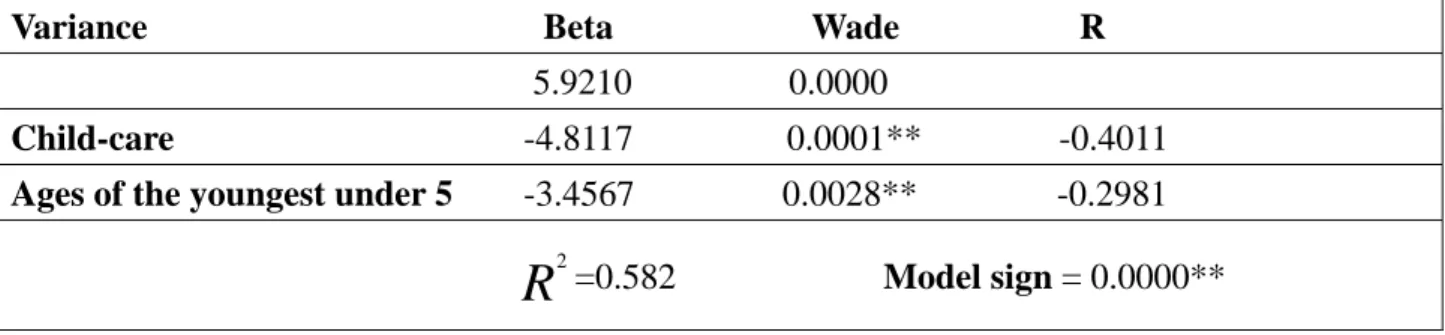
(8) as types of employment, job stability, salary, and working hours, in female returning to work outside the home. Logistic Analysis: The variance between female personal characteristics and employment The research examines influential variables on the choices of married females re-entering labor force participation (MFRELFP). A model of married females re-entering the labor market include the following variables: = f ( HK i , FAMILY i ). MFRELEP. In the equation above, HK is a vector of productive characteristics representing investment in human capital, such as years of education, participation in training programs, tenure, years of experience, and paid-salary or wage. Typically, females who have obtained greater investments in human capital are more likely to choose to work, ceteris paribus. Family is the vector if variables, such as yearly family income, family size, number of children, and ages of children. The logistic regression involving a single (0,1) dependent variable is consider with corresponding odds ratio expressions and focuses on defining the independent variable as an odds ration for each case. The independent variables may be qualitative, or they may be quantitative and represented b indicator variables. A logistic regression model is used for describing the nature of the relationship between the dependent variable and one or more independent variables. It also used for making predictions. The transformed response function is referred to as the logit response function, and p’ is called the logit mean response function. We applied a Logistic regression to analyze the decisions of females re-entering the labor market. It is reasonable to use a logistic regression by testing an estimate of the probability of a given choice for married females. In order to analyze the odds ratio. e. we applied, the formula p =. P = f(x) =. B +B 0. 1. x + B2. X. f ( x). 2. 1+ e. f ( x). (f as a multiple variance), and our model become:. + KK +; (P: the probability of success); (in which subscript i. represent the individual observation.) 1-P = 1 1 + e. f ( x). (1-P: the probability of failure);. Odds ratio: p 1 − p = P × 1 + e. f ( x). Ln p 1 − p = f(x) =. x + B2. B +B 0. 1. ;. X. 2. + KK + B K. X. K. The results of this analysis are in Table 1 below: 8 第五屆全國實證經濟學論文研討會 The 5th Annual Conference of Taiwan's Economic Empirics.
(9) Table 4:1: Logistic Analysis of the Characteristics of Female Employment Variance. Beta. Wade. R. 5.9210. 0.0000. Child-care. -4.8117. 0.0001**. -0.4011. Ages of the youngest under 5. -3.4567. 0.0028**. -0.2981. R. 2. =0.582. Model sign = 0.0000**. A negative anticipated expected sign indicated that women are less likely to re-enter the labor market because of caring for young children under age 5, and it implies a decrease in the likelihood that women have a preference to work outside the home. Bearing and rearing children requires per input of time, and marginal utility of women’s leisure varies directly with their fertility. The opportunity cost of childbearing is a highly intensive use of a woman’s time, and changes in the price of woman’s time varies with her female labor force status. In general, the presence of young children has a negative effect on a married female re-entering the labor market. Analysis of Variance; The Relationship from Between the Characteristics of Employment and Job Satisfaction in Female Labor Force Participation. The researches studied the relationship between employment and satisfaction for females. We considered indigenous variables as singles, so we adopted a one-way ANOVA, and the result revealed that the spouse’s income is significant in this analysis. Analysis of the Characteristics of the Employment; “Spouse Income” and Job Satisfaction When we analyze the characteristics of female employment and “spouse income,” the variances are. split into three parts: “High,” “Middle,” and “Low,” See Tables 4-2 and 4-3. Table 4-2: The Effect of the Characters of the Female Employment “Spouse Income” and Job Satisfaction Source of Variance. Freedom. X. 2. 2. X N. F 5.086**. Spouse Income. 2. 5.768. 2.884. Scrape Value. 47. 26.652. 0.567. Total. 49. 32.420. 9 第五屆全國實證經濟學論文研討會 The 5th Annual Conference of Taiwan's Economic Empirics.
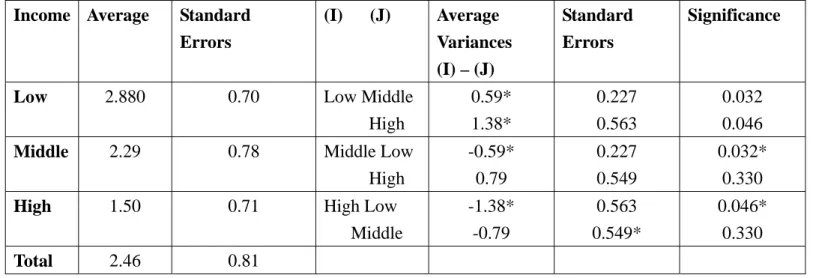
(10) As we know, economic factors are important in influencing the participation of married women in the labor force. Economic factors, however, are numerous and associated with female labor force participation. Economic pressure is a complicated matter related to current income. A given current family in come implies a different level of economic pressure depending on the number of family members (Chen, 1996).Hoffman (1998) suggested that income satisfaction and perceived financial need have an impact on the probability of the employment of wives. Family income is an indicator for a woman to be employed in the labor market. Table 4-3: ANOVA Analysis of Income and Job Satisfaction Income Average. Standard Errors. (I). (J). Average Variances (I) – (J). Standard Errors. Significance. Low. 2.880. 0.70. Low Middle High. 0.59* 1.38*. 0.227 0.563. 0.032 0.046. Middle. 2.29. 0.78. Middle Low High. -0.59* 0.79. 0.227 0.549. 0.032* 0.330. High. 1.50. 0.71. High Low Middle. -1.38* -0.79. 0.563 0.549*. 0.046* 0.330. Total. 2.46. 0.81. Levene = 0.669; F= 5.086: P-value= 0.010. The average variance of each factor is 2.880, 2.29, and 1.50, respectively, and the Levene test is insignificant. It results in no obvious difference between the three discrete samples. But the analysis among the three groups is significant, and spousal income affects women’s satisfaction in this study. Comparing these three groups, the job satisfaction of women with low income spouses is lower than that of middle and higher spousal women income in labor force participation. The researchers concluded that the spouse’s income affect the women’s job satisfaction in study. The Effect of Characteristics Employment and Job Satisfactions. The researchers separate among the characteristics of job “Salary”, the range from under $20,000, $20,000 to $40,000 to $60,000, and over $60,000, respectively. As to job satisfaction, 1: satisfactory, and 5; unsatisfactory, respectively. The results are shown in tables 4-4, and 4-5. Table 4-4: ANOVA Analysis of Income and Job Satisfaction. 10 第五屆全國實證經濟學論文研討會 The 5th Annual Conference of Taiwan's Economic Empirics.
(11) Source of Variance. Freedom. X. 2. 2. X N. F 4.274**. Salary. 3. 6.530. 2.177. Scrape Value. 55. 28.013. 0.509. Total. 58. 34.542. Table 4-5: Test Analysis of Income and Job Satisfaction (Unit = thousand) Average. Standard Errors. (I). (J). Average Variances (I) – (J). Standard Errors. Significance. Under $20. 2.82. 0.60. Under 20 20-40 40-60 Over60. 0.28 0.96* 0.98*. 0.247 0.345 0.362. 0.681 0.036 0.042. 20 - 40. 2.54. 0.70. 20-40 Under 20 40-60 Over60. -0.28 0.69 0.71. 0.247 0.295 0.315. 0.681 0.106 0.123. 40 - 60. 1.86. 0.69. 40-60 Under 20 20-40 Over60. -0.96* -0.69 2.38. 0.345 0.295 0.315. 0.036 0.106 0.123. Over 60. 1.83. 0.98. Over 60 under20 40-60 Over60. -0.98* -0.71 -2.38. 0.362 0.315 0.397. 0.036 0.106 1.000. Total. 2.44. 0.77. Levene Significant = 0.136; F= 4.274: P-value= 0.0009. In relation to salary for female, a positive effect is expected on job satisfaction in table 4-5;Job satisfaction for those with a high salary female is higher than with those of low salary in the work place. SUMMARY AND CONSLUSIONS. The purpose of this study was to estimate the preferences married females re-entering the labor market in Kaohsiung, Taiwan. It is important to consider human capital, demography, and family background characteristics in relation to labor force participation in the study, also review job satisfaction among the employed females. The hypothesis of his study is different form studies because family responsibilities are considered to be related to trends in employment among married women 11 第五屆全國實證經濟學論文研討會 The 5th Annual Conference of Taiwan's Economic Empirics.
(12) Summary Discussion of Empirical Results This study adapts a female labor force participation model to estimate possible variations. among the married women in Kaohsiung, Taiwan. Married females re-entering the labor market model is focused on human capital, demography, and family background characteristics of differences, especially family characteristics. A woman’s family responsibilities, such as childbearing, and childcare, and care of elderly family members, have e an important impact on participation in the labor market. The past two decades have demonstrated important changes in family life, and many are more likely to choose to work outside the home. The following section summarizes the empirical results from married women in this study. The Results of Logistic (LOGIT) Regression Model 1. A central issue of the family responsibilities variable, such as childcare, is hypothesized to decrease the probability of re-entering the labor market 0.4 times of those without childcare 2. The estimated coefficient of young children under age 5 is significant and has negative effect on re-entering the labor market 0.3 times of those without young children under age 5, by and large, women are the main family caregivers, especially in the southern parts of Taiwan 3. The estimated coefficient of the spouse’s yearly income significant and has positive effect among married employed females on their job satisfaction. 4. The estimated coefficient of yearly income is significant and has a positive effect among married employed females on their job satisfaction 5. In relation to other factors, such as age, educational background. Residential location, the spouses’ educational background, number of children, living with elderly, family members. Home value these are insignificant impact on married females re entering the labor market. 6. As to characteristics of employment, such as types of employment (hired or self-employed), working hours, years of work experience, and union member, showing these are insignificant in their effect on married females working outside home. Suggestions:. This study emphasizes married female re-entering the labor market. The married female labor force participation equation reflects important determinants on the choices and preferences to choose work outside the home. Empirical reveal that married women are less likely to work outside the home when family responsibilities, such as childbirth and caring for young children under age 5, are significant in this study. In addition to job satisfaction 12 第五屆全國實證經濟學論文研討會 The 5th Annual Conference of Taiwan's Economic Empirics.
(13) among employed females, the spouses’ yearly income and their own salary have a significant on re-entry of women into the labor market. This study reveals that married women’s salary has an impact on re-entering the labor market. This study provides an important policy for government and business regarding how to use female human resources in the future. Finally this study draws conclusions as well as implications within the framework of the objectives of the research, and emphasizes the importance of the day-care system and salary as predictors of women’s choices and preferences to work outside the home, this is hypothesized to differ between married and single females in the labor market in Taiwan.. Castro,I.L.,. REFERENCE “Equal Pay: a third-five year perspective, Washington DC :Department of. Labor,1998. Chen, Li-ping M. “Does Culture Identification Explain the Difference: A Study of Female Labor Market.” Proceedings of International Conference of Pacific Rim Management, 1999,pp.158-164. “The study of self-choice and salary for re-entering labor force market of Chen, Shi Zhe female in Taiwan “NATIONAL OF Yi Shan university, the Graduate School of Human Resources Department, 1998 Danziger, L. & Katz, E “A theory of Sex Discrimination.” Toronto, Canada: York University, 1996. Dulk, L. & Doorne –huiskes&Schippers, J “Work-family Arrangements and Gender Inequality in Europe.” Women in management Review, vol (11:5), 2002, pp.25-35. “The Gap Generation for married Female: The Division and Integration of Li, Chin Shan Family System. “The Department of Living Application Science, Fu-Zen Catholic University, 1997. “Justice of Sex: The Draft of the Job Equality of Male and Female “ Liu, Mei Jun The Department of Labor of National Chen-Chi University, 1996. “The Survey of Informal Employment of Taiwan Married Female in aiwan.“ Journal of Women and Gender, vol (4), 1992,pp.137-174. Mansfield, P. &Vicary, J. “ Job and Family Stress and Women Performance, Pennsylvania State University Park, 1989. Rout, U & Cooper, C & Kerslake, H. “Working and Non-Working Mothers: A Comparative Study.” Women in Management Review,1997, vol (12:7), pp.264-275 “Gender and Racial Pay Gap in the 1980s: Accounting for Different Trend, Sorensen, E. Washington DC: Bureau of International Labor Affair, 1991. Valentines, S. & Godkin, L. & Tuner, F “Women’s Management, perceived Job Responsibilities, and Job Search Intention.” Women in Management Review, vol (17:1) Lu, Yu Xia. 13 第五屆全國實證經濟學論文研討會 The 5th Annual Conference of Taiwan's Economic Empirics.
(14) Wang, Li Rong. Wang, Li Rong. Wang, Cong Gui Werneke, D. Women’s Bureau. World Bank Group. Yi, Qing Chun. 2002, pp. 29-38. “The Survey and Policy of Re-entering Employment of Females” The Journal of Society Policy and Social Work, 1999, vol (3:2), pp. 181-226. “Comparison of The Family Policy of Female Employment in a Business in US an Taiwan.” Proceedings of the Conference of the Society and the Female Study. 1991, pp.267-312. “The Survey of Work and Family Commitment and Job Evaluation.” National Research Council, Washington DC, 1984. “Microelectronics and Working Women: A Literature Summary” National Research Council, Washington DC, 1984. “Facts on Working Women: Differences Between Women and Men” Women’s Bureau, Washington DC, 1990. “Advance Gender Equality: From Concept to Action.” Washington DC: World Bank Group, 1995. “The Married Female of Continuing Employment: The Compromise of Family and Work.” Taiwan Sociology, 2000, vol (1), pp. 149-182. 14 第五屆全國實證經濟學論文研討會 The 5th Annual Conference of Taiwan's Economic Empirics.
(15)
數據

相關文件
Zhang Jiahao, On the Adaptation of the Story on “Taizong Entering the Underground World” in the Journey to the West with special Reference to the Dunhuang Manuscript
• elearning pilot scheme (Four True Light Schools): WIFI construction, iPad procurement, elearning school visit and teacher training, English starts the elearning lesson.. 2012 •
(Another example of close harmony is the four-bar unaccompanied vocal introduction to “Paperback Writer”, a somewhat later Beatles song.) Overall, Lennon’s and McCartney’s
Microphone and 600 ohm line conduits shall be mechanically and electrically connected to receptacle boxes and electrically grounded to the audio system ground point.. Lines in
Teacher then briefly explains the answers on Teachers’ Reference: Appendix 1 [Suggested Answers for Worksheet 1 (Understanding of Happy Life among Different Jewish Sects in
- Informants: Principal, Vice-principals, curriculum leaders, English teachers, content subject teachers, students, parents.. - 12 cases could be categorised into 3 types, based
volume suppressed mass: (TeV) 2 /M P ∼ 10 −4 eV → mm range can be experimentally tested for any number of extra dimensions - Light U(1) gauge bosons: no derivative couplings. =>
• Formation of massive primordial stars as origin of objects in the early universe. • Supernova explosions might be visible to the most
