Manufacturing Technique and Property Evaluation of Sound Absorption
Composite Planks
Jia Horng Lin
1,2*, Chia Chang Lin
4*, Chao Chiung Huang
3, Ching Wen Lin
5,You
Cheng Liao
1and Ching Wen Lou
6*
1Laboratory of Fiber Application and Manufacturing, Department of Fiber and Composite Materials,
Feng Chia University, Taichung City 407, Taiwan (R.O.C.)
2School of Chinese Medicine, China Medical University, Taichung City 40402, Taiwan (R.O.C.)
3Department of Police Administration, Taiwan Police College, Taipei City 116, Taiwan (R.O.C.)
4Department of Textiles & Clothing, Fu Jen Catholic University, Taipei City 242, Taiwan (R.O.C.)
5
Department of Fashion Design, Asia University, Taichung City 413, Taiwan (R.O.C.)
6Institute of Biomedical Engineering and Material Science, Central Taiwan University of Science and
Technology, Taichung City 406, Taiwan (R.O.C.)
*corresponding email: [email protected],[email protected], [email protected]
Keywords: sound absorption, fracture stress, polyurethane, Abstract
In this study, the basic material for sound absorption was porous nonwoven made of polyester nonwoven and low-melting polyester fiber. Nonwoven was then attached with foam polyurethane as composite plank for sound absorption and sound isolation. We used two microphone impedance tube for sound absorption test and INSTRON 5566 mechanical testing machine for tensile test. The optimum sound absorption coefficients as 0.67 ± 0.008 was obtained when density of foam polyurethane was 1.0 Kg/㎥ with thickness of 20 mm; Polyester (PET) nonwoven were laminated with 9 layers in a total thickness of 10 mm; and its low-melting polyester fiber was 30 wt%. The composite plank obtained the maximum fracture stress when it contained low-melting-point (low-Tm) PET fiber at 30~40 wt%. The results of this study could be applied in the partitions inside ships, vehicles or buildings.
Introduction
Industrialization improves the living standard, but the noise followed impacts the environment. Noise jeopardddizes workers’ hearing, decreases the productivity and brings other negative influence. Noise pollution is colorless, tasteless and odorless and is not accumulate in the environment. Noise disappears when the resource of it is gone [1]. Morse, Blot and Brown (1940) studied about sound absorption of porous material [2]. In 1971, Attenborough researched on its microcosmic structure, such as the influence of the changing of fiber flexible, radius and fiber direction on sound wave propagation [3]. Furthermore, Mechel and Vér (1992) stated that sound pressure brought about the sound; if the sound waves touch sound absorption materials during its delivery, the air molecule would dangle in the voids inside the material; energy would be worn off with the abrasion [4]. Finally, Yang et al. used rice straw–wood particle composite to compare the fiber composite plank with other wooden plank for their sound absorption [5]. As a result, industrial-grade functional textile is one of the major manufacturing goals for the current textile industry in the scope of application [6-15]. Nevertheless, not until now, do some researchers take advantage of the properties of composite structure to improve the sound absorption. This research was with an attempt to attain this function with the least thickness.
Experimental
with the weight ratio of 7:3, forming the nonwoven. 9 layers of the nonwoven were placed in the mold and thermal-treated for twenty minutes. Then it was cooled at the room temperature until it became the nonwoven plank with a thickness of 1 cm. Foam of reagent A and hardener of reagent B were mixed in volume ratio 1:1 and the mixture foamed for 2 days until it became the foam polyurethane plank. Then we adhered the nonwoven and foam polyurethane by thermal treatment for twenty minutes, after which it was left at the room temperature, forming the 30mm-thick-composite plank with sound absorption ability.
Results and Discussion
Tensile strength of the PET nonwoven plank
Figure 1 shows that when 7D PET/ low-Tm was 8:2, the tensile strength of the PET plank started increasing largely when the lamination number was 9 layer. The more layers the nonwoven had, the more fiber dispersed in each unit, resulting in a greater tensile strength.
Figure 2 shows the when the lamination number was 9 layer, the tensile strength of the PET nonwoven plank displayed an optimum tensile strength when the 7D PET/ low-Tm was 6:4. When 7D PET fiber and low-Tm fiber had physical cohesion, tensile strength of bulk nonwoven increased. However, the tensile strength started declined when the weight ratio was 5:5.
0 200 400 600 800 1000 1200 1400
6 layers 7 layers 8 layers 9 layers 10 layers
PET Nonwoven Lamilations
T ens ile S tre ngth (N ) 0 200 400 600 800 1000 1200 10wt% 20wt% 30wt% 40wt% 50wt%
Low-Melting PET Weight Percentage (wt%)
T ens ile S tr engt h (N )
Figure 1 The tensile strength of PET nonwoven Figure 2 The influence of strength of PET plank. (7D PET/ low-Tm ratio: 8:2; lamination nonwoven plank. (7D PET/ low-Tm ratio: number: 6 -10 layers; thickness: 10 mm) 9:1, 8:2, 7:3, 6:4, 5:5; lamination number: 9; total thickness: 10 mm)
Sound absorption coefficient of the PET nonwoven plank
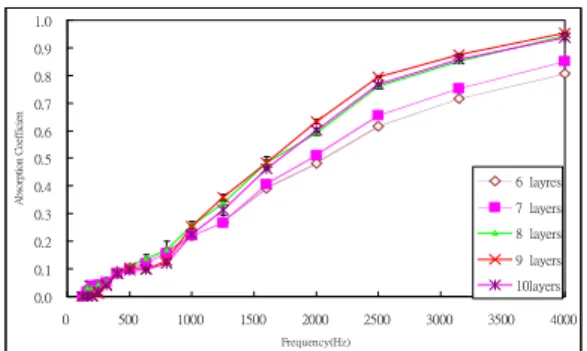
Figure 3 shows that when 7D PET/ low-Tm was 8:2, the PET nonwoven plank sound exhibits the optimum absorption coefficient on the frequencies of 800~4000 Hz when the lamination number was 9 layers. However, a lamination number of 6 to 8 layer contributed to sound absorption on frequencies below 800 Hz. With the same thickness, the greater the lamination number, the higher nonwoven plank’s density, providing the plank with a greater sound absorption coefficient. The 10-layer nonwoven plank displayed a lower sound absorption than the 9-layer one.
Figure 4 reports that when the lamination number was 9 layer, the PET nonwoven plank exhibited an optimum sound absorption coefficient when the 7D PET/ low-Tm was 7:3. When low-melting polyester fiber received thermal treatment, it would melt thus have meshed cohesion with polyester fiber. It lifted the structural complexity because the difference in meshed structure would affect the sound absorption coefficients. When the weight ratio was 30 wt%, there were more junction point hence the meshed structure was more porous, and caused more sound power internal friction losses. However, with a weight ratio of 40 to 50 wt%, there were too many bonding points. Porous structures were blocked with molten material and deteriorated the air mobility and sound absorption. Figure 5 shows the sound absorption coefficients when the polyester fiber of fixed thickness of 10mm was mixed with low-melting polyester fiber at weight ratio of 30 wt%, and lamination was 9 layers. Because 7D polyester fiber was with three-dimensional crimp structure, the planks of polyester fiber nonwoven had more void allowing sound wave incidence to proceed with internal friction losses, and obtained better sound absorption than 12D polyester fiber.
0.0 0.1 0.2 0.3 0.4 0.5 0.6 0.7 0.8 0.9 1.0 0 500 1000 1500 2000 2500 3000 3500 4000 Frequency(Hz) A b so rp ti o n C o ef fi ci en 6 layres 7 layers 8 layers 9 layers 10layers
Figure 3 The sound absorption coefficient of PET nonwoven plank. (7D PET/ low-Tm ratio: 8:2; lamination number: 6 -10 layers; thickness: 10 mm)
0.0 0.1 0.2 0.3 0.4 0.5 0.6 0.7 0.8 0.9 1.0 0 500 1000 1500 2000 2500 3000 3500 4000 Frequency(Hz) A bs orp tio n C oeffi ci en 10 wt% 20 wt% 30 wt% 40 wt% 50 wt%
Figure 4 The sound absorption coefficient of PET nonwoven plank. (7D PET/ low-Tm ratio: 9:1, 8:2, 7:3, 6:4, 5:5; lamination number: 9; total thickness: 10 mm)
Sound absorption coefficient of the PET/ PU composite plank
Figure 6 shows the sound absorption coefficients at different densities of foam polyurethane when nonwoven was with a thickness at 10mm; the foam polyester was with a thickness at 20mm; the ratio of reagents A and B was 1:1. When foam polyurethane foamed to 1.0 Kg/㎥, the foam structure was the most complete. The sound wave incidence was within a closed cell wall, engendering compressed vibration of sound power loss, thus obtaining better sound isolation and absorption. When the density was less than 1.0 Kg/m3 the structure was more uneven, resulting in the lower sound absorption coefficient. When it was higher than 1.0 Kg/㎥ the foam space was restrained by taking more stress. The material was close to rigid wall, the sound absorption would decrease. As a whole, the sound absorption increased, when frequencies was between 125 to 1500 Hz. 0.0 0.1 0.2 0.3 0.4 0.5 0.6 0.7 0.8 0.9 1.0 0 500 1000 1500 2000 2500 3000 3500 4000 Frequency(Hz) A bso rp tio n C oeff ici en 7 D 12 D
Figure 5 The sound absorption of PET nonwoven plank. (7D PET/ low-Tm ratio: 7:3; lamination number: 9; total thickness: 10 mm)
0.0 0.1 0.2 0.3 0.4 0.5 0.6 0.7 0.8 0.9 1.0 0 500 1000 1500 2000 2500 3000 3500 4000 Frequency(Hz) A bs orp tio n C oeff ici en 0.5 Kg/㎥ 1.0 Kg/㎥ 1.5 Kg/㎥ 2.0 Kg/㎥ 2.5 Kg/㎥
Fig.6. Figure 6 The sound absorption of PET/ PU composite plank. (For PET plank, 7D PET/ low-Tm ratio: 7:3; lamination number: 9; total thickness: 10 mm). (For PU plank, reagent A/B: 1:1; thickness: 20 mm; PU density: 0.5, 1.0, 1.5, 2.0, 2.5 Kg/m3).
Conclusion
In this study, we successfully manufactured the PET/ PU composite planks with different PU density. The tensile strength of the PET planks was increased largely when 9 layers of nonwoven were used to laminate. In addition, the tensile strength of PET nonwoven plank increases obviously when the low-Tm fiber was added up to 30 %.. The optimum parameters of PET nonwoven plank were: 7D PET/ low-Tm ratio: 7:3; lamination number: 9; total thickness: 10 mm. Meanwhile, the optimum parameters of PU plank were: reagent A/B: 1:1; thickness: 20 mm; PU density: 1.0 Kg/m3. Finally, the resulting PET/ TPU composite plank exhibited the optimum sound absorption when the density of foam polyurethane was 1.0 Kg/m3, and the sound absorption coefficient was 0.67 ± 0.008, which meant the material can absorb 67 % of sound power.
Acknowledge
This work would especially like to thank National Science Council of the Republic of China, Taiwan, for financially supporting this research under Contract NSC 99-2621-M-035-001.
Reference
[1] J.S. Chang, G.R. Han, J.H. Jang, gau-lih publishing house (2007).
[2] P.M. Morse, R.H. Bolt, R.L. Brown: Journal of the Acoustic Society of America, Vol.13, (1940), p. 217-227.
[3] K. Attenborough: J. Sound Vibr. Vol. 16 (1971), p. 419-442. [4] L.L. Beranek, I.L. Vér and F.P. Mechel etc, John Wiley, (1992).
[5] H.S. Yang, D.J. Kim, H.J. Kim: Bioresour. Technol. Vol.86 (2003), p. 117-121.
[6] A.P. Chen, C.M. Lin, C.T. Hsieh, Y.C. Yang, C.W. Lou and J.H. Lin: Adv Mat Res. Vol.97-101 (2010), p. 1786-1789.
[7] A.P. Chen, C.M. Lin, C.T. Hsieh, Y.C. Yang, C.W. Lou, Y.H. Young and J.H. Lin: Adv Mat Res. Vol.123-125 (2010), p. 967-970.
[8] C.W. Lin and J.H. Lin: Text. Res. J. Vol.75 ( 2005), p. 453-457. [9] J.H. Lin and Lou C.W.: Text. Res. J. Vol. 73 ( 2003), p. 322-326.
[10] C.W. Lou, C.M. Lin, A.P. Chen, Y.C. Yang, C.P. Chen and J.H. Lin: Adv Mat Res. Vol.97-101(2010), p.1797-1800.
[11] Z.Z. Yang, J.H. Lin, I.S. Tsai and T.Y. Kuo: Text. Res. J. Vol. 72 (2002), p.1099-1104.
[12] H.C. Chen, K.C. Lee and J.H. Lin: Compos. Pt. A-Appl. Sci. Manuf. Vol.35 (2004), p.1249-1256.
[13] J.H. Lin, C.W. Chang, C.W. Lou and W.H. Hsing: Text. Res. J. Vol.74 (2004), p.480-484. [14] H.C. Chen, K.C. Lee, J.H. Lin and M. Koch: J. Mater. Process. Technol. Vol.192-193 (2007), p.
549-554.
[15] K.B. Cheng, S. Ramakrishna and K.C. Lee: Compos. Pt. A-Appl. Sci. Manuf. Vol.31 (2000), p.1039-1045.